EP0864310A1 - Grattoir de membrane pour la chirurgie ophtalmique - Google Patents
Grattoir de membrane pour la chirurgie ophtalmique Download PDFInfo
- Publication number
- EP0864310A1 EP0864310A1 EP97114504A EP97114504A EP0864310A1 EP 0864310 A1 EP0864310 A1 EP 0864310A1 EP 97114504 A EP97114504 A EP 97114504A EP 97114504 A EP97114504 A EP 97114504A EP 0864310 A1 EP0864310 A1 EP 0864310A1
- Authority
- EP
- European Patent Office
- Prior art keywords
- grains
- rod
- shaped body
- membrane
- elastic body
- Prior art date
- Legal status (The legal status is an assumption and is not a legal conclusion. Google has not performed a legal analysis and makes no representation as to the accuracy of the status listed.)
- Granted
Links
- 239000012528 membrane Substances 0.000 title claims abstract description 36
- 238000001356 surgical procedure Methods 0.000 claims abstract description 10
- 239000002245 particle Substances 0.000 claims abstract description 9
- 239000000853 adhesive Substances 0.000 claims description 13
- 230000001070 adhesive effect Effects 0.000 claims description 13
- 239000010432 diamond Substances 0.000 claims description 5
- 229910003460 diamond Inorganic materials 0.000 claims description 5
- RTAQQCXQSZGOHL-UHFFFAOYSA-N Titanium Chemical compound [Ti] RTAQQCXQSZGOHL-UHFFFAOYSA-N 0.000 claims description 4
- 229920002379 silicone rubber Polymers 0.000 claims description 4
- 239000004945 silicone rubber Substances 0.000 claims description 4
- 239000010936 titanium Substances 0.000 claims description 4
- 229910052719 titanium Inorganic materials 0.000 claims description 4
- 229920001296 polysiloxane Polymers 0.000 claims description 2
- 230000002062 proliferating effect Effects 0.000 abstract description 32
- 210000001525 retina Anatomy 0.000 description 17
- 208000002367 Retinal Perforations Diseases 0.000 description 7
- 230000006378 damage Effects 0.000 description 6
- 208000037265 diseases, disorders, signs and symptoms Diseases 0.000 description 6
- 239000000463 material Substances 0.000 description 6
- 208000029233 macular holes Diseases 0.000 description 5
- 229910052751 metal Inorganic materials 0.000 description 3
- 239000002184 metal Substances 0.000 description 3
- 238000000034 method Methods 0.000 description 3
- 230000002207 retinal effect Effects 0.000 description 3
- VYPSYNLAJGMNEJ-UHFFFAOYSA-N silicon dioxide Inorganic materials O=[Si]=O VYPSYNLAJGMNEJ-UHFFFAOYSA-N 0.000 description 3
- 239000000126 substance Substances 0.000 description 3
- 208000027418 Wounds and injury Diseases 0.000 description 2
- 230000008878 coupling Effects 0.000 description 2
- 238000010168 coupling process Methods 0.000 description 2
- 238000005859 coupling reaction Methods 0.000 description 2
- 238000005520 cutting process Methods 0.000 description 2
- 230000000694 effects Effects 0.000 description 2
- 208000014674 injury Diseases 0.000 description 2
- 235000017166 Bambusa arundinacea Nutrition 0.000 description 1
- 235000017491 Bambusa tulda Nutrition 0.000 description 1
- 241001330002 Bambuseae Species 0.000 description 1
- OKTJSMMVPCPJKN-UHFFFAOYSA-N Carbon Chemical compound [C] OKTJSMMVPCPJKN-UHFFFAOYSA-N 0.000 description 1
- 244000043261 Hevea brasiliensis Species 0.000 description 1
- 235000015334 Phyllostachys viridis Nutrition 0.000 description 1
- 208000037111 Retinal Hemorrhage Diseases 0.000 description 1
- 206010057430 Retinal injury Diseases 0.000 description 1
- 206010038897 Retinal tear Diseases 0.000 description 1
- 206010048955 Retinal toxicity Diseases 0.000 description 1
- 229910052581 Si3N4 Inorganic materials 0.000 description 1
- PNEYBMLMFCGWSK-UHFFFAOYSA-N aluminium oxide Inorganic materials [O-2].[O-2].[O-2].[Al+3].[Al+3] PNEYBMLMFCGWSK-UHFFFAOYSA-N 0.000 description 1
- 239000011425 bamboo Substances 0.000 description 1
- 230000015572 biosynthetic process Effects 0.000 description 1
- 229910052799 carbon Inorganic materials 0.000 description 1
- 238000004140 cleaning Methods 0.000 description 1
- 238000010276 construction Methods 0.000 description 1
- 230000001054 cortical effect Effects 0.000 description 1
- 239000013078 crystal Substances 0.000 description 1
- 238000011161 development Methods 0.000 description 1
- 229920001971 elastomer Polymers 0.000 description 1
- 238000002474 experimental method Methods 0.000 description 1
- 238000001125 extrusion Methods 0.000 description 1
- NBVXSUQYWXRMNV-UHFFFAOYSA-N fluoromethane Chemical compound FC NBVXSUQYWXRMNV-UHFFFAOYSA-N 0.000 description 1
- 230000006698 induction Effects 0.000 description 1
- 239000010954 inorganic particle Substances 0.000 description 1
- 238000003780 insertion Methods 0.000 description 1
- 230000037431 insertion Effects 0.000 description 1
- 230000004446 light reflex Effects 0.000 description 1
- 239000007788 liquid Substances 0.000 description 1
- 238000004519 manufacturing process Methods 0.000 description 1
- 239000004579 marble Substances 0.000 description 1
- 238000005259 measurement Methods 0.000 description 1
- 150000002739 metals Chemical class 0.000 description 1
- 238000012986 modification Methods 0.000 description 1
- 230000004048 modification Effects 0.000 description 1
- 229920003052 natural elastomer Polymers 0.000 description 1
- 229920001194 natural rubber Polymers 0.000 description 1
- 230000001575 pathological effect Effects 0.000 description 1
- 239000004033 plastic Substances 0.000 description 1
- 229920003023 plastic Polymers 0.000 description 1
- 229920003225 polyurethane elastomer Polymers 0.000 description 1
- 239000010453 quartz Substances 0.000 description 1
- 230000000717 retained effect Effects 0.000 description 1
- 239000005060 rubber Substances 0.000 description 1
- 239000010979 ruby Substances 0.000 description 1
- 229910001750 ruby Inorganic materials 0.000 description 1
- 229910052594 sapphire Inorganic materials 0.000 description 1
- 239000010980 sapphire Substances 0.000 description 1
- 238000000926 separation method Methods 0.000 description 1
- HBMJWWWQQXIZIP-UHFFFAOYSA-N silicon carbide Chemical compound [Si+]#[C-] HBMJWWWQQXIZIP-UHFFFAOYSA-N 0.000 description 1
- 229910010271 silicon carbide Inorganic materials 0.000 description 1
- 239000000377 silicon dioxide Substances 0.000 description 1
- HQVNEWCFYHHQES-UHFFFAOYSA-N silicon nitride Chemical compound N12[Si]34N5[Si]62N3[Si]51N64 HQVNEWCFYHHQES-UHFFFAOYSA-N 0.000 description 1
- 229910052709 silver Inorganic materials 0.000 description 1
- 239000004332 silver Substances 0.000 description 1
- 238000000527 sonication Methods 0.000 description 1
- 229910001220 stainless steel Inorganic materials 0.000 description 1
- 239000010935 stainless steel Substances 0.000 description 1
- 229920003051 synthetic elastomer Polymers 0.000 description 1
- 239000005061 synthetic rubber Substances 0.000 description 1
- 229920001187 thermosetting polymer Polymers 0.000 description 1
- 230000001988 toxicity Effects 0.000 description 1
- 231100000419 toxicity Toxicity 0.000 description 1
- 238000004506 ultrasonic cleaning Methods 0.000 description 1
- 238000012800 visualization Methods 0.000 description 1
- 239000002023 wood Substances 0.000 description 1
Images


Classifications
-
- A—HUMAN NECESSITIES
- A61—MEDICAL OR VETERINARY SCIENCE; HYGIENE
- A61F—FILTERS IMPLANTABLE INTO BLOOD VESSELS; PROSTHESES; DEVICES PROVIDING PATENCY TO, OR PREVENTING COLLAPSING OF, TUBULAR STRUCTURES OF THE BODY, e.g. STENTS; ORTHOPAEDIC, NURSING OR CONTRACEPTIVE DEVICES; FOMENTATION; TREATMENT OR PROTECTION OF EYES OR EARS; BANDAGES, DRESSINGS OR ABSORBENT PADS; FIRST-AID KITS
- A61F9/00—Methods or devices for treatment of the eyes; Devices for putting in contact-lenses; Devices to correct squinting; Apparatus to guide the blind; Protective devices for the eyes, carried on the body or in the hand
- A61F9/007—Methods or devices for eye surgery
- A61F9/00736—Instruments for removal of intra-ocular material or intra-ocular injection, e.g. cataract instruments
Definitions
- the present invention relates to a membrane eraser (hereinafter, called an ophthalmic treatment tool) and, in more detail, to a new instrument which is useful for removing proliferative membranes in a treatment for proliferative vitreoretinal disorders.
- a membrane eraser hereinafter, called an ophthalmic treatment tool
- a continuing challenge to vitreoretinal surgeons is the separation of proliferative membranes from the neurosensory retina without the induction of injury or harm to the neurosensory retina in the treatment for proliferative vitreoretinal disorders .
- the removal of proliferative membranes from the surface of the retina is required in a wide variety of pathologic conditions and surgical situations.
- Various intraocular picks and intraocular forceps have been previously used for the removal of proliferative membranes.
- proliferative membranes seen in proliferative vitreoretinal disorders may be friable, difficult to peel off as films, and often cannot be sufficiently removed from the surface of the retina, so that the unremoved or remaining proliferative membranes can be the source of subsequent reproliferation and then the likelier it become that the reproliferative membranes again require the removal thereof as time elapses.
- an object of the invention to provide a new instrument which can solve the foregoing problems regarding the prior arts and can be useful for removing proliferative membranes in a treatment for proliferative vitreoretinal disorders.
- the invention is directed to an ophthalmic treatment tool for using in an ophthalmic surgery, which comprises: a grip portion; a rod - shaped body attached to one end of the grip portion; an elastic body fitted along a direction toward a front end of the rod-shaped body to the front end side of the rod-shaped body; and hard inorganic fine-grains or particles fixed on a tapered front tip of the elastic body.
- the ophthalmic treatment tool with the construction mentioned above, it is possible to more appropriately separate and remove proliferative membranes consisting of thin and delicate tissues from the retina while more remarkably reducing the risk of causing damage to the retina or of forming the retinal tear, in contradistinction to the case of the conventional instruments being used.
- Fig. 1a which is a side view of an ophthalmic treatment tool of one embodiment according to the present invention
- Fig. 1b which is its partially enlarged detail
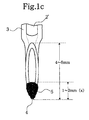
- Fig. 1c which is a front view of a tip portion of the ophthalmic treatment tool
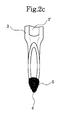
- Figs. 2a to 2c which are views showing a configuration according to a modification of the tool shown in Figs. 1a to 1c.
- An ophthalmic treatment tool of the present invention is characterized by having a grip 1, a rod-shaped body 2 attached to one end of the grip 1, an elastic body 3 fitted along a direction toward a front end of the rod-shaped body 2 to the front end side of the body 2, and a group of hard inorganic fine -grains 5 of particles fixed on a tapered tip 4 of the elastic body 3.
- the grip 1 can be well grasped by user's fingers for a surgery, which is not restricted to the example shown in the figure and may have any shape unless it troubles the users in their operation.
- the grip 1 is suitably formed to be mostly as thick as e.g., pencils, pens, or chopsticks which the users are generally used to handling.
- the grip 1 is made from material which have no hygienic problem, the material being, for example, wood, metal, plastic or the like, the metal being preferably used for the grip, the better of metals being silver, stainless steel, titanium or the like, the titanium being preferably used for the grip in the light of the strength, lightweight and / or others.
- the rod-shaped body 2 is provided for purposes of supporting an elastic body 3 which is placed on the front end side of the rod-shaped body 2.
- the rod-shaped body 2 is made from any material which have no problem for reasons of sanitation as is the case with the grip 1, the rod-shape body 2 is preferably made from titanium in common reason with the grip 1.
- the elastic body 3 is translucent and takes the form of a tube, which is fixed to the rod-shaped body 2 by being inserted on an end 2' of the rod-shaped body.
- the rod-shaped body 2 is tapered in a part of the front end side thereof to form a slender line portion 2' of the rod-shaped body, and the slender line portion 2' is squeezed into the tube-shaped elastic body 3, whereby the bodies 2 and 3 are fixed to each other.
- a way of coupling of both, however, should not be restricted to the configuration shown in the figure, to which any way can be applied, within tight coupling of the rod-shaped body and the elastic body.
- the elastic body 3 is made from any material which has no problem for sanitary reasons on an ophthalmic surgery as in the cases mentioned above, for example, the material of the elastic body 3 being natural rubber, synthetic rubber, polyurethane rubber, silicone rubber, fluorocarbon rubber, or the like, the elastic body being most suitably made from silicone rubber in the light of the pliability, inertness (sanitary property) and so on.
- the slender line portion 2' is not entirely inserted into a tube of the elastic body 3, whose front end side is thus not inserted on the slender line portion 2'.
- An elastic portion positioned on the figure's right side from the front end of the slender line portion 2' must be kept in a sufficiently pliable and flexible state so as not to carry the risk of causing damage to the retina and so on when peeling the membranes during the ophthalmic surgery.
- a tip (in the figure, right end portion) of the elastic member 3 is formed in a tapered shape.
- the shape can be easily formed by cutting the tube-shaped elastic body 3 at a bevel.
- cutting at a bevel causes a cross-sectional profile as in the case of a bamboo being cut at a bevel as shown in Fig. 1c, such a profile is not essential for the present invention.
- an elastic portion having no insertion of the slender line portion 2' may have no space.
- the tip of the elastic body 3 should be tapered only.
- the hard inorganic fine-grains used hereon should consist of any rigid fine-grains or particles which has chemical inertness and no problem in sanitation.
- the fine-grains may be various kinds of fine-grains which are made of diamond, diamond-like carbon, ruby, sapphire, quartz, crystal, alumina, silica, silicon carbide, silicon nitride, marble, grindstone, or the like, and the grains 5 is most suitably made of diamond in the light of the chemical inertness and the hygiene and so on thereof.
- the grains may range in size or diameter from 3 ⁇ m to 80 ⁇ m, preferably range between 9 and 30 ⁇ m. It has been found that proliferative membranes on the retina would not be sufficiently removed at any rate if the diameter of grains are out of the range.
- a bonding between the fine-grains 5 and the elastic body 3 is preferably performed by using an suitable adhesive chosen in accordance with nature of the elastic member 3.
- the elastic member is made from silicone rubber, a silicone base adhesive is preferably used.
- an adhesive of two-liquid setting type, thermosetting type or photosetting type is used, the hard inorganic fine-grains are tightly fixed respectively after the adhesive constructs bridges and hardens as soon as the adhesive makes attachment, and then the adhesive becomes in chemical inertness to have no sanitary problem.
- the choices of an adhesive should not be restricted to the preferred examples mentioned above.
- a bonding of the hard inorganic fine- grains can be performed in any well-known way.
- the bonding of the grains namely, is desirably performed as follows: first, an appropriate adhesive is attached to the tip of the elastic member; secondly, the hard inorganic fine-grains are strewn on a surface of the attached adhesive to cover the surface; thirdly, a process that the adhesive constructs bridges and hardens is performed on condition that the fine-grains can be attached no more; to such an extent that a state of the rough surface of the attached group of fine-grains have activity in remove proliferative membranes.
- Fig. 1c shows an example of a range that the hard inorganic fine-grains 5 are fixed to the tapered portion 4 of the elastic member 3, the example is merely one example. Such a range is not restricted to a particular range within keeping activity at removing proliferative membranes on a retina.
- the range (x) which has been obtained based on experiment and seems to be preferable, has a width between 0.5 and 3 mm substantially.
- the ophthalmic treatment tool according to the present invention is realized as mentioned above. It should be noted that some measurements inscribed in the figures do not limit the present invention but are to easily understand the invention. Further note that Fig. 2 shows an ophthalmic treatment tool of the other embodiment according to the present invention.
- Inventors have used the treatment tool shown in the figures for a series of their patients who have undergone an operation of vitreous removal at their macular hole, and the tool has been applied to a retinal surface around a macular hole after peeling the rear vitreous. Furthermore, the treatment tool shown in the figures has been applied for treatment of the proliferative vitreoretinal disorders with the purpose of removing immature proliferative membranes and pigmented cells from a surface of the retina.
- inventors have used the treatment tool shown in the figures for eyes of seven patients which show the macular holes (Gass stages II, III and IV), and as a result, it has been able to successfully close the macular holes in all eyes.
- the macular holes Gass stages II, III and IV
- hard inorganic fine-grains e.g., diamond particles
- any shed particles can easily be aspirated and removed by an extrusion needle, and any retained inert diamond particles are unlikely to cause retinal damage or toxicity.
- the roughened surface of the elastic body which is an extreme tip of the treatment tool according to the invention allows the proliferative membranes to be removed without the application of high degrees of force on the retina in the removal of the proliferative membranes.
- the treatment instrument embodying the present invention differs from rigid instruments such as picks and forceps applying mechanical force to the synechia portion between the proliferative membranes and the retina, whose slender profile and flexibility of the front tip increases visualization of the area of interest in an ocular tissue during a surgery and enables the treatment to be performed properly and easily.
- the proliferative membranes can be seen to separate from the surface of the retina. Even if a proliferative membranes to be removed is remarkably thin, therefore, changes in the light reflex, color, and the other detail tell the surgeon which regions of the proliferative membrane have been separated, the surgeon being able to perfectly perform the treatment.
- the mechanism as mentioned above makes the tool especially useful for the removal of residual cortical vitreous proliferative membranes or retinal interfaces from the surrounding area of a macular hole.
- the tool is also effective for removing "immature" proliferative membranes and removing pigmented cells from the surface of the retina, which, if left behind, can be a nidus for future membrane formation.
- the present tool may markedly increase the likelihood of success of the ophthalmic surgery.
Landscapes
- Health & Medical Sciences (AREA)
- Ophthalmology & Optometry (AREA)
- Heart & Thoracic Surgery (AREA)
- Surgery (AREA)
- Engineering & Computer Science (AREA)
- Biomedical Technology (AREA)
- Nuclear Medicine, Radiotherapy & Molecular Imaging (AREA)
- Vascular Medicine (AREA)
- Life Sciences & Earth Sciences (AREA)
- Animal Behavior & Ethology (AREA)
- General Health & Medical Sciences (AREA)
- Public Health (AREA)
- Veterinary Medicine (AREA)
- Materials For Medical Uses (AREA)
- Prostheses (AREA)
Applications Claiming Priority (3)
| Application Number | Priority Date | Filing Date | Title |
|---|---|---|---|
| JP9079119A JP3022389B2 (ja) | 1997-03-14 | 1997-03-14 | メンブレンイレーザー |
| JP79119/97 | 1997-03-14 | ||
| JP7911997 | 1997-03-14 |
Publications (2)
| Publication Number | Publication Date |
|---|---|
| EP0864310A1 true EP0864310A1 (fr) | 1998-09-16 |
| EP0864310B1 EP0864310B1 (fr) | 2004-05-12 |
Family
ID=13681046
Family Applications (1)
| Application Number | Title | Priority Date | Filing Date |
|---|---|---|---|
| EP19970114504 Expired - Lifetime EP0864310B1 (fr) | 1997-03-14 | 1997-08-21 | Grattoir de membrane pour la chirurgie ophtalmique |
Country Status (3)
| Country | Link |
|---|---|
| EP (1) | EP0864310B1 (fr) |
| JP (1) | JP3022389B2 (fr) |
| DE (1) | DE69729067D1 (fr) |
Cited By (6)
| Publication number | Priority date | Publication date | Assignee | Title |
|---|---|---|---|---|
| WO2006043975A1 (fr) * | 2004-10-15 | 2006-04-27 | Glaser Bert M | Rateau de limitation interne de membrane |
| WO2009036818A1 (fr) * | 2007-09-19 | 2009-03-26 | Dieter Mann | Dispositif à manier d'une seule main pour chirurgie oculaire |
| US7731728B2 (en) | 2004-11-30 | 2010-06-08 | Glaser Bert M | Internal limiting membrane rake |
| US9433725B2 (en) | 2011-12-23 | 2016-09-06 | Alcon Research, Ltd. | Combined coaxial and bimanual irrigation/aspiration apparatus |
| US9839738B2 (en) | 2013-06-06 | 2017-12-12 | Novartis Ag | Transformer irrigation/aspiration device |
| WO2019108061A1 (fr) * | 2017-11-30 | 2019-06-06 | Netvlieschirurg B.V. | Instrument de nettoyage de rétine |
Families Citing this family (1)
| Publication number | Priority date | Publication date | Assignee | Title |
|---|---|---|---|---|
| US20220087864A1 (en) * | 2019-01-14 | 2022-03-24 | Raico International, Llc | Surgical instrument for goniotomy procedure, method of use, and method of manufacture |
Citations (2)
| Publication number | Priority date | Publication date | Assignee | Title |
|---|---|---|---|---|
| EP0283929A1 (fr) * | 1987-03-25 | 1988-09-28 | Erbe Elektromedizin GmbH | Embout à main à deux canaux |
| US5273530A (en) * | 1990-11-14 | 1993-12-28 | The University Of Rochester | Intraretinal delivery and withdrawal instruments |
Family Cites Families (1)
| Publication number | Priority date | Publication date | Assignee | Title |
|---|---|---|---|---|
| US3937222A (en) | 1973-11-09 | 1976-02-10 | Surgical Design Corporation | Surgical instrument employing cutter means |
-
1997
- 1997-03-14 JP JP9079119A patent/JP3022389B2/ja not_active Expired - Fee Related
- 1997-08-21 DE DE69729067T patent/DE69729067D1/de not_active Expired - Lifetime
- 1997-08-21 EP EP19970114504 patent/EP0864310B1/fr not_active Expired - Lifetime
Patent Citations (2)
| Publication number | Priority date | Publication date | Assignee | Title |
|---|---|---|---|---|
| EP0283929A1 (fr) * | 1987-03-25 | 1988-09-28 | Erbe Elektromedizin GmbH | Embout à main à deux canaux |
| US5273530A (en) * | 1990-11-14 | 1993-12-28 | The University Of Rochester | Intraretinal delivery and withdrawal instruments |
Cited By (7)
| Publication number | Priority date | Publication date | Assignee | Title |
|---|---|---|---|---|
| WO2006043975A1 (fr) * | 2004-10-15 | 2006-04-27 | Glaser Bert M | Rateau de limitation interne de membrane |
| US7731728B2 (en) | 2004-11-30 | 2010-06-08 | Glaser Bert M | Internal limiting membrane rake |
| WO2009036818A1 (fr) * | 2007-09-19 | 2009-03-26 | Dieter Mann | Dispositif à manier d'une seule main pour chirurgie oculaire |
| US9433725B2 (en) | 2011-12-23 | 2016-09-06 | Alcon Research, Ltd. | Combined coaxial and bimanual irrigation/aspiration apparatus |
| US9839738B2 (en) | 2013-06-06 | 2017-12-12 | Novartis Ag | Transformer irrigation/aspiration device |
| WO2019108061A1 (fr) * | 2017-11-30 | 2019-06-06 | Netvlieschirurg B.V. | Instrument de nettoyage de rétine |
| NL2020000B1 (en) * | 2017-11-30 | 2019-06-07 | Netvlieschirurg B V | Retinac-cleaning instrument |
Also Published As
| Publication number | Publication date |
|---|---|
| JPH10248868A (ja) | 1998-09-22 |
| EP0864310B1 (fr) | 2004-05-12 |
| JP3022389B2 (ja) | 2000-03-21 |
| DE69729067D1 (de) | 2004-06-17 |
Similar Documents
| Publication | Publication Date | Title |
|---|---|---|
| US5921998A (en) | Membrane eraser | |
| JP4950081B2 (ja) | 潅注/吸引チップ | |
| CA2227527C (fr) | Embout d'aspiration mou | |
| US5228851A (en) | Single-use disposable prophylactic elastic sleeve | |
| US5888199A (en) | Ear cleaning device with a flexion part | |
| EP1952790A1 (fr) | Dispositif de raclage de membrane | |
| US20080243156A1 (en) | Ophthalmic surgical instrument & surgical methods | |
| JP2017506111A (ja) | 付着性が最適状態にされたエッジを備える外科用器械 | |
| EP0864310B1 (fr) | Grattoir de membrane pour la chirurgie ophtalmique | |
| US20080058761A1 (en) | Diamond Dusted Extrusion Cannula | |
| EP3911284B1 (fr) | Instrument chirurgical pour procédure de goniotomie et procédé de fabrication | |
| US4221414A (en) | Contact lens insertion and removal device | |
| US20070164576A1 (en) | Contact lens device for applying and removing a contact lens | |
| US20060217750A1 (en) | Surgical knife | |
| US20070129743A1 (en) | Surgical device | |
| Živojnović et al. | A brush back-flush needle | |
| JP2021140080A (ja) | コンタクトレンズ装着器具 | |
| US20260076826A1 (en) | Surgical instruments for phacoemulsification surgery | |
| Tolentino et al. | Diamond-dusted microspatula tips for vitreoretinal surgery | |
| US20230061584A1 (en) | Ophthalmic surgical instruments | |
| JP3124504U (ja) | 口腔用清掃具 | |
| RU18233U1 (ru) | Микрохирургический шпатель-расслаиватель | |
| JP2002209929A (ja) | 眼科手術用カッタの刃先清浄化処理法 | |
| JP3090595U (ja) | 耳垢鉗子用耳垢拭い取り器 | |
| CN117942023A (zh) | 眼科用透镜保护装置 |
Legal Events
| Date | Code | Title | Description |
|---|---|---|---|
| PUAI | Public reference made under article 153(3) epc to a published international application that has entered the european phase |
Free format text: ORIGINAL CODE: 0009012 |
|
| AK | Designated contracting states |
Kind code of ref document: A1 Designated state(s): CH DE LI NL |
|
| 17P | Request for examination filed |
Effective date: 19990222 |
|
| AKX | Designation fees paid |
Free format text: CH DE LI NL |
|
| RBV | Designated contracting states (corrected) |
Designated state(s): CH DE LI NL |
|
| GRAP | Despatch of communication of intention to grant a patent |
Free format text: ORIGINAL CODE: EPIDOSNIGR1 |
|
| GRAS | Grant fee paid |
Free format text: ORIGINAL CODE: EPIDOSNIGR3 |
|
| GRAA | (expected) grant |
Free format text: ORIGINAL CODE: 0009210 |
|
| AK | Designated contracting states |
Kind code of ref document: B1 Designated state(s): CH DE LI NL |
|
| PG25 | Lapsed in a contracting state [announced via postgrant information from national office to epo] |
Ref country code: NL Free format text: LAPSE BECAUSE OF FAILURE TO SUBMIT A TRANSLATION OF THE DESCRIPTION OR TO PAY THE FEE WITHIN THE PRESCRIBED TIME-LIMIT Effective date: 20040512 Ref country code: LI Free format text: LAPSE BECAUSE OF FAILURE TO SUBMIT A TRANSLATION OF THE DESCRIPTION OR TO PAY THE FEE WITHIN THE PRESCRIBED TIME-LIMIT Effective date: 20040512 Ref country code: CH Free format text: LAPSE BECAUSE OF FAILURE TO SUBMIT A TRANSLATION OF THE DESCRIPTION OR TO PAY THE FEE WITHIN THE PRESCRIBED TIME-LIMIT Effective date: 20040512 |
|
| REG | Reference to a national code |
Ref country code: CH Ref legal event code: EP |
|
| REF | Corresponds to: |
Ref document number: 69729067 Country of ref document: DE Date of ref document: 20040617 Kind code of ref document: P |
|
| PG25 | Lapsed in a contracting state [announced via postgrant information from national office to epo] |
Ref country code: DE Free format text: LAPSE BECAUSE OF FAILURE TO SUBMIT A TRANSLATION OF THE DESCRIPTION OR TO PAY THE FEE WITHIN THE PRESCRIBED TIME-LIMIT Effective date: 20040813 |
|
| NLV1 | Nl: lapsed or annulled due to failure to fulfill the requirements of art. 29p and 29m of the patents act | ||
| REG | Reference to a national code |
Ref country code: CH Ref legal event code: PL |
|
| PLBE | No opposition filed within time limit |
Free format text: ORIGINAL CODE: 0009261 |
|
| STAA | Information on the status of an ep patent application or granted ep patent |
Free format text: STATUS: NO OPPOSITION FILED WITHIN TIME LIMIT |
|
| 26N | No opposition filed |
Effective date: 20050215 |