EP0865032A2 - Dispositif de reconnaissance de la parole effectuant une adaptation au bruit - Google Patents
Dispositif de reconnaissance de la parole effectuant une adaptation au bruit Download PDFInfo
- Publication number
- EP0865032A2 EP0865032A2 EP98301880A EP98301880A EP0865032A2 EP 0865032 A2 EP0865032 A2 EP 0865032A2 EP 98301880 A EP98301880 A EP 98301880A EP 98301880 A EP98301880 A EP 98301880A EP 0865032 A2 EP0865032 A2 EP 0865032A2
- Authority
- EP
- European Patent Office
- Prior art keywords
- speech
- search
- speech model
- model
- noise superimposed
- Prior art date
- Legal status (The legal status is an assumption and is not a legal conclusion. Google has not performed a legal analysis and makes no representation as to the accuracy of the status listed.)
- Granted
Links
- 230000006978 adaptation Effects 0.000 title description 15
- 238000000034 method Methods 0.000 claims abstract description 77
- 238000004364 calculation method Methods 0.000 claims abstract description 20
- 238000009826 distribution Methods 0.000 claims description 49
- 238000001228 spectrum Methods 0.000 claims description 10
- 238000004891 communication Methods 0.000 claims description 6
- 230000007613 environmental effect Effects 0.000 claims 2
- 239000000654 additive Substances 0.000 abstract description 5
- 230000000996 additive effect Effects 0.000 abstract description 5
- 238000006243 chemical reaction Methods 0.000 description 8
- 238000010586 diagram Methods 0.000 description 5
- 230000002194 synthesizing effect Effects 0.000 description 2
- 241000213951 Salmonella enterica subsp. enterica serovar Austin Species 0.000 description 1
- 238000010276 construction Methods 0.000 description 1
- 238000000354 decomposition reaction Methods 0.000 description 1
- 239000004973 liquid crystal related substance Substances 0.000 description 1
- 238000010845 search algorithm Methods 0.000 description 1
- 230000001360 synchronised effect Effects 0.000 description 1
Images


Classifications
-
- G—PHYSICS
- G10—MUSICAL INSTRUMENTS; ACOUSTICS
- G10L—SPEECH ANALYSIS TECHNIQUES OR SPEECH SYNTHESIS; SPEECH RECOGNITION; SPEECH OR VOICE PROCESSING TECHNIQUES; SPEECH OR AUDIO CODING OR DECODING
- G10L15/00—Speech recognition
- G10L15/20—Speech recognition techniques specially adapted for robustness in adverse environments, e.g. in noise, of stress induced speech
-
- G—PHYSICS
- G10—MUSICAL INSTRUMENTS; ACOUSTICS
- G10L—SPEECH ANALYSIS TECHNIQUES OR SPEECH SYNTHESIS; SPEECH RECOGNITION; SPEECH OR VOICE PROCESSING TECHNIQUES; SPEECH OR AUDIO CODING OR DECODING
- G10L21/00—Speech or voice signal processing techniques to produce another audible or non-audible signal, e.g. visual or tactile, in order to modify its quality or its intelligibility
- G10L21/02—Speech enhancement, e.g. noise reduction or echo cancellation
- G10L21/0208—Noise filtering
- G10L21/0216—Noise filtering characterised by the method used for estimating noise
Definitions
- HMM Hidden Markov Model
- Another object of the invention is to remove an additive noise from an input speech.
- the noise is an additive noise which is additively added to spectrum characteristics
- PMC Parallel Model Combination
- the PMC method is a method of adding and synthesizing an HMM (speech HMM) learned by a speech collected and recorded in a noiseless environment and an HMM (noise HMM) learned by a noise, thereby approaching a model to a noise superimposed environment and executing a conversion to add a noise to all of the models.
- HMM speech HMM
- noise HMM noise HMM
- those parameters are converted into the linear spectrum region and are added and synthesized in the linear spectrum region of the characteristic amount which is derived from the speech HMM and noise HMM.
- an inverse conversion is performed to return the synthesized value from the linear spectrum region to the cepstrum region, thereby obtaining a noise superimposed speech HMM.
- the PMC method By using the foregoing PMC method, it is possible to cope with additive noises such as internal noise, background noise, and the like.
- the PMC method has problems such that since a nonlinear conversion is executed to all of the models, a calculation amount is large, a processing time is very long, and it is not suitable for an instantaneous environment adaptation in which an adaptation to the noise is performed simultaneously with the recognition.
- an adaptation time can be remarkably reduced as compared with the conventional case of performing the noise adaptation by the PMC to all of the models.
- the number of models increases like phoneme models of an environment depending type, it is possible to cope with such a situation in a short time.
- the adaptation and the recognition can be simultaneously performed. Further, by using a high speed PMC method, even in the case where the number of mixed models increases, it is possible to cope with such a situation by a small calculation amount.
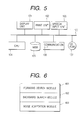
- Fig. 5 is a block diagram showing a construction of a speech recognizing apparatus according to the invention.
- Reference numeral 101 denotes a display unit such as CRT, liquid crystal display, or the like for displaying a character train obtained as a result of a speech recognition;
- 102 a print unit such as LBP, ink jet printer, or the like for printing the character train obtained as a result of the speech recognition;
- 103 a speech input unit such as a microphone or the like.
- a speech can be also inputted via a public line or the like or the LAN as a speech input unit 103.
- Reference numeral 104 denotes a CPU for controlling so as to execute various processes, which will be explained hereinlater, in accordance with control programs stored in a memory unit 105 or a detachable storing medium 107 such as a CD-ROM or the like. Although the CPU 104 also controls the execution of various applications in addition to processes, which will be explained hereinlater, the CPU 104 controls (for example, execution of commands such as "print”, "end”, and the like) so as to execute various processes regarding the applications in accordance with a command corresponding to the speech recognized by the method of the invention.
- Reference numeral 105 denotes the memory unit provided in the apparatus.
- the memory unit 105 stores control programs for various processes which are executed by the CPU 104 and will be explained hereinlater, various parameters (for example, data corresponding to a dictionary which is used for the speech recognition, and the like) which are necessary for the control programs, speech data to be recognized, and the like.
- the control programs and various parameters which are stored in the memory unit 105 can be inputted from the storing medium 107 or can be also inputted and stored through a communication line.
- Reference numeral 106 denotes a communication I/F for controlling a communication so as to transmit and receive data through communicating means such as public line, LAN, or the like.
- Reference numeral 107 denotes the storing medium such as CD-ROM, FD, or the like which can be attached and detached to/from the apparatus main body, namely, the storing medium which can store the control programs, various parameters, and speech data which have already been described as being stored in the memory unit 105 and can be attached and detached to/from the apparatus main body.
- Fig. 6 is a memory map of the data stored in the memory unit 105 or storing medium 107. Control programs for various processes as shown at 401 to 403 have been stored in the memory map. Although not shown in Fig. 6, a parameter storing portion, a speech data storing portion, a working area, and the like besides them are also provided.
- Fig. 1 is a functional block constructional diagram of an apparatus according to the invention.
- reference numeral 1 denotes a microphone for inputting a speech.
- the microphone 1 is realized by the speech input unit 103.
- Reference numeral 2 denotes a speech analyzer for converting the inputted speech to a feature parameter time series; 3 a searcher for searching a correct recognition series by using information of feature parameters, grammar, and phoneme models.
- the speech analyzer 2 and searcher 3 are realized by the CPU 104.
- Reference numeral 4 denotes a recognition grammar and 5 indicates a phoneme model for speech recognition.
- the recognition grammar 4 and phoneme model 5 for speech recognition are realized by the data stored in the memory unit 105 or storing medium 107.
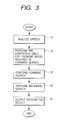
- the multipath searching method is a method of narrowing correct candidates by repeating the search a plurality of times. For example, in a method of outputting a recognition result after completion of the search of two times of a forward search and a backward search, phoneme models in which the adaptation by the PMC is not performed are used at the time of the forward search, the PMC is performed to only the phoneme models necessary for recognition at the time of the backward search, and a likelihood calculation is executed by the adapted phoneme models.
- the speech inputted by the microphone 1 is converted into a time sequence of a feature amount of the speech such as a cepstrum or the like by a speech analysis in the speech analyzer 2.
- the multipath search is used in the searching process 3.
- the Tree-trellis based search has been disclosed in detail in the literature by F. K. Soong and E. F. Huang, "A Tree-Trellis Based Fast Search for Finding the N Best Sentence Hypoteses in Continuous Speech Recognition", Proc. of ICASSP91, pp.705 - 708, May, 1991.
- the Forward-backward search has been described in detail in the literature by S. Austin, R.
- the Tree-trellis based search method is an algorithm for realizing a strict N-best search and is constructed by searches of two stages of the forward search and the backward search.
- the forward search (the first search)
- a Viterbi search synchronized with a frame is performed and an upper predetermined number of results among the results obtained by the forward search are selected as recognition candidates by the first search of the input speech.
- the backward search (the second search)
- an A* search in which the results of the forward search are heuristic is performed with respect to each of the selected candidates.
- a likelihood calculation is executed by using phoneme models before the adaptation by the PMC at the time of the forward search, thereby narrowing the recognition candidates from the grammar (22).
- the adaptation by the PMC is performed (23) at the time of the backward search (24) with respect to only the phoneme models necessary for recognition of the narrowed recognition candidates, namely, with regard to only the phoneme models constructing the recognition candidates narrowed in (22).
- the likelihood is calculated by using the phoneme models after the adaptation, thereby obtaining N-best recognition candidates. Since the likelihood at the time of the forward search and the likelihood at the time of the backward search are different, the A* condition is not satisfied. To obtain a more correct result, the recognition candidates are sorted by the likelihoods (25), thereby obtaining a final recognition result (26).
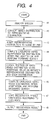
- the method using the on-demand process is a method of performing the PMC with respect to only phonemes which are necessary for recognition in the first searching step and executing a likelihood calculation by the adapted phoneme model.
- the processes in the speech input unit 1 and speech analyzer 2 are similar to those in Fig. 2 and the Tree-trellis based search is used for the searching process of the searcher 3 in a manner similar to the case of 1).
- the likelihood calculation is executed.
- the phonemes which are necessary in the forward search are the phonemes which are narrowed as candidates during the search by the search result before then and the recognition grammar 4.
- the recognition candidates narrowed in the grammar by the process of (33) and the result of the likelihood calculation are stored in the memory unit 105.
- the result of the likelihood calculation stored in the memory unit 105 is read out and a logarithm likelihood obtained from this value is added, thereby searching (34).
- a final recognition result is obtained and outputted (35).
- the adaptation can be usually performed every state and every mixed element of each phoneme model.
- a high speed PMC method of synthesizing the mixed elements and converting into one mix and executing the PMC to such one mix can be also used.
- the high speed PMC method will now be described hereinbelow. (An example of the high speed PMC methods has been also described in Japanese Patent Application No. 8-336291, "Speech Recognizing Apparatus and Speech Recognizing Method").
- a procedure other than the PMC is executed in a manner similar to the processes described in the flowcharts of Figs. 2 and 3.
- a mixed distribution of each state of the phoneme model necessary for the forward search is first converted into a representative distribution which is expressed by one distribution (42) by using the above equation (1).
- the phoneme model which is subjected to the conversion to the representative distribution is selected in a manner similar to (32).
- the representative distribution is adapted to the noise by the PMC method (43).
- the forward search is subsequently executed.
- the likelihood calculation in this case is executed by using the representative distribution after it was adapted to the noise by the PMC (44).
- the position of each mixed distribution after the noise adaptation is obtained (45) by using the relative positional relation between the representative distribution which has already been obtained before the conversion to the representative distribution as mentioned above and each distribution.
- the likelihood calculation is executed by using the obtained mixed distribution after the adaptation and the backward search is performed (46).
- the recognition results are sorted on the basis of the likelihood (47) and the final recognition result is obtained and outputted (48).
Landscapes
- Engineering & Computer Science (AREA)
- Computational Linguistics (AREA)
- Health & Medical Sciences (AREA)
- Audiology, Speech & Language Pathology (AREA)
- Human Computer Interaction (AREA)
- Physics & Mathematics (AREA)
- Acoustics & Sound (AREA)
- Multimedia (AREA)
- Machine Translation (AREA)
Applications Claiming Priority (3)
| Application Number | Priority Date | Filing Date | Title |
|---|---|---|---|
| JP9059158A JPH10254486A (ja) | 1997-03-13 | 1997-03-13 | 音声認識装置および方法 |
| JP5915897 | 1997-03-13 | ||
| JP59158/97 | 1997-03-13 |
Publications (3)
| Publication Number | Publication Date |
|---|---|
| EP0865032A2 true EP0865032A2 (fr) | 1998-09-16 |
| EP0865032A3 EP0865032A3 (fr) | 1999-03-24 |
| EP0865032B1 EP0865032B1 (fr) | 2003-11-26 |
Family
ID=13105289
Family Applications (1)
| Application Number | Title | Priority Date | Filing Date |
|---|---|---|---|
| EP98301880A Expired - Lifetime EP0865032B1 (fr) | 1997-03-13 | 1998-03-13 | Dispositif de reconnaissance de la parole effectuant une adaptation au bruit |
Country Status (4)
| Country | Link |
|---|---|
| US (1) | US6266636B1 (fr) |
| EP (1) | EP0865032B1 (fr) |
| JP (1) | JPH10254486A (fr) |
| DE (1) | DE69819951D1 (fr) |
Families Citing this family (41)
| Publication number | Priority date | Publication date | Assignee | Title |
|---|---|---|---|---|
| US6418411B1 (en) * | 1999-03-12 | 2002-07-09 | Texas Instruments Incorporated | Method and system for adaptive speech recognition in a noisy environment |
| JP4632384B2 (ja) * | 2000-03-31 | 2011-02-16 | キヤノン株式会社 | 音声情報処理装置及びその方法と記憶媒体 |
| JP3728177B2 (ja) * | 2000-05-24 | 2005-12-21 | キヤノン株式会社 | 音声処理システム、装置、方法及び記憶媒体 |
| AU2001294222A1 (en) * | 2000-10-11 | 2002-04-22 | Canon Kabushiki Kaisha | Information processing device, information processing method, and storage medium |
| JP2002268681A (ja) * | 2001-03-08 | 2002-09-20 | Canon Inc | 音声認識システム及び方法及び該システムに用いる情報処理装置とその方法 |
| US6985858B2 (en) * | 2001-03-20 | 2006-01-10 | Microsoft Corporation | Method and apparatus for removing noise from feature vectors |
| JP3542578B2 (ja) * | 2001-11-22 | 2004-07-14 | キヤノン株式会社 | 音声認識装置及びその方法、プログラム |
| JP4061094B2 (ja) * | 2002-03-15 | 2008-03-12 | インターナショナル・ビジネス・マシーンズ・コーポレーション | 音声認識装置、その音声認識方法及びプログラム |
| DE10220524B4 (de) | 2002-05-08 | 2006-08-10 | Sap Ag | Verfahren und System zur Verarbeitung von Sprachdaten und zur Erkennung einer Sprache |
| EP1363271A1 (fr) | 2002-05-08 | 2003-11-19 | Sap Ag | Méthode et système pour le traitement et la mémorisation du signal de parole d'un dialogue |
| US7398209B2 (en) | 2002-06-03 | 2008-07-08 | Voicebox Technologies, Inc. | Systems and methods for responding to natural language speech utterance |
| US7693720B2 (en) | 2002-07-15 | 2010-04-06 | Voicebox Technologies, Inc. | Mobile systems and methods for responding to natural language speech utterance |
| JP4548646B2 (ja) * | 2003-09-12 | 2010-09-22 | 株式会社エヌ・ティ・ティ・ドコモ | 音声モデルの雑音適応化システム、雑音適応化方法、及び、音声認識雑音適応化プログラム |
| JP4587160B2 (ja) * | 2004-03-26 | 2010-11-24 | キヤノン株式会社 | 信号処理装置および方法 |
| CN1295676C (zh) * | 2004-09-29 | 2007-01-17 | 上海交通大学 | 一种语音识别中的状态结构调整方法 |
| US7640160B2 (en) | 2005-08-05 | 2009-12-29 | Voicebox Technologies, Inc. | Systems and methods for responding to natural language speech utterance |
| US7620549B2 (en) | 2005-08-10 | 2009-11-17 | Voicebox Technologies, Inc. | System and method of supporting adaptive misrecognition in conversational speech |
| US7949529B2 (en) | 2005-08-29 | 2011-05-24 | Voicebox Technologies, Inc. | Mobile systems and methods of supporting natural language human-machine interactions |
| EP1934971A4 (fr) * | 2005-08-31 | 2010-10-27 | Voicebox Technologies Inc | Amelioration de precision de parole dynamique |
| US8073681B2 (en) | 2006-10-16 | 2011-12-06 | Voicebox Technologies, Inc. | System and method for a cooperative conversational voice user interface |
| US7818176B2 (en) | 2007-02-06 | 2010-10-19 | Voicebox Technologies, Inc. | System and method for selecting and presenting advertisements based on natural language processing of voice-based input |
| US8140335B2 (en) | 2007-12-11 | 2012-03-20 | Voicebox Technologies, Inc. | System and method for providing a natural language voice user interface in an integrated voice navigation services environment |
| JP4883717B2 (ja) * | 2008-01-17 | 2012-02-22 | Kddi株式会社 | 音声認識方法および装置ならびに音声認識プログラムおよびその記録媒体 |
| US8589161B2 (en) | 2008-05-27 | 2013-11-19 | Voicebox Technologies, Inc. | System and method for an integrated, multi-modal, multi-device natural language voice services environment |
| US9305548B2 (en) | 2008-05-27 | 2016-04-05 | Voicebox Technologies Corporation | System and method for an integrated, multi-modal, multi-device natural language voice services environment |
| CN101315733B (zh) * | 2008-07-17 | 2010-06-02 | 安徽科大讯飞信息科技股份有限公司 | 一种针对计算机语言学习系统发音评测的自适应方法 |
| US8326637B2 (en) | 2009-02-20 | 2012-12-04 | Voicebox Technologies, Inc. | System and method for processing multi-modal device interactions in a natural language voice services environment |
| US9171541B2 (en) | 2009-11-10 | 2015-10-27 | Voicebox Technologies Corporation | System and method for hybrid processing in a natural language voice services environment |
| US9502025B2 (en) | 2009-11-10 | 2016-11-22 | Voicebox Technologies Corporation | System and method for providing a natural language content dedication service |
| US8886668B2 (en) * | 2012-02-06 | 2014-11-11 | Telenav, Inc. | Navigation system with search-term boundary detection mechanism and method of operation thereof |
| US9099096B2 (en) | 2012-05-04 | 2015-08-04 | Sony Computer Entertainment Inc. | Source separation by independent component analysis with moving constraint |
| US8880395B2 (en) | 2012-05-04 | 2014-11-04 | Sony Computer Entertainment Inc. | Source separation by independent component analysis in conjunction with source direction information |
| US8886526B2 (en) | 2012-05-04 | 2014-11-11 | Sony Computer Entertainment Inc. | Source separation using independent component analysis with mixed multi-variate probability density function |
| US9311914B2 (en) * | 2012-09-03 | 2016-04-12 | Nice-Systems Ltd | Method and apparatus for enhanced phonetic indexing and search |
| EP4478276A3 (fr) | 2014-09-16 | 2025-01-22 | VB Assets, LLC | Commerce vocal |
| US9898459B2 (en) | 2014-09-16 | 2018-02-20 | Voicebox Technologies Corporation | Integration of domain information into state transitions of a finite state transducer for natural language processing |
| CN107003999B (zh) | 2014-10-15 | 2020-08-21 | 声钰科技 | 对用户的在先自然语言输入的后续响应的系统和方法 |
| US10431214B2 (en) | 2014-11-26 | 2019-10-01 | Voicebox Technologies Corporation | System and method of determining a domain and/or an action related to a natural language input |
| US10614799B2 (en) | 2014-11-26 | 2020-04-07 | Voicebox Technologies Corporation | System and method of providing intent predictions for an utterance prior to a system detection of an end of the utterance |
| US10331784B2 (en) | 2016-07-29 | 2019-06-25 | Voicebox Technologies Corporation | System and method of disambiguating natural language processing requests |
| CN115917527A (zh) * | 2020-07-22 | 2023-04-04 | 昭和电工株式会社 | 文档检索装置、文档检索系统、文档检索程序、以及文档检索方法 |
Family Cites Families (9)
| Publication number | Priority date | Publication date | Assignee | Title |
|---|---|---|---|---|
| DE69028072T2 (de) | 1989-11-06 | 1997-01-09 | Canon Kk | Verfahren und Einrichtung zur Sprachsynthese |
| JPH03150599A (ja) | 1989-11-07 | 1991-06-26 | Canon Inc | 日本語音節の符号化方式 |
| JP3066920B2 (ja) | 1991-06-11 | 2000-07-17 | キヤノン株式会社 | 音声認識方法及び装置 |
| JPH04362698A (ja) | 1991-06-11 | 1992-12-15 | Canon Inc | 音声認識方法及び装置 |
| JP3397372B2 (ja) | 1993-06-16 | 2003-04-14 | キヤノン株式会社 | 音声認識方法及び装置 |
| JP2768274B2 (ja) * | 1994-09-08 | 1998-06-25 | 日本電気株式会社 | 音声認識装置 |
| JP3581401B2 (ja) | 1994-10-07 | 2004-10-27 | キヤノン株式会社 | 音声認識方法 |
| JP2871561B2 (ja) * | 1995-11-30 | 1999-03-17 | 株式会社エイ・ティ・アール音声翻訳通信研究所 | 不特定話者モデル生成装置及び音声認識装置 |
| JPH10161692A (ja) | 1996-12-03 | 1998-06-19 | Canon Inc | 音声認識装置及び音声認識方法 |
-
1997
- 1997-03-13 JP JP9059158A patent/JPH10254486A/ja not_active Withdrawn
-
1998
- 1998-03-11 US US09/037,998 patent/US6266636B1/en not_active Expired - Fee Related
- 1998-03-13 DE DE69819951T patent/DE69819951D1/de not_active Expired - Lifetime
- 1998-03-13 EP EP98301880A patent/EP0865032B1/fr not_active Expired - Lifetime
Non-Patent Citations (2)
| Title |
|---|
| GALES M J F ET AL: "AN IMPROVED APPROACH TO THE HIDDEN MARKOV MODEL DECOMPOSITION OF SPEECH AND NOISE" SPEECH PROCESSING 1, SAN FRANCISCO, MAR. 23 - 26, 1992, vol. 1, no. CONF. 17, 23 March 1992, pages 233-236, XP000341126 INSTITUTE OF ELECTRICAL AND ELECTRONICS ENGINEERS * |
| MATSUI T ET AL: "N-best-based instantaneous speaker adaptation method for speech recognition" PROCEEDINGS ICSLP 96. FOURTH INTERNATIONAL CONFERENCE ON SPOKEN LANGUAGE PROCESSING (CAT. NO.96TH8206), PROCEEDING OF FOURTH INTERNATIONAL CONFERENCE ON SPOKEN LANGUAGE PROCESSING. ICSLP '96, PHILADELPHIA, PA, USA, 3-6 OCT. 1996, pages 973-976 vol.2, XP002091179 ISBN 0-7803-3555-4, 1996, New York, NY, USA, IEEE, USA * |
Also Published As
| Publication number | Publication date |
|---|---|
| DE69819951D1 (de) | 2004-01-08 |
| JPH10254486A (ja) | 1998-09-25 |
| EP0865032B1 (fr) | 2003-11-26 |
| US6266636B1 (en) | 2001-07-24 |
| EP0865032A3 (fr) | 1999-03-24 |
Similar Documents
| Publication | Publication Date | Title |
|---|---|---|
| EP0865032A2 (fr) | Dispositif de reconnaissance de la parole effectuant une adaptation au bruit | |
| US6041299A (en) | Apparatus for calculating a posterior probability of phoneme symbol, and speech recognition apparatus | |
| EP0847041B1 (fr) | Procédé et dispositif de reconnaissance de la parole effectuant une adaptation au bruit | |
| EP0755046B1 (fr) | Dispositif de reconnaissance de la parole utilisant un dictionnaire à organisation hiérarchique | |
| EP0960417B1 (fr) | Procede de determination de facteurs specifiques selon le modele pour la reconnaissance des formes, en particulier de formes sonores | |
| US20020035469A1 (en) | Method and configuration for determining a descriptive feature of a speech signal | |
| EP0617827B1 (fr) | Systeme expert composite | |
| EP0380297A2 (fr) | Procédé et dispositif pour la reconnaissance de la parole | |
| US6662159B2 (en) | Recognizing speech data using a state transition model | |
| US9431010B2 (en) | Speech-recognition device and speech-recognition method | |
| JPH05257492A (ja) | 音声認識方式 | |
| EP0701245A2 (fr) | Dispositif de reconnaissance de la parole | |
| US5956676A (en) | Pattern adapting apparatus using minimum description length criterion in pattern recognition processing and speech recognition system | |
| US6236962B1 (en) | Speech processing apparatus and method and computer readable medium encoded with a program for recognizing input speech by performing searches based on a normalized current feature parameter | |
| US5860062A (en) | Speech recognition apparatus and speech recognition method | |
| EP0725383A2 (fr) | Système d'adaptation d'éléments de référence utilisant une structure arborescente | |
| EP0798695A2 (fr) | Procédé et dispositif de reconnaissance de la parole | |
| EP0688012B1 (fr) | Dispositif de reconnaissance de la parole | |
| JPH11143486A (ja) | 話者適応装置および方法 | |
| Kannadaguli et al. | Phoneme modeling for speech recognition in Kannada using Hidden Markov Model | |
| US7912715B2 (en) | Determining distortion measures in a pattern recognition process | |
| EP0731447B1 (fr) | Système d'entraínement des motifs de référence et système de reconnaissance de la parole en faisant usage | |
| JP2000259198A (ja) | パターン認識装置および方法、並びに提供媒体 | |
| JP2008197463A (ja) | 音声認識装置及び音声認識方法 | |
| Matrouf et al. | Structural linear model-space transformations for speaker adaptation. |
Legal Events
| Date | Code | Title | Description |
|---|---|---|---|
| PUAI | Public reference made under article 153(3) epc to a published international application that has entered the european phase |
Free format text: ORIGINAL CODE: 0009012 |
|
| AK | Designated contracting states |
Kind code of ref document: A2 Designated state(s): DE FR GB IT |
|
| AX | Request for extension of the european patent |
Free format text: AL;LT;LV;MK;RO;SI |
|
| PUAL | Search report despatched |
Free format text: ORIGINAL CODE: 0009013 |
|
| AK | Designated contracting states |
Kind code of ref document: A3 Designated state(s): AT BE CH DE DK ES FI FR GB GR IE IT LI LU MC NL PT SE |
|
| AX | Request for extension of the european patent |
Free format text: AL;LT;LV;MK;RO;SI |
|
| 17P | Request for examination filed |
Effective date: 19990806 |
|
| AKX | Designation fees paid |
Free format text: DE FR GB IT |
|
| 17Q | First examination report despatched |
Effective date: 20020123 |
|
| GRAH | Despatch of communication of intention to grant a patent |
Free format text: ORIGINAL CODE: EPIDOS IGRA |
|
| RIC1 | Information provided on ipc code assigned before grant |
Ipc: 7G 10L 15/20 A |
|
| GRAS | Grant fee paid |
Free format text: ORIGINAL CODE: EPIDOSNIGR3 |
|
| GRAA | (expected) grant |
Free format text: ORIGINAL CODE: 0009210 |
|
| AK | Designated contracting states |
Kind code of ref document: B1 Designated state(s): DE FR GB IT |
|
| PG25 | Lapsed in a contracting state [announced via postgrant information from national office to epo] |
Ref country code: IT Free format text: LAPSE BECAUSE OF FAILURE TO SUBMIT A TRANSLATION OF THE DESCRIPTION OR TO PAY THE FEE WITHIN THE PRESCRIBED TIME-LIMIT;WARNING: LAPSES OF ITALIAN PATENTS WITH EFFECTIVE DATE BEFORE 2007 MAY HAVE OCCURRED AT ANY TIME BEFORE 2007. THE CORRECT EFFECTIVE DATE MAY BE DIFFERENT FROM THE ONE RECORDED. Effective date: 20031126 Ref country code: FR Free format text: LAPSE BECAUSE OF FAILURE TO SUBMIT A TRANSLATION OF THE DESCRIPTION OR TO PAY THE FEE WITHIN THE PRESCRIBED TIME-LIMIT Effective date: 20031126 |
|
| REG | Reference to a national code |
Ref country code: GB Ref legal event code: FG4D |
|
| REF | Corresponds to: |
Ref document number: 69819951 Country of ref document: DE Date of ref document: 20040108 Kind code of ref document: P |
|
| PG25 | Lapsed in a contracting state [announced via postgrant information from national office to epo] |
Ref country code: DE Free format text: LAPSE BECAUSE OF FAILURE TO SUBMIT A TRANSLATION OF THE DESCRIPTION OR TO PAY THE FEE WITHIN THE PRESCRIBED TIME-LIMIT Effective date: 20040227 |
|
| PLBE | No opposition filed within time limit |
Free format text: ORIGINAL CODE: 0009261 |
|
| STAA | Information on the status of an ep patent application or granted ep patent |
Free format text: STATUS: NO OPPOSITION FILED WITHIN TIME LIMIT |
|
| 26N | No opposition filed |
Effective date: 20040827 |
|
| EN | Fr: translation not filed | ||
| PGFP | Annual fee paid to national office [announced via postgrant information from national office to epo] |
Ref country code: GB Payment date: 20080326 Year of fee payment: 11 |
|
| GBPC | Gb: european patent ceased through non-payment of renewal fee |
Effective date: 20090313 |
|
| PG25 | Lapsed in a contracting state [announced via postgrant information from national office to epo] |
Ref country code: GB Free format text: LAPSE BECAUSE OF NON-PAYMENT OF DUE FEES Effective date: 20090313 |