EP0865033A2 - Normalisierung von Sprachsignalen - Google Patents
Normalisierung von Sprachsignalen Download PDFInfo
- Publication number
- EP0865033A2 EP0865033A2 EP98301919A EP98301919A EP0865033A2 EP 0865033 A2 EP0865033 A2 EP 0865033A2 EP 98301919 A EP98301919 A EP 98301919A EP 98301919 A EP98301919 A EP 98301919A EP 0865033 A2 EP0865033 A2 EP 0865033A2
- Authority
- EP
- European Patent Office
- Prior art keywords
- parameter
- speech
- long
- time
- inputted
- Prior art date
- Legal status (The legal status is an assumption and is not a legal conclusion. Google has not performed a legal analysis and makes no representation as to the accuracy of the status listed.)
- Granted
Links
Images


Classifications
-
- G—PHYSICS
- G10—MUSICAL INSTRUMENTS; ACOUSTICS
- G10L—SPEECH ANALYSIS TECHNIQUES OR SPEECH SYNTHESIS; SPEECH RECOGNITION; SPEECH OR VOICE PROCESSING TECHNIQUES; SPEECH OR AUDIO CODING OR DECODING
- G10L15/00—Speech recognition
- G10L15/20—Speech recognition techniques specially adapted for robustness in adverse environments, e.g. in noise, of stress induced speech
Definitions
- the invention relates to a technique for performing a speech recognition by using a feature of a speech time series such as a cepstrum or the like.
- the invention also relates to a removal of a multiplicational noise such as line characteristics or the like.
- the invention further relates to a technique for enabling an instantaneous or successive adaptation to a noise.
- CMS Cepstrum Mean Subtraction
- the CMS method is a method of compensating the distortion of the line characteristics. According to such a method, on the basis of information extracted from an input speech, the line distortion is corrected on the input time series side or the model side such as HMM or the like, thereby making it adaptive to the input environment. Thus, even if the line characteristics fluctuate, it is possible to flexibly cope with such a situation.
- the CMS method is a method of compensating multiplicational noise (line distortion) which acts due to a convolution of an impulse response.
- a long-time spectrum of an input speech is subtracted from the input speech and a long-time spectrum of a speech used in the model formation is subtracted from a model, thereby normalizing a difference of the line characteristics.
- the normalizing process is generally performed in a logarithm spectrum region or a cepstrum region. Since the multiplicational noise appears as an additive distortion in those two regions, the multiplicational noise can be compensated by a subtraction.
- a method of performing such a process in the cepstrum region is called a CMS method.
- a speech recognition can be performed in a real-time manner at a high precision after a normalization of the line characteristics was performed.
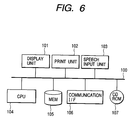
- Fig. 6 is a block diagram showing a construction of a speech recognizing apparatus according to the invention.
- Reference numeral 101 denotes a display unit such as CRT, liquid crystal display, or the like for displaying a character train obtained as a result of a speech recognition; and 102 indicates a print unit such as LBP, ink jet printer, or the like for printing the character train obtained as a result of the speech recognition.
- the character train which is outputted from the display unit 101 or print unit 102 is a train of character fonts corresponding to candidate character codes of recognition results.
- Reference numeral 103 denotes a speech input unit such as a microphone or the like.
- a speech can be also inputted via communicating means such as public line, LAN, or the like as a speech input unit 103.
- Reference numeral 104 denotes a CPU for controlling so as to execute various processes, which will be explained hereinlater, in accordance with control programs stored in a memory unit 105 or a detachable storing medium 107 such as a CD-ROM or the like. Although the CPU 104 controls the execution of various applications in addition to processes, which will be explained hereinlater, the CPU 104 also controls (for example, "print”, "end”, and the like) so as to execute various processes regarding the applications in accordance with a command corresponding to the speech recognized by the method of the invention.
- Reference numeral 105 denotes the memory unit provided in the apparatus.
- the memory unit 105 stores control programs for various processes which are executed by the CPU 104 and will be explained hereinlater, various parameters (for example, data corresponding to a dictionary which is used for the speech recognition, and the like) which are necessary for the control programs, speech data to be recognized, and the like.
- the control programs and various parameters which are stored in the memory unit 105 can be inputted from the storing medium 107 or can be also inputted and stored through a communication line.
- Reference numeral 106 denotes a communication I/F for controlling a communication so as to transmit and receive data through communicating means such as public line, LAN, or the like.
- Reference numeral 107 denotes the storing medium such as CD-ROM, FD, or the like which can be attached and detached to/from the apparatus main body, namely, the storing medium which can store the control programs, various parameters, and speech data which have already been described as being stored in the memory unit 105 and can be attached and detached to/from the apparatus main body.
- Fig. 3 is a memory map of the data stored in the memory unit 105 or storing medium 107. Control programs for various processes as shown at 401 to 403 have been stored in the memory map. Although not shown in Fig. 3, a parameter storing portion, a speech data storing portion, a working area, and the like besides them are also provided.
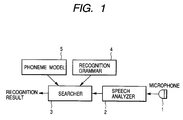
- Fig. 1 is a functional block constructional diagram of a speech recognizing apparatus of the embodiment according to the invention.
- reference numeral 1 denotes a microphone for inputting a speech.
- the microphone 1 is realized by the speech input unit 103.
- Reference numeral 2 denotes a speech analyzer for converting the inputted speech to a feature parameter time series; 3 a searcher for searching a correct recognition series by using information of feature parameters, grammar, and phoneme models.
- the speech analyzer 2 and searcher 3 are realized by the CPU 104 in Fig. 6.
- Reference numeral 4 denotes a recognition grammar and 5 indicates a phoneme model for speech recognition.
- the recognition grammar 4 and phoneme model 5 for speech recognition use the data stored in the memory unit 105 or storing medium 107.
- This method is a method of updating an estimate value of the CM each time a speech of one frame is inputted and subtracting the latest estimate value of the CM from the latest speech frame.
- the number of speech frames which are used for the computation of the estimate value of the CM is small just after the start of the speech, its value includes many errors, so that there is a fear of deterioration of the recognizing performance.
- a weight according to the number of frames used in the computation of the CM estimate value namely, the number of input frames at that time point is added to the CM. When the number of input frames is small, the weight to be added is reduced, thereby decreasing an amount of CM which is subtracted.
- the weight is increased, thereby enlarging an amount of CM which is subtracted.
- the weight is increased or decreased in a range of 0 to 1 in accordance with the number of frames (input time length).
- the speech analyzer 2 performs a general cepstrum analysis of the speech inputted from the microphone 1.
- a normalization of a parameter x n of the n-th frame in one input speech which was cut-out after the analysis is executed by the following equation (1), thereby obtaining a normalized parameter (x n )' of the n-th frame.
- the weight n/(n+ ⁇ ) by the frame number of the second term is not limited to the above equation but can be also substituted by a function in which a value is set to a value within a range from 0 to 1 with an increase in n.
- the parameter (x n )' obtained by normalizing as mentioned above is recognized as a feature parameter.
- the multipath method is a method of narrowing correct answer candidates by repeating the search a plurality of times (at least, twice).
- the search is performed while computing the CM of the input speech.
- the CM of the input speech is not reflected to the speech recognition.
- the CM obtained from the whole input speech in which the speech input has already been completed and the computation has been finished is subtracted from the input speech cepstrum, thereby removing the multiplicational noise as a fluctuation in line characteristics.
- the multipath search is used in the searcher 3 in Fig. 1.
- the Tree-trellis based search has been disclosed in detail in the literature by F. K. Soong and E. F. Huang, "A Tree-Trellis Based Fast Search for Finding the N Best Sentence Hypoteses in Continuous Speech Recognition", Proc. of ICASSP91, pp.705 to 708, May, 1991.
- the Forward-backward search has been described in detail in the literature by S. Austin, R. Schwartz, and P. Placeway, "The Forward-Backward Search Algorithm", Proc. of ICASSP91, pp. 697 to 700, May, 1991.
- the Tree-trellis based search method is an algorithm for realizing a strict N-best search and is constructed by searches of two stages of the forward search and the backward search.
- the forward search (the first search)
- a Viterbi search synchronized with a frame is performed and an upper predetermined number of results among the results obtained by the forward search are selected as recognition result candidates of the input speech.
- the backward search (the second search)
- an A* search in which the results of the forward search are heuristic is performed with respect to each of the selected candidates.
- the CM of the whole input speech is computed in parallel with the search at the time of the forward search and the resultant CM is subtracted and the searching process is executed at the time of the backward search, thereby normalizing the line characteristics.
- the normalization at the time of the backward search is executed by either one of the following equations (2) and (3). or where, N: frame length of the input speech
- the methods of 1) and 2) are combined, in the forward search, the search is performed by the method of 1) while executing the normalization by the CM obtained by the weighting process of the input length and, in the backward search, the normalization is executed by the method of 2).
- Fig. 2 is the flowchart for a speech recognizing method using the computing method of the CM by the weighting process of the input length of 1).
- the input parameter is normalized (22) by the equation (1) before the forward search (23).
- a logarithm likelihood of each parameter calculated at the time of the forward search (24) is used as it is and added.
- Fig. 3 is the flowchart for a speech recognizing method using the CM computing method at the time of the backward search using the multipath search in 2). According to this method, at the time of the forward search (32), the search using the cepstrum parameter by the ordinary speech analysis which is not normalized is performed.
- each candidate selected by the forward search is subjected to the normalization of the input parameter by the equation (2) or (3), thereby searching (34).
- the recognition result candidates are sorted in accordance with the likelihood (35) and the result is outputted (36).
- Fig. 4 relates to the combination method of 1) and 2).
- the search is performed (42) by using the parameter normalized by the equation (1).
- the search is executed by using the parameter (44) normalized by the equation (2) or (3).
- the recognition result candidates are sorted in accordance with the likelihood (46) and the recognition result is outputted (47).
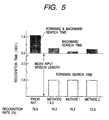
- Fig. 5 is a diagram showing an effect of the invention and shows a recognition processing time of each method.
- Experimental conditions are as follows. First, the evaluation is made by an unspecified speaker sentence recognition. The number of words is set to 1004. The word is perplexity 30.2. The analyzing conditions are set to a sampling rate of 8 kHz, a frame period of 10 msec, a window width of 25.6 msec, and a preemphasis of 0.97. As for the feature amounts, an LPC melcepstrum of 12-th degree, a ⁇ LPC melcepstrum of 12-th degree, and a ⁇ logarithm power are used.
- an HMM of 3 states and 6 mixture is used in a recognition system in which the HMM is used as a base and 243 kinds of right environment dependency phonemes HMM are used in a diagonalization covariance matrix.
- Recognition targets are 50 sentences uttered by ten speakers. By transmitting the speeches through a band pass filter of 300 to 3200 Hz, a distortion of line characteristics are given.
- the normalizing process can be performed only at a time point when the speech utterance is finished, so that it takes 1 sec or more as a recognizing time after the end of the utterance.
- the recognition is finished for a time interval from about 0.05 sec to about 0.26 sec after the end of the utterance.
- a numerical value shown in the lower portion of the diagram indicates a recognition rate of each method in case of adjusting ⁇ .
- a recognition rate in case of not performing the normalization of the line characteristics is equal to 65.0 %.
- the combination method of 1) + 2) it will be understood that the reduction in recognition rate is very small and a computation amount can be remarkably reduced.
- the line characteristics can be normalized at a high speed.
Landscapes
- Engineering & Computer Science (AREA)
- Computational Linguistics (AREA)
- Health & Medical Sciences (AREA)
- Audiology, Speech & Language Pathology (AREA)
- Human Computer Interaction (AREA)
- Physics & Mathematics (AREA)
- Acoustics & Sound (AREA)
- Multimedia (AREA)
- Machine Translation (AREA)
- Image Analysis (AREA)
- Document Processing Apparatus (AREA)
- Information Retrieval, Db Structures And Fs Structures Therefor (AREA)
Applications Claiming Priority (3)
| Application Number | Priority Date | Filing Date | Title |
|---|---|---|---|
| JP05916197A JP3962445B2 (ja) | 1997-03-13 | 1997-03-13 | 音声処理方法及び装置 |
| JP59161/97 | 1997-03-13 | ||
| JP5916197 | 1997-03-13 |
Publications (3)
| Publication Number | Publication Date |
|---|---|
| EP0865033A2 true EP0865033A2 (de) | 1998-09-16 |
| EP0865033A3 EP0865033A3 (de) | 1999-03-24 |
| EP0865033B1 EP0865033B1 (de) | 2004-05-26 |
Family
ID=13105382
Family Applications (1)
| Application Number | Title | Priority Date | Filing Date |
|---|---|---|---|
| EP98301919A Expired - Lifetime EP0865033B1 (de) | 1997-03-13 | 1998-03-13 | Normalisierung von Sprachsignalen |
Country Status (4)
| Country | Link |
|---|---|
| US (1) | US6236962B1 (de) |
| EP (1) | EP0865033B1 (de) |
| JP (1) | JP3962445B2 (de) |
| DE (1) | DE69824063T2 (de) |
Cited By (1)
| Publication number | Priority date | Publication date | Assignee | Title |
|---|---|---|---|---|
| CN107112011A (zh) * | 2014-12-22 | 2017-08-29 | 英特尔公司 | 用于音频特征提取的倒谱方差归一化 |
Families Citing this family (13)
| Publication number | Priority date | Publication date | Assignee | Title |
|---|---|---|---|---|
| JP3902860B2 (ja) * | 1998-03-09 | 2007-04-11 | キヤノン株式会社 | 音声合成制御装置及びその制御方法、コンピュータ可読メモリ |
| US6374220B1 (en) * | 1998-08-05 | 2002-04-16 | Texas Instruments Incorporated | N-best search for continuous speech recognition using viterbi pruning for non-output differentiation states |
| US7039588B2 (en) * | 2000-03-31 | 2006-05-02 | Canon Kabushiki Kaisha | Synthesis unit selection apparatus and method, and storage medium |
| JP4632384B2 (ja) * | 2000-03-31 | 2011-02-16 | キヤノン株式会社 | 音声情報処理装置及びその方法と記憶媒体 |
| JP3728177B2 (ja) * | 2000-05-24 | 2005-12-21 | キヤノン株式会社 | 音声処理システム、装置、方法及び記憶媒体 |
| AU2001294222A1 (en) * | 2000-10-11 | 2002-04-22 | Canon Kabushiki Kaisha | Information processing device, information processing method, and storage medium |
| US6999926B2 (en) * | 2000-11-16 | 2006-02-14 | International Business Machines Corporation | Unsupervised incremental adaptation using maximum likelihood spectral transformation |
| JP2002268681A (ja) * | 2001-03-08 | 2002-09-20 | Canon Inc | 音声認識システム及び方法及び該システムに用いる情報処理装置とその方法 |
| JP3542578B2 (ja) * | 2001-11-22 | 2004-07-14 | キヤノン株式会社 | 音声認識装置及びその方法、プログラム |
| US20040243556A1 (en) * | 2003-05-30 | 2004-12-02 | International Business Machines Corporation | System, method and computer program product for performing unstructured information management and automatic text analysis, and including a document common analysis system (CAS) |
| JP4587160B2 (ja) * | 2004-03-26 | 2010-11-24 | キヤノン株式会社 | 信号処理装置および方法 |
| JP2007271876A (ja) * | 2006-03-31 | 2007-10-18 | Denso Corp | 音声認識装置および音声認識用のプログラム |
| WO2017154279A1 (ja) * | 2016-03-10 | 2017-09-14 | ソニー株式会社 | 音声処理装置および音声処理方法 |
Family Cites Families (12)
| Publication number | Priority date | Publication date | Assignee | Title |
|---|---|---|---|---|
| JPS53105303A (en) * | 1977-02-25 | 1978-09-13 | Hitachi Ltd | Preprocessing system for audio recognition |
| DE69028072T2 (de) | 1989-11-06 | 1997-01-09 | Canon Kk | Verfahren und Einrichtung zur Sprachsynthese |
| JPH03150599A (ja) | 1989-11-07 | 1991-06-26 | Canon Inc | 日本語音節の符号化方式 |
| JP3066920B2 (ja) | 1991-06-11 | 2000-07-17 | キヤノン株式会社 | 音声認識方法及び装置 |
| JPH04362698A (ja) | 1991-06-11 | 1992-12-15 | Canon Inc | 音声認識方法及び装置 |
| US5583961A (en) | 1993-03-25 | 1996-12-10 | British Telecommunications Public Limited Company | Speaker recognition using spectral coefficients normalized with respect to unequal frequency bands |
| JP3397372B2 (ja) | 1993-06-16 | 2003-04-14 | キヤノン株式会社 | 音声認識方法及び装置 |
| US5515475A (en) * | 1993-06-24 | 1996-05-07 | Northern Telecom Limited | Speech recognition method using a two-pass search |
| US5604839A (en) * | 1994-07-29 | 1997-02-18 | Microsoft Corporation | Method and system for improving speech recognition through front-end normalization of feature vectors |
| US5598505A (en) | 1994-09-30 | 1997-01-28 | Apple Computer, Inc. | Cepstral correction vector quantizer for speech recognition |
| JP3581401B2 (ja) | 1994-10-07 | 2004-10-27 | キヤノン株式会社 | 音声認識方法 |
| JP3453456B2 (ja) | 1995-06-19 | 2003-10-06 | キヤノン株式会社 | 状態共有モデルの設計方法及び装置ならびにその状態共有モデルを用いた音声認識方法および装置 |
-
1997
- 1997-03-13 JP JP05916197A patent/JP3962445B2/ja not_active Expired - Fee Related
-
1998
- 1998-03-12 US US09/038,898 patent/US6236962B1/en not_active Expired - Lifetime
- 1998-03-13 DE DE69824063T patent/DE69824063T2/de not_active Expired - Lifetime
- 1998-03-13 EP EP98301919A patent/EP0865033B1/de not_active Expired - Lifetime
Cited By (2)
| Publication number | Priority date | Publication date | Assignee | Title |
|---|---|---|---|---|
| CN107112011A (zh) * | 2014-12-22 | 2017-08-29 | 英特尔公司 | 用于音频特征提取的倒谱方差归一化 |
| US10629184B2 (en) | 2014-12-22 | 2020-04-21 | Intel Corporation | Cepstral variance normalization for audio feature extraction |
Also Published As
| Publication number | Publication date |
|---|---|
| JP3962445B2 (ja) | 2007-08-22 |
| EP0865033B1 (de) | 2004-05-26 |
| US6236962B1 (en) | 2001-05-22 |
| JPH10254492A (ja) | 1998-09-25 |
| DE69824063D1 (de) | 2004-07-01 |
| EP0865033A3 (de) | 1999-03-24 |
| DE69824063T2 (de) | 2004-10-28 |
Similar Documents
| Publication | Publication Date | Title |
|---|---|---|
| US6266636B1 (en) | Single distribution and mixed distribution model conversion in speech recognition method, apparatus, and computer readable medium | |
| US5677990A (en) | System and method using N-best strategy for real time recognition of continuously spelled names | |
| EP0792503B1 (de) | Signalkonditioniertes training mit minimaler fehlerrate für kontinuierliche spracherkennung | |
| US6539353B1 (en) | Confidence measures using sub-word-dependent weighting of sub-word confidence scores for robust speech recognition | |
| US6260013B1 (en) | Speech recognition system employing discriminatively trained models | |
| EP0617827B1 (de) | Mehrteiliger expertsystem | |
| US6490555B1 (en) | Discriminatively trained mixture models in continuous speech recognition | |
| EP1355295B1 (de) | Spracherkennungsvorrichtung, -verfahren und computerlesbares Medium mit entsprechend gespeichertem Programm | |
| EP0960417B1 (de) | Verfahren zur bestimmung modell-spezifischer faktoren für die mustererkennung im insbesonderen für sprachmuster | |
| US20040186714A1 (en) | Speech recognition improvement through post-processsing | |
| EP0865033B1 (de) | Normalisierung von Sprachsignalen | |
| US20020165715A1 (en) | Speech recognition method and system | |
| GB2333877A (en) | Speech recognition | |
| KR20010040669A (ko) | 잡음 보상되는 음성 인식 시스템 및 방법 | |
| US20030200086A1 (en) | Speech recognition apparatus, speech recognition method, and computer-readable recording medium in which speech recognition program is recorded | |
| JP2002507010A (ja) | 同時に起こるマルチモード口述のための装置及び方法 | |
| WO1997010587A9 (en) | Signal conditioned minimum error rate training for continuous speech recognition | |
| EP0762383B1 (de) | Vorrichtung zur Musteranpassung für Sprach- oder Mustererkennung | |
| Schlüter et al. | Interdependence of language models and discriminative training | |
| Ma et al. | A path-stack algorithm for optimizing dynamic regimes in a statistical hidden dynamic model of speech | |
| US20020133343A1 (en) | Method for speech recognition, apparatus for the same, and voice controller | |
| US7280961B1 (en) | Pattern recognizing device and method, and providing medium | |
| EP1488410B1 (de) | Bestimmung eines Verzerrungsmasses bei der Spracherkennung | |
| Wang et al. | Improved Mandarin speech recognition by lattice rescoring with enhanced tone models | |
| JP3105708B2 (ja) | 音声認識装置 |
Legal Events
| Date | Code | Title | Description |
|---|---|---|---|
| PUAI | Public reference made under article 153(3) epc to a published international application that has entered the european phase |
Free format text: ORIGINAL CODE: 0009012 |
|
| AK | Designated contracting states |
Kind code of ref document: A2 Designated state(s): DE FR GB IT |
|
| AX | Request for extension of the european patent |
Free format text: AL;LT;LV;MK;RO;SI |
|
| PUAL | Search report despatched |
Free format text: ORIGINAL CODE: 0009013 |
|
| AK | Designated contracting states |
Kind code of ref document: A3 Designated state(s): AT BE CH DE DK ES FI FR GB GR IE IT LI LU MC NL PT SE |
|
| AX | Request for extension of the european patent |
Free format text: AL;LT;LV;MK;RO;SI |
|
| 17P | Request for examination filed |
Effective date: 19990806 |
|
| AKX | Designation fees paid |
Free format text: DE FR GB IT |
|
| 17Q | First examination report despatched |
Effective date: 20020123 |
|
| GRAP | Despatch of communication of intention to grant a patent |
Free format text: ORIGINAL CODE: EPIDOSNIGR1 |
|
| RIC1 | Information provided on ipc code assigned before grant |
Ipc: 7G 10L 15/20 A |
|
| GRAS | Grant fee paid |
Free format text: ORIGINAL CODE: EPIDOSNIGR3 |
|
| GRAA | (expected) grant |
Free format text: ORIGINAL CODE: 0009210 |
|
| AK | Designated contracting states |
Kind code of ref document: B1 Designated state(s): DE FR GB IT |
|
| PG25 | Lapsed in a contracting state [announced via postgrant information from national office to epo] |
Ref country code: IT Free format text: LAPSE BECAUSE OF FAILURE TO SUBMIT A TRANSLATION OF THE DESCRIPTION OR TO PAY THE FEE WITHIN THE PRE;WARNING: LAPSES OF ITALIAN PATENTS WITH EFFECTIVE DATE BEFORE 2007 MAY HAVE OCCURRED AT ANY TIME BEFORE 2007. THE CORRECT EFFECTIVE DATE MAY BE DIFFERENT FROM THE ONE RECORDED.SCRIBED TIME-LIMIT Effective date: 20040526 |
|
| REG | Reference to a national code |
Ref country code: GB Ref legal event code: FG4D |
|
| REF | Corresponds to: |
Ref document number: 69824063 Country of ref document: DE Date of ref document: 20040701 Kind code of ref document: P |
|
| ET | Fr: translation filed | ||
| PLBE | No opposition filed within time limit |
Free format text: ORIGINAL CODE: 0009261 |
|
| STAA | Information on the status of an ep patent application or granted ep patent |
Free format text: STATUS: NO OPPOSITION FILED WITHIN TIME LIMIT |
|
| 26N | No opposition filed |
Effective date: 20050301 |
|
| PGFP | Annual fee paid to national office [announced via postgrant information from national office to epo] |
Ref country code: DE Payment date: 20140331 Year of fee payment: 17 |
|
| PGFP | Annual fee paid to national office [announced via postgrant information from national office to epo] |
Ref country code: GB Payment date: 20140318 Year of fee payment: 17 |
|
| PGFP | Annual fee paid to national office [announced via postgrant information from national office to epo] |
Ref country code: FR Payment date: 20140326 Year of fee payment: 17 |
|
| REG | Reference to a national code |
Ref country code: DE Ref legal event code: R119 Ref document number: 69824063 Country of ref document: DE |
|
| GBPC | Gb: european patent ceased through non-payment of renewal fee |
Effective date: 20150313 |
|
| REG | Reference to a national code |
Ref country code: FR Ref legal event code: ST Effective date: 20151130 |
|
| PG25 | Lapsed in a contracting state [announced via postgrant information from national office to epo] |
Ref country code: GB Free format text: LAPSE BECAUSE OF NON-PAYMENT OF DUE FEES Effective date: 20150313 Ref country code: DE Free format text: LAPSE BECAUSE OF NON-PAYMENT OF DUE FEES Effective date: 20151001 |
|
| PG25 | Lapsed in a contracting state [announced via postgrant information from national office to epo] |
Ref country code: FR Free format text: LAPSE BECAUSE OF NON-PAYMENT OF DUE FEES Effective date: 20150331 |