EP0865239B1 - Germizide zusammensetzung - Google Patents
Germizide zusammensetzung Download PDFInfo
- Publication number
- EP0865239B1 EP0865239B1 EP96938541A EP96938541A EP0865239B1 EP 0865239 B1 EP0865239 B1 EP 0865239B1 EP 96938541 A EP96938541 A EP 96938541A EP 96938541 A EP96938541 A EP 96938541A EP 0865239 B1 EP0865239 B1 EP 0865239B1
- Authority
- EP
- European Patent Office
- Prior art keywords
- alkyl
- group
- linear
- branched
- compound
- Prior art date
- Legal status (The legal status is an assumption and is not a legal conclusion. Google has not performed a legal analysis and makes no representation as to the accuracy of the status listed.)
- Expired - Lifetime
Links
Classifications
-
- A—HUMAN NECESSITIES
- A61—MEDICAL OR VETERINARY SCIENCE; HYGIENE
- A61Q—SPECIFIC USE OF COSMETICS OR SIMILAR TOILETRY PREPARATIONS
- A61Q17/00—Barrier preparations; Preparations brought into direct contact with the skin for affording protection against external influences, e.g. sunlight, X-rays or other harmful rays, corrosive materials, bacteria or insect stings
- A61Q17/005—Antimicrobial preparations
-
- A—HUMAN NECESSITIES
- A01—AGRICULTURE; FORESTRY; ANIMAL HUSBANDRY; HUNTING; TRAPPING; FISHING
- A01N—PRESERVATION OF BODIES OF HUMANS OR ANIMALS OR PLANTS OR PARTS THEREOF; BIOCIDES, e.g. AS DISINFECTANTS, AS PESTICIDES OR AS HERBICIDES; PEST REPELLANTS OR ATTRACTANTS; PLANT GROWTH REGULATORS
- A01N33/00—Biocides, pest repellants or attractants, or plant growth regulators containing organic nitrogen compounds
- A01N33/02—Amines; Quaternary ammonium compounds
- A01N33/12—Quaternary ammonium compounds
-
- A—HUMAN NECESSITIES
- A01—AGRICULTURE; FORESTRY; ANIMAL HUSBANDRY; HUNTING; TRAPPING; FISHING
- A01N—PRESERVATION OF BODIES OF HUMANS OR ANIMALS OR PLANTS OR PARTS THEREOF; BIOCIDES, e.g. AS DISINFECTANTS, AS PESTICIDES OR AS HERBICIDES; PEST REPELLANTS OR ATTRACTANTS; PLANT GROWTH REGULATORS
- A01N57/00—Biocides, pest repellants or attractants, or plant growth regulators containing organic phosphorus compounds
- A01N57/10—Biocides, pest repellants or attractants, or plant growth regulators containing organic phosphorus compounds having phosphorus-to-oxygen bonds or phosphorus-to-sulfur bonds
- A01N57/12—Biocides, pest repellants or attractants, or plant growth regulators containing organic phosphorus compounds having phosphorus-to-oxygen bonds or phosphorus-to-sulfur bonds containing acyclic or cycloaliphatic radicals
-
- A—HUMAN NECESSITIES
- A61—MEDICAL OR VETERINARY SCIENCE; HYGIENE
- A61K—PREPARATIONS FOR MEDICAL, DENTAL OR TOILETRY PURPOSES
- A61K8/00—Cosmetics or similar toiletry preparations
- A61K8/18—Cosmetics or similar toiletry preparations characterised by the composition
- A61K8/30—Cosmetics or similar toiletry preparations characterised by the composition containing organic compounds
- A61K8/40—Cosmetics or similar toiletry preparations characterised by the composition containing organic compounds containing nitrogen
- A61K8/41—Amines
- A61K8/416—Quaternary ammonium compounds
-
- A—HUMAN NECESSITIES
- A61—MEDICAL OR VETERINARY SCIENCE; HYGIENE
- A61Q—SPECIFIC USE OF COSMETICS OR SIMILAR TOILETRY PREPARATIONS
- A61Q19/00—Preparations for care of the skin
- A61Q19/10—Washing or bathing preparations
-
- A—HUMAN NECESSITIES
- A61—MEDICAL OR VETERINARY SCIENCE; HYGIENE
- A61Q—SPECIFIC USE OF COSMETICS OR SIMILAR TOILETRY PREPARATIONS
- A61Q5/00—Preparations for care of the hair
- A61Q5/02—Preparations for cleaning the hair
-
- A—HUMAN NECESSITIES
- A61—MEDICAL OR VETERINARY SCIENCE; HYGIENE
- A61K—PREPARATIONS FOR MEDICAL, DENTAL OR TOILETRY PURPOSES
- A61K2800/00—Properties of cosmetic compositions or active ingredients thereof or formulation aids used therein and process related aspects
- A61K2800/40—Chemical, physico-chemical or functional or structural properties of particular ingredients
- A61K2800/59—Mixtures
Definitions
- the present invention relates to germicidal compositions, preferably, germicidal compositions for the body.
- the germicidal compositions for the body produce low levels of skin irritation and have excellent sterilizing properties and can be used in the disinfection and sterilization of hands and fingers; the disinfection and sterilization of human skin, such as, for example, facial skin and the human scalp, and hair, such as, for example, hair of the head; and the disinfection and sterilization of animal skin.
- Quaternary ammonium salts have excellent sterilizing power. They have been used for a variety of conventional purposes, including the sterilization and disinfection of buildings and environments, such as, for example, barns and food plants, and the antisepsis of wood. They have also been used for the sterilization of hands and fingers and for the sterilization of skin upon surgical operation.
- quaternary ammonium salts have a tendency to be highly irritable to the skin and have a tendency to cause hand chapping or eruption when used ordinarily.
- containing quaternary ammonium salts are limited in their concentration and range for ordinary everyday use. Therefore, they have not produced sufficiently effective results when used for the skin or the like.
- a germicide preferably a germicide for the body, which produces reduced or little skin irritation, and has greater safety and excellent sterilizing power.
- one object of the present invention is a germicidal composition, preferably a germicidal composition for the body, which produces very low levels of skin irritation and exhibits excellent sterilizing power.
- Another object of the invention is a germicidal composition, preferably a germicidal composition for the body, comprising by mixing, in a specific proportion, two quaternary ammonium salt compounds, each of which comprises a specific counter ion, which produces remarkably little skin irritation and has excellent sterilizing power.
- Another object of the present invention is a germicidal composition, preferably a germicidal composition for the body, which produces little skin irritation, excellent sterilizing power and detergency.
- Another object of the present invention is a germicidal detergent composition, preferably a germicidal detergent composition for the body, comprising a composition comprising quaternary ammonium salt(s) in combination with a surfactant such as, for example, an alkyl glycoside or sugar amide.
- a germicidal detergent composition preferably a germicidal detergent composition for the body, comprising a composition comprising quaternary ammonium salt(s) in combination with a surfactant such as, for example, an alkyl glycoside or sugar amide.
- Still another object of the present invention is a germicidal composition, preferably a germicidal composition for the body, producing even less skin irritation than the above mentioned compositions, comprising a quaternary ammonium salt(s) and a humectant such as, for example, sorbitol or glycerin.
- a germicidal composition preferably a germicidal composition for the body, producing even less skin irritation than the above mentioned compositions, comprising a quaternary ammonium salt(s) and a humectant such as, for example, sorbitol or glycerin.
- Another object of the present invention is a method for washing, preferably the skin or hair, comprising applying a germicidal or germicidal detergent composition of the present invention.
- Another object of the present invention is a method for sterilizing, preferably the skin, comprising washing the skin with a germicidal or germicidal detergent composition of the present invention.
- germicidal compositions preferably for the body, which exhibit excellent sterilizing power and detergency and little skin irritation.
- the present germicidal compositions are ideal for use on the skin or hair of human bodies such as fingers, hands, facial skin, hair of the head or scalp, and also for use on the skin of animals.
- Another germicidal detergent composition, preferably for body, of the present invention comprises the following components (a) and (c):
- the cosmetic method of washing, preferably, the skin or hair, of the present invention comprises applying one of the above-described germicidal and/or germicidal detergent compositions.
- the cosmetic method of sterilizing, preferably the skin comprises washing the skin with one of the above-described germicidal and/or germicidal detergent compositions.
- examples of the linear C 8-30 alkyl group represented by R 1 , R 2 or R 3 include, but are not limited to, n-octyl, n-nonyl, n-decyl, n-undecyl, n-dodecyl, n-tetradecyl, n-hexadecyl and n-octadecyl;
- examples of the branched C 8-30 alkyl group represented by R 1 , R 2 or R 3 include, but are not limited to, 2-ethylhexyl, 2-methyldodecyl, 2-methyltetradecyl, 2-butyloctyl, 2-hexyldecyl, 2-heptylundecyl, 2-octyldodecyl and 2-decyltetradecyl; and examples of the linear or branched C 8-30 alkyl group represented by R 1 , R 2 or R 3 include, but are
- Each of the compounds represented by the formulas (1) and (2) may be derived from a synthetic product or natural product.
- the germicidal and/or germicidal detergent compositions may comprise a mixture of at least two quaternary ammonium compounds selected from the group of quaternary ammonium compounds containing the above-exemplified groups as R 1 , R 2 and R 3 .
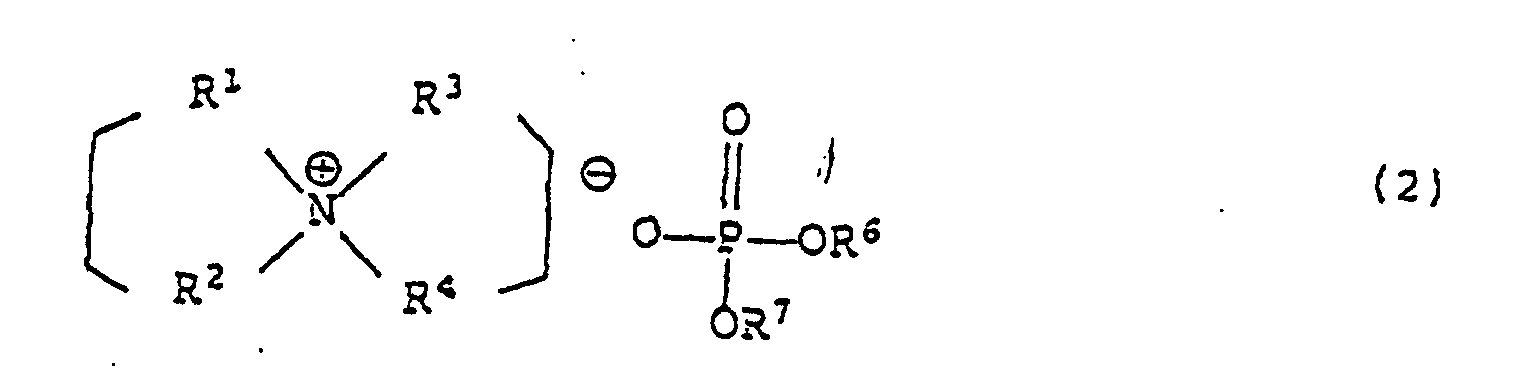
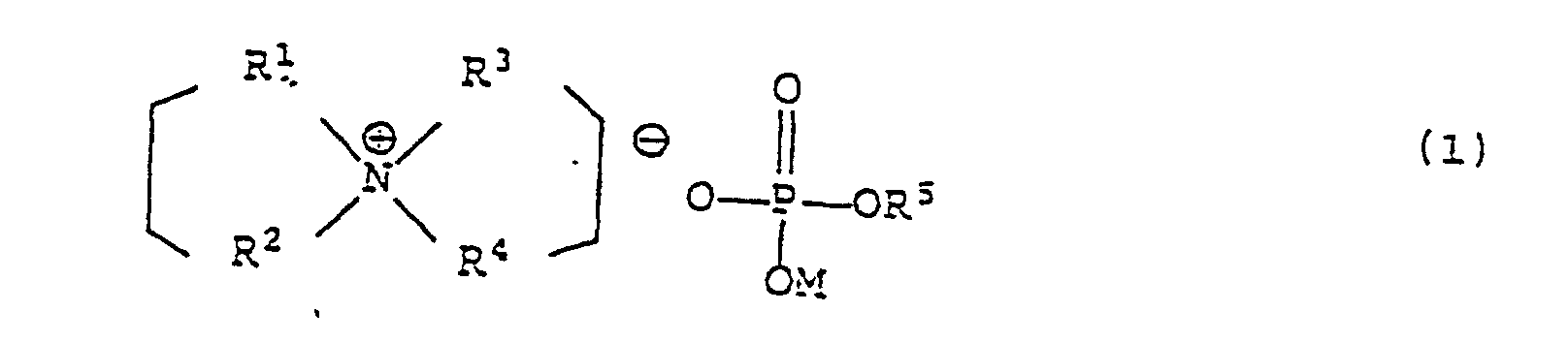
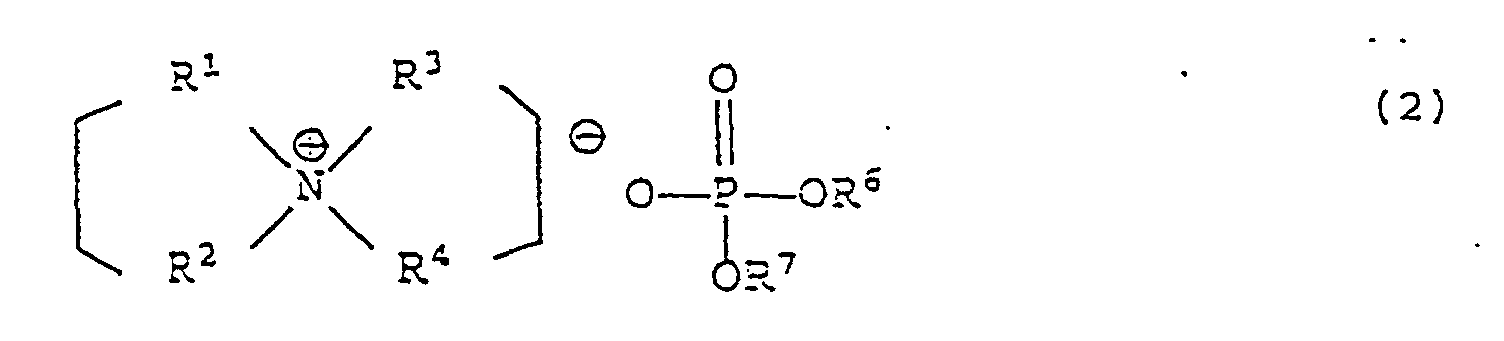
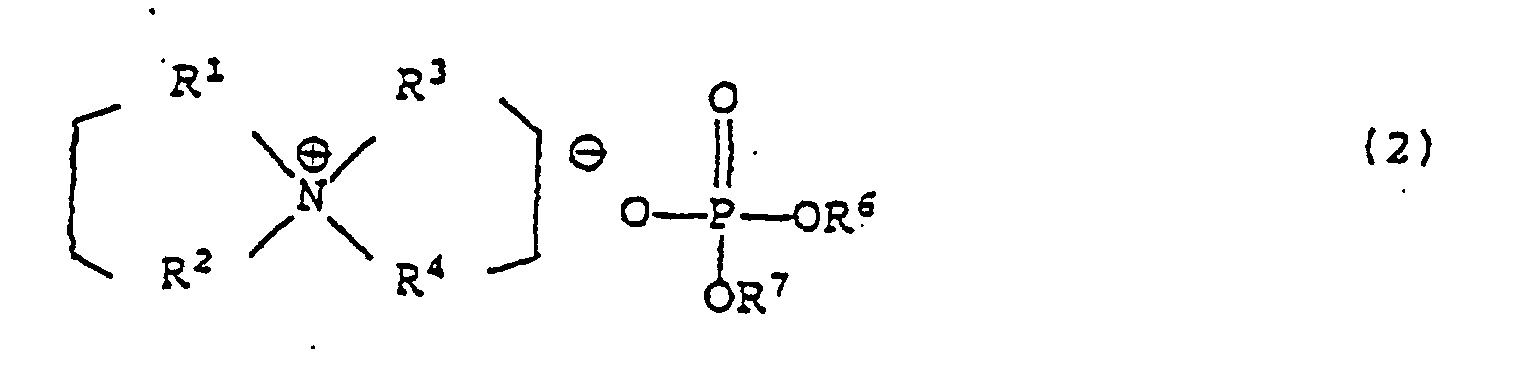
- the quaternary ammonium compounds of formulas (1) and (2) are compounds wherein R 1 is a linear or branched C 8-30 alkyl or alkenyl group, R 2 is a benzyl group and R 3 is a methyl group.
- R 1 is a linear or branched C 8-30 alkyl or alkenyl group
- R 2 is a benzyl group
- R 3 is a methyl group.
- compounds wherein R 1 is a linear C 8-20 alkyl group is. particularly preferred.
- examples of the linear C 1-30 alkyl group represented by R 5 , R 5 or R 7 include, but are not limited to, methyl, ethyl, n-grogyl, n-butyl, n-pentyl, n-hexyl and n-heptyl groups, and the linear alkyl groups exemplified above as R 1 , R 2 and R 3 ;
- examples of the branched C 1-30 alkyl group include, but are not limited to, isopropyl, isobutyl, sec-butyl and tert-butyl groups, and the branched alkyl groups exemplified above as the R 1 , R 2 and R 3 ;
- examples of the alkenyl group include allyl and methallyl groups and the alkenyl groups exemplified above as R 2 and R 3 .
- Illustrative examples of the polyoxyalkylene alkyl ether containing a linear or branched C 1-30 alkyl group represented by R 5 , R 6 or R 7 include, but are not limited to, polyoxyethylene cetyl ether, polyoxyethylene stearyl ether, polyoxyethylene hexadecyl ether and polyoxypropylene cetyl ether.
- Illustrative of the polyoxyalkylene alkenyl ether containing a linear or branched C 1-30 alkenyl group represented by R 5 , R 6 or R 7 include, but are not limited to, polyoxyethylene hexadecenyl ether and polyoxyethylene octadecenyl ether.
- the number of moles of the oxyalkylene group added is preferably 1-30.
- R 5 , R 6 and R 7 represent linear or branched C 12- 20 alkyl or alkenyl groups. More preferably, R 5 , R 6 and R 7 represent linear C 12-20 alkyl groups.
- Examples of the alkali metal represented by M in formula (1) include potassium and sodium.
- M is a hydrogen atom.
- the quaternary ammonium compounds of formula (1) or (2) of the present invention are those containing a linear or branched C 8-20 alkyl or alkenyl group as R 1 , a benzyl group as R 2 , a methyl group as R 1 , linear or branched C 12-20 alkyl groups as R 5 , R 6 and R 7 , respectively, and a hydrogen atom as M.
- the quaternary ammonium salt represented by the formulas (1) or (2) of the present invention can be prepared in a manner known to date, for example, by converting a quaternary ammonium salt whose counter ion is a halogen atom into an OH-type quaternary ammonium salt using an ion exchange resin, and then neutralizing with a phosphate ester compound corresponding to an anionic residue.
- the quaternary ammonium salt so obtained contains an alkali metal salt, amine salt, organic amine salt or the like to such an extent that the function of the present invention is not impaired.
- the quaternary ammonium salt by treating a quaternary ammonium halide under alkaline conditions, desalting by electrodialysis and then neutralizing with a phosphate ester compound corresponding to an anionic residue.
- the quaternary ammonium salt represented by formula (1) or (2) of the present invention is prepared by the process of mixing, in a mixed solvent of an organic solvent and water, a quaternary ammonium salt whose counter ion is a halogen atom with a phosphate ester compound (containing an alkali metal as M) corresponding to an anionic residue; heating for reaction the resulting mixture; subjecting the reaction mixture to phase separation; and then obtaining the target compound from the organic phase.
- the preferred examples of the organic solvent include ethanol and isopropanol.
- the quaternary ammonium salt whose counter ion is a halogen atom with a phosphate ester compound corresponding to an anionic residue at a molar ratio of preferably, 1.5:1 to 1:1.5, more preferably of 1.2:1 to 1:1.2.
- Water and the organic solvent are mixed at a weight ratio of, preferably, from 10:1 to 1:2, more preferably, from 6:1 to 1:1.
- water is added to the quaternary ammonium halide at a weight ratio of, preferably, from 20:1 to 2:1, more preferably, from 12:1 to 5:1.
- chloride ions derived from the raw materials or reaction by-products exist in the target compound.
- the term "chloride ion content" as used herein is defined as a value obtained by subjecting the chloride ions contained in a sample to potentiometric titration with a silver nitrate solution, determining the amount of the chloride ions from the consumption amount of the solution and then expressing the amount in terms of percentage (%) relative to the sample.
- the chloride ion content in the quaternary ammonium compound represented by formula (1) or (2) is preferably less than or equal to 2.0%, more preferably less than or equal to 1.0%, and most preferably, less than or equal to 0.6%.
- a chloride ion content exceeding 2.0% increases skin irritation and corrodes a container used for the preparation or treatment of the quaternary ammonium compound and thus chloride ion content of greater than 2% and should be avoided.
- the germicidal composition preferably for the body, according to the present invention should comprise a mixture of quaternary ammonium compounds of formulas (1) and (2) at a weight ratio of, preferably, from 99:1 to 80:20, more preferably, from 98:2 to 83:17.
- R 8 represents a linear or branched C 8-16 alkyl group (decyl, lauryl, myristyl or the like).
- m stands for 0-10, more preferably for 0-3, and most preferably for 0.
- the glycoside portion is a hydrophilic group (corresponding to G in formula (3)) having C 5-6 reducing sugar as a fundamental unit.
- the reducing sugar include glucose, galactose and fructose.
- the polymerization degree, S, (corresponding to n in formula (3)) of the glycoside is 1-10 of which at least 80% has a polymerization degree of 1-4.
- the average polymerization degree, S can be measured by a proton NMR method.
- alkyl glycoside surfactant examples include, but are not limited to, ⁇ -alkyl saccharides such as octyl glucoside, nonyl glucoside, decyl maltoside, dodecyl maltoside, tridecyl maltoside and polyoxyechylene (2E.O.) dodecyl glucoside, each being synthesized by the Koenigs-Knorr method known to date; reducing sugars such as glucose, galactose and maltose; and those synthesized from higher alcohols or polyoxyethylene alkyl ether alcohols (U.S. Patent Nos. 3,219,656, 3,839,318 and 4,223,129).
- ⁇ -alkyl saccharides such as octyl glucoside, nonyl glucoside, decyl maltoside, dodecyl maltoside, tridecyl maltoside and polyoxyechylene (2E.O.) dodecy
- sugar amide as used herein means a compound represented by the following formula (4) : wherein R 10 represents a linear or branched C 5-31 alkyl or alkenyl group which may be substituted by a hydroxyl group; R 11 represents a hydrogen atom or a linear or branched C 1-4 alkyl group which may be substituted by a hydroxyl group; and Z represents a sugar residue or a sugar alcohol residue or an alkoxylated derivativa of the residue.
- preferred examples of R 10 include C 7-19 alkyl and alkenyl groups, with C 11-17 alkyl and alkenyl groups being particularly preferred.
- Preferred examples of R 11 include linear C 1-4 alkyl groups, with methyl and ethyl groups being particularly preferred.
- preferred examples of the reducing sugar include reducing sugar residues. Examples of preferred reducing sugars include glucose, fructose, maltose, lactose, galactose, mannose and xylose.
- sugar alcohol examples include those derived from a reducing sugar by reductive amination reaction and include, but are not limited to,-CH 2 (CHOH) 1 -CH 2 OH and -CH(CH 2 OH)-(CHOH) l -1 -CH 2 -OH (in which l stands for an integer between 3-5, preferably, 4).
- the germicidal detergent composition preferably for the body, according to the present invention, no particular limitation is imposed on the amount of component (a).
- component (a) it is desired to add the quaternary ammonium compounds of formulas (1) and (2) in total percentages by weight of composition, preferably, 0.005-90 wt.%, more preferably, of 0.01 to 50 wt.%, and even more preferably, 0.02-25 wt.%.
- the surfactant or component (b) is added preferably in an amount of 3-30 wt.% of the total composition, preferably, 5-20 wt.%.
- the composition is used either without dilution or after dilution with water.
- the degree of skin irritation produced by the above-described germicidal composition or germicidal detergent composition according to the present invention is lessened when the composition further comprises sorbitol and/or glycerin.
- the amount of sorbitol and/or glycerin is preferably 1-30 wt.%, more preferably, 3-20 wt.%, based on the entire weight of the composition.
- the germicidal or germicidal detergent composition of the present invention can further comprise a salt, a surfactant other than those already mentioned, and a water-soluble thickener as needed to the extent that the effects of the compositions of the present invention are not impaired.
- the salt examples include, but are not limited to, metal salts of a carboxylic acid such as succinic acid, malonic acid, citric acid, gluconic acid and glutaric acid; metal salts of a phosphoric acid compound such as tripolyphosphoric acid, hexamethaphosphoric acid and phosphoric acid; and inorganic salts such as Na 2 SO 4 and MgSO 4 . They may be used either singly or in combination.
- a carboxylic acid such as succinic acid, malonic acid, citric acid, gluconic acid and glutaric acid
- metal salts of a phosphoric acid compound such as tripolyphosphoric acid, hexamethaphosphoric acid and phosphoric acid
- inorganic salts such as Na 2 SO 4 and MgSO 4 . They may be used either singly or in combination.
- additional surfactants include nonionic, anionic and amphoteric surfactants. They can be added in an amount of 0-30 wt.%, preferably 0-20 wt.%, more preferably 2-5 wt.%, based on the total germicidal composition, preferably for the body.
- anionic surfactant examples include, but are not limited to, higher fatty acid salts, alkylsulfates, alkyl sulfonates, polyoxyethylene alkylsulfates, alkylbenzene sulfonates, N-acylsarcosine salts, N-acyl-N-methyltaurine salts, alfa-olefin sulfonates, alkyl ether acetates, polyoxyethyelne alkyl ether acetates and polyoxyethylene alkylamide ether acetates.
- nonionic surfactant examples include, but are not limited to, sucrose fatty acid esters, polyglycerin fatty acid esters, polyoxyalkylene alkyl ethers, alkylamine oxides and fatty acid polyhydric alcohol esters.
- amphoteric surfactants include, but are not limited to, amidoamino acid base, carbobetaine base, sulfobetaine base, amidesulfobetaine base, imidazolinium betaine base, amino acid betaine base and phosphobetaine base.
- the water-soluble thickener can be any of those selected from the group of natural, semi-synthetic and synthetic water-soluble thickeners. Such a water-soluble thickener is added in an amount of about 0-3.0 wt.%, preferably about 0.05-1.5 wt.%, more preferably 0.05-0.5 wt.%, based on the whole composition.
- water-soluble thickeners examples include, but are not limited to, bacteria derived xanthan gum and xanflow and plant-derived pectin, gum arabic and guar gum.
- semi-synthetic water-soluble thickeners include, but are not limited to, cellulose and starch derivatives which have been methylated, carboxyalkylated or hydroxyalkylated, such as methyl cellulose, carboxymethyl cellulose and hydroxymethyl cellulose.
- Examples of synthetic water-soluble thickeners include, but are not limited to, polyacrylate salts, polymaleate salts, polyvinyl pyrrolidone and pentaerythritol EO adduces.
- the composition of the present invention is preferred to prepare as an ethanol germicidal composition containing ethanol as a base.
- ethanol a base
- No particular limitation is imposed on the amount of ethanol to be added as a base.
- the body germicidal composition according to the present invention can be used for human bodies or animal bodies.
- it can be prepared in the form of a pharmaceutical disinfectant antiseptic, a medical disinfectant antiseptic for animals, a cosmetic, a shampoo, a soap, a rinse or a detergent.
- disinfectant antiseptics include, for example, disinfectant antiseptics that can be used by immersing fingers and hands in a diluted solution thereof and scrubbing type sterilizing detergents that can be used by scrubbing hands.
- Medical disinfectant antiseptics for animals include, for example, disinfectant antiseptics for animal skin.
- Examples of a cosmetic include germicidal cream, germicidal lotion, and germicidal care produces.
- Examples of a shampoo, a soap, a rinse or a detergent include medicated shampoo, medicated soap, hand wash having sterilizing property, medicated rinse, deodorant and sanitizer.
- a germicidal detergent for skin and hair is particularly preferred.
- the sterilizing activity of the quaternary ammonium salts of the present invention against various microorganisms was studied.
- the sterilizing activity was determined from the minimum sterilizing concentration ( ⁇ g/ml, 24 h).
- the results are summarized in Table 2.
- the antimicrobial activity of the quaternary ammonium salts listed in Table 1 against bacteria was studied.
- the antibacterial test was conducted as follows; the bacteria to be tested ( Staphylococcus aureus; IF012732) was pre-incubated on an SCD medium (product of Nippon Seiyaku Co., Ltd.) at 35°C. The pre-incubated culture was smeared onto an SCD agar medium (product of Nippon Seiyaku Co., Ltd.).
- a paper disk (thick, product of ADVANTEC Co.) having a diameter of 8 mm, on which 50 ⁇ l of a 0.5% aqueous solution of a quaternary ammonium salt was poured and which was then washed with water, was placed on the agar medium onto which the culture had been smeared. Twenty four hours later at 35°C, the diameter (mm) of an inhibition zone was measured, whereby antibacterial activity was judged. Results are shown in Table 3. Staphylococcus aureus Quaternary ammonium salt 1 46 (mm) Quaternary ammonium salt 2 44 Quaternary ammonium salt 3 18 Quaternary ammonium salt 4 15 Quaternary ammonium salt 5 10
- a side abdominal part of a Hartley white guinea pig (female) having a body weight of 300-400 g was depilated by an electric hair clipper or electric razor. Three to six hours later, a circle of about 2 cm in diameter was drawn by the tip of a Teflon rod which had been dipped in a sample of a 2.5% aqueous solution of a quaternary ammonium salt, whereby the sample was applied to the depilated part.
- the coating was conducted once a day for four days. The condition of the part of the skin coated with the sample was judged prior to each coating. The judgement was conducted four times. The skin where no reaction was recognized and the skin where erythema was recognized were distinguished.
- the number of the guinea pigs in one group (consisting of 5 guinea pigs) which were recognized to have erythema is shown in Table 4.
- Formulation 1 Detergent for fingers and hands Quaternary ammonium salt of the invention product or comparative product 2.5 Alkyl glucoside (effective content: 40%) 40.0 POE (20) sorbitan monolaurate ester 1.0 Sorbitol 5.0 Purified water Balance 100.0
- Formulation 2 Body Detergent Quaternary ammonium salt of the invention product or comparative product 3.0 Lauric acid 15.0 Lauroyl diethanol amide 5.0 Lauryldimethylamine oxide solution (35%) 5.0 Glycerin 20.0 Chelating agent 1.2 Potassium hydroxide 4.2 Purified water Balance 100.0 Formulation 3: Shampoo Quaternary ammonium salt of the invention product or comparative product 3.0 Sodium POE(3) laurylether sulfate (30%) 30.0 Lauroyldiethanol amide 9.0 Glycer
- Detergents were prepared in accordance with Formulations 1 and 2.
- the palms of the hands were wetted lightly with water, followed by draining off the water.
- the palms of the hands were then lightly pressed against an SCDLP agar medium.
- 1.5 mi of each of the detergents of Formulations 1 and 2 was placed.
- the hands were rubbed for one minute for foaming, followed by washing away with running water for 30 seconds.
- Water was drained off lightly from the hands and then the palms of the hands were lightly pressed against the SCDLP agar medium.
- Bacteria on the SCDLP agar media before and after washing were cultured at 28°C for 48 hours. In each case, the number of the colonies formed was counted, which was designated as the viable count.
- the shampoo and rinse were prepared in accordance with Formulations 3 and 4, respectively, and the effects of their use were tested.
- Quaternary-ammonium-salt-free shampoo and rinse were used for 2 weeks everyday. Then the hair was not washed for a full day and the next day, the scalp was observed and rated as follows:
- the deodorant lotion was prepared in accordance with Formulation 10 and its effects from use was tested.
- a quaternary-ammonium-salt-free lotion (blank) was applied to the armpit everyday for 2 weeks and the smell of the armpit was observed and rated.
- the sanitizer was prepared in accordance with Formulation 11 and its effects of use were tested.
- the hand cream was prepared in accordance with Formulation 9 and its effects of use were tested.
- the quick-dry rubbing-in type disinfectant for hands and fingers was prepared in accordance with Formulation 12 and its effects from use were tested.
- the palms of the hands were pressed against the SCDLP agar media, whereby bacteria were collected, respectively.
- the bacteria so collected were cultured at 28°C for 48 hours.
- Sterlizizing ratio (%) (Viable count before treatment - viable count just after treatment) Viable count before treatment x 100
- Antimicrobial value Viable count with the passage of time Viable count just after the treatment Standards of judgement:
Landscapes
- Life Sciences & Earth Sciences (AREA)
- Health & Medical Sciences (AREA)
- General Health & Medical Sciences (AREA)
- Animal Behavior & Ethology (AREA)
- Public Health (AREA)
- Veterinary Medicine (AREA)
- Dentistry (AREA)
- Environmental Sciences (AREA)
- Plant Pathology (AREA)
- Engineering & Computer Science (AREA)
- Agronomy & Crop Science (AREA)
- Wood Science & Technology (AREA)
- Zoology (AREA)
- Pest Control & Pesticides (AREA)
- Dermatology (AREA)
- Epidemiology (AREA)
- Birds (AREA)
- Detergent Compositions (AREA)
- Agricultural Chemicals And Associated Chemicals (AREA)
- Cosmetics (AREA)
Claims (20)
- Germizide Zusammensetzung, umfassendworin das Gewichtsverhältnis der Verbindung (1) zur Verbindung (2) von 99:1 bis 80:20 ist.(i) eine Verbindung mit der Formel (1):worin zumindest eines von R1, R2 und R3 eine lineare oder verzweigte C8-30-Alkyl oder Alkenylgruppe ist und die verbleibenden Gruppen gleich oder verschieden sind und unabhängig eine Methyl-, Ethyl- oder Benzylgruppe sind; R4 eine Methyl- oder Ethylgruppe ist, R5 eine lineare oder verzweigte C1-30-Alkyl- oder Alkenylgruppe ist oder ein Polyoxyalkylenalkylether oder Polyoxyalkylenalkenylether mit einer linearen oder verzweigten C1-30-Alkyl- oder Alkenylgruppe, und M ein Wasserstoffatom oder ein Alkalimetallatom ist; und
 ii) eine Verbindung mit der Formel (2):worin R1 bis R4 die oben angegebenen Bedeutungen aufweisen und R6 und R7 gleich oder verschieden sind und unabhängig die gleichen Bedeutungen wie R5 aufweisen;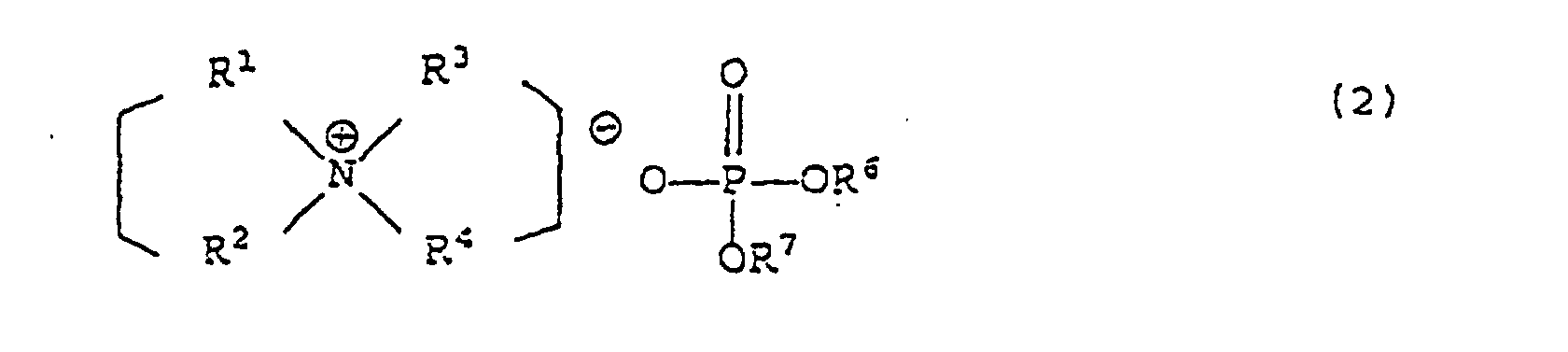
- Germizide Zusammensetzung nach Anspruch 1, worin R1 eine lineare C8-20-Alkylgruppe ist.
- Germizide Zusammensetzung gemäß Anspruch 1, worin R1 eine lineare oder verzweigte C8-20-Alkyl- oder Alkenylgruppe ist; R2 eine Benzylgruppe ist, R3 eine Methylgruppe ist; R5, R6 und R7 eine lineare oder verzweigte C12-20-Alkylgruppe sind; und M ein Wasserstoffatom ist.
- Germizide Zusammensetzung nach Anspruch 1, worin R5, R6 und R7 gleich oder verschieden sind und unabhängig eine lineare oder verzweigte C12-20-Alkyl- oder Alkenylgruppe sind.
- Germizide Zusammensetzung nach Anspruch 1, worin R1 eine lineare oder verzweigte C8-30-Alkyl- oder -Alkenylgruppe ist; R2 eine Benzylgruppe ist; und R3 eine Methylgruppe ist.
- Germizide Zusammensetzung nach Anspruch 1, worin die durch die Formeln (1) und (2) dargestellten Verbindungen jeweils einen Chlorionengehalt von weniger oder gleich 2,0% haben.
- Germizide Zusammensetzung, umfassend das Produkt, das vom Mischen der folgenden Verbindungen resultiert:worin das Gewichtsverhältnis der Verbindung (1) zur Verbindung (2) von 99:1 bis 80:20 ist.(i) eine Verbindung der Formel (1):worin zumindest eines von R1, R2 und R3 eine lineare oder verzweigte C8-30-Alkyl oder Alkenylgruppe ist und die verbleibenden Gruppen gleich oder verschieden sind und unabhängig eine Methyl-, Ethyl- oder Benzylgruppe sind; R4 eine Methyl- oder Ethylgruppe ist, R5 eine lineare oder verzweigte C1-30-Alkyl- oder Alkenylgruppe ist oder ein Polyoxyalkylenalkylether oder Polyoxyalkylenalkenylether mit einer linearen oder verzweigten C1-30-Alkyl- oder Alkenylgruppe, und M ein Wasserstoffatom oder ein Alkalimetallatom ist; und
 ii) eine Verbindung mit der Formel (2):worin R1 bis R4 die oben angegebenen Bedeutungen aufweisen und R6 und R7 gleich oder verschieden sind und unabhängig die gleichen Bedeutungen wie R5 aufweisen;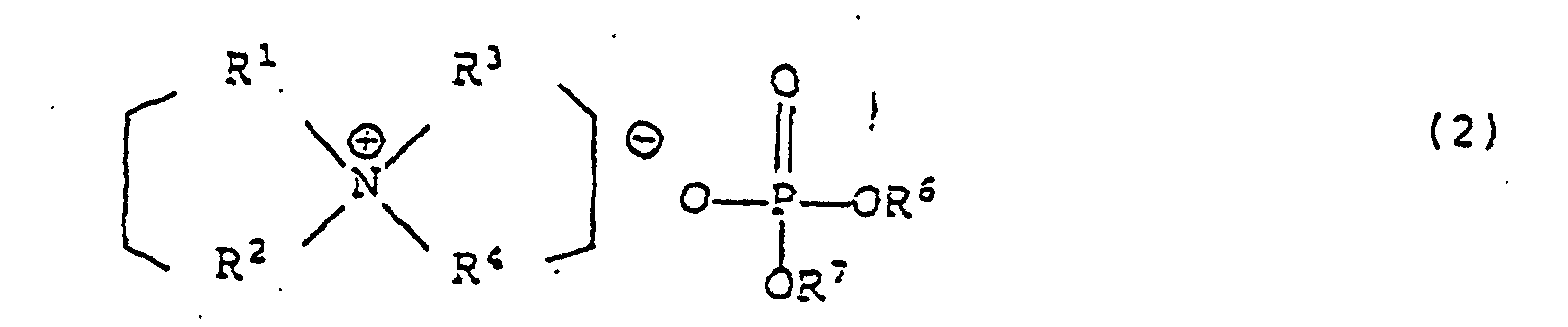
- Germizide Zusammensetzung nach Anspruch 1, worin die Gesamtkonzentration der Verbindung (1) und der Verbindung (2) in dem Bereich von 0,005 bis 90 Gew.% liegt, bezogen auf die Gesamtzusammensetzung.
- Germizide Reinigungszusammensetzung, umfassend:worin das Gewichtsverhältnis der Verbindung (1) zur Verbindung (2) von 99:1 bis 80:20 ist.(a) eine Zusammensetzung, umfassend:i) eine Verbindung der Formel (1):worin zumindest eines von R1, R2 und R3 eine lineare oder verzweigte C8-30-Alkyl oder Alkenylgruppe ist und die verbleibenden Gruppen gleich oder verschieden sind, und unabhängig eine Methyl-, Ethyl- oder Benzylgruppe sind; R4 eine Methyl- oder Ethylgruppe ist, R5 eine lineare oder verzweigte C1-30-Alkyl- oder Alkenylgruppe ist oder ein Polyoxyalkylenalkylether oder Polyoxyalkylenalkenylether mit einer linearen oder verzweigten C1-30-Alkyl- oder Alkenylgruppe, und M ein Wasserstoffatom oder ein Alkalimetallatom ist; und
 ii) eine Verbindung mit der Formel (2):worin R1 bis R4 die oben angegebenen Bedeutungen aufweisen und R6 und R7 gleich oder verschieden sind und unabhängig die gleichen Bedeutungen wie R5 aufweisen; und
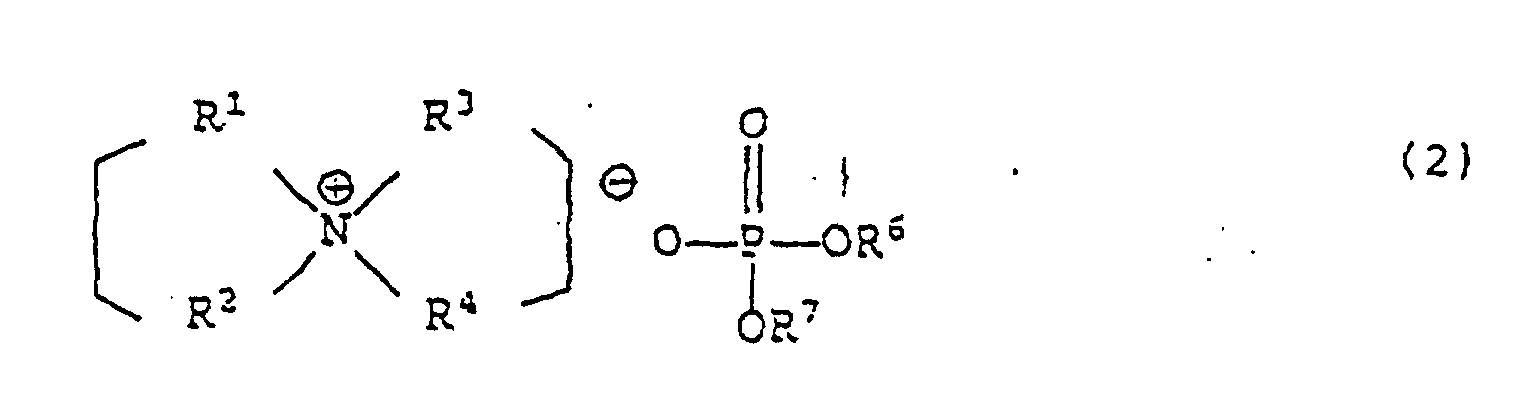 (b) zumindest ein oberflächenaktives Mittel, ausgewählt aus der Gruppe, bestehend aus Alkylglycosiden, Zuckeramiden und einer Mischung davon;
 - Germizide Reinigungszusammensetzung, umfassend das Produkt, das vom Mischen der folgenden Verbindungen resultiert:worin das Gewichtsverhältnis der Verbindung (1) zur Verbindung (2) von 99:1 bis 80:20 ist.(a) eine Zusammensetzung, umfassend:i) eine Verbindung der Formel (1):worin zumindest eines von R1, R2 und R3 eine lineare oder verzweigte C8-30-Alkyl oder Alkenylgruppe ist und die verbleibenden Gruppen gleich oder verschieden sind und unabhängig eine Methyl-, Ethyl- oder Benzylgruppe sind; R4 eine Methyl- oder Ethylgruppe ist, R5 eine lineare oder verzweigte C1-30-Alkyl- oder Alkenylgruppe ist oder ein Polyoxyalkylenalkylether oder Polyoxyalkylenalkenylether mit einer linearen oder verzweigten C1-30-Alkyl- oder Alkenylgruppe, und M ein Wasserstoffatom oder ein Alkalimetallatom ist; und
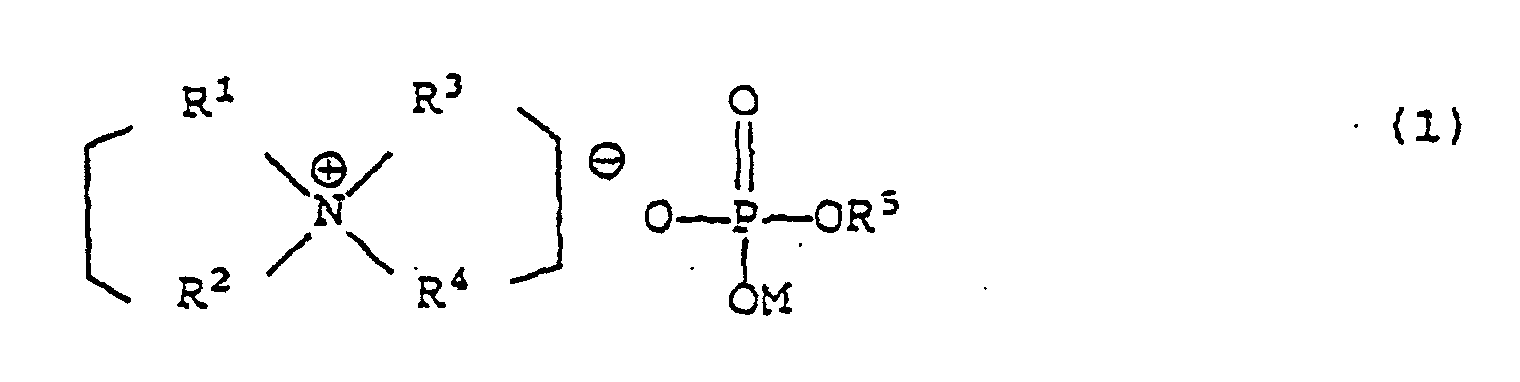 ii) eine Verbindung mit der Formel (2):worin R1 bis R4 die oben angegebenen Bedeutungen aufweisen und R6 und R7 gleich oder verschieden sind und unabhängig die gleichen Bedeutungen wie R5 aufweisen; und
 (b) zumindest ein oberflächenaktives Mittel, ausgewählt aus der Gruppe, bestehend aus Alkylglycosiden, Zuckeramiden und einer Mischung davon;
 - Germizide Reinigungszusammensetzung nach Anspruch 10, worin das Alkylglycosid die folgende Formel (3) hat:
- Germizide Reinigungszusammensetzung nach Anspruch 10, worin das Zuckeramid die folgende Formel (4) hat:worin R10 eine lineare oder verzweigte C5-31-Alkyl- oder Alkenylgruppe ist, die durch eine Hydroxylgruppe substituiert sein kann; R11 ein Wasserstoffatom oder eine lineare oder verzweigte C1-4-Alkylgruppe ist, die durch eine Hydroxylgruppe substituiert sein kann und Z ein Zuckerrest oder ein Zuckeralkoholrest oder ein alkoxyliertes Derivat des Restes ist.

- Kosmetisches Verfahren zum Waschen der Haut oder des Haars, umfassend das Auftragen einer der Zusammensetzungen gemäß den Ansprüchen 9 bis 12.
- Germizide Reinigungszusammensetzung, umfassend:worin das Gewichtsverhältnis der Verbindung (1) zur Verbindung (2) von 99:1 bis 80:20 ist.(a) eine Zusammensetzung, umfassend:i) eine Verbindung der Formel (1):worin zumindest eines von R1, R2 und R3 eine lineare oder verzweigte C8-30-Alkyl- oder Alkenylgruppe ist und die verbleibenden Gruppen gleich oder verschieden sind, und unabhängig eine Methyl-, Ethyl- oder Benzylgruppe sind; R4 eine Methyl- oder Ethylgruppe ist, R5 eine lineare oder verzweigte C1-30-Alkyl- oder Alkenylgruppe ist oder ein Polyoxyalkylenalkylether oder Polyoxyalkylenalkenylether mit einer linearen oder verzweigten C1-30-Alkyl- oder Alkenylgruppe, und M ein Wasserstoffatom oder ein Alkalimetallatom ist; und
 ii) eine Verbindung mit der Formel (2):worin R1 bis R4 die oben angegebenen Bedeutungen aufweisen und R6 und R7 gleich oder verschieden sind und unabhängig die gleichen Bedeutungen wie R5 aufweisen; und
 (c) zumindest ein Feuchtigkeitsmittel, ausgewählt aus der Gruppe, bestehend aus Sorbit, Glycerin und einer Mischung davon;
 - Germizide Reinigungszusammensetzung, umfassend das Produkt, resultierend von dem Mischen der folgenden Verbindungen:worin das Gewichtsverhältnis der Verbindung (1) zur Verbindung (2) von 99:1 bis 80:20 ist.(a) eine Zusammensetzung, umfassend:i) eine Verbindung der Formel (1):worin zumindest eines von R1, R2 und R3 eine lineare oder verzweigte C8-30-Alkyl oder Alkenylgruppe ist und die verbleibenden Gruppen gleich oder verschieden sind und unabhängig eine Methyl-, Ethyl- oder Benzylgruppe sind; R4 eine Methyl- oder Ethylgruppe ist, R5 eine lineare oder verzweigte C1-30-Alkyl- oder Alkenylgruppe ist oder ein Polyoxyalkylenalkylether oder Polyoxyalkylenalkenylether mit einer linearen oder verzweigten C1-30-Alkyl- oder Alkenylgruppe, und M ein Wasserstoffatom oder ein Alkalimetallatom ist; und
 ii) eine Verbindung mit der Formel (2):worin R1 bis R4 die oben angegebenen Bedeutungen aufweisen und R6 und R7 gleich oder verschieden sind und unabhängig die gleichen Bedeutungen wie R5 aufweisen; und
 (c) zumindest ein Feuchtigkeitsmittel, ausgewählt aus der Gruppe, bestehend aus Sorbit, Glycerin und einer Mischung davon;
 - Kosmetisches Verfahren zum Waschen der Haut oder des Haars, umfassend das Auftragen der Zusammensetzung gemäß den Ansprüchen 14 oder 15.
- Zusammensetzung nach Anspruch 1, weiterhin umfassend Ethanol.
- Kosmetisches Verfahren zum Sterilisieren der Haut, umfassend das Waschen der Haut mit der Zusammensetzung gemäß Anspruch 1.
- Kosmetisches Verfahren zum Sterilisieren der Haut, umfassend das Waschen der Haut mit der Zusammensetzung gemäß Anspruch 17.
- Verwendung einer germiziden Zusammensetzung nach einem der Ansprüche 1 bis 8, zur Herstellung einer pharmazeutischen Zusammensetzung mit der Wirkung als desinfizierendes Antisepktikum.
Applications Claiming Priority (4)
| Application Number | Priority Date | Filing Date | Title |
|---|---|---|---|
| JP320460/95 | 1995-12-08 | ||
| JP32046095 | 1995-12-08 | ||
| JP32046095 | 1995-12-08 | ||
| PCT/JP1996/003451 WO1997021348A1 (en) | 1995-12-08 | 1996-11-26 | Germicidal composition |
Publications (2)
| Publication Number | Publication Date |
|---|---|
| EP0865239A1 EP0865239A1 (de) | 1998-09-23 |
| EP0865239B1 true EP0865239B1 (de) | 2001-10-24 |
Family
ID=18121705
Family Applications (1)
| Application Number | Title | Priority Date | Filing Date |
|---|---|---|---|
| EP96938541A Expired - Lifetime EP0865239B1 (de) | 1995-12-08 | 1996-11-26 | Germizide zusammensetzung |
Country Status (7)
| Country | Link |
|---|---|
| US (1) | US6008177A (de) |
| EP (1) | EP0865239B1 (de) |
| JP (1) | JPH11502233A (de) |
| CN (1) | CN1104196C (de) |
| DE (1) | DE69616374T2 (de) |
| ES (1) | ES2162115T3 (de) |
| WO (1) | WO1997021348A1 (de) |
Families Citing this family (10)
| Publication number | Priority date | Publication date | Assignee | Title |
|---|---|---|---|---|
| US6673358B1 (en) * | 1999-12-16 | 2004-01-06 | Kimberly-Clark Worldwide, Inc. | Wet wipes containing a mono alkyl phosphate |
| US7459154B2 (en) * | 2002-12-26 | 2008-12-02 | Cell Genesys, Inc. | Methods and reagents for the enhancement of virus transduction in the bladder epithelium |
| US7112559B1 (en) | 2005-03-14 | 2006-09-26 | Ecolab Inc. | Thickened quaternary ammonium compound sanitizer |
| JP4750499B2 (ja) * | 2005-08-01 | 2011-08-17 | 日華化学株式会社 | イオン性液体並びにそれを用いた抗菌剤及び抗菌性繊維 |
| WO2007047580A2 (en) * | 2005-10-18 | 2007-04-26 | Page2Cell, Inc. | System and method for providing a public number-private number telephony system |
| US20100172845A1 (en) * | 2007-05-29 | 2010-07-08 | Board Of Regents Of The University Of Texas System | Compositions and methods for treating mycobacterial infections |
| US9132111B2 (en) * | 2011-05-13 | 2015-09-15 | Kewang Lu | Topical antimicrobial compositions |
| WO2019126703A1 (en) | 2017-12-22 | 2019-06-27 | Ecolab Usa Inc. | Antimicrobial compositions with enhanced efficacy |
| CN109997849A (zh) * | 2019-04-28 | 2019-07-12 | 河北瑞鸿生物科技有限公司 | 一种消毒液及其制备方法 |
| CN110078182B (zh) * | 2019-05-06 | 2021-11-23 | 无锡广源高科技有限公司 | 一种水处理用多头杀菌灭藻剂及其制备和应用 |
Family Cites Families (12)
| Publication number | Priority date | Publication date | Assignee | Title |
|---|---|---|---|---|
| LU65735A1 (de) * | 1972-07-17 | 1974-01-28 | ||
| GB1475251A (en) * | 1975-01-15 | 1977-06-01 | Colgate Palmolive Co | Oral preparations |
| DE2916318A1 (de) * | 1979-04-23 | 1980-11-06 | Hoechst Ag | Waesserige desinfektionsloesung |
| DE3444958A1 (de) * | 1984-12-10 | 1986-06-12 | Henkel KGaA, 4000 Düsseldorf | Verwendung von alkylglykosiden als potenzierungsmittel in antiseptischen mitteln sowie desinfektions- und reinigungsmittel mit verstaerkter bakterizider wirkung |
| DE3619375A1 (de) * | 1986-06-09 | 1987-12-10 | Henkel Kgaa | Verwendung von alkylglycosiden als potenzierungsmittel in alkohol- oder carbonsaeurehaltigen antiseptischen mitteln sowie alkohol- oder carbonsaeurehaltige desinfektions- und reinigungsmittel mit verstaerkter bakterizider wirkung |
| JPS6485367A (en) * | 1987-09-21 | 1989-03-30 | Nikka Chemical Ind Co Ltd | Antibacterial deodorant for fiber |
| JP2804281B2 (ja) * | 1989-02-20 | 1998-09-24 | 花王株式会社 | 皮膚又は毛髪用殺菌消毒剤 |
| JP3222160B2 (ja) * | 1991-09-30 | 2001-10-22 | 株式会社ザイエンス | 木材防腐防蟻剤 |
| US5362910A (en) * | 1991-10-08 | 1994-11-08 | Nicca Chemical Co., Ltd. | Germicidal and fungicidal agent and a germicidal and fungicidal method |
| JP3024020B2 (ja) * | 1992-02-13 | 2000-03-21 | 花王株式会社 | 殺菌消毒剤組成物 |
| WO1995001414A1 (en) * | 1993-07-01 | 1995-01-12 | Allergan, Inc. | Contact lens cleaning solution based on quaternary ammonium phosphate esters |
| JP3245279B2 (ja) * | 1993-11-08 | 2002-01-07 | 花王株式会社 | 洗浄剤組成物 |
-
1996
- 1996-11-26 JP JP9521916A patent/JPH11502233A/ja active Pending
- 1996-11-26 DE DE69616374T patent/DE69616374T2/de not_active Expired - Lifetime
- 1996-11-26 WO PCT/JP1996/003451 patent/WO1997021348A1/en not_active Ceased
- 1996-11-26 EP EP96938541A patent/EP0865239B1/de not_active Expired - Lifetime
- 1996-11-26 US US09/077,875 patent/US6008177A/en not_active Expired - Fee Related
- 1996-11-26 ES ES96938541T patent/ES2162115T3/es not_active Expired - Lifetime
- 1996-11-26 CN CN96198864A patent/CN1104196C/zh not_active Expired - Lifetime
Also Published As
| Publication number | Publication date |
|---|---|
| ES2162115T3 (es) | 2001-12-16 |
| EP0865239A1 (de) | 1998-09-23 |
| DE69616374D1 (de) | 2001-11-29 |
| CN1203513A (zh) | 1998-12-30 |
| CN1104196C (zh) | 2003-04-02 |
| DE69616374T2 (de) | 2002-07-04 |
| US6008177A (en) | 1999-12-28 |
| JPH11502233A (ja) | 1999-02-23 |
| WO1997021348A1 (en) | 1997-06-19 |
Similar Documents
| Publication | Publication Date | Title |
|---|---|---|
| US6046145A (en) | Cleansing and moisturizing surfactant compositions | |
| EP0358216B2 (de) | Wenig reizendes Reinigungsmittel | |
| US5378731A (en) | Medicated shampoo | |
| JPH069350A (ja) | ヘアシャンプー組成物 | |
| WO1997033561A9 (en) | Cleansing and moisturizing surfactant compositions | |
| JP2018535933A (ja) | パーソナルクレンジング組成物およびマイクロバイオームを安定化させる方法 | |
| WO1992021320A1 (en) | Disinfecting shampoo composition for animals | |
| DK161894B (da) | Ikke-antimikrobielt desodoriserende rensemiddel | |
| US6008177A (en) | Germicidal composition | |
| EP4029871A1 (de) | Neue antimikrobielle antifungale zusammensetzung | |
| CN114432170B (zh) | 一种温和的宠物用沐浴露及其制备工艺 | |
| CN111249176A (zh) | 免洗消毒剂、制备方法及其应用 | |
| CN108125812B (zh) | 一种氨基酸型抑菌泡沫洗手液及其制备方法 | |
| JPH10330793A (ja) | 殺菌力増強剤、殺菌力増強方法及び殺菌洗浄剤組成物 | |
| JPS61241399A (ja) | α―エマルザンを含有する皮膚洗浄組成物およびシャンプー | |
| CN107854329B (zh) | 一种易冲洗型抑菌保湿泡沫洗手液及其制备方法 | |
| EP0392665B1 (de) | Hautreinigungsmittel | |
| CN117915884A (zh) | 清洁组合物中的人乳寡糖 | |
| JP2022062699A (ja) | 皮膚軟化剤および洗浄剤 | |
| CN112915054A (zh) | 一种湿巾溶液及其制备方法及其湿巾 | |
| JP3157524B2 (ja) | 殺菌剤組成物 | |
| JP2804281B2 (ja) | 皮膚又は毛髪用殺菌消毒剤 | |
| EP1086198B1 (de) | Duschgel | |
| JP2001346709A (ja) | ティッシュペーパー | |
| US20050008606A1 (en) | Personal care composition |
Legal Events
| Date | Code | Title | Description |
|---|---|---|---|
| PUAI | Public reference made under article 153(3) epc to a published international application that has entered the european phase |
Free format text: ORIGINAL CODE: 0009012 |
|
| 17P | Request for examination filed |
Effective date: 19980522 |
|
| AK | Designated contracting states |
Kind code of ref document: A1 Designated state(s): DE ES FR GB |
|
| 17Q | First examination report despatched |
Effective date: 20000626 |
|
| GRAG | Despatch of communication of intention to grant |
Free format text: ORIGINAL CODE: EPIDOS AGRA |
|
| GRAG | Despatch of communication of intention to grant |
Free format text: ORIGINAL CODE: EPIDOS AGRA |
|
| GRAG | Despatch of communication of intention to grant |
Free format text: ORIGINAL CODE: EPIDOS AGRA |
|
| GRAH | Despatch of communication of intention to grant a patent |
Free format text: ORIGINAL CODE: EPIDOS IGRA |
|
| GRAH | Despatch of communication of intention to grant a patent |
Free format text: ORIGINAL CODE: EPIDOS IGRA |
|
| GRAH | Despatch of communication of intention to grant a patent |
Free format text: ORIGINAL CODE: EPIDOS IGRA |
|
| GRAA | (expected) grant |
Free format text: ORIGINAL CODE: 0009210 |
|
| AK | Designated contracting states |
Kind code of ref document: B1 Designated state(s): DE ES FR GB |
|
| REF | Corresponds to: |
Ref document number: 69616374 Country of ref document: DE Date of ref document: 20011129 |
|
| REG | Reference to a national code |
Ref country code: ES Ref legal event code: FG2A Ref document number: 2162115 Country of ref document: ES Kind code of ref document: T3 |
|
| REG | Reference to a national code |
Ref country code: GB Ref legal event code: IF02 |
|
| ET | Fr: translation filed | ||
| PLBE | No opposition filed within time limit |
Free format text: ORIGINAL CODE: 0009261 |
|
| STAA | Information on the status of an ep patent application or granted ep patent |
Free format text: STATUS: NO OPPOSITION FILED WITHIN TIME LIMIT |
|
| 26N | No opposition filed | ||
| PGFP | Annual fee paid to national office [announced via postgrant information from national office to epo] |
Ref country code: FR Payment date: 20101123 Year of fee payment: 15 |
|
| PGFP | Annual fee paid to national office [announced via postgrant information from national office to epo] |
Ref country code: DE Payment date: 20101124 Year of fee payment: 15 |
|
| PGFP | Annual fee paid to national office [announced via postgrant information from national office to epo] |
Ref country code: GB Payment date: 20101124 Year of fee payment: 15 |
|
| PGFP | Annual fee paid to national office [announced via postgrant information from national office to epo] |
Ref country code: ES Payment date: 20101126 Year of fee payment: 15 |
|
| GBPC | Gb: european patent ceased through non-payment of renewal fee |
Effective date: 20111126 |
|
| REG | Reference to a national code |
Ref country code: FR Ref legal event code: ST Effective date: 20120731 |
|
| REG | Reference to a national code |
Ref country code: DE Ref legal event code: R119 Ref document number: 69616374 Country of ref document: DE Effective date: 20120601 |
|
| PG25 | Lapsed in a contracting state [announced via postgrant information from national office to epo] |
Ref country code: GB Free format text: LAPSE BECAUSE OF NON-PAYMENT OF DUE FEES Effective date: 20111126 |
|
| PG25 | Lapsed in a contracting state [announced via postgrant information from national office to epo] |
Ref country code: FR Free format text: LAPSE BECAUSE OF NON-PAYMENT OF DUE FEES Effective date: 20111130 |
|
| REG | Reference to a national code |
Ref country code: ES Ref legal event code: FD2A Effective date: 20130603 |
|
| PG25 | Lapsed in a contracting state [announced via postgrant information from national office to epo] |
Ref country code: DE Free format text: LAPSE BECAUSE OF NON-PAYMENT OF DUE FEES Effective date: 20120601 |
|
| PG25 | Lapsed in a contracting state [announced via postgrant information from national office to epo] |
Ref country code: ES Free format text: LAPSE BECAUSE OF NON-PAYMENT OF DUE FEES Effective date: 20111127 |