EP0866262A2 - Elektrisch betriebene Einrichtung für Scheinwerfer - Google Patents
Elektrisch betriebene Einrichtung für Scheinwerfer Download PDFInfo
- Publication number
- EP0866262A2 EP0866262A2 EP98105133A EP98105133A EP0866262A2 EP 0866262 A2 EP0866262 A2 EP 0866262A2 EP 98105133 A EP98105133 A EP 98105133A EP 98105133 A EP98105133 A EP 98105133A EP 0866262 A2 EP0866262 A2 EP 0866262A2
- Authority
- EP
- European Patent Office
- Prior art keywords
- cable
- holding device
- section
- deflecting
- cable section
- Prior art date
- Legal status (The legal status is an assumption and is not a legal conclusion. Google has not performed a legal analysis and makes no representation as to the accuracy of the status listed.)
- Granted
Links
- 230000005540 biological transmission Effects 0.000 claims description 27
- 230000002441 reversible effect Effects 0.000 claims description 17
- 230000033001 locomotion Effects 0.000 claims description 5
- 230000002093 peripheral effect Effects 0.000 claims description 4
- 238000005286 illumination Methods 0.000 abstract 1
- 230000015572 biosynthetic process Effects 0.000 description 3
- 230000000295 complement effect Effects 0.000 description 2
- 238000010276 construction Methods 0.000 description 2
- 230000000694 effects Effects 0.000 description 2
- 238000004519 manufacturing process Methods 0.000 description 2
- 239000000463 material Substances 0.000 description 2
- 230000006835 compression Effects 0.000 description 1
- 238000007906 compression Methods 0.000 description 1
- 230000001419 dependent effect Effects 0.000 description 1
- 238000009826 distribution Methods 0.000 description 1
- 230000002349 favourable effect Effects 0.000 description 1
- 238000009434 installation Methods 0.000 description 1
- 238000012423 maintenance Methods 0.000 description 1
- 239000002184 metal Substances 0.000 description 1
- 230000003287 optical effect Effects 0.000 description 1
- 238000005096 rolling process Methods 0.000 description 1
- 238000007665 sagging Methods 0.000 description 1
- 238000003860 storage Methods 0.000 description 1
- 239000006228 supernatant Substances 0.000 description 1
Images


Classifications
-
- F—MECHANICAL ENGINEERING; LIGHTING; HEATING; WEAPONS; BLASTING
- F21—LIGHTING
- F21V—FUNCTIONAL FEATURES OR DETAILS OF LIGHTING DEVICES OR SYSTEMS THEREOF; STRUCTURAL COMBINATIONS OF LIGHTING DEVICES WITH OTHER ARTICLES, NOT OTHERWISE PROVIDED FOR
- F21V27/00—Cable-stowing arrangements structurally associated with lighting devices, e.g. reels
-
- F—MECHANICAL ENGINEERING; LIGHTING; HEATING; WEAPONS; BLASTING
- F21—LIGHTING
- F21S—NON-PORTABLE LIGHTING DEVICES; SYSTEMS THEREOF; VEHICLE LIGHTING DEVICES SPECIALLY ADAPTED FOR VEHICLE EXTERIORS
- F21S10/00—Lighting devices or systems producing a varying lighting effect
-
- F—MECHANICAL ENGINEERING; LIGHTING; HEATING; WEAPONS; BLASTING
- F21—LIGHTING
- F21V—FUNCTIONAL FEATURES OR DETAILS OF LIGHTING DEVICES OR SYSTEMS THEREOF; STRUCTURAL COMBINATIONS OF LIGHTING DEVICES WITH OTHER ARTICLES, NOT OTHERWISE PROVIDED FOR
- F21V14/00—Controlling the distribution of the light emitted by adjustment of elements
-
- F—MECHANICAL ENGINEERING; LIGHTING; HEATING; WEAPONS; BLASTING
- F21—LIGHTING
- F21V—FUNCTIONAL FEATURES OR DETAILS OF LIGHTING DEVICES OR SYSTEMS THEREOF; STRUCTURAL COMBINATIONS OF LIGHTING DEVICES WITH OTHER ARTICLES, NOT OTHERWISE PROVIDED FOR
- F21V17/00—Fastening of component parts of lighting devices, e.g. shades, globes, refractors, reflectors, filters, screens, grids or protective cages
- F21V17/02—Fastening of component parts of lighting devices, e.g. shades, globes, refractors, reflectors, filters, screens, grids or protective cages with provision for adjustment
-
- F—MECHANICAL ENGINEERING; LIGHTING; HEATING; WEAPONS; BLASTING
- F21—LIGHTING
- F21V—FUNCTIONAL FEATURES OR DETAILS OF LIGHTING DEVICES OR SYSTEMS THEREOF; STRUCTURAL COMBINATIONS OF LIGHTING DEVICES WITH OTHER ARTICLES, NOT OTHERWISE PROVIDED FOR
- F21V9/00—Elements for modifying spectral properties, polarisation or intensity of the light emitted, e.g. filters
- F21V9/40—Elements for modifying spectral properties, polarisation or intensity of the light emitted, e.g. filters with provision for controlling spectral properties, e.g. colour, or intensity
-
- F—MECHANICAL ENGINEERING; LIGHTING; HEATING; WEAPONS; BLASTING
- F21—LIGHTING
- F21V—FUNCTIONAL FEATURES OR DETAILS OF LIGHTING DEVICES OR SYSTEMS THEREOF; STRUCTURAL COMBINATIONS OF LIGHTING DEVICES WITH OTHER ARTICLES, NOT OTHERWISE PROVIDED FOR
- F21V11/00—Screens not covered by groups F21V1/00, F21V3/00, F21V7/00 or F21V9/00
- F21V11/16—Screens not covered by groups F21V1/00, F21V3/00, F21V7/00 or F21V9/00 using sheets without apertures, e.g. fixed
- F21V11/18—Screens not covered by groups F21V1/00, F21V3/00, F21V7/00 or F21V9/00 using sheets without apertures, e.g. fixed movable, e.g. flaps, slides
-
- F—MECHANICAL ENGINEERING; LIGHTING; HEATING; WEAPONS; BLASTING
- F21—LIGHTING
- F21W—INDEXING SCHEME ASSOCIATED WITH SUBCLASSES F21K, F21L, F21S and F21V, RELATING TO USES OR APPLICATIONS OF LIGHTING DEVICES OR SYSTEMS
- F21W2131/00—Use or application of lighting devices or systems not provided for in codes F21W2102/00-F21W2121/00
- F21W2131/40—Lighting for industrial, commercial, recreational or military use
- F21W2131/406—Lighting for industrial, commercial, recreational or military use for theatres, stages or film studios
Definitions
- the invention relates to an electrically operated device, in particular an electric motor-driven device, such as color changer, anti-dazzle flap, light blind or the like, for a spotlight, especially for a stage spotlight.
- an electric motor-driven device such as color changer, anti-dazzle flap, light blind or the like
- the device serves to influence light from the Headlights. It has a holding device for holding the device via a, preferably ring-like, fastening element is connectable to the headlight and the has a, preferably ring-like, rotating element which around one that runs in a potential light propagation direction Axis of rotation is rotatable relative to the fastener.
- the Fastening element and / or the rotary element encompass the Axis of rotation at least partially at a distance.
- the Headlights are preferably between the two legs a U-shaped support frame around a horizontal axis pivoted.
- the support frame itself is vertical Axially pivoted. So that the headlight Align practically to any desired point.
- the Holding device is usually rotatably mounted, namely one that runs in a potential light propagation direction Axis of rotation. If the device is operated electrically, it is necessary to make an electrical connection, preferably between the device on the rotatably mounted holding device and to manufacture the stationary headlight.
- the object of the present invention is an electrical operated, in particular an electric motor driven, Device for influencing light from a headlight, especially from a stage spotlight at the beginning Specify the type mentioned, where possible with a supply cable is arranged outside in a trouble-free and space-saving manner.
- the device according to the invention for a headlight has a holding device which is used to hold the device a, preferably ring-like, fastener with the Headlight is connectable and the one, preferably ring-like, Has rotary element, which in one potential Direction of light propagation axis of rotation relative to the Fastener is rotatable.
- the fastener and / or the rotary element at least partially encompass the axis of rotation with distance.
- An electrical supply cable for the The device is fixed relative to a first cable section to the fastener and to a second cable section stationary relative to the rotating element.
- a third running approximately in the circumferential direction Section of cable that runs in the course of the cable between the first Cable section and the second cable section lies leads such at least at a cable point with the formation of a Reverse loop back in the reverse direction that at Rotation of the holding device the position of the reversing loop changes relative to the first and second cable sections.
- the essence of the invention therefore lies in the fact that in Electrical supply cable running under circumferential direction Formation of a reverse loop attributed so that, under Change the relative position of the reverse loop to the stationary cable points on the fastening element or Headlights and on the rotating element, the rotating element against that Fastener is rotatable. So that the cable can back and forth in every rotational position in the circumferential direction stretch back. In particular, it does not have to be from Hanging device or hanging from the headlight to to allow twisting.
- the predetermined reverse loop continues to prevent one Danger of compression of the cable, since the reversing loop varies depending on Rotational movement of the holding device moves with it.
- the cable can be clamped on the stationary Stage lights on the one hand and on the rotating stored holding device on the other hand so that the clamped ends in the same circumferential direction point.
- the feed cable is which is then preferably designed as a flat cable between the stationary stage spotlight and the rotating one mounted holding device arranged so that it from the outside is neither accessible nor visible.
- the arrangement of the cable takes place within a circumferential channel or channel section in Area of the pivot bearing between stage lights and Holding device.
- the third cable section which is in the course of Cable between the first and the second cable section is deflected by a deflecting element approximately in the reverse direction or deflectable, the deflecting element along a guide on an outer circumference of the rotating element and / or the fastening element is so movable that in a continuous Range of rotational positions of the third section of cable is under tension.
- the holding device an elongated, at least in one section reversible bendable transmission element for transmitting a tensile force the third cable section.
- the fastener is with connected to a first end of the transmission element.
- the Transmission element extends approximately in the circumferential direction on the outer circumference of the rotating element and / or the fastening element, is by a deflecting element movable along the guide deflected approximately in the reverse direction and is on a second End connected to the rotating element. That way it is Tension on the third cable section is particularly easy to apply.
- the transmission element and the third cable section can be in different spatial areas on the Outer circumference run, so that a disturbing friction of the transmission element excluded on the third cable section is.
- the transmission element preferably contains an elastic element Tension element for applying tension. Very cheap it is when the pulling element is slightly spaced from the outer circumference arranged at one end of the transmission element is for a free, undisturbed change in length and thus ensuring the full functionality of the tension element is.
- the tension element is preferably one Coil spring.
- the tension element is the same due to its Elasticity changes in length, for example plastic Strains, the transmission element and the feed cable out.
- a coil spring is particularly advantageous because it can be obtained inexpensively and relative to yours Length in the relaxed state a large reversible Allows length change.
- the rotary element has a rotary stop with which the second end of the transmission element connected is.
- the rotary stop therefore fulfills two functions.
- the rotary stop is preferably at a distance from the outer circumference arranged of the fastener on which the guide for the deflection element is formed.
- the rotation stop is there in the radial direction further away from the axis of rotation than that Outer circumference.
- the deflecting element for deflecting the feed cable and the deflecting element to redirect the transmission element can and be the same component. However, it is preferred that the deflecting element a first deflecting element for deflecting the feed cable is that the deflecting element for deflecting the transmission element is a second deflecting element and that the two deflection elements in the circumferential direction one behind the other and in are arranged in a fixed position relative to each other.
- the distribution of the diverting functions over two diverting elements becomes easier to handle and easier to adjust to the properties, e.g. B. dimensions, coefficient of friction or the ability to bend the parts to be deflected.
- the deflecting element or at least one of the deflection elements with a deflection roller a groove for guiding the supply cable or the transmission element is.
- the supply cable or the transmission element can either roll on the groove without slipping, with Unroll slip or just slide in the groove, when the holding device rotates.
- a material is preferred for the guide roller, in particular a bearing material with which special Have low-friction surfaces produced. Low friction prevents wear and tear on the one hand significant noise development.
- the at least one deflection roller like this, preferably on a shaft is rotatably mounted so that when the rotating element is rotated rolls on the guide. This previously applies to this rolling motion said accordingly.
- the rotary element has a on its outer circumference in the circumferential direction, laterally walled groove-like Has tread that the guide for the deflecting element or Deflection elements is.
- the tread is preferably a smooth, especially polished, metal surface.
- the production is particularly simple because, for example the tread through the outer circumference of an annular Plate is formed on the side wall of the tread coaxial two thinner, also circular plates with a larger outer radius.
- the device according to the invention permits use of supply cables with any cross-section.
- a suitable design of the deflecting element for. B. in use a deflection roller, supports one arranged in this way or arrangable flat cable to guide you in the exercise of your Function.
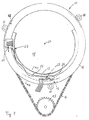
- the holding device 10 for influencing light from a Headlights are used to hold one or several electrically operated devices, such as color changers, Dimming flaps, light blinds or the like that are also not shown.
- a basic element of the holding device 10 is a ring 11, for example, a mounting plate can be mounted, the aforementioned facilities and with which these facilities are rotatable about an axis of rotation 20, which in FIGS. 1 and 3 is perpendicular to the image plane.
- a circumferential tire 12 is arranged on the side of the ring 11, which has an E-shaped profile radially on the outside, the one circumferential groove 13 thus formed for receiving of at least three evenly over the circumference of the Light emission of the headlamp arranged in a distributed manner, in each case rotatably mounted, especially ball or needle bearing, Bearing rollers 15 is used.
- the other circumferential groove 14 is used Inclusion of a drive chain 16 or alternatively a drive belt, wherein the drive chain 16 with a pinion 17 one electric motor mounted on the headlight, in particular one Stepper or geared motor is coupled. So that take away of the ring 11 and thus the rotatable part of the holding device 10, is ensured by the drive chain 16, this is on at least one point with the ring 11 or with this connected tires 12 connected. At the same time, this fixation the chain an angle of rotation limitation for the holding device 10th
- the holding device 10 and that in FIGS. 1 to 3 Mounting plate, not shown, have a central through opening 18 for the light from the headlights so that the holding device 10, the axis of rotation 20 completely at a distance embraces.
- the holding device 10 limits the light emission of the headlamp based on their circumference Arrangement in front of the headlight's light emission.
- the electrical connection to the rotatable part of the electrical operated device is manufactured by a feed cable 19, which is designed as a flat cable.
- a section of the Feed cable 19 extends through one through the Holding device 10 formed circumferential channel 21, one flat side of the axis of rotation 20 faces.
- Another one each Cable section, in particular one end, is stationary relative to the stage spotlight, or to one with the Stage lights connected fastener, and to the rotatable part of the holding device 10 positioned, especially clamped.
- the axis of rotation of the holding device is in Figures 1 and 3 with the reference numeral 20th featured. This axis of rotation is preferably aligned with the optical axis of the stage spotlight.
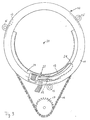
- the feed cable 19 is below Formed a reversing loop 24 placed so that it is without Risk of upsetting when the holding device 10 rotates is moved within the circumferential channel.
- the reverse loop 24 changes its position within the circumferential channel 21, in each case by about half the angle of rotation of the Holding device 10.
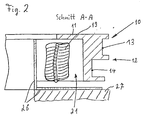
- FIG. 2 forms on the Holding device 10 or its ring 11 arranged, in particular molded, tires 12 with the ring 11 radially an L-profile on the inside.
- This L-profile limits together with a complementary, fixed relative to the headlight arranged L-profile 26, the circumferential channel 21.
- the L-profile 26 extends over a circumferential angle that is the maximum Angle of rotation of the holding device 10 corresponds, for example over a circumferential angle of at least 180 ° to 270 °.
- the complementary L-profile is the correspondingly long and peripheral channel 21 essentially closed on all sides formed for receiving the feed cable 19.
- Fig. 2 is also a piece of one designed as a front plate 27 Fastener to recognize that with the The headlight is connected and the aperture angle is like an aperture of the headlight defined.
- the L-profile 26 is attached to the front panel 27.
- the front panel 27 can either a component of the headlight, a separate one Component or part of the facility.
- the pinion 17 is also rotatably mounted on the front plate 27 and in this way, as well as that associated with the pinion 17 Drive, mounted on the front plate 27.
- the mirror images form those facing each other L profiles essentially closed on all sides Channel with rectangular or square Cross-section.
- the feed cable 19, which is designed as a flat cable is kept secure within this channel. Besides, will sufficient radial space for the formation of the mentioned Reverse loop 24 created.
- the axial distance of the rotatably mounted holding device 10 from the front plate 27 is through the mentioned bearing rollers 15th guaranteed due to their placement in the in FIG upper circumferential groove 13.
- bearing rollers 15 can also be that of FIG. 2 be assigned to the lower circumferential groove 14. Then the Inclusion of the drive chain 16 within the upper circumferential groove 13.
- a defined guidance of the supply cable closed by a cross section framed channel guaranteed.
- the channel prevented in particular evading the reverse loop to the outside and the associated disruptive effect mentioned at the beginning.
- the holding device 30 shown in FIG. 4 is for holding one electrically operated device can be used to influence of light from a headlight with the headlight is connectable.
- the octagonal ring 48 on Light emission of the headlights attached that he the one Light has a dimming effect all around.
- the octagonal Ring 48 is part of the fastener 31 or is with the fastener 31 when mounting the holding device 30 connectable.
- Four eight are shown uniformly in FIG Screw connections distributed over the octagonal ring 48 49 to an annular plate of the fastener 31.
- the electrically operated part can in particular be a Anti-glare flap that is opened by an electric motor or can be closed.
- the electrically powered part is connected to the rotating ring 32.
- the rotating ring 32 surrounds one in a central potential Light propagation direction 28 rotating axis 20 all around in Distance. It is about the axis of rotation 20 relative to the fastener 31 rotatably mounted.
- the holding device has 30 an annular ring (not shown) between the fastening element 31 and the rotary ring 32 arranged rotary bearing, preferably a ball bearing.
- a rotary movement can, for example, that described with reference to FIGS. 1 and 3 Drive arrangement can be used.
- a flat cable 39 supply cable from a connector 43 on the outer periphery of the fastener 31 along via a cable deflection roller 33 on which the flat cable 39 is deflected approximately in the reverse direction up to electrically operated part of the facility.
- the flat cable 39 ends at a rotary stop 47 in the right half of the picture.
- the flat cable 39 fixed relative in another way to the rotating element 32 or to the electrically operated part to position the facility.
- the third cable section 42 is under tension in a continuous range of rotational positions.
- the tension is applied by a transmission element 36 formed from a pull cord 37 and a helical spring 38.
- the third cable section 42 also exerts a tensile force on the transmission element 36 which causes a tension of the transmission element 36.
- the transmission element 36 is connected at its first end to the outer circumference of the fastening element 31. At its second end 45 it is connected to a rotary stop 47 which can be seen in FIGS. 4 and 5 in the left half of the figure.
- the helical spring 38 connects the rotary stop 47 to the end of the pull cord 37.
- the cable deflection roller 33 has a central, axial bore or recess in which a shaft 53 is arranged.
- the shaft 53 is at its ends each provided with an external thread, one on each Nut 52 is screwed on. One end protrudes a hole in a connecting plate 46 through to the side of the connecting plate facing away from the cable deflection roller 33 46.
- the drawstring pulley 34 connected to the connecting plate 46.
- the cable deflection roller 33 has a profile rectangular groove 50 for receiving the flat cable 39.
- the Drawstring pulley 34 has a conical profile tapering groove 51 for receiving the pull cord 37.
- the groove-like tread 35 only a small groove profile depth, d. H. the supernatant of the two Walls laterally on the tread 35 in the radial direction to the outside is small.
- the device according to the invention in particular by the is particularly preferred embodiment described above reliable routing of a supply cable within of a defined spatial area over a continuous range of rotational positions of the device guaranteed. Due to the special construction of the Holding device of the device is handling, especially the assembly and maintenance, compared to the facility already known facilities simplified.
Landscapes
- Engineering & Computer Science (AREA)
- General Engineering & Computer Science (AREA)
- Physics & Mathematics (AREA)
- Spectroscopy & Molecular Physics (AREA)
- Lighting Device Outwards From Vehicle And Optical Signal (AREA)
- Non-Portable Lighting Devices Or Systems Thereof (AREA)
- Circuit Arrangements For Discharge Lamps (AREA)
- Storing, Repeated Paying-Out, And Re-Storing Of Elongated Articles (AREA)
Abstract
Description
- Fig. 1
- den wesentlichen Teil einer an dem Lichtaustritt eines nicht näher dargestellten Scheinwerfers drehbar gelagerten Haltevorrichtung in schematischer Draufsicht,
- Fig. 2
- die Konstruktion gemäß Fig. 1 im Schnitt längs der Linie A-A in Fig. 1 und
- Fig. 3
- die Haltevorrichtung gemäß Fig. 1 in einer gegenüber Fig. 1 geänderten Drehstellung.
- Fig. 4
- eine perspektivische Darstellung einer Haltevorrichtung eines zweiten Ausführungsbeispiels der Erfindung,
- Fig. 5
- eine weitere perspektivische Darstellung der Haltevorrichtung in Teilansicht und
- Fig. 6
- eine Seitenansicht zweier miteinander verbundener Umlenkrollen der Haltevorrichtung gemäß Fig. 4 und 5.
- 10
- Haltevorrichtung
- 11
- Ring
- 12
- Reifen
- 13
- Umfangsnut
- 14
- Umfangsnut
- 15
- Lagerrolle
- 16
- Antriebskette
- 17
- Ritzel
- 18
- Durchgangsöffnung
- 19
- Zuführungskabel
- 20
- Drehachse
- 21
- Umfangskanal
- 22
- Kabel-Klemmstelle am Scheinwerfer
- 23
- Kabel-Klemmstelle am Drehelement
- 24
- Umkehrschleife
- 25
- Drehrichtung
- 26
- L-Profil
- 27
- Frontplatte
- 28
- zentrale potentielle Lichtausbreitungsrichtung
- 30
- Haltevorrichtung
- 31
- Befestigungselement
- 32
- Drehring
- 33
- Kabel-Umlenkrolle
- 34
- Zugschnur-Umlenkrolle
- 35
- nutartig bewandete Lauffläche
- 36
- Übertragungselement
- 37
- Zugschnur
- 38
- Schraubenfeder
- 39
- Flachkabel
- 40
- erster Kabelabschnitt
- 41
- zweiter Kabelabschnitt
- 42
- dritter Kabelabschnitt
- 43
- Anschlußstecker
- 44
- erstes Ende
- 45
- zweites Ende
- 46
- Verbindungsplatte
- 47
- Drehanschlag
- 48
- 8-eckiger Ring
- 49
- Schraubverbindung
- 50
- Nut
- 51
- Nut
- 52
- Mutter
- 53
- Welle
- 54
- Welle
Claims (18)
- Elektrisch betriebene Einrichtung, insbesondere elektromotorisch angetriebene Einrichtung, wie Farbwechsler, Abblendklappe, Lichtjalousie oder dgl., zum Beeinflussen von Licht aus einem Scheinwerfer, insbesondere aus einem Bühnenscheinwerfer, mit einer Haltevorrichtung (10, 30), die zum Halten der Einrichtung über ein, insbesondere ringartiges Befestigungselement (31) mit dem Scheinwerfer verbindbar ist und die ein, insbesondere ringartiges Drehelement (11, 12, 32) aufweist, das um eine in eine potentielle Lichtausbreitungsrichtung (28) verlaufende Drehachse (20) relativ zu dem Befestigungselement (31) drehbar, insbesondere drehangetrieben, ist, wobei sich das Befestigungselement (31) und/oder das Drehelement (11, 12, 32) zumindest teilweise mit Abstand um die Drehachse (20) herum erstreckt,
dadurch gekennzeichnet, daß
ein elektrisches Zuführungskabel (19, 39) für die Einrichtung, das an einem ersten Kabelabschnitt (22, 40) ortsfest relativ zu dem Befestigungselement (31) und an einem zweiten Kabelabschnitt (23, 41) ortsfest relativ zu dem Drehelement (11, 12, 32) positioniert bzw. positionierbar ist, in einem etwa in Umfangsrichtung verlaufenden dritten Kabelabschnitt (42), der zwischen dem ersten (22, 40) und dem zweiten (23, 41) Kabelabschnitt unter Ausbildung einer Umkehrschleife (24) derart in Umkehrrichtung zurückführt, daß sich bei Drehung der Haltevorrichtung (10, 30) die Position der Umkehrschleife relativ zu dem ersten (22, 40) und relativ zu dem zweiten (23, 41) Kabelabschnitt ändert. - Einrichtung nach Anspruch 1,
dadurch gekennzeichnet, daß
das Zuführungskabel (19) als Flachkabel ausgebildet ist und sich in den dritten Kabelabschnitt mit der Flachseite etwa parallel zur Drehachse (20) der Haltevorrichtung (10) erstreckt. - Einrichtung nach Anspruch 1 oder 2,
dadurch gekennzeichnet, daß
das Zuführungskabel (19) sich innerhalb eines zwischen der Haltevorrichtung (10) und dem Bühnenscheinwerfer ausgebildeten Umfangskanals (21) erstreckt. - Einrichtung nach Anspruch 3,
dadurch gekennzeichnet, daß
die Haltevorrichtung (10) einen Montagering (11) sowie eine darauf montierte Montageplatte mit einer zentralen Durchgangsöffnung (18) für den Lichtaustritt umfaßt. - Einrichtung nach einem der Ansprüche 1 bis 4,
dadurch gekennzeichnet, daß
ein Drehlager zwischen Bühnenscheinwerfer und Haltevorrichtung (10) durch einen an der Haltevorrichtung (10) angeordneten Reifen (12) einerseits und durch am Bühnenscheinwerfer in Zuordnung zum Reifen (12) wenigstens drei gleichmäßig über dessen Umfang verteilt angeordnete und an diesem abrollbare Lagerrollen (15) andererseits - bzw. umgekehrt - gebildet ist. - Einrichtung nach Anspruch 5,
dadurch gekennzeichnet, daß
der an der Haltevorrichtung (10) angeordnete Reifen (12) radial außenseitig als E-Profil ausgebildet ist, wobei die eine Umfangsnut (13) zur Aufnahme der wenigstens drei Lagerrollen (15) und die andere Umfangsnut (14) zur Aufnahme einer Antriebskette (16) oder eines Antriebsriemens dient, die bzw. der mit einem Ritzel (17) oder einer Antriebsscheibe eines am Bühnenscheinwerfer montierten Elektromotors, insbesondere Schritt- oder Getriebemotors, gekoppelt ist. - Einrichtung nach Anspruch 5 oder 6,
dadurch gekennzeichnet, daß
der an der Haltevorrichtung (10) angeordnete Reifen (12) radial innenseitig als L-Profil ausgebildet ist, das im montierten Zustand der Haltevorrichtung (10) mit einem umgekehrt am Bühnenscheinwerfer um dessen Lichtaustritt herum montierten L-Profil (26) den Umfangskanal (21) für die Aufnahme des Zuführungskabels (19) begrenzt. - Einrichtung nach Anspruch 7,
dadurch gekennzeichnet, daß
das am Bühnenscheinwerfer sich um den Lichtaustritt herum erstreckende L-Profil (26) ein Profilabschnitt ist, der sich über einen Umfangswinkel erstreckt, der dem maximalen Drehwinkel der Haltevorrichtung (10) entspricht, insbesondere über einen Winkel von wenigstens 180° bis etwa 270°, so daß ein entsprechend langer und nach allen Seiten hin im wesentlichen geschlossener Umfangskanal (21) für die Aufnahme des Zuführungskabels (19) definiert ist, und zwar so, daß die Umkehrschleife (24) des Zuführungskabels (19) innerhalb des Umfangskanals (21) zwängungsfrei der Drehbewegung der Haltevorrichtung (10) folgen kann. - Einrichtung nach einem der Ansprüche 1 bis 8,
dadurch gekennzeichnet, daß
der dritte Kabelabschnitt (42) durch ein Umlenkelement (33) unter Ausbildung der Umkehrschleife etwa in Umkehrrichtung umgelenkt ist oder umlenkbar ist und daß das Umlenkelement (33) entlang einer Führung (35) an einem Außenumfang des Drehelementes (32) und/oder des Befestigungselementes (31) derart bewegbar ist, daß in einem kontinuierlichen Bereich von Drehstellungen der dritte Kabelabschnitt (42) unter Zugspannung steht. - Einrichtung nach Anspruch 9,
dadurch gekennzeichnet, daß
die Haltevorrichtung (30) ein längliches, zumindest in einem Abschnitt reversibel biegbares Übertragungselement (36) zum Übertragen einer Zugkraft auf den dritten Kabelabschnitt (42) aufweist, daß das Befestigungselement (32) mit einem ersten Ende (44) des Übertragungselementes (36) verbunden ist und daß das Übertagungselement (36) sich etwa in Umfangsrichtung erstreckt, durch ein entlang der Führung (35) bewegbares Umlenkelement (34) etwa in Umkehrrichtung umgelenkt ist und an einem zweiten Ende (45) mit dem Drehelement (32) verbunden ist. - Einrichtung nach Anspruch 10,
dadurch gekennzeichnet, daß
das Übertragungselement (36) ein elastisches Zugelement (38) zum Aufbringen der Zugspannung enthält. - Einrichtung nach Anspruch 11,
dadurch gekennzeichnet, daß
das Zugelement (38) eine Schraubenfeder ist. - Einrichtung nach einem der Ansprüche 10 bis 12,
dadurch gekennzeichnet, daß
das Drehelement (32) einen Drehanschlag (47) aufweist, mit dem das zweite Ende (45) des Übertragungselementes (36) verbunden ist. - Einrichtung nach einem der Ansprüche 10 bis 13,
dadurch gekennzeichnet, daß
das Umlenkelement (33) nach Anspruch 9 ein erstes Umlenkelement ist, daß das Umlenkelement (34) nach Anspruch 10 ein zweites Umlenkelement ist und daß die beiden Umlenkelemente (33; 34) in Umfangsrichtung hintereinander und in einer festen Position relativ zueinander angeordnet sind. - Einrichtung nach einem der Ansprüche 9 bis 14,
dadurch gekennzeichnet, daß
das Umlenkelement (33) nach Anspruch 9 bzw. mindestens eines der Umlenkelemente (33; 34) nach Anspruch 14 eine Umlenkrolle mit einer Nut (50; 51) zur Führung des Zuführungskabels (39) bzw. des Übertragungselementes (36) ist. - Einrichtung nach Anspruch 15,
dadurch gekennzeichnet, daß
die mindestens eine Umlenkrolle so, vorzugsweise auf einer Welle (53; 54), drehbar gelagert ist, daß sie bei Verdrehung des Drehelementes (32) an der Führung (35) abrollt. - Einrichtung nach einem der Ansprüche 9 bis 16,
dadurch gekennzeichnet, daß
das Drehelement (32) an seinem Außenumfang eine in Umfangsrichtung verlaufende, nutartig seitlich bewandete Lauffläche hat, die die Führung (35) für das Umlenkelement bzw. die Umlenkelemente (33; 34) ist. - Einrichtung nach Anspruch 17,
dadurch gekennzeichnet, daß
das Zuführungskabel (39) als Flachkabel ausgebildet ist, das so angeordnet oder anordenbar ist, daß sich in dem dritten Kabelabschnitt (42) eine flache Seite ungefähr entlang der Lauffläche erstreckt.
Applications Claiming Priority (4)
| Application Number | Priority Date | Filing Date | Title |
|---|---|---|---|
| DE29705129U | 1997-03-20 | ||
| DE29705129U DE29705129U1 (de) | 1997-03-20 | 1997-03-20 | Beleuchtungseinrichtung |
| DE29713757U DE29713757U1 (de) | 1997-08-01 | 1997-08-01 | Elektrisch betriebene Einrichtung für Scheinwerfer |
| DE29713757U | 1997-08-01 |
Publications (3)
| Publication Number | Publication Date |
|---|---|
| EP0866262A2 true EP0866262A2 (de) | 1998-09-23 |
| EP0866262A3 EP0866262A3 (de) | 2000-11-02 |
| EP0866262B1 EP0866262B1 (de) | 2004-10-06 |
Family
ID=26060099
Family Applications (1)
| Application Number | Title | Priority Date | Filing Date |
|---|---|---|---|
| EP98105133A Expired - Lifetime EP0866262B1 (de) | 1997-03-20 | 1998-03-20 | Elektrisch betriebene Einrichtung für Scheinwerfer |
Country Status (4)
| Country | Link |
|---|---|
| EP (1) | EP0866262B1 (de) |
| AT (1) | ATE278907T1 (de) |
| DE (1) | DE59812055D1 (de) |
| ES (1) | ES2230632T3 (de) |
Family Cites Families (3)
| Publication number | Priority date | Publication date | Assignee | Title |
|---|---|---|---|---|
| DE8519583U1 (de) * | 1985-07-12 | 1986-11-27 | Quartzcolor Ianiro S.p.A., Rom/Roma | Fernsteuerbare Beleuchtungseinrichtung, insbesondere für Theater, Photo-, Film- und Fernsehstudios u. dgl. |
| US4729071A (en) * | 1986-11-03 | 1988-03-01 | Altman Stage Lighting Co. | Low-inertial beam direction lighting system |
| GB2270969A (en) * | 1992-09-29 | 1994-03-30 | Strand Lighting Ltd | Luminaire closure assembly |
-
1998
- 1998-03-20 AT AT98105133T patent/ATE278907T1/de active
- 1998-03-20 ES ES98105133T patent/ES2230632T3/es not_active Expired - Lifetime
- 1998-03-20 DE DE59812055T patent/DE59812055D1/de not_active Expired - Lifetime
- 1998-03-20 EP EP98105133A patent/EP0866262B1/de not_active Expired - Lifetime
Non-Patent Citations (1)
| Title |
|---|
| None |
Also Published As
| Publication number | Publication date |
|---|---|
| EP0866262B1 (de) | 2004-10-06 |
| DE59812055D1 (de) | 2004-11-11 |
| ATE278907T1 (de) | 2004-10-15 |
| EP0866262A3 (de) | 2000-11-02 |
| ES2230632T3 (es) | 2005-05-01 |
Similar Documents
| Publication | Publication Date | Title |
|---|---|---|
| DE4318607C2 (de) | Weitwinkelscharnier mit einem Öffnungswinkel von ca. 180 DEG | |
| DE69735102T2 (de) | Tragebandwickelvorrichtung für fensterabdeckung | |
| DE602004001992T2 (de) | Getriebe mit schraube, mutter und seil | |
| DE2729491A1 (de) | Streifenvorhang | |
| EP4015848B1 (de) | Seilantriebsvorrichtung eines kraftfahrzeugs | |
| DE69508549T2 (de) | Wickelvorrichtung für Tragebänder von Jalousien | |
| EP0313809B1 (de) | Rolladen für Dachfenster | |
| DE19610268A1 (de) | Rolloeinrichtung für ein Isolierglaselement | |
| AT399370B (de) | Jalousie | |
| DE2831870A1 (de) | Universal-seilzugfensterheber | |
| DE3415551C2 (de) | Rolladen für Dachfenster | |
| DE69703620T2 (de) | Elastische mittel zum aufrollen eines rollvorhangs | |
| DE2303782C3 (de) | ||
| DE3037725A1 (de) | Rafflamellenstore | |
| DE2853763A1 (de) | Vertikaljalousie mit um ihre lotrechte achse schwenkbaren sowie seitlich verschiebbaren lamellen | |
| EP0866262B1 (de) | Elektrisch betriebene Einrichtung für Scheinwerfer | |
| EP0377844B1 (de) | Aufzugsvorrichtung eines Vorhanges | |
| DE4105865A1 (de) | Vorrichtung zum auf- und abwickeln von behaengen, insbesondere markisenstoffen, rollaeden, gittern oder dergleichen | |
| DE4327230C1 (de) | Rolladen für Dachfenster | |
| EP0651123A1 (de) | Anbauvorrichtung für den Anschluss einer Torblattbetätigungswelle an unterschiedliche motorische Antriebsaggregate | |
| DE29713757U1 (de) | Elektrisch betriebene Einrichtung für Scheinwerfer | |
| DE102009001667A1 (de) | Aktuator | |
| EP0662559A1 (de) | Türband | |
| EP0839251A1 (de) | Vorrichtung zum öffnen eines fensterflügels | |
| EP3486421B1 (de) | Senkrechtmarkise |
Legal Events
| Date | Code | Title | Description |
|---|---|---|---|
| PUAI | Public reference made under article 153(3) epc to a published international application that has entered the european phase |
Free format text: ORIGINAL CODE: 0009012 |
|
| AK | Designated contracting states |
Kind code of ref document: A2 Designated state(s): AT DE ES FR GB IT |
|
| AX | Request for extension of the european patent |
Free format text: AL;LT;LV;MK;RO;SI |
|
| PUAL | Search report despatched |
Free format text: ORIGINAL CODE: 0009013 |
|
| AK | Designated contracting states |
Kind code of ref document: A3 Designated state(s): AT BE CH DE DK ES FI FR GB GR IE IT LI LU MC NL PT SE |
|
| AX | Request for extension of the european patent |
Free format text: AL;LT;LV;MK;RO;SI |
|
| 17P | Request for examination filed |
Effective date: 20001208 |
|
| AKX | Designation fees paid |
Free format text: AT DE ES FR GB IT |
|
| GRAP | Despatch of communication of intention to grant a patent |
Free format text: ORIGINAL CODE: EPIDOSNIGR1 |
|
| GRAS | Grant fee paid |
Free format text: ORIGINAL CODE: EPIDOSNIGR3 |
|
| GRAA | (expected) grant |
Free format text: ORIGINAL CODE: 0009210 |
|
| RIC1 | Information provided on ipc code assigned before grant |
Ipc: 7F 21V 21/30 B Ipc: 7F 21S 8/00 A |
|
| AK | Designated contracting states |
Kind code of ref document: B1 Designated state(s): AT DE ES FR GB IT |
|
| REG | Reference to a national code |
Ref country code: GB Ref legal event code: FG4D Free format text: NOT ENGLISH |
|
| REF | Corresponds to: |
Ref document number: 59812055 Country of ref document: DE Date of ref document: 20041111 Kind code of ref document: P |
|
| GBT | Gb: translation of ep patent filed (gb section 77(6)(a)/1977) |
Effective date: 20050201 |
|
| REG | Reference to a national code |
Ref country code: ES Ref legal event code: FG2A Ref document number: 2230632 Country of ref document: ES Kind code of ref document: T3 |
|
| PLBE | No opposition filed within time limit |
Free format text: ORIGINAL CODE: 0009261 |
|
| STAA | Information on the status of an ep patent application or granted ep patent |
Free format text: STATUS: NO OPPOSITION FILED WITHIN TIME LIMIT |
|
| ET | Fr: translation filed | ||
| 26N | No opposition filed |
Effective date: 20050707 |
|
| PGFP | Annual fee paid to national office [announced via postgrant information from national office to epo] |
Ref country code: ES Payment date: 20070308 Year of fee payment: 10 |
|
| REG | Reference to a national code |
Ref country code: ES Ref legal event code: FD2A Effective date: 20080322 |
|
| PG25 | Lapsed in a contracting state [announced via postgrant information from national office to epo] |
Ref country code: ES Free format text: LAPSE BECAUSE OF NON-PAYMENT OF DUE FEES Effective date: 20080322 |
|
| REG | Reference to a national code |
Ref country code: FR Ref legal event code: PLFP Year of fee payment: 19 |
|
| PG25 | Lapsed in a contracting state [announced via postgrant information from national office to epo] |
Ref country code: IT Free format text: LAPSE BECAUSE OF NON-PAYMENT OF DUE FEES Effective date: 20160320 |
|
| REG | Reference to a national code |
Ref country code: FR Ref legal event code: PLFP Year of fee payment: 20 |
|
| PGFP | Annual fee paid to national office [announced via postgrant information from national office to epo] |
Ref country code: FR Payment date: 20170327 Year of fee payment: 20 |
|
| PGFP | Annual fee paid to national office [announced via postgrant information from national office to epo] |
Ref country code: AT Payment date: 20170328 Year of fee payment: 20 Ref country code: GB Payment date: 20170328 Year of fee payment: 20 |
|
| PGFP | Annual fee paid to national office [announced via postgrant information from national office to epo] |
Ref country code: DE Payment date: 20170330 Year of fee payment: 20 |
|
| PG25 | Lapsed in a contracting state [announced via postgrant information from national office to epo] |
Ref country code: IT Free format text: LAPSE BECAUSE OF NON-PAYMENT OF DUE FEES Effective date: 20160320 |
|
| PGFP | Annual fee paid to national office [announced via postgrant information from national office to epo] |
Ref country code: IT Payment date: 20170323 Year of fee payment: 20 |
|
| PGRI | Patent reinstated in contracting state [announced from national office to epo] |
Ref country code: IT Effective date: 20170710 |
|
| REG | Reference to a national code |
Ref country code: DE Ref legal event code: R071 Ref document number: 59812055 Country of ref document: DE |
|
| REG | Reference to a national code |
Ref country code: GB Ref legal event code: PE20 Expiry date: 20180319 |
|
| PG25 | Lapsed in a contracting state [announced via postgrant information from national office to epo] |
Ref country code: GB Free format text: LAPSE BECAUSE OF EXPIRATION OF PROTECTION Effective date: 20180319 |
|
| REG | Reference to a national code |
Ref country code: AT Ref legal event code: MK07 Ref document number: 278907 Country of ref document: AT Kind code of ref document: T Effective date: 20180320 |