EP0867155A2 - Dispositif dentaire, électrode de référence et procédé permettant de déterminer l'état d'une couronne ou d'un bridge - Google Patents
Dispositif dentaire, électrode de référence et procédé permettant de déterminer l'état d'une couronne ou d'un bridge Download PDFInfo
- Publication number
- EP0867155A2 EP0867155A2 EP98103961A EP98103961A EP0867155A2 EP 0867155 A2 EP0867155 A2 EP 0867155A2 EP 98103961 A EP98103961 A EP 98103961A EP 98103961 A EP98103961 A EP 98103961A EP 0867155 A2 EP0867155 A2 EP 0867155A2
- Authority
- EP
- European Patent Office
- Prior art keywords
- dental
- reference electrode
- active part
- crown
- electrode
- Prior art date
- Legal status (The legal status is an assumption and is not a legal conclusion. Google has not performed a legal analysis and makes no representation as to the accuracy of the status listed.)
- Withdrawn
Links
Images


Classifications
-
- A—HUMAN NECESSITIES
- A61—MEDICAL OR VETERINARY SCIENCE; HYGIENE
- A61B—DIAGNOSIS; SURGERY; IDENTIFICATION
- A61B5/00—Measuring for diagnostic purposes; Identification of persons
- A61B5/45—For evaluating or diagnosing the musculoskeletal system or teeth
- A61B5/4538—Evaluating a particular part of the muscoloskeletal system or a particular medical condition
- A61B5/4542—Evaluating the mouth, e.g. the jaw
- A61B5/4547—Evaluating teeth
-
- A—HUMAN NECESSITIES
- A61—MEDICAL OR VETERINARY SCIENCE; HYGIENE
- A61B—DIAGNOSIS; SURGERY; IDENTIFICATION
- A61B5/00—Measuring for diagnostic purposes; Identification of persons
- A61B5/24—Detecting, measuring or recording bioelectric or biomagnetic signals of the body or parts thereof
-
- A—HUMAN NECESSITIES
- A61—MEDICAL OR VETERINARY SCIENCE; HYGIENE
- A61C—DENTISTRY; APPARATUS OR METHODS FOR ORAL OR DENTAL HYGIENE
- A61C19/00—Dental auxiliary appliances
- A61C19/04—Measuring instruments specially adapted for dentistry
-
- A—HUMAN NECESSITIES
- A61—MEDICAL OR VETERINARY SCIENCE; HYGIENE
- A61B—DIAGNOSIS; SURGERY; IDENTIFICATION
- A61B2562/00—Details of sensors; Constructional details of sensor housings or probes; Accessories for sensors
- A61B2562/02—Details of sensors specially adapted for in-vivo measurements
- A61B2562/0209—Special features of electrodes classified in A61B5/24, A61B5/25, A61B5/283, A61B5/291, A61B5/296, A61B5/053
- A61B2562/0215—Silver or silver chloride containing
-
- A—HUMAN NECESSITIES
- A61—MEDICAL OR VETERINARY SCIENCE; HYGIENE
- A61B—DIAGNOSIS; SURGERY; IDENTIFICATION
- A61B2562/00—Details of sensors; Constructional details of sensor housings or probes; Accessories for sensors
- A61B2562/02—Details of sensors specially adapted for in-vivo measurements
- A61B2562/0209—Special features of electrodes classified in A61B5/24, A61B5/25, A61B5/283, A61B5/291, A61B5/296, A61B5/053
- A61B2562/0217—Electrolyte containing
Definitions
- the invention relates to a dental device and a method for determining the state of a at least partially made of metal tooth crown or Dental bridge.
- the invention further relates to a Dental reference electrode for the dental Device as well as the method.
- amalgams for a long time they were at least partially made of metal existing dental crowns or dental bridges on teeth assembled, without any existing amalgam fillings to remove completely. If amalgam in direct Contact with, for example, gold crowns or gold bridges accelerated anodic at the amalgam Use corrosion.
- the corrosion products of the amalgam such as. Copper, tin, silver or mercury ions can be toxic to the gums. Under So much mercury is released that dangerous mercury allergies and serious Central nervous system disorders occur. Mercury ions get through the bloodstream and the Blood-brain barrier into the brain, the critical organ for Mercury accumulation. That's why it is indicated amalgam, which is under at least one tooth crown partly made of metal like one Gold crowns are located to remove completely.
- the sub-claims 2 to 8 relate to further advantageous configurations the device.
- the task is further solved with a Method comprising the features of claim 9.
- Die Subclaims 10 to 13 relate to further advantageous embodiments of the method.
- the task is further solved with a dental Reference electrode having the features of claim 14.
- the subclaims 15 to 21 relate to further advantageous embodiments of the Reference electrode.
- a dental crown or dental bridge is more general than one Restoration referred to as the restoration usually consists of metal or at least partially consists of metal, and in particular a precious metal such as for example gold is used.
- the restoration usually consists of metal or at least partially consists of metal, and in particular a precious metal such as for example gold is used.
- one such metallic restoration from, for example aesthetic reasons with a non-metallic coating like ceramics or porcelain, so that the entire restoration at least partially made of metal exists, but also additional non-metallic ones Shares includes.
- Most of time the visible tooth parts are covered with a coating for example ceramic or porcelain covered what is aesthetically pleasing.
- the invention is based on the knowledge that with a Measuring device the electrode potential of the tooth crown is measurable, and that from the measured potential or the measured voltage the presence of an anodic reaction below the tooth crown or dental bridge can be derived.
- An advantage of the invention is the fact that the Find an anodic response to the Presence of amalgam can be concluded.
- a Another advantage of the invention is that based on the measured value of the electrode potential the degree of corrosion can be deduced.
- a An essential advantage of the invention is that that the detection of amalgam under at least one restoration partly made of metal like one Dental crown or a dental bridge as well as the strength of the Corrosion without removing the tooth crown or the Dental bridge is possible.
- the invention allows one quick and non-destructive inspection of the condition of Dental crown or dental bridge and possibly existing amalgam or in general the condition of the tooth and thus an indication regarding the need to dismantle the tooth crown or the dental bridge, for the purpose of restoration or Extraction of the relevant tooth underneath.
- the anodic reaction can also indicate corrosion Dental crown or the dental bridge itself or on oxidizing indicate organic components.
- a dental reference electrode for electrochemical potential measurement in the oral cavity comprising an electrochemically active part consisting of a silver wire coated with silver chloride, whereby the silver wire in particular in the form of a simple or multiple loop is designed.
- the dental reference electrode is the active part covering, absorbent covering made in particular electrically insulating fibers, as well as a plastic or elastically deformable stem, inside of which a electrical connection which connects the active part with a Socket connects, electrically insulated from the outside is arranged progressively.
- Reference electrodes can be seen in the fact that they are robust and is precise, practical to use, is inexpensive to manufacture, and for a one-off Use as a disposable reference electrode for dental technology applications is conceivable.
- the allowed reference electrode according to the invention electrochemical or galvanic potentials of Restorations made at least partially of metal in the oral cavity quickly, precisely, effortlessly and inexpensive to determine.
- the measured potentials can give a doctor additional information about the Condition of at least partially metal Deliver restorations.
- the result measured potentials indications of corrosion processes, which run concealed under crowns or bridges.
- Such corrosion products can over the saliva also get into the digestive tract, and from there in other parts of the human organism get where they accumulate in an undesirable way can be.
- Figure 1 shows the device according to the invention.
- the top consists of one Gold alloy that can be similar to the crown material can.
- the tip can only be on its surface a layer of gold or a gold alloy be.
- the diameter of the tip is less than 2 mm, at foremost end preferably less than 0.5 mm.
- a small cylindrical can also be used as the contact tip 4 Serve pin, which on the cylindrical outside is insulated with plastic.
- the contact tip 4 is with an electrical lead 14 connected within the probe electrode 3 is arranged to extend.
- This Lead 14, designed as a metal wire, is from an insulation 5 surrounded. With the exception of the contact tip 4, the probe electrode 3 is thus electrical towards the outside highly isolated.
- the contact tip 4 protrudes less than 5 mm out of isolation 5.
- a handle 6 surrounds the Isolation 5 and is also ergonomically designed that the tactile electrode 3 is comfortable and easy to hold lies.
- the insulation 5 can form part of the handle 6.
- the electrical lead 14 is connected to a socket 7 connected.
- the socket 7 is a against externally electrically insulated connection cable 8 with a Voltage measuring device 12 connected.
- the device further comprises a reference electrode 9.
- the reference electrode 9 an active part 10 at the front end thereof on, which consists of a silver wire 10, which with Silver chloride is coated and such is appropriately shaped that the active part 10 in a patient's mouth is insertable.
- the silver wire 10 is with an electrically conductive derivative 15 connected, the derivative 15, which as a Metal wire is configured within the reference electrode 9 electrically highly insulated is arranged.
- the insulation 11 surrounds the derivative 15.
- the insulation 11 can be in the holder 13 of the reference electrode 9 be integrated.
- the reference electrode 9 is, with the exception of the active part 10, to the outside electrically highly insulated.
- the reference electrode 9 can be designed such that they can be hung in a Lower jaw is suitable, the active part 10 in the Mouth, preferably under the tongue.
- the silver wire 10 coated with silver chloride becomes such placed in the mouth that he has no dental crown or dental bridge touched, for example under the tongue.
- the silver wire 10 can ensure humidification with a covering of absorbent gauze, tampon or Fabric covered. The gauze, the tampon or that Tissue is inserted into the active part 10 prior to insertion Mouth, for example, with a dilute NaCl solution soaked.
- the active part 10 of the reference electrode 9 has a wire or an electrode made of silver / silver chloride well proven. Instead of a silver / silver chloride electrode in principle, other reference electrodes 9 be used. As a reference electrode 9 are general those with an active part 10 made of metal / metal oxide such as antimony / antimony oxide or Mercury / mercury oxide, or metal / metal chloride such as mercury / mercury chloride, or Suitable for metal / metal sulfate. As an active part 10 of the A reference electrode 9 is also suitable, for example Glass electrode.
- the arrester 15 of the reference electrode 9 is at the rear Provide end with a socket 16.
- the socket 16 is electrically insulated from the outside Connection cable 17 detachable with the voltage measuring device 12 connected.
- the voltage measuring device 12 makes it possible to determine the potential difference, or the voltage, between the probe electrode 3 and the reference electrode 9 or between the contact tip 4 and the active part 10, the voltage measuring device 12, for example, as a millivolt meter with an input -Resistance of more than 10 6 ohms.
- the voltage measuring device 12 has a display device (not shown) for displaying the measured voltage or for displaying the state of the tooth crown or dental bridge.
- the voltage measuring device can also have electronic components such as voltage dividers or amplifier circuits and in particular also digital electronics or a microprocessor.
- dental crowns 2 or dental bridges 2 are made of aesthetic Entirely, or only externally, for example with covered with a porcelain or ceramic layer. Also then the device according to the invention can be used. This is done through the porcelain or ceramic layer drilled a small hole on the gold base which the contact tip 4 of the probe electrode 3rd introduced, and the gold layer can be contacted. The hole is not of for the life of the tooth Meaning. The hole can be taken again after the measurement be cemented.
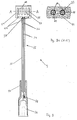
- the exemplary embodiment of a reference electrode 9 shown in FIG. 3 has an active part 10 with a silver wire 32 bent into a loop at the front end. In the region of this active part 10 having loops, the silver wire 32 is covered with a layer of silver chloride 33.
- An electrical connection 34 runs within the handle 35 between the active part 10 and a socket 36.
- the electrical connection 34 consists of a double-guided silver wire 32. This is connected to the socket 36 via a soldering point 38.
- the silver wire 32 running therein is surrounded by a highly insulating silicone tube 37. At the front end of the stem 35, the silver wire 32 is sealed into the silicone tube 37 with a silicone adhesive 39.
- a cylindrical plastic part 40 surrounds and insulates the outside of the solder joint 38, part of the socket 36 and the rear part of the silicone tube 37.
- the plastic part consists, for example, of polyacetal copolymer.
- the thickness of the electrical connection 34 is preferably selected such that it gives the handle 35 additional strength and also a plastic or elastic deformability, so that the handle 35 can be bent and hung into a patient's mouth as desired, comparable to a saliva ejector.
- the double guided silver wire 32 in the stem 35 has a diameter between 0.6 and 1.2 mm.
- the silver wire 32 is covered with a silver chloride layer 33, which has a thickness, as shown in FIG.
- the silver chloride layer 33 can be produced, for example, by anodizing in dilute chloride solution.
- the loop-shaped part 10 coated with silver chloride represents the electrochemically active surface of the reference electrode 9.
- This part 10 is covered with an absorbent covering 41 made of insulating fibers.
- This covering 41 preferably consists of an absorbent felt or fleece made of cotton fibers.
- the absorbent fleece 41 preferably has a thickness of more than 0.5 mm and can absorb at least 0.1 g of water per cm 2 .
- the absorbent fleece 41 is glued or sewn at individual points 42, so that it cannot be stripped from the active part 10 designed as a loop.
- the absorbent fleece 41 surrounds the silver wire loop in such a way that direct electrical contact between the loop and an at least partially metal restoration in the oral cavity is made impossible.
- the reference electrode 9 according to the invention has significant advantages by being very robust.
- the Reference electrode 9 according to the invention contains no parts made of glass, is shock and shatterproof, and also light and handy.
- the reference electrode 9 has, in particular also by the loop-shaped design of the electrochemically active part 10, a very good one Stability and current carrying capacity. Of the electrochemically active parts 10 has no pointed end on, making stab wounds impossible.
- the Silver chloride layer 33 has a uniform thickness, which prevents flaking.
- Reference electrode 9 is its simple handling, which thanks to the bendable handle, similar to a Saliva extractor, allows insertion under the tongue. A doctor needs therefore, the reference electrode 9 is not during the measurement to hold by hand.
- the reference electrodes 9 are used in dry condition can be stored for months. They are preferably in sealed plastic film packaging kept. Immediately before use the reference electrode 9 is removed from the packaging and connected to the connection cable 17 to the voltmeter 12. Of the active part 10, which with the absorbent casing 41st is then covered for a few seconds diluted, calibrated standard solution with choride ions submerged.
- the chloride ion solution should be one Have concentration at least that of corresponds to or exceeds natural saliva.
- the absorbent covering 41 When immersing the absorbent covering 41 also saturates Electrolyte solution. This will make an even one Guaranteed wetting of the silver chloride layer 33.
- the absorbent covering 41 for example a fleece Cotton fibers, soaks up so much electrolyte that the Concentration during the short time (a few seconds) the measurement on the active surface remains constant, and is precisely defined.
- the one soaked with electrolyte Cladding 41 also provides an extensive electrolytic Safe contact area to the saliva of the oral cavity. Since the absorbent covering is electrically non-conductive a direct electrical contact between the Silver wire loop of the active part 10 and one Restoration consisting at least partially of metal impossible.
- the reference electrode 9 according to the invention allows an extremely low-impedance measuring circuit.
- Another advantage of the embodiment according to FIG. 3 is that large distance between the soaked with electrolyte Wrapping 41 and the Lötstellle 38 to the socket 36. This provides additional certainty that when in use no electrolyte or no saliva to the solder joint 38 can reach. Should the electrolyte reach the solder joint could get there electrochemical reactions cause which falsify the potential measurements could.
- Reference electrode 9 is that it is standard can be manufactured very inexpensively. It is suitable therefore for a single use. You can in be packed and stored in a dry state and is in If required, ready to use extremely quickly. It it suffices to cover the electrochemically active part 10 41 immerse in electrolyte solution for a few moments, which is supplied together with the reference electrode 9 becomes.
- To measure the potential of at least partially restorations made of metal become the active one Part 10 with wrapping 41 in the mouth, preferably under put the tongue, and the stem 35 in the desired manner bent as shown in Fig. 4. Under Use of a probe electrode 3 with a noble metal tip 4, with which the subject to be examined at least partially Metal existing restoration can be contacted measured the electrochemical potential of the restoration will. The measurement takes only a few seconds.
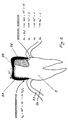
- Fig. 2 shows one Cross section through a tooth 1 with a gold crown 20, an amalgam filling 21 and one between the Amalgam filling 21, or tooth 1, and the Gold crown 20 triple layer of dental cement 22.
- the tooth 1 has grown into bone 24 and from gums 23 surround.
- the electrode potential of gold crowns and gold bridges is essentially determined by an electrochemical reaction, which can be described as a reduction of oxygen to hydrogen peroxide.
- Gold is a rather poor catalyst for the decomposition of peroxide and therefore the reduction down to the final stage water is suppressed.
- a potential of E is calculated 0.328 volts.
- amalgam corrosion the anodic processes can be described as follows Sn (in the amalgam) + H 2 0 ⁇ SnO + 2H + + 2e - Cu (in the amalgam) ⁇ Cu + + e - Hg (in amalgam) ⁇ Hg 2 2+ + 2e - Ag (in the amalgam) ⁇ Ag + + e -
- the device according to the invention and the method therefore allows a diagnosis of the tooth condition under one Dental bridge of the dental crown. Shows the potential measurement using a silver / silver chloride reference electrode a value which is more negative than -0.150 volts, should the tooth crown, resp. Dental bridge for renovation of the tooth underneath.
- the teeth with each other metallic conductive connection must be taken into account that the measured potential is a medium value for the affected teeth.
- the measurement then shows which teeth first again should be restored.
Landscapes
- Health & Medical Sciences (AREA)
- Life Sciences & Earth Sciences (AREA)
- Animal Behavior & Ethology (AREA)
- Biophysics (AREA)
- Veterinary Medicine (AREA)
- Engineering & Computer Science (AREA)
- Biomedical Technology (AREA)
- Public Health (AREA)
- General Health & Medical Sciences (AREA)
- Surgery (AREA)
- Physics & Mathematics (AREA)
- Molecular Biology (AREA)
- Medical Informatics (AREA)
- Heart & Thoracic Surgery (AREA)
- Pathology (AREA)
- Oral & Maxillofacial Surgery (AREA)
- Dentistry (AREA)
- Epidemiology (AREA)
- Physical Education & Sports Medicine (AREA)
- Orthopedic Medicine & Surgery (AREA)
- Rheumatology (AREA)
- Dental Tools And Instruments Or Auxiliary Dental Instruments (AREA)
Applications Claiming Priority (6)
| Application Number | Priority Date | Filing Date | Title |
|---|---|---|---|
| CH73797 | 1997-03-27 | ||
| CH737/97 | 1997-03-27 | ||
| CH76897 | 1997-04-03 | ||
| CH768/97 | 1997-04-03 | ||
| CH2822/97 | 1997-12-05 | ||
| CH282297 | 1997-12-05 |
Publications (2)
| Publication Number | Publication Date |
|---|---|
| EP0867155A2 true EP0867155A2 (fr) | 1998-09-30 |
| EP0867155A3 EP0867155A3 (fr) | 1999-02-03 |
Family
ID=27172372
Family Applications (1)
| Application Number | Title | Priority Date | Filing Date |
|---|---|---|---|
| EP98103961A Withdrawn EP0867155A3 (fr) | 1997-03-27 | 1998-03-06 | Dispositif dentaire, électrode de référence et procédé permettant de déterminer l'état d'une couronne ou d'un bridge |
Country Status (1)
| Country | Link |
|---|---|
| EP (1) | EP0867155A3 (fr) |
Cited By (3)
| Publication number | Priority date | Publication date | Assignee | Title |
|---|---|---|---|---|
| DE19917980C1 (de) * | 1999-04-14 | 2000-04-06 | Georg Keller | Zahnmedizinisches Verfahren zum Auffinden von Dentallegierungen |
| EP1080684A3 (fr) * | 1999-09-03 | 2003-04-16 | Nihon Kohden Corporation | Capteur pour la mesure de la concentration en ion ou de gaz dans les tissus vivants |
| CN115666710A (zh) * | 2020-05-27 | 2023-01-31 | 加伍德医疗设备有限公司 | 用于处理感染的金属牙科植入物的牙冠和系统 |
Family Cites Families (3)
| Publication number | Priority date | Publication date | Assignee | Title |
|---|---|---|---|---|
| EP0283962A3 (fr) * | 1987-03-19 | 1989-11-15 | Dentsply Management Corp. | Procédé de mesure des gaz d'une poche périodontique |
| DE9003076U1 (de) * | 1990-03-14 | 1991-04-11 | Werner Eidam Medizintechnologie GmbH, 6307 Linden | Medizinisches Meßgerät |
| JP2740587B2 (ja) * | 1991-07-18 | 1998-04-15 | 工業技術院長 | 微小複合電極およびその製造方法 |
-
1998
- 1998-03-06 EP EP98103961A patent/EP0867155A3/fr not_active Withdrawn
Non-Patent Citations (1)
| Title |
|---|
| None |
Cited By (3)
| Publication number | Priority date | Publication date | Assignee | Title |
|---|---|---|---|---|
| DE19917980C1 (de) * | 1999-04-14 | 2000-04-06 | Georg Keller | Zahnmedizinisches Verfahren zum Auffinden von Dentallegierungen |
| EP1080684A3 (fr) * | 1999-09-03 | 2003-04-16 | Nihon Kohden Corporation | Capteur pour la mesure de la concentration en ion ou de gaz dans les tissus vivants |
| CN115666710A (zh) * | 2020-05-27 | 2023-01-31 | 加伍德医疗设备有限公司 | 用于处理感染的金属牙科植入物的牙冠和系统 |
Also Published As
| Publication number | Publication date |
|---|---|
| EP0867155A3 (fr) | 1999-02-03 |
Similar Documents
| Publication | Publication Date | Title |
|---|---|---|
| DE60114159T2 (de) | Messung von stoffen in flüssigkeiten | |
| EP0170998B1 (fr) | Procédé pour la détection électrochimique de la concentration en oxygène | |
| Ben-Aryeh et al. | Clinical science whole-saliva secretion rates in old and young healthy subjects | |
| DE69324376T2 (de) | Vorrichtung zur in-vivo bestimmung der konzentration von metaboliten in einer körperflussigkeit | |
| DE2502621C3 (de) | Messung elastischer und dielektrischer Eigenschaften der Membran lebender Zellen | |
| DE2121047C3 (de) | Iridiumelektrode für pH-Wert-Messungen von Flüssigkeiten, insbesondere von Blut, und Verfahren zu ihrer Herstellung | |
| DE4422068A1 (de) | Elektrokatalytischer Glucosesensor | |
| DE69728065T2 (de) | Vorrichtung zum nachweis von karies | |
| DE2613355C3 (de) | Verfahren zur Herstellung von Kathoden für polaropraphische Messungen | |
| DE102009014902A1 (de) | Helicobacter pylori-Sensor | |
| EP0951875A2 (fr) | Matériau servant à l'obturation des canaux radiculaires et méthode de fabrication | |
| EP0867155A2 (fr) | Dispositif dentaire, électrode de référence et procédé permettant de déterminer l'état d'une couronne ou d'un bridge | |
| US6090053A (en) | Dental device and method and also reference electrode for determining the state of a tooth crown or tooth bridge | |
| EP0539814A2 (fr) | Capteur électrocatalytique de glucose | |
| AT407825B (de) | Vorrichtung zum messen von potentialunterschieden zwischen metallischen implantatmaterial und körpergewebe | |
| EP0221969B1 (fr) | AGENCEMENT D'ELECTRODES DU TYPE A INSERTION POUR MESURE DU pO 2? CONTINUE DANS DU TISSU DE PEAU VIVANT | |
| DE2418397B2 (de) | Verfahren zum Herstellen einer Elektrode für polarographische Messungen in physiologischen Medien | |
| DE2548219C3 (de) | Verfahren zur Behandlung von Milchproben für die eine Katalase-Analyse einschließende Milchqualitätskontrolle | |
| EP2872043A1 (fr) | Procédé de fabrication d'un instrument à capteur et instrument à capteur | |
| EP3706627A2 (fr) | Dispositif et procédé pour déterminer l'impédance au niveau d'une dent | |
| EP0333780A1 (fr) | Dispositif pour analyse electrochimique ''in vivo'' d'implants metalliques | |
| DE19714397B4 (de) | Vorrichtung zum Bestimmen des elektrischen Widerstandes von Zähnen | |
| DE19917980C1 (de) | Zahnmedizinisches Verfahren zum Auffinden von Dentallegierungen | |
| AT3567U1 (de) | Vorrichtung zum messen von elektrischen ladungen in bestimmten anatomischen bereichen | |
| DE29918851U1 (de) | Vorrichtung zum Messen von elektrischen Ladungen in bestimmten anatomischen Bereichen, die sich auch in feuchter Umgebung befinden, wie beispielsweise die Mundhöhle |
Legal Events
| Date | Code | Title | Description |
|---|---|---|---|
| PUAI | Public reference made under article 153(3) epc to a published international application that has entered the european phase |
Free format text: ORIGINAL CODE: 0009012 |
|
| AK | Designated contracting states |
Kind code of ref document: A2 Designated state(s): AT BE CH DE DK FI FR GB IE IT LI NL SE |
|
| AX | Request for extension of the european patent |
Free format text: AL;LT;LV;MK;RO;SI |
|
| PUAL | Search report despatched |
Free format text: ORIGINAL CODE: 0009013 |
|
| AK | Designated contracting states |
Kind code of ref document: A3 Designated state(s): AT BE CH DE DK ES FI FR GB GR IE IT LI LU MC NL PT SE |
|
| AX | Request for extension of the european patent |
Free format text: AL;LT;LV;MK;RO;SI |
|
| 17P | Request for examination filed |
Effective date: 19990723 |
|
| AKX | Designation fees paid |
Free format text: AT BE CH DE DK FI FR GB IE IT LI NL SE |
|
| STAA | Information on the status of an ep patent application or granted ep patent |
Free format text: STATUS: THE APPLICATION HAS BEEN WITHDRAWN |
|
| 18W | Application withdrawn |
Withdrawal date: 20020422 |