EP0867752B1 - Elektrochrome Vorrichtung - Google Patents
Elektrochrome Vorrichtung Download PDFInfo
- Publication number
- EP0867752B1 EP0867752B1 EP97400702.3A EP97400702A EP0867752B1 EP 0867752 B1 EP0867752 B1 EP 0867752B1 EP 97400702 A EP97400702 A EP 97400702A EP 0867752 B1 EP0867752 B1 EP 0867752B1
- Authority
- EP
- European Patent Office
- Prior art keywords
- layer
- oxide
- metal
- electrochemical device
- layers
- Prior art date
- Legal status (The legal status is an assumption and is not a legal conclusion. Google has not performed a legal analysis and makes no representation as to the accuracy of the status listed.)
- Expired - Lifetime
Links
- 239000000463 material Substances 0.000 claims description 95
- 239000003792 electrolyte Substances 0.000 claims description 42
- 239000000758 substrate Substances 0.000 claims description 39
- 229910052751 metal Inorganic materials 0.000 claims description 31
- 239000002184 metal Substances 0.000 claims description 31
- XOLBLPGZBRYERU-UHFFFAOYSA-N tin dioxide Chemical compound O=[Sn]=O XOLBLPGZBRYERU-UHFFFAOYSA-N 0.000 claims description 23
- 238000007254 oxidation reaction Methods 0.000 claims description 22
- 230000002441 reversible effect Effects 0.000 claims description 21
- 229910001416 lithium ion Inorganic materials 0.000 claims description 20
- 230000003647 oxidation Effects 0.000 claims description 20
- 150000002500 ions Chemical class 0.000 claims description 18
- 229910001930 tungsten oxide Inorganic materials 0.000 claims description 18
- QGLKJKCYBOYXKC-UHFFFAOYSA-N nonaoxidotritungsten Chemical compound O=[W]1(=O)O[W](=O)(=O)O[W](=O)(=O)O1 QGLKJKCYBOYXKC-UHFFFAOYSA-N 0.000 claims description 17
- -1 optionally hydrated Inorganic materials 0.000 claims description 17
- HBBGRARXTFLTSG-UHFFFAOYSA-N Lithium ion Chemical compound [Li+] HBBGRARXTFLTSG-UHFFFAOYSA-N 0.000 claims description 15
- 239000000203 mixture Substances 0.000 claims description 15
- 229910005855 NiOx Inorganic materials 0.000 claims description 14
- GWEVSGVZZGPLCZ-UHFFFAOYSA-N Titan oxide Chemical compound O=[Ti]=O GWEVSGVZZGPLCZ-UHFFFAOYSA-N 0.000 claims description 13
- 239000011521 glass Substances 0.000 claims description 13
- BQCADISMDOOEFD-UHFFFAOYSA-N Silver Chemical compound [Ag] BQCADISMDOOEFD-UHFFFAOYSA-N 0.000 claims description 11
- 230000005540 biological transmission Effects 0.000 claims description 11
- 150000001768 cations Chemical class 0.000 claims description 11
- 239000011810 insulating material Substances 0.000 claims description 10
- 229910000480 nickel oxide Inorganic materials 0.000 claims description 10
- GNRSAWUEBMWBQH-UHFFFAOYSA-N oxonickel Chemical compound [Ni]=O GNRSAWUEBMWBQH-UHFFFAOYSA-N 0.000 claims description 10
- OGIDPMRJRNCKJF-UHFFFAOYSA-N titanium oxide Inorganic materials [Ti]=O OGIDPMRJRNCKJF-UHFFFAOYSA-N 0.000 claims description 10
- NBIIXXVUZAFLBC-UHFFFAOYSA-N Phosphoric acid Chemical compound OP(O)(O)=O NBIIXXVUZAFLBC-UHFFFAOYSA-N 0.000 claims description 9
- 229910044991 metal oxide Inorganic materials 0.000 claims description 9
- 150000004706 metal oxides Chemical class 0.000 claims description 9
- 239000010931 gold Substances 0.000 claims description 8
- 229910052760 oxygen Inorganic materials 0.000 claims description 8
- 229910052709 silver Inorganic materials 0.000 claims description 8
- 150000001875 compounds Chemical class 0.000 claims description 7
- 230000036571 hydration Effects 0.000 claims description 7
- 238000006703 hydration reaction Methods 0.000 claims description 7
- 239000004332 silver Substances 0.000 claims description 7
- GUVRBAGPIYLISA-UHFFFAOYSA-N tantalum atom Chemical compound [Ta] GUVRBAGPIYLISA-UHFFFAOYSA-N 0.000 claims description 7
- 229910052723 transition metal Inorganic materials 0.000 claims description 7
- 150000003624 transition metals Chemical class 0.000 claims description 7
- GNTDGMZSJNCJKK-UHFFFAOYSA-N divanadium pentaoxide Chemical compound O=[V](=O)O[V](=O)=O GNTDGMZSJNCJKK-UHFFFAOYSA-N 0.000 claims description 6
- 229910000484 niobium oxide Inorganic materials 0.000 claims description 6
- URLJKFSTXLNXLG-UHFFFAOYSA-N niobium(5+);oxygen(2-) Chemical compound [O-2].[O-2].[O-2].[O-2].[O-2].[Nb+5].[Nb+5] URLJKFSTXLNXLG-UHFFFAOYSA-N 0.000 claims description 6
- VYPSYNLAJGMNEJ-UHFFFAOYSA-N Silicium dioxide Chemical compound O=[Si]=O VYPSYNLAJGMNEJ-UHFFFAOYSA-N 0.000 claims description 5
- 239000000654 additive Substances 0.000 claims description 5
- 229910052744 lithium Inorganic materials 0.000 claims description 5
- BPUBBGLMJRNUCC-UHFFFAOYSA-N oxygen(2-);tantalum(5+) Chemical compound [O-2].[O-2].[O-2].[O-2].[O-2].[Ta+5].[Ta+5] BPUBBGLMJRNUCC-UHFFFAOYSA-N 0.000 claims description 5
- 229910052702 rhenium Inorganic materials 0.000 claims description 5
- 229910001936 tantalum oxide Inorganic materials 0.000 claims description 5
- RTAQQCXQSZGOHL-UHFFFAOYSA-N Titanium Chemical compound [Ti] RTAQQCXQSZGOHL-UHFFFAOYSA-N 0.000 claims description 4
- WGLPBDUCMAPZCE-UHFFFAOYSA-N Trioxochromium Chemical compound O=[Cr](=O)=O WGLPBDUCMAPZCE-UHFFFAOYSA-N 0.000 claims description 4
- XLOMVQKBTHCTTD-UHFFFAOYSA-N Zinc monoxide Chemical compound [Zn]=O XLOMVQKBTHCTTD-UHFFFAOYSA-N 0.000 claims description 4
- 239000004020 conductor Substances 0.000 claims description 4
- 229910000476 molybdenum oxide Inorganic materials 0.000 claims description 4
- PQQKPALAQIIWST-UHFFFAOYSA-N oxomolybdenum Chemical compound [Mo]=O PQQKPALAQIIWST-UHFFFAOYSA-N 0.000 claims description 4
- 239000004033 plastic Substances 0.000 claims description 4
- 229920003023 plastic Polymers 0.000 claims description 4
- 229910052700 potassium Inorganic materials 0.000 claims description 4
- 229910052708 sodium Inorganic materials 0.000 claims description 4
- 229910052715 tantalum Inorganic materials 0.000 claims description 4
- PBCFLUZVCVVTBY-UHFFFAOYSA-N tantalum pentoxide Inorganic materials O=[Ta](=O)O[Ta](=O)=O PBCFLUZVCVVTBY-UHFFFAOYSA-N 0.000 claims description 4
- 239000010936 titanium Substances 0.000 claims description 4
- XHCLAFWTIXFWPH-UHFFFAOYSA-N [O-2].[O-2].[O-2].[O-2].[O-2].[V+5].[V+5] Chemical compound [O-2].[O-2].[O-2].[O-2].[O-2].[V+5].[V+5] XHCLAFWTIXFWPH-UHFFFAOYSA-N 0.000 claims description 3
- 229910052782 aluminium Inorganic materials 0.000 claims description 3
- XAGFODPZIPBFFR-UHFFFAOYSA-N aluminium Chemical compound [Al] XAGFODPZIPBFFR-UHFFFAOYSA-N 0.000 claims description 3
- 229910052737 gold Inorganic materials 0.000 claims description 3
- VRIVJOXICYMTAG-IYEMJOQQSA-L iron(ii) gluconate Chemical compound [Fe+2].OC[C@@H](O)[C@@H](O)[C@H](O)[C@@H](O)C([O-])=O.OC[C@@H](O)[C@@H](O)[C@H](O)[C@@H](O)C([O-])=O VRIVJOXICYMTAG-IYEMJOQQSA-L 0.000 claims description 3
- WUAPFZMCVAUBPE-UHFFFAOYSA-N rhenium atom Chemical compound [Re] WUAPFZMCVAUBPE-UHFFFAOYSA-N 0.000 claims description 3
- 229910052814 silicon oxide Inorganic materials 0.000 claims description 3
- 229910001887 tin oxide Inorganic materials 0.000 claims description 3
- 229910052719 titanium Inorganic materials 0.000 claims description 3
- 229910052721 tungsten Inorganic materials 0.000 claims description 3
- 229910001935 vanadium oxide Inorganic materials 0.000 claims description 3
- 229910045601 alloy Inorganic materials 0.000 claims description 2
- 239000000956 alloy Substances 0.000 claims description 2
- 229910000410 antimony oxide Inorganic materials 0.000 claims description 2
- 229910000416 bismuth oxide Inorganic materials 0.000 claims description 2
- 229910000420 cerium oxide Inorganic materials 0.000 claims description 2
- 239000011195 cermet Substances 0.000 claims description 2
- 229910000423 chromium oxide Inorganic materials 0.000 claims description 2
- TYIXMATWDRGMPF-UHFFFAOYSA-N dibismuth;oxygen(2-) Chemical compound [O-2].[O-2].[O-2].[Bi+3].[Bi+3] TYIXMATWDRGMPF-UHFFFAOYSA-N 0.000 claims description 2
- YBMRDBCBODYGJE-UHFFFAOYSA-N germanium oxide Inorganic materials O=[Ge]=O YBMRDBCBODYGJE-UHFFFAOYSA-N 0.000 claims description 2
- PCHJSUWPFVWCPO-UHFFFAOYSA-N gold Chemical compound [Au] PCHJSUWPFVWCPO-UHFFFAOYSA-N 0.000 claims description 2
- 150000002602 lanthanoids Chemical class 0.000 claims description 2
- 229910001092 metal group alloy Inorganic materials 0.000 claims description 2
- 229920003240 metallophthalocyanine polymer Polymers 0.000 claims description 2
- VTRUBDSFZJNXHI-UHFFFAOYSA-N oxoantimony Chemical compound [Sb]=O VTRUBDSFZJNXHI-UHFFFAOYSA-N 0.000 claims description 2
- PVADDRMAFCOOPC-UHFFFAOYSA-N oxogermanium Chemical compound [Ge]=O PVADDRMAFCOOPC-UHFFFAOYSA-N 0.000 claims description 2
- 230000000737 periodic effect Effects 0.000 claims description 2
- 229910052761 rare earth metal Inorganic materials 0.000 claims description 2
- 150000002910 rare earth metals Chemical class 0.000 claims description 2
- 229910052711 selenium Inorganic materials 0.000 claims description 2
- 229910052717 sulfur Inorganic materials 0.000 claims description 2
- WFKWXMTUELFFGS-UHFFFAOYSA-N tungsten Chemical compound [W] WFKWXMTUELFFGS-UHFFFAOYSA-N 0.000 claims description 2
- 239000010937 tungsten Substances 0.000 claims description 2
- 238000002347 injection Methods 0.000 claims 10
- 239000007924 injection Substances 0.000 claims 10
- ZKATWMILCYLAPD-UHFFFAOYSA-N niobium pentoxide Chemical compound O=[Nb](=O)O[Nb](=O)=O ZKATWMILCYLAPD-UHFFFAOYSA-N 0.000 claims 6
- JKQOBWVOAYFWKG-UHFFFAOYSA-N molybdenum trioxide Chemical compound O=[Mo](=O)=O JKQOBWVOAYFWKG-UHFFFAOYSA-N 0.000 claims 4
- 229910052783 alkali metal Inorganic materials 0.000 claims 3
- 150000001340 alkali metals Chemical class 0.000 claims 3
- 229910002451 CoOx Inorganic materials 0.000 claims 2
- 229910019923 CrOx Inorganic materials 0.000 claims 2
- 229910016978 MnOx Inorganic materials 0.000 claims 2
- 229910003087 TiOx Inorganic materials 0.000 claims 2
- MCMNRKCIXSYSNV-UHFFFAOYSA-N Zirconium dioxide Chemical compound O=[Zr]=O MCMNRKCIXSYSNV-UHFFFAOYSA-N 0.000 claims 2
- 230000000996 additive effect Effects 0.000 claims 2
- WMWLMWRWZQELOS-UHFFFAOYSA-N bismuth(iii) oxide Chemical compound O=[Bi]O[Bi]=O WMWLMWRWZQELOS-UHFFFAOYSA-N 0.000 claims 2
- PQXKHYXIUOZZFA-UHFFFAOYSA-M lithium fluoride Chemical compound [Li+].[F-] PQXKHYXIUOZZFA-UHFFFAOYSA-M 0.000 claims 2
- 229910001635 magnesium fluoride Inorganic materials 0.000 claims 2
- 229910020187 CeF3 Inorganic materials 0.000 claims 1
- 229910003320 CeOx Inorganic materials 0.000 claims 1
- 229910016553 CuOx Inorganic materials 0.000 claims 1
- 229910015189 FeOx Inorganic materials 0.000 claims 1
- 229910005831 GeO3 Inorganic materials 0.000 claims 1
- 229910007786 Li2WO4 Inorganic materials 0.000 claims 1
- 229910010227 LiAlF4 Inorganic materials 0.000 claims 1
- 229910013131 LiN Inorganic materials 0.000 claims 1
- 229910003327 LiNbO3 Inorganic materials 0.000 claims 1
- 229910012463 LiTaO3 Inorganic materials 0.000 claims 1
- 229910002097 Lithium manganese(III,IV) oxide Inorganic materials 0.000 claims 1
- 229910001194 LixV2O5 Inorganic materials 0.000 claims 1
- 229910015098 LixVOy Inorganic materials 0.000 claims 1
- 229910018487 Ni—Cr Inorganic materials 0.000 claims 1
- 229910002830 PrOx Inorganic materials 0.000 claims 1
- 229910002842 PtOx Inorganic materials 0.000 claims 1
- 229910002785 ReO3 Inorganic materials 0.000 claims 1
- CSLZEOQUCAWYDO-UHFFFAOYSA-N [O-2].[Ti+4].[Ta+5] Chemical compound [O-2].[Ti+4].[Ta+5] CSLZEOQUCAWYDO-UHFFFAOYSA-N 0.000 claims 1
- 230000002745 absorbent Effects 0.000 claims 1
- 239000002250 absorbent Substances 0.000 claims 1
- 239000004411 aluminium Substances 0.000 claims 1
- LJCFOYOSGPHIOO-UHFFFAOYSA-N antimony pentoxide Inorganic materials O=[Sb](=O)O[Sb](=O)=O LJCFOYOSGPHIOO-UHFFFAOYSA-N 0.000 claims 1
- WUKWITHWXAAZEY-UHFFFAOYSA-L calcium difluoride Chemical compound [F-].[F-].[Ca+2] WUKWITHWXAAZEY-UHFFFAOYSA-L 0.000 claims 1
- 229910001634 calcium fluoride Inorganic materials 0.000 claims 1
- DRVWBEJJZZTIGJ-UHFFFAOYSA-N cerium(3+);oxygen(2-) Chemical class [O-2].[O-2].[O-2].[Ce+3].[Ce+3] DRVWBEJJZZTIGJ-UHFFFAOYSA-N 0.000 claims 1
- 150000004770 chalcogenides Chemical class 0.000 claims 1
- 229910052681 coesite Inorganic materials 0.000 claims 1
- 229910052906 cristobalite Inorganic materials 0.000 claims 1
- 229910001610 cryolite Inorganic materials 0.000 claims 1
- 230000001747 exhibiting effect Effects 0.000 claims 1
- 150000004678 hydrides Chemical class 0.000 claims 1
- 229910052747 lanthanoid Inorganic materials 0.000 claims 1
- IDBFBDSKYCUNPW-UHFFFAOYSA-N lithium nitride Chemical compound [Li]N([Li])[Li] IDBFBDSKYCUNPW-UHFFFAOYSA-N 0.000 claims 1
- 229910001386 lithium phosphate Inorganic materials 0.000 claims 1
- DYIZHKNUQPHNJY-UHFFFAOYSA-N oxorhenium Chemical class [Re]=O DYIZHKNUQPHNJY-UHFFFAOYSA-N 0.000 claims 1
- RVTZCBVAJQQJTK-UHFFFAOYSA-N oxygen(2-);zirconium(4+) Chemical compound [O-2].[O-2].[Zr+4] RVTZCBVAJQQJTK-UHFFFAOYSA-N 0.000 claims 1
- 229910003449 rhenium oxide Inorganic materials 0.000 claims 1
- YSZJKUDBYALHQE-UHFFFAOYSA-N rhenium trioxide Chemical compound O=[Re](=O)=O YSZJKUDBYALHQE-UHFFFAOYSA-N 0.000 claims 1
- 239000000377 silicon dioxide Substances 0.000 claims 1
- 229910052682 stishovite Inorganic materials 0.000 claims 1
- HLLICFJUWSZHRJ-UHFFFAOYSA-N tioxidazole Chemical compound CCCOC1=CC=C2N=C(NC(=O)OC)SC2=C1 HLLICFJUWSZHRJ-UHFFFAOYSA-N 0.000 claims 1
- 229910052905 tridymite Inorganic materials 0.000 claims 1
- TWQULNDIKKJZPH-UHFFFAOYSA-K trilithium;phosphate Chemical compound [Li+].[Li+].[Li+].[O-]P([O-])([O-])=O TWQULNDIKKJZPH-UHFFFAOYSA-K 0.000 claims 1
- 229910001928 zirconium oxide Inorganic materials 0.000 claims 1
- 239000010410 layer Substances 0.000 description 189
- 238000003780 insertion Methods 0.000 description 26
- 230000037431 insertion Effects 0.000 description 23
- 239000007787 solid Substances 0.000 description 15
- 229910006404 SnO 2 Inorganic materials 0.000 description 12
- VNNRSPGTAMTISX-UHFFFAOYSA-N chromium nickel Chemical compound [Cr].[Ni] VNNRSPGTAMTISX-UHFFFAOYSA-N 0.000 description 11
- 229910001120 nichrome Inorganic materials 0.000 description 11
- 229920000642 polymer Polymers 0.000 description 10
- 238000004519 manufacturing process Methods 0.000 description 9
- 241001639412 Verres Species 0.000 description 7
- 239000007789 gas Substances 0.000 description 6
- 239000000243 solution Substances 0.000 description 6
- 229920001940 conductive polymer Polymers 0.000 description 5
- 238000000151 deposition Methods 0.000 description 5
- 229910052742 iron Inorganic materials 0.000 description 5
- 238000000034 method Methods 0.000 description 5
- 238000004544 sputter deposition Methods 0.000 description 5
- QVGXLLKOCUKJST-UHFFFAOYSA-N atomic oxygen Chemical compound [O] QVGXLLKOCUKJST-UHFFFAOYSA-N 0.000 description 4
- 230000004888 barrier function Effects 0.000 description 4
- 230000008901 benefit Effects 0.000 description 4
- 230000008021 deposition Effects 0.000 description 4
- HTXDPTMKBJXEOW-UHFFFAOYSA-N dioxoiridium Chemical compound O=[Ir]=O HTXDPTMKBJXEOW-UHFFFAOYSA-N 0.000 description 4
- 230000000694 effects Effects 0.000 description 4
- 229910000457 iridium oxide Inorganic materials 0.000 description 4
- 239000001301 oxygen Substances 0.000 description 4
- 229920000139 polyethylene terephthalate Polymers 0.000 description 4
- 239000005020 polyethylene terephthalate Substances 0.000 description 4
- 239000002243 precursor Substances 0.000 description 4
- 229910010413 TiO 2 Inorganic materials 0.000 description 3
- 240000008042 Zea mays Species 0.000 description 3
- 229910000147 aluminium phosphate Inorganic materials 0.000 description 3
- 230000015556 catabolic process Effects 0.000 description 3
- 238000004040 coloring Methods 0.000 description 3
- 238000006731 degradation reaction Methods 0.000 description 3
- 238000002845 discoloration Methods 0.000 description 3
- 238000004090 dissolution Methods 0.000 description 3
- 229910052500 inorganic mineral Inorganic materials 0.000 description 3
- 229910052741 iridium Inorganic materials 0.000 description 3
- GKOZUEZYRPOHIO-UHFFFAOYSA-N iridium atom Chemical compound [Ir] GKOZUEZYRPOHIO-UHFFFAOYSA-N 0.000 description 3
- 239000011707 mineral Substances 0.000 description 3
- PXHVJJICTQNCMI-UHFFFAOYSA-N nickel Substances [Ni] PXHVJJICTQNCMI-UHFFFAOYSA-N 0.000 description 3
- 230000003287 optical effect Effects 0.000 description 3
- 230000001681 protective effect Effects 0.000 description 3
- 238000000197 pyrolysis Methods 0.000 description 3
- 238000006722 reduction reaction Methods 0.000 description 3
- 239000011343 solid material Substances 0.000 description 3
- 229910013292 LiNiO Inorganic materials 0.000 description 2
- 229920003171 Poly (ethylene oxide) Polymers 0.000 description 2
- QAOWNCQODCNURD-UHFFFAOYSA-N Sulfuric acid Chemical compound OS(O)(=O)=O QAOWNCQODCNURD-UHFFFAOYSA-N 0.000 description 2
- 239000002253 acid Substances 0.000 description 2
- 229910052787 antimony Inorganic materials 0.000 description 2
- 239000007864 aqueous solution Substances 0.000 description 2
- 230000000903 blocking effect Effects 0.000 description 2
- 230000008859 change Effects 0.000 description 2
- 238000006243 chemical reaction Methods 0.000 description 2
- ZOMNIUBKTOKEHS-UHFFFAOYSA-L dimercury dichloride Chemical class Cl[Hg][Hg]Cl ZOMNIUBKTOKEHS-UHFFFAOYSA-L 0.000 description 2
- 238000004146 energy storage Methods 0.000 description 2
- 229910052739 hydrogen Inorganic materials 0.000 description 2
- 239000010416 ion conductor Substances 0.000 description 2
- DCYOBGZUOMKFPA-UHFFFAOYSA-N iron(2+);iron(3+);octadecacyanide Chemical compound [Fe+2].[Fe+2].[Fe+2].[Fe+3].[Fe+3].[Fe+3].[Fe+3].N#[C-].N#[C-].N#[C-].N#[C-].N#[C-].N#[C-].N#[C-].N#[C-].N#[C-].N#[C-].N#[C-].N#[C-].N#[C-].N#[C-].N#[C-].N#[C-].N#[C-].N#[C-] DCYOBGZUOMKFPA-UHFFFAOYSA-N 0.000 description 2
- 230000002427 irreversible effect Effects 0.000 description 2
- 239000007788 liquid Substances 0.000 description 2
- 229910003002 lithium salt Inorganic materials 0.000 description 2
- 159000000002 lithium salts Chemical class 0.000 description 2
- 150000002739 metals Chemical class 0.000 description 2
- 230000007935 neutral effect Effects 0.000 description 2
- SPIFDSWFDKNERT-UHFFFAOYSA-N nickel;hydrate Chemical compound O.[Ni] SPIFDSWFDKNERT-UHFFFAOYSA-N 0.000 description 2
- 239000011368 organic material Substances 0.000 description 2
- JHQADNCUJQNQAN-UHFFFAOYSA-N oxygen(2-);tantalum(5+);hydrate Chemical compound O.[O-2].[O-2].[O-2].[O-2].[O-2].[Ta+5].[Ta+5] JHQADNCUJQNQAN-UHFFFAOYSA-N 0.000 description 2
- 230000036961 partial effect Effects 0.000 description 2
- 229960003351 prussian blue Drugs 0.000 description 2
- 239000013225 prussian blue Substances 0.000 description 2
- 230000009467 reduction Effects 0.000 description 2
- 239000011669 selenium Substances 0.000 description 2
- 239000006104 solid solution Substances 0.000 description 2
- XLYOFNOQVPJJNP-UHFFFAOYSA-N water Substances O XLYOFNOQVPJJNP-UHFFFAOYSA-N 0.000 description 2
- 229910015902 Bi 2 O 3 Inorganic materials 0.000 description 1
- 229910004261 CaF 2 Inorganic materials 0.000 description 1
- 229910052684 Cerium Inorganic materials 0.000 description 1
- 229910000599 Cr alloy Inorganic materials 0.000 description 1
- KRHYYFGTRYWZRS-UHFFFAOYSA-M Fluoride anion Chemical compound [F-] KRHYYFGTRYWZRS-UHFFFAOYSA-M 0.000 description 1
- UFHFLCQGNIYNRP-UHFFFAOYSA-N Hydrogen Chemical compound [H][H] UFHFLCQGNIYNRP-UHFFFAOYSA-N 0.000 description 1
- 229910018119 Li 3 PO 4 Inorganic materials 0.000 description 1
- 229910015645 LiMn Inorganic materials 0.000 description 1
- 229910013641 LiNbO 3 Inorganic materials 0.000 description 1
- 229910012258 LiPO Inorganic materials 0.000 description 1
- WHXSMMKQMYFTQS-UHFFFAOYSA-N Lithium Chemical compound [Li] WHXSMMKQMYFTQS-UHFFFAOYSA-N 0.000 description 1
- 229910052779 Neodymium Inorganic materials 0.000 description 1
- 229910000990 Ni alloy Inorganic materials 0.000 description 1
- CKWSJJZSPFSLHQ-UHFFFAOYSA-B O=[U++]=O.O=[U++]=O.O=[U++]=O.O=[U++]=O.O=[U++]=O.O=[U++]=O.[O-]P([O-])([O-])=O.[O-]P([O-])([O-])=O.[O-]P([O-])([O-])=O.[O-]P([O-])([O-])=O Chemical compound O=[U++]=O.O=[U++]=O.O=[U++]=O.O=[U++]=O.O=[U++]=O.O=[U++]=O.[O-]P([O-])([O-])=O.[O-]P([O-])([O-])=O.[O-]P([O-])([O-])=O.[O-]P([O-])([O-])=O CKWSJJZSPFSLHQ-UHFFFAOYSA-B 0.000 description 1
- OAICVXFJPJFONN-UHFFFAOYSA-N Phosphorus Chemical compound [P] OAICVXFJPJFONN-UHFFFAOYSA-N 0.000 description 1
- 229920002873 Polyethylenimine Polymers 0.000 description 1
- 108091081062 Repeated sequence (DNA) Proteins 0.000 description 1
- BUGBHKTXTAQXES-UHFFFAOYSA-N Selenium Chemical compound [Se] BUGBHKTXTAQXES-UHFFFAOYSA-N 0.000 description 1
- 229910004298 SiO 2 Inorganic materials 0.000 description 1
- 229920002125 Sokalan® Polymers 0.000 description 1
- NINIDFKCEFEMDL-UHFFFAOYSA-N Sulfur Chemical compound [S] NINIDFKCEFEMDL-UHFFFAOYSA-N 0.000 description 1
- ATJFFYVFTNAWJD-UHFFFAOYSA-N Tin Chemical compound [Sn] ATJFFYVFTNAWJD-UHFFFAOYSA-N 0.000 description 1
- QCWXUUIWCKQGHC-UHFFFAOYSA-N Zirconium Chemical compound [Zr] QCWXUUIWCKQGHC-UHFFFAOYSA-N 0.000 description 1
- RLTFLELMPUMVEH-UHFFFAOYSA-N [Li+].[O--].[O--].[O--].[V+5] Chemical compound [Li+].[O--].[O--].[O--].[V+5] RLTFLELMPUMVEH-UHFFFAOYSA-N 0.000 description 1
- 230000002378 acidificating effect Effects 0.000 description 1
- 150000001450 anions Chemical class 0.000 description 1
- 239000010405 anode material Substances 0.000 description 1
- 230000015572 biosynthetic process Effects 0.000 description 1
- 229920005549 butyl rubber Polymers 0.000 description 1
- 229910052793 cadmium Inorganic materials 0.000 description 1
- BDOSMKKIYDKNTQ-UHFFFAOYSA-N cadmium atom Chemical compound [Cd] BDOSMKKIYDKNTQ-UHFFFAOYSA-N 0.000 description 1
- 238000005266 casting Methods 0.000 description 1
- 239000000919 ceramic Substances 0.000 description 1
- 229910010293 ceramic material Inorganic materials 0.000 description 1
- GWXLDORMOJMVQZ-UHFFFAOYSA-N cerium Chemical compound [Ce] GWXLDORMOJMVQZ-UHFFFAOYSA-N 0.000 description 1
- 229910052798 chalcogen Inorganic materials 0.000 description 1
- 150000001787 chalcogens Chemical class 0.000 description 1
- 239000003638 chemical reducing agent Substances 0.000 description 1
- 239000013626 chemical specie Substances 0.000 description 1
- 229910052804 chromium Inorganic materials 0.000 description 1
- 239000011651 chromium Substances 0.000 description 1
- 239000011248 coating agent Substances 0.000 description 1
- 238000000576 coating method Methods 0.000 description 1
- 238000004737 colorimetric analysis Methods 0.000 description 1
- 230000000295 complement effect Effects 0.000 description 1
- 238000004320 controlled atmosphere Methods 0.000 description 1
- 238000007334 copolymerization reaction Methods 0.000 description 1
- 230000001186 cumulative effect Effects 0.000 description 1
- 238000000354 decomposition reaction Methods 0.000 description 1
- 230000008020 evaporation Effects 0.000 description 1
- 238000001704 evaporation Methods 0.000 description 1
- 229920002457 flexible plastic Polymers 0.000 description 1
- 239000007792 gaseous phase Substances 0.000 description 1
- 239000001257 hydrogen Substances 0.000 description 1
- 239000007943 implant Substances 0.000 description 1
- 229910003437 indium oxide Inorganic materials 0.000 description 1
- PJXISJQVUVHSOJ-UHFFFAOYSA-N indium(iii) oxide Chemical compound [O-2].[O-2].[O-2].[In+3].[In+3] PJXISJQVUVHSOJ-UHFFFAOYSA-N 0.000 description 1
- 230000002401 inhibitory effect Effects 0.000 description 1
- 239000011147 inorganic material Substances 0.000 description 1
- 238000009434 installation Methods 0.000 description 1
- 239000012212 insulator Substances 0.000 description 1
- 229920000554 ionomer Polymers 0.000 description 1
- 239000004922 lacquer Substances 0.000 description 1
- 229910000054 lanthanide hydride Inorganic materials 0.000 description 1
- 229910052746 lanthanum Inorganic materials 0.000 description 1
- FZLIPJUXYLNCLC-UHFFFAOYSA-N lanthanum atom Chemical compound [La] FZLIPJUXYLNCLC-UHFFFAOYSA-N 0.000 description 1
- 239000002346 layers by function Substances 0.000 description 1
- 230000000670 limiting effect Effects 0.000 description 1
- 229910000686 lithium vanadium oxide Inorganic materials 0.000 description 1
- URIIGZKXFBNRAU-UHFFFAOYSA-N lithium;oxonickel Chemical compound [Li].[Ni]=O URIIGZKXFBNRAU-UHFFFAOYSA-N 0.000 description 1
- 239000011159 matrix material Substances 0.000 description 1
- 239000002923 metal particle Substances 0.000 description 1
- 238000006386 neutralization reaction Methods 0.000 description 1
- 229910052759 nickel Inorganic materials 0.000 description 1
- 229910052757 nitrogen Inorganic materials 0.000 description 1
- 125000004433 nitrogen atom Chemical group N* 0.000 description 1
- 230000006911 nucleation Effects 0.000 description 1
- 238000010899 nucleation Methods 0.000 description 1
- 125000002524 organometallic group Chemical group 0.000 description 1
- BMMGVYCKOGBVEV-UHFFFAOYSA-N oxo(oxoceriooxy)cerium Chemical compound [Ce]=O.O=[Ce]=O BMMGVYCKOGBVEV-UHFFFAOYSA-N 0.000 description 1
- 238000004806 packaging method and process Methods 0.000 description 1
- 239000002245 particle Substances 0.000 description 1
- 230000002093 peripheral effect Effects 0.000 description 1
- 230000035699 permeability Effects 0.000 description 1
- IYDGMDWEHDFVQI-UHFFFAOYSA-N phosphoric acid;trioxotungsten Chemical compound O=[W](=O)=O.O=[W](=O)=O.O=[W](=O)=O.O=[W](=O)=O.O=[W](=O)=O.O=[W](=O)=O.O=[W](=O)=O.O=[W](=O)=O.O=[W](=O)=O.O=[W](=O)=O.O=[W](=O)=O.O=[W](=O)=O.OP(O)(O)=O IYDGMDWEHDFVQI-UHFFFAOYSA-N 0.000 description 1
- 229910052698 phosphorus Inorganic materials 0.000 description 1
- 239000011574 phosphorus Substances 0.000 description 1
- 239000004014 plasticizer Substances 0.000 description 1
- 239000004584 polyacrylic acid Substances 0.000 description 1
- 229920000767 polyaniline Polymers 0.000 description 1
- 239000005518 polymer electrolyte Substances 0.000 description 1
- 239000005077 polysulfide Substances 0.000 description 1
- 229920001021 polysulfide Polymers 0.000 description 1
- 150000008117 polysulfides Polymers 0.000 description 1
- 238000004321 preservation Methods 0.000 description 1
- 230000002035 prolonged effect Effects 0.000 description 1
- 230000001737 promoting effect Effects 0.000 description 1
- RUOJZAUFBMNUDX-UHFFFAOYSA-N propylene carbonate Chemical compound CC1COC(=O)O1 RUOJZAUFBMNUDX-UHFFFAOYSA-N 0.000 description 1
- 230000002829 reductive effect Effects 0.000 description 1
- 229910052707 ruthenium Inorganic materials 0.000 description 1
- LIVNPJMFVYWSIS-UHFFFAOYSA-N silicon monoxide Chemical compound [Si-]#[O+] LIVNPJMFVYWSIS-UHFFFAOYSA-N 0.000 description 1
- 239000005361 soda-lime glass Substances 0.000 description 1
- 239000007790 solid phase Substances 0.000 description 1
- 125000006850 spacer group Chemical group 0.000 description 1
- 239000007921 spray Substances 0.000 description 1
- 238000005478 sputtering type Methods 0.000 description 1
- 238000003860 storage Methods 0.000 description 1
- 239000011593 sulfur Substances 0.000 description 1
- 238000003786 synthesis reaction Methods 0.000 description 1
- QHGNHLZPVBIIPX-UHFFFAOYSA-N tin(ii) oxide Chemical class [Sn]=O QHGNHLZPVBIIPX-UHFFFAOYSA-N 0.000 description 1
- 229910000045 transition metal hydride Inorganic materials 0.000 description 1
- XSQUKJJJFZCRTK-UHFFFAOYSA-N urea group Chemical group NC(=O)N XSQUKJJJFZCRTK-UHFFFAOYSA-N 0.000 description 1
- 238000001075 voltammogram Methods 0.000 description 1
- 238000004804 winding Methods 0.000 description 1
- 229910052727 yttrium Inorganic materials 0.000 description 1
- VWQVUPCCIRVNHF-UHFFFAOYSA-N yttrium atom Chemical compound [Y] VWQVUPCCIRVNHF-UHFFFAOYSA-N 0.000 description 1
- 239000011787 zinc oxide Substances 0.000 description 1
- 229910052726 zirconium Inorganic materials 0.000 description 1
Images

Classifications
-
- G—PHYSICS
- G02—OPTICS
- G02F—OPTICAL DEVICES OR ARRANGEMENTS FOR THE CONTROL OF LIGHT BY MODIFICATION OF THE OPTICAL PROPERTIES OF THE MEDIA OF THE ELEMENTS INVOLVED THEREIN; NON-LINEAR OPTICS; FREQUENCY-CHANGING OF LIGHT; OPTICAL LOGIC ELEMENTS; OPTICAL ANALOGUE/DIGITAL CONVERTERS
- G02F1/00—Devices or arrangements for the control of the intensity, colour, phase, polarisation or direction of light arriving from an independent light source, e.g. switching, gating or modulating; Non-linear optics
- G02F1/01—Devices or arrangements for the control of the intensity, colour, phase, polarisation or direction of light arriving from an independent light source, e.g. switching, gating or modulating; Non-linear optics for the control of the intensity, phase, polarisation or colour
- G02F1/15—Devices or arrangements for the control of the intensity, colour, phase, polarisation or direction of light arriving from an independent light source, e.g. switching, gating or modulating; Non-linear optics for the control of the intensity, phase, polarisation or colour based on an electrochromic effect
- G02F1/1514—Devices or arrangements for the control of the intensity, colour, phase, polarisation or direction of light arriving from an independent light source, e.g. switching, gating or modulating; Non-linear optics for the control of the intensity, phase, polarisation or colour based on an electrochromic effect characterised by the electrochromic material, e.g. by the electrodeposited material
- G02F1/1523—Devices or arrangements for the control of the intensity, colour, phase, polarisation or direction of light arriving from an independent light source, e.g. switching, gating or modulating; Non-linear optics for the control of the intensity, phase, polarisation or colour based on an electrochromic effect characterised by the electrochromic material, e.g. by the electrodeposited material comprising inorganic material
- G02F1/1525—Devices or arrangements for the control of the intensity, colour, phase, polarisation or direction of light arriving from an independent light source, e.g. switching, gating or modulating; Non-linear optics for the control of the intensity, phase, polarisation or colour based on an electrochromic effect characterised by the electrochromic material, e.g. by the electrodeposited material comprising inorganic material characterised by a particular ion transporting layer, e.g. electrolyte
-
- C—CHEMISTRY; METALLURGY
- C03—GLASS; MINERAL OR SLAG WOOL
- C03C—CHEMICAL COMPOSITION OF GLASSES, GLAZES OR VITREOUS ENAMELS; SURFACE TREATMENT OF GLASS; SURFACE TREATMENT OF FIBRES OR FILAMENTS MADE FROM GLASS, MINERALS OR SLAGS; JOINING GLASS TO GLASS OR OTHER MATERIALS
- C03C17/00—Surface treatment of glass, not in the form of fibres or filaments, by coating
- C03C17/34—Surface treatment of glass, not in the form of fibres or filaments, by coating with at least two coatings having different compositions
- C03C17/3411—Surface treatment of glass, not in the form of fibres or filaments, by coating with at least two coatings having different compositions with at least two coatings of inorganic materials
- C03C17/3417—Surface treatment of glass, not in the form of fibres or filaments, by coating with at least two coatings having different compositions with at least two coatings of inorganic materials all coatings being oxide coatings
-
- G—PHYSICS
- G02—OPTICS
- G02F—OPTICAL DEVICES OR ARRANGEMENTS FOR THE CONTROL OF LIGHT BY MODIFICATION OF THE OPTICAL PROPERTIES OF THE MEDIA OF THE ELEMENTS INVOLVED THEREIN; NON-LINEAR OPTICS; FREQUENCY-CHANGING OF LIGHT; OPTICAL LOGIC ELEMENTS; OPTICAL ANALOGUE/DIGITAL CONVERTERS
- G02F1/00—Devices or arrangements for the control of the intensity, colour, phase, polarisation or direction of light arriving from an independent light source, e.g. switching, gating or modulating; Non-linear optics
- G02F1/01—Devices or arrangements for the control of the intensity, colour, phase, polarisation or direction of light arriving from an independent light source, e.g. switching, gating or modulating; Non-linear optics for the control of the intensity, phase, polarisation or colour
- G02F1/15—Devices or arrangements for the control of the intensity, colour, phase, polarisation or direction of light arriving from an independent light source, e.g. switching, gating or modulating; Non-linear optics for the control of the intensity, phase, polarisation or colour based on an electrochromic effect
- G02F1/153—Constructional details
- G02F1/1533—Constructional details structural features not otherwise provided for
- G02F2001/1536—Constructional details structural features not otherwise provided for additional, e.g. protective, layer inside the cell
-
- G—PHYSICS
- G02—OPTICS
- G02F—OPTICAL DEVICES OR ARRANGEMENTS FOR THE CONTROL OF LIGHT BY MODIFICATION OF THE OPTICAL PROPERTIES OF THE MEDIA OF THE ELEMENTS INVOLVED THEREIN; NON-LINEAR OPTICS; FREQUENCY-CHANGING OF LIGHT; OPTICAL LOGIC ELEMENTS; OPTICAL ANALOGUE/DIGITAL CONVERTERS
- G02F1/00—Devices or arrangements for the control of the intensity, colour, phase, polarisation or direction of light arriving from an independent light source, e.g. switching, gating or modulating; Non-linear optics
- G02F1/01—Devices or arrangements for the control of the intensity, colour, phase, polarisation or direction of light arriving from an independent light source, e.g. switching, gating or modulating; Non-linear optics for the control of the intensity, phase, polarisation or colour
- G02F1/15—Devices or arrangements for the control of the intensity, colour, phase, polarisation or direction of light arriving from an independent light source, e.g. switching, gating or modulating; Non-linear optics for the control of the intensity, phase, polarisation or colour based on an electrochromic effect
- G02F1/153—Constructional details
- G02F1/155—Electrodes
- G02F2001/1555—Counter electrode
-
- Y—GENERAL TAGGING OF NEW TECHNOLOGICAL DEVELOPMENTS; GENERAL TAGGING OF CROSS-SECTIONAL TECHNOLOGIES SPANNING OVER SEVERAL SECTIONS OF THE IPC; TECHNICAL SUBJECTS COVERED BY FORMER USPC CROSS-REFERENCE ART COLLECTIONS [XRACs] AND DIGESTS
- Y10—TECHNICAL SUBJECTS COVERED BY FORMER USPC
- Y10T—TECHNICAL SUBJECTS COVERED BY FORMER US CLASSIFICATION
- Y10T29/00—Metal working
- Y10T29/49—Method of mechanical manufacture
- Y10T29/49002—Electrical device making
- Y10T29/49108—Electric battery cell making
- Y10T29/49115—Electric battery cell making including coating or impregnating
Definitions
- the present invention relates to the field of electrochemical devices comprising at least one electrochemically active layer capable of reversibly and simultaneously inserting ions and electrons, in particular electrochromic devices.
- electrochemical devices are used in particular to manufacture glazing whose light transmission and / or energy or light reflection can be modulated by means of an electric current.
- energy storage elements such as batteries or gas sensors, or display elements.
- the electrochromic systems comprise a layer of a material capable of reversibly and simultaneously inserting cations and electrons and whose states of oxidation corresponding to the inserted and uninserted states are of distinct coloration, one of the states being generally transparent.
- the insertion or desinsertion reaction is controlled by a suitable power supply, in particular by applying a suitable potential difference.
- the electrochromic material generally based on tungsten oxide, must be brought into contact with an electron source such as a transparent electroconductive layer and a cation source such as as an ionic conductive electrolyte.
- the counterelectrode must consist of a color neutral layer or at least a transparent layer when the electrochromic layer is in the faded state.
- the tungsten oxide being a cathodic electrochromic material, that is to say that its colored state corresponds to the most reduced state
- an anode electrochromic material such as nickel oxide or iridium oxide is usually used for the counter electrode.
- an optically neutral material in the oxidation states concerned, such as, for example, cerium oxide or organic materials such as electronically conductive polymers (polyaniline, etc.) or Prussian blue.
- Electrochromic all these electrochemical devices allow a satisfactory reversibility of the phenomena of insertion / de-insertion of ions, therefore of the phenomena of coloration / discoloration in the specific case of the systems Electrochromic.
- this reversibility character tends to degrade over time, in particular due to prolonged exposure to ultraviolet light, or heat (for example when the temperature reaches 80 ° C.) or makes a large number of switches from one coloring state to another.
- this solution has limitations. Indeed, given the nature, resulting mainly from the manufacturing method, electroconductive layers that support the deposition of electrochemically active layers, and mainly their high roughness, it is found that this barrier layer must be relatively thick to effectively play the protection role of the counter-electrode which is devolved to it.
- the disadvantage of a thick barrier layer lies in a partial or even total loss of the functionality of the whole system, or part of the system, that is to say that it slows or even suppresses reversible ion insertion / deinsertion reactions at one or both electrochemically active layers.
- the object of the invention is then to find a means for increasing the durability of electrochemical systems with layers capable of reversibly inserting ions, especially electrochromic systems, without encountering the drawback mentioned above.
- the invention also aims to simplify the manufacture of such systems.
- the subject of the invention is an electrochemical device comprising at least one substrate, at least one electroconductive layer, at least one electrochemically active layer capable of reversibly inserting ions, in particular cations such as H + , Li + , Na +. , Ag + , K + or anions of the OH - type, and an electrolyte.
- this electrolyte is a layer or a multilayer stack comprising at least one layer of an ionically conductive material capable of reversibly inserting the ions but whose overall degree of oxidation is kept substantially constant, which layer will be designated for clarity in the remainder of the description under the term "layer A".
- all oxidation state is understood to mean the degree of oxidation of the material or of all the materials constituting the layer A, the degree of oxidation integrating both the effects of surface and volume effects.
- an ionic insertion material not only to constitute the electrochemically active layer or layers, which was known, but also to form all or part of the electrolyte of the system.
- Using such a material as an electrolyte amounts to somehow diverting it from its usual primary function: by locking it in a given insertion state, by "inhibiting" its ability to reversibly and simultaneously insert ions and electrons, it only uses its ionic conduction / permeability properties, and it turned out that it played a very satisfactory role in this role of electrolyte.
- the choice of such a material as an electrolyte opens wide possibilities of implementation, which will significantly increase the durability / service life electrochemical devices. They will allow configurations where the electrochemically active layers, in particular those that play the role of counter-electrode, are no longer exposed to irreversible chemical reduction type degradation or worse, dissolution.
- the invention provides two non-limiting embodiments, which can be either alternative or cumulative.
- the layer A is electrically insulated from at least one of the electron sources of the device, in particular by interposing at least one layer of an electronically insulating material (here it is understood by " electron source "is an electrochemically active layer or an electroconductive layer).
- electron source is an electrochemically active layer or an electroconductive layer.
- these layers of electronically insulating material are selected to be also ionic / ion-permeable conductors.
- they can then be part of the electrolyte in the same way as the layer A, the electrolyte being in this case in the form of a multilayer stack.
- they are then arranged in direct contact with at least one of the faces of the layer A.
- the overall degree of oxidation of the layer A is maintained by adapting the power supply to the terminals of the electroconductive layers of the device: it is sufficient to adjust the power supply to conserve the electric potential of the layer A at values which are outside the range of potentials which would cause a variation of the ionic insertion rate of the material which constitutes it. It then remains to adequately select the nature of this material and the nature of the material of the electrochemically active layer (s) so that this range of potentials is different from the range of potentials allowing the operation of the system, that is to say different from the range of potentials allowing the reversible insertion / disinsertion of the electrochemically active layers.
- An exemplary configuration according to one or the other of the embodiments described above is carried out by an electrochemical device which successively comprises an electroconductive layer, an electrochemically active layer capable of reversibly inserting cations, in particular of a cathodic electrochromic material, an electrolyte comprising the layer A, optionally at least one electrically insulating layer but which passes the cations, a second electrochemically active layer capable of reversibly inserting cations, in particular a layer of anodic electrochromic material, and finally an electroconductive layer.
- the type of material chosen to constitute the layer A is a material with electrochromic property
- this type of material may also be chosen to constitute the electrochemically active layers of the device.
- the material constituting the layer A to be a good ionic conductor, it can advantageously be chosen, in the case where the device functions by reversible insertion of proton ions H + , in the form of an oxide or a mixture of metal oxides which can be hydrated or not hydrated. They are preferably chosen from the group comprising the optionally hydrated tungsten oxide WO 3 .nH 2 O, the optionally hydrated niobium oxide Nb 2 O 5 .nH 2 O, the optionally hydrated tin oxide SnO 2 .
- nH 2 O the optionally hydrated bismuth oxide Bi 2 O 3 .nH 2 O
- the optionally hydrated titanium oxide TiO 2 -nH 2 O the optionally hydrated vanadium oxide V 2 O 5 -nH 2 O
- the optionally hydrated nickel oxide NiO x H y .nH 2 O or the optionally hydrated molybdenum oxide MoO 3 -nH 2 O, for all these oxides n ⁇ O.
- This oxide or mixture of oxides may also be have an additional metal different from the predominant metal of the oxide, such as titanium, tantalum or rhenium, especially if one seeks to hydrate the oxide significantly: these three metals tend to facilitate the hydration of the oxide or mixture of oxides in question, hydration often advantageous to ensure a conduction p satisfactory rotonic. To promote this hydration, may also be added as additives alkaline Na, Li, K.
- the material of the layer A must this time pass the lithium ions. It can then advantageously be chosen based on an oxide or a mixture of oxide (s) metal (s) lithiated or not, especially selected (s) in the group comprising nickel oxide NiO x , nickel oxide lithium Li y NiO x , a mixture of titanium oxide and cerium CeTiO x , tungsten oxide WO 3 , niobium oxide Nb 2 O 5 , vanadium oxide V 2 O 5 , lithium vanadium oxide Li x V 2 O 5 .
- the electronically insulating material it may advantageously be based on an oxide or a mixture of oxides.
- oxides of a metal of column Vb of the periodic table in particular tantalum oxide, but also among the oxides belonging to the group comprising antimony oxide Sb 2 O 5 , the oxide of zirconium ZrO 2 , TiO 2 titanium oxide, SiO 2 silicon oxide, CrO 3 chromium oxide, GeO 3 germanium oxide.
- It can be for example a mixed oxide of tantalum and titanium, zinc oxide in the form ZnO- (H 3 PO 4 ) 2 .nH 2 O or the hydrated form of any of the materials previous, the latter hydrated oxides being particularly suitable for devices operating by reversible insertion of protons.
- These materials may further contain additives promoting their hydrophilicity, and thus increasing their rate of hydration.
- additives which preferably only represent a few percent by weight of the layer, are in particular metals such as W, Re or alkalis of the Li, Na, K type.
- layers of electronically insulating material based on the following compounds or mixtures of compounds: CeF 3 , hexauranyl phosphate HUP, MgF 2 , CaF 2 , SiO x , LiF, Na 3 AlF 6 or Li 3 N , LiTaO 3 , LiAlF 4 , Li 3 PO 4 , LiPO 2 , LiN, LiNbO 3 , MgF 2 POLi, Li 2 WO 4 , this latter series of materials being more particularly adapted to an operation of the device by reversible insertion of lithium ions. Li + .
- the device operates by insertion of lithium ions or protons
- the electronically insulating layers such that they comprise a material that has become electronically insulating by blocking its primary capacity to insert ions, by controlling the potential of these layers, it can thus be a material based on tungsten oxide.
- the materials previously listed to constitute the layer A that the system functions by insertion of Li + or H + ions, as well as the materials previously listed to constitute the material electronically insulating, can further be at least partially nitrided (s) and / or phosphaté (s).
- s nitrided
- s / or phosphaté
- the multilayer electrolyte of the invention comprising at least the layer A may also advantageously comprise at least one layer of another ionically conductive material. It may be an aqueous liquid layer, such as water containing sulfuric or phosphoric acid in the case of a reversible insertion of protons, a layer of anhydrous liquid such as propylene carbonate containing a lithium salt in the case of a reversible insertion of lithium ions.
- aqueous liquid layer such as water containing sulfuric or phosphoric acid in the case of a reversible insertion of protons
- anhydrous liquid such as propylene carbonate containing a lithium salt in the case of a reversible insertion of lithium ions.
- a lithium ion conductive polymer it is possible to choose an ionomer obtained by partial neutralization of polyacrylic acid, or a polymer based on branched polyethylene imine and a lithium salt.
- the invention it is also advantageous to superimpose a certain number of multi-layer electrolytes as defined above, in particular to envisage a doubling: it is thus possible to promote the reduction of the risks of appearance of a surface short circuit in the system. It is thus possible to have in the systems of the invention a multi-layer electrolyte "all solid" split type (NiO x H y -nH 2 O / WO 3 -nH 2 O) p or (Ta 2 O 5 -nH 2 O / WO 3 -nH 2 O) p , with p ⁇ 2.
- electrochemically active layers of the device are chosen from preferably electrochromic property and two, with a layer of cathodic electrochromic material and a layer of anodic electrochromic material acting as a counter-electrode.
- a material or a mixture of materials chosen from the group comprising tungsten oxide WO 3 , molybdenum oxide MoO 3 , vanadium oxide V 2 can be chosen.
- These materials are particularly suitable in the case of reversible insertion of protons and lithium ions. It is also possible to choose materials based on metallophthalocyanine or metallodibenzophthalocyanine of transition metals or rare earths.
- the device operates by reversible insertion of protons
- the same materials optionally in hydrated form.
- anodic electrochromic material In order to form the layer of anodic electrochromic material, it is possible to choose a material which corresponds to the formula M x A y U z , with M a transition metal, to the ion used for the reversible insertion, for example an alkaline or a proton, and U a chalcogen such as oxygen, sulfur or selenium Se.
- It may be, especially in the case of an insertion of proton ions H + , a compound or a mixture of compounds belonging to the group comprising LiNiO x , IrO x H y , IrO x H y N z , NiO x , NiO x H z , NiO x H y N z , RhO x , CoO x , CrO x , MnO x .
- rare earth, lanthanide or transition metal hydrides M x H y are also possible to choose rare earth, lanthanide or transition metal hydrides M x H y , particularly in the case where the metal is yttrium or lanthanum.
- a compound or a mixture of compounds belonging to the group comprising LiNiO x , LiMn z O 4 , IrO x , Li x IrO y , NiO x , CeO x is preferably chosen.
- Coupled M / M is more particularly used: Fe / Fe (also known as Prussian blue), Fe / Ru, Cu / Ru, Fe / Cr, Fe / Os, Cu / Os, Cr / Fe, Fe / Rn, or the "pairs" Ce / Fe, Pr / Fe, Nd / Fe, Sm / Fe, Eu / Fe, Gd / Fe, Tb / Fe, Dy / Fe, Ho / Fe, Er / Fe, Tm / Fe, Yb / Fe, Lu / Fe.
- cathodic electrochromic material Whether it is the cathodic electrochromic material or the anodic electrochromic material, these materials can also be nitrided at least partially. It is thus possible to cite as a cathodic electrochromic material WO x N x .
- the electroconductive layers of the device there are two possible variants: doped metal oxide materials such as fluorinated tin oxide SnO 2 : F or indium oxide doped with tin ITO. It is also possible to use metal or metal alloy layers, for example from Au gold, Ag silver or Al aluminum. The metal layer may be deposited on a thinner metal layer of the Ni / Cr alloy type. to facilitate its nucleation. In the most frequent case, the device has two electroconductive layers. They can be either both metallic, or both based on doped oxide, either metal-based and doped oxide-based. The choice may in particular be dictated by the application of the electrochemical device that is aimed at. We can also have overlays of several electroconductive layers.
- doped metal oxide materials such as fluorinated tin oxide SnO 2 : F or indium oxide doped with tin ITO.
- metal or metal alloy layers for example from Au gold, Ag silver or Al aluminum.
- the metal layer may be deposited on a thinner metal layer of the Ni / Cr
- the last electroconductive layer (the furthest away from the substrate on which the deposits of the successive layers have been made) can be made of a stack of the Au / WO 3 type. or NiCr / Au / WO 3 , the last hard oxide layer of WO 3 type protecting the rest of the stack, at least provisionally before mounting, a protective lacquer, assembly with a second substrate, etc. .
- these layers may be transparent, especially when the device is intended to operate in transmission, it is then preferred to use oxide-based layers or thin metal layers. But we can also want to make the device work reflection, and then one can choose wisely one of the transparent electroconductive layers, including oxide-based, and the other reflective layer this time rather metal and selected a sufficient thickness to opacify partially or totally the device .
- the multilayer electrolyte is chosen such that all the layers that constitute it are layers of solid material.
- all the layers of the device is in fact based on solid materials.
- solid material is understood to mean any material having the mechanical strength of a solid, in particular any essentially inorganic or organic material or any hybrid material, that is to say partially mineral and partially organic, as materials that can be obtained by sol-gel deposition from organo-mineral precursors. We then have a system configuration called “all solid” which has a clear advantage in terms of ease of manufacture.
- the system contains an electrolyte in the form of a polymer that does not have the mechanical strength of a solid, for example, it forces to manufacture in fact, in parallel, two "half-cells" each consisting of a carrier substrate coated with a first electroconductive layer and a second electrochemically active layer, these two half-cells are then assembled by inserting the electrolyte between them.
- two half-cells each consisting of a carrier substrate coated with a first electroconductive layer and a second electrochemically active layer
- the manufacturing is simplified, since one can deposit all the layers of the system, one after the other, on a single carrier substrate.
- the device is lightened, since it is no longer necessary to have two carrier substrates.
- all or some of the layers of the electrochemical device can be deposited using vacuum techniques of the cathode sputtering type, possibly assisted by a magnetic and reactive field, or by possibly reactive evaporation, or by techniques involving decomposition. precursors such as pyrolysis or sol-gel techniques. If we take again the "all solid" configuration mentioned above, we can for example deposit on a substrate all the layers by sputtering, the substrate successively scrolling in vacuum enclosures containing the appropriate controlled atmosphere and the target .
- the latter can advantageously be used as glazing for the building, for example laminated glazing, multiple type double glazing or pariétodynamique glazing, for the automobile, glazing vehicles, railway glazings, mirrors, mirrors or optical elements such as camera lenses, or as a front panel or element to be placed on or near the front of display screens of devices such as computers or televisions.
- the devices of the invention used as a battery can also be used in the field of the building or vehicles, or be part of devices such as computers or televisions.
- batteries can find application in vehicles, for example in the form of winding or superimposed layers. They can also be used in electronic smart cards: they then make it possible to confer an active function on the electronic element of the card (they can be encapsulated in the thickness of the card).
- electroconductive layers of the SnO 2 : F type can be substituted by layers of other doped metal oxides of the ITO type or by Ag-type metal layers. , NiCr).
- the nonlimiting examples all relate to electrochromic glazings with reversible insertion of H + protons and using clear silico-soda-lime glass substrates 4 mm thick. All layers coating these metal-based substrates are obtained by magnetic field assisted sputtering in an inert atmosphere (Ar) from a target of the corresponding metal. All layers which are based on oxide are also obtained by this technique from a metal target, but in a reactive atmosphere containing oxygen, and possibly also hydrogen and / or water vapor in case of oxide obtained in hydrated form.
- Ar inert atmosphere
- All fluoride oxide-based layers such as SnO 2 : F are deposited either by reactive-atmosphere cathodic sputtering containing both oxygen and a fluorinated gas, or by solid or gaseous phase pyrolysis from precursors of organo-metallic type, in a known manner.
- the polymer layers are obtained by casting. It goes without saying that the invention is not limited to these types of deposition techniques, and that any other technique can be used profitably.
- the oxide-based layers can also be deposited by pyrolysis or sol-gel.
- Example 1 relates to an electrochromic glazing whose electrolyte contains a polymer, the following examples relate to "all solid" electrochromic glazings.
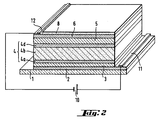
- the current leads 11, 12 in the form of strips placed at the opposite ends of the two electroconductive layers 2, 6 and electrically connected to a voltage generator 10.
- a tri-layer electrolyte which contains a layer 4b of cathodic electrochromic material which has been hydrated to ensure its proton conductivity and whose state has been blocked. insertion by placing it between two layers 4a, 4c both conductive protonic and insulating on the electronic plane.
- the degree of oxidation of the layer 4b is kept constant since it is electrically isolated from the two electroconductive layers 2, 6 of the system.
- the tri-layer electrolyte of the invention makes it possible to preserve the integrity of the "active" electrochromic materials of the system, and especially the integrity and durability of the layer of anodic electrochromic material 3 called counter-electrode.
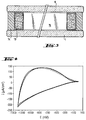
- the voltamogram of the figure 4 corresponds to the electrical behavior of the half-cell according to Example 1: it shows a correct functionality of the latter.
- the table below groups, according to the number of the cycle (n °), the quantity of inserted charges Q inx and thoroughinseche Q Cincinnati by the half-cell, in mC / cm 2 : cycle number Q dice Q lns 2 9.0 - 8.9 10 9.7 - 9.6 12 9.6 - 9.5 20 9.5 9.4
- the half-cell when submitting the half-cell to a potential of -0.4 volts relative to the saturated calomel electrode, the half-cell remains in the decolorized state. However, it is a potential value for which an electrochromic material such as tungsten oxide strongly blue. If it remains transparent, it is therefore that the layer of Ta 2 O 5 .nH 2 O electronically satisfactorily isolates it, blocking it in a discolored state.
- the half-cell made for comparison is immersed in the aqueous solution of H 3 PO 4 at 0.25 M, the half-cell thus lacks layers of Ta 2 O 5 and WO 3 which are hydrated. there is the almost immediate dissolution of the nickel oxide-based anode electrochromic material, and thus a total loss of functionality.
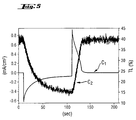
- This glazing is operated by imposing a potential of -1.4 V to impose the color and 0 V to cause discoloration of the system.
- the curve C 1 indicates the change in density of the current in mA / cm 2 as a function of time expressed in seconds.
- the curve C 2 indicates the variation of light transmission T L in% according to the illuminant D 65 also as a function of the time expressed in seconds.
- this example relates to an electrochromic glazing mirror function, the same structure as the figure 2 .
- the stack of layers is the same as in Example 3, except for two characteristics: here, the layer 4c hydrated tantalum oxide (which is actually optional) was removed and the thickness of the electroconductive layer 6 silver was increased to a thickness greater than 30 nm, for example d about 50 nm (it can be replaced by a layer of aluminum of the same thickness).
- the observer here views the glazing through the substrate 1 and its color change, since the first electroconductive layer 2 is transparent, the mirror reflecting effect being obtained by the second electroconductive layer 6 metal.
- the "solid" electrochromic glazings were mounted in double glazing, as shown very schematically in the figure 3 the substrate 1 carrying the stack of layers 2 to 8, not shown, is assembled to a second glass substrate 9 by means of a gas strip 15, so that the stack of layers is turned on the side of this gas blade.
- a metal spacer filled with particles for hygrometric control purpose 13 on which is placed a peripheral seal 14 of polysulfide and / or butyl rubber.
- Any electrochromic glazing assembly according to any one of the examples may be envisaged, especially in insulating multiple glazing and / or in laminated glazing.
- the "inhibited" electrochromic material can then completely replace the usual polymer electrolyte.
- the advantages are combined: the previous advantage, that is to say the preservation of the counter-electrode, and the advantage of a manufacture by successive deposits on the same substrate.
- Double-glazed as shown in figure 3 the all-solid glazing is particularly advantageous: the layers are protected, and the gain in terms of weight and bulk compared to a double glazing using electrochromic glazing with two substrates is obvious.
- the invention is simple to implement, insofar as the layer 4b specific to the invention is in a material generally of the type of those already used for their electrochromic properties, such as the tungsten oxide: even if it is necessary to correctly adjust the deposition conditions, in particular to possibly obtain the desired hydration level, it was already mastered before the invention the manufacture.
- the invention has in fact, in fact, unexpectedly conferred a second function on electrochromic materials which are often already known.
- the electrochromic glazing operates in transmission (examples 1 to 3) or in reflection (example 4), it is advantageous to adjust the characteristics of the layers that it uses to give it a given optical appearance.
- This adjustment of the optical characteristics of the glazing can also be carried out using complementary layers which may, for example, be inserted between substrates and electroconductive layers, or even be "outside" the electrochromic system, for example by being deposited on the other side of the glass substrate.
Landscapes
- Physics & Mathematics (AREA)
- Chemical & Material Sciences (AREA)
- Nonlinear Science (AREA)
- Chemical Kinetics & Catalysis (AREA)
- General Physics & Mathematics (AREA)
- Electrochemistry (AREA)
- Optics & Photonics (AREA)
- Inorganic Chemistry (AREA)
- Engineering & Computer Science (AREA)
- Organic Chemistry (AREA)
- General Chemical & Material Sciences (AREA)
- Geochemistry & Mineralogy (AREA)
- Life Sciences & Earth Sciences (AREA)
- Materials Engineering (AREA)
- Electrochromic Elements, Electrophoresis, Or Variable Reflection Or Absorption Elements (AREA)
- Battery Electrode And Active Subsutance (AREA)
- Laminated Bodies (AREA)
- Physical Vapour Deposition (AREA)
- Secondary Cells (AREA)
Claims (16)
- Elektrochemische Vorrichtung, umfassend wenigstens ein Substrat (1, 7) sowie nacheinander eine elektrisch leitende Schicht (2), eine elektrochemisch aktive Schicht (3), die geeignet ist, Kationen reversibel einzubauen, einen Elektrolyt (4), welcher eine Schicht (4b) aus ionenleitendem Material, die geeignet ist, die Kationen reversibel einzubauen, deren Gesamtoxidationsgrad aber im Wesentlichen konstant gehalten wird, und wenigstens eine elektronisch isolierende Schicht (4a, 4d) umfasst, eine zweite elektrochemisch aktive Schicht (5), die geeignet ist, Kationen reversibel einzubauen, sowie eine elektrisch leitende Schicht (6), dadurch gekennzeichnet, dass der Gesamtoxidationsgrad der Schicht (4b) des Elektrolyten (4) dadurch im Wesentlichen konstant gehalten wird, dass die Schicht (4b) gegenüber wenigstens einer der Elektronenquellen der Vorrichtung durch Zwischenlegen wenigstens einer Schicht (4a, 4d) aus einem elektronisch isolierenden Material elektrisch isoliert wird, wobei die Schicht(en) (4a, 4d) aus elektronisch isolierendem Material auch ionenleitend/ionendurchlässig ist (sind), wobei das Material der Schicht (4b), die geeignet ist, die Ionen reversibel einzubauen, deren Oxidationsgrad aber im Wesentlichen konstant gehalten wird, ein Material mit elektrochromer Eigenschaft ist, das in entfärbtem Zustand oder einem Zwischenfärbungszustand gehalten wird.
- Elektrochemische Vorrichtung nach Anspruch 1, dadurch gekennzeichnet, dass die Schicht(en) (4a, 4d) aus elektronisch isolierendem Material mit wenigstens einer der Seiten der Schicht (4b) mit im Wesentlichen konstant gehaltenem Gesamtoxidationsgrad in direktem Kontakt ist.
- Elektrochemische Vorrichtung nach einem der vorstehenden Ansprüche, dadurch gekennzeichnet, dass der Gesamtoxidationsgrad der Schicht (4b) des Elektrolyten (4) dadurch im Wesentlichen konstant gehalten wird, dass das Potential der Schicht (4b) auf Werten außerhalb des Bereichs von Potentialen gehalten wird, die eine Änderung der Ioneneinbaurate des Materials, aus dem sie besteht, bewirken.
- Elektrochemische Vorrichtung nach einem der vorstehenden Ansprüche, dadurch gekennzeichnet, dass sie durch reversiblen Einbau von Protonen der elektrochemisch aktiven Schicht oder Schichten (3, 5) funktioniert und dass das Material der Schicht (4b) des Elektrolyten (4), die geeignet ist, die Protonen reversibel einzubauen, deren Oxidationsgrad aber im Wesentlichen konstant gehalten wird, auf der Basis eines Metalloxids oder einer Mischung aus Metalloxiden, eventuell hydratisiert, ist, insbesondere ausgewählt aus der Gruppe umfassend eventuell hydratisiertes Wolframoxid WO3.nH2O, eventuell hydratisiertes Nioboxid Nb2O5.nH2O, eventuell hydratisiertes Nickeloxid NiOxHy-nH2O, eventuell hydratisiertes Zinnoxid SnO2.nH2O, eventuell hydratisiertes Bismutoxid Bi2O3.nH2O,
eventuell hydratisiertes Titanoxid TiO2-nH2O, eventuell hydratisiertes Vanadiumoxid V2O5-nH2O, eventuell hydratisiertes Molybdänoxid MoO3-nH2O, mit n ≥ 0 und eventuell umfassend ein die Hydratation begünstigendes Zusatzmetall, in Form eines zusätzlichen Metalls, wie Titan, Tantal oder Rhenium, oder eines Alkalis vom Typ Na, Li oder K. - Elektrochemische Vorrichtung nach einem der Ansprüche 1 bis 3, dadurch gekennzeichnet, dass sie durch reversiblen Einbau von Lithium-Ionen Li+ der elektrochemisch aktiven Schicht oder Schichten (3, 5) funktioniert und dass das Material der Schicht (4b) des Elektrolyten (4), die geeignet ist, die Lithium-Ionen Li+ reversibel einzubauen, deren Oxidationsgrad aber im Wesentlichen konstant gehalten wird, auf der Basis eines Metalloxids oder einer Mischung aus Metalloxiden, lithiiert oder nicht, ist, insbesondere ausgewählt aus der Gruppe umfassend Nickeloxid NiOx, lithiiertes Nickeloxid LiyNiOx, eine Mischung aus Titan- und Ceroxiden Ce-TiOx, Wolframoxid WO3, Nioboxid Nb2O5, Vanadiumoxid V2O5, lithiiertes Vanadiumoxid LixV2O5.
- Elektrochemische Vorrichtung nach einem der vorstehenden Ansprüche, dadurch gekennzeichnet, dass die Schicht oder Schichten (4a, 4d) aus elektronisch isolierendem Material wenigstens ein Oxid eines Metalls aus der Spalte Vb des Periodensystems umfasst (umfassen), insbesondere Tantaloxid Ta2O5, aber auch wenigstens ein Metalloxid, das zu der Gruppe umfassend Antimonoxid Sb2O5, Zirkoniumoxid ZrO2, Titanoxid TiO2, Siliziumoxid SiO2, Chromoxid CrO3, insbesondere ein Tantal-Titan-Mischoxid, Germaniumoxid GeO3, ZnO(H3PO4)2.nH2O gehört, wobei all diese Oxide eventuell hydratisiert sind und eventuell ein ihre Hydratation begünstigendes Additiv, wie ein Metall vom Typ W, Re oder ein Alkali vom Typ Li, Na, K umfassen.
- Elektrochemische Vorrichtung nach einem der vorstehenden Ansprüche, dadurch gekennzeichnet, dass die Schicht (Schichten) (4a, 4d) aus elektronisch isolierendem Material auf der Basis von CeF3, Hexauranylphosphat HUP, MgF2, CaF2, SiOx, LiF, Na3AlF6, oder auf der Basis von Li3N, LiTaO3, LiAlF4, Li3PO4, LiPO2, LiN, LiNbO3, MgF2POLi, Li2WO4 sind, insbesondere in dem Fall, in dem die Vorrichtung durch reversiblen Einbau von Lithium-Ionen der elektrochemisch aktiven Schicht oder Schichten (3, 5) funktioniert.
- Elektrochemische Vorrichtung nach einem der vorstehenden Ansprüche, dadurch gekennzeichnet, dass die Materialien, welche die Schicht (4b) bilden, die geeignet ist, die Ionen reversibel einzubauen, deren Oxidationsgrad aber im Wesentlichen konstant gehalten wird, und/oder die Materialien, welche die Schicht(en) (4a, 4d) aus elektronisch isolierendem Material bilden, nitriert und/oder phosphatiert sind.
- Elektrochemische Vorrichtung nach einem der vorstehenden Ansprüche, dadurch gekennzeichnet, dass die elektrochemisch aktive(n) Schicht(en) (3, 5) eine Schicht (5) aus elektrochromem Kathodenmaterial, wie Wolframoxid WO3,
Molybdänoxid MoO3, Vanadiumoxid V2O5, Nioboxid Nb2O5, Titanoxid TiO2, ein Cermet-Material vom Typ WO3/Au oder WO3/Ag, ein Wolfram- und Rheniumoxidgemisch WO3/ReO3, Phosphorwolframsäure, Metallo-Phthalocyaninen oder
Metallo-Dibenzo-Phthalocyaninen von Übergangsmetallen oder Seltenen Erden, eventuell nitriert, insbesondere in dem Fall, in dem die Vorrichtung durch reversiblen Einbau von Lithium-Ionen Li+ oder von Protonen funktioniert, sowie die gleichen Materialien eventuell hydratisiert in dem Fall, in dem die Vorrichtung insbesondere durch reversiblen Einbau von Protonen H+ funktioniert, umfassen. - Elektrochemische Vorrichtung nach einem der vorstehenden Ansprüche, dadurch gekennzeichnet, dass die elektrochemisch aktive(n) Schicht(en) eine Schicht (3) aus elektrochromem Anodenmaterial in Form von MxAyUz umfassen,
mit M einem Übergangsmetall, A dem für den reversiblen Einbau verwendeten Ion, entweder ein Alkali oder ein Proton, und U einem Chalkogen, wie S, O oder Se, eventuell nitriert. - Elektrochemische Vorrichtung nach einem der vorstehenden Ansprüche, dadurch gekennzeichnet, dass die elektrochemisch aktive(n) Schicht(en) eine Schicht (3) aus elektrochromem Anodenmaterial umfassen, das im Fall eines reversiblen Einbaus von Protonen aus der Gruppe umfassend LiNiOx, IrOxHy, IrOxHyNz, NiOx, NiOxHz, NiOxHyNz, RhOx, CoOx, CrOx, MnOx, Hydrid von Seltene Erde,
von Lanthanid oder von Übergangsmetallen ausgewählt ist und im Fall eines reversiblen Einbaus von Lithium-Ionen Li+ aus der Gruppe umfassend LiNiOx, LiMn2O4, IrOx, LixIrOy, NiOx, CeOx, TiOx, CeOx-TiOx, RhOx, CoOx, CrOx, MnOx, VOx, Lix, CoOy, LiCrOy, LixVOy, ReOx, RhOx, PtOx, FeOx, OsOy, CuOx,
PrOx ausgewählt ist, wobei diese Verbindungen eventuell lithiiert und/oder nitriert sind, sowie, im Fall eines Einbaus von Protonen oder von Li+, aus Hexacyanometalaten, insbesondere der Formel M[M'(CN)6], wobei M und M' Übergangsmetalle und/oder Seltene Erden sind. - Elektrochemische Vorrichtung nach einem der vorstehenden Ansprüche, dadurch gekennzeichnet, dass wenigstens eine der elektrisch leitenden Schichten (2, 6) auf der Basis wenigstens eines dotierten Metalloxids, wie ITO oder SnO2:F oder auf der Basis eines Metalls oder von Metalllegierungen, wie Gold, Silber, Aluminium oder Ni-Cr-Legierung, oder der Übereinanderanordnung mehrerer Schichten aus diesen Materialien ist.
- Elektrochrome Verglasung, dadurch gekennzeichnet, dass sie die elektrochemische Vorrichtung nach einem der vorstehenden Ansprüche umfasst.
- Elektrochrome Verglasung nach Anspruch 13, dadurch gekennzeichnet, dass sie, mit dem oder allen im Wesentlichen transparenten Substrat(en) (1, 7) aus Glas oder aus Kunststoff, eine veränderliche Lichtdurchlässigkeit aufweist.
- Elektrochrome Verglasung nach Anspruch 13, dadurch gekennzeichnet, dass sie eine Spiegelfunktion aufweist, entweder durch Zuordnung der elektrochemischen Vorrichtung zu einem reflektierenden Element oder durch die Wahl eines opaken reflektierenden Substrats oder dadurch, eine der elektrisch leitenden Schichten (2, 6) aus Metall dick genug zu wählen, um reflektierend zu sein.
- Elektrochrome Verglasung nach einem der Ansprüche 13 oder 14, dadurch gekennzeichnet, dass sie die elektrochemische Vorrichtung umfasst, die ein oder zwei transparente(s) oder kaum absorbierende Substrat(e) (1, 7) umfasst, die mit Hilfe eines weiteren transparenten Substrats (9) als Doppelverglasung oder als parietal-dynamisches Fenster angeordnet sind.
Applications Claiming Priority (2)
| Application Number | Priority Date | Filing Date | Title |
|---|---|---|---|
| FR9603799A FR2746934B1 (fr) | 1996-03-27 | 1996-03-27 | Dispositif electrochimique |
| FR9603799 | 1996-03-27 |
Publications (2)
| Publication Number | Publication Date |
|---|---|
| EP0867752A1 EP0867752A1 (de) | 1998-09-30 |
| EP0867752B1 true EP0867752B1 (de) | 2013-12-11 |
Family
ID=9490588
Family Applications (1)
| Application Number | Title | Priority Date | Filing Date |
|---|---|---|---|
| EP97400702.3A Expired - Lifetime EP0867752B1 (de) | 1996-03-27 | 1997-03-27 | Elektrochrome Vorrichtung |
Country Status (6)
| Country | Link |
|---|---|
| US (3) | US6277523B1 (de) |
| EP (1) | EP0867752B1 (de) |
| JP (1) | JP4156685B2 (de) |
| KR (1) | KR100526640B1 (de) |
| CA (1) | CA2201036A1 (de) |
| FR (1) | FR2746934B1 (de) |
Cited By (1)
| Publication number | Priority date | Publication date | Assignee | Title |
|---|---|---|---|---|
| US8637349B2 (en) | 2000-03-24 | 2014-01-28 | Cymbet Corporation | Method and apparatus for integrated-circuit battery devices |
Families Citing this family (185)
| Publication number | Priority date | Publication date | Assignee | Title |
|---|---|---|---|---|
| FR2746934B1 (fr) * | 1996-03-27 | 1998-05-07 | Saint Gobain Vitrage | Dispositif electrochimique |
| FR2753545B1 (fr) * | 1996-09-18 | 1998-10-16 | Saint Gobain Vitrage | Dispositif electrochimique |
| DE69721175T2 (de) * | 1996-10-17 | 2004-05-19 | Saint-Gobain Glass France | Verglazung mit einer activen thermische, elektrische und/oder elektrochemische Einheit |
| FR2791147B1 (fr) * | 1999-03-19 | 2002-08-30 | Saint Gobain Vitrage | Dispositif electrochimique du type dispositif electrocommandable a proprietes optiques et/ou energetiques variables |
| US6676021B1 (en) * | 1999-04-14 | 2004-01-13 | Power Paper Ltd. | Authenticated cards |
| FR2793888B1 (fr) * | 1999-05-20 | 2002-06-28 | Saint Gobain Vitrage | Dispositif electrochimique |
| US6927411B2 (en) * | 2000-02-11 | 2005-08-09 | Axon Technologies Corporation | Programmable structure, an array including the structure, and methods of forming the same |
| US6515787B1 (en) * | 2000-03-07 | 2003-02-04 | Eclipse Energy Systems, Inc. | Electrochromic layer |
| FR2809388B1 (fr) * | 2000-05-23 | 2002-12-20 | Saint Gobain Vitrage | Vitrage comprenant au moins une couche a proprietes thermochromes |
| FR2811778B1 (fr) | 2000-07-13 | 2003-06-20 | Saint Gobain | Dispositif electrochimique du type electrochrome ou dispositif photovoltaique et ses moyens de connexion electrique |
| US6561460B2 (en) * | 2000-08-03 | 2003-05-13 | Ppg Industries Ohio, Inc. | Switchable electrochromic devices for use in aircraft transparency windows |
| FR2815374B1 (fr) | 2000-10-18 | 2003-06-06 | Saint Gobain | Vitrage feuillete et ses moyens d'etancheification peripherique |
| DE60226221T2 (de) * | 2001-03-07 | 2009-05-14 | Acreo Ab | Elektrochemische pixel-einrichtung |
| FR2821937B1 (fr) * | 2001-03-07 | 2003-06-06 | Saint Gobain | Dispositif electrocommandable a proprietes optiques et/ou energetiques variables |
| JP4065670B2 (ja) * | 2001-08-09 | 2008-03-26 | 株式会社ルネサステクノロジ | 半導体集積回路装置の製造方法 |
| US6567204B1 (en) * | 2001-09-04 | 2003-05-20 | Exon Science, Inc. | Electrochromic solution containing hydrazone compound and device manufactured with same |
| FR2833107B1 (fr) * | 2001-12-05 | 2004-02-20 | Saint Gobain | Electrode de dispositifs electrochimiques/electrocommandables |
| FR2835534B1 (fr) * | 2002-02-06 | 2004-12-24 | Saint Gobain | CIBLE CERAMIQUE NiOx NON STOECHIOMETRIQUE |
| JP4532908B2 (ja) * | 2002-03-07 | 2010-08-25 | アクレオ アーベー | 電気化学デバイス |
| FR2840078B1 (fr) * | 2002-05-22 | 2004-08-13 | Saint Gobain | Dispositif electrocommandable a proprietes optiques et/ou energetiques variables |
| US7009750B1 (en) | 2002-10-25 | 2006-03-07 | Eclipse Energy Systems, Inc. | Apparatus and methods for modulating refractive index |
| JP4105537B2 (ja) * | 2002-12-24 | 2008-06-25 | 株式会社村上開明堂 | エレクトロクロミック素子 |
| US7603144B2 (en) | 2003-01-02 | 2009-10-13 | Cymbet Corporation | Active wireless tagging system on peel and stick substrate |
| US6906436B2 (en) | 2003-01-02 | 2005-06-14 | Cymbet Corporation | Solid state activity-activated battery device and method |
| US7294209B2 (en) | 2003-01-02 | 2007-11-13 | Cymbet Corporation | Apparatus and method for depositing material onto a substrate using a roll-to-roll mask |
| US7300166B2 (en) * | 2003-03-05 | 2007-11-27 | Electrochromix, Inc. | Electrochromic mirrors and other electrooptic devices |
| DE20306408U1 (de) * | 2003-04-24 | 2003-06-18 | Institut für Neue Materialien gem. GmbH, 66123 Saarbrücken | Elektrochrome Profilglasmodule und daraus gebildete Fassadenelemente |
| FR2857467B1 (fr) | 2003-07-09 | 2005-08-19 | Saint Gobain | Dispositif electrocommandable a proprietes optiques et/ou energetiques variables |
| FR2857617B1 (fr) * | 2003-07-16 | 2006-10-27 | Saint Gobain | Vitrage de securite fonctionnalise |
| US7211351B2 (en) | 2003-10-16 | 2007-05-01 | Cymbet Corporation | Lithium/air batteries with LiPON as separator and protective barrier and method |
| JP4060779B2 (ja) * | 2003-10-21 | 2008-03-12 | 株式会社東芝 | 表示装置 |
| CN1957487A (zh) | 2004-01-06 | 2007-05-02 | Cymbet公司 | 具有一个或者更多个可限定层的层式阻挡物结构和方法 |
| RU2264610C2 (ru) * | 2004-01-16 | 2005-11-20 | Общество с ограниченной ответственностью "ВИНТЕЛ" | Способ измерения спектроскопических свойств сыпучих продуктов и устройство для его осуществления |
| DE102004005611B4 (de) * | 2004-02-05 | 2006-04-27 | Saint-Gobain Sekurit Deutschland Gmbh & Co. Kg | Transparente Scheibe mit partiell abdunkelbarem Sichtfeld und Verfahren zum Steuern eines elektrochrom verfärbbaren Flächenelements in einer transparenten Scheibe, insbesondere einer Windschutzscheibe |
| US7106488B2 (en) * | 2004-03-23 | 2006-09-12 | Air Products And Chemicals, Inc. | Hybrid process for depositing electrochromic coating |
| GB2417083B (en) * | 2004-08-13 | 2006-08-16 | Mark Sinclair Varney | An electrochemical carbon dioxide gas sensor |
| FR2873460B1 (fr) * | 2004-07-21 | 2006-10-06 | Saint Gobain | Systeme electrochimique a electrolyte non oxyde |
| FR2874100B1 (fr) * | 2004-08-04 | 2006-09-29 | Saint Gobain | Systeme electrochimique comportant au moins une zone de margeage partiel |
| JP4384005B2 (ja) * | 2004-10-15 | 2009-12-16 | 株式会社東芝 | 表示装置 |
| US7372610B2 (en) | 2005-02-23 | 2008-05-13 | Sage Electrochromics, Inc. | Electrochromic devices and methods |
| WO2006092747A1 (en) * | 2005-03-03 | 2006-09-08 | Koninklijke Philips Electronics N.V. | Method of manufacturing an electrochemical energy source, electrochemical energy source thus obtained and electronic device |
| US7776478B2 (en) | 2005-07-15 | 2010-08-17 | Cymbet Corporation | Thin-film batteries with polymer and LiPON electrolyte layers and method |
| JP2009502011A (ja) | 2005-07-15 | 2009-01-22 | シンベット・コーポレイション | 軟質および硬質電解質層付き薄膜電池および方法 |
| US20070076286A1 (en) * | 2005-09-23 | 2007-04-05 | Yungeun Sung | Electrochromic device comprising protective inorganic solid electrolyte film and manufacturing method thereof |
| US7593154B2 (en) | 2005-10-11 | 2009-09-22 | Sage Electrochromics, Inc. | Electrochromic devices having improved ion conducting layers |
| KR100870613B1 (ko) * | 2005-11-02 | 2008-11-25 | 주식회사 엘지화학 | 전기변색소자의 전극구조 |
| EP1975692A4 (de) | 2006-01-19 | 2009-01-14 | Konica Minolta Holdings Inc | Anzeigeelement |
| FR2896621B1 (fr) | 2006-01-23 | 2008-06-27 | St Microelectronics Sa | Systeme electro-optique integre |
| US7443566B2 (en) * | 2006-03-10 | 2008-10-28 | Sony Ericsson Mobile Communications Ab | Low power, configurable display for mobile devices |
| ATE456820T1 (de) | 2006-06-02 | 2010-02-15 | Konica Minolta Holdings Inc | Anzeigeelement |
| WO2007145100A1 (ja) | 2006-06-15 | 2007-12-21 | Konica Minolta Holdings, Inc. | 表示素子 |
| EP2710955A1 (de) * | 2006-07-21 | 2014-03-26 | Anaxsys Technology Limited | Gassensor |
| JPWO2008023551A1 (ja) | 2006-08-22 | 2010-01-07 | コニカミノルタホールディングス株式会社 | 表示素子 |
| EP2058699A4 (de) | 2006-09-08 | 2010-07-21 | Konica Minolta Holdings Inc | Anzeigeelement |
| JP2008102272A (ja) * | 2006-10-18 | 2008-05-01 | Bridgestone Corp | エレクトロクロミック素子及びその製造方法 |
| JP2008102273A (ja) * | 2006-10-18 | 2008-05-01 | Bridgestone Corp | エレクトロクロミック素子及びその製造方法 |
| US8449473B2 (en) * | 2006-10-18 | 2013-05-28 | Anaxsys Technology Limited | Gas sensor |
| WO2008049268A1 (fr) * | 2006-10-24 | 2008-05-02 | Feng Chia University | Dispositif électrochromique |
| EP2081082A4 (de) | 2006-11-08 | 2010-12-08 | Konica Minolta Holdings Inc | Anzeigeelement |
| US7504834B2 (en) * | 2006-12-20 | 2009-03-17 | 3M Innovative Properties Company | Detection system |
| WO2008089110A1 (en) | 2007-01-12 | 2008-07-24 | Microazure Corporation | Three-dimensional batteries and methods of manufacturing the same |
| US9166230B1 (en) | 2007-01-12 | 2015-10-20 | Enovix Corporation | Three-dimensional battery having current-reducing devices corresponding to electrodes |
| JPWO2008087790A1 (ja) | 2007-01-17 | 2010-05-06 | コニカミノルタホールディングス株式会社 | 表示素子及び表示素子の駆動方法 |
| KR101085268B1 (ko) * | 2007-03-23 | 2011-11-22 | 주식회사 엘지화학 | 내수성이 우수한 전기변색소자용 전극 및 그 제조방법 |
| JP5347960B2 (ja) | 2007-05-25 | 2013-11-20 | コニカミノルタ株式会社 | 表示素子の製造方法 |
| US7808693B2 (en) * | 2007-06-07 | 2010-10-05 | Soladigm, Inc. | Electrochromic devices and fabrication methods |
| US7609433B2 (en) * | 2007-06-07 | 2009-10-27 | Soladigm, Inc. | Electrochromic device and method of making the same |
| WO2008149850A1 (ja) | 2007-06-08 | 2008-12-11 | Konica Minolta Holdings, Inc. | 電気化学表示素子の製造方法及び電気化学表示素子 |
| CN101903560B (zh) * | 2007-12-21 | 2014-08-06 | 无穷动力解决方案股份有限公司 | 用于电解质膜的溅射靶的方法 |
| US9782949B2 (en) | 2008-05-30 | 2017-10-10 | Corning Incorporated | Glass laminated articles and layered articles |
| KR100955518B1 (ko) * | 2008-07-10 | 2010-04-30 | 에스케이씨 주식회사 | 전기변색 박막의 이온농도 제어방법 및 이를 포함하는전기변색 소자 |
| FR2934062B1 (fr) * | 2008-07-17 | 2010-08-13 | Saint Gobain | Dispositif electrochrome a reflexion infrarouge controlee |
| KR101457564B1 (ko) * | 2008-10-30 | 2014-11-04 | 삼성전자주식회사 | 전기변색을 이용한 디스플레이 장치 |
| JP2010139541A (ja) * | 2008-12-09 | 2010-06-24 | Konica Minolta Holdings Inc | 表示素子 |
| US8842357B2 (en) | 2008-12-31 | 2014-09-23 | View, Inc. | Electrochromic device and method for making electrochromic device |
| DE202009016725U1 (de) | 2009-01-08 | 2010-05-20 | Saint-Gobain Sekurit Deutschland Gmbh & Co. Kg | Doppelfassade mit integriertem Sonnenschutz für Gebäude |
| US7804635B1 (en) * | 2009-03-20 | 2010-09-28 | Soladigm, Inc. | Electrochromic thin-film material |
| US12043890B2 (en) | 2009-03-31 | 2024-07-23 | View, Inc. | Electrochromic devices |
| US10852613B2 (en) | 2009-03-31 | 2020-12-01 | View, Inc. | Counter electrode material for electrochromic devices |
| US8300298B2 (en) | 2010-04-30 | 2012-10-30 | Soladigm, Inc. | Electrochromic devices |
| US8764950B2 (en) | 2010-04-30 | 2014-07-01 | View, Inc. | Electrochromic devices |
| US9261751B2 (en) | 2010-04-30 | 2016-02-16 | View, Inc. | Electrochromic devices |
| US8764951B2 (en) | 2010-04-30 | 2014-07-01 | View, Inc. | Electrochromic devices |
| US9664974B2 (en) | 2009-03-31 | 2017-05-30 | View, Inc. | Fabrication of low defectivity electrochromic devices |
| US10261381B2 (en) | 2009-03-31 | 2019-04-16 | View, Inc. | Fabrication of low defectivity electrochromic devices |
| US11187954B2 (en) | 2009-03-31 | 2021-11-30 | View, Inc. | Electrochromic cathode materials |
| US10156762B2 (en) | 2009-03-31 | 2018-12-18 | View, Inc. | Counter electrode for electrochromic devices |
| US8582193B2 (en) | 2010-04-30 | 2013-11-12 | View, Inc. | Electrochromic devices |
| US10591795B2 (en) | 2009-03-31 | 2020-03-17 | View, Inc. | Counter electrode for electrochromic devices |
| DE102009026148A1 (de) | 2009-07-10 | 2011-01-13 | Saint-Gobain Sekurit Deutschland Gmbh & Co. Kg | Elektrochrome Schichtstruktur und Verfahren zu dessen Herstellung |
| FR2948356B1 (fr) | 2009-07-22 | 2011-08-19 | Saint Gobain | Dispositif electrochrome |
| US8309242B2 (en) * | 2009-11-03 | 2012-11-13 | Nokia Corporation | Battery cell |
| US12353109B2 (en) | 2009-12-22 | 2025-07-08 | View Operating Corporation | Electrochromic cathode materials |
| US8511535B1 (en) * | 2010-04-19 | 2013-08-20 | Aegis Technology Inc. | Innovative braze and brazing process for hermetic sealing between ceramic and metal components in a high-temperature oxidizing or reducing atmosphere |
| US20140097636A1 (en) * | 2010-04-23 | 2014-04-10 | Magna Mirrors Of America, Inc. | Vehicle window with shade |
| US9759975B2 (en) | 2010-04-30 | 2017-09-12 | View, Inc. | Electrochromic devices |
| US8270059B2 (en) | 2010-08-05 | 2012-09-18 | Soladigm, Inc. | Multi-pane electrochromic windows |
| US9843027B1 (en) | 2010-09-14 | 2017-12-12 | Enovix Corporation | Battery cell having package anode plate in contact with a plurality of dies |
| CN102456805B (zh) | 2010-10-22 | 2015-01-07 | 展晶科技(深圳)有限公司 | 发光二极管 |
| FR2968413B1 (fr) | 2010-12-06 | 2012-12-07 | Saint Gobain | Dispositif electrochimique a proprietes de transmission optique et/ou energetique electrocommandables |
| US8780432B1 (en) | 2011-03-22 | 2014-07-15 | Paul Phong Nguyen | Electrochromic devices and methods for forming such devices |
| EP2522700A1 (de) | 2011-05-11 | 2012-11-14 | Saint-Gobain Glass France | Wassersuspendierbare Druckpaste |
| CN202110359U (zh) * | 2011-05-25 | 2012-01-11 | 王麒 | 纳米智能玻璃 |
| US9222298B2 (en) | 2011-06-14 | 2015-12-29 | Saint-Gobain Glass France | Insulating glazing with electrical connection element |
| CN102326997A (zh) * | 2011-06-22 | 2012-01-25 | 太仓南极风能源设备有限公司 | 电镜 |
| US11527774B2 (en) | 2011-06-29 | 2022-12-13 | Space Charge, LLC | Electrochemical energy storage devices |
| US10658705B2 (en) | 2018-03-07 | 2020-05-19 | Space Charge, LLC | Thin-film solid-state energy storage devices |
| US9853325B2 (en) | 2011-06-29 | 2017-12-26 | Space Charge, LLC | Rugged, gel-free, lithium-free, high energy density solid-state electrochemical energy storage devices |
| US10601074B2 (en) | 2011-06-29 | 2020-03-24 | Space Charge, LLC | Rugged, gel-free, lithium-free, high energy density solid-state electrochemical energy storage devices |
| US11996517B2 (en) | 2011-06-29 | 2024-05-28 | Space Charge, LLC | Electrochemical energy storage devices |
| CN107300819B (zh) * | 2011-07-21 | 2021-03-12 | Sage电致变色显示有限公司 | 同时掺杂有锂和金属掺杂物的电致变色的镍氧化物 |
| EP2570846A1 (de) * | 2011-09-19 | 2013-03-20 | Hydro-Québec | Flexible, transparente elektrochrome Vorrichtung |
| EP2766774B1 (de) | 2011-10-10 | 2019-01-16 | Saint-Gobain Glass France | Elektrochrome isolierverglasung mit kapazitiver sensorschaltfläche |
| CA2859023C (en) | 2011-12-12 | 2023-08-22 | View, Inc. | Thin-film devices and fabrication |
| EP2807698B1 (de) * | 2012-01-24 | 2018-01-10 | Enovix Corporation | Ionisch durchlässige strukturen für energiespeichereinrichtungen |
| EP3543781B1 (de) | 2012-08-09 | 2022-10-12 | SAGE Electrochromics, lnc. | Lithiummetalloxidmaterialien für elektrochrome vorrichtungen |
| PT2882588T (pt) | 2012-08-09 | 2020-03-24 | Saint Gobain | Disposição de placa de vidro laminado comutável eletricamente |
| KR20240055130A (ko) | 2012-08-16 | 2024-04-26 | 에노빅스 코오퍼레이션 | 3차원 배터리들을 위한 전극 구조들 |
| EA028935B1 (ru) | 2012-08-21 | 2018-01-31 | Сэн-Гобэн Гласс Франс | Многослойное оконное стекло с электрически переключаемыми оптическими свойствами |
| EP2900594B1 (de) * | 2012-09-25 | 2018-01-10 | University of Maryland, College Park | Hochleitfähiger nasiconelektrolyt für natriumionenbatterien im festkörperzustand bei raumtemperatur |
| JP2014110166A (ja) * | 2012-12-03 | 2014-06-12 | Toyota Motor Corp | 負極活物質およびリチウム電池 |
| US20140198370A1 (en) * | 2013-01-17 | 2014-07-17 | PixelOptics, Inc. (Estate of) | Solid Electro-chromic Stack Including Electro-chromic Nanoparticles and Methods of Forming the Same Using Layer-by-Layer Deposition |
| CN105308772B (zh) | 2013-03-15 | 2018-11-16 | 艾诺维克斯公司 | 用于三维电池的隔膜 |
| US9091897B2 (en) * | 2013-03-16 | 2015-07-28 | Tintable Smart Material Co., Ltd. | Transmittance control method of electrochromic component |
| US11888149B2 (en) | 2013-03-21 | 2024-01-30 | University Of Maryland | Solid state battery system usable at high temperatures and methods of use and manufacture thereof |
| FR3012656A1 (fr) | 2013-10-30 | 2015-05-01 | St Microelectronics Crolles 2 | Dispositif optoelectronique, en particulier dispositif de memoire |
| EP3137942B1 (de) * | 2014-05-02 | 2023-06-28 | View, Inc. | Herstellung elektrochromer vorrichtungen mit geringer defektanfälligkeit |
| US11891327B2 (en) | 2014-05-02 | 2024-02-06 | View, Inc. | Fabrication of low defectivity electrochromic devices |
| KR102233771B1 (ko) * | 2014-07-24 | 2021-03-30 | 삼성에스디아이 주식회사 | 리튬 이차 전지용 복합 양극 활물질 및 이를 함유하는 리튬 이차 전지용 양극을 포함한 리튬 이차 전지 |
| US10345671B2 (en) | 2014-09-05 | 2019-07-09 | View, Inc. | Counter electrode for electrochromic devices |
| CN104216192A (zh) * | 2014-09-16 | 2014-12-17 | 哈尔滨工业大学 | 一种新型快响应、高对比度电致变色器件的制备方法 |
| JPWO2016063849A1 (ja) | 2014-10-21 | 2017-08-10 | 旭硝子株式会社 | 光学素子および撮像装置 |
| CN116789175A (zh) | 2014-11-26 | 2023-09-22 | 唯景公司 | 用于电致变色装置的对电极 |
| TWI793480B (zh) | 2015-05-14 | 2023-02-21 | 美商易諾維公司 | 用於能量儲存裝置之縱向約束 |
| US10139693B2 (en) * | 2015-06-19 | 2018-11-27 | International Business Machines Corporation | Synaptic electronic devices with electrochromic device |
| EP3328638B1 (de) * | 2015-07-29 | 2023-08-30 | Sage Electrochromics, Inc. | Laminat mit paneelen und füllmaterial zwischen den paneelen und verfahren zur formung des laminats |
| WO2017155262A1 (ko) | 2016-03-07 | 2017-09-14 | 립하이 주식회사 | 전기변색 디바이스 |
| TWI739830B (zh) | 2016-05-13 | 2021-09-21 | 美商易諾維公司 | 用於三維電池之尺寸拘束件 |
| RU2622905C1 (ru) * | 2016-07-07 | 2017-06-21 | федеральное государственное автономное образовательное учреждение высшего образования "Санкт-Петербургский политехнический университет Петра Великого" (ФГАОУ ВО "СПбПУ") | Способ получения тонкопленочного анода |
| TWI819481B (zh) | 2016-11-16 | 2023-10-21 | 美商易諾維公司 | 具有可壓縮陰極之三維電池 |
| US10520780B2 (en) | 2016-12-21 | 2019-12-31 | Southwall Technologies Inc. | Electroactive device provided with a trilayer bus bar |
| KR102027054B1 (ko) * | 2017-03-03 | 2019-10-01 | 립하이 주식회사 | 전기변색장치 |
| US10739662B2 (en) | 2017-03-03 | 2020-08-11 | Leaphigh Inc. | Electrochromic element and electrochromic device including the same |
| KR102113478B1 (ko) * | 2017-04-24 | 2020-05-21 | 주식회사 엘지화학 | 전기변색필름, 전기변색소자 및 그 제조방법 |
| KR102118361B1 (ko) * | 2017-04-24 | 2020-06-04 | 주식회사 엘지화학 | 전기변색필름 및 이를 포함하는 전기변색소자 |
| WO2018204719A1 (en) * | 2017-05-03 | 2018-11-08 | Kinestral Technologies, Inc. | Flexible and multilayer electrochromic devices and methods of making the same |
| JP7068289B2 (ja) * | 2017-05-25 | 2022-05-16 | 株式会社東芝 | 蓄電ユニットおよび蓄電システム |
| CN106997745A (zh) * | 2017-06-15 | 2017-08-01 | 京东方科技集团股份有限公司 | 一种显示装置及其驱动方法 |
| JP7033282B2 (ja) * | 2017-09-29 | 2022-03-10 | スタンレー電気株式会社 | 電気化学光学装置 |
| KR102859540B1 (ko) | 2017-11-15 | 2025-09-17 | 에노빅스 코오퍼레이션 | 전극 어셈블리 및 2차 배터리 |
| US10256507B1 (en) | 2017-11-15 | 2019-04-09 | Enovix Corporation | Constrained electrode assembly |
| EP3752308A4 (de) | 2018-02-15 | 2021-11-17 | University of Maryland, College Park | Geordnete, poröse feste elektrolytstrukturen, elektrochemische vorrichtungen damit, verfahren zur herstellung davon |
| KR20190123889A (ko) * | 2018-04-25 | 2019-11-04 | 주식회사 오리온 | 전기변색소자 |
| US10732476B2 (en) | 2018-05-14 | 2020-08-04 | Nokia Solutions And Networks Oy | Electrochromic cell |
| CN108709923B (zh) * | 2018-05-21 | 2021-04-20 | 上海洞舟实业有限公司 | 一种快速可视化体外疾病检测的电化学试剂盒 |
| US12547040B2 (en) | 2018-07-16 | 2026-02-10 | Polyceed Inc. | Insulated glass unit utilizing electrochromic elements with multipe low-e coatings |
| US20200019032A1 (en) | 2018-07-16 | 2020-01-16 | Polyceed Inc. | Polymeric Compositions for Use in Variable Transmission and Electrochemical Devices |
| US12438189B2 (en) | 2018-07-16 | 2025-10-07 | Polyceed Inc. | Polymeric ion-conductive electrolyte sheet |
| US11211639B2 (en) | 2018-08-06 | 2021-12-28 | Enovix Corporation | Electrode assembly manufacture and device |
| US12066734B1 (en) | 2018-11-07 | 2024-08-20 | Eclipse Energy Systems, Inc. | Electrochromic device having various uses |
| US10996535B1 (en) | 2018-11-07 | 2021-05-04 | Eclipse Energy Systems, Inc. | Electrochromic device with buffer layer(s) |
| FR3088850B1 (fr) | 2018-11-28 | 2020-12-11 | Saint Gobain | Procede de fabrication d’un vitrage electrochrome |
| FR3093720B1 (fr) | 2019-03-14 | 2021-06-18 | Saint Gobain | Procédé de protection d’un substrat en verre revêtu d’un empilement électrochrome et procédé de fabrication d’un vitrage isolant |
| US11569527B2 (en) | 2019-03-26 | 2023-01-31 | University Of Maryland, College Park | Lithium battery |
| FR3106006B1 (fr) | 2020-01-02 | 2023-10-27 | Saint Gobain | Système optique, vitrage isolant comportant un tel système optique, procédé de fabrication de ce vitrage isolant et procédé de protection d’un système optique |
| CN113238422B (zh) * | 2020-01-22 | 2022-12-02 | 青岛凯欧斯光电科技有限公司 | 离子传输复合膜、包含所述复合膜的电致变色玻璃及其制备方法 |
| CN114126861A (zh) | 2020-04-15 | 2022-03-01 | 法国圣戈班玻璃厂 | 带有传感器切换面的玻璃装置 |
| JP7844451B2 (ja) | 2020-09-18 | 2026-04-13 | エノビクス・コーポレイション | 電池に使用する電極の製造 |
| WO2022112582A1 (de) | 2020-11-30 | 2022-06-02 | Saint-Gobain Glass France | Verfahren zum herstellen einer gebogenen scheibe mit funktionsschicht |
| CN116783744A (zh) | 2020-12-09 | 2023-09-19 | 艾诺维克斯公司 | 用于制造二次电池的电极组合件的方法及装置 |
| WO2022129202A1 (de) | 2020-12-16 | 2022-06-23 | Saint-Gobain Glass France | Verglasung mit metallbasierter funktionsschicht |
| AU2021417404B2 (en) | 2021-01-06 | 2025-04-03 | Saint-Gobain Sekurit France | Pane with electric connection element |
| CN115245045A (zh) | 2021-02-24 | 2022-10-25 | 法国圣戈班玻璃厂 | 具有传感器开关面的玻璃 |
| DE202021103109U1 (de) | 2021-06-09 | 2021-06-17 | Saint-Gobain Sekurit Deutschland Gmbh & Co. Kg | Fahrzeugglastür mit integriertem Sensorschaltelement zum Öffnen und Schließen der Tür |
| CN113406155B (zh) * | 2021-06-23 | 2022-08-05 | 长春理工大学 | 氧化锡/多酸/氧化钨三层同轴纳米纤维气体传感材料及其制备方法 |
| KR102601264B1 (ko) * | 2021-08-13 | 2023-11-09 | 연세대학교 산학협력단 | 가스센서용 조성물, 이를 포함하는 가스센서 및 그의 제조방법 |
| EP4397131A1 (de) | 2021-08-31 | 2024-07-10 | Saint-Gobain Glass France | Anschlussanordnung mit verbundscheibe und flachbandkabel |
| CN113834862B (zh) * | 2021-09-17 | 2023-05-30 | 电子科技大学 | 界面应力调控/增强自驱动柔性气体传感器灵敏度的方法 |
| US20240274323A1 (en) | 2021-09-29 | 2024-08-15 | Saint-Gobain Glass France | Ribbon cable for detecting a break, connection assembly with composite panel, method for detecting a break, and use of the ribbon cable |
| DE202021105230U1 (de) | 2021-09-29 | 2021-11-17 | Saint-Gobain Sekurit Deutschland Gmbh & Co. Kg | Anschlussanordnung mit Schutzgehäuse |
| WO2023052099A1 (de) | 2021-09-29 | 2023-04-06 | Saint-Gobain Glass France | Anschlussanordnung mit verbundscheibe und flachbandkabel |
| CN119497816A (zh) | 2022-07-14 | 2025-02-21 | 法国圣戈班玻璃厂 | 具有温度传感器的平带线缆、联接组件和方法 |
| FR3140954A1 (fr) | 2022-10-13 | 2024-04-19 | Saint-Gobain Glass France | Vitrage electrochrome |
| FR3140955B1 (fr) | 2022-10-13 | 2024-10-18 | Saint Gobain | Vitrage electrochrome |
| WO2026082570A1 (de) | 2024-10-14 | 2026-04-23 | Saint-Gobain Sekurit France | Anschlussanordnung mit flachbandkabel, testanordnung und verfahren zum elektrischen testen der anschlussanordnung |
Citations (2)
| Publication number | Priority date | Publication date | Assignee | Title |
|---|---|---|---|---|
| US4170406A (en) * | 1977-11-14 | 1979-10-09 | American Cyanamid Company | Electrochromic devices having protective interlayers |
| EP0058813A1 (de) * | 1981-02-19 | 1982-09-01 | American Cyanamid Company | Elektrochrome Zelle mit einer aus einem zusammengesetzten Festkörper bestehenden, ionenleitenden Schicht |
Family Cites Families (28)
| Publication number | Priority date | Publication date | Assignee | Title |
|---|---|---|---|---|
| CH585913A5 (de) | 1974-01-31 | 1977-03-15 | Suisse Horlogerie | |
| US4193670A (en) * | 1977-11-08 | 1980-03-18 | American Cyanamid Company | Electrochromic devices having protective interlayers |
| JPS57125924A (en) * | 1981-01-30 | 1982-08-05 | Nec Corp | Electrochromic display element |
| US4448493A (en) * | 1981-02-25 | 1984-05-15 | Toppan Printing Co., Ltd. | Electrochromic display device |
| JPS5961820A (ja) * | 1982-09-30 | 1984-04-09 | Canon Inc | 全固体型エレクトロクロミツク素子 |
| JPS60151616A (ja) * | 1984-01-18 | 1985-08-09 | Canon Inc | エレクトロクロミツク素子 |
| US4748542A (en) | 1985-05-20 | 1988-05-31 | The Mead Corporation | Solid state electrochemical device |
| FR2583916B1 (fr) | 1985-06-25 | 1990-01-12 | Europ Composants Electron | Cellule pour condensateur a double couche electrique et procede de fabrication d'une telle cellule |
| US4763139A (en) | 1985-08-08 | 1988-08-09 | Nec Corporation | Optical information storage medium |
| US4832463A (en) * | 1987-09-08 | 1989-05-23 | Tufts University | Thin film ion conducting coating |
| JP2704887B2 (ja) * | 1988-08-22 | 1998-01-26 | キヤノン株式会社 | エレクトロクロミック素子 |
| US5189549A (en) | 1990-02-26 | 1993-02-23 | Molecular Displays, Inc. | Electrochromic, electroluminescent and electrochemiluminescent displays |
| AU643093B2 (en) * | 1990-12-26 | 1993-11-04 | Ppg Industries Ohio, Inc. | Solid-state electrochromic device with protong-conducting polymer electrolyte |
| US5321544A (en) * | 1991-09-04 | 1994-06-14 | Sun Active Glass Electrochromics, Inc. | Electrochromic structures and methods |
| US5327281A (en) * | 1992-04-23 | 1994-07-05 | Eic Laboratories | Solid polymeric electrolytes for electrochromic devices having reduced acidity and high anodic stability |
| FR2706639B1 (fr) | 1993-06-11 | 1995-08-25 | Saint Gobain Vitrage Int | Vitrage électrochrome. |
| US5512391A (en) | 1993-09-07 | 1996-04-30 | E.C.R. - Electro-Chemical Research Ltd. | Solid state electrochemical cell containing a proton-donating aromatic compound |
| JP2770259B2 (ja) * | 1993-11-05 | 1998-06-25 | 株式会社巴川製紙所 | 電極およびそれを用いた電気化学表示素子 |
| ATE196538T1 (de) * | 1994-11-23 | 2000-10-15 | Automotive Fluid Systems Inc | Verbindungsblock mit einlagen |
| FR2746934B1 (fr) * | 1996-03-27 | 1998-05-07 | Saint Gobain Vitrage | Dispositif electrochimique |
| FR2753545B1 (fr) * | 1996-09-18 | 1998-10-16 | Saint Gobain Vitrage | Dispositif electrochimique |
| FR2781062B1 (fr) * | 1998-07-09 | 2002-07-12 | Saint Gobain Vitrage | Vitrage a proprietes optiques et/ou energetiques electrocommandables |
| FR2781084B1 (fr) * | 1998-07-10 | 2007-08-31 | Saint Gobain Vitrage | Procede de traitement d'un dispositif electrochimique |
| FR2791147B1 (fr) * | 1999-03-19 | 2002-08-30 | Saint Gobain Vitrage | Dispositif electrochimique du type dispositif electrocommandable a proprietes optiques et/ou energetiques variables |
| FR2809388B1 (fr) * | 2000-05-23 | 2002-12-20 | Saint Gobain Vitrage | Vitrage comprenant au moins une couche a proprietes thermochromes |
| FR2811778B1 (fr) * | 2000-07-13 | 2003-06-20 | Saint Gobain | Dispositif electrochimique du type electrochrome ou dispositif photovoltaique et ses moyens de connexion electrique |
| FR2815374B1 (fr) * | 2000-10-18 | 2003-06-06 | Saint Gobain | Vitrage feuillete et ses moyens d'etancheification peripherique |
| FR2827397B1 (fr) * | 2001-07-12 | 2003-09-19 | Saint Gobain | Dispositif electrocommandable a proprietes optiques variables ou systeme holographique, thermotrope ou a particules en suspension |
-
1996
- 1996-03-27 FR FR9603799A patent/FR2746934B1/fr not_active Expired - Lifetime
-
1997
- 1997-03-26 CA CA002201036A patent/CA2201036A1/fr not_active Abandoned
- 1997-03-27 JP JP07597897A patent/JP4156685B2/ja not_active Expired - Lifetime
- 1997-03-27 EP EP97400702.3A patent/EP0867752B1/de not_active Expired - Lifetime
- 1997-03-27 KR KR1019970010858A patent/KR100526640B1/ko not_active Expired - Fee Related
- 1997-03-27 US US08/825,100 patent/US6277523B1/en not_active Expired - Lifetime
-
2001
- 2001-03-23 US US09/814,703 patent/US6791737B2/en not_active Expired - Lifetime
-
2004
- 2004-02-09 US US10/773,170 patent/US6940628B2/en not_active Expired - Fee Related
Patent Citations (2)
| Publication number | Priority date | Publication date | Assignee | Title |
|---|---|---|---|---|
| US4170406A (en) * | 1977-11-14 | 1979-10-09 | American Cyanamid Company | Electrochromic devices having protective interlayers |
| EP0058813A1 (de) * | 1981-02-19 | 1982-09-01 | American Cyanamid Company | Elektrochrome Zelle mit einer aus einem zusammengesetzten Festkörper bestehenden, ionenleitenden Schicht |
Non-Patent Citations (1)
| Title |
|---|
| G.BENI, L.M.SCHIAVONE: "Matrix-addressable electrochromic display cell", APPLIED PHYSICS LETTERS, vol. 38, no. 8, 15 April 1981 (1981-04-15), pages 593 - 595 * |
Cited By (1)
| Publication number | Priority date | Publication date | Assignee | Title |
|---|---|---|---|---|
| US8637349B2 (en) | 2000-03-24 | 2014-01-28 | Cymbet Corporation | Method and apparatus for integrated-circuit battery devices |
Also Published As
| Publication number | Publication date |
|---|---|
| US6277523B1 (en) | 2001-08-21 |
| US20040155263A1 (en) | 2004-08-12 |
| KR100526640B1 (ko) | 2006-01-27 |
| JP4156685B2 (ja) | 2008-09-24 |
| KR970066698A (ko) | 1997-10-13 |
| JPH1030181A (ja) | 1998-02-03 |
| US6791737B2 (en) | 2004-09-14 |
| FR2746934A1 (fr) | 1997-10-03 |
| US20010031403A1 (en) | 2001-10-18 |
| US6940628B2 (en) | 2005-09-06 |
| FR2746934B1 (fr) | 1998-05-07 |
| EP0867752A1 (de) | 1998-09-30 |
| CA2201036A1 (fr) | 1997-09-27 |
Similar Documents
| Publication | Publication Date | Title |
|---|---|---|
| EP0867752B1 (de) | Elektrochrome Vorrichtung | |
| EP0831360B1 (de) | Elektrochemische Vorrichtung | |
| US20230176439A1 (en) | Electrochromic devices and methods | |
| US7593154B2 (en) | Electrochromic devices having improved ion conducting layers | |
| US4832463A (en) | Thin film ion conducting coating | |
| US6515787B1 (en) | Electrochromic layer | |
| US4938571A (en) | Solid state electrochromic light modulator | |
| US5442478A (en) | Electrochromic device using mercaptans and organothiolate compounds | |
| US5080471A (en) | Electrochromic material and electro-optical device using same | |
| US5260821A (en) | Electrochromic system | |
| US5631765A (en) | Electrochromic light valve and method of manufacturing it as well as its use | |
| US20070076286A1 (en) | Electrochromic device comprising protective inorganic solid electrolyte film and manufacturing method thereof | |
| USRE34469E (en) | Solid state electrochromic light modulator | |
| EP1779100A2 (de) | Elektrochemisches system mit nicht-oxidiertem elektrolyt | |
| EP1109945A1 (de) | Elektrochemische vorrichtung | |
| US10996535B1 (en) | Electrochromic device with buffer layer(s) | |
| EP0829032B1 (de) | Monolithisches elektrochromes mehrschicht-verbundsystem mit inneren pufferschichten | |
| US12066734B1 (en) | Electrochromic device having various uses |
Legal Events
| Date | Code | Title | Description |
|---|---|---|---|
| PUAI | Public reference made under article 153(3) epc to a published international application that has entered the european phase |
Free format text: ORIGINAL CODE: 0009012 |
|
| AK | Designated contracting states |
Kind code of ref document: A1 Designated state(s): BE DE FR GB IT NL SE |
|
| 17P | Request for examination filed |
Effective date: 19990227 |
|
| RAP1 | Party data changed (applicant data changed or rights of an application transferred) |
Owner name: SAINT-GOBAIN GLASS FRANCE |
|
| 17Q | First examination report despatched |
Effective date: 20050128 |
|
| RAP1 | Party data changed (applicant data changed or rights of an application transferred) |
Owner name: SAGE ELECTROCHROMICS, INC. |
|
| GRAP | Despatch of communication of intention to grant a patent |
Free format text: ORIGINAL CODE: EPIDOSNIGR1 |
|
| INTG | Intention to grant announced |
Effective date: 20130626 |
|
| GRAS | Grant fee paid |
Free format text: ORIGINAL CODE: EPIDOSNIGR3 |
|
| GRAA | (expected) grant |
Free format text: ORIGINAL CODE: 0009210 |
|
| AK | Designated contracting states |
Kind code of ref document: B1 Designated state(s): BE DE FR GB IT NL SE |
|
| REG | Reference to a national code |
Ref country code: GB Ref legal event code: FG4D Free format text: NOT ENGLISH |
|
| REG | Reference to a national code |
Ref country code: DE Ref legal event code: R096 Ref document number: 69740677 Country of ref document: DE Effective date: 20140130 |
|
| REG | Reference to a national code |
Ref country code: NL Ref legal event code: VDEP Effective date: 20131211 |
|
| PG25 | Lapsed in a contracting state [announced via postgrant information from national office to epo] |
Ref country code: NL Free format text: LAPSE BECAUSE OF FAILURE TO SUBMIT A TRANSLATION OF THE DESCRIPTION OR TO PAY THE FEE WITHIN THE PRESCRIBED TIME-LIMIT Effective date: 20131211 Ref country code: SE Free format text: LAPSE BECAUSE OF FAILURE TO SUBMIT A TRANSLATION OF THE DESCRIPTION OR TO PAY THE FEE WITHIN THE PRESCRIBED TIME-LIMIT Effective date: 20131211 |
|
| PGFP | Annual fee paid to national office [announced via postgrant information from national office to epo] |
Ref country code: BE Payment date: 20140327 Year of fee payment: 18 |
|
| REG | Reference to a national code |
Ref country code: DE Ref legal event code: R097 Ref document number: 69740677 Country of ref document: DE |
|
| PLBE | No opposition filed within time limit |
Free format text: ORIGINAL CODE: 0009261 |
|
| STAA | Information on the status of an ep patent application or granted ep patent |
Free format text: STATUS: NO OPPOSITION FILED WITHIN TIME LIMIT |
|
| 26N | No opposition filed |
Effective date: 20140912 |
|
| REG | Reference to a national code |
Ref country code: DE Ref legal event code: R097 Ref document number: 69740677 Country of ref document: DE Effective date: 20140912 |
|
| REG | Reference to a national code |
Ref country code: FR Ref legal event code: PLFP Year of fee payment: 20 |
|
| PGFP | Annual fee paid to national office [announced via postgrant information from national office to epo] |
Ref country code: DE Payment date: 20160322 Year of fee payment: 20 |
|
| PGFP | Annual fee paid to national office [announced via postgrant information from national office to epo] |
Ref country code: GB Payment date: 20160323 Year of fee payment: 20 Ref country code: FR Payment date: 20160322 Year of fee payment: 20 |
|
| PGFP | Annual fee paid to national office [announced via postgrant information from national office to epo] |
Ref country code: IT Payment date: 20160324 Year of fee payment: 20 |
|
| REG | Reference to a national code |
Ref country code: DE Ref legal event code: R071 Ref document number: 69740677 Country of ref document: DE |
|
| REG | Reference to a national code |
Ref country code: GB Ref legal event code: PE20 Expiry date: 20170326 |
|
| PG25 | Lapsed in a contracting state [announced via postgrant information from national office to epo] |
Ref country code: GB Free format text: LAPSE BECAUSE OF EXPIRATION OF PROTECTION Effective date: 20170326 |
|
| PG25 | Lapsed in a contracting state [announced via postgrant information from national office to epo] |
Ref country code: BE Free format text: LAPSE BECAUSE OF NON-PAYMENT OF DUE FEES Effective date: 20150331 |