EP0868033A2 - Dispositif de détection de téléphones mobiles actifs - Google Patents
Dispositif de détection de téléphones mobiles actifs Download PDFInfo
- Publication number
- EP0868033A2 EP0868033A2 EP19980103076 EP98103076A EP0868033A2 EP 0868033 A2 EP0868033 A2 EP 0868033A2 EP 19980103076 EP19980103076 EP 19980103076 EP 98103076 A EP98103076 A EP 98103076A EP 0868033 A2 EP0868033 A2 EP 0868033A2
- Authority
- EP
- European Patent Office
- Prior art keywords
- frequency
- signals
- network
- cell
- ready
- Prior art date
- Legal status (The legal status is an assumption and is not a legal conclusion. Google has not performed a legal analysis and makes no representation as to the accuracy of the status listed.)
- Withdrawn
Links
- 230000005540 biological transmission Effects 0.000 claims description 14
- 238000011156 evaluation Methods 0.000 claims description 10
- 238000012544 monitoring process Methods 0.000 claims description 4
- 230000000007 visual effect Effects 0.000 claims description 2
- 238000001514 detection method Methods 0.000 abstract description 3
- 230000003287 optical effect Effects 0.000 abstract description 2
- 230000003213 activating effect Effects 0.000 abstract 1
- 238000001228 spectrum Methods 0.000 description 4
- 230000005855 radiation Effects 0.000 description 2
- 230000001960 triggered effect Effects 0.000 description 2
- 238000013459 approach Methods 0.000 description 1
- 238000004891 communication Methods 0.000 description 1
- 230000001010 compromised effect Effects 0.000 description 1
- 238000010276 construction Methods 0.000 description 1
- 238000010586 diagram Methods 0.000 description 1
- 230000008030 elimination Effects 0.000 description 1
- 238000003379 elimination reaction Methods 0.000 description 1
- 238000005516 engineering process Methods 0.000 description 1
- 238000001914 filtration Methods 0.000 description 1
- 230000001771 impaired effect Effects 0.000 description 1
- 238000009434 installation Methods 0.000 description 1
- 238000012986 modification Methods 0.000 description 1
- 230000004048 modification Effects 0.000 description 1
- 230000000737 periodic effect Effects 0.000 description 1
- 239000010453 quartz Substances 0.000 description 1
- 230000011664 signaling Effects 0.000 description 1
- VYPSYNLAJGMNEJ-UHFFFAOYSA-N silicon dioxide Inorganic materials O=[Si]=O VYPSYNLAJGMNEJ-UHFFFAOYSA-N 0.000 description 1
- 238000011179 visual inspection Methods 0.000 description 1
Images
Classifications
-
- H—ELECTRICITY
- H04—ELECTRIC COMMUNICATION TECHNIQUE
- H04W—WIRELESS COMMUNICATION NETWORKS
- H04W88/00—Devices specially adapted for wireless communication networks, e.g. terminals, base stations or access point devices
- H04W88/02—Terminal devices
-
- H—ELECTRICITY
- H04—ELECTRIC COMMUNICATION TECHNIQUE
- H04M—TELEPHONIC COMMUNICATION
- H04M19/00—Current supply arrangements for telephone systems
- H04M19/02—Current supply arrangements for telephone systems providing ringing current or supervisory tones, e.g. dialling tone or busy tone
- H04M19/04—Current supply arrangements for telephone systems providing ringing current or supervisory tones, e.g. dialling tone or busy tone the ringing-current being generated at the substations
Definitions
- the invention relates to a device for recognizing mobile devices that are ready for operation Telephones.
- Such mobile telephones in particular so-called cell phones, have been known and enjoy increasing popularity and spread.
- Radio networks e.g. D1, D2 and E network
- GSM Global System for Mobile communications
- each cell phone So that each cell phone can communicate individually, it has its own phone number equipped and, when ready for operation, accessible in the networks. Because of the required Handiness (size and weight) of these cell phones is their radio transmission and Receive power limited. Mobile phones are therefore only within so-called cells or Zones operated, these zones or cells together forming a network. To the To ensure the availability of a cell phone, a network must know whether a cell phone is operational, d. H. is ready to receive, and where, i.e. in which cells of the network it is is currently located. Every cell phone reports its operational readiness to the network, either with the Switch on or in the so-called stand-by mode at certain time intervals or after moving to another cell.
- the Message signals (like the telephony signals) are usually time-division multiplexed broadcast short pulse packets, the periodic repetition rate (pulse repetition frequency) depends on the transmission standard. With the GSM standard, for example this pulse repetition frequency is 217 Hz.
- Information about the location of ready-to-use mobile phones is stored on the network and serve to locate a cell phone on a call by placing the call to the cell is put through, in which the called cell phone is.
- Every cell of a network is therefore with at least one special sending and receiving station, a so-called Base station, which receives the calls from a cell phone located in this cell accepts and forwards and / or calls to or from a cell phone in the cell area mediates or puts through.
- Base station which receives the calls from a cell phone located in this cell accepts and forwards and / or calls to or from a cell phone in the cell area mediates or puts through.
- the invention is therefore based on the object of providing a device with which Operable cell phones can be identified beyond any doubt at possibly interference-prone facilities to switch off the mobile phone (s).
- This object is achieved according to the invention by means of a device which has at least one input section tuned to a network frequency range and a downstream one Frequency evaluation part and one, in the case of discovered ready-to-use telephones has actuatable warning device.
- the particular advantage of the device according to the invention is that each Point in time simultaneously on different frequencies, i. H. Location-independent, the Message signals of the cell phones can be detected in a further, advantageous embodiment the invention is for this purpose by means of an input part in the form of a straight-ahead receiver the desired total width of the so-called uplink frequencies is monitored. The The actual detection of a cell phone signal takes place through the evaluation of the Transmission characteristic pulse repetition frequency.
- the device according to the invention can also be made small and handy can then be used flexibly. Due to the circuitry, the Invention free of its own high-frequency radiation and therefore does not affect itself other devices.
- the device according to the invention is able to handle all cell phones recognized international networks and can thus be installed as a permanent installation in one Airplane or as mobile equipment for cabin crew without further modifications are used worldwide.
- the invention is suitable for all of them Areas of application in which the use of cell phones is prohibited, e.g. B. in Hospitals, detention centers, etc.
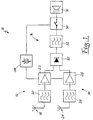
- the device 10 for recognizing ready-to-use devices mobile telephone devices shown in a block diagram.
- the device 10 comprises two input circuits 12 and 14, each in the form of a straight-ahead receiver broadband monitoring of the uplink frequencies from a cell phone to the network. Both Input circuits 12 and 14 are processed in a subsequent evaluation circuit 16.
- the first input circuit 12 consists of a Broadband antenna 18, a frequency filter 20 and an RF amplifier 22.
- Antenna 18, filter 20 and amplifier 22 are coordinated so that they monitor one Serve frequency band of a radio network, for example a frequency band from 1710 to 1900 MHz, as used for the E-radio network common in Germany.
- the second input circuit 14 also exists in the first embodiment described a broadband antenna 24, a frequency filter 26 and an RF amplifier 28.
- antenna 24, filter 26 and amplifier 28 are on a different frequency band of another radio network: here, for example, a frequency band from 880 to 915 MHz, as is the case for the D radio network common in Germany (currently D1 and D2) is used.
- a very steep-sided filter 20 according to the invention, 26 for example a so-called SAW filter or an L-C filter, can be used monitoring uplink messages from the cell phones to the network, possibly from the network to the Mobile-targeted more powerful messages, the so-called downlinks, differentiate.
- several can Filter stages can be switched in series.
- the actual detection of a transmitted from an operational cell phone to the network Notification is carried out by evaluating the characteristic for transmissions in this network pulse repetition frequency specified by the transmission standard (e.g. GSM).
- this pulse repetition frequency is 217 Hz Detect such a pulse repetition rate by an operational cell phone is used, the receiving circuit is equipped with a rectifier 30 and one downstream filter 32.
- the rectification of the input circuit 12 and 14 preferably takes place coming signals with the help of a diode 30.
- This version has the advantage that despite simple construction offers sufficient effectiveness.
- a filter 32 finally filtered out all signals with the frequency that the selected pulse repetition frequency corresponds.
- a switch 34 is activated via a switch 34, here designated 36, and there triggered a warning signal.
- Alarm transmitter 36 is an acoustic signal transmitter.
- Other signal generators are of course possible, as later in the description in connection with the Figure description of Figure 2 will be explained.
- An energy source that the active elements of the inventive device 10 with electrical energy supply is designated 38.
- a portable device 10 can, as shown in Figure 1, from at least one battery or at least one battery.
- a stationary assembly of the invention is 10 also another form of electrical energy supply without restricting the invention conceivable.
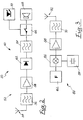
- FIG. 2 shows a second embodiment of the device 50 according to the invention shown in which a single input circuit 52, consisting of a broadband antenna 54, a filter 56 and an RF amplifier 58 is used.
- a single input circuit 52 consisting of a broadband antenna 54, a filter 56 and an RF amplifier 58 is used.
- Such a quasi simplified Input circuitry of the device 50 is always appropriate when the Device 50 according to the invention exclusively in the area of a single radio network to be used.
- Elements of the evaluation circuit, here designated 60 such as a rectifier 62, and a filter 64 which is tuned to a selected pulse repetition frequency, becomes here acoustic, for example a buzzer, and an additional optical alarm signal generator 70, for example, a light emitting diode.
- Figure 2 Device 50 does not show the energy supply (see FIG. 1).
- the in the Devices 10; 50 generated warning signals in another device not shown here forward.
- This has the advantage, for example automatic warning announcements or others To be able to trigger notices when mobile phones that are undesirably operational are discovered or to be able to control additional warning or signal devices.
- 50 generated warning signals with, for example, time and Store location information or the like and evaluate it statistically if necessary.
- FIG. 3 shows a schematic representation of an additional device 80, which is particularly suitable for suitable for use with the invention.
- signals can be Send out ready-to-use cell phones, which in turn can be handed over from above Initiate the described signal signals at the respective radio cell.
- the device 80 includes for this purpose a frequency / signal generator 82 for generating a variable Radio signals.
- This frequency is at a fixed frequency generated in an oscillator 84 (for example with a preselected quartz) mixed by means of a mixer 86.
- This Signal is then amplified in an amplifier 88 so that after passing through a Filters 90 are sent via an antenna 92 to all the mobile phones in the transmission environment can.
- An energy source required for the electrical supply is well known and not shown here for the sake of simplicity.
- the operation of the in Figure 3 Device 80 shown can be described as follows:
- pulse data packet-like Signals are generated which are those of a base station of a radio network cell correspond.
- a (new) network can be simulated in this way, which causes it to do so register to this simulated network.
- the one for these login signals from the cell phones emitted signals can be with the invention described in the above Devices 10; Detect 50 (see Figures 1 and 2) immediately.
Landscapes
- Engineering & Computer Science (AREA)
- Signal Processing (AREA)
- Computer Networks & Wireless Communication (AREA)
- Mobile Radio Communication Systems (AREA)
Applications Claiming Priority (2)
| Application Number | Priority Date | Filing Date | Title |
|---|---|---|---|
| DE1997107560 DE19707560A1 (de) | 1997-02-26 | 1997-02-26 | Vorrichtung zur Erkennung von betriebsbereiten mobilen Telefonapparaten |
| DE19707560 | 1997-02-26 |
Publications (1)
| Publication Number | Publication Date |
|---|---|
| EP0868033A2 true EP0868033A2 (fr) | 1998-09-30 |
Family
ID=7821450
Family Applications (1)
| Application Number | Title | Priority Date | Filing Date |
|---|---|---|---|
| EP19980103076 Withdrawn EP0868033A2 (fr) | 1997-02-26 | 1998-02-21 | Dispositif de détection de téléphones mobiles actifs |
Country Status (2)
| Country | Link |
|---|---|
| EP (1) | EP0868033A2 (fr) |
| DE (1) | DE19707560A1 (fr) |
Cited By (2)
| Publication number | Priority date | Publication date | Assignee | Title |
|---|---|---|---|---|
| EP1037485A3 (fr) * | 1999-03-15 | 2001-04-18 | MAZ Mikroelektronik Anwendungszentrum Hamburg GmbH | Procédé pour déterminer la position de téléphones mobiles |
| DE102006018106A1 (de) * | 2006-04-18 | 2007-11-08 | Niels Dernedde | Verfahren zur kontaktlosen Erkennung und Lokalisierung von mikroprozessorgesteuerten, batteriebetriebenen Geräten im Stand-by Betrieb |
Families Citing this family (3)
| Publication number | Priority date | Publication date | Assignee | Title |
|---|---|---|---|---|
| DE19859264A1 (de) * | 1998-12-22 | 2000-07-06 | Bosch Gmbh Robert | Verfahren zur Lokalisierung von mobilen Stationen und mobile Station |
| DE19944882B4 (de) * | 1999-09-18 | 2012-02-09 | Deutsche Telekom Ag | Anordnung zum Auffinden von eingeschalteten Funktelefonen |
| CN112562281B (zh) * | 2020-12-23 | 2022-10-21 | 广东工业大学 | 基于边缘计算的车间设备告警事件处理装置及方法 |
Family Cites Families (7)
| Publication number | Priority date | Publication date | Assignee | Title |
|---|---|---|---|---|
| DE9213584U1 (de) * | 1992-10-08 | 1993-02-04 | New Tech GmbH, 2401 Ratekau | Vorrichtung zum Auffinden einer über Bord gegangenen Person |
| DE4240284A1 (de) * | 1992-12-01 | 1994-06-16 | Joerg Richter | Verfahren und technisches Mittel zur Auffindung gestohlener PKW und als Abschreckung von Diebstählen sowie deren Zwecklosigkeit |
| DE4403873A1 (de) * | 1994-02-08 | 1994-09-08 | Wenner Manfred E | Schutz von beweglichen Gegenständen vor Entwendung und Wiederauffindung von beweglichen Gegenständen bei Verlust |
| DE9405078U1 (de) * | 1994-03-25 | 1995-07-27 | Autoflug Gmbh & Co, 25462 Rellingen | Rettungseinheit mit Notfunkeinrichtung |
| DE9406605U1 (de) * | 1994-04-20 | 1994-09-22 | VHB-Funktechnik GmbH, 34132 Kassel | System zur Ortung von gestohlenen Fahrzeugen |
| DE9411778U1 (de) * | 1994-07-21 | 1994-11-03 | Nikolaj, Dietmar, 69168 Wiesloch | Mobiles Notrufgerät |
| DE19619330A1 (de) * | 1995-06-13 | 1996-12-19 | Dieter Dr Mikolajetz | Hilferufanordnung |
-
1997
- 1997-02-26 DE DE1997107560 patent/DE19707560A1/de not_active Withdrawn
-
1998
- 1998-02-21 EP EP19980103076 patent/EP0868033A2/fr not_active Withdrawn
Cited By (3)
| Publication number | Priority date | Publication date | Assignee | Title |
|---|---|---|---|---|
| EP1037485A3 (fr) * | 1999-03-15 | 2001-04-18 | MAZ Mikroelektronik Anwendungszentrum Hamburg GmbH | Procédé pour déterminer la position de téléphones mobiles |
| DE102006018106A1 (de) * | 2006-04-18 | 2007-11-08 | Niels Dernedde | Verfahren zur kontaktlosen Erkennung und Lokalisierung von mikroprozessorgesteuerten, batteriebetriebenen Geräten im Stand-by Betrieb |
| DE102006018106B4 (de) * | 2006-04-18 | 2009-07-09 | Niels Dernedde | Verfahren zur kontaktlosen Erkennung von mikroprozessorgesteuerten, batteriebetriebenen Geräten im Stand-by Betrieb |
Also Published As
| Publication number | Publication date |
|---|---|
| DE19707560A1 (de) | 1998-08-27 |
Similar Documents
| Publication | Publication Date | Title |
|---|---|---|
| DE69936070T2 (de) | System und verfahren zur bereitstellung von wetterwarnung und anderen warnungen | |
| DE69838321T2 (de) | Firewall für zellulare kommunikation | |
| EP0956720A2 (fr) | Procede permettant de detecter des stations radiotelephoniques mobiles | |
| EP1013130B1 (fr) | Procede pour proteger une zone locale limitee contre le rayonnement electromagnetique emis par des terminaux radiotelephoniques mobiles, et station radio correspondante | |
| DE102006036082A1 (de) | Kontrollvorrichtung für die Abschirmung eines Raums | |
| DE2108602A1 (de) | Nachrichten-Übertragungseinrichtung, insbesondere Sprechfunkanlage | |
| DE19904842A1 (de) | Überwachungssystem für terristrische Navigations- und Flughafenlandesysteme | |
| DE102004048668A1 (de) | Alarmanlage und Alarmverfahren | |
| DE2164335B2 (de) | Fernmeldesystem begrenzter reichweite | |
| EP0868033A2 (fr) | Dispositif de détection de téléphones mobiles actifs | |
| EP0856999B1 (fr) | Dispositif pour empêcher la transmission d'une station mobile | |
| DE19832633A1 (de) | Sicherungssystem | |
| EP1526747B1 (fr) | Récepteur de radiodiffusion et appareil mobile pour la réception d'appels de secours | |
| DE2638842A1 (de) | Verfahren und vorrichtung zum ueberwachen gefaehrdeter personen mittels einer elektronischen ueberwachungseinrichtung | |
| DE2820840C3 (de) | Anordnung zur Absicherung von Gefahrenbereichen in Untertagebetrieben | |
| DE3624099C2 (fr) | ||
| EP1293757A1 (fr) | Procédé pour déterminer la position d'un dispositif mobile, en particulier un dispositif d'appel de détresse, système et appareil d'appel de détresse | |
| EP1128697A1 (fr) | Méthode pour actionner un dispositif mobile | |
| EP0173998B1 (fr) | Procédé et dispositif pour la localisation d'émetteurs fonctionnant en sauts de fréquence | |
| DE4016959A1 (de) | Ortungssystem, insbesondere fuer den untertaegigen bergbau | |
| DE69913945T2 (de) | Vorrichtung und Verfahren zum Detektieren der Anwesenheit eines in Betrieb befindlichen zellularen GSM-Telefons oder jeglicher anderen mobilen Geräte | |
| DE19705447A1 (de) | Funkgerät | |
| EP2461616B1 (fr) | Procédé de reconnaissance de stations mobiles actives | |
| DE2256926A1 (de) | Raumueberwachungseinrichtung | |
| EP0928549A1 (fr) | Methode de transmission sans fil d'informations locales ou utilitaires, et installation d'emission/reception |
Legal Events
| Date | Code | Title | Description |
|---|---|---|---|
| PUAI | Public reference made under article 153(3) epc to a published international application that has entered the european phase |
Free format text: ORIGINAL CODE: 0009012 |
|
| AK | Designated contracting states |
Kind code of ref document: A2 Designated state(s): AT BE CH DE DK ES FI FR GB GR IE IT LI LU MC NL PT SE |
|
| AX | Request for extension of the european patent |
Free format text: AL;LT;LV;MK;RO;SI |
|
| STAA | Information on the status of an ep patent application or granted ep patent |
Free format text: STATUS: THE APPLICATION IS DEEMED TO BE WITHDRAWN |
|
| 18D | Application deemed to be withdrawn |
Effective date: 20000830 |