EP0868042B1 - Système pour la transmission d'information d'horloge pour une couche d'adaption ATM de type 1 (AAL 1) - Google Patents
Système pour la transmission d'information d'horloge pour une couche d'adaption ATM de type 1 (AAL 1) Download PDFInfo
- Publication number
- EP0868042B1 EP0868042B1 EP98105397A EP98105397A EP0868042B1 EP 0868042 B1 EP0868042 B1 EP 0868042B1 EP 98105397 A EP98105397 A EP 98105397A EP 98105397 A EP98105397 A EP 98105397A EP 0868042 B1 EP0868042 B1 EP 0868042B1
- Authority
- EP
- European Patent Office
- Prior art keywords
- signal
- clock
- atm
- network
- atm cell
- Prior art date
- Legal status (The legal status is an assumption and is not a legal conclusion. Google has not performed a legal analysis and makes no representation as to the accuracy of the status listed.)
- Expired - Lifetime
Links
Images

Classifications
-
- H—ELECTRICITY
- H04—ELECTRIC COMMUNICATION TECHNIQUE
- H04J—MULTIPLEX COMMUNICATION
- H04J3/00—Time-division multiplex systems
- H04J3/02—Details
- H04J3/06—Synchronising arrangements
- H04J3/062—Synchronisation of signals having the same nominal but fluctuating bit rates, e.g. using buffers
- H04J3/0632—Synchronisation of packets and cells, e.g. transmission of voice via a packet network, circuit emulation service [CES]
Definitions
- the present invention relates to a clock information transfer system for an AAL type 1 (ATM Adaptation Layer type 1) transmission mode, and more particularly to a clock information transfer system for an AAL type 1 transmission mode for transmitting clock information from a transmitting device over an ATM (Asynchronous Transfer Mode) transmission path when a CBR (Constant Bit Rate) signal is transmitted as an AAL type 1 ATM cell.
- ATM Asynchronous Transfer Mode
- CBR Constant Bit Rate
- clock information is transferred from a transmitting device over an ATM transmission path to a receiving device.
- the receiving device may regenerate a clock signal from the clock information from the transmitting device according to an SRTS (Synchronous Residual Time Stamp) method and an adaptive clock method as described in recommendations of ITU-T (formerly CCITT).
- SRTS Synchronous Residual Time Stamp
- the SRTS method is used when the transmitting and receiving devices are connected to the same ATM network.
- RTS Residual Time Stamp
- information representing how many clock pulses of a network clock signal correspond to a certain number of clock pulses of the CBR signal of the transmitting device is multiplexed with an ATM cell, and transmitted to the receiving device, in which the clock signal of the transmitting device is regenerated from the received RTS information and the network clock signal.
- the adaptive clock method is used when the transmitting and receiving devices are not connected to the same ATM network.
- a CBR signal is separated from an ATM cell and thereafter stored in a buffer memory, after which the stored CBR signal is read from the buffer memory such that the CBR signal stored in the buffer memory will be kept at a constant level.
- the clock signal with which to read the stored CBR signal from the buffer memory is the clock signal of the transmitting device.
- the transfer of the clock information according to the SRTS method requires that the transmitting and receiving devices use a common network clock signal.
- the SRTS method cannot be used for international communications because the transmitting and receiving devices use different network clock signals.
- the adaptive clock method can be used for international communications. However, because of control complexities of the adaptive clock method, it needs a more expensive facility than a CLAD (Cell Assembler and Disassembler) used by the SRTS method, and suffers a poor quality of the regenerated clock signal.
- CLAD Cell Assembler and Disassembler
- clock information may be transferred from the transmitting device to the receiving device using only the CLAD according to the SRTS method.
- communications in the same ATM network and communications between different ATM networks are to be selectively performed, then it is necessary to prepare a communication terminal capable of selectively operating according to the SRTS method and the adaptive clock method, and to switch between these SRTS and adaptive clock method.
- Such a communication terminal results in an expensive system.
- the communication terminal should recognize at all times which network the remote communication terminal belongs to in switching between the SRTS and adaptive clock method. Consequently, the communication terminal needs to carry out a complicated monitoring action.
- U.S. Patent No. 5,260,978 (“Fleischer et al. ”) relates to a technique for recovering the timing signal of a CBR input service signal in a synchronous ATM network, where the source and destination nodes receive reference timing signals from a single common network clock.
- Fleischer et al. achieves synchronous timing recovery using an actual synchrony of node time to carry out SRTS.
- the method of Fleischer et al. purportedly has the advantages of both synchronous frequency encoding technique (SFET) and time stamp (TS).
- SFET synchronous frequency encoding technique
- TS time stamp
- McTiffin European Patent Application Publication No. 0 660 553
- McTiffin includes means for calculating a value indicative of the number of complete source network clock cycles in a predetermined period which is loaded into a counter. When the counter reaches a predetermined value, a latch connected to a further counter contains a new residual time stamp value.
- a clock information transfer method for use in an AAL type 1 transmission system comprising a plurality of ATM transmission devices connected to respective transmitting and receiving ATM networks which operate with different network clock signals, and transmitting and receiving communication terminals for transmitting a CBR signal therebetween via the ATM networks and the ATM transmission devices connected thereto, wherein the ATM transmission device of the receiving ATM network is connected to an input terminal of the receiving ATM network, and when the ATM transmission device of the receiving ATM network receives an ATM cell signal converted according to AAL type 1 from the transmitted CBR signal from the transmitting ATM network, the ATM transmission device of the receiving ATM network regenerates a clock signal of the transmitted CBR signal from the received ATM cell signal, generates RTS information based on the regenerated clock signal and a network clock signal of the receiving ATM network which is different from a network clock signal of the transmitting ATM network, inserts the generated RTS information into the ATM cell signal at a predetermined position therein, multiplexes the ATM cell signal, and outputs the multiplexed ATM cell signal to
- a clock information transfer system for an AAL type 1 transmission mode for transmitting a CBR signal from a first CBR signal communication terminal connected to a first ATM network via an ATM transmission path to a second CBR signal communication terminal connected to a second ATM network which is synchronous with a network clock signal from a clock frequency source that is different from a clock frequency source of the first ATM network, comprising a first SRTS CLAD connected to an input terminal of the first ATM network, for converting the transmitted CBR signal supplied from the first CBR signal communication terminal into an ATM cell of AAL type 1, including clock information according to a SRTS method, and supplying the ATM cell as a first ATM cell signal to the first ATM network, a first ATM transmission device connected to an output terminal of the first ATM network, for transmitting the first ATM cell signal supplied from the first SRTS CLAD via the first ATM network to the ATM transmission path, a second ATM transmission device connected to an input terminal of the second ATM network, for regenerating, as a first regenerated clock signal,
- the ATM transmission device connected to the receiving or second ATM network may comprise clock regenerating means for regenerating the clock signal of the transmitted CBR signal according to an adaptive clock method from the ATM cell signal, and outputting the regenerated clock signal as a first regenerated clock signal, RTS information generating means for generating RTS information representing how many clock pulses of the network clock signal correspond to a predetermined number of clock pulses of the first regenerated clock signal from the clock regenerating means, based on the first regenerated clock signal from the clock regenerating means and the network clock signal of the receiving or second ATM network, RTS information inserting means for inserting the RTS information into an ATM cell of the ATM cell signal to be outputted to the receiving or second ATM network at a position therein determined by an SRTS method, multiplexing the ATM cell signal, and outputting the multiplexed ATM cell signal to the receiving or second ATM network.
- clock regenerating means for regenerating the clock signal of the transmitted CBR signal according to an adaptive clock method from the ATM cell signal, and outputting the
- the clock regenerating means may comprise clock generating means for generating a clock signal normally at a predetermined period and generating the first regenerated clock signal when controlled by a clock control signal, and clock control means for counting up the amount of information of the transmitted CBR signal based on the interval between ATM cell arrival times each time an ATM cell of the received ATM cell signal is received, counting down the count with the first regenerated clock signal from the clock generating means, and outputting the clock control signal so that the count will be of a constant value, for thereby controlling the period of the first regenerated clock signal outputted by the clock generating means.
- the clock control means may comprise a differential counting circuit comprising an up/down counter for counting the amount of information of the transmitted CBR signal contained in the received ATM cell signal and counting clock pulses of the first regenerated clock signal from the clock generating means, and outputs a differential value which increases when the first regenerated clock signal is slower than the clock information of the transmitted CBR signal and decreases when the first regenerated clock signal is faster than the clock information of the transmitted CBR signal.
- Fig. 1 is a block diagram of a clock information transfer system for an AAL type 1 transmission mode according to the present invention.
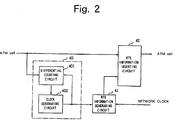
- Fig. 2 is a block diagram of an ATM
- a clock information transfer system for an AAL type 1 transmission mode transfers clock information for a CBR signal between a CBR signal communication terminal 1-1 connected as a transmitting device to an ATM network A 3-1 and a CBR signal communication terminal 1-2 connected as a receiving device to an ATM network B 3-2 which is synchronous with a clock signal from a clock frequency source that is different from a clock frequency source of the ATM network A 3-1.
- Information is transferred between the CBR signal communication terminals 1-1, 1-2 via an SRTS CLAD 2-1 connected to the CBR signal communication terminal 1-1 and the ATM network A 3-1, an ATM transmission device 4-1 connected to the ATM network A 3-1, an ATM transmission path 5 connected to the ATM transmission device 4-1, an ATM transmission device 4-2 connected to ATM transmission path 5 and the ATM network B 3-2, and an SRTS CLAD 2-2 connected to the ATM network B 3-2 and the CBR signal communication terminal 1-2.
- the SRTS CLAD 2-1 is connected to an input terminal of the ATM network A 3-1, and serves to convert a transmitted CBR signal supplied from the CBR signal communication terminal 1-1 into an ATM cell of AAL type 1, including clock information according to the SRTS method, and supplies the ATM cell as an ATM cell signal to the ATM network A 3-1.
- the ATM transmission device 4-1 is connected to an output terminal of the ATM network A 3-1, and serves to transmit the ATM cell signal supplied from the SRTS CLAD 2-1 via the ATM network A 3-1 to the ATM transmission path 5.
- the ATM transmission device 4-2 which is connected to an input terminal of the ATM network B 3-2, serves to regenerate, as a first regenerated clock signal, a clock signal of the transmitted CBR signal from the ATM cell signal transmitted from the ATM transmission device 4-1 via the ATM transmission path 5, generate RTS information from the first regenerated clock signal and the network clock signal of the ATM network B 3-2, insert the RTS information into the ATM cell of the ATM cell signal, multiplex the ATM cell signal, and supply the multiplexed ATM cell signal to the ATM network B 3-2.
- the SRTS CLAD 2-2 which is connected to an output terminal of the ATM network B 3-2, serves to regenerate, as a second regenerated clock signal, a clock signal of the transmitted CBR signal based on the multiplexed RTS information from the multiplexed ATM cell signal transmitted from the ATM transmission device 4-2 via the ATM network B 3-2, recover the transmitted CBR signal from the multiplexed ATM cell signal based on the second regenerated clock signal, and transmits the recovered CBR signal to the CBR signal communication terminal 1-2.
- a CBR signal from the CBR signal communication terminal 1-1 is received by the SRTS CLAD 2-1.
- the SRTS CLAD 2-1 converts the received CBR signal into an ATM cell including clock information according to the SRTS method, and supplies the ATM cell to the ATM network A 3-1.
- the ATM cell supplied to the ATM network A 3-1 is transmitted via the ATM network A 3-1 and then transmitted from the ATM transmission device 4-1 via the ATM transmission path 5 to the ATM transmission device 4-2 that is connected to the ATM network B 3-2.
- the ATM transmission device 4-2 regenerates a clock signal of the transmitted CBR signal from the received ATM cell according to the adaptive clock method, generates RTS information from the regenerated clock signal and the network clock signal of the ATM network B 3-2, inserts the RTS information into the ATM cell, multiplexes the ATM cell, and supplies the multiplexed ATM cell to the ATM network B 3-2.
- the multiplexed ATM cell is transmitted via the ATM network B 3-2 to the SRTS CLAD 2-2.
- the SRTS CLAD 2-2 regenerates a clock signal of the transmitted CBR signal based on the multiplexed RTS information, converts the received ATM cell back into the CBR signal, and transmits the CBR signal to the CBR signal communication terminal 1-2.
- a means for generating RTS information in synchronism with the network clock signal of the ATM network to which the receiving communication terminal is connected is provided in the junction between different ATM networks, and inserts the generated RTS information into an ATM cell. Therefore, even though communications are performed between the different ATM networks, the receiving communication terminal can receive the RTS information generated on the basis of the network clock signal of the ATM network to which the receiving communication terminal is connected, and hence can regenerate a clock signal according to the SRTS method.
- a converting device for regenerating a clock signal according to the adaptive clock method, generating RTS information, to be transferred according to the SRTS method, from the regenerated clock signal, and inserting the RTS information into an ATM cell is provided in the junction between different ATM networks. Therefore, all CLADs at transmission route ends may be SRTS CLADs.
- the ATM transmission device 4-2 will be described below.
- Fig. 2 shows in block form the ATM transmission device 4-2.
- the ATM transmission device 4-2 comprises a clock regenerator 40 for regenerating a clock signal of a transmitted CBR signal from a received ATM cell signal according to the adaptive clock method and outputting the regenerated clock signal as a first regenerated clock signal, an RTS information generating circuit 41 for generating RTS information, representative of how many clock pulses of a network clock signal correspond to a certain number of clock pulses of the first regenerated clock signal, based on the first regenerated clock signal from the clock regenerator 40 and the network clock signal from a receiving ATM network, and an RTS information inserting circuit 42 for inserting the RTS information from the RTS information generating circuit 41 into an ATM cell of the received ATM cell signal to be transmitted to the receiving ATM network, at a position therein determined by the SRTS method, and multiplexing and outputting the ATM cell signal.
- a clock regenerator 40 for regenerating a clock signal of a transmitted CBR signal from a received ATM cell signal according to the adaptive clock method and outputting the regenerated clock signal as a first
- the clock regenerator 40 comprises a clock generating circuit 402 for generating a clock signal normally at a constant period and generating the first regenerated clock signal when controlled by a clock control signal, and a differential counting circuit 401, serving as a clock control means, for counting up the amount of information of the transmitted CBR signal based on the interval between ATM cell arrival times each time an ATM cell of the received ATM cell signal is received, counting down the count with the first regenerated clock signal from the clock generating circuit 402, and outputting the clock control signal so that the count will be of a constant value, for thereby controlling the period of the first regenerated clock signal outputted by the clock generating circuit 402.
- the differential counting circuit 401 comprises an up/down counter which counts the amount of information of the transmitted CBR signal contained in the received ATM cell signal and also counts clock pulses of the first regenerated clock signal from the clock generating circuit 402, and outputs a differential value that increases when the first regenerated clock signal is slower than the clock information of the transmitted CBR signal and decreases when the first regenerated clock signal is faster than the clock information of the transmitted CBR signal.
- the ATM transmission device shown in Fig. 2 operates as follows: When an ATM cell is received, the differential counting circuit 401 counts the amount of information of a transmitted CBR signal contained in the received ATM cell and clock pulses generated by the clock generating circuit 402 of the clock regenerator 40, and outputs a differential value between the counted values.
- the clock generating circuit 402 controls the frequency of a clock signal generated thereby with the differential value outputted from the differential counting circuit 401.
- the differential value outputted from the differential counting circuit 401 increases when the clock signal generated by the clock generating circuit 402 is slower than the clock signal of the transmitted CBR signal, decreases when the clock signal generated by the clock generating circuit 402 is faster than the clock signal of the transmitted CBR signal, and is constant when the clock signal generated by the clock generating circuit 402 and the clock signal of the transmitted CBR signal have the same rate. Therefore, the clock generating circuit 402 increases the frequency of the clock signal generated thereby when the differential value outputted from the differential counting circuit 401 increases, and reduces the frequency of the clock signal generated thereby when the differential value outputted from the differential counting circuit 401 decreases, so that the differential value outputted from the differential counting circuit 401 will be constant. Accordingly, the clock generating circuit 402 generates a clock signal whose frequency is in conformity with the clock frequency of the transmitted CBR signal.
- the differential counting circuit 401 may comprise an up/down counter for counting up the amount of information of the CBR signal contained in the received ATM cell and counting down clock pulses of the clock signal generated by the clock generating circuit 402.
- the RTS information generating circuit 41 generates RTS information from the clock signal generated by the clock generating circuit 402 and the network clock signal.
- the RTS information which represents how many clock pulses of the network clock signal correspond to a certain number of clock pulses of the clock signal generated by the clock generating circuit 402, may be generated by several counters.
- the RTS information generated by the RTS information generating circuit 41 is inserted into the ATM cell to be transmitted at a position therein determined by the SRTS method, by the RTS information inserting circuit 42.
- the clock information transfer system according to the present invention is advantageous in that it allows communications between different ATM networks without changing clock information transfer processes depending on the remote communication terminal and makes it unnecessary to confirm the remote communication terminal and change settings of transmission devices.
- the ATM transmission device at the junction between different ATM networks regenerates a clock signal of a CBR signal based on the interval between ATM cell arrival times, generates RTS information from a network clock signal of the ATM network to which the receiving communication terminal is connected, and inserts the generated RTS information into an ATM cell. Therefore, even though communications are performed between the different ATM networks, the receiving communication terminal can receive the RTS information generated on the basis of the network clock signal of the ATM network to which the receiving communication terminal is connected, and hence can regenerate a clock signal according to the SRTS method.
Landscapes
- Engineering & Computer Science (AREA)
- Multimedia (AREA)
- Computer Hardware Design (AREA)
- Computer Networks & Wireless Communication (AREA)
- Signal Processing (AREA)
- Data Exchanges In Wide-Area Networks (AREA)
- Synchronisation In Digital Transmission Systems (AREA)
Claims (8)
- Système de transfert d'informations d'horloge pour un mode de transmission AAL type 1 destiné à transmettre un signal à débit binaire constant d'un premier terminal de communication de signal à débit binaire constant (1-1) connecté à un premier réseau à mode ATM (3-1) par l'intermédiaire d'une voie de transmission à mode ATM (5) à un second terminal de communication de signal à débit binaire constant (1-2) connecté à un second réseau à mode ATM (3-2) qui est synchrone avec un signal d'horloge de réseau provenant d'une source de fréquence d'horloge qui est différente d'une source de fréquence d'horloge dudit premier réseau à mode ATM (3-1), le système de transfert d'informations d'horloge comprenant :un premier module d'assemblage et de désassemblage de cellule d'horodateur résiduel synchrone (SRTS CLAD) (2-1) connecté à une borne d'entrée du premier réseau à mode ATM (3-1), conçu pour convertir le signal à débit binaire constant transmis fourni depuis ledit premier terminal de communication de signal à débit binaire constant (1-1) en une cellule à mode ATM du type AAL type 1, comprenant des informations d'horloge conformément à un procédé SRTS, et fournir la cellule à mode ATM en tant que premier signal de cellules à mode ATM audit premier réseau à mode ATM (3-1),et un premier dispositif de transmission à mode ATM (4-1) connecté à une borne de sortie dudit premier réseau à mode ATM (3-1), conçu pour transmettre le premier signal de cellules à mode ATM fourni depuis ledit premier module SRTS CLAD (2-1) par l'intermédiaire dudit premier réseau à mode ATM (3-1) à la voie de transmission à mode ATM (5), le système de transfert d'informations d'horloge étant caractérisé par:un second dispositif de transmission à mode ATM (4-2) connecté à une borne d'entrée du second réseau à mode ATM (3-2), conçu pour régénérer, conformément à un procédé d'horloge adaptatif, en tant que premier signal d'horloge régénéré, un signal d'horloge du signal à débit binaire constant transmis à partir dudit premier signal de cellules à mode ATM transmis depuis ledit premier dispositif de transmission à mode ATM (4-1) par l'intermédiaire de ladite voie de transmission à mode ATM (5), générer des informations d'horodateur RTS à partir dudit premier signal d'horloge régénéré et du signal d'horloge de réseau dudit second réseau à mode ATM (3-2), insérer les informations d'horodateur RTS dans la cellule à mode ATM du premier signal de cellules à mode ATM, multiplexer le premier signal de cellules à mode ATM, et fournir le premier signal de cellules à mode ATM multiplexé audit second réseau à mode ATM (3-2), etun second module SRTS CLAD (2-2) connecté à une borne de sortie dudit second réseau à mode ATM (3-2), conçu pour régénérer, en tant que second signal d'horloge régénéré, un signal d'horloge du signal à débit binaire constant transmis sur la base des informations d'horodateur RTS multiplexées à partir du premier signal de cellules à mode ATM multiplexé transmis depuis le second dispositif de transmission à mode ATM (4-2) par l'intermédiaire du second réseau à mode ATM (3-2), récupérer le signal à débit binaire constant transmis à partir du premier signal de cellules à mode ATM multiplexé sur la base du second signal d'horloge régénéré, et transmettre le signal à débit binaire constant récupéré audit second terminal de communication de signal à débit constant (1-2).
- Système de transfert d'informations d'horloge selon la revendication 1, dans lequel ledit second dispositif de transmission à mode ATM (4-2) comprend :un moyen de régénération d'horloge (40) adapté pour générer le signal d'horloge du signal à débit binaire constant transmis conformément au procédé d'horloge adaptatif à partir du premier signal de cellules à mode ATM et fournir en sortie le signal d'horloge régénéré en tant que ledit premier signal d'horloge régénéré,un moyen de génération d'informations d'horodateur RTS (41) conçu pour générer des informations d'horodateur RTS représentant combien d'impulsions d'horloge du signal d'horloge de réseau correspondent à un nombre prédéterminé d'impulsions d'horloge du premier signal d'horloge régénéré provenant dudit moyen de régénération d'horloge (40), sur la base du premier signal d'horloge régénéré provenant dudit moyen de régénération d'horloge (40) et du signal d'horloge de réseau dudit second réseau à mode ATM (3-2), etun moyen d'insertion d'informations d'horodateur RTS (42) conçu pour insérer lesdites informations d'horodateur RTS dans une cellule à mode ATM du signal de cellules à mode ATM devant être fourni en sortie audit second réseau à mode ATM (3-2) à une position dans celui-ci déterminée par le procédé d'horodateur SRTS, multiplexer le signal de cellules à mode ATM, et fournir en sortie le signal de cellules à mode ATM multiplexé au second réseau à mode ATM (3-2).
- Système de transfert d'informations d'horloge selon la revendication 2, dans lequel ledit moyen de régénération d'horloge (40) comprend :un moyen de génération d'horloge (402) conçu pour générer un signal d'horloge normalement à une période prédéterminée et générer ledit premier signal d'horloge régénéré lorsqu'il est commandé par un signal de commande d'horloge, etun moyen de commande d'horloge (401) conçu pour compter la quantité d'informations du signal à débit binaire constant transmis sur la base de l'intervalle entre les instants d'arrivée de cellules à mode ATM chaque fois qu'une cellule à mode ATM du signal de cellules à mode ATM est reçue, effectuer un décompte sur le comptage avec le premier signal d'horloge régénéré provenant du moyen de génération d'horloge (402), et fournir en sortie le signal de commande d'horloge de sorte que le comptage soit une valeur constante, pour commander la période du premier signal d'horloge régénéré fourni en sortie par ledit moyen de génération d'horloge (402).
- Système de transfert d'informations d'horloge selon la revendication 3, dans lequel ledit moyen de commande d'horloge (401) comprend:un circuit de comptage différentiel (401) comprenant un compteur vers le haut/vers le bas conçu pour compter la quantité d'informations du signal à débit binaire constant transmis contenue dans le signal de cellules à mode ATM reçu et compter les impulsions d'horloge du premier signal d'horloge régénéré provenant dudit moyen de génération d'horloge (402), et fournir en sortie une valeur différentielle qui augmente lorsque le premier signal d'horloge régénéré est plus lent que les informations d'horloge du signal à débit binaire constant transmis et diminue lorsque le premier signal d'horloge régénéré est plus rapide que les informations d'horloge du signal à débit binaire constant transmis.
- Procédé de transfert d'informations d'horloge à utiliser dans un système de transmission à couche d'adaptation à mode ATM (AAL) de type 1 comprenant une pluralité de dispositifs de transmission à mode ATM (4-1, 4-2) connectés à des réseaux en mode de transfert asynchrone (ATM) d'émission et de réception respectifs (3-1,3-2) qui fonctionnent avec différents signaux d'horloge de réseau, et des terminaux de communication d'émission et de réception (1-1, 1-2) destinés à transmettre un signal à débit binaire constant (CBR) entre eux par l'intermédiaire des réseaux à mode ATM (3-1, 3-2) et des dispositifs d'émission à mode ATM (4-1, 4-2) connectés à ceux-ci, où ledit dispositif d'émission à mode ATM (4-2) associé au réseau à mode ATM de réception (3-2) est connecté à une borne d'entrée du réseau à mode ATM de réception (3-2), le procédé de transfert d'informations d'horloge comprenant les étapes consistant à :recevoir, par le biais dudit dispositif d'émission à mode ATM (4-2) associé au réseau à mode ATM de réception (3-2), un signal de cellules à mode ATM converti conformément au mode AAL type 1 à partir du signal à débit binaire constant émis depuis le réseau à mode ATM d'émission (3-1), le procédé de transfert d'informations d'horloge étant caractérisé par les étapes consistant à :régénérer, conformément à un procédé d'horloge adaptatif, un signal d'horloge du signal à débit binaire constant émis à partir du signal de cellules à mode ATM reçu,générer des informations d'horodateur résiduel (RTS) sur la base du signal d'horloge régénéré et d'un signal d'horloge de réseau du réseau à mode ATM de réception (3-2) qui est différent d'un signal d'horloge de réseau du réseau à mode ATM d'émission (3-1),insérer les informations d'horodateur RTS générées dans ledit signal de cellules à mode ATM à une position prédéterminée dans celui-ci,multiplexer le signal de cellules à mode ATM,fournir en sortie le signal de cellules à mode ATM multiplexé à partir du dispositif d'émission à mode ATM (4-2) audit réseau à mode ATM de réception (3-2),récupérer le signal à débit binaire constant transmis, ettransmettre ledit signal à débit binaire constant récupéré audit terminal de communication de réception (1-2).
- Procédé de transfert d'informations d'horloge selon la revendication 5, comprenant en outre les étapes consistant à :régénérer le signal d'horloge du signal à débit binaire constant transmis conformément au procédé d'horloge adaptatif à partir du signal de cellules à mode ATM, et fournir en sortie le signal d'horloge régénéré en tant que premier signal d'horloge régénéré,générer des informations d'horodateur RTS représentant combien d'impulsions d'horloge du signal d'horloge de réseau correspondent à un nombre prédéterminé d'impulsions d'horloge du premier signal d'horloge régénéré, sur la base du premier signal d'horloge régénéré et du signal d'horloge de réseau dudit réseau à mode ATM de réception (3-2), etinsérer lesdites informations d'horodateur RTS dans une cellule à mode ATM du signal de cellules à mode ATM devant être fourni en sortie audit réseau à mode ATM de réception à une position dans celui-ci déterminée par un procédé d'horodateur SRTS, multiplexer le signal de cellules à mode ATM, et fournir en sortie le signal de cellules à mode ATM multiplexé au réseau à mode ATM de réception (3-2).
- Procédé de transfert d'informations d'horloge selon la revendication 6, comprenant en outre les étapes consistant à :générer un signal d'horloge à un intervalle prédéterminé et générer ledit premier signal d'horloge régénéré lorsque cela est commandé par un signal de commande d'horloge,compter la quantité d'informations du signal à débit binaire constant transmis sur la base de l'intervalle entre les instants d'arrivée de cellules à mode ATM chaque fois qu'une cellule à mode ATM du signal de cellules à mode ATM reçu est reçue, effectuer un décompte sur le comptage avec le premier signal d'horloge régénéré, et fournir en sortie le signal de commande d'horloge de sorte que le comptage présentera une valeur constante, etcommander la période du premier signal d'horloge régénéré fourni en sortie.
- Procédé de transfert d'informations d'horloge selon la revendication 7, comprenant en outre les étapes consistant à :compter la quantité d'informations du signal à débit binaire constant transmis contenue dans le signal de cellules à mode ATM reçu,compter les impulsions d'horloge du premier signal d'horloge régénéré, etfournir en sortie une valeur différentielle qui augmente lorsque le premier signal d'horloge régénéré est plus lent que les informations d'horloge du signal à débit binaire constant transmis et diminue lorsque le premier signal d'horloge régénéré est plus rapide que les informations d'horloge du premier signal à débit binaire constant transmis.
Applications Claiming Priority (3)
| Application Number | Priority Date | Filing Date | Title |
|---|---|---|---|
| JP77700/97 | 1997-03-28 | ||
| JP7770097 | 1997-03-28 | ||
| JP9077700A JP3011128B2 (ja) | 1997-03-28 | 1997-03-28 | Aalタイプ1伝送におけるクロック情報転送方式 |
Publications (3)
| Publication Number | Publication Date |
|---|---|
| EP0868042A2 EP0868042A2 (fr) | 1998-09-30 |
| EP0868042A3 EP0868042A3 (fr) | 2002-06-05 |
| EP0868042B1 true EP0868042B1 (fr) | 2007-11-14 |
Family
ID=13641182
Family Applications (1)
| Application Number | Title | Priority Date | Filing Date |
|---|---|---|---|
| EP98105397A Expired - Lifetime EP0868042B1 (fr) | 1997-03-28 | 1998-03-25 | Système pour la transmission d'information d'horloge pour une couche d'adaption ATM de type 1 (AAL 1) |
Country Status (5)
| Country | Link |
|---|---|
| US (1) | US6137778A (fr) |
| EP (1) | EP0868042B1 (fr) |
| JP (1) | JP3011128B2 (fr) |
| AU (1) | AU745211B2 (fr) |
| DE (1) | DE69838693T2 (fr) |
Families Citing this family (20)
| Publication number | Priority date | Publication date | Assignee | Title |
|---|---|---|---|---|
| US6157659A (en) * | 1997-12-19 | 2000-12-05 | Nortel Networks Corporation | Method of and apparatus for multiplexing and demultiplexing digital signal streams |
| US6556573B1 (en) * | 1998-06-05 | 2003-04-29 | Nokia Telecommunications Oy | Synchronization of ATM-based network system using variable bit rate ATM adaptation layer protocols |
| JP2000083034A (ja) * | 1998-09-07 | 2000-03-21 | Fujitsu Ltd | インタフェース装置及び周波数変動試験方法 |
| US6791987B1 (en) * | 1998-10-23 | 2004-09-14 | Nortel Networks Limited | Maintaining synchronization over asynchronous interface |
| US6885661B1 (en) | 1998-12-30 | 2005-04-26 | Nortel Networks Limited | Private branch exchange built using an ATM Network |
| US6768736B1 (en) * | 1998-12-30 | 2004-07-27 | Nortel Networks Limited | Using an ATM switch to grow the capacity of a switching stage |
| US6804229B2 (en) | 1998-12-30 | 2004-10-12 | Nortel Networks Limited | Multiple node network architecture |
| US6778538B2 (en) | 1998-12-30 | 2004-08-17 | Nortel Networks Limited | Virtual junctors |
| US6788703B2 (en) | 1998-12-30 | 2004-09-07 | Nortel Networks Limited | DS0 on ATM, mapping and handling |
| DE60019466T2 (de) * | 2000-01-27 | 2006-04-27 | Telefonaktiebolaget Lm Ericsson (Publ) | Empfänger für die rückgewinnung des taktes bei der übertragung von diensten mit konstanter bitrate, die bei dcti- und srts-sendern entstehen |
| DE60031090T2 (de) * | 2000-03-22 | 2007-04-05 | Alcatel | Verfahren und Vorrichtung zur Wiederzusammensetzung von Rahmen |
| US20020172229A1 (en) * | 2001-03-16 | 2002-11-21 | Kenetec, Inc. | Method and apparatus for transporting a synchronous or plesiochronous signal over a packet network |
| US7167480B1 (en) * | 2001-06-21 | 2007-01-23 | Lighthouse Capital Partners Iv, Lp | Multi-service data transport architecture |
| GB2381693B (en) * | 2001-11-01 | 2004-07-14 | Zarlink Semiconductor Ltd | Automatic masking of interrupts |
| GB0205350D0 (en) * | 2002-03-07 | 2002-04-24 | Zarlink Semiconductor Inc | Clock synchronisation over a packet network using SRTS without a common network clock |
| AU2003278736A1 (en) * | 2002-06-21 | 2004-01-06 | Thomson Licensing S.A. | Clock extraction circuit for use in a linearly expandable broadcast router |
| DE602004017423D1 (de) * | 2003-02-20 | 2008-12-11 | Zarlink Semiconductor Inc | Synchronisation von takten über mehrerepaketnetzwerke hinweg |
| EP1880494A1 (fr) * | 2005-05-11 | 2008-01-23 | Telefonaktiebolaget L M Ericsson (Publ) | Synchronisation de vodsl pour dslam connecte seulement a ethernet |
| RU2369015C2 (ru) * | 2005-05-11 | 2009-09-27 | Телефонактиеболагет Лм Эрикссон (Пабл) | Синхронизация vodsl для dslam, соединенного только с ethernet |
| KR101196823B1 (ko) | 2005-07-15 | 2012-11-06 | 삼성전자주식회사 | 일정 비트율 트래픽의 클럭 복원 방법 및 장치 |
Family Cites Families (7)
| Publication number | Priority date | Publication date | Assignee | Title |
|---|---|---|---|---|
| US5260978A (en) * | 1992-10-30 | 1993-11-09 | Bell Communications Research, Inc. | Synchronous residual time stamp for timing recovery in a broadband network |
| GB2285201B (en) * | 1993-12-22 | 1997-12-10 | Roke Manor Research | Timing recovery apparatus |
| WO1995027385A2 (fr) * | 1994-03-31 | 1995-10-12 | Telco Systems Inc | Procede et appareil de controle de systemes de transmission |
| GB9419611D0 (en) * | 1994-09-29 | 1994-11-16 | Plessey Telecomm | Constant bit rate synchronisation |
| US5812618A (en) * | 1995-12-15 | 1998-09-22 | Cisco Technology, Inc. | SRTS clock recovery system implementing adaptive clock recovery techniques |
| US5742649A (en) * | 1995-12-15 | 1998-04-21 | Cisco Technology, Inc. | SRTS clock recovery system for use in a highly stressed network environment |
| US5822383A (en) * | 1995-12-15 | 1998-10-13 | Cisco Technology, Inc. | System and method for maintaining network synchronization utilizing digital phase comparison techniques with synchronous residual time stamps |
-
1997
- 1997-03-28 JP JP9077700A patent/JP3011128B2/ja not_active Expired - Fee Related
-
1998
- 1998-03-25 DE DE69838693T patent/DE69838693T2/de not_active Expired - Lifetime
- 1998-03-25 EP EP98105397A patent/EP0868042B1/fr not_active Expired - Lifetime
- 1998-03-26 US US09/048,271 patent/US6137778A/en not_active Expired - Lifetime
- 1998-03-27 AU AU59695/98A patent/AU745211B2/en not_active Ceased
Non-Patent Citations (1)
| Title |
|---|
| None * |
Also Published As
| Publication number | Publication date |
|---|---|
| EP0868042A2 (fr) | 1998-09-30 |
| EP0868042A3 (fr) | 2002-06-05 |
| DE69838693D1 (de) | 2007-12-27 |
| DE69838693T2 (de) | 2008-04-10 |
| US6137778A (en) | 2000-10-24 |
| JP3011128B2 (ja) | 2000-02-21 |
| AU5969598A (en) | 1998-10-01 |
| JPH10276202A (ja) | 1998-10-13 |
| AU745211B2 (en) | 2002-03-14 |
Similar Documents
| Publication | Publication Date | Title |
|---|---|---|
| EP0868042B1 (fr) | Système pour la transmission d'information d'horloge pour une couche d'adaption ATM de type 1 (AAL 1) | |
| EP0544975B1 (fr) | Système d'attribution d'unités temporelles | |
| US5103447A (en) | High-speed ring LAN system | |
| US5220563A (en) | Device for the transmission by an asynchronous network, notably an atm type network, of signalling data, channel by channel, assembled in a multiframe transmitted synchronously in out-of-band mode | |
| US5896427A (en) | System and method for maintaining network synchronization utilizing digital phase comparison techniques with synchronous residual time stamps | |
| EP0530680A2 (fr) | Système et dispositif d'assemblage et de désassemblage de cellules à ATM | |
| EP0876017A1 (fr) | Système numérique de récupération d'horloge | |
| EP0878076B1 (fr) | Boucle en temps virtuel | |
| JP2001513301A (ja) | Stm伝送システムによるatmにおける同期 | |
| EP1155540A1 (fr) | Transmission de donnees | |
| US7050450B1 (en) | Telecommunications system and method for producing a master clock in the same | |
| JPH1188332A (ja) | 同期ディジタルインタフェースへのセル多重装置及び方法 | |
| US20020048260A1 (en) | Circuit emulation communication method and device | |
| JPH0955746A (ja) | Cbr信号の位相跳躍防止方式 | |
| JP3246423B2 (ja) | 網同期装置 | |
| KR100378587B1 (ko) | 시분할 채널 변조된 신호와 비동기 전송 모드 셀 상호변환 장치 | |
| JP3567647B2 (ja) | 一次群速度インタフェース収容回路 | |
| JP2834030B2 (ja) | Atmセルインタフェースおよび該インタフェースを用いたatmセル伝送システム | |
| JP3347877B2 (ja) | 狭帯域回線モードで供給/復元される情報のセルモードでの伝送方法および装置 | |
| JP3577715B2 (ja) | Atm通信システム及びatmマルチ・リンク通信方法 | |
| JPH02266631A (ja) | Isdnベーシックアクセス端末 | |
| JP2001053736A (ja) | フレーム同期回路 | |
| KR100263388B1 (ko) | 동기식 잔여 타임스탬프를 이용한 클럭 정보송수신장치 | |
| JPH09270797A (ja) | 等時性データのセル転送方式 | |
| JPH04362824A (ja) | 通信網接続装置 |
Legal Events
| Date | Code | Title | Description |
|---|---|---|---|
| PUAI | Public reference made under article 153(3) epc to a published international application that has entered the european phase |
Free format text: ORIGINAL CODE: 0009012 |
|
| AK | Designated contracting states |
Kind code of ref document: A2 Designated state(s): AT BE CH DE DK ES FI FR GB GR IE IT LI LU MC NL PT SE |
|
| AX | Request for extension of the european patent |
Free format text: AL;LT;LV;MK;RO;SI |
|
| PUAL | Search report despatched |
Free format text: ORIGINAL CODE: 0009013 |
|
| AK | Designated contracting states |
Kind code of ref document: A3 Designated state(s): AT BE CH DE DK ES FI FR GB GR IE IT LI LU MC NL PT SE |
|
| AX | Request for extension of the european patent |
Free format text: AL;LT;LV;MK;RO;SI |
|
| 17P | Request for examination filed |
Effective date: 20020424 |
|
| AKX | Designation fees paid |
Designated state(s): DE FR GB |
|
| RAP1 | Party data changed (applicant data changed or rights of an application transferred) |
Owner name: JUNIPER NETWORKS, INC. |
|
| GRAP | Despatch of communication of intention to grant a patent |
Free format text: ORIGINAL CODE: EPIDOSNIGR1 |
|
| RTI1 | Title (correction) |
Free format text: CLOCK INFORMATION TRANSFER SYSTEM FOR AAL TYPE 1 TRANSMISSION |
|
| GRAS | Grant fee paid |
Free format text: ORIGINAL CODE: EPIDOSNIGR3 |
|
| GRAA | (expected) grant |
Free format text: ORIGINAL CODE: 0009210 |
|
| AK | Designated contracting states |
Kind code of ref document: B1 Designated state(s): DE FR GB |
|
| REG | Reference to a national code |
Ref country code: GB Ref legal event code: FG4D |
|
| REF | Corresponds to: |
Ref document number: 69838693 Country of ref document: DE Date of ref document: 20071227 Kind code of ref document: P |
|
| ET | Fr: translation filed | ||
| PLBE | No opposition filed within time limit |
Free format text: ORIGINAL CODE: 0009261 |
|
| STAA | Information on the status of an ep patent application or granted ep patent |
Free format text: STATUS: NO OPPOSITION FILED WITHIN TIME LIMIT |
|
| 26N | No opposition filed |
Effective date: 20080815 |
|
| PGFP | Annual fee paid to national office [announced via postgrant information from national office to epo] |
Ref country code: GB Payment date: 20130327 Year of fee payment: 16 Ref country code: DE Payment date: 20130327 Year of fee payment: 16 Ref country code: FR Payment date: 20130405 Year of fee payment: 16 |
|
| REG | Reference to a national code |
Ref country code: DE Ref legal event code: R119 Ref document number: 69838693 Country of ref document: DE |
|
| GBPC | Gb: european patent ceased through non-payment of renewal fee |
Effective date: 20140325 |
|
| REG | Reference to a national code |
Ref country code: FR Ref legal event code: ST Effective date: 20141128 |
|
| REG | Reference to a national code |
Ref country code: DE Ref legal event code: R119 Ref document number: 69838693 Country of ref document: DE Effective date: 20141001 |
|
| PG25 | Lapsed in a contracting state [announced via postgrant information from national office to epo] |
Ref country code: DE Free format text: LAPSE BECAUSE OF NON-PAYMENT OF DUE FEES Effective date: 20141001 Ref country code: GB Free format text: LAPSE BECAUSE OF NON-PAYMENT OF DUE FEES Effective date: 20140325 Ref country code: FR Free format text: LAPSE BECAUSE OF NON-PAYMENT OF DUE FEES Effective date: 20140331 |