EP0868099A2 - Verfahren zum Ermitteln eines innerhalb von zwei sich überlappenden Kommunikationsnetzen verlaufenden Leitwegs einer aufzubauenden Verbindung - Google Patents
Verfahren zum Ermitteln eines innerhalb von zwei sich überlappenden Kommunikationsnetzen verlaufenden Leitwegs einer aufzubauenden Verbindung Download PDFInfo
- Publication number
- EP0868099A2 EP0868099A2 EP98105334A EP98105334A EP0868099A2 EP 0868099 A2 EP0868099 A2 EP 0868099A2 EP 98105334 A EP98105334 A EP 98105334A EP 98105334 A EP98105334 A EP 98105334A EP 0868099 A2 EP0868099 A2 EP 0868099A2
- Authority
- EP
- European Patent Office
- Prior art keywords
- network
- communication network
- route
- node
- network node
- Prior art date
- Legal status (The legal status is an assumption and is not a legal conclusion. Google has not performed a legal analysis and makes no representation as to the accuracy of the status listed.)
- Withdrawn
Links
Images
Classifications
-
- H—ELECTRICITY
- H04—ELECTRIC COMMUNICATION TECHNIQUE
- H04Q—SELECTING
- H04Q3/00—Selecting arrangements
- H04Q3/58—Arrangements providing connection between main exchange and sub-exchange or satellite
- H04Q3/62—Arrangements providing connection between main exchange and sub-exchange or satellite for connecting to private branch exchanges
- H04Q3/622—Circuit arrangements therefor
-
- H—ELECTRICITY
- H04—ELECTRIC COMMUNICATION TECHNIQUE
- H04Q—SELECTING
- H04Q3/00—Selecting arrangements
- H04Q3/64—Distributing or queueing
- H04Q3/66—Traffic distributors
Definitions
- the invention relates to a method for determining an inside of two overlapping communication networks Route of a connection to be established after Preamble of claim 1.
- Communication networks overlapping at least partially, which together form a communication network, whereby Connections with a gateway from a communication network routed to the other communication network include in Form of cellular networks and stationary overlapping with them
- Networks or in the form of private networks or company networks and mobile networks or stationary networks are known.
- private networks are becoming increasingly accessible to everyone, for example private networks of service providers, which is a private communication network for long distance purposes provide and the peripheral area of public Use communication networks.
- the present invention now concerns the case that a connection establishment from one in a terminal connected to a first communication network one connected in a second communication network Terminal should be made.
- the invention also relates to the case that a connection from some communication network established in a first communication network becomes a route within this first communication network the search is to a gateway in a second Communication network to then within the second communication network a route via a destination switching node to lead to an addressee.
- the object of the present invention is an inexpensive Procedure for determining the route and for determining of the gateway.
- the invention solves this problem by a method with the Features of claim 1.
- a favorable embodiment of such a method provides for determining the route, in particular for determining possible gateways, in addition to the distance to the destination node in the second communication network also under Taking into account the network edge lengths of the first communication network the route length in the first communication network take into account and the gateway for the route select the cheapest fee range available to the target network node.
- Fee distance zone becomes the shortest route within of the first communication network selected.
- Another embodiment of a method according to the invention provides for determining the route, for determining possible network transition points in addition to the distance to Target node in the second communication network also the number of network nodes in the first communication network affected by the route to consider. It will be the gateway for selected the route which is the cheapest toll range available to the target network node and from several possible gateways with respect to the target network node same route within the same fee distance zone of the first communication network.
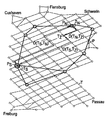
- the figure shows the public German communication network representative communication network, which is a private network is superimposed, in a schematic representation.
- the public communications network becomes representative Communication network T reduced its 690 representative Network nodes from the approximately 5100 that can be dialed by area codes Network nodes or places of public German Communication network are selected.
- the 690 deputy Network nodes are chosen such that every German area code either identical to the area code one of these deputy network nodes is or is neighborly can be assigned to such.
- the route from any node of the full public Communication network to its assigned network node representative communication network T is in general short enough to be neglected in route optimization to be able to. It is therefore usually sufficient to use the inventive one Procedure on the representative communication network T apply.
- the number of digits for the area codes is understood here and in the following without leading zero.
- the network nodes T P1 , ..., T Pm of the representative communication network T assigned to them are determined and this information is also stored.
- a private network node P N to which a route is to be routed is now to be switched to the representative communication network T via the network node T N and from there to a destination node T Z in the representative communication network T, be determined so that the portion of the route running in the representative communication network T is minimized.
- the representative network node in the representative communication network T assigned to the actual destination node in the public communication network is to be determined beforehand as the destination node T Z. From there, the (short) route to the actual destination node is continued, regardless of the route determination according to the invention.
- the route determination is to be carried out on the basis of a sequence of digits entered at the start node P S , which is composed of the area code of the actual destination node in the public communication network and the telephone number of a subscriber to be called.
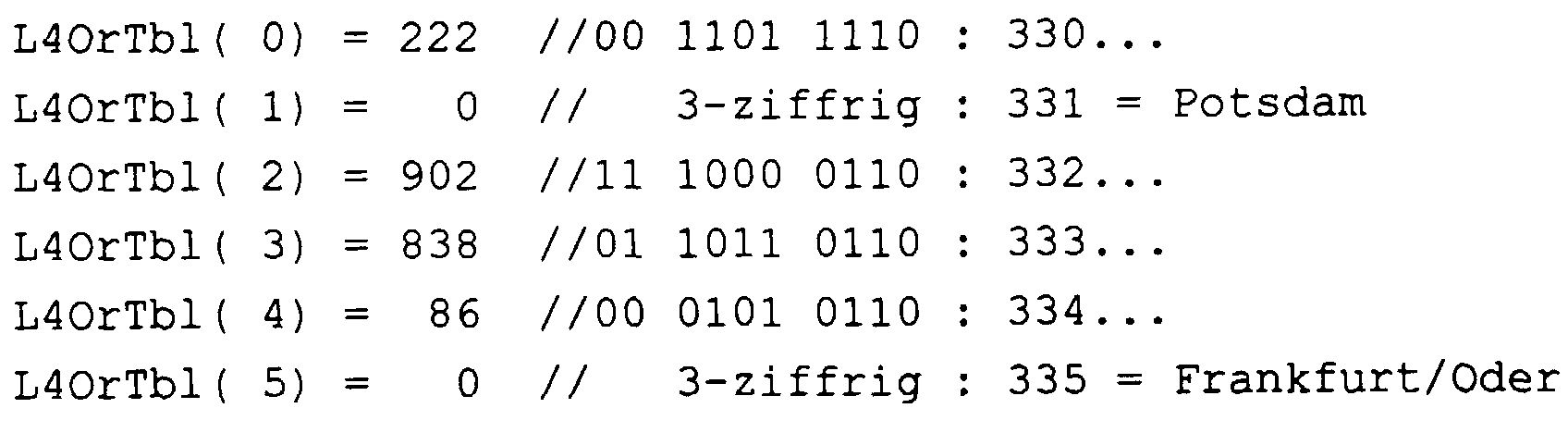
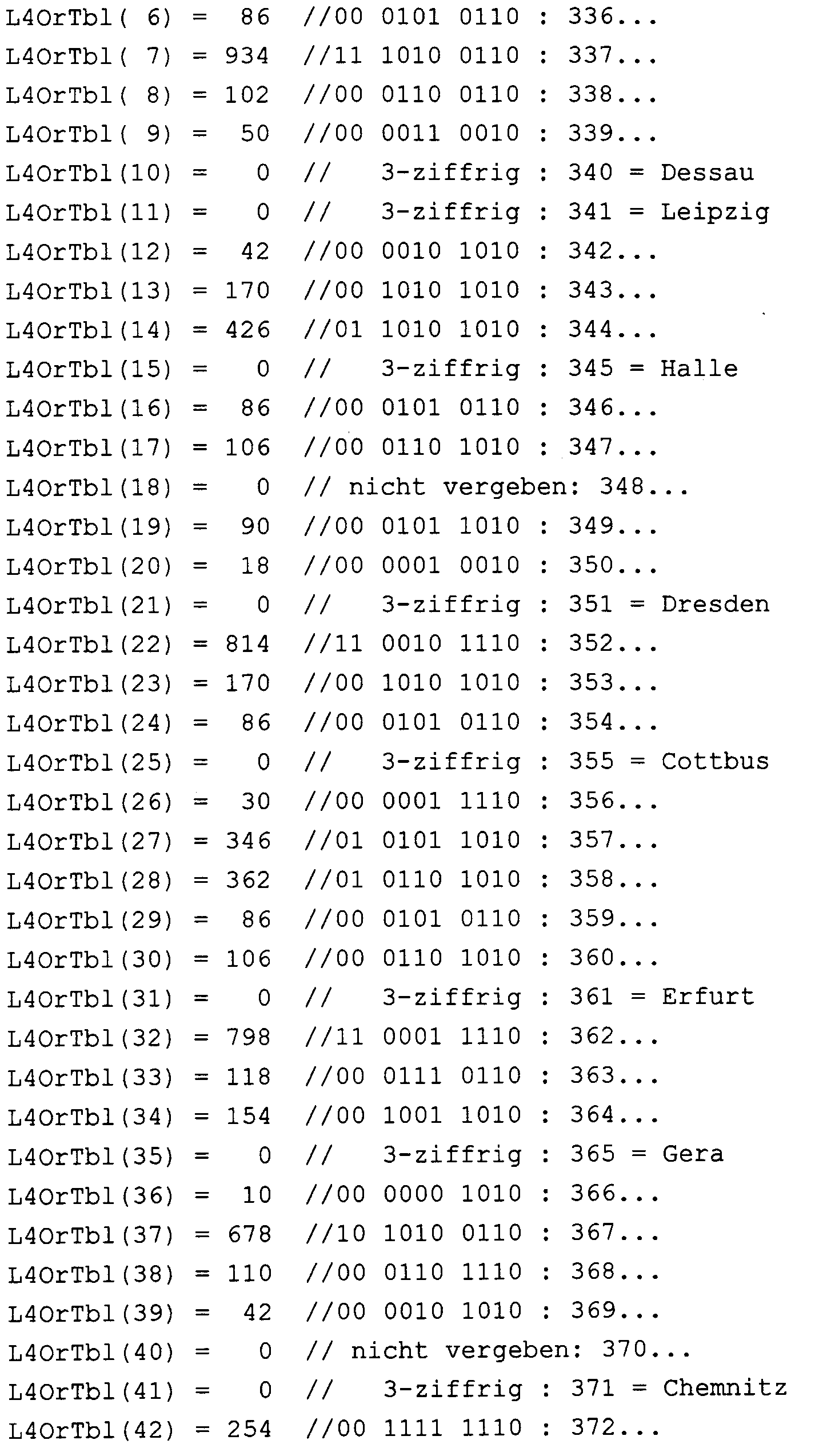
- the actual destination node and from it the representative destination node T Z must first be determined via the area code contained in the entered string of digits. This is made more difficult by the fact that area codes have different lengths and are not delimited from the subscriber's number in the number sequence entered. First of all, the proportion or number of digits of the area code must be determined in the sequence of digits entered:
- Area codes start with 0, followed by 2, 3, 4 or 5 digits.
- the first digit of a area code after the introductory 0 is referred to below as digit1, the second with digit2 etc. up to the fifth, which is called digit5 becomes.
- digit12, digit123, digit1234 and digit12345 denotes the respective sub-digit sequences, those from the following 2, 3, There are 4 or 5 digits.
- the area code is 4 digits, if set the digit4th bit of x, i.e. is equal to 1, otherwise 5 digits.
- the actual target node is already identical to a network node of the representative communication network T. This does not apply if the area code of an actual destination node is 5 digits in eastern Germany or 4 digits in western Germany, where the last digit is not equal to 1.
- the actual target node is assigned to a target node T Z of the representative communication network T as follows:
- An actual destination node in East Germany with 5 digits Area code will be the representative network node assigned to the representative communication network T, whose area code in the first three digits with the Area code of the actual destination node matches and arithmetically least with regard to the fourth digit differs.
- An actual destination node in West Germany with 4 digits Area code, with the third digit not equal 0 and the last digit is greater than 1, will be the deputy Network node of the representative communication network T assigned whose area code in the first three digits with the area code of the actual destination node matches and has a 1 as the fourth digit.
- An actual destination node in West Germany with 4 digits Area code where the third digit is a 0 is the representative network node of the representative Assigned communication network T, its area code Is 3 digits, in the first two digits with the area code of the actual destination node matches and has a 1 as the third digit.
- the distances D (T P1 , T Z ), ..., D ( Pm , T Z ) of the destination node T Z to all the network nodes P 1 , ..., P m of the private network P assigned to the network node T P1 , ..., T Pm of the representative communication network T and thus determine the network node T N or P N that has the smallest distance D (T N , T Z ) min ⁇ D (T P1 , T Z ), .. ., D (T Pm , T Z ) ⁇ to the destination node T Z.
- connection fees are graded according to distance zones.
- these charges are thus determined by the distance that the portion of the route that runs in the public communication network T bridges. If the distance D (T N , T Z ) falls within a less expensive distance zone than the bridged distance D (T PS , T Z ) of a route that runs entirely in the public communication network T from P S to T Z , the route from the start node P S is routed via the determined private network node P N in order to switch there to the public communication network via the network node T N. If, on the other hand, no improvement with regard to the distance zone can be achieved in this way, a switch is made to the public communication network at the start node P S.
- the distance information D (T i , T j ) determined by means of the Dijkstra algorithm and the method described above for analyzing a area code can also be used to refine the charge calculation in the public communication network T in addition to the route determination. Billing can thus be carried out on the basis of the distance D (T i , T j ) actually bridged by a connection from T i to T j instead of, as before, on the fact that long-distance lines are also used.
Landscapes
- Engineering & Computer Science (AREA)
- Computer Networks & Wireless Communication (AREA)
- Physics & Mathematics (AREA)
- Astronomy & Astrophysics (AREA)
- General Physics & Mathematics (AREA)
- Telephonic Communication Services (AREA)
- Meter Arrangements (AREA)
Abstract
Description
- um die eine Stadt mit 2-ziffriger Vorwahl (Berlin),
- um die 14 Städte mit 3-ziffriger Vorwahl und
- um die 216 Städte mit 4-ziffriger Vorwahl.

Claims (3)
- Verfahren zum Ermitteln des Leitwegs einer zu einem Zielnetzknoten (TZ) aufzubauenden Verbindung innerhalb eines Kommunikationsnetzverbundes, wobei die Verbindung einen Netzübergang zwischen einem ersten Kommunikationsnetz (P) und einem zweiten, mit dem ersten überlappenden Kommunikationsnetz (T) mit einer Vielzahl von Netzknoten und zwischen diesen Netzknoten verlaufenden Netzkanten vorsieht und der Zielnetzknoten (TZ) im zweiten Kommunikationsnetz (T) liegt, unter Verwendung des Dijkstra-Routing-Algorithmus, gekennzeichnet durch Ermitteln möglicher Netzübergangsstellen und deren Abstand zum Zielnetzknoten (TZ) mit Hilfe des Dijkstra-Algorithmus unter Berücksichtigung der Netzkantenlängen des zweiten Kommunikationsnetzes (T), wobei Netzknoten des ersten Kommunikationsnetzes (P) gemäß ihrem Aufenthaltsort Netzknoten des zweiten Kommunikationsnetzes (T) zugeordnet werden, und durch Auswahl der Netzübergangsstelle (PN, TN) für den Leitweg, die gemäß einer Gebührenentfernungszonenabstufung des zweiten Kommunikationsnetzes (T) in der billigsten verfügbaren Gebührenentfernungszone zum Zielnetzknoten (TZ) liegt.
- Verfahren zum Ermitteln des Leitwegs nach Anspruch 1, wobei zum Ermitteln möglicher Netzübergangsstellen zusätzlich zum Abstand zum Zielnetzknoten (TZ) im zweiten Kommunikationsnetz (T) auch unter Berücksichtigung der Netzkantenlängen des ersten Kommunikationsnetzes (P) die Leitweglänge im ersten Kommunikationsnetz (P) berücksichtigt wird und die Netzübergangsstelle (PN, TN) für den Leitweg ausgewählt wird, die die billigste verfügbare Gebührenentfernungszone zum Zielnetzknoten (TZ) hat und von mehreren möglichen Netzübergangsstellen der bezüglich des Zielnetzknotens (TZ) selben Gebührenentfernungszone den kürzesten Leitweg innerhalb des ersten Kommunikationsnetzes (P) hat.
- Verfahren zum Ermitteln des Leitwegs nach Anspruch 1, wobei zum Ermitteln möglicher Netzübergangsstellen zusätzlich zum Abstand zum Zielnetzknoten (TZ) im zweiten Kommunikationsnetz (T) auch die Anzahl der vom Leitweg tangierten Netzknoten im ersten Kommunikationsnetz (P) berücksichtigt wird und die Netzübergangsstelle (PN, TN) für den Leitweg ausgewählt wird, die die billigste verfügbare Gebührenentfernungszone zum Zielnetzknoten (TZ) hat und von mehreren möglichen Netzübergangsstellen der bezüglich des Zielnetzknotens (TZ) selben Gebührenentfernungszone den kürzesten Leitweg innerhalb des ersten Kommunikationsnetzes (P) tangiert.
Applications Claiming Priority (2)
| Application Number | Priority Date | Filing Date | Title |
|---|---|---|---|
| DE19713167 | 1997-03-27 | ||
| DE19713167 | 1997-03-27 |
Publications (2)
| Publication Number | Publication Date |
|---|---|
| EP0868099A2 true EP0868099A2 (de) | 1998-09-30 |
| EP0868099A3 EP0868099A3 (de) | 1999-07-14 |
Family
ID=7824958
Family Applications (1)
| Application Number | Title | Priority Date | Filing Date |
|---|---|---|---|
| EP98105334A Withdrawn EP0868099A3 (de) | 1997-03-27 | 1998-03-24 | Verfahren zum Ermitteln eines innerhalb von zwei sich überlappenden Kommunikationsnetzen verlaufenden Leitwegs einer aufzubauenden Verbindung |
Country Status (1)
| Country | Link |
|---|---|
| EP (1) | EP0868099A3 (de) |
Cited By (3)
| Publication number | Priority date | Publication date | Assignee | Title |
|---|---|---|---|---|
| EP0979015A1 (de) * | 1998-08-06 | 2000-02-09 | Alcatel | Leitweglenkung von einem privaten Netz ausgehenden Anrufen |
| EP0979012A1 (de) * | 1998-08-06 | 2000-02-09 | Alcatel | Uberlaufanrufleitweglenkung in einem Fernsprechnebenstellennetz |
| EP0979013A1 (de) * | 1998-08-06 | 2000-02-09 | Alcatel | Wartedienstzugangskontrolle in einem privaten Telekommunikationsnetz |
Family Cites Families (3)
| Publication number | Priority date | Publication date | Assignee | Title |
|---|---|---|---|---|
| GB2300089A (en) * | 1995-04-21 | 1996-10-23 | Eurotel Telecom Limited | Least cost router in a telecommunications system |
| DE19614926A1 (de) * | 1996-04-16 | 1997-10-23 | Philips Patentverwaltung | Privates Telekommunikationsnetz |
| DE19621718A1 (de) * | 1996-05-30 | 1997-12-04 | Sel Alcatel Ag | Verfahren zum Aufbau einer Verbindung sowie Vermittlungsstelle, Dienstrechner und Kommunikationsnetz |
-
1998
- 1998-03-24 EP EP98105334A patent/EP0868099A3/de not_active Withdrawn
Cited By (3)
| Publication number | Priority date | Publication date | Assignee | Title |
|---|---|---|---|---|
| EP0979015A1 (de) * | 1998-08-06 | 2000-02-09 | Alcatel | Leitweglenkung von einem privaten Netz ausgehenden Anrufen |
| EP0979012A1 (de) * | 1998-08-06 | 2000-02-09 | Alcatel | Uberlaufanrufleitweglenkung in einem Fernsprechnebenstellennetz |
| EP0979013A1 (de) * | 1998-08-06 | 2000-02-09 | Alcatel | Wartedienstzugangskontrolle in einem privaten Telekommunikationsnetz |
Also Published As
| Publication number | Publication date |
|---|---|
| EP0868099A3 (de) | 1999-07-14 |
Similar Documents
| Publication | Publication Date | Title |
|---|---|---|
| DE60111173T2 (de) | Verfahren, Vorrichtung und Programm für den Zugriff auf ortsabhängige Internetdienste | |
| WO1998019484A2 (de) | Verfahren und telefonnetz zur vermittlung von telefonverbindungen | |
| DE69831036T2 (de) | Verfahren zur Identifikation von Dienstleistungs-Verarbeitungen von Telefonanrufen | |
| DE10000888A1 (de) | Verfahren zur Lokalitätsinformationbereitstellung und -verarbeitung in vermittelten Netzen | |
| WO2007107421A2 (de) | Verfahren zur lokalisierung und ortbezogenen vermittlung eines mobilen voice-over-ip-teilnehmers zu einem notrufzentrum | |
| DE10341737B4 (de) | Verfahren und System zum automatischen und benutzerindividuellen Least-Cost-Routing in einem Telekommunikationssystem mit Mobilfunk- und Festnetzen | |
| DE60119849T2 (de) | Telekommunikationssystem un Verfahren zur Herstelung von mindestens einem neuen Numerierungsplan | |
| DE60311952T2 (de) | Umsetzung von Trägeridentifikationskodes | |
| EP1068744A2 (de) | Verfahren zum verbindungsaufbau von einem mobilfunknetz zu einer zielrufnummer eines privaten kommunikationsnetzes | |
| EP0796021B1 (de) | Verfahren und Anordnung zum Einbeziehen von abgesetzten Kommunikationssystemen in ein Corporate Network | |
| DE19852103B4 (de) | Verfahren zum Betrieb ortsabhängiger Vermittlungsdienste in Telekommunikationsnetzen | |
| EP0972411A2 (de) | Verfahren zum aufbau einer kommunikationsverbindung | |
| EP0868097A2 (de) | Verfahren zum Bestimmen eines Netzübergangsknotens | |
| EP1021920B1 (de) | Verfahren zur leitwegsuche in telekommunikationsnetzen | |
| EP1097565B1 (de) | Verfahren zur telekommunikationsnetzseitigen detektion des telekommunikationsnetzseitigen aufwandes bezüglich einer telekommunikationsverbindung zwischen zwei teilnehmern zur gebührenberechnung und vorrichtung zur durchführung des verfahrens | |
| DE19804056B4 (de) | Verfahren zur kostengünstigen Vermittlung von Telekommunikationsverbindungen innerhalb öffentlicher Telekommunikationsnetze | |
| EP0988761A2 (de) | Verfahren und einrichtung zur standortbezogenen information von mobilfunkteilnehmern | |
| DE10004738C1 (de) | Verfahren zum Herstellen einer Kommunikationsverbindung | |
| DE10110679B4 (de) | Verfahren zur Übertragung einer Signalisierungsnachricht im SS#7-Netz | |
| DE19745251A1 (de) | Verfahren zum Bestimmen eines Netzübergangsknotens | |
| DE10062383A1 (de) | Verfahren zum Routen und Austauschen von Nachrichten in einem Telekommunikationssystem | |
| DE10043265A1 (de) | Verfahren zum Erstellen einer Routing-Tabelle und TK-Einrichtung zur Durchführung des Verfahrens | |
| DE19852197A1 (de) | Verfahren zur telekommunikationsnetzseitigen Detektion des telekommunikationsnetzseitigen Aufwandes bezüglich einer Telekommunikationsverbindung zwischen zwei Teilnehmern zur Gebührenberechnung und Vorrichtung zur Durchführung des Verfahrens | |
| EP0726686A2 (de) | Mobiles Kommunikationssystem | |
| DE19844596A1 (de) | Telekommunikationsnetzwerk und Verfahren zum Betreiben eines Telekommunikationsnetzwerks |
Legal Events
| Date | Code | Title | Description |
|---|---|---|---|
| PUAI | Public reference made under article 153(3) epc to a published international application that has entered the european phase |
Free format text: ORIGINAL CODE: 0009012 |
|
| AK | Designated contracting states |
Kind code of ref document: A2 Designated state(s): DE FR GB IT |
|
| AX | Request for extension of the european patent |
Free format text: AL;LT;LV;MK;RO;SI |
|
| PUAL | Search report despatched |
Free format text: ORIGINAL CODE: 0009013 |
|
| AK | Designated contracting states |
Kind code of ref document: A3 Designated state(s): AT BE CH DE DK ES FI FR GB GR IE IT LI LU MC NL PT SE |
|
| AX | Request for extension of the european patent |
Free format text: AL;LT;LV;MK;RO;SI |
|
| 17P | Request for examination filed |
Effective date: 19990805 |
|
| AKX | Designation fees paid |
Free format text: DE FR GB IT |
|
| 17Q | First examination report despatched |
Effective date: 20040719 |
|
| STAA | Information on the status of an ep patent application or granted ep patent |
Free format text: STATUS: THE APPLICATION IS DEEMED TO BE WITHDRAWN |
|
| 18D | Application deemed to be withdrawn |
Effective date: 20041130 |