EP0868463B1 - Compose a groupes isocyanate et a groupes masques reactifs vis-a-vis des isocyanates - Google Patents
Compose a groupes isocyanate et a groupes masques reactifs vis-a-vis des isocyanates Download PDFInfo
- Publication number
- EP0868463B1 EP0868463B1 EP96943965A EP96943965A EP0868463B1 EP 0868463 B1 EP0868463 B1 EP 0868463B1 EP 96943965 A EP96943965 A EP 96943965A EP 96943965 A EP96943965 A EP 96943965A EP 0868463 B1 EP0868463 B1 EP 0868463B1
- Authority
- EP
- European Patent Office
- Prior art keywords
- formula
- compound
- isocyanate groups
- mol
- groups
- Prior art date
- Legal status (The legal status is an assumption and is not a legal conclusion. Google has not performed a legal analysis and makes no representation as to the accuracy of the status listed.)
- Expired - Lifetime
Links
- 150000001875 compounds Chemical class 0.000 title claims description 87
- IQPQWNKOIGAROB-UHFFFAOYSA-N isocyanate group Chemical group [N-]=C=O IQPQWNKOIGAROB-UHFFFAOYSA-N 0.000 title claims description 42
- 239000012948 isocyanate Substances 0.000 title claims description 15
- 150000002513 isocyanates Chemical class 0.000 title claims description 15
- 239000000203 mixture Substances 0.000 claims description 44
- 239000011527 polyurethane coating Substances 0.000 claims description 21
- 238000006243 chemical reaction Methods 0.000 claims description 17
- 238000000576 coating method Methods 0.000 claims description 17
- 239000001257 hydrogen Substances 0.000 claims description 15
- 229910052739 hydrogen Inorganic materials 0.000 claims description 15
- 238000004519 manufacturing process Methods 0.000 claims description 12
- UFHFLCQGNIYNRP-UHFFFAOYSA-N Hydrogen Chemical compound [H][H] UFHFLCQGNIYNRP-UHFFFAOYSA-N 0.000 claims description 10
- 125000003118 aryl group Chemical group 0.000 claims description 10
- 239000011248 coating agent Substances 0.000 claims description 10
- OHJMTUPIZMNBFR-UHFFFAOYSA-N biuret Chemical group NC(=O)NC(N)=O OHJMTUPIZMNBFR-UHFFFAOYSA-N 0.000 claims description 9
- 150000002431 hydrogen Chemical class 0.000 claims description 9
- 125000001931 aliphatic group Chemical group 0.000 claims description 8
- AVWRKZWQTYIKIY-UHFFFAOYSA-N urea-1-carboxylic acid Chemical group NC(=O)NC(O)=O AVWRKZWQTYIKIY-UHFFFAOYSA-N 0.000 claims description 8
- 125000000008 (C1-C10) alkyl group Chemical group 0.000 claims description 6
- 125000004435 hydrogen atom Chemical group [H]* 0.000 claims description 6
- JOYRKODLDBILNP-UHFFFAOYSA-N urethane group Chemical group NC(=O)OCC JOYRKODLDBILNP-UHFFFAOYSA-N 0.000 claims description 6
- 125000001033 ether group Chemical group 0.000 claims description 5
- 125000004430 oxygen atom Chemical group O* 0.000 claims description 5
- XSQUKJJJFZCRTK-UHFFFAOYSA-N urea group Chemical group NC(=O)N XSQUKJJJFZCRTK-UHFFFAOYSA-N 0.000 claims description 5
- 125000002723 alicyclic group Chemical group 0.000 claims description 4
- -1 isocyanato compound Chemical class 0.000 claims description 4
- 238000000034 method Methods 0.000 claims description 3
- 230000008569 process Effects 0.000 claims description 2
- 125000000041 C6-C10 aryl group Chemical group 0.000 claims 4
- HTSGKJQDMSTCGS-UHFFFAOYSA-N 1,4-bis(4-chlorophenyl)-2-(4-methylphenyl)sulfonylbutane-1,4-dione Chemical compound C1=CC(C)=CC=C1S(=O)(=O)C(C(=O)C=1C=CC(Cl)=CC=1)CC(=O)C1=CC=C(Cl)C=C1 HTSGKJQDMSTCGS-UHFFFAOYSA-N 0.000 claims 2
- 125000003837 (C1-C20) alkyl group Chemical group 0.000 claims 1
- KKFDJZZADQONDE-UHFFFAOYSA-N (hydridonitrato)hydroxidocarbon(.) Chemical compound O[C]=N KKFDJZZADQONDE-UHFFFAOYSA-N 0.000 claims 1
- 125000001261 isocyanato group Chemical group *N=C=O 0.000 description 35
- 239000005056 polyisocyanate Substances 0.000 description 31
- 229920001228 polyisocyanate Polymers 0.000 description 31
- RRAMGCGOFNQTLD-UHFFFAOYSA-N hexamethylene diisocyanate Chemical compound O=C=NCCCCCCN=C=O RRAMGCGOFNQTLD-UHFFFAOYSA-N 0.000 description 22
- 125000005442 diisocyanate group Chemical group 0.000 description 21
- 239000005057 Hexamethylene diisocyanate Substances 0.000 description 18
- 239000003973 paint Substances 0.000 description 18
- 239000000047 product Substances 0.000 description 17
- NIMLQBUJDJZYEJ-UHFFFAOYSA-N isophorone diisocyanate Chemical compound CC1(C)CC(N=C=O)CC(C)(CN=C=O)C1 NIMLQBUJDJZYEJ-UHFFFAOYSA-N 0.000 description 12
- 229920000642 polymer Polymers 0.000 description 12
- 239000002904 solvent Substances 0.000 description 12
- 239000005058 Isophorone diisocyanate Substances 0.000 description 11
- IJGRMHOSHXDMSA-UHFFFAOYSA-N Atomic nitrogen Chemical compound N#N IJGRMHOSHXDMSA-UHFFFAOYSA-N 0.000 description 10
- 239000003054 catalyst Substances 0.000 description 10
- 239000003795 chemical substances by application Substances 0.000 description 10
- 238000004132 cross linking Methods 0.000 description 9
- 239000007787 solid Substances 0.000 description 9
- 239000007858 starting material Substances 0.000 description 9
- 239000012855 volatile organic compound Substances 0.000 description 9
- 239000011541 reaction mixture Substances 0.000 description 8
- FKLJPTJMIBLJAV-UHFFFAOYSA-N Compound IV Chemical compound O1N=C(C)C=C1CCCCCCCOC1=CC=C(C=2OCCN=2)C=C1 FKLJPTJMIBLJAV-UHFFFAOYSA-N 0.000 description 7
- UKLDJPRMSDWDSL-UHFFFAOYSA-L [dibutyl(dodecanoyloxy)stannyl] dodecanoate Chemical compound CCCCCCCCCCCC(=O)O[Sn](CCCC)(CCCC)OC(=O)CCCCCCCCCCC UKLDJPRMSDWDSL-UHFFFAOYSA-L 0.000 description 7
- 239000008199 coating composition Substances 0.000 description 7
- 239000012975 dibutyltin dilaurate Substances 0.000 description 7
- XLYOFNOQVPJJNP-UHFFFAOYSA-N water Chemical compound O XLYOFNOQVPJJNP-UHFFFAOYSA-N 0.000 description 7
- DKPFZGUDAPQIHT-UHFFFAOYSA-N Butyl acetate Natural products CCCCOC(C)=O DKPFZGUDAPQIHT-UHFFFAOYSA-N 0.000 description 5
- PEDCQBHIVMGVHV-UHFFFAOYSA-N Glycerine Chemical compound OCC(O)CO PEDCQBHIVMGVHV-UHFFFAOYSA-N 0.000 description 5
- RTZKZFJDLAIYFH-UHFFFAOYSA-N ether Substances CCOCC RTZKZFJDLAIYFH-UHFFFAOYSA-N 0.000 description 5
- FUZZWVXGSFPDMH-UHFFFAOYSA-N hexanoic acid Chemical compound CCCCCC(O)=O FUZZWVXGSFPDMH-UHFFFAOYSA-N 0.000 description 5
- ZFSLODLOARCGLH-UHFFFAOYSA-N isocyanuric acid Chemical group OC1=NC(O)=NC(O)=N1 ZFSLODLOARCGLH-UHFFFAOYSA-N 0.000 description 5
- 239000000463 material Substances 0.000 description 5
- 229910052757 nitrogen Inorganic materials 0.000 description 5
- FCLYQYOJLQDQNA-BNWDXEGFSA-N 4-Deacetylneosolaniol Chemical compound C([C@@]12[C@]3(C)[C@H](O)[C@@H](O)[C@H]1O[C@@H]1C=C(C)[C@@H](O)C[C@@]13COC(=O)C)O2 FCLYQYOJLQDQNA-BNWDXEGFSA-N 0.000 description 4
- IAYPIBMASNFSPL-UHFFFAOYSA-N Ethylene oxide Chemical compound C1CO1 IAYPIBMASNFSPL-UHFFFAOYSA-N 0.000 description 4
- 125000003710 aryl alkyl group Chemical group 0.000 description 4
- 239000007795 chemical reaction product Substances 0.000 description 4
- 239000012973 diazabicyclooctane Substances 0.000 description 4
- 239000010408 film Substances 0.000 description 4
- 238000005227 gel permeation chromatography Methods 0.000 description 4
- 125000002887 hydroxy group Chemical group [H]O* 0.000 description 4
- HLJDOURGTRAFHE-UHFFFAOYSA-N isocyanic acid;3,5,5-trimethylcyclohex-2-en-1-one Chemical compound N=C=O.N=C=O.CC1=CC(=O)CC(C)(C)C1 HLJDOURGTRAFHE-UHFFFAOYSA-N 0.000 description 4
- 238000002156 mixing Methods 0.000 description 4
- 239000000178 monomer Substances 0.000 description 4
- 239000010409 thin film Substances 0.000 description 4
- IMNIMPAHZVJRPE-UHFFFAOYSA-N triethylenediamine Chemical compound C1CN2CCN1CC2 IMNIMPAHZVJRPE-UHFFFAOYSA-N 0.000 description 4
- HLFNUPJVFUAPLD-UHFFFAOYSA-M 2-ethylhexanoate;2-hydroxypropyl(trimethyl)azanium Chemical compound CC(O)C[N+](C)(C)C.CCCCC(CC)C([O-])=O HLFNUPJVFUAPLD-UHFFFAOYSA-M 0.000 description 3
- 0 CC*NC*(C)C Chemical compound CC*NC*(C)C 0.000 description 3
- WSFSSNUMVMOOMR-UHFFFAOYSA-N Formaldehyde Chemical compound O=C WSFSSNUMVMOOMR-UHFFFAOYSA-N 0.000 description 3
- DNIAPMSPPWPWGF-UHFFFAOYSA-N Propylene glycol Chemical compound CC(O)CO DNIAPMSPPWPWGF-UHFFFAOYSA-N 0.000 description 3
- ZJCCRDAZUWHFQH-UHFFFAOYSA-N Trimethylolpropane Chemical compound CCC(CO)(CO)CO ZJCCRDAZUWHFQH-UHFFFAOYSA-N 0.000 description 3
- 239000002253 acid Substances 0.000 description 3
- 239000012298 atmosphere Substances 0.000 description 3
- 125000004432 carbon atom Chemical group C* 0.000 description 3
- 101150038956 cup-4 gene Proteins 0.000 description 3
- 125000001495 ethyl group Chemical group [H]C([H])([H])C([H])([H])* 0.000 description 3
- 125000002496 methyl group Chemical group [H]C([H])([H])* 0.000 description 3
- 239000004814 polyurethane Substances 0.000 description 3
- 229920002635 polyurethane Polymers 0.000 description 3
- 239000000243 solution Substances 0.000 description 3
- 125000001424 substituent group Chemical group 0.000 description 3
- 239000000758 substrate Substances 0.000 description 3
- 239000002966 varnish Substances 0.000 description 3
- 229920002554 vinyl polymer Polymers 0.000 description 3
- QKOWXXDOHMJOMQ-UHFFFAOYSA-N 1,3,5-tris(6-isocyanatohexyl)biuret Chemical compound O=C=NCCCCCCNC(=O)N(CCCCCCN=C=O)C(=O)NCCCCCCN=C=O QKOWXXDOHMJOMQ-UHFFFAOYSA-N 0.000 description 2
- UPMLOUAZCHDJJD-UHFFFAOYSA-N 4,4'-Diphenylmethane Diisocyanate Chemical compound C1=CC(N=C=O)=CC=C1CC1=CC=C(N=C=O)C=C1 UPMLOUAZCHDJJD-UHFFFAOYSA-N 0.000 description 2
- VTDOEFXTVHCAAM-UHFFFAOYSA-N 4-methylpent-3-ene-1,2,3-triol Chemical compound CC(C)=C(O)C(O)CO VTDOEFXTVHCAAM-UHFFFAOYSA-N 0.000 description 2
- CSCPPACGZOOCGX-UHFFFAOYSA-N Acetone Chemical compound CC(C)=O CSCPPACGZOOCGX-UHFFFAOYSA-N 0.000 description 2
- PAYRUJLWNCNPSJ-UHFFFAOYSA-N Aniline Chemical compound NC1=CC=CC=C1 PAYRUJLWNCNPSJ-UHFFFAOYSA-N 0.000 description 2
- CURLTUGMZLYLDI-UHFFFAOYSA-N Carbon dioxide Chemical compound O=C=O CURLTUGMZLYLDI-UHFFFAOYSA-N 0.000 description 2
- NBIIXXVUZAFLBC-UHFFFAOYSA-N Phosphoric acid Chemical compound OP(O)(O)=O NBIIXXVUZAFLBC-UHFFFAOYSA-N 0.000 description 2
- GOOHAUXETOMSMM-UHFFFAOYSA-N Propylene oxide Chemical compound CC1CO1 GOOHAUXETOMSMM-UHFFFAOYSA-N 0.000 description 2
- WQDUMFSSJAZKTM-UHFFFAOYSA-N Sodium methoxide Chemical compound [Na+].[O-]C WQDUMFSSJAZKTM-UHFFFAOYSA-N 0.000 description 2
- PPBRXRYQALVLMV-UHFFFAOYSA-N Styrene Chemical compound C=CC1=CC=CC=C1 PPBRXRYQALVLMV-UHFFFAOYSA-N 0.000 description 2
- WYURNTSHIVDZCO-UHFFFAOYSA-N Tetrahydrofuran Chemical compound C1CCOC1 WYURNTSHIVDZCO-UHFFFAOYSA-N 0.000 description 2
- 150000007513 acids Chemical class 0.000 description 2
- 239000011230 binding agent Substances 0.000 description 2
- 230000015572 biosynthetic process Effects 0.000 description 2
- 150000001735 carboxylic acids Chemical class 0.000 description 2
- 230000000052 comparative effect Effects 0.000 description 2
- 239000003431 cross linking reagent Substances 0.000 description 2
- 239000003085 diluting agent Substances 0.000 description 2
- USIUVYZYUHIAEV-UHFFFAOYSA-N diphenyl ether Chemical compound C=1C=CC=CC=1OC1=CC=CC=C1 USIUVYZYUHIAEV-UHFFFAOYSA-N 0.000 description 2
- 238000001035 drying Methods 0.000 description 2
- 239000011521 glass Substances 0.000 description 2
- 235000011187 glycerol Nutrition 0.000 description 2
- 150000002430 hydrocarbons Chemical group 0.000 description 2
- 239000004922 lacquer Substances 0.000 description 2
- HXSACZWWBYWLIS-UHFFFAOYSA-N oxadiazine-4,5,6-trione Chemical group O=C1ON=NC(=O)C1=O HXSACZWWBYWLIS-UHFFFAOYSA-N 0.000 description 2
- 150000002917 oxazolidines Chemical class 0.000 description 2
- KJIFKLIQANRMOU-UHFFFAOYSA-N oxidanium;4-methylbenzenesulfonate Chemical compound O.CC1=CC=C(S(O)(=O)=O)C=C1 KJIFKLIQANRMOU-UHFFFAOYSA-N 0.000 description 2
- 239000004033 plastic Substances 0.000 description 2
- 229920005862 polyol Polymers 0.000 description 2
- 150000003077 polyols Chemical class 0.000 description 2
- 238000002360 preparation method Methods 0.000 description 2
- 238000005507 spraying Methods 0.000 description 2
- 239000000126 substance Substances 0.000 description 2
- 238000004448 titration Methods 0.000 description 2
- RUELTTOHQODFPA-UHFFFAOYSA-N toluene 2,6-diisocyanate Chemical compound CC1=C(N=C=O)C=CC=C1N=C=O RUELTTOHQODFPA-UHFFFAOYSA-N 0.000 description 2
- 125000000391 vinyl group Chemical group [H]C([*])=C([H])[H] 0.000 description 2
- HXOYWCSTHVTLOW-UHFFFAOYSA-N (2,2-dimethyl-1,3-dioxolan-4-yl)methanamine Chemical compound CC1(C)OCC(CN)O1 HXOYWCSTHVTLOW-UHFFFAOYSA-N 0.000 description 1
- FAPNDZXPXUNLRE-UHFFFAOYSA-N (2,2-dimethyl-1,3-dioxolan-4-yl)methanol;4-methylpent-3-ene-1,2,3-triol Chemical compound CC(C)=C(O)C(O)CO.CC1(C)OCC(CO)O1 FAPNDZXPXUNLRE-UHFFFAOYSA-N 0.000 description 1
- RUUJECRHYIYRSH-UHFFFAOYSA-N (5-ethyl-2,2-dimethyl-1,3-dioxan-5-yl)methanol Chemical compound CCC1(CO)COC(C)(C)OC1 RUUJECRHYIYRSH-UHFFFAOYSA-N 0.000 description 1
- 125000004169 (C1-C6) alkyl group Chemical group 0.000 description 1
- VNMOIBZLSJDQEO-UHFFFAOYSA-N 1,10-diisocyanatodecane Chemical compound O=C=NCCCCCCCCCCN=C=O VNMOIBZLSJDQEO-UHFFFAOYSA-N 0.000 description 1
- GFNDFCFPJQPVQL-UHFFFAOYSA-N 1,12-diisocyanatododecane Chemical compound O=C=NCCCCCCCCCCCCN=C=O GFNDFCFPJQPVQL-UHFFFAOYSA-N 0.000 description 1
- NNOZGCICXAYKLW-UHFFFAOYSA-N 1,2-bis(2-isocyanatopropan-2-yl)benzene Chemical compound O=C=NC(C)(C)C1=CC=CC=C1C(C)(C)N=C=O NNOZGCICXAYKLW-UHFFFAOYSA-N 0.000 description 1
- ODKSRULWLOLNJQ-UHFFFAOYSA-N 1,2-diisocyanatocyclohexane Chemical compound O=C=NC1CCCCC1N=C=O ODKSRULWLOLNJQ-UHFFFAOYSA-N 0.000 description 1
- PFUKECZPRROVOD-UHFFFAOYSA-N 1,3,5-triisocyanato-2-methylbenzene Chemical compound CC1=C(N=C=O)C=C(N=C=O)C=C1N=C=O PFUKECZPRROVOD-UHFFFAOYSA-N 0.000 description 1
- PCHXZXKMYCGVFA-UHFFFAOYSA-N 1,3-diazetidine-2,4-dione Chemical group O=C1NC(=O)N1 PCHXZXKMYCGVFA-UHFFFAOYSA-N 0.000 description 1
- OHTRJOZKRSVAOX-UHFFFAOYSA-N 1,3-diisocyanato-2-methylcyclohexane Chemical compound CC1C(N=C=O)CCCC1N=C=O OHTRJOZKRSVAOX-UHFFFAOYSA-N 0.000 description 1
- OHLKMGYGBHFODF-UHFFFAOYSA-N 1,4-bis(isocyanatomethyl)benzene Chemical compound O=C=NCC1=CC=C(CN=C=O)C=C1 OHLKMGYGBHFODF-UHFFFAOYSA-N 0.000 description 1
- ALQLPWJFHRMHIU-UHFFFAOYSA-N 1,4-diisocyanatobenzene Chemical compound O=C=NC1=CC=C(N=C=O)C=C1 ALQLPWJFHRMHIU-UHFFFAOYSA-N 0.000 description 1
- OVBFMUAFNIIQAL-UHFFFAOYSA-N 1,4-diisocyanatobutane Chemical compound O=C=NCCCCN=C=O OVBFMUAFNIIQAL-UHFFFAOYSA-N 0.000 description 1
- SBJCUZQNHOLYMD-UHFFFAOYSA-N 1,5-Naphthalene diisocyanate Chemical compound C1=CC=C2C(N=C=O)=CC=CC2=C1N=C=O SBJCUZQNHOLYMD-UHFFFAOYSA-N 0.000 description 1
- JMFCAIUTSABFDU-UHFFFAOYSA-N 1,6-diisocyanatohexane Chemical compound O=C=NCCCCCCN=C=O.O=C=NCCCCCCN=C=O JMFCAIUTSABFDU-UHFFFAOYSA-N 0.000 description 1
- QUPKOUOXSNGVLB-UHFFFAOYSA-N 1,8-diisocyanatooctane Chemical compound O=C=NCCCCCCCCN=C=O QUPKOUOXSNGVLB-UHFFFAOYSA-N 0.000 description 1
- SZBXTBGNJLZMHB-UHFFFAOYSA-N 1-chloro-2,4-diisocyanatobenzene Chemical compound ClC1=CC=C(N=C=O)C=C1N=C=O SZBXTBGNJLZMHB-UHFFFAOYSA-N 0.000 description 1
- MKZPMOFOBNHBSL-UHFFFAOYSA-N 1-isocyanato-1-methylcyclohexane Chemical compound O=C=NC1(C)CCCCC1 MKZPMOFOBNHBSL-UHFFFAOYSA-N 0.000 description 1
- DZARITHRMKPIQB-UHFFFAOYSA-N 2-(2-propan-2-yl-1,3-oxazolidin-3-yl)ethanol Chemical compound CC(C)C1OCCN1CCO DZARITHRMKPIQB-UHFFFAOYSA-N 0.000 description 1
- WBIQQQGBSDOWNP-UHFFFAOYSA-N 2-dodecylbenzenesulfonic acid Chemical compound CCCCCCCCCCCCC1=CC=CC=C1S(O)(=O)=O WBIQQQGBSDOWNP-UHFFFAOYSA-N 0.000 description 1
- OBETXYAYXDNJHR-UHFFFAOYSA-M 2-ethylhexanoate Chemical compound CCCCC(CC)C([O-])=O OBETXYAYXDNJHR-UHFFFAOYSA-M 0.000 description 1
- SHAMRMCOVNDTCS-UHFFFAOYSA-M 2-hydroxypropyl(trimethyl)azanium;hydroxide Chemical compound [OH-].CC(O)C[N+](C)(C)C SHAMRMCOVNDTCS-UHFFFAOYSA-M 0.000 description 1
- CCTFMNIEFHGTDU-UHFFFAOYSA-N 3-methoxypropyl acetate Chemical compound COCCCOC(C)=O CCTFMNIEFHGTDU-UHFFFAOYSA-N 0.000 description 1
- NIXOWILDQLNWCW-UHFFFAOYSA-M Acrylate Chemical compound [O-]C(=O)C=C NIXOWILDQLNWCW-UHFFFAOYSA-M 0.000 description 1
- 239000004925 Acrylic resin Substances 0.000 description 1
- NLZUEZXRPGMBCV-UHFFFAOYSA-N Butylhydroxytoluene Chemical compound CC1=CC(C(C)(C)C)=C(O)C(C(C)(C)C)=C1 NLZUEZXRPGMBCV-UHFFFAOYSA-N 0.000 description 1
- PRLVDXHZKRZBIS-UHFFFAOYSA-N CC(C)C(C)OCCNCCO Chemical compound CC(C)C(C)OCCNCCO PRLVDXHZKRZBIS-UHFFFAOYSA-N 0.000 description 1
- JYFHYPJRHGVZDY-UHFFFAOYSA-N Dibutyl phosphate Chemical compound CCCCOP(O)(=O)OCCCC JYFHYPJRHGVZDY-UHFFFAOYSA-N 0.000 description 1
- VGGSQFUCUMXWEO-UHFFFAOYSA-N Ethene Chemical compound C=C VGGSQFUCUMXWEO-UHFFFAOYSA-N 0.000 description 1
- 239000005977 Ethylene Substances 0.000 description 1
- 229920000877 Melamine resin Polymers 0.000 description 1
- NTIZESTWPVYFNL-UHFFFAOYSA-N Methyl isobutyl ketone Chemical compound CC(C)CC(C)=O NTIZESTWPVYFNL-UHFFFAOYSA-N 0.000 description 1
- UIHCLUNTQKBZGK-UHFFFAOYSA-N Methyl isobutyl ketone Natural products CCC(C)C(C)=O UIHCLUNTQKBZGK-UHFFFAOYSA-N 0.000 description 1
- SECXISVLQFMRJM-UHFFFAOYSA-N N-Methylpyrrolidone Chemical compound CN1CCCC1=O SECXISVLQFMRJM-UHFFFAOYSA-N 0.000 description 1
- CVGYTOLNWAMTRJ-UHFFFAOYSA-N N=C=O.N=C=O.CCCCC(C)C(C)(C)C Chemical compound N=C=O.N=C=O.CCCCC(C)C(C)(C)C CVGYTOLNWAMTRJ-UHFFFAOYSA-N 0.000 description 1
- JTDWCIXOEPQECG-UHFFFAOYSA-N N=C=O.N=C=O.CCCCCC(C)(C)C Chemical compound N=C=O.N=C=O.CCCCCC(C)(C)C JTDWCIXOEPQECG-UHFFFAOYSA-N 0.000 description 1
- QORUGOXNWQUALA-UHFFFAOYSA-N N=C=O.N=C=O.N=C=O.C1=CC=C(C(C2=CC=CC=C2)C2=CC=CC=C2)C=C1 Chemical compound N=C=O.N=C=O.N=C=O.C1=CC=C(C(C2=CC=CC=C2)C2=CC=CC=C2)C=C1 QORUGOXNWQUALA-UHFFFAOYSA-N 0.000 description 1
- CTQNGGLPUBDAKN-UHFFFAOYSA-N O-Xylene Chemical compound CC1=CC=CC=C1C CTQNGGLPUBDAKN-UHFFFAOYSA-N 0.000 description 1
- BPQQTUXANYXVAA-UHFFFAOYSA-N Orthosilicate Chemical compound [O-][Si]([O-])([O-])[O-] BPQQTUXANYXVAA-UHFFFAOYSA-N 0.000 description 1
- WYNCHZVNFNFDNH-UHFFFAOYSA-N Oxazolidine Chemical compound C1COCN1 WYNCHZVNFNFDNH-UHFFFAOYSA-N 0.000 description 1
- 241000170793 Phalaris canariensis Species 0.000 description 1
- 229920001807 Urea-formaldehyde Polymers 0.000 description 1
- HCHKCACWOHOZIP-UHFFFAOYSA-N Zinc Chemical compound [Zn] HCHKCACWOHOZIP-UHFFFAOYSA-N 0.000 description 1
- 238000005299 abrasion Methods 0.000 description 1
- 125000004018 acid anhydride group Chemical group 0.000 description 1
- 150000008065 acid anhydrides Chemical class 0.000 description 1
- 150000001252 acrylic acid derivatives Chemical class 0.000 description 1
- 239000000654 additive Substances 0.000 description 1
- 230000001476 alcoholic effect Effects 0.000 description 1
- 239000003513 alkali Substances 0.000 description 1
- 125000000217 alkyl group Chemical group 0.000 description 1
- 239000002168 alkylating agent Substances 0.000 description 1
- 229940100198 alkylating agent Drugs 0.000 description 1
- 125000002947 alkylene group Chemical group 0.000 description 1
- 229910000147 aluminium phosphate Inorganic materials 0.000 description 1
- 150000001408 amides Chemical class 0.000 description 1
- 150000001412 amines Chemical class 0.000 description 1
- 125000003277 amino group Chemical group 0.000 description 1
- 235000011114 ammonium hydroxide Nutrition 0.000 description 1
- 229940053194 antiepileptics oxazolidine derivative Drugs 0.000 description 1
- 150000004945 aromatic hydrocarbons Chemical class 0.000 description 1
- 230000008901 benefit Effects 0.000 description 1
- PASDCCFISLVPSO-UHFFFAOYSA-N benzoyl chloride Chemical compound ClC(=O)C1=CC=CC=C1 PASDCCFISLVPSO-UHFFFAOYSA-N 0.000 description 1
- 238000009835 boiling Methods 0.000 description 1
- 230000001680 brushing effect Effects 0.000 description 1
- CDQSJQSWAWPGKG-UHFFFAOYSA-N butane-1,1-diol Chemical compound CCCC(O)O CDQSJQSWAWPGKG-UHFFFAOYSA-N 0.000 description 1
- 125000003917 carbamoyl group Chemical group [H]N([H])C(*)=O 0.000 description 1
- 150000001718 carbodiimides Chemical class 0.000 description 1
- 239000001569 carbon dioxide Substances 0.000 description 1
- 229910002092 carbon dioxide Inorganic materials 0.000 description 1
- 238000006555 catalytic reaction Methods 0.000 description 1
- 150000001768 cations Chemical class 0.000 description 1
- 230000008859 change Effects 0.000 description 1
- FOCAUTSVDIKZOP-UHFFFAOYSA-N chloroacetic acid Chemical compound OC(=O)CCl FOCAUTSVDIKZOP-UHFFFAOYSA-N 0.000 description 1
- 238000009833 condensation Methods 0.000 description 1
- 230000005494 condensation Effects 0.000 description 1
- 238000007796 conventional method Methods 0.000 description 1
- 229920001577 copolymer Polymers 0.000 description 1
- 125000004122 cyclic group Chemical group 0.000 description 1
- 125000000113 cyclohexyl group Chemical group [H]C1([H])C([H])([H])C([H])([H])C([H])(*)C([H])([H])C1([H])[H] 0.000 description 1
- 125000001511 cyclopentyl group Chemical group [H]C1([H])C([H])([H])C([H])([H])C([H])(*)C1([H])[H] 0.000 description 1
- 125000002704 decyl group Chemical group [H]C([H])([H])C([H])([H])C([H])([H])C([H])([H])C([H])([H])C([H])([H])C([H])([H])C([H])([H])C([H])([H])C([H])([H])* 0.000 description 1
- 150000001991 dicarboxylic acids Chemical class 0.000 description 1
- 238000006471 dimerization reaction Methods 0.000 description 1
- VAYGXNSJCAHWJZ-UHFFFAOYSA-N dimethyl sulfate Chemical compound COS(=O)(=O)OC VAYGXNSJCAHWJZ-UHFFFAOYSA-N 0.000 description 1
- 150000002009 diols Chemical class 0.000 description 1
- 150000002012 dioxanes Chemical class 0.000 description 1
- 150000004862 dioxolanes Chemical class 0.000 description 1
- 229940060296 dodecylbenzenesulfonic acid Drugs 0.000 description 1
- 238000005516 engineering process Methods 0.000 description 1
- 230000007613 environmental effect Effects 0.000 description 1
- 239000000945 filler Substances 0.000 description 1
- 229920001002 functional polymer Polymers 0.000 description 1
- 150000004820 halides Chemical class 0.000 description 1
- 238000010438 heat treatment Methods 0.000 description 1
- 230000006872 improvement Effects 0.000 description 1
- 125000001449 isopropyl group Chemical group [H]C([H])([H])C([H])(*)C([H])([H])[H] 0.000 description 1
- HCWCAKKEBCNQJP-UHFFFAOYSA-N magnesium orthosilicate Chemical compound [Mg+2].[Mg+2].[O-][Si]([O-])([O-])[O-] HCWCAKKEBCNQJP-UHFFFAOYSA-N 0.000 description 1
- 239000000391 magnesium silicate Substances 0.000 description 1
- 229910052919 magnesium silicate Inorganic materials 0.000 description 1
- 235000019792 magnesium silicate Nutrition 0.000 description 1
- 229910052751 metal Inorganic materials 0.000 description 1
- 239000002184 metal Substances 0.000 description 1
- AYLRODJJLADBOB-QMMMGPOBSA-N methyl (2s)-2,6-diisocyanatohexanoate Chemical compound COC(=O)[C@@H](N=C=O)CCCCN=C=O AYLRODJJLADBOB-QMMMGPOBSA-N 0.000 description 1
- 125000000325 methylidene group Chemical group [H]C([H])=* 0.000 description 1
- 150000007522 mineralic acids Chemical class 0.000 description 1
- 125000004108 n-butyl group Chemical group [H]C([H])([H])C([H])([H])C([H])([H])C([H])([H])* 0.000 description 1
- 125000004123 n-propyl group Chemical group [H]C([H])([H])C([H])([H])C([H])([H])* 0.000 description 1
- 230000006855 networking Effects 0.000 description 1
- 150000002825 nitriles Chemical class 0.000 description 1
- 150000007524 organic acids Chemical class 0.000 description 1
- 235000005985 organic acids Nutrition 0.000 description 1
- 239000003960 organic solvent Substances 0.000 description 1
- 239000003208 petroleum Substances 0.000 description 1
- 239000000049 pigment Substances 0.000 description 1
- 229920003023 plastic Polymers 0.000 description 1
- 229920000647 polyepoxide Polymers 0.000 description 1
- 229920000728 polyester Polymers 0.000 description 1
- 239000004848 polyfunctional curative Substances 0.000 description 1
- 229920006389 polyphenyl polymer Polymers 0.000 description 1
- LPNYRYFBWFDTMA-UHFFFAOYSA-N potassium tert-butoxide Chemical compound [K+].CC(C)(C)[O-] LPNYRYFBWFDTMA-UHFFFAOYSA-N 0.000 description 1
- AZIQALWHRUQPHV-UHFFFAOYSA-N prop-2-eneperoxoic acid Chemical compound OOC(=O)C=C AZIQALWHRUQPHV-UHFFFAOYSA-N 0.000 description 1
- 235000013772 propylene glycol Nutrition 0.000 description 1
- 125000001453 quaternary ammonium group Chemical group 0.000 description 1
- 230000005855 radiation Effects 0.000 description 1
- 238000010992 reflux Methods 0.000 description 1
- 238000005096 rolling process Methods 0.000 description 1
- 125000000467 secondary amino group Chemical group [H]N([*:1])[*:2] 0.000 description 1
- 238000000926 separation method Methods 0.000 description 1
- 238000003860 storage Methods 0.000 description 1
- 150000005846 sugar alcohols Polymers 0.000 description 1
- 238000010345 tape casting Methods 0.000 description 1
- LMBFAGIMSUYTBN-MPZNNTNKSA-N teixobactin Chemical compound C([C@H](C(=O)N[C@@H]([C@@H](C)CC)C(=O)N[C@@H](CO)C(=O)N[C@H](CCC(N)=O)C(=O)N[C@H]([C@@H](C)CC)C(=O)N[C@@H]([C@@H](C)CC)C(=O)N[C@@H](CO)C(=O)N[C@H]1C(N[C@@H](C)C(=O)N[C@@H](C[C@@H]2NC(=N)NC2)C(=O)N[C@H](C(=O)O[C@H]1C)[C@@H](C)CC)=O)NC)C1=CC=CC=C1 LMBFAGIMSUYTBN-MPZNNTNKSA-N 0.000 description 1
- 150000003573 thiols Chemical class 0.000 description 1
- 239000013638 trimer Substances 0.000 description 1
- 238000005829 trimerization reaction Methods 0.000 description 1
- GBXQPDCOMJJCMJ-UHFFFAOYSA-M trimethyl-[6-(trimethylazaniumyl)hexyl]azanium;bromide Chemical compound [Br-].C[N+](C)(C)CCCCCC[N+](C)(C)C GBXQPDCOMJJCMJ-UHFFFAOYSA-M 0.000 description 1
- 150000003673 urethanes Chemical class 0.000 description 1
- 229920001567 vinyl ester resin Polymers 0.000 description 1
- 239000002023 wood Substances 0.000 description 1
- 238000010626 work up procedure Methods 0.000 description 1
- 239000008096 xylene Substances 0.000 description 1
- 229910052725 zinc Inorganic materials 0.000 description 1
- 239000011701 zinc Substances 0.000 description 1
- NHXVNEDMKGDNPR-UHFFFAOYSA-N zinc;pentane-2,4-dione Chemical compound [Zn+2].CC(=O)[CH-]C(C)=O.CC(=O)[CH-]C(C)=O NHXVNEDMKGDNPR-UHFFFAOYSA-N 0.000 description 1
Classifications
-
- C—CHEMISTRY; METALLURGY
- C07—ORGANIC CHEMISTRY
- C07D—HETEROCYCLIC COMPOUNDS
- C07D317/00—Heterocyclic compounds containing five-membered rings having two oxygen atoms as the only ring hetero atoms
- C07D317/08—Heterocyclic compounds containing five-membered rings having two oxygen atoms as the only ring hetero atoms having the hetero atoms in positions 1 and 3
- C07D317/10—Heterocyclic compounds containing five-membered rings having two oxygen atoms as the only ring hetero atoms having the hetero atoms in positions 1 and 3 not condensed with other rings
- C07D317/14—Heterocyclic compounds containing five-membered rings having two oxygen atoms as the only ring hetero atoms having the hetero atoms in positions 1 and 3 not condensed with other rings with substituted hydrocarbon radicals attached to ring carbon atoms
-
- C—CHEMISTRY; METALLURGY
- C08—ORGANIC MACROMOLECULAR COMPOUNDS; THEIR PREPARATION OR CHEMICAL WORKING-UP; COMPOSITIONS BASED THEREON
- C08G—MACROMOLECULAR COMPOUNDS OBTAINED OTHERWISE THAN BY REACTIONS ONLY INVOLVING UNSATURATED CARBON-TO-CARBON BONDS
- C08G18/00—Polymeric products of isocyanates or isothiocyanates
- C08G18/06—Polymeric products of isocyanates or isothiocyanates with compounds having active hydrogen
- C08G18/70—Polymeric products of isocyanates or isothiocyanates with compounds having active hydrogen characterised by the isocyanates or isothiocyanates used
- C08G18/72—Polyisocyanates or polyisothiocyanates
- C08G18/80—Masked polyisocyanates
-
- C—CHEMISTRY; METALLURGY
- C07—ORGANIC CHEMISTRY
- C07D—HETEROCYCLIC COMPOUNDS
- C07D319/00—Heterocyclic compounds containing six-membered rings having two oxygen atoms as the only ring hetero atoms
- C07D319/04—1,3-Dioxanes; Hydrogenated 1,3-dioxanes
- C07D319/06—1,3-Dioxanes; Hydrogenated 1,3-dioxanes not condensed with other rings
-
- C—CHEMISTRY; METALLURGY
- C08—ORGANIC MACROMOLECULAR COMPOUNDS; THEIR PREPARATION OR CHEMICAL WORKING-UP; COMPOSITIONS BASED THEREON
- C08G—MACROMOLECULAR COMPOUNDS OBTAINED OTHERWISE THAN BY REACTIONS ONLY INVOLVING UNSATURATED CARBON-TO-CARBON BONDS
- C08G18/00—Polymeric products of isocyanates or isothiocyanates
- C08G18/06—Polymeric products of isocyanates or isothiocyanates with compounds having active hydrogen
- C08G18/28—Polymeric products of isocyanates or isothiocyanates with compounds having active hydrogen characterised by the compounds used containing active hydrogen
- C08G18/2805—Compounds having only one group containing active hydrogen
-
- C—CHEMISTRY; METALLURGY
- C08—ORGANIC MACROMOLECULAR COMPOUNDS; THEIR PREPARATION OR CHEMICAL WORKING-UP; COMPOSITIONS BASED THEREON
- C08G—MACROMOLECULAR COMPOUNDS OBTAINED OTHERWISE THAN BY REACTIONS ONLY INVOLVING UNSATURATED CARBON-TO-CARBON BONDS
- C08G18/00—Polymeric products of isocyanates or isothiocyanates
- C08G18/06—Polymeric products of isocyanates or isothiocyanates with compounds having active hydrogen
- C08G18/28—Polymeric products of isocyanates or isothiocyanates with compounds having active hydrogen characterised by the compounds used containing active hydrogen
- C08G18/2805—Compounds having only one group containing active hydrogen
- C08G18/2815—Monohydroxy compounds
- C08G18/282—Alkanols, cycloalkanols or arylalkanols including terpenealcohols
- C08G18/2825—Alkanols, cycloalkanols or arylalkanols including terpenealcohols having at least 6 carbon atoms
-
- C—CHEMISTRY; METALLURGY
- C08—ORGANIC MACROMOLECULAR COMPOUNDS; THEIR PREPARATION OR CHEMICAL WORKING-UP; COMPOSITIONS BASED THEREON
- C08G—MACROMOLECULAR COMPOUNDS OBTAINED OTHERWISE THAN BY REACTIONS ONLY INVOLVING UNSATURATED CARBON-TO-CARBON BONDS
- C08G18/00—Polymeric products of isocyanates or isothiocyanates
- C08G18/06—Polymeric products of isocyanates or isothiocyanates with compounds having active hydrogen
- C08G18/28—Polymeric products of isocyanates or isothiocyanates with compounds having active hydrogen characterised by the compounds used containing active hydrogen
- C08G18/2805—Compounds having only one group containing active hydrogen
- C08G18/285—Nitrogen containing compounds
- C08G18/2865—Compounds having only one primary or secondary amino group; Ammonia
-
- C—CHEMISTRY; METALLURGY
- C08—ORGANIC MACROMOLECULAR COMPOUNDS; THEIR PREPARATION OR CHEMICAL WORKING-UP; COMPOSITIONS BASED THEREON
- C08G—MACROMOLECULAR COMPOUNDS OBTAINED OTHERWISE THAN BY REACTIONS ONLY INVOLVING UNSATURATED CARBON-TO-CARBON BONDS
- C08G18/00—Polymeric products of isocyanates or isothiocyanates
- C08G18/06—Polymeric products of isocyanates or isothiocyanates with compounds having active hydrogen
- C08G18/28—Polymeric products of isocyanates or isothiocyanates with compounds having active hydrogen characterised by the compounds used containing active hydrogen
- C08G18/2805—Compounds having only one group containing active hydrogen
- C08G18/285—Nitrogen containing compounds
- C08G18/2875—Monohydroxy compounds containing tertiary amino groups
-
- C—CHEMISTRY; METALLURGY
- C08—ORGANIC MACROMOLECULAR COMPOUNDS; THEIR PREPARATION OR CHEMICAL WORKING-UP; COMPOSITIONS BASED THEREON
- C08G—MACROMOLECULAR COMPOUNDS OBTAINED OTHERWISE THAN BY REACTIONS ONLY INVOLVING UNSATURATED CARBON-TO-CARBON BONDS
- C08G18/00—Polymeric products of isocyanates or isothiocyanates
- C08G18/06—Polymeric products of isocyanates or isothiocyanates with compounds having active hydrogen
- C08G18/28—Polymeric products of isocyanates or isothiocyanates with compounds having active hydrogen characterised by the compounds used containing active hydrogen
- C08G18/30—Low-molecular-weight compounds
- C08G18/32—Polyhydroxy compounds; Polyamines; Hydroxyamines
-
- C—CHEMISTRY; METALLURGY
- C08—ORGANIC MACROMOLECULAR COMPOUNDS; THEIR PREPARATION OR CHEMICAL WORKING-UP; COMPOSITIONS BASED THEREON
- C08G—MACROMOLECULAR COMPOUNDS OBTAINED OTHERWISE THAN BY REACTIONS ONLY INVOLVING UNSATURATED CARBON-TO-CARBON BONDS
- C08G18/00—Polymeric products of isocyanates or isothiocyanates
- C08G18/06—Polymeric products of isocyanates or isothiocyanates with compounds having active hydrogen
- C08G18/70—Polymeric products of isocyanates or isothiocyanates with compounds having active hydrogen characterised by the isocyanates or isothiocyanates used
- C08G18/72—Polyisocyanates or polyisothiocyanates
- C08G18/77—Polyisocyanates or polyisothiocyanates having heteroatoms in addition to the isocyanate or isothiocyanate nitrogen and oxygen or sulfur
- C08G18/78—Nitrogen
-
- C—CHEMISTRY; METALLURGY
- C09—DYES; PAINTS; POLISHES; NATURAL RESINS; ADHESIVES; COMPOSITIONS NOT OTHERWISE PROVIDED FOR; APPLICATIONS OF MATERIALS NOT OTHERWISE PROVIDED FOR
- C09D—COATING COMPOSITIONS, e.g. PAINTS, VARNISHES OR LACQUERS; FILLING PASTES; CHEMICAL PAINT OR INK REMOVERS; INKS; CORRECTING FLUIDS; WOODSTAINS; PASTES OR SOLIDS FOR COLOURING OR PRINTING; USE OF MATERIALS THEREFOR
- C09D175/00—Coating compositions based on polyureas or polyurethanes; Coating compositions based on derivatives of such polymers
-
- C—CHEMISTRY; METALLURGY
- C09—DYES; PAINTS; POLISHES; NATURAL RESINS; ADHESIVES; COMPOSITIONS NOT OTHERWISE PROVIDED FOR; APPLICATIONS OF MATERIALS NOT OTHERWISE PROVIDED FOR
- C09D—COATING COMPOSITIONS, e.g. PAINTS, VARNISHES OR LACQUERS; FILLING PASTES; CHEMICAL PAINT OR INK REMOVERS; INKS; CORRECTING FLUIDS; WOODSTAINS; PASTES OR SOLIDS FOR COLOURING OR PRINTING; USE OF MATERIALS THEREFOR
- C09D175/00—Coating compositions based on polyureas or polyurethanes; Coating compositions based on derivatives of such polymers
- C09D175/04—Polyurethanes
Definitions
- the invention further relates to crosslinking polyurethane coating compositions, contain the compounds of the formula I and coating processes, in which these crosslinking polyurethane coating compositions Find use.
- Crosslinking polyurethane coating compositions are e.g. in the form of 2-component lacquers generally known (see plastic manual, volume 7, Polyurethane, 2nd edition, 1983, Carl Hanser Verlag Kunststoff Vienna, Pp. 540 to 561). These two-component systems contain as binders a polyol and a compound as a crosslinking component with several free isocyanate groups.
- the two components may first immediately before application to the workpiece to be coated be mixed. This results for the processor
- These systems require the individual work steps to have to coordinate well with one another when coating, because after mixing the components a defined amount of paint must process within a certain time.
- paints can be easily processed using conventional methods, e.g. by spraying be applied to the surface to be coated can, the paints should have a limited viscosity. Paints based on two-component systems therefore contain usually solvents. The solvent content of these paints causes problems, however, because the processors of the paints technically have to take expensive measures to avoid that Solvent released when applying and drying the paints will not get into the atmosphere. It was because of that often tried to find a way out of this conflict of goals find and provide two component systems that have a low Viscosity, at the same time a high solids content and besides also have a high property profile, what the mentioned Usage properties concerns.
- EP-A-0585835 describes two-component systems, wherein the isocyanate component is trimerized diisocyanates deals with isocyanurate groups, in which a part of remaining isocyanate groups with a monohydric alcohol Urethane groups are implemented.
- Polyisocyanates with isocyanurate groups and allophanate groups a diisocyanate and a polyester monoalcohol are in the DE-A-O 15 155. These polyisocyanates can be used as hardeners can be used in two-component polyurethane coatings.
- Document US-A-4,002,601 discloses a method for Manufacture of urethanes, the oxazolidine and optionally Contain isocyanate groups, characterized in that N-hydroxyalkyl oxazolidines with organic polyisocyanates an OH / NCO ratio of 1: 1 to 1: 6 are implemented.
- the object of the present invention was therefore two-component systems, which with a high solids content a low viscosity have, which lead to coatings with a good property profile processed and components for it. task were still crosslinking one-component systems, which have a low viscosity at high solids content, the are stable in storage and can be processed into coatings, those at least equivalent to those from two-component systems are, as well as components for this.
- the compounds (I) defined at the outset were added Isocyanate groups and blocked, reactive towards isocyanate groups Groups found.
- Preferred compounds of the formula I according to the invention are those in which R 1 , R 2 , R 3 , X and Y have the following meaning:
- Suitable radicals R 1 and R 2 are, in particular, hydrogen, C 1 -C 6 -alkyl, especially methyl, ethyl and isopropyl.
- cyclopentyl and cyclohexyl are preferred.
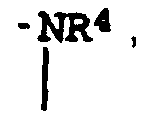
- Preferred radicals R 4 in the group which can stand for X and / or Y are C 1 to C 6 alkyl groups, for example methyl, ethyl, n-propyl or n-butyl.
- Suitable groups R 3 are in particular C 2 - to C 10 -alkanediyl groups which, together with the unit -X-CR 1 R 2 -Y-, form a 5- or 6-membered ring.
- either a hydrogen atom of the unit R 3 or the radical R 4 is necessarily substituted by an allophanate group R Ia , a biuret group R Ib , a biuret group R Ic or a thioallophanate group R Id .
- the compounds of the formula I thus carry a single group selected from the group consisting of R Ia , R Ib , R Ic and R Id .
- the group, which can be a group R Ia , R Ib , R Ic and R Id is referred to in the following text as R I.
- Dioxolanes of the formula I.1 are particularly preferred Dioxanes of the formula I.2 where R a is a hydrogen atom or a C 1 - to C 10 -alkyl radical, or oxazolidine derivatives of the formula I.3.
- the units R 5 which are part of the radicals R I , are preferably units which are derived from conventional diisocyanates (cf. Kunststoff Handbuch, Volume 7, Polyurethane, 2nd edition, 1983, Carl Hanser Verlag Kunststoff Vienna, chapter 2.2.1) by abstraction of the two isocyanate groups.
- Examples of common diisocyanates are aliphatic diisocyanates such as tetramethylene diisocyanate, hexamethylene diisocyanate (1,6-diisocyanatohexane), Octamethylene diisocyanate, decamethylene diisocyanate, Dodecamethylene diisocyanate, tetradecamethylene diisocyanate, derivatives of lysine diisocyanate, tetramethylxylylene diisocyanate, trimethylhexane diisocyanate or tetramethylhexane diisocyanate, cycloaliphatic Diisocyanates such as 1,4-, 1,3- or 1,2-diisocyanatocyclohexane, 4,4'-di (isocyanatocyclohexyl) methane, 1-isocyanato-3,3,5-trimethyl-5- (isocyanatomethyl) cyclohexane (isophorone diisocyanate)
- R 6 branched and unbranched C 1 -C 4 -alkanediyl groups are preferred. Methylene or ethylene is particularly preferred.
- units R 6 are mono- or poly (C 2 to C 4 alkylene oxide) units of the formula where "alkylene" is a branched or unbranched C 1 to C 4 alkanediyl group, n is a number from 1 to 20 and R b is independently methyl, ethyl or hydrogen.
- Both homo- and copolymer units are derived of ethylene oxide, propylene oxide or butylene oxide.
- isocyanates with an average of at least 2 isocyanate groups are suitable, for example, triisocyanates such as 2,4,6-triisocyanatotoluene, triphenylmethane triisocyanate or 2,4,4'-triisocyanatodiphenyl ether or the mixtures Di-, tri- and higher polyisocyanates by phosgenation can be obtained from corresponding aniline / formaldehyde condensates and represent polyphenyl polyisocyanates having methylene bridges.
- triisocyanates such as 2,4,6-triisocyanatotoluene, triphenylmethane triisocyanate or 2,4,4'-triisocyanatodiphenyl ether or the mixtures Di-, tri- and higher polyisocyanates by phosgenation can be obtained from corresponding aniline / formaldehyde condensates and represent polyphenyl polyisocyanates having methylene bridges.
- the isocyanate groups of the polyisocyanates (a) to (f) mentioned can also be partially reacted with monoalcohols.
- the same units are preferred for the compounds of the formula III as for the corresponding units of the formula I.
- the units R 10 , R 11 , U and V in Formula III differ from the corresponding units R 3 , R 4 , X and Y in formula I in general only in that instead of the group R Ia the group R IIIa , instead of the group R Ib the group R IIIb , instead of the group R Ic can carry the group R IIIc and instead of the group R Id the group R IIId .
- the reaction is generally carried out in bulk or in solution preferably made at normal pressure.
- the compounds of the formula I according to the invention and compounds of the formula III can be prepared in a targeted manner.
- the units D, E, R 12 in the starting compounds (compounds IV) differ from the corresponding units U, V, R 10 (compounds III) and X, Y, R 3 (compounds I) in the target compounds in general only in that that they have different substituents R IVa , R IVb , R IVc , R IVd (compounds IV), R IIIa , R IIIb , R IIIc, R IIId (compounds III) or R Ia , R Ib , R Ic , R Id ( Wear connections I).
- the lower case letters a, b, c or d are assigned in the names for the starting and target compounds or in the residues characterizing them so that they are the same for the starting and the target compounds that can be produced from them (ie a compound with the substituent R IVa leads to Ia, for example, where R 1 , R 2 , R 5 and R 7 have the same meaning in both the starting compound and the target compound). Because of their ease of preparation, mixtures of compounds I, II and optionally III, which are formed in the reaction of the corresponding starting compounds IV and V, are particularly preferred.
- the reaction is usually terminated when the starting compound of formula IV in the reaction mixture practically quantitative has reacted.
- reaction parameters are generally known to the person skilled in the art and can be chosen, for example, as in the EP-A-0585835, 0496208, 069866, in U.S. Patents 5,124,427, 5 258 482, 5 290 902 and DE-A-4015155 for the manufacture of others Biurete, allophanates and isocyanurates are described.
- reaction of the compounds IV and V in Presence of a catalyst preferably in amounts of 10 to 5000 ppm by weight, based on the amount of used Compounds V, performed.
- the catalysts for the trimerization reaction come from Isocyanate groups generally known catalysts for example those described in EP-A-0649866 quaternary ammonium hydroxides, e.g. N, N, N-trimethyl-N- (2-hydroxypropyl) ammonium hydroxide, or those known from EP-A-0182203 quaternary ammonium carboxylates, e.g. N, N, N-trimethyl-N- (2-hydroxypropyl) ammonium 2-ethylhexanoate, or as allophanate formation catalysts known zinc-organic compounds, e.g. Zinc acetylacetonate or zinc 2-ethyl caproate.
- quaternary ammonium hydroxides e.g. N, N, N-trimethyl-N- (2-hydroxypropyl) ammonium hydroxide
- EP-A-0182203 quaternary ammonium carboxylates, e.g. N, N, N-trimethyl-N- (2-
- the progress of the reaction is expediently by gel permeation chromatography (GPC) or by determining the NCO content followed the reaction mixture.
- the reaction is usually terminated when the starting compound IV practically completely implemented, i.e. by GPC is no longer detectable.
- deactivators are, for example inorganic or organic acids, the corresponding acid halides and alkylating agents. May be mentioned as an example Phosphoric acid, monochloroacetic acid, dodecylbenzenesulfonic acid, Benzoyl chloride, dimethyl sulfate and preferably dibutyl phosphate and di-2-ethylhexyl phosphate.
- the deactivators can in amounts of 1 to 200 mol%, preferably 20 to 100 mol%, based on the moles of catalyst used.
- any unreacted portion of the compound present of formula V is convenient to separate from the reaction mixture preferably up to a content of less than 1.0, particularly preferably less than 0.5% by weight. If the compounds of formula I from those of Formula III to be separated, this can be done by means of gel permeation chromatography respectively. A separation is not necessary however, in most cases, since both compounds are in two-component polyurethane coatings for similar purposes can be used. The resulting product is in its Handling unproblematic and can generally be done without special Safety precautions are processed.
- the compounds of formula I according to the invention are optionally in the form of their mixtures with the compounds II and III as a B component in two-component polyurethane coating compositions used as the A component generally a hydroxy-functional Contain polymer (A) that has no isocyanate groups wearing.
- the hydroxy-functional polymers (A) are, for example, polymers with a hydroxyl group content of 0.1 to 20, preferably 0.5 to 10% by weight.
- the number average molecular weight M n of the polymers is preferably 1000 to 100,000, particularly preferably 2,000 to 10,000.
- the polymers are preferably those which comprise more than 50% by weight of C 1 -C 20 -alkyl (meth ) acrylate, vinyl aromatics with up to 20 C atoms, vinyl esters of up to 20 C atoms containing carboxylic acids, vinyl halides, non-aromatic hydrocarbons with 4 to 8 C atoms and 1 or 2 double bonds, unsaturated nitriles and mixtures thereof.
- the polymers which consist of more than 60% by weight of C 1 -C 10 -alkyl (meth) acrylates, styrene or mixtures thereof are particularly preferred.
- the polymers (A) contain hydroxy-functional ones Monomers corresponding to the above hydroxyl group content and optionally other monomers, e.g. ethylenically unsaturated Acids, especially carboxylic acids, acid anhydrides or acid amides.
- polyesterols such as those caused by condensation of polycarboxylic acids, especially dicarboxylic acids with Polyols, especially diols are available.
- polymers (A) are polyetherols which by adding ethylene oxide, propylene oxide or butylene oxide H-active components are manufactured. Polycondensates are also suitable from butanediol.
- the polymers (A) can of course also be compounds deal with primary of secondary amino groups.
- polyisocyanates and Compounds with reactive towards polyisocyanates Groups can be included, as is usually the case in two-component coating compositions available.
- the isocyanates that are used to prepare the Compounds of formula I are used.
- Preferred two-component polyurethane coating compositions contain as A component a polymer (A) with at least 2 groups reactive toward isocyanate groups, preferably alcoholic hydroxyl groups, wherein the molar ratio of the sum formed from the units X, Y, U, V in the compounds of the formula I and III and the groups of the polymer (A) which are reactive toward isocyanate groups to the sum of the isocyanate groups in the compounds of the formula I, II and III is 0.6: 1 to 1.4: 1, preferably 0.7: 1 to 1.3: 1.
- Components B which are suitable for use in two-component polyurethane coating compositions, are obtained directly if the compounds IV are reacted with the compounds V in a molar ratio of 1:50 to 1: 1.5 until the groups R IV which are reactive toward isocyanates are practical are completely reacted, and then the unreacted portion of the compounds V is removed from the reaction mixture.
- NCO groups whose real content of isocyanate groups are preferred (NCO groups) 1 to 40, particularly preferably 5 to 25% by weight (the molecular weight of the NCO groups of 42) and a fictitious NCO content of -6 to +6, particularly preferably -3 to +3 wt .-%.
- the real NCO content in percent is obtained by measuring the molar amount of NCO groups per unit weight, e.g. by generally known titration methods can be determined, and Multiply this value by 100 and 42 (molecular weight of -NCO).
- a common titration method is described in DIN 53185.
- the fictitious NCO content arises arithmetically from the measured molar amount of NCO groups per unit weight subtracts molar amount of NCO groups per unit weight, which the molar amount of units X, Y, U and V corresponds to a weight unit and multiplied that value by 4200.
- the fictitious NCO content in percent is the NCO content that would result if the protected against NCO-reactive groups (Units X, Y, U and V) reacted quantitatively with the NCO groups would have been and is equal to 0 for compounds I.
- Such one-component systems can be stored practically indefinitely and only network when water enters, for example in Form of air humidity, as protected by the water Units X, Y, U and V deprotected, i.e. in opposite to isocyanate groups reactive groups are transferred.
- the water Units X, Y, U and V deprotected i.e. in opposite to isocyanate groups reactive groups are transferred.
- the polyisocyanates II can also be completely or partially others reactive with the reactive component or components Connections to be replaced.
- Polyepoxides Compounds with acid anhydride groups or N-methylol groups or compounds containing etherified N-methylol groups, e.g. Urea- or melamine resins, which with the deblocked groups X, Y, U and V of compounds I and III can react.
- the coating compositions of the invention can still organic solvents, e.g. Xylene, butyl acetate, methyl isobutyl ketone, Contain methoxypropylacetate, N-methylpyrrolidone.
- organic solvents e.g. Xylene, butyl acetate, methyl isobutyl ketone, Contain methoxypropylacetate, N-methylpyrrolidone.
- Solvent is used for processing, i.e. for application on substrates desired low viscosity of the coating material is set.
- the connections I make this much less Solvent required, i.e. the desired lower viscosity is achieved with higher detentions.
- the coating compositions can of course be more, in coating technology usual additives, e.g. Pigments, fillers, Flow aids etc. included.
- the production of two-component polyurethane coating agents can be done in a known manner. Usually the A- and the B component before the coating agents are applied mixed a substrate. With solvent the desired viscosity can be set.
- one-component polyurethane coating agents can be done at any time before their application, because the networking cannot happen spontaneously, because the opposite the isocyanate groups reactive amine, thiol or hydroxyl groups are in protected form, i.e. as groups X, Y and possibly U and V before.
- Crosslinking takes place after application, when the coating agent come into contact with water or humidity.
- the one- and two-component coating compositions can be in usually by spraying, pouring, rolling, brushing, knife coating etc. are applied to substrates.
- the coating compositions are particularly suitable for workpieces with surfaces made of metal, plastic, wood, wood materials etc.
- the coatings obtained have very good mechanical properties, especially high hardness, flexibility and Chemical resistance.
- the compounds of formula I according to the invention have the advantage that they can be used for high-quality one- and two-component polyurethane coating agents have it made have a particularly low viscosity.
- mixtures of compounds I and the mixtures of the Compounds I, II and III are also suitable as reactive diluents in two-component polyurethane systems because they participate in the crosslinking reaction able to participate, but the stoichiometric Ratios of the NCO groups to those reactive with NCO groups Practically hardly change groups.
- Products according to the invention B components product Starting compound IV Molar ratio NCO content (% By weight) Visc. 25 ° C (mPas) 3rd IV.1 2.5 21.1 1590 4th IV.1 5.0 20.1 810 5 IV.1 10.0 18.4 680 6 IV.2 10.0 18.5 1310 7 IV.3 10.0 15.9 460 8th IV.4 2.5 20.9 2150 9 IV.4 5.0 19.6 2040 10th IV.4 10.0 17.7 2260 11 IV.5 2.5 20.5 1540 12th IV.5 5.0 19.1 1040 13 IV.5 10.0 17.0 1410
- Coatings with a wet film thickness of 200 ⁇ m were applied to glass plates using a film drawing frame.
- the clearcoat materials thus obtained were cured under a standard atmosphere for 7 days.
- the coating properties obtained are summarized in Table 2.
- clear coats with BASONAT® HI 100 and BASONAT® P LR 8901 (BASF AG) were tested.
- reaction mixture was then distilled to remove the monomeric diisocyanate in a thin film evaporator at an oil temperature of 165 ° C. and 2.5 mbar.
- Product number Isocyanate Starting compound IV Fictitious NCO [% by weight] NCO real [wt%] Visc.
- the products according to the invention from Table 3 were (with negative fictitious NCO levels according to the stoichiometry Basonat® HI 100 mixed and) to accelerate curing treated with 0.1% dibutyltin dilaurate (DBTL, Merck).
- DBTL dibutyltin dilaurate
- the setting to an application viscosity of 20 s was carried out with butyl acetate.
- the paint content were determined according to DIN V 53 216 1st part, the VOC values calculated from mass / volume ratios.
- Isocyanate No. 14 was mixed with the lacquer of the comparative example from Table 4 in various ratios and the mixture was catalyzed with 0.1% dibutyltin dilaurate (DBTL, Merck) to accelerate the curing.
- DBTL dibutyltin dilaurate
- the setting to an application viscosity of 20 s was carried out with butyl acetate.
- the paint solids were determined according to DIN V 53 216 1st part, the VOC values calculated from mass / volume ratios. Coatings with a wet film thickness of 150 ⁇ m were applied to glass plates using a film drawing frame. The clearcoat materials thus obtained were cured under a standard atmosphere for 7 days. The resulting paint properties are summarized in Table 5.
Landscapes
- Chemical & Material Sciences (AREA)
- Organic Chemistry (AREA)
- Polymers & Plastics (AREA)
- Health & Medical Sciences (AREA)
- Chemical Kinetics & Catalysis (AREA)
- Medicinal Chemistry (AREA)
- Materials Engineering (AREA)
- Wood Science & Technology (AREA)
- Engineering & Computer Science (AREA)
- Life Sciences & Earth Sciences (AREA)
- Polyurethanes Or Polyureas (AREA)
- Paints Or Removers (AREA)
- Organic Low-Molecular-Weight Compounds And Preparation Thereof (AREA)
Claims (10)
- Composés comportant des groupements isocyanate et des groupements masqués réactifs vis-à-vis des groupements isocyanate, de formule Idans laquelle R1, R2, R3, X et Y ont les significations suivantes :
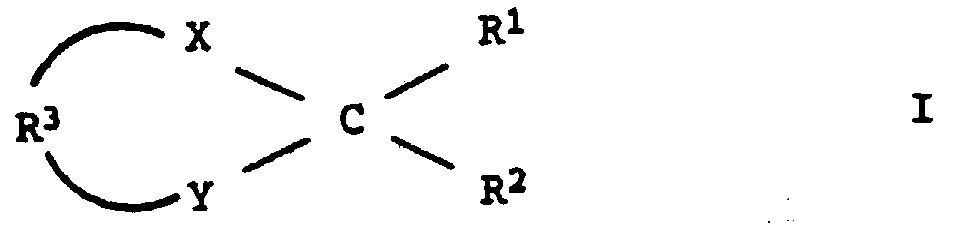
- R1, R2
- représentent un atome d'hydrogène, un groupement alkyle en C1-C10, aryle en C6-C10, aralkyle en C7-C10 ou bien R1 et R2 forment ensemble un groupement alcanediyle en C3-C10,
- X, Y
- représentent -O-, -S-,
où R4 est mis pour un atome d'hydrogène, un groupement alkyle en C1-C20, pouvant être interrompu par des atomes d'oxygène en fonction éther, un groupement aryle en C6-C10 ou un groupement aralkyle en C7-C10,
- R3
- représente un groupement alcanediyle en C1-C10, qui forme, avec l'unité -X-CR1R2-Y- un cycle à 4-7 maillons,
est remplacé par un groupement allophanate RIa dans lequel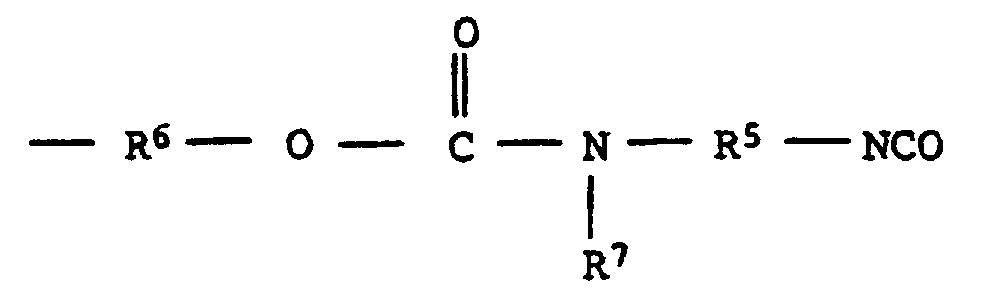
- R5
- représente une unité hydrocarbonée en C2-C20 divalente, aliphatique, alicyclique, araliphatique ou aromatique et
- R6
- représente une simple liaison ou une unité hydrocarbonée en C2-C20 divalente, aliphatique, alicyclique, araliphatique ou aromatique ou une unité mono- ou poly-(oxyde d'alkylène en C2-C4) et
- R7
- représente un reste carbamoyle
ou un groupement biuret RIb
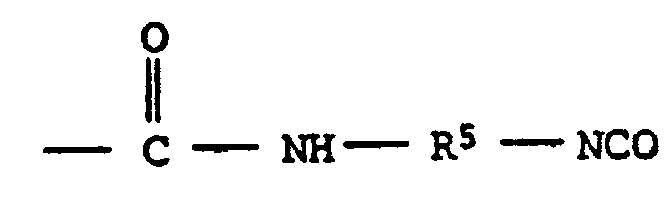 dans lequel l'un des restes R8 représente un atome d'hydrogène et l'autre reste prend la même signification que R7,
ou un groupement biuret RIcdans lequel l'un des restes R9 prend la même signification que R7 et l'autre prend la même signification que R1,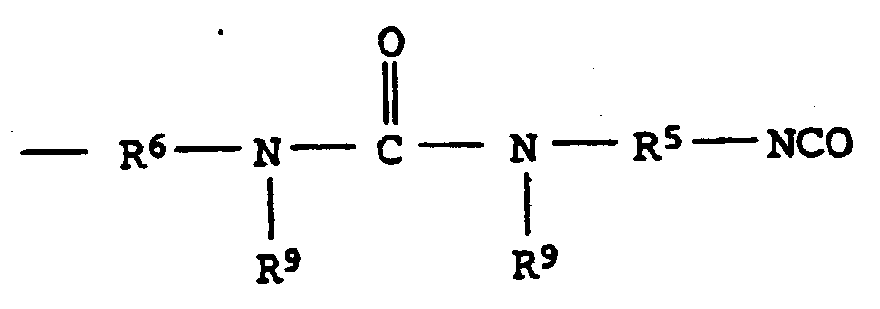
ou un groupement thioallophanate RId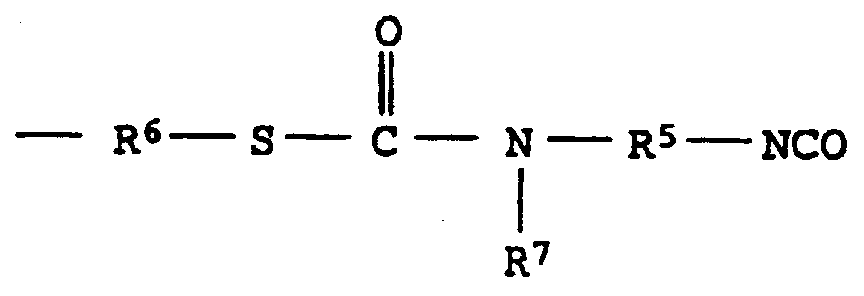
- Mélanges contenanta) 0,2-100% en mole de groupements isocyanate sous forme du composé de formule générale I,b) 0-99,8% en mole de groupements isocyanate sous forme d'un isocyanate usuel ayant en moyenne au moins 2 groupements isocyanate (composé II),c) 0-58,2% en moles de groupements isocyanate sous forme d'un composé de formule IIIdans laquelle R1, R2, R10, U et V ont les significations suivantes :

- R1, R2
- prennent la signification donnée pour la formule I,
- U,V
- représentent -O-, -S-,
où R11 est mis pour un atome d'hydrogène, un groupement alkyle en C1-C10, pouvant être interrompu par des atomes d'oxygène en fonction éther, un groupement aryle en C6-C10 ou un groupement aralkyle en C7-C10,
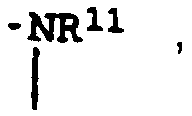
- R10
- représente un groupement alcanediyle en C1-C10, qui forme, avec l'unité -U-CR1R2-V- un cycle à 4-7 maillons,
est substitué par un groupement uréthane RIIIa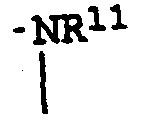 ou un groupement urée RIIIb
 ou un groupement urée RIIIc
 ou un groupement thiouréthane RIIId
 où R1, R5 et R6 prennent la signification donnée dans le formule I.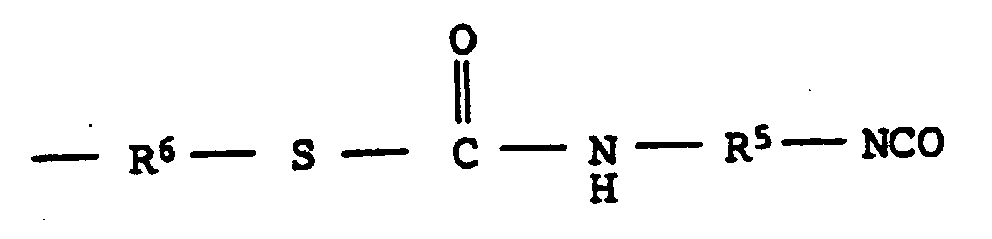
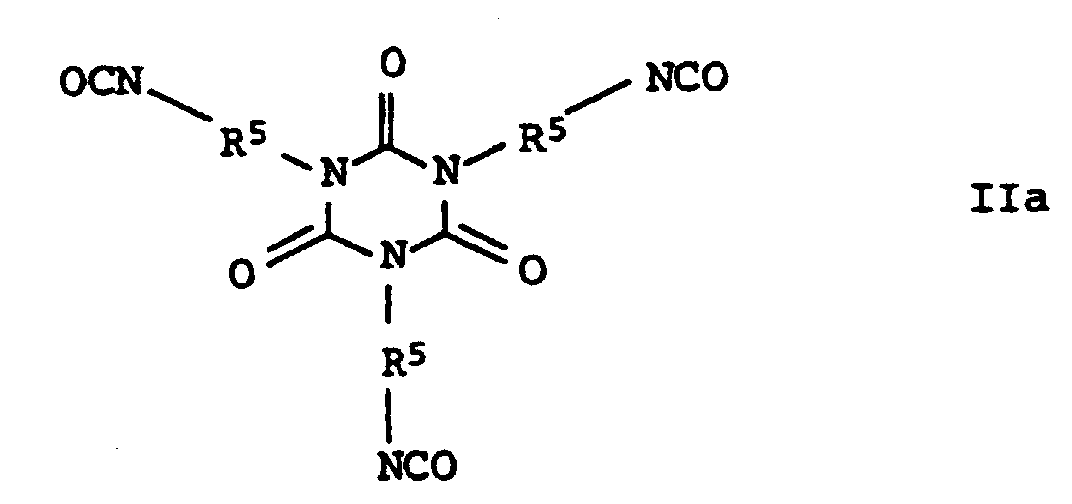
- Mélanges selon la revendication 2, caractérisés en ce que les composés II sont ceux répondant à la formule générale (IIa)ou les formes oligomères qui en dérivent.
- Procédé de préparation de mélanges selon la revendication 3, caractérisé en ce que l'on fait réagir un composé de formule IV,dans laquelle R1, R2, R12, D et E ont les significations suivantes :

R1, R2 comme pour la formule I,
- D, E
- représentent -O-, -S-,
où R13 est mis pour un atome d'hydrogène, un groupement alkyle en C1-C10, pouvant être interrompu par des atomes d'oxygène en fonction éther, un groupement aryle en C6-C10 ou un groupement aralkyle en C7-C10,

- R12
- représente un groupement alcanediyle en C1-C13, qui forme, avec l'unité -D-CR1R2-E- un cycle à 4-7 maillons,
est substitué par un reste RIVa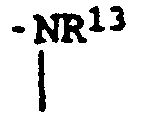 ou un reste RIVd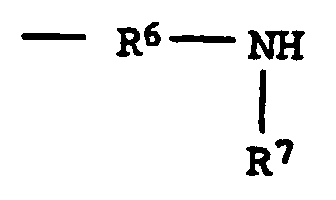
- Procédé selon la revendication 4, caractérisé en ce que, à la fin de la réaction, on sépare la partie du composé de formule V n'ayant pas réagi, jusqu'à une teneur de moins de 1% en poids.
- Composant B pour masses de revêtement en polyuréthane à deux composants, contenant0,2-99,9% en mole de groupements isocyanate sous forme du composé de formule I,0,1-99,8% en mole de groupements isocyanate sous forme d'un composé de formule II et0-58,2% en moles de groupements isocyanate sous forme d'un composé de formule III.
- Masses de revêtement en polyuréthane à deux composants, contenantétant spécifié que le rapport molaire de la somme formée par les unités X, Y, U, V dans les composés de formule I et III ainsi que des groupements du composant A réagissant avec NCO à la somme des groupements isocyanate dans les composés de formule I, II et III s'élève de 0,6 : 1 à 1,4 : 1.un composant B selon la revendication 6 etun composant A ayant au moins deux groupements réactifs vis-à-vis de NCO
- Masses de revêtement en polyuréthane à un composant, contenant0,2-100% en mole de groupements isocyanate sous forme du composé de formule I,0-58,2% en mole de groupements isocyanate sous forme d'un composé de formule II et0-58,2% en moles de groupements isocyanate sous forme d'un composé de formule III.
- Procédé de revêtement, caractérisé en ce que l'on revêt un objet avec une masse de revêtement en polyuréthane à deux composants selon la revendication 6 ou 7.
- Procédé de revêtement, caractérisé en ce que l'on revêt un objet avec une masse de revêtement en polyuréthane à un composant selon la revendication 8.
Applications Claiming Priority (3)
| Application Number | Priority Date | Filing Date | Title |
|---|---|---|---|
| DE19547974 | 1995-12-21 | ||
| DE19547974A DE19547974A1 (de) | 1995-12-21 | 1995-12-21 | Verbindungen mit Isocyanatgruppen und verkappten gegenüber Isocyanaten reaktiven Gruppen |
| PCT/EP1996/005634 WO1997023536A1 (fr) | 1995-12-21 | 1996-12-16 | Compose a groupes isocyanate et a groupes masques reactifs vis-a-vis des isocyanates |
Publications (2)
| Publication Number | Publication Date |
|---|---|
| EP0868463A1 EP0868463A1 (fr) | 1998-10-07 |
| EP0868463B1 true EP0868463B1 (fr) | 1999-07-07 |
Family
ID=7780906
Family Applications (1)
| Application Number | Title | Priority Date | Filing Date |
|---|---|---|---|
| EP96943965A Expired - Lifetime EP0868463B1 (fr) | 1995-12-21 | 1996-12-16 | Compose a groupes isocyanate et a groupes masques reactifs vis-a-vis des isocyanates |
Country Status (11)
| Country | Link |
|---|---|
| US (1) | US6022938A (fr) |
| EP (1) | EP0868463B1 (fr) |
| JP (1) | JP2000503689A (fr) |
| KR (1) | KR100463976B1 (fr) |
| CN (1) | CN1097602C (fr) |
| AU (1) | AU2017097A (fr) |
| DE (2) | DE19547974A1 (fr) |
| ES (1) | ES2135950T3 (fr) |
| SK (1) | SK81898A3 (fr) |
| WO (1) | WO1997023536A1 (fr) |
| ZA (1) | ZA9610762B (fr) |
Families Citing this family (13)
| Publication number | Priority date | Publication date | Assignee | Title |
|---|---|---|---|---|
| JP2001510868A (ja) * | 1997-07-22 | 2001-08-07 | ビーエーエスエフ コーティングス アクチェンゲゼルシャフト | 塗料及びその製法 |
| US6500180B1 (en) | 1999-10-20 | 2002-12-31 | Sdgi Holdings, Inc. | Methods and instrumentation for distraction of a disc space |
| DE10241299A1 (de) | 2002-09-04 | 2004-03-25 | Basf Ag | Strahlungshärtbare Polyurethane mit verkappten Aminogrupppen |
| US8455679B2 (en) * | 2008-12-12 | 2013-06-04 | Basf Se | Prepolymer systems having reduced monomeric isocyanate contents |
| JP2011068806A (ja) * | 2009-09-28 | 2011-04-07 | Auto Kagaku Kogyo Kk | 硬化性組成物 |
| ES2970734T3 (es) | 2014-06-13 | 2024-05-30 | Covestro Intellectual Property Gmbh & Co Kg | Poliisocianatos de tioalofanato que contienen grupos silano |
| EP3155031B8 (fr) * | 2014-06-13 | 2020-10-28 | Covestro Intellectual Property GmbH & Co. KG | Polyisocyanate à structure thioallophanate |
| JP6483816B2 (ja) * | 2014-09-26 | 2019-03-13 | ビーエーエスエフ コーティングス ゲゼルシャフト ミット ベシュレンクテル ハフツングBASF Coatings GmbH | 2,2−ジメチル−1,3−ジオキソラン−4−メタノールブロック化ポリイソシアネートに基づく架橋剤を含む、陰極電着材料用の水性バインダー分散液 |
| KR102555281B1 (ko) * | 2015-09-09 | 2023-07-14 | 코베스트로 도이칠란트 아게 | 스크래치-내성 2-성분 폴리우레탄 코팅 |
| EP3580250B1 (fr) * | 2017-02-08 | 2022-01-26 | Covestro (Netherlands) B.V. | Composition de revêtement aqueux |
| EP3853278B1 (fr) | 2018-09-20 | 2025-08-20 | 3M Innovative Properties Company | Matériau polymère comprenant un matériau contenant de l'uretdione et un composant époxy, compositions en deux parties et procédés |
| CN112739738A (zh) | 2018-09-25 | 2021-04-30 | 3M创新有限公司 | 包含含脲二酮的材料和可热活化的胺的聚合物材料、两部分组合物以及方法 |
| KR20240001023U (ko) | 2022-12-07 | 2024-06-14 | 이진욱 | 휴대용 음료 용기의 탈착 구조 |
Family Cites Families (4)
| Publication number | Priority date | Publication date | Assignee | Title |
|---|---|---|---|---|
| DE2446438C2 (de) * | 1974-09-28 | 1985-04-11 | Bayer Ag, 5090 Leverkusen | Verfahren zur Herstellung von Oxazolidingruppen enthaltenden Urethanen und ihre Verwendung |
| DE4229183A1 (de) * | 1992-09-02 | 1994-03-03 | Basf Ag | Verfahren zur Herstellung von niedrigviskosen Isocyanurat- und Urethangruppen enthaltenden Polyisocyanatmischungen |
| DE4416321A1 (de) * | 1994-05-09 | 1995-11-16 | Bayer Ag | Verfahren zur Herstellung von Allophanatgruppen aufweisenden lichtechten Polyisocyanaten |
| DE19524046A1 (de) * | 1995-07-01 | 1997-01-02 | Basf Ag | Zweikomponenten-Polyurethanbeschichtungsmasse |
-
1995
- 1995-12-21 DE DE19547974A patent/DE19547974A1/de not_active Withdrawn
-
1996
- 1996-12-16 KR KR10-1998-0704755A patent/KR100463976B1/ko not_active Expired - Fee Related
- 1996-12-16 ES ES96943965T patent/ES2135950T3/es not_active Expired - Lifetime
- 1996-12-16 US US09/091,239 patent/US6022938A/en not_active Expired - Lifetime
- 1996-12-16 CN CN96199191A patent/CN1097602C/zh not_active Expired - Lifetime
- 1996-12-16 DE DE59602411T patent/DE59602411D1/de not_active Expired - Lifetime
- 1996-12-16 EP EP96943965A patent/EP0868463B1/fr not_active Expired - Lifetime
- 1996-12-16 WO PCT/EP1996/005634 patent/WO1997023536A1/fr not_active Ceased
- 1996-12-16 AU AU20170/97A patent/AU2017097A/en not_active Abandoned
- 1996-12-16 SK SK818-98A patent/SK81898A3/sk unknown
- 1996-12-16 JP JP9523275A patent/JP2000503689A/ja active Pending
- 1996-12-20 ZA ZA9610762A patent/ZA9610762B/xx unknown
Also Published As
| Publication number | Publication date |
|---|---|
| ZA9610762B (en) | 1998-06-22 |
| US6022938A (en) | 2000-02-08 |
| ES2135950T3 (es) | 1999-11-01 |
| CN1205716A (zh) | 1999-01-20 |
| JP2000503689A (ja) | 2000-03-28 |
| EP0868463A1 (fr) | 1998-10-07 |
| KR100463976B1 (ko) | 2005-09-26 |
| AU2017097A (en) | 1997-07-17 |
| KR19990076646A (ko) | 1999-10-15 |
| SK81898A3 (en) | 1999-03-12 |
| DE19547974A1 (de) | 1997-06-26 |
| DE59602411D1 (de) | 1999-08-12 |
| WO1997023536A1 (fr) | 1997-07-03 |
| CN1097602C (zh) | 2003-01-01 |
Similar Documents
| Publication | Publication Date | Title |
|---|---|---|
| EP0752433B1 (fr) | Compositions de revêtement à base de polyuréthane à un ou deux composants | |
| EP1134247B1 (fr) | Polyisocyanates ayant une fonctionnalité élevée | |
| EP0712840B1 (fr) | Polyisocyanates contenant des groupes allophanates | |
| EP0649866A1 (fr) | Polyisocyanates pour vernis et leur utilisation | |
| EP3347397B1 (fr) | Isocyanates émulsifiables dans l'eau, présentant des propriétés améliorées | |
| EP3247732A1 (fr) | Prépolymères de polyester résistant à la cristallisation | |
| DE2304893B1 (de) | Verfahren zur Herstellung von Überzügen | |
| EP0868463A1 (fr) | Compose a groupes isocyanate et a groupes masques reactifs vis-a-vis des isocyanates | |
| EP0467153B1 (fr) | Combinaison de liants, leur utilisation dans des vernis au four et procédé de préparation de revêtements | |
| EP1524284B1 (fr) | Polyisocyanates bloqués par une diisopropylamine présentant une structure biuret | |
| EP1629023B1 (fr) | Polyisocyanates bloques resistant au durcissement | |
| EP1122272B1 (fr) | Polyisocyanates stables au stockage | |
| EP1122273B1 (fr) | Polyisocyanates stables au stockage | |
| DE19609617A1 (de) | Einkomponenten- und Zweikomponenten-Polyurethanbeschichtungsmassen | |
| EP3760658A1 (fr) | Revêtements 2k pur résistants | |
| EP1669384B1 (fr) | Mélanges de liants qui contiennent des groupes bicycloorthoester et/ou polyorthoester | |
| DE4120323C2 (de) | Verfahren zur Herstellung von Harnstoffgruppen aufweisenden Melaminharzen, die so erhaltenen Harze und ihre Verwendung | |
| EP1047719B1 (fr) | Melanges comprenant des diisocyanates porteurs de groupes allophanate derives d'alcools alicycliques | |
| DE19524046A1 (de) | Zweikomponenten-Polyurethanbeschichtungsmasse | |
| EP0039864A1 (fr) | Isocyanato-isocyanurates, procédé pour leur préparation, ainsi que leur utilisation comme composant d'isocyanate dans les laques polyuréthane | |
| DE10300155A1 (de) | Neue Beschichtungssysteme | |
| EP4574874A1 (fr) | Mélange de polyisocyanates | |
| EP4574864A1 (fr) | Mélange de polyisocyanates | |
| EP4148077A1 (fr) | Production d'un durcisseur bloqué à base d'un polyisocyanate partiellement d'origine biologique et utilisation en tant que vernis émail 1k-pur | |
| DE10057603A1 (de) | Lagerstabile Polyisocyanate |
Legal Events
| Date | Code | Title | Description |
|---|---|---|---|
| PUAI | Public reference made under article 153(3) epc to a published international application that has entered the european phase |
Free format text: ORIGINAL CODE: 0009012 |
|
| 17P | Request for examination filed |
Effective date: 19980519 |
|
| AK | Designated contracting states |
Kind code of ref document: A1 Designated state(s): BE DE ES FR GB IT NL |
|
| GRAG | Despatch of communication of intention to grant |
Free format text: ORIGINAL CODE: EPIDOS AGRA |
|
| 17Q | First examination report despatched |
Effective date: 19981116 |
|
| GRAG | Despatch of communication of intention to grant |
Free format text: ORIGINAL CODE: EPIDOS AGRA |
|
| GRAH | Despatch of communication of intention to grant a patent |
Free format text: ORIGINAL CODE: EPIDOS IGRA |
|
| GRAH | Despatch of communication of intention to grant a patent |
Free format text: ORIGINAL CODE: EPIDOS IGRA |
|
| GRAA | (expected) grant |
Free format text: ORIGINAL CODE: 0009210 |
|
| AK | Designated contracting states |
Kind code of ref document: B1 Designated state(s): BE DE ES FR GB IT NL |
|
| GBT | Gb: translation of ep patent filed (gb section 77(6)(a)/1977) |
Effective date: 19990719 |
|
| REF | Corresponds to: |
Ref document number: 59602411 Country of ref document: DE Date of ref document: 19990812 |
|
| ITF | It: translation for a ep patent filed | ||
| REG | Reference to a national code |
Ref country code: ES Ref legal event code: FG2A Ref document number: 2135950 Country of ref document: ES Kind code of ref document: T3 |
|
| ET | Fr: translation filed | ||
| PLBE | No opposition filed within time limit |
Free format text: ORIGINAL CODE: 0009261 |
|
| STAA | Information on the status of an ep patent application or granted ep patent |
Free format text: STATUS: NO OPPOSITION FILED WITHIN TIME LIMIT |
|
| 26N | No opposition filed | ||
| REG | Reference to a national code |
Ref country code: GB Ref legal event code: IF02 |
|
| PGFP | Annual fee paid to national office [announced via postgrant information from national office to epo] |
Ref country code: IT Payment date: 20121218 Year of fee payment: 17 |
|
| PGFP | Annual fee paid to national office [announced via postgrant information from national office to epo] |
Ref country code: GB Payment date: 20130102 Year of fee payment: 17 Ref country code: FR Payment date: 20130124 Year of fee payment: 17 Ref country code: ES Payment date: 20130125 Year of fee payment: 17 |
|
| PGFP | Annual fee paid to national office [announced via postgrant information from national office to epo] |
Ref country code: NL Payment date: 20121219 Year of fee payment: 17 Ref country code: BE Payment date: 20130130 Year of fee payment: 17 |
|
| BERE | Be: lapsed |
Owner name: *BASF A.G. Effective date: 20131231 |
|
| REG | Reference to a national code |
Ref country code: NL Ref legal event code: V1 Effective date: 20140701 |
|
| GBPC | Gb: european patent ceased through non-payment of renewal fee |
Effective date: 20131216 |
|
| REG | Reference to a national code |
Ref country code: FR Ref legal event code: ST Effective date: 20140829 |
|
| PG25 | Lapsed in a contracting state [announced via postgrant information from national office to epo] |
Ref country code: NL Free format text: LAPSE BECAUSE OF NON-PAYMENT OF DUE FEES Effective date: 20140701 Ref country code: BE Free format text: LAPSE BECAUSE OF NON-PAYMENT OF DUE FEES Effective date: 20131231 |
|
| PG25 | Lapsed in a contracting state [announced via postgrant information from national office to epo] |
Ref country code: GB Free format text: LAPSE BECAUSE OF NON-PAYMENT OF DUE FEES Effective date: 20131216 Ref country code: FR Free format text: LAPSE BECAUSE OF NON-PAYMENT OF DUE FEES Effective date: 20131231 |
|
| REG | Reference to a national code |
Ref country code: ES Ref legal event code: FD2A Effective date: 20150401 |
|
| PG25 | Lapsed in a contracting state [announced via postgrant information from national office to epo] |
Ref country code: ES Free format text: LAPSE BECAUSE OF NON-PAYMENT OF DUE FEES Effective date: 20131217 |
|
| PGFP | Annual fee paid to national office [announced via postgrant information from national office to epo] |
Ref country code: DE Payment date: 20150227 Year of fee payment: 19 |
|
| PG25 | Lapsed in a contracting state [announced via postgrant information from national office to epo] |
Ref country code: IT Free format text: LAPSE BECAUSE OF NON-PAYMENT OF DUE FEES Effective date: 20131231 |
|
| PG25 | Lapsed in a contracting state [announced via postgrant information from national office to epo] |
Ref country code: IT Free format text: LAPSE BECAUSE OF NON-PAYMENT OF DUE FEES Effective date: 20131216 |
|
| REG | Reference to a national code |
Ref country code: DE Ref legal event code: R119 Ref document number: 59602411 Country of ref document: DE |
|
| PG25 | Lapsed in a contracting state [announced via postgrant information from national office to epo] |
Ref country code: DE Free format text: LAPSE BECAUSE OF NON-PAYMENT OF DUE FEES Effective date: 20160701 |