EP0868909A2 - Ophthalmic carrier solution - Google Patents
Ophthalmic carrier solution Download PDFInfo
- Publication number
- EP0868909A2 EP0868909A2 EP98104601A EP98104601A EP0868909A2 EP 0868909 A2 EP0868909 A2 EP 0868909A2 EP 98104601 A EP98104601 A EP 98104601A EP 98104601 A EP98104601 A EP 98104601A EP 0868909 A2 EP0868909 A2 EP 0868909A2
- Authority
- EP
- European Patent Office
- Prior art keywords
- shaking time
- time
- conductivity
- temperature
- weight
- Prior art date
- Legal status (The legal status is an assumption and is not a legal conclusion. Google has not performed a legal analysis and makes no representation as to the accuracy of the status listed.)
- Granted
Links
Images
Classifications
-
- A—HUMAN NECESSITIES
- A61—MEDICAL OR VETERINARY SCIENCE; HYGIENE
- A61K—PREPARATIONS FOR MEDICAL, DENTAL OR TOILETRY PURPOSES
- A61K9/00—Medicinal preparations characterised by special physical form
- A61K9/0012—Galenical forms characterised by the site of application
- A61K9/0048—Eye, e.g. artificial tears
Definitions
- This invention belongs to the field of matter compositions used for ophthalmic treatments, and specifically it deals with an aqueous solution with characteristics similar to the human pre-corneal lachrymal film, which prevents a user from feeling pain or a burning sensation due to the application of a topical ophthalmic medication, and which also increases the ocular penetration of the ophthalmic composition and its bio-availability.
- the object of this invention is to provide an ophthalmic carrier solution suitable for the topical application of ophthalmic solutions of several different types, among them, sodium dyclophenac or antibiotics such as tobramicin, gentamicin and timolol sulfate.
- Another object of this invention is that of allowing a compound based on sodium dyclophenac to reach the human eye, which usually causes pain, a burning sensation, temporary irritation and weeping as undesirable effects of its topical application, but without the inherent problems of pain, the burning sensation and irritation.
- Another additional objective of this invention is that of preparing a formulation which contains the active ingredient but which is effective for avoiding the mentioned undesirable effects.
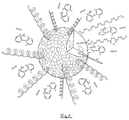
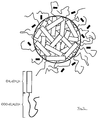
- Figure 2 is an illustration of a micella of polyoxyl stearate 40 linked to the main active ingredient (sodium dyclophenac) of this invention.
- the molecule which has these characteristics is polyoxyl stearate 40 whose formula and stoichiometric position allows the active ingredient, in this case sodium dyclophenac, to be isolated and wrapped in the polarized portion of this molecule, acting as an inert carrier, so that at the time of its application, the active ingredient does not react or become "contaminated" by other radicals.
- the ratio of the molecular weight of the active ingredient (sodium dyclophenac) with regards t the molecular weight of the polarized fraction should be 5.68 times the polarized fraction with regards to the molecular weight of the active ingredient (sodium dyclophenac).
- the polar part (2) of the polyoxyl stearate 40 can be seen, corresponding to the polyoxyethylene chain (CH2OCH2)40, linked to the molecules of the main active ingredient (3) (sodium dyclophenac).
- the diagram of the reaction which takes place between the components of the ophthalmic carrier compound nd the main active ingredient can be seen.
- composition of the ophthalmic carrier solution of this invention is formed by the following ingredients:
- composition of the ophthalmic carrier solution shown in the above formula also containing the active ingredient, in this case sodium dyclophenac, is as follows:
- the polyoxyl stearate 40 has a formula and stoichiometric position which allows the active ingredient to be isolated and wrapped in the polarized portion of this molecule, acting as an inert carrier, so that at the time of its application, the active ingredient does not react or become "contaminated" by other radicals.
- the dehydrated disodium edetate as a classic sequester is added to capture free ions which at a given moment could interfere with the polarizing effect of the stearate.
- NaCl is added to increase the isotonicity but principally the conductivity of the solution, containing the values described in Table I.
- the boric acid is a pH regulating substance which is added with the aim of maintaining the pH value close to neutrality, given the characteristics of the human pre-corneal lachrymal film which has a pH of 7.0 to 7.4.
- the sorbic acid is a preservative used in the preparation of ophthalmic solutions with the aim of protecting such solutions from any contamination by microorganisms. It is characterized by being a substance which does not irritate the eyeball and having a wide spectrum.
- sodium hydroxide is used to adjust the pH to neutrality protecting the oxide reduction potential of the already formed compound allowing the polarization of the stearate to be ready for when the main active ingredient is added.
- the sodium methabisulfite has the characteristic of being highly antioxidant, making sure that none of the dissolved oxygen interacts with the main active ingredient and the polarization of the polyoxyl stearate 40 is not altered.
- a pH of 6.98 must be possessed and with a conductivity of 16.97.
- the volume of the solution of the active ingredient (solution at 0. 3%) must be 30% with regards to the volume of the stearate compound, constantly obtaining a reduction of 30% in the conductivity (dilution factor) and a final pH of 6.84.
- Example 1 Preparation of the ophthalmic carrier compound .
- the pH was immediately adjusted to 7.21 through the addition of sodium hydroxide, being shaken at a speed of 800 rpm for 10 minutes; at this stage the conductivity was 17.06 mS/cm and the temperature of the solution was 45°C.
- the solution was left to cool to a temperature of 30°C and in continuation 0.080 kg of sodium bisulfite were slowly added, maintaining the shaking at a speed of 800 rpm for 15 minutes; a pH of 6.98, conductivity of 16.97 and a temperature of the solution of 30°C were observed.
- Example 2 Preparation of a composition for ophthalmic use containing the carrier compound and sodium dyclophenac as the active ingredient.
- the sodium dyclophenac solution was transferred into a stainless steel tank with a capacity of 200 liters, containing 120 liters of the carrier compound solution prepared in example 1, shaken at a speed of 8900 rpm for 15 minutes.
- the total volume of 200 liters with distilled water was gauged a temperature of 23°C and whose conductivity should not be greater than 0.002 mS/cm.
- the solution has a pH of 6.25.
- the solution was shaken for approximately 2 hours and next the pH was adjusted to an approximate value of 6.84; the conductivity of the final solution is 11.77 and the final temperature of the solution was approximately 23°C.
Landscapes
- Health & Medical Sciences (AREA)
- General Health & Medical Sciences (AREA)
- Ophthalmology & Optometry (AREA)
- Medicinal Chemistry (AREA)
- Pharmacology & Pharmacy (AREA)
- Epidemiology (AREA)
- Life Sciences & Earth Sciences (AREA)
- Chemical & Material Sciences (AREA)
- Public Health (AREA)
- Animal Behavior & Ethology (AREA)
- Veterinary Medicine (AREA)
- Pharmaceuticals Containing Other Organic And Inorganic Compounds (AREA)
- Medicinal Preparation (AREA)
- Acyclic And Carbocyclic Compounds In Medicinal Compositions (AREA)
- Agricultural Chemicals And Associated Chemicals (AREA)
- Medicines Containing Material From Animals Or Micro-Organisms (AREA)
Abstract
Description
| INGREDIENT | AMOUNT | % BY WEIGHT |
| Polyoxyl stearate 40 | 7.0 g | 10.20 |
| Dehydrated disodium edetate | 0.1 g | 0.15 |
| Sodium Chloride | 0.7 g | 1.03 |
| Boric Acid | 0.095 g | 0.14 |
| Sorbic Acid | 0.22 g | 0.32 |
| Sodium Bisulfite | 0.040 g | 0.06 |
| Distilled water excipient | 100 ml | 88.00 |
| Sodium dyclophenac | 0.1 g |
| Polyoxyl stearate 40 | 7.0 g |
| Dehydrated disodium edetate | 0.1 g |
| Sodium Chloride | 0.7 g |
| Boric Acid | 0.095 g |
| Sorbic Acid | 0.22 g |
| Sodium Bisulfite | 0.040 g |
| Distilled water excipient | 100 ml |
- 316 stainless steel tank, with a medical finish.
- Medical type shaker with helix type 316 stainless steel propellers.
- 316 stainless steel tank, medical finish with an internal coil for the heating of distilled water.
| Process stage | Conductivity mS/cm | Conductivity TDS g/L | Temperature °C | pH |
| Distilled water | 0.002 | 0.001 | 70 | 6.25 |
| Polyoxyl stearate 40 | 0.12 | 0.0603 | 60 | 6.1 |
| Disodium edetate | 0.68 | 0.342 | 60 | 5.56 |
| Sodium chloride | 16.32 | 8.15 | 56 | 5.21 |
| Boric acid | 12.64 | 6.32 | 54 | 5.22 |
| Sorbic acid | 15.87 | 7.93 | 50 | 3.86 |
| Adjustment with NaOH | 17.06 | 8.52 | 35 | 7.21 |
| Sodium bisulfite | 16.97 | 8.47 | 30 | 6.98 |
| Mixture + dyclophenac | 11.77 | 5.88 | 22 | 6.84 |
| Dyclophenac alone | 0.734 | 0.368 | 22 | 7.25 |
Claims (5)
- An ophthalmic carrier solution to be used in the topical application of ophthalmic use compounds, characterized in that it contains the following ingredients:10.20 % by weight of polyoxyl stearate 40;0.15 % by weight of dehydrated disodium edetate;1.03 % by weight of sodium chloride;0.14 % by weight of boric acid;0.32 % by weight of sorbic acid;0.06 % by weight of sodium bisulfite, and88.00 % by weight of distilled water.
- A procedure for the preparation of an ophthalmic carrier solution comprising polyoxyl stearate 40, dehydrated disodium edetate, sodium chloride, boric acid, sorbic acid, sodium bisulfite and distilled water, characterized in that it comprises the following stages:a) Heat a predetermined volume of distilled water to an approximate temperature of 69 to 71°C; adjust the pH to 6.25 (± 0.25) and that a conductivity no greater than 0.002 mS/cm is maintained;b) Empty the warm distilled water into the stainless steel tank;c) Slowly add the polyoxyl stearate 40 to the warm distilled water, maintaining the shaker operating for a time of between 27 and 33 minutes; the pH at the end of the shaking time should be approximately between 6.0 and 6.2 and the conductivity after the shaking time should be 0.12 mS/cm (± 0.05 mS/cm); in addition, the temperature after the shaking time should be between 63 and 67°C;d) Add the disodium edetate 2 H2O slowly, maintaining the shaker operating for a time of between 13 and 17 minutes at a speed of 750-850 rpm; the pH at the end of the shaking time should be within a range of 5.54 to 5.58 and the conductivity after the shaking time should be between 0.679 and 0.681 mS/cm; the temperature after the shaking time should be between 59 and 61°C;e) Slowly add the sodium chloride, maintaining the shaker at a speed of between 750 and 850 rpm during an approximate time of 13 to 17 minutes; the pH at the end of the shaking time should be within a range of 5.20 to 5.22 and the conductivity after the shaking time should be between 15.32 and 17.32 mS/cm; the temperature after the shaking time should be between 55 and 57°C;f) Slowly add the boric acid, maintaining the shaker at a speed of between 750 and 850 rpm during an approximate time of 13 to 17 minutes; the pH at the end of the shaking time should be within a range of 5.20 to 5.24 and the conductivity after the shaking time should be between 11.64 and 13.64 mS/cm; the temperature after the shaking time should be between 55 and 57°C;g) Let the preparation cool to approximately 49-51°C;h) Slowly add the sorbic acid, maintaining the shaker at a speed of between 750 and 850 rpm during an approximate time of 13 to 17 minutes; the pH at the end of the shaking time should be within a range of 3.84 to 3.88 and the conductivity after the shaking time should be between 15.82 and 15.92 mS/cm; the temperature after the shaking time should be between 46 and 48°C;i) Adjust the pH with sodium hydroxide as soon as possible to value of 7.15 ± 0.1, maintaining the shaker at a speed of between 750 and 850 rpm during an approximate time of 9 to 11 minutes; the conductivity after the shaking time should be between 16.06 and 18.06 mS/cm; the temperature after the shaking time should be between 44.5 and 45.5°C;j) Let the preparation cool to approximately 29-31°C;k) Slowly add the sodium bisulfite, maintaining the shaker at a speed of between 750 and 850 rpm during an approximate time of 13 to 17 minutes; the pH at the end of the shaking time should be 7.0 ± 0.1. The conductivity after the shaking time should be 16.97 mS/cm (with a limit of ± 1.0 mS/cm); and the temperature after the shaking time should be between 25 and 29°C.
- An ophthalmic composition for topical use, characterized in that it contains:68.16 % by weight of the composition of claim 1;0.10 % by weight of an active agent selected from sodium dyclophenac and antibiotics such as tobramicin or gentamicin; and sufficient distilled water to complete the 100% by weight of the solution.
- An ophthalmic composition for topical use according to claim 3, characterized in that it contains:68.16 % by weight of the composition of claim 1;0.10 % by weight of sodium dyclophenac and sufficient distilled water to complete the 100% by weight of the solution.
- Procedure for the preparation of an ophthalmic composition for topical use which comprises an ophthalmic carrier solution according to claim 1 and an active ingredient such as sodium dyclophenac, characterized in that it comprises the following stages:i) empty a predetermined amount of distilled water into a stainless steel container; shake at an approximate speed of between 580 and 620 rpm; add the sodium dyclophenac slowly, maintaining the shaker turned-on for approximately 13 to 17 minutes; the pH at the end of the shaking time should be 7.25 ± 0.1. The conductivity after the shaking time should be 0.734 mS/cm (± 1.0 mS/cm); and the temperature after the shaking time should be between 21 and 25°C;ii) transfer the sodium dyclophenac preparation obtained in the previous step, into the tank which contains a predetermined volume of the composition prepared according to the process of claim 2, maintaining a shaker speed of 800 ± 50 rpm for approximately 13 to 17 minutes;iii) heat the total volume with distilled water to a temperature of 21 to 25°C and with an approximate pH of between 6.00 and 6.50. The conductivity of the distilled water must not be greater than 0.002 mS/cm;iv) shake the solution for a time of 2 hours ± 5 minutes;v) adjust the pH at the end of the shaking time to a value between 6.83 and 6.85. The conductivity after the shaking time should be 11.77 mS/cm ± 0.5 mS/cm and the temperature after the shaking time should be approximately 21-25°C.
Applications Claiming Priority (3)
| Application Number | Priority Date | Filing Date | Title |
|---|---|---|---|
| MX9701946A MX9701946A (en) | 1997-03-14 | 1997-03-14 | Transporting ophthalmic solution. |
| MX9701946 | 1997-03-14 | ||
| MX0971946 | 1997-03-14 |
Publications (3)
| Publication Number | Publication Date |
|---|---|
| EP0868909A2 true EP0868909A2 (en) | 1998-10-07 |
| EP0868909A3 EP0868909A3 (en) | 1999-09-08 |
| EP0868909B1 EP0868909B1 (en) | 2002-11-20 |
Family
ID=19744965
Family Applications (1)
| Application Number | Title | Priority Date | Filing Date |
|---|---|---|---|
| EP98104601A Expired - Lifetime EP0868909B1 (en) | 1997-03-14 | 1998-03-13 | Ophthalmic carrier solution |
Country Status (9)
| Country | Link |
|---|---|
| US (1) | US6071958A (en) |
| EP (1) | EP0868909B1 (en) |
| AT (1) | ATE227976T1 (en) |
| CA (1) | CA2219065C (en) |
| DE (1) | DE69809489T2 (en) |
| DK (1) | DK0868909T3 (en) |
| ES (1) | ES2187845T3 (en) |
| MX (1) | MX9701946A (en) |
| PT (1) | PT868909E (en) |
Cited By (4)
| Publication number | Priority date | Publication date | Assignee | Title |
|---|---|---|---|---|
| WO2004054589A1 (en) * | 2002-12-13 | 2004-07-01 | Arturo Jimenez Bayardo | Intravitreally-injectable solution for the treatment of vitreous haemorrhages |
| WO2004096261A1 (en) * | 2003-05-02 | 2004-11-11 | Arturo Jimenez Bayardo | Method of preparing an aqueous solution of cyclosporin-a and resulting aqueous solution |
| US10265375B2 (en) | 2007-10-08 | 2019-04-23 | Aurinia Pharmaceuticals Inc. | Ophthalmic compositions |
| US11622991B2 (en) | 2017-05-12 | 2023-04-11 | Aurinia Pharmaceuticals Inc. | Protocol for treatment of lupus nephritis |
Families Citing this family (23)
| Publication number | Priority date | Publication date | Assignee | Title |
|---|---|---|---|---|
| US20060177430A1 (en) * | 2002-12-20 | 2006-08-10 | Chakshu Research Inc | Treatment of ocular disorders with ophthalmic formulations containing methylsulfonylmethane as a transport enhancer |
| US20060166879A1 (en) * | 2002-12-20 | 2006-07-27 | Chakshu Research Inc | Treatment of conditions associated with the presence of macromolecular aggregates, particularly ophthalmic disorders |
| US20060172972A1 (en) * | 2002-12-20 | 2006-08-03 | Chakshu Research Inc | Formulation and method for administration of ophthalmologically active agents |
| NZ540885A (en) * | 2002-12-20 | 2009-02-28 | Chakshu Res Inc | Ophthalmic formulation for the prevention and treatment of ocular conditions |
| BR0318395A (en) | 2003-07-10 | 2006-08-01 | Arturo Jimenez Bayardo | method for preparing an aqueous meloxicam solution and the resulting aqueous solution |
| CA2615231A1 (en) * | 2005-07-15 | 2007-01-25 | Chakshu Research Inc. | Prevention and treatment of ophthalmic complications of diabetes |
| TW200812575A (en) * | 2006-04-28 | 2008-03-16 | Alcon Inc | Formulations containing amide derivatives of carboxylic acid NSAIDs for topical administration to the eye |
| NZ573174A (en) * | 2006-06-01 | 2012-01-12 | Msd Consumer Care Inc | Sustained release pharmaceutical dosage form containing phenylephrine |
| AU2007254821B2 (en) * | 2006-06-01 | 2013-11-14 | Bayer Consumer Care Ag | Sustained release pharmaceutical formulation comprising phenylephrine |
| PE20150773A1 (en) * | 2006-06-01 | 2015-05-21 | Merck Sharp & Dohme | PHARMACEUTICAL COMPOSITIONS FOR THE SUSTAINED RELEASE OF PHENYLEPHRINE |
| KR20090015103A (en) * | 2006-06-01 | 2009-02-11 | 쉐링 코포레이션 | Phenylephrine Pulsed Release Formulations and Pharmaceutical Compositions |
| KR20170012582A (en) | 2006-11-02 | 2017-02-02 | 악셀레론 파마 인코포레이티드 | Alk1 receptor and ligand antagonists and uses thereof |
| CN101848706A (en) * | 2007-06-01 | 2010-09-29 | 先灵-普劳健康护理产品公司 | Pharmaceutical composition comprising a substrate and a coating containing an active ingredient and polyvinylalcohol |
| JP2011508776A (en) * | 2008-01-04 | 2011-03-17 | アルコン ファーマシューティカルズ リミテッド | Stable aqueous cyclosporine composition |
| TWI672151B (en) | 2008-05-02 | 2019-09-21 | 艾西利羅製藥公司 | Methods and compositions for modulating angiogenesis and pericyte composition |
| EP2440185B1 (en) * | 2009-06-09 | 2015-04-08 | Aurinia Pharmaceuticals Inc. | Topical drug delivery systems for ophthalmic use |
| US20100323978A1 (en) * | 2009-06-22 | 2010-12-23 | Calvin Hanna | Non-aqueous oil delivery system for ophthalmic drugs |
| DK2699590T3 (en) | 2011-04-20 | 2019-05-06 | Acceleron Pharma Inc | ENDOGLIN POLYPEPTIDES AND APPLICATIONS THEREOF |
| PL2887923T3 (en) | 2012-08-24 | 2023-08-14 | Sun Pharmaceutical Industries Limited | Ophthalmic formulation of polyoxyl lipid or polyoxyl fatty acid and treatment of ocular conditions |
| EP3851118A1 (en) | 2013-10-25 | 2021-07-21 | Acceleron Pharma Inc. | Endoglin peptides to treat fibrotic diseases |
| EP3373976B1 (en) | 2015-11-10 | 2024-01-03 | Sun Pharmaceutical Industries Limited | Topical formulations and uses thereof |
| US10918694B2 (en) | 2016-02-29 | 2021-02-16 | Sun Pharma Global Fze | Topical cyclosporine-containing formulations and uses thereof |
| MX2023015452A (en) * | 2023-12-15 | 2025-07-01 | Centro De Retina Medica Y Quirurgica S C | Formulacion de base lipidica de uso topico oftalmico para incrementar la biodisponibilidad de los non steroidal en los tejidos intraoculares. |
Family Cites Families (4)
| Publication number | Priority date | Publication date | Assignee | Title |
|---|---|---|---|---|
| NZ226100A (en) * | 1987-09-11 | 1990-12-21 | Syntex Inc | Stabilised ophthalmic formulation containing non-steroidal anti-inflammatory drug |
| DE69307505T2 (en) * | 1992-05-13 | 1997-07-24 | Sandoz-Patent-Gmbh, 79539 Loerrach | OPTHALMIC COMPOSITIONS CONTAINING A CYCLOSPORIN |
| JPH06298649A (en) * | 1993-04-19 | 1994-10-25 | Teika Seiyaku Kk | Azelastine eye drop composition |
| JP3155689B2 (en) * | 1995-08-10 | 2001-04-16 | 昭和薬品化工株式会社 | Anti-inflammatory eye drops |
-
1997
- 1997-03-14 MX MX9701946A patent/MX9701946A/en unknown
- 1997-10-27 CA CA002219065A patent/CA2219065C/en not_active Expired - Fee Related
- 1997-10-27 US US08/958,681 patent/US6071958A/en not_active Expired - Lifetime
-
1998
- 1998-03-13 ES ES98104601T patent/ES2187845T3/en not_active Expired - Lifetime
- 1998-03-13 EP EP98104601A patent/EP0868909B1/en not_active Expired - Lifetime
- 1998-03-13 PT PT98104601T patent/PT868909E/en unknown
- 1998-03-13 DE DE69809489T patent/DE69809489T2/en not_active Expired - Fee Related
- 1998-03-13 AT AT98104601T patent/ATE227976T1/en not_active IP Right Cessation
- 1998-03-13 DK DK98104601T patent/DK0868909T3/en active
Cited By (5)
| Publication number | Priority date | Publication date | Assignee | Title |
|---|---|---|---|---|
| WO2004054589A1 (en) * | 2002-12-13 | 2004-07-01 | Arturo Jimenez Bayardo | Intravitreally-injectable solution for the treatment of vitreous haemorrhages |
| WO2004096261A1 (en) * | 2003-05-02 | 2004-11-11 | Arturo Jimenez Bayardo | Method of preparing an aqueous solution of cyclosporin-a and resulting aqueous solution |
| US10265375B2 (en) | 2007-10-08 | 2019-04-23 | Aurinia Pharmaceuticals Inc. | Ophthalmic compositions |
| US10973871B2 (en) | 2007-10-08 | 2021-04-13 | Aurinia Pharmaceuticals, Inc. | Ophthalmic compositions |
| US11622991B2 (en) | 2017-05-12 | 2023-04-11 | Aurinia Pharmaceuticals Inc. | Protocol for treatment of lupus nephritis |
Also Published As
| Publication number | Publication date |
|---|---|
| DE69809489D1 (en) | 2003-01-02 |
| MX9701946A (en) | 1998-04-30 |
| EP0868909A3 (en) | 1999-09-08 |
| PT868909E (en) | 2003-03-31 |
| DE69809489T2 (en) | 2003-09-04 |
| CA2219065A1 (en) | 1998-09-14 |
| DK0868909T3 (en) | 2003-01-20 |
| CA2219065C (en) | 2008-04-22 |
| ATE227976T1 (en) | 2002-12-15 |
| EP0868909B1 (en) | 2002-11-20 |
| US6071958A (en) | 2000-06-06 |
| ES2187845T3 (en) | 2003-06-16 |
Similar Documents
| Publication | Publication Date | Title |
|---|---|---|
| US6071958A (en) | Ophthalmic carrier solution | |
| MXPA97001946A (en) | Transfer oftalmica solution | |
| EP0700249B1 (en) | Anti-infective agents | |
| CA2423354C (en) | Self-preserved nasal, inhalable, and topical ophthalmic preparations and medications | |
| EP1553953B1 (en) | Method and composition containing latanoprost for treating ocular hypertension and glaucoma | |
| DE3310079C2 (en) | ||
| SK153398A3 (en) | Antimicrobial composition and its use for the preparation of product for treatment of diseases induced by herpex simplex virus and other infectious diseases | |
| JP2025516814A (en) | Novel methods of application of zwitterions in topical ophthalmic cream compositions and preparations | |
| KR20120112537A (en) | Non-irritating ophthalmic povidone-iodine compositions | |
| JPH1160505A (en) | Antiseptic composition | |
| IE51085B1 (en) | Ophthalmic compositions | |
| EP1050300A2 (en) | Selective antibacterial composition | |
| JPS61143318A (en) | Novel drug and preparation | |
| JP2916340B2 (en) | Aqueous pharmaceutical composition of sodium cromoglycate | |
| JP3502574B2 (en) | Eye ointment for treatment of eye infections | |
| JP3274223B2 (en) | Hypoallergenic d-phenothrin shampoo | |
| JP2002527382A (en) | Histochrome and its use in ophthalmic treatment | |
| Fassi, AR* & Naidoo | Irritation associated with tear-replacement ophthalmic drops-a pharmaceutical and subjective investigation | |
| DE3787274T2 (en) | Pharmaceutical preparations containing an aqueous solution of a pyranoquinoline. | |
| RU2192860C1 (en) | Ointment for treatment of blepharitis and blepharoconjunctivitis | |
| CN109453151B (en) | Pharmaceutical composition for eyes, preparation method and application thereof | |
| KR102482158B1 (en) | gel composition for disinfection and manufacturing method thereof | |
| JP2023548884A (en) | Preparations based on polyhexamethylene biguanide for use in the treatment of Acanthamoeba keratitis and/or fungal infections | |
| JP2944759B2 (en) | Antimicrobial composition | |
| CN111568869A (en) | A kind of freeze-dried powder preparation for dry eye prevention and improvement nursing and preparation method thereof |
Legal Events
| Date | Code | Title | Description |
|---|---|---|---|
| PUAI | Public reference made under article 153(3) epc to a published international application that has entered the european phase |
Free format text: ORIGINAL CODE: 0009012 |
|
| AK | Designated contracting states |
Kind code of ref document: A2 Designated state(s): AT BE CH DE DK ES FI FR GB GR IE IT LI LU MC NL PT SE |
|
| PUAL | Search report despatched |
Free format text: ORIGINAL CODE: 0009013 |
|
| AK | Designated contracting states |
Kind code of ref document: A3 Designated state(s): AT BE CH DE DK ES FI FR GB GR IE IT LI LU MC NL PT SE |
|
| AX | Request for extension of the european patent |
Free format text: AL;LT;LV;MK;RO;SI |
|
| RIC1 | Information provided on ipc code assigned before grant |
Free format text: 6A 61K 9/08 A, 6A 61K 31/195 B |
|
| 17P | Request for examination filed |
Effective date: 20000201 |
|
| AKX | Designation fees paid |
Free format text: AT BE CH DE DK ES FI FR GB GR IE IT LI LU MC NL PT SE |
|
| GRAG | Despatch of communication of intention to grant |
Free format text: ORIGINAL CODE: EPIDOS AGRA |
|
| 17Q | First examination report despatched |
Effective date: 20010426 |
|
| GRAG | Despatch of communication of intention to grant |
Free format text: ORIGINAL CODE: EPIDOS AGRA |
|
| GRAG | Despatch of communication of intention to grant |
Free format text: ORIGINAL CODE: EPIDOS AGRA |
|
| GRAG | Despatch of communication of intention to grant |
Free format text: ORIGINAL CODE: EPIDOS AGRA |
|
| GRAH | Despatch of communication of intention to grant a patent |
Free format text: ORIGINAL CODE: EPIDOS IGRA |
|
| GRAG | Despatch of communication of intention to grant |
Free format text: ORIGINAL CODE: EPIDOS AGRA |
|
| GRAH | Despatch of communication of intention to grant a patent |
Free format text: ORIGINAL CODE: EPIDOS IGRA |
|
| GRAA | (expected) grant |
Free format text: ORIGINAL CODE: 0009210 |
|
| AK | Designated contracting states |
Kind code of ref document: B1 Designated state(s): AT BE CH DE DK ES FI FR GB GR IE IT LI LU MC NL PT SE |
|
| REF | Corresponds to: |
Ref document number: 227976 Country of ref document: AT Date of ref document: 20021215 Kind code of ref document: T |
|
| REG | Reference to a national code |
Ref country code: GB Ref legal event code: FG4D |
|
| REG | Reference to a national code |
Ref country code: CH Ref legal event code: EP |
|
| REG | Reference to a national code |
Ref country code: IE Ref legal event code: FG4D |
|
| REF | Corresponds to: |
Ref document number: 69809489 Country of ref document: DE Date of ref document: 20030102 |
|
| REG | Reference to a national code |
Ref country code: DK Ref legal event code: T3 |
|
| REG | Reference to a national code |
Ref country code: CH Ref legal event code: NV Representative=s name: NOVAGRAAF INTERNATIONAL SA |
|
| REG | Reference to a national code |
Ref country code: GR Ref legal event code: EP Ref document number: 20030400511 Country of ref document: GR |
|
| REG | Reference to a national code |
Ref country code: PT Ref legal event code: SC4A Free format text: AVAILABILITY OF NATIONAL TRANSLATION Effective date: 20030129 |
|
| ET | Fr: translation filed | ||
| REG | Reference to a national code |
Ref country code: ES Ref legal event code: FG2A Ref document number: 2187845 Country of ref document: ES Kind code of ref document: T3 |
|
| PLBE | No opposition filed within time limit |
Free format text: ORIGINAL CODE: 0009261 |
|
| STAA | Information on the status of an ep patent application or granted ep patent |
Free format text: STATUS: NO OPPOSITION FILED WITHIN TIME LIMIT |
|
| 26N | No opposition filed |
Effective date: 20030821 |
|
| PGFP | Annual fee paid to national office [announced via postgrant information from national office to epo] |
Ref country code: IE Payment date: 20060309 Year of fee payment: 9 Ref country code: BE Payment date: 20060309 Year of fee payment: 9 |
|
| PGFP | Annual fee paid to national office [announced via postgrant information from national office to epo] |
Ref country code: CH Payment date: 20060313 Year of fee payment: 9 |
|
| PGFP | Annual fee paid to national office [announced via postgrant information from national office to epo] |
Ref country code: LU Payment date: 20060314 Year of fee payment: 9 Ref country code: AT Payment date: 20060314 Year of fee payment: 9 |
|
| PGFP | Annual fee paid to national office [announced via postgrant information from national office to epo] |
Ref country code: FI Payment date: 20060315 Year of fee payment: 9 |
|
| PGFP | Annual fee paid to national office [announced via postgrant information from national office to epo] |
Ref country code: DK Payment date: 20060323 Year of fee payment: 9 |
|
| PGFP | Annual fee paid to national office [announced via postgrant information from national office to epo] |
Ref country code: GR Payment date: 20060331 Year of fee payment: 9 Ref country code: NL Payment date: 20060331 Year of fee payment: 9 |
|
| PG25 | Lapsed in a contracting state [announced via postgrant information from national office to epo] |
Ref country code: FI Free format text: LAPSE BECAUSE OF NON-PAYMENT OF DUE FEES Effective date: 20070313 |
|
| PG25 | Lapsed in a contracting state [announced via postgrant information from national office to epo] |
Ref country code: SE Free format text: LAPSE BECAUSE OF NON-PAYMENT OF DUE FEES Effective date: 20070314 |
|
| PGFP | Annual fee paid to national office [announced via postgrant information from national office to epo] |
Ref country code: MC Payment date: 20070320 Year of fee payment: 10 |
|
| PGFP | Annual fee paid to national office [announced via postgrant information from national office to epo] |
Ref country code: ES Payment date: 20070321 Year of fee payment: 10 |
|
| PGFP | Annual fee paid to national office [announced via postgrant information from national office to epo] |
Ref country code: DE Payment date: 20070326 Year of fee payment: 10 |
|
| PGFP | Annual fee paid to national office [announced via postgrant information from national office to epo] |
Ref country code: PT Payment date: 20070327 Year of fee payment: 10 |
|
| REG | Reference to a national code |
Ref country code: DK Ref legal event code: EBP |
|
| REG | Reference to a national code |
Ref country code: CH Ref legal event code: PL |
|
| EUG | Se: european patent has lapsed | ||
| PG25 | Lapsed in a contracting state [announced via postgrant information from national office to epo] |
Ref country code: AT Free format text: LAPSE BECAUSE OF NON-PAYMENT OF DUE FEES Effective date: 20070313 |
|
| GBPC | Gb: european patent ceased through non-payment of renewal fee |
Effective date: 20070313 |
|
| NLV4 | Nl: lapsed or anulled due to non-payment of the annual fee |
Effective date: 20071001 |
|
| REG | Reference to a national code |
Ref country code: IE Ref legal event code: MM4A |
|
| BERE | Be: lapsed |
Owner name: *JIMENEZ-BAYARDO ARTURO Effective date: 20070331 |
|
| PG25 | Lapsed in a contracting state [announced via postgrant information from national office to epo] |
Ref country code: BE Free format text: LAPSE BECAUSE OF NON-PAYMENT OF DUE FEES Effective date: 20070331 |
|
| PGFP | Annual fee paid to national office [announced via postgrant information from national office to epo] |
Ref country code: IT Payment date: 20070622 Year of fee payment: 10 |
|
| PG25 | Lapsed in a contracting state [announced via postgrant information from national office to epo] |
Ref country code: NL Free format text: LAPSE BECAUSE OF NON-PAYMENT OF DUE FEES Effective date: 20071001 Ref country code: IE Free format text: LAPSE BECAUSE OF NON-PAYMENT OF DUE FEES Effective date: 20070313 |
|
| PGFP | Annual fee paid to national office [announced via postgrant information from national office to epo] |
Ref country code: SE Payment date: 20060327 Year of fee payment: 9 |
|
| PG25 | Lapsed in a contracting state [announced via postgrant information from national office to epo] |
Ref country code: CH Free format text: LAPSE BECAUSE OF NON-PAYMENT OF DUE FEES Effective date: 20070331 Ref country code: LI Free format text: LAPSE BECAUSE OF NON-PAYMENT OF DUE FEES Effective date: 20070331 |
|
| PG25 | Lapsed in a contracting state [announced via postgrant information from national office to epo] |
Ref country code: GB Free format text: LAPSE BECAUSE OF NON-PAYMENT OF DUE FEES Effective date: 20070313 Ref country code: DK Free format text: LAPSE BECAUSE OF NON-PAYMENT OF DUE FEES Effective date: 20070402 |
|
| PGFP | Annual fee paid to national office [announced via postgrant information from national office to epo] |
Ref country code: FR Payment date: 20070330 Year of fee payment: 10 |
|
| REG | Reference to a national code |
Ref country code: PT Ref legal event code: MM4A Free format text: LAPSE DUE TO NON-PAYMENT OF FEES Effective date: 20080915 |
|
| PG25 | Lapsed in a contracting state [announced via postgrant information from national office to epo] |
Ref country code: PT Free format text: LAPSE BECAUSE OF NON-PAYMENT OF DUE FEES Effective date: 20080915 Ref country code: MC Free format text: LAPSE BECAUSE OF NON-PAYMENT OF DUE FEES Effective date: 20080331 Ref country code: GR Free format text: LAPSE BECAUSE OF NON-PAYMENT OF DUE FEES Effective date: 20071003 |
|
| PGFP | Annual fee paid to national office [announced via postgrant information from national office to epo] |
Ref country code: GB Payment date: 20060315 Year of fee payment: 9 |
|
| REG | Reference to a national code |
Ref country code: FR Ref legal event code: ST Effective date: 20081125 |
|
| PG25 | Lapsed in a contracting state [announced via postgrant information from national office to epo] |
Ref country code: DE Free format text: LAPSE BECAUSE OF NON-PAYMENT OF DUE FEES Effective date: 20081001 |
|
| PG25 | Lapsed in a contracting state [announced via postgrant information from national office to epo] |
Ref country code: FR Free format text: LAPSE BECAUSE OF NON-PAYMENT OF DUE FEES Effective date: 20080331 |
|
| REG | Reference to a national code |
Ref country code: ES Ref legal event code: FD2A Effective date: 20080314 |
|
| PG25 | Lapsed in a contracting state [announced via postgrant information from national office to epo] |
Ref country code: ES Free format text: LAPSE BECAUSE OF NON-PAYMENT OF DUE FEES Effective date: 20080314 |
|
| PG25 | Lapsed in a contracting state [announced via postgrant information from national office to epo] |
Ref country code: LU Free format text: LAPSE BECAUSE OF NON-PAYMENT OF DUE FEES Effective date: 20070313 Ref country code: IT Free format text: LAPSE BECAUSE OF NON-PAYMENT OF DUE FEES Effective date: 20080313 |