EP0870340B1 - Polymermaterial für elektrolytische membranen von brennstoffzellen - Google Patents
Polymermaterial für elektrolytische membranen von brennstoffzellen Download PDFInfo
- Publication number
- EP0870340B1 EP0870340B1 EP96944201A EP96944201A EP0870340B1 EP 0870340 B1 EP0870340 B1 EP 0870340B1 EP 96944201 A EP96944201 A EP 96944201A EP 96944201 A EP96944201 A EP 96944201A EP 0870340 B1 EP0870340 B1 EP 0870340B1
- Authority
- EP
- European Patent Office
- Prior art keywords
- film
- cross
- membrane
- polymer
- linked
- Prior art date
- Legal status (The legal status is an assumption and is not a legal conclusion. Google has not performed a legal analysis and makes no representation as to the accuracy of the status listed.)
- Expired - Lifetime
Links
- 239000000446 fuel Substances 0.000 title claims description 81
- 239000012528 membrane Substances 0.000 title claims description 77
- 239000002861 polymer material Substances 0.000 title claims description 11
- OKKJLVBELUTLKV-UHFFFAOYSA-N Methanol Chemical compound OC OKKJLVBELUTLKV-UHFFFAOYSA-N 0.000 claims description 95
- 239000000463 material Substances 0.000 claims description 53
- XLYOFNOQVPJJNP-UHFFFAOYSA-N water Substances O XLYOFNOQVPJJNP-UHFFFAOYSA-N 0.000 claims description 32
- 229920000642 polymer Polymers 0.000 claims description 29
- 229920002465 poly[5-(4-benzoylphenoxy)-2-hydroxybenzenesulfonic acid] polymer Polymers 0.000 claims description 26
- 238000000034 method Methods 0.000 claims description 24
- 238000004132 cross linking Methods 0.000 claims description 16
- 229920002530 polyetherether ketone Polymers 0.000 claims description 15
- 125000001273 sulfonato group Chemical group [O-]S(*)(=O)=O 0.000 claims description 15
- 239000004696 Poly ether ether ketone Substances 0.000 claims description 14
- 239000010457 zeolite Substances 0.000 claims description 12
- 238000006243 chemical reaction Methods 0.000 claims description 11
- 229910052680 mordenite Inorganic materials 0.000 claims description 11
- LSNNMFCWUKXFEE-UHFFFAOYSA-M Bisulfite Chemical compound OS([O-])=O LSNNMFCWUKXFEE-UHFFFAOYSA-M 0.000 claims description 10
- 239000002904 solvent Substances 0.000 claims description 10
- 125000001997 phenyl group Chemical group [H]C1=C([H])C([H])=C(*)C([H])=C1[H] 0.000 claims description 9
- 238000005266 casting Methods 0.000 claims description 7
- -1 poly(p-phenylene ether sulfone Chemical class 0.000 claims description 7
- 238000006722 reduction reaction Methods 0.000 claims description 7
- 238000010438 heat treatment Methods 0.000 claims description 6
- 239000002322 conducting polymer Substances 0.000 claims description 5
- 229920001940 conductive polymer Polymers 0.000 claims description 5
- 239000000126 substance Substances 0.000 claims description 5
- RZVAJINKPMORJF-UHFFFAOYSA-N Acetaminophen Chemical compound CC(=O)NC1=CC=C(O)C=C1 RZVAJINKPMORJF-UHFFFAOYSA-N 0.000 claims description 4
- 229920006254 polymer film Polymers 0.000 claims description 4
- 239000011521 glass Substances 0.000 claims description 3
- 238000007254 oxidation reaction Methods 0.000 claims description 3
- 239000005297 pyrex Substances 0.000 claims description 3
- 230000003647 oxidation Effects 0.000 claims description 2
- 230000035515 penetration Effects 0.000 claims description 2
- 229920001643 poly(ether ketone) Polymers 0.000 claims description 2
- 239000010405 anode material Substances 0.000 claims 2
- 229920005597 polymer membrane Polymers 0.000 claims 2
- 229920000557 Nafion® Polymers 0.000 description 16
- BASFCYQUMIYNBI-UHFFFAOYSA-N platinum Chemical compound [Pt] BASFCYQUMIYNBI-UHFFFAOYSA-N 0.000 description 15
- 230000035699 permeability Effects 0.000 description 14
- QVGXLLKOCUKJST-UHFFFAOYSA-N atomic oxygen Chemical compound [O] QVGXLLKOCUKJST-UHFFFAOYSA-N 0.000 description 13
- 239000001301 oxygen Substances 0.000 description 13
- 229910052760 oxygen Inorganic materials 0.000 description 13
- 239000000203 mixture Substances 0.000 description 11
- JUPQTSLXMOCDHR-UHFFFAOYSA-N benzene-1,4-diol;bis(4-fluorophenyl)methanone Chemical compound OC1=CC=C(O)C=C1.C1=CC(F)=CC=C1C(=O)C1=CC=C(F)C=C1 JUPQTSLXMOCDHR-UHFFFAOYSA-N 0.000 description 10
- 239000007788 liquid Substances 0.000 description 10
- 238000006277 sulfonation reaction Methods 0.000 description 10
- 229910052799 carbon Inorganic materials 0.000 description 9
- OKTJSMMVPCPJKN-UHFFFAOYSA-N Carbon Chemical compound [C] OKTJSMMVPCPJKN-UHFFFAOYSA-N 0.000 description 8
- 229910021536 Zeolite Inorganic materials 0.000 description 7
- HNPSIPDUKPIQMN-UHFFFAOYSA-N dioxosilane;oxo(oxoalumanyloxy)alumane Chemical compound O=[Si]=O.O=[Al]O[Al]=O HNPSIPDUKPIQMN-UHFFFAOYSA-N 0.000 description 7
- 239000010411 electrocatalyst Substances 0.000 description 7
- 238000003487 electrochemical reaction Methods 0.000 description 7
- 239000002245 particle Substances 0.000 description 7
- 229910052697 platinum Inorganic materials 0.000 description 7
- BDHFUVZGWQCTTF-UHFFFAOYSA-M sulfonate Chemical compound [O-]S(=O)=O BDHFUVZGWQCTTF-UHFFFAOYSA-M 0.000 description 7
- 125000000542 sulfonic acid group Chemical group 0.000 description 7
- CURLTUGMZLYLDI-UHFFFAOYSA-N Carbon dioxide Chemical compound O=C=O CURLTUGMZLYLDI-UHFFFAOYSA-N 0.000 description 6
- 239000003792 electrolyte Substances 0.000 description 6
- 238000006056 electrooxidation reaction Methods 0.000 description 6
- 230000004048 modification Effects 0.000 description 6
- 238000012986 modification Methods 0.000 description 6
- 229910045601 alloy Inorganic materials 0.000 description 5
- 239000000956 alloy Substances 0.000 description 5
- 239000003054 catalyst Substances 0.000 description 5
- 239000002131 composite material Substances 0.000 description 5
- 230000008569 process Effects 0.000 description 5
- PEDCQBHIVMGVHV-UHFFFAOYSA-N Glycerine Chemical compound OCC(O)CO PEDCQBHIVMGVHV-UHFFFAOYSA-N 0.000 description 4
- 230000002209 hydrophobic effect Effects 0.000 description 4
- 229920001600 hydrophobic polymer Polymers 0.000 description 4
- CFQCIHVMOFOCGH-UHFFFAOYSA-N platinum ruthenium Chemical compound [Ru].[Pt] CFQCIHVMOFOCGH-UHFFFAOYSA-N 0.000 description 4
- 239000007787 solid Substances 0.000 description 4
- 238000005481 NMR spectroscopy Methods 0.000 description 3
- HEMHJVSKTPXQMS-UHFFFAOYSA-M Sodium hydroxide Chemical compound [OH-].[Na+] HEMHJVSKTPXQMS-UHFFFAOYSA-M 0.000 description 3
- 239000002253 acid Substances 0.000 description 3
- 239000001569 carbon dioxide Substances 0.000 description 3
- 229910002092 carbon dioxide Inorganic materials 0.000 description 3
- 239000011248 coating agent Substances 0.000 description 3
- 238000000576 coating method Methods 0.000 description 3
- 239000004020 conductor Substances 0.000 description 3
- 238000001704 evaporation Methods 0.000 description 3
- 230000008020 evaporation Effects 0.000 description 3
- 229920001477 hydrophilic polymer Polymers 0.000 description 3
- 238000004519 manufacturing process Methods 0.000 description 3
- 239000003960 organic solvent Substances 0.000 description 3
- 239000005518 polymer electrolyte Substances 0.000 description 3
- 230000009467 reduction Effects 0.000 description 3
- 239000007784 solid electrolyte Substances 0.000 description 3
- 239000007858 starting material Substances 0.000 description 3
- 229910052718 tin Inorganic materials 0.000 description 3
- CSCPPACGZOOCGX-UHFFFAOYSA-N Acetone Chemical compound CC(C)=O CSCPPACGZOOCGX-UHFFFAOYSA-N 0.000 description 2
- 229920000049 Carbon (fiber) Polymers 0.000 description 2
- IAZDPXIOMUYVGZ-WFGJKAKNSA-N Dimethyl sulfoxide Chemical compound [2H]C([2H])([2H])S(=O)C([2H])([2H])[2H] IAZDPXIOMUYVGZ-WFGJKAKNSA-N 0.000 description 2
- PPBRXRYQALVLMV-UHFFFAOYSA-N Styrene Chemical compound C=CC1=CC=CC=C1 PPBRXRYQALVLMV-UHFFFAOYSA-N 0.000 description 2
- ATJFFYVFTNAWJD-UHFFFAOYSA-N Tin Chemical compound [Sn] ATJFFYVFTNAWJD-UHFFFAOYSA-N 0.000 description 2
- 238000004458 analytical method Methods 0.000 description 2
- 230000015572 biosynthetic process Effects 0.000 description 2
- 238000009835 boiling Methods 0.000 description 2
- 239000004917 carbon fiber Substances 0.000 description 2
- 229920001577 copolymer Polymers 0.000 description 2
- 230000018044 dehydration Effects 0.000 description 2
- 238000006297 dehydration reaction Methods 0.000 description 2
- 238000009792 diffusion process Methods 0.000 description 2
- 239000007789 gas Substances 0.000 description 2
- 230000009477 glass transition Effects 0.000 description 2
- 235000011187 glycerol Nutrition 0.000 description 2
- 150000002500 ions Chemical class 0.000 description 2
- VNWKTOKETHGBQD-UHFFFAOYSA-N methane Chemical compound C VNWKTOKETHGBQD-UHFFFAOYSA-N 0.000 description 2
- 229920000867 polyelectrolyte Polymers 0.000 description 2
- QAOWNCQODCNURD-UHFFFAOYSA-N sulfuric acid Substances OS(O)(=O)=O QAOWNCQODCNURD-UHFFFAOYSA-N 0.000 description 2
- 230000002459 sustained effect Effects 0.000 description 2
- RRZIJNVZMJUGTK-UHFFFAOYSA-N 1,1,2-trifluoro-2-(1,2,2-trifluoroethenoxy)ethene Chemical compound FC(F)=C(F)OC(F)=C(F)F RRZIJNVZMJUGTK-UHFFFAOYSA-N 0.000 description 1
- OYPRJOBELJOOCE-UHFFFAOYSA-N Calcium Chemical compound [Ca] OYPRJOBELJOOCE-UHFFFAOYSA-N 0.000 description 1
- 229910001111 Fine metal Inorganic materials 0.000 description 1
- 229920000106 Liquid crystal polymer Polymers 0.000 description 1
- 239000004977 Liquid-crystal polymers (LCPs) Substances 0.000 description 1
- 238000003853 Pinholing Methods 0.000 description 1
- 229910000929 Ru alloy Inorganic materials 0.000 description 1
- 230000002378 acidificating effect Effects 0.000 description 1
- 230000004913 activation Effects 0.000 description 1
- 230000000712 assembly Effects 0.000 description 1
- 238000000429 assembly Methods 0.000 description 1
- 239000011230 binding agent Substances 0.000 description 1
- 229910052791 calcium Inorganic materials 0.000 description 1
- 239000011575 calcium Substances 0.000 description 1
- 230000003197 catalytic effect Effects 0.000 description 1
- 238000005341 cation exchange Methods 0.000 description 1
- 150000001768 cations Chemical class 0.000 description 1
- 230000008859 change Effects 0.000 description 1
- 239000013522 chelant Substances 0.000 description 1
- 238000005336 cracking Methods 0.000 description 1
- 238000010586 diagram Methods 0.000 description 1
- 238000009826 distribution Methods 0.000 description 1
- 230000000694 effects Effects 0.000 description 1
- 238000003411 electrode reaction Methods 0.000 description 1
- 238000004880 explosion Methods 0.000 description 1
- 239000000835 fiber Substances 0.000 description 1
- 239000012456 homogeneous solution Substances 0.000 description 1
- 239000001257 hydrogen Substances 0.000 description 1
- 229910052739 hydrogen Inorganic materials 0.000 description 1
- 230000003993 interaction Effects 0.000 description 1
- 229910052741 iridium Inorganic materials 0.000 description 1
- GKOZUEZYRPOHIO-UHFFFAOYSA-N iridium atom Chemical compound [Ir] GKOZUEZYRPOHIO-UHFFFAOYSA-N 0.000 description 1
- 239000007791 liquid phase Substances 0.000 description 1
- 238000012423 maintenance Methods 0.000 description 1
- 230000007246 mechanism Effects 0.000 description 1
- 229910052751 metal Inorganic materials 0.000 description 1
- 239000002184 metal Substances 0.000 description 1
- 239000002923 metal particle Substances 0.000 description 1
- 229910052762 osmium Inorganic materials 0.000 description 1
- SYQBFIAQOQZEGI-UHFFFAOYSA-N osmium atom Chemical compound [Os] SYQBFIAQOQZEGI-UHFFFAOYSA-N 0.000 description 1
- 230000033116 oxidation-reduction process Effects 0.000 description 1
- 230000001590 oxidative effect Effects 0.000 description 1
- 230000003071 parasitic effect Effects 0.000 description 1
- 239000012466 permeate Substances 0.000 description 1
- 239000012071 phase Substances 0.000 description 1
- 239000000843 powder Substances 0.000 description 1
- 238000002360 preparation method Methods 0.000 description 1
- 239000000047 product Substances 0.000 description 1
- 238000005086 pumping Methods 0.000 description 1
- 238000005215 recombination Methods 0.000 description 1
- 230000006798 recombination Effects 0.000 description 1
- 238000011084 recovery Methods 0.000 description 1
- 238000006479 redox reaction Methods 0.000 description 1
- 229910052702 rhenium Inorganic materials 0.000 description 1
- WUAPFZMCVAUBPE-UHFFFAOYSA-N rhenium atom Chemical compound [Re] WUAPFZMCVAUBPE-UHFFFAOYSA-N 0.000 description 1
- 239000002002 slurry Substances 0.000 description 1
- 238000000935 solvent evaporation Methods 0.000 description 1
- 239000011877 solvent mixture Substances 0.000 description 1
- 238000001228 spectrum Methods 0.000 description 1
- 238000003756 stirring Methods 0.000 description 1
- 125000001174 sulfone group Chemical group 0.000 description 1
- 230000008961 swelling Effects 0.000 description 1
- BFKJFAAPBSQJPD-UHFFFAOYSA-N tetrafluoroethene Chemical group FC(F)=C(F)F BFKJFAAPBSQJPD-UHFFFAOYSA-N 0.000 description 1
- 238000004448 titration Methods 0.000 description 1
Images

Classifications
-
- H—ELECTRICITY
- H01—ELECTRIC ELEMENTS
- H01M—PROCESSES OR MEANS, e.g. BATTERIES, FOR THE DIRECT CONVERSION OF CHEMICAL ENERGY INTO ELECTRICAL ENERGY
- H01M8/00—Fuel cells; Manufacture thereof
- H01M8/10—Fuel cells with solid electrolytes
- H01M8/1016—Fuel cells with solid electrolytes characterised by the electrolyte material
- H01M8/1018—Polymeric electrolyte materials
- H01M8/102—Polymeric electrolyte materials characterised by the chemical structure of the main chain of the ion-conducting polymer
- H01M8/1025—Polymeric electrolyte materials characterised by the chemical structure of the main chain of the ion-conducting polymer having only carbon and oxygen, e.g. polyethers, sulfonated polyetheretherketones [S-PEEK], sulfonated polysaccharides, sulfonated celluloses or sulfonated polyesters
-
- C—CHEMISTRY; METALLURGY
- C08—ORGANIC MACROMOLECULAR COMPOUNDS; THEIR PREPARATION OR CHEMICAL WORKING-UP; COMPOSITIONS BASED THEREON
- C08J—WORKING-UP; GENERAL PROCESSES OF COMPOUNDING; AFTER-TREATMENT NOT COVERED BY SUBCLASSES C08B, C08C, C08F, C08G or C08H
- C08J5/00—Manufacture of articles or shaped materials containing macromolecular substances
- C08J5/20—Manufacture of shaped structures of ion-exchange resins
- C08J5/22—Films, membranes or diaphragms
- C08J5/2206—Films, membranes or diaphragms based on organic and/or inorganic macromolecular compounds
- C08J5/2218—Synthetic macromolecular compounds
-
- H—ELECTRICITY
- H01—ELECTRIC ELEMENTS
- H01M—PROCESSES OR MEANS, e.g. BATTERIES, FOR THE DIRECT CONVERSION OF CHEMICAL ENERGY INTO ELECTRICAL ENERGY
- H01M8/00—Fuel cells; Manufacture thereof
- H01M8/10—Fuel cells with solid electrolytes
- H01M8/1009—Fuel cells with solid electrolytes with one of the reactants being liquid, solid or liquid-charged
-
- H—ELECTRICITY
- H01—ELECTRIC ELEMENTS
- H01M—PROCESSES OR MEANS, e.g. BATTERIES, FOR THE DIRECT CONVERSION OF CHEMICAL ENERGY INTO ELECTRICAL ENERGY
- H01M8/00—Fuel cells; Manufacture thereof
- H01M8/10—Fuel cells with solid electrolytes
- H01M8/1016—Fuel cells with solid electrolytes characterised by the electrolyte material
- H01M8/1018—Polymeric electrolyte materials
- H01M8/102—Polymeric electrolyte materials characterised by the chemical structure of the main chain of the ion-conducting polymer
- H01M8/1027—Polymeric electrolyte materials characterised by the chemical structure of the main chain of the ion-conducting polymer having carbon, oxygen and other atoms, e.g. sulfonated polyethersulfones [S-PES]
-
- H—ELECTRICITY
- H01—ELECTRIC ELEMENTS
- H01M—PROCESSES OR MEANS, e.g. BATTERIES, FOR THE DIRECT CONVERSION OF CHEMICAL ENERGY INTO ELECTRICAL ENERGY
- H01M8/00—Fuel cells; Manufacture thereof
- H01M8/10—Fuel cells with solid electrolytes
- H01M8/1016—Fuel cells with solid electrolytes characterised by the electrolyte material
- H01M8/1018—Polymeric electrolyte materials
- H01M8/102—Polymeric electrolyte materials characterised by the chemical structure of the main chain of the ion-conducting polymer
- H01M8/1032—Polymeric electrolyte materials characterised by the chemical structure of the main chain of the ion-conducting polymer having sulfur, e.g. sulfonated-polyethersulfones [S-PES]
-
- H—ELECTRICITY
- H01—ELECTRIC ELEMENTS
- H01M—PROCESSES OR MEANS, e.g. BATTERIES, FOR THE DIRECT CONVERSION OF CHEMICAL ENERGY INTO ELECTRICAL ENERGY
- H01M8/00—Fuel cells; Manufacture thereof
- H01M8/10—Fuel cells with solid electrolytes
- H01M8/1016—Fuel cells with solid electrolytes characterised by the electrolyte material
- H01M8/1018—Polymeric electrolyte materials
- H01M8/1041—Polymer electrolyte composites, mixtures or blends
- H01M8/1046—Mixtures of at least one polymer and at least one additive
- H01M8/1051—Non-ion-conducting additives, e.g. stabilisers, SiO2 or ZrO2
-
- H—ELECTRICITY
- H01—ELECTRIC ELEMENTS
- H01M—PROCESSES OR MEANS, e.g. BATTERIES, FOR THE DIRECT CONVERSION OF CHEMICAL ENERGY INTO ELECTRICAL ENERGY
- H01M8/00—Fuel cells; Manufacture thereof
- H01M8/10—Fuel cells with solid electrolytes
- H01M8/1016—Fuel cells with solid electrolytes characterised by the electrolyte material
- H01M8/1018—Polymeric electrolyte materials
- H01M8/1069—Polymeric electrolyte materials characterised by the manufacturing processes
- H01M8/1081—Polymeric electrolyte materials characterised by the manufacturing processes starting from solutions, dispersions or slurries exclusively of polymers
-
- H—ELECTRICITY
- H01—ELECTRIC ELEMENTS
- H01M—PROCESSES OR MEANS, e.g. BATTERIES, FOR THE DIRECT CONVERSION OF CHEMICAL ENERGY INTO ELECTRICAL ENERGY
- H01M8/00—Fuel cells; Manufacture thereof
- H01M8/10—Fuel cells with solid electrolytes
- H01M8/1016—Fuel cells with solid electrolytes characterised by the electrolyte material
- H01M8/1018—Polymeric electrolyte materials
- H01M8/1069—Polymeric electrolyte materials characterised by the manufacturing processes
- H01M8/1086—After-treatment of the membrane other than by polymerisation
- H01M8/1088—Chemical modification, e.g. sulfonation
-
- H—ELECTRICITY
- H01—ELECTRIC ELEMENTS
- H01M—PROCESSES OR MEANS, e.g. BATTERIES, FOR THE DIRECT CONVERSION OF CHEMICAL ENERGY INTO ELECTRICAL ENERGY
- H01M2300/00—Electrolytes
- H01M2300/0017—Non-aqueous electrolytes
- H01M2300/0065—Solid electrolytes
- H01M2300/0082—Organic polymers
-
- Y—GENERAL TAGGING OF NEW TECHNOLOGICAL DEVELOPMENTS; GENERAL TAGGING OF CROSS-SECTIONAL TECHNOLOGIES SPANNING OVER SEVERAL SECTIONS OF THE IPC; TECHNICAL SUBJECTS COVERED BY FORMER USPC CROSS-REFERENCE ART COLLECTIONS [XRACs] AND DIGESTS
- Y02—TECHNOLOGIES OR APPLICATIONS FOR MITIGATION OR ADAPTATION AGAINST CLIMATE CHANGE
- Y02E—REDUCTION OF GREENHOUSE GAS [GHG] EMISSIONS, RELATED TO ENERGY GENERATION, TRANSMISSION OR DISTRIBUTION
- Y02E60/00—Enabling technologies; Technologies with a potential or indirect contribution to GHG emissions mitigation
- Y02E60/30—Hydrogen technology
- Y02E60/50—Fuel cells
-
- Y—GENERAL TAGGING OF NEW TECHNOLOGICAL DEVELOPMENTS; GENERAL TAGGING OF CROSS-SECTIONAL TECHNOLOGIES SPANNING OVER SEVERAL SECTIONS OF THE IPC; TECHNICAL SUBJECTS COVERED BY FORMER USPC CROSS-REFERENCE ART COLLECTIONS [XRACs] AND DIGESTS
- Y02—TECHNOLOGIES OR APPLICATIONS FOR MITIGATION OR ADAPTATION AGAINST CLIMATE CHANGE
- Y02P—CLIMATE CHANGE MITIGATION TECHNOLOGIES IN THE PRODUCTION OR PROCESSING OF GOODS
- Y02P70/00—Climate change mitigation technologies in the production process for final industrial or consumer products
- Y02P70/50—Manufacturing or production processes characterised by the final manufactured product
Definitions
- the present invention describes a new specialized polymer material, and its use in fuel cells which rely on oxidation- reduction reactions. More specifically, the present invention describes special materials which have proton conducting properties, and are suitable for use as electrolytic membranes in methanol oxidizing reducing fuel cells.
- This special aqueous-methanol fuel cell is the first practical fuel cell to operate without an acid electrolyte. Like many other fuel cells, however, this fuel cell requires a proton conducting membrane.
- the operation of the fuel cell is shown in Figure 1 and briefly described with reference thereto. Since the present inventors include inventors of the fuel cell described with reference to Figure 1, no admission or implication should be taken from this application that this application represents prior art.
- a preferred material for a proton conductivity was a perfluorinated proton-exchange material formed of a copolymer of tetrafluoroethylene and perfluorovinylether sulfonic acid available from DuPont under the brand name Nafion TM. Nafion 117 has been used extensively for a proton-conducting membrane.
- Nafion raises its own host of problems. It is very expensive -- Nafion costs $700 per square meter and at the time of writing of this patent application is more expensive per pound than platinum. Nor is Nafion ideal for its intended purpose. Nafion is quite sensitive to high heat, and can only be used effectively at temperatures below 90 to 100°C. These lower temperatures prevent fuel cells from being operated at their otherwise optimal temperatures of 270° - 300°C.
- Nafion Another problem with Nafion is its methanol permeability which allows a substantial amount of fuel crossover across the membrane as described above. Fuel can cross over: it passes across the anode, through the proton conducting membrane (Nafion), to the cathode. The fuel is then oxidized at the cathode instead of at the anode. Nafion's methanol permeability hence allows methanol to cross over and oxidize at the cathode. A mixed reaction (oxidation and reduction) develops on the cathode side, reducing the reaction efficiency. The inventors recognized that this methanol permeability lowers the efficiency of a methanol-based fuel cell.
- Nafion's is intended to be used at temperature less than around 100°C.
- a fuel cell operating at a higher temperature would have a higher rate of oxygen reduction and a simultaneously-lowered activation energy of the chemical reaction.
- This higher temperature also increases the catalytic activity of the platinum catalyst. This is important, since the platinum catalyst proves to be one of the most expensive elements of the preferred fuel cell of the present invention.
- Nafion also causes problems with water balance. Nafion has a very low rate of water uptake. As a consequence, extreme anode dehydration is caused. Too much anode dehydration causes a reduction in the membrane catalyst continuity. This effectively increases the resistance between the electrode and the membrane. This resistance raises the output voltage which needs to drop across the resistance. Heat is produced across the voltage drop. This also can result in membrane cracking or pin-holing, and a chemical short-circuit. In the worst case, the local gas recombination could lead to the possibility of explosion.
- EP 0 574 791 discloses that polyether ketones can be sulfonated in order to achieve ion conductivity, how such a film can be formed and that such films can be treated to cause crosslinking.
- US 5,468,574 discloses the preparation of an ion-conducting membrane consisting of a sulfonated polymer.
- the membrane was prepared from benzene rings-containing copolymer such as styrene(ethylene-butylene)-styrene by firstly sulfonating the benzene rings and then heating the sulfonated polymer to obtain a desired product.
- proton conducting membranes are formed based on a sulfonic acid-containing polymer.
- a sulfonic acid-containing polymer is polyether ether ketone or "PEEK”.
- PEEK polyether ether ketone
- PES poly (p phenylene ether sulfone) or "PES”. Any sulfonic acid-containing polymer which has the requisite structural characteristics to act as a membrane could be used.
- This material is further processed in a way to minimize the methanol permeability.
- One preferred aspect modifies the surface to produce asymmetric permeability properties by controlled cross-linking of sulfonate groups.
- the proton conductivity is attained by controlling the degree of sulfonation.
- Another aspect modifies the materials using interpenetration polymer materials.
- Yet another aspect uses zeolites to control the size of interpenetrating materials.
- a polymer film as defined in the appended claims In accordance with a first aspect of the invention, there is provided a polymer film as defined in the appended claims. In accordance with a second aspect of the invention, there is provided a fuel cell electrode/membrane assembly including a film according to the first aspect of the invention. In accordance with a third aspect of the invention, there is provided a method of forming a proton conducting polymer film according to the first aspect of the invention.
- Fig. 1 illustrates a liquid feed organic fuel cell 10 having a housing 12, an anode 14, a cathode 16 and a solid polymer proton-conducting cation-exchange electrolyte membrane 18.
- anode 14, cathode 16 and solid polymer electrolyte membrane 18 are preferably a single multilayer composite structure, referred to herein as a membrane-electrode assembly.
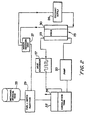
- a pump 20 is provided for pumping an organic fuel and water solution into an anode chamber 22 of housing 12. The organic fuel and water mixture is withdrawn through an outlet port 23 and is re-circulated through a re-circulation system described below with reference to Fig. 2 which includes a methanol tank 19.
- Fig. 2 illustrates a fuel cell system incorporating a stack of individual fuel cells including the re-circulation system. The following detailed description of the fuel cell of Fig. 1 primarily focuses on the structure and function of anode 14, cathode 16 and membrane 18.
- anode chamber 22 Prior to use, anode chamber 22 is filled with the organic fuel and water mixture and cathode chamber 28 is filled with air or oxygen.
- the organic fuel is circulated past anode 14 while oxygen or air is pumped into chamber 28 and circulated past cathode 16.
- an electrical load (not shown) is connected between anode 14 and cathode 16
- electro-oxidation of the organic fuel occurs at anode 14 and electro-reduction of oxygen occurs at cathode 16.
- the occurrence of different reactions at the anode and cathode gives rise to a voltage difference between the two electrodes.
- Electrons generated by electro-oxidation at anode 14 are conducted through the external load (not shown) and are ultimately captured at cathode 16.
- Hydrogen ions or protons generated at anode 14 are transported directly across membrane electrolyte 18 to cathode 16.
- a flow of current is sustained by a flow of ions through the cell and electrons through the external load.
- anode 14, cathode 16 and membrane 18 form a single composite layered structure.
- the material of the membrane 18 represents the important subject matter of the present invention.
- Anode 14 is formed from platinum-ruthenium alloy particles either as fine metal powders, i.e. "unsupported", or dispersed on high surface area carbon, i.e. "supported”.
- the high surface area carbon may be material such as Vulcan XC-72A, provided by Cabot Inc., USA.
- a carbon fiber sheet backing (not shown) is used to make electrical contact with the particles of the electrocatalyst.
- Commercially available TorayTM paper is used as the electrode backing sheet.
- a supported alloy electrocatalyst on a TorayTM paper backing is available from E-Tek, Inc., of Framingham, Massachusetts.
- both unsupported and supported electrocatalysts may be prepared by chemical methods, combined with TeflonTM binder and spread on TorayTM paper backing to produce the anode.
- TeflonTM binder and spread on TorayTM paper backing to produce the anode.
- An efficient and time-saving method of fabrication of electro-catalytic electrodes is described in detail herein below.
- Platinum-based alloys in which a second metal is either tin, iridium, osmium, or rhenium can be used instead of platinum-ruthenium.
- the choice of the alloy depends on the fuel to be used in the fuel cell.
- Platinum-ruthenium is preferable for electro-oxidation of methanol.
- the loading of the alloy particles in the electrocatalyst layer is preferably in the range of 0.5 - 4.0 mg/cm 2 . More efficient electro-oxidation is realized at higher loading levels, rather than lower loading levels.
- Cathode 16 is a gas diffusion electrode in which platinum particles are bonded to one side of membrane 18.
- Cathode 16 is preferably formed from unsupported or supported platinum bonded to a side of membrane 18 opposite to anode 14.
- Unsupported platinum black (fuel cell grade) available from Johnson Matthey Inc., USA or supported platinum materials available from E-Tek Inc., USA are suitable for the cathode.
- the cathode metal particles are preferably mounted on a carbon backing material.
- the loading of the electrocatalyst particles onto the carbon backing is preferably in the range of 0.5-4.0 mg/cm 2 .
- the electrocatalyst alloy and the carbon fiber backing contain 10-50 weight percent TeflonTM to provide hydrophobicity needed to create a three-phase boundary and to achieve efficient removal of water produced by electro-reduction of oxygen.
- a fuel and water mixture (containing no acidic or alkaline electrolyte) in the concentration range of 0.5 - 3.0 mole/liter is circulated past anode 14 within anode chamber 22.
- flow rates in the range of 10 - 500 milliliters/min. are used.
- Anode CH 3 OH + H 2 0 ⁇ C0 2 + 6 H + + 6 e -
- Carbon dioxide produced by the above reaction is withdrawn along with the fuel and water solution through outlet 23 and separated from the solution in a gas-liquid separator (described below with reference to Fig. 2).
- the fuel and water solution is then re-circulated into the cell by pump 20.
- oxygen or air is circulated past cathode 16 at pressures in the range of 68,95 to 206,85 kPa (10 to 30 psig). Pressures greater than ambient improve the mass transport of oxygen to the sites of electrochemical reactions, especially at high current densities. Water produced by electrochemical reaction at the cathode is transported out of cathode chamber 28 by flow of oxygen through port 30.
- Fuel crossover lowers the operating potential of the oxygen electrode and results in consumption of fuel without producing useful electrical energy. In general, fuel crossover is a parasitic reaction which lowers efficiency, reduces performance and generates heat in the fuel cell. It is therefore desirable to minimize the rate of fuel crossover.
- the rate of crossover is proportional to the permeability of the fuel through the solid electrolyte membrane and increases with increasing concentration and temperature.
- the permeability of the membrane to the liquid fuel can be reduced. Reduced permeability for the fuel results in a lower crossover rate.
- fuels having a large molecular size have a smaller diffusion coefficient than fuels which have small molecular size.
- permeability can be reduced by choosing a fuel having a large molecular size. While water soluble fuels are desirable, fuels with moderate solubility exhibit lowered permeability. Fuels with high boiling points do not vaporize and their transport through the membrane is in the liquid phase.
- Protons generated at anode 14 and water produced at cathode 16 are transported between the two electrodes by proton-conducting solid electrolyte membrane 18.
- the maintenance of high proton conductivity of membrane 18 is important to the effective operation of an organic/air fuel cell.
- the water content of the membrane is maintained by providing contact directly with the liquid fuel and water mixture.
- the thickness of the proton-conducting solid polymer electrolyte membranes should be in the range from 0.05 - 0.5 mm to be dimensionally stable. Membranes thinner than 0.05 mm may result in membrane electrode assemblies which are poor in mechanical strength, while membranes thicker than 0.5 mm may suffer extreme and damaging dimensional changes induced by swelling of the polymer by the liquid fuel and water solutions and also exhibit excessive resistance.
- the ionic conductivity of the membranes should be greater than 1 ohm -1 cm -1 for the fuel cell to have a tolerable internal resistance. As noted above, the membrane should have a low permeability to the liquid fuel.
- methanol transport across the membrane is limited.
- the methanol transport limiting can be carried out using one of the following embodiments.
- An inexpensive sulfonated material e.g., sulfonic acid polymer, which is stable in electro-oxidative condition and susceptible of forming a membrane layer, is used as a starting material. That material should be inexpensive and also stable at high temperatures.
- the inventors recognized the material needs to include an excess number of proton conductors beyond that which is really needed for the proton conduction that is needed by the fuel cell. Preferably, those excess proton conductors are excess sulfonate groups. According to the present invention, that material is further processed to sacrifice some of the proton conductivity capability in a way as a trade off to reduce methanol permeability.
- the first preferred material is poly ether ether ketone, "PEEK”.
- PEEK is a temperature resistant and oxidatively stable engineering polymer. PEEK is converted into an asymmetric proton conducting membrane. The asymmetric membrane has spaces which allow protons to pass, but which minimize the amount of methanol molecules which pass. This hence reduces fuel crossover when this membrane is used in a fuel cell.
- the methanol permeation is reduced according to this embodiment by surface modifications of the polymer.
- the polymer is then precipitated in ice slurry bath and filtered then washed to remove the excess acid, and to form an appropriate material.
- pH 5 the polymer is dried under ambient conditions for 36 to 72 hours. The chemical reaction is given below.
- H-SPEEK has an equivalent weight of 365. Unlike PEEK, H-SPEEK is soluble in an organic solvent and water mixture. One out of every three benzene rings in the material is sulfonated with a sulfonate (SO 3 H) group.
- the material is then dried, and then dissolved in a solvent mixture: preferably an acetone/water mixture. This mixture is further diluted with approximately 10% of the polymer sample weight of glycerin - here 3 g. The dissolved-polymer and glycerin mixture is then filtered over a chelate pack. This filtered mixture forms the cast film when the solvent is evaporated.
- a solvent mixture preferably an acetone/water mixture. This mixture is then diluted with approximately 10% of the polymer sample weight of glycerin - here 3 g.
- the dissolved-polymer and glycerin mixture is then filtered over a chelate pack. This filtered mixture forms the cast film when the solvent is evaporated.
- the preferred embodiment casts these films in glass pyrex dishes. Evaporation is carried out over a evaporation time which ranges between 24 and 48 hours.
- a first technique of this first embodiment crosslinks as follows. After the film has been set, the, entire dish is heated to 120°C under vacuum.
- the H-SPEEK formed by the above-discussed process has a large number of sulfonate groups on the benzene rings in the PEEK polymer chain. On the average, one out of every three rings include a sulfonate group.
- the H-SPEEK as formed in that way has about 22 mol % sulfonate (365 mass per proton), a much better figure than NafionTM which has a much smaller value of 7 ⁇ 1 mol % sulfonate (1144 mass per proton). This represents an excess proton capacity beyond what is really necessary for operating the fuel cell.
- the polymer maintains more than 13 ⁇ 5 mol % free sulfonate (600 mass per proton).
- the inventors recognized that even though there is a lot of cross-linking in the present invention, there is still a large amount of proton conductivity.
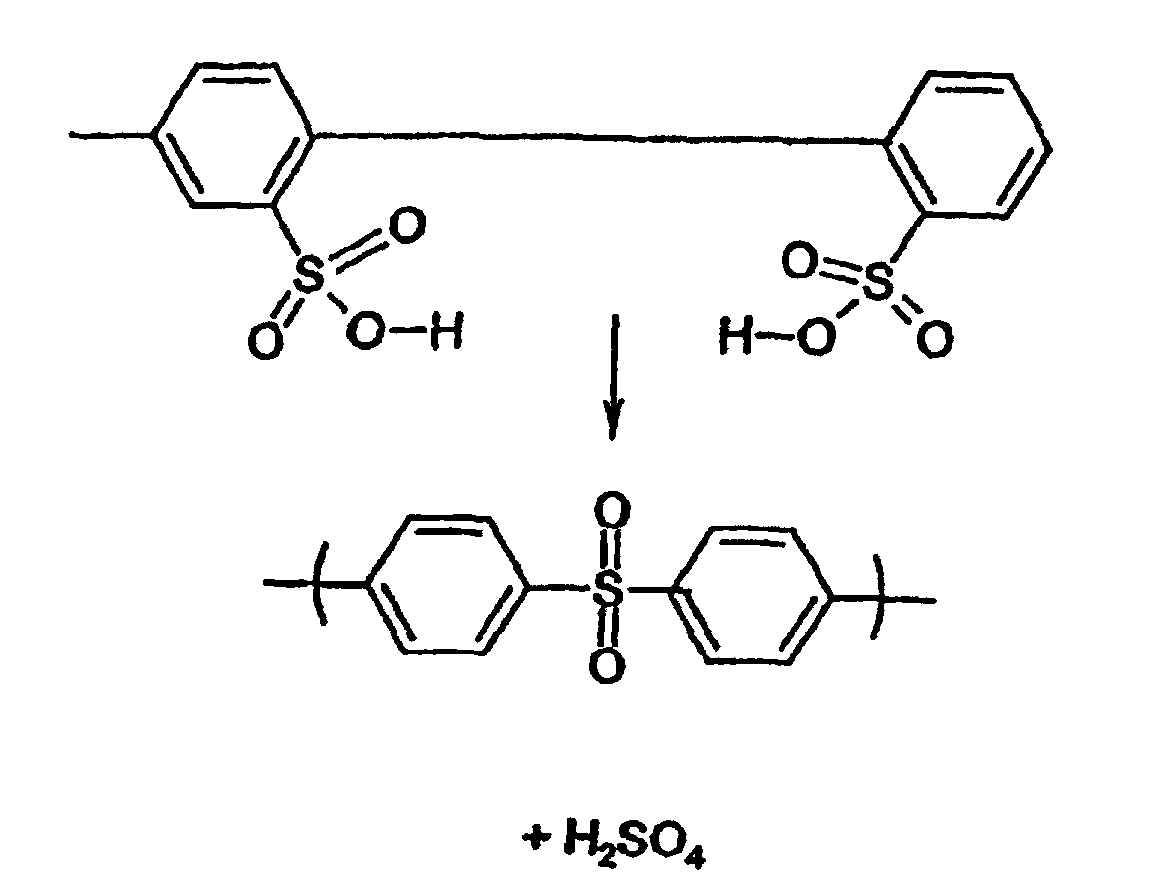
- the heating at 120°C under vacuum causes cross-linking shown below.
- NMR nuclear magnetic resonance
- the inventor found that a trade-off was necessary between the amount of sulfonation and the necessity for a stable physical structure. More sulfonic acid improves the proton conducting performance. However, it also correspondingly degrades the physical structure of the resulting membrane. The inventors therefore developed a trade-off between the amount of sulfonation and the appropriate physical structure. They found that sulfonating one out of every three benzene rings provides the best trade-off between the two competing objectives.
- the materials formed herein are preferably surface-dense. It was found that the surface-dense samples prepared by this process were comparable to commercial Nafion in mechanical strength and proton conductivity. These materials had a larger number of sulfonic acid groups than Nafion. The cross-linking could therefore be carried out without significant loss of proton conductivity.
- a second material embodiment of the present invention uses a different sulfonic acid polymer.
- Poly (p-phenylene ether sulfone) or PES which is a liquid crystal polymer has the structure
- the operation on the PES is quite analogous to that of the PEEK described above.
- PES's glass transition temperature is 225°C, as compared with PEEKs glass transition temperature of 156°C.
- the price of PES is about $10 lb: an order of magnitude less than Nafion.
- H-SPES-like H-SPEEK requires a trade-off between the amount of sulfonation and its physical structure. Below 30% sulfonation, both materials act as ionimers. Above 70% sulfonation, these materials act as polyelectrolytes or PEs. By controlling the degree of sulfonation, the H-SPES film properties can be optimized: ease of film fabrication, strength and conductivity of the H-SPES film can be controlled and optimized.
- H-SPEEK materials had more than 22 mol % free sulfonate (365 mass per proton). When cross-linked, these materials still have 16 mol % free sulfonate (504 mass per proton). This compares quite favorably with Nafion film's 7 ⁇ 1 mol % (1144 mass per proton).
- the sulfonic acid groups in H-SPEEK are located in the H-SPEEK backbone. This type of polyelectrolyte film is well-known to contain functional channel structures for proton conduction.
- a first technique varies the amount of water and organic solvents used as polymer solvents during the film casting process. As described above, the characteristics of these materials change based on the amount of sulfonation and nature of the solvent during the membrane fabrication. According to this aspect of the present invention, the amount of water is lowered or eliminated from H-SPEEK film casting solution during the time when the surface of the film is being cast. This causes a dense-surface area on the resulting film.
- Another alternative technique forms two separate films: a first film which acts as the base backbone, and a second film forms low proton concentration coating on the base conducting membrane.
- This low proton concentration H-SPEEK or H-SPES is then cross-linked by heating under vacuum to form an anisotropic composite membrane. This forms an asymmetric membrane.
- the first embodiment uses a process of surface modifying the material.
- the present embodiment preferably modifies only one "side" of the materials and not the other side. This asymmetric modification provides a surface-dense anisotropic membrane. That surface-dense membrane faces the anode to minimize methanol cross-over.
- the modification of surface morphology can be carried out by varying the proportion of water and organic solvent used as polymer solvent. This allows modifying the rate of solvent evaporation during the film casting process.
- An alternate technique is to heat the surface to cause polymer cross-linking.
- the methanol transport is limited according to this second embodiment by optimizing hydrophobic and hydrophilic polymer chain interactions.
- Proton-conducting inter penetration polymer networks are formed by using a combination of these structures.
- the second embodiment forms a similar starting compound to that described above.
- the second type of structural modification according to the present invention which forms an asymmetric membrane by modifying the highly sulfonated PEEK or PES to form an inter-penetrating polymer network.
- This proton conducting membrane system forms from two types of proton conducting polymer network.
- the type I membrane forms from a cross-linked hydrophobic polymer chain and inter-penetrating with another cross linked hydrophilic polymer chain as described above.
- This type I membrane has a variable amount of low sulfonated H-SPES. It also has cross-linked hydrophobic polymer chains of highly sulfonated H-SPEEK.
- the type II membrane has cross-linked hydrophobic varying low sulfonated H-SPEEK as well as cross-linked hydrophilic highly sulfonated H-SPES. Both materials have their chemical structure modified according to the following: The highly sulfonated H-SPEEK or H-SPES can be cross-linked at high temperature according to the reaction mechanism previously shown.
- Type I film is formed from a film casting solution mixture including a cross-linked hydrophobic polymer, a cross-linked hydrophilic polymer and highly sulfonated H-SPEEK or H-SPES.
- Type II material with interpenetration polymer networks is formed of hydrophobic H-SPEEK and hydrophilic H-SPES. This can also be prepared using the same method. This effectively causes two different kinds of polymers, with different chemical properties. Both have proton conductivity, but both have different structures. These different structures have been found to minimize the fuel crossover.
- the third embodiment modifies free volumes in proton conducting membranes. These free volumes can be reduced by preparing small particle-size-selected zeolites-preferably mordenite. This does not occlude methanol, but does have proton conductivity.
- a zeolite material is added to the H-SPEEK or H-SPES to form a zeolite/H-SPEEK or zeolite/H-SPES composite membrane.
- the proton-containing H-SPEEK and H-SPES, as well as the proton in the hole of zeolite will cause proton conductivity.
- the preferred zeolite used according to this embodiment is proton containing mordenite.
- the mordenite is added to the HSPEEK or HSPES proton conducting composite membrane. The inventor found that this reduces the free volume of the membrane, and therefore also reduces the methanol crossover.
- Mordenite has the function of selectively adsorbing or rejecting different molecules.
- the ionic conductivity of mordenite is depending on the nature of the cation and the water concentration.
- mordenite which has a lot of tin therein. So called "tin-rich mordenite” is highly conducting. Calcium and BA rich mordenites do not include methanol, because the diameters of the narrowest cross-section of the interstitial channel is between 3.48 and 4.0 angstroms. Mordenite is very stable in acid solutions of around pH 0.75.
- Mordenite is well described in the literature. Any described zeolite material can be used. The inventors believe that the best mordenite will include H + .
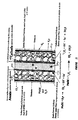
- the preferred fuel cell final assembly is shown in Fig. 3.
- This includes an anode which is a porous carbon electrode including carbon/catalyst particles coated with the materials of the present invention.
- the anode current collector 202 includes carbon paper fiber impregnated with the material.
- Proton conducting membrane 204 of the present invention adjoins the cathode 210.
- the proton conducting membrane preferably includes a dense surface of proton conducting membrane 206 facing the anode 200.
- the surface 208 facing cathode 210 is preferably a very thin layer of cross-linked low proton conducting surface.
- the cathode 210 includes carbon catalyst particles also coated with high H-SPEEK or H-SPES.
- H-SPEEK and H-SPES have been described above as being the preferred materials, it should be understood that other alternative materials can also be used. Any similar material which is capable of sulfonation and cross-linking can be used in place of the H-SPEEK or H-SPES.
- the specific kind of inter-penetrating polymer which is used is only exemplary, and it should be understood that other inter-penetrating polymers could be used.
- the zeolite could be any zeolite which forms the necessary function, and the criteria for choosing an appropriate zeolite have been described above.
Landscapes
- Chemical & Material Sciences (AREA)
- Engineering & Computer Science (AREA)
- Manufacturing & Machinery (AREA)
- Chemical Kinetics & Catalysis (AREA)
- General Chemical & Material Sciences (AREA)
- Life Sciences & Earth Sciences (AREA)
- Sustainable Development (AREA)
- Sustainable Energy (AREA)
- Electrochemistry (AREA)
- Crystallography & Structural Chemistry (AREA)
- Health & Medical Sciences (AREA)
- Composite Materials (AREA)
- Inorganic Chemistry (AREA)
- Medicinal Chemistry (AREA)
- Polymers & Plastics (AREA)
- Organic Chemistry (AREA)
- Dispersion Chemistry (AREA)
- Materials Engineering (AREA)
- Fuel Cell (AREA)
- Polyethers (AREA)
- Polymers With Sulfur, Phosphorus Or Metals In The Main Chain (AREA)
- Conductive Materials (AREA)
- Processes Of Treating Macromolecular Substances (AREA)
- Manufacture Of Macromolecular Shaped Articles (AREA)
- Compositions Of Macromolecular Compounds (AREA)
- Inert Electrodes (AREA)
Claims (18)
- Protonenleitender Polymerfilm, der ein Sulfonsäurepolymermaterial mit nicht-vernetzten Sulfonatgruppen und vernetzten Sulfonatgruppen umfasst, wobei mehr vernetzte Sulfonatgruppen an einer ersten Hauptoberfläche des Films im Vergleich zu einer entgegengesetzten zweiten Hauptoberfläche des Films vorhanden sind, wobei ein Film mit asymmetrischen Eigenschaften der Oberflächendichte bereitgestellt wird, und die nicht-vernetzten Sulfonatgruppen eine gewünschte Protonenleitfähigkeit durchgängig durch den Film bereitstellen.
- Film nach Anspruch 1, wobei das Sulfonsäurepolymermaterial Benzolringe in diesem umfasst und etwa ein Benzolring pro einzelne Wiederholungseinheit der Polymerkette eine Sulfonatgruppe an diesem umfasst.
- Film nach Anspruch 2, wobei das Sulfonsäurepolymermaterial ein Polyetheretherketon (PEEK) ist.
- Film nach Anspruch 2, wobei das Sulfonsäurepolymermaterial ein Poly(p-phenylenethersulfon)(PES) ist.
- Brennstoffzellen-Elektrode/Membran-Anordnung, die umfasst:ein Anodenmaterial, das aus einem Material zum Durchführen einer Oxidationsreaktion gebildet ist;einen protonenleitenden Polymerfilm nach einem der Ansprüche 1 bis 4, wobei der Film eine Membran bildet, die eine erste Hauptoberfläche, die mit dem Anodenmaterial verbunden ist, aufweist; undeine Katode, die mit einer zweiten Hauptoberfläche der Membran verbunden ist, wobei die Katode dafür geeignet ist, dass an dieser eine Reduktionsreaktion durchgeführt werden kann.
- Anordnung nach Anspruch 5, wobei die Anode und Katode zum Durchführen der Oxidation von wässrigem Methanol geeignet sind.
- Anordnung nach Anspruch 5, wobei die Polymermembran eine selektiv sulfonierte Membran ist, die eine Sulfonatgruppe an etwa einen Benzolring pro einzelne Wiederholungseinheit der Polymerkette gebunden aufweist und in dieser eine vernetzte Struktur umfasst, die vernetzte Sulfonatgruppen der chemischen Formelumfasst.

- Anordnung nach Anspruch 7, wobei die Polymermembran sulfoniertes Polyetherketon (H-SPEEK) ist.
- Anordnung nach Anspruch 7, wobei das Polymermaterial sulfoniertes Poly(p-phenylenethersulfon) (H-SPES) ist.
- Anordnung nach Anspruch 5, wobei die erste Hauptoberfläche eine dichte Oberfläche vernetzter Strukturen umfasst.
- Verfahren zur Bildung eines protonenleitenden Polymerfilms nach einem der Ansprüche 1 bis 4, das die folgenden Stufen umfasst:wobei die verbliebenen nicht-vernetzten Sulfonatgruppen eine gewünschte Protonenleitfähigkeit durchgängig durch den Film bereitstellen.Bereitstellen eines Polymermaterials einer Art, die sulfoniert werden kann;selektives Sulfonieren des Polymermaterials;Gießen eines Polymerfilms aus dem sulfonierten Polymermaterial; undselektives Vernetzen von einigen der Sulfonatgruppen, wobei ein asymmetrischer Film bereitgestellt wird, der mehr vernetzte Sulfonatgruppen auf einer ersten Hauptoberfläche des Films im Vergleich zu einer entgegengesetzten zweiten Hauptoberfläche des Films aufweist,
- Verfahren nach Anspruch 11, wobei das Vernetzen durch Erhitzen der ersten Hauptoberfläche durchgeführt wird.
- Verfahren nach Anspruch 11, wobei der Film bereitgestellt wird durch:Auflösen eines sulfonierten Polyetheretherketons (H-SPEEK) in einem Lösemittel;Entfernen des Lösemittels;Gießen eines Films aus der H-SPEEK-Lösung in einer Pyrexglasschale durch Entfernen des Lösemittels; undErhitzen des gebildeten trockenen Films und der Schale unter Vakuum über 100 °C, wobei eine asymmetrische vernetzte protonenleitende Membran gebildet wird.
- Verfahren nach Anspruch 11, wobei der Film bereitgestellt wird, durch:Auflösen eines sulfonierten Poly(p-phenylenethersulfon) (H-SPES) in einem Lösemittel;Entfernen des Lösemittels;Gießen eines Films aus der H-SPES-Lösung in einer Pyrexglasschale durch Entfernen des Lösemittels undErhitzen des gebildeten trockenen Films und der Schale unter Vakuum über 100 °C, wobei eine asymmetrische vernetzte protonenleitende Membran gebildet wird.
- Verfahren nach Anspruch 11, wobei das Vernetzen der folgenden chemischen Reaktion folgt:
- Verfahren nach Anspruch 11, wobei der Polymerfilm zur Verwendung in einer Brennstoffzelle auf Methanolbasis dient und das Verfahren ferner die Stufe des Zugebens eines Materials, das ein Durchdringungspolymernetzwerk, enthält, umfasst, was die Okklusion von Methanol weiter verstärkt.
- Verfahren nach Anspruch 11, wobei der Polymerfilm zur Verwendung in einer Brennstoffzelle auf Methanolbasis dient und das Verfahren ferner die Stufe des Zugebens von Zeolithen zur weiteren Verstärkung der Okklusion von Methanol umfasst.
- Verfahren nach Anspruch 17, wobei die Zeolithe Mordenit umfassen, das Methanol einschließt, jedoch nicht Wasser oder Protonen einschließt.
Applications Claiming Priority (3)
| Application Number | Priority Date | Filing Date | Title |
|---|---|---|---|
| US08/561,899 US5795496A (en) | 1995-11-22 | 1995-11-22 | Polymer material for electrolytic membranes in fuel cells |
| US561899 | 1995-11-22 | ||
| PCT/US1996/018823 WO1997019480A1 (en) | 1995-11-22 | 1996-11-22 | New polymer material for electrolytic membranes in fuel cells |
Publications (3)
| Publication Number | Publication Date |
|---|---|
| EP0870340A1 EP0870340A1 (de) | 1998-10-14 |
| EP0870340A4 EP0870340A4 (de) | 2000-03-22 |
| EP0870340B1 true EP0870340B1 (de) | 2004-04-21 |
Family
ID=24243966
Family Applications (1)
| Application Number | Title | Priority Date | Filing Date |
|---|---|---|---|
| EP96944201A Expired - Lifetime EP0870340B1 (de) | 1995-11-22 | 1996-11-22 | Polymermaterial für elektrolytische membranen von brennstoffzellen |
Country Status (7)
| Country | Link |
|---|---|
| US (1) | US5795496A (de) |
| EP (1) | EP0870340B1 (de) |
| JP (1) | JP3927601B2 (de) |
| AU (1) | AU1406897A (de) |
| CA (1) | CA2238189C (de) |
| DE (1) | DE69632266T2 (de) |
| WO (1) | WO1997019480A1 (de) |
Cited By (1)
| Publication number | Priority date | Publication date | Assignee | Title |
|---|---|---|---|---|
| DE112006000311B4 (de) * | 2005-02-08 | 2012-09-27 | General Motors Corp. | Brennstoffzelle mit einer einen sulfonierten Polyphenylensulfidfilm enthaltenden Protonenaustauschmembran |
Families Citing this family (101)
| Publication number | Priority date | Publication date | Assignee | Title |
|---|---|---|---|---|
| US6703150B2 (en) * | 1993-10-12 | 2004-03-09 | California Institute Of Technology | Direct methanol feed fuel cell and system |
| US5599638A (en) | 1993-10-12 | 1997-02-04 | California Institute Of Technology | Aqueous liquid feed organic fuel cell using solid polymer electrolyte membrane |
| JP3861367B2 (ja) * | 1996-04-18 | 2006-12-20 | 住友化学株式会社 | 高分子電解質、その製造方法およびそれを使用してなる燃料電池 |
| DE19622337C1 (de) * | 1996-06-04 | 1998-03-12 | Dlr Deutsche Forschungsanstalt | Vernetzung von modifizierten Engineering Thermoplasten |
| US5981097A (en) * | 1996-12-23 | 1999-11-09 | E.I. Du Pont De Nemours And Company | Multiple layer membranes for fuel cells employing direct feed fuels |
| JP4823401B2 (ja) * | 1996-12-30 | 2011-11-24 | イドロ―ケベック | 過フッ化アミド塩及びイオン伝導物質としてのその使用方法 |
| CN1255248A (zh) * | 1997-05-14 | 2000-05-31 | 斯马特化学公司 | 诸如燃料电池这样的具有沸石膜的电解反应器 |
| DE19732578C2 (de) * | 1997-07-29 | 2000-08-24 | Aventis Res & Tech Gmbh & Co | Verwendung von sulfonierten aromatischen Polyetherketon-Kationenaustauschern und sulfonierten Polyphenylensulfid-Kationenaustauschern als Katalysatoren |
| US6150047A (en) | 1997-09-22 | 2000-11-21 | California Institute Of Technology | Polymer electrolyte membrane assembly for fuel cells |
| US6030718A (en) * | 1997-11-20 | 2000-02-29 | Avista Corporation | Proton exchange membrane fuel cell power system |
| WO1999027600A1 (en) * | 1997-11-25 | 1999-06-03 | California Institute Of Technology | Improved hspes membrane electrode assembly |
| EP1400539B1 (de) | 1998-01-30 | 2008-12-03 | Hydro Quebec | Verfahren zur Herstellung von vernetzten sulfonierten Polymeren |
| US6090895A (en) * | 1998-05-22 | 2000-07-18 | 3M Innovative Properties Co., | Crosslinked ion conductive membranes |
| US6500571B2 (en) | 1998-08-19 | 2002-12-31 | Powerzyme, Inc. | Enzymatic fuel cell |
| CA2343184C (en) * | 1998-09-11 | 2010-06-29 | Victrex Manufacturing Limited | Ion-exchange polymers |
| US6153323A (en) * | 1998-10-16 | 2000-11-28 | Ballard Power Systems Inc. | Electrode treatment method for improving performance in liquid feed fuel cells |
| CA2256829A1 (en) * | 1998-12-18 | 2000-06-18 | Universite Laval | Composite electrolyte membranes for fuel cells |
| EP1171924B1 (de) | 1999-01-22 | 2007-10-03 | University Of Southern California | Verbesserter membranelektrodenaufbau für brennstoffzelle |
| US6586561B1 (en) | 1999-02-18 | 2003-07-01 | Case Western Reserve University | Rigid rod ion conducting copolymers |
| US6117581A (en) * | 1999-03-15 | 2000-09-12 | Ford Global Technologies, Inc. | Fuel cell electrode comprising conductive zeolite support material |
| DE19919881A1 (de) * | 1999-04-30 | 2000-11-02 | Univ Stuttgart | Organisch-Anorganische Komposites und Kompositmembranen aus Ionomeren oder Ionomerblends und aus Schicht- oder Gerätsilicaten |
| DE19926353A1 (de) * | 1999-06-10 | 2000-12-14 | Daimler Chrysler Ag | Brennstoffzelle mit Polymerelektrolytmembran |
| US6440594B1 (en) | 1999-06-17 | 2002-08-27 | California Institute Of Technology | Aerosol feed direct methanol fuel cell |
| US6331694B1 (en) | 1999-12-08 | 2001-12-18 | Lincoln Global, Inc. | Fuel cell operated welder |
| US6824900B2 (en) * | 2002-03-04 | 2004-11-30 | Mti Microfuel Cells Inc. | Method and apparatus for water management of a fuel cell system |
| ATE478913T1 (de) | 2000-06-02 | 2010-09-15 | Stanford Res Inst Int | Polymermembranzusammensetzung |
| JP3607862B2 (ja) * | 2000-09-29 | 2005-01-05 | 株式会社日立製作所 | 燃料電池 |
| WO2002045196A2 (en) * | 2000-11-30 | 2002-06-06 | Mti Microfuel Cells, Inc. | Fuel cell membrane and system with integrated gas separation |
| DE10201692A1 (de) * | 2001-01-19 | 2002-09-05 | Honda Motor Co Ltd | Membranelektrodenanordnung und Verfahren zu deren Herstellung und eine Polymerelektrolytbrennstoffzelle, die eine derartige Membranelektrodenanordnung umfasst |
| DE10201886B4 (de) * | 2001-01-19 | 2014-01-23 | Honda Giken Kogyo K.K. | Polymerelektrolytmembran sowie Verfahren zur Herstellung dieser und Festpolymerelektrolytbrennstoffzelle, welche diese verwendet |
| US7303830B2 (en) | 2001-03-21 | 2007-12-04 | Victrex Manufacturing Limited | Fuel cell |
| GB0107075D0 (en) * | 2001-03-21 | 2001-05-09 | Victrex Mfg Ltd | Fuel cell |
| US6632553B2 (en) * | 2001-03-27 | 2003-10-14 | Mti Microfuel Cells, Inc. | Methods and apparatuses for managing effluent products in a fuel cell system |
| US6686081B2 (en) * | 2001-05-15 | 2004-02-03 | Mti Microfuel Cells, Inc. | Methods and apparatuses for a pressure driven fuel cell system |
| US7316855B2 (en) | 2001-06-01 | 2008-01-08 | Polyfuel, Inc. | Fuel cell assembly for portable electronic device and interface, control, and regulator circuit for fuel cell powered electronic device |
| WO2002099916A2 (en) | 2001-06-01 | 2002-12-12 | Polyfuel, Inc | Fuel cell assembly for portable electronic device and interface, control, and regulator circuit for fuel cell powered electronic device |
| US6737181B2 (en) * | 2001-06-15 | 2004-05-18 | Mti Microfuel Cells, Inc. | Methods and apparatuses for a self-regulating gas displacement pump for a fuel cell system |
| GB0123109D0 (en) * | 2001-09-26 | 2001-11-14 | Victrex Mfg Ltd | Cells |
| GB0123135D0 (en) * | 2001-09-26 | 2001-11-14 | Victrex Mfg Ltd | Ion-conducting polymeric materials |
| TWI236486B (en) * | 2001-10-10 | 2005-07-21 | Mitsui Chemicals Inc | Crosslinkable aromatic resin having protonic acid group, and ion conductive polymer membrane, binder and fuel cell using the resin |
| JP4052005B2 (ja) * | 2001-12-20 | 2008-02-27 | 住友化学株式会社 | 高分子電解質膜の製造法 |
| JP4501052B2 (ja) * | 2002-01-24 | 2010-07-14 | 東洋紡績株式会社 | 熱架橋性高分子固体電解質、高分子固体電解質膜及びその製造方法 |
| US20030143444A1 (en) * | 2002-01-31 | 2003-07-31 | Qin Liu | Fuel cell with fuel droplet fuel supply |
| CA2475501C (en) * | 2002-02-06 | 2011-03-15 | Battelle Memorial Institute | Polymer electrolyte membranes for use in fuel cells |
| WO2003067695A2 (en) * | 2002-02-06 | 2003-08-14 | Battelle Memorial Institute | Polymer electrolyte membrane fuel cell system |
| AU2003219726A1 (en) | 2002-02-06 | 2003-09-02 | Battelle Memorial Institute | Methods of removing contaminants from a fuel cell electrode |
| US6890674B2 (en) * | 2002-02-19 | 2005-05-10 | Mti Microfuel Cells, Inc. | Methods and apparatuses for managing fluids in a fuel cell system |
| US20050053818A1 (en) * | 2002-03-28 | 2005-03-10 | Marc St-Arnaud | Ion exchange composite material based on proton conductive functionalized inorganic support compounds in a polymer matrix |
| US7354679B2 (en) * | 2002-05-13 | 2008-04-08 | Polyfuel, Inc. | Ion conductive random copolymers |
| CA2485971A1 (en) | 2002-05-13 | 2004-05-21 | Polyfuel, Inc. | Ion conductive block copolymers |
| AU2003237849B2 (en) | 2002-05-13 | 2009-07-02 | Polyfuel, Inc. | Sulfonated copolymer |
| US7282291B2 (en) | 2002-11-25 | 2007-10-16 | California Institute Of Technology | Water free proton conducting membranes based on poly-4-vinylpyridinebisulfate for fuel cells |
| AU2003296367A1 (en) * | 2002-12-05 | 2004-06-30 | Battelle Memorial Institute | Methods of removing sulfur from a fuel cell electrode |
| KR100486728B1 (ko) * | 2002-12-12 | 2005-05-03 | 삼성에스디아이 주식회사 | 나노복합전해질막 및 이를 채용한 연료전지 |
| TW571455B (en) * | 2002-12-31 | 2004-01-11 | Ind Tech Res Inst | Layered proton exchange membrane and method for preparing the same |
| US7147955B2 (en) * | 2003-01-31 | 2006-12-12 | Societe Bic | Fuel cartridge for fuel cells |
| US7211203B2 (en) * | 2003-02-04 | 2007-05-01 | Honda Motor Co., Ltd. | Polymer electrolyte, proton conductive membrane and membrane-electrode assembly |
| KR100493171B1 (ko) * | 2003-02-08 | 2005-06-02 | 삼성에스디아이 주식회사 | 복합전해질막 및 이를 채용한 연료전지 |
| GB0307606D0 (en) * | 2003-04-02 | 2003-05-07 | Victrex Mfg Ltd | Ion-conducting polymeric materials |
| JP2004359925A (ja) * | 2003-04-07 | 2004-12-24 | Mitsui Chemicals Inc | プロトン伝導性ブロック共重合体およびプロトン伝導膜 |
| US7176247B1 (en) | 2003-06-27 | 2007-02-13 | The United States Of America As Represented By The Secretary Of The Army | Interpenetrating polymer network |
| US6962959B2 (en) * | 2003-08-28 | 2005-11-08 | Hoku Scientific, Inc. | Composite electrolyte with crosslinking agents |
| KR100528345B1 (ko) * | 2003-08-29 | 2005-11-15 | 삼성에스디아이 주식회사 | 고분자 나노 복합막 및 이를 채용한 연료 전지 |
| ATE550368T1 (de) * | 2003-09-30 | 2012-04-15 | Sumitomo Chemical Co | Blockcopolymer und seine verwendung |
| US7071271B2 (en) * | 2003-10-30 | 2006-07-04 | 3M Innovative Properties Company | Aqueous emulsion polymerization of functionalized fluoromonomers |
| US7265162B2 (en) * | 2003-11-13 | 2007-09-04 | 3M Innovative Properties Company | Bromine, chlorine or iodine functional polymer electrolytes crosslinked by e-beam |
| US7179847B2 (en) | 2003-11-13 | 2007-02-20 | 3M Innovative Properties Company | Polymer electrolytes crosslinked by e-beam |
| US7074841B2 (en) * | 2003-11-13 | 2006-07-11 | Yandrasits Michael A | Polymer electrolyte membranes crosslinked by nitrile trimerization |
| US7259208B2 (en) * | 2003-11-13 | 2007-08-21 | 3M Innovative Properties Company | Reinforced polymer electrolyte membrane |
| US7060756B2 (en) * | 2003-11-24 | 2006-06-13 | 3M Innovative Properties Company | Polymer electrolyte with aromatic sulfone crosslinking |
| US7112614B2 (en) * | 2003-12-08 | 2006-09-26 | 3M Innovative Properties Company | Crosslinked polymer |
| US7060738B2 (en) * | 2003-12-11 | 2006-06-13 | 3M Innovative Properties Company | Polymer electrolytes crosslinked by ultraviolet radiation |
| US7173067B2 (en) | 2003-12-17 | 2007-02-06 | 3M Innovative Properties Company | Polymer electrolyte membranes crosslinked by direct fluorination |
| TWI276654B (en) * | 2004-02-18 | 2007-03-21 | Ind Tech Res Inst | Proton exchange membrane (PEM) with different molecular permeation rates |
| US20070275286A1 (en) * | 2004-02-23 | 2007-11-29 | Serge Kaliaguine | Method for Cross-Linking Sulfonated Polymers |
| US7425266B2 (en) * | 2004-03-04 | 2008-09-16 | Freeman Mark C | Water-filtering media and filters |
| EP1765481A4 (de) * | 2004-03-04 | 2009-11-11 | Jon Joseph Freeman | Wasserfiltriermedien und filter |
| US7375176B2 (en) * | 2004-03-31 | 2008-05-20 | Litt Morton H | Liquid crystal poly(phenylene sulfonic acids) |
| US7524298B2 (en) * | 2004-05-25 | 2009-04-28 | California Institute Of Technology | Device and method for treating hydrocephalus |
| US7208243B2 (en) | 2004-12-01 | 2007-04-24 | Toyota Technical Center Usa, Inc. | Proton exchange membranes using cycloaddition reaction between azide and alkyne containing components |
| CN100487003C (zh) * | 2004-12-21 | 2009-05-13 | 比亚迪股份有限公司 | 一种聚合物及含有该聚合物的质子交换膜 |
| CN100369305C (zh) * | 2004-12-30 | 2008-02-13 | 比亚迪股份有限公司 | 一种燃料电池 |
| KR100696521B1 (ko) * | 2005-05-25 | 2007-03-19 | 삼성에스디아이 주식회사 | 수소 이온 전도성 무기물, 이를 포함한 고분자 나노 복합막및 이를 채용한 연료 전지 |
| US20060280981A1 (en) * | 2005-06-02 | 2006-12-14 | Polyfuel, Inc. | Polymer electrolyte membrane having an improved dimensional stability |
| JP4916144B2 (ja) * | 2005-08-05 | 2012-04-11 | 旭化成株式会社 | 芳香族スルフィドおよび/またはスルホン誘導体 |
| JP4841195B2 (ja) * | 2005-08-05 | 2011-12-21 | 旭化成株式会社 | 燃料電池用電解質膜 |
| US8993193B2 (en) * | 2005-08-05 | 2015-03-31 | GM Global Technology Operations LLC | Sulfonated perfluorosulfonic acid polyelectrolyte membranes |
| KR101354298B1 (ko) * | 2005-09-30 | 2014-02-07 | 바텔리 메모리얼 인스티튜트 | 연료 전지 부품용 중합체 |
| KR100717745B1 (ko) * | 2005-10-06 | 2007-05-11 | 삼성에스디아이 주식회사 | 연료전지용 바인더, 이를 이용한 촉매층 형성용 조성물, 및 이를 이용한 연료전지용 막-전극 어셈블리와 이의 제조방법 |
| US7324329B2 (en) * | 2005-12-22 | 2008-01-29 | Giner, Inc. | Electrochemical-electrolytic capacitor and method of making the same |
| DE102006004748A1 (de) * | 2006-02-02 | 2007-08-16 | Umicore Ag & Co. Kg | Membran-Elektroden-Einheit mit mehrkomponentigem Dichtungsrand |
| DE112007001464T5 (de) | 2006-06-20 | 2009-05-07 | Sumitomo Chemical Co., Ltd. | Kondensierte Ringe enthaltender Polymerelektrolyt und Anwendung hierfür |
| US20090214905A1 (en) * | 2007-01-08 | 2009-08-27 | California Institute Of Technology | Direct methanol fuel cell operable with neat methanol |
| EP2131431B1 (de) | 2007-03-16 | 2013-05-01 | Sekisui Chemical Co., Ltd. | Membran-elektroden-bondmittel, protonenleitende membran mit bondschicht, membran-elektrodenbaugruppe, festpolymer-brennstoffzelle und verfahren zur herstellung einer membran-elektrodenbaugruppe |
| JP2010015980A (ja) | 2008-06-05 | 2010-01-21 | Sumitomo Chemical Co Ltd | 高分子電解質、架橋高分子電解質、高分子電解質膜およびその用途 |
| TWI387146B (zh) * | 2009-07-14 | 2013-02-21 | Univ Yuan Ze | 多層質子交換膜及其製備方法 |
| EP2335820A1 (de) | 2009-12-18 | 2011-06-22 | Leopold-Franzens-Universität Innsbruck | Verfahren zur kovalenten Befestigung von polymerischen Monolithen an Polyether-Etherketon (PEEK) -Oberflächen |
| KR101142235B1 (ko) * | 2010-01-28 | 2012-05-24 | 금오공과대학교 산학협력단 | Dmfc용 고분자 나노복합막, 이를 이용한 막-전극 어셈블리 및 메탄올 연료전지 |
| EP2574637A1 (de) * | 2011-09-30 | 2013-04-03 | Basf Se | Hochfeste Blends auf Basis von Polyarylenethern |
| CN109841799B (zh) * | 2017-11-28 | 2021-07-06 | 中国科学院大连化学物理研究所 | 一种活性炭电极及其制备和应用 |
| WO2023001793A1 (en) * | 2021-07-20 | 2023-01-26 | Green Hydrogen Systems | Improved durability of diaphragm for higher temperature electrolysis |
Family Cites Families (6)
| Publication number | Priority date | Publication date | Assignee | Title |
|---|---|---|---|---|
| DE3407719A1 (de) * | 1984-03-02 | 1985-09-05 | Basf Ag, 6700 Ludwigshafen | Membrane aus im wesentlichen unvernetzten organischen polymeren, die ionogene gruppen gebunden enthalten |
| DE58909860D1 (de) * | 1988-04-30 | 1999-11-11 | Akzo Nobel Nv | Verfahren zur Sulfonierung von aromatischen Polyäthersulfonen |
| EP0574791B1 (de) * | 1992-06-13 | 1999-12-22 | Aventis Research & Technologies GmbH & Co. KG | Polymerelektrolyt-Membran und Verfahren zu ihrer Herstellung |
| US5599638A (en) * | 1993-10-12 | 1997-02-04 | California Institute Of Technology | Aqueous liquid feed organic fuel cell using solid polymer electrolyte membrane |
| US5468574A (en) * | 1994-05-23 | 1995-11-21 | Dais Corporation | Fuel cell incorporating novel ion-conducting membrane |
| DE69435082T2 (de) * | 1994-10-18 | 2008-08-14 | The University Of Southern California, Los Angeles | Organische brennstoffzelle, verfahren zum betrieb der zelle und herstellung einer elektrode dafür |
-
1995
- 1995-11-22 US US08/561,899 patent/US5795496A/en not_active Expired - Lifetime
-
1996
- 1996-11-22 CA CA002238189A patent/CA2238189C/en not_active Expired - Fee Related
- 1996-11-22 AU AU14068/97A patent/AU1406897A/en not_active Abandoned
- 1996-11-22 WO PCT/US1996/018823 patent/WO1997019480A1/en not_active Ceased
- 1996-11-22 EP EP96944201A patent/EP0870340B1/de not_active Expired - Lifetime
- 1996-11-22 DE DE69632266T patent/DE69632266T2/de not_active Expired - Lifetime
- 1996-11-22 JP JP51994697A patent/JP3927601B2/ja not_active Expired - Fee Related
Cited By (1)
| Publication number | Priority date | Publication date | Assignee | Title |
|---|---|---|---|---|
| DE112006000311B4 (de) * | 2005-02-08 | 2012-09-27 | General Motors Corp. | Brennstoffzelle mit einer einen sulfonierten Polyphenylensulfidfilm enthaltenden Protonenaustauschmembran |
Also Published As
| Publication number | Publication date |
|---|---|
| JP3927601B2 (ja) | 2007-06-13 |
| US5795496A (en) | 1998-08-18 |
| EP0870340A4 (de) | 2000-03-22 |
| AU1406897A (en) | 1997-06-11 |
| DE69632266T2 (de) | 2005-04-21 |
| CA2238189C (en) | 2006-08-29 |
| EP0870340A1 (de) | 1998-10-14 |
| CA2238189A1 (en) | 1997-05-29 |
| JP2000501223A (ja) | 2000-02-02 |
| WO1997019480A1 (en) | 1997-05-29 |
| DE69632266D1 (de) | 2004-05-27 |
Similar Documents
| Publication | Publication Date | Title |
|---|---|---|
| EP0870340B1 (de) | Polymermaterial für elektrolytische membranen von brennstoffzellen | |
| EP0755576B1 (de) | Organische brennstoffzelle, verfahren zum betrieb der zelle und herstellung einer elektrode dafür | |
| US7445859B2 (en) | Organic fuel cell methods and apparatus | |
| EP1956673B1 (de) | Neuartige Polymer-Elektrolyt-Membranen zur Verwendung in Direkt-Methanol-Brennstoffzellen | |
| EP2161770A1 (de) | Filmelektrodenbaugruppe, filmelektrodengasdiffusionsschichtbaugruppe damit, festpolymer-brennstoffzelle und filmelektrodenbaugruppenherstellungsverfahren | |
| EP2169751A1 (de) | Membranelektrodenanordnung, herstellungsverfahren dafür sowie festpolymerbrennstoffzelle | |
| Yen et al. | Polymer material for electrolytic membranes in fuel cells | |
| KR101002654B1 (ko) | 연료전지용 고분자 전해질막, 이의 제조방법, 이를포함하는 연료전지용 막-전극 어셈블리, 및 이를 포함하는연료전지 시스템 | |
| JP5458774B2 (ja) | 電解質膜−電極接合体 | |
| AU744342B2 (en) | Organic fuel cell, and methods of operation thereof and manufacture of electrode therefor | |
| Surampudi et al. | Organic fuel cell methods and apparatus | |
| Vamos et al. | Organic fuel cell methods and apparatus |
Legal Events
| Date | Code | Title | Description |
|---|---|---|---|
| PUAI | Public reference made under article 153(3) epc to a published international application that has entered the european phase |
Free format text: ORIGINAL CODE: 0009012 |
|
| 17P | Request for examination filed |
Effective date: 19980622 |
|
| AK | Designated contracting states |
Kind code of ref document: A1 Designated state(s): DE FR GB IT NL |
|
| A4 | Supplementary search report drawn up and despatched |
Effective date: 20000203 |
|
| AK | Designated contracting states |
Kind code of ref document: A4 Designated state(s): DE FR GB IT NL |
|
| RIC1 | Information provided on ipc code assigned before grant |
Free format text: 7H 01M 8/10 A, 7H 01M 8/22 B, 7C 08J 5/18 B, 7C 08J 5/22 B |
|
| 17Q | First examination report despatched |
Effective date: 20011102 |
|
| GRAH | Despatch of communication of intention to grant a patent |
Free format text: ORIGINAL CODE: EPIDOS IGRA |
|
| GRAS | Grant fee paid |
Free format text: ORIGINAL CODE: EPIDOSNIGR3 |
|
| GRAA | (expected) grant |
Free format text: ORIGINAL CODE: 0009210 |
|
| AK | Designated contracting states |
Kind code of ref document: B1 Designated state(s): DE FR GB IT NL |
|
| REG | Reference to a national code |
Ref country code: GB Ref legal event code: FG4D |
|
| REF | Corresponds to: |
Ref document number: 69632266 Country of ref document: DE Date of ref document: 20040527 Kind code of ref document: P |
|
| ET | Fr: translation filed | ||
| PLBE | No opposition filed within time limit |
Free format text: ORIGINAL CODE: 0009261 |
|
| STAA | Information on the status of an ep patent application or granted ep patent |
Free format text: STATUS: NO OPPOSITION FILED WITHIN TIME LIMIT |
|
| 26N | No opposition filed |
Effective date: 20050124 |
|
| PGFP | Annual fee paid to national office [announced via postgrant information from national office to epo] |
Ref country code: NL Payment date: 20081103 Year of fee payment: 13 |
|
| PGFP | Annual fee paid to national office [announced via postgrant information from national office to epo] |
Ref country code: IT Payment date: 20081125 Year of fee payment: 13 |
|
| PGFP | Annual fee paid to national office [announced via postgrant information from national office to epo] |
Ref country code: FR Payment date: 20081112 Year of fee payment: 13 |
|
| REG | Reference to a national code |
Ref country code: NL Ref legal event code: V1 Effective date: 20100601 |
|
| REG | Reference to a national code |
Ref country code: FR Ref legal event code: ST Effective date: 20100730 |
|
| PG25 | Lapsed in a contracting state [announced via postgrant information from national office to epo] |
Ref country code: NL Free format text: LAPSE BECAUSE OF NON-PAYMENT OF DUE FEES Effective date: 20100601 Ref country code: FR Free format text: LAPSE BECAUSE OF NON-PAYMENT OF DUE FEES Effective date: 20091130 |
|
| PG25 | Lapsed in a contracting state [announced via postgrant information from national office to epo] |
Ref country code: IT Free format text: LAPSE BECAUSE OF NON-PAYMENT OF DUE FEES Effective date: 20091122 |
|
| PGFP | Annual fee paid to national office [announced via postgrant information from national office to epo] |
Ref country code: DE Payment date: 20121114 Year of fee payment: 17 |
|
| PGFP | Annual fee paid to national office [announced via postgrant information from national office to epo] |
Ref country code: GB Payment date: 20121121 Year of fee payment: 17 |
|
| GBPC | Gb: european patent ceased through non-payment of renewal fee |
Effective date: 20131122 |
|
| PG25 | Lapsed in a contracting state [announced via postgrant information from national office to epo] |
Ref country code: DE Free format text: LAPSE BECAUSE OF NON-PAYMENT OF DUE FEES Effective date: 20140603 |
|
| REG | Reference to a national code |
Ref country code: DE Ref legal event code: R119 Ref document number: 69632266 Country of ref document: DE Effective date: 20140603 |
|
| PG25 | Lapsed in a contracting state [announced via postgrant information from national office to epo] |
Ref country code: GB Free format text: LAPSE BECAUSE OF NON-PAYMENT OF DUE FEES Effective date: 20131122 |