EP0870385B1 - Nachrichten-kollisionsarbitrierung unter verwendung von mini-schlitzen - Google Patents
Nachrichten-kollisionsarbitrierung unter verwendung von mini-schlitzen Download PDFInfo
- Publication number
- EP0870385B1 EP0870385B1 EP97903557A EP97903557A EP0870385B1 EP 0870385 B1 EP0870385 B1 EP 0870385B1 EP 97903557 A EP97903557 A EP 97903557A EP 97903557 A EP97903557 A EP 97903557A EP 0870385 B1 EP0870385 B1 EP 0870385B1
- Authority
- EP
- European Patent Office
- Prior art keywords
- message
- messages
- station
- stations
- reservation signal
- Prior art date
- Legal status (The legal status is an assumption and is not a legal conclusion. Google has not performed a legal analysis and makes no representation as to the accuracy of the status listed.)
- Expired - Lifetime
Links
Images

Classifications
-
- H—ELECTRICITY
- H04—ELECTRIC COMMUNICATION TECHNIQUE
- H04B—TRANSMISSION
- H04B7/00—Radio transmission systems, i.e. using radiation field
- H04B7/14—Relay systems
- H04B7/15—Active relay systems
- H04B7/185—Space-based or airborne stations; Stations for satellite systems
- H04B7/18578—Satellite systems for providing broadband data service to individual earth stations
- H04B7/1858—Arrangements for data transmission on the physical system, i.e. for data bit transmission between network components
-
- H—ELECTRICITY
- H04—ELECTRIC COMMUNICATION TECHNIQUE
- H04L—TRANSMISSION OF DIGITAL INFORMATION, e.g. TELEGRAPHIC COMMUNICATION
- H04L12/00—Data switching networks
- H04L12/28—Data switching networks characterised by path configuration, e.g. LAN [Local Area Networks] or WAN [Wide Area Networks]
Definitions
- the present invention relates to a method of controlling the transmission of messages between a plurality of stations, said stations being interconnected via a communication channel comprising at least an upstream channel at least partially shared by said stations and said upstream channel being divided into successive frames of predetermined length consisting of message slots, each of which includes a data part used to transmit at least a message generated by one of the stations, and minislots used to send a first message slot reservation signal representative of a reservation of one of the message slots in a next frame for the retransmission of the message if the message collides with another message in the upstream channel, and of a common minislot pool including minislots, the common minislot pool of a subsequent frame being used by the station to send a second message slot reservation signal representative of a reservation of one of the message slots in a next frame for the retransmission of the message if the first message slot reservation signal collides with another message slot reservation signal sent by another station.
- the present invention also relates to communication stations in which said control method can be implemented, and more particularly to a communication station for a transmission of messages between a plurality of stations, said stations being interconnected via a communication channel comprising at least an upstream channel at least partially shared by said stations and said upstream channel being divided into successive frames of predetermined length consisting of message slots, each of which includes a data part, used to transmit at least a message generated by the station, and minislots used to send a first message slot reservation signal, representative of a reservation of one of the message slots of a future frame for the retransmission of the message if the message collides with another message in the upstream channel, and of a common minislot pool including minislots, the common minislot pool of a subsequent frame being used by the station to send a second message reservation signal representative of a reservation of one of the message slots in a next frame for the retransmission of the message if the first message slot reservation signal collides with another message slot reservation signal sent by another station.
- each frame, of t(f) seconds in length comprises a given number K of message slots 21(1) to 21(K) and a particular slot called common minislot pool or CMP.
- Each message slot (or data slot) has a time duration of t(m) and is composed of a data part (or data message DM) and K minislots, and the CMP is also composed of K minislots but without any data part.
- the time durations of the minislots of each message slot are very small compared to t(m), and these minislots occur at the beginning of the message slot.
- this message When a message has to be transmitted from a first station to a second one, this message has to wait until the beginning of the next frame, here called frame I, occurs (before frame I, all the stations had received from the hub a feedback message or signal indicating which slot is free for new messages or for messages which had sent successfully a transmission request). If there are indeed some available message slots, the emitting station chooses randomly one of these slots and transmits its message in the data part of this slot. Together with this message transmitted in the data part, an associated transmission request is placed in one of the minislots (randomly chosen) of the concerned message slot, in order to announce the reservation of said slot. If there are no available slot, this station puts a transmission request in one of the minislots of the CMP.
- the hub After a given propagation delay (for instance 0,27 second as indicated in Fig.1, in the case of a link via a satellite), the hub receives all the messages and transmission requests that have been sent in the frame I. It then detects collisions in the data slots and calculates the set of slots that are available (or available slot set ASS) in the frame I+R+1 that just follows the frame during which all the stations have received from the hub the feedback messages (all the stations that have transmitted in frame I being assumed to receive their feedback before frame I+R+1).
- a slot (in said frame I+R+1 for instance) is said available (i.e. not reserved) if no request has announced a retransmission in this slot, or on the contrary reserved if one (and only one) request has announced such a retransmission. If more than one request announce a retransmission in the same slot, no successful transmission is possible and this slot is let free for new arrivals, while retransmission requests now occur in the CMP.
- Such a contention-based protocol suited to low traffic conditions and well adapted to applications involving the generation of short constant length messages (for instance to interactivity applications such as user authentication for pay-per-view or multimedia data base consultation), is described for example in the US patent n° 4641304.
- ARRA A nnounced R etransmission R andom A ccess
- the protocol saturates when doubly collided messages (i.e. suffering collisions in both the data field and the minislot field) are not authorized to access the available slots of a frame and these available slots are consequently wasted.
- the efficiency of this protocol defined by its capacity or maximum normalized throughput, is then limited to a value of about 0,42 at most, which means that less than 50 % of the data slots are successfully used.
- a first object of the invention is therefore to propose an improved protocol reducing the probability of collisions in the minislots and increasing the performance behaviour of the protocol in terms of average throughput and delay for higher network loading conditions.
- the invention relates to a method as defined in the preamble of the description and wherein said method includes a recycling step including retransmitting the message if the second message slot reservation signal collides with another reservation signal in the common minislot pool based on an analysis of an information related to a number of encountered collisions of messages and reservation signals in the upstream channel.
- the basic idea of said method is to use the wasted data slots to resolve collisions in the CMP, by allowing at least some of the contending messages to reaccess the data field of an available message slot, a priority being then given to these messages.
- the recycling step comprises a first sub-step for analyzing an information related to the number of encountered collisions and, if said number is greater than a predetermined threshold, a second sub-step for recycling the messages corresponding to the collisions by giving them a higher priority with respect to newly generated messages.
- Another object of the invention is to propose a communication station equipped in order to carry out said method.
- the invention relates to a communication station as defined in the preamble of the description and wherein said station includes a reception sub-assembly comprising :
- the frame structure is divided into K data slots, each of which is divided in turn into a data part (or field) and K minislots, with a common minislot pool CMP (also composed of K minislots) marking the beginning of the frame.
- a ground station GS1 generating a message sends it by means of one of the available slots in the next frame (the set ASS of said available slots being indicated by a feedback information broadcasted by the hub MS in order to be received by all ground stations before the beginning of each frame) and simultaneously introduces a reservation signal in an accompanying minislot.
- This signal is intended to announce the reservation of a slot (the K-ith slot for an accompanying minislot K) in the subsequent frame if said generated message collides with another one generated by another station. All the reservation announcements that succeed to arrive to the hub without suffering any collision with other announcements then allow to exclude corresponding reserved slots from the available slots set ASS. If there is no available slot, said station GS1 tries to introduce a similar announcement signal in one of the minislots of the CMP.
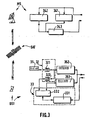
- each concerned station includes the following equipment: a message generation sub-assembly 31, a transmission sub-assembly 32, and a reception sub-assembly 33.
- the sub-assembly 31 is a traffic generator, following in the described embodiment a Poisson process with an arrival rate of ⁇ messages per slot duration, ⁇ being identified as the overall system loading parameter.
- the transmission sub-assembly 32 comprises two queues 321 and 322, the first of which is provided at the output of the sub-assembly 31 for storing new messages, while the second one is provided for storing (as will be seen) messages that have to be recycled.
- the reception sub-assembly 33 provided for organizing a transmission or retransmission process comprises an analysis circuit 331 that receives the feedback information broadcasted by the hub for indicating at the beginning of each frame the available slots and the collided ones. This circuit 331 is followed by a comparison circuit 332 provided for counting the number of collisions or unsuccessful transmissions in the minislots and comparing it to a threshold corresponding to a predetermined number of allowed collisions:
- Each station has in the described example the access possibility for only some recycled messages per frame (for instance one), but the invention also applies in more general cases considering an increased possibility for each station for recycling its messages. Moreover it must be noted that the invention also applies when said station, as described in the preamble of the description, comprises a generation sub-assembly, provided for generating messages that have to be transmitted, a transmission sub-assembly, and means for yielding said information related to the number of encountered collisions.
- the hub MS has monitored the process by carrying out two types of operations: the detection of collisions or unsuccessful transmissions and the generation of the corresponding feedback information.
- These operations are implemented in a first collision detector 341, provided for detecting a possible collision of messages in the data field of a slot, in a second collision detector 342, provided for detection possible collisions of transmission requests in the minislots field of a slot or in the CMP, and in a feedback information generating circuit 343, provided for transmitting to the stations the information concerning the available slots for the access of new or recycled messages to the communication channel.
- the available set ASS broadcasted by the circuit 343 and arriving at the beginning of each frame indicates, as previously said, the available slots for new and recycled messages.
- VSAT perture t erminal
Landscapes
- Engineering & Computer Science (AREA)
- Computer Networks & Wireless Communication (AREA)
- Signal Processing (AREA)
- General Physics & Mathematics (AREA)
- Astronomy & Astrophysics (AREA)
- Aviation & Aerospace Engineering (AREA)
- Physics & Mathematics (AREA)
- Small-Scale Networks (AREA)
- Time-Division Multiplex Systems (AREA)
- Radio Relay Systems (AREA)
- Mobile Radio Communication Systems (AREA)
- Data Exchanges In Wide-Area Networks (AREA)
- Communication Control (AREA)
Claims (5)
- Verfahren zum Steuern der Übertragung von Nachrichten zwischen einer Anzahl von Stationen (GS1), wobei die Stationen miteinander über einen Kommunikationskanal (2) verbunden sind, der mindestens einen Stromauf-Kanal umfasst, welcher von den Stationen zumindest teilweise gemeinsam genutzt wird, und wobei der Stromauf-Kanal in fortlaufende Rahmen (I, I + R) vorgegebener Länge (t(f)) unterteilt ist, bestehend aus Nachrichtenschlitzen (21(1), 21(2) ...), von denen jeder einen Datenteil (DM), welcher zur Übertragung mindestens einer Nachricht verwendet wird, die durch eine der Stationen erzeugt wird, und Minischlitze enthält, die verwendet werden, um ein erstes Nachrichtenschlitz-Reservierungssignal zu senden, das kennzeichnend ist für eine Reservierung eines der Nachrichtenschlitze in einem nächsten Rahmen für die Rückübertragung der Nachricht, wenn die Nachricht mit einer anderen Nachricht, die von einer anderen Station übertragen wird, im Stromauf-Kanal kollidiert, und aus einem gemeinsamen Minischlitzreservoir (CMP), das Minischlitze enthält, wobei das gemeinsame Minischlitzreservoir eines nachfolgenden Rahmens durch die Station verwendet wird, um ein zweites Nachrichtenschlitz-Reservierungssignal zu senden, das kennzeichnend ist für eine Reservierung eines der Nachrichtenschlitze in einem nächsten Rahmen für die Rückübertragung der Nachricht, wenn das erste Nachrichtenschlitz-Reservierungssignal mit einem anderen Nachrichtenschlitz-Reservierungssignal, das durch eine andere Station gesendet wurde, kollidiert, dadurch gekennzeichnet, dass das Verfahren enthält:einen Regenerierungsschritt einschließlich einer Rückübertragung der Nachricht in einem verfügbaren Nachrichtenschlitz des nächsten Rahmens, wenn das zweite Nachrichtenschlitz-Reservierungssignal mit einem anderen Reservierungssignal in dem gemeinsamen Minischlitzreservoir (CMP) kollidiert, in Abhängigkeit von einer Analyse einer Information, die eine Anzahl von angetroffenen Kollisionen von Nachrichten und Reservierungssignalen im Stromauf-Kanal betrifft.
- Verfahren nach Anspruch 1, wobei der Regenerierungsschritt einen ersten Teilschritt für die Analyse der Information, welche die Anzahl der angetroffenen Kollisionen betrifft, und dann, wenn die Anzahl größer ist als ein vorgegebener Grenzwert (C), einen zweiten Teilschritt für das Regenerieren der Nachrichten umfasst, die zu den Kollisionen gehören, indem ihnen eine höhere Priorität mit Bezug auf die neu erzeugten Nachrichten erteilt wird.
- Kommunikationsstation (GS1) für das Übertragen von Nachrichten zwischen einer Anzahl von Stationen, wobei die Stationen miteinander über einen Kommunikationskanal verbunden sind, der mindestens einen Stromauf-Kanal umfasst, welcher von den Stationen zumindest teilweise gemeinsam genutzt wird, und wobei der Stromauf Kanal in fortlaufende Rahmen vorgegebener Länge unterteilt ist, bestehend aus Nachrichtenschlitzen, von denen jeder einen Datenteil, welcher zur Übertragung mindestens einer Nachricht verwendet wird, die durch eine der Stationen erzeugt wird, und Minischlitze enthält, die verwendet werden, um ein erstes Nachrichtenschlitz-Reservierungssignal zu senden, das kennzeichnend ist für eine Reservierung eines der Nachrichtenschlitze in einem nächsten Rahmen für die Rückübertragung der Nachricht, wenn die Nachricht mit einer anderen Nachricht, die von einer anderen Station übertragen wird, im Stromauf-Kanal kollidiert, und aus einem gemeinsamen Minischlitzreservoir, das Minischlitze enthält, wobei das gemeinsame Minischlitzreservoir eines nachfolgenden Rahmens durch die Station verwendet wird, um ein zweites Nachrichtenschlitz-Reservierungssignal zu senden, das kennzeichnend ist für eine Reservierung eines der Nachrichtenschlitze in einem nächsten Rahmen für die Rückübertragung der Nachricht, wenn das erste Nachrichtenschlitz-Reservierungssignal mit einem anderen Nachrichtenschlitz-Reservierungssignal, das durch eine andere Station gesendet wurde, kollidiert, dadurch gekennzeichnet, dass die Station eine Empfangs-Untergruppe einschließt, die umfasst:(a) einen Analyseschaltkreis (33), der zum Feststellen einer Information vorgesehen ist, die sich auf die Anzahl der angetroffenen Kollisionen bezieht;(b) einen Verarbeitungsschaltkreis (332), der für die Regenerierung der Nachricht einschließlich der Rückübertragung der Nachricht in einem verfügbaren Nachrichtenschlitz vorgesehen ist, wenn das zweite Nachrichtenschlitz-Reservierungssignal mit einem anderen Reservierungssignal in dem gemeinsamen Minischlitzreservoir (CMP) kollidiert, was auf einer Analyse einer Information beruht, die sich auf eine Anzahl von angetroffenen Kollisionen von Nachrichten und Reservierungssignalen im Stromauf-Kanal bezieht.
- Kommunikationsstation nach Anspruch 3, dadurch gekennzeichnet, dass der Verarbeitungsschaltkreis (332) ferner die Anzahl mit einem vorgegebenen Grenzwert vergleicht und nur dann, wenn die Anzahl größer als der Grenzwert ist, die zu den Kollisionen gehörenden Nachrichten zurück überträgt, indem er ihnen eine höhere Übertragungspriorität gibt als den neu erzeugten Nachrichten.
- Kommunikationsstation (GS1) nach Anspruch 4, wobei die Empfangs-Untergruppe auch zwei parallele Warteschlangen (321, 322) umfasst, wobei die erste Warteschlange (321) die neu erzeugten Nachrichten aufnimmt und der Verarbeitungsschaltkreis dann die Nachrichten, die zu den Kollisionen gehören, in der zweiten Warteschlange (322) regeneriert und den Nachrichten in der zweiten Warteschlange eine höhere Übertragungspriorität gibt als den Nachrichten in der ersten Warteschlange.
Applications Claiming Priority (5)
| Application Number | Priority Date | Filing Date | Title |
|---|---|---|---|
| EP96400552 | 1996-03-18 | ||
| EP96400552 | 1996-03-18 | ||
| EP96402611 | 1996-12-03 | ||
| EP96402611 | 1996-12-03 | ||
| PCT/IB1997/000229 WO1997035408A2 (en) | 1996-03-18 | 1997-03-10 | Message collision arbitration using minislots |
Publications (2)
| Publication Number | Publication Date |
|---|---|
| EP0870385A2 EP0870385A2 (de) | 1998-10-14 |
| EP0870385B1 true EP0870385B1 (de) | 2006-03-15 |
Family
ID=26144025
Family Applications (1)
| Application Number | Title | Priority Date | Filing Date |
|---|---|---|---|
| EP97903557A Expired - Lifetime EP0870385B1 (de) | 1996-03-18 | 1997-03-10 | Nachrichten-kollisionsarbitrierung unter verwendung von mini-schlitzen |
Country Status (7)
| Country | Link |
|---|---|
| US (1) | US5953321A (de) |
| EP (1) | EP0870385B1 (de) |
| JP (1) | JP3801645B2 (de) |
| KR (1) | KR100465362B1 (de) |
| CN (1) | CN1151637C (de) |
| DE (1) | DE69735476T2 (de) |
| WO (1) | WO1997035408A2 (de) |
Families Citing this family (9)
| Publication number | Priority date | Publication date | Assignee | Title |
|---|---|---|---|---|
| GB2321578B (en) * | 1996-12-27 | 2001-10-31 | Lg Electronics Inc | Adaptive random access protocol and dynamic search tree expansion resolution for multiple station networks |
| US6115390A (en) * | 1997-10-14 | 2000-09-05 | Lucent Technologies, Inc. | Bandwidth reservation and collision resolution method for multiple access communication networks where remote hosts send reservation requests to a base station for randomly chosen minislots |
| WO1999049687A2 (en) * | 1998-03-26 | 1999-09-30 | Koninklijke Philips Electronics N.V. | Communication network with improved access protocol |
| US6366761B1 (en) * | 1998-10-06 | 2002-04-02 | Teledesic Llc | Priority-based bandwidth allocation and bandwidth-on-demand in a low-earth-orbit satellite data communication network |
| DE10027595A1 (de) * | 2000-06-02 | 2001-12-13 | Alstom Anl & Automtech Gmbh | Verfahren zum Bereitstellen von Zeitschlitzen in einem Rahmen für die Übertragung von Informationen |
| JP4752113B2 (ja) * | 2001-01-16 | 2011-08-17 | ソニー株式会社 | 電子機器及び信号伝送方法 |
| CN101252322B (zh) * | 2007-12-20 | 2011-05-11 | 英飞特电子(杭州)有限公司 | 组合式电源适配器 |
| CN101969671B (zh) * | 2010-10-21 | 2015-12-02 | 展讯通信(上海)有限公司 | 一种解决数据冲突的方法及移动终端 |
| KR20120095153A (ko) * | 2011-02-18 | 2012-08-28 | 삼성전자주식회사 | Dali 통신 기반의 조명 제어 장치 및 방법 |
Family Cites Families (6)
| Publication number | Priority date | Publication date | Assignee | Title |
|---|---|---|---|---|
| US4574378A (en) * | 1982-06-14 | 1986-03-04 | Nec Corporation | Multiple access system and method |
| US4641304A (en) * | 1986-06-06 | 1987-02-03 | Rca Corporation | Announced retransmission random access system |
| DE68916231T2 (de) * | 1989-03-23 | 1995-02-02 | Ibm | Verfahren und Vorrichtung zum Vielfachzugriff mit verteilten Warteschlangen in einem Kommunikationssystem. |
| US4987571A (en) * | 1989-07-25 | 1991-01-22 | Motorola, Inc. | Data communication system with prioritized periodic and aperiodic messages |
| FR2677473B1 (fr) * | 1991-06-05 | 1995-04-07 | Telemecanique | Procede et bus d'arbitrage pour transmission de donnees serie. |
| JP2730338B2 (ja) * | 1991-07-15 | 1998-03-25 | 日本電気株式会社 | 衛星通信方式 |
-
1997
- 1997-03-10 JP JP53329497A patent/JP3801645B2/ja not_active Expired - Fee Related
- 1997-03-10 CN CNB971904928A patent/CN1151637C/zh not_active Expired - Fee Related
- 1997-03-10 EP EP97903557A patent/EP0870385B1/de not_active Expired - Lifetime
- 1997-03-10 KR KR1019970708307A patent/KR100465362B1/ko not_active Expired - Fee Related
- 1997-03-10 WO PCT/IB1997/000229 patent/WO1997035408A2/en not_active Ceased
- 1997-03-10 DE DE69735476T patent/DE69735476T2/de not_active Expired - Lifetime
- 1997-03-12 US US08/815,242 patent/US5953321A/en not_active Expired - Lifetime
Also Published As
| Publication number | Publication date |
|---|---|
| JPH11508751A (ja) | 1999-07-27 |
| WO1997035408A2 (en) | 1997-09-25 |
| WO1997035408A3 (en) | 1997-10-30 |
| DE69735476T2 (de) | 2006-10-19 |
| JP3801645B2 (ja) | 2006-07-26 |
| CN1151637C (zh) | 2004-05-26 |
| KR19990021833A (ko) | 1999-03-25 |
| DE69735476D1 (de) | 2006-05-11 |
| KR100465362B1 (ko) | 2005-05-17 |
| EP0870385A2 (de) | 1998-10-14 |
| US5953321A (en) | 1999-09-14 |
| CN1193435A (zh) | 1998-09-16 |
Similar Documents
| Publication | Publication Date | Title |
|---|---|---|
| US5896385A (en) | Transmission control method between a plurality of stations and corresponding stations and communication systems | |
| US6151329A (en) | Transmission control method between a plurality of stations | |
| US7899404B2 (en) | Random access burst transmission scheme | |
| EP0523648B1 (de) | Zeitschlitz-Zuteilung an gleichzeitige Benutzer in einer Datenübertragungsanordnung mit zufallsbedingtem Zugang | |
| USRE37301E1 (en) | Multiple access protocol | |
| US5651009A (en) | System and method for hybrid contention/polling protocol collision resolution using a depth first search technique | |
| US6999441B2 (en) | Method and apparatus for contention management in a radio-based packet network | |
| EP0889664A2 (de) | Überlastregelung auf einen Direkt-Zugriffskanal für Rückquittierungsnachrichten eines Rundsende-Teleservices | |
| US20040013135A1 (en) | System and method for scheduling traffic in wireless networks | |
| EP0901253B1 (de) | Übertragungssteuerungsverfahren | |
| WO1996031077A1 (en) | Method and arrangement in a radio communication system | |
| AU5851896A (en) | Method, device and data communication system for multilink polling | |
| US7027461B1 (en) | Reservation/retry media access control | |
| US5684802A (en) | System and method for hybrid contention/polling protocol collison resolution used backoff timers with polling | |
| US5953321A (en) | Transmission control method between a plurality of stations and corresponding communication stations | |
| Muir et al. | Supporting real-time multimedia traffic in a wireless LAN | |
| WO1999000933A1 (en) | Minimizing contention delay in a multi-slot mac protocol | |
| Cleary et al. | An investigation of stack based algorithms for voice-packet transmission in microcellular wireless environments | |
| Li et al. | On the performance analysis of EPRMA protocol with Markov chain model | |
| Du et al. | A new multi-access protocol for satellite channels | |
| JP2527660B2 (ja) | 通信方法 | |
| Koraitim et al. | Performance of multiple access protocols in geo-stationary satellite systems |
Legal Events
| Date | Code | Title | Description |
|---|---|---|---|
| PUAI | Public reference made under article 153(3) epc to a published international application that has entered the european phase |
Free format text: ORIGINAL CODE: 0009012 |
|
| 17P | Request for examination filed |
Effective date: 19980325 |
|
| AK | Designated contracting states |
Kind code of ref document: A2 Designated state(s): DE FR GB IT |
|
| 17Q | First examination report despatched |
Effective date: 20040319 |
|
| GRAP | Despatch of communication of intention to grant a patent |
Free format text: ORIGINAL CODE: EPIDOSNIGR1 |
|
| GRAC | Information related to communication of intention to grant a patent modified |
Free format text: ORIGINAL CODE: EPIDOSCIGR1 |
|
| GRAS | Grant fee paid |
Free format text: ORIGINAL CODE: EPIDOSNIGR3 |
|
| GRAA | (expected) grant |
Free format text: ORIGINAL CODE: 0009210 |
|
| AK | Designated contracting states |
Kind code of ref document: B1 Designated state(s): DE FR GB IT |
|
| PG25 | Lapsed in a contracting state [announced via postgrant information from national office to epo] |
Ref country code: IT Free format text: LAPSE BECAUSE OF FAILURE TO SUBMIT A TRANSLATION OF THE DESCRIPTION OR TO PAY THE FEE WITHIN THE PRESCRIBED TIME-LIMIT;WARNING: LAPSES OF ITALIAN PATENTS WITH EFFECTIVE DATE BEFORE 2007 MAY HAVE OCCURRED AT ANY TIME BEFORE 2007. THE CORRECT EFFECTIVE DATE MAY BE DIFFERENT FROM THE ONE RECORDED. Effective date: 20060315 |
|
| REG | Reference to a national code |
Ref country code: GB Ref legal event code: FG4D |
|
| REF | Corresponds to: |
Ref document number: 69735476 Country of ref document: DE Date of ref document: 20060511 Kind code of ref document: P |
|
| ET | Fr: translation filed | ||
| PLBE | No opposition filed within time limit |
Free format text: ORIGINAL CODE: 0009261 |
|
| STAA | Information on the status of an ep patent application or granted ep patent |
Free format text: STATUS: NO OPPOSITION FILED WITHIN TIME LIMIT |
|
| 26N | No opposition filed |
Effective date: 20061218 |
|
| REG | Reference to a national code |
Ref country code: GB Ref legal event code: 732E Free format text: REGISTERED BETWEEN 20090305 AND 20090311 |
|
| PGFP | Annual fee paid to national office [announced via postgrant information from national office to epo] |
Ref country code: FR Payment date: 20090312 Year of fee payment: 13 |
|
| REG | Reference to a national code |
Ref country code: FR Ref legal event code: ST Effective date: 20101130 |
|
| PG25 | Lapsed in a contracting state [announced via postgrant information from national office to epo] |
Ref country code: FR Free format text: LAPSE BECAUSE OF NON-PAYMENT OF DUE FEES Effective date: 20100331 |
|
| REG | Reference to a national code |
Ref country code: GB Ref legal event code: 732E Free format text: REGISTERED BETWEEN 20120628 AND 20120704 |
|
| REG | Reference to a national code |
Ref country code: DE Ref legal event code: R082 Ref document number: 69735476 Country of ref document: DE Representative=s name: PATENTANWAELTE BRESSEL UND PARTNER MBB, DE Effective date: 20121213 Ref country code: DE Ref legal event code: R082 Ref document number: 69735476 Country of ref document: DE Representative=s name: PATENTANWAELTE BRESSEL UND PARTNER, DE Effective date: 20121213 Ref country code: DE Ref legal event code: R081 Ref document number: 69735476 Country of ref document: DE Owner name: PENDRAGON WIRELESS LLC (A NEVADA MANAGED LIMIT, US Free format text: FORMER OWNER: IPG ELECTRONICS 503 LTD., ST. PETER PORT, GUERNSEY, GB Effective date: 20121213 Ref country code: DE Ref legal event code: R081 Ref document number: 69735476 Country of ref document: DE Owner name: PENDRAGON WIRELESS LLC (A NEVADA MANAGED LIMIT, US Free format text: FORMER OWNER: IPG ELECTRONICS 503 LTD., ST. PETER PORT, GB Effective date: 20121213 |
|
| PGFP | Annual fee paid to national office [announced via postgrant information from national office to epo] |
Ref country code: DE Payment date: 20140328 Year of fee payment: 18 |
|
| PGFP | Annual fee paid to national office [announced via postgrant information from national office to epo] |
Ref country code: GB Payment date: 20140319 Year of fee payment: 18 |
|
| REG | Reference to a national code |
Ref country code: DE Ref legal event code: R119 Ref document number: 69735476 Country of ref document: DE |
|
| GBPC | Gb: european patent ceased through non-payment of renewal fee |
Effective date: 20150310 |
|
| PG25 | Lapsed in a contracting state [announced via postgrant information from national office to epo] |
Ref country code: DE Free format text: LAPSE BECAUSE OF NON-PAYMENT OF DUE FEES Effective date: 20151001 Ref country code: GB Free format text: LAPSE BECAUSE OF NON-PAYMENT OF DUE FEES Effective date: 20150310 |