EP0870553A2 - Walzverfahren und Walzstrasse für dünne Flacherzeugnisse - Google Patents
Walzverfahren und Walzstrasse für dünne Flacherzeugnisse Download PDFInfo
- Publication number
- EP0870553A2 EP0870553A2 EP98101103A EP98101103A EP0870553A2 EP 0870553 A2 EP0870553 A2 EP 0870553A2 EP 98101103 A EP98101103 A EP 98101103A EP 98101103 A EP98101103 A EP 98101103A EP 0870553 A2 EP0870553 A2 EP 0870553A2
- Authority
- EP
- European Patent Office
- Prior art keywords
- finishing
- rolling line
- thickness
- inclusive
- product
- Prior art date
- Legal status (The legal status is an assumption and is not a legal conclusion. Google has not performed a legal analysis and makes no representation as to the accuracy of the status listed.)
- Granted
Links
Images

Classifications
-
- C—CHEMISTRY; METALLURGY
- C21—METALLURGY OF IRON
- C21D—MODIFYING THE PHYSICAL STRUCTURE OF FERROUS METALS; GENERAL DEVICES FOR HEAT TREATMENT OF FERROUS OR NON-FERROUS METALS OR ALLOYS; MAKING METAL MALLEABLE, e.g. BY DECARBURISATION OR TEMPERING
- C21D8/00—Modifying the physical properties of ferrous metals or ferrous alloys by deformation combined with, or followed by, heat treatment
- C21D8/02—Modifying the physical properties of ferrous metals or ferrous alloys by deformation combined with, or followed by, heat treatment during manufacturing of plates or strips
- C21D8/0221—Modifying the physical properties of ferrous metals or ferrous alloys by deformation combined with, or followed by, heat treatment during manufacturing of plates or strips characterised by the working steps
- C21D8/0226—Hot rolling
-
- B—PERFORMING OPERATIONS; TRANSPORTING
- B21—MECHANICAL METAL-WORKING WITHOUT ESSENTIALLY REMOVING MATERIAL; PUNCHING METAL
- B21B—ROLLING OF METAL
- B21B1/00—Metal-rolling methods or mills for making semi-finished products of solid or profiled cross-section; Sequence of operations in milling trains; Layout of rolling-mill plant, e.g. grouping of stands; Succession of passes or of sectional pass alternations
- B21B1/22—Metal-rolling methods or mills for making semi-finished products of solid or profiled cross-section; Sequence of operations in milling trains; Layout of rolling-mill plant, e.g. grouping of stands; Succession of passes or of sectional pass alternations for rolling plates, strips, bands or sheets of indefinite length
- B21B1/24—Metal-rolling methods or mills for making semi-finished products of solid or profiled cross-section; Sequence of operations in milling trains; Layout of rolling-mill plant, e.g. grouping of stands; Succession of passes or of sectional pass alternations for rolling plates, strips, bands or sheets of indefinite length in a continuous or semi-continuous process
- B21B1/26—Metal-rolling methods or mills for making semi-finished products of solid or profiled cross-section; Sequence of operations in milling trains; Layout of rolling-mill plant, e.g. grouping of stands; Succession of passes or of sectional pass alternations for rolling plates, strips, bands or sheets of indefinite length in a continuous or semi-continuous process by hot-rolling, e.g. Steckel hot mill
-
- B—PERFORMING OPERATIONS; TRANSPORTING
- B21—MECHANICAL METAL-WORKING WITHOUT ESSENTIALLY REMOVING MATERIAL; PUNCHING METAL
- B21B—ROLLING OF METAL
- B21B1/00—Metal-rolling methods or mills for making semi-finished products of solid or profiled cross-section; Sequence of operations in milling trains; Layout of rolling-mill plant, e.g. grouping of stands; Succession of passes or of sectional pass alternations
- B21B1/46—Metal-rolling methods or mills for making semi-finished products of solid or profiled cross-section; Sequence of operations in milling trains; Layout of rolling-mill plant, e.g. grouping of stands; Succession of passes or of sectional pass alternations for rolling metal immediately subsequent to continuous casting
- B21B1/466—Metal-rolling methods or mills for making semi-finished products of solid or profiled cross-section; Sequence of operations in milling trains; Layout of rolling-mill plant, e.g. grouping of stands; Succession of passes or of sectional pass alternations for rolling metal immediately subsequent to continuous casting in a non-continuous process, i.e. the cast being cut before rolling
-
- B—PERFORMING OPERATIONS; TRANSPORTING
- B21—MECHANICAL METAL-WORKING WITHOUT ESSENTIALLY REMOVING MATERIAL; PUNCHING METAL
- B21B—ROLLING OF METAL
- B21B1/00—Metal-rolling methods or mills for making semi-finished products of solid or profiled cross-section; Sequence of operations in milling trains; Layout of rolling-mill plant, e.g. grouping of stands; Succession of passes or of sectional pass alternations
- B21B1/22—Metal-rolling methods or mills for making semi-finished products of solid or profiled cross-section; Sequence of operations in milling trains; Layout of rolling-mill plant, e.g. grouping of stands; Succession of passes or of sectional pass alternations for rolling plates, strips, bands or sheets of indefinite length
- B21B1/24—Metal-rolling methods or mills for making semi-finished products of solid or profiled cross-section; Sequence of operations in milling trains; Layout of rolling-mill plant, e.g. grouping of stands; Succession of passes or of sectional pass alternations for rolling plates, strips, bands or sheets of indefinite length in a continuous or semi-continuous process
-
- B—PERFORMING OPERATIONS; TRANSPORTING
- B21—MECHANICAL METAL-WORKING WITHOUT ESSENTIALLY REMOVING MATERIAL; PUNCHING METAL
- B21B—ROLLING OF METAL
- B21B1/00—Metal-rolling methods or mills for making semi-finished products of solid or profiled cross-section; Sequence of operations in milling trains; Layout of rolling-mill plant, e.g. grouping of stands; Succession of passes or of sectional pass alternations
- B21B1/22—Metal-rolling methods or mills for making semi-finished products of solid or profiled cross-section; Sequence of operations in milling trains; Layout of rolling-mill plant, e.g. grouping of stands; Succession of passes or of sectional pass alternations for rolling plates, strips, bands or sheets of indefinite length
- B21B1/30—Metal-rolling methods or mills for making semi-finished products of solid or profiled cross-section; Sequence of operations in milling trains; Layout of rolling-mill plant, e.g. grouping of stands; Succession of passes or of sectional pass alternations for rolling plates, strips, bands or sheets of indefinite length in a non-continuous process
- B21B1/32—Metal-rolling methods or mills for making semi-finished products of solid or profiled cross-section; Sequence of operations in milling trains; Layout of rolling-mill plant, e.g. grouping of stands; Succession of passes or of sectional pass alternations for rolling plates, strips, bands or sheets of indefinite length in a non-continuous process in reversing single stand mills, e.g. with intermediate storage reels for accumulating work
-
- B—PERFORMING OPERATIONS; TRANSPORTING
- B21—MECHANICAL METAL-WORKING WITHOUT ESSENTIALLY REMOVING MATERIAL; PUNCHING METAL
- B21B—ROLLING OF METAL
- B21B13/00—Metal-rolling stands, i.e. an assembly composed of a stand frame, rolls, and accessories
- B21B2013/003—Inactive rolling stands
-
- B—PERFORMING OPERATIONS; TRANSPORTING
- B21—MECHANICAL METAL-WORKING WITHOUT ESSENTIALLY REMOVING MATERIAL; PUNCHING METAL
- B21B—ROLLING OF METAL
- B21B15/00—Arrangements for performing additional metal-working operations specially combined with or arranged in, or specially adapted for use in connection with, metal-rolling mills
- B21B2015/0057—Coiling the rolled product
-
- B—PERFORMING OPERATIONS; TRANSPORTING
- B21—MECHANICAL METAL-WORKING WITHOUT ESSENTIALLY REMOVING MATERIAL; PUNCHING METAL
- B21B—ROLLING OF METAL
- B21B2201/00—Special rolling modes
- B21B2201/02—Austenitic rolling
-
- B—PERFORMING OPERATIONS; TRANSPORTING
- B21—MECHANICAL METAL-WORKING WITHOUT ESSENTIALLY REMOVING MATERIAL; PUNCHING METAL
- B21B—ROLLING OF METAL
- B21B2201/00—Special rolling modes
- B21B2201/04—Ferritic rolling
-
- B—PERFORMING OPERATIONS; TRANSPORTING
- B21—MECHANICAL METAL-WORKING WITHOUT ESSENTIALLY REMOVING MATERIAL; PUNCHING METAL
- B21B—ROLLING OF METAL
- B21B2201/00—Special rolling modes
- B21B2201/14—Soft reduction
Definitions
- This invention concerns a rolling method for thin flat products, and the relative rolling line, as set forth in the respective main claims.
- the invention is applied in the field of flat rolled stock, such as strip or sheet, and more particularly to obtain thin final products, around 1.5 ⁇ 3.0 mm, and very thin, less than 1 mm, to as little as 0.6 ⁇ 0.7 mm.
- the state of the art includes rolling lines for flat rolled products, both of the traditional type, where the furnace to heat the slabs is separated from the casting machine and connected to the rolling train, and also the type where the rolling train is directly connected to the continuous casting machine.
- the standard configuration of these rolling lines generally comprises, downstream of the continuous casting machine and the shears, a temperature-maintaining and possibly a temperature-restoring system, a roughing train comprising a number of stands which is normally between one and three, a temperature maintaining and equalisation system and the finishing train, normally comprising between four and ten stands, followed by a cooling system and a coiler to form the coil of rolled product.
- Rolling ultra-thin products has demonstrated problems and disadvantages which had never been thought of before, which in conventional rolling lines of the type described above have a considerable impact on the surface and internal dimensional quality (thickness, profile and planarity) of the finished product.
- the temperature at which this transformation takes place depends mainly on the composition of the steel being worked and particularly on the percentage of carbon therein, the speed of cooling and the sequence of reduction of the thickness.
- the temperature at which the allotropic transformation begins is around 800 ⁇ 880°C.
- the purpose of the invention is to achieve a rolling method, and the relative rolling line, to obtain thin (1.5 ⁇ 3.0 mm) and very thin (about 0.6 ⁇ 0.7 mm and less) flat rolled products, characterised by a very high standard both of the surface and internal quality.
- Another purpose of the invention is to achieve a rolling line which is not specifically applied only to these thicknesses, but which will be able to roll alternately, according to the planned cycle of production, both products having the aforesaid thickness and also products with a more conventional thickness, such as for example those in the range of 2.0 ⁇ 12.7 mm and up to 20 ⁇ 25.4 mm.
- the rolling line which achieves the method according to the invention, it is possible, in at least part of the finishing assembly, to roll both in the austenitic field (phase ⁇ ) and in the ferritic field (phase ⁇ ) depending on the final product.
- the slabs produced by the continuous casting machine, according to the invention are supplied to the heating and temperature-maintenance furnace with a thickness of between 50 and 90 mm.
- pre-finishing train comprising at least a reversible stand, preceded and followed by hot winding reels, in order to carry out the desired number of pre-finishing passes.
- the heating and temperature-maintaining furnace according to the invention is as long as is necessary to contain all the product cast with one ladle, or a slab as long as a desired plurality of coils of the desired product.
- upstream of the heating and temperature-maintaining furnace there is an accumulation and heating furnace which makes it possible to feed a cold load, or to contain the slabs cast with one ladle, or to feed thick slabs or slabs with an intermediate thickness of between 80 and 200 ⁇ 250 mm.
- downstream of the roughing train there is a tunnel furnace to equalise the temperature.
- This temperature conditioning and adjustment system takes the bar, which leaves the roughing train with a thickness of between 10 and 50 mm depending on the thickness of the final product, to the desired temperature so that at least part of the finishing rolling takes place in the austenitic or ferritic field according to the chosen field wherein rolling has to proceed.
- a thickness of between 10 and 15 mm serves to obtain final thicknesses of between 0.6 and 1.0 mm, whereas a thickness of 15 to 20 ⁇ 25 mm serves to obtain final thicknesses of between 1 to 3 mm.
- a thickness of between 20 ⁇ 25 mm and 50 mm serves to obtain final thicknesses of between 3.0 and 25.4 mm.
- all the finishing rolling (that is to say, rolling carried out with the finishing stands) takes place in the austenitic or ferritic field.
- the temperature conditioning and adjustment system comprises means for both heating and cooling the bar in a homogeneous manner; this is because it serves to heat the bar to obtain thin strip in the austenitic field, that is to say with the temperatures of the strip at the outlet of the rolling mill above the austenite-ferrite transformation point.
- the invention includes these heating and/or cooling means, that is to say, means which control the temperature of the bar and are connected with heating-adjustment and/or, respectively, cooling-adjustment means.
- the invention After the temperature conditioning and adjustment system, the invention includes from five to seven finishing stands and, downstream thereof, a cooling system, a winding system, and a system to discharge the coils.
- the conditioning and adjustment system that is, the means which control the temperature of the bar, is placed in an intermediate position of the finishing stands.
- the conditioning and adjustment system can be put after the first stand, or after one or another of the subsequent stands, provided that there is at least a finishing stand after the conditioning and adjustment system.
- finishing assembly is divided into two blocks, the first and second finishing blocks.
- the rolling passes in the second block are carried out with the product in the ferritic field (phase ⁇ ).
- the first block of the finishing train serves to take the thickness of the intermediate product progressively to a value of around 1.0 ⁇ 1.4 mm, according to the production requirements of the line.
- the second block of the finishing train takes the thickness of the product to the final values required, for example 0.6 ⁇ 1.0 mm, or other thickness close to the desired values.
- the intermediate segment between the first and second block of the finishing train there is at least a cooling system.
- the length of the intermediate segment and the intensity of the action of the cooling system are calculated to ensure that, when thin products are produced, the product entering the second finishing block is substantially in the ferritic state ⁇ .
- the product which has been rolled in its austenitic state ⁇ in the first reducing passes, is thus taken to its ferritic state ⁇ and in this state the product is subjected to the final reducing passes.
- the product in the intermediate segment between the two blocks of the finishing train is subjected to a heat treatment which returns it, wholly or almost wholly, to its austenitic state ⁇ .
- downstream of the second block of the finishing train there is a cooling assembly structured and sized to guarantee the correct cooling of the finished product before it is wound into a coil.
- a coiler assembly immediately downstream of the finishing assembly there is a coiler assembly, with a single mandrel or a double carousel-type mandrel.
- the coiler assembly which includes by-pass and exclusion means, serves for thin strip, that is to say, up to 3 mm, while for greater thicknesses a traditional method is followed.
- the positioning of the coiler immediately after the finishing assembly serves to control the temperature of the strip so that it does not go below the desired values due to radiance.
- the coiler assembly is associated with a shears assembly immediately upstream thereof.
- the invention makes it possible to roll the product in a heat condition which is far removed from the allotropic transformation step, thus avoiding the aforesaid disadvantages and ensuring better rolling conditions.
- the second block of the finishing train is excluded, the product is already finished when it leaves the reducing passes carried out in the first block and is cooled in a conventional manner by the cooling system downstream of the first block.
- rolling in the second block of the finishing train is carried out, with the product in phase ⁇ , even of products which are not particularly thin, for example in the range of 2.0 ⁇ 3.0 mm, when it is desired to give the rolled stock particular mechanical characteristics of malleability without subsequent heat treatments.
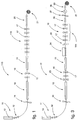
- the rolling line 10 is of the conventional type.
- the rolling lines 10 according to the invention as shown in Figs. 2 and 3 are of the type where rolling is directly connected to the continuous casting machine which in this case is advantageously equipped with a soft-reduction system.
- the rolling line 10 as shown in Fig. 4 is of the type which includes a furnace 22 to accumulate and heat thick slabs or slabs with an intermediate thickness of between 80 and 200 ⁇ 250 mm, connected at the outlet with the rolling train and connected with the continuous casting machine possibly by a feeder way 23 and with a cold loading system by a feeder way 23a.
- the continuous casting machine 11 is equipped with soft-reduction devices 12 for the slab leaving the ingot mold 13, followed by a shears 14 and a heating and maintenance furnace 15.
- shears 14 There may possibly be other systems, such as descaling devices or other, before the shears 14.
- a descaling system 25 is advantageously included.
- a descaling system 25 followed by a roughing or pre-finishing train 16 comprising, in this case, two stands 17, which achieves a first reduction in the thickness of the cast product.
- the roughing train 16 can be of the reversible type and cooperate upstream and downstream with hot winding/unwinding systems such as are known to the state of the art and which are not shown here.
- a tunnel furnace system 18 Downstream of the roughing train 16 there is a tunnel furnace system 18, to equalise the temperature, which serves to feed to the finishing train 19, which includes at least three reduction passes, a product with a uniform temperature, both lengthwise and also on the transverse section, and with the correct heat conditions.
- the temperature equalisation system, or tunnel furnace 18, is arranged so that at least the first passes of the finishing train 19 are carried out with the product in its austenitic state ⁇ , thus guaranteeing rolling conditions such as to ensure that a final product is obtained with a high quality, both metallurgical and dimensional.
- the finishing train 19 in this case comprises seven rolling stands 17 and is followed by a cooling system 20 and in this case a downcoiler 21 to form the coil.
- the shears assembly 27 and the coiler assembly 26 may be preceded by a fast cooling assembly 28 shown for the sake of simplicity in Fig. 3 only.
- the rolling lines 10 as shown in Figs. 2 and 4 according to the invention include a finishing train 19 structured in two blocks, respectively 19a and 19b, between which there is a temperature conditioning and adjustment system 24.
- the temperature conditioning and adjustment system 24 consists of a cooling system.
- the first block 19a which in this case comprises five rolling stands 17, causes a progressive reduction in thickness which may or may not require further reduction passes in the second block 19b.
- the product leaves the first block 19a in a finished state, it is cooled in the temperature conditioning and adjustment system 24 and then wound into coils, and the second block 19b is operationally excluded from the process.
- the product leaves the five passes made in the first block 19a with a thickness of around 1.0 ⁇ 1.4 mm, it is then subjected to cooling in the temperature conditioning and adjustment system 24 which causes the transition from allotropic phase ⁇ to phase ⁇ , and then it is finished in the two passes made by the second block 19b to take it to the desired final thickness.
- the passes of final reduction are carried out with the product in the ferritic state ⁇ , and therefore in conditions which guarantee that a product is obtained which is characterised by a high standard of quality, both metallurgical and dimensional, so that the product is suitable for pressing applications after a simple pickling treatment.
- the pickling may even be omitted.
- rolling is carried out in the second block 19b of the finishing train 19 with the product in its ferritic state ⁇ for thicknesses of the order of 2.0 ⁇ 3.0 mm in order to give the rolled stock, even if it is not particularly thin, particular metallurgical and mechanical characteristics.
- composition achieved on each occasion will depend on the cycle and the result desired.
- the number of reduction passes in the first block 19a is between 1 and 7, while the number of reduction passes in the second block 19b is 6 at the most.
- the temperature conditioning system 24 placed between the first block 19a and the second block 19b of the finishing train 19 also comprises a heating system which can either be excluded from the line so as to assume a position of non-interference 24a, or can be temporally switched on or off.
- the temperature conditioning and adjustment system 24 acts on the product leaving the first block 19a during its allotropic transformation step from state ⁇ to state ⁇ , and returns the product to its austenitic state ⁇ , in order to perform the final reduction passes in the second block 19b and obtain thin strip even in the austenitic step.
- the second block 19b is followed by a cooling system 20 structured and sized to take the finished rolled product to the correct temperature to be wound into a coil.
- a coiling assembly 26 is used which is not of a conventional type, for example including a carousel with two winding reels operating alternately, in order to avoid the problems which might arise with a strip of such a reduced thickness entering a conventional downcoiler.
- the temperature conditioning and adjustment system 24 located immediately downstream of the tunnel furnace 18 includes heating and cooling means.
Landscapes
- Engineering & Computer Science (AREA)
- Chemical & Material Sciences (AREA)
- Mechanical Engineering (AREA)
- Materials Engineering (AREA)
- Thermal Sciences (AREA)
- Crystallography & Structural Chemistry (AREA)
- Physics & Mathematics (AREA)
- Metallurgy (AREA)
- Organic Chemistry (AREA)
- Metal Rolling (AREA)
- Wrappers (AREA)
- Forging (AREA)
- Casting Or Compression Moulding Of Plastics Or The Like (AREA)
Applications Claiming Priority (3)
| Application Number | Priority Date | Filing Date | Title |
|---|---|---|---|
| ITUS970063 | 1997-04-10 | ||
| IT97UD000063A IT1290743B1 (it) | 1997-04-10 | 1997-04-10 | Procedimento di laminazione per prodotti piani con spessori sottili e relativa linea di laminazione |
| ITUD970063 | 1997-04-10 |
Publications (3)
| Publication Number | Publication Date |
|---|---|
| EP0870553A2 true EP0870553A2 (de) | 1998-10-14 |
| EP0870553A3 EP0870553A3 (de) | 1999-02-10 |
| EP0870553B1 EP0870553B1 (de) | 2003-05-14 |
Family
ID=11422366
Family Applications (1)
| Application Number | Title | Priority Date | Filing Date |
|---|---|---|---|
| EP98101103A Revoked EP0870553B1 (de) | 1997-04-10 | 1998-01-23 | Walzverfahren und Walzstrasse für dünne Flacherzeugnisse |
Country Status (10)
| Country | Link |
|---|---|
| US (1) | US6062055A (de) |
| EP (1) | EP0870553B1 (de) |
| JP (1) | JPH10277601A (de) |
| CN (1) | CN1195584A (de) |
| AT (1) | ATE240166T1 (de) |
| AU (1) | AU739716B2 (de) |
| CA (1) | CA2228005A1 (de) |
| DE (1) | DE69814513T2 (de) |
| EG (1) | EG21595A (de) |
| IT (1) | IT1290743B1 (de) |
Cited By (8)
| Publication number | Priority date | Publication date | Assignee | Title |
|---|---|---|---|---|
| WO2000030776A1 (en) * | 1998-11-26 | 2000-06-02 | Demag Italimpianti S.P.A. | Hot-rolling mill for thin strips |
| WO2000074867A1 (de) * | 1999-06-04 | 2000-12-14 | Sms Demag Aktiengesellschaft | Verfahren und walzanlage zum austenitischen walzen von dünnen bändern |
| WO2003013750A3 (de) * | 2001-08-07 | 2003-09-25 | Sms Demag Ag | Warmwalzanlage |
| WO2009000387A1 (de) * | 2007-06-22 | 2008-12-31 | Sms Siemag Ag | Verfahren zum warmwalzen und zur wärmebehandlung eines bandes aus stahl |
| WO2011015365A1 (de) * | 2009-08-06 | 2011-02-10 | Sms Siemag Aktiengesellschaft | Verfahren und vorrichtung zum herstellen eines mikrolegierten stahls, insbesondere eines röhrenstahls |
| WO2011067315A1 (de) * | 2009-12-02 | 2011-06-09 | Sms Siemag Ag | Warmwalzwerk und verfahren zum warmwalzen eines metallbandes oder -blechs |
| CN106853461A (zh) * | 2017-03-07 | 2017-06-16 | 华北理工大学 | 一种热轧钢板生产系统 |
| US20230271247A1 (en) * | 2020-07-23 | 2023-08-31 | Primetals Technologies Austria GmbH | Casting-rolling integrated plant for producing a hot-rolled finished strip from a steel melt |
Families Citing this family (39)
| Publication number | Priority date | Publication date | Assignee | Title |
|---|---|---|---|---|
| DE19815032A1 (de) * | 1998-04-03 | 1999-10-07 | Schloemann Siemag Ag | Walzverfahren für ein Metallband |
| CN1087673C (zh) * | 1998-12-14 | 2002-07-17 | 北京有色金属研究总院 | 快速凝固扁平合金焊丝的制备方法 |
| FR2792857B1 (fr) * | 1999-04-28 | 2001-07-27 | Kvaerner Metals Clecim | Procede de fabrication, en continu, d'une bande metallique |
| US6615633B1 (en) * | 1999-11-18 | 2003-09-09 | Nippon Steel Corporation | Metal plateness controlling method and device |
| DE10038292A1 (de) * | 2000-08-05 | 2002-02-14 | Sms Demag Ag | Produktionsverfahren und -anlage zur Erzeugung von dünnen Flachprodukten |
| AUPR046000A0 (en) * | 2000-10-02 | 2000-10-26 | Bhp Steel (Jla) Pty Limited | A method of producing steel strip |
| AUPR047900A0 (en) * | 2000-09-29 | 2000-10-26 | Bhp Steel (Jla) Pty Limited | A method of producing steel |
| AU2001291499B2 (en) * | 2000-09-29 | 2007-02-08 | Nucor Corporation | A method of producing steel |
| US7591917B2 (en) * | 2000-10-02 | 2009-09-22 | Nucor Corporation | Method of producing steel strip |
| US7076983B2 (en) * | 2001-03-16 | 2006-07-18 | Nakayama Steel Works, Ltd. | Apparatus and method for hot rolling |
| DE10203711A1 (de) * | 2002-01-31 | 2003-08-14 | Sms Demag Ag | Verfahren und Anlage zur Herstellung von Warmband aus austenitischen nichtrostenden Stählen |
| DE10304318C5 (de) * | 2003-02-04 | 2015-10-15 | Sms Group Gmbh | Verfahren zum Walzen von dünnen und/oder dicken Brammen aus Stahlwerkstoffen zu Warmband |
| US20080264525A1 (en) * | 2004-03-22 | 2008-10-30 | Nucor Corporation | High copper low alloy steel sheet |
| US20050205169A1 (en) * | 2004-03-22 | 2005-09-22 | Alwin Mary E | High copper low alloy steel sheet |
| US20050205170A1 (en) * | 2004-03-22 | 2005-09-22 | Mary Alwin | High copper low alloy steel sheet |
| KR100729646B1 (ko) | 2006-04-06 | 2007-06-20 | 강대식 | 프레타이용 소재의 제조 방법 및 제조 장치 |
| CN100382903C (zh) * | 2006-05-30 | 2008-04-23 | 江阴博丰钢铁有限公司 | 热轧条形宽扁钢的轧制工艺 |
| CN100409955C (zh) * | 2006-09-29 | 2008-08-13 | 邯郸钢铁股份有限公司 | 一种csp薄板坯生产线冷轧供料的工艺方法 |
| CN100418650C (zh) * | 2006-09-29 | 2008-09-17 | 邯郸钢铁股份有限公司 | Csp生产线冷轧供料变形制度 |
| US20100215981A1 (en) * | 2009-02-20 | 2010-08-26 | Nucor Corporation | Hot rolled thin cast strip product and method for making the same |
| IT1400002B1 (it) * | 2010-05-10 | 2013-05-09 | Danieli Off Mecc | Procedimento ed impianto per la produzione di prodotti laminati piani |
| IT1403833B1 (it) * | 2011-02-03 | 2013-10-31 | Danieli Off Mecc | Procedimento di laminazione per nastri e relativa linea di laminazione |
| DE112011105560T5 (de) * | 2011-09-28 | 2014-05-15 | Mitsubishi-Hitachi Metals Machinery, Inc. | Warmwalzanlage |
| WO2013046345A1 (ja) * | 2011-09-28 | 2013-04-04 | 三菱日立製鉄機械株式会社 | 熱間圧延設備 |
| WO2013046347A1 (ja) * | 2011-09-28 | 2013-04-04 | 三菱日立製鉄機械株式会社 | 熱間圧延設備 |
| CN102975377B (zh) * | 2012-11-27 | 2015-07-29 | 江苏泰瑞斯特新材料科技有限公司 | 连续玻纤布增强热塑性塑料型材的生产方法 |
| WO2014135710A1 (de) | 2013-03-08 | 2014-09-12 | Sms Siemag Ag | VERFAHREN ZUM HERSTELLEN EINES METALLBANDES DURCH GIEßWALZEN |
| JP6233614B2 (ja) * | 2016-01-27 | 2017-11-22 | Jfeスチール株式会社 | 熱延鋼帯の製造設備列および熱延鋼帯の製造方法 |
| JP6684968B2 (ja) | 2016-11-10 | 2020-04-22 | エス・エム・エス・グループ・ゲゼルシャフト・ミト・ベシュレンクテル・ハフツング | 連続鋳造圧延設備内において、金属的なストリップを製造するための方法 |
| IT201700028768A1 (it) * | 2017-03-15 | 2018-09-15 | Danieli Off Mecc | Impianto combinato di colata continua e laminazione di nastri metallici a caldo |
| IT201700028732A1 (it) * | 2017-03-15 | 2018-09-15 | Danieli Off Mecc | Impianto combinato di colata continua e laminazione di nastri metallici a caldo |
| CN107876564A (zh) * | 2017-12-15 | 2018-04-06 | 唐山全丰薄板有限公司 | 一种铁素体轧制控制装置及其控制工艺 |
| CN108637014B (zh) * | 2018-05-08 | 2019-11-22 | 攀钢集团西昌钢钒有限公司 | 一种热轧极薄钢带工艺方法 |
| CN109013701B (zh) * | 2018-07-25 | 2019-09-20 | 唐山全丰薄板有限公司 | 一种薄板坯连铸连轧生产线及其生产工艺 |
| CN114786832A (zh) | 2019-12-11 | 2022-07-22 | Sms集团有限公司 | 用于热轧机和用于制造金属扁平产品的热轧机架、热轧机以及用于运行热轧机的方法 |
| EP4072746B1 (de) * | 2019-12-11 | 2025-04-09 | SMS group GmbH | Modulare walzstrasse, insbesondere warmwalzstrasse, vorzugsweise in verbindung mit einer vorgeschalteten giesseinrichtung |
| DE102020206176A1 (de) * | 2019-12-11 | 2021-06-17 | Sms Group Gmbh | Vorrichtung und Verfahren zum flexiblen Beeinflussen der Prozessführung, insbesondere Temperaturführung, eines entlang einer einzelnen Durchlauflinie durchgeleiteten Metallproduktes mittels mindestens zweier benachbarter Segmente |
| CN115351082B (zh) * | 2022-08-24 | 2024-07-09 | 中冶赛迪工程技术股份有限公司 | 一种连续热轧超薄低碳带钢的方法及生产线 |
| WO2025248637A1 (en) * | 2024-05-28 | 2025-12-04 | Primetals Technologies Japan, Ltd. | Temperature raising device, rolling facility, and temperature raising method |
Family Cites Families (10)
| Publication number | Priority date | Publication date | Assignee | Title |
|---|---|---|---|---|
| DE1908004B2 (de) * | 1969-02-18 | 1974-07-18 | Demag Ag, 4100 Duisburg | Kontinuierliches Feinwalzwerk |
| FR223577A (de) * | 1973-12-11 | |||
| US4793401A (en) * | 1985-12-12 | 1988-12-27 | Kawasaki Steel Corporation | Method of producing thin steel sheets having an improved processability |
| JPS63207410A (ja) * | 1987-02-24 | 1988-08-26 | Kawasaki Steel Corp | 熱延鋼帯の板幅変動防止方法 |
| DE4236307A1 (de) * | 1992-10-28 | 1994-05-05 | Schloemann Siemag Ag | Verfahren und Anlage zur Herstellung von warmgewalztem Stahlband, insbesondere aus bandförmig stranggegossenem Vormaterial |
| NL1000693C2 (nl) * | 1995-06-29 | 1996-12-31 | Hoogovens Staal Bv | Inrichting voor het vervaardigen van een stalen band. |
| DE19531538A1 (de) * | 1995-08-25 | 1997-02-27 | Schloemann Siemag Ag | Warmbandproduktionsanlage für ferritisches Walzen und Verfahren zur Erzeugung von ferritischem Walzband |
| EP0761326B1 (de) * | 1995-09-06 | 2000-02-09 | Sms Schloemann-Siemag Aktiengesellschaft | Warmbandproduktionsanlage für das Walzen von dünnem Walzband |
| DE19540978A1 (de) * | 1995-11-03 | 1997-05-07 | Schloemann Siemag Ag | Produktionsanlage zum kontinuierlichen- oder diskontinuierlichen Auswalzen von Warmband |
| NL1003293C2 (nl) * | 1996-06-07 | 1997-12-10 | Hoogovens Staal Bv | Werkwijze en inrichting voor het vervaardigen van een stalen band. |
-
1997
- 1997-04-10 IT IT97UD000063A patent/IT1290743B1/it active IP Right Grant
-
1998
- 1998-01-23 EP EP98101103A patent/EP0870553B1/de not_active Revoked
- 1998-01-23 AT AT98101103T patent/ATE240166T1/de active
- 1998-01-23 DE DE69814513T patent/DE69814513T2/de not_active Revoked
- 1998-01-26 CA CA002228005A patent/CA2228005A1/en not_active Abandoned
- 1998-01-27 AU AU52768/98A patent/AU739716B2/en not_active Ceased
- 1998-01-29 US US09/015,323 patent/US6062055A/en not_active Expired - Lifetime
- 1998-02-19 CN CN98104485A patent/CN1195584A/zh active Pending
- 1998-03-02 EG EG24898A patent/EG21595A/xx active
- 1998-03-20 JP JP10071575A patent/JPH10277601A/ja active Pending
Cited By (12)
| Publication number | Priority date | Publication date | Assignee | Title |
|---|---|---|---|---|
| WO2000030776A1 (en) * | 1998-11-26 | 2000-06-02 | Demag Italimpianti S.P.A. | Hot-rolling mill for thin strips |
| WO2000074867A1 (de) * | 1999-06-04 | 2000-12-14 | Sms Demag Aktiengesellschaft | Verfahren und walzanlage zum austenitischen walzen von dünnen bändern |
| WO2003013750A3 (de) * | 2001-08-07 | 2003-09-25 | Sms Demag Ag | Warmwalzanlage |
| US7213432B2 (en) | 2001-08-07 | 2007-05-08 | Sms Demag Ag | Hot rolling installation |
| KR100853666B1 (ko) | 2001-08-07 | 2008-08-25 | 에스엠에스 데마그 악티엔게젤샤프트 | 열간 압연 설비 및 열간 압연 설비의 작업 방법 |
| WO2009000387A1 (de) * | 2007-06-22 | 2008-12-31 | Sms Siemag Ag | Verfahren zum warmwalzen und zur wärmebehandlung eines bandes aus stahl |
| WO2011015365A1 (de) * | 2009-08-06 | 2011-02-10 | Sms Siemag Aktiengesellschaft | Verfahren und vorrichtung zum herstellen eines mikrolegierten stahls, insbesondere eines röhrenstahls |
| WO2011067315A1 (de) * | 2009-12-02 | 2011-06-09 | Sms Siemag Ag | Warmwalzwerk und verfahren zum warmwalzen eines metallbandes oder -blechs |
| US8734601B2 (en) | 2009-12-02 | 2014-05-27 | Sms Siemag Aktiengesellschaft | Method for hot rolling a metal slab, strip or sheet |
| CN106853461A (zh) * | 2017-03-07 | 2017-06-16 | 华北理工大学 | 一种热轧钢板生产系统 |
| US20230271247A1 (en) * | 2020-07-23 | 2023-08-31 | Primetals Technologies Austria GmbH | Casting-rolling integrated plant for producing a hot-rolled finished strip from a steel melt |
| US12551943B2 (en) * | 2020-07-23 | 2026-02-17 | Primetals Technologies Austria GmbH | Casting-rolling integrated plant for producing a hot-rolled finished strip from a steel melt |
Also Published As
| Publication number | Publication date |
|---|---|
| AU5276898A (en) | 1998-10-15 |
| EP0870553B1 (de) | 2003-05-14 |
| US6062055A (en) | 2000-05-16 |
| EG21595A (en) | 2001-12-31 |
| IT1290743B1 (it) | 1998-12-10 |
| ATE240166T1 (de) | 2003-05-15 |
| AU739716B2 (en) | 2001-10-18 |
| DE69814513D1 (de) | 2003-06-18 |
| EP0870553A3 (de) | 1999-02-10 |
| CA2228005A1 (en) | 1998-10-10 |
| CN1195584A (zh) | 1998-10-14 |
| JPH10277601A (ja) | 1998-10-20 |
| DE69814513T2 (de) | 2004-03-18 |
| ITUD970063A0 (de) | 1997-04-10 |
| ITUD970063A1 (it) | 1998-10-10 |
Similar Documents
| Publication | Publication Date | Title |
|---|---|---|
| US6062055A (en) | Rolling method for thin flat products and relative rolling line | |
| CN1103647C (zh) | 制造热轧钢带的方法和设备 | |
| CN1062196C (zh) | 具有冷轧性能的带钢制造方法和设备 | |
| JP4677097B2 (ja) | 熱間圧延薄板製品をエンドレス製造するための生産方法及び生産設備 | |
| AU722051B2 (en) | Method and apparatus for the manufacture of a steel strip | |
| CA2654913C (en) | Method of and apparatus for hot rolling a thin silicon-steel workpiece into sheet steel | |
| FI98896C (fi) | Menetelmä ja laitos sellaisten teräsnauhakelojen saamiseksi, joilla onkylmävalssausominaisuuksia ja jotka saadaan suoraan kuumavalssauslinjassa | |
| US7491276B2 (en) | Production method and installation for producing thin flat products | |
| EP0594828B2 (de) | Verfahren und anlage zum stranggiessen von brammen mittlerer dicke und zum unmittelbar nachfolgenden herstellen von warmbändern und -blechen | |
| AU729977B2 (en) | Method for the continuous rolling of plate and/or strip and the relative continuous rolling line | |
| US5910184A (en) | Method of manufacturing hot-rolled flat products | |
| CN1207113C (zh) | 用于生产高强度钢带的方法和装置 | |
| CN1625447A (zh) | 奥氏体不锈钢热轧带材的制造方法和设备 | |
| US20050039320A1 (en) | Method and casting/rolling mill for producing steel strips | |
| US20120144638A1 (en) | Device for producing a hot-rolled thermal strip, especially made of strip-type continuous casting material | |
| US6978531B1 (en) | Method of manufacturing hot rolled steel sheet using mini mill process | |
| US5689991A (en) | Process and device for producing hot-rolled steel strip | |
| EP0665296A1 (de) | Verfahren und Anlage zum Herstellen warmgewalzter Stahlbänder | |
| CA2586719C (en) | Apparatus for manufacturing metal material by rolling | |
| JPH06320203A (ja) | 鋳造熱間圧延連続設備 | |
| US6149740A (en) | Method of and apparatus for manufacturing hot rolled steel strips, in particular from strip-shaped continuously cast primary material | |
| US9126263B2 (en) | CSP-continuous casting plant with an additional rolling line | |
| RU2491140C2 (ru) | Способ горячей прокатки полос и комбинированный полунепрерывный стан для его осуществления | |
| US20120018113A1 (en) | CSP-continuous casting plant with an additional rolling line | |
| JPH09300004A (ja) | 熱延鋼帯の圧延方法 |
Legal Events
| Date | Code | Title | Description |
|---|---|---|---|
| PUAI | Public reference made under article 153(3) epc to a published international application that has entered the european phase |
Free format text: ORIGINAL CODE: 0009012 |
|
| AK | Designated contracting states |
Kind code of ref document: A2 Designated state(s): AT BE CH DE ES FI FR GB GR IT LI NL SE |
|
| AX | Request for extension of the european patent |
Free format text: AL;LT;LV;MK;RO;SI |
|
| PUAL | Search report despatched |
Free format text: ORIGINAL CODE: 0009013 |
|
| AK | Designated contracting states |
Kind code of ref document: A3 Designated state(s): AT BE CH DE DK ES FI FR GB GR IE IT LI LU MC NL PT SE |
|
| AX | Request for extension of the european patent |
Free format text: AL;LT;LV;MK;RO;SI |
|
| K1C3 | Correction of patent application (complete document) published |
Effective date: 19990210 |
|
| 17P | Request for examination filed |
Effective date: 19990730 |
|
| AKX | Designation fees paid |
Free format text: AT BE CH DE ES FI FR GB GR IT LI NL SE |
|
| 17Q | First examination report despatched |
Effective date: 20010316 |
|
| GRAH | Despatch of communication of intention to grant a patent |
Free format text: ORIGINAL CODE: EPIDOS IGRA |
|
| GRAH | Despatch of communication of intention to grant a patent |
Free format text: ORIGINAL CODE: EPIDOS IGRA |
|
| GRAA | (expected) grant |
Free format text: ORIGINAL CODE: 0009210 |
|
| AK | Designated contracting states |
Designated state(s): AT BE CH DE ES FI FR GB GR IT LI NL SE |
|
| PG25 | Lapsed in a contracting state [announced via postgrant information from national office to epo] |
Ref country code: NL Free format text: LAPSE BECAUSE OF FAILURE TO SUBMIT A TRANSLATION OF THE DESCRIPTION OR TO PAY THE FEE WITHIN THE PRESCRIBED TIME-LIMIT Effective date: 20030514 Ref country code: LI Free format text: LAPSE BECAUSE OF FAILURE TO SUBMIT A TRANSLATION OF THE DESCRIPTION OR TO PAY THE FEE WITHIN THE PRESCRIBED TIME-LIMIT Effective date: 20030514 Ref country code: FI Free format text: LAPSE BECAUSE OF FAILURE TO SUBMIT A TRANSLATION OF THE DESCRIPTION OR TO PAY THE FEE WITHIN THE PRESCRIBED TIME-LIMIT Effective date: 20030514 Ref country code: CH Free format text: LAPSE BECAUSE OF FAILURE TO SUBMIT A TRANSLATION OF THE DESCRIPTION OR TO PAY THE FEE WITHIN THE PRESCRIBED TIME-LIMIT Effective date: 20030514 Ref country code: BE Free format text: LAPSE BECAUSE OF FAILURE TO SUBMIT A TRANSLATION OF THE DESCRIPTION OR TO PAY THE FEE WITHIN THE PRESCRIBED TIME-LIMIT Effective date: 20030514 |
|
| REG | Reference to a national code |
Ref country code: GB Ref legal event code: FG4D |
|
| REG | Reference to a national code |
Ref country code: CH Ref legal event code: EP |
|
| REF | Corresponds to: |
Ref document number: 69814513 Country of ref document: DE Date of ref document: 20030618 Kind code of ref document: P |
|
| PG25 | Lapsed in a contracting state [announced via postgrant information from national office to epo] |
Ref country code: SE Free format text: LAPSE BECAUSE OF FAILURE TO SUBMIT A TRANSLATION OF THE DESCRIPTION OR TO PAY THE FEE WITHIN THE PRESCRIBED TIME-LIMIT Effective date: 20030814 Ref country code: GR Free format text: LAPSE BECAUSE OF FAILURE TO SUBMIT A TRANSLATION OF THE DESCRIPTION OR TO PAY THE FEE WITHIN THE PRESCRIBED TIME-LIMIT Effective date: 20030814 |
|
| PG25 | Lapsed in a contracting state [announced via postgrant information from national office to epo] |
Ref country code: ES Free format text: LAPSE BECAUSE OF FAILURE TO SUBMIT A TRANSLATION OF THE DESCRIPTION OR TO PAY THE FEE WITHIN THE PRESCRIBED TIME-LIMIT Effective date: 20030825 |
|
| ET | Fr: translation filed | ||
| NLV1 | Nl: lapsed or annulled due to failure to fulfill the requirements of art. 29p and 29m of the patents act | ||
| REG | Reference to a national code |
Ref country code: CH Ref legal event code: PL |
|
| PG25 | Lapsed in a contracting state [announced via postgrant information from national office to epo] |
Ref country code: GB Free format text: LAPSE BECAUSE OF NON-PAYMENT OF DUE FEES Effective date: 20040123 |
|
| PLBQ | Unpublished change to opponent data |
Free format text: ORIGINAL CODE: EPIDOS OPPO |
|
| PLBI | Opposition filed |
Free format text: ORIGINAL CODE: 0009260 |
|
| PLAX | Notice of opposition and request to file observation + time limit sent |
Free format text: ORIGINAL CODE: EPIDOSNOBS2 |
|
| 26 | Opposition filed |
Opponent name: SMS DEMAG AG Effective date: 20040213 |
|
| PLAX | Notice of opposition and request to file observation + time limit sent |
Free format text: ORIGINAL CODE: EPIDOSNOBS2 |
|
| GBPC | Gb: european patent ceased through non-payment of renewal fee |
Effective date: 20040123 |
|
| PGFP | Annual fee paid to national office [announced via postgrant information from national office to epo] |
Ref country code: IT Payment date: 20060131 Year of fee payment: 9 |
|
| PGFP | Annual fee paid to national office [announced via postgrant information from national office to epo] |
Ref country code: DE Payment date: 20061227 Year of fee payment: 10 Ref country code: AT Payment date: 20061227 Year of fee payment: 10 |
|
| RDAF | Communication despatched that patent is revoked |
Free format text: ORIGINAL CODE: EPIDOSNREV1 |
|
| RDAG | Patent revoked |
Free format text: ORIGINAL CODE: 0009271 |
|
| STAA | Information on the status of an ep patent application or granted ep patent |
Free format text: STATUS: PATENT REVOKED |
|
| 27W | Patent revoked |
Effective date: 20070215 |
|
| PGFP | Annual fee paid to national office [announced via postgrant information from national office to epo] |
Ref country code: FR Payment date: 20070129 Year of fee payment: 10 |