EP0870687A1 - Récipient avec couvercle - Google Patents
Récipient avec couvercle Download PDFInfo
- Publication number
- EP0870687A1 EP0870687A1 EP98106706A EP98106706A EP0870687A1 EP 0870687 A1 EP0870687 A1 EP 0870687A1 EP 98106706 A EP98106706 A EP 98106706A EP 98106706 A EP98106706 A EP 98106706A EP 0870687 A1 EP0870687 A1 EP 0870687A1
- Authority
- EP
- European Patent Office
- Prior art keywords
- closure
- flange
- container
- seal
- matching means
- Prior art date
- Legal status (The legal status is an assumption and is not a legal conclusion. Google has not performed a legal analysis and makes no representation as to the accuracy of the status listed.)
- Withdrawn
Links
- 238000007789 sealing Methods 0.000 claims abstract description 21
- 238000000034 method Methods 0.000 claims abstract description 16
- 238000003466 welding Methods 0.000 claims abstract description 13
- 239000000463 material Substances 0.000 claims description 14
- 239000004033 plastic Substances 0.000 claims description 10
- 229920003023 plastic Polymers 0.000 claims description 10
- 239000003566 sealing material Substances 0.000 claims description 4
- 230000004075 alteration Effects 0.000 claims description 3
- 239000004743 Polypropylene Substances 0.000 claims description 2
- -1 polypropylene Polymers 0.000 claims description 2
- 229920001155 polypropylene Polymers 0.000 claims description 2
- 230000000717 retained effect Effects 0.000 claims description 2
- 239000011888 foil Substances 0.000 description 2
- 235000013305 food Nutrition 0.000 description 2
- 238000007373 indentation Methods 0.000 description 2
- 235000013365 dairy product Nutrition 0.000 description 1
- 230000002950 deficient Effects 0.000 description 1
- 239000003925 fat Substances 0.000 description 1
- 239000012530 fluid Substances 0.000 description 1
- 239000007788 liquid Substances 0.000 description 1
- 235000013310 margarine Nutrition 0.000 description 1
- 239000003264 margarine Substances 0.000 description 1
- 238000002844 melting Methods 0.000 description 1
- 230000008018 melting Effects 0.000 description 1
- 230000002093 peripheral effect Effects 0.000 description 1
- 239000002985 plastic film Substances 0.000 description 1
- 229920006255 plastic film Polymers 0.000 description 1
- 239000007787 solid Substances 0.000 description 1
Images



Classifications
-
- B—PERFORMING OPERATIONS; TRANSPORTING
- B65—CONVEYING; PACKING; STORING; HANDLING THIN OR FILAMENTARY MATERIAL
- B65D—CONTAINERS FOR STORAGE OR TRANSPORT OF ARTICLES OR MATERIALS, e.g. BAGS, BARRELS, BOTTLES, BOXES, CANS, CARTONS, CRATES, DRUMS, JARS, TANKS, HOPPERS, FORWARDING CONTAINERS; ACCESSORIES, CLOSURES, OR FITTINGS THEREFOR; PACKAGING ELEMENTS; PACKAGES
- B65D77/00—Packages formed by enclosing articles or materials in preformed containers, e.g. boxes, cartons, sacks or bags
- B65D77/10—Container closures formed after filling
- B65D77/20—Container closures formed after filling by applying separate lids or covers, i.e. flexible membrane or foil-like covers
- B65D77/2024—Container closures formed after filling by applying separate lids or covers, i.e. flexible membrane or foil-like covers the cover being welded or adhered to the container
- B65D77/2068—Means for reclosing the cover after its first opening
- B65D77/2072—Mechanical means
- B65D77/2076—Mechanical means provided by the cover itself
- B65D77/208—Mechanical means provided by the cover itself the cover having a cap-like or plug-like shape
Definitions
- the invention which is the subject of this application relates to a container of a type comprising a body and a closure therefor, said container principally for use in containing a foodstuff which can be liquid, fluid or solid in form, therein.
- the container is of a form such that, when first provided, the closure is sealed directly to a flange of the body of the container thereby overcoming the need for additional sealing materials to be used such as foil, plastics or the like.
- the closure can then be peelably removed from the container without any alteration in the form of the closure or the container body being required and furthermore the closure can then be replaced in position to close the container for subsequent uses.
- a container of this type is the subject of the applicants co-pending British Patent application No 9411145.7.
- the subject of the current application is to provide an improvement to this type of container and to provide a general improvement in the sealing of closures to container bodies in a form which allows the closure, in the first instance, to be reliably and completely sealed to the body yet still be peelably removable therefrom.
- a known problem with the existing containers where closures have been sealed to the body is that during the sealing of the closure using heat sealing techniques, irregularities in the surface of the flange of the body and/or or the lip of the closure mean that either the seal formed between the closure and body is not complete around the periphery of the closure and body and therefore the container is rejected or, alternatively, the amount of heat which is required to be applied to form a complete seal is such that the closure is effectively welded to the body thereby preventing the peelable removal of the closure from the body as required and again the container is rejected.
- This problem is exacerbated if the flange of the body is wide or relatively thin as even irregularities which may not be apparent to the eye can cause the seal between the closure and the body to be defective.
- a container formed of plastics material said container comprising a body and closure therefor and which closure, prior to first use, is sealed to the body to seal material held in the container therein and wherein the seal is formed between a flange around the opening of the body and a matching means on the closure and either or both of the body flange and closure matching means are provided with a raised protrusion which is formed substantially along the length of the seal formed.
- the raised protrusion on either or both of the closure and body is sealed to the other of the closure or body rather than the whole of the flange of the body or the whole of the flange or lip of the closure and this allows the area, i.e. the raised protrusion, which forms the seal to be controlled and minimised so as to reduce the opportunity for irregularities in the same which could damage the seal.
- the protrusion can be used sacrificially to indent or flex along the length of the seal so that relatively minor irregularities can be evened out by the sacrificial indentation of the protrusion and thus a complete seal can still be formed without the application of additional pressure where previously this was not possible, without the application of additional pressure which can cause the closure to be welded and not be peelably removed.
- the protrusion is provided in the form of an elongated beaded section which is moulded as part of the body or closure but preferably is provided on the flange formed around the opening of the body.
- the raised protrusion is sufficiently flexible such that when apparatus is applied to seal the closure to the body the raised protrusion can move to a sufficient extent to take into account any irregularities in the surface of the closure so that when the sealing takes place a complete seal is formed between the body and closure. Furthermore, the seal which is required to be formed can still be provided so as to allow the closure to be peelably removable from the body rather than welded thereto.
- the plastics material used comprises a base layer and a sealing material layer and is used to form at least one of, but preferably both of the closure and body such that the sealing material layer is provided to allow the seal to be formed.
- One particularly suited material is polypropylene material with a sealing layer applied thereto.
- the closure and/or body are provided with means which allow the closure to be subsequently placed and retained in position once it has been peelably removed, so as to close the container. It is envisaged that this arrangement is of particular advantage with respect to the storing of perishable goods in the container such as dairy and yellow fat products.
- the closure is provided in the first instance to seal the goods in the container and, upon opening the container for the first time by peelably removing the closure, the closure can be replaced to close the container and thereby store and protect any remaining goods within the container.
- the closure is provided with an internal flange which allows a friction fit engagement between the internal flange and the internal face of the wall of the container body.
- a method of forming a container comprising a closure and a body, with said closure, prior to first use, sealed to the body to be peelably removable therefrom, comprising the steps of forming a flange at the opening of the body, forming a matching means on the closure to allow said matching means to be sealed to the flange, forming a raised protrusion on either or both of the flange on the body and/or the matching means on the closure and sealing the closure to the body by sealing the raised protrusion on one of the closure matching means or body flange to the other of the closure matching means or body flange.
- a raised protrusion is formed on both of the closure matching means and body flange and it is the raised protrusions which are joined to form the seal.
- the raised protrusion is normally only required on one of the body or closure and preferably the raised protrusion is provided along the flange of the body.
- the closure is heat sealed to the body of the container.
- a sealed container comprising a closure and body of plastics material is formed when the closure is sealed to the body via a protrusion formed on either of a flange on the body or a matching means formed on the closure, by ultrasonic welding.
- FIG. 1 there is illustrated a view of a container 2 formed according to the invention in a condition prior to first use.
- the container 2 comprises a body 4 in which a material such as a foodstuff is held and a closure 6 which serves to close the opening into the body.
- the closure 6 is sealed to the body at the area 7 before first use so as to seal the foodstuff within the body in a hygienic and required manner to keep the foodstuff fresh.
- the closure 6 is shown in detail and in section in Figure 5 and is provided with location or matching means 10 which, in this embodiment, is the peripheral lip of the closure. This area is provided to be sealed to the flange 12 of the body which defines the opening of the body.
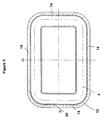
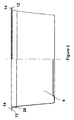
- the matching means 10 of the closure is not sealed to the whole of the flange 12 but rather to a raised beaded protrusion 14 which passes along the flange and is shown in Figures 2, 3 and 4 which show the body 4 in more detail.
- the overall shape of the body is similar to conventional container bodies for foodstuffs which in this case could be, for example, margarine but equally the container can be circular in plan or any other shape as required.
- the flange 12 is shown to be relatively wide but it is only the raised portion 14 which comes into contact to be sealed to the closure.
- the closure lip 10 may be provided with a protrusion instead of or in addition to that on the flange but this is not always necessary.
- the closure shown in Figure 5 provides a lip with an area to be sealed to the raised protrusion 14 of the container body.
- the provision of the protrusion allows any irregularities in the flange surface of the body and /or lip of the closure to be accommodated as, as the area of the protrusion is significantly less than the flange and the shape and linear nature of the same allows the protrusion to be sacrificially indented or flexed to an extent and without the application of additional pressure so as to allow the closure to be sealed at all points thereby providing a hygienic and complete seal as is required. Furthermore the provision of the protrusion ensures that this seal can be created without the need for an increase in the pressure applied and the resultant increase in the strength of seal formed as the flex or indentation of the protrusion allows for any irregularity in the surfaces to be sealed together.
- the protrusion can be indented to an extent to take into account surface irregularities. This is in contrast to conventional sealing procedures where it is necessary to increase the pressure applied and the strength of the seal formed to overcome irregularities as the faces which are sealed being relatively wide and planar cannot indent or flex and ensure that the seal with required integrity is formed. This can mean that the subsequent peelable removal of the closure from the body is not possible.
- the seal can be created and because the protrusion is significantly narrower than the flange so that the seal is significantly narrower than it would be if the closure was applied straight to the flange, the peelable removal of the closure is possible.
- Figure 5 illustrates that the closure can be provided with an internal flange 18 which allows the closure to be applied to close the body after the seal has been broken, and the internal flange contacts with the inner wall 20 of the body thus providing a friction fit which allows the container to be subsequently closed without the need for alteration to the body or the closure form.
- the container according to the invention allows a container to be provided which has a body and a closure, with the closure in the first instance sealed to the body thereby overcoming the need for any additional foil or plastic film sealing and is not altered in shape or form once the seal has been broken so as to allow the integrity of the closure and body to be maintained and also to allow the closure to be subsequently used to close the body.
- the provision of the protrusion defines the area on the flange which is to be joined to the closure more accurately than with the conventional sealing of the entire flange.
- an ultrasonic welding process can be used which, by causing friction by vibrating the two components, causes melting of the protrusion and the closure to join the same together.
- the use of ultrasonic welding in relation to plastic containers such as those for foodstuffs has never been considered as practical in the past due to the problems with thin walled containers having a tendency to flex during the ultrasonic welding process. This flexing can cause inconsistent contact but by providing the protrusion according to this invention, so the contact between the components is consistent and so ultrasonic welding is successful.
- the body of the container is held in a clamp and the closure is applied in position to be sealed to the body whereupon a face of a sonitrode of the ultrasonic apparatus is brought into contact with the outer surface of the closure.
- the sonitrode vibrates to cause a weld to be created between the protrusion and the closure and hence form the sealed container.
- the use of ultrasonic welding means that the join between the closure and the body can be formed in approximately half the time required to form the same join using heat sealing and therefore improvements in the efficiency and the quality of join are created.
- a further advantage of this invention is that the problems of using a heat sealing method to seal the closure to the body, said problems including the closure being welded to the body rather than simply to be sealed to be peelably removable, can be overcome.
Landscapes
- Engineering & Computer Science (AREA)
- Mechanical Engineering (AREA)
- Closures For Containers (AREA)
Applications Claiming Priority (2)
| Application Number | Priority Date | Filing Date | Title |
|---|---|---|---|
| GBGB9707473.6A GB9707473D0 (en) | 1997-04-12 | 1997-04-12 | Container assembly |
| GB9707473 | 1997-04-12 |
Publications (1)
| Publication Number | Publication Date |
|---|---|
| EP0870687A1 true EP0870687A1 (fr) | 1998-10-14 |
Family
ID=10810728
Family Applications (1)
| Application Number | Title | Priority Date | Filing Date |
|---|---|---|---|
| EP98106706A Withdrawn EP0870687A1 (fr) | 1997-04-12 | 1998-04-14 | Récipient avec couvercle |
Country Status (2)
| Country | Link |
|---|---|
| EP (1) | EP0870687A1 (fr) |
| GB (1) | GB9707473D0 (fr) |
Citations (4)
| Publication number | Priority date | Publication date | Assignee | Title |
|---|---|---|---|---|
| CH652369A5 (en) * | 1981-09-17 | 1985-11-15 | Aluminiumwerke Ag Rorschach | Container with reclosable tear-off lid |
| US4605142A (en) * | 1984-07-17 | 1986-08-12 | Toyo Seikan Kaisha, Ltd. | Synthetic resin vessel and heat sealed lid |
| WO1996015049A1 (fr) * | 1994-08-03 | 1996-05-23 | Gics & Vermee, L.P. | Recipient pour produit alimentaire |
| FR2736617A1 (fr) * | 1995-07-13 | 1997-01-17 | Pechiney Emballage Alimentaire | Procede d'inviolabilite de recipients munis de couvercles pelables et reutilisables |
-
1997
- 1997-04-12 GB GBGB9707473.6A patent/GB9707473D0/en active Pending
-
1998
- 1998-04-14 EP EP98106706A patent/EP0870687A1/fr not_active Withdrawn
Patent Citations (4)
| Publication number | Priority date | Publication date | Assignee | Title |
|---|---|---|---|---|
| CH652369A5 (en) * | 1981-09-17 | 1985-11-15 | Aluminiumwerke Ag Rorschach | Container with reclosable tear-off lid |
| US4605142A (en) * | 1984-07-17 | 1986-08-12 | Toyo Seikan Kaisha, Ltd. | Synthetic resin vessel and heat sealed lid |
| WO1996015049A1 (fr) * | 1994-08-03 | 1996-05-23 | Gics & Vermee, L.P. | Recipient pour produit alimentaire |
| FR2736617A1 (fr) * | 1995-07-13 | 1997-01-17 | Pechiney Emballage Alimentaire | Procede d'inviolabilite de recipients munis de couvercles pelables et reutilisables |
Also Published As
| Publication number | Publication date |
|---|---|
| GB9707473D0 (en) | 1997-05-28 |
Similar Documents
| Publication | Publication Date | Title |
|---|---|---|
| US3934749A (en) | Plastic container | |
| US5240133A (en) | Clamped-wave lid seal structure | |
| US4782951A (en) | Reclosable package and method of making reclosable package | |
| US5077064A (en) | Easy-open recloseable peggable package | |
| US5005707A (en) | Reclosable package | |
| US5050736A (en) | Reclosable package | |
| US4823961A (en) | Reclosable package | |
| US5107658A (en) | Method of making a reclosable package | |
| EP1069049A2 (fr) | Capuchon pour bouteilles en aluminium et/ou en acier | |
| JPS63500586A (ja) | 容器 | |
| JP2847077B2 (ja) | 容器底の気密密閉方法及び同方法により形成された円筒形容器 | |
| JPS61259948A (ja) | 任意選択の再閉手段を備えた容易開放式積層容器およびその製造方法 | |
| JPH0159182B2 (fr) | ||
| CA2879790C (fr) | Canettes metalliques a couvercles pelables | |
| US5074416A (en) | Package with recloseable board seal | |
| US5160391A (en) | Method for the formation of a clamped wave seal structure | |
| US5164208A (en) | Apparatus for the formation of a clamped wave lid seal structure | |
| US20100146911A1 (en) | Sealed plastic closure and method for making the same | |
| US4948441A (en) | Method and apparatus for fabrication of an openable container lid | |
| US20060191940A1 (en) | Sealing surfaces for container end panels | |
| US5887743A (en) | Process for covering cut edge of a container opening with protective layer | |
| JPS63503533A (ja) | 容器 | |
| JPH0248377Y2 (fr) | ||
| RU1816275C (ru) | Способ подготовки упаковочного материала, содержащего по меньшей мере один наружный слой термопластичного материала, к изготовлению упаковки с захватным элементом, предназначенной дл предварительно стерилизованных пищевых продуктов | |
| WO1999019226A1 (fr) | Emballage refermable pour produits alimentaires |
Legal Events
| Date | Code | Title | Description |
|---|---|---|---|
| PUAI | Public reference made under article 153(3) epc to a published international application that has entered the european phase |
Free format text: ORIGINAL CODE: 0009012 |
|
| AK | Designated contracting states |
Kind code of ref document: A1 Designated state(s): BE CH DE DK FR GB IT LI NL SE |
|
| AX | Request for extension of the european patent |
Free format text: AL;LT;LV;MK;RO;SI |
|
| 17P | Request for examination filed |
Effective date: 19990325 |
|
| AKX | Designation fees paid |
Free format text: BE CH DE DK FR GB IT LI NL SE |
|
| STAA | Information on the status of an ep patent application or granted ep patent |
Free format text: STATUS: THE APPLICATION IS DEEMED TO BE WITHDRAWN |
|
| 18D | Application deemed to be withdrawn |
Effective date: 20001102 |