EP0870807A1 - Mischungen von Reaktivfarbstoffen und deren Verwendung - Google Patents
Mischungen von Reaktivfarbstoffen und deren Verwendung Download PDFInfo
- Publication number
- EP0870807A1 EP0870807A1 EP98810272A EP98810272A EP0870807A1 EP 0870807 A1 EP0870807 A1 EP 0870807A1 EP 98810272 A EP98810272 A EP 98810272A EP 98810272 A EP98810272 A EP 98810272A EP 0870807 A1 EP0870807 A1 EP 0870807A1
- Authority
- EP
- European Patent Office
- Prior art keywords
- formula
- dye
- hal
- reactive
- radical
- Prior art date
- Legal status (The legal status is an assumption and is not a legal conclusion. Google has not performed a legal analysis and makes no representation as to the accuracy of the status listed.)
- Granted
Links
- 239000000203 mixture Substances 0.000 title claims abstract description 51
- 239000000985 reactive dye Substances 0.000 title claims description 41
- 239000000975 dye Substances 0.000 claims abstract description 117
- 229910052736 halogen Inorganic materials 0.000 claims abstract description 8
- 150000002367 halogens Chemical class 0.000 claims abstract description 8
- 238000004043 dyeing Methods 0.000 claims description 45
- 239000004952 Polyamide Substances 0.000 claims description 15
- 229920002647 polyamide Polymers 0.000 claims description 15
- 238000000034 method Methods 0.000 claims description 14
- 239000002657 fibrous material Substances 0.000 claims description 13
- 125000000956 methoxy group Chemical group [H]C([H])([H])O* 0.000 claims description 6
- 125000002496 methyl group Chemical group [H]C([H])([H])* 0.000 claims description 6
- WKBOTKDWSSQWDR-UHFFFAOYSA-N Bromine atom Chemical compound [Br] WKBOTKDWSSQWDR-UHFFFAOYSA-N 0.000 claims description 5
- GDTBXPJZTBHREO-UHFFFAOYSA-N bromine Substances BrBr GDTBXPJZTBHREO-UHFFFAOYSA-N 0.000 claims description 5
- 229910052794 bromium Inorganic materials 0.000 claims description 5
- 229910052739 hydrogen Inorganic materials 0.000 claims description 5
- 150000002431 hydrogen Chemical class 0.000 claims description 4
- 239000001257 hydrogen Substances 0.000 claims description 4
- 125000002887 hydroxy group Chemical group [H]O* 0.000 claims description 3
- ZAMOUSCENKQFHK-UHFFFAOYSA-N Chlorine atom Chemical compound [Cl] ZAMOUSCENKQFHK-UHFFFAOYSA-N 0.000 claims description 2
- 239000000460 chlorine Substances 0.000 claims description 2
- 229910052801 chlorine Inorganic materials 0.000 claims description 2
- IJGRMHOSHXDMSA-UHFFFAOYSA-N Atomic nitrogen Chemical compound N#N IJGRMHOSHXDMSA-UHFFFAOYSA-N 0.000 claims 2
- 229910052757 nitrogen Inorganic materials 0.000 claims 1
- 125000000664 diazo group Chemical group [N-]=[N+]=[*] 0.000 abstract description 2
- 239000000980 acid dye Substances 0.000 abstract 1
- 125000001424 substituent group Chemical group 0.000 abstract 1
- XLYOFNOQVPJJNP-UHFFFAOYSA-N water Substances O XLYOFNOQVPJJNP-UHFFFAOYSA-N 0.000 description 25
- QTBSBXVTEAMEQO-UHFFFAOYSA-N Acetic acid Chemical compound CC(O)=O QTBSBXVTEAMEQO-UHFFFAOYSA-N 0.000 description 20
- 210000002268 wool Anatomy 0.000 description 17
- 238000004040 coloring Methods 0.000 description 14
- HEMHJVSKTPXQMS-UHFFFAOYSA-M Sodium hydroxide Chemical compound [OH-].[Na+] HEMHJVSKTPXQMS-UHFFFAOYSA-M 0.000 description 12
- 229920000742 Cotton Polymers 0.000 description 11
- VEXZGXHMUGYJMC-UHFFFAOYSA-N Hydrochloric acid Chemical compound Cl VEXZGXHMUGYJMC-UHFFFAOYSA-N 0.000 description 10
- FAPWRFPIFSIZLT-UHFFFAOYSA-M Sodium chloride Chemical compound [Na+].[Cl-] FAPWRFPIFSIZLT-UHFFFAOYSA-M 0.000 description 10
- 235000002639 sodium chloride Nutrition 0.000 description 9
- 239000004744 fabric Substances 0.000 description 8
- 239000000835 fiber Substances 0.000 description 8
- 238000004519 manufacturing process Methods 0.000 description 8
- VMHLLURERBWHNL-UHFFFAOYSA-M Sodium acetate Chemical compound [Na+].CC([O-])=O VMHLLURERBWHNL-UHFFFAOYSA-M 0.000 description 7
- 239000002253 acid Substances 0.000 description 7
- 239000003795 chemical substances by application Substances 0.000 description 7
- 238000001816 cooling Methods 0.000 description 7
- 239000004753 textile Substances 0.000 description 7
- 239000000463 material Substances 0.000 description 6
- 239000011780 sodium chloride Substances 0.000 description 6
- 239000000725 suspension Substances 0.000 description 6
- -1 amine salt Chemical class 0.000 description 5
- 230000008878 coupling Effects 0.000 description 5
- 238000010168 coupling process Methods 0.000 description 5
- 238000005859 coupling reaction Methods 0.000 description 5
- 239000001048 orange dye Substances 0.000 description 5
- CDBYLPFSWZWCQE-UHFFFAOYSA-L Sodium Carbonate Chemical compound [Na+].[Na+].[O-]C([O-])=O CDBYLPFSWZWCQE-UHFFFAOYSA-L 0.000 description 4
- 150000001875 compounds Chemical class 0.000 description 4
- 238000010411 cooking Methods 0.000 description 4
- BDAGIHXWWSANSR-UHFFFAOYSA-N methanoic acid Natural products OC=O BDAGIHXWWSANSR-UHFFFAOYSA-N 0.000 description 4
- 238000002360 preparation method Methods 0.000 description 4
- 239000001632 sodium acetate Substances 0.000 description 4
- 235000017281 sodium acetate Nutrition 0.000 description 4
- JVMSQRAXNZPDHF-UHFFFAOYSA-N 2,4-diaminobenzenesulfonic acid Chemical compound NC1=CC=C(S(O)(=O)=O)C(N)=C1 JVMSQRAXNZPDHF-UHFFFAOYSA-N 0.000 description 3
- KIWBPDUYBMNFTB-UHFFFAOYSA-N Ethyl hydrogen sulfate Natural products CCOS(O)(=O)=O KIWBPDUYBMNFTB-UHFFFAOYSA-N 0.000 description 3
- 239000000654 additive Substances 0.000 description 3
- 239000003513 alkali Substances 0.000 description 3
- 239000011541 reaction mixture Substances 0.000 description 3
- OSWFIVFLDKOXQC-UHFFFAOYSA-N 4-(3-methoxyphenyl)aniline Chemical compound COC1=CC=CC(C=2C=CC(N)=CC=2)=C1 OSWFIVFLDKOXQC-UHFFFAOYSA-N 0.000 description 2
- QGZKDVFQNNGYKY-UHFFFAOYSA-N Ammonia Chemical compound N QGZKDVFQNNGYKY-UHFFFAOYSA-N 0.000 description 2
- USFZMSVCRYTOJT-UHFFFAOYSA-N Ammonium acetate Chemical compound N.CC(O)=O USFZMSVCRYTOJT-UHFFFAOYSA-N 0.000 description 2
- 229920003043 Cellulose fiber Polymers 0.000 description 2
- UFHFLCQGNIYNRP-UHFFFAOYSA-N Hydrogen Chemical compound [H][H] UFHFLCQGNIYNRP-UHFFFAOYSA-N 0.000 description 2
- UIIMBOGNXHQVGW-UHFFFAOYSA-M Sodium bicarbonate Chemical compound [Na+].OC([O-])=O UIIMBOGNXHQVGW-UHFFFAOYSA-M 0.000 description 2
- 235000019253 formic acid Nutrition 0.000 description 2
- 238000010438 heat treatment Methods 0.000 description 2
- 238000002156 mixing Methods 0.000 description 2
- QJGQUHMNIGDVPM-UHFFFAOYSA-N nitrogen group Chemical group [N] QJGQUHMNIGDVPM-UHFFFAOYSA-N 0.000 description 2
- 150000003839 salts Chemical class 0.000 description 2
- LPXPTNMVRIOKMN-UHFFFAOYSA-M sodium nitrite Chemical compound [Na+].[O-]N=O LPXPTNMVRIOKMN-UHFFFAOYSA-M 0.000 description 2
- RSIJVJUOQBWMIM-UHFFFAOYSA-L sodium sulfate decahydrate Chemical compound O.O.O.O.O.O.O.O.O.O.[Na+].[Na+].[O-]S([O-])(=O)=O RSIJVJUOQBWMIM-UHFFFAOYSA-L 0.000 description 2
- 125000000391 vinyl group Chemical group [H]C([*])=C([H])[H] 0.000 description 2
- 239000000080 wetting agent Substances 0.000 description 2
- RNFJDJUURJAICM-UHFFFAOYSA-N 2,2,4,4,6,6-hexaphenoxy-1,3,5-triaza-2$l^{5},4$l^{5},6$l^{5}-triphosphacyclohexa-1,3,5-triene Chemical compound N=1P(OC=2C=CC=CC=2)(OC=2C=CC=CC=2)=NP(OC=2C=CC=CC=2)(OC=2C=CC=CC=2)=NP=1(OC=1C=CC=CC=1)OC1=CC=CC=C1 RNFJDJUURJAICM-UHFFFAOYSA-N 0.000 description 1
- ZMCHBSMFKQYNKA-UHFFFAOYSA-N 2-aminobenzenesulfonic acid Chemical compound NC1=CC=CC=C1S(O)(=O)=O ZMCHBSMFKQYNKA-UHFFFAOYSA-N 0.000 description 1
- 239000005695 Ammonium acetate Substances 0.000 description 1
- LSNNMFCWUKXFEE-UHFFFAOYSA-M Bisulfite Chemical compound OS([O-])=O LSNNMFCWUKXFEE-UHFFFAOYSA-M 0.000 description 1
- 0 CC(C=CC=C1S(O)(=O)=O)(C=C1N=Nc(c(*)c(*)cc1N=Nc2ccc(*)cc2)c1N)NC Chemical compound CC(C=CC=C1S(O)(=O)=O)(C=C1N=Nc(c(*)c(*)cc1N=Nc2ccc(*)cc2)c1N)NC 0.000 description 1
- 244000025254 Cannabis sativa Species 0.000 description 1
- 235000012766 Cannabis sativa ssp. sativa var. sativa Nutrition 0.000 description 1
- 235000012765 Cannabis sativa ssp. sativa var. spontanea Nutrition 0.000 description 1
- 235000011777 Corchorus aestuans Nutrition 0.000 description 1
- 240000004792 Corchorus capsularis Species 0.000 description 1
- 235000010862 Corchorus capsularis Nutrition 0.000 description 1
- 239000004375 Dextrin Substances 0.000 description 1
- 229920001353 Dextrin Polymers 0.000 description 1
- 102000020897 Formins Human genes 0.000 description 1
- 108091022623 Formins Proteins 0.000 description 1
- DGAQECJNVWCQMB-PUAWFVPOSA-M Ilexoside XXIX Chemical compound C[C@@H]1CC[C@@]2(CC[C@@]3(C(=CC[C@H]4[C@]3(CC[C@@H]5[C@@]4(CC[C@@H](C5(C)C)OS(=O)(=O)[O-])C)C)[C@@H]2[C@]1(C)O)C)C(=O)O[C@H]6[C@@H]([C@H]([C@@H]([C@H](O6)CO)O)O)O.[Na+] DGAQECJNVWCQMB-PUAWFVPOSA-M 0.000 description 1
- WHXSMMKQMYFTQS-UHFFFAOYSA-N Lithium Chemical compound [Li] WHXSMMKQMYFTQS-UHFFFAOYSA-N 0.000 description 1
- 229920002292 Nylon 6 Polymers 0.000 description 1
- ZLMJMSJWJFRBEC-UHFFFAOYSA-N Potassium Chemical compound [K] ZLMJMSJWJFRBEC-UHFFFAOYSA-N 0.000 description 1
- 239000004902 Softening Agent Substances 0.000 description 1
- 229920000615 alginic acid Polymers 0.000 description 1
- 235000010443 alginic acid Nutrition 0.000 description 1
- 229910021529 ammonia Inorganic materials 0.000 description 1
- 235000019257 ammonium acetate Nutrition 0.000 description 1
- 229940043376 ammonium acetate Drugs 0.000 description 1
- 150000003863 ammonium salts Chemical class 0.000 description 1
- 239000002518 antifoaming agent Substances 0.000 description 1
- 239000000872 buffer Substances 0.000 description 1
- 235000009120 camo Nutrition 0.000 description 1
- 229920002678 cellulose Polymers 0.000 description 1
- 239000001913 cellulose Substances 0.000 description 1
- 229920003086 cellulose ether Polymers 0.000 description 1
- 235000005607 chanvre indien Nutrition 0.000 description 1
- 235000019425 dextrin Nutrition 0.000 description 1
- 238000006193 diazotization reaction Methods 0.000 description 1
- KZTYYGOKRVBIMI-UHFFFAOYSA-N diphenyl sulfone Chemical compound C=1C=CC=CC=1S(=O)(=O)C1=CC=CC=C1 KZTYYGOKRVBIMI-UHFFFAOYSA-N 0.000 description 1
- 239000000834 fixative Substances 0.000 description 1
- 239000003063 flame retardant Substances 0.000 description 1
- 239000011487 hemp Substances 0.000 description 1
- 229910052744 lithium Inorganic materials 0.000 description 1
- 239000010446 mirabilite Substances 0.000 description 1
- 230000020477 pH reduction Effects 0.000 description 1
- 239000004014 plasticizer Substances 0.000 description 1
- 229910052700 potassium Inorganic materials 0.000 description 1
- 239000011591 potassium Substances 0.000 description 1
- 239000011814 protection agent Substances 0.000 description 1
- 239000004627 regenerated cellulose Substances 0.000 description 1
- 230000002940 repellent Effects 0.000 description 1
- 239000005871 repellent Substances 0.000 description 1
- 229910052708 sodium Inorganic materials 0.000 description 1
- 239000011734 sodium Substances 0.000 description 1
- 235000017557 sodium bicarbonate Nutrition 0.000 description 1
- 229910000030 sodium bicarbonate Inorganic materials 0.000 description 1
- 235000017550 sodium carbonate Nutrition 0.000 description 1
- 229910000029 sodium carbonate Inorganic materials 0.000 description 1
- 235000010288 sodium nitrite Nutrition 0.000 description 1
- 239000007921 spray Substances 0.000 description 1
- 238000003756 stirring Methods 0.000 description 1
- 239000000126 substance Substances 0.000 description 1
- 125000000020 sulfo group Chemical group O=S(=O)([*])O[H] 0.000 description 1
- 239000002562 thickening agent Substances 0.000 description 1
- GSEJCLTVZPLZKY-UHFFFAOYSA-O triethanolammonium Chemical class OCC[NH+](CCO)CCO GSEJCLTVZPLZKY-UHFFFAOYSA-O 0.000 description 1
- 238000005406 washing Methods 0.000 description 1
- 235000020681 well water Nutrition 0.000 description 1
- 239000002349 well water Substances 0.000 description 1
Classifications
-
- C—CHEMISTRY; METALLURGY
- C09—DYES; PAINTS; POLISHES; NATURAL RESINS; ADHESIVES; COMPOSITIONS NOT OTHERWISE PROVIDED FOR; APPLICATIONS OF MATERIALS NOT OTHERWISE PROVIDED FOR
- C09B—ORGANIC DYES OR CLOSELY-RELATED COMPOUNDS FOR PRODUCING DYES, e.g. PIGMENTS; MORDANTS; LAKES
- C09B62/00—Reactive dyes, i.e. dyes which form covalent bonds with the substrates or which polymerise with themselves
- C09B62/44—Reactive dyes, i.e. dyes which form covalent bonds with the substrates or which polymerise with themselves with the reactive group not directly attached to a heterocyclic ring
- C09B62/465—Reactive dyes, i.e. dyes which form covalent bonds with the substrates or which polymerise with themselves with the reactive group not directly attached to a heterocyclic ring the reactive group being an acryloyl group, a quaternised or non-quaternised aminoalkyl carbonyl group or a (—N)n—CO—A—O—X or (—N)n—CO—A—Hal group, wherein A is an alkylene or alkylidene group, X is hydrogen or an acyl radical of an organic or inorganic acid, Hal is a halogen atom, and n is 0 or 1
- C09B62/47—Azo dyes
- C09B62/475—Disazo or polyazo dyes
-
- C—CHEMISTRY; METALLURGY
- C09—DYES; PAINTS; POLISHES; NATURAL RESINS; ADHESIVES; COMPOSITIONS NOT OTHERWISE PROVIDED FOR; APPLICATIONS OF MATERIALS NOT OTHERWISE PROVIDED FOR
- C09B—ORGANIC DYES OR CLOSELY-RELATED COMPOUNDS FOR PRODUCING DYES, e.g. PIGMENTS; MORDANTS; LAKES
- C09B62/00—Reactive dyes, i.e. dyes which form covalent bonds with the substrates or which polymerise with themselves
- C09B62/44—Reactive dyes, i.e. dyes which form covalent bonds with the substrates or which polymerise with themselves with the reactive group not directly attached to a heterocyclic ring
- C09B62/443—Reactive dyes, i.e. dyes which form covalent bonds with the substrates or which polymerise with themselves with the reactive group not directly attached to a heterocyclic ring the reactive group being alternatively specified
- C09B62/447—Azo dyes
- C09B62/453—Disazo or polyazo dyes
-
- C—CHEMISTRY; METALLURGY
- C09—DYES; PAINTS; POLISHES; NATURAL RESINS; ADHESIVES; COMPOSITIONS NOT OTHERWISE PROVIDED FOR; APPLICATIONS OF MATERIALS NOT OTHERWISE PROVIDED FOR
- C09B—ORGANIC DYES OR CLOSELY-RELATED COMPOUNDS FOR PRODUCING DYES, e.g. PIGMENTS; MORDANTS; LAKES
- C09B67/00—Influencing the physical, e.g. the dyeing or printing properties of dyestuffs without chemical reactions, e.g. by treating with solvents grinding or grinding assistants, coating of pigments or dyes; Process features in the making of dyestuff preparations; Dyestuff preparations of a special physical nature, e.g. tablets, films
- C09B67/0033—Blends of pigments; Mixtured crystals; Solid solutions
- C09B67/0046—Mixtures of two or more azo dyes
- C09B67/0055—Mixtures of two or more disazo dyes
- C09B67/0057—Mixtures of two or more reactive disazo dyes
- C09B67/0059—Mixtures of two or more reactive disazo dyes all the reactive groups are not directly attached to a heterocyclic system
-
- D—TEXTILES; PAPER
- D06—TREATMENT OF TEXTILES OR THE LIKE; LAUNDERING; FLEXIBLE MATERIALS NOT OTHERWISE PROVIDED FOR
- D06P—DYEING OR PRINTING TEXTILES; DYEING LEATHER, FURS OR SOLID MACROMOLECULAR SUBSTANCES IN ANY FORM
- D06P1/00—General processes of dyeing or printing textiles, or general processes of dyeing leather, furs, or solid macromolecular substances in any form, classified according to the dyes, pigments, or auxiliary substances employed
- D06P1/38—General processes of dyeing or printing textiles, or general processes of dyeing leather, furs, or solid macromolecular substances in any form, classified according to the dyes, pigments, or auxiliary substances employed using reactive dyes
- D06P1/384—General processes of dyeing or printing textiles, or general processes of dyeing leather, furs, or solid macromolecular substances in any form, classified according to the dyes, pigments, or auxiliary substances employed using reactive dyes reactive group not directly attached to heterocyclic group
Definitions
- the present invention relates to mixtures of reactive dyes, in particular for Dyeing or printing nitrogen-containing or hydroxyl-containing fiber materials are suitable and dyeings or prints with good general fastness properties surrender.
- the leaving group U is, for example, -Cl, -Br, -F, -OSO 3 H, -SSO 3 H, -OCO-CH 3 , -OPO 3 H 2 , -OCO-C 6 H 5 , -OSO 2 -C 1 -C 4 alkyl or -OSO 2 -N (C 1 -C 4 alkyl) 2 into consideration.
- U is preferably a group of the formula -Cl, -OSO 3 H, -SSO 3 H, -OCO-CH 3 , -OCO-C 6 H 5 or -OPO 3 H 2 , in particular -Cl or OSO 3 H and particularly preferred -OSO 3 H.
- Hal preferably represents chlorine or bromine, especially bromine.
- n and n are preferably each independently the number 0 or 1. Particular the sum of m and n is preferably the number 0 or 1. m is very particularly preferred and n is the number 0.
- p and q are preferably the number 0.
- the radicals X 1 and X 2 are preferably each independently a radical of the formula (3a) or (3c). At least one of the radicals X 1 and X 2 particularly preferably denotes a radical of the formula (3a). X 1 and X 2 very particularly preferably represent a radical of the formula (3a). U here is in particular the remainder -OSO 3 H.
- the sum of m and n is preferably the number 0 or 1, in particular m and n are the number 0.
- radicals X 3 and X 4 are preferably each independently a radical of the formula (3a) or (3c). X 3 and X 4 are particularly preferably a radical of the formula (3a). U is in particular the radical -OSO 3 H.
- p and q preferably denote the number 0.
- Preferred dye mixtures are those in which X 1 , X 2 , X 3 and X 4 are a radical of the formula (3a) or (3c), U is the radical -OSO 3 H, and the sum of m and n is the number 0 or 1 is.
- Hal is preferably bromine.
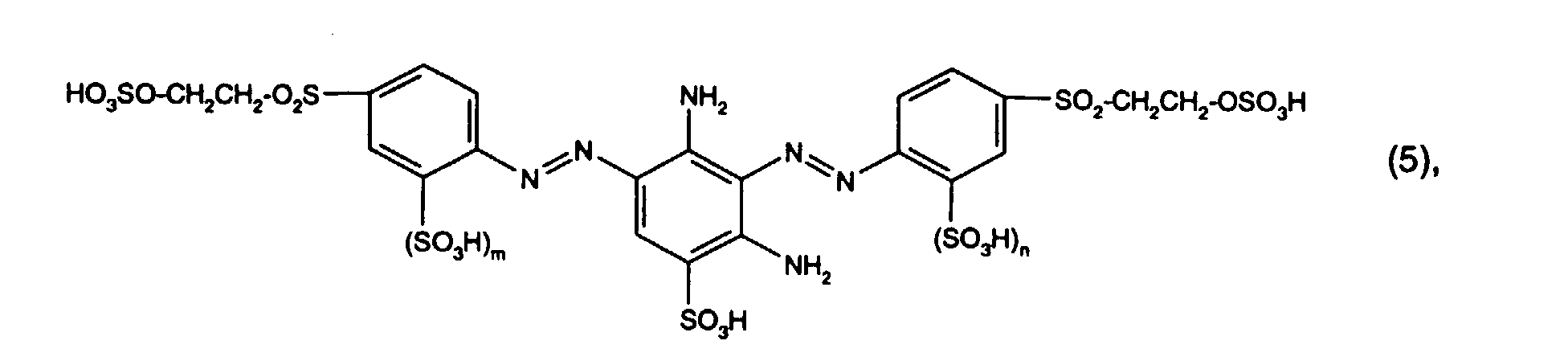
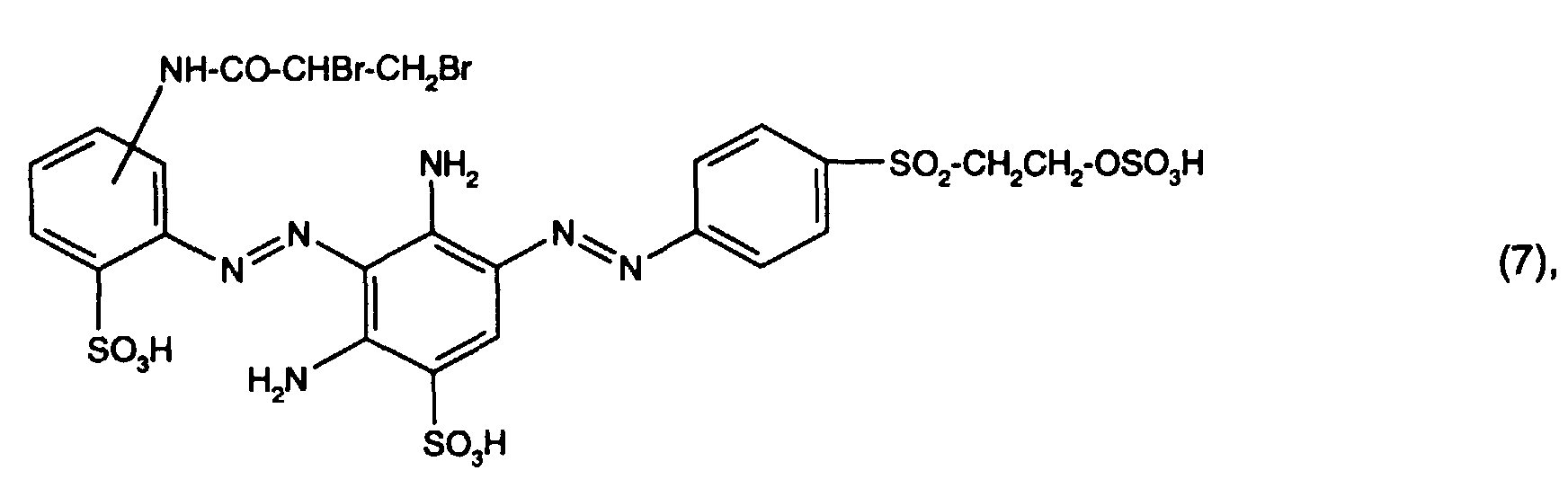
- the reactive dyes of the formula (1) are those of the formulas and in particular those of the formula (5) or (6) and preferably those of the formula (5) are preferred.
- the meanings and preferences given above apply to m and n.
- the sum of m and n is preferably the number 0 or 1.
- the reactive dyes of the formula (2) are those of the formulas and in particular those of the formula (8) are preferred.
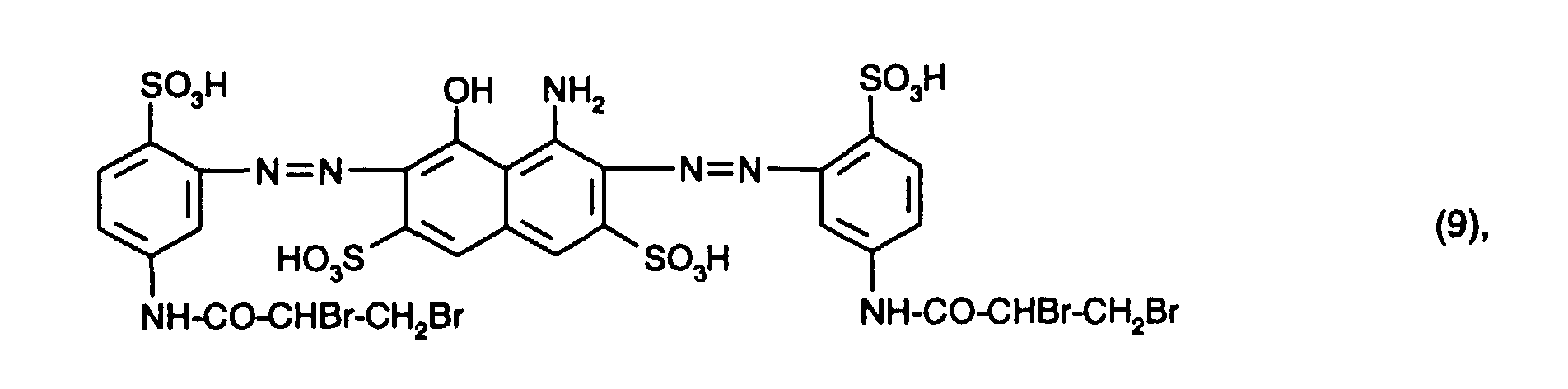
- Dye mixtures which have at least one reactive dye are particularly preferred of the formulas (5), (6) and (7) together with at least one reactive dye of the formulas (8) and (9) included.
- the sum of m and n is preferably the number 0 or 1. In particular, m and n are the number 0.
- Dye mixtures which have at least one are very particularly preferred Reactive dye of the formula (5) together with at least one reactive dye Contain formulas (8).
- the sum of m and n is preferably the number 0 or 1. In particular, m and n are the number 0.
- dye mixtures which have at least one reactive dye of the formula (6) or (7), in particular of the formula (6), together with at least one Contain reactive dye of the formulas (8).
- the dye mixtures according to the invention can be used in addition to those mentioned above Reactive dyes further dyes, in particular further reactive dyes Shading included.
- Substantial amounts of reactive dyes of the formula (4) are e.g. Amounts above of 5 percent by weight, based on the total weight of the dye mixture understand.
- the dye mixtures according to the invention preferably do not contain any substantial amounts of a reactive dye of the formula (4), particularly preferably none Reactive dye of the formula (4).
- the above weight ratio of the dye of the formula (1) to that Dye of the formula (4a) is preferably greater than 3: 1, in particular greater than 4: 1 and particularly preferably greater than 6: 1. This is very particularly preferred Weight ratio greater than 10: 1, preferably greater than 20: 1 and in particular greater than 40: 1.
- the present invention also relates to reactive dyes of the formula wherein for m, n, X 1 and X 2 the meanings given above under formula (1) apply and one of the radicals X 1 and X 2 denotes a radical of the formula (3a), (3b), (3c) or (3d) and the other of the radicals X 1 and X 2 represents a radical of the formula (3c) or (3d).
- the preferences given above apply to m, n, X 1 and X 2 .
- the reactive dyes of the formula (1a) the preferences given above for the reactive dyes of the formula (1) apply.
- the present invention furthermore relates to a process for the preparation of the reactive dyes of the formula (1a), which is characterized in that compounds of the formulas diazotized and in any order on a coupling component of the formula couples.
- the diazotization can be carried out in a manner known per se, e.g. with sodium nitrite in one aqueous, hydrochloric acid medium.
- the coupling can also be carried out according to known methods take place, e.g. at a temperature of 0 to 30 ° C and a pH of, for example, 3 until 6.
- the reactive dyes of the formula (2) are known or can be used in analogy to known ones Procedure can be obtained.
- Reactive dyes of the formula (1) can be used analogously to the information for the preparation of the reactive dyes of the formula (1a) can be obtained.
- the reactive dyes of the formulas (1), (2) and (1a) contain sulfo groups, each of which either in the form of the free sulfonic acid or preferably as its salt, e.g. as Sodium, lithium, potassium, ammonium salt or as an organic amine salt, e.g. as Triethanolammonium salt.
- the reactive dyes of the formulas (1), (2) and (1a) and thus the dye mixtures can also contain other additives, e.g. Table salt or dextrin, contain.
- the dyes of formulas (1) and (2) are in the dye mixture e.g. in the Weight ratio of 1:99 to 99: 1, preferably 5:95 to 95: 5 and particularly preferred 10:90 to 90:10, before.
- the dye mixtures according to the invention can e.g. by mixing the Individual dyes are produced. This mixing process takes place e.g. in suitable mills, e.g. Ball or pin mills, as well as in kneaders or mixers.
- Another object of the invention relates to a method for dyeing or printing of hydroxyl-containing or nitrogen-containing fiber materials with the Dye mixtures according to the invention or the reactive dyes according to the invention of the formula (1a).
- fiber materials come e.g. the natural cellulose fibers such as cotton, linen, Jute or hemp, as well as modified cellulose fibers such as cellulose or regenerated cellulose in question.
- the dye mixtures or Dyes for dyeing or printing natural polyamide fiber materials e.g. Silk or wool
- synthetic polyamide fiber materials e.g. Polyamide 6 or polyamide 6.6
- wool and synthetic polyamide blends e.g. Polyamide 6 or polyamide 6.6
- the inventive Dye mixtures or dyes are particularly suitable for dyeing or printing of natural polyamide fiber materials, in particular wool or chlorinated or machine washable wool.
- the textile fiber material mentioned can be in a wide variety of processing forms are present, e.g. as fiber, yarn, flake, woven or knitted fabric.
- the dye mixtures or dyes according to the invention are suitable for the customary ones Dyeing and printing processes and can be applied to the fiber material in various ways apply and fix, especially in the form of aqueous dye solutions or printing pastes. They are suitable for the exhaust process as well as for foulard dyeing, after which the goods with aqueous, possibly saline dye solutions is impregnated, and the dyes after an alkali treatment or in the presence of Alkali, if necessary under the influence of heat.
- the inventive Dye mixtures or dyes are also for the so-called cold residence process suitable, after which the dye is applied to the foulard together with the alkali and is then fixed by storing for several hours at room temperature.
- the dyeing of natural and synthetic polyamide fiber materials, especially of Wool preferably carried out using the pull-out method, at a pH of approx. 3 to 7, especially 3 to 5, and at temperatures of e.g. 70 to 120 ° C and especially 90 to 105 ° C.
- the dyeing liquors or printing pastes can be used in addition to water and the dyes of the formulas (1) and (2) or the formula (1a) further additives, e.g. known shading dyes, Salts, buffer substances, wetting agents, anti-foaming agents, leveling agents or the Agents influencing properties of the textile material, e.g. Plasticizers, Additives for flame retardant or dirt, water and oil repellent agents as well water softening agents and natural or synthetic thickeners, e.g. Alginates or Cellulose ether.
- additives e.g. known shading dyes, Salts, buffer substances, wetting agents, anti-foaming agents, leveling agents or the Agents influencing properties of the textile material, e.g. Plasticizers, Additives for flame retardant or dirt, water and oil repellent agents as well water softening agents and natural or synthetic thickeners, e.g. Alginates or Cellulose ether.
- the dye mixtures or dyes according to the invention result in level dyeings and Prints with good general fastness properties, especially good washing, rubbing, wet, wet rubbing and Lightfastness. Draw the dye mixtures or dyes according to the invention also by uniform color structure, good mounting behavior and high degrees of fixation out. Furthermore, in the dye mixtures or dyes according to the invention the usual aftertreatment of the dyeings and prints with so-called fixatives to be dispensed with.
- parts represent parts by weight.
- the temperatures are Celsius degrees.
- the relationship between parts by weight and parts by volume is the same as the one between grams and cubic centimeters.
- Production Example 1 A suspension of 8.70 parts of diazotized 5- (2,3-dibromopropionamido) is added to a hydrochloric acid suspension of 3.95 parts of 1,3-phenylenediamine-4-sulfonic acid in 25 parts of water within 30 minutes with ice cooling. aniline-2-sulfonic acid in 90 parts of water. After two hours at a temperature of 5 ° C., the temperature is raised to 15 ° C. and the reaction mixture is stirred at this temperature for 15 hours.
- Production Examples 2 to 8 The dyes indicated in the following Table 1 in column 2 in the form of the free acid can be obtained analogously to the information in Production Example 1.
- the dyes listed in Table 1 dye wool, synthetic polyamide or cotton in orange shades.
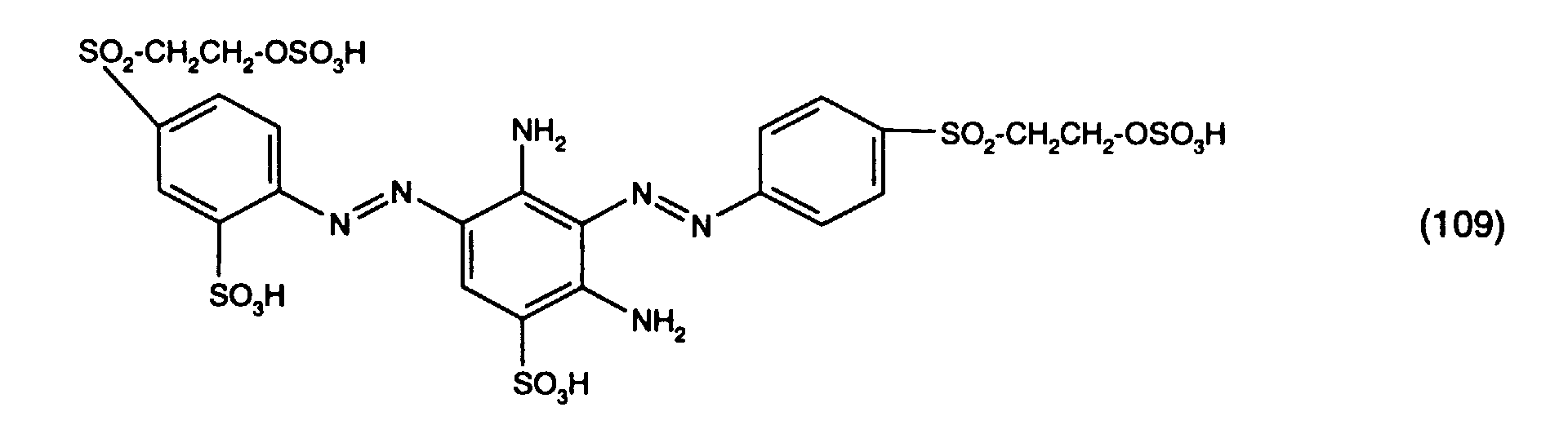
- Preparation Example 9 5.58 parts of diazotized 4-amino-3-sulfo (2-sulfatoethyl) phenyl sulfone in 36 parts of water are added to a hydrochloric acid suspension of 2.82 parts of 1,3-phenylenediamine-4-sulfonic acid in 16 parts of water metered in over an hour at a temperature of 0 to 5 ° C with ice cooling. After the coupling has ended, 4.22 parts of diazotized 2- (4-aminophenylsulfonyl) ethyl hydrogen sulfate in 35 parts of water are added at a temperature of 0 to 5 ° C. With approx.
- the dye of the formula given in the form of the free acid can be prepared in an analogous manner to the information in Preparation Example 9 be obtained, which dyes wool, synthetic polyamide or cotton in orange shades.
- Production Example 10 3.8 parts of 1,3-phenylenediamine-4-sulfonic acid are dissolved at a temperature of 50 ° C. in 13 parts of water with the addition of 2.8 parts of an aqueous sodium hydroxide solution (30%) at a pH of 7 . After adding 20 parts of ice and 3 parts of sodium acetate, a cold hydrochloric acid suspension of 12 parts of diazotized 2- (4-aminophenylsulfonyl) ethyl hydrogen sulfate in 100 parts of water is metered in with vigorous stirring. The pH is kept at a value of 4 with aqueous sodium hydroxide solution (30%) and is increased to a value of 4.5 after the addition of the diazo suspension has ended. After the coupling has ended, the reaction mixture is spray-dried. A dye is obtained which is in the form of the free acid of the compound of the formula corresponds.
- the dye of formula (110) dyes wool, synthetic polyamide or cotton in orange shades.
- Production Examples 11 to 22 The dyes indicated in the following Table 2 in column 2 in the form of the free acid can be obtained analogously to the information in Production Example 10.
- the dyes listed in Table 2 dye wool, synthetic polyamide or cotton in orange shades.
- Production Examples 23 to 32 The dyes indicated in the following Table 3 in column 2 in the form of the free acid can be obtained analogously to the information in Production Example 10.
- the dyes listed in Table 3 dye wool, synthetic polyamide or cotton in orange shades.
- the pH of the liquor is 4.5.
- the textile is treated in the dyeing liquor at 40 ° C. for 5 minutes, then heated to a cooking temperature (98 ° C) at a rate of 1 ° / min and 90 Minutes colored at this temperature. After cooling the liquor to 80 ° C Coloring rinsed and finished as usual. You get a fiber and surface shelf black coloring with good fastness properties.
- Dyeing Examples 2 to 10 The procedure is as in Dyeing Example 1, but instead of 0.36 g of the blue-dyeing dye of the formula (123) and 0.04 g of the orange-dyeing dye of the formula (101), the column 4 in Table 4 below is used 2 specified dye mixtures or dyes in the amounts given there, analog fiber and flat dyeings are obtained with good fastness properties. In the case of dyeing examples 2 to 8, black dyeings are obtained, and in the case of dyeing examples 9 and 10, orange dyeings are obtained.
- the pH of the liquor is 4.7.
- the textile material is in the dyeing liquor at 40 ° C for 5 minutes treated, then heated to 60 ° C at a rate of 1 ° / min and 20 minutes at 60 ° C held. The mixture is then heated to 1 ° / min to the cooking temperature (98 ° C) and 90 minutes colored at this temperature. After cooling, the textile material becomes fresh Fleet containing 5 g / l of sodium hydrogen carbonate for 20 minutes at 80 ° C. and pH 8.3 treated. Then it is rinsed as usual and the last rinsing bath is acidified with 1% Formic acid, based on the fiber weight, added. You get a fiber and flat black coloring with good fastness properties.
- 0.36 g of the blue-coloring can be used instead of the dye mixture Dye of formula (123) and 0.04 g of the orange dye of formula (101) a dye mixture according to one of the dyeing examples 2 to 8 or a dye according to Coloring example 9 or 10 can be used.
- the pH of the liquor is 4.7.
- the material is in the dye liquor at 40 ° C for 5 minutes treated, then with a heating rate of 1 ° C / min to cooking temperature (98 ° C) warmed and dyed at this temperature for 90 minutes. After the liquor has cooled to 80 ° C the dyeing is rinsed and finished as usual. You get a fiber and flat black coloring with good fastness properties.
- 0.36 g of the blue-coloring can be used instead of the dye mixture Dye of formula (123) and 0.04 g of the orange dye of formula (101) a dye mixture according to one of the dyeing examples 2 to 8 or a dye according to Coloring example 9 or 10 can be used.
- the dye liquor is treated for 5 minutes at 40 ° C. and then at a heating rate of 1 ° C./ heated to 70 ° C for min and held at 70 ° C for 15 minutes. The mixture is then heated to cooking temperature (98 ° C.) at 1 ° / min and dyed at this temperature for 90 minutes.
- the textile material is treated in a fresh liquor adjusted to pH 8.5 with 35 g of 35% ammonia for 20 minutes at 80 ° C. Then it is rinsed as usual and 1% formic acid, based on the fiber weight, is added to the last rinsing bath for acidification. A fiber-like and flat black dyeing with good fastness properties is obtained.
- Dyeing example 14 If the procedure described in dyeing example 13 is followed, an additional 4% by weight, based on the textile material, of a commercially available wool protection agent (Irgasol HTW®) is added to the dyeing liquor, dyeing is carried out at 105 ° C. and the dyeing time is reduced to 45 min. a fiber and flat black coloring with good fastness properties is also obtained.
- a commercially available wool protection agent Irgasol HTW®
- Dyeing example 15 A dye bath containing 5.1 parts of the dye of the formula (125), 0.9 part of the dye of the formula (109) and 60 parts of sodium chloride in 1000 parts of water is carried out at a temperature of 60 ° C. with 100 parts of a cotton fabric. After 45 minutes at 60 ° C, 20 parts of soda ash are added. The temperature of the dyebath is kept at 60 ° C. for a further 45 minutes. The dyed fabric is then rinsed and dried in the usual way.
- Dyeing Example 16 In a dyebath which contains 1.2 parts of the dye of the formula (125), 1.2 parts of the dye of the formula (110), 3.6 parts of the dye of the formula and contains 30 parts of sodium chloride in 1000 parts of water, 100 parts of a cotton fabric are used at a temperature of 30 ° C. The temperature of the dyebath is raised to 90 ° C. within 30 minutes and held for a further 45 minutes. The temperature is then reduced to 70 ° C. in about 15 minutes, 15 parts of calcined soda are added, and the temperature of the dyebath is kept at 70 ° C. for a further 45 minutes. The dyed fabric is then rinsed and dried in the usual way.
- Dyeing Example 17 In a dyebath containing 2.7 parts of the dye of the formula (125), 0.9 part of the dye of the formula (110), 2.4 parts of the dye of the formula and contains 90 parts of sodium chloride in 1000 parts of water, 100 parts of a cotton fabric are used at a temperature of 30 ° C. The temperature of the dyebath is kept for 20 minutes and then raised to 80 ° C. in about 40 minutes. Then 20 parts of calcined soda are added, and the temperature of the dyebath is kept at 80 ° C. for a further 45 minutes. The dyed fabric is then rinsed and dried in the usual way.
Landscapes
- Chemical & Material Sciences (AREA)
- Organic Chemistry (AREA)
- Chemical Kinetics & Catalysis (AREA)
- Engineering & Computer Science (AREA)
- Textile Engineering (AREA)
- Coloring (AREA)
- Paper (AREA)
Abstract
Description


mit der Massgabe, dass die Farbstoffmischungen keine wesentliche Menge eines Reaktivfarbstoffes der Formel

oder, falls die Farbstoffmischungen einen Farbstoff der Formel




für m, n, X1 und X2 die oben unter Formel (1) angegebenen Bedeutungen gelten und einer der Reste X1 und X2 einen Rest der Formel (3a), (3b), (3c) oder (3d) bedeutet und der andere der Reste X1 und X2 einen Rest der Formel (3c) oder (3d) bedeutet. Für m, n, X1 und X2 gelten hierbei die oben angegebenen Bevorzugungen. Für die Reaktivfarbstoffe der Formel (1a) gelten die oben für die Reaktivfarbstoffe der Formel (1) angegebenen Bevorzugungen.




Nach Zugabe einer Lösung, die 36 g des blaufärbenden Farbstoffs der Formel (123) und 4 g des orangefärbenden Farbstoffs der Formel (101) enthält, wird in der Färbeflotte 5 Minuten bei 40°C behandelt und dann mit einer Aufheizrate von 1°C/min auf 70°C erwärmt und 15 Minuten bei 70°C gehalten. Anschliessend wird mit 1°/min auf Kochtemperatur (98°C) erwärmt und 90 Minuten bei dieser Temperatur gefärbt. Nach dem Abkühlen wird das Textilmaterial in einer frischen mit 35 g 35%igem Ammoniak auf pH 8,5 gestellten Flotte 20 Minuten bei 80°C behandelt. Dann wird wie üblich gespült und dem letzten Spülbad zum Absäuem 1% Ameisensäure, bezogen auf das Fasergewicht, zugesetzt. Man erhält eine faser- und flächenegale schwarze Färbung mit guten Echtheitseigenschaften.


Claims (16)
- Farbstoffmischungen, dadurch gekennzeichnet, dass sie mindestens einen Reaktivfarbstoff der Formelzusammen mit mindestens einem Reaktivfarbstoff der Formel
 enthalten, worin
 bedeuten und U eine Abgangsgruppe und Hal Halogen ist,m und n unabhängig voneinander jeweils die Zahl 0, 1 oder 2,p und q unabhängig voneinander jeweils die Zahl 0 oder 1 sind undX1, X2, X3 und X4 unabhängig voneinander jeweils einen Rest der Formel
mit der Massgabe, dass die Farbstoffmischungen keine wesentliche Menge eines Reaktivfarbstoffes der Formelenthalten, worin R1 und R2 Wasserstoff, Methyl oder Methoxy sind und X ein Rest der obigen Formel (3a) oder (3b) ist,
oder, falls die Farbstoffmischungen einen Farbstoff der Formelenthalten, worin R1' und R2' Wasserstoff, Methyl oder Methoxy sind und X' ein Rest der obigen Formel (3a) oder (3b) ist, das Gewichtsverhältnis des Farbstoffs der Formel (1) zu dem Farbstoff der Formel (4a) grösser als 2:1 ist.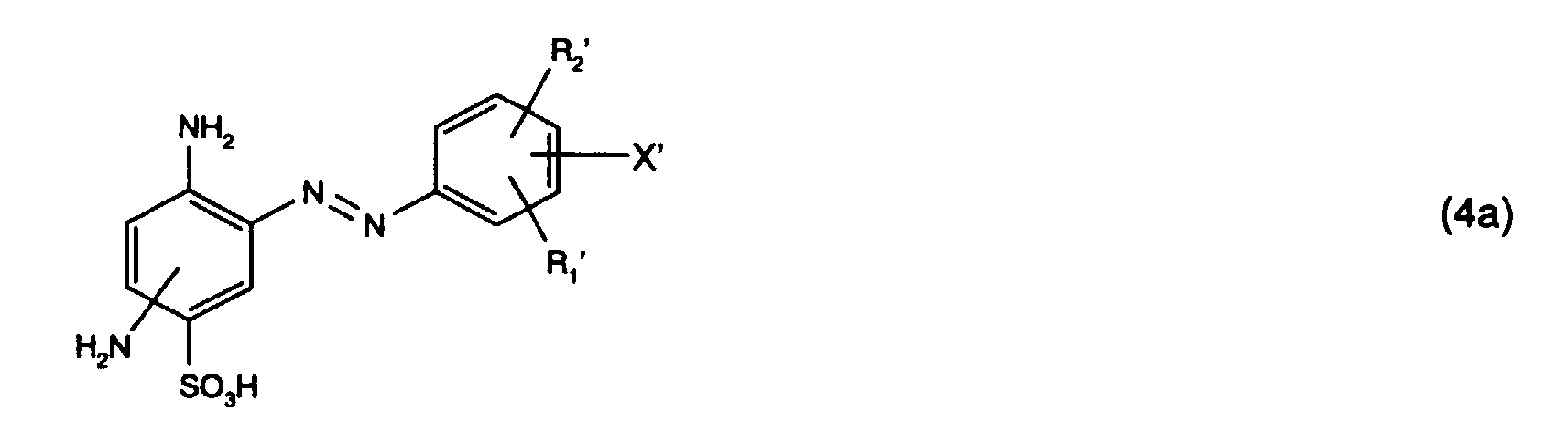
- Farbstoffmischungen gemäss Anspruch 1, dadurch gekennzeichnet, dass Hal Chlor oder Brom ist.
- Farbstoffmischungen gemäss einem der Ansprüche 1 und 2, dadurch gekennzeichnet, dass Hal Brom ist.
- Farbstoffmischungen gemäss einem der Ansprüche 1 bis 3, dadurch gekennzeichnet, dass U -Cl, -Br, -F, -OSO3H, -SSO3H, -OCO-CH3, -OPO3H2, -OCO-C6H5, -OSO2-C1-C4-Alkyl oder -OSO2-N(C1-C4-Alkyl)2 ist.
- Farbstoffmischungen gemäss einem der Ansprüche 1 bis 4, dadurch gekennzeichnet, dass U -Cl oder -OSO3H, insbesondere -OSO3H, ist.
- Farbstoffmischungen gemäss einem der Ansprüche 1 bis 5, dadurch gekennzeichnet, dass X1 und X2 unabhängig voneinander jeweils ein Rest der Formel (3a) oder (3c) sind.
- Farbstoffmischungen gemäss einem der Ansprüche 1 bis 6, dadurch gekennzeichnet, dass X3 und X4 unabhängig voneinander jeweils ein Rest der Formel (3a) oder (3c) sind.
- Farbstoffmischungen gemäss einem der Ansprüche 1 bis 7, dadurch gekennzeichnet, dass X1, X2, X3 und X4 ein Rest der Formel (3a) oder (3c) sind und U der Rest -OSO3H ist, und die Summe von m und n die Zahl 0 oder 1 ist.
- Farbstoffmischungen gemäss Anspruch 1, dadurch gekennzeichnet, dass sie mindestens einen Reaktivfarbstoff der Formeln (5), (6) und (7)

 zusammen mit mindestens einem Reaktivfarbstoff der Formeln (8) und (9)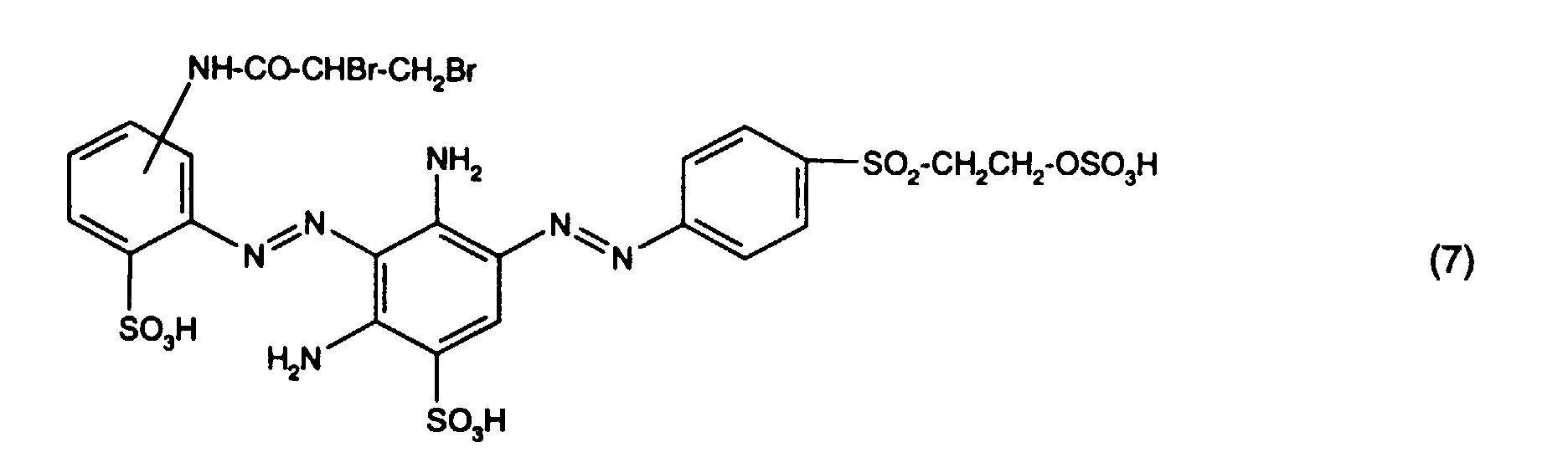
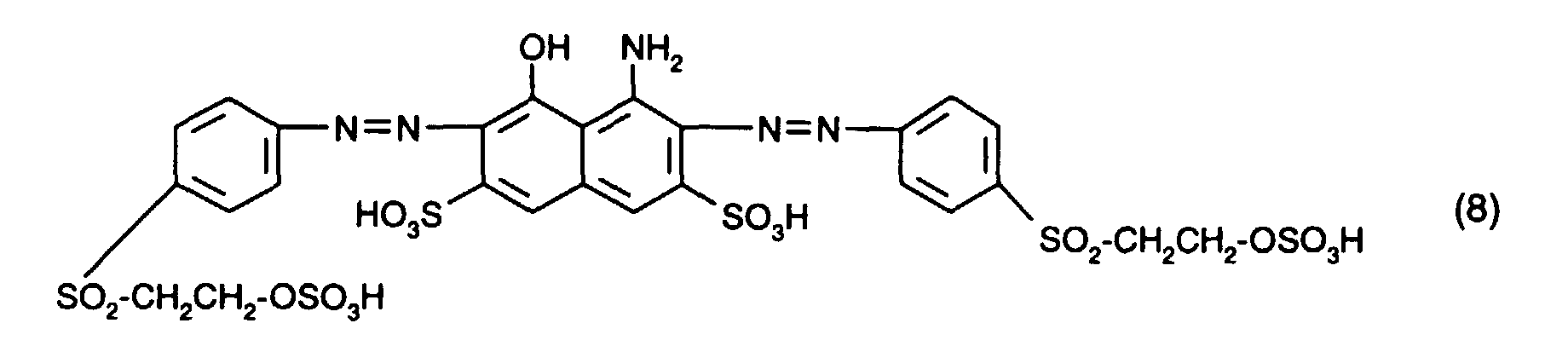 enthalten, wobei die Summe von m und n die Zahl 0 oder 1 ist.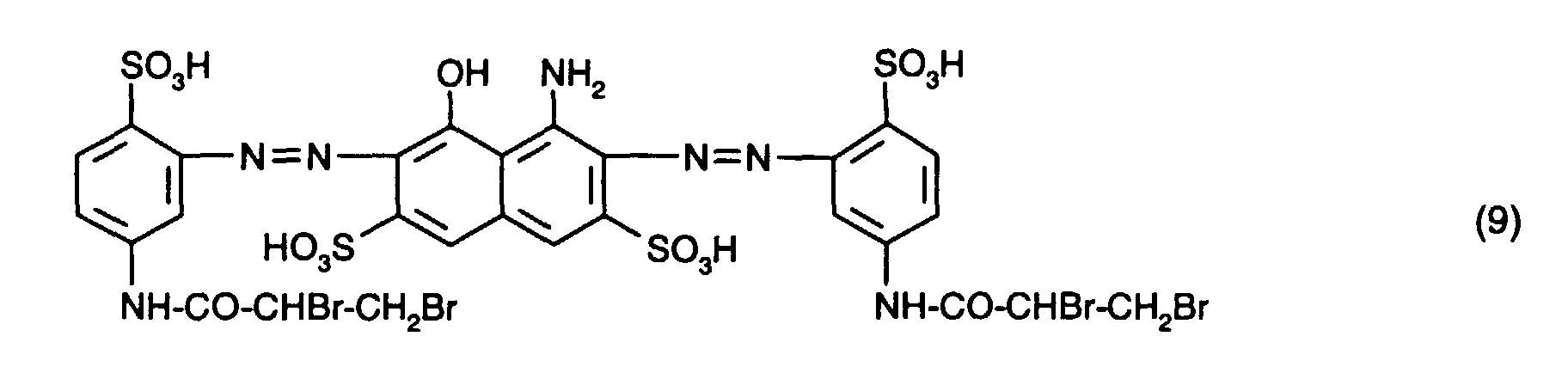
- Farbstoffmischungen gemäss Anspruch 9, dadurch gekennzeichnet, dass sie einen Reaktivfarbstoff der Formel (5) zusammen mit einem Reaktivfarbstoff der Formel (8) enthalten.
- Farbstoffmischungen gemäss Anspruch 1, dadurch gekennzeichnet, dass sie keine wesentliche Menge eines Reaktivfarbstoffes der Formel (4) enthalten.
- Farbstoffmischungen gemäss Anspruch 1, dadurch gekennzeichnet, dass, falls die Farbstoffmischungen einen Farbstoff der Formel (4a) enthalten, das Gewichtsverhältnis des Farbstoffs der Formel (1) zu dem Farbstoff der Formel (4a) grösser als 4:1 ist.
- Verfahren zum Färben oder Bedrucken von natürlichen oder synthetischen Polyamidfasermaterialen, dadurch gekennzeichnet, dass man
eine Farbstoffmischung verwendet, welche mindestens einen Reaktivfarbstoff der Formelzusammen mit mindestens einem Reaktivfarbstoff der Formel enthält, worin
 bedeuten und U eine Abgangsgruppe und Hal Halogen ist.m und n unabhängig voneinander jeweils die Zahl 0, 1 oder 2,p und q unabhängig voneinander jeweils die Zahl 0 oder 1 sind undX1, X2, X3 und X4 unabhängig voneinander jeweils einen Rest der Formel
 - Verwendung der Farbstoffmischungen gemäss einem der Ansprüche 1 bis 12 zum Färben oder Bedrucken von hydroxylgruppenhaltigem oder stickstoffhaltigem Fasermaterial.
- Verwendung gemäss Anspruch 14 zum Färben oder Bedrucken von cellulosischem Fasermaterial.
- Reaktivfarbstoffe der Formelworin
 und der andere der Reste X1 und X2 einen Rest der Formel (3c) oder (3d) bedeutet, und U eine Abgangsgruppe und Hal Halogen ist.m und n unabhängig voneinander jeweils die Zahl 0, 1 oder 2 bedeuten,
einer der Reste X1 und X2 einen Rest der Formel
Applications Claiming Priority (3)
| Application Number | Priority Date | Filing Date | Title |
|---|---|---|---|
| CH806/97 | 1997-04-07 | ||
| CH80697 | 1997-04-07 | ||
| CH80697 | 1997-04-07 |
Publications (2)
| Publication Number | Publication Date |
|---|---|
| EP0870807A1 true EP0870807A1 (de) | 1998-10-14 |
| EP0870807B1 EP0870807B1 (de) | 2001-07-11 |
Family
ID=4195626
Family Applications (1)
| Application Number | Title | Priority Date | Filing Date |
|---|---|---|---|
| EP98810272A Expired - Lifetime EP0870807B1 (de) | 1997-04-07 | 1998-03-30 | Mischungen von Reaktivfarbstoffen und deren Verwendung |
Country Status (12)
| Country | Link |
|---|---|
| US (1) | US5849887A (de) |
| EP (1) | EP0870807B1 (de) |
| JP (1) | JP4244076B2 (de) |
| KR (1) | KR100533181B1 (de) |
| CN (1) | CN1084769C (de) |
| DE (1) | DE59800980D1 (de) |
| ES (1) | ES2159929T3 (de) |
| ID (1) | ID20526A (de) |
| MY (1) | MY116247A (de) |
| PT (1) | PT870807E (de) |
| SG (1) | SG68660A1 (de) |
| TW (1) | TW473516B (de) |
Cited By (26)
| Publication number | Priority date | Publication date | Assignee | Title |
|---|---|---|---|---|
| EP0969051A1 (de) * | 1998-06-30 | 2000-01-05 | Ciba SC Holding AG | Mischungen von Reaktivfarbstoffen und deren Verwendung |
| EP0974621A1 (de) * | 1998-07-21 | 2000-01-26 | DyStar Textilfarben GmbH & Co. Deutschland KG | Marineblaue MIschungen von faserreaktiven Azofarbstoffen |
| EP0976792A1 (de) * | 1998-07-28 | 2000-02-02 | DyStar Textilfarben GmbH & Co. Deutschland KG | Schwarze Mischungen von faserreaktiven Farbstoffen |
| EP1035173A3 (de) * | 1999-03-09 | 2000-09-20 | DyStar Textilfarben GmbH & Co. Deutschland KG | Schwarze Farbstoffmischungen von faserreaktiven Azofarbstoffen und ihre Verwendung zum Färben von hydroxy- und/oder carbonamidgruppenhaltigem Fasermaterial |
| EP1048695A1 (de) * | 1999-04-30 | 2000-11-02 | DyStar Textilfarben GmbH & Co. Deutschland KG | Schwarze Farbstoffmischungen von faserreaktiven Azofarbstoffen,deren Herstellungsverfahren und deren Verwendung zum Färben von hydroxy- und/oder carbonamidgruppenhaltigem Fasermaterial |
| WO2001000736A3 (en) * | 1999-06-24 | 2001-05-03 | Basf Ag | Reactive dye mixtures |
| WO2002053653A3 (en) * | 2000-12-29 | 2002-11-14 | Dystar Textilfarben Gmbh & Co | Black dye mixtures of fiber-reactive azo dyes, methods for their preparation and use thereof for dyeing hydroxy- and/or carboxamido-containing fiber material |
| WO2002098989A1 (de) * | 2001-06-02 | 2002-12-12 | Dystar Textilfarben Gmbh & Co. Deutschland Kg | Farbstoffmischungen von faserrektiven azofarbstoffen und ihre verwendung |
| WO2003080739A1 (de) | 2002-03-22 | 2003-10-02 | Dystar Textilfarben Gmbh & Co. Deutschland Kg | Farbstoffmischungen von faserreaktiven azofarbstoffen, ihre herstellung und ihre verwendung |
| EP1234858A3 (de) * | 2001-02-27 | 2003-11-26 | Everlight USA, Inc. | Reaktivfarbstoffmischungen und deren Verwendung |
| WO2005080508A1 (en) * | 2004-02-13 | 2005-09-01 | Ciba Specialty Chemicals Holding Inc. | Mixtures of reactive dyes and their use |
| EP1669415A1 (de) * | 2004-11-29 | 2006-06-14 | Everlight USA, Inc. | Farbstoffmischung und deren Verwendung |
| CN1312226C (zh) * | 2004-09-22 | 2007-04-25 | 上海科华染料工业有限公司 | 一种复合活性黑染料 |
| CN1322066C (zh) * | 2004-09-22 | 2007-06-20 | 上海科华染料工业有限公司 | 一种复合活性黑染料 |
| WO2007039573A3 (en) * | 2005-10-05 | 2007-11-29 | Dystar Textilfarben Gmbh & Co | Azo reactive dyes and mixtures of fiber-reactive azo dyes, their preparation and their use |
| WO2007115960A3 (en) * | 2006-04-07 | 2008-03-06 | Clariant Int Ltd | Acid dyes |
| WO2010066570A3 (en) * | 2008-12-09 | 2010-09-16 | Dystar Colours Deutschland Gmbh | Fiber-reactive azo dyes and dye mixtures, preparation thereof and use thereof |
| US8349029B2 (en) | 2008-12-09 | 2013-01-08 | Dystar Colours Deutschland Gmbh | Fiber-reactive azo dyes and dye mixtures, preparation thereof and use thereof |
| WO2013021352A2 (en) | 2011-08-10 | 2013-02-14 | Colourtex Industries Limited | Black mixtures of fibre reactive azo reactive dyestuffs |
| EP2725070A1 (de) | 2012-10-25 | 2014-04-30 | DyStar Colours Distribution GmbH | Mischungen aus faserreaktiven Azo-Farbstoffen, Herstellung und Verwendung |
| EP2725068A1 (de) | 2012-10-25 | 2014-04-30 | DyStar Colours Distribution GmbH | Mischungen von faserreaktiven Azo-Farbstoffen, Herstellung und Verwendung |
| EP2725069A1 (de) | 2012-10-25 | 2014-04-30 | DyStar Colours Distribution GmbH | Mischungen aus faserreaktiven Azo-Farbstoffen, Herstellung und Verwendung |
| WO2014063824A1 (en) | 2012-10-25 | 2014-05-01 | Dystar Colours Distribution Gmbh | Mixtures of fiber-reactive azo dyes, their preparation and their use |
| WO2015028499A1 (en) * | 2013-08-29 | 2015-03-05 | Dystar Colours Distribution Gmbh | Dye mixtures of reactive dyes, production and use |
| CN105566946A (zh) * | 2015-12-22 | 2016-05-11 | 浙江亿得化工有限公司 | 复合毛用活性蓝染料及其制备方法 |
| US10138596B2 (en) | 2012-10-25 | 2018-11-27 | Dystar Colours Distribution Gmbh | Mixtures of fiber-reactive azo dyes, their preparation and their use |
Families Citing this family (21)
| Publication number | Priority date | Publication date | Assignee | Title |
|---|---|---|---|---|
| JP2001139835A (ja) | 1999-09-16 | 2001-05-22 | Ciba Specialty Chem Holding Inc | アクリロイルアミノ置換染料の付加生成物、その調製法及び用途 |
| US6159251A (en) * | 1999-10-05 | 2000-12-12 | Dystar Textilfarbon Gmbh & Co. Deutschland Kg | Dye mixtures of fiber-reactive azo dyes and use thereof for dyeing material containing hydroxy-and/or carboxamido groups |
| WO2003080741A1 (de) * | 2002-03-22 | 2003-10-02 | Dystar Textilfarben Gmbh & Co. Deutschland Kg | Farbstoffmischungen von faserreaktiven azofarbstoffen, deren herstellung und ihre verwendung |
| EP1685197A2 (de) * | 2003-11-18 | 2006-08-02 | Ciba SC Holding AG | Mischungen von reaktionsfarbstoffen und deren verwendung |
| CN1317336C (zh) * | 2004-09-16 | 2007-05-23 | 明德国际仓储贸易(上海)有限公司 | 季铵盐双偶氮反应性染料及其应用 |
| CN100413930C (zh) * | 2005-08-31 | 2008-08-27 | 明德国际仓储贸易(上海)有限公司 | 反应性染料组成物及其应用 |
| KR100686977B1 (ko) | 2006-04-14 | 2007-02-26 | (주)경인양행 | 반응성 염료 화합물 및 그 제조방법 |
| JP5165880B2 (ja) * | 2006-11-06 | 2013-03-21 | ユニチカトレーディング株式会社 | 涼感性獣毛繊維布帛及びそれを用いてなるフォーマル衣料 |
| CN101235219B (zh) * | 2007-02-01 | 2010-09-08 | 明德国际仓储贸易(上海)有限公司 | 应用于纺织品数字印染的黑色染料组成物及墨水组成物 |
| CN101117449B (zh) * | 2007-09-04 | 2012-05-16 | 大连理工大学 | 一种高浓度复合活性染料 |
| CN102115614B (zh) * | 2009-12-30 | 2013-05-29 | 上海雅运纺织化工股份有限公司 | 藏青色活性染料组合物及其在纤维上的染色应用 |
| TWI444437B (zh) * | 2010-06-18 | 2014-07-11 | Everlight Chem Ind Corp | 藍色、紅色及黃色染料化合物及所組成之黑色墨水組成物 |
| CN103044960A (zh) * | 2010-08-27 | 2013-04-17 | 天津德凯化工股份有限公司 | 一种染料活性兰及其制备方法 |
| JP5805416B2 (ja) * | 2011-03-29 | 2015-11-04 | オー・ジー長瀬カラーケミカル株式会社 | セルロース繊維用染料組成物、及びセルロース繊維を含む染色物を製造する方法 |
| CN102504577A (zh) * | 2011-09-29 | 2012-06-20 | 天津德凯化工股份有限公司 | 一种黑色活性染料 |
| WO2013087400A2 (en) * | 2011-12-14 | 2013-06-20 | Huntsman Advanced Materials (Switzerland) Gmbh | Azo dyes |
| CN103013176B (zh) * | 2013-01-05 | 2014-12-10 | 江苏德美科化工有限公司 | 一种高性能绿色活性染料混合物及其应用 |
| CN104119693A (zh) * | 2013-04-28 | 2014-10-29 | 浙江科永化工有限公司 | 一种橙色活性染料化合物及其应用 |
| CN104513497A (zh) * | 2013-09-27 | 2015-04-15 | 浙江科永化工有限公司 | 一种活性黑染料组合物 |
| CN103571231A (zh) * | 2013-11-07 | 2014-02-12 | 褚平忠 | 具有高固色率的深黑色活性染料 |
| CN104263007B (zh) * | 2014-08-20 | 2016-04-06 | 张家港市振新印染有限公司 | 一种高日晒牢度活性染料 |
Citations (4)
| Publication number | Priority date | Publication date | Assignee | Title |
|---|---|---|---|---|
| DE2032927A1 (de) * | 1970-07-03 | 1972-01-05 | Farbwerke Hoechst AG vormals Meister Lucius & Brüning, 6000 Frankfurt | Wasserlösliche, metallhaltige Disazofarbstoffe und Verfahren zu ihrer Herstellung |
| EP0600322A2 (de) * | 1992-11-28 | 1994-06-08 | Hoechst Aktiengesellschaft | Schwarze Farbstoffmischungen von faserreaktiven Azofarbstoffen und ihre Verwendung zum Färben von hydroxy- und/oder carbonamidgruppenhaltigem Fasermaterial |
| EP0735112A2 (de) * | 1995-03-30 | 1996-10-02 | Hoechst Aktiengesellschaft | Farbstoffmischungen von faserreaktiven Azofarbstoffen und ihre Verwendung zum Färben von hydroxy- und/oder carbonamidgruppenhaltigem Fasermaterial |
| DE19620415A1 (de) * | 1995-09-16 | 1997-03-20 | Everlight Chem Ind Corp | Schwarze Reaktivfarbstoff-Zusammensetzung |
Family Cites Families (2)
| Publication number | Priority date | Publication date | Assignee | Title |
|---|---|---|---|---|
| TW279889B (de) * | 1993-10-07 | 1996-07-01 | Ciba Geigy Ag | |
| MY117759A (en) * | 1996-01-19 | 2004-08-30 | Ciba Sc Holding Ag | Reactive dyes their preparation and use. |
-
1998
- 1998-03-27 SG SG1998000641A patent/SG68660A1/en unknown
- 1998-03-30 PT PT98810272T patent/PT870807E/pt unknown
- 1998-03-30 EP EP98810272A patent/EP0870807B1/de not_active Expired - Lifetime
- 1998-03-30 MY MYPI98001391A patent/MY116247A/en unknown
- 1998-03-30 DE DE59800980T patent/DE59800980D1/de not_active Expired - Lifetime
- 1998-03-30 US US09/050,280 patent/US5849887A/en not_active Expired - Lifetime
- 1998-03-30 ES ES98810272T patent/ES2159929T3/es not_active Expired - Lifetime
- 1998-04-03 ID IDP980505A patent/ID20526A/id unknown
- 1998-04-03 JP JP09049198A patent/JP4244076B2/ja not_active Expired - Fee Related
- 1998-04-04 TW TW087105129A patent/TW473516B/zh not_active IP Right Cessation
- 1998-04-06 CN CN98106332A patent/CN1084769C/zh not_active Expired - Fee Related
- 1998-04-07 KR KR1019980012197A patent/KR100533181B1/ko not_active Expired - Fee Related
Patent Citations (4)
| Publication number | Priority date | Publication date | Assignee | Title |
|---|---|---|---|---|
| DE2032927A1 (de) * | 1970-07-03 | 1972-01-05 | Farbwerke Hoechst AG vormals Meister Lucius & Brüning, 6000 Frankfurt | Wasserlösliche, metallhaltige Disazofarbstoffe und Verfahren zu ihrer Herstellung |
| EP0600322A2 (de) * | 1992-11-28 | 1994-06-08 | Hoechst Aktiengesellschaft | Schwarze Farbstoffmischungen von faserreaktiven Azofarbstoffen und ihre Verwendung zum Färben von hydroxy- und/oder carbonamidgruppenhaltigem Fasermaterial |
| EP0735112A2 (de) * | 1995-03-30 | 1996-10-02 | Hoechst Aktiengesellschaft | Farbstoffmischungen von faserreaktiven Azofarbstoffen und ihre Verwendung zum Färben von hydroxy- und/oder carbonamidgruppenhaltigem Fasermaterial |
| DE19620415A1 (de) * | 1995-09-16 | 1997-03-20 | Everlight Chem Ind Corp | Schwarze Reaktivfarbstoff-Zusammensetzung |
Cited By (40)
| Publication number | Priority date | Publication date | Assignee | Title |
|---|---|---|---|---|
| EP0969051A1 (de) * | 1998-06-30 | 2000-01-05 | Ciba SC Holding AG | Mischungen von Reaktivfarbstoffen und deren Verwendung |
| US6319291B1 (en) | 1998-07-21 | 2001-11-20 | Dystar Textilfarben Gmbh & Co. | Navy-blue dye mixture of fiber-reactive azo dyes |
| EP0974621A1 (de) * | 1998-07-21 | 2000-01-26 | DyStar Textilfarben GmbH & Co. Deutschland KG | Marineblaue MIschungen von faserreaktiven Azofarbstoffen |
| EP0976792A1 (de) * | 1998-07-28 | 2000-02-02 | DyStar Textilfarben GmbH & Co. Deutschland KG | Schwarze Mischungen von faserreaktiven Farbstoffen |
| EP1035173A3 (de) * | 1999-03-09 | 2000-09-20 | DyStar Textilfarben GmbH & Co. Deutschland KG | Schwarze Farbstoffmischungen von faserreaktiven Azofarbstoffen und ihre Verwendung zum Färben von hydroxy- und/oder carbonamidgruppenhaltigem Fasermaterial |
| EP1048695A1 (de) * | 1999-04-30 | 2000-11-02 | DyStar Textilfarben GmbH & Co. Deutschland KG | Schwarze Farbstoffmischungen von faserreaktiven Azofarbstoffen,deren Herstellungsverfahren und deren Verwendung zum Färben von hydroxy- und/oder carbonamidgruppenhaltigem Fasermaterial |
| WO2001000736A3 (en) * | 1999-06-24 | 2001-05-03 | Basf Ag | Reactive dye mixtures |
| US6800099B2 (en) | 1999-06-24 | 2004-10-05 | Dystar Textilfarben Gmbh & Co. Deutschland Kg | Reactive dye mixtures |
| WO2002053653A3 (en) * | 2000-12-29 | 2002-11-14 | Dystar Textilfarben Gmbh & Co | Black dye mixtures of fiber-reactive azo dyes, methods for their preparation and use thereof for dyeing hydroxy- and/or carboxamido-containing fiber material |
| US6623534B2 (en) | 2000-12-29 | 2003-09-23 | Dystar Textilfarben Gmbh & Co. Deutschland Kg | Black dye mixtures of fiber-reactive azo dyes, methods for their preparation and use thereof for dyeing hydroxy-and/or carboxamido-containing fiber material |
| US6870035B2 (en) | 2000-12-29 | 2005-03-22 | Dystar Textilfarben Gmbh & Co. Deutschland Kg | Black dye mixtures of fiber-reactive azo dyes, methods for their preparation and use thereof for dyeing hydroxy-and/or carboxamido-containing fiber material |
| EP1234858A3 (de) * | 2001-02-27 | 2003-11-26 | Everlight USA, Inc. | Reaktivfarbstoffmischungen und deren Verwendung |
| WO2002098989A1 (de) * | 2001-06-02 | 2002-12-12 | Dystar Textilfarben Gmbh & Co. Deutschland Kg | Farbstoffmischungen von faserrektiven azofarbstoffen und ihre verwendung |
| US7455699B2 (en) | 2002-03-22 | 2008-11-25 | Dystar Texilfarben Gmbh & Co. Deutschland Kg | Dye mixtures of fiber-reactive azo dyes, their preparation and use |
| WO2003080739A1 (de) | 2002-03-22 | 2003-10-02 | Dystar Textilfarben Gmbh & Co. Deutschland Kg | Farbstoffmischungen von faserreaktiven azofarbstoffen, ihre herstellung und ihre verwendung |
| US7708786B2 (en) | 2002-03-22 | 2010-05-04 | Dystar Textilfarben Gmbh & Co. Deutschland Kg | Dye mixtures of fiber-reactive azo dyes, their preparation and use |
| WO2005080508A1 (en) * | 2004-02-13 | 2005-09-01 | Ciba Specialty Chemicals Holding Inc. | Mixtures of reactive dyes and their use |
| CN1312226C (zh) * | 2004-09-22 | 2007-04-25 | 上海科华染料工业有限公司 | 一种复合活性黑染料 |
| CN1322066C (zh) * | 2004-09-22 | 2007-06-20 | 上海科华染料工业有限公司 | 一种复合活性黑染料 |
| EP1669415A1 (de) * | 2004-11-29 | 2006-06-14 | Everlight USA, Inc. | Farbstoffmischung und deren Verwendung |
| WO2007039573A3 (en) * | 2005-10-05 | 2007-11-29 | Dystar Textilfarben Gmbh & Co | Azo reactive dyes and mixtures of fiber-reactive azo dyes, their preparation and their use |
| US8080101B2 (en) | 2005-10-05 | 2011-12-20 | Dystar Colours Deutschland Gmbh | Azo reactive dyes and mixtures of fiber-reactive azo dyes, their preparation and their use |
| WO2007115960A3 (en) * | 2006-04-07 | 2008-03-06 | Clariant Int Ltd | Acid dyes |
| US8137416B2 (en) | 2006-04-07 | 2012-03-20 | Clariant Finance (Bvi) Limited | Acid dyes |
| WO2010066570A3 (en) * | 2008-12-09 | 2010-09-16 | Dystar Colours Deutschland Gmbh | Fiber-reactive azo dyes and dye mixtures, preparation thereof and use thereof |
| US8349029B2 (en) | 2008-12-09 | 2013-01-08 | Dystar Colours Deutschland Gmbh | Fiber-reactive azo dyes and dye mixtures, preparation thereof and use thereof |
| WO2013021352A2 (en) | 2011-08-10 | 2013-02-14 | Colourtex Industries Limited | Black mixtures of fibre reactive azo reactive dyestuffs |
| EP2725070A1 (de) | 2012-10-25 | 2014-04-30 | DyStar Colours Distribution GmbH | Mischungen aus faserreaktiven Azo-Farbstoffen, Herstellung und Verwendung |
| EP2725068A1 (de) | 2012-10-25 | 2014-04-30 | DyStar Colours Distribution GmbH | Mischungen von faserreaktiven Azo-Farbstoffen, Herstellung und Verwendung |
| EP2725069A1 (de) | 2012-10-25 | 2014-04-30 | DyStar Colours Distribution GmbH | Mischungen aus faserreaktiven Azo-Farbstoffen, Herstellung und Verwendung |
| WO2014063824A1 (en) | 2012-10-25 | 2014-05-01 | Dystar Colours Distribution Gmbh | Mixtures of fiber-reactive azo dyes, their preparation and their use |
| US10190255B2 (en) | 2012-10-25 | 2019-01-29 | Dystar Colours Distribution Gmbh | Mixtures of fiber-reactive azo dyes, their preparation and their use |
| US10138596B2 (en) | 2012-10-25 | 2018-11-27 | Dystar Colours Distribution Gmbh | Mixtures of fiber-reactive azo dyes, their preparation and their use |
| AU2014314257B2 (en) * | 2013-08-29 | 2017-11-23 | Dystar Colours Distribution Gmbh | Dye mixtures of reactive dyes, production and use |
| CN105745282A (zh) * | 2013-08-29 | 2016-07-06 | 德司达染料分销有限公司 | 活性染料混合物,及其制备方法和应用 |
| CN105745282B (zh) * | 2013-08-29 | 2017-06-23 | 德司达染料分销有限公司 | 活性染料混合物,及其制备方法和应用 |
| AU2014314257C1 (en) * | 2013-08-29 | 2018-04-26 | Dystar Colours Distribution Gmbh | Dye mixtures of reactive dyes, production and use |
| EP2862902A1 (de) | 2013-08-29 | 2015-04-22 | DyStar Colours Distribution GmbH | Farbstoffmischungen aus metallfreien Reaktivfarbstoffen, Herstellung und Verwendung |
| WO2015028499A1 (en) * | 2013-08-29 | 2015-03-05 | Dystar Colours Distribution Gmbh | Dye mixtures of reactive dyes, production and use |
| CN105566946A (zh) * | 2015-12-22 | 2016-05-11 | 浙江亿得化工有限公司 | 复合毛用活性蓝染料及其制备方法 |
Also Published As
| Publication number | Publication date |
|---|---|
| DE59800980D1 (de) | 2001-08-16 |
| KR19980081141A (ko) | 1998-11-25 |
| ES2159929T3 (es) | 2001-10-16 |
| JP4244076B2 (ja) | 2009-03-25 |
| SG68660A1 (en) | 1999-11-16 |
| CN1195678A (zh) | 1998-10-14 |
| TW473516B (en) | 2002-01-21 |
| MY116247A (en) | 2003-12-31 |
| HK1015812A1 (en) | 1999-10-22 |
| ID20526A (id) | 1999-01-07 |
| JPH10279827A (ja) | 1998-10-20 |
| CN1084769C (zh) | 2002-05-15 |
| PT870807E (pt) | 2001-12-28 |
| KR100533181B1 (ko) | 2006-03-22 |
| US5849887A (en) | 1998-12-15 |
| EP0870807B1 (de) | 2001-07-11 |
Similar Documents
| Publication | Publication Date | Title |
|---|---|---|
| EP0870807B1 (de) | Mischungen von Reaktivfarbstoffen und deren Verwendung | |
| EP0094055A1 (de) | Monoazoverbindungen, Verfahren zu ihrer Herstellung und ihre Verwendung als Farbstoffe | |
| EP0979849B1 (de) | Farbstoffmischung von wasserlöslichen faserreaktiven Azofarbstoffen, Verfahren zu ihrer Herstellung und ihre Verwendung | |
| EP0036582B1 (de) | Wasserlösliche Azoverbindungen, Verfahren zu ihrer Herstellung und ihre Verwendung als Farbstoffe | |
| EP0719841B1 (de) | Farbstoffmischung von wasserlöslichen faserreaktiven Azofarbstoffen, Verfahren zu ihrer Herstellung und ihre Verwendung | |
| DE60101903T2 (de) | Faserreaktive disazoverbindungen | |
| EP0887386B1 (de) | Verfahren zum Färben oder Bedrucken von cellulosehaltigen Fasermaterialien und neue Reaktivfarbstoffe | |
| EP0957137B1 (de) | Farbstoffmischung von wasserlöslichen faserreaktiven Azofarbstoffen, Verfahren zu ihrer Herstellung und ihre Verwendung | |
| EP0775730B1 (de) | Reaktivfarbstoffe, Verfahren zu deren Herstellung und deren Verwendung | |
| EP0718374B1 (de) | 1:2-Chromkomplexfarbstoffe enthaltende Farbstoffmischungen und 1:2 Chromkomplexfarbstoffe | |
| EP0169457A1 (de) | Wasserlösliche Pyridon-Monoazoverbindungen, Verfahren zu ihrer Herstellung und ihre Verwendung als Farbstoffe | |
| EP0775731B1 (de) | Reaktivfarbstoffe, Verfahren zu deren Herstellung und deren Verwendung | |
| EP0629666A1 (de) | Wasserlösliche Azoverbindungen, Verfahren zu ihrer Herstellung und ihre Verwendung als Farbstoffe | |
| DE69702963T2 (de) | Faserreaktive farbstoffe | |
| EP0969051B1 (de) | Mischungen von Reaktivfarbstoffen und deren Verwendung | |
| EP0708151B1 (de) | Faserreaktive Anthrachinonfarbstoffe, Verfahren zu deren Herstellung und deren Verwendung | |
| EP1088858B1 (de) | Reaktivfarbstoffe, enthaltend einen Formazan- und einen Monoazofarbstoffrest, Verfahren zu deren Herstellung und deren Verwendung | |
| EP0832940B1 (de) | Farbstoffmischungen, Verfahren zu deren Herstellung und deren Verwendung | |
| EP0647685B1 (de) | Reaktivfarbstoffe, Verfahren zu deren Herstellung und deren Verwendung | |
| EP0739952B1 (de) | Azofarbstoffmischungen und deren Verwendung | |
| EP0857762B1 (de) | Wässrige Reaktivfarbstoff-Formulierungen sowie Verfahren zum Färben und Bedrucken von textilen Fasermaterialien | |
| EP0866100B1 (de) | Reaktivfarbstoffe, ihre Herstellung und Verwendung | |
| EP0974622A1 (de) | Farbstoffmischung von wasserlöslichen faserreaktiven Azofarbstoffen, Verfahren zu ihrer Herstellung und ihre Verwendung | |
| DE3113989A1 (de) | Wasserloesliche disazoverbindungen, verfahren zu ihrer herstellung und ihre verwendung als farbstoffe | |
| EP1054041A1 (de) | Neue fluortriazinhaltige brillantgelbe Farbstoffe, Verfahren zu ihrer Herstellung und ihre Verwendung zum Färben von hydroxy- und amidgruppenhaltigen Materialien |
Legal Events
| Date | Code | Title | Description |
|---|---|---|---|
| PUAI | Public reference made under article 153(3) epc to a published international application that has entered the european phase |
Free format text: ORIGINAL CODE: 0009012 |
|
| AK | Designated contracting states |
Kind code of ref document: A1 Designated state(s): BE CH DE ES FR GB IT LI NL PT |
|
| AX | Request for extension of the european patent |
Free format text: AL;LT;LV;MK;RO;SI |
|
| 17P | Request for examination filed |
Effective date: 19990311 |
|
| AKX | Designation fees paid |
Free format text: BE CH DE ES FR GB IT LI NL PT |
|
| 17Q | First examination report despatched |
Effective date: 20000516 |
|
| GRAG | Despatch of communication of intention to grant |
Free format text: ORIGINAL CODE: EPIDOS AGRA |
|
| GRAG | Despatch of communication of intention to grant |
Free format text: ORIGINAL CODE: EPIDOS AGRA |
|
| GRAH | Despatch of communication of intention to grant a patent |
Free format text: ORIGINAL CODE: EPIDOS IGRA |
|
| GRAH | Despatch of communication of intention to grant a patent |
Free format text: ORIGINAL CODE: EPIDOS IGRA |
|
| GRAA | (expected) grant |
Free format text: ORIGINAL CODE: 0009210 |
|
| AK | Designated contracting states |
Kind code of ref document: B1 Designated state(s): BE CH DE ES FR GB IT LI NL PT |
|
| REG | Reference to a national code |
Ref country code: CH Ref legal event code: EP |
|
| REF | Corresponds to: |
Ref document number: 59800980 Country of ref document: DE Date of ref document: 20010816 |
|
| ITF | It: translation for a ep patent filed | ||
| GBT | Gb: translation of ep patent filed (gb section 77(6)(a)/1977) |
Effective date: 20010823 |
|
| REG | Reference to a national code |
Ref country code: ES Ref legal event code: FG2A Ref document number: 2159929 Country of ref document: ES Kind code of ref document: T3 |
|
| ET | Fr: translation filed | ||
| REG | Reference to a national code |
Ref country code: PT Ref legal event code: SC4A Free format text: AVAILABILITY OF NATIONAL TRANSLATION Effective date: 20010920 |
|
| REG | Reference to a national code |
Ref country code: GB Ref legal event code: IF02 |
|
| PLBE | No opposition filed within time limit |
Free format text: ORIGINAL CODE: 0009261 |
|
| STAA | Information on the status of an ep patent application or granted ep patent |
Free format text: STATUS: NO OPPOSITION FILED WITHIN TIME LIMIT |
|
| 26N | No opposition filed | ||
| REG | Reference to a national code |
Ref country code: CH Ref legal event code: PUE Owner name: HUNTSMAN ADVANCED MATERIALS (SWITZERLAND) GMBH Free format text: CIBA SPECIALTY CHEMICALS HOLDING INC.#KLYBECKSTRASSE 141#4057 BASEL (CH) -TRANSFER TO- HUNTSMAN ADVANCED MATERIALS (SWITZERLAND) GMBH#KLYBECKSTRASSE 200#4057 BASEL (CH) |
|
| PGFP | Annual fee paid to national office [announced via postgrant information from national office to epo] |
Ref country code: NL Payment date: 20090310 Year of fee payment: 12 |
|
| REG | Reference to a national code |
Ref country code: NL Ref legal event code: V1 Effective date: 20101001 |
|
| PG25 | Lapsed in a contracting state [announced via postgrant information from national office to epo] |
Ref country code: NL Free format text: LAPSE BECAUSE OF NON-PAYMENT OF DUE FEES Effective date: 20101001 |
|
| REG | Reference to a national code |
Ref country code: FR Ref legal event code: PLFP Year of fee payment: 18 |
|
| PGFP | Annual fee paid to national office [announced via postgrant information from national office to epo] |
Ref country code: PT Payment date: 20150226 Year of fee payment: 18 Ref country code: ES Payment date: 20150312 Year of fee payment: 18 |
|
| PGFP | Annual fee paid to national office [announced via postgrant information from national office to epo] |
Ref country code: FR Payment date: 20150224 Year of fee payment: 18 |
|
| PGFP | Annual fee paid to national office [announced via postgrant information from national office to epo] |
Ref country code: BE Payment date: 20150317 Year of fee payment: 18 |
|
| PG25 | Lapsed in a contracting state [announced via postgrant information from national office to epo] |
Ref country code: BE Free format text: LAPSE BECAUSE OF NON-PAYMENT OF DUE FEES Effective date: 20160331 |
|
| PG25 | Lapsed in a contracting state [announced via postgrant information from national office to epo] |
Ref country code: PT Free format text: LAPSE BECAUSE OF NON-PAYMENT OF DUE FEES Effective date: 20160930 |
|
| REG | Reference to a national code |
Ref country code: FR Ref legal event code: ST Effective date: 20161130 |
|
| PG25 | Lapsed in a contracting state [announced via postgrant information from national office to epo] |
Ref country code: FR Free format text: LAPSE BECAUSE OF NON-PAYMENT OF DUE FEES Effective date: 20160331 |
|
| REG | Reference to a national code |
Ref country code: ES Ref legal event code: FD2A Effective date: 20170427 |
|
| PGFP | Annual fee paid to national office [announced via postgrant information from national office to epo] |
Ref country code: CH Payment date: 20170124 Year of fee payment: 20 Ref country code: DE Payment date: 20161230 Year of fee payment: 20 |
|
| PGFP | Annual fee paid to national office [announced via postgrant information from national office to epo] |
Ref country code: GB Payment date: 20170126 Year of fee payment: 20 |
|
| PGFP | Annual fee paid to national office [announced via postgrant information from national office to epo] |
Ref country code: IT Payment date: 20170309 Year of fee payment: 20 |
|
| PG25 | Lapsed in a contracting state [announced via postgrant information from national office to epo] |
Ref country code: ES Free format text: LAPSE BECAUSE OF NON-PAYMENT OF DUE FEES Effective date: 20160331 |
|
| REG | Reference to a national code |
Ref country code: DE Ref legal event code: R071 Ref document number: 59800980 Country of ref document: DE |
|
| REG | Reference to a national code |
Ref country code: CH Ref legal event code: PL |
|
| REG | Reference to a national code |
Ref country code: GB Ref legal event code: PE20 Expiry date: 20180329 |
|
| PG25 | Lapsed in a contracting state [announced via postgrant information from national office to epo] |
Ref country code: GB Free format text: LAPSE BECAUSE OF EXPIRATION OF PROTECTION Effective date: 20180329 |