EP0870823A1 - Gerät zur Überwachung der metabolischen Aktivität von Zellen - Google Patents
Gerät zur Überwachung der metabolischen Aktivität von Zellen Download PDFInfo
- Publication number
- EP0870823A1 EP0870823A1 EP98103344A EP98103344A EP0870823A1 EP 0870823 A1 EP0870823 A1 EP 0870823A1 EP 98103344 A EP98103344 A EP 98103344A EP 98103344 A EP98103344 A EP 98103344A EP 0870823 A1 EP0870823 A1 EP 0870823A1
- Authority
- EP
- European Patent Office
- Prior art keywords
- cell
- duct
- culture medium
- disposed
- cell population
- Prior art date
- Legal status (The legal status is an assumption and is not a legal conclusion. Google has not performed a legal analysis and makes no representation as to the accuracy of the status listed.)
- Withdrawn
Links
- 238000012544 monitoring process Methods 0.000 title claims abstract description 9
- 230000002503 metabolic effect Effects 0.000 title claims abstract description 7
- 239000001963 growth medium Substances 0.000 claims abstract description 44
- 239000012528 membrane Substances 0.000 claims abstract description 15
- 230000015556 catabolic process Effects 0.000 claims abstract description 4
- 238000005259 measurement Methods 0.000 claims description 25
- 239000000654 additive Substances 0.000 claims description 7
- 238000001514 detection method Methods 0.000 claims description 3
- 238000000034 method Methods 0.000 claims description 3
- 230000008569 process Effects 0.000 claims description 2
- 238000011144 upstream manufacturing Methods 0.000 claims description 2
- 230000002596 correlated effect Effects 0.000 claims 1
- 210000004027 cell Anatomy 0.000 description 70
- 239000000243 solution Substances 0.000 description 16
- 238000012360 testing method Methods 0.000 description 9
- 230000004060 metabolic process Effects 0.000 description 7
- 238000005406 washing Methods 0.000 description 7
- 230000000694 effects Effects 0.000 description 6
- 239000003795 chemical substances by application Substances 0.000 description 5
- 230000003115 biocidal effect Effects 0.000 description 4
- 239000003139 biocide Substances 0.000 description 4
- 238000004659 sterilization and disinfection Methods 0.000 description 4
- 241000894006 Bacteria Species 0.000 description 3
- 230000000750 progressive effect Effects 0.000 description 3
- 230000004044 response Effects 0.000 description 3
- 241000206602 Eukaryota Species 0.000 description 2
- 238000004458 analytical method Methods 0.000 description 2
- 230000000721 bacterilogical effect Effects 0.000 description 2
- 239000002537 cosmetic Substances 0.000 description 2
- 235000013305 food Nutrition 0.000 description 2
- 238000010438 heat treatment Methods 0.000 description 2
- WQYVRQLZKVEZGA-UHFFFAOYSA-N hypochlorite Chemical compound Cl[O-] WQYVRQLZKVEZGA-UHFFFAOYSA-N 0.000 description 2
- 230000001900 immune effect Effects 0.000 description 2
- 150000002500 ions Chemical class 0.000 description 2
- 239000002609 medium Substances 0.000 description 2
- 230000000144 pharmacologic effect Effects 0.000 description 2
- 230000004962 physiological condition Effects 0.000 description 2
- 230000035945 sensitivity Effects 0.000 description 2
- 238000012795 verification Methods 0.000 description 2
- XLYOFNOQVPJJNP-UHFFFAOYSA-N water Chemical compound O XLYOFNOQVPJJNP-UHFFFAOYSA-N 0.000 description 2
- 241000607142 Salmonella Species 0.000 description 1
- 230000009471 action Effects 0.000 description 1
- 230000004913 activation Effects 0.000 description 1
- 238000004873 anchoring Methods 0.000 description 1
- 230000000712 assembly Effects 0.000 description 1
- 238000000429 assembly Methods 0.000 description 1
- 239000000560 biocompatible material Substances 0.000 description 1
- 230000015572 biosynthetic process Effects 0.000 description 1
- 230000001925 catabolic effect Effects 0.000 description 1
- 230000006800 cellular catabolic process Effects 0.000 description 1
- 230000019522 cellular metabolic process Effects 0.000 description 1
- 239000002131 composite material Substances 0.000 description 1
- 238000010276 construction Methods 0.000 description 1
- 238000011161 development Methods 0.000 description 1
- 238000010586 diagram Methods 0.000 description 1
- 238000010790 dilution Methods 0.000 description 1
- 239000012895 dilution Substances 0.000 description 1
- 239000012153 distilled water Substances 0.000 description 1
- 239000003651 drinking water Substances 0.000 description 1
- 235000020188 drinking water Nutrition 0.000 description 1
- 230000008030 elimination Effects 0.000 description 1
- 238000003379 elimination reaction Methods 0.000 description 1
- 230000002349 favourable effect Effects 0.000 description 1
- 230000005669 field effect Effects 0.000 description 1
- 239000012530 fluid Substances 0.000 description 1
- 229910052739 hydrogen Inorganic materials 0.000 description 1
- 239000001257 hydrogen Substances 0.000 description 1
- -1 hydrogen ions Chemical class 0.000 description 1
- 238000001727 in vivo Methods 0.000 description 1
- 239000002440 industrial waste Substances 0.000 description 1
- 238000002347 injection Methods 0.000 description 1
- 239000007924 injection Substances 0.000 description 1
- 239000007788 liquid Substances 0.000 description 1
- 238000009630 liquid culture Methods 0.000 description 1
- 238000004519 manufacturing process Methods 0.000 description 1
- 239000000463 material Substances 0.000 description 1
- 239000008267 milk Substances 0.000 description 1
- 210000004080 milk Anatomy 0.000 description 1
- 235000013336 milk Nutrition 0.000 description 1
- 239000000203 mixture Substances 0.000 description 1
- 235000016709 nutrition Nutrition 0.000 description 1
- 230000000050 nutritive effect Effects 0.000 description 1
- 238000011017 operating method Methods 0.000 description 1
- 230000003287 optical effect Effects 0.000 description 1
- 238000001139 pH measurement Methods 0.000 description 1
- 230000020477 pH reduction Effects 0.000 description 1
- 230000002572 peristaltic effect Effects 0.000 description 1
- 239000011148 porous material Substances 0.000 description 1
- 238000011160 research Methods 0.000 description 1
- 229920002379 silicone rubber Polymers 0.000 description 1
- 239000004945 silicone rubber Substances 0.000 description 1
- 239000002904 solvent Substances 0.000 description 1
- 210000001082 somatic cell Anatomy 0.000 description 1
- 238000001228 spectrum Methods 0.000 description 1
- 230000002110 toxicologic effect Effects 0.000 description 1
- 231100000027 toxicology Toxicity 0.000 description 1
Images


Classifications
-
- C—CHEMISTRY; METALLURGY
- C12—BIOCHEMISTRY; BEER; SPIRITS; WINE; VINEGAR; MICROBIOLOGY; ENZYMOLOGY; MUTATION OR GENETIC ENGINEERING
- C12M—APPARATUS FOR ENZYMOLOGY OR MICROBIOLOGY; APPARATUS FOR CULTURING MICROORGANISMS FOR PRODUCING BIOMASS, FOR GROWING CELLS OR FOR OBTAINING FERMENTATION OR METABOLIC PRODUCTS, i.e. BIOREACTORS OR FERMENTERS
- C12M41/00—Means for regulation, monitoring, measurement or control, e.g. flow regulation
- C12M41/46—Means for regulation, monitoring, measurement or control, e.g. flow regulation of cellular or enzymatic activity or functionality, e.g. cell viability
-
- C—CHEMISTRY; METALLURGY
- C12—BIOCHEMISTRY; BEER; SPIRITS; WINE; VINEGAR; MICROBIOLOGY; ENZYMOLOGY; MUTATION OR GENETIC ENGINEERING
- C12M—APPARATUS FOR ENZYMOLOGY OR MICROBIOLOGY; APPARATUS FOR CULTURING MICROORGANISMS FOR PRODUCING BIOMASS, FOR GROWING CELLS OR FOR OBTAINING FERMENTATION OR METABOLIC PRODUCTS, i.e. BIOREACTORS OR FERMENTERS
- C12M41/00—Means for regulation, monitoring, measurement or control, e.g. flow regulation
- C12M41/26—Means for regulation, monitoring, measurement or control, e.g. flow regulation of pH
Definitions
- the present invention relates to a system for monitoring the metabolic activity of living cells, and to its operating procedure.
- the object of the present invention is that of providing a system for monitoring the catabolic activity of eukaryote and/or prokaryote living cells, adapted to operate both continuously and intermittently, capable of effecting measurements both of qualitative and quantitative type and having a wide spectrum of applications which extend from research activity to routine analysis.
- a system for monitoring the metabolic activity of eukaryote and/or prokaryote cells comprises ( Figure 1) a measurement chamber 10 provided with temperature control means. These latter in particular comprise a heating resistor 12 with which are associated a motor driven fan 14 and a temperature transducer 15, and are governed in a manner known per se by an electronic central control unit 16 for control, acquisition and presentation of data.
- a cell 20 in which the population of living cells to be monitored is present.
- the cell 20 comprises ( Figures 2 and 3) a casing formed by two shell-like assemblies 21 which enclose a membrane 22 and a porous support 24 for this (it is to be noted that, for greater clarity, Figures 2 and 3 show the shells 20 as separated).
- the membrane 22 constitutes an anchoring surface for the population of cells 26 to be monitored.
- a channel 28 is formed in the casing for supply of a solution containing the cells 26 and a channel 30 for passage of a culture medium, the manner of operation of which will be described hereinafter.
- the channels 28, 30, provided with respective inlet and outlet apertures 32, 34; 36, 38 pass alongside the membrane 22 on opposite sides and are separated from one another.
- Figures 4 and 5 it is possible to utilise a multiple cell ( Figures 4 and 5) comprising a plurality of single cells of the type described above in which the channels 30 for passage of the culture medium are connected in series with one another as also, independently of the culture medium channels 30, are the channels 28 for the supply of the solution containing the cells 26.
- Figure 4 only the channels 28 for supply of the solution containing the cell population have been shown, whilst in Figure 5 only the channels 30 for passage of the culture medium are shown.
- seals 40 of silicone rubber or other material.
- a cell constituted by a standard syringe filter of porosity suitable to retain the population of cells and formed of biocompatible material.
- filters are known per se and commonly utilised in laboratory practice.
- the cell 20 has ( Figure 1) a duct 42 opening into it for supply of culture medium, in which are disposed a pump 44 and temperature control means comprising a further heating resistor 46 and a temperature transducer 48 also controlled by the central control unit 16.
- Respective switching valves 52, 54 are disposed upstream of the cell 20 and in the bypass duct 50.
- an exit duct 56 along which are located means for detecting the pH value determined by the catabolism of the cell population 26.
- these detection means can be integrated with the cell 20.
- the detection means comprise an ISFET sensor 58 (Ion Sensitive Field Effect Transistor) of a type known per se.
- This sensor is capable of detecting the concentration of hydrogen ions in solution thanks to the presence of specific sites for the H + and OH - ions on the exposed surface of this solution, and is able to produce an electrical signal, in particular a voltage, depending on this concentration.
- the typical sensitivity at ambient temperature is about 50 mV/unit of pH.
- a reservoir 60 containing a reference and/or working electrode 62 operable to polarise the solution to guarantee the operation of the sensor 58.
- an air bubble detector 64 is located along the exit duct 56, between the sensor 58 and the reservoir 60. This latter can be of any commercially available type, for example optical or conductivity sensitive. Both the bubble detector 64 and the sensor 58 are connected to the central control unit 16.
- the reservoir 60 is provided with a drain duct 66 with switching valves 68 and an overflow duct 70 in which are disposed a discharge pump 72 and a valve 73.
- the pumps 72 and 44 constitute two different sections of the same peristaltic pump driven by a stepping motor 75.
- auxiliary chamber 74 Adjacent the measurement chamber 10 is an auxiliary chamber 74 provided with temperature control means. These latter in particular include a heat pump of the Peltier battery type 76 controlled by the central control unit 16. The heat extracted from the chamber 74 is dissipated to the environment via a finned heat dissipater 78 cooled by a motor driven fan 80.
- the chamber 74 there is contained a plurality of culture medium containers 82, for example four in number, of which, for simplicity, only one is shown in Figure 1.
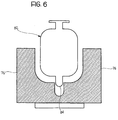
- This latter is shaped substantially in the form of a bottle and is provided at its bottom with an oblong protuberance 84 ( Figure 6).
- the container 82 has ( Figure 1) an outlet duct 86 which is provided with an interception valve 88 and is connected to the supply duct 42 leading to the cell 20.
- the diagram of Figure 1 shows the switching valves 90, 92, 94 disposed on the end section of the outlet ducts of the other three containers not illustrated, which ducts are all connected to the supply duct 42.
- the container 82 has moreover an inlet duct 96 - which is provided with an interception valve 98 and is connected to the discharge duct 70 from the reservoir 60 - and a pressure balancing duct 100 in which there is disposed a filter 106 between two valves 102, 104.
- auxiliary chamber 74 there are further disposed means 112 for injecting desired additives into the containers 82.
- injection means 112 comprise replaceable syringes of different capacities which can be operated by a stepping motor under the control of the central control unit 16.
- a first mode of operation of the system described above for open circuit measurement of the base metabolism of a given cell population 26 is as follows.
- part of the cell population 26 is captured on the pores of the membrane 22 whilst part of the solvent percolates through these latter and is discharged through the outlet aperture 38 of the channel 30 downstream of which there is provided a discharge duct 120 having a lower pressure drop than that of the recirculation tubes 118 of the circuit.
- the cell 20 charged with the cell population 26 to be monitored is then located within the measurement chamber 10 closing the apertures 32, 36 of the channel 28 and connecting the apertures 34, 38 of the channel 30 respectively to the supply duct 42 and to the outflow conduit 56 ( Figures 1 and 3).
- valves 88, 102, 104, 52 and 73 are opened keeping the remaining valves 90, 92, 94, 98, 110, 68 and 54 closed and starting the pumps 44 and 72 to effect a washing phase of the components of the system and to bring them to the desired temperature.
- the culture medium flows through the outlet duct 86, the valve 88, the supply duct 42, being preheated thanks to the resistance 46, the valve 52, the cell 20, the sensor 58, the detector 64 and the reservoir 60, from which it is discharged through the duct 70 and the valve 73.
- the opening of the valves 102, 104 allows filtered air to enter the container 82 so as to re-establish the pressure balance which otherwise would fall following the outflow of culture medium.
- the operating parameters such as temperature of the chambers 10, 74, rate of flow, and duration of the various operations, are controlled by the central control unit 16 to which possible alarm signals can be sent by the detector 64 in the case of the presence of air bubbles over a protracted time.
- the temperature of the chamber 74 is convenient to adjust the temperature of the chamber 74 to rather low temperatures, of the order of 10°C, so as to prevent bacteria which may have infiltrated in from the outside, from being able to develop and multiply.
- the resistance 46 can then heat the culture medium arriving from the chamber 74 to a higher temperature, of the order of 37°C, favourable for the development of the cell population 26 to be monitored.
- washing phase can be repeated once or twice.
- the pH values detected by the sensor 58 correspond to those of the virgin culture medium and can serve as a comparison term (reference) in the subsequent measurement phase.
- the condition of the valves is the same as that of the washing phase, but without a flow in the bypass duct 50.
- the activation of the pumps 44, 72 therefore causes a flow of culture medium through the cell 20 and in particular along the channel 30 (compare Figure 3 for the single cell and Figure 5 for the multiple cell).
- the culture medium can thus yield nutritive principles to the cell population 26 and absorb the H + ions produced by the cellular catabolism.
- pumps 44, 72 are stopped and a pH measurement of the medium is taken with the ISFET sensor 58 of the medium loaded with the products of catabolism which flow out through the outflow duct 56. This value is transmitted to the central control unit 16.
- the above-described measurement phase can be repeated any desired number of times so as to monitor the evolution in time of the pH value.
- the detected values can be displayed, for example in the form of a graph of pH as a function of time, under the control of the central control unit 16.
- the rate of flow of culture medium through the cell 20 in each measurement phase can be established at will.
- this rate of flow can vary from a minimum value which allows during each phase replacement of only a micro quantity of the culture medium present in the cell 20, to a maximum value which allows complete replacement in one phase of the quantity of culture medium present in the cell 20.
- the cell population 26 is in an environment with variable physiological conditions, in the second case they are constant.
- the concentration, type and activity of the cell population 26 to be monitored it is possible to choose the most suitable value for the rate of flow.
- the concentration is low it is preferable to choose a low flow rate so as to increase the sensitivity of the measurement.
- the concentration is high, it is preferable to choose a high flow rate so as to avoid variations over time of the physiological conditions which would induce significant variations in the response.
- the central control unit 16 can moreover be programmed to command the performance, at a predetermined frequency/rate, of a blank phase as described above to compensate for possible drift of the sensor 58 and to test the state of the pH of the virgin culture medium.
- the possible presence of air bubbles in the outflow duct 56 is indicated by the detector 64 to the central control unit 16 which acts to interrupt the measurement phase and to effect, if necessary, one or more further washing phases.
- the measurement of the base metabolism of a given cell population 26 can also be effected in a closed cycle rather than an open cycle manner.
- washing and blank phases are performed similar to what has been described above.
- the culture medium is withdrawn from a container 82 different from that used for the other phases and filled only in correspondence with the protuberance 84.
- the oblong shape of this latter ensures, however, a certain head even when operating with reduced quantities of culture medium, and thus avoids the formation of air bubbles when this latter is put into circulation.
- the pumps 44, 72 are activated, keeping the valve (for example number 88) associated with this latter container open and the valve 90 associated with the container utilised for the washing and blank phases closed.
- a further difference with respect to the open circuit measurement phase lies in the fact that the discharge valve 73 is now closed, whilst the valve 98 is open. In this way the culture medium flowing in the discharge duct 70 is recycled to the container 82 through the duct 96 and the valve 98 rather than being discharged to the outside.
- the same culture medium can be subjected several times to the action of the cell population as long as its pH value remains sufficiently high to allow the cells to remain alive.
- the system of the invention also makes it possible to measure the variation of the basal metabolism of a cell population induced by an external agent.
- measurement phases are performed by supplying the cell 20 with culture medium having a desired external agent added to it, from a different container 82 (by opening the valve disposed on the associated outlet duct 86 and closing the valve associated with the preceding container).
- the external agent added to the culture medium induces variations in the metabolic activity of the cell population with respect to the culture medium without additives. From a comparison of the measurements made with and without additives it will therefore be possible to arrive at a measurement of the effects of the additives themselves on a cell population. This manner of operation finds significant applications in the immunological, pharmacological and cosmetics fields and in many cases can advantageously replace in vivo tests.
- Measurement of the variation of the basal metabolism of a cell population induced by an external agent can also be made in a closed cycle.
- the culture medium to which an external agent has been added is therefore drawn from one of the containers 82, flows through the cell 20 and is recycled to the same container 82 maintaining the discharge valve 73 closed.
- the same culture medium is thus in contact with the cell population 26 several times so that, at the same concentration of this latter, the response of the system is more rapid than in an open cycle.
- the closed cycle manner of operation moreover makes it possible to monitor cell populations having very low concentrations which cannot be analysed in the open cycle mode, however having the disadvantage of producing a progressive acidification of the culture medium which, once exceeding a certain value, ends by causing the death of the cell population.
- a further mode of operation of the system envisages a function similar to that of open cycle measurement of the basal metabolism, with the difference that the measurement phases are performed in a predetermined succession with different culture media supplied from time to time from different containers 82.
- This mode of operation is advantageously employed when composite cell populations have to be monitored.
- the metabolisms of cells belonging to different families have different responses depending on the type of culture medium utilised, which makes it possible to encourage or inhibit the metabolism of cells from a specific family with respect to that of cells from other families.
- the system of the invention also allows easy disinfection and sterilisation between one test and another, whereby to avoid the residues of culture medium or cell populations of preceding tests from influencing the results of subsequent tests.
- a disinfection programme by filling all the containers 82 with a biocide solution, for example hypochlorite, dismantling the cell 20 with the direct connection of the ducts 42, 56, opening the valves 88, 90, 92, 94, 98, 52, 54, 110, closing the valve 73 and operating the pumps 44, 72.
- a biocide solution for example hypochlorite
- the discharge duct 108 in which the valve 110 is open, acts as an overflow and allows the elimination of excess biocide solution from the associated container 82.
- a rinsing programme is performed in a similar manner to the preceding one and utilising distilled water, possibly sterile, as the treatment fluid. In this way possible residues of biocide solution are eliminated and the system is then ready for subsequent measurement procedures.
Landscapes
- Chemical & Material Sciences (AREA)
- Life Sciences & Earth Sciences (AREA)
- Wood Science & Technology (AREA)
- Zoology (AREA)
- Engineering & Computer Science (AREA)
- Bioinformatics & Cheminformatics (AREA)
- Organic Chemistry (AREA)
- Health & Medical Sciences (AREA)
- Biotechnology (AREA)
- Sustainable Development (AREA)
- Analytical Chemistry (AREA)
- Microbiology (AREA)
- Biochemistry (AREA)
- General Engineering & Computer Science (AREA)
- General Health & Medical Sciences (AREA)
- Genetics & Genomics (AREA)
- Biomedical Technology (AREA)
- Cell Biology (AREA)
- Measuring And Recording Apparatus For Diagnosis (AREA)
- Apparatus Associated With Microorganisms And Enzymes (AREA)
Applications Claiming Priority (2)
| Application Number | Priority Date | Filing Date | Title |
|---|---|---|---|
| ITTO970188 | 1997-03-07 | ||
| ITTO970188 IT1291173B1 (it) | 1997-03-07 | 1997-03-07 | Sistema per il monitoraggio dell'attivita' metabolica di popolazioni cellulari viventi. |
Publications (1)
| Publication Number | Publication Date |
|---|---|
| EP0870823A1 true EP0870823A1 (de) | 1998-10-14 |
Family
ID=11415486
Family Applications (1)
| Application Number | Title | Priority Date | Filing Date |
|---|---|---|---|
| EP98103344A Withdrawn EP0870823A1 (de) | 1997-03-07 | 1998-02-26 | Gerät zur Überwachung der metabolischen Aktivität von Zellen |
Country Status (2)
| Country | Link |
|---|---|
| EP (1) | EP0870823A1 (de) |
| IT (1) | IT1291173B1 (de) |
Cited By (4)
| Publication number | Priority date | Publication date | Assignee | Title |
|---|---|---|---|---|
| WO1999047922A3 (en) * | 1998-03-18 | 1999-11-04 | Massachusetts Inst Technology | Vascularized perfused microtissue/micro-organ arrays |
| JP2002055102A (ja) * | 2000-06-09 | 2002-02-20 | Micronas Gmbh | 膜包囲された生体区画の試験法 |
| WO2011000572A1 (de) | 2009-07-02 | 2011-01-06 | Patenthandel Portfoliofonds I Gmbh & Co. Kg | Verfahren und vorrichtung zum nachweis von biologischen langzeiteffekten in zellen |
| US8318479B2 (en) | 2004-05-19 | 2012-11-27 | Massachusetts Institute Of Technology | Perfused three-dimensional cell/tissue disease models |
Citations (8)
| Publication number | Priority date | Publication date | Assignee | Title |
|---|---|---|---|---|
| US3941662A (en) * | 1971-06-09 | 1976-03-02 | Max-Planck-Gesellschaft Zur Forderung Der Wissenschaften E.V. | Apparatus for culturing cells |
| DE2657209A1 (de) * | 1976-12-17 | 1978-06-22 | Bender & Hobein Gmbh | Biokulturverfahren und vorrichtung zu seiner ausuebung |
| JPS60244281A (ja) * | 1984-05-21 | 1985-12-04 | Mitsubishi Electric Corp | 溶存水素濃度センサ |
| JPS6439544A (en) * | 1987-08-05 | 1989-02-09 | Mitsubishi Electric Corp | Function recovering method for microorganism sensor |
| US4812392A (en) * | 1984-12-27 | 1989-03-14 | Sumitomo Electric Industries, Ltd. | Method and apparatus for incubating cells |
| US4844097A (en) * | 1985-05-21 | 1989-07-04 | Bellhouse Technology Limited | Apparatus and method for testing liquids |
| EP0486443A1 (de) * | 1990-11-15 | 1992-05-20 | GENESIS S.r.L. | Verfahren zum Nachweis von giftigen Stoffen im Wasser, durch Überwachung des Stoffwechsels von ausgewählten lebendigen Zellen wie Mikroorganismen |
| WO1997031128A1 (en) * | 1996-02-22 | 1997-08-28 | Vivorx Pharmaceuticals, Inc. | Apparatus and methods for culturing mammalian cells |
-
1997
- 1997-03-07 IT ITTO970188 patent/IT1291173B1/it active IP Right Grant
-
1998
- 1998-02-26 EP EP98103344A patent/EP0870823A1/de not_active Withdrawn
Patent Citations (8)
| Publication number | Priority date | Publication date | Assignee | Title |
|---|---|---|---|---|
| US3941662A (en) * | 1971-06-09 | 1976-03-02 | Max-Planck-Gesellschaft Zur Forderung Der Wissenschaften E.V. | Apparatus for culturing cells |
| DE2657209A1 (de) * | 1976-12-17 | 1978-06-22 | Bender & Hobein Gmbh | Biokulturverfahren und vorrichtung zu seiner ausuebung |
| JPS60244281A (ja) * | 1984-05-21 | 1985-12-04 | Mitsubishi Electric Corp | 溶存水素濃度センサ |
| US4812392A (en) * | 1984-12-27 | 1989-03-14 | Sumitomo Electric Industries, Ltd. | Method and apparatus for incubating cells |
| US4844097A (en) * | 1985-05-21 | 1989-07-04 | Bellhouse Technology Limited | Apparatus and method for testing liquids |
| JPS6439544A (en) * | 1987-08-05 | 1989-02-09 | Mitsubishi Electric Corp | Function recovering method for microorganism sensor |
| EP0486443A1 (de) * | 1990-11-15 | 1992-05-20 | GENESIS S.r.L. | Verfahren zum Nachweis von giftigen Stoffen im Wasser, durch Überwachung des Stoffwechsels von ausgewählten lebendigen Zellen wie Mikroorganismen |
| WO1997031128A1 (en) * | 1996-02-22 | 1997-08-28 | Vivorx Pharmaceuticals, Inc. | Apparatus and methods for culturing mammalian cells |
Non-Patent Citations (2)
| Title |
|---|
| PATENT ABSTRACTS OF JAPAN vol. 010, no. 120 (C - 343) 6 May 1986 (1986-05-06) * |
| PATENT ABSTRACTS OF JAPAN vol. 013, no. 228 (P - 877) 26 May 1989 (1989-05-26) * |
Cited By (7)
| Publication number | Priority date | Publication date | Assignee | Title |
|---|---|---|---|---|
| WO1999047922A3 (en) * | 1998-03-18 | 1999-11-04 | Massachusetts Inst Technology | Vascularized perfused microtissue/micro-organ arrays |
| US6197575B1 (en) | 1998-03-18 | 2001-03-06 | Massachusetts Institute Of Technology | Vascularized perfused microtissue/micro-organ arrays |
| JP2002055102A (ja) * | 2000-06-09 | 2002-02-20 | Micronas Gmbh | 膜包囲された生体区画の試験法 |
| US6787331B2 (en) * | 2000-06-09 | 2004-09-07 | Micronas Gmbh | Process for examining membrane enclosed biocompartments |
| US7090996B2 (en) * | 2000-06-09 | 2006-08-15 | Micronas Gmbh | Process for examining membrane enclosed biocompartments |
| US8318479B2 (en) | 2004-05-19 | 2012-11-27 | Massachusetts Institute Of Technology | Perfused three-dimensional cell/tissue disease models |
| WO2011000572A1 (de) | 2009-07-02 | 2011-01-06 | Patenthandel Portfoliofonds I Gmbh & Co. Kg | Verfahren und vorrichtung zum nachweis von biologischen langzeiteffekten in zellen |
Also Published As
| Publication number | Publication date |
|---|---|
| IT1291173B1 (it) | 1998-12-29 |
| ITTO970188A1 (it) | 1998-09-07 |
Similar Documents
| Publication | Publication Date | Title |
|---|---|---|
| US3884640A (en) | Apparatus to analyze fluids | |
| US4818361A (en) | Combined pH and dissolved carbon dioxide gas sensor | |
| JP5416772B2 (ja) | バイオリアクター内で増殖した細胞を採取する時の予測器 | |
| US4963236A (en) | Apparatus and methods for isoelectric focusing | |
| US4086061A (en) | Temperature control system for chemical reaction cell | |
| US4407152A (en) | Breath test simulator and method | |
| RU2470300C2 (ru) | Портативное устройство для измерения и контроля аналитов в биологических жидкостях | |
| Adams et al. | Determination of the blood-gas factor of the oxygen electrode using a new tonometer | |
| BR112017006530B1 (pt) | analisador de líquidos | |
| EP0870823A1 (de) | Gerät zur Überwachung der metabolischen Aktivität von Zellen | |
| KR20180125972A (ko) | 샘플을 정화하고 분석하기 위한 카트리지 | |
| US3028965A (en) | Dialysis apparatus | |
| EP0004760A2 (de) | Gerät zur Feststellung der Anwesenheit bestimmter Bestandteile in einer Flüssigkeit | |
| US4593563A (en) | Procedure for determining velocity of dissolution | |
| US3111390A (en) | Apparatus for blood gas analysis | |
| RU164923U1 (ru) | Картридж для анализа индуцированной агрегации тромбоцитов крови методом импедансной агрегометрии | |
| CN215404286U (zh) | 一种生物样品在线实时检测系统 | |
| CN210294265U (zh) | 恒温系统及生化分析仪 | |
| Cowell | Automated Fluoride Ion Determination: Determination of Urine Fluoride Ion Levels | |
| JP2020079713A (ja) | 分析装置及び該分析装置に用いられる濃縮装置 | |
| WO2000039577A1 (en) | Contaminant detection | |
| CN206300922U (zh) | 一种库伦法全自动微量水分测定仪 | |
| CN115328239B (zh) | 实验室用超滤设备及其实验方法 | |
| WO2020127563A2 (en) | In-process device and method for cell culture monitoring | |
| US20090031827A1 (en) | Smart sample Extraction Device and Method |
Legal Events
| Date | Code | Title | Description |
|---|---|---|---|
| PUAI | Public reference made under article 153(3) epc to a published international application that has entered the european phase |
Free format text: ORIGINAL CODE: 0009012 |
|
| AK | Designated contracting states |
Kind code of ref document: A1 Designated state(s): AT BE CH DE DK ES FI FR GB GR IE IT LI LU MC NL PT SE |
|
| AX | Request for extension of the european patent |
Free format text: AL;LT;LV;MK;RO;SI |
|
| AKX | Designation fees paid | ||
| STAA | Information on the status of an ep patent application or granted ep patent |
Free format text: STATUS: THE APPLICATION IS DEEMED TO BE WITHDRAWN |
|
| 18D | Application deemed to be withdrawn |
Effective date: 20000901 |
|
| REG | Reference to a national code |
Ref country code: DE Ref legal event code: 8566 |