EP0871233A1 - Cellule electrolytique secondaire non aqueuse - Google Patents
Cellule electrolytique secondaire non aqueuse Download PDFInfo
- Publication number
- EP0871233A1 EP0871233A1 EP97933851A EP97933851A EP0871233A1 EP 0871233 A1 EP0871233 A1 EP 0871233A1 EP 97933851 A EP97933851 A EP 97933851A EP 97933851 A EP97933851 A EP 97933851A EP 0871233 A1 EP0871233 A1 EP 0871233A1
- Authority
- EP
- European Patent Office
- Prior art keywords
- electrolyte secondary
- secondary battery
- aqueous electrolyte
- conductive agent
- anode
- Prior art date
- Legal status (The legal status is an assumption and is not a legal conclusion. Google has not performed a legal analysis and makes no representation as to the accuracy of the status listed.)
- Granted
Links
Images



Classifications
-
- H—ELECTRICITY
- H01—ELECTRIC ELEMENTS
- H01M—PROCESSES OR MEANS, e.g. BATTERIES, FOR THE DIRECT CONVERSION OF CHEMICAL ENERGY INTO ELECTRICAL ENERGY
- H01M10/00—Secondary cells; Manufacture thereof
- H01M10/05—Accumulators with non-aqueous electrolyte
- H01M10/052—Li-accumulators
- H01M10/0525—Rocking-chair batteries, i.e. batteries with lithium insertion or intercalation in both electrodes; Lithium-ion batteries
-
- H—ELECTRICITY
- H01—ELECTRIC ELEMENTS
- H01M—PROCESSES OR MEANS, e.g. BATTERIES, FOR THE DIRECT CONVERSION OF CHEMICAL ENERGY INTO ELECTRICAL ENERGY
- H01M4/00—Electrodes
- H01M4/02—Electrodes composed of, or comprising, active material
- H01M4/13—Electrodes for accumulators with non-aqueous electrolyte, e.g. for lithium-accumulators; Processes of manufacture thereof
- H01M4/131—Electrodes based on mixed oxides or hydroxides, or on mixtures of oxides or hydroxides, e.g. LiCoOx
-
- H—ELECTRICITY
- H01—ELECTRIC ELEMENTS
- H01M—PROCESSES OR MEANS, e.g. BATTERIES, FOR THE DIRECT CONVERSION OF CHEMICAL ENERGY INTO ELECTRICAL ENERGY
- H01M4/00—Electrodes
- H01M4/02—Electrodes composed of, or comprising, active material
- H01M4/13—Electrodes for accumulators with non-aqueous electrolyte, e.g. for lithium-accumulators; Processes of manufacture thereof
- H01M4/133—Electrodes based on carbonaceous material, e.g. graphite-intercalation compounds or CFx
-
- H—ELECTRICITY
- H01—ELECTRIC ELEMENTS
- H01M—PROCESSES OR MEANS, e.g. BATTERIES, FOR THE DIRECT CONVERSION OF CHEMICAL ENERGY INTO ELECTRICAL ENERGY
- H01M4/00—Electrodes
- H01M4/02—Electrodes composed of, or comprising, active material
- H01M4/36—Selection of substances as active materials, active masses, active liquids
- H01M4/48—Selection of substances as active materials, active masses, active liquids of inorganic oxides or hydroxides
- H01M4/485—Selection of substances as active materials, active masses, active liquids of inorganic oxides or hydroxides of mixed oxides or hydroxides for inserting or intercalating light metals, e.g. LiTi2O4 or LiTi2OxFy
-
- H—ELECTRICITY
- H01—ELECTRIC ELEMENTS
- H01M—PROCESSES OR MEANS, e.g. BATTERIES, FOR THE DIRECT CONVERSION OF CHEMICAL ENERGY INTO ELECTRICAL ENERGY
- H01M4/00—Electrodes
- H01M4/02—Electrodes composed of, or comprising, active material
- H01M4/36—Selection of substances as active materials, active masses, active liquids
- H01M4/58—Selection of substances as active materials, active masses, active liquids of inorganic compounds other than oxides or hydroxides, e.g. sulfides, selenides, tellurides, halogenides or LiCoFy; of polyanionic structures, e.g. phosphates, silicates or borates
- H01M4/583—Carbonaceous material, e.g. graphite-intercalation compounds or CFx
- H01M4/587—Carbonaceous material, e.g. graphite-intercalation compounds or CFx for inserting or intercalating light metals
-
- H—ELECTRICITY
- H01—ELECTRIC ELEMENTS
- H01M—PROCESSES OR MEANS, e.g. BATTERIES, FOR THE DIRECT CONVERSION OF CHEMICAL ENERGY INTO ELECTRICAL ENERGY
- H01M4/00—Electrodes
- H01M4/02—Electrodes composed of, or comprising, active material
- H01M4/62—Selection of inactive substances as ingredients for active masses, e.g. binders, fillers
- H01M4/624—Electric conductive fillers
- H01M4/625—Carbon or graphite
-
- H—ELECTRICITY
- H01—ELECTRIC ELEMENTS
- H01M—PROCESSES OR MEANS, e.g. BATTERIES, FOR THE DIRECT CONVERSION OF CHEMICAL ENERGY INTO ELECTRICAL ENERGY
- H01M50/00—Constructional details or processes of manufacture of the non-active parts of electrochemical cells other than fuel cells, e.g. hybrid cells
- H01M50/50—Current conducting connections for cells or batteries
- H01M50/572—Means for preventing undesired use or discharge
- H01M50/574—Devices or arrangements for the interruption of current
- H01M50/581—Devices or arrangements for the interruption of current in response to temperature
-
- H—ELECTRICITY
- H01—ELECTRIC ELEMENTS
- H01M—PROCESSES OR MEANS, e.g. BATTERIES, FOR THE DIRECT CONVERSION OF CHEMICAL ENERGY INTO ELECTRICAL ENERGY
- H01M10/00—Secondary cells; Manufacture thereof
- H01M10/05—Accumulators with non-aqueous electrolyte
- H01M10/058—Construction or manufacture
- H01M10/0587—Construction or manufacture of accumulators having only wound construction elements, i.e. wound positive electrodes, wound negative electrodes and wound separators
-
- H—ELECTRICITY
- H01—ELECTRIC ELEMENTS
- H01M—PROCESSES OR MEANS, e.g. BATTERIES, FOR THE DIRECT CONVERSION OF CHEMICAL ENERGY INTO ELECTRICAL ENERGY
- H01M2300/00—Electrolytes
- H01M2300/0017—Non-aqueous electrolytes
- H01M2300/0025—Organic electrolyte
-
- H—ELECTRICITY
- H01—ELECTRIC ELEMENTS
- H01M—PROCESSES OR MEANS, e.g. BATTERIES, FOR THE DIRECT CONVERSION OF CHEMICAL ENERGY INTO ELECTRICAL ENERGY
- H01M4/00—Electrodes
- H01M4/02—Electrodes composed of, or comprising, active material
- H01M4/36—Selection of substances as active materials, active masses, active liquids
- H01M4/48—Selection of substances as active materials, active masses, active liquids of inorganic oxides or hydroxides
- H01M4/52—Selection of substances as active materials, active masses, active liquids of inorganic oxides or hydroxides of nickel, cobalt or iron
- H01M4/525—Selection of substances as active materials, active masses, active liquids of inorganic oxides or hydroxides of nickel, cobalt or iron of mixed oxides or hydroxides containing iron, cobalt or nickel for inserting or intercalating light metals, e.g. LiNiO2, LiCoO2 or LiCoOxFy
-
- H—ELECTRICITY
- H01—ELECTRIC ELEMENTS
- H01M—PROCESSES OR MEANS, e.g. BATTERIES, FOR THE DIRECT CONVERSION OF CHEMICAL ENERGY INTO ELECTRICAL ENERGY
- H01M6/00—Primary cells; Manufacture thereof
- H01M6/04—Cells with aqueous electrolyte
- H01M6/06—Dry cells, i.e. cells wherein the electrolyte is rendered non-fluid
- H01M6/10—Dry cells, i.e. cells wherein the electrolyte is rendered non-fluid with wound or folded electrodes
-
- H—ELECTRICITY
- H01—ELECTRIC ELEMENTS
- H01M—PROCESSES OR MEANS, e.g. BATTERIES, FOR THE DIRECT CONVERSION OF CHEMICAL ENERGY INTO ELECTRICAL ENERGY
- H01M6/00—Primary cells; Manufacture thereof
- H01M6/14—Cells with non-aqueous electrolyte
- H01M6/16—Cells with non-aqueous electrolyte with organic electrolyte
- H01M6/162—Cells with non-aqueous electrolyte with organic electrolyte characterised by the electrolyte
- H01M6/164—Cells with non-aqueous electrolyte with organic electrolyte characterised by the electrolyte by the solvent
-
- Y—GENERAL TAGGING OF NEW TECHNOLOGICAL DEVELOPMENTS; GENERAL TAGGING OF CROSS-SECTIONAL TECHNOLOGIES SPANNING OVER SEVERAL SECTIONS OF THE IPC; TECHNICAL SUBJECTS COVERED BY FORMER USPC CROSS-REFERENCE ART COLLECTIONS [XRACs] AND DIGESTS
- Y02—TECHNOLOGIES OR APPLICATIONS FOR MITIGATION OR ADAPTATION AGAINST CLIMATE CHANGE
- Y02E—REDUCTION OF GREENHOUSE GAS [GHG] EMISSIONS, RELATED TO ENERGY GENERATION, TRANSMISSION OR DISTRIBUTION
- Y02E60/00—Enabling technologies; Technologies with a potential or indirect contribution to GHG emissions mitigation
- Y02E60/10—Energy storage using batteries
Definitions
- This invention relates to improvements in the cycle characteristic of charge/discharge of a non-aqueous electrolyte secondary battery.
- Recent electronic technologies have conspicuously progressed so that, e.g., miniaturization and/or light weight of electronic equipments can be realized in succession.
- batteries as portable power supply (source)
- non-aqueous electrolyte secondary batteries using carbon material as the anode which are so called lithium ion secondary battery
- the lithium ion secondary battery utilizes doping/undoping of lithium into portion between carbon layers as the anode reaction. Even if charge/discharge cycle is developed, precipitation of crystal in dendrite form cannot be observed at the time of charging. Thus, such batteries exhibit satisfactory charge/discharge cycle characteristic.
- the material which was first put into practical use is coke or carbon in glass form. These carbon materials are material having low crystallinity obtained by allowing organic material to undergo heat-treatment at relatively low temperature, and has been commercialized as practical battery by using electrolytic solution mainly consisting of propylene carbon (PC). Further, in recent years, when propylene carbon (PC) is used as main solvent, graphite or the like which cannot be used as anode has reached usable level by using electrolytic solution mainly consisting of ethylene carbon (EC).
- PC propylene carbon
- EC ethylene carbon
- This invention contemplates realizing cathode/anode structure difficult to be broken even if charge/discharge cycle is repeatedly carried out thus to provide a non-aqueous electrolyte secondary battery having long cycle life time and high reliability.
- anode and the cathode By allowing the anode and the cathode to include (contain) flaky graphite having high crystallinity and high electron conduction as conductive agent, electrode structure having satisfactory electron conductivity is constituted. Further, by containing granulated carbon having specific material property as conductive agent, granulated carbon holds electrode structure having satisfactory electron conduction. Thus, long charge/discharge cycle life time can be obtained. In addition, by containing carbon black as conductive agent, carbon black functions as electrolytic solution holding material at the active material surface. Thus, longer charge/discharge cycle life time can be obtained.
- aqueous solution including inorganic acid aqueous solution in which hydrogen fluoride, hydrogen chloride, etc. is included with respect to water, inorganic alkali aqueous solution in which sodium hydroxide, etc. is included, aqueous solution including basic organic material, and organic system solvent.
- quantity of addition with respect to electrode mix of total conductive agent is 1.5 to 20 % by weight, and it is more preferable that this quantity of addition is 2 to 15 % by weight.
- carbon material and metal oxide which can carry out doping/undoping of lithium can be used.
- the petrolium pitch there are tar or the like obtained by high temperature thermal decomposition such as coal tar, ethylene bottom oil or crude oil, etc. and pitch obtained by operation such as distillation (vacuum distillation, ordinary pressure distillation, steam distillation), thermal condensation polymerization, extraction, chemical condensation polymerization, etc.
- H/C atomic ratio of the petrolium pitch is important. In order to allow it to be non-graphitaizable carbon, it is necessary to allow this H/C atomic ratio to fall within the range from 0.6 to 0.8.
- carbonization operation may be omitted in dependency upon situations.
- the carbon material thus obtained is used as anode material after undergone crushing/milling. This crushing may be carried out at process step before and after carbonization, calcination or high temperature heat treatment, or temperature elevation process.
- This invention is advantageous particularly in the battery using graphite material as anode. This graphite material will now be described.
- specific surface area of graphite powder is 9 m 2 /g or less, the above-mentioned effect can be sufficiently obtained, that specific surface area is preferably 7 m 2 /g or less, and is more preferably 5 m 2 /g or less.
- graphite material having high crystallinity is adapted so that the graphite hexagonal net surfaces are developed in the a-axis direction, and crystalline elements of the c-axis are constituted by stacking thereof.
- coupling between carbon hexagonal net surfaces is weak coupling called Van der Waals force
- deformation is apt to take place with respect to stress.
- in compression-molding particles of graphite powder to fill them into the electrode they are easy to be collapsed as compared to carbonaceous material baked at low temperature. As a result, it is difficult to ensure vacancies. Accordingly, by using graphite powder particles having high breakage strength, particles are difficult to be collapsed, and vacancies (holes) are thus easy to be produced. For this reason, the load characteristic can be improved.
- graphite material having crystallinity, true density, bult density, shape parameter X, specific surface area, grain size distribution and particle breakage strength as described above, either natural graphite or artificial graphite obtained by carbonizing organic material to allow the carbonized organic material thus obtained to further undergo high temperature treatment as previously described may be used as the graphite material.
- the graphitized molded body generally consists of coke serving as filler and binder pitch as molding agent or sintering agent. Namely, coke and binder pitch are mixed and molded thereafter to carbonize binder pitch thereafter to impregnate pitch thereinto.
- the article thus obtained is carbonized and is further graphitized.
- material in which molding ability and sintering ability are rendered to filler itself may be used to obtain similar graphitized molded body.
- the graphitized molded body is caused to undergo crushing/milling after heat treatment. The article thus obtained is used as anode material. In this case, since hardness of the molded body itself is high, material having high bulk density and high breakage strength can be easily obtained as crushed powder.
- the second component solvent there can be used propylene carbonate (PC), butylene carbonate, 1, 2-dimethoxy ethane, 1, 2-diethoxy methane, ⁇ - butyro lactone, valerolactone, tetrahydrofuran, 2-methyltetrahydrofuran, 1, 3-dioxolan, 4-metyl-1, 3-dioxolan, sulfolane, methyl sulfolane, etc. It is preferable that quantity of addition thereof is less than 10 % by volume.
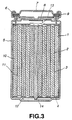
- lithium cobalt oxide was used as cathode and lithium titanium oxide was used as anode to make up a battery as shown in FIG. 3 to allow total conductive agent quantities added to the cathode and the anode to be respectively 10 % by weight to examine the effect in the case where carbon black is added, in addition to flaky graphite, as conductive agent.
- anode 1 was made up in a manner as described below.
- Cathode 2 was made up in a manner as described below.
- This LiCoO 2 was crushed to allow it to be LiCoO 2 powder in which accumulated 50 % particle diameter obtained by the laser diffraction method is 15 ⁇ m. Then, this LiCoO 2 powder 95 weight part and lithium carbonate powder 5 weight part were mixed to mix 87 weight part of this mixture, acetylene black 10 weight part as conductive agent and 3 weight part of polyvinylidene fluoride as binding agent to prepare cathode mix to disperse it into N-methyl pyrolidone as the solvent to allow it to be slurry in paste state.
- cathode collector 11 aluminum foil in belt form having thickness of 20 ⁇ m was used as cathode collector 11 to uniformly coat the cathode mix slurry on both surfaces of the cathode collector 11 to dry it thereafter to carry out compression-molding thereof to prepare cathode 2 in belt form.
- Electrolytic solution in which LiPF 6 is dissolved in the ratio of 1 mol/1 in equi-volumetric mixed solvent of ethylene carbonate (EC) and dimethyl carbonate (DMC) is poured into this battery can 5. Then, the battery can 5 is caulked through selealing gasket 6 of which surface is coated by asphalt to thereby fix safety valve unit 8 having current interrupting mechanism, PTC element 9 and battery cover 7 to maintain air-tightness within the battery to make up cylindrical non-aqueous electrolyte secondary battery having diameter of 18 mm and height of 65 mm.
- EC ethylene carbonate
- DMC dimethyl carbonate
- Cylindrical non-aqueous electrolyte secondary battery was made up similarly to the sample 1 except that flaky graphite (trade name: KS-15; Lonza Ltd.) 10 weight part is added as conductive agent of cathode, and flaky graphite (trade name: KS-15; Lonza Ltd.) 10 weight part is added as conductive agent of anode.
- flaky graphite trade name: KS-15; Lonza Ltd.
- Cylindrical non-aqueous electrolyte secondary battery was made up similarly to the sample 1 except that flaky graphite (trade name: KS-15; Lonza Ltd.) 10 weight part is added as conductive agent of cathode, and flaky graphite (trade name: KS-15; Lonza Ltd.) 5 weight part and acetylene black 5 weight part are added as conductive agent of anode.
- flaky graphite trade name: KS-15; Lonza Ltd.
- Cylindrical non-aqueous electrolyte secondary battery was made up similarly to the sample 1 except that acetylene black 10 weight part is added as conductive agent of cathode and flaky graphite (trade name: KS-15; Lonza Ltd.) 10 weight part is added as conductive agent of anode.
- Cylindrical non-aqueous electrolyte secondary battery was made up similarly to the sample 1 except that flaky graphite (trade name: KS-15; Lonza Ltd.) 5 weight part and acetylene black 5 weight part are added as conductive agent of cathode, and acetylene black 10 weight part is added as conductive agent of anode.
- flaky graphite trade name: KS-15; Lonza Ltd.
- Cylindrical non-aqueous electrolyte secondary battery was made up similarly to the sample 1 except that flaky graphite (trade name: KS-15; Lonza Ltd.) 5 weight part and acetylene black 5 weight part are added as conductive agent of cathode, and flaky graphite (trade name: KS-15; Lonza Ltd.) 10 weight part is added as conductive agent of anode.
- flaky graphite trade name: KS-15; Lonza Ltd.
- Cylindrical non-aqueous electrolyte secondary battery was made up similarly to the sample 1 except that flaky graphite (trade name: KS-15; Lonza Ltd.) 5 weight part and acetylene black 5 weight part are added as conductive agent of cathode, and flaky graphite (trade name: KS-15; Lonza Ltd.) 5 weight part and acetylene black 5 weight part are added as conductive agent of anode.
- flaky graphite trade name: KS-15; Lonza Ltd.
- Cylindrical non-aqueous electrolyte secondary battery was made up similarly to the sample 1 except that flaky graphite (trade name: KS-15; Lonza Ltd.) 8 weight part and acetylene black 2 weight part are added as conductive agent of cathode, and flaky graphite (trade name: KS-15; Lonza Ltd.) 10 weight part is added as conductive agent of anode.
- flaky graphite trade name: KS-15; Lonza Ltd.
- Cylindrical non-aqueous electrolyte secondary battery was made up similarly to the sample 1 except that flaky graphite (trade name: KS-15; Lonza Ltd.) 3 weight part and acetylene 7 weight part are added as conductive agent of cathode, and flaky graphite (trade name: KS-15; Lonza Ltd.) 10 weight part is added as conductive agent of anode.
- flaky graphite trade name: KS-15; Lonza Ltd.
- the cylindrical non-aqueous electrolyte secondary batteries made up as the samples 1 to 11 were used to repeatedly carry out charge/discharge cycle to determine, as capacity maintenance ratio, ratio of capacity of the 100-th cycle with respect to capacity of the 2-nd cycle.
- charge operation was carried out for 2.5 hours under the condition of maximum charge voltage of 4.2 V and charge current of 1A, and discharge operation was conducted until voltage falls down to 2.75 V under the condition of constant current of 1.5 A. Its result is shown in Table 1.
- lithium cobalt oxide was used as cathode and lithium titanium oxide was used as anode to make up a battery as shown in FIG. 3 to examine the relationship between total conductive agent quantities (flaky graphite and carbon black) added to the cathode and the anode and the capacity maintenance ratio.
- Cylindrical non-aqueous electrolyte secondary battery was made up similarly to the sample 7 except that flaky graphite (trade name: KS-15; Lonza Ltd.) 3 weight part and acetylene black 3 weight part are added as conductive agent with respect to mixture 91 weight part of LiCoO 2 powder 95 weight part and lithium carbonate powder 5 weight part as composition of cathode mix.
- flaky graphite trade name: KS-15; Lonza Ltd.
- Cylindrical non-aqueous electrolyte secondary battery was made up similarly to the sample 7 except that flaky graphite (trade name: KS-15; Lonza Ltd.) 2 weight part and acetylene black 2 weight part are added as conductive agent with respect to mixture 93 weight part of LiCoO 2 powder 95 weight part and lithium carbonate powder 5 weight part as composition of cathode mix.
- flaky graphite trade name: KS-15; Lonza Ltd.
- Cylindrical non-aqueous electrolyte secondary battery was made up similarly to the sample 7 except that flaky graphite (trade name: KS-15; Lonza Ltd.) 1 weight part and acetylene black 1 weight part are added as the conductive agent with respect to mixture 95 weight part of LiCoO 2 powder 95 weight part and lithium carbonate powder 5 weight part as composition of cathode mix.
- flaky graphite trade name: KS-15; Lonza Ltd.
- Cylindrical non-aqueous electrolyte secondary battery was made up similarly to the sample 7 except that flaky graphite (trade name: KS-15; Lonza Ltd.) 0.5 weight part and acetylene black 0.5 weight part are added as the conductive agent with respect to mixture 96 weight part of LiCoO 2 powder 95 weight part and lithium carbonate powder 5 weight part as composition of cathode mix.
- flaky graphite trade name: KS-15; Lonza Ltd.
- Cylindrical non-aqueous electrolyte secondary battery was made up similarly to the sample 7 except that flaky graphite (trade name: KS-15; Lonza Ltd.) 0.1 weight part and acetylene black 0.1 weight part are added as the conductive agent with respect to mixture 96.8 weight part of LiCoO 2 powder 95 weight part and lithium carbonate powder 5 weight part as composition of cathode mix.
- flaky graphite trade name: KS-15; Lonza Ltd.
- Cylindrical non-aqueous electrolyte secondary batteries made up as the samples 12 to 16 were used to repeatedly carry out the charge/discharge cycle under the same condition as that of the cycle test carried out at the sample 7 to determine, as capacity maintenance ratio, ratio of capacity of the 100-th cycle with respect to capacity of the second cycle. Its result is shown in Table 2.
- lithium cobalt oxide was used as the cathode and lithium titanium oxide was used as anode to make up a battery as shown in FIG. 3 to examine the influence by difference between particle diameters of carbon black materials added to the cathode and the anode.
- Cylindrical non-aqueous electrolyte secondary buttery was made up similarly to the sample 14 except that the particle diameter of acetylene black as the conductive agent of the cathode is set to 25 ⁇ m.
- Cylindrical non-aqueous electrolyte secondary battery was made up similarly to the sample 14 except that the particle diameter of acetylene black as the conductive agent of the cathode is set to 19 ⁇ m.
- Cylindrical non-aqueous electrolyte secondary battery was made up similarly to the sample 14 except that the particle diameter of acetylene black as the conductive agent of the cathode is set to 13 ⁇ m.
- Cylindrical non-aqueous electrolyte secondary battery was made up similarly to the sample 14 except that the particle diameter of acetylene black as the conductive agent of the cathode is set to 40 ⁇ m.
- Cylindrical non-aqueous electrolyte secondary battery was made up similarly to the sample 14 except that the particle diameter of acetylene black as the conductive agent of the cathode is set to 48 ⁇ m.
- the cylindrical non-aqueous electrolyte secondary batteries made up as the samples 17 to 22 were used to repeatedly carry out the charge/discharge cycle under the same condition as that of the cycle test carried out at the sample 14 to determine ratio of capacity of the 100-th cycle with respect to capacity of the second cycle as the capacity maintenance ratio. Its result is shown in Table 3.
- the particle diameter of carbon black added as the conductive agent is preferably 75 nm or less, and excellent capacity maintenance ratio can be obtained particularly within the range from 10 to 40 nm.
- lithium cobalt oxide was used as cathode and carbonaceous material was used as anode to make up a battery as shown in FIG. 3 to allow total conductive agent quantities added to the cathode and the anode to be respectively 10 % by weight to examine the effect in the case where carbon black/granulated carbon is added, in addition to flaky graphite, as the conductive agent.
- sample 23 in which only granulated carbon is added, without adding flaky graphite, as the conductive agent is prepared as object to be compared.
- Anode 1 was made up in a manner as described below.
- binder pitch serving as binder was added to coal system coke 100 weight part serving as filler to mix them at about 100°C thereafter to carry out compression-molding thereof by the press to obtain precursor of carbon molded body.
- Binder pitch fused at 200°C or less is further impregnated into carbon material molded body obtained by heat-treating this precursor at 1000°C or less to repeat, several times, process steps of pitch impregnation and baking which carry out heat treatment at 1000 °C or less. Thereafter, this carbon molded body is caused to undergo heat treatment at 2700°C in the atmosphere of inactive gas to obtain carbonized molded body thereafter to carry out crushing/milling thereof to make up sample powder.
- sample powder 90 weight part and polyvinyledene fluoride (PVDF) 10 weight part were mixed to prepare anode mix to disperse it into N-methylpyrolidone serving as solvent to allow it to be slurry in paste state.
- PVDF polyvinyledene fluoride
- Copper foil in belt form having thickness of 10 ⁇ m was used as anode collector 10 to coat anode mix slurry on both surfaces of the anode collector 10 to dry it thereafter carry out compression-molding thereof at a constant pressure to make up belt-shaped anode 1.
- the cathode 2 was made up in a manner as described below.
- lithium carbonate of 0.5 mol and cobalt carbonate of 1 mol were mixed to bake this mixture for five (5) hours at temperature of 900°C in air to obtain active cathode material.
- the X-ray diffraction measurement was conducted in connection with the material thus obtained, its peak was well in correspondence with the peak of LiCoO 2 registered in the JCPDS file.
- belt-shaped aluminum foil having thickness of 20 ⁇ m was used as cathode collector 11 to uniformly coat the cathode mix slurry on both surfaces of the cathode collector 11 to dry it to carry out compressions-molding thereof to make up belt-shaped cathode 2.
- Cylindrical non-aqueous electrolyte secondary battery having diameter of 18 mm and height of 65 mm was made up similarly to the sample 1 except that the anode 1 and the cathode 2 which have been made up in a manner as described above are used.
- Cylindrical non-aqueous electrolyte secondary battery was made up similarly to the sample 23 except that flaky graphite (trade name: KS-15; Lonza Ltd.) 10 weight part is added as the conductive agent of the cathode.
- flaky graphite trade name: KS-15; Lonza Ltd.
- Cylindrical non-aqueous electrolyte secondary battery was made up similarly to the sample 23 except that flaky graphite (trade name: KS-15; Lonza Ltd.) 4.2 weight part, pitch system granulated carbon 4.2 weight part and carbon black 1.6 weight part are added as the conductive agent of the cathode.
- flaky graphite trade name: KS-15; Lonza Ltd.
- the batteries made up as the samples 25 to 27 have excellent capacity maintenance ratio as compared to the batteries made up as the samples 23 and 24, and that granulated carbon is added in addition to the flaky graphite, whereby the cycle characteristic can be further improved.
- the batteries made up as the samples 28 to 33 have excellent capacity maintenance ratio as compared to the samples 23 and 24, and that carbon black is added in addition to the flaky graphite and the granulated carbon, whereby the cycle characteristic can be further improved.
- Cylindrical non-aqueous electrolyte secondary battery was made up similarly to the sample 23 except that flaky graphite (trade name: KS-15; Lonza Ltd.) 0.45 weight part, pitch system granulated carbon 0.45 weight part and acetylene black 0.1 weight part are added as the conductive agent with respect to mixture 96 weight part of LiCoO 2 powder 95 weight part and lithium carbonate powder 5 weight part as composition of cathode mix.
- flaky graphite trade name: KS-15; Lonza Ltd.
- Cylindrical non-aqueous electrolyte secondary battery was made up similarly to the sample 23 except that flaky graphite (trade name: KS-15; Lonza Ltd.) 7.2 weight part, pitch system granulated carbon 7.2 weight part and acetylene black 1.6 weight part are added as the conductive agent with respect to mixture 81 weight part of LiCoO 2 powder 95 weight part and lithium carbonate powder 5 weight part as composition of cathode mix.
- flaky graphite trade name: KS-15; Lonza Ltd.
- Cylindrical non-aqueous electrolyte secondary battery having diameter of 18 mm and height of 65 mm was made up similarly to the sample 24 except that the non-graphitaizable carbon material made up in this way is used as anode material.
- Cylindrical non-aqueous electrolyte secondary battery was made up similarly to the sample 25 except that the anode material of the sample 39 is used.
- Cylindrical non-aqueous electrolyte secondary batteries made up as the samples 39 to 42 were used to repeatedly carry out charge/discharge cycle under the same condition as that of the cycle test carried out as the sample 1 to determine, as capacity maintenance ratio, ratio of capacity of the 100-th cycle with respect to capacity of the 2-nd cycle. Its result is shown in Table 6.
Landscapes
- Chemical & Material Sciences (AREA)
- Chemical Kinetics & Catalysis (AREA)
- Electrochemistry (AREA)
- General Chemical & Material Sciences (AREA)
- Engineering & Computer Science (AREA)
- Materials Engineering (AREA)
- Inorganic Chemistry (AREA)
- Manufacturing & Machinery (AREA)
- Battery Electrode And Active Subsutance (AREA)
- Secondary Cells (AREA)
- Carbon And Carbon Compounds (AREA)
Applications Claiming Priority (4)
| Application Number | Priority Date | Filing Date | Title |
|---|---|---|---|
| JP20030496 | 1996-07-30 | ||
| JP200304/96 | 1996-07-30 | ||
| JP20030496 | 1996-07-30 | ||
| PCT/JP1997/002652 WO1998005083A1 (fr) | 1996-07-30 | 1997-07-30 | Cellule electrolytique secondaire non aqueuse |
Publications (3)
| Publication Number | Publication Date |
|---|---|
| EP0871233A1 true EP0871233A1 (fr) | 1998-10-14 |
| EP0871233A4 EP0871233A4 (fr) | 1998-10-21 |
| EP0871233B1 EP0871233B1 (fr) | 2000-01-12 |
Family
ID=16422097
Family Applications (1)
| Application Number | Title | Priority Date | Filing Date |
|---|---|---|---|
| EP97933851A Expired - Lifetime EP0871233B1 (fr) | 1996-07-30 | 1997-07-30 | Batterie electrolytique secondaire non aqueuse |
Country Status (6)
| Country | Link |
|---|---|
| US (2) | US6686094B2 (fr) |
| EP (1) | EP0871233B1 (fr) |
| JP (1) | JP4161376B2 (fr) |
| CA (1) | CA2233128A1 (fr) |
| DE (1) | DE69701126T2 (fr) |
| WO (1) | WO1998005083A1 (fr) |
Cited By (4)
| Publication number | Priority date | Publication date | Assignee | Title |
|---|---|---|---|---|
| EP0949702A1 (fr) * | 1998-03-17 | 1999-10-13 | Asahi Glass Company Ltd. | Pile secondaire d'alimentation |
| EP0977291A1 (fr) * | 1998-07-29 | 2000-02-02 | VARTA Aktiengesllschaft | Electrode positive d'une pile au lithium pour une utilisation à forte charge |
| EP1057783A2 (fr) * | 1999-06-03 | 2000-12-06 | Titan Kogyo Kabushiki Kaisha | Oxydes composites de lithium et titanium, leurs procédé de préparation et leurs utilisations |
| EP1089366A1 (fr) * | 1999-09-30 | 2001-04-04 | Sony Corporation | Batterie secondaire à électrolyte nonaqueux |
Families Citing this family (42)
| Publication number | Priority date | Publication date | Assignee | Title |
|---|---|---|---|---|
| JP2002289261A (ja) * | 2001-01-16 | 2002-10-04 | Matsushita Electric Ind Co Ltd | 非水電解質二次電池 |
| TW431004B (en) * | 1998-10-29 | 2001-04-21 | Toshiba Corp | Nonaqueous electrolyte secondary battery |
| JP2001216970A (ja) * | 2000-02-04 | 2001-08-10 | Sony Corp | 非水電解質電池 |
| JP5059992B2 (ja) * | 2000-09-06 | 2012-10-31 | 株式会社東芝 | 正極及び非水電解質二次電池 |
| CA2327370A1 (fr) * | 2000-12-05 | 2002-06-05 | Hydro-Quebec | Nouvelle methode de fabrication de li4ti5o12 pur a partir du compose ternaire tix-liy-carbone: effet du carbone sur la synthese et la conductivite de l'electrode |
| JP2002358966A (ja) * | 2001-06-04 | 2002-12-13 | Hitachi Ltd | リチウム二次電池正極板及びリチウム二次電池 |
| JP2003217667A (ja) * | 2002-01-16 | 2003-07-31 | Japan Storage Battery Co Ltd | 非水電解質二次電池 |
| US7479349B2 (en) * | 2002-12-31 | 2009-01-20 | Cardiac Pacemakers, Inc. | Batteries including a flat plate design |
| JP4055642B2 (ja) * | 2003-05-01 | 2008-03-05 | 日産自動車株式会社 | 高速充放電用電極および電池 |
| JP4159954B2 (ja) | 2003-09-24 | 2008-10-01 | 株式会社東芝 | 非水電解質電池 |
| JP4527423B2 (ja) * | 2004-03-18 | 2010-08-18 | 大日本印刷株式会社 | 活物質層用塗工組成物、非水電解液二次電池用電極板、及び非水電解液二次電池 |
| JP2007048692A (ja) * | 2005-08-12 | 2007-02-22 | Hitachi Vehicle Energy Ltd | リチウム二次電池用正極材料、リチウム二次電池用正極板及びこれを用いたリチウム二次電池 |
| TW200746523A (en) * | 2006-01-30 | 2007-12-16 | Tokai Carbon Kk | Negative electrode material for lithium ion secondary battery and process for producing the same |
| JP2007305546A (ja) * | 2006-05-15 | 2007-11-22 | Sony Corp | リチウムイオン電池 |
| JP2008047512A (ja) * | 2006-07-18 | 2008-02-28 | Nissan Motor Co Ltd | 非水電解質二次電池用正極 |
| KR100907621B1 (ko) * | 2006-08-28 | 2009-07-15 | 주식회사 엘지화학 | 두 성분의 도전재를 포함하는 양극 합제 및 그것으로구성된 리튬 이차전지 |
| JP4857073B2 (ja) * | 2006-10-20 | 2012-01-18 | 富士重工業株式会社 | リチウムイオンキャパシタ |
| JP4240157B2 (ja) * | 2007-03-05 | 2009-03-18 | 東洋インキ製造株式会社 | 電池用組成物 |
| JP5061728B2 (ja) * | 2007-05-30 | 2012-10-31 | 信越半導体株式会社 | シリコン単結晶の育成方法 |
| KR101658678B1 (ko) | 2008-02-29 | 2016-09-21 | 미쓰비시 가가꾸 가부시키가이샤 | 비수계 전해액 및 비수계 전해액 전지 |
| JP4834030B2 (ja) * | 2008-04-22 | 2011-12-07 | 第一工業製薬株式会社 | リチウム二次電池用正極及びこれを用いたリチウム二次電池 |
| DE102008026580A1 (de) | 2008-06-03 | 2009-12-10 | Süd-Chemie AG | Verfahren zur Herstellung von Lithiumtitan-Spinell und dessen Verwendung |
| JP5254722B2 (ja) * | 2008-09-25 | 2013-08-07 | 日立ビークルエナジー株式会社 | リチウム二次電池 |
| JP2011070994A (ja) * | 2009-09-28 | 2011-04-07 | Sumitomo Chemical Co Ltd | 正極合剤、正極および非水電解質二次電池 |
| KR20120046253A (ko) * | 2010-06-30 | 2012-05-09 | 파나소닉 주식회사 | 비수 전해질 이차전지용 음극 및 그 제조방법 |
| JPWO2012001845A1 (ja) * | 2010-06-30 | 2013-08-22 | パナソニック株式会社 | 非水電解質二次電池用負極およびその製造方法 |
| WO2012067800A1 (fr) * | 2010-11-17 | 2012-05-24 | Conocophillips Company | Fabrication d'articles en carbone à partir de particules revêtues |
| US9620784B2 (en) | 2011-07-14 | 2017-04-11 | Nec Energy Devices, Ltd. | Negative electrode including platy graphite conductive additive for lithium ion battery, and lithium ion battery using the same |
| JP5561559B2 (ja) * | 2011-10-06 | 2014-07-30 | トヨタ自動車株式会社 | リチウム二次電池の製造方法 |
| US9911972B2 (en) * | 2011-12-14 | 2018-03-06 | Toyota Jidosha Kabushiki Kaisha | Non-aqueous electrolyte secondary battery and method for manufacturing negative electrode for secondary battery |
| JP5708526B2 (ja) * | 2012-02-23 | 2015-04-30 | トヨタ自動車株式会社 | 二次電池用の正極板の製造方法 |
| US10074848B2 (en) | 2013-07-02 | 2018-09-11 | Samsung Sdi Co., Ltd. | Rechargeable lithium battery with controlled particle size ratio of activated carbon to positive active material |
| KR101599322B1 (ko) * | 2013-07-02 | 2016-03-03 | 삼성에스디아이 주식회사 | 양극 활물질과 활성탄의 입경 비율이 제어된 리튬 이차 전지 |
| US10381686B2 (en) * | 2014-07-18 | 2019-08-13 | Nec Corporation | Electrolyte solution and secondary battery using same |
| KR102270513B1 (ko) * | 2014-08-05 | 2021-06-30 | 삼성에스디아이 주식회사 | 리튬 이차 전지용 양극 조성물, 그리고 이를 포함하는 리튬 이차 전지용 양극 및 리튬 이차 전지 |
| JP6246682B2 (ja) * | 2014-09-01 | 2017-12-13 | 日立オートモティブシステムズ株式会社 | リチウムイオン二次電池 |
| KR101673724B1 (ko) * | 2014-12-31 | 2016-11-23 | 현대자동차주식회사 | 전고체 리튬전지의 양극 및 이를 포함하는 이차전지 |
| JP6394987B2 (ja) * | 2015-08-06 | 2018-09-26 | トヨタ自動車株式会社 | 非水電解液二次電池 |
| JP6616278B2 (ja) * | 2016-12-27 | 2019-12-04 | 株式会社エンビジョンAescジャパン | リチウムイオン二次電池用電極 |
| JP6889404B2 (ja) * | 2017-11-01 | 2021-06-18 | トヨタ自動車株式会社 | 負極の製造方法、負極およびリチウムイオン二次電池 |
| CN114784267A (zh) * | 2022-05-31 | 2022-07-22 | 广汽埃安新能源汽车有限公司 | 一种正极浆料及其制备方法和锂离子电池 |
| CN118630216B (zh) * | 2024-07-01 | 2025-11-11 | 厦门海辰储能科技股份有限公司 | 正极片及其制备方法、电池和用电系统 |
Family Cites Families (15)
| Publication number | Priority date | Publication date | Assignee | Title |
|---|---|---|---|---|
| JPS58189963A (ja) * | 1982-04-30 | 1983-11-05 | Sanyo Electric Co Ltd | 有機電解質電池の正極 |
| JPH01294356A (ja) | 1988-05-20 | 1989-11-28 | Hitachi Maxell Ltd | リチウム二次電池 |
| JPH05101818A (ja) * | 1991-08-07 | 1993-04-23 | Mitsubishi Gas Chem Co Inc | 負極用炭素成形体及びリチウム二次電池 |
| US5686138A (en) * | 1991-11-12 | 1997-11-11 | Sanyo Electric Co., Ltd. | Lithium secondary battery |
| US5478671A (en) * | 1992-04-24 | 1995-12-26 | Fuji Photo Film Co., Ltd. | Nonaqueous secondary battery |
| JP3222932B2 (ja) * | 1992-05-22 | 2001-10-29 | 三洋電機株式会社 | 非水系電池 |
| US5340670A (en) * | 1992-06-01 | 1994-08-23 | Kabushiki Kaisha Toshiba | Lithium secondary battery and method of manufacturing carbonaceous material for negative electrode of the battery |
| US5478673A (en) | 1992-10-29 | 1995-12-26 | Fuji Photo Film Co., Ltd. | Nonaqueous secondary battery |
| US5618640A (en) | 1993-10-22 | 1997-04-08 | Fuji Photo Film Co., Ltd. | Nonaqueous secondary battery |
| JPH07240200A (ja) | 1994-02-28 | 1995-09-12 | Fuji Photo Film Co Ltd | 非水二次電池 |
| WO1995026057A1 (fr) * | 1994-03-19 | 1995-09-28 | Hitachi Maxell, Ltd. | Accumulateur secondaire a electrolyte organique |
| US5683834A (en) | 1994-09-07 | 1997-11-04 | Fuji Photo Film Co., Ltd. | Nonaqueous secondary battery |
| US5686203A (en) * | 1994-12-01 | 1997-11-11 | Fuji Photo Film Co., Ltd. | Non-aqueous secondary battery |
| JPH08195201A (ja) | 1995-01-17 | 1996-07-30 | Fuji Photo Film Co Ltd | 非水二次電池の負極用合剤の製造方法 |
| US5718989A (en) * | 1995-12-29 | 1998-02-17 | Japan Storage Battery Co., Ltd. | Positive electrode active material for lithium secondary battery |
-
1997
- 1997-07-30 CA CA002233128A patent/CA2233128A1/fr not_active Abandoned
- 1997-07-30 WO PCT/JP1997/002652 patent/WO1998005083A1/fr not_active Ceased
- 1997-07-30 JP JP50870398A patent/JP4161376B2/ja not_active Expired - Fee Related
- 1997-07-30 EP EP97933851A patent/EP0871233B1/fr not_active Expired - Lifetime
- 1997-07-30 US US09/043,634 patent/US6686094B2/en not_active Expired - Fee Related
- 1997-07-30 DE DE69701126T patent/DE69701126T2/de not_active Expired - Lifetime
-
2003
- 2003-11-18 US US10/715,571 patent/US7070883B2/en not_active Expired - Fee Related
Cited By (10)
| Publication number | Priority date | Publication date | Assignee | Title |
|---|---|---|---|---|
| EP0949702A1 (fr) * | 1998-03-17 | 1999-10-13 | Asahi Glass Company Ltd. | Pile secondaire d'alimentation |
| US6558846B1 (en) | 1998-03-17 | 2003-05-06 | Asahi Glass Company Ltd. | Secondary power source |
| EP0977291A1 (fr) * | 1998-07-29 | 2000-02-02 | VARTA Aktiengesllschaft | Electrode positive d'une pile au lithium pour une utilisation à forte charge |
| EP1057783A2 (fr) * | 1999-06-03 | 2000-12-06 | Titan Kogyo Kabushiki Kaisha | Oxydes composites de lithium et titanium, leurs procédé de préparation et leurs utilisations |
| EP1089366A1 (fr) * | 1999-09-30 | 2001-04-04 | Sony Corporation | Batterie secondaire à électrolyte nonaqueux |
| US6806003B1 (en) | 1999-09-30 | 2004-10-19 | Sony Corporation | Nonaqueous electrolyte secondary battery having a negative electrode containing carbon fibers and carbon flakes |
| US7172837B2 (en) | 1999-09-30 | 2007-02-06 | Sony Corporation | Nonaqueous electrolyte secondary battery having a negative electrode containing carbon fibers and carbon flakes |
| KR100714346B1 (ko) * | 1999-09-30 | 2007-05-03 | 소니 가부시끼 가이샤 | 비수성 전해액 2차 전지 |
| EP1988592A1 (fr) | 1999-09-30 | 2008-11-05 | Sony Corporation | Batterie secondaire électrolytique non aqueuse |
| US7498101B2 (en) | 1999-09-30 | 2009-03-03 | Sony Corporation | Non-aqueous electrolyte secondary battery having a negative electrode containing carbon fibers and carbon flakes |
Also Published As
| Publication number | Publication date |
|---|---|
| WO1998005083A1 (fr) | 1998-02-05 |
| JP4161376B2 (ja) | 2008-10-08 |
| DE69701126T2 (de) | 2000-06-21 |
| CA2233128A1 (fr) | 1998-02-05 |
| US7070883B2 (en) | 2006-07-04 |
| EP0871233A4 (fr) | 1998-10-21 |
| EP0871233B1 (fr) | 2000-01-12 |
| US20040072077A1 (en) | 2004-04-15 |
| US20010014422A1 (en) | 2001-08-16 |
| US6686094B2 (en) | 2004-02-03 |
| DE69701126D1 (de) | 2000-02-17 |
Similar Documents
| Publication | Publication Date | Title |
|---|---|---|
| EP0871233B1 (fr) | Batterie electrolytique secondaire non aqueuse | |
| EP0713258B1 (fr) | Cellule electrolytique secondaire non aqueuse | |
| CA2125003C (fr) | Pile secondaire a electrolyte liquide non aqueux | |
| JP4529274B2 (ja) | 非水電解質電池 | |
| JP3436033B2 (ja) | 非水電解液二次電池 | |
| US20020015888A1 (en) | Non-aqueous electrolyte secondary battery and method of preparing carbon-based material for negative electrode | |
| JPWO1998005083A1 (ja) | 非水電解液二次電池 | |
| EP0848440B1 (fr) | Materiau de cathode d'accumulateur electrolytique non-aqueux et accumulateur electolytique non-aqueux utilisant le materiau de cathode | |
| JPWO1995028011A1 (ja) | 非水電解液二次電池 | |
| JP4818498B2 (ja) | 非水電解質二次電池 | |
| JPH0927344A (ja) | 非水電解液二次電池 | |
| JP4150087B2 (ja) | 非水電解液二次電池 | |
| US6083646A (en) | Non-aqueous electrolyte secondary battery and method for producing cathode material | |
| JP5636786B2 (ja) | リチウム二次電池用負極材、これを用いたリチウム二次電池用負極、及びリチウム二次電池。 | |
| JP3787943B2 (ja) | 非水電解液二次電池 | |
| JP2001148241A (ja) | 非水電解質電池 | |
| JPH09283178A (ja) | 非水電解液二次電池 | |
| JPH09306488A (ja) | 非水電解液二次電池用負極材料とこの非水電解液二次電池用負極材料の製造方法およびこれを用いた非水電解液二次電池 | |
| JPH11260365A (ja) | 電 池 |
Legal Events
| Date | Code | Title | Description |
|---|---|---|---|
| PUAI | Public reference made under article 153(3) epc to a published international application that has entered the european phase |
Free format text: ORIGINAL CODE: 0009012 |
|
| 17P | Request for examination filed |
Effective date: 19980324 |
|
| AK | Designated contracting states |
Kind code of ref document: A1 Designated state(s): DE FR GB |
|
| A4 | Supplementary search report drawn up and despatched | ||
| AK | Designated contracting states |
Kind code of ref document: A4 Designated state(s): DE FR GB |
|
| 17Q | First examination report despatched |
Effective date: 19981216 |
|
| GRAG | Despatch of communication of intention to grant |
Free format text: ORIGINAL CODE: EPIDOS AGRA |
|
| GRAG | Despatch of communication of intention to grant |
Free format text: ORIGINAL CODE: EPIDOS AGRA |
|
| GRAG | Despatch of communication of intention to grant |
Free format text: ORIGINAL CODE: EPIDOS AGRA |
|
| GRAH | Despatch of communication of intention to grant a patent |
Free format text: ORIGINAL CODE: EPIDOS IGRA |
|
| RTI1 | Title (correction) |
Free format text: NON-AQUEOUS ELECTROLYTE SECONDARY BATTERY |
|
| GRAH | Despatch of communication of intention to grant a patent |
Free format text: ORIGINAL CODE: EPIDOS IGRA |
|
| GRAA | (expected) grant |
Free format text: ORIGINAL CODE: 0009210 |
|
| AK | Designated contracting states |
Kind code of ref document: B1 Designated state(s): DE FR GB |
|
| REF | Corresponds to: |
Ref document number: 69701126 Country of ref document: DE Date of ref document: 20000217 |
|
| ET | Fr: translation filed | ||
| PLBE | No opposition filed within time limit |
Free format text: ORIGINAL CODE: 0009261 |
|
| STAA | Information on the status of an ep patent application or granted ep patent |
Free format text: STATUS: NO OPPOSITION FILED WITHIN TIME LIMIT |
|
| 26N | No opposition filed | ||
| REG | Reference to a national code |
Ref country code: GB Ref legal event code: IF02 |
|
| REG | Reference to a national code |
Ref country code: GB Ref legal event code: 746 Effective date: 20091130 |
|
| PGFP | Annual fee paid to national office [announced via postgrant information from national office to epo] |
Ref country code: FR Payment date: 20110729 Year of fee payment: 15 |
|
| PGFP | Annual fee paid to national office [announced via postgrant information from national office to epo] |
Ref country code: GB Payment date: 20110721 Year of fee payment: 15 Ref country code: DE Payment date: 20110722 Year of fee payment: 15 |
|
| GBPC | Gb: european patent ceased through non-payment of renewal fee |
Effective date: 20120730 |
|
| REG | Reference to a national code |
Ref country code: FR Ref legal event code: ST Effective date: 20130329 |
|
| PG25 | Lapsed in a contracting state [announced via postgrant information from national office to epo] |
Ref country code: FR Free format text: LAPSE BECAUSE OF NON-PAYMENT OF DUE FEES Effective date: 20120731 Ref country code: GB Free format text: LAPSE BECAUSE OF NON-PAYMENT OF DUE FEES Effective date: 20120730 Ref country code: DE Free format text: LAPSE BECAUSE OF NON-PAYMENT OF DUE FEES Effective date: 20130201 |
|
| REG | Reference to a national code |
Ref country code: DE Ref legal event code: R119 Ref document number: 69701126 Country of ref document: DE Effective date: 20130201 |