EP0871400B1 - Ermittlung von daten über das hörvermögen - Google Patents
Ermittlung von daten über das hörvermögen Download PDFInfo
- Publication number
- EP0871400B1 EP0871400B1 EP96943915A EP96943915A EP0871400B1 EP 0871400 B1 EP0871400 B1 EP 0871400B1 EP 96943915 A EP96943915 A EP 96943915A EP 96943915 A EP96943915 A EP 96943915A EP 0871400 B1 EP0871400 B1 EP 0871400B1
- Authority
- EP
- European Patent Office
- Prior art keywords
- frequency
- sound pressure
- pressure level
- set forth
- tone
- Prior art date
- Legal status (The legal status is an assumption and is not a legal conclusion. Google has not performed a legal analysis and makes no representation as to the accuracy of the status listed.)
- Expired - Lifetime
Links
- 238000000034 method Methods 0.000 claims abstract description 42
- 210000000056 organ Anatomy 0.000 claims abstract description 23
- 238000005259 measurement Methods 0.000 claims description 24
- 238000012935 Averaging Methods 0.000 claims description 6
- 238000012545 processing Methods 0.000 claims description 6
- 241000124008 Mammalia Species 0.000 claims description 5
- 210000003477 cochlea Anatomy 0.000 claims description 5
- 238000006243 chemical reaction Methods 0.000 claims description 4
- 241000251539 Vertebrata <Metazoa> Species 0.000 claims description 3
- 230000008569 process Effects 0.000 abstract description 8
- 230000001629 suppression Effects 0.000 description 27
- 239000000523 sample Substances 0.000 description 17
- 210000000613 ear canal Anatomy 0.000 description 6
- 241000282412 Homo Species 0.000 description 5
- 230000000763 evoking effect Effects 0.000 description 5
- 241000282414 Homo sapiens Species 0.000 description 4
- 230000000638 stimulation Effects 0.000 description 4
- 238000013461 design Methods 0.000 description 3
- 238000001514 detection method Methods 0.000 description 3
- 210000003027 ear inner Anatomy 0.000 description 3
- 210000000959 ear middle Anatomy 0.000 description 3
- 230000000694 effects Effects 0.000 description 3
- 238000011156 evaluation Methods 0.000 description 3
- 230000007246 mechanism Effects 0.000 description 3
- 210000003454 tympanic membrane Anatomy 0.000 description 3
- 210000000721 basilar membrane Anatomy 0.000 description 2
- 230000008878 coupling Effects 0.000 description 2
- 238000010168 coupling process Methods 0.000 description 2
- 238000005859 coupling reaction Methods 0.000 description 2
- 230000007423 decrease Effects 0.000 description 2
- 238000011161 development Methods 0.000 description 2
- 238000010586 diagram Methods 0.000 description 2
- 210000000883 ear external Anatomy 0.000 description 2
- 230000002452 interceptive effect Effects 0.000 description 2
- 230000004044 response Effects 0.000 description 2
- 238000012360 testing method Methods 0.000 description 2
- 238000012549 training Methods 0.000 description 2
- 238000012937 correction Methods 0.000 description 1
- 238000013501 data transformation Methods 0.000 description 1
- 230000001419 dependent effect Effects 0.000 description 1
- 230000030808 detection of mechanical stimulus involved in sensory perception of sound Effects 0.000 description 1
- 239000013013 elastic material Substances 0.000 description 1
- 230000007613 environmental effect Effects 0.000 description 1
- 230000007717 exclusion Effects 0.000 description 1
- 230000006870 function Effects 0.000 description 1
- 238000009499 grossing Methods 0.000 description 1
- 210000003128 head Anatomy 0.000 description 1
- 230000002401 inhibitory effect Effects 0.000 description 1
- 230000010355 oscillation Effects 0.000 description 1
- 230000002787 reinforcement Effects 0.000 description 1
- 230000003014 reinforcing effect Effects 0.000 description 1
- 238000011160 research Methods 0.000 description 1
- 238000013214 routine measurement Methods 0.000 description 1
- 238000007789 sealing Methods 0.000 description 1
- 230000035945 sensitivity Effects 0.000 description 1
- 238000000926 separation method Methods 0.000 description 1
- 239000007779 soft material Substances 0.000 description 1
- 230000005236 sound signal Effects 0.000 description 1
- 238000001228 spectrum Methods 0.000 description 1
- 230000001360 synchronised effect Effects 0.000 description 1
Images


Classifications
-
- A—HUMAN NECESSITIES
- A61—MEDICAL OR VETERINARY SCIENCE; HYGIENE
- A61B—DIAGNOSIS; SURGERY; IDENTIFICATION
- A61B5/00—Measuring for diagnostic purposes; Identification of persons
- A61B5/12—Audiometering
Definitions
- the invention relates to a method for determining data about hearing by measuring distortion products otoacoustic emissions, d. H. by measuring so-called DPOAE.
- hearing is of mammals linked to active reinforcement processes in the inner ear that overall sensitivity and frequency resolution of the ear improve.
- active reinforcement processes in the inner ear that overall sensitivity and frequency resolution of the ear improve.
- the so-called otoacoustic emissions are sound signals emitted from the ear that occur spontaneously or caused by external stimulation, d. H. evokes can be.
- the stimulation can be acoustic, for example or done electrically.
- the invention therefore has as its object such develop an objective method for measuring hearing or a process that largely meets these requirements corresponds.
- the disadvantages mentioned should be avoided become.
- the development of such a process should also in the provision of a corresponding device and a suitable probe.
- two primary tones with the frequencies f 1 and f 2 > f 1 and the sound pressure levels L 1 and L 2 and at least one sound event with portions of the frequency f 3 and the sound pressure level L 3 are applied to the hearing organ as stimuli and a distortion product defined frequency determined.
- the frequency f 3 has a value that is close to the frequency of the distortion product.
- This method ensures, among other things, that the Dependence of the emission amplitude of the distortion product determined relatively simply by the frequency of the stimuli can be.
- the creation of measurement data of the emission amplitude of the distortion product depending on the frequency the stimuli a so-called DP gram, can be used with just a few Measuring points are scanned with sufficient accuracy.
- the one with routine Measurements occurring disadvantage that the fine structure with a limitation to a few measuring frequencies cannot be scanned by using the overcome the inventive method.
- the expression "in the vicinity of the frequency of the distortion product” chosen in claim 1 primarily means that the frequency f 3 is not in the range of the frequency f 2 or in the range between the frequencies f 1 and f 2 .
- the frequency f 3 is preferably approximated as close as possible to the frequency of the distortion product, this approximation being limited by the equipment. For example, in the case of an apparatus which can be used according to the invention, the approximation takes place to frequencies of 10 or 12.5 Hz, since this frequency resolution results from the data transformation system used.
- the frequency f 3 is not identical to the frequency of the distortion product, since a separation of the two frequencies in the measured signal is necessary.
- the frequency f 3 is just above the value for the frequency of the distortion product.
- a third (pure) tone with the frequency f 3 and the sound pressure level L 3 is preferably applied as the sound event, which is used as an interference tone or suppressor. This then leads to stimulation of the hearing organ with three pure tones of the frequencies f 1 , f 2 and f 3 and the sound pressure levels L 1 , L 2 and L 3 .
- the sound pressure level L 3 of the sound event is lower than the sound pressure level L 1 or L 2 of at least one primary sound.
- the sound pressure level L 3 for example at a third tone with the frequency f 3 must be sufficiently large to achieve the advantages as have already been described and will still be described.
- the sound pressure level L 3 can be chosen to be lower the closer the frequency f 3 is to the frequency of the distortion product.
- the method can be carried out particularly well if f 3 is somewhat above the frequency of the distortion product. The farther away the frequency f 3 is selected from the frequency of the distortion product, the greater the sound pressure level L 3 must normally be selected.
- the sound pressure level L 3 of the sound event or of the third sound does not differ significantly from the sound pressure level L 2 of the primary sound with the frequency f 2 .
- the sound pressure level L 3 can be selected to be somewhat smaller than the sound pressure level L 2 .
- the sound pressure level L 3 is preferably equal to the sound pressure level L 2 .
- Appropriate deviations of the sound pressure level L 3 from the sound pressure level L 2 are in the range between -15 dB to +15 dB. Within this range, deviations between -10 dB and +10 dB are particularly preferred.
- all possible distortion products can be determined in the invention. Some distortion products are particularly easy to determine, for example due to the intensities of the corresponding sound emissions. In humans, the so-called cubic distortion product 2f 1 - f 2 can be determined.
- the method according to the invention is carried out preferably in the so-called audio area, d. H. the "normal" Listening area. Within this area the procedure especially at frequencies between 500 Hz and 16 kHz carried out, d. H. the frequency of the stimuli will be within of the frequency range mentioned varies.
- the stimuli can be delivered in the course of the measurement period done in different ways.
- the stimuli especially the primary sounds on the hearing organ applied continuously.
- Will an intermittent levy the stimuli to the hearing organ is chosen, in particular that Intermittent sound event used as a suppressor.
- the properties can also be used phenomenon resulting from the measuring apparatus that the analysis time window, d. H. the period within which the measurement is made is limited, can be used advantageously.
- the frequency of the stimuli becomes an integer A multiple of the reciprocal of the analysis time window base frequency (in Hertz) selected (in seconds), account for the length of the time window of the following Analyze a whole number of waves from all three stimuli. This requires a significant simplification of the evaluation.
- Coupling of three tones applied to the hearing organ with each other, this coupling ultimately through a device for digital data processing with associated digital-to-analog conversion is caused.
- a calibration is carried out, for example that the specific Conditions of the respective ear canal of a human Subjects are considered individually.
- To this Purpose becomes a stimulus before the actual measurement begins given over all frequencies of interest (white noise) and recorded.
- a correction is made for each individual frequency, which takes into account the individual design of the respective ear canal.
- Used to generate the stimuli for example electroacoustic transducer used, so in the invention an individual voltage value is determined for each frequency be that of the desired sound pressure level on the Hearing organ generated.
- the prior art Usually constant voltage signals are used independently whether or not they actually match the one you want Lead sound pressure level.
- a time averaging can be expedient in the invention the measurement data for the determined within time windows Distortion product can be made. This is in the phenomenon justifies that the actual measurement signal at a single measurement against background noise is not or only with difficulty recognizable, with a large number the noise is averaged from measurements with averaging.
- the values obtained in the averaging continuously with the environmental or background noise are compared and evaluated. This ensures that the averaging at any time Achieving a desired signal-to-noise ratio, i.e. a certain distance between the DPOAE signal and the underlying background noise can be canceled and cannot go through a fixed number of cycles (time windows) must become. This can shorten the total measuring time become.
- the hearing organ mentioned is preferably a hearing organ of vertebrates, especially mammals. In mammals and humans, it can affect the hearing organ especially the cochlea.
- the stimulus frequency photoacoustic emission can now be switched off separately at the frequency f dp .
- a suppressor in the vicinity of the frequency of the distortion product pulls the energy of the amplifier to its frequency. This also explains the dependencies of suppression on frequency and sound pressure level of the suppressor.
- the invention can also be represented by a method for determining data about the hearing ability by measuring distortion products of otoacoustic emissions (DPOAE), in which two primary tones with the frequencies f 1 and f 2 > f 1 and the sound pressure levels L 1 and L 2 are applied as stimuli to the hearing organ and at least one distortion product of a defined frequency is determined, with this method suppressing at least one of these generators or generation mechanisms for the distortion product if there are at least two generators or generation mechanisms.
- DPOAE distortion products of otoacoustic emissions
- a device for performing the method according to the invention includes first Means for generating at least three stimuli, in particular acoustic stimuli, second means for the detection of otoacoustic Emissions, especially associated noise emissions, and third means for control and evaluation, especially for the generation of stimuli as well as the acquisition and processing of measurement data.
- the first means can in particular be so-called electroacoustic Have transducers as they are from the prior art are known.
- an electroacoustic can Transducers are provided for generating two or more stimuli his.
- an electroacoustic transducer a primary tone and the suppression stimulus (suppression tone) produce.
- a separate transducer for each stimulus d. H. for two Primary tones and a suppression tone three electroacoustic Transducers are provided.
- the second means have at least one Microphone to detect the evoked sound events.
- Several microphones, for example four, can be provided from which measured values are averaged.
- the third means preferably have a device for digital data processing with associated D / A conversion and A / D conversion on.
- a device for performing the method according to the invention comprises a probe or a measuring head for the determination of data about hearing, the or the at least three facilities for the emission of Sound stimuli, especially of defined frequency and at least one device for the detection of sound emissions assigned.
- the facilities for emission Sound stimuli are preferably electroacoustic Converter and preferably in the detection devices around microphones.
- the probe is at least partially in the external auditory canal of a mammal, in particular of human beings, with which also the measuring accuracy is increased.
- a sealing element for the most part Exclusion of disturbing external sound events (ambient sound) be provided.
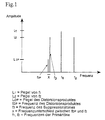
- the two primary tones having the sound pressure levels L 1 and L 2 are symbolized.
- the second primary tone has a higher frequency than the first primary tone with a lower sound pressure level L 2 .
- the distortion product with the sound pressure level L DP is symbolized by the narrow bar at the frequency f DP .
- a suppression tone with frequency f 3 is shown just above at higher frequencies, the frequency difference between the frequency of the distortion product and the frequency of the suppression tone being x.
- the sound pressure level L 3 of the suppression tone is chosen equal to the sound pressure level L 2 of the second primary tone.
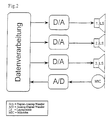
- the block diagram according to FIG. 2 schematically shows essentials Parts of a device, the abbreviations and symbols in turn explained in a legend are.
- the device has three digital-to-analog converters and an analog-to-digital converter, which one Evaluation and control device are assigned, which in Figure 2 is generally referred to as data processing.
- the converters are controlled, d. H. ultimately those applied to the hearing organ Generates stimuli and evaluates the evoked sound events.
- the digital-to-analog converters are each with one Speakers connected to the actual sound stimulus of the electroacoustic transducers formed overall.
- the analog-to-digital converter stands with a microphone in connection with which the evoked sound event is detected.
- FIG 3 shows the schematic view of one probe, the three Speakers 1, 2 and 3 and a microphone 9 assigned are.
- the three loudspeakers stand with the actual probe body connected by hose lines 5, 6 and 7, which lead through this to a probe tip 8 are.
- a microphone 9 is in the probe body 4 integrated and also via a thin hose line 10 led into the probe tip 8.
- speakers 1, 2 and 3 in the probe body 4 may be integrated.
- fitting aid 11 On the outer circumference of the pointed towards the hearing organ, in particular tapered probe tip 8 is a fitting aid 11 arranged, when inserting the probe in the outer ear canal for better introduction and subsequent Definition serves.
- the fitting aid 11 is preferably made of made of a soft and elastic material.
- FIG. 4 shows a cross-sectional view of the probe tip 8, the respective ends of the thin hose lines 5, 6, 7 and 10 are shown. These hose lines are in Direction towards the hearing organ so that between the speakers 1, 2 and 3 as well as the microphone 9 and the eardrum, that is not shown in the figures, a continuous Air cushion is present.
- the Hose line 10 for the microphone 9 has a larger cross section than the three hose lines 5, 6 and 7 of the speakers 1, 2 and 3.
- DPOAE measurements are carried out on the ear of a test subject, and the device or probe shown in the figures can be used.
- FIG. 5 shows the amplitude of the measured distortion product 2f 1 -f 2 as a function of the frequency of the second primary tone.
- the round measuring points symbolize measurements without applying a suppression tone, while the square measuring points symbolize measurements in which a suppression tone with the frequency 2f 1 - f 2 + 12.5 Hz and a volume of 55 dB SPL was radiated onto the hearing organ.
- Figure 5 shows that the measurement curve without suppressor, the one large blur in the order of magnitude jumps between neighboring minima and maxima, through which inventive method in a comparatively flat Curve can be transferred, which is hardly more pronounced Has amplitude jumps.
- Figure 6 shows the suppression effect depending on the Suppression tone volume. This suppression behavior differs significantly depending on the frequency of stimulus tones. In areas of a maximum in the fine structure the DP amplitude decreases in areas of one At least the emission amplitude increases. This The phenomenon is evident both in the smoothing effect according to FIG. 5 as well as in the growth curves according to FIG. 6, in which the in Figure 5 with a to i designated measuring points depending are recorded by the volume of the suppression tone.
- the inhibiting or reinforcing influence of a second generator for the distortion product is thus removed and the measured signal can only be attributed to the other generator.
- This (main) generator which, as in the present case, enables conclusions to be drawn about the condition of the inner ear, can thus be reliably determined.
- the remaining signal is only associated with the state of the inner ear at the location of the remaining generator, ie with the (2f 1 - f 2 ) distortion product with the location at frequency f 2 and no longer a mixed signal.
- FIG. 6 shows that in the case shown, at suppression levels from approx. 35 dB SPL, a first suppression effect sets in, which leads to an increase in the emission in the curves for g, h, i.
- the suppression effect can be seen up to a sound pressure level of the suppression tone of approx. 65 dB SPL. Only above this suppression level does the suppression tone influence the other ("main generator") at f 2 , the determination of which is desired without interfering influences.
- the DP amplitude changes almost nothing in the present case, regardless of the frequency at which the measurement is made. The effect shown is different in different people, but it can be demonstrated in all.
Landscapes
- Health & Medical Sciences (AREA)
- Life Sciences & Earth Sciences (AREA)
- Engineering & Computer Science (AREA)
- Physics & Mathematics (AREA)
- Heart & Thoracic Surgery (AREA)
- Surgery (AREA)
- Audiology, Speech & Language Pathology (AREA)
- Biophysics (AREA)
- Pathology (AREA)
- Biomedical Technology (AREA)
- Acoustics & Sound (AREA)
- Medical Informatics (AREA)
- Molecular Biology (AREA)
- Multimedia (AREA)
- Animal Behavior & Ethology (AREA)
- General Health & Medical Sciences (AREA)
- Public Health (AREA)
- Veterinary Medicine (AREA)
- Measurement Of The Respiration, Hearing Ability, Form, And Blood Characteristics Of Living Organisms (AREA)
- Measuring Pulse, Heart Rate, Blood Pressure Or Blood Flow (AREA)
- Investigating Or Analyzing Materials By The Use Of Ultrasonic Waves (AREA)
- Complex Calculations (AREA)
Description
- Figur 1
- die Darstellung des Spektrums zur Erläuterung der Erfindung,
- Figur 2
- ein Blockschaltbild einer Ausführungsform der Vorrichtung zur Durchführung der Erfindung
- Figur 3
- eine schematische Darstellung einer Sonde zur Durchführung der Erfindung
- Figur 4
- einen Querschnitt durch die Spitze einer Sonde gemäß Figur 3,
- Figur 5
- ein sogenanntes DP-Gramm zur Erläuterung der Erfindung, und
- Figur 6
- die Darstellung von Suppressions-Wachstums-Kurven zur Erläuterung der Erfindung.
Claims (12)
- Verfahren zur Ermittlung von Daten über das Hörvermögen durch Messung von Distorsionsprodukten otoakustischer Emissionen (DPOAE), bei dem als Stimuli zwei Primärtöne mit den Frequenzen f1 und f2 > f1 und den Schalldruckpegeln L1 und L2 sowie mindestens ein Schallereignis mit Anteilen der Frequenz f3 und dem Schalldruckpegel L3 auf das Hörorgan aufgebracht werden und mindestens ein Distorsionsprodukt definierter Frequenz gemessen wird, dadurch gekennzeichnet, daß f3 einen Wert besitzt, der in der Nähe der Frequenz des Distorsionsproduktes liegt.
- Verfahren nach Anspruch 1, dadurch gekennzeichnet, daß als Schallereignis ein dritter Ton mit der Frequenz f3 und dem Schalldruckpegel L3 aufgebracht wird.
- Verfahren nach Anspruch 1 oder 2, dadurch gekennzeichnet, daß der Schalldruckpegel L3 des Schallereignisses, insbesondere des dritten Tons kleiner als ein Schalldruckpegel L1 oder L2 mindestens eines Primärtons ist.
- Verfahren nach einem der vorhergehenden Ansprüche, dadurch gekennzeichnet, daß der Schalldruckpegel L3 des Schallereignisses, insbesondere des dritten Tons nicht wesentlich vom Schalldruckpegel L2 des Primärtons mit der Frequenz f2 abweicht, vorzugsweise gleich oder geringfügig kleiner als der Schalldruckpegel L2 des Primärtons mit der Frequenz f2 ist.
- Verfahren nach einem der vorhergehenden Ansprüche, dadurch gekennzeichnet, daß der Schalldruckpegel L3 des Schallereignisses, insbesondere des dritten Tons um -15 dB bis +15 dB, insbesondere um -10 dB bis +10 dB vom Schalldruckpegel L2 des Primärtons mit der Frequenz f2 abweicht.
- Verfahren nach einem der vorhergehenden Ansprüche, dadurch gekennzeichnet, daß das sogenannte (2f1 - f2)-Distorsionsprodukt bestimmt wird.
- Verfahren nach einem der vorhergehenden Ansprüche, dadurch gekennzeichnet, daß es im sogenannten Audiobereich, vorzugsweise bei Frequenzen zwischen 500 Hz und 16 kHz durchgeführt wird.
- Verfahren nach einem der vorhergehenden Ansprüche, dadurch gekennzeichnet, daß die Abgabe der Stimuli auf das Hörorgan kontinuierlich erfolgt.
- Verfahren nach einem der Ansprüche 1 bis 7, dadurch gekennzeichnet, daß die Abgabe der Stimuli auf das Hörorgan intermittierend erfolgt.
- Verfahren nach einem der vorhergehenden Ansprüche, gekennzeichnet durch eine definierte Kopplung von drei auf das Hörorgan aufgebrachten Tönen untereinander, vorzugsweise mit Hilfe einer Einrichtung zur digitalen Datenverarbeitung mit zugehöriger Digital-Analog-Wandlung.
- Verfahren nach einem der vorhergehenden Ansprüche, gekennzeichnet durch eine zeitliche Mittelung der Meßdaten für das innerhalb von Zeitfenstern bestimmte Distorsionsprodukt, wobei vorzugsweise die bei der Mittelung erhaltenen Werte laufend im Vergleich mit dem Umgebungs- bzw. Hintergrundrauschen bewertet werden.
- Verfahren nach einem der vorhergehenden Ansprüche, dadurch gekennzeichnet, daß es sich bei dem Hörorgan um ein Hörorgan von Wirbeltieren, vorzugsweise bei Säugetieren und dem Menschen um die Cochlea handelt.
Applications Claiming Priority (3)
| Application Number | Priority Date | Filing Date | Title |
|---|---|---|---|
| DE19549165A DE19549165A1 (de) | 1995-12-29 | 1995-12-29 | Ermittlung von Daten über das Hörvermögen |
| DE19549165 | 1995-12-29 | ||
| PCT/EP1996/005527 WO1997024065A1 (de) | 1995-12-29 | 1996-12-11 | Ermittlung von daten über das hörvermögen |
Publications (2)
| Publication Number | Publication Date |
|---|---|
| EP0871400A1 EP0871400A1 (de) | 1998-10-21 |
| EP0871400B1 true EP0871400B1 (de) | 2000-03-01 |
Family
ID=7781654
Family Applications (1)
| Application Number | Title | Priority Date | Filing Date |
|---|---|---|---|
| EP96943915A Expired - Lifetime EP0871400B1 (de) | 1995-12-29 | 1996-12-11 | Ermittlung von daten über das hörvermögen |
Country Status (7)
| Country | Link |
|---|---|
| US (1) | US6123677A (de) |
| EP (1) | EP0871400B1 (de) |
| AT (1) | ATE189951T1 (de) |
| AU (1) | AU1369897A (de) |
| CA (1) | CA2241898A1 (de) |
| DE (2) | DE19549165A1 (de) |
| WO (1) | WO1997024065A1 (de) |
Families Citing this family (8)
| Publication number | Priority date | Publication date | Assignee | Title |
|---|---|---|---|---|
| DE19905743B4 (de) | 1999-02-11 | 2004-09-23 | Janssen, Thomas, Priv.Doz. Dr.-Ing. Dr.med. habil. | Vorrichtung und Verfahren zur objektiven Bestimmung der schwellennahen und überschwelligen Schallverarbeitung des Innenohres |
| FR2835732B1 (fr) * | 2002-02-11 | 2004-11-12 | Spinevision | Dispositif permettant le suivi de la penetration d'un moyen de penetration dans des elements anatomiques |
| US7695441B2 (en) * | 2002-05-23 | 2010-04-13 | Tympany, Llc | Automated diagnostic hearing test |
| US7261106B2 (en) * | 2003-09-25 | 2007-08-28 | Ethicon Endo-Surgery, Inc. | Response testing for conscious sedation utilizing a cannula for support/response |
| DK1611846T3 (en) * | 2004-07-02 | 2016-02-15 | Maico Diagnostic Gmbh | Method of designing acoustic stimuli in the spectral range for the recording of Auditory Steady-State Responses (ASSR) |
| US8419655B2 (en) * | 2009-09-23 | 2013-04-16 | JD Birck, LLC | Method and apparatus for aural acoustic immittance measurement |
| CN103892842B (zh) * | 2012-12-25 | 2017-11-10 | 深圳先进技术研究院 | 信号检测方法和系统 |
| CA2952869C (en) * | 2014-06-19 | 2022-09-27 | Eers Global Technologies Inc. | Method and device for continuous in-ear hearing health monitoring on a human being |
Family Cites Families (7)
| Publication number | Priority date | Publication date | Assignee | Title |
|---|---|---|---|---|
| GB1522031A (en) * | 1975-07-24 | 1978-08-23 | Bennett M | Electroacoustic impedance bridges |
| US4007731A (en) * | 1975-08-14 | 1977-02-15 | Ciwa Griffiths | Means and techniques for establishing hearing deficiencies |
| CA1146659A (en) * | 1978-02-10 | 1983-05-17 | National Research Development Corporation | Hearing faculty testing and apparatus therefor |
| DE2951856A1 (de) * | 1979-12-21 | 1981-07-02 | Siemens AG, 1000 Berlin und 8000 München | Elektroakustisches messgeraet |
| DE4142257A1 (de) * | 1991-12-20 | 1993-06-24 | Egon Fred Warnke | Verfahren und vorrichtung zur objektiven messung des hoervermoegens |
| US5267571A (en) * | 1992-04-08 | 1993-12-07 | Sensimetrics Corporation | Method for testing adequacy of human hearing |
| US5601091A (en) * | 1995-08-01 | 1997-02-11 | Sonamed Corporation | Audiometric apparatus and association screening method |
-
1995
- 1995-12-29 DE DE19549165A patent/DE19549165A1/de not_active Withdrawn
-
1996
- 1996-12-11 CA CA002241898A patent/CA2241898A1/en not_active Abandoned
- 1996-12-11 AT AT96943915T patent/ATE189951T1/de not_active IP Right Cessation
- 1996-12-11 WO PCT/EP1996/005527 patent/WO1997024065A1/de not_active Ceased
- 1996-12-11 EP EP96943915A patent/EP0871400B1/de not_active Expired - Lifetime
- 1996-12-11 US US09/101,007 patent/US6123677A/en not_active Expired - Fee Related
- 1996-12-11 AU AU13698/97A patent/AU1369897A/en not_active Abandoned
- 1996-12-11 DE DE59604563T patent/DE59604563D1/de not_active Expired - Fee Related
Also Published As
| Publication number | Publication date |
|---|---|
| AU1369897A (en) | 1997-07-28 |
| ATE189951T1 (de) | 2000-03-15 |
| WO1997024065A1 (de) | 1997-07-10 |
| DE59604563D1 (de) | 2000-04-06 |
| US6123677A (en) | 2000-09-26 |
| CA2241898A1 (en) | 1997-07-10 |
| EP0871400A1 (de) | 1998-10-21 |
| DE19549165A1 (de) | 1997-07-03 |
Similar Documents
| Publication | Publication Date | Title |
|---|---|---|
| DE10041725B4 (de) | Gerät zur elektromechanischen Stimulation und Prüfung des Gehörs | |
| DE60018084T2 (de) | Audiosignalverarbeitung | |
| EP0527742B1 (de) | Tinnitus-maskiergerät | |
| DE3851453T2 (de) | Signalprozessor und Hörgerät mit Kanaldominanz. | |
| DE102016003133B4 (de) | Verfahren zur automatischen Bestimmung einer individuellen Funktion einer DPOAE-Pegelkarte eines menschlichen oder tierischen Gehörs | |
| DE19905743B4 (de) | Vorrichtung und Verfahren zur objektiven Bestimmung der schwellennahen und überschwelligen Schallverarbeitung des Innenohres | |
| DE102016225205A1 (de) | Verfahren zum Bestimmen einer Richtung einer Nutzsignalquelle | |
| EP3638103B1 (de) | Verfahren und vorrichtung zur untersuchung des hörvermögens | |
| EP0871400B1 (de) | Ermittlung von daten über das hörvermögen | |
| DE102021208735B3 (de) | Verfahren zum Erstellen eines Audiogramms einer Testperson mittels eines Hörinstruments | |
| CH643727A5 (de) | Anordnung zum erzeugen einer signalfolge fuer die anpassung eines hoergeraetes. | |
| EP0840568A1 (de) | Ermittlung von daten über das hörvermögen | |
| WO2001047335A2 (de) | Verfahren zur elimination von störsignalanteilen in einem eingangssignal eines auditorischen systems, anwendung des verfahrens und ein hörgerät | |
| DE19954666B4 (de) | Verfahren zur objektiven frequenzspezifischen Hörschwellenbestimmung mittels der Amplitude Modulation Following Response (AMFR) | |
| EP3772861B1 (de) | Verfahren zur direktionalen signalverarbeitung für ein hörgerät | |
| EP4247007A1 (de) | Verfahren zum betrieb eines binauralen hörsystems | |
| EP0535425A2 (de) | Verfahren zur Verstärkung von akustischen Signalen für Hörbehinderte, sowie Vorrichtung zur Durchführung des Verfahrens | |
| EP4109929A1 (de) | Verfahren zur direktionalen signalverarbeitung von signalen einer mikrofonanordnung | |
| CH719643A2 (de) | Verfahren und System zum Verifizieren von Hörgeräten mit frequenzverändernder Funktion | |
| DE9218844U1 (de) | Vorrichtung zur Überprüfung des Hörvermögens | |
| EP4664931A1 (de) | Verfahren zur rauschunterdrückung in einem hörgerät | |
| DE2735977C3 (de) | Verfahren für eine Hörhilfe zum Anregen eines Benutzers, Schallereignisse wahrzunehmen und zu erkennen, und Hörhilfe zur Durchführung des Verfahrens | |
| DE2309028C3 (de) | Verfahren zur Messung von Gehörschäden | |
| EP2622879B1 (de) | Verfahren und vorrichtung zur frequenzkompression | |
| DE10339680A1 (de) | Verfahren zum Auswerten von EEG-Daten für das Narkosemonitoring |
Legal Events
| Date | Code | Title | Description |
|---|---|---|---|
| PUAI | Public reference made under article 153(3) epc to a published international application that has entered the european phase |
Free format text: ORIGINAL CODE: 0009012 |
|
| 17P | Request for examination filed |
Effective date: 19980717 |
|
| AK | Designated contracting states |
Kind code of ref document: A1 Designated state(s): AT DE DK FR GB IT |
|
| 17Q | First examination report despatched |
Effective date: 19981116 |
|
| RBV | Designated contracting states (corrected) |
Designated state(s): AT DE DK FR GB IT |
|
| GRAG | Despatch of communication of intention to grant |
Free format text: ORIGINAL CODE: EPIDOS AGRA |
|
| GRAG | Despatch of communication of intention to grant |
Free format text: ORIGINAL CODE: EPIDOS AGRA |
|
| GRAH | Despatch of communication of intention to grant a patent |
Free format text: ORIGINAL CODE: EPIDOS IGRA |
|
| GRAH | Despatch of communication of intention to grant a patent |
Free format text: ORIGINAL CODE: EPIDOS IGRA |
|
| GRAA | (expected) grant |
Free format text: ORIGINAL CODE: 0009210 |
|
| AK | Designated contracting states |
Kind code of ref document: B1 Designated state(s): AT DE DK FR GB IT |
|
| REF | Corresponds to: |
Ref document number: 189951 Country of ref document: AT Date of ref document: 20000315 Kind code of ref document: T |
|
| TPAD | Observations filed by third parties |
Free format text: ORIGINAL CODE: EPIDOS TIPA |
|
| GBT | Gb: translation of ep patent filed (gb section 77(6)(a)/1977) |
Effective date: 20000307 |
|
| REF | Corresponds to: |
Ref document number: 59604563 Country of ref document: DE Date of ref document: 20000406 |
|
| ITF | It: translation for a ep patent filed | ||
| PG25 | Lapsed in a contracting state [announced via postgrant information from national office to epo] |
Ref country code: DK Free format text: LAPSE BECAUSE OF FAILURE TO SUBMIT A TRANSLATION OF THE DESCRIPTION OR TO PAY THE FEE WITHIN THE PRESCRIBED TIME-LIMIT Effective date: 20000601 |
|
| ET | Fr: translation filed | ||
| PLBE | No opposition filed within time limit |
Free format text: ORIGINAL CODE: 0009261 |
|
| STAA | Information on the status of an ep patent application or granted ep patent |
Free format text: STATUS: NO OPPOSITION FILED WITHIN TIME LIMIT |
|
| 26N | No opposition filed | ||
| REG | Reference to a national code |
Ref country code: GB Ref legal event code: IF02 |
|
| PGFP | Annual fee paid to national office [announced via postgrant information from national office to epo] |
Ref country code: GB Payment date: 20041207 Year of fee payment: 9 |
|
| PGFP | Annual fee paid to national office [announced via postgrant information from national office to epo] |
Ref country code: FR Payment date: 20041221 Year of fee payment: 9 |
|
| PGFP | Annual fee paid to national office [announced via postgrant information from national office to epo] |
Ref country code: AT Payment date: 20041227 Year of fee payment: 9 |
|
| PGFP | Annual fee paid to national office [announced via postgrant information from national office to epo] |
Ref country code: DE Payment date: 20050122 Year of fee payment: 9 |
|
| PG25 | Lapsed in a contracting state [announced via postgrant information from national office to epo] |
Ref country code: IT Free format text: LAPSE BECAUSE OF NON-PAYMENT OF DUE FEES;WARNING: LAPSES OF ITALIAN PATENTS WITH EFFECTIVE DATE BEFORE 2007 MAY HAVE OCCURRED AT ANY TIME BEFORE 2007. THE CORRECT EFFECTIVE DATE MAY BE DIFFERENT FROM THE ONE RECORDED. Effective date: 20051211 Ref country code: GB Free format text: LAPSE BECAUSE OF NON-PAYMENT OF DUE FEES Effective date: 20051211 Ref country code: AT Free format text: LAPSE BECAUSE OF NON-PAYMENT OF DUE FEES Effective date: 20051211 |
|
| PG25 | Lapsed in a contracting state [announced via postgrant information from national office to epo] |
Ref country code: DE Free format text: LAPSE BECAUSE OF NON-PAYMENT OF DUE FEES Effective date: 20060701 |
|
| GBPC | Gb: european patent ceased through non-payment of renewal fee |
Effective date: 20051211 |
|
| PG25 | Lapsed in a contracting state [announced via postgrant information from national office to epo] |
Ref country code: FR Free format text: LAPSE BECAUSE OF NON-PAYMENT OF DUE FEES Effective date: 20060831 |
|
| REG | Reference to a national code |
Ref country code: FR Ref legal event code: ST Effective date: 20060831 |