EP0871423B1 - Corset a pression negative - Google Patents
Corset a pression negative Download PDFInfo
- Publication number
- EP0871423B1 EP0871423B1 EP96942048A EP96942048A EP0871423B1 EP 0871423 B1 EP0871423 B1 EP 0871423B1 EP 96942048 A EP96942048 A EP 96942048A EP 96942048 A EP96942048 A EP 96942048A EP 0871423 B1 EP0871423 B1 EP 0871423B1
- Authority
- EP
- European Patent Office
- Prior art keywords
- chest
- patient
- brace
- recited
- segment
- Prior art date
- Legal status (The legal status is an assumption and is not a legal conclusion. Google has not performed a legal analysis and makes no representation as to the accuracy of the status listed.)
- Expired - Lifetime
Links
- 206010008469 Chest discomfort Diseases 0.000 title description 2
- 230000001464 adherent effect Effects 0.000 claims abstract description 7
- 230000009471 action Effects 0.000 claims abstract description 5
- 230000004044 response Effects 0.000 claims abstract description 4
- 239000000853 adhesive Substances 0.000 claims description 25
- 230000001070 adhesive effect Effects 0.000 claims description 20
- 239000000416 hydrocolloid Substances 0.000 claims description 8
- DPXJVFZANSGRMM-UHFFFAOYSA-N acetic acid;2,3,4,5,6-pentahydroxyhexanal;sodium Chemical compound [Na].CC(O)=O.OCC(O)C(O)C(O)C(O)C=O DPXJVFZANSGRMM-UHFFFAOYSA-N 0.000 claims description 2
- 229920001400 block copolymer Polymers 0.000 claims description 2
- 239000001768 carboxy methyl cellulose Substances 0.000 claims description 2
- 239000004014 plasticizer Substances 0.000 claims description 2
- 235000019812 sodium carboxymethyl cellulose Nutrition 0.000 claims description 2
- 229920001027 sodium carboxymethylcellulose Polymers 0.000 claims description 2
- 230000001747 exhibiting effect Effects 0.000 claims 1
- 230000000241 respiratory effect Effects 0.000 claims 1
- 210000000038 chest Anatomy 0.000 abstract description 67
- 239000010410 layer Substances 0.000 abstract description 27
- 210000000779 thoracic wall Anatomy 0.000 abstract description 20
- 239000012790 adhesive layer Substances 0.000 abstract description 12
- 230000029058 respiratory gaseous exchange Effects 0.000 abstract description 5
- 230000002269 spontaneous effect Effects 0.000 abstract description 3
- 230000001681 protective effect Effects 0.000 abstract description 2
- 210000000115 thoracic cavity Anatomy 0.000 abstract description 2
- 230000006835 compression Effects 0.000 abstract 1
- 238000007906 compression Methods 0.000 abstract 1
- 238000009423 ventilation Methods 0.000 description 9
- 239000002184 metal Substances 0.000 description 8
- 229910052751 metal Inorganic materials 0.000 description 8
- 210000004072 lung Anatomy 0.000 description 7
- 239000000463 material Substances 0.000 description 6
- 229910000831 Steel Inorganic materials 0.000 description 5
- 210000004712 air sac Anatomy 0.000 description 5
- 239000010959 steel Substances 0.000 description 5
- 230000002028 premature Effects 0.000 description 4
- XEEYBQQBJWHFJM-UHFFFAOYSA-N Iron Chemical compound [Fe] XEEYBQQBJWHFJM-UHFFFAOYSA-N 0.000 description 2
- 208000004756 Respiratory Insufficiency Diseases 0.000 description 2
- 230000003292 diminished effect Effects 0.000 description 2
- 230000000694 effects Effects 0.000 description 2
- 230000007246 mechanism Effects 0.000 description 2
- 238000000034 method Methods 0.000 description 2
- 238000012986 modification Methods 0.000 description 2
- 230000004048 modification Effects 0.000 description 2
- 230000000474 nursing effect Effects 0.000 description 2
- 201000004193 respiratory failure Diseases 0.000 description 2
- 230000000284 resting effect Effects 0.000 description 2
- 239000007779 soft material Substances 0.000 description 2
- 206010011469 Crying Diseases 0.000 description 1
- 206010018985 Haemorrhage intracranial Diseases 0.000 description 1
- 208000008574 Intracranial Hemorrhages Diseases 0.000 description 1
- 208000017442 Retinal disease Diseases 0.000 description 1
- 206010038923 Retinopathy Diseases 0.000 description 1
- 230000004872 arterial blood pressure Effects 0.000 description 1
- QVGXLLKOCUKJST-UHFFFAOYSA-N atomic oxygen Chemical compound [O] QVGXLLKOCUKJST-UHFFFAOYSA-N 0.000 description 1
- 230000001746 atrial effect Effects 0.000 description 1
- 230000000747 cardiac effect Effects 0.000 description 1
- 230000000295 complement effect Effects 0.000 description 1
- 230000008602 contraction Effects 0.000 description 1
- 238000001816 cooling Methods 0.000 description 1
- 230000003247 decreasing effect Effects 0.000 description 1
- 238000001035 drying Methods 0.000 description 1
- 230000003203 everyday effect Effects 0.000 description 1
- 239000007789 gas Substances 0.000 description 1
- 231100001261 hazardous Toxicity 0.000 description 1
- 239000004615 ingredient Substances 0.000 description 1
- 208000014674 injury Diseases 0.000 description 1
- 230000003993 interaction Effects 0.000 description 1
- 210000000876 intercostal muscle Anatomy 0.000 description 1
- 229910052742 iron Inorganic materials 0.000 description 1
- 239000007788 liquid Substances 0.000 description 1
- 210000002751 lymph Anatomy 0.000 description 1
- 230000013011 mating Effects 0.000 description 1
- 239000001301 oxygen Substances 0.000 description 1
- 229910052760 oxygen Inorganic materials 0.000 description 1
- 238000006213 oxygenation reaction Methods 0.000 description 1
- 206010033675 panniculitis Diseases 0.000 description 1
- 239000002245 particle Substances 0.000 description 1
- 230000001575 pathological effect Effects 0.000 description 1
- 229920006264 polyurethane film Polymers 0.000 description 1
- 230000035935 pregnancy Effects 0.000 description 1
- 210000001147 pulmonary artery Anatomy 0.000 description 1
- 230000002685 pulmonary effect Effects 0.000 description 1
- 230000036593 pulmonary vascular resistance Effects 0.000 description 1
- 208000023504 respiratory system disease Diseases 0.000 description 1
- 210000001991 scapula Anatomy 0.000 description 1
- 238000000926 separation method Methods 0.000 description 1
- 210000001562 sternum Anatomy 0.000 description 1
- 210000004304 subcutaneous tissue Anatomy 0.000 description 1
- 208000011580 syndromic disease Diseases 0.000 description 1
- 230000008733 trauma Effects 0.000 description 1
- 238000011277 treatment modality Methods 0.000 description 1
- 238000005303 weighing Methods 0.000 description 1
- 210000002417 xiphoid bone Anatomy 0.000 description 1
Images

Classifications
-
- A—HUMAN NECESSITIES
- A61—MEDICAL OR VETERINARY SCIENCE; HYGIENE
- A61H—PHYSICAL THERAPY APPARATUS, e.g. DEVICES FOR LOCATING OR STIMULATING REFLEX POINTS IN THE BODY; ARTIFICIAL RESPIRATION; MASSAGE; BATHING DEVICES FOR SPECIAL THERAPEUTIC OR HYGIENIC PURPOSES OR SPECIFIC PARTS OF THE BODY
- A61H31/00—Artificial respiration by a force applied to the chest; Heart stimulation, e.g. heart massage
- A61H31/02—Iron lungs
-
- A—HUMAN NECESSITIES
- A61—MEDICAL OR VETERINARY SCIENCE; HYGIENE
- A61H—PHYSICAL THERAPY APPARATUS, e.g. DEVICES FOR LOCATING OR STIMULATING REFLEX POINTS IN THE BODY; ARTIFICIAL RESPIRATION; MASSAGE; BATHING DEVICES FOR SPECIAL THERAPEUTIC OR HYGIENIC PURPOSES OR SPECIFIC PARTS OF THE BODY
- A61H31/00—Artificial respiration by a force applied to the chest; Heart stimulation, e.g. heart massage
- A61H2031/002—Artificial respiration by a force applied to the chest; Heart stimulation, e.g. heart massage fixed on the chest by adhesives
-
- A—HUMAN NECESSITIES
- A61—MEDICAL OR VETERINARY SCIENCE; HYGIENE
- A61H—PHYSICAL THERAPY APPARATUS, e.g. DEVICES FOR LOCATING OR STIMULATING REFLEX POINTS IN THE BODY; ARTIFICIAL RESPIRATION; MASSAGE; BATHING DEVICES FOR SPECIAL THERAPEUTIC OR HYGIENIC PURPOSES OR SPECIFIC PARTS OF THE BODY
- A61H2201/00—Characteristics of apparatus not provided for in the preceding codes
- A61H2201/01—Constructive details
- A61H2201/0103—Constructive details inflatable
-
- A—HUMAN NECESSITIES
- A61—MEDICAL OR VETERINARY SCIENCE; HYGIENE
- A61H—PHYSICAL THERAPY APPARATUS, e.g. DEVICES FOR LOCATING OR STIMULATING REFLEX POINTS IN THE BODY; ARTIFICIAL RESPIRATION; MASSAGE; BATHING DEVICES FOR SPECIAL THERAPEUTIC OR HYGIENIC PURPOSES OR SPECIFIC PARTS OF THE BODY
- A61H2201/00—Characteristics of apparatus not provided for in the preceding codes
- A61H2201/01—Constructive details
- A61H2201/0192—Specific means for adjusting dimensions
-
- A—HUMAN NECESSITIES
- A61—MEDICAL OR VETERINARY SCIENCE; HYGIENE
- A61H—PHYSICAL THERAPY APPARATUS, e.g. DEVICES FOR LOCATING OR STIMULATING REFLEX POINTS IN THE BODY; ARTIFICIAL RESPIRATION; MASSAGE; BATHING DEVICES FOR SPECIAL THERAPEUTIC OR HYGIENIC PURPOSES OR SPECIFIC PARTS OF THE BODY
- A61H2201/00—Characteristics of apparatus not provided for in the preceding codes
- A61H2201/12—Driving means
- A61H2201/1238—Driving means with hydraulic or pneumatic drive
Definitions
- This invention relates to a chest brace for providing both rigidity and a continuous outward pull on the chest wall of a neonate to keep the lungs inflated and, more particularly, to an inexpensive chest brace which applies a continuous outward pull on the chest via interaction with skin covering the chest, rather than through applied negative air pressure.
- Pulmonary insufficiency associated with immaturity is one of the most common life-threatening hurdles that confronts the premature newborn baby.
- the newborn's rib cage is soft and buckles easily during spontaneous respiration. Underdevelopment of the intercostal muscles contributes to the chest's deformability.
- thoracic wall elastic recoil is almost non-existent so that the resting volume of the lungs is very close to or below their collapsed volume.
- the compliant chest wall tends to collapse as the diaphragm descends, resulting in a diminished tidal volume.
- CDP continuous distending pressure
- CPAP Continuous positive airway pressure
- CPAP is widely established as an effective method for preventing lung wall collapse, chest wall distortion and for increasing oxygenation.
- CPAP is used almost exclusively in preference to continuous negative distending pressure.
- CPAP is potentially hazardous. It is usually administered by nasal prongs, but has major limitations and serious side effects. These include: nasal trauma; difficulty in obtaining a good fit in very small infants; high gas flows which cause cooling, drying and obstruction of the nasal passages; during periods of crying and mouth opening, especially with high flows, there is a loss of pressure and the infant inhales room air; and frequent dislodgement makes nursing difficult, especially when associated with repeated bouts of desaturation. Fluctuating saturation may increase the risk of retinopathy. Perhaps more serious are the circulatory disturbances: decreased venous return to the heart; diminished cardiac output; and increased intra-cranial hemorrhage.
- Negative pressure applied intermittently around the chest has been used for more than a 100 years as a way of assisting ventilation in patients with respiratory failure.
- the iron lung is perhaps one of the best recognized negative pressure ventilators.
- Continuous negative distending pressure (CNP) is used to manage a number of specific conditions that produce respiratory failure in neonates and older infants. Negative distending pressure is highly effective and does not have many of the side effects of CPAP. Among its benefits with patients with respiratory disease syndrome are an increase in resting volume of the lung and arterial oxygen tension. There is also no need for an airway or nasal prongs.
- CNP produces a decrease in intrathoracic and right atrial pressures, favoring venous return to the heart from parts of the body that are not exposed to the negative pressure.
- CNP further increases lung lymph flow and lung albumen transport.
- CNP also avoids the increases in pulmonary vascular resistance and pulmonary artery pressure that are observed with positive airway pressure.
- CNP has been reintroduced to treat infants with various pathological conditions.
- WO-A-94 20060 discloses a chest brace apparatus for providing negative distending intra-thoracic pressure to a patient, comprising adhesive means adapted to adhere to a chest region of said patient and a brace structure for placement about said patient's chest region, and including a bladder and a pump connected to the bladder for imparting an outward flexure thereto so as to distend said patient's chest region by outward pressure exerted thereon via said adhesive means.
- EP-A-0 584 505 discloses a resuscitation device comprising a resilient plate covered with a layer of foamed material and a layer of touch-and-close material for attachment to a second layer of touch-and-close material on the patient's chest.
- a chest brace apparatus prevents the chest wall from buckling inwards during spontaneous breathing efforts and provides negative distending intra-thoracic pressure to a patient.
- the apparatus includes a protective adhesive layer placed on the patients skin and a brace structure that is designed to attach to the adhesive layer.
- the adhesive layer has an inner surface and an outer surface, the inner surface adapted to adhere to a chest region of the patient and the outer surface manifesting an outer adherent layer for attachment to the brace structure.
- the brace structure is placed about the patient's chest region and includes a frontal resilient segment with a patient-side adherent layer for joinder to the outer surface of the adhesive layer, and flexure strips connected to the frontal resilient segment for imparting an outward flexure thereon so as to distend the patient's chest region by outward pressure exerted on the adhesive layer.
- a pneumatically operated extension device can be connected to the frontal resilient segment for control of distension thereof in response to a pneumatic control action.
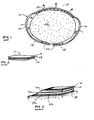
- the chest brace 10 incorporating the invention hereof is shown schematically in Fig. 1 and comprises a resilient metal core which is bent to surround a patient's chest 12 (shown in cross-section).
- Chest brace 10 includes a pair of arms 14 and 16 which are bent around chest 12.
- a frontal resilient segment 18 is adhered to the patient's chest wall by an adhesive structure 20 whose details will be described below.
- arms 14 and 16 are adhered to the patient's back via an adhesive structure 22.
- the lateral segments 24 and 26 of chest brace 10 are not adhered to the patient's chest wall thereby enabling lateral expansion and contraction during breathing.
- Chest brace 10 when in the position shown in Fig. 1, exerts an outward distending force (via adhesive structure 20) on the skin of the patient's chest.
- the distending force is accomplished by assuring that the resilient metal core assumes an approximately oval shape when arms 14 and 16 are bent around the patient, the oval shape being such as to cause a separation of frontal resilient segment 18 from the patient's chest wall.
- a pressure is applied to frontal resilient segment 18, causing it to adhere to the patient's chest wall.
- the resiliency and inherent recoil of the compressed metal core causes an outward flexure of frontal resilient segment 18, and a continuous distending force upon the patient's chest wall.
- FIG. 2 a small section of chest brace is shown and illustrates that resilient metal core 28 is sandwiched between a soft material layer 30 and a VelcroTM layer 32.
- Velcro layer 32 only extends over the length of chest brace 10 which makes contact with a mating layer of Velcro that has been adhered, by an intermediate adhesive layer, to the patient's chest wall.
- the Velcro/adhesive layer is shown in further detail in Fig. 3 and is comprised of a thin, elastic, transparent and self-adhesive hydrocolloid layer 34.
- a thin, elastic, transparent and self-adhesive hydrocolloid layer 34 Such materials are often used as a sterile skin dressing in neonatal intensive care units to protect newborn skin. Such materials consist of liquid absorbing particles in an elastic, self-adhesive mass 34a, covered on one side by a semi-permeable elastic and non-adherent polyurethane film 34b.
- the principal ingredients of such a hydrocolloid dressing are sodium carboxymethyl cellulose, synthetic block co-polymer, artificial tackifier and a plasticizer.
- Such a hydrocolloid material is manufactured by Coloplast, Inc., Tampa, Florida, and is marketed under the trademark COMFEELTM.
- Adhered to film surface 34b of hydrocolloid layer 34 is a further layer of Velcro 36.
- Velcro layer 36 may be of the loop variety and Velcro layer 32 of the hook variety (or vice-versa) to enable a joinder therebetween. While the attachment mechanism is most preferably accomplished by the described, interacting Velcro layers, those skilled in the art will realize that any instrumentality which enables an adhesion between the patient's chest wall and the inner surface of chest brace 10 is within the scope of the invention.
- Resilient metal core 28 is preferably comprised of strips of thin steel (e.g. .007-.001 shim steel).
- the metal strips (or strip) are encased on their outer side with a soft material (such as moleskinTM, available from the Johnson & Johnson Company, New Brunswick, New Jersey), and on their inner surface with Velcro layer 32.
- the thickness of each metal core 28 can be changed to suit the needs and dimensions of the patient. For example, an infant weighing 1,500 grams may need a chest brace 10 made of two steel strips, with each steel strip being approximately 0.64cm (1/4 inch) wide, thereby making the brace a little more than 1.27cm (1/2 inch) wide.
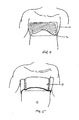
- Figs. 4-7 illustrate the method of application of chest brace 10 to a patient.
- a strip of self-adhesive loop Velcro 36 is centered on the top of hydrocolloid layer 34 on the patient's anterior chest wall.
- Velcro 36 extends between the anterior axillary lines and a similar Velcro strip 40 is placed over hydrocolloid layer 42 posteriorly between the patient's scapulas (see Fig. 6).
- chest brace 10 With the patient in the supine position, arm 16 of chest brace 10 (see Fig. 7) is first brought into contact with velcro layer 40 and is joined thereto by the corresponding Velcro layer on arm 16. Chest brace 10 is then swung anteriorly so as to encircle the patient's chest, arching over the xiphisternum and leaving at least 0.127cm (1/2 inch) space between velcro layer 36 on the patient's chest (see Fig. 4) and Velcro layer 32 on the underside of the resilient segment (see. Fig. 5). The free end of the chest brace 10 (e.g. arm 14) is then attached onto Velcro layer 40, that is adhered to the patient's back by hydrocolloid layer 42.
- Velcro layer 40 that is adhered to the patient's back by hydrocolloid layer 42.
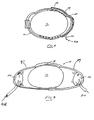
- chest brace 10 is also adapted to provide active ventilation.
- the exterior surface of chest brace 10 includes an air bladder 50 which is bonded thereto.
- the stiffness of bladder 50 can be altered to control the amount of outward pull of chest brace 10. More specifically, filling bladder 50 with air changes its shape, and as bladder 50 straightens, it pulls the brace away from the chest.
- chest brace 10 is enabled to resume its original position by the natural resiliency of its metal core. In such manner, ventilation of the patient can be assisted by periodically altering the air pressure within air bladder 50.
- a similar ventilation structure is shown, however, in this case, a pair of air bladders 54 and 56 are positioned within chest brace 10 and upon inflation and deflation, control the position of frontal resilient segment 18 of chest brace 10. In such manner, ventilation of the patient is assisted.
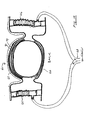
- chest brace 60 comprises a pair of separated brace members 62 and 64.
- Anterior brace member 62 is adhered to the patient's chest wall via the same connection mechanism as described above.
- posterior brace member 62 is adhered to the back of the patient in the manner described above.
- the spacing between brace members 62 and 64 is controlled by air pressure within a pair of corrugated respirator tubes 64 and 66.
- anterior brace member 62 moves away from posterior brace member 64.
- Velcro interconnection between anterior brace member 62 and the patient's chest wall moves outwardly.
- Control of air pressure in tubes 64 and 66 is via an input 68 from a ventilator system.
Landscapes
- Health & Medical Sciences (AREA)
- Pulmonology (AREA)
- Animal Behavior & Ethology (AREA)
- General Health & Medical Sciences (AREA)
- Heart & Thoracic Surgery (AREA)
- Epidemiology (AREA)
- Pain & Pain Management (AREA)
- Physical Education & Sports Medicine (AREA)
- Rehabilitation Therapy (AREA)
- Life Sciences & Earth Sciences (AREA)
- Cardiology (AREA)
- Emergency Medicine (AREA)
- Public Health (AREA)
- Veterinary Medicine (AREA)
- Orthopedics, Nursing, And Contraception (AREA)
- Materials For Medical Uses (AREA)
- Finger-Pressure Massage (AREA)
- Corsets Or Brassieres (AREA)
- Flanged Joints, Insulating Joints, And Other Joints (AREA)
- Measuring Pulse, Heart Rate, Blood Pressure Or Blood Flow (AREA)
- Cold Air Circulating Systems And Constructional Details In Refrigerators (AREA)
- Laminated Bodies (AREA)
Claims (12)
- Plastron rigide de renfort thoracique (10) permettant de fournir à un patient une pression de distension intrathoracique négative, comprenant :la structure de renfort comprend également un moyen (24, 26, 28) permettant de transmettre une flexion extérieure continue audit segment frontal sur plusieurs cycles respiratoires réagissant au raccordement du segment frontal utilisé audit premier moyen adhésif, où ladite flexion extérieure appliquée distend la région pulmonaire d'un patient en conséquence de la pression extérieure exercée sur celle-ci par le biais dudit premier moyen adhésif, créant ainsi une pression intrathoracique négative.(a) un premier moyen adhésif (20) adapté pour adhérer à la région pulmonaire d'un patient; et(b) une structure de renfort permettant d'encercler substantiellement le corps d'un patient et comprenant un segment frontal (18) adapté de façon à pouvoir être raccordé audit premier moyen adhésif ; caractérisée par le fait que
- Plastron rigide de renfort thoracique tel qu'indiqué à la revendication 1, comprenant également un premier mécanisme de fixation (32, 36) disposé entre ledit premier moyen adhésif et ledit segment frontal.
- Plastron rigide de renfort thoracique tel qu'indiqué à la revendication 2, où ledit premier moyen adhésif contient un pansement hydrocolloïde (34) comprenant : cellulose de carboxyméthyle de sodium, un copolymère bloc synthétique, un agent poisseux artificiel et un plastifiant, et ledit premier mécanisme de fixation (32, 36) comprend un système d'attache à fermeture velcro accouplé audit premier moyen adhésif.
- Plastron rigide de renfort thoracique tel qu'indiqué dans l'une quelconque des revendications qui précèdent, où ledit moyen transmettant une flexion comprend : une paire de bras flexibles élastiques (14, 16) adaptés de façon à pouvoir encercler la région pulmonaire d'un patient et la région dorsale d'un patient, chaque bras ayant une extrémité distale ; et
un moyen de fixation (22) permettant d'attacher chacune desdites extrémités distales des bras élastiques à la région dorsale d'un patient. - Plastron rigide de renfort thoracique tel qu'indiqué à la revendication 4, où ledit moyen de fixation (22) comprend un deuxième moyen adhésif adapté de façon à pouvoir adhérer à la région dorsale d'un patient et auxdites extrémités distales desdits bras lorsque lesdits bras utilisés sont mis en contact avec ledit deuxième moyen adhésif.
- Plastron rigide de renfort thoracique tel qu'indiqué à la revendication 5, où ledit moyen de fixation (22) comprend également un deuxième mécanisme de fixation disposé entre ledit deuxième moyen adhésif et lesdites extrémités distales des bras élastiques.
- Plastron rigide de renfort thoracique tel qu'indiqué à la revendication 6, où ledit deuxième mécanisme de fixation comprend un système d'attache à fermeture velcro.
- Plastron rigide de renfort thoracique tel qu'indiqué dans l'une quelconque des revendications qui précèdent, comprenant également un moyen d'extension (50) permettant de transmettre une force de distension de la poitrine audit segment frontal en réaction à une action de contrôle.
- Plastron rigide de renfort thoracique tel qu'indiqué à la revendication 8, où ledit moyen d'extension (50) est contrôlable de façon à pouvoir transmettre une force de distension variable de la poitrine audit segment frontal.
- Plastron rigide de renfort thoracique tel qu'indiqué à la revendication 9, où ledit moyen d'extension (50) est contrôlable grâce à une commande pneumatique de façon à pouvoir transmettre ladite force de distension variable de la poitrine audit segment frontal.
- Plastron rigide de renfort thoracique tel qu'indiqué à la revendication 10, où ladite structure de renfort comprend également un segment arrière (64), et ledit moyen d'extension comprend une paire d'actionneurs à commande pneumatique (64, 66) connectés entre ledit segment frontal (62) et ledit segment arrière (64) pour permettre de déplacer ledit segment frontal par rapport audit segment arrière en réaction à ladite action de contrôle.
- Appareil consistant en un plastron rigide de renfort thoracique tel qu'indiqué à la revendication 1, où ledit premier moyen adhésif utilise une couche intérieure (34) adhérant à la région thoracique d'un patient et une couche extérieure (36) avec une couche externe adhésive, ladite structure de renfort comprenant une bande élastique (28) de forme ovale dans un état non stressé et également ledit segment frontal avec une couche adhésive du côté du patient pour attacher ladite couche extérieure dudit premier moyen adhésif, et où, en vue de l'utilisation, le segment frontal est déplacé d'une première position séparée dudit premier moyen adhésif vers une autre position y adhérant afin d'exercer la force de distension vers l'extérieur.
Applications Claiming Priority (3)
| Application Number | Priority Date | Filing Date | Title |
|---|---|---|---|
| US08/560,267 US5820572A (en) | 1995-11-21 | 1995-11-21 | Negative pressure chest brace |
| US560267 | 1995-11-21 | ||
| PCT/US1996/018794 WO1997018789A1 (fr) | 1995-11-21 | 1996-11-21 | Corset a pression negative |
Publications (3)
| Publication Number | Publication Date |
|---|---|
| EP0871423A1 EP0871423A1 (fr) | 1998-10-21 |
| EP0871423A4 EP0871423A4 (fr) | 2002-11-20 |
| EP0871423B1 true EP0871423B1 (fr) | 2005-09-07 |
Family
ID=24237058
Family Applications (1)
| Application Number | Title | Priority Date | Filing Date |
|---|---|---|---|
| EP96942048A Expired - Lifetime EP0871423B1 (fr) | 1995-11-21 | 1996-11-21 | Corset a pression negative |
Country Status (6)
| Country | Link |
|---|---|
| US (2) | US5820572A (fr) |
| EP (1) | EP0871423B1 (fr) |
| AT (1) | ATE303782T1 (fr) |
| AU (1) | AU1122597A (fr) |
| DE (1) | DE69635163T2 (fr) |
| WO (1) | WO1997018789A1 (fr) |
Families Citing this family (23)
| Publication number | Priority date | Publication date | Assignee | Title |
|---|---|---|---|---|
| US6533739B1 (en) * | 1995-11-21 | 2003-03-18 | The Penn State Research Foundation | Chest brace and method of using same |
| US6174295B1 (en) * | 1998-10-16 | 2001-01-16 | Elroy T. Cantrell | Chest mounted cardio pulmonary resuscitation device and system |
| US6952605B1 (en) | 2000-08-10 | 2005-10-04 | Respironics, Inc. | Pneumatic release mechanism for a patient contacting article |
| US6726639B2 (en) * | 2002-01-16 | 2004-04-27 | Jorge I. Bassuk | Medical cuirass for cardio-pulmonary resuscitation |
| US7211056B2 (en) * | 2004-08-28 | 2007-05-01 | Danuta Grazyna Petelenz | Device for chest and abdominal compression CPR |
| US7644714B2 (en) | 2005-05-27 | 2010-01-12 | Apnex Medical, Inc. | Devices and methods for treating sleep disorders |
| US7037281B1 (en) * | 2005-06-29 | 2006-05-02 | Jeffrey M Neil | Arm sling apparatus |
| US8034011B2 (en) * | 2005-10-27 | 2011-10-11 | Temple University—Of the Commonwealth System of Higher Education | Thoracic stabilizer |
| US20070235041A1 (en) * | 2006-03-28 | 2007-10-11 | Grande Magnar J | "Stampede" protection belt |
| US20080027360A1 (en) * | 2006-07-25 | 2008-01-31 | Smith George K | Medical device for temporarily treating flail chest injury |
| US20140024979A1 (en) | 2010-12-23 | 2014-01-23 | Mark Bruce Radbourne | Respiration-assistance systems, devices, or methods |
| US10070984B2 (en) | 2012-12-06 | 2018-09-11 | Childrens's Hospital & Research Center at Oakland | Variable pressure upper torso braces and methods related thereto |
| US9855184B2 (en) * | 2013-05-09 | 2018-01-02 | Children's Hospital & Research Center At Oakland | Non-surgical torso deformity correction devices and methods related thereto |
| EP3128987A4 (fr) * | 2014-04-07 | 2017-11-22 | The Penn State Research Foundation | Attelle de poitrine néonatale pour appliquer une pression de distension négative |
| DE102015101706A1 (de) * | 2015-02-06 | 2016-08-11 | GS Elektromedizinische Geräte G. Stemple GmbH | Vorrichtung zur kardiopulmonalen Massage und/oder Reanimation |
| US11179098B2 (en) * | 2015-02-23 | 2021-11-23 | Norman A. Paradis | System for dynamically stabilizing the chest wall after injury, fracture, or operative procedures |
| US11833096B2 (en) | 2016-03-21 | 2023-12-05 | The Trustees Of The University Of Pennsylvania | Ambulatory respiratory assist device |
| EP3531989B1 (fr) * | 2016-10-28 | 2022-09-07 | The Penn State Research Foundation | Dispositif et procédé d'assistance respiratoire chez un sujet |
| TWI622385B (zh) | 2016-11-29 | 2018-05-01 | 肋骨支撐裝置 | |
| TWI678198B (zh) | 2017-11-28 | 2019-12-01 | 財團法人工業技術研究院 | 可調式胸甲 |
| WO2020131736A1 (fr) | 2018-12-17 | 2020-06-25 | The Trustees Of The University Of Pennsylvania | Améliorations de dispositif d'assistance respiratoire ambulatoire |
| US12508204B2 (en) * | 2021-12-20 | 2025-12-30 | Stryker Corporation | Chest compression system retainer with shoulder brace for use with a patient transport apparatus |
| US11839587B1 (en) | 2023-02-03 | 2023-12-12 | RightAir, Inc. | Systems, devices, and methods for ambulatory respiration assistance |
Family Cites Families (33)
| Publication number | Priority date | Publication date | Assignee | Title |
|---|---|---|---|---|
| US201038A (en) * | 1878-03-05 | Improvement in apparatus for developing the chest | ||
| US2529258A (en) * | 1946-07-04 | 1950-11-07 | Lobo Fernando Gonzalez | Apparatus for artificial respiration |
| US2825327A (en) * | 1953-11-25 | 1958-03-04 | Electronic & X Ray Appliances | Mechanical breathing apparatus |
| US2833275A (en) * | 1956-02-28 | 1958-05-06 | Tunnicliffe Edward Alber James | Mechanical breathing apparatus |
| US3941120A (en) * | 1972-05-02 | 1976-03-02 | Shaotsu Thomas Lee | Ventilating endoscopes |
| US4187277A (en) * | 1975-03-07 | 1980-02-05 | Petrolite Corporation | Process of inhibiting corrosion with quaternaries of halogen derivatives of alkynoxymethyl amines |
| US4257407A (en) * | 1977-10-21 | 1981-03-24 | Macchi Pier G | Negative pressure respirator shells |
| US4371497A (en) * | 1979-04-23 | 1983-02-01 | Petrolite Corporation | Inhibition of corrosion with thiazine quaternary ammonium salts of polyepihalophydrin |
| US4770164A (en) * | 1980-10-16 | 1988-09-13 | Lach Ralph D | Resuscitation method and apparatus |
| US4425920A (en) * | 1980-10-24 | 1984-01-17 | Purdue Research Foundation | Apparatus and method for measurement and control of blood pressure |
| US4523579A (en) * | 1983-06-24 | 1985-06-18 | Barry Edward R | Lightweight body respirator having flexible walls |
| SU1225560A1 (ru) * | 1984-11-12 | 1986-04-23 | Ставропольский государственный медицинский институт | Устройство дл лечени переломов ребер |
| GB8501600D0 (en) * | 1985-01-22 | 1985-02-20 | Hayek Z | Infant ventilator |
| SU1247009A1 (ru) * | 1985-01-28 | 1986-07-30 | Тульский Ордена Трудового Красного Знамени Политехнический Институт | Аппарат искусственного дыхани |
| WO1987004615A2 (fr) * | 1986-02-04 | 1987-08-13 | Breasy Medical Equipment Limited | Appareil de ventilation pulmonaire et vanne de commande de fluide |
| US4669461A (en) * | 1986-08-11 | 1987-06-02 | Maryann Battaglia | Device for administering oxygen to infants during nursing |
| GB8704104D0 (en) * | 1987-02-21 | 1987-03-25 | Manitoba University Of | Respiratory system load apparatus |
| FR2624008B1 (fr) * | 1987-12-03 | 1993-08-27 | France Etat | Prothese extra-thoracique d'assistance ventilatoire moulable par depression |
| JPH01223966A (ja) * | 1988-03-01 | 1989-09-07 | Sumitomo Bakelite Co Ltd | 人工呼吸器 |
| US4915095A (en) * | 1988-05-02 | 1990-04-10 | Newton Chun | Cardiac CPR mechanism |
| US4945899A (en) * | 1988-07-14 | 1990-08-07 | Nihon Kohden Corporation | Method of and apparatus for artificial respiration in synchronism with voluntary breathing of a patient |
| US4881527A (en) * | 1988-11-14 | 1989-11-21 | Lerman Samuel I | Cardiac assist cuirass |
| US4971042A (en) * | 1988-11-14 | 1990-11-20 | Lerman Samuel I | Cardiac assist curiass |
| GB2226959B (en) * | 1989-01-16 | 1992-11-18 | Zamir Hayek | Chest enclosures for ventilators |
| US4977889A (en) * | 1989-10-12 | 1990-12-18 | Regents Of The University Of Minnesota | Fitting and tuning chest compression device |
| AU651189B2 (en) * | 1991-04-17 | 1994-07-14 | Regents Of The University Of California, The | Improved devices and methods for external chest compression |
| CA2137275A1 (fr) * | 1992-06-03 | 1993-12-09 | Richard L. Eckert | Bandage servant a l'application continue de produits biologiques |
| DE9209296U1 (de) * | 1992-07-10 | 1992-09-24 | Fuchs, Carl-Günter, Dr.med., 37619 Bodenwerder | Saugdruckvorrichtung für die Herz-/Lungenwiederbelebung |
| US5362304A (en) * | 1992-10-28 | 1994-11-08 | Restorative Care Of America Incorporated | Thoracic lumbar sacral orthosis device |
| US5549914A (en) * | 1992-12-14 | 1996-08-27 | Sween Corporation | Heat stable wound care gel |
| US5490820A (en) * | 1993-03-12 | 1996-02-13 | Datascope Investment Corp. | Active compression/decompression cardiac assist/support device and method |
| US5466724A (en) * | 1993-06-01 | 1995-11-14 | Variseal Corporation | Adhesive composition for a wound dressing |
| GB9509192D0 (en) * | 1995-05-05 | 1995-06-28 | Dranez Anstalt | Apparatus for producing lung expansion or assisted ventilation |
-
1995
- 1995-11-21 US US08/560,267 patent/US5820572A/en not_active Expired - Lifetime
-
1996
- 1996-11-21 EP EP96942048A patent/EP0871423B1/fr not_active Expired - Lifetime
- 1996-11-21 AT AT96942048T patent/ATE303782T1/de not_active IP Right Cessation
- 1996-11-21 AU AU11225/97A patent/AU1122597A/en not_active Abandoned
- 1996-11-21 WO PCT/US1996/018794 patent/WO1997018789A1/fr not_active Ceased
- 1996-11-21 DE DE69635163T patent/DE69635163T2/de not_active Expired - Lifetime
-
1998
- 1998-03-24 US US09/046,726 patent/US6059742A/en not_active Expired - Lifetime
Also Published As
| Publication number | Publication date |
|---|---|
| DE69635163D1 (de) | 2005-10-13 |
| AU1122597A (en) | 1997-06-11 |
| EP0871423A4 (fr) | 2002-11-20 |
| WO1997018789A1 (fr) | 1997-05-29 |
| EP0871423A1 (fr) | 1998-10-21 |
| ATE303782T1 (de) | 2005-09-15 |
| US6059742A (en) | 2000-05-09 |
| DE69635163T2 (de) | 2006-06-14 |
| US5820572A (en) | 1998-10-13 |
Similar Documents
| Publication | Publication Date | Title |
|---|---|---|
| EP0871423B1 (fr) | Corset a pression negative | |
| US7297125B2 (en) | Chest brace to prevent collapse of chest wall | |
| US11576835B2 (en) | Neonatal chest splint for applying negative distending pressure | |
| EP0688201B1 (fr) | Dispositif d'assistance/soutien cardiaque a compression/decompression active | |
| US4971042A (en) | Cardiac assist curiass | |
| US8567407B1 (en) | Internal pressure therapy apparatus | |
| US20050126578A1 (en) | External pressure garment in combination with a complementary positive pressure ventilator for pulmocardiac assistance | |
| US6461315B1 (en) | Apparatus for improving the distribution of gas in the lungs of a patient receiving respiratory treatment | |
| CN109414557A (zh) | 患者接口 | |
| US12390393B2 (en) | Device and method for assisting breathing in a subject | |
| US20190254901A1 (en) | Infant Care Apparatus and System | |
| JP2007512905A (ja) | 負圧換気及び蘇生システム | |
| CN209392539U (zh) | 一种无创呼吸面罩固定装置 | |
| US20250360051A1 (en) | Wearable device for improving vascular insufficiency to the extremities | |
| CA3040944A1 (fr) | Appareil et systeme de soins pour nourrissons | |
| CN213491212U (zh) | 一种术中输液固定装置 | |
| CN211534612U (zh) | 一种可拆卸式桡动脉加压固定器 | |
| CN118267283A (zh) | 一种缓解呼吸窘迫的拍背器 | |
| CN114557875A (zh) | 一种用于辅助胸廓扩张促进呼吸训练的负压手部固定装置 | |
| JPH033491B2 (fr) |
Legal Events
| Date | Code | Title | Description |
|---|---|---|---|
| PUAI | Public reference made under article 153(3) epc to a published international application that has entered the european phase |
Free format text: ORIGINAL CODE: 0009012 |
|
| 17P | Request for examination filed |
Effective date: 19980618 |
|
| AK | Designated contracting states |
Kind code of ref document: A1 Designated state(s): AT BE CH DE DK ES FI FR GB GR IE IT LI NL PT SE |
|
| A4 | Supplementary search report drawn up and despatched |
Effective date: 20021004 |
|
| AK | Designated contracting states |
Kind code of ref document: A4 Designated state(s): AT BE CH DE DK ES FI FR GB GR IE IT LI NL PT SE |
|
| RIC1 | Information provided on ipc code assigned before grant |
Free format text: 7A 61H 31/00 A, 7A 61H 31/02 B |
|
| 17Q | First examination report despatched |
Effective date: 20040206 |
|
| GRAP | Despatch of communication of intention to grant a patent |
Free format text: ORIGINAL CODE: EPIDOSNIGR1 |
|
| GRAS | Grant fee paid |
Free format text: ORIGINAL CODE: EPIDOSNIGR3 |
|
| GRAA | (expected) grant |
Free format text: ORIGINAL CODE: 0009210 |
|
| AK | Designated contracting states |
Kind code of ref document: B1 Designated state(s): AT BE CH DE DK ES FI FR GB GR IE IT LI NL PT SE |
|
| PG25 | Lapsed in a contracting state [announced via postgrant information from national office to epo] |
Ref country code: NL Free format text: LAPSE BECAUSE OF FAILURE TO SUBMIT A TRANSLATION OF THE DESCRIPTION OR TO PAY THE FEE WITHIN THE PRESCRIBED TIME-LIMIT Effective date: 20050907 Ref country code: LI Free format text: LAPSE BECAUSE OF FAILURE TO SUBMIT A TRANSLATION OF THE DESCRIPTION OR TO PAY THE FEE WITHIN THE PRESCRIBED TIME-LIMIT Effective date: 20050907 Ref country code: FI Free format text: LAPSE BECAUSE OF FAILURE TO SUBMIT A TRANSLATION OF THE DESCRIPTION OR TO PAY THE FEE WITHIN THE PRESCRIBED TIME-LIMIT Effective date: 20050907 Ref country code: ES Free format text: LAPSE BECAUSE OF FAILURE TO SUBMIT A TRANSLATION OF THE DESCRIPTION OR TO PAY THE FEE WITHIN THE PRESCRIBED TIME-LIMIT Effective date: 20050907 Ref country code: DK Free format text: LAPSE BECAUSE OF FAILURE TO SUBMIT A TRANSLATION OF THE DESCRIPTION OR TO PAY THE FEE WITHIN THE PRESCRIBED TIME-LIMIT Effective date: 20050907 Ref country code: CH Free format text: LAPSE BECAUSE OF FAILURE TO SUBMIT A TRANSLATION OF THE DESCRIPTION OR TO PAY THE FEE WITHIN THE PRESCRIBED TIME-LIMIT Effective date: 20050907 Ref country code: BE Free format text: LAPSE BECAUSE OF FAILURE TO SUBMIT A TRANSLATION OF THE DESCRIPTION OR TO PAY THE FEE WITHIN THE PRESCRIBED TIME-LIMIT Effective date: 20050907 Ref country code: AT Free format text: LAPSE BECAUSE OF FAILURE TO SUBMIT A TRANSLATION OF THE DESCRIPTION OR TO PAY THE FEE WITHIN THE PRESCRIBED TIME-LIMIT Effective date: 20050907 |
|
| REG | Reference to a national code |
Ref country code: GB Ref legal event code: FG4D |
|
| REG | Reference to a national code |
Ref country code: CH Ref legal event code: EP |
|
| REG | Reference to a national code |
Ref country code: IE Ref legal event code: FG4D |
|
| REF | Corresponds to: |
Ref document number: 69635163 Country of ref document: DE Date of ref document: 20051013 Kind code of ref document: P |
|
| PGFP | Annual fee paid to national office [announced via postgrant information from national office to epo] |
Ref country code: GR Payment date: 20051026 Year of fee payment: 10 |
|
| PGFP | Annual fee paid to national office [announced via postgrant information from national office to epo] |
Ref country code: NL Payment date: 20051106 Year of fee payment: 10 |
|
| PGFP | Annual fee paid to national office [announced via postgrant information from national office to epo] |
Ref country code: FR Payment date: 20051108 Year of fee payment: 10 |
|
| PGFP | Annual fee paid to national office [announced via postgrant information from national office to epo] |
Ref country code: IE Payment date: 20051111 Year of fee payment: 10 Ref country code: AT Payment date: 20051111 Year of fee payment: 10 |
|
| PGFP | Annual fee paid to national office [announced via postgrant information from national office to epo] |
Ref country code: CH Payment date: 20051129 Year of fee payment: 10 |
|
| PG25 | Lapsed in a contracting state [announced via postgrant information from national office to epo] |
Ref country code: SE Free format text: LAPSE BECAUSE OF FAILURE TO SUBMIT A TRANSLATION OF THE DESCRIPTION OR TO PAY THE FEE WITHIN THE PRESCRIBED TIME-LIMIT Effective date: 20051207 Ref country code: GR Free format text: LAPSE BECAUSE OF FAILURE TO SUBMIT A TRANSLATION OF THE DESCRIPTION OR TO PAY THE FEE WITHIN THE PRESCRIBED TIME-LIMIT Effective date: 20051207 |
|
| PG25 | Lapsed in a contracting state [announced via postgrant information from national office to epo] |
Ref country code: PT Free format text: LAPSE BECAUSE OF FAILURE TO SUBMIT A TRANSLATION OF THE DESCRIPTION OR TO PAY THE FEE WITHIN THE PRESCRIBED TIME-LIMIT Effective date: 20060207 |
|
| NLV1 | Nl: lapsed or annulled due to failure to fulfill the requirements of art. 29p and 29m of the patents act | ||
| REG | Reference to a national code |
Ref country code: CH Ref legal event code: PL |
|
| PLBE | No opposition filed within time limit |
Free format text: ORIGINAL CODE: 0009261 |
|
| STAA | Information on the status of an ep patent application or granted ep patent |
Free format text: STATUS: NO OPPOSITION FILED WITHIN TIME LIMIT |
|
| 26N | No opposition filed |
Effective date: 20060608 |
|
| PG25 | Lapsed in a contracting state [announced via postgrant information from national office to epo] |
Ref country code: FR Free format text: LAPSE BECAUSE OF FAILURE TO SUBMIT A TRANSLATION OF THE DESCRIPTION OR TO PAY THE FEE WITHIN THE PRESCRIBED TIME-LIMIT Effective date: 20061020 |
|
| EN | Fr: translation not filed | ||
| PG25 | Lapsed in a contracting state [announced via postgrant information from national office to epo] |
Ref country code: IE Free format text: LAPSE BECAUSE OF NON-PAYMENT OF DUE FEES Effective date: 20061121 |
|
| REG | Reference to a national code |
Ref country code: IE Ref legal event code: MM4A |
|
| PGFP | Annual fee paid to national office [announced via postgrant information from national office to epo] |
Ref country code: IT Payment date: 20081126 Year of fee payment: 13 |
|
| PGFP | Annual fee paid to national office [announced via postgrant information from national office to epo] |
Ref country code: GB Payment date: 20081128 Year of fee payment: 13 |
|
| PGFP | Annual fee paid to national office [announced via postgrant information from national office to epo] |
Ref country code: DE Payment date: 20091119 Year of fee payment: 14 |
|
| GBPC | Gb: european patent ceased through non-payment of renewal fee |
Effective date: 20091121 |
|
| PG25 | Lapsed in a contracting state [announced via postgrant information from national office to epo] |
Ref country code: GB Free format text: LAPSE BECAUSE OF NON-PAYMENT OF DUE FEES Effective date: 20091121 |
|
| PG25 | Lapsed in a contracting state [announced via postgrant information from national office to epo] |
Ref country code: IT Free format text: LAPSE BECAUSE OF NON-PAYMENT OF DUE FEES Effective date: 20091121 |
|
| REG | Reference to a national code |
Ref country code: DE Ref legal event code: R119 Ref document number: 69635163 Country of ref document: DE Effective date: 20110601 Ref country code: DE Ref legal event code: R119 Ref document number: 69635163 Country of ref document: DE Effective date: 20110531 |
|
| PG25 | Lapsed in a contracting state [announced via postgrant information from national office to epo] |
Ref country code: DE Free format text: LAPSE BECAUSE OF NON-PAYMENT OF DUE FEES Effective date: 20110531 |