EP0872003B1 - Denudeur de fils - Google Patents
Denudeur de fils Download PDFInfo
- Publication number
- EP0872003B1 EP0872003B1 EP96930284A EP96930284A EP0872003B1 EP 0872003 B1 EP0872003 B1 EP 0872003B1 EP 96930284 A EP96930284 A EP 96930284A EP 96930284 A EP96930284 A EP 96930284A EP 0872003 B1 EP0872003 B1 EP 0872003B1
- Authority
- EP
- European Patent Office
- Prior art keywords
- blade
- wire
- carrier
- selector
- cutting
- Prior art date
- Legal status (The legal status is an assumption and is not a legal conclusion. Google has not performed a legal analysis and makes no representation as to the accuracy of the status listed.)
- Expired - Lifetime
Links
- 230000006835 compression Effects 0.000 claims description 4
- 238000007906 compression Methods 0.000 claims description 4
- 230000001154 acute effect Effects 0.000 claims description 2
- 238000009413 insulation Methods 0.000 description 19
- 239000004020 conductor Substances 0.000 description 4
- 230000001419 dependent effect Effects 0.000 description 2
- 230000000694 effects Effects 0.000 description 2
- 239000002783 friction material Substances 0.000 description 2
- 238000010276 construction Methods 0.000 description 1
- 238000010292 electrical insulation Methods 0.000 description 1
- 210000003811 finger Anatomy 0.000 description 1
- 239000000463 material Substances 0.000 description 1
- 239000002184 metal Substances 0.000 description 1
- 239000004033 plastic Substances 0.000 description 1
- 229920003023 plastic Polymers 0.000 description 1
- -1 polytetrafluoroethylene Polymers 0.000 description 1
- 229920001343 polytetrafluoroethylene Polymers 0.000 description 1
- 239000004810 polytetrafluoroethylene Substances 0.000 description 1
- 210000003813 thumb Anatomy 0.000 description 1
Images



Classifications
-
- H—ELECTRICITY
- H02—GENERATION; CONVERSION OR DISTRIBUTION OF ELECTRIC POWER
- H02G—INSTALLATION OF ELECTRIC CABLES OR LINES, OR OF COMBINED OPTICAL AND ELECTRIC CABLES OR LINES
- H02G1/00—Methods or apparatus specially adapted for installing, maintaining, repairing or dismantling electric cables or lines
- H02G1/12—Methods or apparatus specially adapted for installing, maintaining, repairing or dismantling electric cables or lines for removing insulation or armouring from cables, e.g. from the end thereof
- H02G1/1202—Methods or apparatus specially adapted for installing, maintaining, repairing or dismantling electric cables or lines for removing insulation or armouring from cables, e.g. from the end thereof by cutting and withdrawing insulation
- H02G1/1204—Hand-held tools
- H02G1/1229—Hand-held tools the cutting element making a longitudinal, and a transverse or a helical cut
- H02G1/1231—Hand-held tools the cutting element making a longitudinal, and a transverse or a helical cut using a swivelling cutting element
Definitions
- This invention relates to a wire stripper - that is to say, a tool intended normally to remove insulation from an insulated electrical wire or cable.
- the term "wire stripper” as used herein is not to be regarded as limited to this normal use; the wire stripper of this invention may be used to assist in the removal of any outer sheath from an elongate filamentary member.
- wire will be used broadly to refer to all kinds of filamentary member (such as an electrical conductor) having an outer sheath (in the case of an electrical conductor, a sheath of electrical insulation).
- a known kind of wire stripper has a body from which projects a cutting blade, the body supporting a wire clamp in the form of a hook-like member adapted to receive the insulated wire to be stripped and urge that wire into engagement with the projecting cutting blade.
- a wire stripper as described above particularly lends itself to the stripping of relatively large diameter wires and to the stripping of heavy duty or tough insulation sheaths.
- GB-A-1196140 there is described a tool of the above kind, where the blade is cranked and is rotatably mounted in a holder so that the blade may perform a castoring action.
- the blade will thus take up an appropriate position dependent upon whether the user rotates the tool around the wire, or pulls the tool towards the end of the wire.
- a lever is provided to allow the user to move the blade between its two positions respectively for annular and linear cuts, the blade being spring-urged to the annular cut position.
- the user may also hold the lever at an intermediate position so that on rotating the tool about a wire, the tool makes a helical cut along the insulation.
- the present invention aims at addressing the disadvantages of the known forms of wire stripper of the kind described above, in order to provide a tool which is relatively easy to use and yet which is effective at producing annular, linear and helical cuts to facilitate the removal of insulation from the wire.
- a wire stripper comprising a first sub-assembly comprising a sleeve, a blade carrier secured to the sleeve and a cutting blade projecting from the carrier, and a second sub-assembly comprising a selector and a wire clamp slidably mounted on the selector which clamp is arranged to hold a wire to be stripped and is spring-loaded to urge that wire against the cutting blade, the second sub-assembly being supported by and arranged for relative turning movement with respect to the first sub-assembly, and there being co-operating abutment means on the blade carrier and the selector positively to define a first cutting position where the blade is set to rotate around a held wire and a second cutting position where the blade is set to perform an axial cut along a held wire, spring means applying a rotational bias to the blade carrier to urge the carrier away from the second cutting position towards the first cutting position, the blade being moved between the first and second cutting positions by
- Such a wire stripper is relatively easy to use and permits the blade orientation to be changed to switch the tool from a setting which makes an encircling cut to a setting which makes an axial cut, without any special skill being required by the operator.
- a wire stripper comprising a selector, a blade carrier supported by the selector and having a projecting cutting blade, the selector and blade carrier being arranged for relative turning movement, a wire clamp slidably mounted on the selector and arranged to hold a wire to be stripped and to urge that wire against the cutting blade, co-operating abutment means on the blade carrier and the selector positively to define first, second and third cutting positions, in the first cutting position the blade being set to rotate around a held wire, in the second cutting position the carrier and blade being turned through substantially 90° from the first cutting position whereby the blade is set to perform an axial cut, and in the third cutting position the carrier and blade being turned through an acute angle from the first cutting position whereby the blade is set to perform a helical cut, and spring means applying a rotational bias to the blade carrier with respect to the selector whereby the carrier is torsionally urged selectively to either of the first or third cutting positions.
- a positive stop arrangement for the cutting blade whereby the blade may be set to perform annular, axial or helical cuts, and in the case of the helical cut, there is no need for the operator to exercise skill in ensuring the blade remains turned to the appropriate position. Moreover, whenever the tool is released, it will always reset itself for performing either an annular cut or a helical cut, dependent upon the setting of the selector, ready to perform a further similar cut.
- a single spring is used to perform the combined functions of biasing the blade carrier to allow automatic resetting of the tool, ready to perform a further cut, and also of biasing the clamp member to its wire-clamping position.
- This allows the construction of a compact and easy to use tool in contrast with the previous arrangements, all of which have employed at least two springs, one for each of these two functions separately.
- the abutment means is arranged such that the carrier is turned in one sense from the first cutting position in order to reach the second cutting position, but is turned in the opposite sense from the first cutting position in order to reach the third cutting position.
- the selector itself advantageously is slidable axially with respect to the blade carrier whereby the carrier may be moved from its first cutting position to its third cutting position by axial movement of the selector towards a held wire.
- the tool may include means carrying a spare blade, for example arranged within a sleeve which at least partially surrounds the blade carrier itself, whereby the spare blade is arranged parallel to the blade carrier axis and adjacent the end of the sleeve remote from the cutting blade. Access to such a spare blade may be restricted until the selector has appropriately been moved in order to free the blade carrier to move to a fourth position arcuately outside the normal range of movement of the blade carrier.
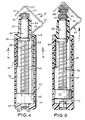
- the wire stripping tool shown in the drawings comprises a blade carrier 23 having a cylindrical end portion 22 which is rotatably located in a bore 21 in a selector 20.
- a collar is formed around the blade carrier at the inner end of the end portion, the collar having a radially projecting lug 24 which is accommodated within a tubular portion 25 of the selector 20.
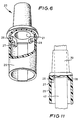
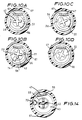
- Three abutment surfaces 26, 27 and 28 are provided within tubular portion 25, with which the lug 24 is engageable upon rotation of the blade carrier 23 with respect to the selector.
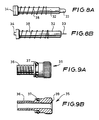
- the end portion 22 of the blade carrier 23 is internally threaded at 30 and the blind end of the threaded portion has a diametral slot 31.
- a cutter 32 Received in the end portion 22 is a cutter 32 having at one end a cutting blade 33 and at the other end a transverse peg 34 which locates in slot 31.
- the cutter 32 is held in position within the blade carrier by means of a depth-of-cut adjusting screw 35 ( Figure 9), the threads 36 of which are engageable with threads 30 of the blade carrier.
- a resilient O-ring 37 provides friction between the adjusting screw 35 and the blade carrier to resist unintentional turning of the screw.
- the cutter 32 extends through the adjusting screw 35 and a compression spring 38 serves to maintain peg 34 in engagement with slot 31 in the carrier.
- Rotation of the adjusting screw adjusts the amount by which cutting blade 33 projects beyond end face 39 of the screw, and removal of the screw allows a worn cutter 32 to be replaced by another.
- the end face 39 of the screw 35 may be coated with a low friction material, such as polytretrafluoroethylene.
- the screw 35 could be moulded from a low friction plastics material.
- the blade carrier has a shaft 42 of cruciform section projecting within the tool from lug 24. Slidably mounted on that shaft is a block 43 having a cylindrical bore so that the blade carrier may rotate with respect to the block. A slot is formed in the block parallel to the axis of the bore and the end tang 44 of a clamp 45 is fixed within that slot.
- the clamp 45 is formed from a metal strip and has an elongate portion 47 (on the free end of which is formed the tang 44) which passes through a slot 48 formed in the selector 20.
- the part of the clamp 45 located externally of the selector 20 is generally hook-shaped and is defined by sections 49, 50 and 51, with a rounded region 52 between sections 49 and 50.
- the corner 53 between sections 50 and 51 lies on the axis of the tool, above the projecting blade 33.
- the inwardly-directed surfaces of the clamp 45 external of the selector 20 may be coated with a low-friction material, such as polytetrafluoroethylene.
- a helical compression spring 55 acts between lug 24 and collar of the blade carrier 23 and block 43 mounted on that carrier. As shown, the two ends of the spring are turned through 90° and are located in holes formed respectively in the lug of the carrier 23 and the block 43. As fitted, the spring urges the block axially away from the cutting blade 33 and also applies torque to the blade carrier 23 to urge the lug 24 towards the abutments 26 and 27 of the selector 20. The block itself is restrained against rotation by means of the elongate portion 47 of the clamp, extending through slot 48 in the selector 20.
- a sleeve 56 Rotatably fitted around the tubular portion 25 of the selector 20 is a sleeve 56, the lower end (in Figures 1 to 5) of which is provided with an inwardly directed flange 57 having a cross-shaped central opening 58 in which is received the correspondingly-shaped end portion 59 of the blade carrier shaft 42.
- a screw 60 serves to lock the sleeve 56 to the blade carrier 23.
- the projection of the blade 33 beyond the end face 39 of the adjusting screw 35 is set to suit the radial thickness of the insulation 65.
- the clamp member 45 is pushed to be spaced further from the sleeve 56, against the action of spring 55, the wire is located between sections 50 and 51 of the clamp, and the clamp is released so that the spring force causes the blade 33 to penetrate the insulation, as shown in Figure 5.
- the tool is then rotated around the wire so that the blade 33 performs an annular (i.e. radial) cut into the insulation.
- the rounded region 52 between sections 49 and 50 of the clamp 45 facilitates pushing of the clamp further away from the sleeve 56.
- a user may grasp the sleeve in the palm of his hand with his four fingers and then may use his thumb to drive the clamp 45 away from the sleeve, the rounded region 52 providing a convenient thumb-grip.
- the external surface of the selector 20 in the region of its axial bore is generally conical, there is a flat 54 provided on one side and along which the elongate portion 47 of the clamp 45 slides. This imparts stability to the clamp.
- the selector 20 is pushed axially away from the sleeve 56, as illustrated in Figure 3. This allows the lug 24 to ride over abutment surface 26 and engage abutment surface 27 ( Figure 6) under the action of the spring 55.
- the abutment surfaces 26 and 27 are spaced by 15° of arc, to give a helical cut on rotating the tool about the wire to be stripped.
- the cutter may be exchanged for another by pushing the clamp 45 as far as possible away from sleeve 56 (and so until the upper surface of the block 43 engages the inner skirt of the selector 20) and then unscrewing the adjusting screw 35 to release the cutter. So long as the adjusting screw is in position within the blade carrier 23, the selector 20 cannot be pushed much further away from sleeve 56 than is required for the helical cut setting because the selector will foul on the adjusting screw 35. This prevents lug 24 riding over abutment surface 27.
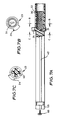
- Figures 12 to 14 show a modified form of the tool illustrated in Figures 1 to 11, wherein provision is made for the carrying of a spare cutter.
- the tool is the same as that described above and like parts are indicated with like reference characters: those parts will not be described again here.
- the tubular portion 25 of the selector 20 has a pin 70 projecting parallel to the selector axis, beyond the skirt 71 of that portion 25.
- a generally C-shaped groove 72 is formed in the block 43 and a tube 74 is positioned within that groove 72 with the tube end 75 located on the pin 70.
- the flange 57 of the sleeve 56 has an opening 76 which may come into alignment with the tube 74 upon rotation of the sleeve with respect to the selector 20 and so also the block 43.
- the configuration is such that the alignment can be achieved only when the lug 24 of the blade carrier 23 is moved further beyond the abutment surface 27 of the selector 20 - and this can be achieved only once the adjusting screw 35 has been removed so allowing the selector 20 to be pushed axially further away from the sleeve 56 than is required for the helical cut setting illustrated in Figure 3.
- This movement further beyond abutment surface 27 will be under the action of the spring 55 but is limited by the lug 24 engaging the elongate portion 47 of the clamp 45, as shown in Figure 10D.
- the tool may conveniently be used to remove a section of insulation part way along the length of a wire. This is achieved by making a first annular cut, then a helical cut from that annular cut for the required distance and finally a further annular cut at the other end of the helical cut. Thereafter, the insulation may easily be removed, for example by using a pair of side cutters.
- the sleeve 56 has a flat 67 formed along its length. This serves as a convenient reference point for operation of the tool, since in the "normal" (annular cut) setting, the flat 67 is aligned with the clamp 45. Moreover, the flat serves as a convenient surface on which to carry information such as the manufacturer's details.
Landscapes
- Removal Of Insulation Or Armoring From Wires Or Cables (AREA)
Claims (16)
- Dispositif à dénuder les fils, comprenant un sélecteur (20), un porte-lame (23) supporté par le sélecteur (20) et possédant une lame coupante saillante (33), le sélecteur et le porte-lame étant agencés pour un mouvement tournant relatif, un serre-fil (45) monté coulissant sur le sélecteur (20) et agencé pour maintenir un fil (64) à dénuder et pour pousser ce fil contre la lame coupante (33), des moyens de butée coopérants (24, 26, 27, 28) sur le porte-lame (23) et le sélecteur (20) pour définir positivement des première, deuxième et troisième positions de coupe, dans la première position de coupe la lame (33) étant réglée pour tourner autour d'un fil maintenu, dans la deuxième position de coupe le porte-lame et la lame étant tournés de sensiblement 90° à partir de la première position de coupe de sorte que la lame (33) est réglée pour effectuer une coupe axiale, et dans la troisième positon de coupe le porte-lame et la lame étant tournés d'un angle aigu à partir de la première position de coupe de sorte que la lame (33) est réglée pour effectuer une coupe hélicoïdale, et des moyens élastiques (55) exerçant sur le porte-lame un rappel rotatif (23) par rapport au sélecteur (20) de sorte que le porte-lame (23) est poussé en rotation sélectivement dans l'une ou l'autre de la première ou la troisième position de coupe.
- Dispositif à dénuder les fils selon la revendication 1, dans lequel les moyens de butée (24, 26, 27, 28) sont agencés de façon que le porte-lame (23) tourne dans un premier sens pour atteindre la deuxième position de coupe, et tourne dans le sens opposé pour atteindre la troisième position de coupe à partir de la première position de coupe.
- Dispositif à dénuder les fils selon la revendication 1 ou 2, dans lequel les moyens de butée coopérants comprennent une butée (24) sur le porte-lame (20) et des premier, deuxième et troisième arrêts (26, 27, 28) prévus sur le sélecteur (20).
- Dispositif à dénuder les fils selon la revendication 2 et 3, dans lequel le porte-lame (23) est supporté par le sélecteur (20) avec mouvement axial limité par rapport à celui-ci, le porte-lame (23) étant mobile de sa première position de coupe à sa troisième position de coupe par mouvement axial du porte-lame (23) dans le sens écartant celui-ci d'un fil (60) en train d'être maintenu, pour permettre à la butée (24) du porte-lame de franchir le premier arrêt (26) et de tourner dans ledit sens opposé pour atteindre le troisième arrêt (27).
- Dispositif à dénuder les fils selon la revendication 4, dans lequel le porte-lame (23) est poussé élastiquement en direction axiale par rapport au sélecteur (20) vers sa position où la butée (24) du porte-lame peut s'appuyer sur le premier arrêt (26).
- Dispositif à dénuder les fils selon la revendication 5, dans lequel un ressort hélicoïdal (38) agit entre le sélecteur (20) et le porte-lame (23) et sert à pousser le porte-lame en rotation dans le sens l'écartant de la seconde position de coupe.
- Dispositif à dénuder les fils selon l'une quelconque des revendications précédentes, dans lequel le serre-fil (45) est monté pour avoir par rapport au sélecteur un mouvement coulissant sensiblement parallèle à l'axe du porte-lame, et subit une poussée élastique vers une position de serrage du fil.
- Dispositif à dénuder les fils selon la revendication 7, dans lequel un seul ressort hélicoïdal (38) sert à la fois à pousser le porte-lame (23) en rotation dans le sens l'écartant de la seconde position de coupe vers la première position de coupe, et également à pousser le serre-fil (45) vers une position du serrage du fil.
- Dispositif à dénuder les fils selon l'une quelconque des revendications précédentes, dans lequel un manchon extérieur (56) entourant au moins une partie du sélecteur (20) et une partie du porte-lame (23), est relié au porte-lame pour impartir à celui-ci un mouvement par rapport au sélecteur.
- Dispositif à dénuder les fils selon l'une quelconque des revendications précédentes, dans lequel la lame coupante (33) est maintenue de façon interchangeable dans le porte-lame.
- Dispositif à dénuder les fils selon les revendications 9 et 10, dans lequel il est prévu des moyens portant une lame de rechange (33) agencée dans le manchon (56), parallèlement à l'axe du porte-lame et en position adjacente à l'extrémité du manchon qui est opposée à la lame coupante.
- Dispositif à dénuder les fils selon la revendication 11, dans lequel le moyen portant la lame de rechange est sous la forme d'un tube (74) dans lequel est portée au moins une lame de rechange, ce tube (74) étant maintenu immobile par rapport au sélecteur, et on peut avoir accès à la lame de rechange en faisant tourner le manchon dans une position où une ouverture (76) dans le manchon (56) est alignée avec l'extrémité (75) du tube.
- Dispositif à dénuder les fils selon la revendication 12, dans lequel l'ouverture dans le manchon (56) est alignée avec le tube (74) en faisant tourner le manchon dans une position située au-delà de n'importe laquelle des première, deuxième et troisième positions de coupe.
- Dispositif à dénuder les fils selon la revendication 13, dans lequel le manchon (56) est déplacé dans ladite position alignée en commençant par déplacer le sélecteur (20) axialement à l'écart du porte-lame (23) dans une mesure telle que le porte-lame est libéré des moyens de butée.
- Dispositif à dénuder les fils selon la revendication 1, dans lequel le serre-fil (45) monté coulissant sur le sélecteur (20) possède une première partie (50, 51) agencée pour maintenir un fil (64) à dénuder et pour pousser ce fil contre la lame coupante (33), et une seconde partie (47) saillant vers l'intérieur du dispositif à dénuder les fils à partir de la première partie, et un ressort de compression (55) agencé entre le porte-lame (22) et la seconde partie (47) du serre-fil (45) tout en ayant ses deux extrémités reliées au porte-lame et à ladite seconde partie respectivement, le ressort de compression (55) étant pré-contraint pour tendre à écarter le porte-lame (23) et la seconde partie (47) du serre-fil, de façon à rappeler le serre-fil dans sa position de maintien d'un fil et également pour appliquer un couple rotatif au porte-lame (23) pour tendre à écarter le porte-lame de sa deuxième position de coupe, sélectivement vers la première ou la troisième position de coupe.
- Dispositif à dénuder les fils comprenant un premier sous-ensemble comprenant un manchon (56), un porte-lame (23) fixé au manchon et une lame coupante (33) saillant du porte-lame (23), et un deuxième sous-ensemble comprenant un sélecteur (20) et un serre-fil (45) monté coulissant sur le sélecteur (20), le serre-fil étant agencé pour maintenir un fil (64) à dénuder et étant chargé élastiquement pour pousser ce fil contre la lame coupante (33), le deuxième sous-ensemble étant supporté par le premier sous-ensemble et agencé pour un mouvement relatif de rotation par rapport à celui-ci, tandis qu'il est prévu des moyens de butée coopérants (24, 26, 28) sur le porte-lame (23) et le sélecteur (20) pour définir positivement une première position de coupe où la lame (33) est réglée pour tourner autour d'un fil maintenu (64) et une deuxième position de coupe où la lame (33) est réglée pour effectuer une coupe axiale le long d'un fil maintenu, des moyens élastiques (55) appliquant un rappel rotatif au porte-lame (23) pour tendre à écarter le porte-lame de la deuxième position de coupe vers la première position de coupe, la lame étant déplacée entre les première et deuxièmes positions de coupe par un mouvement relatif tournant de sensiblement 90° du deuxième sous-ensemble par rapport au premier sous-ensemble.
Applications Claiming Priority (3)
| Application Number | Priority Date | Filing Date | Title |
|---|---|---|---|
| GB9518674 | 1995-09-13 | ||
| GBGB9518674.8A GB9518674D0 (en) | 1995-09-13 | 1995-09-13 | Wire stripper |
| PCT/GB1996/002277 WO1997010633A1 (fr) | 1995-09-13 | 1996-09-13 | Denudeur de fils |
Publications (2)
| Publication Number | Publication Date |
|---|---|
| EP0872003A1 EP0872003A1 (fr) | 1998-10-21 |
| EP0872003B1 true EP0872003B1 (fr) | 2001-12-05 |
Family
ID=10780624
Family Applications (1)
| Application Number | Title | Priority Date | Filing Date |
|---|---|---|---|
| EP96930284A Expired - Lifetime EP0872003B1 (fr) | 1995-09-13 | 1996-09-13 | Denudeur de fils |
Country Status (5)
| Country | Link |
|---|---|
| US (1) | US6073349A (fr) |
| EP (1) | EP0872003B1 (fr) |
| DE (1) | DE69617740T2 (fr) |
| GB (1) | GB9518674D0 (fr) |
| WO (1) | WO1997010633A1 (fr) |
Families Citing this family (18)
| Publication number | Priority date | Publication date | Assignee | Title |
|---|---|---|---|---|
| US6334253B1 (en) * | 2000-08-28 | 2002-01-01 | Yin-Ho Cheng | Adjustable wire stripper |
| USD481286S1 (en) | 2001-12-19 | 2003-10-28 | Pressmaster Ab | Cable stripping tool |
| SE0104300L (sv) * | 2001-12-19 | 2003-01-21 | Pressmaster Ab | Kabelskalningsverktyg |
| SE519152C2 (sv) * | 2001-12-19 | 2003-01-21 | Pressmaster Ab | Kabelskalningsverktyg |
| USD481607S1 (en) | 2001-12-19 | 2003-11-04 | Pressmaster Ab | Cable stripping tool |
| JP2006012572A (ja) * | 2004-06-25 | 2006-01-12 | Agilent Technol Inc | 超高抵抗用テフロンスタッド |
| JP5014892B2 (ja) * | 2007-06-25 | 2012-08-29 | 株式会社ディスコ | ブレード交換工具 |
| DE102007032399B3 (de) | 2007-07-10 | 2008-09-11 | Rennsteig Werkzeuge Gmbh | Kabelabmantelwerkzeug |
| US7913394B2 (en) * | 2008-04-15 | 2011-03-29 | Hager Gregory L | Cable sheath splitter |
| US9748748B2 (en) | 2011-08-16 | 2017-08-29 | Southwire Company, Llc | Cable stripper |
| FR2992108B1 (fr) * | 2012-06-14 | 2014-06-13 | Stanley Works Europe Gmbh | Outil manuel perfectionne de denudage de cable |
| WO2017172416A1 (fr) | 2016-03-27 | 2017-10-05 | Southwire Company, Llc | Machine à dénuder |
| CA3081186A1 (fr) | 2019-05-23 | 2020-11-23 | Southwire Company, Llc | Outil de decapage a cable arme pour couper l`armature a deux endroits |
| CN111668619A (zh) * | 2020-07-20 | 2020-09-15 | 贵州电网有限责任公司 | 一种接线夹及其接线方法 |
| CN112152155A (zh) * | 2020-08-31 | 2020-12-29 | 贵州电网有限责任公司 | 一种便携式电动剥线机 |
| CN115864235A (zh) * | 2022-12-08 | 2023-03-28 | 贵州电网有限责任公司 | 一种电力工程用高压剥线辅助装置 |
| CN116316306A (zh) * | 2023-03-30 | 2023-06-23 | 江西电力职业技术学院 | 绝缘导线电动剥线装置 |
| CN118739125B (zh) * | 2024-06-24 | 2025-03-18 | 国网青海省电力公司海南供电公司 | 一种电缆半导电层剥皮专用工具 |
Citations (1)
| Publication number | Priority date | Publication date | Assignee | Title |
|---|---|---|---|---|
| GB2108773A (en) * | 1980-08-29 | 1983-05-18 | Weidmueller Gmbh And Co C A | A tool for removing insulation from cables |
Family Cites Families (10)
| Publication number | Priority date | Publication date | Assignee | Title |
|---|---|---|---|---|
| US1866095A (en) * | 1930-04-29 | 1932-07-05 | Western Electric Co | Cutting tool |
| US3710654A (en) * | 1970-09-04 | 1973-01-16 | Thomas & Betts Corp | Cable stripping tool |
| GB1458366A (en) * | 1973-04-26 | 1976-12-15 | Bieganski Z | Tools for cutting |
| US3881249A (en) * | 1974-06-05 | 1975-05-06 | Ideal Ind | Cable stripper |
| DE3263749D1 (en) * | 1981-08-28 | 1985-06-27 | Weidmueller C A Gmbh Co | Wire stripping tool |
| DE4204141C1 (fr) * | 1992-02-12 | 1993-06-17 | Weidmueller Interface Gmbh & Co, 4930 Detmold, De | |
| US5386632A (en) * | 1993-01-12 | 1995-02-07 | Pacific Handy Cutter, Inc. | Ergonomic utility knife/box cutter and method of making |
| JP2689882B2 (ja) * | 1993-12-03 | 1997-12-10 | 日本電気株式会社 | 同軸ケーブル用端末処理工具 |
| US5644843A (en) * | 1995-10-30 | 1997-07-08 | Young; Monte | Easily loaded utility knife |
| US5809652A (en) * | 1996-11-07 | 1998-09-22 | Ducret; Lucien C. | Cable stripping device |
-
1995
- 1995-09-13 GB GBGB9518674.8A patent/GB9518674D0/en active Pending
-
1996
- 1996-09-13 DE DE69617740T patent/DE69617740T2/de not_active Expired - Lifetime
- 1996-09-13 EP EP96930284A patent/EP0872003B1/fr not_active Expired - Lifetime
- 1996-09-13 WO PCT/GB1996/002277 patent/WO1997010633A1/fr not_active Ceased
- 1996-09-13 US US09/043,199 patent/US6073349A/en not_active Expired - Lifetime
Patent Citations (1)
| Publication number | Priority date | Publication date | Assignee | Title |
|---|---|---|---|---|
| GB2108773A (en) * | 1980-08-29 | 1983-05-18 | Weidmueller Gmbh And Co C A | A tool for removing insulation from cables |
Also Published As
| Publication number | Publication date |
|---|---|
| US6073349A (en) | 2000-06-13 |
| GB9518674D0 (en) | 1995-11-15 |
| DE69617740D1 (de) | 2002-01-17 |
| DE69617740T2 (de) | 2002-07-18 |
| WO1997010633A1 (fr) | 1997-03-20 |
| EP0872003A1 (fr) | 1998-10-21 |
Similar Documents
| Publication | Publication Date | Title |
|---|---|---|
| EP0872003B1 (fr) | Denudeur de fils | |
| US4945788A (en) | Adjustable-mid-span stripper for wire and cable | |
| KR100573204B1 (ko) | 풀러장치 | |
| DE102017100409B4 (de) | Elektrochirurgische vorrichtung | |
| US5314445A (en) | Surgical instrument | |
| US5573530A (en) | Handle for a surgical instrument including a manually actuated brake | |
| US5137288A (en) | Side loading wire grip | |
| US5009130A (en) | Coaxial cable stripper | |
| US6834864B2 (en) | Chuck having quick change mechanism | |
| DE102007032399B3 (de) | Kabelabmantelwerkzeug | |
| CA1121564A (fr) | Dispositif d'insertion pour degorgeoir de plomberie | |
| US5653027A (en) | Cable stripper | |
| US5310294A (en) | Wire-puller apparatus | |
| US4489490A (en) | Cable stripper | |
| US6138362A (en) | Cable stripper | |
| US6618945B2 (en) | Microcable stripping tool | |
| US6526661B1 (en) | Cutting and stripping tool | |
| US6662450B1 (en) | Wire and cable stripper | |
| AU2013206132B2 (en) | Electrician's tool having a foldable blade for stripping an electrical conductor | |
| CN116867608A (zh) | 用于电缆护套件的切割工具 | |
| JPH0734616B2 (ja) | ケーブルストリッパ | |
| US9136677B2 (en) | Flush cut tool | |
| US20040055160A1 (en) | Cable stripper | |
| EP1059025A2 (fr) | Outil de jardin motorisé, notamment taille-haie | |
| US5009005A (en) | Cable stripper |
Legal Events
| Date | Code | Title | Description |
|---|---|---|---|
| PUAI | Public reference made under article 153(3) epc to a published international application that has entered the european phase |
Free format text: ORIGINAL CODE: 0009012 |
|
| 17P | Request for examination filed |
Effective date: 19980408 |
|
| AK | Designated contracting states |
Kind code of ref document: A1 Designated state(s): DE FR GB SE |
|
| 17Q | First examination report despatched |
Effective date: 19981023 |
|
| GRAG | Despatch of communication of intention to grant |
Free format text: ORIGINAL CODE: EPIDOS AGRA |
|
| GRAG | Despatch of communication of intention to grant |
Free format text: ORIGINAL CODE: EPIDOS AGRA |
|
| GRAH | Despatch of communication of intention to grant a patent |
Free format text: ORIGINAL CODE: EPIDOS IGRA |
|
| GRAH | Despatch of communication of intention to grant a patent |
Free format text: ORIGINAL CODE: EPIDOS IGRA |
|
| GRAA | (expected) grant |
Free format text: ORIGINAL CODE: 0009210 |
|
| AK | Designated contracting states |
Kind code of ref document: B1 Designated state(s): DE FR GB SE |
|
| REG | Reference to a national code |
Ref country code: GB Ref legal event code: IF02 |
|
| REF | Corresponds to: |
Ref document number: 69617740 Country of ref document: DE Date of ref document: 20020117 |
|
| ET | Fr: translation filed | ||
| PLBE | No opposition filed within time limit |
Free format text: ORIGINAL CODE: 0009261 |
|
| STAA | Information on the status of an ep patent application or granted ep patent |
Free format text: STATUS: NO OPPOSITION FILED WITHIN TIME LIMIT |
|
| 26N | No opposition filed | ||
| PGFP | Annual fee paid to national office [announced via postgrant information from national office to epo] |
Ref country code: SE Payment date: 20090925 Year of fee payment: 14 |
|
| REG | Reference to a national code |
Ref country code: SE Ref legal event code: EUG |
|
| PG25 | Lapsed in a contracting state [announced via postgrant information from national office to epo] |
Ref country code: SE Free format text: LAPSE BECAUSE OF NON-PAYMENT OF DUE FEES Effective date: 20100914 |
|
| PGFP | Annual fee paid to national office [announced via postgrant information from national office to epo] |
Ref country code: DE Payment date: 20140917 Year of fee payment: 19 |
|
| PGFP | Annual fee paid to national office [announced via postgrant information from national office to epo] |
Ref country code: GB Payment date: 20140912 Year of fee payment: 19 |
|
| PGFP | Annual fee paid to national office [announced via postgrant information from national office to epo] |
Ref country code: FR Payment date: 20141113 Year of fee payment: 19 |
|
| REG | Reference to a national code |
Ref country code: DE Ref legal event code: R119 Ref document number: 69617740 Country of ref document: DE |
|
| GBPC | Gb: european patent ceased through non-payment of renewal fee |
Effective date: 20150913 |
|
| REG | Reference to a national code |
Ref country code: FR Ref legal event code: ST Effective date: 20160531 |
|
| PG25 | Lapsed in a contracting state [announced via postgrant information from national office to epo] |
Ref country code: GB Free format text: LAPSE BECAUSE OF NON-PAYMENT OF DUE FEES Effective date: 20150913 Ref country code: DE Free format text: LAPSE BECAUSE OF NON-PAYMENT OF DUE FEES Effective date: 20160401 |
|
| PG25 | Lapsed in a contracting state [announced via postgrant information from national office to epo] |
Ref country code: FR Free format text: LAPSE BECAUSE OF NON-PAYMENT OF DUE FEES Effective date: 20150930 |