EP0872997A1 - Interface de programme de communication - Google Patents
Interface de programme de communication Download PDFInfo
- Publication number
- EP0872997A1 EP0872997A1 EP97302532A EP97302532A EP0872997A1 EP 0872997 A1 EP0872997 A1 EP 0872997A1 EP 97302532 A EP97302532 A EP 97302532A EP 97302532 A EP97302532 A EP 97302532A EP 0872997 A1 EP0872997 A1 EP 0872997A1
- Authority
- EP
- European Patent Office
- Prior art keywords
- communication
- protocol
- variable
- devices
- features
- Prior art date
- Legal status (The legal status is an assumption and is not a legal conclusion. Google has not performed a legal analysis and makes no representation as to the accuracy of the status listed.)
- Withdrawn
Links
- 230000003068 static effect Effects 0.000 claims abstract description 12
- 230000002708 enhancing effect Effects 0.000 abstract description 5
- 230000006870 function Effects 0.000 description 6
- 238000000034 method Methods 0.000 description 4
- 238000010586 diagram Methods 0.000 description 2
- 230000001413 cellular effect Effects 0.000 description 1
- 230000010354 integration Effects 0.000 description 1
Images
Classifications
-
- H—ELECTRICITY
- H04—ELECTRIC COMMUNICATION TECHNIQUE
- H04M—TELEPHONIC COMMUNICATION
- H04M3/00—Automatic or semi-automatic exchanges
- H04M3/42—Systems providing special services or facilities to subscribers
-
- H—ELECTRICITY
- H04—ELECTRIC COMMUNICATION TECHNIQUE
- H04L—TRANSMISSION OF DIGITAL INFORMATION, e.g. TELEGRAPHIC COMMUNICATION
- H04L69/00—Network arrangements, protocols or services independent of the application payload and not provided for in the other groups of this subclass
- H04L69/24—Negotiation of communication capabilities
-
- H—ELECTRICITY
- H04—ELECTRIC COMMUNICATION TECHNIQUE
- H04M—TELEPHONIC COMMUNICATION
- H04M3/00—Automatic or semi-automatic exchanges
- H04M3/42—Systems providing special services or facilities to subscribers
- H04M3/42314—Systems providing special services or facilities to subscribers in private branch exchanges
- H04M3/42323—PBX's with CTI arrangements
Definitions
- the present invention is directed to communication program interface among plural devices under control of a controlling device, in which a telephone communication protocol enhances communication capabilities to a controller and selectively to communication devices.
- a controller controls communication among plural communication devices (also referred to as clients, workstations, users, device drivers, service providers), the format for communicating is a protocol that enables the devices to talk the same "language", and is typically a software package that is installed at the controller and at the communication devices.
- the controller may use the protocol to direct communications among the devices and the devices may use the protocol to understand what is being communicated.
- the controller may be a public or private telephone exchange and the communication devices may be telephones.
- the telephone asks the exchange to provide a protocol.
- the exchange sends the protocol, typically a program, to the telephone where it is stored.
- the protocol is updated at the exchange, the exchange provides the new protocol to the telephones. For example, if a new feature becomes available in the protocol (e . g ., a "hold" button is activated), the updated protocol is provided to the telephones where it will be implemented if the telephone has been authorized to receive the new feature.
- Telephone systems may also be integrated with computers by using computer/telephone integration (CTI) devices that enable operation of a telephone through a computer.
- CTI computer/telephone integration
- One of the functions of CTI devices is to provide the communication protocol from the telephone to computer. Where one exchange is providing protocols to a number of computers each of the computers must have capability to receive and process the protocol, and it would be desirable to reduce the need for this much of this capability in the computers ( i . e ., making the telephone and computer "dumber").
- An object of the present invention is to provide a system of enhancing communication in which a communication protocol that includes only a table of enhancement features is provided from a controller to communication devices so that the devices may select which of the features are to be implemented for the device by the controller, and to provide a method of controlling the degree of communication compatibility of two devices that share a fixed interface for minimal communications capability in which a variable interface with a table of communication enhancement features is provided to communication devices for selection.
- the present invention includes a telecommunication system among a plurality of communicating devices with an interface comprising a list of features for enhancing the ability of devices to communicate is copied from a device controlling communication to the controlled communication devices.
- the interface is a variable portion of a communication protocol that, together with a static portion of the protocol provided separately, defines the communication capability of the devices.
- Applications for telephone systems in a public or private telephone exchange and the controlled devices are computer operated telephones. The display screen of the computer at each telephone is used to select features of the interface.
- the invention also includes a telecommunication system for controlling the degree of communication compatibility of two devices sharing a static interface, characterized by establishing communication between two devices by way of a shared static interface at a controlling device, transmitting to a controlled one of the two devices from the controlling device a variable interface with a table of communication features; and selectively providing the features of the variable interface at the controlled one of the two device from the controlling device, so that the selected features of the variable interface together with the static interface determines the degree of communication compatibility of the two devices.
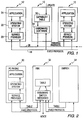
- Figure 1 is a block diagram of an embodiment of the present invention.
- Figure 2 is a block diagram of a further embodiment of the present invention in a telephone system environment.
- Figure 1 shows an embodiment that includes a controller 10 connected to one or more communication devices 12.
- the communication among the devices 12 and with the controller 10 may be provided through connection 14 and controlled by a static interface that may be a fixed portion of a communication protocol for enabling a minimal level of communication. This may include the portion of a protocol needed to provide a minimal ability to exchange information (e . g ., talk, send facsimiles) that does not change, or that changes infrequently.
- the controller may have installed therein a protocol table 16 that identifies features of a variable portion of the communication protocol for enhancing the communication capabilities beyond those provided by the static interface, and software and/or hardware 18 needed for implementing the features identified in table 16.
- the features identified in table 16 may change, new features may be added and existing features may be deleted when the table 16 is updated.
- the table 16 may be updated as frequently as needed to ensure that the table accurately reflects communication features available.
- Each communication device 12 may include a variety of components and those shown in Figure 1 are illustrative.
- a device 12 may have a service provider 20 for an operating system 22 and application (or end user) 24.
- One or more may be a computer with the ability to store protocol information provided from the controller 10 to enable communication with the controller 10 and other devices 12.
- Each device 12 communicates at a minimal level of capability using the static interface through connection 14.
- the table 16 lists the enhanced features available in the variable portion of the protocol and a copy of the table is provided through connection 26 to the each communication device 12 for storage in one or more of the components thereof.
- the table 16 may be provided to each device whenever the table is updated or periodically.
- a feature identified in table 16 is to be exercised by a communication device 12, one of its components selects the feature from the table and sends the tabulated entry to the controller 10 where the selected feature is implemented. For example, if a communication device 12 wants to "hold” communication (and assuming that this feature is available in the table 16), it may select the "hold” feature from its copy of the table 16 and tell the controller of its selection.
- the controller 10, through its software 18 takes the steps needed to place the device 12 on "hold”.
- the device 12 does not need to know about the steps being taken to implement the selected feature, and thus can be quite "dumb”.
- the devices 12 can be stable (except for the changes to their copies of the table 16) and yet keep up with the latest protocol changes.
- DNA for "Dynamic Negotiated API (application program interface)" has been applied to this procedure.
- variable protocol in the devices 12 may be selected and assigned to commands at the computer.
- a "mute" feature of the variable protocol may selected at a device 12 by calling up a screen on the computer display which enables assignment of the "mute" feature to a key or series of keys ( e . g ., by assigning a hexadecimal byte identifier to the feature).
- the screen may include a description of the feature to assist in the selection.
- the DNA procedure may find application in many types of communication systems in which there is a controller and controlled devices, such as computers and printers, computers and public or private telephone exchanges, cellular phones or pagers and base stations, workstations and voice, and other client/server relationships.
- controller and controlled devices such as computers and printers, computers and public or private telephone exchanges, cellular phones or pagers and base stations, workstations and voice, and other client/server relationships.
- a communication device 12 can query the controller 10 to determine availability of features.
- the controller 10 may respond with bit fields of its features, and may also provide variable length ASCII text strings, entire "Help" files, or other appropriate explanatory information to assist the user at device 12.
- a telephone system environment illustrated in Figure 2 includes a computer operated telephone 30, such as that known by the Registered Trademark HARRIS® PC Phone, and a private exchange 32, such that known in the trade as HARRIS 20-20® PBX, connected to a telephone system switch 34 that provides a connection to an external telephone system and portions of the communication protocol.
- the fixed protocols connecting the exchange 32 to the switch 34 and computer telephone 30 may be same or different, and may be conventional such as the industry standard BRI protocol.
- new function codes are copied to the computer telephone 30.
- the user can view the new functions and pick a new key for commanding a new function.
- pressing the key accesses the object code control word for the function and transmits it to the PBX.
- the PBX would respond by performing the selected function.
- a communication system among a plurality of communicating devices with an interface comprising a list of features for enhancing the ability of devices to communicate is copied from a device controlling communication to the controlled communication devices.
- the interface is a variable portion of a communication protocol that, together with a static portion of the protocol provided separately, defines the communication capability of the devices.
- Applications for telephone systems in a public or private telephone exchange and the controlled devices are computer operated telephones. The display screen of the computer at each telephone is used to select features of the interface.
Landscapes
- Engineering & Computer Science (AREA)
- Signal Processing (AREA)
- Telephonic Communication Services (AREA)
- Sub-Exchange Stations And Push- Button Telephones (AREA)
Priority Applications (1)
| Application Number | Priority Date | Filing Date | Title |
|---|---|---|---|
| EP97302532A EP0872997A1 (fr) | 1997-04-14 | 1997-04-14 | Interface de programme de communication |
Applications Claiming Priority (1)
| Application Number | Priority Date | Filing Date | Title |
|---|---|---|---|
| EP97302532A EP0872997A1 (fr) | 1997-04-14 | 1997-04-14 | Interface de programme de communication |
Publications (1)
| Publication Number | Publication Date |
|---|---|
| EP0872997A1 true EP0872997A1 (fr) | 1998-10-21 |
Family
ID=8229294
Family Applications (1)
| Application Number | Title | Priority Date | Filing Date |
|---|---|---|---|
| EP97302532A Withdrawn EP0872997A1 (fr) | 1997-04-14 | 1997-04-14 | Interface de programme de communication |
Country Status (1)
| Country | Link |
|---|---|
| EP (1) | EP0872997A1 (fr) |
Cited By (1)
| Publication number | Priority date | Publication date | Assignee | Title |
|---|---|---|---|---|
| WO2001030026A3 (fr) * | 1999-10-18 | 2002-03-21 | Gateway Inc | Acces de reseau a multiples paliers |
Citations (4)
| Publication number | Priority date | Publication date | Assignee | Title |
|---|---|---|---|---|
| EP0365200A2 (fr) * | 1988-10-19 | 1990-04-25 | AT&T Corp. | Système de télécommunication avec modification de caractéristiques commandée par l'abonné |
| US4928306A (en) * | 1989-02-28 | 1990-05-22 | International Business Machines Corporation | Dynamically configurable telephone |
| EP0555997A2 (fr) * | 1992-02-10 | 1993-08-18 | AT&T Corp. | Appareil et méthodes pour la réalisation de protocoles |
| WO1997000570A1 (fr) * | 1995-06-16 | 1997-01-03 | Harris Corporation | Procede faisant appel a une interface a programme d'application de conception dynamique |
-
1997
- 1997-04-14 EP EP97302532A patent/EP0872997A1/fr not_active Withdrawn
Patent Citations (4)
| Publication number | Priority date | Publication date | Assignee | Title |
|---|---|---|---|---|
| EP0365200A2 (fr) * | 1988-10-19 | 1990-04-25 | AT&T Corp. | Système de télécommunication avec modification de caractéristiques commandée par l'abonné |
| US4928306A (en) * | 1989-02-28 | 1990-05-22 | International Business Machines Corporation | Dynamically configurable telephone |
| EP0555997A2 (fr) * | 1992-02-10 | 1993-08-18 | AT&T Corp. | Appareil et méthodes pour la réalisation de protocoles |
| WO1997000570A1 (fr) * | 1995-06-16 | 1997-01-03 | Harris Corporation | Procede faisant appel a une interface a programme d'application de conception dynamique |
Cited By (1)
| Publication number | Priority date | Publication date | Assignee | Title |
|---|---|---|---|---|
| WO2001030026A3 (fr) * | 1999-10-18 | 2002-03-21 | Gateway Inc | Acces de reseau a multiples paliers |
Similar Documents
| Publication | Publication Date | Title |
|---|---|---|
| CA2202244C (fr) | Procede faisant appel a une interface a programme d'application de conception dynamique | |
| KR100342952B1 (ko) | 사용자 애플리케이션 프로그램과 전화 통신 프로그램 간의 api 및 메소드를 구비한 무선 통신 장치 및 방법 | |
| EP0939531B1 (fr) | Méthode de formation d'une icône | |
| RU2273103C2 (ru) | Способ и устройство для обмена информацией в сети связи | |
| US5625678A (en) | Method and system for allowing switched voice and data communication among multiple application programs | |
| EP1477007B1 (fr) | Agent personnel d'utilisateur | |
| US8005952B2 (en) | Method for intelligently selecting wireless access point | |
| JP3550503B2 (ja) | 通信を可能とするための方法及び通信システム | |
| US8325895B2 (en) | Conference system and conference telephone line setting method | |
| EP0910223A2 (fr) | Fonctions de messages courts pour terminal radio mobile | |
| US7376392B2 (en) | Communication device | |
| US20070297394A1 (en) | Telephony and data network services at a telephone | |
| KR20030006577A (ko) | 이동통신 단말기를 이용한 개인정보 관리 방법 | |
| US7111056B1 (en) | Method, apparatus and article of manufacture for web-based control of a unified multi-service communication system | |
| AU6685000A (en) | Method for automatically adapting to the capabilities of a data transmitting terminal a device supplying data to said terminal requesting the data | |
| JP2000148677A (ja) | 通信方法、通信システム、通信を制御するためのソフトウエア・プロダクトを格納した記録媒体 | |
| KR100369899B1 (ko) | 블루투스 탑재 기기 종류 및 모델 자동 확인 방법 및 시스템 | |
| JP4125395B2 (ja) | 通信プログラムインタフェース | |
| EP1309154B1 (fr) | Système et méthode pour sélection de services électroniques utilisant de la communication infrarouge | |
| EP1533975B1 (fr) | Procédé et système pour la communication entre un terminal multimode et une application Web | |
| US20020078210A1 (en) | Method and system for establishing a communication connection via a schedule store | |
| JP3245787B2 (ja) | 電話接続システム | |
| US10944658B2 (en) | Method, apparatus and system for method for start-up of monitoring of monitor objects in a computer-integrated telecommunications environment | |
| JPH1174976A (ja) | 自動発信制御装置 | |
| KR100594057B1 (ko) | 네트워크 환경에서 사설통신 환경 구현장치및 방법 |
Legal Events
| Date | Code | Title | Description |
|---|---|---|---|
| PUAI | Public reference made under article 153(3) epc to a published international application that has entered the european phase |
Free format text: ORIGINAL CODE: 0009012 |
|
| AK | Designated contracting states |
Kind code of ref document: A1 Designated state(s): DE FR GB SE |
|
| 17P | Request for examination filed |
Effective date: 19990421 |
|
| AKX | Designation fees paid |
Free format text: DE FR GB SE |
|
| RAP1 | Party data changed (applicant data changed or rights of an application transferred) |
Owner name: TELTRONICS INC. |
|
| 17Q | First examination report despatched |
Effective date: 20030718 |
|
| STAA | Information on the status of an ep patent application or granted ep patent |
Free format text: STATUS: THE APPLICATION HAS BEEN WITHDRAWN |
|
| 18W | Application withdrawn |
Effective date: 20050915 |