EP0873307B1 - Ethers d'oxime cyanimino et produits intermediaires utilises pour les preparer et leur utilisation pour lutter contre des champignons nocifs et des parasites animaux - Google Patents
Ethers d'oxime cyanimino et produits intermediaires utilises pour les preparer et leur utilisation pour lutter contre des champignons nocifs et des parasites animaux Download PDFInfo
- Publication number
- EP0873307B1 EP0873307B1 EP96943130A EP96943130A EP0873307B1 EP 0873307 B1 EP0873307 B1 EP 0873307B1 EP 96943130 A EP96943130 A EP 96943130A EP 96943130 A EP96943130 A EP 96943130A EP 0873307 B1 EP0873307 B1 EP 0873307B1
- Authority
- EP
- European Patent Office
- Prior art keywords
- oxadiazol
- thien
- och
- pyrazol
- thiadiazol
- Prior art date
- Legal status (The legal status is an assumption and is not a legal conclusion. Google has not performed a legal analysis and makes no representation as to the accuracy of the status listed.)
- Expired - Lifetime
Links
- 0 CC1C(C(*)=O)=CC=CC1 Chemical compound CC1C(C(*)=O)=CC=CC1 0.000 description 2
Classifications
-
- C—CHEMISTRY; METALLURGY
- C07—ORGANIC CHEMISTRY
- C07C—ACYCLIC OR CARBOCYCLIC COMPOUNDS
- C07C261/00—Derivatives of cyanic acid
- C07C261/04—Cyanamides
-
- A—HUMAN NECESSITIES
- A01—AGRICULTURE; FORESTRY; ANIMAL HUSBANDRY; HUNTING; TRAPPING; FISHING
- A01N—PRESERVATION OF BODIES OF HUMANS OR ANIMALS OR PLANTS OR PARTS THEREOF; BIOCIDES, e.g. AS DISINFECTANTS, AS PESTICIDES OR AS HERBICIDES; PEST REPELLANTS OR ATTRACTANTS; PLANT GROWTH REGULATORS
- A01N47/00—Biocides, pest repellants or attractants, or plant growth regulators containing organic compounds containing a carbon atom not being member of a ring and having no bond to a carbon or hydrogen atom, e.g. derivatives of carbonic acid
- A01N47/40—Biocides, pest repellants or attractants, or plant growth regulators containing organic compounds containing a carbon atom not being member of a ring and having no bond to a carbon or hydrogen atom, e.g. derivatives of carbonic acid the carbon atom having a double or triple bond to nitrogen, e.g. cyanates, cyanamides
Definitions
- the invention also relates to processes and intermediates for the preparation of these compounds and agents containing them and the use of the compounds I for controlling animal Pests and harmful fungi.
- Type I phenylacetic acid derivatives with fungicidal and insecticidal Effect is known from the following publications: WO-A 95/18789 and WO-A 93/16986. In terms of their effect however, the active ingredients disclosed there are still unsatisfactory.
- the present invention was therefore new compounds with improved Effect against harmful fungi and pests as a task.
- the compounds I are known per se in various ways Process available.
- the structure of the grouping -C (X) -CO-YR 1 is known, for example, from the following publications: EP-A 422 597, EP-A 463 488, EP-A 370 629, EP-A 460 575, EP-A 472 300 , WO-A 90/07493, WO-A 92/13830, WO-A 92/18487, DE-Anm. P 44 20 416.7.
- the ⁇ -ketoester X and the ⁇ -ketoamide XI can according to usual processes in the compounds I are converted (see EP-A 178 826, EP-A 348 766, DE-A 36 23 921, DE-A 37 05 389 as well as the literature cited at the beginning).
- the compounds II are known from EP-A 513 580, EP-A 477 631, EP-A 463 488, EP-A 251 082, EP-A 400 417 and / or EP-A 585 751 or can be produced according to the methods described there become.
- isomer mixtures are obtained in the synthesis, it is generally however, separation of the isomers is not absolutely necessary, because the individual isomers partially for use or in use (e.g. under Light, acid or base exposure) can convert into each other. Corresponding conversions can also be made after application, for example in the treatment of plants, in the treated Plant or in the harmful fungus or animal pest to be controlled respectively.
- the E isomers of the compounds I are preferred in terms of their activity (configuration based on the -OCH 3 or the -CH 3 group in relation to the -COYR 1 group).
- the cis isomers of the compounds I are preferred in terms of their activity (the radical R 3 and the -OCH 2 group are on the same side of the double bond).
- the salts of the acid-resistant are also part of the invention Compounds I, which are basic centers, especially basic Contain nitrogen atoms, especially with mineral acids such as Sulfuric acid and phosphoric acid or Lewis acids such as zinc chloride. Usually it depends on the type of salt not at. For the purposes of the invention, those salts are preferred which those to be kept free from harmful fungi or animal pests Do not damage plants, surfaces, materials or spaces and that Do not impair the action of the compounds I. Particularly important are such, suitable for agricultural purposes Salts.
- the salts of the compounds I are accessible in a manner known per se, especially by implementing the appropriate connection I with the acids mentioned in water or an inert organic solvents at temperatures from -80 to 120 ° C, preferably 0 to 60 ° C.
- Aryl or aryloxy, arylthio, arylcarbonyl and arylsulfonyl aromatic mono- or polycyclic hydrocarbon radicals which directly or (aryloxy) via an oxygen atom (-O-) or (arylthio) a sulfur atom (-S-), (arylcarbonyl) via a carbonyl group (-CO-) or (arylsulfonyl) are attached to the skeleton via a sulfonyl group (-SO 2 -), for example phenyl, naphthyl and phenanthrenyl or phenyloxy, naphthyloxy and phenanthrenyloxy and the corresponding carbonyl and sulfonyl radicals;
- Arylamino aromatic mono- or polycyclic hydrocarbon residues, which are attached to the structure via a nitrogen atom.
- Heteroarylamino aromatic mono- or polycyclic radicals which, in addition to carbon ring members, can additionally contain one to four nitrogen atoms or one to three nitrogen atoms and one oxygen or one sulfur atom and which are bonded to the structure via a nitrogen atom.
- R 3 represents hydrogen, cyclopropyl, methyl, ethyl, 1-methylethyl, trifluoromethyl, cyano or methoxy.
- R 4 represents optionally substituted C 1 -C 6 alkyl, C 2 -C 6 alkenyl or C 2 -C 6 alkynyl.
- R 4 represents optionally substituted heterocyclyl or optionally substituted C 3 -C 6 cycloalkenyl.
- R 4 represents optionally substituted C 3 -C 6 cycloalkyl.
- R 4 represents optionally substituted aryl or hetaryl.
- R 4 for optionally subst.
- R 4 for optionally subst. Furyl, thienyl or pyrrolyl.
- R 4 for optionally subst.
- R 4 for optionally subst. Oxdiazolyl, thiadiazolyl or triazolyl.
- R 4 represents phenyl which is unsubstituted or carries one or two of the following groups: nitro, cyano, hydroxy, amino, aminocarbonyl, aminothiocarbonyl, halogen, C 1 -C 4 alkyl, C 1 -C 4 haloalkyl, C 3 -C 6 cycloalkyl, C 1 -C 4 alkoxy, C 1 -C 4 haloalkoxy, C 1 -C 4 alkylamino, C 1 -C 4 alkylcarbonyl, di-C 1 -C 4 alkylamino, C 1 -C 4 alkylsulfonyl, C 1 -C 4 alkoxycarbonyl, C 1 -C 4 alkylaminocarbonyl, di-C 1 -C 4 alkylaminocarbonyl, C 1 -C 4 alkylthio, C 2 -C 6 -alkenyl, C 2 -C 6 -alkenyl, C 2
- R 4 is phenyl which is unsubstituted or carries one or two of the following groups: nitro, cyano, halogen, C 1 -C 4 alkyl, C 1 -C 4 haloalkyl, C 3 -C 6 cycloalkyl, C 1 -C 4 alkoxy, C 1 -C 4 haloalkoxy and C 1 -C 4 alkylenedioxy, which can be halogenated.
- the compounds I are suitable for combating harmful fungi and animal pests.
- Suitable formulation aids are e.g. solid or liquid Carriers, surfactants and adhesives.
- Liquid solvents such as liquid carriers Understood water and organic solvents, the latter especially when using water as a solvent have an auxiliary solvent.
- organic solvent can be used: aromatics such as xylene, toluene and Alkylnaphthalenes, chlorinated aromatics or chlorinated aliphatic hydrocarbons such as chlorobenzenes, chlorethylenes and methylene chloride, aliphatic hydrocarbons such as cyclohexane and paraffins, e.g.
- Mineral oil fractions such as Butanol, iso-butanol, cyclohexanol and glycol and the associated Ethers and esters, ketones such as acetone, methyl ethyl ketone, methyl isobutyl ketone and cyclohexanone, aprotic dipolar solvents such as dimethylformamide, N-methyl-2-pyrrolidone and dimethyl sulfoxide.
- alcohols such as Butanol, iso-butanol, cyclohexanol and glycol and the associated Ethers and esters
- ketones such as acetone, methyl ethyl ketone, methyl isobutyl ketone and cyclohexanone
- aprotic dipolar solvents such as dimethylformamide, N-methyl-2-pyrrolidone and dimethyl sulfoxide.
- suitable solid carriers are: Natural Rock powders and mineral soils such as silicas, silicates, Kaolins, clays, bolus, loess, talc, chalk, limestone, lime, Dolomite, magnesium oxide, quartz, attapulgite, montmorillonite and Diatomaceous earth; synthetic stone powder such as finely divided silica or flours of synthetic alumina and synthetic Silicates.
- Solid, particularly suitable for granules Carriers are, for example: broken and fractionated natural rocks such as calcite, marble, pumice, sepiolite; synthetic Granules made from inorganic and organic flours; Granules made of organic material such as sawdust, coconut shells, Corn cobs or tobacco stalks.
- Suitable adhesives are: carboxymethyl cellulose; natural and synthetic powdery, granular or latex-shaped polymers such as gum arabic, polyvinyl alcohol, polyvinyl acetate, natural phospholipids such as cephalins and lecithins, synthetic phospholipids.
- the agent can be one or more representatives of the following Substance groups contain: dyes, other known active substances, Trace nutrients and other additives.
- dyes come e.g. inorganic pigments such as iron oxide, Titanium oxide, ferrocyan blue, also organic pigments such as alizarin, Azo and metal phthalocyanine dyes into consideration.
- active ingredients include other fungicides as well Insecticides, acaricides, herbicides and growth regulators too understand.
- Trace nutrients are, for example, salts of iron, Manganese, boron, copper, cobalt, molybdenum and zinc.
- mineral and vegetable oils are suitable.
- the funds can also be used with other, practically significant Mixing partners such as fertilizers or other finished products agents containing active ingredients must be mixed.
- the agents are prepared in a manner known per se, namely depending on the chemical and physical properties of the substances used e.g. by mixing together Grinding, spraying, extruding, granulating or dissolving in water, the latter possibly with the help of an organic Solvent. Powders, sprinkles and dusts are e.g. by Mixing or grinding the compounds I together with a solid carrier available.
- the means depend on the ones used Fabrics e.g. solutions, emulsions, suspensions, Powders, foams, pastes, granules, aerosols or very fine encapsulations in polymeric substances or in seed coating compositions.
- the funds are spent in a manner known per se, for example by spraying, atomizing, dusting, scattering or To water.
- the plants are usually sprayed with the agents or pollinated.
- the seeds are treated the plants in a manner known per se.
- the compounds I and their salts and those according to the invention Means are applied by looking at the harmful fungi, their habitat or the seeds, plants to be protected from fungal attack, Surfaces, materials or rooms with a fungicidal effect Amount of agents or compounds I or their salts treated.
- the application can be before or after infestation by the fungi respectively.
- the agents according to the invention and the compounds I are particularly suitable for controlling the following plant diseases: Erysiphe graminis (powdery mildew) in cereals, Erysiphe cichoracearum and Sphaerotheca fuliginea on pumpkin plants, Podosphaera leucotricha on apples, Uncinula necator on vines, Puccinia species on cereals, Rhizoctonia species on cotton, rice and lawn, cereals and sugar cane, Ustilago , Venturia inaequalis (scab) on apples, Helminthosporium species on cereals, Septoria nodorum on wheat, Botrytis cinerea (gray mold) on strawberries, vines, ornamental plants and vegetables, Cercospora arachidicola on peanuts, Pseudocercosporella herpotrichoides on wheat, barley, pyriformes , Phytophthora infestans on potatoes and tomatoes, Fusarium and Verticillium species on
- the fungicidal compositions generally contain between 0.1 and 95, preferably between 0.5 and 90% by weight of active ingredient.
- the application rates depend on the type of effect desired between 0.01 and 2.0 kg of active ingredient per ha.
- amounts of active ingredient are generally used from 0.001 to 0.1 g, preferably 0.01 to 0.05 g per kilogram Seed needed.
- the agents according to the invention can be used as Fungicides are also present together with other active ingredients e.g. with herbicides, insecticides, growth regulators, Fungicides or with fertilizers.
- Sulfur, dithiocarbamates and their derivatives such as ferridimethyldithiocarbamate, Zinc dimethyldithiocarbamate, zinc ethylene bisdithiocarbamate, Manganese ethylene bisdithiocarbamate, manganese zinc ethylene diamine bis dithiocarbamate, Tetramethylthiuram disulfide, ammonia complex of zinc (N, N-ethylene-bis-dithiocarbamate), ammonia complex zinc (N, N'-propylene-bis-dithiocarbamate), Zinc (N, N'-propylene bis-dithiocarbamate), N, N'-polypropylene bis (thiocarbamoyl) disulfide;
- Nitroderivatives such as dinitro- (1-methylheptyl) phenylcrotonate, 2-sec-butyl-4,6-dinitrophenyl-3,3-dimethylacrylate, 2-sec-butyl-4,6-dinitrophenyl-isopropyl carbonate, 5-nitro-isophthalic acid di-isopropyl ester;
- heterocyclic substances such as 2-heptadecyl-2-imidazoline acetate, 2,4-dichloro-6- (o-chloroanilino) -s-triazine, O, O-diethyl-phthalimidophosphonothioate, 5-amino-1- [bis- (dimethylamino) phosphinyl] -3-phenyl-1,2,4-triazole, 2,3-dicyano-1,4-dithioanthraquinone, Methyl 2-thio-1,3-dithiolo [4,5-b] quinoxaline, 1- (butylcarbamoyl) -2-benzimidazole-carbamic acid, 2-methoxycarbonylamino-benzimidazole, 2- (furyl- (2)) - benzimidazole, 2- (thiazolyl- (4)) - benzimidazole, N- (1,1,2,2-tetrachloroethy
- Strobilurins such as methyl-E-methoximino- [ ⁇ - (o-tolyloxy) -o-tolyl] acetate, Methyl E-2- ⁇ 2- [6- (2-cyanophenoxy) pyrimidin-4-yloxy] phenyl ⁇ -3-methoxyacrylate, Methyl-E-methoximino- [ ⁇ - (2-phenoxyphenyl)] acetamide, Methyl-E-methoximino- [ ⁇ - (2,5-dimethylphenoxy) -o-tolyl] acetamide.
- the compounds of formula I are also suitable, animal Pests, especially from the class of insects, arachnids and effectively combat nematodes. You can in crop protection as well as in the hygiene, stock protection and veterinary sector as Pesticides are used.
- Harmful insects belong to the order of the butterflies (Lepidoptera) for example Agrotis ypsilon, Agrotis segetum, Alabama argillacea, Anticarsia gemmatalis, Argyresthia conjugella, Autographa gamma, Bupalus piniarius, Cacoecia murinana, Capua reticulana, Cheimatobia brumata, Choristoneura fumiferana, Choristoneura occidentalis, Cirphis unipuncta, Cydia pomonella, Dendrolimus pini, Diaphania nitidalis, Diatraea grandiosella, Earias insulana, Elasmopalpus lignosellus, Eupoecilia ambiguella, Evetria bouliana, Feltia subterranea, Galleria mellonella, Grapholitha funebrana, Grapholitha molesta, Heliothis armiger
- Thrips for example Frankliniella fusca, Frankliniella occidentalis, Frankliniella tritici, Scirtothrips citri, Thrips oryzae, Thrips palmi, Thrips tabaci.
- From the order of the hymenoptera for example Athalia rosae, Atta cephalotes, Atta sexdens, Atta texana, Hoplocampa minuta, Hoplocampa testudinea, Monomorium pharaonis, Solenopsis geminata, Solenopsis invicta.
- Heteroptera From the order of the bugs (Heteroptera), for example, Acrosternum hilare, blissus leucopterus, cyrtopeltis notatus, dysdercus cingulatus, Dysdercus intermedius, Eurygaster integriceps, Euschistus impictiventris, Leptoglossus phyllopus, Lygus lineolaris, Lygus pratensis, Nezara viridula, Piesma quadrata, Solubea insularis, Thyanta perditor.
- suckers for example Acyrthosiphon onobrychis, Adelges laricis, Aphidula nasturtii, Aphis fabae, Aphis pomi, Aphis sambuci, Brachycaudus cardui, Brevicoryne brassicae, Cerosipha gossypii, Dreyfusia nordmannianae, Dreyfusia piceae, Dysaphis radicola, Dysaulacorthum pseudosolani, Empoasca fabae, Macrosiphum avenae, Macrosiphum euphorbiae, Macrosiphon rosae, Megoura viciae, Metopolophium dirhodum, Myzodes persicae, Myzus cerasi, Nilaparvata lugens, Pemphigus bursarius, Perkinsiella saccharicida, Phor
- Orthoptera for example Acheta domestica, Blatta orientalis, Blattella germanica, Forficula auricularia, Gryllotalpa gryllotalpa, Locusta migratoria, Melanoplus bivittatus, Melanoplus femur-rubrum, Melanoplus mexicanus, Melanoplus sanguinipes, Melanoplus spretus, Nomadacris septemfasciata, Periplaneta americana, Schistocerca americana, Schistocerca peregrina, Stauronotus maroccanus, Tachycines asynamorus.
- Orthoptera for example Acheta domestica, Blatta orientalis, Blattella germanica, Forficula auricularia, Gryllotalpa gryllotalpa, Locusta migratoria, Melanoplus bivittatus, Melanoplus femur-rubrum, Melanoplus mexicanus, Melan
- Arachnoid for example, arachnids (Acarina) such as Amblyomma americanum, Amblyomma variegatum, Argas persicus, Boophilus annulatus, Boophilus decoloratus, Boophilus microplus, Brevipalpus phoenicis, Bryobia praetiosa, Dermacentor silvarum, Eotetranychus carpini, Eriophyes sheldoni, Hyalomma truncatum, Ixodes ricinus, Ixodes rubicundus, Ornithodorus moubata, Otobius megnini, Paratetranychus pilosus, Dermanyssus gallinae, Phyllocoptruta oleivora, Polyphagotarsonemus latus, Psoroptes ovis, Rhipicephalus appendiculatus, Rhipicephalus evertsi, Sarcoptes scabiei, Tetran
- root gall nematodes e.g. Meloidogyne hapla, Meloidogyne incognita, Meloidogyne javanica, cyst-forming nematodes, e.g. Globodera rostochiensis, heterodera avenae, heterodera glycines, heterodera schachtii, Heterodera trifolii, stick and leaf flakes, e.g.
- Belonolaimus longicaudatus Ditylenchus destructor, Ditylenchus dipsaci, Heliocotylenchus multicinctus, Longidorus elongatus, Radopholus similis, Rotylenchus robustus, Trichodorus primitivus, Tylenchorhynchus claytoni, Tylenchorhynchus dubius, Pratylenchus neglectus, Pratylenchus penetrans, Pratylenchus curvitatus, Pratylenchus goodeyi.
- the drug concentrations in the ready-to-use Preparations can be varied in larger areas.
- the active ingredients can also be used with great success in the ultra-low-volume process (ULV) are used, it being possible to use formulations with more than 95% by weight of active ingredient or even the active ingredient without applying additives.
- UUV ultra-low-volume process
- the amount of active ingredient used to control pests is 0.1 to 2.0, preferably in the field 0.2 to 1.0 kg / ha.
- an emulsion which consists of 10% by weight of the active ingredient and 90% by weight of a mixture 70% by weight Cyclohexanol, 20% by weight Nekanil® LN (Lutensol® AP6, wetting agent with emulsifying and dispersing action based on ethoxylated alkylphenols) and 10% by weight Emulphor® EL (Emulan® EL, emulsifier based on ethoxylated fatty alcohols) duration.
- the desired active ingredient concentrations were set by diluting this emulsion with water.
- Leaves of pot vines of the "Müller-Thurgau" variety were watery Spray liquor, the 10 wt .-% active ingredient, 63% cyclohexanone and Contained 27 wt .-% emulsifier in the dry substance, sprayed.
- the plants became 8 days after the spray coating had dried on set up in the greenhouse. Only then were the leaves included a zoo spore suspension of Plasmopara viticola (vine peronospora) infected. After that, the vines were first left for 48 hours in a steam-saturated chamber at 24 ° C and then for 5 days in a greenhouse at temperatures between 20 and set up at 30 ° C. After that time the plants were accelerating of the sporangium carrier outbreak again for 16 hours placed in the humid chamber. Then there was the visual Assessment of the extent of the fungal outbreak on the undersides of the leaves.
- the aqueous preparation of the compounds I.1, I.2, I.3, I.4, I.6, I.7, I.8, I.9, I.10 and I.11 treated plants had an infection of 15% and less, while the plants treated with the same amount of compound A were 65% infected. The untreated plants were 80% infected.
- Rice seedlings (variety: "Tai Nong 67") were sprayed to runoff point with the active ingredient preparation (application rate: 63ppm; preparation: 10% active ingredient, 63% cyclohexanone and 27% emulsifier). After 24 hours, the plants were sprayed with an aqueous spore suspension of the fungus Pyricularia oryzae and kept for 6 days at 22-24 ° C at a relative humidity of 95-99%. The assessment was made visually.
- the plants treated with the compounds I.1, I.3, I.4, I.5, I.6, I.7 and I.10 showed an infection of 15% and less, while the untreated plants at 75 % were infected.
- the plants treated with the comparison substances A and B were 65% and 40% infected.
Landscapes
- Chemical & Material Sciences (AREA)
- Organic Chemistry (AREA)
- Life Sciences & Earth Sciences (AREA)
- Dentistry (AREA)
- Wood Science & Technology (AREA)
- Plant Pathology (AREA)
- Health & Medical Sciences (AREA)
- Engineering & Computer Science (AREA)
- Agronomy & Crop Science (AREA)
- General Health & Medical Sciences (AREA)
- Pest Control & Pesticides (AREA)
- Zoology (AREA)
- Environmental Sciences (AREA)
- Agricultural Chemicals And Associated Chemicals (AREA)
- Organic Low-Molecular-Weight Compounds And Preparation Thereof (AREA)
- Heterocyclic Carbon Compounds Containing A Hetero Ring Having Nitrogen And Oxygen As The Only Ring Hetero Atoms (AREA)
- Thiazole And Isothizaole Compounds (AREA)
- Acyclic And Carbocyclic Compounds In Medicinal Compositions (AREA)
Claims (16)
- Ethers de cyaniminoximes de formule Idans laquelle les symboles ont les significations suivantes :

- X :
- NOCH3, CHOCH3 ou CHCH3;
- Y :
- O ou NZ, Z représentant l'hydrogène ou un groupe alkyle en C1-C4;
- R1 :
- l'hydrogène ou un groupe alkyle en C1-C4;
- R2 :
- un groupe cyano, nitro, un halogène, un groupe alkyle en C1-C4, trifluorométhyle ou alcoxy en C1-C4;
- m :
- 0, 1 ou 2, les symboles R2 pouvant avoir des significations différentes lorsque m est égal à 2;
- R3 :
- l'hydrogène, un groupe cyano, alkyle, halogénoalkyle, alcoxy ou cycloalkyle;
- R4 :
- l'hydrogène ou un groupe alkyle, alcényle, alcynyle, cycloalkyle, cycloalcényle, hétérocyclyle, aryle ou hétéroaryle, chacun d'eux éventuellement substitué, et leurs sels.
- Procédé de préparation des composés de formule I de la revendication 1, caractérisé par le fait que l'on fait réagir un dérivé benzylique de formule IIdans laquelle L1 représente un groupe éliminable par échange nucléophique, avec une hydroxyimine de formule III


- Procédé de préparation des composés de formule I de la revendication 1, caractérisé par le fait que l'on fait réagir un dérivé benzylique de formule II de la revendication 2 avec un dérivé carbonylhydroxyiminé de formule IVce qui donne un composé de formule V
 qu'on fait ensuite réagir avec le bis-(triméthylsilyl)-carbodiimide.
- Produit approprié à l'utilisation pour la lutte contre les parasites animaux ou contre les mycètes nuisibles, contenant un composé de formule I ou l'un de ses sels selon la revendication 1, et au moins un produit auxiliaire de formulation.
- Produit selon la revendication 4, pour la lutte contre les parasites animaux appartenant aux classes des insectes, des arachnides ou des nématodes.
- Procédé pour combattre des parasites animaux ou des mycètes nuisibles, caractérisé par le fait que l'on traite les parasites ou les mycètes nuisibles, leur habitat ou les végétaux, surfaces, matériaux ou locaux qu'on veut débarrasser de ces parasites par une quantité efficace d'un composé de formule I ou d'un de ses sels selon la revendication 1.
- Utilisation des composés de formule I selon la revendication 1 pour la préparation de produits contre les parasites animaux ou contre les mycètes nuisibles.
- Utilisation des composés de formule I selon la revendication 1 pour la lutte contre les parasites animaux ou contre les mycètes nuisibles.
- Composés de formule IIIdans laquelle les variables ont les significations de la revendication 1.

- Composés de formule VIIdans laquelle les variables ont les significations de la revendication 1.

- Composés de formule VIIIdans laquelle :

Hal = halogène, et dans laquelle les autres variables ont les significations de la revendication 1. - Composés de formule IXdans laquelle les variables ont les significations de la revendication 1.

- Composés de formule Xdans laquelle les variables ont les significations de la revendication 1.
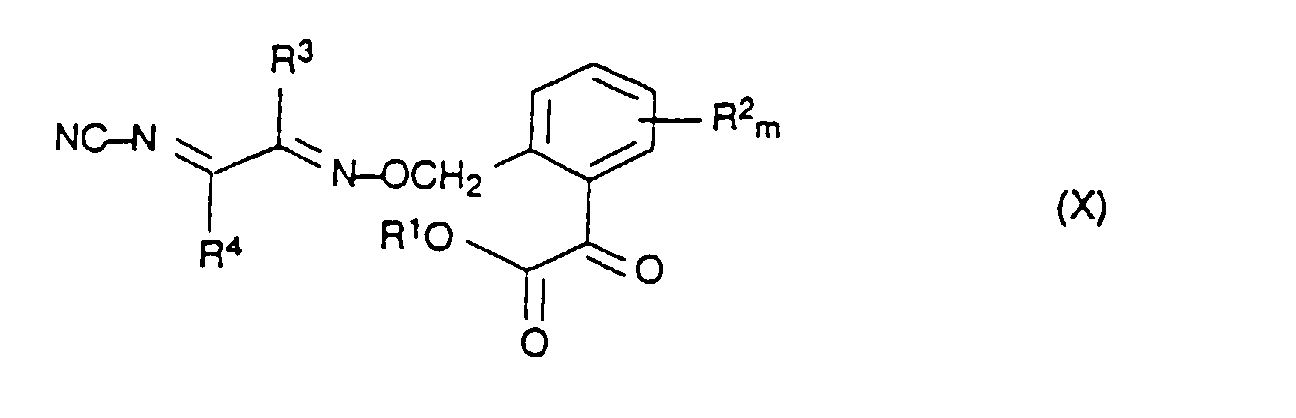
- Composés de formule XIdans laquelle les variables ont les significations de la revendication 1.

- Composés de formule XIIdans laquelle les variables ont les significations de la revendication 1.

- Utilisation des composés selon les revendications 9 à 15 comme produits intermédiaires.
Applications Claiming Priority (3)
| Application Number | Priority Date | Filing Date | Title |
|---|---|---|---|
| DE19548783A DE19548783A1 (de) | 1995-12-27 | 1995-12-27 | Cyaniminooximether, Verfahren und Zwischenprodukte zu ihrer Herstellung und ihre Verwendung zur Bekämpfung von Schadpilzen und tierischen Schädlingen |
| DE19548783 | 1995-12-27 | ||
| PCT/EP1996/005641 WO1997024319A1 (fr) | 1995-12-27 | 1996-12-16 | Ethers d'oxime cyanimino et produits intermediaires utilises pour les preparer et leur utilisation pour lutter contre des champignons nocifs et des parasites animaux |
Publications (2)
| Publication Number | Publication Date |
|---|---|
| EP0873307A1 EP0873307A1 (fr) | 1998-10-28 |
| EP0873307B1 true EP0873307B1 (fr) | 2000-05-31 |
Family
ID=7781451
Family Applications (1)
| Application Number | Title | Priority Date | Filing Date |
|---|---|---|---|
| EP96943130A Expired - Lifetime EP0873307B1 (fr) | 1995-12-27 | 1996-12-16 | Ethers d'oxime cyanimino et produits intermediaires utilises pour les preparer et leur utilisation pour lutter contre des champignons nocifs et des parasites animaux |
Country Status (8)
| Country | Link |
|---|---|
| US (1) | US6063813A (fr) |
| EP (1) | EP0873307B1 (fr) |
| JP (1) | JP2000503007A (fr) |
| AR (1) | AR004411A1 (fr) |
| AT (1) | ATE193523T1 (fr) |
| AU (1) | AU1195997A (fr) |
| DE (2) | DE19548783A1 (fr) |
| WO (1) | WO1997024319A1 (fr) |
Cited By (1)
| Publication number | Priority date | Publication date | Assignee | Title |
|---|---|---|---|---|
| CN103180291A (zh) * | 2010-06-24 | 2013-06-26 | 组合化学工业株式会社 | 烷氧基亚氨基衍生物和有害生物防除剂 |
Families Citing this family (2)
| Publication number | Priority date | Publication date | Assignee | Title |
|---|---|---|---|---|
| ES2221407T3 (es) | 1998-07-18 | 2004-12-16 | Bayer Cropscience Ag | Derivados de imidoamida. |
| DE10221121A1 (de) * | 2002-05-13 | 2003-12-04 | Bayer Cropscience Ag | N'-Cyano-N-methyl-imidamid-Derivate |
Family Cites Families (3)
| Publication number | Priority date | Publication date | Assignee | Title |
|---|---|---|---|---|
| TW221965B (fr) * | 1992-02-28 | 1994-04-01 | Ciba Geigy | |
| IL105191A (en) * | 1992-04-04 | 1998-08-16 | Basf Ag | Acids and aminooxymethylbenzoic acids and their preparation |
| CA2179418C (fr) * | 1994-01-05 | 2004-06-22 | Hugo Ziegler | Pesticides |
-
1995
- 1995-12-27 DE DE19548783A patent/DE19548783A1/de not_active Withdrawn
-
1996
- 1996-12-16 AU AU11959/97A patent/AU1195997A/en not_active Abandoned
- 1996-12-16 DE DE59605370T patent/DE59605370D1/de not_active Expired - Lifetime
- 1996-12-16 AT AT96943130T patent/ATE193523T1/de not_active IP Right Cessation
- 1996-12-16 EP EP96943130A patent/EP0873307B1/fr not_active Expired - Lifetime
- 1996-12-16 WO PCT/EP1996/005641 patent/WO1997024319A1/fr not_active Ceased
- 1996-12-16 JP JP9523997A patent/JP2000503007A/ja active Pending
- 1996-12-16 US US09/091,850 patent/US6063813A/en not_active Expired - Fee Related
- 1996-12-21 AR ARP960105939A patent/AR004411A1/es unknown
Cited By (2)
| Publication number | Priority date | Publication date | Assignee | Title |
|---|---|---|---|---|
| CN103180291A (zh) * | 2010-06-24 | 2013-06-26 | 组合化学工业株式会社 | 烷氧基亚氨基衍生物和有害生物防除剂 |
| CN103180291B (zh) * | 2010-06-24 | 2015-08-19 | 组合化学工业株式会社 | 烷氧基亚氨基衍生物和有害生物防除剂 |
Also Published As
| Publication number | Publication date |
|---|---|
| WO1997024319A1 (fr) | 1997-07-10 |
| JP2000503007A (ja) | 2000-03-14 |
| AR004411A1 (es) | 1998-11-04 |
| DE59605370D1 (de) | 2000-07-06 |
| AU1195997A (en) | 1997-07-28 |
| DE19548783A1 (de) | 1997-07-03 |
| ATE193523T1 (de) | 2000-06-15 |
| US6063813A (en) | 2000-05-16 |
| EP0873307A1 (fr) | 1998-10-28 |
Similar Documents
| Publication | Publication Date | Title |
|---|---|---|
| EP0741694B1 (fr) | Derives d'acide acetique phenylique, leur procede de preparation, produits intermediaires a cet effet et agents les contenant | |
| AU713475B2 (en) | Phenylacetic acid derivatives, processes and intermediates for their preparation, and compositions comprising them | |
| EP0738259A1 (fr) | Derives d'acide phenylacetique, leur procede de preparation et produits intermediaires utilises a cet effet, et agents les contenant | |
| EP0793645B1 (fr) | Anilides d'iminooxymethylene, procede et produits intermediaires de preparation de celles-ci, et pesticides les contenant | |
| EP0842144A1 (fr) | Derives d'acide acetique phenylique, procedes et produits intermediaires permettant de les produire et utilisation comme agents de lutte contre les parasites et comme fongicides | |
| EP0873305B1 (fr) | Azinooximethers, procede de production et produits intermediaires utilises, utilisation de ces ethers dans la lutte contre les champignons et animaux nuisibles | |
| EP0673923A1 (fr) | Dérivés substitués de phénoxyméthyle-phényle, procédé pour leur préparation et leur usage comme parasiticides et fongicides | |
| EP0873307B1 (fr) | Ethers d'oxime cyanimino et produits intermediaires utilises pour les preparer et leur utilisation pour lutter contre des champignons nocifs et des parasites animaux | |
| EP0858446B1 (fr) | Phenylcarbamates, procedes et produits intermediaires permettant de les preparer, et leur utilisation pour lutter contre des parasites et des champignons nuisibles | |
| EP0861229B1 (fr) | Derives d'acide phenylacetique, procedes et produits intermediaires permettant de les preparer, et leur utilisation pour lutter contre les parasites animaux et les champignons nuisibles | |
| EP0876344B1 (fr) | Derives d'acide acetique pyridylique, procede de preparation correspondant, produits intermediaires utilises et substances les contenant | |
| EP0974578A2 (fr) | Phénylcarbamates, procédés et intermédiaires pour leur préparation et agents pesticides et fongidices les contenant | |
| EP0876334B1 (fr) | Derives d'acide phenylacetique, procedes de preparation et utilisation comme pesticides et comme fongicides | |
| EP0873313B1 (fr) | Derives d'acide pyridylacetique, procedes et produits intermediaires permettant de les preparer et utilisation | |
| EP0854861B1 (fr) | Ethers d'oxyamino-oxime, procedes et produits intermediaires utilises pour leur production et agent les contenant servant a lutter contre les champignons parasites et les parasites animaux | |
| WO1997029093A1 (fr) | Derives de pyrimidine, procede et intermediaires servant a les preparer et compositions pesticides ou fongicides les contenant | |
| EP0865432A1 (fr) | Derives d'acide phenylacetique, procede et intermediaires pour leur production, et leur utilisation en tant que pesticides et/ou fongicides | |
| DE19540092A1 (de) | Phenylessigsäurederivate, Verfahren zu ihrer Herstellung und ihre Verwendung | |
| DE19537749A1 (de) | Phenylessigsäurederivate, Verfahren zu ihrer Herstellung und ihre Verwendung |
Legal Events
| Date | Code | Title | Description |
|---|---|---|---|
| PUAI | Public reference made under article 153(3) epc to a published international application that has entered the european phase |
Free format text: ORIGINAL CODE: 0009012 |
|
| 17P | Request for examination filed |
Effective date: 19980520 |
|
| AK | Designated contracting states |
Kind code of ref document: A1 Designated state(s): AT BE CH DE DK ES FR GB GR IE IT LI NL PT SE |
|
| GRAG | Despatch of communication of intention to grant |
Free format text: ORIGINAL CODE: EPIDOS AGRA |
|
| GRAG | Despatch of communication of intention to grant |
Free format text: ORIGINAL CODE: EPIDOS AGRA |
|
| GRAH | Despatch of communication of intention to grant a patent |
Free format text: ORIGINAL CODE: EPIDOS IGRA |
|
| 17Q | First examination report despatched |
Effective date: 19990930 |
|
| GRAH | Despatch of communication of intention to grant a patent |
Free format text: ORIGINAL CODE: EPIDOS IGRA |
|
| GRAA | (expected) grant |
Free format text: ORIGINAL CODE: 0009210 |
|
| AK | Designated contracting states |
Kind code of ref document: B1 Designated state(s): AT BE CH DE DK ES FR GB GR IE IT LI NL PT SE |
|
| PG25 | Lapsed in a contracting state [announced via postgrant information from national office to epo] |
Ref country code: IT Free format text: LAPSE BECAUSE OF FAILURE TO SUBMIT A TRANSLATION OF THE DESCRIPTION OR TO PAY THE FEE WITHIN THE PRE;WARNING: LAPSES OF ITALIAN PATENTS WITH EFFECTIVE DATE BEFORE 2007 MAY HAVE OCCURRED AT ANY TIME BEFORE 2007. THE CORRECT EFFECTIVE DATE MAY BE DIFFERENT FROM THE ONE RECORDED.SCRIBED TIME-LIMIT Effective date: 20000531 Ref country code: GR Free format text: LAPSE BECAUSE OF NON-PAYMENT OF DUE FEES Effective date: 20000531 Ref country code: ES Free format text: THE PATENT HAS BEEN ANNULLED BY A DECISION OF A NATIONAL AUTHORITY Effective date: 20000531 |
|
| REF | Corresponds to: |
Ref document number: 193523 Country of ref document: AT Date of ref document: 20000615 Kind code of ref document: T |
|
| REG | Reference to a national code |
Ref country code: CH Ref legal event code: EP |
|
| REF | Corresponds to: |
Ref document number: 59605370 Country of ref document: DE Date of ref document: 20000706 |
|
| GBT | Gb: translation of ep patent filed (gb section 77(6)(a)/1977) |
Effective date: 20000619 |
|
| REG | Reference to a national code |
Ref country code: IE Ref legal event code: FG4D Free format text: GERMAN |
|
| ET | Fr: translation filed | ||
| PG25 | Lapsed in a contracting state [announced via postgrant information from national office to epo] |
Ref country code: SE Free format text: LAPSE BECAUSE OF FAILURE TO SUBMIT A TRANSLATION OF THE DESCRIPTION OR TO PAY THE FEE WITHIN THE PRESCRIBED TIME-LIMIT Effective date: 20000831 Ref country code: PT Free format text: LAPSE BECAUSE OF FAILURE TO SUBMIT A TRANSLATION OF THE DESCRIPTION OR TO PAY THE FEE WITHIN THE PRESCRIBED TIME-LIMIT Effective date: 20000831 Ref country code: DK Free format text: LAPSE BECAUSE OF FAILURE TO SUBMIT A TRANSLATION OF THE DESCRIPTION OR TO PAY THE FEE WITHIN THE PRESCRIBED TIME-LIMIT Effective date: 20000831 |
|
| PG25 | Lapsed in a contracting state [announced via postgrant information from national office to epo] |
Ref country code: AT Free format text: LAPSE BECAUSE OF NON-PAYMENT OF DUE FEES Effective date: 20001216 |
|
| PG25 | Lapsed in a contracting state [announced via postgrant information from national office to epo] |
Ref country code: LI Free format text: LAPSE BECAUSE OF NON-PAYMENT OF DUE FEES Effective date: 20001231 Ref country code: CH Free format text: LAPSE BECAUSE OF NON-PAYMENT OF DUE FEES Effective date: 20001231 Ref country code: BE Free format text: LAPSE BECAUSE OF NON-PAYMENT OF DUE FEES Effective date: 20001231 |
|
| PG25 | Lapsed in a contracting state [announced via postgrant information from national office to epo] |
Ref country code: IE Free format text: LAPSE BECAUSE OF NON-PAYMENT OF DUE FEES Effective date: 20010205 |
|
| REG | Reference to a national code |
Ref country code: IE Ref legal event code: FD4D |
|
| PLBE | No opposition filed within time limit |
Free format text: ORIGINAL CODE: 0009261 |
|
| STAA | Information on the status of an ep patent application or granted ep patent |
Free format text: STATUS: NO OPPOSITION FILED WITHIN TIME LIMIT |
|
| 26N | No opposition filed | ||
| BERE | Be: lapsed |
Owner name: BASF A.G. Effective date: 20001231 |
|
| REG | Reference to a national code |
Ref country code: CH Ref legal event code: PL |
|
| REG | Reference to a national code |
Ref country code: GB Ref legal event code: IF02 |
|
| PGFP | Annual fee paid to national office [announced via postgrant information from national office to epo] |
Ref country code: FR Payment date: 20021118 Year of fee payment: 7 |
|
| PGFP | Annual fee paid to national office [announced via postgrant information from national office to epo] |
Ref country code: NL Payment date: 20021128 Year of fee payment: 7 |
|
| PGFP | Annual fee paid to national office [announced via postgrant information from national office to epo] |
Ref country code: GB Payment date: 20021213 Year of fee payment: 7 |
|
| PGFP | Annual fee paid to national office [announced via postgrant information from national office to epo] |
Ref country code: DE Payment date: 20030122 Year of fee payment: 7 |
|
| PG25 | Lapsed in a contracting state [announced via postgrant information from national office to epo] |
Ref country code: GB Free format text: LAPSE BECAUSE OF NON-PAYMENT OF DUE FEES Effective date: 20031216 |
|
| PG25 | Lapsed in a contracting state [announced via postgrant information from national office to epo] |
Ref country code: DE Free format text: LAPSE BECAUSE OF THE APPLICANT RENOUNCES Effective date: 20040122 |
|
| PG25 | Lapsed in a contracting state [announced via postgrant information from national office to epo] |
Ref country code: NL Free format text: LAPSE BECAUSE OF NON-PAYMENT OF DUE FEES Effective date: 20040701 |
|
| GBPC | Gb: european patent ceased through non-payment of renewal fee |
Effective date: 20031216 |
|
| PG25 | Lapsed in a contracting state [announced via postgrant information from national office to epo] |
Ref country code: FR Free format text: LAPSE BECAUSE OF NON-PAYMENT OF DUE FEES Effective date: 20040831 |
|
| NLV4 | Nl: lapsed or anulled due to non-payment of the annual fee |
Effective date: 20040701 |
|
| REG | Reference to a national code |
Ref country code: FR Ref legal event code: ST |