EP0874494A2 - Verfahren zum Mehrfachzugriff unter Verwendung von Mehrträgermodulation - Google Patents
Verfahren zum Mehrfachzugriff unter Verwendung von Mehrträgermodulation Download PDFInfo
- Publication number
- EP0874494A2 EP0874494A2 EP97306234A EP97306234A EP0874494A2 EP 0874494 A2 EP0874494 A2 EP 0874494A2 EP 97306234 A EP97306234 A EP 97306234A EP 97306234 A EP97306234 A EP 97306234A EP 0874494 A2 EP0874494 A2 EP 0874494A2
- Authority
- EP
- European Patent Office
- Prior art keywords
- application
- bits
- coded
- multitone
- symbols
- Prior art date
- Legal status (The legal status is an assumption and is not a legal conclusion. Google has not performed a legal analysis and makes no representation as to the accuracy of the status listed.)
- Withdrawn
Links
Images

Classifications
-
- H—ELECTRICITY
- H04—ELECTRIC COMMUNICATION TECHNIQUE
- H04L—TRANSMISSION OF DIGITAL INFORMATION, e.g. TELEGRAPHIC COMMUNICATION
- H04L5/00—Arrangements affording multiple use of the transmission path
- H04L5/02—Channels characterised by the type of signal
- H04L5/023—Multiplexing of multicarrier modulation signals, e.g. multi-user orthogonal frequency division multiple access [OFDMA]
Definitions
- the present invention relates to the field of telecommunications. More particularly, the present invention relates to a method for multi-user telecommunications.
- FDMA frequency division multiple access
- TDMA time division multiple access
- CDMA code division multiple access
- a CDMA approach breakdowns the high-rate bit stream to several lower rate bit streams for achieving a sufficiently large processing gain.
- Each low-rate stream requires spreading and despreading processing.
- the breakdown to several low-rate streams is also necessary if dynamic assignment of any data types to a CDMA channel is to be achieved.
- the performance of a CDMA rake receiver degrades considerably in the presence of intersymbol interference.
- the present invention provides a multiple access technique for multi-user communications that is resistant to intersymbol interference occurring in high-speed transmission, accommodates multiple user data rates, and keeps hardware implementation simple.
- the present invention provides a new multiple access method for multi-user communications that allows transmission of multiple user data rates over a common channel and has an implementation complexity comparable to that for systems providing single user data rates.
- Intersymbol interference arising from channel impairments, such as channel distortion and multipath propagation, as well as from transmitter and receiver baseband filtering, is avoided without using channel equalization.
- frequency selective fading is also overcome.
- the present invention avoids inter-user interference for both point-to-multipoint and multipoint-to-point communications, while greatly relaxing the timing accuracy requirement at a receiver when compared to other multiple access techniques such as CDMA and TDMA.
- Coded application bits are generated for a plurality of applications for a plurality of users.
- a plurality of tones which are preferably a subset of available tones, are assigned to the coded application bits for each application.
- the coded application bits for each application are encoded into multitone symbols at a transmitter using the plurality of tones assigned to the coded application bits.
- the multitone symbols for each application are synchronized for transmission on a common channel.
- the multitone symbols for each application are received from the common channel and tone decoded into the coded application bits for each application using the plurality of tones assigned to the coded application bits.
- the coded application bits are then decoded for each application.
- the present invention provides a multiple access method for multi-user communications.
- the approach of the present invention referred to as Multitone Division Multiple Access (MDMA)
- MDMA Multitone Division Multiple Access
- the approach of the present invention does not increase system hardware complexity, nor decrease channel throughput in comparison to FDMA, TDMA, and CDMA approaches.
- MDMA is resistant to intersymbol interference without using channel equalization, as is required by FDMA, TDMA and CDMA approaches.
- the present invention imposes no stringent transmitter and receiver timing accuracy, as is the case for TDMA and CDMA approaches.
- the present invention uses multitone modulation and assigns different application data to different tones.
- the multitone modulation technique not only serves as a modulation scheme, but also provides a multiple access mechanism.
- coded bits for various applications which are originated from, or destined to, a plurality of users are mapped over distinct sets of tones that are assigned to the respective applications at the time the calls are initialized.
- the bits are encoded into symbols (tones) for discrete multitone modulation, and the reverse demodulation process is performed for recovering received tones and the information bits. Unassigned symbols are set to zero.
- a user receiver selects the tones assigned for the applications intended for the user receiver after discrete multitone demodulation so that only the information bits belonging to that user are decoded.
- the transmission is synchronized among all the users associated with a particular receiver. The demodulated symbols are aligned with associated applications and users so that the decoded bits can be identified properly for further processing. The synchronization accuracy may be greatly relaxed by appropriately designing the multitone modem.
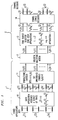
- Figure 1 shows a block diagram of the basic functional elements for a transmitter 1 and a receiver 2 for an MDMA downlink (point-to-multipoint).
- Multiple data streams c (1) through c (a) representing different applications and different users are assigned to distinct subsets of the tones at 10.
- a subset of tones may comprise the entire set of available tones, and is established during the setup process for a call. With this pre-assignment of tones, encoding of the channel coded data bits into multitone symbols proceeds at 11. Symbols that are not associated with any applications are set to zero.
- the encoded tones for the multiple data streams are then processed by block 12, which represents modulation and transmission of the multiple data streams by transmitter 1, and reception and demodulation of the data streams at receiver 2.
- Figures 2 and 3 show functional details of an FFT-based multitone DPSK modem system that is suitable for block 12. Following multitone demodulation at receiver 2, the recovered symbols are selected for symbol and channel decoding, if and only if, the symbols are associated with applications at receiver 2. The symbols are properly identified with an application and decoded.
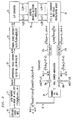
- FIG. 2 shows a block diagram of the basic functional elements of an FFT-based multitone DPSK modem according to the invention that is configured as a transmitter for a single bit stream.
- a sequence of (trellis) coded information bits 20 are input to an MPSK mapper 21.
- MPSK mapper 21 maps groups of data bits onto MPSK constellation points.
- the coded information bits are segmented into frames of M bits. (In this case, the number of constellation points (M) and the number of bits (M) per frame coincidently use the same symbol M.
- the number of constellation points M can be different from the number of bits M per frame.)
- a differential phase encoder 22 operates on two consecutive frames in a well-known manner to generate an absolute phase ⁇ 1 (k).
- the absolute phase ⁇ 1 (k) is then used by a symbol (tone) encoder 23 for generating a complex symbol X 1 (k), or a discrete tone, on the complex signal plane.
- a complex symbol X 1 (k) equals X 1 (k)exp[j ⁇ 1 (k)].
- the amplitude X 1 (k) is chosen for maximizing the overall channel capacity or for achieving desired signal-to-noise ratios across the tones.
- N complex symbols within each frame pass through a serial-to-parallel (S/P) converter 24 and are applied to the input of an inverse discrete Fourier transform (IDFT) discrete multitone modulator 25.
- IDFT inverse discrete Fourier transform
- the N complex symbols within each frame are inverse discrete Fourier transformed into N (complex) samples in the time domain via an FFT.
- the N parallel samples in each frame are converted to a serial sequence by a parallel-to-serial (P/S) converter 26, which also adds a cyclic prefix and suffix to each frame and further converts the enlarged complex sample sequence into two real data sequences by separating each complex sample into a real part and an imaginary part (R/I).
- the length of the cyclic suffix is one or two samples, while the length of the cyclic prefix is the length of the cyclic suffix plus the unit-sample response of the overall digital channel including the transmitting and receiving filters as well as the transport medium between the transmitting and receiving filters.
- the one or two samples added for both prefix and suffix allows for a large timing offset in synchronization and sampling at the receiver, while the other samples appended to the prefix enables interframe free interference, and thus intersymbol-free interference, over a time dispersive channel.
- the two real sequences are then passed through two identical lowpass filters 27a and 27b for digital-to-analog (D/A) conversion.
- Two baseband signals are thus generated, and subsequently they modulate two quadrature carriers at mixers 28a and 28b.
- appropriate power amplification and bandpass filtering at 29, successive (extended) frames are transmitted.
- the modem of Figure 2 processes multiple bit streams that have each been associated with distinct tone sets in a similar fashion.
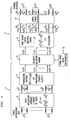
- FIG. 3 shows a block diagram of the basic functional elements of an FFT-based multitone DPSK modem configured as a receiver according to the present invention.
- a received RF signal 30 is bandpass filtered, power amplified and split into two components at 31 for non-coherent quadrature demodulation (i.e., frequency down-conversion) at mixers 32a and 32b and lowpass filters 33a and 33b.
- the resulting quadrature baseband components are sampled in parallel by analog-to-digital (A/D) converters 34a and 34b.
- A/D analog-to-digital
- A/D converters 34a and 34b are input to an S/P & R/I converter 35, where the two real sample sequences are converted to a complex sample sequence by treating each pair of the real samples as the real part and the imaginary part (R/I) of a complex sample.
- the samples at the two ends of the extended frame that are associated with the added prefix and suffix are discarded here, and the resulting N complex samples within each frame are further organized into a parallel format by an serial-to-parallel (S/P) converter.
- S/P serial-to-parallel
- the N parallel complex numbers within each frame are then discrete Fourier transformed via an FFT by discrete multitone demodulator 36 to yield N complex symbols.
- the N complex symbols are the transmitted tones weighted by the exponential of the locally generated and received carrier phase difference and the frequency response of the overall channel at the corresponding tones, and further corrupted by noise.
- the N complex symbols pass through a parallel-to-serial (P/S) converter 37, having a serial output that is sent to a frame delay device 38 and a differential phase comparator 39.
- the output of frame delay device 38 is the input delayed by one frame. Differential phases between the corresponding symbols of two consecutive frames are evaluated by differential phase comparator 39 in a well-known manner without having to determine the received carrier phase or the channel frequency response.
- the extracted differential phase values are mapped back to coded bits by an MPSK demapper 40 for subsequent channel decoding (not shown).
- the MPSK demapper and the channel decoder such as a Viterbi decoder, may be combined for soft-decision decoding.
- Figure 4 shows a block diagram of the basic functional elements for a transmitter 3 and a receiver 4 for an MDMA uplink (multipoint-to-point).
- the architecture for an uplink is similar to that for the downlink ( Figure 1).
- each application accessing the uplink is assigned a distinct set of multitone symbols so that messages generated by each application are distinguishable from messages generated by other applications.
- the unused symbols are again set to zero. All transmissions are frame synchronized with respect to the receiver for avoiding inter-user interference when more than one other user 15 accesses the channel.
- Synchronization errors of one or even two sample intervals will not cause substantial transmission errors to the present invention where one or two cyclic samples are added to the prefix and suffix of the multitone modulated sample sequences for each frame prior to transmission, as previously mentioned. All the recovered symbols at the receiver after multitone demodulation are identified with the respective applications and users, followed by symbol and channel decoding.
Landscapes
- Engineering & Computer Science (AREA)
- Signal Processing (AREA)
- Computer Networks & Wireless Communication (AREA)
- Digital Transmission Methods That Use Modulated Carrier Waves (AREA)
- Mobile Radio Communication Systems (AREA)
Applications Claiming Priority (2)
| Application Number | Priority Date | Filing Date | Title |
|---|---|---|---|
| US808782 | 1997-03-04 | ||
| US08/808,782 US6072769A (en) | 1997-03-04 | 1997-03-04 | Method for multitone division multiple access communications |
Publications (2)
| Publication Number | Publication Date |
|---|---|
| EP0874494A2 true EP0874494A2 (de) | 1998-10-28 |
| EP0874494A3 EP0874494A3 (de) | 2000-05-17 |
Family
ID=25199730
Family Applications (1)
| Application Number | Title | Priority Date | Filing Date |
|---|---|---|---|
| EP97306234A Withdrawn EP0874494A3 (de) | 1997-03-04 | 1997-08-15 | Verfahren zum Mehrfachzugriff unter Verwendung von Mehrträgermodulation |
Country Status (5)
| Country | Link |
|---|---|
| US (1) | US6072769A (de) |
| EP (1) | EP0874494A3 (de) |
| JP (1) | JPH10294712A (de) |
| CN (1) | CN1193228A (de) |
| CA (1) | CA2213596C (de) |
Cited By (6)
| Publication number | Priority date | Publication date | Assignee | Title |
|---|---|---|---|---|
| WO1999062207A1 (en) * | 1998-05-26 | 1999-12-02 | Jean Armstrong | Data transmission and reception in multicarrier modulation systems |
| EP1109356A3 (de) * | 1999-12-17 | 2001-08-29 | At&T Wireless Services, Inc. | Kollisionsfreies Vielfachzugriffsreservierungsschema für Datenpaketkommunikation mit einer Mehrzahl von Frequenztonsignalen |
| WO2001048969A3 (en) * | 1999-12-29 | 2002-01-10 | Atheros Comm Inc | Multiuser ofdm or dmt communications system for users transmitting at different data rates |
| EP1146659A4 (de) * | 1999-11-22 | 2003-03-26 | Mitsubishi Electric Corp | Kommunikationsverfahren und kommunikationsgerät |
| US8363757B1 (en) | 1999-10-12 | 2013-01-29 | Qualcomm Incorporated | Method and apparatus for eliminating the effects of frequency offsets in a digital communication system |
| US8644170B2 (en) | 2001-11-21 | 2014-02-04 | Qualcomm Incorporated | Rate selection for an OFDM system |
Families Citing this family (10)
| Publication number | Priority date | Publication date | Assignee | Title |
|---|---|---|---|---|
| AU3477999A (en) * | 1998-04-07 | 1999-10-25 | 3Com Corporation | Controlled aliasing to simplify service selection |
| US6349120B1 (en) * | 1998-09-01 | 2002-02-19 | Hughes Electronics Corporation | Method for improving spectral sampling using sub-burst discreet fourier transforms |
| EP1087585B1 (de) * | 1999-09-17 | 2013-08-21 | Alcatel-Lucent | Identifizierung einer terrestrischen Zwischenstation durch Verwendung von inaktiven Unterträger eines Mehrträgersignals |
| US8363744B2 (en) | 2001-06-10 | 2013-01-29 | Aloft Media, Llc | Method and system for robust, secure, and high-efficiency voice and packet transmission over ad-hoc, mesh, and MIMO communication networks |
| JP4034169B2 (ja) * | 2002-11-05 | 2008-01-16 | 株式会社エヌ・ティ・ティ・ドコモ | 移動通信システム、無線制御装置、基地局及び通信方法 |
| EP1964288A2 (de) * | 2005-12-12 | 2008-09-03 | Nxp B.V. | Verfahren und system zum übertragen von daten aus einer mediumzugangskontrolleinrichtung über eine bitübertragungsschicht zu einer antenne |
| JP2018184828A (ja) * | 2017-04-26 | 2018-11-22 | トラクト−テヒニーク ゲゼルシャフト ミット ベシュレンクテル ハフツング ウント コンパニー コマンディートゲゼルシャフトTRACTO−TECHNIK GmbH & Co. KG | 地中削孔用のドリルヘッド、ドリルヘッドを有する地中削孔用のドリル装置、および地中削孔中に対象物を検出する方法 |
| US20180313210A1 (en) * | 2017-04-26 | 2018-11-01 | Tracto-Technik Gmbh & Co. Kg | Drill head for earth boring, Drilling device for earth boring having the drill head, Method to detect objects while earth boring and Use of a receiver for receiving a radio signal in a drill head for earth boring |
| DE102018003400A1 (de) | 2017-04-26 | 2018-10-31 | Florence Engineering s.r.l. | Bohrkopf für Erdbohrungen, Bohrvorrichtung für Erdbohrungen aufweisend den Bohrkopf, Verfahren zum Erfassen von Objekten während einer Erdbohrung und Verwendung eines direkten Digitalsynthesizers als ein Signal bei der Erfassung eines Hindernisses beim Erdbohren |
| US11991034B1 (en) * | 2022-11-09 | 2024-05-21 | Qualcomm Incorporated | Sample-level error-correcting code |
Family Cites Families (13)
| Publication number | Priority date | Publication date | Assignee | Title |
|---|---|---|---|---|
| US5023889A (en) * | 1988-05-31 | 1991-06-11 | California Institute Of Technology | Trellis coded multilevel DPSK system with doppler correction for mobile satellite channels |
| US5038341A (en) * | 1989-12-01 | 1991-08-06 | Hughes Aircraft Company | Relay communication system |
| FR2670969B1 (fr) * | 1990-12-19 | 1993-04-16 | France Etat | Systeme de transmission de donnees par repartition dans l'espace temps-frequence, avec structuration en canaux. |
| FR2690029B1 (fr) * | 1992-04-08 | 1995-03-31 | France Telecom | Procédé de transmission de données numériques de radiomessagerie, et récepteur de radiomessagerie correspondant. |
| GB9218874D0 (en) * | 1992-09-07 | 1992-10-21 | British Broadcasting Corp | Improvements relating to the transmission of frequency division multiplex signals |
| WO1995007576A2 (en) * | 1993-09-10 | 1995-03-16 | Amati Communications Corporation | Digital sound broadcasting using a dedicated control channel |
| US5410538A (en) * | 1993-11-09 | 1995-04-25 | At&T Corp. | Method and apparatus for transmitting signals in a multi-tone code division multiple access communication system |
| US5539777A (en) * | 1995-01-26 | 1996-07-23 | Motorola, Inc. | Method and apparatus for a DMT receiver having a data de-formatter coupled directly to a constellation decoder |
| US5608722A (en) * | 1995-04-03 | 1997-03-04 | Qualcomm Incorporated | Multi-user communication system architecture with distributed receivers |
| US5680394A (en) * | 1995-07-11 | 1997-10-21 | Amati Communications Corporation | Time division duplexed high speed data transmission system and method |
| US5914933A (en) * | 1996-03-08 | 1999-06-22 | Lucent Technologies Inc. | Clustered OFDM communication system |
| US5875208A (en) * | 1997-02-06 | 1999-02-23 | At&T Wireless Services, Inc | Delay compensation in a discrete multitone spread spectrum communications system |
| US5896425A (en) * | 1997-02-24 | 1999-04-20 | At&T Wireless Services Inc | Non-uniformly spaced tones for synchronization waveform |
-
1997
- 1997-03-04 US US08/808,782 patent/US6072769A/en not_active Expired - Lifetime
- 1997-08-15 EP EP97306234A patent/EP0874494A3/de not_active Withdrawn
- 1997-08-21 CA CA002213596A patent/CA2213596C/en not_active Expired - Lifetime
-
1998
- 1998-03-02 CN CN98105390A patent/CN1193228A/zh active Pending
- 1998-03-04 JP JP10051187A patent/JPH10294712A/ja active Pending
Cited By (9)
| Publication number | Priority date | Publication date | Assignee | Title |
|---|---|---|---|---|
| WO1999062207A1 (en) * | 1998-05-26 | 1999-12-02 | Jean Armstrong | Data transmission and reception in multicarrier modulation systems |
| US8363757B1 (en) | 1999-10-12 | 2013-01-29 | Qualcomm Incorporated | Method and apparatus for eliminating the effects of frequency offsets in a digital communication system |
| US8767893B2 (en) | 1999-10-12 | 2014-07-01 | Qualcomm Incorporated | Method and apparatus for eliminating the effects of frequency offsets in a digital communication system |
| EP1146659A4 (de) * | 1999-11-22 | 2003-03-26 | Mitsubishi Electric Corp | Kommunikationsverfahren und kommunikationsgerät |
| EP1109356A3 (de) * | 1999-12-17 | 2001-08-29 | At&T Wireless Services, Inc. | Kollisionsfreies Vielfachzugriffsreservierungsschema für Datenpaketkommunikation mit einer Mehrzahl von Frequenztonsignalen |
| US6967937B1 (en) | 1999-12-17 | 2005-11-22 | Cingular Wireless Ii, Llc | Collision-free multiple access reservation scheme for multi-tone modulation links |
| WO2001048969A3 (en) * | 1999-12-29 | 2002-01-10 | Atheros Comm Inc | Multiuser ofdm or dmt communications system for users transmitting at different data rates |
| US7120166B2 (en) | 1999-12-29 | 2006-10-10 | Atheros Communications, Inc. | Scalable communication system using overlaid signals and multi-carrier frequency communication |
| US8644170B2 (en) | 2001-11-21 | 2014-02-04 | Qualcomm Incorporated | Rate selection for an OFDM system |
Also Published As
| Publication number | Publication date |
|---|---|
| CA2213596C (en) | 2001-08-07 |
| CA2213596A1 (en) | 1998-09-04 |
| EP0874494A3 (de) | 2000-05-17 |
| CN1193228A (zh) | 1998-09-16 |
| JPH10294712A (ja) | 1998-11-04 |
| US6072769A (en) | 2000-06-06 |
Similar Documents
| Publication | Publication Date | Title |
|---|---|---|
| US6148024A (en) | FFT-based multitone DPSK modem | |
| KR100768052B1 (ko) | 직교 주파수 분할 다중 시스템에서의 두 개의 전파 채널의추정 | |
| US5914933A (en) | Clustered OFDM communication system | |
| US8000268B2 (en) | Frequency-hopped IFDMA communication system | |
| US7701839B2 (en) | Method and system for multirate multiuser modulation | |
| US5166924A (en) | Echo cancellation in multi-frequency differentially encoded digital communications | |
| US6072769A (en) | Method for multitone division multiple access communications | |
| EP0839423B1 (de) | Pulsformung für mehrträgermodulation | |
| US8363696B2 (en) | Low-rate long-range mode for OFDM wireless LAN | |
| US7324600B2 (en) | Channel estimation in a multi carrier transmit diversity system | |
| RU2313910C2 (ru) | Устройство и способ уменьшения papr в системе связи ofdm | |
| US5640423A (en) | Method for signal transmission using spectrally efficient orthogonal modulation | |
| US20050259727A1 (en) | Frequency-domain decision feedback equalizing device and method | |
| US20050232134A1 (en) | Frequency division multiplexing system with selectable rate | |
| EP1610514A1 (de) | Verfahren und Vorrichtung zur Erzeugung eines Pilotsignals mit einer Zellenidentifikation in einem OFDM-System | |
| EP1276288A1 (de) | Referenzsymbole zur Kanalschätzung bei Mehrträgerübertragung | |
| EP1525686A1 (de) | Vorrichtung und verfahren für verbesserte leistung in pulsformfilter verwendenden mc-cdma-funktelekommunikationssystemen | |
| JP3891986B2 (ja) | マルチキャリア伝送の方法および装置 | |
| CN1194506A (zh) | 基于fft的多频音dpsk调制解调器 | |
| Dayana et al. | Dynamic Power Allocation for Mc-Cdma System Using Iterative Water Filling Algorithm (Iwfa) | |
| MXPA98001458A (en) | A multiple tone dpsk modem based on | |
| Matsuda et al. | A multimedia wireless transmission system using complex‐coefficient multirate filter banks | |
| HK1157092B (en) | Ofdm communications methods and apparatus | |
| HK1157092A1 (en) | Ofdm communications methods and apparatus |
Legal Events
| Date | Code | Title | Description |
|---|---|---|---|
| PUAI | Public reference made under article 153(3) epc to a published international application that has entered the european phase |
Free format text: ORIGINAL CODE: 0009012 |
|
| 17P | Request for examination filed |
Effective date: 19970919 |
|
| AK | Designated contracting states |
Kind code of ref document: A2 Designated state(s): DE FR GB |
|
| AX | Request for extension of the european patent |
Free format text: AL;LT;LV;RO;SI |
|
| PUAL | Search report despatched |
Free format text: ORIGINAL CODE: 0009013 |
|
| AK | Designated contracting states |
Kind code of ref document: A3 Designated state(s): AT BE CH DE DK ES FI FR GB GR IE IT LI LU MC NL PT SE |
|
| AX | Request for extension of the european patent |
Free format text: AL;LT;LV;RO;SI |
|
| RIC1 | Information provided on ipc code assigned before grant |
Free format text: 7H 04L 5/02 A, 7H 04L 27/26 B |
|
| AKX | Designation fees paid |
Free format text: DE FR GB |
|
| STAA | Information on the status of an ep patent application or granted ep patent |
Free format text: STATUS: THE APPLICATION IS DEEMED TO BE WITHDRAWN |
|
| 18D | Application deemed to be withdrawn |
Effective date: 20030301 |