EP0874610B1 - Hochabsorbierender artikel mit einer schichtstruktur zum ableiten von flüssigkeit - Google Patents
Hochabsorbierender artikel mit einer schichtstruktur zum ableiten von flüssigkeit Download PDFInfo
- Publication number
- EP0874610B1 EP0874610B1 EP19960929155 EP96929155A EP0874610B1 EP 0874610 B1 EP0874610 B1 EP 0874610B1 EP 19960929155 EP19960929155 EP 19960929155 EP 96929155 A EP96929155 A EP 96929155A EP 0874610 B1 EP0874610 B1 EP 0874610B1
- Authority
- EP
- European Patent Office
- Prior art keywords
- liquid
- binder
- absorbent article
- zone
- integrally formed
- Prior art date
- Legal status (The legal status is an assumption and is not a legal conclusion. Google has not performed a legal analysis and makes no representation as to the accuracy of the status listed.)
- Revoked
Links
- 239000002250 absorbent Substances 0.000 title claims abstract description 88
- 230000002745 absorbent Effects 0.000 title claims abstract description 36
- 238000012546 transfer Methods 0.000 title claims abstract description 31
- 239000011230 binding agent Substances 0.000 claims abstract description 86
- 239000007788 liquid Substances 0.000 claims abstract description 57
- 238000000034 method Methods 0.000 claims description 20
- 239000007787 solid Substances 0.000 claims description 10
- 239000002245 particle Substances 0.000 claims description 8
- 239000012530 fluid Substances 0.000 claims description 7
- 239000011236 particulate material Substances 0.000 claims description 7
- 238000004519 manufacturing process Methods 0.000 claims description 5
- 206010021639 Incontinence Diseases 0.000 claims description 3
- 229920002678 cellulose Polymers 0.000 claims description 2
- 239000001913 cellulose Substances 0.000 claims description 2
- 230000007423 decrease Effects 0.000 claims description 2
- 230000000474 nursing effect Effects 0.000 claims description 2
- 230000002485 urinary effect Effects 0.000 claims description 2
- 239000002657 fibrous material Substances 0.000 claims 2
- NIXOWILDQLNWCW-UHFFFAOYSA-N acrylic acid group Chemical group C(C=C)(=O)O NIXOWILDQLNWCW-UHFFFAOYSA-N 0.000 claims 1
- 239000000463 material Substances 0.000 abstract description 13
- 210000000416 exudates and transudate Anatomy 0.000 abstract description 4
- 239000010410 layer Substances 0.000 description 61
- 239000000835 fiber Substances 0.000 description 19
- 239000000523 sample Substances 0.000 description 7
- 230000008021 deposition Effects 0.000 description 5
- 238000012360 testing method Methods 0.000 description 5
- 241000736285 Sphagnum Species 0.000 description 4
- 230000004888 barrier function Effects 0.000 description 4
- 238000005507 spraying Methods 0.000 description 4
- 239000011800 void material Substances 0.000 description 4
- 238000013508 migration Methods 0.000 description 3
- 230000005012 migration Effects 0.000 description 3
- 230000035515 penetration Effects 0.000 description 3
- DQXBYHZEEUGOBF-UHFFFAOYSA-N but-3-enoic acid;ethene Chemical compound C=C.OC(=O)CC=C DQXBYHZEEUGOBF-UHFFFAOYSA-N 0.000 description 2
- 239000013068 control sample Substances 0.000 description 2
- 230000000694 effects Effects 0.000 description 2
- 239000005038 ethylene vinyl acetate Substances 0.000 description 2
- 239000000203 mixture Substances 0.000 description 2
- 229920001200 poly(ethylene-vinyl acetate) Polymers 0.000 description 2
- 235000005018 Pinus echinata Nutrition 0.000 description 1
- 241001236219 Pinus echinata Species 0.000 description 1
- 235000017339 Pinus palustris Nutrition 0.000 description 1
- 239000004698 Polyethylene Substances 0.000 description 1
- 238000010521 absorption reaction Methods 0.000 description 1
- 229920005822 acrylic binder Polymers 0.000 description 1
- 239000000853 adhesive Substances 0.000 description 1
- 230000001070 adhesive effect Effects 0.000 description 1
- 230000015572 biosynthetic process Effects 0.000 description 1
- 239000002131 composite material Substances 0.000 description 1
- 239000000470 constituent Substances 0.000 description 1
- 239000006185 dispersion Substances 0.000 description 1
- 239000002355 dual-layer Substances 0.000 description 1
- 230000005484 gravity Effects 0.000 description 1
- 230000002175 menstrual effect Effects 0.000 description 1
- QSHDDOUJBYECFT-UHFFFAOYSA-N mercury Chemical compound [Hg] QSHDDOUJBYECFT-UHFFFAOYSA-N 0.000 description 1
- 229910052753 mercury Inorganic materials 0.000 description 1
- 238000012986 modification Methods 0.000 description 1
- 230000004048 modification Effects 0.000 description 1
- 230000000149 penetrating effect Effects 0.000 description 1
- -1 polyethylene Polymers 0.000 description 1
- 229920000573 polyethylene Polymers 0.000 description 1
- 102000004169 proteins and genes Human genes 0.000 description 1
- 108090000623 proteins and genes Proteins 0.000 description 1
- 239000007921 spray Substances 0.000 description 1
- 238000010186 staining Methods 0.000 description 1
- 239000000126 substance Substances 0.000 description 1
- 238000010998 test method Methods 0.000 description 1
Images
Classifications
-
- A—HUMAN NECESSITIES
- A61—MEDICAL OR VETERINARY SCIENCE; HYGIENE
- A61F—FILTERS IMPLANTABLE INTO BLOOD VESSELS; PROSTHESES; DEVICES PROVIDING PATENCY TO, OR PREVENTING COLLAPSING OF, TUBULAR STRUCTURES OF THE BODY, e.g. STENTS; ORTHOPAEDIC, NURSING OR CONTRACEPTIVE DEVICES; FOMENTATION; TREATMENT OR PROTECTION OF EYES OR EARS; BANDAGES, DRESSINGS OR ABSORBENT PADS; FIRST-AID KITS
- A61F13/00—Bandages or dressings; Absorbent pads
- A61F13/15—Absorbent pads, e.g. sanitary towels, swabs or tampons for external or internal application to the body; Supporting or fastening means therefor; Tampon applicators
- A61F13/53—Absorbent pads, e.g. sanitary towels, swabs or tampons for external or internal application to the body; Supporting or fastening means therefor; Tampon applicators characterised by the absorbing medium
- A61F13/534—Absorbent pads, e.g. sanitary towels, swabs or tampons for external or internal application to the body; Supporting or fastening means therefor; Tampon applicators characterised by the absorbing medium having an inhomogeneous composition through the thickness of the pad
- A61F13/537—Absorbent pads, e.g. sanitary towels, swabs or tampons for external or internal application to the body; Supporting or fastening means therefor; Tampon applicators characterised by the absorbing medium having an inhomogeneous composition through the thickness of the pad characterised by a layer facilitating or inhibiting flow in one direction or plane, e.g. a wicking layer
- A61F13/53743—Absorbent pads, e.g. sanitary towels, swabs or tampons for external or internal application to the body; Supporting or fastening means therefor; Tampon applicators characterised by the absorbing medium having an inhomogeneous composition through the thickness of the pad characterised by a layer facilitating or inhibiting flow in one direction or plane, e.g. a wicking layer characterised by the position of the layer relative to the other layers
- A61F13/53747—Absorbent pads, e.g. sanitary towels, swabs or tampons for external or internal application to the body; Supporting or fastening means therefor; Tampon applicators characterised by the absorbing medium having an inhomogeneous composition through the thickness of the pad characterised by a layer facilitating or inhibiting flow in one direction or plane, e.g. a wicking layer characterised by the position of the layer relative to the other layers the layer is facing the topsheet
-
- A—HUMAN NECESSITIES
- A61—MEDICAL OR VETERINARY SCIENCE; HYGIENE
- A61F—FILTERS IMPLANTABLE INTO BLOOD VESSELS; PROSTHESES; DEVICES PROVIDING PATENCY TO, OR PREVENTING COLLAPSING OF, TUBULAR STRUCTURES OF THE BODY, e.g. STENTS; ORTHOPAEDIC, NURSING OR CONTRACEPTIVE DEVICES; FOMENTATION; TREATMENT OR PROTECTION OF EYES OR EARS; BANDAGES, DRESSINGS OR ABSORBENT PADS; FIRST-AID KITS
- A61F13/00—Bandages or dressings; Absorbent pads
- A61F13/15—Absorbent pads, e.g. sanitary towels, swabs or tampons for external or internal application to the body; Supporting or fastening means therefor; Tampon applicators
- A61F13/53—Absorbent pads, e.g. sanitary towels, swabs or tampons for external or internal application to the body; Supporting or fastening means therefor; Tampon applicators characterised by the absorbing medium
- A61F13/534—Absorbent pads, e.g. sanitary towels, swabs or tampons for external or internal application to the body; Supporting or fastening means therefor; Tampon applicators characterised by the absorbing medium having an inhomogeneous composition through the thickness of the pad
- A61F13/537—Absorbent pads, e.g. sanitary towels, swabs or tampons for external or internal application to the body; Supporting or fastening means therefor; Tampon applicators characterised by the absorbing medium having an inhomogeneous composition through the thickness of the pad characterised by a layer facilitating or inhibiting flow in one direction or plane, e.g. a wicking layer
- A61F13/53708—Absorbent pads, e.g. sanitary towels, swabs or tampons for external or internal application to the body; Supporting or fastening means therefor; Tampon applicators characterised by the absorbing medium having an inhomogeneous composition through the thickness of the pad characterised by a layer facilitating or inhibiting flow in one direction or plane, e.g. a wicking layer the layer having a promotional function on liquid propagation in at least one direction
- A61F13/53713—Absorbent pads, e.g. sanitary towels, swabs or tampons for external or internal application to the body; Supporting or fastening means therefor; Tampon applicators characterised by the absorbing medium having an inhomogeneous composition through the thickness of the pad characterised by a layer facilitating or inhibiting flow in one direction or plane, e.g. a wicking layer the layer having a promotional function on liquid propagation in at least one direction the layer having a promotional function on liquid propagation in the vertical direction
-
- A—HUMAN NECESSITIES
- A61—MEDICAL OR VETERINARY SCIENCE; HYGIENE
- A61F—FILTERS IMPLANTABLE INTO BLOOD VESSELS; PROSTHESES; DEVICES PROVIDING PATENCY TO, OR PREVENTING COLLAPSING OF, TUBULAR STRUCTURES OF THE BODY, e.g. STENTS; ORTHOPAEDIC, NURSING OR CONTRACEPTIVE DEVICES; FOMENTATION; TREATMENT OR PROTECTION OF EYES OR EARS; BANDAGES, DRESSINGS OR ABSORBENT PADS; FIRST-AID KITS
- A61F13/00—Bandages or dressings; Absorbent pads
- A61F13/15—Absorbent pads, e.g. sanitary towels, swabs or tampons for external or internal application to the body; Supporting or fastening means therefor; Tampon applicators
- A61F13/53—Absorbent pads, e.g. sanitary towels, swabs or tampons for external or internal application to the body; Supporting or fastening means therefor; Tampon applicators characterised by the absorbing medium
- A61F13/534—Absorbent pads, e.g. sanitary towels, swabs or tampons for external or internal application to the body; Supporting or fastening means therefor; Tampon applicators characterised by the absorbing medium having an inhomogeneous composition through the thickness of the pad
- A61F13/537—Absorbent pads, e.g. sanitary towels, swabs or tampons for external or internal application to the body; Supporting or fastening means therefor; Tampon applicators characterised by the absorbing medium having an inhomogeneous composition through the thickness of the pad characterised by a layer facilitating or inhibiting flow in one direction or plane, e.g. a wicking layer
- A61F13/53708—Absorbent pads, e.g. sanitary towels, swabs or tampons for external or internal application to the body; Supporting or fastening means therefor; Tampon applicators characterised by the absorbing medium having an inhomogeneous composition through the thickness of the pad characterised by a layer facilitating or inhibiting flow in one direction or plane, e.g. a wicking layer the layer having a promotional function on liquid propagation in at least one direction
- A61F13/53717—Absorbent pads, e.g. sanitary towels, swabs or tampons for external or internal application to the body; Supporting or fastening means therefor; Tampon applicators characterised by the absorbing medium having an inhomogeneous composition through the thickness of the pad characterised by a layer facilitating or inhibiting flow in one direction or plane, e.g. a wicking layer the layer having a promotional function on liquid propagation in at least one direction the layer having a promotional function on liquid propagation in the horizontal direction
-
- A—HUMAN NECESSITIES
- A61—MEDICAL OR VETERINARY SCIENCE; HYGIENE
- A61F—FILTERS IMPLANTABLE INTO BLOOD VESSELS; PROSTHESES; DEVICES PROVIDING PATENCY TO, OR PREVENTING COLLAPSING OF, TUBULAR STRUCTURES OF THE BODY, e.g. STENTS; ORTHOPAEDIC, NURSING OR CONTRACEPTIVE DEVICES; FOMENTATION; TREATMENT OR PROTECTION OF EYES OR EARS; BANDAGES, DRESSINGS OR ABSORBENT PADS; FIRST-AID KITS
- A61F13/00—Bandages or dressings; Absorbent pads
- A61F13/15—Absorbent pads, e.g. sanitary towels, swabs or tampons for external or internal application to the body; Supporting or fastening means therefor; Tampon applicators
- A61F13/15203—Properties of the article, e.g. stiffness or absorbency
- A61F2013/15284—Properties of the article, e.g. stiffness or absorbency characterized by quantifiable properties
- A61F2013/15487—Capillary properties, e.g. wicking
-
- A—HUMAN NECESSITIES
- A61—MEDICAL OR VETERINARY SCIENCE; HYGIENE
- A61F—FILTERS IMPLANTABLE INTO BLOOD VESSELS; PROSTHESES; DEVICES PROVIDING PATENCY TO, OR PREVENTING COLLAPSING OF, TUBULAR STRUCTURES OF THE BODY, e.g. STENTS; ORTHOPAEDIC, NURSING OR CONTRACEPTIVE DEVICES; FOMENTATION; TREATMENT OR PROTECTION OF EYES OR EARS; BANDAGES, DRESSINGS OR ABSORBENT PADS; FIRST-AID KITS
- A61F13/00—Bandages or dressings; Absorbent pads
- A61F13/15—Absorbent pads, e.g. sanitary towels, swabs or tampons for external or internal application to the body; Supporting or fastening means therefor; Tampon applicators
- A61F13/53—Absorbent pads, e.g. sanitary towels, swabs or tampons for external or internal application to the body; Supporting or fastening means therefor; Tampon applicators characterised by the absorbing medium
- A61F13/534—Absorbent pads, e.g. sanitary towels, swabs or tampons for external or internal application to the body; Supporting or fastening means therefor; Tampon applicators characterised by the absorbing medium having an inhomogeneous composition through the thickness of the pad
- A61F13/537—Absorbent pads, e.g. sanitary towels, swabs or tampons for external or internal application to the body; Supporting or fastening means therefor; Tampon applicators characterised by the absorbing medium having an inhomogeneous composition through the thickness of the pad characterised by a layer facilitating or inhibiting flow in one direction or plane, e.g. a wicking layer
- A61F13/53708—Absorbent pads, e.g. sanitary towels, swabs or tampons for external or internal application to the body; Supporting or fastening means therefor; Tampon applicators characterised by the absorbing medium having an inhomogeneous composition through the thickness of the pad characterised by a layer facilitating or inhibiting flow in one direction or plane, e.g. a wicking layer the layer having a promotional function on liquid propagation in at least one direction
- A61F2013/53721—Absorbent pads, e.g. sanitary towels, swabs or tampons for external or internal application to the body; Supporting or fastening means therefor; Tampon applicators characterised by the absorbing medium having an inhomogeneous composition through the thickness of the pad characterised by a layer facilitating or inhibiting flow in one direction or plane, e.g. a wicking layer the layer having a promotional function on liquid propagation in at least one direction with capillary means
Definitions
- the present invention relates to the art of manufacturing structures for handling body exudate. More particularly, the invention relates to a binder consolidated liquid-absorbent article characterized by a non-uniform binder distribution profile that allows the liquid-absorbent article to take-up liquid faster.
- the liquid-absorbent article is well suited for use as a transfer layer in a sanitary napkin or another disposable sanitary protection product.
- the invention also relates to a method for manufacturing the novel liquid-absorbent article.
- Sanitary napkins are multi-layered structures that normally comprise a body contacting liquid-pervious cover layer, an absorbent system and a barrier layer that prevents fluid entrapped in the absorbent system to egress from the garment facing surface of the sanitary napkin.
- the absorbent system is a dual-layer arrangement. It includes an absorbent core whose primary function is to entrap the liquid discharge permanently and a transfer layer whose function is to collect the body exudate quickly and then meter the liquid to the absorbent core. Liquid discharged on such composite absorbent systems will rapidly ingress the transfer layer due to its highly porous network. From the transfer layer, liquid migrates toward the absorbent core by capillary pressure because of the substantial difference in wicking power between the different materials. The liquid migration is well-controlled, occurring at the rate of acceptance. of the absorbent core.
- the transfer layer is in the form of a sheet and it is typically made from cellulosic fibers by an air-laid process.
- binder is applied on both main surfaces of the transfer layer, namely on its liquid-acquisition surface that faces the cover layer and on its liquid-release surface oriented toward the absorbent core. The amount of binder applied to both surfaces is the same.
- GB-A-2266465 provides an absorbent article comprising a laminate structure wherein a first layer includes a mixture of resilient fibers and from 5-20% heat actuable binding fibers and a second layer which includes a mixture of absorbent fibers and 5-15% binding fibers.
- An object of the present invention is a binder-consolidated liquid-absorbent article manifesting a short liquid-penetration time.
- Another object of the invention is a method for manufacturing the aforementioned liquid-absorbent article.
- the invention provides an integrally formed liquid-absorbent article of particulate material including first and second zones in intimate fluid communicative relationship, each zone having a multiplicity of inter-particle interstices admitting passage of liquid, whereby liquid contained in one of said zones can migrate toward the other of said zones, said liquid-absorbent article containing binder, said first zone having a higher average concentration of binder than said second zone.
- particle means a small unit of material without limitation of shape.
- a fiber that is characterized by a geometrical extension along a preferential direction will be considered a particle. Therefore, “particle” and “particulate” cover a material made of fibers, particles having non-fibrous identity, such as sphagnum moss, or a combination of both.
- the term “absorbent” will be used to designate a structure capable of taking-up liquid, without any regard to liquid-retentivity.
- binder concentration means the weight of binder (solids) per unit weight of particulate material and other constituents that may be included with the particulate material but excluding the binder (solids). The "average concentration of binder” for a given zone is obtained by dividing the weight of binder (solids) contained in the zone by the weight of the zone (solids) from which the weight of binder has been subtracted.
- the present inventor believes that the non-uniform binder distribution profile creates within the liquid-absorbent article an intermediate zone having a high void volume (low density). Liquid migrating through the porous network of the liquid-absorbent article will have a tendency to spread along the X-Y plane, once it reaches the high void volume zone. The liquid front, now distributed over a larger surface area advances more rapidly since it is channelled through a larger number of capillary passageways.
- Such liquid-absorbent structure is particularly useful as a transfer layer for a disposable absorbent product, such as a sanitary napkin, diaper, adult incontinence brief, urinary pad, wound dressing and nursing pad.
- the liquid-absorbent article manifests a higher liquid penetration rate when the liquid is deposited on the surface on which the binder concentration is highest. This is contrary to conventional wisdom that dictates that an increase in the amount of binder on the liquid-acquisition surface of a porous structure reduces the rate of penetration of liquid in the structure.
- the liquid-absorbent article according to the invention is made of fibers.
- Cellulosic fibers are most preferred although other fibers could also be used without departing from the spirit of the invention.
- the length of the fibers influences the formation of the intermediate high void volume zone. Best results have been obtained with fibers having a length not exceeding 3.5 millimeters (mm).
- the invention also provides a transfer layer for a disposable absorbent product comprising the integrally formed liquid-absorbent article as defined above.
- the invention also provides a method for manufacturing a liquid-absorbent article as defined above, said method comprising the steps of:
- the present invention provides an integrally formed liquid-absorbent article suitable for use as a transfer layer in a sanitary absorbent product, such as a sanitary napkin.
- the liquid absorbent article is characterized by a non-uniform binder deposition profile.
- the transfer layer is manufactured in a sheet form from cellulosic fibers according to the well-known air-laid process.
- the resulting sheet is subjected to binder treatment that consists of spraying one main face of the sheet with binder, letting the binder set and then spraying the other face of the sheet with binder.
- binder treatment that consists of spraying one main face of the sheet with binder, letting the binder set and then spraying the other face of the sheet with binder.
- the amount of binder deposited at each spraying step is different to create a higher binder concentration near one surface of the liquid-absorbent article than near the other surface.
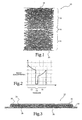
- FIG. 1 provides an enlarged cross-sectional view of the liquid-absorbent article designated comprehensively with the reference numeral 10.
- the liquid-absorbent article 10 includes three superposed layers, namely an upper layer 12, an intermediate layer 14 and a lower layer 16.
- the upper layer 12 and the lower layer 16 have approximately the same thickness, while the intermediate layer 14 is much thinner.
- the upper layer 12 is distinguished from the two other layers by a comparatively high binder content.
- the binder concentration profile is at a maximum level at the upper surface 18, where the binder has been deposited in liquid form by spraying. As depth increases, the binder concentration progressively diminishes toward the interface between the upper layer 12 and the intermediate layer 14, where virtually no binder exists.
- This negative binder concentration gradient is the result of a migration of the liquid binder substance that occurs immediately after the binder has been sprayed.
- the liquid binder sinks within the porous structure due to capillary pressure and gravity.
- the rate of progression of the liquid front gradually diminishes because the viscosity of the liquid increases as the curing process nears completion.
- the migration process is completed when the binder is fully cured.
- the structure of the lower layer 16 is similar to the upper layer 12 except that it contains much less binder.
- the binder concentration of the lower layer 16 peaks at the lower surface 20 and gradually decreases in the upward direction until the interface lower layer 16/intermediate layer 14 where it drops to negligible levels.
- the intermediate layer 14 is formed as a result of the presence of the binder consolidated upper and lower layers 12 and 16. Without intent of being bound by a particular theory it is believed that immediately after the binder is cured the fibers in the upper layer 12 and in the lower layer 16 are linked to one another and thus fixed in predetermined spacial positions, except the fibers at the intervening region between these two layers where the amount of binder is minimal. During subsequent manipulations and handling of the liquid-absorbent article, the layers 12 and 16 may slightly separate from one another creating between them the intermediate layer 14.
- the intermediate layer 14 is characterized by a much lower density (higher void volume) than layers 12 and 14 and it can transport liquid much faster than layers 12 and 14.
- the graph of Figure 2 illustrates the binder deposition profile of the liquid-absorbent article 10.
- liquid When liquid is discharged on the liquid-absorbent article 10, say the surface 18, the liquid begins penetrating the porous network along a vector that is generally transverse to the plane of the liquid-absorbent article, i.e., the liquid front advances vertically and there is very little lateral dispersion.
- the liquid when the liquid reaches the intermediate layer 14, it spreads apart considerably and enters the lower layer 16 distributed over a larger surface area. The liquid travels faster through lower layer 16 because it is channelled through an increased number of capillary passageways.
- the liquid-absorbent article 10 is made from cellulosic fibers (100% Southern Pine Kraft) by an air-laid process.
- the cellulosic web prior to the binder deposition has a basis weight of 66.2 grams per meter squared (g/m 2 ).
- the total amount of binder deposited on the cellulosic web ranges from about 10% to about 25% by weight of solids in the liquid-absorbent article (cellulosic fibers plus binder). In a preferred embodiment the amount of binder deposited on the cellulosic web is 13.8 g/m 2 of solids.
- EVA ethylene vinyl acetate binder has been found satisfactory. Acrylic binder can also be used.
- No less than 75% of the total amount of binder applied to the web is deposited on one surface of the web, while the balance (25% maximum) on the other surface.
- Most preferably, 85% of the total amount of binder (11.73 g/m 2 of solids in the example given above) is applied to one side of the web while the other side receives 15% (2.07 g/m 2 ).
- the concentration of the liquid binder is changed, not the amount of material sprayed.
- both sides of the web receive the same amount of liquid, but the concentration of binder in the liquid varies.
- Other methods to effect the non-uniform binder deposition can also be used. For example, it could be considered to spray or otherwise deposit liquid binder having the same concentration on both faces of the web, except that one face receives more material than the other face.
- the properties of the liquid-absorbent article 10 constructed under the specific example discussed above are compared with a control sample in a test.
- the control sample is identical to the invention except that the binder is applied uniformly on both surfaces of the cellulosic web. Thus each side receives 6.9 g/m 2 of binder (solids).
- the purpose of the test is to determine the capillary attraction developed by an absorbent material on a fluid.
- test fluid is synthetic menstrual liquid without protein having a viscosity of 5.5 cps.
- test results are reported in the following table: SAMPLE CAPILLARY PRESSURE (mmHg) Control 26.2 Invention (sensor of the instrument in contract with side having the 85% binder portion) 31.8 Invention (sensor of the instrument in contact with side having the 15% binder portion) 23.5
- the liquid-absorbent article 10 is well-suited for use as a transfer layer in a sanitary napkin.
- An example of such sanitary napkin is shown in Figure 3.
- the napkin comprehensively designated by the reference numeral 22, comprises a liquid-permeable cover layer 24 overlaying a transfer layer 26 manufactured in accordance with the invention.
- a transfer layer 26 manufactured in accordance with the invention.
- an absorbent core 28 that preferably includes sphagnum moss material and it is comparatively thin, i.e., having a few millimeters in thickness.
- the absorbent core 28 Underneath the absorbent core 28 is provided a barrier layer 30 made of liquid-impervious material, such as polyethylene, to prevent liquid entrapped in the absorbent core 30 from egressing the sanitary napkin 22 and staining the wearer's underpants.
- the cover layer 24 and the barrier layer 30 are joined along their marginal portions so as to form an enclosure that maintains the absorbent core 28 captive.
- the joint may be made by means of adhesive or heat-bond.
- the transfer layer 26 comprises an upper liquid-acquisition surface 32 through which liquid is received from the cover layer 24.
- the lower surface 34 of the transfer layer that faces the absorbent core 28 is the liquid-release surface through which liquid is passed to the absorbent core. It is preferred to orient the transfer layer 32 in such a way as to place the side containing the most binder up so it forms the liquid-acquisition surface. As discussed earlier, this configuration provides better performance.
Landscapes
- Health & Medical Sciences (AREA)
- General Health & Medical Sciences (AREA)
- Epidemiology (AREA)
- Biomedical Technology (AREA)
- Heart & Thoracic Surgery (AREA)
- Vascular Medicine (AREA)
- Life Sciences & Earth Sciences (AREA)
- Engineering & Computer Science (AREA)
- Public Health (AREA)
- Animal Behavior & Ethology (AREA)
- Veterinary Medicine (AREA)
- Absorbent Articles And Supports Therefor (AREA)
- Laminated Bodies (AREA)
- Decoration By Transfer Pictures (AREA)
- Pens And Brushes (AREA)
- Orthopedics, Nursing, And Contraception (AREA)
Claims (16)
- Integral gebildeter flüssigkeitsabsorbierender Artikel (10) aus einem partikulären Material mit einer ersten Zone (12) und einer zweiten Zone (16), die in intensiver fluidkommunizierender Beziehung stehen, und einer ersten Hauptoberfläche (18) und einer entgegengesetzten zweiten Hauptoberfläche(20), wobei die erste Zone (12) die erste Hauptoberfläche und die zweite Zone (16) die zweite Hauptoberfläche umfaßt, wobei jede Zone mehrere Zwischenteilchenzwischenräume aufweist, die einen Durchgang von Flüssigkeit zulassen, wodurch eine in einer der Zonen enthaltene Flüssigkeit in der Lage ist, zu der anderen der Zonen zu wandern, wobei der flüssigkeitsabsorbierende Artikel (10) ein Bindemittel aufweist, und wobei die erste Zone (12) eine höhere Durchschnittskonzentration des Bindemittels als die zweite Zone (16) aufweist, dadurch gekennzeichnet, daß die erste Zone (12) einen Bindemittelkonzentrationsgradienten aufweist, wobei die Bindemittelkonzentration an der ersten Oberfläche (18) maximal ist und nach und nach in Richtung der Grenzfläche zwischen der ersten Zone und der zweiten Zone abnimmt und die zweite Zone einen Bindemittelkonzentrationsgradienten aufweist, und wobei eine maximale Bindemittelkonzentration an der zweiten Oberfläche (20) gebildet ist und die Bindemittelkonzentration allmählich in Richtung der Grenzfläche zwischen der ersten und der zweiten Zone abnimmt.
- Integral gebildeter flüssigkeitsabsorbierender Artikel (10) nach Anspruch 1, dadurch gekennzeichnet, daß der flüssigkeitsabsorbierende Artikel die Form eines Blattes aufweist.
- Integral gebildeter flüssigkeitsabsorbierender Artikel (10) nach Anspruch 2, gekennzeichnet durch eine dritte Zone (14), welche zwischen der ersten Zone (12) und der zweiten Zone (16) angeordnet ist, wobei die dritte Zone (14) eine geringere Dichte als die erste und die zweite Zone aufweist.
- Integral gebildeter flüssigkeitsabsorbierender Artikel (10) nach Anspruch 3, dadurch gekennzeichnet, daß die dritte Zone (14) eine geringere Bindemittelkonzentration als die erste Zone (12) und die zweite Zone (16) aufweist.
- Integral gebildeter flüssigkeitsabsorbierender Artikel (10) nach Anspruch 1, dadurch gekennzeichnet, daß der flüssigkeitsabsorbierende Artikel faserstoffartiges Material umfaßt.
- Integral gebildeter flüssigkeitsabsorbierender Artikel (10) nach Anspruch 5, dadurch gekennzeichnet, daß das faserstoffartige Material Zellulose ist.
- Integral gebildeter flüssigkeitsabsorbierender Artikel (10) nach Anspruch 1, dadurch gekennzeichnet, daß der flüssigkeitsabsorbierende Artikel Bindemittel im Bereich von etwa 10 % bis etwa 25 % des Trockengewichts des flüssigkeitsabsorbierenden Artikels umfaßt.
- Integral gebildeter flüssigkeitsabsorbierender Artikel (10) nach Anspruch 7, dadurch gekennzeichnet, daß das Bindemittel aus Ethylen-Venyl-Acetat (EVA) oder Acryl ist.
- Integral gebildeter flüssigkeitsabsorbierender Artikel (10) nach Anspruch 7, dadurch gekennzeichnet, daß die erste Zone (12) nicht weniger als etwa 75 % des gesamten Bindemittelgehalts des flüssigkeitsabsorbierenden Artikels umfaßt.
- Weiterleitlage für ein absorbierendes Einwegprodukt mit dem integral gebildeten flüssigkeitsabsorbierenden Artikel (10) nach einem der Ansprüche 1 bis 9.
- Absorbierendes Einwegprodukt mit der Weiterleitungslage nach Anspruch 10.
- Absorbierendes Einwegprodukt nach Anspruch 11, dadurch gekennzeichnet, daß das absorbierende Einwegprodukt eine Monatsbinde, eine Windel, ein Erwachseneninkontinenzslip, eine Urinvorlage, ein Wundverband oder eine Stilleinlage ist.
- Verfahren zur Herstellung eines flüssigkeitsabsorbierenden Artikels nach einem der Ansprüche 1 bis 9, wobei das Verfahren die folgenden Schritte umfaßt:Formen eines partikulären Material zu einem Blatt mit einer ersten Hauptoberfläche und einer zweiten Hauptoberfläche, wobei das Blatt mehrere Zwischenteilzwischenräume aufweist, die einen Durchgang von Flüssigkeit zulassen; undAufbringen eines Bindemittels auf das Blatt, um in der Nähe der ersten Hauptoberfläche eine höhere Konzentration des Bindemittels als in der Nähe der zweiten Hauptoberfläche zu schaffen.
- Verfahren nach Anspruch 13, dadurch gekennzeichnet, daß das partikuläre Material mittels Luftschichtens in ein Blatt geformt wird.
- Verfahren nach Anspruch 13, dadurch gekennzeichnet, daß das Bindemittel auf die erste Hauptoberfläche und die zweite Hauptoberfläche gesprüht wird,
- Verfahren nach Anspruch 13, dadurch gekennzeichnet, daß das Bindemittel auf das Blatt in einem Bereich von etwa 10 % bis etwa 25 % des Trockengewichts des Blattes aufgetragen wird.
Applications Claiming Priority (3)
| Application Number | Priority Date | Filing Date | Title |
|---|---|---|---|
| CA2160757 | 1995-10-17 | ||
| CA 2160757 CA2160757C (en) | 1995-10-17 | 1995-10-17 | Highly absorbent transfer layer structure |
| PCT/CA1996/000607 WO1997014384A1 (en) | 1995-10-17 | 1996-09-12 | Highly absorbent transfer layer structure |
Publications (2)
| Publication Number | Publication Date |
|---|---|
| EP0874610A1 EP0874610A1 (de) | 1998-11-04 |
| EP0874610B1 true EP0874610B1 (de) | 2002-06-26 |
Family
ID=4156789
Family Applications (1)
| Application Number | Title | Priority Date | Filing Date |
|---|---|---|---|
| EP19960929155 Revoked EP0874610B1 (de) | 1995-10-17 | 1996-09-12 | Hochabsorbierender artikel mit einer schichtstruktur zum ableiten von flüssigkeit |
Country Status (15)
| Country | Link |
|---|---|
| EP (1) | EP0874610B1 (de) |
| AR (1) | AR004022A1 (de) |
| AU (1) | AU6868096A (de) |
| CA (1) | CA2160757C (de) |
| CO (1) | CO4770932A1 (de) |
| DE (1) | DE69622045T2 (de) |
| ES (1) | ES2178713T3 (de) |
| GT (1) | GT199600086A (de) |
| HN (1) | HN1996000066A (de) |
| IN (1) | IN190084B (de) |
| MY (1) | MY115399A (de) |
| TW (1) | TW368406B (de) |
| UY (1) | UY24348A1 (de) |
| WO (1) | WO1997014384A1 (de) |
| ZA (1) | ZA968734B (de) |
Families Citing this family (17)
| Publication number | Priority date | Publication date | Assignee | Title |
|---|---|---|---|---|
| US6339727B1 (en) | 1998-12-21 | 2002-01-15 | Recot, Inc. | Apparatus and method for controlling distribution of product in manufacturing process |
| US6348253B1 (en) | 1999-04-03 | 2002-02-19 | Kimberly-Clark Worldwide, Inc. | Sanitary pad for variable flow management |
| US6534149B1 (en) | 1999-04-03 | 2003-03-18 | Kimberly-Clark Worldwide, Inc. | Intake/distribution material for personal care products |
| GB0224986D0 (en) | 2002-10-28 | 2002-12-04 | Smith & Nephew | Apparatus |
| BRPI0615715A2 (pt) | 2005-09-06 | 2011-05-24 | Tyco Healthcare | curativo de ferimento independente com microbomba |
| GB201011173D0 (en) | 2010-07-02 | 2010-08-18 | Smith & Nephew | Provision of wound filler |
| GB201020005D0 (en) | 2010-11-25 | 2011-01-12 | Smith & Nephew | Composition 1-1 |
| EP2643412B1 (de) | 2010-11-25 | 2016-08-17 | Smith & Nephew PLC | Zusammensetzung i-ii sowie produkte und ihre verwendung |
| MX2014000526A (es) | 2011-07-14 | 2014-10-01 | Smith & Nephew | Vendaje para heridas y método de tratamiento. |
| US20150159066A1 (en) | 2011-11-25 | 2015-06-11 | Smith & Nephew Plc | Composition, apparatus, kit and method and uses thereof |
| WO2013175306A2 (en) | 2012-05-23 | 2013-11-28 | Smith & Nephew Plc | Apparatuses and methods for negative pressure wound therapy |
| EP4699626A2 (de) | 2012-08-01 | 2026-02-25 | Smith & Nephew plc | Wundverband und behandlungsverfahren |
| BR112015002154A2 (pt) | 2012-08-01 | 2017-07-04 | Smith & Nephew | curativo de ferimento |
| US20160120706A1 (en) | 2013-03-15 | 2016-05-05 | Smith & Nephew Plc | Wound dressing sealant and use thereof |
| EP2968647B1 (de) | 2013-03-15 | 2022-06-29 | Smith & Nephew plc | Wundverbanddichtmasse und verwendung davon |
| WO2015193257A1 (en) | 2014-06-18 | 2015-12-23 | Smith & Nephew Plc | Wound dressing |
| GB2555584B (en) | 2016-10-28 | 2020-05-27 | Smith & Nephew | Multi-layered wound dressing and method of manufacture |
Family Cites Families (6)
| Publication number | Priority date | Publication date | Assignee | Title |
|---|---|---|---|---|
| CA2012526A1 (en) * | 1989-03-20 | 1990-09-20 | Amar N. Neogi | Natural fiber product coated with a thermoset binder material |
| US5432000A (en) * | 1989-03-20 | 1995-07-11 | Weyerhaeuser Company | Binder coated discontinuous fibers with adhered particulate materials |
| AU6140990A (en) * | 1989-08-10 | 1991-03-11 | National Felt Company | Superabsorbent nonwoven fibrous material |
| HU214348B (hu) * | 1991-07-23 | 1998-03-30 | Procter And Gamble Co. | Javított folyadékelosztó képességű abszorbens cikkek, különösen egészségügyi betétek |
| CA2076416A1 (en) * | 1991-12-19 | 1993-06-20 | Randy Emil Meirowitz | Absorbent structure for masking and distributing a liquid |
| SE508402C2 (sv) * | 1992-04-28 | 1998-10-05 | Sca Hygiene Prod Ab | Absorptionskropp i ett absorberande alster såsom en dambinda, trosskydd, inkontinensskydd, blöja och liknande samt förfarande för tillverkning av ett banformat absorptionsmaterial |
-
1995
- 1995-10-17 CA CA 2160757 patent/CA2160757C/en not_active Expired - Fee Related
-
1996
- 1996-09-12 WO PCT/CA1996/000607 patent/WO1997014384A1/en not_active Ceased
- 1996-09-12 ES ES96929155T patent/ES2178713T3/es not_active Expired - Lifetime
- 1996-09-12 DE DE69622045T patent/DE69622045T2/de not_active Revoked
- 1996-09-12 EP EP19960929155 patent/EP0874610B1/de not_active Revoked
- 1996-09-12 AU AU68680/96A patent/AU6868096A/en not_active Abandoned
- 1996-10-01 IN IN1742CA1996 patent/IN190084B/en unknown
- 1996-10-10 CO CO96053965A patent/CO4770932A1/es unknown
- 1996-10-11 UY UY24348A patent/UY24348A1/es not_active IP Right Cessation
- 1996-10-15 GT GT199600086A patent/GT199600086A/es unknown
- 1996-10-16 MY MYPI9604307 patent/MY115399A/en unknown
- 1996-10-16 ZA ZA9608734A patent/ZA968734B/xx unknown
- 1996-10-16 HN HN1996000066A patent/HN1996000066A/es unknown
- 1996-10-16 AR ARP960104774 patent/AR004022A1/es active IP Right Grant
- 1996-10-17 TW TW085112793A patent/TW368406B/zh active
Also Published As
| Publication number | Publication date |
|---|---|
| EP0874610A1 (de) | 1998-11-04 |
| WO1997014384A1 (en) | 1997-04-24 |
| TW368406B (en) | 1999-09-01 |
| IN190084B (de) | 2003-06-07 |
| AU6868096A (en) | 1997-05-07 |
| CO4770932A1 (es) | 1999-04-30 |
| ES2178713T3 (es) | 2003-01-01 |
| AR004022A1 (es) | 1998-09-30 |
| DE69622045T2 (de) | 2003-01-23 |
| DE69622045D1 (de) | 2002-08-01 |
| HN1996000066A (es) | 1997-07-08 |
| GT199600086A (es) | 1998-04-08 |
| CA2160757A1 (en) | 1997-04-18 |
| ZA968734B (en) | 1998-04-16 |
| CA2160757C (en) | 2000-01-04 |
| UY24348A1 (es) | 1996-12-05 |
| MY115399A (en) | 2003-05-31 |
Similar Documents
| Publication | Publication Date | Title |
|---|---|---|
| US5665082A (en) | Highly absorbent transfer layer structure | |
| EP0874610B1 (de) | Hochabsorbierender artikel mit einer schichtstruktur zum ableiten von flüssigkeit | |
| KR940008958B1 (ko) | Z방향의 초흡수제 농도 구배를 갖는 무층 흡수제 삽입체 | |
| CZ282375B6 (cs) | Absorbentový výrobek pro jedno použití | |
| CA2316495C (en) | A sanitary napkin with improved liquid retention capability | |
| CN101018523B (zh) | 具有改进的采集速率的吸收产品 | |
| EP1191915B2 (de) | Einheitliches flüssigkeitsaufnahme-, speicher-, und verteiler-material | |
| US8319005B2 (en) | Comfortable diaper | |
| CA2145842C (en) | Absorbent article with plates | |
| US6515195B1 (en) | Sanitary napkin with improved liquid retention capability | |
| CA2098322C (en) | Absorbent article having rapid acquiring, multiple layer absorbent core | |
| EP1074234B1 (de) | Herstellungsverfahren für absorbierende Mehrschichtstrukturen | |
| US4578071A (en) | Disposable absorbent article having an improved liquid migration resistant perimeter construction | |
| US20030093047A1 (en) | Absorbent structure and absorbent articles containing the absorbent structure | |
| IE67323B1 (en) | Absorbent article having rapid acquiring wrapped multiple layer absorbent body | |
| US5718699A (en) | Disposable absorbent product with secondary liquid-containment structure | |
| EP0059015A2 (de) | Saugfähiger Wegwerfartikel mit verbessertem Aufbau der gegen Durchfeuchten widerstandsfähigen äusseren Begrenzung | |
| US6118042A (en) | Absorbent article with controlled distribution of liquid | |
| AU653108B2 (en) | A method for preparing a fluid-repellent fibrous material | |
| CA2013943C (en) | Selective placement of absorbent product materials in sanitary napkins and the like | |
| HK1003079B (en) | Disposable absorbent product with secondary liquid-containment structure | |
| HK1035313B (en) | A sanitary napkin with improved liquid retention capability |
Legal Events
| Date | Code | Title | Description |
|---|---|---|---|
| PUAI | Public reference made under article 153(3) epc to a published international application that has entered the european phase |
Free format text: ORIGINAL CODE: 0009012 |
|
| 17P | Request for examination filed |
Effective date: 19980513 |
|
| AK | Designated contracting states |
Kind code of ref document: A1 Designated state(s): DE ES FR GB GR IT NL |
|
| 17Q | First examination report despatched |
Effective date: 19990510 |
|
| GRAG | Despatch of communication of intention to grant |
Free format text: ORIGINAL CODE: EPIDOS AGRA |
|
| GRAG | Despatch of communication of intention to grant |
Free format text: ORIGINAL CODE: EPIDOS AGRA |
|
| GRAH | Despatch of communication of intention to grant a patent |
Free format text: ORIGINAL CODE: EPIDOS IGRA |
|
| GRAH | Despatch of communication of intention to grant a patent |
Free format text: ORIGINAL CODE: EPIDOS IGRA |
|
| GRAA | (expected) grant |
Free format text: ORIGINAL CODE: 0009210 |
|
| AK | Designated contracting states |
Kind code of ref document: B1 Designated state(s): DE ES FR GB GR IT NL |
|
| REG | Reference to a national code |
Ref country code: GB Ref legal event code: FG4D |
|
| REF | Corresponds to: |
Ref document number: 69622045 Country of ref document: DE Date of ref document: 20020801 |
|
| ET | Fr: translation filed | ||
| REG | Reference to a national code |
Ref country code: GR Ref legal event code: EP Ref document number: 20020403025 Country of ref document: GR |
|
| REG | Reference to a national code |
Ref country code: ES Ref legal event code: FG2A Ref document number: 2178713 Country of ref document: ES Kind code of ref document: T3 |
|
| PLBQ | Unpublished change to opponent data |
Free format text: ORIGINAL CODE: EPIDOS OPPO |
|
| PLBI | Opposition filed |
Free format text: ORIGINAL CODE: 0009260 |
|
| PLBF | Reply of patent proprietor to notice(s) of opposition |
Free format text: ORIGINAL CODE: EPIDOS OBSO |
|
| 26 | Opposition filed |
Opponent name: THE PROCTER & GAMBLE COMPANY Effective date: 20030321 |
|
| NLR1 | Nl: opposition has been filed with the epo |
Opponent name: THE PROCTER & GAMBLE COMPANY |
|
| PLAX | Notice of opposition and request to file observation + time limit sent |
Free format text: ORIGINAL CODE: EPIDOSNOBS2 |
|
| PLAX | Notice of opposition and request to file observation + time limit sent |
Free format text: ORIGINAL CODE: EPIDOSNOBS2 |
|
| PLAX | Notice of opposition and request to file observation + time limit sent |
Free format text: ORIGINAL CODE: EPIDOSNOBS2 |
|
| PLBB | Reply of patent proprietor to notice(s) of opposition received |
Free format text: ORIGINAL CODE: EPIDOSNOBS3 |
|
| PLBQ | Unpublished change to opponent data |
Free format text: ORIGINAL CODE: EPIDOS OPPO |
|
| PLAB | Opposition data, opponent's data or that of the opponent's representative modified |
Free format text: ORIGINAL CODE: 0009299OPPO |
|
| R26 | Opposition filed (corrected) |
Opponent name: THE PROCTER & GAMBLE COMPANY Effective date: 20030321 |
|
| NLR1 | Nl: opposition has been filed with the epo |
Opponent name: THE PROCTER & GAMBLE COMPANY |
|
| APBP | Date of receipt of notice of appeal recorded |
Free format text: ORIGINAL CODE: EPIDOSNNOA2O |
|
| APBM | Appeal reference recorded |
Free format text: ORIGINAL CODE: EPIDOSNREFNO |
|
| APBQ | Date of receipt of statement of grounds of appeal recorded |
Free format text: ORIGINAL CODE: EPIDOSNNOA3O |
|
| APAH | Appeal reference modified |
Free format text: ORIGINAL CODE: EPIDOSCREFNO |
|
| PGFP | Annual fee paid to national office [announced via postgrant information from national office to epo] |
Ref country code: GR Payment date: 20060822 Year of fee payment: 11 |
|
| PGFP | Annual fee paid to national office [announced via postgrant information from national office to epo] |
Ref country code: NL Payment date: 20060903 Year of fee payment: 11 |
|
| PGFP | Annual fee paid to national office [announced via postgrant information from national office to epo] |
Ref country code: GB Payment date: 20060906 Year of fee payment: 11 |
|
| PGFP | Annual fee paid to national office [announced via postgrant information from national office to epo] |
Ref country code: DE Payment date: 20060907 Year of fee payment: 11 |
|
| PGFP | Annual fee paid to national office [announced via postgrant information from national office to epo] |
Ref country code: FR Payment date: 20060908 Year of fee payment: 11 |
|
| PGFP | Annual fee paid to national office [announced via postgrant information from national office to epo] |
Ref country code: ES Payment date: 20061023 Year of fee payment: 11 |
|
| APBU | Appeal procedure closed |
Free format text: ORIGINAL CODE: EPIDOSNNOA9O |
|
| RDAF | Communication despatched that patent is revoked |
Free format text: ORIGINAL CODE: EPIDOSNREV1 |
|
| RDAG | Patent revoked |
Free format text: ORIGINAL CODE: 0009271 |
|
| STAA | Information on the status of an ep patent application or granted ep patent |
Free format text: STATUS: PATENT REVOKED |
|
| 27W | Patent revoked |
Effective date: 20070223 |
|
| GBPR | Gb: patent revoked under art. 102 of the ep convention designating the uk as contracting state |
Free format text: 20070223 |
|
| NLR2 | Nl: decision of opposition |
Effective date: 20070223 |
|
| PGFP | Annual fee paid to national office [announced via postgrant information from national office to epo] |
Ref country code: IT Payment date: 20070926 Year of fee payment: 12 |