EP0874935B1 - Verfahren zur herstellung von papierzellstoff aus lignocellulosischen pflanzen sowie danach hergestellter papierzellstoff - Google Patents
Verfahren zur herstellung von papierzellstoff aus lignocellulosischen pflanzen sowie danach hergestellter papierzellstoff Download PDFInfo
- Publication number
- EP0874935B1 EP0874935B1 EP97900645A EP97900645A EP0874935B1 EP 0874935 B1 EP0874935 B1 EP 0874935B1 EP 97900645 A EP97900645 A EP 97900645A EP 97900645 A EP97900645 A EP 97900645A EP 0874935 B1 EP0874935 B1 EP 0874935B1
- Authority
- EP
- European Patent Office
- Prior art keywords
- plants
- process according
- substantially comprised
- lignocellulosic
- pressure
- Prior art date
- Legal status (The legal status is an assumption and is not a legal conclusion. Google has not performed a legal analysis and makes no representation as to the accuracy of the status listed.)
- Expired - Lifetime
Links
Images
Classifications
-
- D—TEXTILES; PAPER
- D21—PAPER-MAKING; PRODUCTION OF CELLULOSE
- D21C—PRODUCTION OF CELLULOSE BY REMOVING NON-CELLULOSE SUBSTANCES FROM CELLULOSE-CONTAINING MATERIALS; REGENERATION OF PULPING LIQUORS; APPARATUS THEREFOR
- D21C1/00—Pretreatment of the finely-divided materials before digesting
- D21C1/06—Pretreatment of the finely-divided materials before digesting with alkaline reacting compounds
-
- D—TEXTILES; PAPER
- D21—PAPER-MAKING; PRODUCTION OF CELLULOSE
- D21B—FIBROUS RAW MATERIALS OR THEIR MECHANICAL TREATMENT
- D21B1/00—Fibrous raw materials or their mechanical treatment
-
- D—TEXTILES; PAPER
- D21—PAPER-MAKING; PRODUCTION OF CELLULOSE
- D21B—FIBROUS RAW MATERIALS OR THEIR MECHANICAL TREATMENT
- D21B1/00—Fibrous raw materials or their mechanical treatment
- D21B1/04—Fibrous raw materials or their mechanical treatment by dividing raw materials into small particles, e.g. fibres
- D21B1/12—Fibrous raw materials or their mechanical treatment by dividing raw materials into small particles, e.g. fibres by wet methods, by the use of steam
- D21B1/30—Defibrating by other means
- D21B1/36—Explosive disintegration by sudden pressure reduction
-
- D—TEXTILES; PAPER
- D21—PAPER-MAKING; PRODUCTION OF CELLULOSE
- D21C—PRODUCTION OF CELLULOSE BY REMOVING NON-CELLULOSE SUBSTANCES FROM CELLULOSE-CONTAINING MATERIALS; REGENERATION OF PULPING LIQUORS; APPARATUS THEREFOR
- D21C5/00—Other processes for obtaining cellulose, e.g. cooking cotton linters ; Processes characterised by the choice of cellulose-containing starting materials
Definitions
- the invention relates to a method of manufacture of paper pulp from raw materials lignocellulosic based on annual or perennial plants.
- annual plant is meant hereinafter any plant having a development period of approximately one year (cotton, hemp, flax, cereal, sugar cane, sorghum, ...); “perennial plants” means plants whose development spans periods much longer (bamboo, reed, sisal, hardwood or resinous, ...); raw materials lignocellulosiques targeted by the invention may contain plants as a whole, or only parts of these plants (stems, leaves, etc.), or by-products of these plants (straw, bagasse ).
- Manufacturing costs are increasing from very low quality pasta to good quality, due to increasing material losses raw materials, increasing energy expenditure in the form mechanical or thermal, and increasing consumption chemicals used.
- the present invention proposes to provide a process for making paper pulp from plants annual or perennial, which leads to good pasta quality (in particular at least equal break length at 5,500 meters), which uses quantities of reagents moderate chemicals much lower than needed in chemical processes, and which benefits from a yield of 60 at 70%, much higher than the yield of pasta chemicals of similar quality or process yield proposed by MAMERS et al.
- the invention relates to a process which allows to obtain these performances whatever the nature of the plants used and which is therefore particularly interesting in the case of annual plants to provide a new outlet for these plants.
- the method of the invention is derived from the The following surprising observation: when a steam cracking of lignocellulosic materials in the presence of a proportion by weight of soda between 3.5% and 10% and preferably between 5% and 8%, with a rate sufficient hydration (more than 40%), we avoid degradation of lignocellulosic fibers and preserves their paper quality despite the high stresses suffered during the explosion, and what whether the type of plants (annual or perennial). We thus obtains very resistant quality pasta corresponding to that of chemical pulp, with a much higher yield than chemical processes (yield of the order of 60 to 70% in experiments carried out).
- the invention thus makes it possible, by relation to traditional or derived chemical processes, on the one hand to obtain a higher dough weight compared to the same weight of lignocellulosic raw material, other hand to use much smaller amounts of chemicals (less than 10% soda); these quantities less soda used is an advantage essential in practice since they lead to a considerable reduction in the costs of recycling this product.
- soda represents an essential advantage compared to others proposed chemical reagents such as sulfite because the soda is, by nature, easy to recycle chemically (transformation into sodium carbonate, incineration and lime causticization).
- the process is particularly interesting for annual plants because it allows excellent promotion of products considered today as second category, without presenting the faults of chemical processes.
- a hash is carried out prior to the lignocellulosic material so as to reduce to fragments of substantially understood length between 0.5 and 15 centimeters. This increases the surface specific contact of raw materials with soda and saturated steam.
- the impregnation is carried out by immersion of duration included between 10 and 30 minutes, in an aqueous soda solution with a concentration substantially between 5 and 15 g / l, with a hydrovolume (weight of solution / dry weight of material lignocellulosic) substantially between 8 and 20.
- This mode of implementation leads to simple equipment and cheap.
- the impregnation is carried out by spraying on the cellulosic raw material of an aqueous solution of soda with a concentration substantially between 10 and 25 g / l in appropriate quantity to reach the proportion weight and hydration rate above, the material lignocellulosic undergoing kneading during said spray.
- Impregnation can be carried out at ambient temperature. A slight increase in temperature favors this impregnation and, in practice, it it is possible to choose an impregnation temperature between 40 ° C and 60 ° C.
- the general conditions for implementing steam cracking are known in themselves: this is advantageously carried out by ensuring, in a closed enclosure, a rise in pressure and in temperature of the impregnated lignocellulosic material, by introduction of saturated vapor at a pressure substantially between 12 and 22 bars (12.10 5 and 22.10 5 pascals), and at a temperature substantially between 140 ° C and 230 ° C, then after a cooking time, decompressing the medium to bring it back to atmospheric pressure by less than 4 seconds, this being carried out, as already indicated, through a direct passage valve such as to limit the stresses undergone by the lignocellulosic fibers at the outlet of the enclosure.
- the steam cracking time (rise in temperature and pressure, cooking, relaxation) is preferably adjusted between approximately 4 and 8 minutes, which allows good defibration without significant degradation of fibers.
- preheating prior to steam cracking, preheating is carried out impregnated material to bring it to a temperature between 60 ° and 100 ° C, said preheating being combined with a mechanical homogenization operation.
- the steam cracking is then carried out under conditions optimal (better productivity).
- the breaking length is measured according to the standard NFQ 03002, the KAPPA index according to standard NFT 12-018 and the CMT index according to standard NFQ 03044.
- the protocol used in the examples is as follows: The lignocellulosic raw material is first of all freed of undesirable foreign elements (dust, sand, earth, leaves, etc.) by traditional methods. It is then chopped into strands of 0.5 to 15 cm using a 12-knife forage harvester.
- the impregnation step is carried out by total immersion of the raw material in a solution aqueous soda at a temperature of 40 ° C.
- the rate of fixed soda and the hydration level are adjusted by setting of the following parameters: concentration of soda solution, soaking time, stirring mode and of drainage (the drainage being carried out by presses with screw).
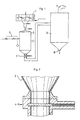
- the impregnated raw material is then introduced into a mixer / preheater as symbolized in 1 in the figure of the drawings.
- the material is heated to a temperature of about 90 ° C by steam inlet at 3 bars; the length of stay of the material is 10 minutes.
- the impregnated, homogenized and preheated is then introduced into a reactor steam cracking 2.
- the first phase of steam cracking consists by pressurizing the reactor with saturated vapor and a rise in temperature of the materials. This phase is short duration (around 1 to 2 minutes) thanks to the use of a boiler with high steam flow.
- the next phase of steam cracking is carried out; she consists of isothermal and isobaric cooking of the materials. Maintaining pressure and temperature is achieved through to a regulation loop 3 which supplies the reactor with steam as the reactor steam gets condenses.
- the last phase is the relaxation phase abrupt and is operated by abruptly opening a gate valve purge 4 with direct passage located at the bottom of the reactor.
- this valve is a knife gate valve which, when open, fully clears the outlet of the reactor and ensures continuity of material flow, without any obstacle.
- pressurized water condensed in the plant is transformed in vapor and releases the energy needed to defibrate the vegetable matter. The material is expelled through the direct flow valve without shear stress notable.
- a cyclone 5 allows to separate and recover the phase aqueous and solid (outlet 6) of the gaseous phase generated during the explosion (exit 7).
- the KAPPA index of examples varied between 62 and 65, the average index being 64.
Landscapes
- Engineering & Computer Science (AREA)
- Mechanical Engineering (AREA)
- Life Sciences & Earth Sciences (AREA)
- Wood Science & Technology (AREA)
- Paper (AREA)
Claims (11)
- Verfahren zur Herstellung von Papierzellstoff, umfassend die folgenden Schritte:Imprägnieren einer Lignozellulose-Primärmasse auf der Basis von ein- oder mehrjährigen Pflanzen oder von Rückständen solcher Pflanzen mit einer wäßrigen Sodalösung, so daß der Gewichtsanteil des Soda in der genannten Lignozellulosemasse im wesentlichen 3,5 bis 10% bezogen auf die Trockenmasse beträgt und das Hydratationsgewichtsverhältnis der genannten Zellulosemasse nach der Imprägnation im wesentlichen wenigstens 40% entspricht,Unterziehen der auf diese Weise imprägnierten Lignozellulosemasse einem Dampfcrackingvorgang, wobei in einem geschlossenen Raum ein Aufbau von Druck und Temperatur der imprägnierten Lignozellulosemasse durch Einführen eines gesättigten Dampfes erzielt wird, wobei die genannten Massen in dem Raum auf dem/der so erreichten Druck und Temperatur kochen gelassen und dann rasch entspannt werden, indem ein Schieberventil geöffnet wird, das mit dem genannten Raum in Verbindung steht und eine freie Passage gewährt, so daß die Masse ohne nennenswerte mechanische Schubkräfte entweichen kann,und Trennen der den Papierzellstoff bildenden Feststofffraktion von der wäßrigen Phase und von wasserlöslichen Produkten.
- Verfahren nach Anspruch 1, bei dem die Lignozellulosemasse vorher zerschnitten wird, um sie in Längenfragmente von im wesentlichen 0,5 bis 15 cm zu zerkleinern.
- Verfahren nach einem der Ansprüche 1 oder 2, bei dem die Imprägnation so erfolgt, daß der Gewichtsanteil des Soda in der Lignozellulosemasse im wesentlichen 5 bis 8% beträgt und sein Hydratationsverhältnis im wesentlichen zwischen 60 und 85% liegt.
- Verfahren nach einem der Ansprüche 1, 2 oder 3, dadurch gekennzeichnet, daß die Imprägnation durch Eintauchen für eine Zeitdauer von 10 bis 30 Minuten in eine wäßrige Sodalösung mit einer Konzentration von im wesentlichen 5 bis 15 g/l mit einem Hydrovolumen erfolgt, das durch das Verhältnis zwischen dem Gewicht der Lösung und dem Trockengewicht der Lignozellulosemasse definiert wird und im wesentlichen zwischen 8 und 20 liegt.
- Verfahren nach einem der Ansprüche 1, 2 oder 3, dadurch gekennzeichnet, daß die Imprägnation durch Pulverisierung auf der Zelluloseprimärmasse einer wäßrigen Sodalösung mit einer Konzentration im wesentlichen zwischen 10 und 25 g/l in einer Menge erfolgt, die geeignet ist, um den obengenannten Gewichtsanteil und das obengenannte Hydratationsverhältnis zu erzielen, wobei die Lignozellulosemasse während der genannten Pulverisierung geknetet wird.
- Verfahren nach einem der Ansprüche 1, 2, 3, 4, 5, dadurch gekennzeichnet, daß die Imprägnation mit einer wäßrigen Sodalösung mit einer Temperatur zwischen 40 und 60°C erfolgt.
- Verfahren nach einem der Ansprüche 1, 2, 3, 4, 5 oder 6, bei dem das Dampfcracken in einem geschlossenen Raum bei einem Aufbau von Druck und Temperatur der imprägnierten Lignozellulosemasse durch Einleiten eines gesättigten Dampfes mit einem Druck im wesentlichen zwischen 12 und 22 Bar (12x105 bis 22x105 Pascal) und mit einer Temperatur im wesentlichen zwischen 140 und 230°C erfolgt, dann nach dem Kochenlassen das Medium entspannt wird, um es innerhalb von weniger als 4 Sekunden durch das Schieberventil im wesentlichen auf atmosphärischen Druck zurückzubringen.
- Verfahren nach Anspruch 7, dadurch gekennzeichnet, daß das Dampfcracken der imprägnierten Lignozellulosemasse, das den Aufbau von Temperatur und Druck, das Kochenlassen und Entspannen beinhaltet, innerhalb eines Zeitraums von im wesentlichen 4 bis 8 Minuten durchgeführt wird.
- Verfahren nach einem der Ansprüche 7 oder 8, dadurch gekennzeichnet, daß die imprägnierte Masse vor dem Dampfcracken vorerhitzt wird, um sie auf eine Temperatur zwischen 60 und 100°C zu bringen, wobei das genannte Vorerhitzen mit einem mechanischen Homogenisierungsvorgang kombiniert wird.
- Verfahren nach einem der Ansprüche 1 bis 9, bei dem als Lignozelluloseprimärmasse Pflanzen, Pflanzenteile oder Pflanzenmischungen der folgenden Gruppe verwendet werden: einjährige Pflanzen, Getreidestroh, mehrjährige Pflanzen, landwirtschaftliche Rückstände.
- Papierzellstoff, hergestellt auf der Basis von einjährigen Pflanzen durch Anwenden eines Verfahrens nach einem der Ansprüche 1 bis 10 unter Vorlage einer Reißlänge im wesentlichen zwischen 5500 m und 9000 m, gekennzeichnet durch:(1) einen KAPPA-Index im wesentlichen zwischen 60 und 65,(2) einen CMT- (Concora Medium Test) Index im wesentlichen zwischen 1, 5 und 2,5 N.m2/g,(3) die folgende Gewichtsverteilung: Zellulose - 55 bis 80%, Hemizellulose - 12 bis 25%, und Lignine - 8 bis 12%.
Applications Claiming Priority (3)
| Application Number | Priority Date | Filing Date | Title |
|---|---|---|---|
| FR9600760A FR2743579B1 (fr) | 1996-01-17 | 1996-01-17 | Procede de fabrication de pate a papier a partir de plantes lignocellulosiques et pate a papier obtenue |
| FR9600760 | 1996-01-17 | ||
| PCT/FR1997/000065 WO1997026401A1 (fr) | 1996-01-17 | 1997-01-15 | Procede de fabrication de pate a papier a partir de plantes lignocellulosiques et pate a papier obtenue |
Publications (2)
| Publication Number | Publication Date |
|---|---|
| EP0874935A1 EP0874935A1 (de) | 1998-11-04 |
| EP0874935B1 true EP0874935B1 (de) | 2000-05-10 |
Family
ID=9488388
Family Applications (1)
| Application Number | Title | Priority Date | Filing Date |
|---|---|---|---|
| EP97900645A Expired - Lifetime EP0874935B1 (de) | 1996-01-17 | 1997-01-15 | Verfahren zur herstellung von papierzellstoff aus lignocellulosischen pflanzen sowie danach hergestellter papierzellstoff |
Country Status (8)
| Country | Link |
|---|---|
| EP (1) | EP0874935B1 (de) |
| CN (1) | CN1077630C (de) |
| AT (1) | ATE192798T1 (de) |
| CA (1) | CA2242232A1 (de) |
| DE (1) | DE69701960T2 (de) |
| ES (1) | ES2146456T3 (de) |
| FR (1) | FR2743579B1 (de) |
| WO (1) | WO1997026401A1 (de) |
Families Citing this family (9)
| Publication number | Priority date | Publication date | Assignee | Title |
|---|---|---|---|---|
| US6365732B1 (en) * | 2000-07-10 | 2002-04-02 | Sweet Beet Incorporated | Process for obtaining stereoisomers from biomass |
| CN101748633B (zh) * | 2008-12-19 | 2012-07-04 | 北京英力生科新材料技术有限公司 | 纤维素提取新工艺 |
| CN105178080A (zh) * | 2015-09-18 | 2015-12-23 | 新疆国力源投资有限公司 | 一种制备胡麻杆本色浆的方法 |
| CN108277670B (zh) * | 2018-03-12 | 2024-03-08 | 北京新锐得环保科技有限公司 | 一种用于沙柳制浆的汽爆制浆系统 |
| DE102019008351A1 (de) * | 2019-12-03 | 2021-06-10 | Klingele Papierwerke Gmbh & Co. Kg | Verfahren und Vorrichtung zur Herstellung von Faserstoff mit einem Zuführsystem und einem Schneckensystem |
| WO2021110188A1 (de) * | 2019-12-03 | 2021-06-10 | Klingele Papierwerke Gmbh & Co. Kg | Verfahren und vorrichtung zur herstellung von faserstoff mit einem zuführsystem und einem schneckensystem |
| CN113829459B (zh) * | 2021-09-23 | 2022-07-22 | 北京科技大学 | 一种人工降解饱水木材的制备方法 |
| CN116084206A (zh) * | 2022-12-29 | 2023-05-09 | 中冶美利云产业投资股份有限公司 | 一种高档黑卡纸的生产工艺 |
| CN116334943A (zh) * | 2023-04-12 | 2023-06-27 | 张志晔 | 物理蒸解法植物纤维提取工艺 |
Family Cites Families (1)
| Publication number | Priority date | Publication date | Assignee | Title |
|---|---|---|---|---|
| CA1230208A (en) * | 1987-03-24 | 1987-12-15 | Bohuslav V. Kokta | Process for preparing pulp for paper making |
-
1996
- 1996-01-17 FR FR9600760A patent/FR2743579B1/fr not_active Expired - Fee Related
-
1997
- 1997-01-15 EP EP97900645A patent/EP0874935B1/de not_active Expired - Lifetime
- 1997-01-15 WO PCT/FR1997/000065 patent/WO1997026401A1/fr not_active Ceased
- 1997-01-15 CA CA002242232A patent/CA2242232A1/fr not_active Abandoned
- 1997-01-15 DE DE69701960T patent/DE69701960T2/de not_active Expired - Fee Related
- 1997-01-15 CN CN97193114A patent/CN1077630C/zh not_active Expired - Fee Related
- 1997-01-15 ES ES97900645T patent/ES2146456T3/es not_active Expired - Lifetime
- 1997-01-15 AT AT97900645T patent/ATE192798T1/de active
Also Published As
| Publication number | Publication date |
|---|---|
| FR2743579A1 (fr) | 1997-07-18 |
| CA2242232A1 (fr) | 1997-07-24 |
| CN1214091A (zh) | 1999-04-14 |
| FR2743579B1 (fr) | 1998-03-06 |
| EP0874935A1 (de) | 1998-11-04 |
| WO1997026401A1 (fr) | 1997-07-24 |
| ATE192798T1 (de) | 2000-05-15 |
| CN1077630C (zh) | 2002-01-09 |
| ES2146456T3 (es) | 2000-08-01 |
| DE69701960D1 (de) | 2000-06-15 |
| DE69701960T2 (de) | 2001-01-25 |
Similar Documents
| Publication | Publication Date | Title |
|---|---|---|
| EP0170530B1 (de) | Verfahren zur Herstellung von Zellulose-Mikrokristallitaggregaten und Glukose aus lignozellulosehaltigen Materialien | |
| CN104582511B (zh) | 用于从烟草生产微晶纤维素的方法和相关的烟草产品 | |
| JP2017526835A (ja) | バイオマスからセルロースを単離するための方法およびそれから得られる産物 | |
| EP0874935B1 (de) | Verfahren zur herstellung von papierzellstoff aus lignocellulosischen pflanzen sowie danach hergestellter papierzellstoff | |
| AU758966B2 (en) | Separating and recovering components from plants | |
| EP0880616B1 (de) | Verwendung von zuckerrübenpulpe in der papier- oder pappeherstellung | |
| AU758967B2 (en) | Accessing leaf and/or stem parts of plants | |
| FR2580669A1 (fr) | Procede de conversion de substrats lignocellulosiques en pentoses | |
| Fauziyah et al. | Isolation and characterization of sugarcane (Saccharum officinarum l.) bagasse cellulose hydrolyzed with acid variation | |
| CA3164391A1 (fr) | Procede d'obtention d'une pulpe cellulosique a base de chanvre, pulpe cellulosique obtenue a partir dudit procede et produit obtenu a partir de ladite pulpe cellulosique | |
| US6986828B2 (en) | Process for producing low DP microcrystalline cellulose | |
| EP2859107B1 (de) | Verfahren zur enzymatischen behandlung von festen lignocellulosematerialien | |
| US20160264875A1 (en) | Continuous lignin conversion process | |
| FR3015529A1 (fr) | Procede de preparation de pate a papier | |
| RU2856643C1 (ru) | Способ получения микрокристаллической целлюлозы | |
| FR2751671A1 (fr) | Procede de fabrication de pate a papier blanchie | |
| EP2365871B1 (de) | Verfahren zur herstellung eines emulgators und verfahren zur herstellung einer emulsion | |
| EP0434564B1 (de) | Verfahren zur Trennung von Faserbestandteilen | |
| RU2153980C1 (ru) | Способ получения плитных материалов из лигноцеллюлозного сырья | |
| CN105980630A (zh) | 用于从生物质中离析纤维素的方法和由该方法提供的产品 | |
| WO2024184474A1 (fr) | Procédé d'obtention d'au moins deux pulpes cellulosiques présentant des caractéristiques différentes | |
| Aguilar R et al. | Productive diversification from sugarcane lignocellulosic byproducts. | |
| CH295086A (fr) | Procédé mécano-chimique pour la fabrication de la pâte à papier. | |
| CN113811649A (zh) | 纤维素材料塑化和粘度受控的纤维素材料 | |
| BE504011A (de) |
Legal Events
| Date | Code | Title | Description |
|---|---|---|---|
| PUAI | Public reference made under article 153(3) epc to a published international application that has entered the european phase |
Free format text: ORIGINAL CODE: 0009012 |
|
| 17P | Request for examination filed |
Effective date: 19980630 |
|
| AK | Designated contracting states |
Kind code of ref document: A1 Designated state(s): AT BE CH DE DK ES FI FR GB GR IE IT LI LU MC NL PT SE |
|
| 17Q | First examination report despatched |
Effective date: 19990211 |
|
| GRAG | Despatch of communication of intention to grant |
Free format text: ORIGINAL CODE: EPIDOS AGRA |
|
| GRAG | Despatch of communication of intention to grant |
Free format text: ORIGINAL CODE: EPIDOS AGRA |
|
| GRAH | Despatch of communication of intention to grant a patent |
Free format text: ORIGINAL CODE: EPIDOS IGRA |
|
| GRAH | Despatch of communication of intention to grant a patent |
Free format text: ORIGINAL CODE: EPIDOS IGRA |
|
| GRAA | (expected) grant |
Free format text: ORIGINAL CODE: 0009210 |
|
| AK | Designated contracting states |
Kind code of ref document: B1 Designated state(s): AT BE CH DE DK ES FI FR GB GR IE IT LI LU MC NL PT SE |
|
| PG25 | Lapsed in a contracting state [announced via postgrant information from national office to epo] |
Ref country code: NL Free format text: LAPSE BECAUSE OF FAILURE TO SUBMIT A TRANSLATION OF THE DESCRIPTION OR TO PAY THE FEE WITHIN THE PRESCRIBED TIME-LIMIT Effective date: 20000510 Ref country code: FI Free format text: LAPSE BECAUSE OF FAILURE TO SUBMIT A TRANSLATION OF THE DESCRIPTION OR TO PAY THE FEE WITHIN THE PRESCRIBED TIME-LIMIT Effective date: 20000510 Ref country code: AT Free format text: LAPSE BECAUSE OF FAILURE TO SUBMIT A TRANSLATION OF THE DESCRIPTION OR TO PAY THE FEE WITHIN THE PRESCRIBED TIME-LIMIT Effective date: 20000510 |
|
| REF | Corresponds to: |
Ref document number: 192798 Country of ref document: AT Date of ref document: 20000515 Kind code of ref document: T |
|
| REG | Reference to a national code |
Ref country code: CH Ref legal event code: EP |
|
| REG | Reference to a national code |
Ref country code: IE Ref legal event code: FG4D Free format text: FRENCH |
|
| REF | Corresponds to: |
Ref document number: 69701960 Country of ref document: DE Date of ref document: 20000615 |
|
| REG | Reference to a national code |
Ref country code: ES Ref legal event code: FG2A Ref document number: 2146456 Country of ref document: ES Kind code of ref document: T3 |
|
| GBT | Gb: translation of ep patent filed (gb section 77(6)(a)/1977) |
Effective date: 20000707 |
|
| ITF | It: translation for a ep patent filed | ||
| PG25 | Lapsed in a contracting state [announced via postgrant information from national office to epo] |
Ref country code: SE Free format text: LAPSE BECAUSE OF FAILURE TO SUBMIT A TRANSLATION OF THE DESCRIPTION OR TO PAY THE FEE WITHIN THE PRESCRIBED TIME-LIMIT Effective date: 20000810 Ref country code: PT Free format text: LAPSE BECAUSE OF FAILURE TO SUBMIT A TRANSLATION OF THE DESCRIPTION OR TO PAY THE FEE WITHIN THE PRESCRIBED TIME-LIMIT Effective date: 20000810 Ref country code: DK Free format text: LAPSE BECAUSE OF FAILURE TO SUBMIT A TRANSLATION OF THE DESCRIPTION OR TO PAY THE FEE WITHIN THE PRESCRIBED TIME-LIMIT Effective date: 20000810 |
|
| PG25 | Lapsed in a contracting state [announced via postgrant information from national office to epo] |
Ref country code: GR Free format text: LAPSE BECAUSE OF FAILURE TO SUBMIT A TRANSLATION OF THE DESCRIPTION OR TO PAY THE FEE WITHIN THE PRESCRIBED TIME-LIMIT Effective date: 20000811 |
|
| NLV1 | Nl: lapsed or annulled due to failure to fulfill the requirements of art. 29p and 29m of the patents act | ||
| PG25 | Lapsed in a contracting state [announced via postgrant information from national office to epo] |
Ref country code: LU Free format text: LAPSE BECAUSE OF NON-PAYMENT OF DUE FEES Effective date: 20010115 |
|
| PG25 | Lapsed in a contracting state [announced via postgrant information from national office to epo] |
Ref country code: MC Free format text: LAPSE BECAUSE OF NON-PAYMENT OF DUE FEES Effective date: 20010131 Ref country code: LI Free format text: LAPSE BECAUSE OF NON-PAYMENT OF DUE FEES Effective date: 20010131 Ref country code: CH Free format text: LAPSE BECAUSE OF NON-PAYMENT OF DUE FEES Effective date: 20010131 Ref country code: BE Free format text: LAPSE BECAUSE OF NON-PAYMENT OF DUE FEES Effective date: 20010131 |
|
| PG25 | Lapsed in a contracting state [announced via postgrant information from national office to epo] |
Ref country code: IE Free format text: LAPSE BECAUSE OF NON-PAYMENT OF DUE FEES Effective date: 20010205 |
|
| REG | Reference to a national code |
Ref country code: IE Ref legal event code: FD4D |
|
| PLBE | No opposition filed within time limit |
Free format text: ORIGINAL CODE: 0009261 |
|
| STAA | Information on the status of an ep patent application or granted ep patent |
Free format text: STATUS: NO OPPOSITION FILED WITHIN TIME LIMIT |
|
| 26N | No opposition filed | ||
| BERE | Be: lapsed |
Owner name: E.MC2 DEVELOPPEMENT Effective date: 20010131 |
|
| REG | Reference to a national code |
Ref country code: CH Ref legal event code: PL |
|
| REG | Reference to a national code |
Ref country code: GB Ref legal event code: IF02 |
|
| PGFP | Annual fee paid to national office [announced via postgrant information from national office to epo] |
Ref country code: ES Payment date: 20021220 Year of fee payment: 7 |
|
| PGFP | Annual fee paid to national office [announced via postgrant information from national office to epo] |
Ref country code: GB Payment date: 20030115 Year of fee payment: 7 |
|
| PGFP | Annual fee paid to national office [announced via postgrant information from national office to epo] |
Ref country code: FR Payment date: 20030124 Year of fee payment: 7 |
|
| PGFP | Annual fee paid to national office [announced via postgrant information from national office to epo] |
Ref country code: DE Payment date: 20030226 Year of fee payment: 7 |
|
| PG25 | Lapsed in a contracting state [announced via postgrant information from national office to epo] |
Ref country code: GB Free format text: LAPSE BECAUSE OF NON-PAYMENT OF DUE FEES Effective date: 20040115 |
|
| PG25 | Lapsed in a contracting state [announced via postgrant information from national office to epo] |
Ref country code: ES Free format text: LAPSE BECAUSE OF NON-PAYMENT OF DUE FEES Effective date: 20040116 |
|
| PG25 | Lapsed in a contracting state [announced via postgrant information from national office to epo] |
Ref country code: DE Free format text: LAPSE BECAUSE OF NON-PAYMENT OF DUE FEES Effective date: 20040803 |
|
| GBPC | Gb: european patent ceased through non-payment of renewal fee |
Effective date: 20040115 |
|
| PG25 | Lapsed in a contracting state [announced via postgrant information from national office to epo] |
Ref country code: FR Free format text: LAPSE BECAUSE OF NON-PAYMENT OF DUE FEES Effective date: 20040930 |
|
| REG | Reference to a national code |
Ref country code: FR Ref legal event code: ST |
|
| PG25 | Lapsed in a contracting state [announced via postgrant information from national office to epo] |
Ref country code: IT Free format text: LAPSE BECAUSE OF NON-PAYMENT OF DUE FEES;WARNING: LAPSES OF ITALIAN PATENTS WITH EFFECTIVE DATE BEFORE 2007 MAY HAVE OCCURRED AT ANY TIME BEFORE 2007. THE CORRECT EFFECTIVE DATE MAY BE DIFFERENT FROM THE ONE RECORDED. Effective date: 20050115 |
|
| REG | Reference to a national code |
Ref country code: ES Ref legal event code: FD2A Effective date: 20040116 |