EP0875264B1 - Stimulateur cardiaque/défibrillateur implantable avec double chambre protégé contre les phénomènes d'écoute croisée atrio-ventriculaire - Google Patents
Stimulateur cardiaque/défibrillateur implantable avec double chambre protégé contre les phénomènes d'écoute croisée atrio-ventriculaire Download PDFInfo
- Publication number
- EP0875264B1 EP0875264B1 EP98401029A EP98401029A EP0875264B1 EP 0875264 B1 EP0875264 B1 EP 0875264B1 EP 98401029 A EP98401029 A EP 98401029A EP 98401029 A EP98401029 A EP 98401029A EP 0875264 B1 EP0875264 B1 EP 0875264B1
- Authority
- EP
- European Patent Office
- Prior art keywords
- cavity
- ctva
- cross
- detection
- stimulation
- Prior art date
- Legal status (The legal status is an assumption and is not a legal conclusion. Google has not performed a legal analysis and makes no representation as to the accuracy of the status listed.)
- Expired - Lifetime
Links
- 238000001514 detection method Methods 0.000 claims description 50
- 230000000638 stimulation Effects 0.000 claims description 41
- 230000002861 ventricular Effects 0.000 claims description 36
- 230000002269 spontaneous effect Effects 0.000 claims description 20
- 238000012790 confirmation Methods 0.000 claims description 18
- 230000001746 atrial effect Effects 0.000 claims description 17
- 230000036279 refractory period Effects 0.000 claims description 14
- 208000000418 Premature Cardiac Complexes Diseases 0.000 claims description 11
- 230000035945 sensitivity Effects 0.000 claims description 7
- 230000000747 cardiac effect Effects 0.000 claims description 6
- 230000028161 membrane depolarization Effects 0.000 claims description 5
- 230000000694 effects Effects 0.000 claims description 4
- 230000008602 contraction Effects 0.000 claims description 3
- 230000004936 stimulating effect Effects 0.000 claims description 2
- 230000004048 modification Effects 0.000 claims 1
- 238000012986 modification Methods 0.000 claims 1
- 238000003745 diagnosis Methods 0.000 description 12
- 238000012360 testing method Methods 0.000 description 12
- 206010003130 Arrhythmia supraventricular Diseases 0.000 description 10
- 208000037265 diseases, disorders, signs and symptoms Diseases 0.000 description 6
- 208000035475 disorder Diseases 0.000 description 6
- 230000008034 disappearance Effects 0.000 description 5
- 210000002837 heart atrium Anatomy 0.000 description 5
- 238000000034 method Methods 0.000 description 5
- 208000001871 Tachycardia Diseases 0.000 description 3
- 238000004458 analytical method Methods 0.000 description 3
- 230000006794 tachycardia Effects 0.000 description 3
- 101150080038 Sur-8 gene Proteins 0.000 description 2
- 208000009729 Ventricular Premature Complexes Diseases 0.000 description 2
- 206010047289 Ventricular extrasystoles Diseases 0.000 description 2
- 230000002159 abnormal effect Effects 0.000 description 2
- 230000003071 parasitic effect Effects 0.000 description 2
- 230000002688 persistence Effects 0.000 description 2
- 238000011084 recovery Methods 0.000 description 2
- 238000011160 research Methods 0.000 description 2
- 230000033764 rhythmic process Effects 0.000 description 2
- 101150114085 soc-2 gene Proteins 0.000 description 2
- 230000001629 suppression Effects 0.000 description 2
- 230000001360 synchronised effect Effects 0.000 description 2
- 238000012795 verification Methods 0.000 description 2
- 206010015856 Extrasystoles Diseases 0.000 description 1
- 230000001133 acceleration Effects 0.000 description 1
- 206010003668 atrial tachycardia Diseases 0.000 description 1
- 206010061592 cardiac fibrillation Diseases 0.000 description 1
- 230000003247 decreasing effect Effects 0.000 description 1
- 230000001627 detrimental effect Effects 0.000 description 1
- 230000009977 dual effect Effects 0.000 description 1
- 230000002600 fibrillogenic effect Effects 0.000 description 1
- 244000045947 parasite Species 0.000 description 1
- 230000000737 periodic effect Effects 0.000 description 1
- 230000002028 premature Effects 0.000 description 1
- 230000002035 prolonged effect Effects 0.000 description 1
- 230000034225 regulation of ventricular cardiomyocyte membrane depolarization Effects 0.000 description 1
- 230000009163 spontaneous depolarization Effects 0.000 description 1
- 238000013112 stability test Methods 0.000 description 1
- 230000001960 triggered effect Effects 0.000 description 1
Images


Classifications
-
- A—HUMAN NECESSITIES
- A61—MEDICAL OR VETERINARY SCIENCE; HYGIENE
- A61N—ELECTROTHERAPY; MAGNETOTHERAPY; RADIATION THERAPY; ULTRASOUND THERAPY
- A61N1/00—Electrotherapy; Circuits therefor
- A61N1/18—Applying electric currents by contact electrodes
- A61N1/32—Applying electric currents by contact electrodes alternating or intermittent currents
- A61N1/36—Applying electric currents by contact electrodes alternating or intermittent currents for stimulation
- A61N1/362—Heart stimulators
- A61N1/3621—Heart stimulators for treating or preventing abnormally high heart rate
- A61N1/3622—Heart stimulators for treating or preventing abnormally high heart rate comprising two or more electrodes co-operating with different heart regions
-
- A—HUMAN NECESSITIES
- A61—MEDICAL OR VETERINARY SCIENCE; HYGIENE
- A61N—ELECTROTHERAPY; MAGNETOTHERAPY; RADIATION THERAPY; ULTRASOUND THERAPY
- A61N1/00—Electrotherapy; Circuits therefor
- A61N1/18—Applying electric currents by contact electrodes
- A61N1/32—Applying electric currents by contact electrodes alternating or intermittent currents
- A61N1/36—Applying electric currents by contact electrodes alternating or intermittent currents for stimulation
- A61N1/362—Heart stimulators
- A61N1/365—Heart stimulators controlled by a physiological parameter, e.g. heart potential
- A61N1/368—Heart stimulators controlled by a physiological parameter, e.g. heart potential comprising more than one electrode co-operating with different heart regions
Definitions
- the invention relates to "active implantable medical devices" as defined by Council Directive 90/385 / EEC of 20 June 1990 of European communities, more specifically stimulating devices cardiac, defibrillators and / or cardioverters with dual chamber stimulation function for the treatment of disorders atrial rhythm.
- This phenomenon occurs when, in the ear cavity, the stimulator detects a signal from depolarization following a anterior ventricular pacing (this cross listening will be designated hereinafter "CTVA” (“Ventriculo-Auricular Cross-Talk”)).
- CTVA anterior ventricular pacing
- the device may misinterpret this signal as resulting from depolarization spontaneous from the atrium, so this phenomenon is of course detrimental to the expected operation of the device.
- TdRA Atrial Rhythm Disorders
- tachycardia a generic term which covers various atrial arrhythmias such as tachycardia, fibrillation, flutter , etc., all disorders characterized, upon detection, by a rapid abnormal atrial rhythm.
- a first solution consists in creating a time interval called "blanking" during which the ear amplifier is completely disconnected from the listening circuit during ventricular pacing (as described for example in US-A-4,825,870 for an amplifier signals detected in the ventricular cavity).
- this blanking period is only triggered during stimulation and has only a short duration; therefore it does not protect against late detection of the depolarization signal.
- EP-A-0 594 957 describes another way of dealing with the problem CTVA. It proposes to analyze the signals collected and, when a signal in the headset is detected at the same time as a signal is present on the ventricular stage, the device deduces from this concomitance that the detected ear signal originates in the ventricle.
- Another solution would be to increase the refractory period Atrial. This solution, easy to implement in most of current stimulators, would have the disadvantage of reducing the window listening. Rapid atrial arrhythmias could then be partially detected, limiting the effectiveness of the algorithms diagnostic.
- EP-A-0 705 620 describes a dynamic window technique to better recognize signals from a tachycardia and distinguish them from those from a CTVA.
- the object of the present invention is to overcome the drawbacks described upper.
- the invention proposes to recognize the phenomenon of CTVA by observing how the stimulation sequences repeat ventricular / atrial detection. A repetition of such sequences will lead to a phase of suspicion of cross-listening, which will trigger itself a verification phase; if the verification is positive, then the device will take the measures to overcome of this phenomenon.
- the invention provides an implantable medical device active, including a pacemaker, defibrillator and / or cardiovertor, provided with a double chamber stimulation function, device comprising means for detecting cardiac events, spontaneous or stimulated, in a first cavity and means stimulation in a second cavity, and means of detection and confirmation of cross listening, to detect in the first cavity a signal from depolarization following previous stimulation of the second cavity, and to distinguish such a signal from a signal resulting from a spontaneous contraction of the first cavity.
- a pacemaker, defibrillator and / or cardiovertor provided with a double chamber stimulation function
- device comprising means for detecting cardiac events, spontaneous or stimulated, in a first cavity and means stimulation in a second cavity, and means of detection and confirmation of cross listening, to detect in the first cavity a signal from depolarization following previous stimulation of the second cavity, and to distinguish such a signal from a signal resulting from a spontaneous contraction of the first cavity.
- the listening detection and confirmation means crossed include means for detecting activity of the type extra-systole of the first cavity occurring between stimulation of the second cavity and a consecutive event, stimulated or spontaneous, in the first cavity.
- the first cavity can in particular be an ear cavity and the second cavity, an associated ventricular cavity.
- the means for detecting and confirming cross-listening include advantageously means for detecting an extra-systole of the first cavity occurring between stimulation of the second cavity and a consecutive event, stimulated or spontaneous, in the first cavity, to determine that the time interval between stimulation of the second cavity and extra-systole of the first cavity is less than a predetermined time, and to detect stability of the time interval between stimulation of the second cavity and extra-systole of the first cavity.
- These last means stability detectors preferably include means for vary the delay between the detection of an event in the first cavity and stimulation of the second cavity, and to detect the absence significant change in the range of these variations of time between stimulation of the second cavity and extra-systole of the first cavity.
- the device can also include suppressor means listening, which increase the refractory period associated with the first cavity in case of detection and confirmation of a cross listening or, alternatively, reduce the sensitivity of the event detection means in the first cavity in case of detection and confirmation of a cross listening.
- It also provides means to detect the end of the phenomenon listening and to restore the parameters to their initial value of the device modified by means of detection and confirmation cross-listening.
- FIGS. 1A and 1B illustrate, on an electrocardiogram plot, the position of the different time periods and refractory periods implemented.
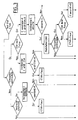
- FIGS 2 and 3 are flowcharts showing the sequence various stages of the process implemented by the invention.
- a CTVA is an over-detection auricular: after ventricular stimulation, under certain conditions, you can detect a signal on the ear electrode that is not in fact that a "residue" of ventricular stimulation. Now this detection occurs just after the Absolute Atrial Refractory Period (PRAA), which it may be desirable to program short in order to optimize listening to the ear in the event of an atrial arrhythmia.
- PRAA Absolute Atrial Refractory Period
- the device In normal operation, the device records the sequence of ventricular events, in particular the ventricular pacing signal, and the sequence of ear events (by "event” we will hear either the signals coming from spontaneous depolarizations, or signals resulting from stimuli applied by the device).
- the device includes means for detecting ESAs (Extra-Systoles Auricular) and ESV (Ventricular Extra-Systoles) like described for example in EP-A-0 676 217 (ELA Médical): a P wave (collection of an activity having its origin in the atrium) is defined as an ESA if the time interval separating this P wave from previous atrial event is less than a fraction of the interval Average PP, i.e. the average interval of the ear frequency calculated on (typically) eight cardiac cycles not including no extra systole.
- ESAs Extra-Systoles Auricular
- ESV Ventricular Extra-Systoles
- the object of the algorithm of the invention is to identify, in the sequence signals, the early P waves resembling ESA.
- ESAs that is to say signals indicative of a TdRA by abnormal acceleration rhythm, or a CTVA, therefore a parasitic signal.
- CTVA abnormal acceleration rhythm
- the pacemaker modulates the DAV to determine if the V-ESA time interval remains stable or varies: in the first case (see Figure 1A), it is a CTVA; in the otherwise (see Figure 1B) it is a TdRA.
- the modulation of the DAV depends on the state in which the stimulator. If the DAV programmed by the device at the instant considered allows, the modulation of the DAV is negative, i.e. the DAV must be decreased. Otherwise, the DAV is increased.
- the stimulator Upon confirmation of a CTVA, the stimulator changes its behavior so that the CTVA cannot be interpreted as resulting from a spontaneous contraction of the atrium.
- a first solution consists in modifying the refractory periods defined by the device by adding a relative refractory period Pctva such as any ear event detected in this window is considered not to be an ESA and is not registered like an ESA.
- This refractory period Pctva is for example equal to the interval [V-ESA] + 31 ms, and must be relative to allow detection and CTVA analysis.
- Figures 2 and 3 which will be considered to be part of this description, give a detailed implementation flowchart of the algorithm which we have just outlined above, Figure 2 corresponding to the detection and confirmation phases of CTVA and Figure 3 in the removal phase.
- the second step is the modulation of the DAV: as soon as the conditions above are met, we perform on the cycle following a modulation of the DAV to verify that the stability of the VP interval does not depend previous ear signal but only stimulation ventricular.
- the modulation will be negative and 31 ms (for example) if the AVD allows, otherwise the modulation will be positive and 31 ms (for example).
- CTVA When the device has detected a CTVA the general operation is the same, in particular, all the algorithms are active. Only refractory periods change. Indeed, we add to previous periods the relative refractory period of CTVA designated Pctva (see figure 1).
- This relative refractory period is only applied after stimulation ventricular. It is no longer applied after detection ventricular, synchronous or not.
- L 1000
- the two output counters Cspontane and C TrustESA are reset to zero as soon as the phenomenon of CTVA reappears, that is to say a stimulation followed by atrial detection in Pctva.
Landscapes
- Health & Medical Sciences (AREA)
- Cardiology (AREA)
- Heart & Thoracic Surgery (AREA)
- Life Sciences & Earth Sciences (AREA)
- Animal Behavior & Ethology (AREA)
- Nuclear Medicine, Radiotherapy & Molecular Imaging (AREA)
- Radiology & Medical Imaging (AREA)
- Biomedical Technology (AREA)
- Engineering & Computer Science (AREA)
- General Health & Medical Sciences (AREA)
- Public Health (AREA)
- Veterinary Medicine (AREA)
- Biophysics (AREA)
- Physiology (AREA)
- Electrotherapy Devices (AREA)
- Measurement And Recording Of Electrical Phenomena And Electrical Characteristics Of The Living Body (AREA)
Description
- en diagnostiquant la survenance du CTVA et en opérant une différenciation entre CTVA et TdRA (Trouble du Rythme Auriculaire), et
- en maintenant dans la mesure du possible une détection optimale des arythmies auriculaires en évitant d'appliquer une période réfractaire auriculaire longue en l'absence de CTVA.
- soit par disparition spontanée du CTVA,
- soit par test à intervalle régulier de l'existence du CTVA pour savoir si celui-ci est toujours présent,
- soit par retour à une activité V spontanée.
- "CTVA" : Variable binaire, indiquant la présence ou l'absence de Cross-talk VA.
- "Pctva" : Période réfractaire de recouvrement du CTVA, typiquement Pctva = [V-ESA] + 31 ms.
- "Cstabilité" : Compteur permettant de tester la stabilité de la détection du CTVA sur 8 cycles ; ce compteur sert uniquement à compter huit cycles consécutifs comportant une stimulation ventriculaire suivie d'une détection auriculaire réfractaire (ESA).
- "Csécurité" : Compteur de sécurité, permettant après le diagnostic d'un CTVA de tester périodiquement la persistance du phénomène ; donc, tous les 'Csécurité' cycles ventriculaires, on module à nouveau le DAV afin de voir si le phénomène est toujours présent.
- "Cspontané" : Compteur de sortie par réapparition du rythme spontané : au bout de 'Cspontané' cycles ventriculaires spontanés, on sort de l'algorithme ; en effet il n'y a plus de CTVA si le ventricule n'est plus stimulé.
- "CarrêtESA" : Compteur de sortie par disparition du CTVA : au bout de 'CarrêtESA' cycles ventriculaires stimulés sans CTVA détecté en Pctva, on sort de l'algorithme car le phénomène a disparu de façon prolongée.
- "Stimulation V et détection d'une ESA" : Cycle avec une stimulation ventriculaire et détection d'un événement auriculaire en période réfractaire relative (donc d'une ESA).
- "Test stabilité sur 8 cycles" : Sur les huit cycles on a eu à chaque cycle une stimulation ventriculaire suivie d'un détection auriculaire en période réfractaire (donc d'une ESA). Avec ce test, on veut voir si le délai entre la stimulation ventriculaire et la détection auriculaire est stable sur les huit cycles.
- "Modulation du DAV" : Pour confirmer le CTVA. on veut vérifier que la stabilité du délai entre la stimulation ventriculaire et détection auriculaire dépend uniquement de la stimulation ventriculaire et non de l'événement auriculaire précédent. Pour cela, on module le DAV afin de changer le délai entre l'événement auriculaire précédent et la détection ventriculaire.
- "Maintien de la stabilité" : Après la modulation, on regarde si le délai entre la stimulation ventriculaire et la détection auriculaire est toujours identique.
- des stimulations ventriculaires à chaque cycle,
- une ESA et une seule à chaque cycle,
- un intervalle [V-ESA] stable, typiquement à 16 ms près sur les huit cycles.
- si une détection ventriculaire survient suite à la modulation :
- s'il y a une ESA après cet événement ventriculaire, alors le diagnostic de CTVA est négatif (c'est probablement un TdRA).
- s'il n'y a pas d'ESA alors l'étape de modulation du DAV est réitérée au prochain cycle car aucune décision ne peut être prise.
- dans le cas d'une détection ventriculaire asynchrone au cours du cycle où l'on aurait dû moduler, alors la modulation est reportée au cycle suivant et l'analyse se poursuit normalement.
- si, suite à la modulation, le ventricule est stimulé et l'intervalle [V-ESA] est identique à l'intervalle calculé sur les 8 cycles (à 16 ms près), alors le diagnostic de CTVA est positif.
- si, suite à la modulation, le ventricule est stimulé et l'intervalle [V-ESA] est différent de celui mesuré sur les 8 cycles précédents (à 16 ms près) alors le diagnostic de CTVA est négatif et la recherche de CTVA est interdite pendant 100 cycles.
- on calcule la valeur d'une fenêtre de recouvrement du CTVA : Pctva = [V-ESA] + 31 ms, on initialise un compteur Csécurité permettant de contrôler régulièrement si le diagnostic de CTVA est toujours vérifié.
- on initialise un compteur CarrêtESA qui conditionnera la sortie du diagnostic de CTVA en cas de disparition des détections en Pctva.
- on initialise un compteur Cspontané permettant de conditionner la sortie du diagnostic de CTVA en cas d'apparition d'une conduction spontanée.
Claims (8)
- Un dispositif médical implantable actif, notamment un stimulateur cardiaque, défibrillateur et/ou cardioverteur, pourvu d'une fonction de stimulation double chambre, ce dispositif comportant des moyens de détection d'événements cardiaques, spontanés ou stimulés, dans une première cavité et des moyens de stimulation dans une seconde cavité, ainsi que des moyens de détection et de confirmation d'écoute croisée, pour détecter dans la première cavité un signal issu d'une dépolarisation consécutive à une stimulation antérieure de la seconde cavité, et pour distinguer un tel signal d'un signal résultant d'une activité spontanée de la première cavité,
dispositif caractérisé en ce que les moyens de détection et de confirmation d'écoute croisée comprennent des moyens pour détecter une activité de type extra-systole de la première cavité survenant entre une stimulation de la seconde cavité et un événement consécutif, stimulé ou spontané, dans la première cavité. - Le dispositif de la revendication 1, dans lequel la première cavité est une cavité auriculaire et la seconde cavité est une cavité ventriculaire associée.
- Le dispositif de la revendication 1, dans lequel les moyens de détection et de confirmation d'écoute croisée comprennent des moyens pour déterminer que l'intervalle de temps compris entre la stimulation de la seconde cavité et l'extra-systole de la première cavité est inférieur à une durée prédéterminée.
- Le dispositif de la revendication 1, dans lequel les moyens de détection et de confirmation d'écoute croisée comprennent des moyens pour détecter la stabilité de l'intervalle de temps compris entre la stimulation de la seconde cavité et l'extra-systole de la première cavité.
- Le dispositif de la revendication 4, dans lequel les moyens détecteurs de stabilité comprennent des moyens pour faire varier le délai (DAV) entre la détection d'un événement dans la première cavité et la stimulation de la seconde cavité, et pour détecter l'absence de modification significative, à l'égard de ces variations, de l'intervalle de temps ([V-ESA]) compris entre la stimulation de la seconde cavité et l'extra-systole de la première cavité.
- Le dispositif de la revendication 1, comprenant en outre des moyens suppresseurs d'écoute croisée, pour accroítre (Pctva) la période réfractaire (PRAA) associée à la première cavité en cas de détection et de confirmation d'une écoute croisée.
- Le dispositif de la revendication 1, comprenant en outre des moyens suppresseurs d'écoute croisée, qui accroissent la sensibilité des moyens de détection d'événements cardiaques dans la première cavité en cas de détection et de confirmation d'une écoute croisée.
- Le dispositif de la revendication 1, comprenant en outre des moyens pour détecter la fin du phénomène d'écoute croisée et pour restaurer à leur valeur initiale les paramètres du dispositif modifiés par les moyens de détection et de confirmation d'écoute croisée.
Applications Claiming Priority (2)
| Application Number | Priority Date | Filing Date | Title |
|---|---|---|---|
| FR9705286A FR2762518B1 (fr) | 1997-04-29 | 1997-04-29 | Dispositif medical implantable actif, notamment stimulateur cardiaque, defibrillateur et/ou cardioverteur, pourvu d'une fonction de stimulation double chambre et protege contre les phenomenes d'ecoute croisee atrio-ventriculaire |
| FR9705286 | 1997-04-29 |
Publications (2)
| Publication Number | Publication Date |
|---|---|
| EP0875264A1 EP0875264A1 (fr) | 1998-11-04 |
| EP0875264B1 true EP0875264B1 (fr) | 2003-12-17 |
Family
ID=9506424
Family Applications (1)
| Application Number | Title | Priority Date | Filing Date |
|---|---|---|---|
| EP98401029A Expired - Lifetime EP0875264B1 (fr) | 1997-04-29 | 1998-04-28 | Stimulateur cardiaque/défibrillateur implantable avec double chambre protégé contre les phénomènes d'écoute croisée atrio-ventriculaire |
Country Status (5)
| Country | Link |
|---|---|
| US (1) | US5978708A (fr) |
| EP (1) | EP0875264B1 (fr) |
| JP (1) | JPH1170173A (fr) |
| DE (1) | DE69820521T2 (fr) |
| FR (1) | FR2762518B1 (fr) |
Families Citing this family (6)
| Publication number | Priority date | Publication date | Assignee | Title |
|---|---|---|---|---|
| FR2809630B1 (fr) * | 2000-06-05 | 2003-01-24 | Ela Medical Sa | Dispositif medical implantable actif tel que stimulateur cardiaque, defibrillateur, cardioverteur et/ou dispositif multisite a detection perfectionnee des extrasystoles auriculaires tardives |
| US7245966B2 (en) * | 2000-12-21 | 2007-07-17 | Medtronic, Inc. | Ventricular event filtering for an implantable medical device |
| DE10132228C1 (de) * | 2001-06-29 | 2003-04-03 | Karl Stangl | Herzschrittmacher mit periodischer Modulation einzelner Stimulationsintervalle |
| US7813798B2 (en) * | 2002-02-14 | 2010-10-12 | Pacesetter, Inc. | Systems and methods for preventing, detecting, and terminating pacemaker mediated tachycardia in biventricular implantable cardiac stimulation systems |
| SE0301743D0 (sv) * | 2003-06-12 | 2003-06-12 | St Jude Medical | A heart stimulating device, a system including such a device and use of the system |
| FR2886859A1 (fr) * | 2005-06-09 | 2006-12-15 | Ela Medical Soc Par Actions Si | Dispositif medical implantable actif aai/ddd, notamment stimulateur cardiaque, a gestion perfectionnee des commutations de mode en presence d'evenements ventriculaires de nature incertaine |
Family Cites Families (10)
| Publication number | Priority date | Publication date | Assignee | Title |
|---|---|---|---|---|
| FR2544988B1 (fr) | 1983-04-29 | 1986-10-10 | Ela Medical Sa | Stimulateur cardiaque auriculo-ventriculaire |
| US4825870A (en) | 1987-06-19 | 1989-05-02 | Siemens-Pacesetter, Inc. | Pacemaker having crosstalk protection feature |
| US4967746A (en) * | 1989-10-23 | 1990-11-06 | Intermedics, Inc. | Dual chamber pacemaker with adjustable blanking and V-A extension |
| FR2668372B1 (fr) * | 1990-10-24 | 1993-02-12 | Ela Medical Sa | Procede de detection et de controle des tachycardies induites par conduction retrograde, d'un cóoeur controle par un stimulateur cardiaque. |
| FR2669828B1 (fr) * | 1990-11-30 | 1993-02-12 | Ela Medical Sa | Procede de commande d'un stimulateur cardiaque double chambre. |
| US5247929A (en) * | 1992-02-04 | 1993-09-28 | Vitatron Medical, B.V. | Dual chamber pacemaker with AV extension and PMT control |
| SE9200907D0 (sv) * | 1992-03-24 | 1992-03-24 | Siemens Elema Ab | Dubbelkammarpacemaker |
| SE9203171D0 (sv) | 1992-10-28 | 1992-10-28 | Siemens Elema Ab | Anordning foer identifiering av atriell depolarisation |
| US5549647A (en) * | 1994-10-04 | 1996-08-27 | Vitatron Medical, B.V. | Pacemaker with improved far field R wave sensing and suppression |
| US5782881A (en) * | 1996-09-20 | 1998-07-21 | Lu; Richard | Pacemaker with safety pacing |
-
1997
- 1997-04-29 FR FR9705286A patent/FR2762518B1/fr not_active Expired - Fee Related
-
1998
- 1998-04-28 US US09/067,812 patent/US5978708A/en not_active Expired - Lifetime
- 1998-04-28 EP EP98401029A patent/EP0875264B1/fr not_active Expired - Lifetime
- 1998-04-28 DE DE69820521T patent/DE69820521T2/de not_active Expired - Lifetime
- 1998-04-29 JP JP10136085A patent/JPH1170173A/ja active Pending
Also Published As
| Publication number | Publication date |
|---|---|
| JPH1170173A (ja) | 1999-03-16 |
| FR2762518A1 (fr) | 1998-10-30 |
| US5978708A (en) | 1999-11-02 |
| EP0875264A1 (fr) | 1998-11-04 |
| DE69820521D1 (de) | 2004-01-29 |
| FR2762518B1 (fr) | 1999-07-02 |
| DE69820521T2 (de) | 2004-09-23 |
Similar Documents
| Publication | Publication Date | Title |
|---|---|---|
| EP1857142B1 (fr) | Dispositif médical implantable actif de stimulation cardiaque, resynchronisation, cardioversion et/ou défibrillation, comportant des moyens de détection d'artefacts de bruit ventriculaire | |
| FR2749765A1 (fr) | Dispositif medical actif du type defibrillateur/cardioverteur implantable a discrimination perfectionnee des tachycardies | |
| EP0550343A1 (fr) | Procédé et système d'analyse de l'activité cardiaque pour dispositif implantable de traitement des tachycardies | |
| EP2324885B1 (fr) | Dispositif médical actif comprenant des moyens de test de capture par analyse du vectogramme cardiaque | |
| EP0770412A1 (fr) | Dispositif médical du type défibrillateur/cardioverteur implantable actif à défibrillation de l'oreillette | |
| EP0676216A1 (fr) | Procédé de commande d'un stimulateur cardiaque auriculaire double du type triple chambre | |
| EP2368493B1 (fr) | Dispositif médical actif comprenant des moyens de détection et de filtrage d'artefacts par analyse du vectogramme cardiaque | |
| EP1208873B1 (fr) | Dispositif médical actif du type défibrillateur/cardioverteur implantable à discrimination perfectionnée des fibrillations auriculaires | |
| EP1308183B1 (fr) | Dispositif médical implantable actif pour le traitement des troubles du rythme cardiaque, comprenant des moyens perfectionnés de détection des arythmies auriculaires | |
| EP0875264B1 (fr) | Stimulateur cardiaque/défibrillateur implantable avec double chambre protégé contre les phénomènes d'écoute croisée atrio-ventriculaire | |
| EP1205214A1 (fr) | Dispositif médical actif implantable, notamment stimulateur cardiaque, défibrillateur, cardioverteur ou dispositif multisite, comprenant des moyens de détection d'un risque de situation de fusion | |
| EP3402397B1 (fr) | Dispositif medical implantable actif de defibrillation, comprenant des moyens de discrimination entre bruit externe et rupture de sonde ainsi que des moyens de caracterisation des tachyarythmies | |
| EP1161965B1 (fr) | Dispositif médical implantable actif tel que stimulateur cardiaque, défibrillateur, cardioverteur et/ou dispositif multisite à détection perfectionnée des extrasystoles auriculaires tardives | |
| EP2596832B1 (fr) | Dispositif médical de type défibrillateur/cardioverteur implantable avec seuil de détection ventriculaire ajustable dynamiquement | |
| EP1731195B1 (fr) | Dispositif médical implantable actif AAI/DDD, notamment stimulateur cardiaque, à gestion perfectionnée des commutations de mode en présence d'évènements ventriculaires de nature incertaine | |
| EP0884065B1 (fr) | Dispositif et procédé pour la détermination d'un critère de présence fréquente ou de gravité d'extra-systole (auriculaire ou ventriculaire) | |
| EP1470836B1 (fr) | Dispositif médical implantable actif tel que stimulateur cardiaque, défibrillateur et/ou cardioverteur de type AAI ou AAI/DDD | |
| FR2901147A1 (fr) | Dispositif medical implantable actif de stimulation cardiaque, resynchronisation, cardioversion et/ou defibrillation, comportant des moyens de detection de fracture de sonde | |
| EP1050320B1 (fr) | Dispositif médical implantable actif, notamment stimulateur cardiaque, défibrillateur et/ou cardioverteur de type DDD/AAI à fonctionnement optimisé à l'effort | |
| EP1433497A1 (fr) | Dispositif médical implantable actif à détection des potentiels cardiaques évoqués post-stimulation, notamment auriculaires | |
| EP1731194B1 (fr) | Dispositif médical implantable actif tel que stimulateur cardiaque, cardioverteur et/ou défibrillateur de type AAI ou AAI/DDD à détection des tachycardies ventriculaires | |
| EP0908196B1 (fr) | Stimulateur / défibrillateur cardiaque , comprenant des moyens de détection et de détermination de l'instant des dépolarisations spontanées du myocarde | |
| FR2817759A1 (fr) | Dispositif medical actif implantable, notamment stimulateur cardiaque, defibrillateur ou cardioverteur, a detection des situations de fusions | |
| EP1743675A1 (fr) | Dispositif medical implantable actif de type prothèse cardiaque comprenant des moyens perfectionnes de discrimination entre stimulations auriculaires efficaces et non efficaces |
Legal Events
| Date | Code | Title | Description |
|---|---|---|---|
| PUAI | Public reference made under article 153(3) epc to a published international application that has entered the european phase |
Free format text: ORIGINAL CODE: 0009012 |
|
| AK | Designated contracting states |
Kind code of ref document: A1 Designated state(s): BE CH DE DK ES FR GB IT LI NL SE |
|
| AX | Request for extension of the european patent |
Free format text: AL;LT;LV;MK;RO;SI |
|
| 17P | Request for examination filed |
Effective date: 19990408 |
|
| AKX | Designation fees paid |
Free format text: BE CH DE DK ES FR GB IT LI NL SE |
|
| GRAP | Despatch of communication of intention to grant a patent |
Free format text: ORIGINAL CODE: EPIDOSNIGR1 |
|
| GRAS | Grant fee paid |
Free format text: ORIGINAL CODE: EPIDOSNIGR3 |
|
| GRAA | (expected) grant |
Free format text: ORIGINAL CODE: 0009210 |
|
| AK | Designated contracting states |
Kind code of ref document: B1 Designated state(s): BE CH DE DK ES FR GB IT LI NL SE |
|
| PG25 | Lapsed in a contracting state [announced via postgrant information from national office to epo] |
Ref country code: NL Free format text: LAPSE BECAUSE OF FAILURE TO SUBMIT A TRANSLATION OF THE DESCRIPTION OR TO PAY THE FEE WITHIN THE PRESCRIBED TIME-LIMIT Effective date: 20031217 |
|
| REG | Reference to a national code |
Ref country code: GB Ref legal event code: FG4D Free format text: NOT ENGLISH |
|
| REG | Reference to a national code |
Ref country code: CH Ref legal event code: EP |
|
| REF | Corresponds to: |
Ref document number: 69820521 Country of ref document: DE Date of ref document: 20040129 Kind code of ref document: P |
|
| REG | Reference to a national code |
Ref country code: CH Ref legal event code: NV Representative=s name: M. ZARDI & CO. SA |
|
| PG25 | Lapsed in a contracting state [announced via postgrant information from national office to epo] |
Ref country code: DK Free format text: LAPSE BECAUSE OF FAILURE TO SUBMIT A TRANSLATION OF THE DESCRIPTION OR TO PAY THE FEE WITHIN THE PRESCRIBED TIME-LIMIT Effective date: 20040317 |
|
| PG25 | Lapsed in a contracting state [announced via postgrant information from national office to epo] |
Ref country code: ES Free format text: LAPSE BECAUSE OF FAILURE TO SUBMIT A TRANSLATION OF THE DESCRIPTION OR TO PAY THE FEE WITHIN THE PRESCRIBED TIME-LIMIT Effective date: 20040328 |
|
| REG | Reference to a national code |
Ref country code: SE Ref legal event code: TRGR |
|
| GBT | Gb: translation of ep patent filed (gb section 77(6)(a)/1977) |
Effective date: 20040316 |
|
| PG25 | Lapsed in a contracting state [announced via postgrant information from national office to epo] |
Ref country code: BE Free format text: LAPSE BECAUSE OF NON-PAYMENT OF DUE FEES Effective date: 20040430 |
|
| NLV1 | Nl: lapsed or annulled due to failure to fulfill the requirements of art. 29p and 29m of the patents act | ||
| PLBE | No opposition filed within time limit |
Free format text: ORIGINAL CODE: 0009261 |
|
| STAA | Information on the status of an ep patent application or granted ep patent |
Free format text: STATUS: NO OPPOSITION FILED WITHIN TIME LIMIT |
|
| BERE | Be: lapsed |
Owner name: S.A. *ELA MEDICAL Effective date: 20040430 |
|
| 26N | No opposition filed |
Effective date: 20040920 |
|
| PGFP | Annual fee paid to national office [announced via postgrant information from national office to epo] |
Ref country code: CH Payment date: 20120412 Year of fee payment: 15 |
|
| PGFP | Annual fee paid to national office [announced via postgrant information from national office to epo] |
Ref country code: SE Payment date: 20120411 Year of fee payment: 15 |
|
| REG | Reference to a national code |
Ref country code: CH Ref legal event code: PL |
|
| REG | Reference to a national code |
Ref country code: SE Ref legal event code: EUG |
|
| PG25 | Lapsed in a contracting state [announced via postgrant information from national office to epo] |
Ref country code: SE Free format text: LAPSE BECAUSE OF NON-PAYMENT OF DUE FEES Effective date: 20130429 Ref country code: CH Free format text: LAPSE BECAUSE OF NON-PAYMENT OF DUE FEES Effective date: 20130430 Ref country code: LI Free format text: LAPSE BECAUSE OF NON-PAYMENT OF DUE FEES Effective date: 20130430 |
|
| PGFP | Annual fee paid to national office [announced via postgrant information from national office to epo] |
Ref country code: GB Payment date: 20150422 Year of fee payment: 18 Ref country code: DE Payment date: 20150422 Year of fee payment: 18 |
|
| PGFP | Annual fee paid to national office [announced via postgrant information from national office to epo] |
Ref country code: IT Payment date: 20150420 Year of fee payment: 18 |
|
| REG | Reference to a national code |
Ref country code: FR Ref legal event code: PLFP Year of fee payment: 19 |
|
| REG | Reference to a national code |
Ref country code: DE Ref legal event code: R119 Ref document number: 69820521 Country of ref document: DE |
|
| GBPC | Gb: european patent ceased through non-payment of renewal fee |
Effective date: 20160428 |
|
| PG25 | Lapsed in a contracting state [announced via postgrant information from national office to epo] |
Ref country code: GB Free format text: LAPSE BECAUSE OF NON-PAYMENT OF DUE FEES Effective date: 20160428 Ref country code: DE Free format text: LAPSE BECAUSE OF NON-PAYMENT OF DUE FEES Effective date: 20161101 |
|
| PG25 | Lapsed in a contracting state [announced via postgrant information from national office to epo] |
Ref country code: IT Free format text: LAPSE BECAUSE OF NON-PAYMENT OF DUE FEES Effective date: 20160428 |
|
| REG | Reference to a national code |
Ref country code: FR Ref legal event code: PLFP Year of fee payment: 20 |
|
| PGFP | Annual fee paid to national office [announced via postgrant information from national office to epo] |
Ref country code: FR Payment date: 20170313 Year of fee payment: 20 |