EP0875495A1 - Nouveaux dérivés de l'acide salicylique et leur utilisation dans une composition cosmétique et/ou dermatologique - Google Patents
Nouveaux dérivés de l'acide salicylique et leur utilisation dans une composition cosmétique et/ou dermatologique Download PDFInfo
- Publication number
- EP0875495A1 EP0875495A1 EP98400946A EP98400946A EP0875495A1 EP 0875495 A1 EP0875495 A1 EP 0875495A1 EP 98400946 A EP98400946 A EP 98400946A EP 98400946 A EP98400946 A EP 98400946A EP 0875495 A1 EP0875495 A1 EP 0875495A1
- Authority
- EP
- European Patent Office
- Prior art keywords
- skin
- derivative according
- cosmetic
- composition
- derivative
- Prior art date
- Legal status (The legal status is an assumption and is not a legal conclusion. Google has not performed a legal analysis and makes no representation as to the accuracy of the status listed.)
- Granted
Links
Images

Classifications
-
- A—HUMAN NECESSITIES
- A61—MEDICAL OR VETERINARY SCIENCE; HYGIENE
- A61Q—SPECIFIC USE OF COSMETICS OR SIMILAR TOILETRY PREPARATIONS
- A61Q19/00—Preparations for care of the skin
- A61Q19/08—Anti-ageing preparations
-
- A—HUMAN NECESSITIES
- A61—MEDICAL OR VETERINARY SCIENCE; HYGIENE
- A61K—PREPARATIONS FOR MEDICAL, DENTAL OR TOILETRY PURPOSES
- A61K8/00—Cosmetics or similar toiletry preparations
- A61K8/18—Cosmetics or similar toiletry preparations characterised by the composition
- A61K8/30—Cosmetics or similar toiletry preparations characterised by the composition containing organic compounds
- A61K8/33—Cosmetics or similar toiletry preparations characterised by the composition containing organic compounds containing oxygen
- A61K8/37—Esters of carboxylic acids
-
- A—HUMAN NECESSITIES
- A61—MEDICAL OR VETERINARY SCIENCE; HYGIENE
- A61P—SPECIFIC THERAPEUTIC ACTIVITY OF CHEMICAL COMPOUNDS OR MEDICINAL PREPARATIONS
- A61P17/00—Drugs for dermatological disorders
-
- A—HUMAN NECESSITIES
- A61—MEDICAL OR VETERINARY SCIENCE; HYGIENE
- A61P—SPECIFIC THERAPEUTIC ACTIVITY OF CHEMICAL COMPOUNDS OR MEDICINAL PREPARATIONS
- A61P17/00—Drugs for dermatological disorders
- A61P17/10—Anti-acne agents
-
- A—HUMAN NECESSITIES
- A61—MEDICAL OR VETERINARY SCIENCE; HYGIENE
- A61Q—SPECIFIC USE OF COSMETICS OR SIMILAR TOILETRY PREPARATIONS
- A61Q19/00—Preparations for care of the skin
-
- C—CHEMISTRY; METALLURGY
- C07—ORGANIC CHEMISTRY
- C07C—ACYCLIC OR CARBOCYCLIC COMPOUNDS
- C07C65/00—Compounds having carboxyl groups bound to carbon atoms of six—membered aromatic rings and containing any of the groups OH, O—metal, —CHO, keto, ether, groups, groups, or groups
- C07C65/01—Compounds having carboxyl groups bound to carbon atoms of six—membered aromatic rings and containing any of the groups OH, O—metal, —CHO, keto, ether, groups, groups, or groups containing hydroxy or O-metal groups
- C07C65/03—Compounds having carboxyl groups bound to carbon atoms of six—membered aromatic rings and containing any of the groups OH, O—metal, —CHO, keto, ether, groups, groups, or groups containing hydroxy or O-metal groups monocyclic and having all hydroxy or O-metal groups bound to the ring
- C07C65/05—Compounds having carboxyl groups bound to carbon atoms of six—membered aromatic rings and containing any of the groups OH, O—metal, —CHO, keto, ether, groups, groups, or groups containing hydroxy or O-metal groups monocyclic and having all hydroxy or O-metal groups bound to the ring o-Hydroxy carboxylic acids
-
- C—CHEMISTRY; METALLURGY
- C07—ORGANIC CHEMISTRY
- C07C—ACYCLIC OR CARBOCYCLIC COMPOUNDS
- C07C65/00—Compounds having carboxyl groups bound to carbon atoms of six—membered aromatic rings and containing any of the groups OH, O—metal, —CHO, keto, ether, groups, groups, or groups
- C07C65/01—Compounds having carboxyl groups bound to carbon atoms of six—membered aromatic rings and containing any of the groups OH, O—metal, —CHO, keto, ether, groups, groups, or groups containing hydroxy or O-metal groups
- C07C65/03—Compounds having carboxyl groups bound to carbon atoms of six—membered aromatic rings and containing any of the groups OH, O—metal, —CHO, keto, ether, groups, groups, or groups containing hydroxy or O-metal groups monocyclic and having all hydroxy or O-metal groups bound to the ring
- C07C65/05—Compounds having carboxyl groups bound to carbon atoms of six—membered aromatic rings and containing any of the groups OH, O—metal, —CHO, keto, ether, groups, groups, or groups containing hydroxy or O-metal groups monocyclic and having all hydroxy or O-metal groups bound to the ring o-Hydroxy carboxylic acids
- C07C65/10—Salicylic acid
-
- C—CHEMISTRY; METALLURGY
- C07—ORGANIC CHEMISTRY
- C07C—ACYCLIC OR CARBOCYCLIC COMPOUNDS
- C07C65/00—Compounds having carboxyl groups bound to carbon atoms of six—membered aromatic rings and containing any of the groups OH, O—metal, —CHO, keto, ether, groups, groups, or groups
- C07C65/32—Compounds having carboxyl groups bound to carbon atoms of six—membered aromatic rings and containing any of the groups OH, O—metal, —CHO, keto, ether, groups, groups, or groups containing keto groups
- C07C65/40—Compounds having carboxyl groups bound to carbon atoms of six—membered aromatic rings and containing any of the groups OH, O—metal, —CHO, keto, ether, groups, groups, or groups containing keto groups containing singly bound oxygen-containing groups
-
- A—HUMAN NECESSITIES
- A61—MEDICAL OR VETERINARY SCIENCE; HYGIENE
- A61K—PREPARATIONS FOR MEDICAL, DENTAL OR TOILETRY PURPOSES
- A61K2800/00—Properties of cosmetic compositions or active ingredients thereof or formulation aids used therein and process related aspects
- A61K2800/20—Chemical, physico-chemical or functional or structural properties of the composition as a whole
- A61K2800/28—Rubbing or scrubbing compositions; Peeling or abrasive compositions; Containing exfoliants
Definitions
- the present invention relates to new derivatives of salicylic acid, to their preparation process and their use in the cosmetic and / or dermatological. These derivatives can also be used in the pharmaceutical field or veterinarian. More specifically, these derivatives are used as exfoliating agents, especially in a composition intended for caring for and / or making up the skin, mucous membranes and / or keratin fibers of human beings, in particular for combating the signs of skin aging and / or to improve the radiance of the complexion and / or to smooth the facial and / or body skin and / or to treat wrinkles and fine lines on the skin and / or to stimulate the epidermal renewal process and / or to treat acne and / or skin disorders.
- Salicylic acid derivatives are of great interest, given their effects biological on the skin, especially on the main clinical signs of aging skin that are fine lines and wrinkles, disorganization of the "grain" of the skin, change in skin tone and loss of firmness and tone of the skin.
- the use of these derivatives poses a problem insofar as they can cause tingling, itching, tightness after application, which can lead to significant discomfort.
- the use of these compounds for Users with sensitive skin is therefore often unacceptable.
- WO-A-96/19184, WO-A-96/19182 and WO-A-96/19228 describe the use of divalent salts of strontium, manganese, magnesium and calcium, soluble in water to reduce the irritation of compounds having an irritant effect, in particular exfoliators such as hydroxy acids.
- exfoliators such as hydroxy acids.
- the irritant active ingredient remains in the composition in acid form.
- the salicylic acid derivatives are chosen from the salts of the n-octanoyl-5-salicylic acids, n-decanoyl-5-salicylic, n-dodecanoyl-5-salicylic.
- the divalent inorganic cations are in particular those of the elements of the columns IB, IIA, IIB, IIIB, IIIA, IVB, VB, VIB, VIIB, VIII of the periodic table (CAS version).
- the preferred divalent cations are those of columns IB, IIA, IIB, VIIB, VIII and again better those of columns IIA, IIB and VIIB of the periodic table and in particular those of strontium, calcium, magnesium, barium and manganese.
- the preferred derivatives according to the invention are the strontium salt of 5-octanoylsalicylic acid, the calcium salt of 5-octanoyl-salicylic acid, the magnesium salt of 5-octanoyl-salicylic acid.
- solvents it is possible to use alcohols having from 1 to 12 carbon atoms, and for example isopropanol and butanol, hydrocarbons such as hexane and heptane, ketones such as methyl ethyl ketone, water and more generally, everything compound capable of solvating the acid and the compound comprising the inorganic cation, like ethers and amines ..
- the compound comprising the inorganic cation can be chosen from carbonates, bicarbonates, sulfates, glycerophosphates, borates, chlorides, nitrates, acetates, hydroxides, persulfates, ⁇ -hydroxy acid salts (citrates, tartrates, lactates, malates) or fruit acids, the amino acid salts (aspartate, arginate, glycocholate, fumarate), fatty acid salts (palmitate, oleate, caseinate, behenate) and any other compound capable of releasing a divalent cation.
- carbonate or hydroxide we uses carbonate or hydroxide.
- the subject of the invention is also a composition comprising at least one salified derivative such as defined above.
- This composition is in particular a topical composition, in particular cosmetic and / or dermatological.
- physiologically acceptable medium is meant a medium compatible with the skin, mucous membranes (including the inside of the eyelids and lips), nails and / or keratin fibers (hair and eyelashes).
- the derivatives according to the invention must be present in an amount effective to ensure the expected result. They can for example be present in a composition according to the invention in an amount ranging from 0.001 to 30%, preferably from 0.01 to 20% and better from 0.1 to 10% of the total weight of the composition.
- compositions containing a derivative according to the invention can be presented in any the dosage forms normally used and in particular those suitable for a topical application, for example in the form of an aqueous, alcoholic, hydroalcoholic solution or oily, an aqueous or oily gel, a liquid, pasty anhydrous product or solid, of a water-in-oil (W / O), oil-in-water (O / W) or multiple emulsion (W / O / W or O / W / O), a microemulsion or a dispersion of vesicles of ionic type and / or nonionic.
- W / O water-in-oil
- O / W oil-in-water
- O / W oil-in-water
- multiple emulsion W / O / W or O / W / O
- a microemulsion or a dispersion of vesicles of ionic type and / or nonionic are prepared according to the usual methods.
- compositions can be more or less fluid and have the appearance of a cream.
- compositions can comprise at least one adjuvant chosen from water, fatty substances, preservatives, gelling agents, surfactants and emulsifiers, antioxidants, fillers, solvents, perfumes, dyes, filters, cosmetic and / or dermatological active ingredients such as moisturizers, vitamins and anti-aging active agents other than the derivatives of formula (I), and their mixtures.
- adjuvants chosen from water, fatty substances, preservatives, gelling agents, surfactants and emulsifiers, antioxidants, fillers, solvents, perfumes, dyes, filters, cosmetic and / or dermatological active ingredients such as moisturizers, vitamins and anti-aging active agents other than the derivatives of formula (I), and their mixtures.
- the quantities used of these various additives are those conventionally used in the cosmetic and / or dermatological field.
- the fatty substances can be chosen from synthetic oils, oils of origin animal, vegetable oils, mineral oils (petroleum jelly), oils silicone, fluorinated oils and their mixtures. We can also use fatty alcohols, fatty acids, waxes.
- the proportion of the fatty phase can range from 5% to 80% by weight, and preferably 5% to 50% by weight relative to the weight total of the composition.
- Oils, waxes, emulsifiers and coemulsifiers used in the composition in the form of an emulsion are chosen from those conventionally used in the cosmetic field.
- the emulsifier and coemulsifiers are present in the composition in a proportion ranging from 0.3% to 30% by weight, and preferably from 0.5 to 20% by weight relative to the total weight of the composition.
- the fatty phase may represent more than 90% of the total weight of the composition.
- emulsifiers which can be used in the invention, there may be mentioned, for example, ethers polyethylene glycol oleics such as the products sold under the names BRIJ92 and BRIJ96 by the company ICI.
- compositions according to the invention are those conventionally used in the fields considered.
- nature of the adjuvants and their quantities must be such that they do not modify the properties of the derivatives according to the invention.
- compositions of the invention can be used as a cleaning product, protection, treatment or care and / or as a make-up product for the skin of the face and / or body, mucous membranes and / or keratin fibers.
- They constitute in particular treatment or care creams for the face, for the hands or for the body (for example day creams, night creams, sun creams), milks body protection or care, lotions (cleaning lotions, sun lotions), gels or foams for the care of the skin, compositions for the bath.
- care creams for the face, for the hands or for the body for example day creams, night creams, sun creams), milks body protection or care, lotions (cleaning lotions, sun lotions), gels or foams for the care of the skin, compositions for the bath.
- make-up products in particular cheeks, lips, eyelashes and eyelids, such as foundations, lipsticks and eyeshadows: for this purpose, they may include coloring matters and in particular pigments or chemical dyes.
- compositions for hair care such as shampoos, treating lotions, restructuring hair lotions, anti-hair loss lotions or gels, antiparasitic shampoos, etc.
- compositions according to the invention can also consist of preparations solids constituting soaps or cleaning bars.
- the derivatives according to the invention have good exfoliating properties.
- the invention therefore also relates to the use of at least one derivative of formula (I) as an exfoliating agent.
- the derivatives according to the invention have proved to be particularly suitable for the care and / or make-up of the skin and / or mucous membranes and / or keratin fibers to be human, and in particular to combat the signs of skin aging and / or to improve the radiance of the complexion and / or to smooth the skin of the face and / or of the body and / or to treat wrinkles and fine lines on the skin and / or to stimulate the process of epidermal renewal and / or for the treatment of acne and / or for the treatment skin disorders.
- skin disorders in particular shingles, burns, eczema, demodicosis, skin ulcer, fibrosis, scar control, psoriasis, pruritus, dermatitis, ichthyosis, corns and warts.
- the subject of the invention is also the use of at least one derivative of formula (I) in and / or for the manufacture of a cosmetic and / or dermatological composition intended for care and / or make-up of the skin and / or mucous membranes and / or keratin fibers.
- a subject of the invention is also the use of at least one derivative of formula (I) in and / or for the manufacture of a cosmetic and / or dermatological composition intended for combating against the signs of skin aging and / or to improve the radiance of the complexion and / or to smooth the facial and / or body skin and / or to treat wrinkles and fine lines of the skin and / or stimulate the epidermal renewal process.
- Another subject of the invention is the use of at least one derivative of formula (I) in and / or for the manufacture of a cosmetic and / or dermatological composition intended for combating against acne.
- Another subject of the invention is the use of at least one derivative of formula (I) in the manufacture of a dermatological composition intended to fight against disorders skin.
- the invention also relates to a cosmetic treatment process and / or dermatological signs of skin aging, which consists of applying to the skin exhibiting these signs, at least one derivative of formula (I) in a medium physiologically acceptable.
- the invention also relates to a cosmetic treatment process and / or dermatological acne consisting in applying to acne skin at least one derivative of formula (I), in a physiologically acceptable medium.
- the invention finally relates to a method for dermatological treatment of disorders cutaneous, consisting in applying to the skin at least one derivative of formula (I), in a physiologically acceptable medium.
- Example of formulation 1 Milk for the skin, with exfoliating activity
- the milk obtained is soft and has a good exfoliating property for the skin.
- TEST The Applicant has found that stimulation of the epidermal renewal process consisting in eliminating the superficial cells of the skin results in a smoothing of the features, a revitalization of the complexion and a reduction of wrinkles and fine lines. Also, a compound is all the more effective for the treatment of the signs of aging that it has a good exfoliating property. This property was demonstrated by carrying out an in vitro cell detachment test.
- This in vitro test was carried out on keratinocytes using the composition of Example 1.
- the principle of the test is based on the fact that cell detachment induces the release of corneocytes.
- the aging treatment power of the tested product will be greater the greater the number of corneocytes released.
- the test protocol was as follows: from skin biopsies, the keratinocytes were obtained by separation of the epidermis, which were dissociated by enzymatic action with trypsin and cultured at a concentration of 2.10 5 cells / ml. The growth and differentiation of the keratinocytes were obtained by culture for 10 to 20 days in a specific medium.
- the product to be tested and evaluated was added. product activity.
- two samples were taken at T0 and T60, i.e. before adding the product and 60 minutes after adding it, and we analyzed the flow cytometer samples to count the population of corneocytes.
- the populations of corneocytes and keratinocytes are differentiated by treatment with acridine orange specific for the DNA of the cells, which binds to the cell nucleus and therefore exclusively reveals the presence of keratinocytes.
- the cell detachment index is determined by the difference between T60 and T0.
- Formulation example 2 Skin milk, with exfoliating activity
- a second composition is produced by replacing, in formulation example 1, the Strontium 5-octanoyl-salicylate by calcium 5-octanoyl-salicylate.
- the milk obtained allows a gentle treatment of the signs of aging of the skin.
- Test he carried out a test on an isolated cornea to demonstrate the reduction in irritation of the examples of formulation 1 and 2 compared to an analogous composition containing free acid.
- This test is based on the measurement of two parameters, opacity and permeability, whose alterations reflect the damage to the tissue and therefore the potential for aggressiveness of the product on the isolated cornea.
- compositions studied are brought into contact for 30 minutes in compartments containing isolated cornea. We then measure with a opacimeter, the opacity of the treated corneas and that of a control cornea to determine the difference in transmission between the control cornea and the treated corneas. This difference transmission is measured just after incubation and 2 hours after the first measure; it is this last value T which is taken into account.
- the corneal permeability is also measured just after the second opacity measurement: the compartment containing the corneas is filled with a nuritive medium to which a 4 mg / ml fluorescein solution is added and, after a contact time of 10 minutes, the medium is taken to determine the optical density (OD) at spectrophotometer at 490 nm.
- a nuritive medium to which a 4 mg / ml fluorescein solution is added and, after a contact time of 10 minutes, the medium is taken to determine the optical density (OD) at spectrophotometer at 490 nm.
- the corneal score is lower the less the irritation.
- FIG. 1 shows that the salts of Examples 1 and 2, applied to a reconstructed epidermis (Episkin R ) have significantly lower cellular toxicity than the corresponding associations of free acid and of a salt containing the same cation or as the free acid alone.
- Figure 1 shows the percentage of cell viability as a function of concentration p / v of the products tested. From left to right, the first histogram relates to vehicle only, the following 4 histograms relate to free acid, the following 4 are relating to the association of the free acid and a salt of divalent cation, the divalent cation being that of the derivative according to the invention of Example 2, the following 4 histograms are relative to a derivative according to the invention (example 2), the following 4 histograms relate to the association of free acid and a salt of divalent cation, the divalent cation being that of derivative according to the invention of example 1, the last 4 histograms relate to a derivative according to the invention (example 1).
Landscapes
- Health & Medical Sciences (AREA)
- Organic Chemistry (AREA)
- Chemical & Material Sciences (AREA)
- Life Sciences & Earth Sciences (AREA)
- Animal Behavior & Ethology (AREA)
- General Health & Medical Sciences (AREA)
- Public Health (AREA)
- Veterinary Medicine (AREA)
- Dermatology (AREA)
- Epidemiology (AREA)
- General Chemical & Material Sciences (AREA)
- Emergency Medicine (AREA)
- Gerontology & Geriatric Medicine (AREA)
- Engineering & Computer Science (AREA)
- Bioinformatics & Cheminformatics (AREA)
- Chemical Kinetics & Catalysis (AREA)
- Birds (AREA)
- Medicinal Chemistry (AREA)
- Nuclear Medicine, Radiotherapy & Molecular Imaging (AREA)
- Pharmacology & Pharmacy (AREA)
- Cosmetics (AREA)
- Pharmaceuticals Containing Other Organic And Inorganic Compounds (AREA)
- Organic Low-Molecular-Weight Compounds And Preparation Thereof (AREA)
Abstract
Description

- 5-octanoyl-salicylate de strontium 0,5 %
- BRIJ92 2,5 %
- BRIJ96 2,5 %
- Huile de vaseline 30 %
- Eau qsp 100 %
| Acide 5-octanoyl-salicylique 5.10-5 M | Dérivé de l'exemple 1 5.10-5 M |
| 100 % | 104.5 % |
| TESTS à 2 % | Score cornéen |
| Exemple 1 | 11,9 ± 3 |
| Exemple 2 | 8,6 ± 3,8 |
| Acide 5-octanoyl salicylique à 0,5 % | 23,5 ± 2 |
| Témoin | 2,4 ± 1,9 |
Claims (23)
- Dérivé de l'acide salicylique de formule (I) :S2+ représente un cation inorganique divalent ;AR- représente le radical de formule (II) :dans laquelle :
 R5 représente une chaíne aliphatique, linéaire ou ramifiée, saturée ou insaturée, ayant de 3 à 15 atomes de carbone.
 - Dérivé selon la revendication 1, caractérisé en ce qu'il est choisi parmi les sels des acides n-octanoyl-5-salicylique, n-décanoyl-5-salicylique, n-dodécanoyl-5-salicylique.
- Dérivé selon l'une quelconque des revendications 1 et 2, caractérisé en ce que S2+ représente un cation choisi parmi les éléments des colonnes IB, IIA, IIB, IIIB, IIIA, IVB, VB, VIB, VIIB, VIII de la classification périodique.
- Dérivé selon l'une quelconque des revendications 1 à 3, caractérisé en ce que S2+ représente un cation choisi parmi les cations des éléments des colonnes IB, IIA, IIB, VllB, VIII.
- Dérivé selon l'une quelconque des revendications 1 à 4, caractérisé en ce que S2+ représente un cation choisi parmi les cations des éléments des colonnes IIA, IIB et VIIB de la classification périodique.
- Dérivé selon l'une quelconque des revendications 1 à 5, caractérisé en ce que S2+ représente un cation choisi parmi les cations de strontium, de calcium, de magnésium, de baryum et de manganèse.
- Dérivé selon l'une quelconque des revendications 1 à 6, caractérisé en ce qu'il est choisi parmi le sel de strontium de l'acide 5-octanoyl salicylique, le sel de calcium de l'acide 5-octanoyl salicylique, le sel de magnésium de l'acide 5-octanoyl salicylique.
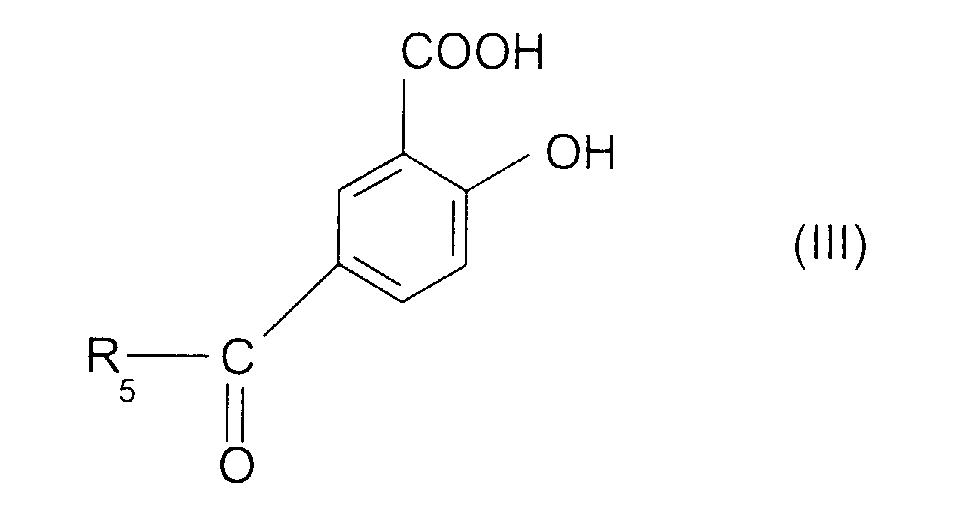
- Procédé de préparation d'un dérivé selon l'une quelconque des revendications 1 à 7, consistant à faire réagir un dérivé de l'acide salicylique ayant la formule (III) :dans laquelle :
 R5 représente une chaíne aliphatique, linéaire ou ramifiée, saturée ou insaturée, ayant de 3 à 15 atomes de carbone, avec un composé comportant un cation inorganique divalent en présence d'un solvant.
 - Procédé selon la revendication 8, caractérisé en ce que le composé de cation divalent est choisi parmi les carbonates, bicarbonates, sulfates, glycérophosphates, borates, chlorures, nitrates, acétates, hydroxydes, persulfates, les sels d'α-hydroxy-acides ou d'acides de fruits, les sels d'acides aminés, les sels d'acides gras.
- Procédé selon la revendication 8 ou 9, caractérisé en ce que le solvant est choisi parmi les alcools comportant de 1 à 12 atomes de carbone, les hydrocarbures, les cétones et l'eau, les éthers et les amines.
- Procédé selon l'une quelconque des revendications 8 à 10, caractérisé en ce que le solvant est l'isopropanol.
- Composition, caractérisée en ce qu'elle contient au moins un dérivé selon l'une quelconque des revendications 1 à 7.
- Composition selon la revendication 12, caractérisée en ce qu'elle consiste en une composition topique.
- Composition selon la revendication 12 ou 13, caractérisée en ce qu'elle constitue une composition cosmétique et/ou dermatologique.
- Composition selon l'une quelconque des revendications 12 à 14, caractérisée en ce que le dérivé de formule (I) est présent en une quantité allant de 0,001 à 30 % du poids total de la composition, et de préférence de 0,01 à 20 % du poids total de la composition.
- Composition selon l'une quelconque des revendications 12 à 15, caractérisée en ce qu'elle comprend, en outre, au moins un adjuvant choisi parmi l'eau, les corps gras, les conservateurs, les gélifiants, les tensioactifs et émulsionnants, les antioxydants, les charges, les solvants, les parfums, les matières colorantes, les filtres, les actifs cosmétiques et/ou dermatologiques et leurs mélanges.
- Utilisation d'au moins un dérivé selon l'une quelconque des revendications 1 à 7 comme agent exfoliant.
- Utilisation d'au moins un dérivé selon l'une quelconque des revendications 1 à 7, dans et/ou pour la fabrication d'une composition cosmétique et/ou dermatologique destinée au soin et/ou au maquillage de la peau et/ou des muqueuses et/ou des fibres kératiniques.
- Utilisation d'au moins un dérivé selon l'une quelconque des revendications 1 à 7, dans et/ou pour la fabrication d'une composition cosmétique et/ou dermatologique destinée à lutter contre les signes du vieillissement cutané et/ou à améliorer l'éclat du teint et/ou à lisser la peau du visage et/ou du corps et/ou à traiter les rides et les ridules de la peau et/ou à stimuler le processus de renouvellement épidermique.
- Utilisation d'au moins un dérivé selon l'une quelconque des revendications 1 à 7, dans et/ou pour la fabrication d'une composition cosmétique et/ou dermatologique destinée à lutter contre l'acné.
- Utilisation d'au moins un dérivé selon l'une quelconque des revendications 1 à 7, dans et/ou pour la fabrication d'une composition cosmétique et/ou dermatologique destinée à lutter contre les désordres cutanés.
- Procédé de traitement cosmétique des signes du vieillissement de la peau, caractérisé en ce qu'il consiste à appliquer sur la peau présentant ces signes, au moins un dérivé selon l'une quelconque des revendications 1 à 7, dans un milieu physiologiquement acceptable.
- Procédé de traitement cosmétique de l'acné consistant à appliquer sur la peau acnéique au moins un dérivé selon l'une quelconque des revendications 1 à 7, dans un milieu physiologiquement acceptable.
Applications Claiming Priority (2)
| Application Number | Priority Date | Filing Date | Title |
|---|---|---|---|
| FR9705412A FR2762839B1 (fr) | 1997-04-30 | 1997-04-30 | Nouveaux derives de l'acide salicylique et leur utilisation dans une composition cosmetique et/ou dermatologique |
| FR9705412 | 1997-04-30 |
Publications (2)
| Publication Number | Publication Date |
|---|---|
| EP0875495A1 true EP0875495A1 (fr) | 1998-11-04 |
| EP0875495B1 EP0875495B1 (fr) | 2000-06-21 |
Family
ID=9506511
Family Applications (1)
| Application Number | Title | Priority Date | Filing Date |
|---|---|---|---|
| EP98400946A Expired - Lifetime EP0875495B1 (fr) | 1997-04-30 | 1998-04-16 | Nouveaux dérivés de l'acide salicylique et leur utilisation dans une composition cosmétique et/ou dermatologique |
Country Status (9)
| Country | Link |
|---|---|
| US (1) | US5917088A (fr) |
| EP (1) | EP0875495B1 (fr) |
| JP (1) | JP2983517B2 (fr) |
| KR (1) | KR100280898B1 (fr) |
| AT (1) | ATE194001T1 (fr) |
| CA (1) | CA2234113C (fr) |
| DE (1) | DE69800185T2 (fr) |
| ES (1) | ES2149633T3 (fr) |
| FR (1) | FR2762839B1 (fr) |
Cited By (6)
| Publication number | Priority date | Publication date | Assignee | Title |
|---|---|---|---|---|
| EP0970690A1 (fr) * | 1998-07-06 | 2000-01-12 | L'oreal | Composition cosmétique et/ou dermatologique contenant des dérivés d'acide salicylique et procédé d'introduction des dits dérivés dans une composition aqueuse |
| EP1601339A4 (fr) * | 2003-02-19 | 2006-12-06 | Oreal | Composition et methode de peeling de la peau |
| US7351699B1 (en) | 1999-10-13 | 2008-04-01 | L'oreal | Use of DHEA or precursors or metabolic derivatives thereof as a depigmenting agent |
| EP2223680A2 (fr) | 2008-12-30 | 2010-09-01 | L'Oréal | Association de monosaccharides et d'agents desquamants et son utilisation en cosmétique |
| WO2012022899A2 (fr) | 2010-07-28 | 2012-02-23 | L'oreal | Procédé pour diminuer les hyperpigmentations post-réactionnelles |
| WO2012117340A1 (fr) | 2011-03-01 | 2012-09-07 | L'oreal | Procédé pour le traitement cosmétique d'une rougeur de la peau |
Families Citing this family (9)
| Publication number | Priority date | Publication date | Assignee | Title |
|---|---|---|---|---|
| FR2806622B1 (fr) * | 2000-03-24 | 2004-01-02 | Oreal | Composition cosmetique comprenant au moins un sel cristallin non polymerique |
| US20020182237A1 (en) * | 2001-03-22 | 2002-12-05 | The Procter & Gamble Company | Skin care compositions containing a sugar amine |
| CA2449103A1 (fr) * | 2001-06-01 | 2002-12-12 | Tendskin Company | Compositions topiques pour utilisations en medecine veterinaire |
| US20060148767A1 (en) * | 2001-12-06 | 2006-07-06 | George Cioca | Use of acyl salicylates as heat shock inducers |
| ITMI20012573A1 (it) * | 2001-12-06 | 2003-06-06 | D B P Dev Biotechonologica L P | Gli acilsalicilati:una nuova classe di induttori di risposta heat shock |
| US6555095B1 (en) | 2001-12-14 | 2003-04-29 | Avon Products, Inc. | Topical compositions and methods of application |
| US6517816B1 (en) | 2001-12-26 | 2003-02-11 | Avon Products, Inc. | Sunscreen emulsion composition and method of use |
| CN1993106A (zh) * | 2003-06-04 | 2007-07-04 | 埃伯赛特斯公司 | 新的皮肤病学的组合物 |
| US20060120980A1 (en) * | 2004-12-02 | 2006-06-08 | Eberl James J | Novel dermatological composition using bio-activating organocatalysts |
Citations (4)
| Publication number | Priority date | Publication date | Assignee | Title |
|---|---|---|---|---|
| US1933520A (en) * | 1931-07-18 | 1933-10-31 | Resinous Prod & Chemical Co | Drier and drying oil composition |
| US2431127A (en) * | 1944-04-29 | 1947-11-18 | Gen Foods Corp | Process of treating cashew nut shell liquid |
| FR2053011A1 (fr) * | 1969-06-25 | 1971-04-16 | Merck & Co Inc | |
| FR2581542A1 (fr) * | 1985-05-07 | 1986-11-14 | Oreal | Compositions topiques destinees au traitement de la peau a base de derives de l'acide salicylique |
Family Cites Families (15)
| Publication number | Priority date | Publication date | Assignee | Title |
|---|---|---|---|---|
| NL64136C (fr) * | 1946-05-02 | |||
| FR1210496A (fr) * | 1958-11-28 | 1960-03-09 | Fabrication du salicylate de manganèse | |
| FR5061M (fr) * | 1965-12-23 | 1967-05-08 | ||
| US3657430A (en) * | 1969-06-25 | 1972-04-18 | Merck & Co Inc | Composition and methods for treating inflammation |
| CH579579A5 (fr) * | 1972-11-22 | 1976-09-15 | Ciba Geigy Ag | |
| US4627928A (en) * | 1976-08-26 | 1986-12-09 | The Lubrizol Corporation | Basic non-carbonated magnesium compositions and fuel, lubricant and additive concentrate compositions containing same |
| US5091171B2 (en) * | 1986-12-23 | 1997-07-15 | Tristrata Inc | Amphoteric compositions and polymeric forms of alpha hydroxyacids and their therapeutic use |
| FR2623395B1 (fr) * | 1987-11-24 | 1990-04-20 | Oreal | Compositions pharmaceutiques et cosmetiques a base de peroxyde de benzoyle et de salicylates lipophiles d'ammonium quaternaires et leur utilisation, notamment dans le traitement de l'acne |
| LU87408A1 (fr) * | 1988-12-16 | 1990-07-10 | Oreal | Utilisation de derives salicyles pour le traitement du vieillissement de la peau |
| US5144965A (en) * | 1991-05-15 | 1992-09-08 | Philip Morris Incorporated | Smoking compositions containing a vanillin-release additive |
| GB9316646D0 (en) * | 1993-08-11 | 1993-09-29 | Uniliver Plc | Sunscreen agents |
| EP0799018A4 (fr) * | 1994-12-21 | 2000-03-29 | Cosmederm Technologies | Formulations et procedes pour diminuer l'irritation de la peau |
| US5716625A (en) * | 1994-12-21 | 1998-02-10 | Cosmederm Technologies | Formulations and methods for reducing skin irritation |
| BR9510488A (pt) * | 1994-12-21 | 1998-01-13 | Cosmederm Technologies | Formulações e métodos para redução da irritação da pele |
| FR2739556B1 (fr) * | 1995-10-04 | 1998-01-09 | Oreal | Utilisation de carbohydrates pour favoriser la desquamation de la peau |
-
1997
- 1997-04-30 FR FR9705412A patent/FR2762839B1/fr not_active Expired - Fee Related
-
1998
- 1998-04-16 AT AT98400946T patent/ATE194001T1/de not_active IP Right Cessation
- 1998-04-16 EP EP98400946A patent/EP0875495B1/fr not_active Expired - Lifetime
- 1998-04-16 ES ES98400946T patent/ES2149633T3/es not_active Expired - Lifetime
- 1998-04-16 DE DE69800185T patent/DE69800185T2/de not_active Expired - Lifetime
- 1998-04-28 JP JP10119529A patent/JP2983517B2/ja not_active Expired - Fee Related
- 1998-04-29 US US09/069,112 patent/US5917088A/en not_active Expired - Lifetime
- 1998-04-29 CA CA002234113A patent/CA2234113C/fr not_active Expired - Fee Related
- 1998-04-30 KR KR1019980015546A patent/KR100280898B1/ko not_active Expired - Fee Related
Patent Citations (4)
| Publication number | Priority date | Publication date | Assignee | Title |
|---|---|---|---|---|
| US1933520A (en) * | 1931-07-18 | 1933-10-31 | Resinous Prod & Chemical Co | Drier and drying oil composition |
| US2431127A (en) * | 1944-04-29 | 1947-11-18 | Gen Foods Corp | Process of treating cashew nut shell liquid |
| FR2053011A1 (fr) * | 1969-06-25 | 1971-04-16 | Merck & Co Inc | |
| FR2581542A1 (fr) * | 1985-05-07 | 1986-11-14 | Oreal | Compositions topiques destinees au traitement de la peau a base de derives de l'acide salicylique |
Non-Patent Citations (1)
| Title |
|---|
| BIALOBRZESKI, M. ; NENCKI, M.: "ÜBER DIE ACETSALICYLSÄURE", BERICHTE DER DEUTSCHEN CHEMISCHEN GESELLSCHAFT, vol. 30, 1897, pages 1776 - 1779, XP002075249 * |
Cited By (6)
| Publication number | Priority date | Publication date | Assignee | Title |
|---|---|---|---|---|
| EP0970690A1 (fr) * | 1998-07-06 | 2000-01-12 | L'oreal | Composition cosmétique et/ou dermatologique contenant des dérivés d'acide salicylique et procédé d'introduction des dits dérivés dans une composition aqueuse |
| US7351699B1 (en) | 1999-10-13 | 2008-04-01 | L'oreal | Use of DHEA or precursors or metabolic derivatives thereof as a depigmenting agent |
| EP1601339A4 (fr) * | 2003-02-19 | 2006-12-06 | Oreal | Composition et methode de peeling de la peau |
| EP2223680A2 (fr) | 2008-12-30 | 2010-09-01 | L'Oréal | Association de monosaccharides et d'agents desquamants et son utilisation en cosmétique |
| WO2012022899A2 (fr) | 2010-07-28 | 2012-02-23 | L'oreal | Procédé pour diminuer les hyperpigmentations post-réactionnelles |
| WO2012117340A1 (fr) | 2011-03-01 | 2012-09-07 | L'oreal | Procédé pour le traitement cosmétique d'une rougeur de la peau |
Also Published As
| Publication number | Publication date |
|---|---|
| JPH10298136A (ja) | 1998-11-10 |
| EP0875495B1 (fr) | 2000-06-21 |
| ES2149633T3 (es) | 2000-11-01 |
| ATE194001T1 (de) | 2000-07-15 |
| FR2762839A1 (fr) | 1998-11-06 |
| KR100280898B1 (ko) | 2001-02-01 |
| DE69800185D1 (de) | 2000-07-27 |
| DE69800185T2 (de) | 2000-10-26 |
| JP2983517B2 (ja) | 1999-11-29 |
| KR19980081865A (ko) | 1998-11-25 |
| CA2234113A1 (fr) | 1998-10-30 |
| US5917088A (en) | 1999-06-29 |
| FR2762839B1 (fr) | 2001-05-11 |
| CA2234113C (fr) | 2005-06-07 |
Similar Documents
| Publication | Publication Date | Title |
|---|---|---|
| CA2174598C (fr) | Utilisation d'un inhibiteur d'hmg-coenzyme a-reductase pour lutter contre le vieillissement de la peau_ou stimuler le processus de renouvellement epidermique | |
| EP1337234B1 (fr) | Utilisation de derives de l'acide 2-oxothiazolidine 4-carboxylique comme agents prodesquamants | |
| EP0706368B1 (fr) | Composition antiacneique contenant un extrait de poria cocos wolf | |
| EP0875495B1 (fr) | Nouveaux dérivés de l'acide salicylique et leur utilisation dans une composition cosmétique et/ou dermatologique | |
| CA2147089C (fr) | Composition cosmetique et/ou dermatologique contenant un tri(alpha-hydroxyacylate) de glycerol comme seul precurseur de glycerol | |
| FR2807320A1 (fr) | Utilisation de derives d'acide ascorbique pour augmenter la synthese des creramides epidermiques | |
| EP0756866B1 (fr) | Utilisation de dérivés d'acide benzoique pour stimuler le processus de renouvellement épidermique et traiter la peau | |
| CA2319849C (fr) | Utilisation de complexes inorganiques-organiques dans une composition | |
| EP0858319B1 (fr) | Utilisation d'acides carboxyliques porteurs d'une fonction soufr e pour favoriser la desquamation de la peau ou stimuler le renouvellement epidermique | |
| EP1337233B1 (fr) | Utilisation d'au moins un derive amino sulfonique dans une composition destinee a favoriser la desquamation de la peau | |
| EP0761203B1 (fr) | Utilisation de l'acide cystéique ou homocystéique pour favoriser la desquamation de la peau ou stimuler le renouvellement épidermique | |
| EP0968221B1 (fr) | Nouveaux derives de l'acide salicylique et leur utilisation dans les compositions cosmetiques ou dermatologiques | |
| FR2855048A1 (fr) | Composition comprenant un precurseur de ceramide a base phytosphingosine et un activeur de la voie des 4-hydroxylases, utilisation pour renforcer la fonction barriere de la peau | |
| CA2299171A1 (fr) | Utilisation d'un 2-amino-alcane polyol pour le traitement de vieillissement cutane | |
| FR3151198A1 (fr) | Nouvelles utilisations dermatologiques d’un extrait de la microalgue Dunaliella tertiolecta | |
| FR3142888A1 (fr) | Utilisation cosmétique d’une association d’acide salicylique et/ou de ses dérivés et/ou de leurs sels, de sarcosine et d’un extrait d’algue d’origine marine pour traiter et/ou prévenir les peaux grasses | |
| FR3155426A3 (fr) | Composition cosmetique avec un c-glycoside, du niacinamide et du panthenol |
Legal Events
| Date | Code | Title | Description |
|---|---|---|---|
| PUAI | Public reference made under article 153(3) epc to a published international application that has entered the european phase |
Free format text: ORIGINAL CODE: 0009012 |
|
| AK | Designated contracting states |
Kind code of ref document: A1 Designated state(s): AT BE CH DE ES FR GB IT LI NL SE |
|
| AX | Request for extension of the european patent |
Free format text: AL;LT;LV;MK;RO;SI |
|
| 17P | Request for examination filed |
Effective date: 19990504 |
|
| AKX | Designation fees paid |
Free format text: AT BE CH DE ES FR GB IT LI NL SE |
|
| GRAG | Despatch of communication of intention to grant |
Free format text: ORIGINAL CODE: EPIDOS AGRA |
|
| 17Q | First examination report despatched |
Effective date: 20000208 |
|
| GRAG | Despatch of communication of intention to grant |
Free format text: ORIGINAL CODE: EPIDOS AGRA |
|
| GRAH | Despatch of communication of intention to grant a patent |
Free format text: ORIGINAL CODE: EPIDOS IGRA |
|
| GRAH | Despatch of communication of intention to grant a patent |
Free format text: ORIGINAL CODE: EPIDOS IGRA |
|
| GRAA | (expected) grant |
Free format text: ORIGINAL CODE: 0009210 |
|
| AK | Designated contracting states |
Kind code of ref document: B1 Designated state(s): AT BE CH DE ES FR GB IT LI NL SE |
|
| REF | Corresponds to: |
Ref document number: 194001 Country of ref document: AT Date of ref document: 20000715 Kind code of ref document: T |
|
| ITF | It: translation for a ep patent filed | ||
| REG | Reference to a national code |
Ref country code: CH Ref legal event code: EP |
|
| REF | Corresponds to: |
Ref document number: 69800185 Country of ref document: DE Date of ref document: 20000727 |
|
| GBT | Gb: translation of ep patent filed (gb section 77(6)(a)/1977) |
Effective date: 20000717 |
|
| REG | Reference to a national code |
Ref country code: ES Ref legal event code: FG2A Ref document number: 2149633 Country of ref document: ES Kind code of ref document: T3 |
|
| PLBE | No opposition filed within time limit |
Free format text: ORIGINAL CODE: 0009261 |
|
| STAA | Information on the status of an ep patent application or granted ep patent |
Free format text: STATUS: NO OPPOSITION FILED WITHIN TIME LIMIT |
|
| 26N | No opposition filed | ||
| REG | Reference to a national code |
Ref country code: GB Ref legal event code: IF02 |
|
| PGFP | Annual fee paid to national office [announced via postgrant information from national office to epo] |
Ref country code: NL Payment date: 20060403 Year of fee payment: 9 |
|
| PGFP | Annual fee paid to national office [announced via postgrant information from national office to epo] |
Ref country code: SE Payment date: 20060406 Year of fee payment: 9 |
|
| PGFP | Annual fee paid to national office [announced via postgrant information from national office to epo] |
Ref country code: AT Payment date: 20060412 Year of fee payment: 9 |
|
| PGFP | Annual fee paid to national office [announced via postgrant information from national office to epo] |
Ref country code: CH Payment date: 20060413 Year of fee payment: 9 |
|
| PGFP | Annual fee paid to national office [announced via postgrant information from national office to epo] |
Ref country code: BE Payment date: 20060619 Year of fee payment: 9 |
|
| REG | Reference to a national code |
Ref country code: CH Ref legal event code: PL |
|
| BERE | Be: lapsed |
Owner name: L'*OREAL Effective date: 20070430 |
|
| NLV4 | Nl: lapsed or anulled due to non-payment of the annual fee |
Effective date: 20071101 |
|
| PG25 | Lapsed in a contracting state [announced via postgrant information from national office to epo] |
Ref country code: NL Free format text: LAPSE BECAUSE OF NON-PAYMENT OF DUE FEES Effective date: 20071101 |
|
| PG25 | Lapsed in a contracting state [announced via postgrant information from national office to epo] |
Ref country code: CH Free format text: LAPSE BECAUSE OF NON-PAYMENT OF DUE FEES Effective date: 20070430 Ref country code: LI Free format text: LAPSE BECAUSE OF NON-PAYMENT OF DUE FEES Effective date: 20070430 Ref country code: AT Free format text: LAPSE BECAUSE OF NON-PAYMENT OF DUE FEES Effective date: 20070416 |
|
| PG25 | Lapsed in a contracting state [announced via postgrant information from national office to epo] |
Ref country code: BE Free format text: LAPSE BECAUSE OF NON-PAYMENT OF DUE FEES Effective date: 20070430 |
|
| PG25 | Lapsed in a contracting state [announced via postgrant information from national office to epo] |
Ref country code: SE Free format text: LAPSE BECAUSE OF NON-PAYMENT OF DUE FEES Effective date: 20070417 |
|
| PGFP | Annual fee paid to national office [announced via postgrant information from national office to epo] |
Ref country code: DE Payment date: 20110413 Year of fee payment: 14 Ref country code: FR Payment date: 20110426 Year of fee payment: 14 Ref country code: ES Payment date: 20110518 Year of fee payment: 14 |
|
| PGFP | Annual fee paid to national office [announced via postgrant information from national office to epo] |
Ref country code: GB Payment date: 20110413 Year of fee payment: 14 |
|
| PGFP | Annual fee paid to national office [announced via postgrant information from national office to epo] |
Ref country code: IT Payment date: 20110420 Year of fee payment: 14 |
|
| GBPC | Gb: european patent ceased through non-payment of renewal fee |
Effective date: 20120416 |
|
| REG | Reference to a national code |
Ref country code: FR Ref legal event code: ST Effective date: 20121228 |
|
| PG25 | Lapsed in a contracting state [announced via postgrant information from national office to epo] |
Ref country code: GB Free format text: LAPSE BECAUSE OF NON-PAYMENT OF DUE FEES Effective date: 20120416 |
|
| REG | Reference to a national code |
Ref country code: DE Ref legal event code: R119 Ref document number: 69800185 Country of ref document: DE Effective date: 20121101 |
|
| PG25 | Lapsed in a contracting state [announced via postgrant information from national office to epo] |
Ref country code: IT Free format text: LAPSE BECAUSE OF NON-PAYMENT OF DUE FEES Effective date: 20120416 Ref country code: FR Free format text: LAPSE BECAUSE OF NON-PAYMENT OF DUE FEES Effective date: 20120430 |
|
| REG | Reference to a national code |
Ref country code: ES Ref legal event code: FD2A Effective date: 20130716 |
|
| PG25 | Lapsed in a contracting state [announced via postgrant information from national office to epo] |
Ref country code: ES Free format text: LAPSE BECAUSE OF NON-PAYMENT OF DUE FEES Effective date: 20120417 |
|
| PG25 | Lapsed in a contracting state [announced via postgrant information from national office to epo] |
Ref country code: DE Free format text: LAPSE BECAUSE OF NON-PAYMENT OF DUE FEES Effective date: 20121101 |