EP0875582A2 - Procédé pour le typage de l'ADN de l'HLA de classe 1 par amplfication PCR - Google Patents
Procédé pour le typage de l'ADN de l'HLA de classe 1 par amplfication PCR Download PDFInfo
- Publication number
- EP0875582A2 EP0875582A2 EP98108382A EP98108382A EP0875582A2 EP 0875582 A2 EP0875582 A2 EP 0875582A2 EP 98108382 A EP98108382 A EP 98108382A EP 98108382 A EP98108382 A EP 98108382A EP 0875582 A2 EP0875582 A2 EP 0875582A2
- Authority
- EP
- European Patent Office
- Prior art keywords
- hla
- nucleic acid
- acid sequence
- seq
- sequence
- Prior art date
- Legal status (The legal status is an assumption and is not a legal conclusion. Google has not performed a legal analysis and makes no representation as to the accuracy of the status listed.)
- Granted
Links
- 238000000034 method Methods 0.000 title claims abstract description 48
- 238000012408 PCR amplification Methods 0.000 title description 2
- 108700028369 Alleles Proteins 0.000 claims abstract description 58
- 108010061486 HLA-B27 Antigen Proteins 0.000 claims abstract description 42
- 102000012153 HLA-B27 Antigen Human genes 0.000 claims abstract description 41
- 230000003321 amplification Effects 0.000 claims abstract description 39
- 238000003199 nucleic acid amplification method Methods 0.000 claims abstract description 39
- 108010058607 HLA-B Antigens Proteins 0.000 claims abstract description 23
- 102000006390 HLA-B Antigens Human genes 0.000 claims abstract description 23
- 239000000872 buffer Substances 0.000 claims abstract description 22
- 108020005187 Oligonucleotide Probes Proteins 0.000 claims abstract description 13
- 239000002751 oligonucleotide probe Substances 0.000 claims abstract description 13
- 239000013615 primer Substances 0.000 claims description 91
- 150000007523 nucleic acids Chemical group 0.000 claims description 70
- 108091028043 Nucleic acid sequence Proteins 0.000 claims description 42
- 239000000523 sample Substances 0.000 claims description 40
- 230000000295 complement effect Effects 0.000 claims description 34
- 108020004707 nucleic acids Proteins 0.000 claims description 22
- 102000039446 nucleic acids Human genes 0.000 claims description 22
- 108091034117 Oligonucleotide Proteins 0.000 claims description 21
- 239000002773 nucleotide Substances 0.000 claims description 15
- 150000001413 amino acids Chemical class 0.000 claims description 14
- 125000003729 nucleotide group Chemical group 0.000 claims description 13
- 239000003155 DNA primer Substances 0.000 claims description 12
- 239000000427 antigen Substances 0.000 claims description 12
- 108091007433 antigens Proteins 0.000 claims description 12
- 102000036639 antigens Human genes 0.000 claims description 12
- 238000001514 detection method Methods 0.000 claims description 11
- 208000036487 Arthropathies Diseases 0.000 claims description 8
- 208000012659 Joint disease Diseases 0.000 claims description 8
- 230000002757 inflammatory effect Effects 0.000 claims description 8
- -1 nucleoside triphosphates Chemical class 0.000 claims description 8
- 239000001226 triphosphate Substances 0.000 claims description 5
- 235000011178 triphosphate Nutrition 0.000 claims description 5
- HNDVDQJCIGZPNO-UHFFFAOYSA-N histidine Natural products OC(=O)C(N)CC1=CN=CN1 HNDVDQJCIGZPNO-UHFFFAOYSA-N 0.000 claims description 3
- 108010014303 DNA-directed DNA polymerase Proteins 0.000 claims description 2
- 102000016928 DNA-directed DNA polymerase Human genes 0.000 claims description 2
- 239000002777 nucleoside Substances 0.000 claims description 2
- 125000003275 alpha amino acid group Chemical group 0.000 claims 8
- FWMNVWWHGCHHJJ-SKKKGAJSSA-N 4-amino-1-[(2r)-6-amino-2-[[(2r)-2-[[(2r)-2-[[(2r)-2-amino-3-phenylpropanoyl]amino]-3-phenylpropanoyl]amino]-4-methylpentanoyl]amino]hexanoyl]piperidine-4-carboxylic acid Chemical compound C([C@H](C(=O)N[C@H](CC(C)C)C(=O)N[C@H](CCCCN)C(=O)N1CCC(N)(CC1)C(O)=O)NC(=O)[C@H](N)CC=1C=CC=CC=1)C1=CC=CC=C1 FWMNVWWHGCHHJJ-SKKKGAJSSA-N 0.000 claims 1
- 108090000626 DNA-directed RNA polymerases Proteins 0.000 claims 1
- 102000004163 DNA-directed RNA polymerases Human genes 0.000 claims 1
- 108010002634 HLA-Bw4 antigen Proteins 0.000 claims 1
- IAZDPXIOMUYVGZ-UHFFFAOYSA-N Dimethylsulphoxide Chemical compound CS(C)=O IAZDPXIOMUYVGZ-UHFFFAOYSA-N 0.000 abstract description 13
- 206010003246 arthritis Diseases 0.000 abstract description 10
- 238000003752 polymerase chain reaction Methods 0.000 abstract description 10
- 239000002738 chelating agent Substances 0.000 abstract description 9
- 239000000047 product Substances 0.000 description 24
- 208000037265 diseases, disorders, signs and symptoms Diseases 0.000 description 17
- 201000010099 disease Diseases 0.000 description 16
- TWRXJAOTZQYOKJ-UHFFFAOYSA-L Magnesium chloride Chemical compound [Mg+2].[Cl-].[Cl-] TWRXJAOTZQYOKJ-UHFFFAOYSA-L 0.000 description 14
- 206010002556 Ankylosing Spondylitis Diseases 0.000 description 11
- 229960001760 dimethyl sulfoxide Drugs 0.000 description 11
- 108020004414 DNA Proteins 0.000 description 10
- 235000001014 amino acid Nutrition 0.000 description 8
- 229940024606 amino acid Drugs 0.000 description 8
- 238000009396 hybridization Methods 0.000 description 7
- 229910001629 magnesium chloride Inorganic materials 0.000 description 7
- 108090000765 processed proteins & peptides Proteins 0.000 description 7
- 238000003786 synthesis reaction Methods 0.000 description 7
- KCXVZYZYPLLWCC-UHFFFAOYSA-N EDTA Chemical compound OC(=O)CN(CC(O)=O)CCN(CC(O)=O)CC(O)=O KCXVZYZYPLLWCC-UHFFFAOYSA-N 0.000 description 6
- 230000015572 biosynthetic process Effects 0.000 description 6
- 108010004141 HLA-B35 Antigen Proteins 0.000 description 5
- 239000003880 polar aprotic solvent Substances 0.000 description 5
- 208000002574 reactive arthritis Diseases 0.000 description 5
- 108010017826 DNA Polymerase I Proteins 0.000 description 4
- 102000004594 DNA Polymerase I Human genes 0.000 description 4
- 108010006785 Taq Polymerase Proteins 0.000 description 4
- 239000002253 acid Substances 0.000 description 4
- 238000004458 analytical method Methods 0.000 description 4
- 239000003795 chemical substances by application Substances 0.000 description 4
- 230000000405 serological effect Effects 0.000 description 4
- WFDIJRYMOXRFFG-UHFFFAOYSA-N Acetic anhydride Chemical compound CC(=O)OC(C)=O WFDIJRYMOXRFFG-UHFFFAOYSA-N 0.000 description 3
- CSCPPACGZOOCGX-UHFFFAOYSA-N Acetone Chemical compound CC(C)=O CSCPPACGZOOCGX-UHFFFAOYSA-N 0.000 description 3
- WEVYAHXRMPXWCK-UHFFFAOYSA-N Acetonitrile Chemical compound CC#N WEVYAHXRMPXWCK-UHFFFAOYSA-N 0.000 description 3
- 206010003267 Arthritis reactive Diseases 0.000 description 3
- YMWUJEATGCHHMB-UHFFFAOYSA-N Dichloromethane Chemical compound ClCCl YMWUJEATGCHHMB-UHFFFAOYSA-N 0.000 description 3
- LFQSCWFLJHTTHZ-UHFFFAOYSA-N Ethanol Chemical compound CCO LFQSCWFLJHTTHZ-UHFFFAOYSA-N 0.000 description 3
- WHUUTDBJXJRKMK-UHFFFAOYSA-N Glutamic acid Natural products OC(=O)C(N)CCC(O)=O WHUUTDBJXJRKMK-UHFFFAOYSA-N 0.000 description 3
- DHMQDGOQFOQNFH-UHFFFAOYSA-N Glycine Chemical compound NCC(O)=O DHMQDGOQFOQNFH-UHFFFAOYSA-N 0.000 description 3
- 208000004575 Infectious Arthritis Diseases 0.000 description 3
- DCXYFEDJOCDNAF-REOHCLBHSA-N L-asparagine Chemical compound OC(=O)[C@@H](N)CC(N)=O DCXYFEDJOCDNAF-REOHCLBHSA-N 0.000 description 3
- JLVVSXFLKOJNIY-UHFFFAOYSA-N Magnesium ion Chemical compound [Mg+2] JLVVSXFLKOJNIY-UHFFFAOYSA-N 0.000 description 3
- BFNBIHQBYMNNAN-UHFFFAOYSA-N ammonium sulfate Chemical compound N.N.OS(O)(=O)=O BFNBIHQBYMNNAN-UHFFFAOYSA-N 0.000 description 3
- 229910052921 ammonium sulfate Inorganic materials 0.000 description 3
- 239000001166 ammonium sulphate Substances 0.000 description 3
- 235000011130 ammonium sulphate Nutrition 0.000 description 3
- 239000000969 carrier Substances 0.000 description 3
- 210000004027 cell Anatomy 0.000 description 3
- 210000001151 cytotoxic T lymphocyte Anatomy 0.000 description 3
- 208000015181 infectious disease Diseases 0.000 description 3
- 210000000265 leukocyte Anatomy 0.000 description 3
- 229910001425 magnesium ion Inorganic materials 0.000 description 3
- 230000008506 pathogenesis Effects 0.000 description 3
- 210000005105 peripheral blood lymphocyte Anatomy 0.000 description 3
- 238000005406 washing Methods 0.000 description 3
- DCXYFEDJOCDNAF-UHFFFAOYSA-N Asparagine Natural products OC(=O)C(N)CC(N)=O DCXYFEDJOCDNAF-UHFFFAOYSA-N 0.000 description 2
- HEDRZPFGACZZDS-UHFFFAOYSA-N Chloroform Chemical compound ClC(Cl)Cl HEDRZPFGACZZDS-UHFFFAOYSA-N 0.000 description 2
- 102000004190 Enzymes Human genes 0.000 description 2
- 108090000790 Enzymes Proteins 0.000 description 2
- 102220378376 HLA-B*2705 Human genes 0.000 description 2
- 108010054198 HLA-B*27:05 antigen Proteins 0.000 description 2
- CKLJMWTZIZZHCS-REOHCLBHSA-N L-aspartic acid Chemical compound OC(=O)[C@@H](N)CC(O)=O CKLJMWTZIZZHCS-REOHCLBHSA-N 0.000 description 2
- KDXKERNSBIXSRK-UHFFFAOYSA-N Lysine Natural products NCCCCC(N)C(O)=O KDXKERNSBIXSRK-UHFFFAOYSA-N 0.000 description 2
- 108700018351 Major Histocompatibility Complex Proteins 0.000 description 2
- ZMXDDKWLCZADIW-UHFFFAOYSA-N N,N-Dimethylformamide Chemical compound CN(C)C=O ZMXDDKWLCZADIW-UHFFFAOYSA-N 0.000 description 2
- 239000000020 Nitrocellulose Substances 0.000 description 2
- 108010021757 Polynucleotide 5'-Hydroxyl-Kinase Proteins 0.000 description 2
- 102000008422 Polynucleotide 5'-hydroxyl-kinase Human genes 0.000 description 2
- 208000032236 Predisposition to disease Diseases 0.000 description 2
- JUJWROOIHBZHMG-UHFFFAOYSA-N Pyridine Chemical compound C1=CC=NC=C1 JUJWROOIHBZHMG-UHFFFAOYSA-N 0.000 description 2
- 208000033464 Reiter syndrome Diseases 0.000 description 2
- WYURNTSHIVDZCO-UHFFFAOYSA-N Tetrahydrofuran Chemical compound C1CCOC1 WYURNTSHIVDZCO-UHFFFAOYSA-N 0.000 description 2
- 206010046851 Uveitis Diseases 0.000 description 2
- 150000007513 acids Chemical class 0.000 description 2
- 150000003863 ammonium salts Chemical class 0.000 description 2
- 238000000137 annealing Methods 0.000 description 2
- 230000003286 arthritogenic effect Effects 0.000 description 2
- 235000009582 asparagine Nutrition 0.000 description 2
- 229960001230 asparagine Drugs 0.000 description 2
- 235000003704 aspartic acid Nutrition 0.000 description 2
- 238000003556 assay Methods 0.000 description 2
- OQFSQFPPLPISGP-UHFFFAOYSA-N beta-carboxyaspartic acid Natural products OC(=O)C(N)C(C(O)=O)C(O)=O OQFSQFPPLPISGP-UHFFFAOYSA-N 0.000 description 2
- SUYVUBYJARFZHO-RRKCRQDMSA-N dATP Chemical compound C1=NC=2C(N)=NC=NC=2N1[C@H]1C[C@H](O)[C@@H](COP(O)(=O)OP(O)(=O)OP(O)(O)=O)O1 SUYVUBYJARFZHO-RRKCRQDMSA-N 0.000 description 2
- SUYVUBYJARFZHO-UHFFFAOYSA-N dATP Natural products C1=NC=2C(N)=NC=NC=2N1C1CC(O)C(COP(O)(=O)OP(O)(=O)OP(O)(O)=O)O1 SUYVUBYJARFZHO-UHFFFAOYSA-N 0.000 description 2
- 230000000694 effects Effects 0.000 description 2
- 235000013922 glutamic acid Nutrition 0.000 description 2
- 239000004220 glutamic acid Substances 0.000 description 2
- ZDXPYRJPNDTMRX-UHFFFAOYSA-N glutamine Natural products OC(=O)C(N)CCC(N)=O ZDXPYRJPNDTMRX-UHFFFAOYSA-N 0.000 description 2
- 239000000203 mixture Substances 0.000 description 2
- 229920001220 nitrocellulos Polymers 0.000 description 2
- 229920000768 polyamine Polymers 0.000 description 2
- 102000004196 processed proteins & peptides Human genes 0.000 description 2
- 108090000623 proteins and genes Proteins 0.000 description 2
- 230000002285 radioactive effect Effects 0.000 description 2
- 239000002904 solvent Substances 0.000 description 2
- ATHGHQPFGPMSJY-UHFFFAOYSA-N spermidine Chemical compound NCCCCNCCCN ATHGHQPFGPMSJY-UHFFFAOYSA-N 0.000 description 2
- 230000020382 suppression by virus of host antigen processing and presentation of peptide antigen via MHC class I Effects 0.000 description 2
- OUYCCCASQSFEME-UHFFFAOYSA-N tyrosine Natural products OC(=O)C(N)CC1=CC=C(O)C=C1 OUYCCCASQSFEME-UHFFFAOYSA-N 0.000 description 2
- 239000004475 Arginine Substances 0.000 description 1
- 206010053555 Arthritis bacterial Diseases 0.000 description 1
- 206010003274 Arthritis viral Diseases 0.000 description 1
- 241000972773 Aulopiformes Species 0.000 description 1
- 208000008035 Back Pain Diseases 0.000 description 1
- IAZDPXIOMUYVGZ-WFGJKAKNSA-N Dimethyl sulfoxide Chemical group [2H]C([2H])([2H])S(=O)C([2H])([2H])[2H] IAZDPXIOMUYVGZ-WFGJKAKNSA-N 0.000 description 1
- 108010067770 Endopeptidase K Proteins 0.000 description 1
- 206010015226 Erythema nodosum Diseases 0.000 description 1
- 239000004471 Glycine Substances 0.000 description 1
- 201000005569 Gout Diseases 0.000 description 1
- 206010018634 Gouty Arthritis Diseases 0.000 description 1
- 102100028972 HLA class I histocompatibility antigen, A alpha chain Human genes 0.000 description 1
- 108010075704 HLA-A Antigens Proteins 0.000 description 1
- 102220391613 HLA-B*2702 Human genes 0.000 description 1
- 108010056113 HLA-B55 antigen Proteins 0.000 description 1
- 102100034343 Integrase Human genes 0.000 description 1
- 206010023509 Kyphosis Diseases 0.000 description 1
- QNAYBMKLOCPYGJ-REOHCLBHSA-N L-alanine Chemical compound C[C@H](N)C(O)=O QNAYBMKLOCPYGJ-REOHCLBHSA-N 0.000 description 1
- WHUUTDBJXJRKMK-VKHMYHEASA-N L-glutamic acid Chemical compound OC(=O)[C@@H](N)CCC(O)=O WHUUTDBJXJRKMK-VKHMYHEASA-N 0.000 description 1
- ZDXPYRJPNDTMRX-VKHMYHEASA-N L-glutamine Chemical compound OC(=O)[C@@H](N)CCC(N)=O ZDXPYRJPNDTMRX-VKHMYHEASA-N 0.000 description 1
- AGPKZVBTJJNPAG-WHFBIAKZSA-N L-isoleucine Chemical compound CC[C@H](C)[C@H](N)C(O)=O AGPKZVBTJJNPAG-WHFBIAKZSA-N 0.000 description 1
- ROHFNLRQFUQHCH-YFKPBYRVSA-N L-leucine Chemical compound CC(C)C[C@H](N)C(O)=O ROHFNLRQFUQHCH-YFKPBYRVSA-N 0.000 description 1
- FFEARJCKVFRZRR-BYPYZUCNSA-N L-methionine Chemical compound CSCC[C@H](N)C(O)=O FFEARJCKVFRZRR-BYPYZUCNSA-N 0.000 description 1
- COLNVLDHVKWLRT-QMMMGPOBSA-N L-phenylalanine Chemical compound OC(=O)[C@@H](N)CC1=CC=CC=C1 COLNVLDHVKWLRT-QMMMGPOBSA-N 0.000 description 1
- OUYCCCASQSFEME-QMMMGPOBSA-N L-tyrosine Chemical compound OC(=O)[C@@H](N)CC1=CC=C(O)C=C1 OUYCCCASQSFEME-QMMMGPOBSA-N 0.000 description 1
- ROHFNLRQFUQHCH-UHFFFAOYSA-N Leucine Natural products CC(C)CC(N)C(O)=O ROHFNLRQFUQHCH-UHFFFAOYSA-N 0.000 description 1
- 208000007623 Lordosis Diseases 0.000 description 1
- 208000008930 Low Back Pain Diseases 0.000 description 1
- 239000004472 Lysine Substances 0.000 description 1
- 108700005089 MHC Class I Genes Proteins 0.000 description 1
- 206010028391 Musculoskeletal Pain Diseases 0.000 description 1
- ONIBWKKTOPOVIA-UHFFFAOYSA-N Proline Natural products OC(=O)C1CCCN1 ONIBWKKTOPOVIA-UHFFFAOYSA-N 0.000 description 1
- 208000036824 Psoriatic arthropathy Diseases 0.000 description 1
- 206010037549 Purpura Diseases 0.000 description 1
- 241001672981 Purpura Species 0.000 description 1
- 108010092799 RNA-directed DNA polymerase Proteins 0.000 description 1
- 208000025747 Rheumatic disease Diseases 0.000 description 1
- MTCFGRXMJLQNBG-UHFFFAOYSA-N Serine Natural products OCC(N)C(O)=O MTCFGRXMJLQNBG-UHFFFAOYSA-N 0.000 description 1
- 238000002105 Southern blotting Methods 0.000 description 1
- 210000001744 T-lymphocyte Anatomy 0.000 description 1
- 239000007983 Tris buffer Substances 0.000 description 1
- QIVBCDIJIAJPQS-UHFFFAOYSA-N Tryptophan Natural products C1=CC=C2C(CC(N)C(O)=O)=CNC2=C1 QIVBCDIJIAJPQS-UHFFFAOYSA-N 0.000 description 1
- JLCPHMBAVCMARE-UHFFFAOYSA-N [3-[[3-[[3-[[3-[[3-[[3-[[3-[[3-[[3-[[3-[[3-[[5-(2-amino-6-oxo-1H-purin-9-yl)-3-[[3-[[3-[[3-[[3-[[3-[[5-(2-amino-6-oxo-1H-purin-9-yl)-3-[[5-(2-amino-6-oxo-1H-purin-9-yl)-3-hydroxyoxolan-2-yl]methoxy-hydroxyphosphoryl]oxyoxolan-2-yl]methoxy-hydroxyphosphoryl]oxy-5-(5-methyl-2,4-dioxopyrimidin-1-yl)oxolan-2-yl]methoxy-hydroxyphosphoryl]oxy-5-(6-aminopurin-9-yl)oxolan-2-yl]methoxy-hydroxyphosphoryl]oxy-5-(6-aminopurin-9-yl)oxolan-2-yl]methoxy-hydroxyphosphoryl]oxy-5-(6-aminopurin-9-yl)oxolan-2-yl]methoxy-hydroxyphosphoryl]oxy-5-(6-aminopurin-9-yl)oxolan-2-yl]methoxy-hydroxyphosphoryl]oxyoxolan-2-yl]methoxy-hydroxyphosphoryl]oxy-5-(5-methyl-2,4-dioxopyrimidin-1-yl)oxolan-2-yl]methoxy-hydroxyphosphoryl]oxy-5-(4-amino-2-oxopyrimidin-1-yl)oxolan-2-yl]methoxy-hydroxyphosphoryl]oxy-5-(5-methyl-2,4-dioxopyrimidin-1-yl)oxolan-2-yl]methoxy-hydroxyphosphoryl]oxy-5-(5-methyl-2,4-dioxopyrimidin-1-yl)oxolan-2-yl]methoxy-hydroxyphosphoryl]oxy-5-(6-aminopurin-9-yl)oxolan-2-yl]methoxy-hydroxyphosphoryl]oxy-5-(6-aminopurin-9-yl)oxolan-2-yl]methoxy-hydroxyphosphoryl]oxy-5-(4-amino-2-oxopyrimidin-1-yl)oxolan-2-yl]methoxy-hydroxyphosphoryl]oxy-5-(4-amino-2-oxopyrimidin-1-yl)oxolan-2-yl]methoxy-hydroxyphosphoryl]oxy-5-(4-amino-2-oxopyrimidin-1-yl)oxolan-2-yl]methoxy-hydroxyphosphoryl]oxy-5-(6-aminopurin-9-yl)oxolan-2-yl]methoxy-hydroxyphosphoryl]oxy-5-(4-amino-2-oxopyrimidin-1-yl)oxolan-2-yl]methyl [5-(6-aminopurin-9-yl)-2-(hydroxymethyl)oxolan-3-yl] hydrogen phosphate Polymers Cc1cn(C2CC(OP(O)(=O)OCC3OC(CC3OP(O)(=O)OCC3OC(CC3O)n3cnc4c3nc(N)[nH]c4=O)n3cnc4c3nc(N)[nH]c4=O)C(COP(O)(=O)OC3CC(OC3COP(O)(=O)OC3CC(OC3COP(O)(=O)OC3CC(OC3COP(O)(=O)OC3CC(OC3COP(O)(=O)OC3CC(OC3COP(O)(=O)OC3CC(OC3COP(O)(=O)OC3CC(OC3COP(O)(=O)OC3CC(OC3COP(O)(=O)OC3CC(OC3COP(O)(=O)OC3CC(OC3COP(O)(=O)OC3CC(OC3COP(O)(=O)OC3CC(OC3COP(O)(=O)OC3CC(OC3COP(O)(=O)OC3CC(OC3COP(O)(=O)OC3CC(OC3COP(O)(=O)OC3CC(OC3COP(O)(=O)OC3CC(OC3CO)n3cnc4c(N)ncnc34)n3ccc(N)nc3=O)n3cnc4c(N)ncnc34)n3ccc(N)nc3=O)n3ccc(N)nc3=O)n3ccc(N)nc3=O)n3cnc4c(N)ncnc34)n3cnc4c(N)ncnc34)n3cc(C)c(=O)[nH]c3=O)n3cc(C)c(=O)[nH]c3=O)n3ccc(N)nc3=O)n3cc(C)c(=O)[nH]c3=O)n3cnc4c3nc(N)[nH]c4=O)n3cnc4c(N)ncnc34)n3cnc4c(N)ncnc34)n3cnc4c(N)ncnc34)n3cnc4c(N)ncnc34)O2)c(=O)[nH]c1=O JLCPHMBAVCMARE-UHFFFAOYSA-N 0.000 description 1
- SWPYNTWPIAZGLT-UHFFFAOYSA-N [amino(ethoxy)phosphanyl]oxyethane Chemical class CCOP(N)OCC SWPYNTWPIAZGLT-UHFFFAOYSA-N 0.000 description 1
- 239000011543 agarose gel Substances 0.000 description 1
- 238000000246 agarose gel electrophoresis Methods 0.000 description 1
- 235000004279 alanine Nutrition 0.000 description 1
- 238000013459 approach Methods 0.000 description 1
- ODKSFYDXXFIFQN-UHFFFAOYSA-N arginine Natural products OC(=O)C(N)CCCNC(N)=N ODKSFYDXXFIFQN-UHFFFAOYSA-N 0.000 description 1
- QRUDEWIWKLJBPS-UHFFFAOYSA-N benzotriazole Chemical compound C1=CC=C2N[N][N]C2=C1 QRUDEWIWKLJBPS-UHFFFAOYSA-N 0.000 description 1
- 239000012964 benzotriazole Substances 0.000 description 1
- 230000002146 bilateral effect Effects 0.000 description 1
- 210000004369 blood Anatomy 0.000 description 1
- 239000008280 blood Substances 0.000 description 1
- 238000006243 chemical reaction Methods 0.000 description 1
- 239000007795 chemical reaction product Substances 0.000 description 1
- 238000009833 condensation Methods 0.000 description 1
- 230000005494 condensation Effects 0.000 description 1
- 108091036078 conserved sequence Proteins 0.000 description 1
- 230000008878 coupling Effects 0.000 description 1
- 238000010168 coupling process Methods 0.000 description 1
- 238000005859 coupling reaction Methods 0.000 description 1
- 235000018417 cysteine Nutrition 0.000 description 1
- XUJNEKJLAYXESH-UHFFFAOYSA-N cysteine Natural products SCC(N)C(O)=O XUJNEKJLAYXESH-UHFFFAOYSA-N 0.000 description 1
- 125000000151 cysteine group Chemical group N[C@@H](CS)C(=O)* 0.000 description 1
- 230000009089 cytolysis Effects 0.000 description 1
- 231100000433 cytotoxic Toxicity 0.000 description 1
- 230000001472 cytotoxic effect Effects 0.000 description 1
- RGWHQCVHVJXOKC-SHYZEUOFSA-J dCTP(4-) Chemical compound O=C1N=C(N)C=CN1[C@@H]1O[C@H](COP([O-])(=O)OP([O-])(=O)OP([O-])([O-])=O)[C@@H](O)C1 RGWHQCVHVJXOKC-SHYZEUOFSA-J 0.000 description 1
- HAAZLUGHYHWQIW-KVQBGUIXSA-N dGTP Chemical compound C1=NC=2C(=O)NC(N)=NC=2N1[C@H]1C[C@H](O)[C@@H](COP(O)(=O)OP(O)(=O)OP(O)(O)=O)O1 HAAZLUGHYHWQIW-KVQBGUIXSA-N 0.000 description 1
- NHVNXKFIZYSCEB-XLPZGREQSA-N dTTP Chemical compound O=C1NC(=O)C(C)=CN1[C@@H]1O[C@H](COP(O)(=O)OP(O)(=O)OP(O)(O)=O)[C@@H](O)C1 NHVNXKFIZYSCEB-XLPZGREQSA-N 0.000 description 1
- 238000004925 denaturation Methods 0.000 description 1
- 230000036425 denaturation Effects 0.000 description 1
- 239000003599 detergent Substances 0.000 description 1
- 238000006642 detritylation reaction Methods 0.000 description 1
- 238000003745 diagnosis Methods 0.000 description 1
- 238000002405 diagnostic procedure Methods 0.000 description 1
- 208000035475 disorder Diseases 0.000 description 1
- ZMMJGEGLRURXTF-UHFFFAOYSA-N ethidium bromide Chemical compound [Br-].C12=CC(N)=CC=C2C2=CC=C(N)C=C2[N+](CC)=C1C1=CC=CC=C1 ZMMJGEGLRURXTF-UHFFFAOYSA-N 0.000 description 1
- 229960005542 ethidium bromide Drugs 0.000 description 1
- 238000000605 extraction Methods 0.000 description 1
- 238000010438 heat treatment Methods 0.000 description 1
- 125000000487 histidyl group Chemical class [H]N([H])C(C(=O)O*)C([H])([H])C1=C([H])N([H])C([H])=N1 0.000 description 1
- 230000000415 inactivating effect Effects 0.000 description 1
- 238000011534 incubation Methods 0.000 description 1
- 238000007689 inspection Methods 0.000 description 1
- AGPKZVBTJJNPAG-UHFFFAOYSA-N isoleucine Natural products CCC(C)C(N)C(O)=O AGPKZVBTJJNPAG-UHFFFAOYSA-N 0.000 description 1
- 229960000310 isoleucine Drugs 0.000 description 1
- 210000005067 joint tissue Anatomy 0.000 description 1
- 210000004698 lymphocyte Anatomy 0.000 description 1
- 159000000003 magnesium salts Chemical class 0.000 description 1
- 229910052751 metal Inorganic materials 0.000 description 1
- 239000002184 metal Substances 0.000 description 1
- 229930182817 methionine Natural products 0.000 description 1
- 244000005700 microbiome Species 0.000 description 1
- PSHKMPUSSFXUIA-UHFFFAOYSA-N n,n-dimethylpyridin-2-amine Chemical compound CN(C)C1=CC=CC=N1 PSHKMPUSSFXUIA-UHFFFAOYSA-N 0.000 description 1
- 239000013642 negative control Substances 0.000 description 1
- 210000000056 organ Anatomy 0.000 description 1
- 201000008482 osteoarthritis Diseases 0.000 description 1
- 244000052769 pathogen Species 0.000 description 1
- 230000002093 peripheral effect Effects 0.000 description 1
- 238000002205 phenol-chloroform extraction Methods 0.000 description 1
- COLNVLDHVKWLRT-UHFFFAOYSA-N phenylalanine Natural products OC(=O)C(N)CC1=CC=CC=C1 COLNVLDHVKWLRT-UHFFFAOYSA-N 0.000 description 1
- 108091033319 polynucleotide Proteins 0.000 description 1
- 102000040430 polynucleotide Human genes 0.000 description 1
- 239000002157 polynucleotide Substances 0.000 description 1
- 229920001184 polypeptide Polymers 0.000 description 1
- 238000002360 preparation method Methods 0.000 description 1
- UMJSCPRVCHMLSP-UHFFFAOYSA-N pyridine Natural products COC1=CC=CN=C1 UMJSCPRVCHMLSP-UHFFFAOYSA-N 0.000 description 1
- 239000011541 reaction mixture Substances 0.000 description 1
- 238000007894 restriction fragment length polymorphism technique Methods 0.000 description 1
- 206010039073 rheumatoid arthritis Diseases 0.000 description 1
- 235000019515 salmon Nutrition 0.000 description 1
- 238000012216 screening Methods 0.000 description 1
- 201000001223 septic arthritis Diseases 0.000 description 1
- 239000001509 sodium citrate Substances 0.000 description 1
- NLJMYIDDQXHKNR-UHFFFAOYSA-K sodium citrate Chemical compound O.O.[Na+].[Na+].[Na+].[O-]C(=O)CC(O)(CC([O-])=O)C([O-])=O NLJMYIDDQXHKNR-UHFFFAOYSA-K 0.000 description 1
- 239000000243 solution Substances 0.000 description 1
- 238000011895 specific detection Methods 0.000 description 1
- 238000002943 spectrophotometric absorbance Methods 0.000 description 1
- 229940063673 spermidine Drugs 0.000 description 1
- 238000010186 staining Methods 0.000 description 1
- 238000006467 substitution reaction Methods 0.000 description 1
- YLQBMQCUIZJEEH-UHFFFAOYSA-N tetrahydrofuran Natural products C=1C=COC=1 YLQBMQCUIZJEEH-UHFFFAOYSA-N 0.000 description 1
- 238000005382 thermal cycling Methods 0.000 description 1
- 238000012546 transfer Methods 0.000 description 1
- YNJBWRMUSHSURL-UHFFFAOYSA-N trichloroacetic acid Chemical compound OC(=O)C(Cl)(Cl)Cl YNJBWRMUSHSURL-UHFFFAOYSA-N 0.000 description 1
- 125000002264 triphosphate group Chemical class [H]OP(=O)(O[H])OP(=O)(O[H])OP(=O)(O[H])O* 0.000 description 1
- LENZDBCJOHFCAS-UHFFFAOYSA-N tris Chemical compound OCC(N)(CO)CO LENZDBCJOHFCAS-UHFFFAOYSA-N 0.000 description 1
- 125000001493 tyrosinyl group Chemical group [H]OC1=C([H])C([H])=C(C([H])=C1[H])C([H])([H])C([H])(N([H])[H])C(*)=O 0.000 description 1
- 238000012800 visualization Methods 0.000 description 1
- XLYOFNOQVPJJNP-UHFFFAOYSA-N water Substances O XLYOFNOQVPJJNP-UHFFFAOYSA-N 0.000 description 1
- 239000002023 wood Substances 0.000 description 1
Images


Classifications
-
- C—CHEMISTRY; METALLURGY
- C12—BIOCHEMISTRY; BEER; SPIRITS; WINE; VINEGAR; MICROBIOLOGY; ENZYMOLOGY; MUTATION OR GENETIC ENGINEERING
- C12Q—MEASURING OR TESTING PROCESSES INVOLVING ENZYMES, NUCLEIC ACIDS OR MICROORGANISMS; COMPOSITIONS OR TEST PAPERS THEREFOR; PROCESSES OF PREPARING SUCH COMPOSITIONS; CONDITION-RESPONSIVE CONTROL IN MICROBIOLOGICAL OR ENZYMOLOGICAL PROCESSES
- C12Q1/00—Measuring or testing processes involving enzymes, nucleic acids or microorganisms; Compositions therefor; Processes of preparing such compositions
- C12Q1/68—Measuring or testing processes involving enzymes, nucleic acids or microorganisms; Compositions therefor; Processes of preparing such compositions involving nucleic acids
- C12Q1/6813—Hybridisation assays
- C12Q1/6827—Hybridisation assays for detection of mutation or polymorphism
-
- C—CHEMISTRY; METALLURGY
- C07—ORGANIC CHEMISTRY
- C07K—PEPTIDES
- C07K14/00—Peptides having more than 20 amino acids; Gastrins; Somatostatins; Melanotropins; Derivatives thereof
- C07K14/435—Peptides having more than 20 amino acids; Gastrins; Somatostatins; Melanotropins; Derivatives thereof from animals; from humans
- C07K14/705—Receptors; Cell surface antigens; Cell surface determinants
- C07K14/70503—Immunoglobulin superfamily
- C07K14/70539—MHC-molecules, e.g. HLA-molecules
-
- C—CHEMISTRY; METALLURGY
- C07—ORGANIC CHEMISTRY
- C07K—PEPTIDES
- C07K5/00—Peptides containing up to four amino acids in a fully defined sequence; Derivatives thereof
- C07K5/04—Peptides containing up to four amino acids in a fully defined sequence; Derivatives thereof containing only normal peptide links
- C07K5/08—Tripeptides
- C07K5/0819—Tripeptides with the first amino acid being acidic
-
- C—CHEMISTRY; METALLURGY
- C07—ORGANIC CHEMISTRY
- C07K—PEPTIDES
- C07K5/00—Peptides containing up to four amino acids in a fully defined sequence; Derivatives thereof
- C07K5/04—Peptides containing up to four amino acids in a fully defined sequence; Derivatives thereof containing only normal peptide links
- C07K5/10—Tetrapeptides
- C07K5/1002—Tetrapeptides with the first amino acid being neutral
- C07K5/1005—Tetrapeptides with the first amino acid being neutral and aliphatic
- C07K5/101—Tetrapeptides with the first amino acid being neutral and aliphatic the side chain containing 2 to 4 carbon atoms, e.g. Val, Ile, Leu
-
- C—CHEMISTRY; METALLURGY
- C12—BIOCHEMISTRY; BEER; SPIRITS; WINE; VINEGAR; MICROBIOLOGY; ENZYMOLOGY; MUTATION OR GENETIC ENGINEERING
- C12Q—MEASURING OR TESTING PROCESSES INVOLVING ENZYMES, NUCLEIC ACIDS OR MICROORGANISMS; COMPOSITIONS OR TEST PAPERS THEREFOR; PROCESSES OF PREPARING SUCH COMPOSITIONS; CONDITION-RESPONSIVE CONTROL IN MICROBIOLOGICAL OR ENZYMOLOGICAL PROCESSES
- C12Q1/00—Measuring or testing processes involving enzymes, nucleic acids or microorganisms; Compositions therefor; Processes of preparing such compositions
- C12Q1/68—Measuring or testing processes involving enzymes, nucleic acids or microorganisms; Compositions therefor; Processes of preparing such compositions involving nucleic acids
- C12Q1/6844—Nucleic acid amplification reactions
- C12Q1/6858—Allele-specific amplification
-
- C—CHEMISTRY; METALLURGY
- C12—BIOCHEMISTRY; BEER; SPIRITS; WINE; VINEGAR; MICROBIOLOGY; ENZYMOLOGY; MUTATION OR GENETIC ENGINEERING
- C12Q—MEASURING OR TESTING PROCESSES INVOLVING ENZYMES, NUCLEIC ACIDS OR MICROORGANISMS; COMPOSITIONS OR TEST PAPERS THEREFOR; PROCESSES OF PREPARING SUCH COMPOSITIONS; CONDITION-RESPONSIVE CONTROL IN MICROBIOLOGICAL OR ENZYMOLOGICAL PROCESSES
- C12Q1/00—Measuring or testing processes involving enzymes, nucleic acids or microorganisms; Compositions therefor; Processes of preparing such compositions
- C12Q1/68—Measuring or testing processes involving enzymes, nucleic acids or microorganisms; Compositions therefor; Processes of preparing such compositions involving nucleic acids
- C12Q1/6876—Nucleic acid products used in the analysis of nucleic acids, e.g. primers or probes
- C12Q1/6881—Nucleic acid products used in the analysis of nucleic acids, e.g. primers or probes for tissue or cell typing, e.g. human leukocyte antigen [HLA] probes
-
- C—CHEMISTRY; METALLURGY
- C12—BIOCHEMISTRY; BEER; SPIRITS; WINE; VINEGAR; MICROBIOLOGY; ENZYMOLOGY; MUTATION OR GENETIC ENGINEERING
- C12Q—MEASURING OR TESTING PROCESSES INVOLVING ENZYMES, NUCLEIC ACIDS OR MICROORGANISMS; COMPOSITIONS OR TEST PAPERS THEREFOR; PROCESSES OF PREPARING SUCH COMPOSITIONS; CONDITION-RESPONSIVE CONTROL IN MICROBIOLOGICAL OR ENZYMOLOGICAL PROCESSES
- C12Q2600/00—Oligonucleotides characterized by their use
- C12Q2600/156—Polymorphic or mutational markers
Definitions
- the present invention relates to a process for amplifying a desired nucleic acid sequence, and in particular for the amplification of a nucleic acid sequence encoding at least part of a human leucocyte antigen.
- HLA Human leucocyte antigen
- PCR polymerase chain reaction
- PCR techniques themselves are known from EP-A-0200362, EP-A-0201184 and EP-A-0258017, all of which are in the name of Cetus Corporation. These publications disclose processes for amplifying a desired nucleic acid sequence by treating separate complementary strands of nucleic acid with a molar excess of two oligonucleotide primers, and extending the primers (often using Klenow fragment) to form complementary primer extension products which act as templates for synthesising the desired nucleic acid sequence.
- EP-A-0258017 teaches that the use of DMSO in an amplification buffer is undesirable when using a heat stable polymerase such as Taq polymerase as it inhibits the activity of the polymerase, and that the addition of EDTA will halt amplification by inactivating the polymerase.
- a heat stable polymerase such as Taq polymerase
- the primer may loop back on itself (to form a hairpin) or form a complex structure, both of which will prevent amplification of the desired sequence.
- the primer may hybridise to a different sequence from the one that is desired to amplify. (This problem is also encountered when designing probes for a specific sequence.)
- HLA is the human version of the major histocompatibility complex (MHC) which is a cluster of genes that encode for cell surface antigens on leucocytes. These antigens are responsible for rejection of skin and organ grafts between individuals.
- MHC major histocompatibility complex
- the present invention seeks to overcome or at least mitigate some or all of the above problems, and provide a PCR technique that may allow the typing and sub-typing of human leucocyte antigens.
- a process for amplifying a nucleic acid sequence comprising two complementary strands (which may or may not be hybridised), at least one strand coding for a human leucocyte antigen (HLA) sequence, the process comprising:
- HLA sequences and alleles may be grouped into types and sub-types by being able to successfully amplify HLA sequences.
- the Applicants believe that the very high GC nucleotide content of HLA sequences, especially class I sequences which can be from 70 to 75% GC rich, may be responsible for previously unsuccessful attempts to employ PCR in HLA typing. It is believed that the use of a buffer containing a polar aprotic solvent such as DMSO during amplification allows amplification of such (often GC rich) sequences to be viably repeated.
- two primers are employed (one specific for each of the two strands of the nucleic acid sequence to be amplified).
- the HLA nucleic acid sequence suitably comprises a sequence from the class I, II or III alleles, although class I is the class of choice.
- the present invention has been found to be particularly useful for amplifying class I sequences as they are often GC rich.
- Suitable class I sequences include sequences that belong to type A, B or C, and preferably type B.
- stages (b) to (d) are repeated at least once. Repetition for at least 20, and preferably 30, times is generally preferred.
- the stages, (b) and (c) are suitably accomplished by treatment with the four different nucleotide triphosphates and a polymerisation agent, such as DNA polymerase I, a Klenow fragment of DNA polymerase I, T4 DNA polymerase or reverse transcriptase.
- a polymerisation agent such as DNA polymerase I, a Klenow fragment of DNA polymerase I, T4 DNA polymerase or reverse transcriptase.
- the polymerisation agent of choice is a heat-stable enzyme such as a Taq polymerase (available from Cetus Corporation, 1400 53rd Street, Emeryville, California 94608, U.S.A.). Efficient amplification has been achieved with this enzyme despite the fact that EP-A-0258017 teaches that DMSO inhibits its polymerase activity.
- the oligonucleotide primers are preferably specific for at least a portion of an alpha domain of the HLA gene, such as alpha 2 or (preferably) alpha 1, suitably found in the HLA B-type.
- the primers are preferably less than 30, and more particularly less than 20, nucleotide in length.
- Suitable primers are those that are specific for at least a portion of the nucleic acid corresponding to any or all of the following regions:
- nucleic acid codes for, or is complementary to nucleic acid coding for, the amino acids or residues specified.
- primers are capable of hybridising to (and will thus be complementary, or substantially complementary, to) a nucleic acid sequence corresponding to (in the sense of coding for, or being complementary to, nucleic acid coding for) any or all of the following regions:
- Preferred examples of the above primers have the sequences:
- Particularly preferred primers are capable of selectively hybridising to (and thus amplifying) a sequence:
- Suitable primers include those that are capable of hybridising to a nucleic acid sequence, or its complementary sequence, at least one of which encodes any or all of the following amino acid sequences:
- the primers used in the present application are thus suitably specific for (and thus the HLA sequence to be amplified is present in):
- all alleles or only a chosen type, group or allele can be amplified.
- the present invention allows the typing of HLA alleles.
- the primers employed are either allele-group-specific or allele-specific. Particularly but not exclusively in the latter case, detection of and/or identification of an allele may be used in the diagnosis of disease or predisposition to disease.
- the buffer suitably contains from 1% to 20%, preferably from 5 to 15% and optimally from 8 to 12%, of the polar aprotic solvent.
- solvents include acetonitrile, DMF and acetone although the solvent of choice is dimethylsulphoxide (DMSO).
- the buffer also suitably contains an amount of each of the four deoxynucleotide triphosphates (dATP, dCTP, dGTP and dTTP) such as at a concentration of from 100 to 300 mM, preferably from 150 to 250 mM, and optimally from 180 to 220 mM.
- the primers are suitably provided in an amount of from 30 to 80, preferably from 40 to 60, pmol.
- the buffer is suitably at a pH of from 6 to 10, optimally from 8.5 to 9.0.
- the same buffer is suitably employed for all stages (a) through to (d).
- the buffer preferably contains magnesium ions, for example supplied as magnesium chloride MgCl 2 , such as in an amount of from 0.5 to 5 mM, preferably from 1 to 4 mM.
- the buffer advantageously contains ammonium ions, such as provided by ammonium sulphate, which has surprisingly been found to assist amplification.
- the ammonium salt is suitably provided in an amount of from 10 to 50 mM, such as 15 to 30 mM, and optimally from 16 to 18 mM.
- the buffer will be provided with a chelating agent.
- the chelating agent assists amplification somewhat unexpectedly due to the fact that it may complex MgCl 2 which is often employed in the buffer.
- a chelating agent such as EDTA inactivates the polymerase.
- the chelating agent may be present in an amount of from 1 to 110 mM, preferably from 20 to 80 mM, and optimally from 60 to 70 mM.
- Preferred chelating agents include polyacetic acids, for example polyamine polyacetic acids such as ethylenediaminetetraacetic acid (EDTA).
- nucleic acid used in the process of the present application is suitably DNA, and preferably genomic DNA.
- the nucleic acid will generally be double-stranded. If it is, then it is preferred that the strands are separated by denaturation before or during stage (a).
- the double stranded nucleic acid can be suitably denatured by heating at a temperature of from 90-110 o C, such as at from 1 to 10 minutes.
- the same conditions are preferably employed in stage (c).
- stages (a) through to (d) may be performed simply by varying the temperature of the buffer, such as by using a thermal cycling apparatus.
- the temperature of the buffer can be particularly important. If the temperature is too low, the primers may anneal to many different sequences in the nucleic acid, resulting in non-specific amplification. Too high a temperature may result in insufficient hybridisation and thus no amplification.
- Stage (b) is preferably conducted at a temperature of from 41 to 70 o C, preferably from 45 to 63 o C, and optimally at from 50 to 58 o C.
- the exact temperature employed may depend upon the primers being employed and other operating conditions. Thus, for the preferred primers whose specific sequences have been mentioned, the corresponding preferred temperature employed in stage (b) are as follows:
- the temperature is suitably from 50 to 80 o C, such as from 30 seconds to 2 minutes.
- the invention finds particular use in the detection of, or detection of predisposition of, diseases or disorders including inflammatory arthropathy such as arthritis, and arthritis related diseases, including reactive arthritis, Reiter's syndrome, uveitis and in particular ankylosing spondylitis.
- diseases or disorders including inflammatory arthropathy such as arthritis, and arthritis related diseases, including reactive arthritis, Reiter's syndrome, uveitis and in particular ankylosing spondylitis.
- the process of the first aspect of the invention preferably additionally comprises:
- the label is preferably a radioactive one, such as one containing 32 P. This may be attached to the probe by using gamma 32 P dATP (with T4 polynucleotide kinase).
- Preferred probes are from 10 to 30 nucleotides in length, such as from 15 to 20 nucleotides.
- the probe is preferably specific for at least a portion of the alpha 1 domain of the HLA sequence, such as HLA type B.
- the probe is a primer as mentioned before, and so the preferred features and characteristics of the primers are as for the probe mutatis mutandis .
- Suitable probes are those that are specific for at least a portion of the nucleic acid corresponding to any of the following regions:
- Particularly preferred probes have nucleic acid a sequence that comprises a sequence that is specific for a sequence that encodes CX 1 X 2 KA wherein each of X 1 and X 2 individually represent any amino acid, or the complementary nucleic acid sequence.
- Such probes are suitably capable of hybridising to nucleic acid corresponding to the 67-71, e.g. 66-72 region of the alpha 1 domain (HLA-B27 and thus specific only for the group).
- X 1 represents K and/or X 2 represents A.
- a suitable probe is 5'-CTGCAAGGCCAAGGCACA-3' (SEQ.ID: 11).
- probes have a sequence that is capable of hybridising to a sequence spanning the sequence encoding residue 59 (H:His) in the alpha 1 domain (of HLA-B), e.g. residues 58 to 60, 57 to 61 or 56 to 62, such as one that encodes the polypeptide sequence GPEHWD (SEQ.ID:14):
- Such probes are suitable for identifying HLA-B*2703.
- a suitable probe is 5'-GGGCCGGAGCATTGGGAC-3' (SEQ.ID:12).
- a further suitable probe has a sequence that comprises a sequence that is specific for a sequence that encodes a Bw4 epitope, e.g. IALR, or the complementary nucleic acid sequence.
- a suitable probe is 5'-CGGATCGCGCTCCGCTAC-3' (SEQ.ID: 13).
- the present invention thus encompasses a method of detecting and/or identifying an HLA sequence that may be indicative of a patient's susceptability to inflammatory arthropathy, such as ankylosing spondylitis, the method comprising amplifying nucleic acid by using the process of the first aspect of the present invention where the nucleic acid comprises an HLA sequence, such as a sequence from the alpha 1 domain, hybridising to the HLA sequence a detectably labelled probe, and detecting any hybridised nucleic acid so formed.
- the probe may be radio-labelled, metal labelled, or enzymatically labelled.
- the nucleic acid comprising the HLA sequence will generally be present in a sample, which sample is preferably obtained from DNA extracted from white blood cells.
- the detection of hybridisation may thus indicate either the detection and/or identification of an HLA sequence and/or a specific type or sub-type of HLA sequence.
- the primer and/or probe may be specific for only one allele, for example HLA-B*2703. The detection and identification of this allele may indicate that a human is not susceptible to arthritis.
- the present invention can therefore be thought of in another aspect as relating to a process for amplifying a human leucocyte antigen nucleic acid sequence, the sequence being contained in nucleic acid consisting of two complementary strands, which may be of equal or unequal length, the process comprising:
- Stages (a) to (c) are repeated at least once, and preferably from 20 to 40, such as from 30 to 35, times.
- a second aspect of the present invention relates to a kit for the detection and/or identification of a human leucocyte antigen (HLA) sequence (for example that may be indicative of the risk of a human being susceptible to inflammatory arthropathy, e.g. arthritis or an arthritis related disease) in a sample, the kit comprising:
- the primer and/or the probe is specific for an allele group only (e.g. HLA-B27) or (preferably) specific for only one allele (e.g. HLA-B*2703).
- the kit may thus be used to determine the risk, such as a high or low risk, of a human to a disease or predisposition to disease.
- the kit can be used for determining whether a human has a high or low risk to inflammatory arthropathy, e.g. arthritis or an arthritis related disease (low risk may be indicated by the presence of the HLA-B*2703 allele).
- a third aspect of the present invention relates to a nucleic acid sequence that is a primer or a probe as discussed for the first aspect.
- a fourth aspect of the present invention relates to a method of detecting if a human has, or has predisposition to, a disease, for example being susceptible to a high or low risk inflammatory arthropathy, e.g. arthritis, such as ankylosing spondylitis, the method comprising conducting a process according to the first aspect and determining the presence of a HLA sequence indicative of a disease, or predisposition to a disease, such as inflammatory arthropathy.
- a disease for example being susceptible to a high or low risk inflammatory arthropathy, e.g. arthritis, such as ankylosing spondylitis
- inflammatory arthropathy includes rheumatic disease, arthritis such as osteoarthritis, rheumatoid arthritis, reactive arthritis, Reiter's syndrome, uveitis, ankylosing spondylitis, viral arthritis, psoriatic arthropathy, gouty arthritis, septic arthritis (suppurative arthritis), erythema nodosum and Henoch-Schloelein purpura.
- arthritis such as osteoarthritis, rheumatoid arthritis, reactive arthritis, Reiter's syndrome, uveitis, ankylosing spondylitis, viral arthritis, psoriatic arthropathy, gouty arthritis, septic arthritis (suppurative arthritis), erythema nodosum and Henoch-Schloelein purpura.
- Ankylosing spondylitis is often characterised by the gradual onset of low back pain (sometimes bilateral buttock pain) with morning stiffness. Peripheral joints may be affected. Often a reduced range of spinal movement and chest expansion is experienced, followed by rigidity of the spine, often in the cranial direction (firstly lumber, then dorsal, then cervical). Clinically one may often find high dorsal kyphosis, obliteration of lumber lordosis and flattening of the chest.
- the method of the fourth aspect suitably involves isolating DNA from white blood cells before amplification according to the first aspect.
- the method also preferably involves the stages (e) and (f) of the first aspect. This is suitably conducted by dot blot analysis.
- a fifth aspect of the present invention relates to a process for the preparation of a nucleic acid sequence of the third aspect, the process comprising coupling successive nucleotides together and/or ligating successive oligo- and/or polynucleotides together.
- the nucleic acid is preferably made by chemical synthesis. For example, this may be achieved employing diethylphosphoramidites, and preferably using automated synthesis.
- the procedure suitably involves detritylation with trichloroacetic acid in dichloromethane, condensation with benzotriazole, and capping with acetic anhydride and dimethylamino pyridine in tetrahydrofuran and pyridine.
- a process for amplifying a nucleic acid sequence (which may or may not be hybridised),at least one strand coding for a human leucocyte antigen (HLA) sequence, the process comprising:
- the chelating agent is preferably a polyacetic acid, such as a polyamine polyacetic acid. Particularly preferred is EDTA.
- the buffer preferably contains magnesium ions which are suitably provided by means of a magnesium salt, for example magnesium chloride.
- a magnesium salt for example magnesium chloride.
- the source of ammonium ions may be provided by way of an ammonium salt, such as ammonium sulphate.
- a seventh aspect of the present invention relates to a composition suitable for use as a buffer in a polymerase chain reaction amplification process, the composition comprising:
- HLA-B*2703 The polymerase chain reaction and oligonucleotide hybridisation was used to demonstrate that the predominant sub-type of HLA-B27 in the Gambia, West Africa is HLA-B*2703 which has never been found in other ethnic groups. This sub-type differs from the common Caucasian HLA-B27 sub-types in its recognition by cytotoxic T cells. Unlike other sub-types HLA-B*2703 has not been shown to be associated with ankylosing spondylitis and the predominance of this sub-type may in part account of the rarity of this condition in black populations.
- a panel of 180 well-defined antisera were used to type either freshly isolated or cryopreserved peripheral blood lymphocytes (PBL) using the standard 2-stage NIH microcytotoxicity assay.
- DNA was extracted from the residual white cells by lysis in a non-ionic detergent, overnight incubation in proteinase K and two phenol-chloroform extractions followed by one chloroform extraction.
- the DNA was precipitated in ethanol, redissolved in water and its concentration measured by spectrophotometric absorbance at 260 nm.
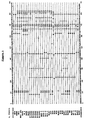
- oligonucleotide primers to conserve sequences at either end of the exon encoding the alpha 1 domain of HLA class I sequences were used (see Figure 4). The primers used were:
- the primers were synthesised using the procedure of Beaucage and Caruthers, Tetrahedron Letters 24 : 245 (1981). Amplification was performed in a buffer containing 3 mM MgCl 2 , 17 mM ammonium sulphate, 66 mM Tris of pH 8.8, 67 mM EDTA, 10% DMSO, 1mM spermidine, 200 microM of each dNTP with 50 pmol of each primer and 0.5 mcg of DNA in a 50 microlitre reaction volume.
- Example 1 The procedure of Example 1 was followed except that for allele-specific HLA-B27 group amplification the same first 5' primer was used (SEQ.ID:1) with the 3' primer 5'-CGGTCAGTCTGTGCCTT-3'(SEQ.ID:3), (see Figure 4) with 1 mM magnesium chloride in the amplification buffer, anealing at 52 o C, and the product detected by ethidium bromide staining following agarose gel electrophoresis and visualisation of a band of 210 base pairs in size.
- Example 1 The procedure of Example 1 was conducted except using the primers 5'-CCGGAACACACAGATCTT-3' (SEQ.ID:4) and 5'-GTCGTAGGCGGACTGGTC-3' (SEQ.ID:5) (see Figure 3) for allele-group-specific amplification of HLA-Bw55 and HLA-B35 alleles.
- the same procedure of Example 1 was conducted except that the magnesium chloride was provided at a concentration of 1 mM and 35 cycles were performed of 90 seconds at 94 o C, 120 seconds at 58 o C (to anneal) and 120 seconds at 72 o C.
- Prehybridisation using 1.8 x SSC, standardised sodium citrate, 10 x Denhardts solution, 2 mg/ml salmon sperm DNA and 0.2% SDS
- hybridisation using 1.8 x SSC with 0.1% SDS
- the probes used were:
- Position 1 represents a cloned negative control (HLA-Bw53), position 2 a cloned HLA-B27 allele. Samples in positions 9, 14, 15 and 24 were amplified from individuals who did not have HLA-B27 on serological typing. All other samples were taken from HLA-B27 carriers.
- HLA sub-type HLA-B2703 has been reported in a single American black. To look for this sequence in the Gambia an oligonucleotide which spans amino acid 59 of the alpha 1 domain was synthesised, which is the only position at which HLA-B*2703 differs from the most common Caucasian HLA-B27 allele, HLA-B*2705 ( Figure 4). Surprisingly, it was found that 11 of the 18 HLA-B27 positive samples from the Gambia hybridised to this oligonucleotide. All non-HLA-B27 controls did not.
- HLA class I alleles have unique sequences which will allow their detection by a single oligonucleotide probe. Many are composed of patchwork type sequences where a combination of sequence motifs defines the allelic type.
- HLA-Bw53 differs from another common allele, HLA B35, only by the presence of a short sequence at the 3' end of exon 2 that is shared by many other alleles, and which specifies the serological Bw4 epitope.
- all of these alleles can also be typed using PCR by employing specific amplification primers.
- HLA-B27 associated diseases in sub-Saharan Africa has been thought to be related to the near absence of this HLA type in unmixed Africans. This is not the case in the Gambia where nearly 3% of the population carry HLA-B27.
- An alternative and attractive explanation raised by this study is that the African sub-type of HLA-B27, B*2703, carries a lesser risk of ankylosing spondylitis and other HLA-B27 related conditions.
- Previously HLA-B*2703 has only been identified previously in one healthy American black.
- Four of the other 5 sub-types of HLA-B27 have been shown to be associated with ankylosing spondylitis.
- T lymphocytes that respond to the common sub-types HLA-B*2703 and HLA-B*2702 in both alloreactive and peptide specific cytotoxic T cell (CTL) assays fail to recognise HLA-B*2703. This would be predicted by the model of HLA-B27 disease pathogenesis which implicates cytotoxic lymphocytes reactive with an HLA-B27 specific peptide carried by foreign pathogens that crossreact with a similar or identical peptide normally expressed in joint tissues, the "arthritogenic peptide" model of ankylosing spondylitis and reactive arthritis.
- CTL cytotoxic T cell
- HLA-B*2703 The importance of determining whether or not HLA-B*2703 is associated with a high risk of ankylosing spondylitis arises from the single amino acid difference between this allele and the common Caucasian sub-type HLA-B*2705, a substitution of histidine for tyrosine at position 59 of the alpha 1 domain ( Figure 4). If the former is not a susceptibility allele this would strongly support an arthritogenic peptide model of disease pathogenesis rather than the "altered-self" and "molecular mimicry" models which propose a crucial role for the cysteine residue at position 71 or neigbouring residues. Furthermore, it would provide a potential method of screening peptides isolated from microorganisms which represent HLA-B27 epitopes for possible involvement in disease pathogenesis.
- HLA-B27 typing and sub-typing of numerous blacks with HLA-B27 related diseases may define the risk of disease associated with HLA-B*2703.
- the availability of a simple method of HLA class I typing and sub-typing may facilitate such studies.
Landscapes
- Chemical & Material Sciences (AREA)
- Life Sciences & Earth Sciences (AREA)
- Organic Chemistry (AREA)
- Health & Medical Sciences (AREA)
- Proteomics, Peptides & Aminoacids (AREA)
- Zoology (AREA)
- Molecular Biology (AREA)
- Biochemistry (AREA)
- Engineering & Computer Science (AREA)
- Genetics & Genomics (AREA)
- Immunology (AREA)
- Biophysics (AREA)
- General Health & Medical Sciences (AREA)
- Wood Science & Technology (AREA)
- Analytical Chemistry (AREA)
- Microbiology (AREA)
- Bioinformatics & Cheminformatics (AREA)
- General Engineering & Computer Science (AREA)
- Physics & Mathematics (AREA)
- Biotechnology (AREA)
- Medicinal Chemistry (AREA)
- Cell Biology (AREA)
- Chemical Kinetics & Catalysis (AREA)
- Toxicology (AREA)
- Gastroenterology & Hepatology (AREA)
- Measuring Or Testing Involving Enzymes Or Micro-Organisms (AREA)
Applications Claiming Priority (3)
| Application Number | Priority Date | Filing Date | Title |
|---|---|---|---|
| GB9024005 | 1990-11-05 | ||
| GB909024005A GB9024005D0 (en) | 1990-11-05 | 1990-11-05 | Process for amplifying nucleic acid |
| EP91918606A EP0556214B1 (fr) | 1990-11-05 | 1991-11-05 | Procede d'amplification d'acide nucleique de hla classe i |
Related Parent Applications (1)
| Application Number | Title | Priority Date | Filing Date |
|---|---|---|---|
| EP91918606A Division EP0556214B1 (fr) | 1990-11-05 | 1991-11-05 | Procede d'amplification d'acide nucleique de hla classe i |
Publications (3)
| Publication Number | Publication Date |
|---|---|
| EP0875582A2 true EP0875582A2 (fr) | 1998-11-04 |
| EP0875582A3 EP0875582A3 (fr) | 2004-03-24 |
| EP0875582B1 EP0875582B1 (fr) | 2007-06-27 |
Family
ID=10684876
Family Applications (2)
| Application Number | Title | Priority Date | Filing Date |
|---|---|---|---|
| EP91918606A Expired - Lifetime EP0556214B1 (fr) | 1990-11-05 | 1991-11-05 | Procede d'amplification d'acide nucleique de hla classe i |
| EP98108382A Expired - Lifetime EP0875582B1 (fr) | 1990-11-05 | 1991-11-05 | Procédé pour le typage de l'ADN de l'HLA de classe 1 par amplfication PCR |
Family Applications Before (1)
| Application Number | Title | Priority Date | Filing Date |
|---|---|---|---|
| EP91918606A Expired - Lifetime EP0556214B1 (fr) | 1990-11-05 | 1991-11-05 | Procede d'amplification d'acide nucleique de hla classe i |
Country Status (5)
| Country | Link |
|---|---|
| US (2) | US5525492A (fr) |
| EP (2) | EP0556214B1 (fr) |
| DE (2) | DE69131101T2 (fr) |
| GB (1) | GB9024005D0 (fr) |
| WO (1) | WO1992007956A1 (fr) |
Cited By (1)
| Publication number | Priority date | Publication date | Assignee | Title |
|---|---|---|---|---|
| US7060438B1 (en) | 1999-05-20 | 2006-06-13 | Bio Merieux | Method for analyzing a patient's genetic prediposition to at least one disease and amplification adapted to such a method |
Families Citing this family (19)
| Publication number | Priority date | Publication date | Assignee | Title |
|---|---|---|---|---|
| CA2081582A1 (fr) * | 1991-11-05 | 1993-05-06 | Teodorica Bugawan | Methodes et reactifs pour le typage de l'adn codant pour les antigenes hla de classe i |
| ES2123775T5 (es) * | 1993-03-18 | 2005-10-01 | N.V. Innogenetics S.A. | Procedimiento para la tipificacion de hla-b por medio de iniciadores especificos y conjuntos de sondas. |
| US6413747B1 (en) * | 1994-10-03 | 2002-07-02 | Shimadzu Corporation | Enhancement of nucleic acid amplification by the addition of a polyamine |
| US5550039A (en) * | 1995-03-07 | 1996-08-27 | Hoffmann-La Roche Inc. | Oligonucleotide primers for HLA class I B locus DNA typing |
| US5753442A (en) * | 1995-09-01 | 1998-05-19 | Cedars-Sinai Medical Center | Method for determining genetic predisposition for seronegative spondyloarthropathies and products useful therefor |
| GB9524381D0 (en) * | 1995-11-29 | 1996-01-31 | Anthony Nolan Bone Marrow Trus | Method for identifying an unknown allele |
| EP0910662B1 (fr) * | 1996-02-20 | 2000-11-08 | The Perkin-Elmer Corporation | Procede et reactifs de typage de genes hla de classe i |
| US6828094B2 (en) * | 1996-12-20 | 2004-12-07 | Roche Diagnostics Gmbh | Method for the uncoupled, direct, exponential amplification and sequencing of DNA molecules with the addition of a second thermostable DNA polymerase and its application |
| EP0866071B1 (fr) * | 1997-03-20 | 2004-10-20 | F. Hoffmann-La Roche Ag | Amorces modifiées |
| DE19715430A1 (de) * | 1997-04-14 | 1998-11-26 | Boehringer Mannheim Gmbh | Verfahren zur Typisierung von Allelen |
| US6783940B2 (en) * | 2001-10-31 | 2004-08-31 | Applera Corporation | Method of reducing non-specific amplification in PCR |
| PT1953551E (pt) * | 2002-12-03 | 2014-05-06 | Pathogen Removal & Diagnostic Technologies Inc | Ligandos a proteína de prião e métodos de uso |
| CN101970042A (zh) | 2008-02-25 | 2011-02-09 | 眼门药品公司 | 经由离子电渗法增强递送治疗药物至眼部组织 |
| JP5588970B2 (ja) * | 2008-05-27 | 2014-09-10 | ダコ・デンマーク・エー/エス | ハイブリダイゼーション組成物及び方法 |
| US9303287B2 (en) | 2009-02-26 | 2016-04-05 | Dako Denmark A/S | Compositions and methods for RNA hybridization applications |
| EP2507391B1 (fr) * | 2009-12-02 | 2016-08-17 | Dako Denmark A/S | Compositions et procédés pour réaliser des hybridations sans dénaturation |
| US10662465B2 (en) | 2011-09-30 | 2020-05-26 | Agilent Technologies, Inc. | Hybridization compositions and methods using formamide |
| US11118226B2 (en) | 2011-10-21 | 2021-09-14 | Agilent Technologies, Inc. | Hybridization compositions and methods |
| US20250388878A1 (en) * | 2021-10-06 | 2025-12-25 | 5Prime Biosciences, Inc. | Polymerases for mixed aqueous-organic media and uses thereof |
Family Cites Families (5)
| Publication number | Priority date | Publication date | Assignee | Title |
|---|---|---|---|---|
| CA1284931C (fr) * | 1986-03-13 | 1991-06-18 | Henry A. Erlich | Procede de detection de variations specifiques de nucleotides et de polymorphismes genetiques dans les acides nucleiques |
| US5130238A (en) * | 1988-06-24 | 1992-07-14 | Cangene Corporation | Enhanced nucleic acid amplification process |
| JPH0249589A (ja) * | 1988-08-11 | 1990-02-19 | Olympus Optical Co Ltd | Hlaクラスidnaおよびdnaプローブ並びに形質転換細胞 |
| FR2636970B1 (fr) * | 1988-09-26 | 1991-11-29 | Inst Nat Sante Rech Med | Procede de detection et de dosage d'une sequence specifique d'adn ou d'arn, reactif et necessaire pour sa mise en oeuvre |
| US5192659A (en) * | 1989-08-25 | 1993-03-09 | Genetype Ag | Intron sequence analysis method for detection of adjacent and remote locus alleles as haplotypes |
-
1990
- 1990-11-05 GB GB909024005A patent/GB9024005D0/en active Pending
-
1991
- 1991-11-05 EP EP91918606A patent/EP0556214B1/fr not_active Expired - Lifetime
- 1991-11-05 WO PCT/GB1991/001935 patent/WO1992007956A1/fr not_active Ceased
- 1991-11-05 EP EP98108382A patent/EP0875582B1/fr not_active Expired - Lifetime
- 1991-11-05 US US08/050,232 patent/US5525492A/en not_active Expired - Fee Related
- 1991-11-05 DE DE69131101T patent/DE69131101T2/de not_active Expired - Fee Related
- 1991-11-05 DE DE69133573T patent/DE69133573D1/de not_active Expired - Lifetime
-
1996
- 1996-06-11 US US08/661,767 patent/US5824515A/en not_active Expired - Fee Related
Cited By (1)
| Publication number | Priority date | Publication date | Assignee | Title |
|---|---|---|---|---|
| US7060438B1 (en) | 1999-05-20 | 2006-06-13 | Bio Merieux | Method for analyzing a patient's genetic prediposition to at least one disease and amplification adapted to such a method |
Also Published As
| Publication number | Publication date |
|---|---|
| US5525492A (en) | 1996-06-11 |
| EP0556214A1 (fr) | 1993-08-25 |
| US5824515A (en) | 1998-10-20 |
| WO1992007956A1 (fr) | 1992-05-14 |
| EP0875582B1 (fr) | 2007-06-27 |
| DE69131101T2 (de) | 1999-08-12 |
| EP0556214B1 (fr) | 1999-04-07 |
| GB9024005D0 (en) | 1990-12-19 |
| EP0875582A3 (fr) | 2004-03-24 |
| DE69133573D1 (de) | 2007-08-09 |
| DE69131101D1 (de) | 1999-05-12 |
Similar Documents
| Publication | Publication Date | Title |
|---|---|---|
| EP0875582B1 (fr) | Procédé pour le typage de l'ADN de l'HLA de classe 1 par amplfication PCR | |
| EP0417160B1 (fr) | Procede de determination de type de hla dp | |
| Dejean et al. | Hepatitis B virus DNA integration in a sequence homologous to v-erb-A and steroid receptor genes in a hepatocellular carcinoma | |
| Palacio et al. | Single-strand conformation polymorphism (SSCP) analysis as a tool for viroid characterisation | |
| KR100735137B1 (ko) | 핵산 염기서열의 결정방법 | |
| Giebel et al. | Rapid detection of genomic variations in different strains of hantaviruses by polymerase chain reaction techniques and nucleotide sequence analysis | |
| Nadin-Davis et al. | The design of strain-specific polymerase chain reactions for discrimination of the racoon rabies virus strain fron indigenous rabies viruses of Ontario | |
| Yao et al. | Identification of two major HLA-B44 subtypes and a novel B44 sequence (B∗ 4404): Oligotyping and solid phase sequencing of polymerase chain reaction products | |
| US5545526A (en) | Method for HLA Typing | |
| Reddy et al. | Localization of the HumanRor1Gene (NTRKR1) to chromosome 1p31–p32 by fluorescencein SituHybridization and somatic cell hybrid analysis | |
| Wu et al. | MHC (major histocompatibility complex)-DRB genes and polymorphisms in common marmoset | |
| ES2534935T3 (es) | Procedimiento para determinar el locus del antígeno de histocompatibilidad clase II | |
| US6492109B1 (en) | Susceptibility mutation 6495delGC of BRCA2 | |
| JP4145129B2 (ja) | Pcrクランピング法 | |
| JP3417601B2 (ja) | Hla−dp型決定法 | |
| EP1113079A2 (fr) | Un procédé pour le typage des polymorphismes des gènes MHC classe II d'origine bovine | |
| Dhar et al. | Alu elements in a Plasmodium vivax antigen gene | |
| WO2004000998A2 (fr) | Compositions et procedes pour des genes de resistance aux virus | |
| Li et al. | Identification of a novel HLA‐A* 11 allele, HLA‐A* 11: 333, in a Chinese individual. | |
| US6379881B1 (en) | Nucleic acids and methods for the discrimination between syncytium inducing and non syncytium inducing variants of the human immunodeficiency virus | |
| Savoia et al. | Molecular characterization of Fanconi anaemia group C (FAC) gene polymorphisms | |
| CA1339206C (fr) | Methode pour le typage de hla-dp | |
| CN114540505A (zh) | 一种用于鉴定奶牛基因型的引物及其应用 | |
| JP2001514887A5 (fr) | ||
| CN112899353A (zh) | 一种用于dna聚合酶识别特异性的缓冲液及其应用 |
Legal Events
| Date | Code | Title | Description |
|---|---|---|---|
| PUAI | Public reference made under article 153(3) epc to a published international application that has entered the european phase |
Free format text: ORIGINAL CODE: 0009012 |
|
| 17P | Request for examination filed |
Effective date: 19980507 |
|
| AC | Divisional application: reference to earlier application |
Ref document number: 556214 Country of ref document: EP |
|
| AK | Designated contracting states |
Kind code of ref document: A2 Designated state(s): CH DE FR GB IT LI SE |
|
| PUAL | Search report despatched |
Free format text: ORIGINAL CODE: 0009013 |
|
| AK | Designated contracting states |
Kind code of ref document: A3 Designated state(s): CH DE FR GB IT LI SE |
|
| 17Q | First examination report despatched |
Effective date: 20050221 |
|
| GRAP | Despatch of communication of intention to grant a patent |
Free format text: ORIGINAL CODE: EPIDOSNIGR1 |
|
| GRAS | Grant fee paid |
Free format text: ORIGINAL CODE: EPIDOSNIGR3 |
|
| GRAA | (expected) grant |
Free format text: ORIGINAL CODE: 0009210 |
|
| AC | Divisional application: reference to earlier application |
Ref document number: 0556214 Country of ref document: EP Kind code of ref document: P |
|
| AK | Designated contracting states |
Kind code of ref document: B1 Designated state(s): CH DE FR GB IT LI SE |
|
| REG | Reference to a national code |
Ref country code: GB Ref legal event code: FG4D |
|
| REG | Reference to a national code |
Ref country code: CH Ref legal event code: EP |
|
| REF | Corresponds to: |
Ref document number: 69133573 Country of ref document: DE Date of ref document: 20070809 Kind code of ref document: P |
|
| PG25 | Lapsed in a contracting state [announced via postgrant information from national office to epo] |
Ref country code: SE Free format text: LAPSE BECAUSE OF FAILURE TO SUBMIT A TRANSLATION OF THE DESCRIPTION OR TO PAY THE FEE WITHIN THE PRESCRIBED TIME-LIMIT Effective date: 20070927 |
|
| REG | Reference to a national code |
Ref country code: CH Ref legal event code: PL |
|
| EN | Fr: translation not filed | ||
| PG25 | Lapsed in a contracting state [announced via postgrant information from national office to epo] |
Ref country code: CH Free format text: LAPSE BECAUSE OF FAILURE TO SUBMIT A TRANSLATION OF THE DESCRIPTION OR TO PAY THE FEE WITHIN THE PRESCRIBED TIME-LIMIT Effective date: 20070627 Ref country code: LI Free format text: LAPSE BECAUSE OF FAILURE TO SUBMIT A TRANSLATION OF THE DESCRIPTION OR TO PAY THE FEE WITHIN THE PRESCRIBED TIME-LIMIT Effective date: 20070627 |
|
| PG25 | Lapsed in a contracting state [announced via postgrant information from national office to epo] |
Ref country code: IT Free format text: LAPSE BECAUSE OF FAILURE TO SUBMIT A TRANSLATION OF THE DESCRIPTION OR TO PAY THE FEE WITHIN THE PRESCRIBED TIME-LIMIT Effective date: 20070627 Ref country code: DE Free format text: LAPSE BECAUSE OF FAILURE TO SUBMIT A TRANSLATION OF THE DESCRIPTION OR TO PAY THE FEE WITHIN THE PRESCRIBED TIME-LIMIT Effective date: 20070928 |
|
| PLBE | No opposition filed within time limit |
Free format text: ORIGINAL CODE: 0009261 |
|
| STAA | Information on the status of an ep patent application or granted ep patent |
Free format text: STATUS: NO OPPOSITION FILED WITHIN TIME LIMIT |
|
| 26N | No opposition filed |
Effective date: 20080328 |
|
| GBPC | Gb: european patent ceased through non-payment of renewal fee |
Effective date: 20071105 |
|
| PG25 | Lapsed in a contracting state [announced via postgrant information from national office to epo] |
Ref country code: FR Free format text: LAPSE BECAUSE OF FAILURE TO SUBMIT A TRANSLATION OF THE DESCRIPTION OR TO PAY THE FEE WITHIN THE PRESCRIBED TIME-LIMIT Effective date: 20080222 |
|
| PG25 | Lapsed in a contracting state [announced via postgrant information from national office to epo] |
Ref country code: GB Free format text: LAPSE BECAUSE OF NON-PAYMENT OF DUE FEES Effective date: 20071105 |