EP0875808A2 - Verfahren und System zur Generierung eines Prozessmodells eines technischen Prozesses - Google Patents
Verfahren und System zur Generierung eines Prozessmodells eines technischen Prozesses Download PDFInfo
- Publication number
- EP0875808A2 EP0875808A2 EP98107770A EP98107770A EP0875808A2 EP 0875808 A2 EP0875808 A2 EP 0875808A2 EP 98107770 A EP98107770 A EP 98107770A EP 98107770 A EP98107770 A EP 98107770A EP 0875808 A2 EP0875808 A2 EP 0875808A2
- Authority
- EP
- European Patent Office
- Prior art keywords
- linear
- model
- process model
- network
- generating
- Prior art date
- Legal status (The legal status is an assumption and is not a legal conclusion. Google has not performed a legal analysis and makes no representation as to the accuracy of the status listed.)
- Withdrawn
Links
Images

Classifications
-
- G—PHYSICS
- G05—CONTROLLING; REGULATING
- G05B—CONTROL OR REGULATING SYSTEMS IN GENERAL; FUNCTIONAL ELEMENTS OF SUCH SYSTEMS; MONITORING OR TESTING ARRANGEMENTS FOR SUCH SYSTEMS OR ELEMENTS
- G05B13/00—Adaptive control systems, i.e. systems automatically adjusting themselves to have a performance which is optimum according to some preassigned criterion
- G05B13/02—Adaptive control systems, i.e. systems automatically adjusting themselves to have a performance which is optimum according to some preassigned criterion electric
- G05B13/04—Adaptive control systems, i.e. systems automatically adjusting themselves to have a performance which is optimum according to some preassigned criterion electric involving the use of models or simulators
- G05B13/042—Adaptive control systems, i.e. systems automatically adjusting themselves to have a performance which is optimum according to some preassigned criterion electric involving the use of models or simulators in which a parameter or coefficient is automatically adjusted to optimise the performance
-
- G—PHYSICS
- G05—CONTROLLING; REGULATING
- G05B—CONTROL OR REGULATING SYSTEMS IN GENERAL; FUNCTIONAL ELEMENTS OF SUCH SYSTEMS; MONITORING OR TESTING ARRANGEMENTS FOR SUCH SYSTEMS OR ELEMENTS
- G05B17/00—Systems involving the use of models or simulators of said systems
- G05B17/02—Systems involving the use of models or simulators of said systems electric
Definitions
- the invention relates to a method and a system for generating a process model of a technical process according to The preamble of claim 1 and the preamble of the claim 4th
- Process models serve to map, analyze and optimize technical processes, these processes being both production facilities as well as individual system components or even single units can act. As a rule, should Process models to be expected from given input parameters Predict output variables, they can be part of a scheme of the process.
- nonlinear optimization algorithms are used with an extremely high computing effort, especially in associated with the learning phase.
- a special difficulty also represents the formation of the neural network structure, i.e. the Choice of the number of individual neuronal cells and their network-like Connections.
- the invention is therefore based on the object of a generic Method or system for generating a process model to create which is able to comparatively low cost of nonlinear behavior of complex systems model and that are used for process control can that process optimization is achieved.
- the invention takes advantage of both the ability of neural networks to be able to map very complex process behavior as well Possibility of using reliable statistical methods on a process model.
- the statistical methods can be used the combination of a linear and a neural according to the invention Apply network, although the transmission is statistical Statements on neural networks alone are not possible.
- a preferred embodiment of the invention provides that the neuronal cells according to the method of radial basis functions work, being particularly beneficial for imaging quality of the process model is when the radial basis functions are of the Gauss type.
- the method of radial basis functions is for example from J. Moody and C. Darken, "Fast learning in networks of locally tuned processing units ", Neural Computation, 1: 281-294, 1989.
- the method according to the invention and the system for generation a process model of a technical process becomes an example in Fig. 1 explained in the manufacture of particle board.
- the method according to the invention can be used to analyze production processes especially for forecasting and monitoring of product quality and for process optimization in general be used. It is based on a process model that measured process parameters is obtained and that for prediction of quality measures and used for process control is that the process costs with a desired product quality be minimized.
- the goal is to achieve a desired product quality minimal use of resources such as energy, water or glue addition to reach.
- process parameters are, on the one hand, adjustable variables 1, such as the gluing factor, belt speeds, chip fractions, amount of liquid and, on the other hand, variables 2 which cannot be influenced and which are determined by measurements. Such measured values are, for example, temperatures, pressures, press travel, etc.
- process parameters 1 and 2 are referred to as M input variables when forming the process model.
- the quality features in the production of chipboard are the properties of the boards, for example the transverse tensile strength, the swelling or the bending strength, and are determined in the laboratory.
- the quality features 3 are referred to as L output variables when forming the process model.
- Both the quality features 3 and the process parameters 1 and 2 represent the data records necessary for the process model formation.
- the process model 4, including its structure, is to be generated by means of a number of N training data records.
- the training data records contain an already verified assignment of input values to output values. For the Nth training data record, this means the assignment of the input values x n1 , x n2 ..., n xM to the output values y n1 , y n2 ..., y nL . These individual input or output values can each be combined to form input vectors x n or output vectors y n .
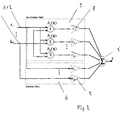
- the process model 4 shown in FIG. 2 is composed of a neural network 5 and a linear network 6 together.
- the neural Network 5 has neural cells 7, each with each other are networked and all process parameters x1 to xnm are fed.
- the neuronal cells 7 use radial basic functions to process the input vector into individual activation values h 1 to h K.
- a radial basis function is a function of the distance of the input vector X n from its basis center V K.
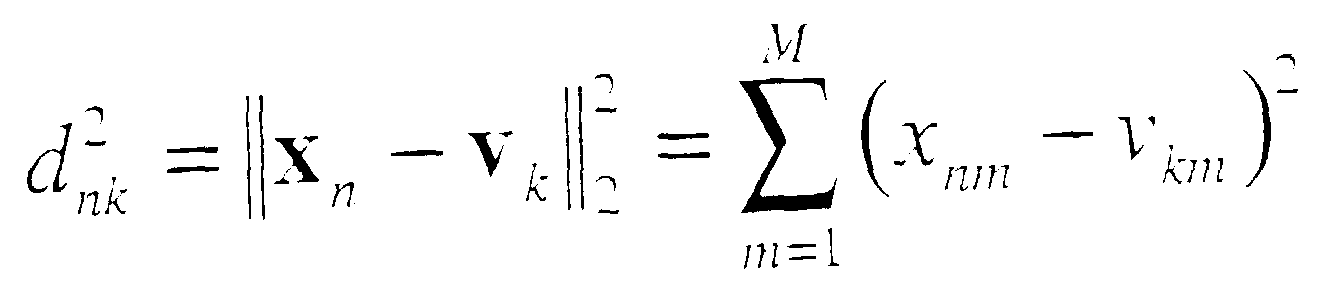
- radial basic functions of the Gauss type and the Euclidean distance are used. This distance results from:
- the neuronal cells 7 differ with regard to the base centers.
- the activation values are then calculated from the Euclidean distance and the expansion parameter of the Gaussian function:
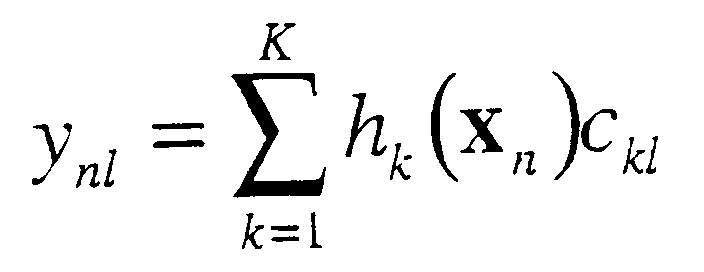
- the activation values of the neural network become after performing a linear combination of the basic functions
- c 1 ... c kl are so-called weighting factors 8. These activation values are weighted by the weighting factors c 1 to c K and fed to the summing point 11.
- the linear network 6 is arranged parallel to the neural network, to which the input variables X 1 to X M are also fed, and which carries out a linear combination of these input variables weighted by the weighting factors w 1 to w M 9. These weighted signals are also fed to the common summation point 9 ', as a result of which the lth output of the combined network is increased results.
- w 0 represents a constant 0th order term of the linear component.
- the weighting factors are determined using the method of least squares from the training data sets.
- the base centers V k contain nonlinear parameters, statistical methods, such as, for example, the least squares method, can surprisingly be used for solving if a neural cell is set up for each of the N training data sets within the neural network. The center of this neuronal cell is thus placed on the corresponding input vector.
- the initial neural model therefore has N neuronal cells in the first phase. In this phase, each base center V k corresponds to an input vector X n . All non-linear parameters can be determined by this method step and the known statistical evaluation methods can be used.
- Step of stepwise regression solved namely a meaningful structure determination is carried out, which leads to a very simplified model with a much smaller one Number of neuronal cells leads.
- This regression model can be used because, as already mentioned above, to the nonlinear parameters are already known at this time are.
- the method of stepwise regression is from the Literature, for example M.J.L. Orr, "Regularization in the selection of radial basis function centers ", neural computation, 7 (3): 606-623, 1995.
- a variant of this is the so-called forward selection algorithm, the one with an empty regression model and a lot of basic functions as candidates starts, then the reduction for each remaining candidate of the model error, which is caused by adding it would be the candidate who has the greatest error reduction causes the model to be added. From each of the Candidates of the set of remaining candidates will now again the model error determined by adding it and the next candidate will be added which would then bring about the greatest reduction in errors. These steps are repeated until an abort criterion is reached and the structure determination is finished.
- the forward selection process as such, S. Chen, C.F.N. Cowan and P. M. Grant, "Orthogonal least squares learning for radial basis function networks ", IEEE Trans. Neural Networks, 2 (2): 302-309, 1991.
- a number of basic functions to be selected are candidates understood that are available for the process model.
- the termination criterion takes into account the change in the selection criterion as an estimate of the generalization error to be expected before and after the addition of a new candidate, ie a new basic function, and is inherently from G. Deco and D. Obradovic, "An Information-Theoretic Approach to Neural Computing” Springer, known in 1996. If the selection criterion rises again after adding another basic function, this indicates that the process model is in the over-adaptation range and the selection process must then be terminated at this point. At this point in time, there are then only K neuronal cells 10 together with their weighting factors c 1 to c K in the neural network.
- This reduced process model 4 is now in an evaluation unit 11 filed.
- Process parameters 1 and 2 as input variables or as input vector the process model 4 stored in the evaluation unit 11 fed.
- the resulting output variables L (shown by arrow 12) are then fed to an evaluation unit 13.
- the output quantities describe the predicted quality quantities the chipboard.
- the influenceable process parameters 1 calculated from the predicted quality values.
- the calculated ones can then be controlled by a control device 14 Process parameters can be set.
Landscapes
- Engineering & Computer Science (AREA)
- Physics & Mathematics (AREA)
- General Physics & Mathematics (AREA)
- Automation & Control Theory (AREA)
- Health & Medical Sciences (AREA)
- Artificial Intelligence (AREA)
- Computer Vision & Pattern Recognition (AREA)
- Evolutionary Computation (AREA)
- Medical Informatics (AREA)
- Software Systems (AREA)
- Feedback Control In General (AREA)
- Management, Administration, Business Operations System, And Electronic Commerce (AREA)
Abstract
Description
- Fig. 1:
- ein Blockdiagramm;
- Fig. 2:
- eine Darstellung der Struktur des Prozeßmodells gemäß der Erfindung und
- Fig. 3:
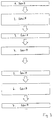
- ein Ablaufdiagramm des erfindungsgemäßen Verfahrens


Claims (4)
- Verfahren zum Generieren eines Prozeßmodells eines technischen Prozesses, durch welches einer Anzahl von M Prozeßparametern als Eingangsgrößen eine Anzahl von L Qualitätsmerkmalen als Ausgangsgrößen zugeordnet werden, dadurch gekennzeichnet, daß in einem ersten Schritt N Trainingsdatensätze des technischen Prozesses ermittelt werden, die in einem zweiten Schritt während einer Lernphase mit einer Datenprozessoreinrichtung mittels eines vorläufigen Abbildungsmodells, bei welchem parallel zu einem neuronalen Netz mit lokal approximierenden Eigenschaften, welches eine Anzahl von N neuronalen Zellen aufweist, ein lineares Netz geschaltet ist, welches eine gewichtete Linearkombination der M Prozeßparameter durchführt, wobei das lineare und das neuronale Netz einen gemeinsamen Ausgangssummenpunkt besitzen, und daß in einem dritten Schritt eine Reduktion des neuronalen und des linearen Netzes auf ein Prozeßmodell mit K neuronalen Zellen und M-R gewichteten Linearkombinationen durch Anwendung der Methode der schrittweisen Regression auf das vorläufige Abbildungsmodell erfolgt und daß in einem vierten Schritt aktuelle Prozeßparameter ermittelt werden und in einem fünften Schritt dem Prozeßmodell zugeführt werden, welches als Ausgangsgröße zu erwartende Qualitätsmerkmale bestimmt und in einem sechsten Schritt aus diesen berechneten Qualitätsmerkmalen mittels eines Optimierungsalgorithmus die einzustellenden Prozeßparameter ermittelt und diese anschließend in einem siebten Schritt am Prozeß eingestellt werden.
- Verfahren zum Generieren eines Prozeßmodells eines technischen Prozesses nach Patentanspruch 1, dadurch gekennzeichnet, daß das neuronale Netz aus Radial-Basis-Neuronen besteht und Radial-Basis-Funktionen kombiniert.
- Verfahren zum Generieren eines Prozeßmodells eines technischen Prozesses nach Patentanspruch 2, dadurch gekennzeichnet, daß die Radial-Basis-Funktionen vom Gauß-Typ sind.
- System zum Generieren eines Prozeßmodells eines technischen Prozesses anhand von N Trainingsdatensätzen, durch welches einer Anzahl von M Prozeßparametern als Eingangsgrößen eine Anzahl von L Qualitätsmerkmalen als Ausgangsgrößen zugeordnet werden, dadurch gekennzeichnet, daß die Prozeßmodellstruktur ein parallel zu einem neuronalen Netz mit lokal approximierenden Eigenschaften, welches eine Anzahl von K neuronalen Zellen besitzt, geschaltetes lineares Netz aufweist, welches eine gewichtete Linearkombination von höchstens M Prozeßparametern durchführt, wobei das lineare und das neuronale Netz einen gemeinsamen Ausgangssummenpunkt besitzen, wobei K kleiner oder gleich N ist.
Applications Claiming Priority (2)
| Application Number | Priority Date | Filing Date | Title |
|---|---|---|---|
| DE19718262 | 1997-04-30 | ||
| DE19718262A DE19718262A1 (de) | 1997-04-30 | 1997-04-30 | Verfahren und System zur Generierung eines Prozeßmodells eines technischen Problems |
Publications (2)
| Publication Number | Publication Date |
|---|---|
| EP0875808A2 true EP0875808A2 (de) | 1998-11-04 |
| EP0875808A3 EP0875808A3 (de) | 1998-11-18 |
Family
ID=7828221
Family Applications (1)
| Application Number | Title | Priority Date | Filing Date |
|---|---|---|---|
| EP98107770A Withdrawn EP0875808A3 (de) | 1997-04-30 | 1998-04-29 | Verfahren und System zur Generierung eines Prozessmodells eines technischen Prozesses |
Country Status (4)
| Country | Link |
|---|---|
| US (1) | US6212438B1 (de) |
| EP (1) | EP0875808A3 (de) |
| CA (1) | CA2236426C (de) |
| DE (1) | DE19718262A1 (de) |
Cited By (6)
| Publication number | Priority date | Publication date | Assignee | Title |
|---|---|---|---|---|
| DE10036971A1 (de) * | 2000-07-28 | 2002-02-28 | Siemens Ag | Verfahren zur Ferndiagnose eines technologischen Prozesses |
| WO2001069329A3 (en) * | 2000-03-10 | 2002-06-13 | Cyrano Sciences Inc | Control for an industrial process using one or more multidimensional variables |
| DE102006059430A1 (de) * | 2006-12-15 | 2008-06-19 | Robert Bosch Gmbh | Automatisierte Erstellung und Adaption eines Maschinen- oder Anlagenmodells |
| WO2017125408A1 (en) * | 2016-01-20 | 2017-07-27 | Robert Bosch Gmbh | Value addition dependent data mining techniques for assembly lines |
| WO2021165394A1 (de) * | 2020-02-18 | 2021-08-26 | Dieffenbacher GmbH Maschinen- und Anlagenbau | Verfahren zur herstellung von werkstoffplatten in einer produktionsanlage, produktionsanlage, computerprogrammprodukt und verwendung eines computerprogrammprodukts |
| DE102021209582A1 (de) | 2021-09-01 | 2023-03-02 | Robert Bosch Gesellschaft mit beschränkter Haftung | Verfahren und Steuergerät zur automatisierten Optimierung von einstellbaren Parametern eines steuerbaren Systems zum Ausführen eines Prozesses basierend auf entsprechend eingestellten Parametern |
Families Citing this family (13)
| Publication number | Priority date | Publication date | Assignee | Title |
|---|---|---|---|---|
| EP1021263B1 (de) * | 1998-07-21 | 2004-11-03 | Dofasco Inc. | Auf einem multivariablen statistischen modell basierendes system zur darstellung des betriebs einer stranggiessanlage und detektion bevorstehender durchbrüche |
| US6725208B1 (en) * | 1998-10-06 | 2004-04-20 | Pavilion Technologies, Inc. | Bayesian neural networks for optimization and control |
| GB0124130D0 (en) * | 2001-10-08 | 2001-11-28 | Millennium Venture Holdings Lt | Improvements relating to staged production in volume manufacture |
| US20040076944A1 (en) * | 2002-08-22 | 2004-04-22 | Ibex Process Technology, Inc. | Supervised learning in the presence of null data |
| CA2414167A1 (en) * | 2002-12-12 | 2004-06-12 | Dofasco Inc. | Method and online system for monitoring continuous caster start-up operation and predicting start cast breakouts |
| US6885907B1 (en) | 2004-05-27 | 2005-04-26 | Dofasco Inc. | Real-time system and method of monitoring transient operations in continuous casting process for breakout prevention |
| US20060036345A1 (en) * | 2004-08-09 | 2006-02-16 | An Cao | Systems and method for lights-out manufacturing |
| US20080077907A1 (en) * | 2006-09-21 | 2008-03-27 | Kulkami Anand P | Neural network-based system and methods for performing optical proximity correction |
| FR2944125B1 (fr) * | 2009-04-03 | 2015-10-30 | Airbus France | Procede d'identification de modeles aerodynamiques pour procede de simulation d'aeronef. |
| CN103675005B (zh) * | 2013-09-22 | 2015-09-30 | 浙江大学 | 最优模糊网络的工业熔融指数软测量仪表及方法 |
| CN110824954A (zh) * | 2019-10-24 | 2020-02-21 | 北京仿真中心 | 智能体训练方法及系统、计算机设备、可读存储介质 |
| US20230051330A1 (en) * | 2021-08-16 | 2023-02-16 | Applied Materials Inc. | Using defect models to estimate defect risk and optimize process recipes |
| CN114638117B (zh) * | 2022-03-29 | 2022-11-08 | 厦门链建科技有限公司 | 一种基于人工智能的数据处理方法、系统及云平台 |
Family Cites Families (12)
| Publication number | Priority date | Publication date | Assignee | Title |
|---|---|---|---|---|
| US5159660A (en) * | 1990-08-09 | 1992-10-27 | Western Thunder | Universal process control using artificial neural networks |
| US5377307A (en) * | 1992-10-07 | 1994-12-27 | Schlumberger Technology Corporation | System and method of global optimization using artificial neural networks |
| US5966302A (en) * | 1992-10-16 | 1999-10-12 | Pitney Bowes Inc. | Sheet processing system with neural network control |
| DE4416364B4 (de) * | 1993-05-17 | 2004-10-28 | Siemens Ag | Verfahren und Regeleinrichtung zur Regelung eines Prozesses |
| US6000827A (en) * | 1993-09-10 | 1999-12-14 | Fujitsu Limited | System identifying device and adaptive learning control device |
| DE4338608B4 (de) * | 1993-11-11 | 2005-10-06 | Siemens Ag | Verfahren und Vorrichtung zur Führung eines Prozesses in einem geregelten System |
| DE4338607B4 (de) * | 1993-11-11 | 2005-10-06 | Siemens Ag | Verfahren und Vorrichtung zur Führung eines Prozesses in einem geregelten System |
| DE4338615B4 (de) * | 1993-11-11 | 2005-10-13 | Siemens Ag | Verfahren und Vorrichtung zur Führung eines Prozesses in einem geregelten System |
| US5704011A (en) * | 1994-11-01 | 1997-12-30 | The Foxboro Company | Method and apparatus for providing multivariable nonlinear control |
| DE19516426A1 (de) * | 1995-05-04 | 1996-11-07 | Siemens Ag | Anordnung zur Modellierung eines dynamischen Prozesses |
| US5877954A (en) * | 1996-05-03 | 1999-03-02 | Aspen Technology, Inc. | Hybrid linear-neural network process control |
| US5999893A (en) * | 1997-05-02 | 1999-12-07 | The United States Of America As Represented By The Secretary Of The Navy | Classification system and method using combined information testing |
-
1997
- 1997-04-30 DE DE19718262A patent/DE19718262A1/de not_active Withdrawn
-
1998
- 1998-04-23 US US09/065,393 patent/US6212438B1/en not_active Expired - Fee Related
- 1998-04-29 EP EP98107770A patent/EP0875808A3/de not_active Withdrawn
- 1998-04-30 CA CA002236426A patent/CA2236426C/en not_active Expired - Fee Related
Cited By (16)
| Publication number | Priority date | Publication date | Assignee | Title |
|---|---|---|---|---|
| US8352049B2 (en) | 2000-03-10 | 2013-01-08 | Smiths Detection Inc. | Temporary expanding integrated monitoring network |
| WO2001069329A3 (en) * | 2000-03-10 | 2002-06-13 | Cyrano Sciences Inc | Control for an industrial process using one or more multidimensional variables |
| US6985779B2 (en) | 2000-03-10 | 2006-01-10 | Smiths Detection, Inc. | Monitoring system for an industrial process using one or more multidimensional variables |
| US7031778B2 (en) | 2000-03-10 | 2006-04-18 | Smiths Detection Inc. | Temporary expanding integrated monitoring network |
| US7313447B2 (en) | 2000-03-10 | 2007-12-25 | Smiths Detection Inc. | Temporary expanding integrated monitoring network |
| US7912561B2 (en) | 2000-03-10 | 2011-03-22 | Smiths Detection Inc. | Temporary expanding integrated monitoring network |
| DE10036971A1 (de) * | 2000-07-28 | 2002-02-28 | Siemens Ag | Verfahren zur Ferndiagnose eines technologischen Prozesses |
| US8855792B2 (en) | 2006-12-15 | 2014-10-07 | Robert Bosch Gmbh | Automated creation and adaption of a machine or system model |
| DE102006059430A1 (de) * | 2006-12-15 | 2008-06-19 | Robert Bosch Gmbh | Automatisierte Erstellung und Adaption eines Maschinen- oder Anlagenmodells |
| WO2017125408A1 (en) * | 2016-01-20 | 2017-07-27 | Robert Bosch Gmbh | Value addition dependent data mining techniques for assembly lines |
| CN108780313A (zh) * | 2016-01-20 | 2018-11-09 | 罗伯特·博世有限公司 | 用于装配线的增值相关数据挖掘技术 |
| US10817800B2 (en) | 2016-01-20 | 2020-10-27 | Robert Bosch Gmbh | Value addition dependent data mining techniques for assembly lines |
| CN108780313B (zh) * | 2016-01-20 | 2021-04-09 | 罗伯特·博世有限公司 | 为装配线执行目标参数分析的方法、系统和计算机可读介质 |
| WO2021165394A1 (de) * | 2020-02-18 | 2021-08-26 | Dieffenbacher GmbH Maschinen- und Anlagenbau | Verfahren zur herstellung von werkstoffplatten in einer produktionsanlage, produktionsanlage, computerprogrammprodukt und verwendung eines computerprogrammprodukts |
| CN115136078A (zh) * | 2020-02-18 | 2022-09-30 | 迪芬巴赫机械工程有限公司 | 用于在生产设备中生产材料板的方法、生产设备、计算机程序产品及计算机程序产品的应用 |
| DE102021209582A1 (de) | 2021-09-01 | 2023-03-02 | Robert Bosch Gesellschaft mit beschränkter Haftung | Verfahren und Steuergerät zur automatisierten Optimierung von einstellbaren Parametern eines steuerbaren Systems zum Ausführen eines Prozesses basierend auf entsprechend eingestellten Parametern |
Also Published As
| Publication number | Publication date |
|---|---|
| US6212438B1 (en) | 2001-04-03 |
| DE19718262A1 (de) | 1998-11-05 |
| CA2236426C (en) | 2000-08-08 |
| CA2236426A1 (en) | 1998-10-30 |
| EP0875808A3 (de) | 1998-11-18 |
Similar Documents
| Publication | Publication Date | Title |
|---|---|---|
| EP0875808A2 (de) | Verfahren und System zur Generierung eines Prozessmodells eines technischen Prozesses | |
| EP4193135B1 (de) | Computerimplementiertes verfahren zum bereitstellen eines test-verlaufs zu testender verkehrsszenarien | |
| EP3701433B1 (de) | Verfahren, vorrichtung und computerprogramm zur erstellung eines tiefen neuronalen netzes | |
| DE102018220941A1 (de) | Auswertung von Messgrößen mit KI-Modulen unter Berücksichtigung von Messunsicherheiten | |
| DE102007006616B3 (de) | Verfahren zur Optimierung eines elektronisch gesteuerten automatisch schaltenden Getriebes für ein Kraftfahrzeug | |
| EP2433185B1 (de) | Vorrichtung und verfahren zum bearbeiten einer prozesssimulationsdatenbasis eines prozesses | |
| DE4121453C2 (de) | Näherungsschlußfolgerungsvorrichtung | |
| EP3786853B1 (de) | Komprimieren eines tiefen neuronalen netzes | |
| WO2018206522A1 (de) | Produktreifebestimmung eines technischen systems und insbesondere eines autonom fahrenden fahrzeugs | |
| DE102020205962B3 (de) | Vorrichtung und Verfahren zum Betreiben eines Prüfstands | |
| DE19703964C1 (de) | Verfahren zur Transformation einer zur Nachbildung eines technischen Prozesses dienenden Fuzzy-Logik in ein neuronales Netz | |
| WO2020193481A1 (de) | Verfahren und vorrichtung für training und herstellung eines künstlichen neuronalen netzes | |
| DE19963123B4 (de) | Analytisches Informationssystem | |
| DE69414636T2 (de) | Neuronales Netzwerk für Signalverarbeitung | |
| DE69123623T2 (de) | Unscharfe Folgerungsanlage | |
| EP3629252A1 (de) | Verfahren und vorrichtung zum betreiben eines steuerungssystems | |
| DE3910036C1 (de) | ||
| DE3609925C2 (de) | ||
| DE202017105656U1 (de) | Prädiktives Messsystem, Aktorsteuerungssystem und Vorrichtung zum Betreiben des prädiktiven Messsystems und/oder des Aktorsteuerungssystems | |
| DE102007032926A1 (de) | Verfahren und Vorrichtung zur Produktionsplanung | |
| DE102024102864A1 (de) | Verfahren zum Bestimmen eines Produktionsdurchsatzes einer Fertigungsanlage zur Herstellung von Bauteilen, Computerprogramm und elektronisch lesbarer Datenträger | |
| DE102019207016A1 (de) | Verfahren zum Ermitteln eines Systemmodells für ein technisches System | |
| DE19848059A1 (de) | Verfahren zur Generierung eines Prozeßmodells bei der Herstellung von Plattenprodukten | |
| EP3586744A1 (de) | Verfahren und system zur ganganalyse | |
| DE202021103700U1 (de) | Vorrichtung zum Erzeugen eines künstlichen neuronalen Netzes |
Legal Events
| Date | Code | Title | Description |
|---|---|---|---|
| PUAI | Public reference made under article 153(3) epc to a published international application that has entered the european phase |
Free format text: ORIGINAL CODE: 0009012 |
|
| PUAL | Search report despatched |
Free format text: ORIGINAL CODE: 0009013 |
|
| AK | Designated contracting states |
Kind code of ref document: A2 Designated state(s): DE IT SE |
|
| AX | Request for extension of the european patent |
Free format text: AL;LT;LV;MK;RO;SI |
|
| AK | Designated contracting states |
Kind code of ref document: A3 Designated state(s): AT BE CH CY DE DK ES FI FR GB GR IE IT LI LU MC NL PT SE |
|
| AX | Request for extension of the european patent |
Free format text: AL;LT;LV;MK;RO;SI |
|
| 17P | Request for examination filed |
Effective date: 19990512 |
|
| AKX | Designation fees paid |
Free format text: DE IT SE |
|
| STAA | Information on the status of an ep patent application or granted ep patent |
Free format text: STATUS: THE APPLICATION IS DEEMED TO BE WITHDRAWN |
|
| 18D | Application deemed to be withdrawn |
Effective date: 20021105 |