EP0877010B1 - Fluorierte Alkane und ihre Verwendungen - Google Patents
Fluorierte Alkane und ihre Verwendungen Download PDFInfo
- Publication number
- EP0877010B1 EP0877010B1 EP98106109A EP98106109A EP0877010B1 EP 0877010 B1 EP0877010 B1 EP 0877010B1 EP 98106109 A EP98106109 A EP 98106109A EP 98106109 A EP98106109 A EP 98106109A EP 0877010 B1 EP0877010 B1 EP 0877010B1
- Authority
- EP
- European Patent Office
- Prior art keywords
- alkane according
- alkyls
- alkane
- perfluoro
- solvent
- Prior art date
- Legal status (The legal status is an assumption and is not a legal conclusion. Google has not performed a legal analysis and makes no representation as to the accuracy of the status listed.)
- Revoked
Links
- 150000001335 aliphatic alkanes Chemical class 0.000 title claims abstract description 50
- 125000000753 cycloalkyl group Chemical group 0.000 claims abstract description 5
- 125000005460 perfluorocycloalkyl group Chemical group 0.000 claims abstract description 4
- 239000002904 solvent Substances 0.000 claims description 25
- 125000001424 substituent group Chemical group 0.000 claims description 16
- 239000007943 implant Substances 0.000 claims description 8
- 239000007788 liquid Substances 0.000 claims description 7
- 239000003814 drug Substances 0.000 claims description 5
- 210000004072 lung Anatomy 0.000 claims description 5
- 238000004140 cleaning Methods 0.000 claims description 4
- 229930195733 hydrocarbon Natural products 0.000 claims description 4
- 150000002430 hydrocarbons Chemical class 0.000 claims description 4
- 229940079593 drug Drugs 0.000 claims description 3
- 210000001525 retina Anatomy 0.000 claims description 3
- 239000003633 blood substitute Substances 0.000 claims description 2
- 239000003795 chemical substances by application Substances 0.000 claims description 2
- 230000015271 coagulation Effects 0.000 claims description 2
- 238000005345 coagulation Methods 0.000 claims description 2
- 239000000314 lubricant Substances 0.000 claims description 2
- 230000002980 postoperative effect Effects 0.000 claims description 2
- 230000002207 retinal effect Effects 0.000 claims description 2
- 206010052428 Wound Diseases 0.000 claims 1
- 208000027418 Wounds and injury Diseases 0.000 claims 1
- 239000000654 additive Substances 0.000 claims 1
- 230000000996 additive effect Effects 0.000 claims 1
- 239000012459 cleaning agent Substances 0.000 claims 1
- 239000011248 coating agent Substances 0.000 claims 1
- 238000000576 coating method Methods 0.000 claims 1
- 238000009499 grossing Methods 0.000 claims 1
- 239000003879 lubricant additive Substances 0.000 claims 1
- 239000000463 material Substances 0.000 claims 1
- 230000001172 regenerating effect Effects 0.000 claims 1
- TXEYQDLBPFQVAA-UHFFFAOYSA-N tetrafluoromethane Chemical compound FC(F)(F)F TXEYQDLBPFQVAA-UHFFFAOYSA-N 0.000 claims 1
- 210000004127 vitreous body Anatomy 0.000 claims 1
- 125000004432 carbon atom Chemical group C* 0.000 abstract description 4
- 150000001875 compounds Chemical class 0.000 description 13
- 239000000126 substance Substances 0.000 description 10
- 238000000034 method Methods 0.000 description 7
- OZAIFHULBGXAKX-UHFFFAOYSA-N 2-(2-cyanopropan-2-yldiazenyl)-2-methylpropanenitrile Chemical compound N#CC(C)(C)N=NC(C)(C)C#N OZAIFHULBGXAKX-UHFFFAOYSA-N 0.000 description 6
- 238000004821 distillation Methods 0.000 description 5
- 239000000203 mixture Substances 0.000 description 5
- 229920002545 silicone oil Polymers 0.000 description 5
- OZAIFHULBGXAKX-VAWYXSNFSA-N AIBN Substances N#CC(C)(C)\N=N\C(C)(C)C#N OZAIFHULBGXAKX-VAWYXSNFSA-N 0.000 description 4
- IJGRMHOSHXDMSA-UHFFFAOYSA-N Atomic nitrogen Chemical compound N#N IJGRMHOSHXDMSA-UHFFFAOYSA-N 0.000 description 4
- CURLTUGMZLYLDI-UHFFFAOYSA-N Carbon dioxide Chemical compound O=C=O CURLTUGMZLYLDI-UHFFFAOYSA-N 0.000 description 4
- VQTUBCCKSQIDNK-UHFFFAOYSA-N Isobutene Chemical compound CC(C)=C VQTUBCCKSQIDNK-UHFFFAOYSA-N 0.000 description 4
- QVGXLLKOCUKJST-UHFFFAOYSA-N atomic oxygen Chemical compound [O] QVGXLLKOCUKJST-UHFFFAOYSA-N 0.000 description 4
- 238000001816 cooling Methods 0.000 description 4
- 230000006378 damage Effects 0.000 description 4
- 125000001153 fluoro group Chemical group F* 0.000 description 4
- 125000004435 hydrogen atom Chemical group [H]* 0.000 description 4
- PHTQWCKDNZKARW-UHFFFAOYSA-N isoamylol Chemical compound CC(C)CCO PHTQWCKDNZKARW-UHFFFAOYSA-N 0.000 description 4
- 239000001301 oxygen Substances 0.000 description 4
- 229910052760 oxygen Inorganic materials 0.000 description 4
- 238000003756 stirring Methods 0.000 description 4
- 230000000694 effects Effects 0.000 description 3
- 238000005984 hydrogenation reaction Methods 0.000 description 3
- 238000005204 segregation Methods 0.000 description 3
- 239000011269 tar Substances 0.000 description 3
- BULLJMKUVKYZDJ-UHFFFAOYSA-N 1,1,1,2,2,3,3,4,4,5,5,6,6-tridecafluoro-6-iodohexane Chemical compound FC(F)(F)C(F)(F)C(F)(F)C(F)(F)C(F)(F)C(F)(F)I BULLJMKUVKYZDJ-UHFFFAOYSA-N 0.000 description 2
- PGRFXXCKHGIFSV-UHFFFAOYSA-N 1,1,1,2,2,3,3,4,4-nonafluoro-4-iodobutane Chemical compound FC(F)(F)C(F)(F)C(F)(F)C(F)(F)I PGRFXXCKHGIFSV-UHFFFAOYSA-N 0.000 description 2
- NBIIXXVUZAFLBC-UHFFFAOYSA-N Phosphoric acid Chemical compound OP(O)(O)=O NBIIXXVUZAFLBC-UHFFFAOYSA-N 0.000 description 2
- 125000000217 alkyl group Chemical group 0.000 description 2
- 230000015572 biosynthetic process Effects 0.000 description 2
- 238000009835 boiling Methods 0.000 description 2
- 239000001569 carbon dioxide Substances 0.000 description 2
- 229910002092 carbon dioxide Inorganic materials 0.000 description 2
- 239000000839 emulsion Substances 0.000 description 2
- 239000003925 fat Substances 0.000 description 2
- 239000003999 initiator Substances 0.000 description 2
- 239000002480 mineral oil Substances 0.000 description 2
- 229910052757 nitrogen Inorganic materials 0.000 description 2
- 239000003921 oil Substances 0.000 description 2
- YWAKXRMUMFPDSH-UHFFFAOYSA-N pentene Chemical compound CCCC=C YWAKXRMUMFPDSH-UHFFFAOYSA-N 0.000 description 2
- 239000004033 plastic Substances 0.000 description 2
- 150000003254 radicals Chemical class 0.000 description 2
- 230000006641 stabilisation Effects 0.000 description 2
- 238000011105 stabilization Methods 0.000 description 2
- 239000007858 starting material Substances 0.000 description 2
- 238000003786 synthesis reaction Methods 0.000 description 2
- 241001631457 Cannula Species 0.000 description 1
- 102000004190 Enzymes Human genes 0.000 description 1
- 108090000790 Enzymes Proteins 0.000 description 1
- XUIMIQQOPSSXEZ-UHFFFAOYSA-N Silicon Chemical compound [Si] XUIMIQQOPSSXEZ-UHFFFAOYSA-N 0.000 description 1
- 239000004480 active ingredient Substances 0.000 description 1
- 239000013543 active substance Substances 0.000 description 1
- 229910000147 aluminium phosphate Inorganic materials 0.000 description 1
- 238000006243 chemical reaction Methods 0.000 description 1
- 238000002485 combustion reaction Methods 0.000 description 1
- 230000001609 comparable effect Effects 0.000 description 1
- 239000000356 contaminant Substances 0.000 description 1
- 238000007796 conventional method Methods 0.000 description 1
- 238000005202 decontamination Methods 0.000 description 1
- 230000003588 decontaminative effect Effects 0.000 description 1
- 230000002950 deficient Effects 0.000 description 1
- 238000006731 degradation reaction Methods 0.000 description 1
- OGQYPPBGSLZBEG-UHFFFAOYSA-N dimethyl(dioctadecyl)azanium Chemical compound CCCCCCCCCCCCCCCCCC[N+](C)(C)CCCCCCCCCCCCCCCCCC OGQYPPBGSLZBEG-UHFFFAOYSA-N 0.000 description 1
- 238000004090 dissolution Methods 0.000 description 1
- 239000004744 fabric Substances 0.000 description 1
- 238000011010 flushing procedure Methods 0.000 description 1
- 230000002209 hydrophobic effect Effects 0.000 description 1
- 239000012535 impurity Substances 0.000 description 1
- 230000002045 lasting effect Effects 0.000 description 1
- 235000021190 leftovers Nutrition 0.000 description 1
- 238000004519 manufacturing process Methods 0.000 description 1
- 239000004530 micro-emulsion Substances 0.000 description 1
- 235000010446 mineral oil Nutrition 0.000 description 1
- 239000011279 mineral tar Substances 0.000 description 1
- 231100000252 nontoxic Toxicity 0.000 description 1
- 230000003000 nontoxic effect Effects 0.000 description 1
- 230000035515 penetration Effects 0.000 description 1
- -1 perfluoro substituents Chemical group 0.000 description 1
- 238000000746 purification Methods 0.000 description 1
- 230000008929 regeneration Effects 0.000 description 1
- 238000011069 regeneration method Methods 0.000 description 1
- 230000004491 retinal development Effects 0.000 description 1
- 125000002914 sec-butyl group Chemical group [H]C([H])([H])C([H])([H])C([H])(*)C([H])([H])[H] 0.000 description 1
- 229910052710 silicon Inorganic materials 0.000 description 1
- 239000010703 silicon Substances 0.000 description 1
- 230000000391 smoking effect Effects 0.000 description 1
- 230000003381 solubilizing effect Effects 0.000 description 1
- 125000006850 spacer group Chemical group 0.000 description 1
- QAOWNCQODCNURD-UHFFFAOYSA-N sulfuric acid Substances OS(O)(=O)=O QAOWNCQODCNURD-UHFFFAOYSA-N 0.000 description 1
- 230000001225 therapeutic effect Effects 0.000 description 1
- 231100000331 toxic Toxicity 0.000 description 1
- 230000002588 toxic effect Effects 0.000 description 1
- 238000009423 ventilation Methods 0.000 description 1
- XLYOFNOQVPJJNP-UHFFFAOYSA-N water Substances O XLYOFNOQVPJJNP-UHFFFAOYSA-N 0.000 description 1
Classifications
-
- A—HUMAN NECESSITIES
- A61—MEDICAL OR VETERINARY SCIENCE; HYGIENE
- A61K—PREPARATIONS FOR MEDICAL, DENTAL OR TOILETRY PURPOSES
- A61K9/00—Medicinal preparations characterised by special physical form
- A61K9/0012—Galenical forms characterised by the site of application
- A61K9/0019—Injectable compositions; Intramuscular, intravenous, arterial, subcutaneous administration; Compositions to be administered through the skin in an invasive manner
- A61K9/0026—Blood substitute; Oxygen transporting formulations; Plasma extender
-
- A—HUMAN NECESSITIES
- A61—MEDICAL OR VETERINARY SCIENCE; HYGIENE
- A61L—METHODS OR APPARATUS FOR STERILISING MATERIALS OR OBJECTS IN GENERAL; DISINFECTION, STERILISATION OR DEODORISATION OF AIR; CHEMICAL ASPECTS OF BANDAGES, DRESSINGS, ABSORBENT PADS OR SURGICAL ARTICLES; MATERIALS FOR BANDAGES, DRESSINGS, ABSORBENT PADS OR SURGICAL ARTICLES
- A61L27/00—Materials for grafts or prostheses or for coating grafts or prostheses
- A61L27/50—Materials characterised by their function or physical properties, e.g. injectable or lubricating compositions, shape-memory materials, surface modified materials
-
- A—HUMAN NECESSITIES
- A61—MEDICAL OR VETERINARY SCIENCE; HYGIENE
- A61L—METHODS OR APPARATUS FOR STERILISING MATERIALS OR OBJECTS IN GENERAL; DISINFECTION, STERILISATION OR DEODORISATION OF AIR; CHEMICAL ASPECTS OF BANDAGES, DRESSINGS, ABSORBENT PADS OR SURGICAL ARTICLES; MATERIALS FOR BANDAGES, DRESSINGS, ABSORBENT PADS OR SURGICAL ARTICLES
- A61L31/00—Materials for other surgical articles, e.g. stents, stent-grafts, shunts, surgical drapes, guide wires, materials for adhesion prevention, occluding devices, surgical gloves, tissue fixation devices
- A61L31/14—Materials characterised by their function or physical properties, e.g. injectable or lubricating compositions, shape-memory materials, surface modified materials
-
- C—CHEMISTRY; METALLURGY
- C07—ORGANIC CHEMISTRY
- C07C—ACYCLIC OR CARBOCYCLIC COMPOUNDS
- C07C17/00—Preparation of halogenated hydrocarbons
- C07C17/26—Preparation of halogenated hydrocarbons by reactions involving an increase in the number of carbon atoms in the skeleton
- C07C17/272—Preparation of halogenated hydrocarbons by reactions involving an increase in the number of carbon atoms in the skeleton by addition reactions
- C07C17/275—Preparation of halogenated hydrocarbons by reactions involving an increase in the number of carbon atoms in the skeleton by addition reactions of hydrocarbons and halogenated hydrocarbons
-
- C—CHEMISTRY; METALLURGY
- C07—ORGANIC CHEMISTRY
- C07C—ACYCLIC OR CARBOCYCLIC COMPOUNDS
- C07C19/00—Acyclic saturated compounds containing halogen atoms
- C07C19/08—Acyclic saturated compounds containing halogen atoms containing fluorine
-
- C—CHEMISTRY; METALLURGY
- C07—ORGANIC CHEMISTRY
- C07C—ACYCLIC OR CARBOCYCLIC COMPOUNDS
- C07C23/00—Compounds containing at least one halogen atom bound to a ring other than a six-membered aromatic ring
-
- C—CHEMISTRY; METALLURGY
- C07—ORGANIC CHEMISTRY
- C07C—ACYCLIC OR CARBOCYCLIC COMPOUNDS
- C07C23/00—Compounds containing at least one halogen atom bound to a ring other than a six-membered aromatic ring
- C07C23/02—Monocyclic halogenated hydrocarbons
-
- C—CHEMISTRY; METALLURGY
- C10—PETROLEUM, GAS OR COKE INDUSTRIES; TECHNICAL GASES CONTAINING CARBON MONOXIDE; FUELS; LUBRICANTS; PEAT
- C10M—LUBRICATING COMPOSITIONS; USE OF CHEMICAL SUBSTANCES EITHER ALONE OR AS LUBRICATING INGREDIENTS IN A LUBRICATING COMPOSITION
- C10M105/00—Lubricating compositions characterised by the base-material being a non-macromolecular organic compound
- C10M105/50—Lubricating compositions characterised by the base-material being a non-macromolecular organic compound containing halogen
- C10M105/52—Lubricating compositions characterised by the base-material being a non-macromolecular organic compound containing halogen containing carbon, hydrogen and halogen only
-
- C—CHEMISTRY; METALLURGY
- C10—PETROLEUM, GAS OR COKE INDUSTRIES; TECHNICAL GASES CONTAINING CARBON MONOXIDE; FUELS; LUBRICANTS; PEAT
- C10M—LUBRICATING COMPOSITIONS; USE OF CHEMICAL SUBSTANCES EITHER ALONE OR AS LUBRICATING INGREDIENTS IN A LUBRICATING COMPOSITION
- C10M131/00—Lubricating compositions characterised by the additive being an organic non-macromolecular compound containing halogen
- C10M131/02—Lubricating compositions characterised by the additive being an organic non-macromolecular compound containing halogen containing carbon, hydrogen and halogen only
- C10M131/04—Lubricating compositions characterised by the additive being an organic non-macromolecular compound containing halogen containing carbon, hydrogen and halogen only aliphatic
-
- C—CHEMISTRY; METALLURGY
- C10—PETROLEUM, GAS OR COKE INDUSTRIES; TECHNICAL GASES CONTAINING CARBON MONOXIDE; FUELS; LUBRICANTS; PEAT
- C10M—LUBRICATING COMPOSITIONS; USE OF CHEMICAL SUBSTANCES EITHER ALONE OR AS LUBRICATING INGREDIENTS IN A LUBRICATING COMPOSITION
- C10M2211/00—Organic non-macromolecular compounds containing halogen as ingredients in lubricant compositions
- C10M2211/02—Organic non-macromolecular compounds containing halogen as ingredients in lubricant compositions containing carbon, hydrogen and halogen only
- C10M2211/022—Organic non-macromolecular compounds containing halogen as ingredients in lubricant compositions containing carbon, hydrogen and halogen only aliphatic
-
- C—CHEMISTRY; METALLURGY
- C10—PETROLEUM, GAS OR COKE INDUSTRIES; TECHNICAL GASES CONTAINING CARBON MONOXIDE; FUELS; LUBRICANTS; PEAT
- C10M—LUBRICATING COMPOSITIONS; USE OF CHEMICAL SUBSTANCES EITHER ALONE OR AS LUBRICATING INGREDIENTS IN A LUBRICATING COMPOSITION
- C10M2211/00—Organic non-macromolecular compounds containing halogen as ingredients in lubricant compositions
- C10M2211/06—Perfluorinated compounds
Definitions
- the invention relates to partially fluorinated alkanes according to the preamble of claim 1, that is, with the empirical formula R F [CF 2 - CH 2 ] R H where R H is a substituent of the general formula C n H x and is selected from the group of n-alkyls, s-alkyls, t-alkyls or cycloalkyls and R F is a substituent of the general formula C m F x and is selected from the group of perfluoro-n-alkyls, perfluoro-s-alkyls, perfluoro-t-alkyls or perfluoro-cycloalkyls.
- s-alkyls, t-alkyls or cycloalkyls or the perfluorinated variants of these alkyls used the molecule is branched.
- linear or branched Molecules are for example in DE 42 05 341 A1 and in US 5,275,669 described. From these and other publications is also the use of such Alkanes known in medicine, pharmacy and technology. Especially in DE 42 05 341 A 1, density reduction plays a vital role in what is chosen of compounds with short perfluoro substituents. Fluorinated alkanes and their use is also described in DE 195 36 504 A1. There are also many further publications on fluorinated alkanes and their possible uses, which, however, are not all listed for reasons of clarity. The Publications mentioned describe the to the best of our knowledge present invention closest prior art.
- R H substituents generally do not give alkanes with optimal biocompatible properties, since the aggregated systems that arise when interacting with other substances are often unstable. As a result, undesired segregation and short life spans of the mixtures and emulsions occur.
- biocompatibility includes both chemical inertness to understand a substance as well as its tissue compatibility.
- the desired properties are achieved in that the hydrogen substituent R H contains at least four carbon atoms and the sum of carbon atoms in the hydrogen substituents R H and fluorine substituents R F is smaller than 18 and in that at least one of the two substituents (hydrogen substituent R is H or fluorine substituent R F ) is designed as branched alkyl.
- the fluorine substituent R F can be a perfluoro-n-alkyl
- the water substituent R H can be an s-alkyl, t-alkyl or a cycloalkyl
- the hydrogen substituent R H can be an n-alkyl, in which case the fluorine substituent is branched, ie is a perfluoro-s-alkyl or a perfluoro-t-alkyl or a perfluoro-cycloalkyl.
- Both substituents R F and R H can also be branched, but it is excluded according to the invention that both substituents are linear.
- the compounds described are particularly highly purified before medical applications, using methods known per se.
- the compounds prepared in this way are then completely non-toxic, since exchange reactions which would lead to toxic effects cannot take place neither on the spacer group CF 2 -CH 2 nor on the perfluorinated part of the compound.
- the special solvent properties of the compounds are based on the fact that they not only combine the properties of pure perfluorocarbons with the properties of pure hydrocarbons, but also form aggregated systems of various structures after the dissolution process, which are stabilized by the anisotropic structure of the compounds according to the invention. This is made possible by the choice of substituents according to the invention, the different space requirements of the R F and R H substituents also playing a role.
- the alkane according to the invention can be particularly advantageous in the following applications be used.
- the alkanes according to the invention enable the cleaning of such Fabrics contaminated tissues.
- the impurities form with the alkanes according to the invention stable solutions so that they can be washed out. In this way, silicone oils that have escaped from defective implant cushions can be removed or used as liquid implants in ophthalmology, gently removed become.
- the alkanes according to the invention are particularly suitable for the supply of Injuries that have been penetrated by oil, tar or greases based on mineral oil. In particular, the removal of combustion residues is also carried out Fire injuries possible.
- the ability of the alkanes according to the invention Transporting oxygen is the decontamination of the tissues by the Supports oxygen supply.
- the alkanes according to the invention can be used as auxiliaries for the regeneration of Tissues used in smoking lungs are deposited within the body Lungs can be washed out by flushing the lungs. Because of the high Solubility of the alkanes according to the invention for oxygen and carbon dioxide can Oxygen supply is maintained and the removal of carbon dioxide is not interrupted.
- the alkanes according to the invention have the advantage that the size and spatial structure of the R F and R H substituents can be selected in such a way that the removal of contaminants can take place with minimal tissue penetration.
- biocompatible properties and the low surface tension as well as the Special interface properties of the alkanes make it possible to use these compounds to use as liquid implants.
- An example of this is the use in the Ophthalmology, e.g. as vitreous substitute, as retinal development agent, as Aid for laser coagulation of the retina or as postoperative Retinal tamponade.
- the alkanes according to the invention can here by a Two-step procedures can be used sensibly. In a first step it will Silicon oil, the tar or the fat with an effective, but possibly tissue-damaging Rinsed solvent and in a second, subsequent step, this is Washed out solvent with one of the alkanes according to the invention.
- the described method can also be carried out in several steps, wherein by gradually changing the solvents, individual effects of these Solvents are used for a limited time and thus optimally the therapeutic Requirements can be adjusted. Some or all of these procedures can Applied solvents fall under the substance class of the invention.
- the alkanes of the invention can be used with a highly effective Solvent can be used as a liquid scalpel. To do this, first a Solvent that deliberately attacks tissue components, introduced and then by Addition of one of the "alkanes deactivated". This corresponds to one chemical alternative to the effects of Enzymes that are already used for such specific degradation reactions.
- the amphiphilic nature of the compounds opens up further areas of application developed.
- the alkanes according to the invention can be used with pharmacologically active substances Form microemulsions in which the active ingredients are enclosed by the alkanes. In this way, so-called “slow drug release” systems can be set up So substances that enclose certain pharmaceuticals and only slowly release them.
- amphiphilic character of the compounds is the Stabilization of oxygen-transporting media from perfluorinated emulsions Connections are established. Oxygen-transporting media are found in particular as Blood substitutes or a role in liquid ventilation.
- the alkanes of the invention can moreover because of their particular Solvent properties are also used in technology, namely as Cleaning and / or solvent. This is particularly advantageous if direct Human contact with the solvent is unavoidable or leftovers of solvents on or in the technical treated with these solvents or medical technology products remain and cannot be removed completely and get into the human body in this way. This includes cleaning of implants and prostheses as well as the application of thin silicone oil films Cannulas and other medical devices to improve their lubricity increase.
- alkanes according to the invention can themselves be used as lubricants, for example by rubbing plastic surfaces with these compounds.
- the alkanes align themselves in such a way that the R H substituent is oriented toward the plastic surface and the fluorinated regions which are then directed outward modify the surfaces in a known manner.
- Alkanes according to the formula mentioned at the beginning have been found to be particularly advantageous if n> 7 and m has a value between 5 and 8.
- alkanes of the formula mentioned at the outset are particularly advantageous if the ratio of the steric volume of the substituents R F to R H is less than 0.7 or greater than 1.3.
- the alkane R F (4) [CF 2 - CH 2 ] R H (3) written differently which has its boiling point at 143 ° C, are produced by dewatering subsequent addition of C 5 F 11 I, hydrogenation with Zn / HCl and distillation and subsequent high purification.
- Perfluorobutyl iodide is flushed with nitrogen together with AIBN (azo-bis-isobutyronitrile) as a radical initiator in an autoclave with cooling for 30 minutes and then isobutene is condensed in a molar ratio.
- AIBN azo-bis-isobutyronitrile
- the mixture is then heated to 90 ° C. in the closed system with stirring and stirring is continued for about 6 hours at this temperature.
- hydrogenation is dehalogenated using Zn / HCl and the product is fractionally distilled in vacuo via a Vigreux column.
- the product is then highly purified using a known method.
- Perfluorohexyl iodide is flushed with AIBN as a radical initiator in an autoclave with cooling for 30 min with nitrogen and then isobutene is condensed in a molar ratio. The mixture is then heated to 90 ° C. in the closed system with stirring and stirring is continued for about 6 hours at this temperature. After the unreacted starting material (Vigreux column, reduced pressure) has been separated off by distillation, hydrogenation is dehalogenated with Zn / HCl and the product is fractionally distilled in vacuo via a Vigreux column. Kp .: 80 ° / 60 Torr .; Yield approx. 40% (GC). The product is then highly purified using a known method.
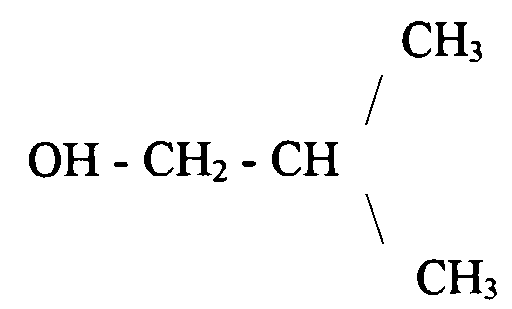
- Isoamyl alcohol is converted into the corresponding pentene with 85% phosphoric acid, purified by distillation and placed in a molar ratio with perfluorobutyl iodide in an autoclave. After addition of AIBN, the mixture is flushed with N 2 for 30 minutes with cooling and then continued as in Example 1. Yield approx. 35% (GC), bp: 65 ° / 60 torr.
- Isoamyl alcohol (isomers) is converted into the corresponding pentene with concentrated sulfuric acid, purified by distillation and placed in an autoclave in a molar ratio with perfluorohexyl iodide. After addition of AIBN, the mixture is flushed with N 2 for 30 minutes with cooling and then continued as in Example 1. Yield approx. 35% (GC), bp: 85 ° / 60 torr.
Landscapes
- Chemical & Material Sciences (AREA)
- Organic Chemistry (AREA)
- Health & Medical Sciences (AREA)
- Chemical Kinetics & Catalysis (AREA)
- Epidemiology (AREA)
- Life Sciences & Earth Sciences (AREA)
- Animal Behavior & Ethology (AREA)
- General Health & Medical Sciences (AREA)
- Public Health (AREA)
- Veterinary Medicine (AREA)
- Medicinal Chemistry (AREA)
- Dermatology (AREA)
- Oil, Petroleum & Natural Gas (AREA)
- General Chemical & Material Sciences (AREA)
- Surgery (AREA)
- Hematology (AREA)
- Pharmacology & Pharmacy (AREA)
- Transplantation (AREA)
- Oral & Maxillofacial Surgery (AREA)
- Vascular Medicine (AREA)
- Heart & Thoracic Surgery (AREA)
- Organic Low-Molecular-Weight Compounds And Preparation Thereof (AREA)
- Acyclic And Carbocyclic Compounds In Medicinal Compositions (AREA)
- Materials For Medical Uses (AREA)
Description
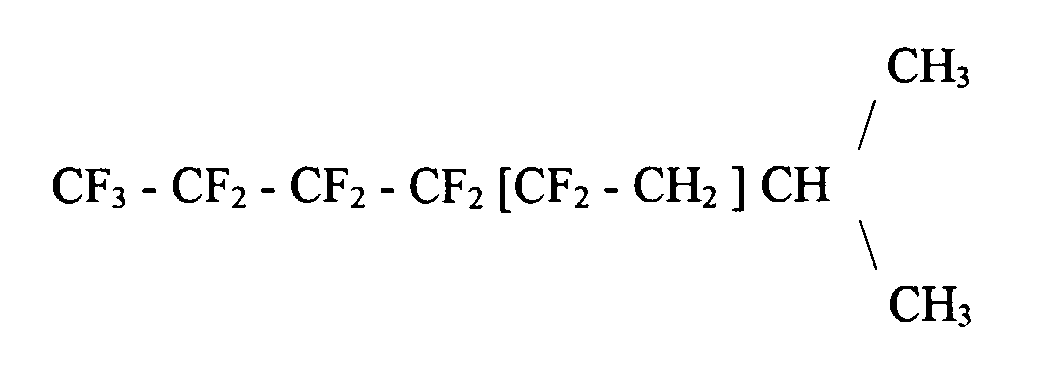
Nach der destillativen Abtrennung von unumgesetzten Ausgangsstoff (Vigreuxkolonne, verminderter Druck) wird mit Zn/HCl hydrierend dehalogeniert und das Produkt im Vakuum über eine Vigreuxkolonne fraktioniert destilliert. Kp.: 70°/60 Torr., Ausbeute ca. 40 % (GC). Das Produkt wird anschließend nach bekanntem Verfahren hochgereinigt.
Nach der destillativen Abtrennung von unumgesetzten Ausgangstoff (Vigreuxkolonne, verminderter Druck) wird mit Zn/HCl hydrierend dehalogeniert und das Produkt im Vakuum über eine Vigreuxkolonne fraktioniert destilliert. Kp.: 80°/60 Torr.; Ausbeute ca. 40 % (GC). Das Produkt wird anschließend nach bekanntem Verfahren hochgereinigt.
Claims (17)
- Teilfluoriertes Alkan mit der Summenformel
- Alkan nach Anspruch 1, dadurch gekennzeichnet, daß n > 7 ist und m zwischen 5 und 8 liegt.
- Alkan nach Anspruch 1, dadurch gekennzeichnet, daß m > 5 ist und n zwischen m - 1 und m + 2 ist.
- Alkan nach Anspruch 1, dadurch gekennzeichnet, daß das Verhältnis des sterischen Volumens von RF zu RH kleiner als 0,7 ist.
- Alkan nach Anspruch 1, dadurch gekennzeichnet, daß das Verhältnis des sterischen Volumens von RF zu RH größer als 1,3 ist.
- Verwendung eines Alkans nach einem der Ansprüche 1 bis 5 als biokompatibles Lösungsmittel, insbesondere für Perfluorcarbone und Kohlenwasserstoffe.
- Verwendung eines Alkans nach einem der Ansprüche 1 bis 5 als Bestandteil eines sauerstofftransportierenden Mediums, insbesondere eines Blutersatzstoffes.
- Verwendung eines Alkans nach einem der Ansprüche 1 bis 5 als Bestandteil eines flüssigen Implantats.
- Verwendung eines Alkans nach einem der Ansprüche 1 bis 5 als Lösungsmittel oder Lösungsvermittler für Pharmaka.
- Verwendung eines Alkans nach einem der Ansprüche 1 bis 5 als technisches Reinigungsmittel.
- Verwendung eines Alkans nach einem der Ansprüche 1 bis 5 als Additiv zu mindestens einem bekannten Perfluorcarbon.
- Verwendung eines Alkans nach einem der Ansprüche 1 bis 5 als Lösungsmittel für Beschichtungsmaterialien für medizinische Geräte zur Erhöhung deren Gleitfähigkeit.
- Verwendung eines Alkans nach einem der Ansprüche 1 bis 5 als medizinisches Hilfsmittel, insbesondere in der Augenheilkunde als Glaskörpersubstitut oder Netzhautentfaltungsmittel oder Hilfsmittel bei der Laserkoagulation an der Netzhaut oder Lösungsmittel für Arzneimittel oder postoperative Netzhauttamponade.
- Verwendung eines Alkans nach einem der Ansprüche 1 bis 5 als medizinisches Hilfsmittel in der Dermatologie.
- Verwendung eines Alkans nach einem der Ansprüche 1 bis 5 als technisches Gleitmittel bzw. Gleitmitteladditiv.
- Verwendung eines Alkans nach einem der Ansprüche 1 bis 5 als medizinisches Hilfsmittel bei der Wundversorgung, insbesondere von Brandwunden zur Reinigung von Verbrennungsrückständen.
- Verwendung eines Alkans nach einem der Ansprüche 1 bis 5 als medizinisches Hilfsmittel zur Regenerierung von Lungengewebe durch Spülen der Lunge.
Applications Claiming Priority (2)
| Application Number | Priority Date | Filing Date | Title |
|---|---|---|---|
| DE19719280A DE19719280C1 (de) | 1997-05-07 | 1997-05-07 | Fluorierte Alkane und ihre Verwendungen |
| DE19719280 | 1997-05-07 |
Publications (2)
| Publication Number | Publication Date |
|---|---|
| EP0877010A1 EP0877010A1 (de) | 1998-11-11 |
| EP0877010B1 true EP0877010B1 (de) | 2000-08-30 |
Family
ID=7828880
Family Applications (1)
| Application Number | Title | Priority Date | Filing Date |
|---|---|---|---|
| EP98106109A Revoked EP0877010B1 (de) | 1997-05-07 | 1998-04-03 | Fluorierte Alkane und ihre Verwendungen |
Country Status (5)
| Country | Link |
|---|---|
| US (1) | US6211248B1 (de) |
| EP (1) | EP0877010B1 (de) |
| AT (1) | ATE195929T1 (de) |
| CA (1) | CA2237048C (de) |
| DE (2) | DE19719280C1 (de) |
Cited By (1)
| Publication number | Priority date | Publication date | Assignee | Title |
|---|---|---|---|---|
| WO2018202835A1 (en) | 2017-05-05 | 2018-11-08 | Novaliq Gmbh | Process for the production of semifluorinated alkanes |
Families Citing this family (5)
| Publication number | Priority date | Publication date | Assignee | Title |
|---|---|---|---|---|
| DE19926890C1 (de) | 1999-06-12 | 2000-07-27 | Pharm Pur Gmbh | Verwendung eines hochfluorierten oligomeren Alkans in der Ophthalmologie |
| DE19926889B4 (de) | 1999-06-12 | 2005-06-16 | Bausch & Lomb Inc. | Verwendung eines Gels mit Polyaphronstruktur zur Herstellung eines Implantats |
| DE19938668B4 (de) * | 1999-08-14 | 2006-01-26 | Bausch & Lomb Inc. | Tränenersatzmittel |
| DE102010022567A1 (de) | 2010-06-02 | 2011-12-08 | Fluoron Gmbh | Zubereitung |
| WO2018228975A1 (en) * | 2017-06-12 | 2018-12-20 | Novaliq Gmbh | Process for the preparation of semifluorinated alkanes using grignard reagents |
Citations (3)
| Publication number | Priority date | Publication date | Assignee | Title |
|---|---|---|---|---|
| EP0444752A1 (de) * | 1990-03-02 | 1991-09-04 | ENICHEM SYNTHESIS S.p.A. | Glitscheigenschaften liefernde Mittel |
| WO1993001798A1 (en) * | 1991-07-17 | 1993-02-04 | S.A. A.T.T.A. Applications Et Transferts De Technologies Avancees | Preparations comprising a fluorocarbon and a lipophilic/fluorophilic organic compound, and their uses |
| WO1997012852A1 (de) * | 1995-09-29 | 1997-04-10 | Hasso Meinert | Semifluorierte alkane und ihre verwendung |
Family Cites Families (6)
| Publication number | Priority date | Publication date | Assignee | Title |
|---|---|---|---|---|
| US4173654A (en) * | 1977-01-03 | 1979-11-06 | California Institute Of Technology | Novel fluorohydrocarbons |
| DE3903336A1 (de) * | 1989-02-04 | 1990-08-09 | Bayer Ag | Verwendung von c(pfeil abwaerts)3(pfeil abwaerts)- bis c(pfeil abwaerts)5(pfeil abwaerts)-polyfluoralkanen als treibgase |
| US5116599A (en) * | 1989-07-31 | 1992-05-26 | Johns Hopkins Univ. | Perfluoro-t-butyl-containing compounds for use in fluorine-19 nmr and/or mri |
| US5275669A (en) * | 1991-08-15 | 1994-01-04 | Alliedsignal Inc. | Method of dissolving contaminants from substrates by using hydrofluorocarbon solvents having a portion which is fluorocarbon and the remaining portion is hydrocarbon |
| DE4211958A1 (de) * | 1992-04-01 | 1993-10-21 | Pharmpur Gmbh | Behandlungsmittel für die Augenheilkunde und seine Verwendung |
| US5874481A (en) * | 1995-06-07 | 1999-02-23 | Alliance Pharmaceutical Corp. | Fluorochemical solutions for the delivery of lipophilic pharmaceutical agents |
-
1997
- 1997-05-07 DE DE19719280A patent/DE19719280C1/de not_active Expired - Lifetime
-
1998
- 1998-04-03 DE DE59800251T patent/DE59800251D1/de not_active Revoked
- 1998-04-03 EP EP98106109A patent/EP0877010B1/de not_active Revoked
- 1998-04-03 AT AT98106109T patent/ATE195929T1/de not_active IP Right Cessation
- 1998-05-07 US US09/074,252 patent/US6211248B1/en not_active Expired - Lifetime
- 1998-05-07 CA CA002237048A patent/CA2237048C/en not_active Expired - Lifetime
Patent Citations (3)
| Publication number | Priority date | Publication date | Assignee | Title |
|---|---|---|---|---|
| EP0444752A1 (de) * | 1990-03-02 | 1991-09-04 | ENICHEM SYNTHESIS S.p.A. | Glitscheigenschaften liefernde Mittel |
| WO1993001798A1 (en) * | 1991-07-17 | 1993-02-04 | S.A. A.T.T.A. Applications Et Transferts De Technologies Avancees | Preparations comprising a fluorocarbon and a lipophilic/fluorophilic organic compound, and their uses |
| WO1997012852A1 (de) * | 1995-09-29 | 1997-04-10 | Hasso Meinert | Semifluorierte alkane und ihre verwendung |
Cited By (1)
| Publication number | Priority date | Publication date | Assignee | Title |
|---|---|---|---|---|
| WO2018202835A1 (en) | 2017-05-05 | 2018-11-08 | Novaliq Gmbh | Process for the production of semifluorinated alkanes |
Also Published As
| Publication number | Publication date |
|---|---|
| CA2237048C (en) | 2008-07-29 |
| EP0877010A1 (de) | 1998-11-11 |
| DE59800251D1 (de) | 2000-10-05 |
| ATE195929T1 (de) | 2000-09-15 |
| DE19719280C1 (de) | 1998-09-24 |
| US6211248B1 (en) | 2001-04-03 |
| CA2237048A1 (en) | 1998-11-07 |
Similar Documents
| Publication | Publication Date | Title |
|---|---|---|
| EP0965338B1 (de) | Sauerstoffarme Perfluoroalkane für die Ophthalmologie | |
| DE19938668B4 (de) | Tränenersatzmittel | |
| DE69524679T2 (de) | Verwendung Rapamycin zur Herstellung eines Medikaments für die Verbeugung und Behandlung von hyperproliferativen Gefässerkrankheiten, eventuell in Kombination mit Mycophenolsäure | |
| EP1185256B1 (de) | Verwendung eines hochfluorierten oligomeren alkans in der ophthalmologie | |
| DE69418468T2 (de) | Viskoelastische zusammensetzungen aus organischen fluorierten verbindungen | |
| DE69820997T3 (de) | Zusammensetzungen und verfahren zur behandlung des erhöhten augenindruckes | |
| DE19536504A1 (de) | Fluorierte Alkane und ihre Verwendung | |
| EP0732936A1 (de) | Adjuvans für antigene, verfahren zur herstellung und verwendung | |
| LU85030A1 (de) | Neue topisch applizierbare pharmazeutische zusammensetzungen | |
| DE202009019116U1 (de) | Wässrige pharmazeutische Zusammensetzungen, die Borat-Polyol-Komplexe enthalten | |
| DE69027220T2 (de) | Zusammensetzung und verfahren zur behandlung von schmerzvollen entzündlichen oder allergischen erkrankungen | |
| EP0817610B1 (de) | Steriles tropfbares ophthalmisches gelpräparat und verfahren zu dessen herstellung | |
| EP0877010B1 (de) | Fluorierte Alkane und ihre Verwendungen | |
| EP0185007A2 (de) | Mischung zur Pflege und Reinigung von Kontaktlinsen | |
| EP0493677B1 (de) | Verwendung einer Perfluorocarbon(PFC)-Mixtur zur Herstellung einer Behandlungsflüssigkeit zum Wiederanlegen (Entfalten) abgelöster Netzhaut an die Aderhaut des Auges | |
| DE69501359T2 (de) | Verwendung von Phosphatdiestern zur Behandlung von Erkrankungen der Retina | |
| EP0069269A2 (de) | Ektoparasitizide Sprüh-Formulierungen | |
| EP1372607B1 (de) | Adjuvans-emulsion und deren verwendung | |
| EP0557876B1 (de) | Verwendung von Xanthinderivaten zur Behandlung von Muskelschädigungen nach vollständiger Unterbrechung der Blutzirkulation | |
| DE69613793T2 (de) | Ophthalmische Cromolyn-Gelzubereitung | |
| DE19811683C2 (de) | Behandlungsmittel für die Ophthalmologie | |
| CH629938A5 (en) | Emulsion for flushing organs to be transplanted, and process for the preparation of the emulsion | |
| DE3341569C2 (de) | ||
| DE102005017279A1 (de) | Glaskörpertamponadeflüssigkeit und ihre Verwendung | |
| WO1996028147A1 (de) | Wund- und schleimhautantiseptikum enthaltend magnesiumperphthalat |
Legal Events
| Date | Code | Title | Description |
|---|---|---|---|
| PUAI | Public reference made under article 153(3) epc to a published international application that has entered the european phase |
Free format text: ORIGINAL CODE: 0009012 |
|
| AK | Designated contracting states |
Kind code of ref document: A1 Designated state(s): AT CH DE FR GB IT LI SE |
|
| AX | Request for extension of the european patent |
Free format text: AL;LT;LV;MK;RO;SI |
|
| TPAD | Observations filed by third parties |
Free format text: ORIGINAL CODE: EPIDOS TIPA |
|
| 17P | Request for examination filed |
Effective date: 19990227 |
|
| AKX | Designation fees paid |
Free format text: AT CH DE FR GB IT LI SE |
|
| GRAG | Despatch of communication of intention to grant |
Free format text: ORIGINAL CODE: EPIDOS AGRA |
|
| 17Q | First examination report despatched |
Effective date: 19990820 |
|
| GRAG | Despatch of communication of intention to grant |
Free format text: ORIGINAL CODE: EPIDOS AGRA |
|
| GRAG | Despatch of communication of intention to grant |
Free format text: ORIGINAL CODE: EPIDOS AGRA |
|
| GRAH | Despatch of communication of intention to grant a patent |
Free format text: ORIGINAL CODE: EPIDOS IGRA |
|
| GRAH | Despatch of communication of intention to grant a patent |
Free format text: ORIGINAL CODE: EPIDOS IGRA |
|
| GRAA | (expected) grant |
Free format text: ORIGINAL CODE: 0009210 |
|
| AK | Designated contracting states |
Kind code of ref document: B1 Designated state(s): AT CH DE FR GB IT LI SE |
|
| REF | Corresponds to: |
Ref document number: 195929 Country of ref document: AT Date of ref document: 20000915 Kind code of ref document: T |
|
| REG | Reference to a national code |
Ref country code: CH Ref legal event code: EP |
|
| REG | Reference to a national code |
Ref country code: CH Ref legal event code: NV Representative=s name: LUCHS & PARTNER PATENTANWAELTE |
|
| REF | Corresponds to: |
Ref document number: 59800251 Country of ref document: DE Date of ref document: 20001005 |
|
| ET | Fr: translation filed | ||
| ITF | It: translation for a ep patent filed | ||
| GBT | Gb: translation of ep patent filed (gb section 77(6)(a)/1977) |
Effective date: 20001106 |
|
| PLBQ | Unpublished change to opponent data |
Free format text: ORIGINAL CODE: EPIDOS OPPO |
|
| PLBI | Opposition filed |
Free format text: ORIGINAL CODE: 0009260 |
|
| PLBF | Reply of patent proprietor to notice(s) of opposition |
Free format text: ORIGINAL CODE: EPIDOS OBSO |
|
| 26 | Opposition filed |
Opponent name: FLUORON GMBH Effective date: 20010529 |
|
| PLBF | Reply of patent proprietor to notice(s) of opposition |
Free format text: ORIGINAL CODE: EPIDOS OBSO |
|
| REG | Reference to a national code |
Ref country code: GB Ref legal event code: IF02 |
|
| PLBF | Reply of patent proprietor to notice(s) of opposition |
Free format text: ORIGINAL CODE: EPIDOS OBSO |
|
| PLBO | Opposition rejected |
Free format text: ORIGINAL CODE: EPIDOS REJO |
|
| APAC | Appeal dossier modified |
Free format text: ORIGINAL CODE: EPIDOS NOAPO |
|
| APAC | Appeal dossier modified |
Free format text: ORIGINAL CODE: EPIDOS NOAPO |
|
| APAC | Appeal dossier modified |
Free format text: ORIGINAL CODE: EPIDOS NOAPO |
|
| APAC | Appeal dossier modified |
Free format text: ORIGINAL CODE: EPIDOS NOAPO |
|
| RAP2 | Party data changed (patent owner data changed or rights of a patent transferred) |
Owner name: BAUSCH & LOMB INCORPORATED |
|
| REG | Reference to a national code |
Ref country code: CH Ref legal event code: PUE Owner name: BAUSCH & LOMB INCORPORATED Free format text: PHARMPUR GMBH#HOLZWEG 27#86156 AUGSBURG (DE) -TRANSFER TO- BAUSCH & LOMB INCORPORATED#ONE BAUSCH & LOMB PLACE#ROCHESTER NEW YORK 14604-2701 (US) |
|
| REG | Reference to a national code |
Ref country code: GB Ref legal event code: 732E |
|
| REG | Reference to a national code |
Ref country code: FR Ref legal event code: TP |
|
| PGFP | Annual fee paid to national office [announced via postgrant information from national office to epo] |
Ref country code: GB Payment date: 20040312 Year of fee payment: 7 Ref country code: AT Payment date: 20040312 Year of fee payment: 7 |
|
| PGFP | Annual fee paid to national office [announced via postgrant information from national office to epo] |
Ref country code: SE Payment date: 20040402 Year of fee payment: 7 Ref country code: FR Payment date: 20040402 Year of fee payment: 7 |
|
| PGFP | Annual fee paid to national office [announced via postgrant information from national office to epo] |
Ref country code: DE Payment date: 20040430 Year of fee payment: 7 |
|
| PGFP | Annual fee paid to national office [announced via postgrant information from national office to epo] |
Ref country code: CH Payment date: 20040608 Year of fee payment: 7 |
|
| APBU | Appeal procedure closed |
Free format text: ORIGINAL CODE: EPIDOSNNOA9O |
|
| RDAF | Communication despatched that patent is revoked |
Free format text: ORIGINAL CODE: EPIDOSNREV1 |
|
| APAA | Appeal reference recorded |
Free format text: ORIGINAL CODE: EPIDOS REFN |
|
| RDAG | Patent revoked |
Free format text: ORIGINAL CODE: 0009271 |
|
| STAA | Information on the status of an ep patent application or granted ep patent |
Free format text: STATUS: PATENT REVOKED |
|
| REG | Reference to a national code |
Ref country code: CH Ref legal event code: PL |
|
| 27W | Patent revoked |
Effective date: 20041218 |
|
| GBPR | Gb: patent revoked under art. 102 of the ep convention designating the uk as contracting state |
Free format text: 20041218 |
|
| REG | Reference to a national code |
Ref country code: SE Ref legal event code: ECNC |
|
| APAH | Appeal reference modified |
Free format text: ORIGINAL CODE: EPIDOSCREFNO |