EP0877014A2 - Diaminoalkylene quaternary ammonium salts, method for their preparation and use - Google Patents
Diaminoalkylene quaternary ammonium salts, method for their preparation and use Download PDFInfo
- Publication number
- EP0877014A2 EP0877014A2 EP98303215A EP98303215A EP0877014A2 EP 0877014 A2 EP0877014 A2 EP 0877014A2 EP 98303215 A EP98303215 A EP 98303215A EP 98303215 A EP98303215 A EP 98303215A EP 0877014 A2 EP0877014 A2 EP 0877014A2
- Authority
- EP
- European Patent Office
- Prior art keywords
- quaternary ammonium
- carbon atoms
- diamine
- salt
- nitrogen
- Prior art date
- Legal status (The legal status is an assumption and is not a legal conclusion. Google has not performed a legal analysis and makes no representation as to the accuracy of the status listed.)
- Granted
Links
Classifications
-
- C—CHEMISTRY; METALLURGY
- C07—ORGANIC CHEMISTRY
- C07D—HETEROCYCLIC COMPOUNDS
- C07D295/00—Heterocyclic compounds containing polymethylene-imine rings with at least five ring members, 3-azabicyclo [3.2.2] nonane, piperazine, morpholine or thiomorpholine rings, having only hydrogen atoms directly attached to the ring carbon atoms
- C07D295/04—Heterocyclic compounds containing polymethylene-imine rings with at least five ring members, 3-azabicyclo [3.2.2] nonane, piperazine, morpholine or thiomorpholine rings, having only hydrogen atoms directly attached to the ring carbon atoms with substituted hydrocarbon radicals attached to ring nitrogen atoms
- C07D295/12—Heterocyclic compounds containing polymethylene-imine rings with at least five ring members, 3-azabicyclo [3.2.2] nonane, piperazine, morpholine or thiomorpholine rings, having only hydrogen atoms directly attached to the ring carbon atoms with substituted hydrocarbon radicals attached to ring nitrogen atoms substituted by singly or doubly bound nitrogen atoms
- C07D295/125—Heterocyclic compounds containing polymethylene-imine rings with at least five ring members, 3-azabicyclo [3.2.2] nonane, piperazine, morpholine or thiomorpholine rings, having only hydrogen atoms directly attached to the ring carbon atoms with substituted hydrocarbon radicals attached to ring nitrogen atoms substituted by singly or doubly bound nitrogen atoms with the ring nitrogen atoms and the substituent nitrogen atoms attached to the same carbon chain, which is not interrupted by carbocyclic rings
- C07D295/13—Heterocyclic compounds containing polymethylene-imine rings with at least five ring members, 3-azabicyclo [3.2.2] nonane, piperazine, morpholine or thiomorpholine rings, having only hydrogen atoms directly attached to the ring carbon atoms with substituted hydrocarbon radicals attached to ring nitrogen atoms substituted by singly or doubly bound nitrogen atoms with the ring nitrogen atoms and the substituent nitrogen atoms attached to the same carbon chain, which is not interrupted by carbocyclic rings to an acyclic saturated chain
-
- C—CHEMISTRY; METALLURGY
- C07—ORGANIC CHEMISTRY
- C07C—ACYCLIC OR CARBOCYCLIC COMPOUNDS
- C07C211/00—Compounds containing amino groups bound to a carbon skeleton
- C07C211/62—Quaternary ammonium compounds
- C07C211/63—Quaternary ammonium compounds having quaternised nitrogen atoms bound to acyclic carbon atoms
-
- C—CHEMISTRY; METALLURGY
- C08—ORGANIC MACROMOLECULAR COMPOUNDS; THEIR PREPARATION OR CHEMICAL WORKING-UP; COMPOSITIONS BASED THEREON
- C08G—MACROMOLECULAR COMPOUNDS OBTAINED OTHERWISE THAN BY REACTIONS ONLY INVOLVING UNSATURATED CARBON-TO-CARBON BONDS
- C08G64/00—Macromolecular compounds obtained by reactions forming a carbonic ester link in the main chain of the macromolecule
- C08G64/20—General preparatory processes
- C08G64/22—General preparatory processes using carbonyl halides
- C08G64/24—General preparatory processes using carbonyl halides and phenols
Definitions
- This invention relates to the interfacial preparation of polycarbonates, and more particularly to the improvement of catalyst species used therein.
- interfacial method for polycarbonate preparation involves the reaction of at least one dihydroxyaromatic compound with phosgene in a basic aqueous-organic medium, in the presence of a suitable catalyst.
- the resulting polycarbonate migrates to the organic phase and may be recovered therefrom.
- tertiary amines especially trialkylamines such as triethylamine
- phosgene hydrolysis is a principal side reaction.
- phase transfer catalysts such as quaternary ammonium halides and quaternary phosphonium halides can replace tertiary amines as catalysts for interfacial polycarbonate preparation, thereby improving utilization of phosgene.
- the use of such catalysts also suppresses the conversion of chloroformate-terminated intermediate polymers to useful species, most often endcapped or hydroxy-terminated polycarbonates. Since chloroformate-terminated species may be produced in significant proportions and since their presence in the polycarbonate product is undesirable, the use of phase transfer catalysts with its concomitant improvement in phosgene usage has not been widely employed on a commercial scale. Chloroformate formation and slowness to convert to less detrimental species, and long polymerization times coupled with mandatory further additions of phosgene to produce a polymer of the desired molecular weight, are hereinafter collectively designated "end point problems".
- the conventional procedures include separation of the aqueous and organic phases, during which it is preferred that the major proportion of catalyst be in the organic phase; aqueous acidic wash of the organic phase, during which as much catalyst as possible should transfer to the wash liquid; and subsequent recovery of the catalyst from the wash liquid for recycle.
- the present invention is based on the discovery of a new class of organic compounds which combine in a single molecule the tertiary amine and quaternary ammonium salt functionalities. These compounds may be employed as catalysts for interfacial polycarbonate preparation, and when so employed they combine the benefits of efficient phosgene usage, rapid conversion of chloroformate groups and very low proportions of dihydroxyaromatic compound in the polycarbonate product.
- amino salts diaminoalkyl quaternary ammonium salts having the formula wherein:
- Another aspect is a method for preparing such salts substantially free from corresponding diamines which comprises contacting a tertiary aliphatic or alicyclic diamine having at least 2 carbon atoms separating the two nitrogen atoms with a C 1-20 alkyl halide at a temperature in the range of about 20-150°C, the molar ratio of said diamine to said halide being at least 1:1, and subsequently removing unreacted diamine by dissolving the amino salt in a basic aqueous medium and extracting said medium with an organic liquid of low polarity.
- Still another aspect is a method for preparing a polycarbonate which comprises contacting at least one dihydroxyaromatic compound with phosgene in a basic aqueous-organic system, in the presence of a catalytically effective proportion of an amino salt as described hereinabove.
- R 1 , R 2 and R 4-6 radicals in the amino salts of this invention are C 1-20 primary alkyl radicals. Methyl radicals are, however, not preferred since the compounds containing them are similar to trialkylamines in causing significant phosgene hydrolysis. Thus, the preferred R 1 , R 2 and R 4-6 radicals contain 2-20 and especially 2-8 carbon atoms.
- R 1-2 and R 4-5 to form with the associated nitrogen atom a heterocyclic ring; i.e., pyrrolidine or piperidine which may be unsubstituted or substituted.
- a heterocyclic ring i.e., pyrrolidine or piperidine which may be unsubstituted or substituted.
- Such compounds while not “diaminoalkyl quaternary ammonium salts" as strictly defined, are equivalent thereto. However, such compounds are generally not preferred since they tend to exhibit increased phosgene hydrolysis when employed in polycarbonate preparation.
- the R 3 radical is an alkylene radical containing 2-20 carbon atoms, at least 2 of which are in a chain separating the two nitrogen atoms. Since compounds in which R 3 is the ethylene radical exhibit significant end point problems when employed as catalysts, R 3 preferably has at least 3 and most preferably 3-10 carbon atoms and the nitrogen atoms are separated by a chain of at least 5 of said carbon atoms.
- the Z radical is one equivalent of an anion, usually a monovalent anion and most often hydroxide, chloride or bromide.
- Said salts may be prepared by the reaction of a corresponding diamine, typically one of the formula wherein R 1-5 are as previously defined, with a C 1-20 alkyl halide, most often having the formula R 6 Z in which Z is chloride or bromide as previously defined.
- the reaction typically takes place at a temperature in the range of about 20-150°C and most often in an organic solvent.
- organic solvents include aliphatic nitriles such as acetonitrile, halogenated aliphatic hydrocarbons such as methylene chloride and chloroform, aromatic hydrocarbons such as toluene and xylene and dipolar aprotic solvents such as dimethylformamide, dimethyl sulfoxide and N-methylpyrrolidone.
- the molar ratio of diamine to alkyl halide be at least 1:1. Ratios of at least 2:1 are preferred, since sizable proportions of bis-quaternary ammonium salt may be produced as by-products at lower molar ratios.
- the product of this reaction will ordinarily be a mixture of unreacted diamine, bis-quaternary ammonium salt and the amino salt of the invention. If conversion to the hydroxide is desired, it may be achieved by reaction with a suitable alkali metal hydroxide.
- the presence of a substantial proportion of diamine may cause an increase in phosgene usage.
- the presence of small proportions of bis-quaternary ammonium salt may not be particularly disadvantageous since it may also act as a phosgenation catalyst and the amine group concentration, from the amino salt, is high enough to afford rapid reaction of chloroformate groups.
- the amino salt substantially free from unreacted diamine has a diamine content of no more than 1.0% and preferably no more than 0.1% by weight.
- a basic aqueous medium typically aqueous alkali metal hydroxide and preferably sodium hydroxide having a concentration in the range of about 0.1-0.5 M , thereby maintaining all unreacted diamine in the free form, and extracting said basic aqueous medium with an organic liquid of low polarity, which dissolves said diamine and which can then be readily separated from the aqueous medium.
- organic liquids which may be used for this purpose are aliphatic hydrocarbons such as hexane, octane, decane and petroleum ether and aromatic hydrocarbons such as toluene and xylene.
- the amino salt may be recovered by conventional techniques. Such techniques may involve operations such as salting out of aqueous solution, extraction into an organic solvent and stripping.
- Example 1 The procedure of Example 1 was repeated, employing various diamines and alkyl bromides as shown in Table I. The products obtained were similar to that obtained in Example 1.
- Example R 1-2, 4-5 R 3 R 6 2 n-Pentyl Trimethylene n-Pentyl 3 n-Propyl Hexamethylene n-Propyl 4 n-Pentyl Nonamethylene Ethyl 5 n-Pentyl Nonamethylene n-Pentyl
- a mixture of 20 mmol of 1,6-bis(diethylamino)hexane, 10 mmol of n-hexyl bromide and sufficient acetonitrile to effect dissolution was heated under reflux in a nitrogen atmosphere for 24 hours, whereupon it was shown by proton nuclear magnetic resonance spectroscopy that all the n-hexyl bromide had reacted.
- the mixture was diluted with water and made basic by the addition of 10 ml of 2 M aqueous sodium hydroxide solution.
- the resulting aqueous phase was washed 3 times with toluene to remove unreacted diamine, and the resulting aqueous solution was found to comprise 65% of the desired 6-(diethylamino)hexyldiethyl-n-hexylammonium bromide (65% yield based on n-hexyl bromide) and 35% of the corresponding bis-quaternary ammonium salt. A major proportion of the latter was precipitated by addition of ethyl acetate, after which the filtrate comprised 95% amino salt and 5% bis-quaternary ammonium salt.
- Example 6 The procedure of Example 6 was repeated, employing diamine and n-hexyl bromide in a 4:1 molar ratio. The yield of the amino salt was 85%.
- Example 6 The procedure of Example 6 was repeated, employing dimethyl sulfoxide as a solvent. The yield of the amino salt was 80%.
- Example 6 The procedure of Example 6 was repeated with the use of various alkylenediamines and alkyl bromides as shown in Table II.
- Example R 1-2, 4-5 R 3 R 6 9 Methyl Ethylene n-Hexyl 10 Methyl Ethylene n-Octyl 11 Ethyl Ethylene n-Hexyl 12 Ethyl Ethylene n-Octyl 13 Ethyl Hexamethylene n-Octyl 14 Ethyl Octamethylene n-Hexyl 15 Ethyl Octamethylene n-Octyl 16 Piperidinyl Hexamethylene n-Hexyl 17 Piperidinyl Hexamethylene n-Octyl 18 R 1,3 -n-Octyl R 2,4 -Ethyl Hexamethylene n-Hexyl
- the amino salts of this invention are, as previously stated, useful as catalysts for interfacial polycarbonate preparation.
- the polycarbonate-forming reaction takes place in a mixture comprising at least one dihydroxyaromatic compound, phosgene, an aqueous alkaline solution, a catalyst and a water-immiscible organic solvent.
- reaction mixture at least one monohydroxyaromatic compound as a chain termination agent.
- Suitable compounds of this type include phenol and p-cumylphenol. Also present may be an aromatic dicarboxylic acid or functional derivative thereof, such as a dialkyl ester, whereupon the product is a copolyestercarbonate.
- Suitable dihydroxyaromatic compounds include those having the formula (III) HO-A 1 -OH , wherein A 1 is a divalent aromatic hydrocarbon radical.
- Suitable A 1 radicals include m-phenylene, p-phenylene, 4,4'-biphenylene, 4,4'-bi(3,5-dimethyl)phenylene, 2,2-bis(4-phenylene)propane and similar radicals such as those which correspond to the dihydroxy-substituted aromatic hydrocarbons disclosed by name or formula (generic or specific) in U.S. Patent 4,217,438.
- the A 1 radical preferably has the formula (IV) -A 2 -Y-A 3 - , wherein each of A 2 and A 3 is a monocyclic divalent aromatic hydrocarbon radical and Y is a bridging hydrocarbon radical in which one or two atoms separate A 2 from A 3 .
- the free valence bonds in formula III are usually in the meta or para positions of A 2 and A 3 in relation to Y.
- Compounds in which A 1 has formula IV are bisphenols, and for the sake of brevity the term "bisphenol" is sometimes used herein to designate the dihydroxy-substituted aromatic hydrocarbons; it should be understood, however, that non-bisphenol compounds of this type may also be employed as appropriate.
- the A 2 and A 3 values may be unsubstituted phenylene or hydrocarbon-substituted derivatives thereof, illustrative substituents (one or more) being alkyl and alkenyl. Unsubstituted phenylene radicals are preferred. Both A 2 and A 3 are preferably p-phenylene, although both may be o- or m-phenylene or one o- or m-phenylene and the other p-phenylene.
- the bridging radical, Y is one in which one or two atoms, preferably one, separate A 2 from A 3 .
- Illustrative radicals of this type are methylene, cyclohexylmethylene, 2-[2.2.1]-bicycloheptylmethylene, ethylene, isopropylidene, neopentylidene, cyclohexylidene, cyclopentadecylidene, cyclododecylidene and adamantylidene; gem-alkylene (alkylidene) radicals are preferred. Also included, however, are unsaturated radicals.
- bisphenol 2,2-bis(4-hydroxyphenyl)propane
- Y is isopropylidene
- a 2 and A 3 are each p-phenylene
- the water-immiscible organic solvents which may be used in the interfacial polymerization reaction are conventional for such types of reactions. Methylene chloride is often preferred.
- the amount of catalyst present is an amount effective to promote interfacial condensation and polycarbonate formation, which is generally in the range of about 0.1-5.0 mole percent based on dihydroxyaromatic compound.
- the preferred catalysts are the compounds of formula I in which each of R 1 , R 2 , R 4 and R 5 contains at least 2 carbon atoms and R 3 has at least 3 carbon atoms separating the nitrogen atoms.
- R 1 , R 2 , R 4 and R 5 contains at least 2 carbon atoms and R 3 has at least 3 carbon atoms separating the nitrogen atoms.
- the interfacial polymerization reaction is ordinarily carried out at a temperature in the range of about 10-50°C and preferably at ambient temperature. Phosgene is passed into the mixture at a suitable rate to effect polymerization, which rate may be determined by simple experimentation.
- reaction with phosgene When the reaction with phosgene is complete, it may be necessary to continue to agitate the reaction mixture until chloroformate groups are converted. Following polycarbonate formation, the organic and aqueous phases may be separated and the polycarbonate isolated from the organic phase by anti-solvent precipitation or the like. Prior to polycarbonate isolation, however, it may be desirable to isolate the amino salt for recycle.
- the amino salt prefers to remain in the organic phase.
- K D of the salt which for this purpose is considered to include its conversion product in basic medium, the corresponding amino hydroxide
- the value of K D as between these two phases is uniformly less than 1.
- a major proportion of the amino salt may be recovered for recycle by removal from the organic phase.
- One convenient way of doing this is by washing with dilute aqueous acid, typically having a concentration in the range of about 0.5-2.0 M , to convert the amino salt into its acidified form (i.e., the form in which the free amino group is protonated) which preferentially migrates to the aqueous acidic phase.
- the K D values as between the aqueous acidic wash liquid and the organic phase are very high, typically at least about 60.
- the vastly major proportion of the amino salt enters the wash liquid in its protonated form and may be regenerated and isolated by treatment with aqueous base.
- Any remainder of the amino salt in the basic aqueous phase of the interfacial reaction mixture can be removed prior to recovery, if desired, of other values therefrom.
- a typical method of removal is by adsorption on a non-ionic polystyrene resin as disclosed, for example, in copending, commonly owned application EP-A-0804954.
- the amino salts of this invention produce polycarbonates having very low proportions of unreacted monomer, frequently too low to be detectable. Thus, they are particularly useful for the production of polymers to be employed in contact with foods and beverages.
- phosgene detection paper was used to determine the presence or absence of chloroformates and the time required to effect complete reaction thereof.
- the amount of phosgene required was determined from the amount of sodium hydroxide added to the reaction mixture, and the weight average molecular weight of the polycarbonate produced was determined by gel permeation chromatography relative to polystyrene.
- Residual monomeric bisphenol A in the product of Example 19 was separated by precipitating the polycarbonate from the acid-washed organic phase by pouring into hexane, filtering, drying, dissolving in chloroform and precipitating into acetonitrile, whereupon said bisphenol A remained in solution. Said level was too low to be detectable. By contrast, Control 1 had a bisphenol A level of 6.2 ppm.
Landscapes
- Chemical & Material Sciences (AREA)
- Organic Chemistry (AREA)
- Health & Medical Sciences (AREA)
- Chemical Kinetics & Catalysis (AREA)
- Medicinal Chemistry (AREA)
- Polymers & Plastics (AREA)
- Organic Low-Molecular-Weight Compounds And Preparation Thereof (AREA)
- Polyesters Or Polycarbonates (AREA)
- Catalysts (AREA)
- Low-Molecular Organic Synthesis Reactions Using Catalysts (AREA)
Abstract
Description


| Example | R1-2, 4-5 | R3 | R6 |
| 2 | n-Pentyl | Trimethylene | n-Pentyl |
| 3 | n-Propyl | Hexamethylene | n-Propyl |
| 4 | n-Pentyl | Nonamethylene | Ethyl |
| 5 | n-Pentyl | Nonamethylene | n-Pentyl |
| Example | R1-2, 4-5 | R3 | R6 |
| 9 | Methyl | Ethylene | n-Hexyl |
| 10 | Methyl | Ethylene | n-Octyl |
| 11 | Ethyl | Ethylene | n-Hexyl |
| 12 | Ethyl | Ethylene | n-Octyl |
| 13 | Ethyl | Hexamethylene | n-Octyl |
| 14 | Ethyl | Octamethylene | n-Hexyl |
| 15 | Ethyl | Octamethylene | n-Octyl |
| 16 | Piperidinyl | Hexamethylene | n-Hexyl |
| 17 | Piperidinyl | Hexamethylene | n-Octyl |
| 18 | R1,3-n-Octyl R2,4-Ethyl | Hexamethylene | n-Hexyl |
| Catalyst | |||||
| Example | Identity | Mole % | Chloroformate reaction time, min. | Excess phosgene req., mole % | Product Mw |
| 19 | Ex. 6 | 0.6 | 2.5 | 8 | 41,700 |
| 20 | Ex. 16 | 0.3 | 3 | 9 | 40,900 |
| 21 | Ex. 17 | 0.3 | 4 | 8 | 40,100 |
| 22 | Ex. 12 | 0.3 | 3 | 5 | 41,000 |
| 23 | Ex. 11 | 1.0 | 150 | 4 | 41,200 |
| 24 | Ex. 9 | 0.5 | - | 58 | 40,700 |
| Control 1 | Listed above | 1.0 | - | 18 | 42,900 |
| Control 2 | Listed above | 0.15 | 20 | 21 | 38,000 |
Claims (10)
- A diaminoalkyl quaternary ammonium salt having the formulawherein:
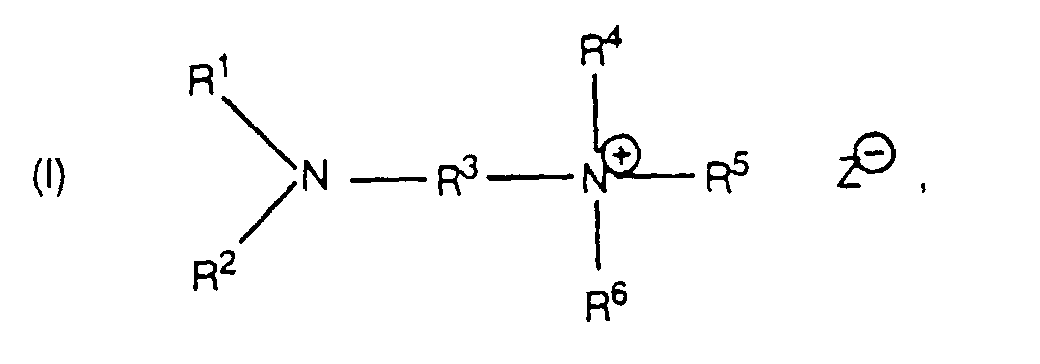 each of R1, R2, R4, R5 and R6 is a C1-20 primary alkyl radical, or at least one of the combinations of R1 and R2 with the nitrogen atom connecting them, and R4 and R5 with the nitrogen atom connecting them, form a pyrrolidine or piperidine ring;R3 is a C2-20 alkylene radical wherein at least 2 carbon atoms separate the two nitrogen atoms; andZ is one equivalent of an anion.
 - A salt according to claim 1 wherein each of R1, R2, R4, R5 and R6 is a C2-20 primary alkyl radical and R3 is a C3-20 alkylene radical.
- A salt according to claim 2 wherein each of R1, R2, R4, R5 and R6 is a C2-8 primary alkyl radical.
- A salt according to claim 2 wherein R3 is a C3-10 alkylene radical wherein at least 5 carbon atoms separate the two nitrogen atoms.
- A method for preparing a diaminoalkyl quaternary ammonium salt substantially free from corresponding diamines which comprises contacting a tertiary aliphatic or alicyclic diamine having at least 3 carbon atoms separating the two nitrogen atoms with a C2-20 alkyl halide at a temperature in the range of about 20-150°C, the molar ratio of said diamine to said halide being at least 1:1, and subsequently removing unreacted diamine by dissolving the amino salt in a basic aqueous medium and extracting said medium with an organic liquid of low polarity.
- A method according to claim 5 wherein the diamine has the formulaand the halide has the formula R6Z, wherein:
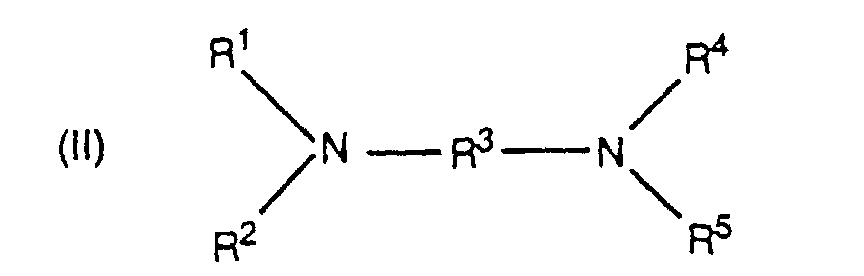 each of R1, R2, R4 and R5 is a C1-20 primary alkyl radical, or at least one of the combinations of R1 and R2 with the nitrogen atom connecting them, and R4 and R5 with the nitrogen atom connecting them, form a pyrrolidine or piperidine ring; andR3 is a C2-20 alkylene radical wherein at least 2 carbon atoms separate the two nitrogen atoms; andZ is chloride or bromide.
 - A method for preparing a polycarbonate which comprises contacting at least one dihydroxyaromatic compound with phosgene in a basic aqueous-organic system, in the presence of a catalytically effective proportion of a diaminoalkyl quaternary ammonium salt having the formulawherein:
 each of R1, R2, R4, R5 and R6 is a C1-20 primary alkyl radical, or at least one of the combinations of R1 and R2 with the nitrogen atom connecting them, and R4 and R5 with the nitrogen atom connecting them, form a pyrrolidine or piperidine ring;R3 is a C2-20 alkylene radical wherein at least 2 carbon atoms separate the two nitrogen atoms; andZ is one equivalent of an anion.
 - A method according to claim 7 wherein each of R1, R2, R4, R5 and R6 is a C2-20 primary alkyl radical and R3 is a C3-20 alkylene radical.
- A method according to claim 7 wherein the aqueous-organic system includes a water-immiscible organic solvent.
- A method according to claim 8 wherein each of R1, R2, R4 and R5 is ethyl, R6 is n-hexyl or n-octyl, R3 is hexamethylene, Z is bromide or chloride and said aminoalkyl quaternary ammonium salt is substantially free from unreacted diamine.
Applications Claiming Priority (2)
| Application Number | Priority Date | Filing Date | Title |
|---|---|---|---|
| US851260 | 1997-05-05 | ||
| US08/851,260 US5821322A (en) | 1997-05-05 | 1997-05-05 | Diaminoalkyl quaternary ammonium salts and method for their preparation and use |
Publications (3)
| Publication Number | Publication Date |
|---|---|
| EP0877014A2 true EP0877014A2 (en) | 1998-11-11 |
| EP0877014A3 EP0877014A3 (en) | 2000-10-11 |
| EP0877014B1 EP0877014B1 (en) | 2003-08-13 |
Family
ID=25310364
Family Applications (1)
| Application Number | Title | Priority Date | Filing Date |
|---|---|---|---|
| EP98303215A Expired - Lifetime EP0877014B1 (en) | 1997-05-05 | 1998-04-24 | Diaminoalkylene quaternary ammonium salts, method for their preparation and use |
Country Status (7)
| Country | Link |
|---|---|
| US (1) | US5821322A (en) |
| EP (1) | EP0877014B1 (en) |
| JP (1) | JP4153079B2 (en) |
| CN (1) | CN1201782A (en) |
| BR (1) | BR9801565A (en) |
| DE (1) | DE69817070T2 (en) |
| SG (1) | SG66454A1 (en) |
Families Citing this family (21)
| Publication number | Priority date | Publication date | Assignee | Title |
|---|---|---|---|---|
| US7790292B2 (en) * | 1999-05-18 | 2010-09-07 | Sabic Innovative Plastics Ip B.V. | Polysiloxane copolymers, thermoplastic composition, and articles formed therefrom |
| US7169859B2 (en) * | 1999-05-18 | 2007-01-30 | General Electric Company | Weatherable, thermostable polymers having improved flow composition |
| US7605221B2 (en) * | 1999-05-18 | 2009-10-20 | Sabic Innovative Plastics Ip B.V. | Weatherable, thermostable polymers having improved flow composition |
| US6812320B2 (en) | 2002-03-25 | 2004-11-02 | General Electric Company | Method for copolyestercarbonate synthesis |
| US7514147B2 (en) * | 2003-01-14 | 2009-04-07 | Sabic Innovative Plastics Ip B.V. | Formable thermoplastic multi-layer laminate, a formed multi-layer laminate, an article, and a method of making an article |
| KR20050106447A (en) * | 2003-02-21 | 2005-11-09 | 제너럴 일렉트릭 캄파니 | Weatherable multilayer articles and method for their preparation |
| US7270882B2 (en) * | 2003-02-21 | 2007-09-18 | General Electric Company | Weatherable multilayer articles and method for their preparation |
| DE10357161A1 (en) * | 2003-12-06 | 2005-06-30 | Bayer Materialscience Ag | Process for the preparation of polycarbonates with a low content of volatile compounds by the transesterification process |
| US20050144309A1 (en) * | 2003-12-16 | 2005-06-30 | Intel Corporation, A Delaware Corporation | Systems and methods for controlling congestion using a time-stamp |
| US20050159542A1 (en) | 2004-01-17 | 2005-07-21 | General Electric Company | Compositions useful as coatings, their preparation, and articles made therefrom |
| US7321014B2 (en) * | 2004-12-29 | 2008-01-22 | General Electric Company | Transparent compositions, methods for the preparation thereof, and articles derived therefrom |
| US7227149B2 (en) * | 2004-12-30 | 2007-06-05 | General Electric Company | Method and system for positron emission tomography image reconstruction |
| US7432327B2 (en) | 2004-12-30 | 2008-10-07 | Sabic Innovative Plastics Ip B.V. | Transparent polymeric compositions comprising polysiloxane-polycarbonate copolymer, articles made therefrom and methods of making same |
| US7452848B2 (en) | 2005-04-26 | 2008-11-18 | Air Products And Chemicals, Inc. | Amine-based gas hydrate inhibitors |
| US7323536B2 (en) * | 2005-05-20 | 2008-01-29 | General Electric Company | Transparent compositions, methods for the preparation thereof, and articles derived therefrom |
| US7273917B2 (en) * | 2005-05-20 | 2007-09-25 | General Electric Company | Transparent compositions, methods for the preparation thereof, and articles derived therefrom |
| US7323535B2 (en) * | 2005-05-20 | 2008-01-29 | General Electric Company | Transparent compositions, methods for the preparation thereof, and articles derived therefrom |
| US7326764B2 (en) * | 2005-05-20 | 2008-02-05 | General Electric Company | Transparent compositions, methods for the preparation thereof, and articles derived therefrom |
| US20100009207A1 (en) * | 2008-07-10 | 2010-01-14 | Sabic Innovative Plastics Ip B.V. | Formable thermoplastic multi-layer article, a formed multi-layer article, an article, and a method of making an article |
| CN105085303B (en) * | 2015-06-26 | 2017-09-29 | 丰益表面活性材料(连云港)有限公司 | Quarternary ammonium salt compound, its preparation method and the purposes as catalyst in acyl chlorides preparation |
| WO2017200607A1 (en) * | 2016-05-20 | 2017-11-23 | Chevron U.S.A. Inc. | Synthesis of zeolite ssz-16 |
Family Cites Families (6)
| Publication number | Priority date | Publication date | Assignee | Title |
|---|---|---|---|---|
| US2813904A (en) * | 1955-05-12 | 1957-11-19 | Olin Mathieson | Acid-addition quaternary salts and methods of preparing same |
| US3079436A (en) * | 1955-11-25 | 1963-02-26 | Rohm & Haas | Bis-quaternary ammonium compounds |
| US5391692A (en) * | 1993-05-24 | 1995-02-21 | General Electric Company | Method for making aromatic polycarbonates |
| US5510449A (en) * | 1994-05-10 | 1996-04-23 | General Electric Company | Catalyst system for polycarbonate manufacture |
| US5519105A (en) * | 1994-05-10 | 1996-05-21 | General Electric Company | Method for making polycarbonates |
| EP0804954A3 (en) * | 1996-05-01 | 1998-01-14 | General Electric Company | Adsorption process for organic base recovery from aqueous brine solutions |
-
1997
- 1997-05-05 US US08/851,260 patent/US5821322A/en not_active Expired - Lifetime
-
1998
- 1998-04-22 SG SG1998000784A patent/SG66454A1/en unknown
- 1998-04-24 DE DE69817070T patent/DE69817070T2/en not_active Expired - Lifetime
- 1998-04-24 EP EP98303215A patent/EP0877014B1/en not_active Expired - Lifetime
- 1998-04-28 JP JP11763998A patent/JP4153079B2/en not_active Expired - Fee Related
- 1998-05-04 BR BR9801565A patent/BR9801565A/en not_active Application Discontinuation
- 1998-05-05 CN CN98109756A patent/CN1201782A/en active Pending
Also Published As
| Publication number | Publication date |
|---|---|
| CN1201782A (en) | 1998-12-16 |
| JPH1149729A (en) | 1999-02-23 |
| JP4153079B2 (en) | 2008-09-17 |
| US5821322A (en) | 1998-10-13 |
| BR9801565A (en) | 1999-06-29 |
| EP0877014A3 (en) | 2000-10-11 |
| EP0877014B1 (en) | 2003-08-13 |
| SG66454A1 (en) | 1999-07-20 |
| DE69817070D1 (en) | 2003-09-18 |
| DE69817070T2 (en) | 2004-06-03 |
Similar Documents
| Publication | Publication Date | Title |
|---|---|---|
| EP0877014B1 (en) | Diaminoalkylene quaternary ammonium salts, method for their preparation and use | |
| US4737573A (en) | Method for polymerizing aromatic bischloroformate composition to polycarbonate | |
| US4950731A (en) | Method for preparing spirobiindane polycarbonates | |
| USRE38995E1 (en) | Interfacial method of preparing ester-substituted diaryl carbonates | |
| US20030060649A1 (en) | Solventless preparation of ester-substituted diaryl carbonates | |
| US4743676A (en) | Method for preparing polycarbonate of controlled molecular weight from aromatic bischloroformate | |
| US7592464B2 (en) | Methods for producing and purifying 2-hydrocarbyl-3,3-bis(4-hydroxyaryl)phthalimidine monomers and polycarbonates derived therefrom | |
| JPS6354433A (en) | Polyether imide bisphenol composition | |
| JP3402845B2 (en) | Two-component catalysts for the production of aromatic polycarbonates | |
| EP0375935A2 (en) | Hydroquine-bisphenol cyclic copolycarbonates and method of preparation | |
| KR19990063327A (en) | Surface preparation method of copolyester carbonate using a catalyst containing hexaalkylguanidinium salt and tertiary amine | |
| JP2556517B2 (en) | Cyclic polycarbonate oligomers from spirobiindane bisphenols | |
| US20080242829A1 (en) | Methods for producing and purifying 2-hydrocarbyl-3,3-bis(4-hydroxyaryl)phthalimidine monomers and polycarbonates derived therefrom | |
| US5015720A (en) | Method for preparing polycarbonates containing aliphatic ester groups | |
| US6106918A (en) | Optical quality polycarbonates | |
| JPH0747628B2 (en) | Oligomeric carbonate chain terminator | |
| JP2971324B2 (en) | Method for converting macrocyclic polyimide oligomer to linear polyimide | |
| EP0374508A2 (en) | Method for preparing polycarbonate-polysiloxane block copolymers | |
| JPS62164652A (en) | Bridgeable polycyclic polycarbonate oligomer, manufacture and use | |
| JP3108584B2 (en) | Method for producing aromatic polycarbonate | |
| US20020111456A1 (en) | Method of polycarbonate preparation | |
| JPH0841191A (en) | Catalyst system for the production of polycarbonate | |
| JPS63113023A (en) | Block copolyimide carbonate and its production |
Legal Events
| Date | Code | Title | Description |
|---|---|---|---|
| PUAI | Public reference made under article 153(3) epc to a published international application that has entered the european phase |
Free format text: ORIGINAL CODE: 0009012 |
|
| AK | Designated contracting states |
Kind code of ref document: A2 Designated state(s): BE DE ES FR GB IT NL |
|
| AX | Request for extension of the european patent |
Free format text: AL;LT;LV;MK;RO;SI |
|
| PUAL | Search report despatched |
Free format text: ORIGINAL CODE: 0009013 |
|
| AK | Designated contracting states |
Kind code of ref document: A3 Designated state(s): AT BE CH CY DE DK ES FI FR GB GR IE IT LI LU MC NL PT SE |
|
| AX | Request for extension of the european patent |
Free format text: AL;LT;LV;MK;RO;SI |
|
| 17P | Request for examination filed |
Effective date: 20010411 |
|
| AKX | Designation fees paid |
Free format text: BE DE ES FR GB IT NL |
|
| 17Q | First examination report despatched |
Effective date: 20010525 |
|
| GRAH | Despatch of communication of intention to grant a patent |
Free format text: ORIGINAL CODE: EPIDOS IGRA |
|
| GRAH | Despatch of communication of intention to grant a patent |
Free format text: ORIGINAL CODE: EPIDOS IGRA |
|
| GRAA | (expected) grant |
Free format text: ORIGINAL CODE: 0009210 |
|
| AK | Designated contracting states |
Designated state(s): BE DE ES FR GB IT NL |
|
| PG25 | Lapsed in a contracting state [announced via postgrant information from national office to epo] |
Ref country code: IT Free format text: LAPSE BECAUSE OF FAILURE TO SUBMIT A TRANSLATION OF THE DESCRIPTION OR TO PAY THE FEE WITHIN THE PRESCRIBED TIME-LIMIT;WARNING: LAPSES OF ITALIAN PATENTS WITH EFFECTIVE DATE BEFORE 2007 MAY HAVE OCCURRED AT ANY TIME BEFORE 2007. THE CORRECT EFFECTIVE DATE MAY BE DIFFERENT FROM THE ONE RECORDED. Effective date: 20030813 |
|
| REG | Reference to a national code |
Ref country code: GB Ref legal event code: FG4D |
|
| REF | Corresponds to: |
Ref document number: 69817070 Country of ref document: DE Date of ref document: 20030918 Kind code of ref document: P |
|
| PG25 | Lapsed in a contracting state [announced via postgrant information from national office to epo] |
Ref country code: ES Free format text: LAPSE BECAUSE OF FAILURE TO SUBMIT A TRANSLATION OF THE DESCRIPTION OR TO PAY THE FEE WITHIN THE PRESCRIBED TIME-LIMIT Effective date: 20031124 |
|
| ET | Fr: translation filed | ||
| PLBE | No opposition filed within time limit |
Free format text: ORIGINAL CODE: 0009261 |
|
| STAA | Information on the status of an ep patent application or granted ep patent |
Free format text: STATUS: NO OPPOSITION FILED WITHIN TIME LIMIT |
|
| 26N | No opposition filed |
Effective date: 20040514 |
|
| PGFP | Annual fee paid to national office [announced via postgrant information from national office to epo] |
Ref country code: BE Payment date: 20080527 Year of fee payment: 11 |
|
| PGFP | Annual fee paid to national office [announced via postgrant information from national office to epo] |
Ref country code: NL Payment date: 20080424 Year of fee payment: 11 |
|
| PGFP | Annual fee paid to national office [announced via postgrant information from national office to epo] |
Ref country code: FR Payment date: 20080417 Year of fee payment: 11 |
|
| PGFP | Annual fee paid to national office [announced via postgrant information from national office to epo] |
Ref country code: GB Payment date: 20080429 Year of fee payment: 11 |
|
| REG | Reference to a national code |
Ref country code: FR Ref legal event code: TP |
|
| NLS | Nl: assignments of ep-patents |
Owner name: SABIC INNOVATIVE PLASTICS IP B.V. Effective date: 20081023 |
|
| BERE | Be: lapsed |
Owner name: *SABIC INNOVATIVE PLASTICS IP B.V. Effective date: 20090430 |
|
| GBPC | Gb: european patent ceased through non-payment of renewal fee |
Effective date: 20090424 |
|
| NLV4 | Nl: lapsed or anulled due to non-payment of the annual fee |
Effective date: 20091101 |
|
| REG | Reference to a national code |
Ref country code: FR Ref legal event code: ST Effective date: 20091231 |
|
| PG25 | Lapsed in a contracting state [announced via postgrant information from national office to epo] |
Ref country code: NL Free format text: LAPSE BECAUSE OF NON-PAYMENT OF DUE FEES Effective date: 20091101 |
|
| PG25 | Lapsed in a contracting state [announced via postgrant information from national office to epo] |
Ref country code: GB Free format text: LAPSE BECAUSE OF NON-PAYMENT OF DUE FEES Effective date: 20090424 Ref country code: FR Free format text: LAPSE BECAUSE OF NON-PAYMENT OF DUE FEES Effective date: 20091222 |
|
| PG25 | Lapsed in a contracting state [announced via postgrant information from national office to epo] |
Ref country code: BE Free format text: LAPSE BECAUSE OF NON-PAYMENT OF DUE FEES Effective date: 20090430 |
|
| PGFP | Annual fee paid to national office [announced via postgrant information from national office to epo] |
Ref country code: DE Payment date: 20140430 Year of fee payment: 17 |
|
| REG | Reference to a national code |
Ref country code: DE Ref legal event code: R119 Ref document number: 69817070 Country of ref document: DE |
|
| PG25 | Lapsed in a contracting state [announced via postgrant information from national office to epo] |
Ref country code: DE Free format text: LAPSE BECAUSE OF NON-PAYMENT OF DUE FEES Effective date: 20151103 |