EP0877016B1 - N,N,N'-trimethylbis(aminoethyl)ether-substituierte Harnstoffzusammensetzungen für die Herstellung von Polyurethanen - Google Patents
N,N,N'-trimethylbis(aminoethyl)ether-substituierte Harnstoffzusammensetzungen für die Herstellung von Polyurethanen Download PDFInfo
- Publication number
- EP0877016B1 EP0877016B1 EP98107857A EP98107857A EP0877016B1 EP 0877016 B1 EP0877016 B1 EP 0877016B1 EP 98107857 A EP98107857 A EP 98107857A EP 98107857 A EP98107857 A EP 98107857A EP 0877016 B1 EP0877016 B1 EP 0877016B1
- Authority
- EP
- European Patent Office
- Prior art keywords
- catalyst
- reaction
- catalyst composition
- blowing
- urea
- Prior art date
- Legal status (The legal status is an assumption and is not a legal conclusion. Google has not performed a legal analysis and makes no representation as to the accuracy of the status listed.)
- Expired - Lifetime
Links
- 239000000203 mixture Substances 0.000 title claims description 56
- 239000004202 carbamide Substances 0.000 title claims description 15
- 229920002635 polyurethane Polymers 0.000 title description 15
- 239000004814 polyurethane Substances 0.000 title description 15
- 238000004519 manufacturing process Methods 0.000 title description 7
- BPOJHKFBHRYIHZ-UHFFFAOYSA-N 2-[2-(dimethylamino)ethoxy]-n-methylethanamine Chemical group CNCCOCCN(C)C BPOJHKFBHRYIHZ-UHFFFAOYSA-N 0.000 title description 6
- 150000003672 ureas Chemical class 0.000 title description 3
- 239000003054 catalyst Substances 0.000 claims description 60
- 238000006243 chemical reaction Methods 0.000 claims description 31
- 229920005862 polyol Polymers 0.000 claims description 29
- 150000003077 polyols Chemical class 0.000 claims description 27
- 150000001875 compounds Chemical class 0.000 claims description 20
- 238000007664 blowing Methods 0.000 claims description 17
- 239000012948 isocyanate Substances 0.000 claims description 14
- -1 4,10-Diaza-4,10-di-methyl-7-oxa-undecane urea Chemical compound 0.000 claims description 13
- XSQUKJJJFZCRTK-UHFFFAOYSA-N Urea Chemical compound NC(N)=O XSQUKJJJFZCRTK-UHFFFAOYSA-N 0.000 claims description 13
- 229910052757 nitrogen Inorganic materials 0.000 claims description 13
- 150000002513 isocyanates Chemical class 0.000 claims description 12
- 229920005830 Polyurethane Foam Polymers 0.000 claims description 10
- 239000001257 hydrogen Substances 0.000 claims description 10
- 229910052739 hydrogen Inorganic materials 0.000 claims description 10
- 238000000034 method Methods 0.000 claims description 10
- 239000011496 polyurethane foam Substances 0.000 claims description 10
- UFHFLCQGNIYNRP-UHFFFAOYSA-N Hydrogen Chemical compound [H][H] UFHFLCQGNIYNRP-UHFFFAOYSA-N 0.000 claims description 8
- 239000005056 polyisocyanate Substances 0.000 claims description 8
- 229920001228 polyisocyanate Polymers 0.000 claims description 8
- 239000004604 Blowing Agent Substances 0.000 claims description 4
- 238000005829 trimerization reaction Methods 0.000 claims description 3
- 239000003381 stabilizer Substances 0.000 claims description 2
- HTSGKJQDMSTCGS-UHFFFAOYSA-N 1,4-bis(4-chlorophenyl)-2-(4-methylphenyl)sulfonylbutane-1,4-dione Chemical compound C1=CC(C)=CC=C1S(=O)(=O)C(C(=O)C=1C=CC(Cl)=CC=1)CC(=O)C1=CC=C(Cl)C=C1 HTSGKJQDMSTCGS-UHFFFAOYSA-N 0.000 claims 3
- 239000006260 foam Substances 0.000 description 19
- 235000013877 carbamide Nutrition 0.000 description 17
- IMNIMPAHZVJRPE-UHFFFAOYSA-N triethylenediamine Chemical compound C1CN2CCN1CC2 IMNIMPAHZVJRPE-UHFFFAOYSA-N 0.000 description 15
- RTZKZFJDLAIYFH-UHFFFAOYSA-N Diethyl ether Chemical compound CCOCC RTZKZFJDLAIYFH-UHFFFAOYSA-N 0.000 description 13
- 239000000047 product Substances 0.000 description 12
- LYCAIKOWRPUZTN-UHFFFAOYSA-N Ethylene glycol Chemical compound OCCO LYCAIKOWRPUZTN-UHFFFAOYSA-N 0.000 description 9
- 238000009472 formulation Methods 0.000 description 9
- 239000007795 chemical reaction product Substances 0.000 description 8
- 229920000642 polymer Polymers 0.000 description 8
- 0 C*C1(C)C(CCOCCN(C)CCC*C*N)C1 Chemical compound C*C1(C)C(CCOCCN(C)CCC*C*N)C1 0.000 description 7
- CURLTUGMZLYLDI-UHFFFAOYSA-N Carbon dioxide Chemical compound O=C=O CURLTUGMZLYLDI-UHFFFAOYSA-N 0.000 description 7
- 239000012973 diazabicyclooctane Substances 0.000 description 7
- DNRUQHYIUPKPOQ-UHFFFAOYSA-N n'-[2-[2-(dimethylamino)ethoxy]ethyl]-n'-methylpropane-1,3-diamine Chemical compound CN(C)CCOCCN(C)CCCN DNRUQHYIUPKPOQ-UHFFFAOYSA-N 0.000 description 7
- XLYOFNOQVPJJNP-UHFFFAOYSA-N water Substances O XLYOFNOQVPJJNP-UHFFFAOYSA-N 0.000 description 7
- IJGRMHOSHXDMSA-UHFFFAOYSA-N Atomic nitrogen Chemical compound N#N IJGRMHOSHXDMSA-UHFFFAOYSA-N 0.000 description 6
- JOYRKODLDBILNP-UHFFFAOYSA-N Ethyl urethane Chemical compound CCOC(N)=O JOYRKODLDBILNP-UHFFFAOYSA-N 0.000 description 6
- BAVYZALUXZFZLV-UHFFFAOYSA-N Methylamine Chemical compound NC BAVYZALUXZFZLV-UHFFFAOYSA-N 0.000 description 6
- 239000004721 Polyphenylene oxide Substances 0.000 description 6
- DNIAPMSPPWPWGF-UHFFFAOYSA-N Propylene glycol Chemical compound CC(O)CO DNIAPMSPPWPWGF-UHFFFAOYSA-N 0.000 description 6
- 229910002092 carbon dioxide Inorganic materials 0.000 description 6
- 229920000570 polyether Polymers 0.000 description 6
- YSAANLSYLSUVHB-UHFFFAOYSA-N 2-[2-(dimethylamino)ethoxy]ethanol Chemical compound CN(C)CCOCCO YSAANLSYLSUVHB-UHFFFAOYSA-N 0.000 description 5
- 150000001412 amines Chemical class 0.000 description 5
- 150000003512 tertiary amines Chemical class 0.000 description 5
- UPMLOUAZCHDJJD-UHFFFAOYSA-N 4,4'-Diphenylmethane Diisocyanate Chemical compound C1=CC(N=C=O)=CC=C1CC1=CC=C(N=C=O)C=C1 UPMLOUAZCHDJJD-UHFFFAOYSA-N 0.000 description 4
- 239000007788 liquid Substances 0.000 description 4
- 229920005906 polyester polyol Polymers 0.000 description 4
- 239000000126 substance Substances 0.000 description 4
- 238000001644 13C nuclear magnetic resonance spectroscopy Methods 0.000 description 3
- 125000000022 2-aminoethyl group Chemical group [H]C([*])([H])C([H])([H])N([H])[H] 0.000 description 3
- CFWMZVWHQVCXCK-UHFFFAOYSA-N CN(C)CCOCCN(C)CCCNC(N)=O Chemical compound CN(C)CCOCCN(C)CCCNC(N)=O CFWMZVWHQVCXCK-UHFFFAOYSA-N 0.000 description 3
- PEDCQBHIVMGVHV-UHFFFAOYSA-N Glycerine Chemical compound OCC(O)CO PEDCQBHIVMGVHV-UHFFFAOYSA-N 0.000 description 3
- OKKJLVBELUTLKV-UHFFFAOYSA-N Methanol Chemical compound OC OKKJLVBELUTLKV-UHFFFAOYSA-N 0.000 description 3
- 229920002396 Polyurea Polymers 0.000 description 3
- 230000005587 bubbling Effects 0.000 description 3
- 125000001951 carbamoylamino group Chemical group C(N)(=O)N* 0.000 description 3
- MTHSVFCYNBDYFN-UHFFFAOYSA-N diethylene glycol Chemical compound OCCOCCO MTHSVFCYNBDYFN-UHFFFAOYSA-N 0.000 description 3
- 125000005442 diisocyanate group Chemical group 0.000 description 3
- SZXQTJUDPRGNJN-UHFFFAOYSA-N dipropylene glycol Chemical compound OCCCOCCCO SZXQTJUDPRGNJN-UHFFFAOYSA-N 0.000 description 3
- 229920001296 polysiloxane Polymers 0.000 description 3
- 238000010992 reflux Methods 0.000 description 3
- 238000000526 short-path distillation Methods 0.000 description 3
- 229910001220 stainless steel Inorganic materials 0.000 description 3
- 239000010935 stainless steel Substances 0.000 description 3
- PUPZLCDOIYMWBV-UHFFFAOYSA-N (+/-)-1,3-Butanediol Chemical compound CC(O)CCO PUPZLCDOIYMWBV-UHFFFAOYSA-N 0.000 description 2
- FCQPNTOQFPJCMF-UHFFFAOYSA-N 1,3-bis[3-(dimethylamino)propyl]urea Chemical compound CN(C)CCCNC(=O)NCCCN(C)C FCQPNTOQFPJCMF-UHFFFAOYSA-N 0.000 description 2
- NLHHRLWOUZZQLW-UHFFFAOYSA-N Acrylonitrile Chemical compound C=CC#N NLHHRLWOUZZQLW-UHFFFAOYSA-N 0.000 description 2
- 101100435120 Arabidopsis thaliana APRR2 gene Proteins 0.000 description 2
- DRSHXJFUUPIBHX-UHFFFAOYSA-N COc1ccc(cc1)N1N=CC2C=NC(Nc3cc(OC)c(OC)c(OCCCN4CCN(C)CC4)c3)=NC12 Chemical compound COc1ccc(cc1)N1N=CC2C=NC(Nc3cc(OC)c(OC)c(OCCCN4CCN(C)CC4)c3)=NC12 DRSHXJFUUPIBHX-UHFFFAOYSA-N 0.000 description 2
- 239000004128 Copper(II) sulphate Substances 0.000 description 2
- 239000004971 Cross linker Substances 0.000 description 2
- PXHVJJICTQNCMI-UHFFFAOYSA-N Nickel Chemical compound [Ni] PXHVJJICTQNCMI-UHFFFAOYSA-N 0.000 description 2
- OFBQJSOFQDEBGM-UHFFFAOYSA-N Pentane Chemical compound CCCCC OFBQJSOFQDEBGM-UHFFFAOYSA-N 0.000 description 2
- VYPSYNLAJGMNEJ-UHFFFAOYSA-N Silicium dioxide Chemical compound O=[Si]=O VYPSYNLAJGMNEJ-UHFFFAOYSA-N 0.000 description 2
- PPBRXRYQALVLMV-UHFFFAOYSA-N Styrene Chemical compound C=CC1=CC=CC=C1 PPBRXRYQALVLMV-UHFFFAOYSA-N 0.000 description 2
- 239000000654 additive Substances 0.000 description 2
- WNLRTRBMVRJNCN-UHFFFAOYSA-N adipic acid Chemical compound OC(=O)CCCCC(O)=O WNLRTRBMVRJNCN-UHFFFAOYSA-N 0.000 description 2
- PNEYBMLMFCGWSK-UHFFFAOYSA-N aluminium oxide Inorganic materials [O-2].[O-2].[O-2].[Al+3].[Al+3] PNEYBMLMFCGWSK-UHFFFAOYSA-N 0.000 description 2
- 238000004458 analytical method Methods 0.000 description 2
- 230000008901 benefit Effects 0.000 description 2
- CDQSJQSWAWPGKG-UHFFFAOYSA-N butane-1,1-diol Chemical compound CCCC(O)O CDQSJQSWAWPGKG-UHFFFAOYSA-N 0.000 description 2
- WERYXYBDKMZEQL-UHFFFAOYSA-N butane-1,4-diol Chemical compound OCCCCO WERYXYBDKMZEQL-UHFFFAOYSA-N 0.000 description 2
- 238000004587 chromatography analysis Methods 0.000 description 2
- 229910052593 corundum Inorganic materials 0.000 description 2
- 239000012043 crude product Substances 0.000 description 2
- ZBCBWPMODOFKDW-UHFFFAOYSA-N diethanolamine Chemical compound OCCNCCO ZBCBWPMODOFKDW-UHFFFAOYSA-N 0.000 description 2
- 150000002009 diols Chemical class 0.000 description 2
- 230000000694 effects Effects 0.000 description 2
- 238000010438 heat treatment Methods 0.000 description 2
- 238000011065 in-situ storage Methods 0.000 description 2
- IQPQWNKOIGAROB-UHFFFAOYSA-N isocyanate group Chemical group [N-]=C=O IQPQWNKOIGAROB-UHFFFAOYSA-N 0.000 description 2
- 239000000463 material Substances 0.000 description 2
- 239000000178 monomer Substances 0.000 description 2
- 229920001281 polyalkylene Polymers 0.000 description 2
- 238000006116 polymerization reaction Methods 0.000 description 2
- 238000002360 preparation method Methods 0.000 description 2
- 239000000741 silica gel Substances 0.000 description 2
- 229910002027 silica gel Inorganic materials 0.000 description 2
- 238000003756 stirring Methods 0.000 description 2
- 239000004094 surface-active agent Substances 0.000 description 2
- DVKJHBMWWAPEIU-UHFFFAOYSA-N toluene 2,4-diisocyanate Chemical compound CC1=CC=C(N=C=O)C=C1N=C=O DVKJHBMWWAPEIU-UHFFFAOYSA-N 0.000 description 2
- RUELTTOHQODFPA-UHFFFAOYSA-N toluene 2,6-diisocyanate Chemical compound CC1=C(N=C=O)C=CC=C1N=C=O RUELTTOHQODFPA-UHFFFAOYSA-N 0.000 description 2
- 239000003039 volatile agent Substances 0.000 description 2
- 229910001845 yogo sapphire Inorganic materials 0.000 description 2
- MTZUIIAIAKMWLI-UHFFFAOYSA-N 1,2-diisocyanatobenzene Chemical compound O=C=NC1=CC=CC=C1N=C=O MTZUIIAIAKMWLI-UHFFFAOYSA-N 0.000 description 1
- XTUPRKONHBQJHJ-UHFFFAOYSA-N 1,3-bis(3-morpholin-4-ylpropyl)urea Chemical compound C1COCCN1CCCNC(=O)NCCCN1CCOCC1 XTUPRKONHBQJHJ-UHFFFAOYSA-N 0.000 description 1
- IGUPFZIYWMMDCW-UHFFFAOYSA-N 1-[3-(dimethylamino)propyl]-3-(3-morpholin-4-ylpropyl)urea Chemical compound CN(C)CCCNC(=O)NCCCN1CCOCC1 IGUPFZIYWMMDCW-UHFFFAOYSA-N 0.000 description 1
- VHUUQVKOLVNVRT-UHFFFAOYSA-N Ammonium hydroxide Chemical compound [NH4+].[OH-] VHUUQVKOLVNVRT-UHFFFAOYSA-N 0.000 description 1
- XXLWPVDGEYGCEO-UHFFFAOYSA-N CN(C)CCOCCN(C)CCCNC(NCCCN(C)CCOCCN(C)C)=O Chemical compound CN(C)CCOCCN(C)CCCNC(NCCCN(C)CCOCCN(C)C)=O XXLWPVDGEYGCEO-UHFFFAOYSA-N 0.000 description 1
- 239000004970 Chain extender Substances 0.000 description 1
- VYZAMTAEIAYCRO-UHFFFAOYSA-N Chromium Chemical compound [Cr] VYZAMTAEIAYCRO-UHFFFAOYSA-N 0.000 description 1
- FKLJPTJMIBLJAV-UHFFFAOYSA-N Compound IV Chemical compound O1N=C(C)C=C1CCCCCCCOC1=CC=C(C=2OCCN=2)C=C1 FKLJPTJMIBLJAV-UHFFFAOYSA-N 0.000 description 1
- LFQSCWFLJHTTHZ-UHFFFAOYSA-N Ethanol Chemical compound CCO LFQSCWFLJHTTHZ-UHFFFAOYSA-N 0.000 description 1
- IAYPIBMASNFSPL-UHFFFAOYSA-N Ethylene oxide Chemical compound C1CO1 IAYPIBMASNFSPL-UHFFFAOYSA-N 0.000 description 1
- 239000005057 Hexamethylene diisocyanate Substances 0.000 description 1
- OFOBLEOULBTSOW-UHFFFAOYSA-N Malonic acid Chemical compound OC(=O)CC(O)=O OFOBLEOULBTSOW-UHFFFAOYSA-N 0.000 description 1
- 239000004594 Masterbatch (MB) Substances 0.000 description 1
- KWYHDKDOAIKMQN-UHFFFAOYSA-N N,N,N',N'-tetramethylethylenediamine Chemical compound CN(C)CCN(C)C KWYHDKDOAIKMQN-UHFFFAOYSA-N 0.000 description 1
- CBENFWSGALASAD-UHFFFAOYSA-N Ozone Chemical compound [O-][O+]=O CBENFWSGALASAD-UHFFFAOYSA-N 0.000 description 1
- 241001425800 Pipa Species 0.000 description 1
- 229920003171 Poly (ethylene oxide) Polymers 0.000 description 1
- 239000004809 Teflon Substances 0.000 description 1
- 229920006362 Teflon® Polymers 0.000 description 1
- XSTXAVWGXDQKEL-UHFFFAOYSA-N Trichloroethylene Chemical compound ClC=C(Cl)Cl XSTXAVWGXDQKEL-UHFFFAOYSA-N 0.000 description 1
- GSEJCLTVZPLZKY-UHFFFAOYSA-N Triethanolamine Chemical compound OCCN(CCO)CCO GSEJCLTVZPLZKY-UHFFFAOYSA-N 0.000 description 1
- ZJCCRDAZUWHFQH-UHFFFAOYSA-N Trimethylolpropane Chemical compound CCC(CO)(CO)CO ZJCCRDAZUWHFQH-UHFFFAOYSA-N 0.000 description 1
- 230000000996 additive effect Effects 0.000 description 1
- 239000001361 adipic acid Substances 0.000 description 1
- 235000011037 adipic acid Nutrition 0.000 description 1
- 125000000217 alkyl group Chemical group 0.000 description 1
- 239000000908 ammonium hydroxide Substances 0.000 description 1
- 238000009835 boiling Methods 0.000 description 1
- 235000019437 butane-1,3-diol Nutrition 0.000 description 1
- 125000003917 carbamoyl group Chemical group [H]N([H])C(*)=O 0.000 description 1
- 239000001569 carbon dioxide Substances 0.000 description 1
- 150000007942 carboxylates Chemical class 0.000 description 1
- 230000003197 catalytic effect Effects 0.000 description 1
- 230000008859 change Effects 0.000 description 1
- 239000003795 chemical substances by application Substances 0.000 description 1
- KYKAJFCTULSVSH-UHFFFAOYSA-N chloro(fluoro)methane Chemical compound F[C]Cl KYKAJFCTULSVSH-UHFFFAOYSA-N 0.000 description 1
- 229910052804 chromium Inorganic materials 0.000 description 1
- 239000011651 chromium Substances 0.000 description 1
- 239000002131 composite material Substances 0.000 description 1
- 229920001577 copolymer Polymers 0.000 description 1
- 150000004985 diamines Chemical class 0.000 description 1
- 238000009792 diffusion process Methods 0.000 description 1
- GPLRAVKSCUXZTP-UHFFFAOYSA-N diglycerol Chemical compound OCC(O)COCC(O)CO GPLRAVKSCUXZTP-UHFFFAOYSA-N 0.000 description 1
- LVTYICIALWPMFW-UHFFFAOYSA-N diisopropanolamine Chemical compound CC(O)CNCC(C)O LVTYICIALWPMFW-UHFFFAOYSA-N 0.000 description 1
- 229940043276 diisopropanolamine Drugs 0.000 description 1
- 230000003467 diminishing effect Effects 0.000 description 1
- 239000006185 dispersion Substances 0.000 description 1
- 239000000284 extract Substances 0.000 description 1
- 238000001914 filtration Methods 0.000 description 1
- 238000005187 foaming Methods 0.000 description 1
- 239000007789 gas Substances 0.000 description 1
- RRAMGCGOFNQTLD-UHFFFAOYSA-N hexamethylene diisocyanate Chemical compound O=C=NCCCCCCN=C=O RRAMGCGOFNQTLD-UHFFFAOYSA-N 0.000 description 1
- XXMIOPMDWAUFGU-UHFFFAOYSA-N hexane-1,6-diol Chemical compound OCCCCCCO XXMIOPMDWAUFGU-UHFFFAOYSA-N 0.000 description 1
- 150000002431 hydrogen Chemical class 0.000 description 1
- 125000002887 hydroxy group Chemical group [H]O* 0.000 description 1
- 230000006872 improvement Effects 0.000 description 1
- 150000002596 lactones Chemical class 0.000 description 1
- 239000000401 methanolic extract Substances 0.000 description 1
- 238000002156 mixing Methods 0.000 description 1
- SLCVBVWXLSEKPL-UHFFFAOYSA-N neopentyl glycol Chemical compound OCC(C)(C)CO SLCVBVWXLSEKPL-UHFFFAOYSA-N 0.000 description 1
- 229910052759 nickel Inorganic materials 0.000 description 1
- 230000003647 oxidation Effects 0.000 description 1
- 238000007254 oxidation reaction Methods 0.000 description 1
- 239000002245 particle Substances 0.000 description 1
- WXZMFSXDPGVJKK-UHFFFAOYSA-N pentaerythritol Chemical compound OCC(CO)(CO)CO WXZMFSXDPGVJKK-UHFFFAOYSA-N 0.000 description 1
- 229920000233 poly(alkylene oxides) Polymers 0.000 description 1
- 229920002285 poly(styrene-co-acrylonitrile) Polymers 0.000 description 1
- 229920000582 polyisocyanurate Polymers 0.000 description 1
- 230000000379 polymerizing effect Effects 0.000 description 1
- 229920001451 polypropylene glycol Polymers 0.000 description 1
- 230000008569 process Effects 0.000 description 1
- 238000010926 purge Methods 0.000 description 1
- 238000000746 purification Methods 0.000 description 1
- 230000009257 reactivity Effects 0.000 description 1
- 239000005437 stratosphere Substances 0.000 description 1
- 239000012970 tertiary amine catalyst Substances 0.000 description 1
- 125000001302 tertiary amino group Chemical group 0.000 description 1
- 230000001988 toxicity Effects 0.000 description 1
- 231100000419 toxicity Toxicity 0.000 description 1
- YKLUMGLEFOKZBY-UHFFFAOYSA-J tricarbamoyloxystannyl carbamate Chemical compound C(N)(=O)[O-].[Sn+4].C(N)(=O)[O-].C(N)(=O)[O-].C(N)(=O)[O-] YKLUMGLEFOKZBY-UHFFFAOYSA-J 0.000 description 1
- 150000004072 triols Chemical class 0.000 description 1
- 125000000391 vinyl group Chemical group [H]C([*])=C([H])[H] 0.000 description 1
- 229920002554 vinyl polymer Polymers 0.000 description 1
- PAPBSGBWRJIAAV-UHFFFAOYSA-N ε-Caprolactone Chemical compound O=C1CCCCCO1 PAPBSGBWRJIAAV-UHFFFAOYSA-N 0.000 description 1
Classifications
-
- C—CHEMISTRY; METALLURGY
- C08—ORGANIC MACROMOLECULAR COMPOUNDS; THEIR PREPARATION OR CHEMICAL WORKING-UP; COMPOSITIONS BASED THEREON
- C08G—MACROMOLECULAR COMPOUNDS OBTAINED OTHERWISE THAN BY REACTIONS ONLY INVOLVING UNSATURATED CARBON-TO-CARBON BONDS
- C08G18/00—Polymeric products of isocyanates or isothiocyanates
- C08G18/06—Polymeric products of isocyanates or isothiocyanates with compounds having active hydrogen
- C08G18/08—Processes
- C08G18/16—Catalysts
- C08G18/18—Catalysts containing secondary or tertiary amines or salts thereof
-
- C—CHEMISTRY; METALLURGY
- C08—ORGANIC MACROMOLECULAR COMPOUNDS; THEIR PREPARATION OR CHEMICAL WORKING-UP; COMPOSITIONS BASED THEREON
- C08J—WORKING-UP; GENERAL PROCESSES OF COMPOUNDING; AFTER-TREATMENT NOT COVERED BY SUBCLASSES C08B, C08C, C08F, C08G or C08H
- C08J9/00—Working-up of macromolecular substances to porous or cellular articles or materials; After-treatment thereof
- C08J9/0014—Use of organic additives
- C08J9/0028—Use of organic additives containing nitrogen
-
- B—PERFORMING OPERATIONS; TRANSPORTING
- B01—PHYSICAL OR CHEMICAL PROCESSES OR APPARATUS IN GENERAL
- B01J—CHEMICAL OR PHYSICAL PROCESSES, e.g. CATALYSIS OR COLLOID CHEMISTRY; THEIR RELEVANT APPARATUS
- B01J31/00—Catalysts comprising hydrides, coordination complexes or organic compounds
- B01J31/02—Catalysts comprising hydrides, coordination complexes or organic compounds containing organic compounds or metal hydrides
- B01J31/0234—Nitrogen-, phosphorus-, arsenic- or antimony-containing compounds
- B01J31/0235—Nitrogen containing compounds
- B01J31/0237—Amines
-
- B—PERFORMING OPERATIONS; TRANSPORTING
- B01—PHYSICAL OR CHEMICAL PROCESSES OR APPARATUS IN GENERAL
- B01J—CHEMICAL OR PHYSICAL PROCESSES, e.g. CATALYSIS OR COLLOID CHEMISTRY; THEIR RELEVANT APPARATUS
- B01J31/00—Catalysts comprising hydrides, coordination complexes or organic compounds
- B01J31/02—Catalysts comprising hydrides, coordination complexes or organic compounds containing organic compounds or metal hydrides
- B01J31/0234—Nitrogen-, phosphorus-, arsenic- or antimony-containing compounds
- B01J31/0235—Nitrogen containing compounds
- B01J31/0245—Nitrogen containing compounds being derivatives of carboxylic or carbonic acids
- B01J31/0249—Ureas (R2N-C(=O)-NR2)
-
- C—CHEMISTRY; METALLURGY
- C08—ORGANIC MACROMOLECULAR COMPOUNDS; THEIR PREPARATION OR CHEMICAL WORKING-UP; COMPOSITIONS BASED THEREON
- C08G—MACROMOLECULAR COMPOUNDS OBTAINED OTHERWISE THAN BY REACTIONS ONLY INVOLVING UNSATURATED CARBON-TO-CARBON BONDS
- C08G18/00—Polymeric products of isocyanates or isothiocyanates
- C08G18/06—Polymeric products of isocyanates or isothiocyanates with compounds having active hydrogen
- C08G18/08—Processes
- C08G18/16—Catalysts
- C08G18/18—Catalysts containing secondary or tertiary amines or salts thereof
- C08G18/1841—Catalysts containing secondary or tertiary amines or salts thereof having carbonyl groups which may be linked to one or more nitrogen or oxygen atoms
-
- C—CHEMISTRY; METALLURGY
- C08—ORGANIC MACROMOLECULAR COMPOUNDS; THEIR PREPARATION OR CHEMICAL WORKING-UP; COMPOSITIONS BASED THEREON
- C08J—WORKING-UP; GENERAL PROCESSES OF COMPOUNDING; AFTER-TREATMENT NOT COVERED BY SUBCLASSES C08B, C08C, C08F, C08G or C08H
- C08J2375/00—Characterised by the use of polyureas or polyurethanes; Derivatives of such polymers
- C08J2375/04—Polyurethanes
-
- Y—GENERAL TAGGING OF NEW TECHNOLOGICAL DEVELOPMENTS; GENERAL TAGGING OF CROSS-SECTIONAL TECHNOLOGIES SPANNING OVER SEVERAL SECTIONS OF THE IPC; TECHNICAL SUBJECTS COVERED BY FORMER USPC CROSS-REFERENCE ART COLLECTIONS [XRACs] AND DIGESTS
- Y10—TECHNICAL SUBJECTS COVERED BY FORMER USPC
- Y10S—TECHNICAL SUBJECTS COVERED BY FORMER USPC CROSS-REFERENCE ART COLLECTIONS [XRACs] AND DIGESTS
- Y10S521/00—Synthetic resins or natural rubbers -- part of the class 520 series
- Y10S521/902—Cellular polymer containing an isocyanurate structure
Definitions
- the present invention relates to the use of tertiary amine catalysts for producing polyurethanes, especially polyurethane foam.
- Polyurethane foams are widely known and used in automotive, housing and other industries. Such foams are produced by reaction of a polyisocyanate with a polyol in the presence of various additives.
- One such additive is a chlorofluorocarbon (CFC) blowing agent which vaporizes as a result of the reaction exotherm, causing the polymerizing mass to form a foam.
- CFC chlorofluorocarbon
- the discovery that CFCs deplete ozone in the stratosphere has resulted in mandates diminishing CFC use.
- Production of water-blown foams, in which blowing is performed with CO 2 generated by the reaction of water with the polyisocyanate has therefore become increasingly important.
- Tertiary amine catalysts are typically used to accelerate blowing (reaction of water with isocyanate to generate CO 2 ) and gelling (reaction of polyol with isocyanate).
- the ability of the tertiary amine catalyst to selectively promote either blowing or gelling is an important consideration in selecting a catalyst for the production of a particular polyurethane foam. If a catalyst promotes the blowing reaction to a too high degree, much of the CO 2 will be evolved before sufficient reaction of isocyanate with polyol has occurred, and the CO 2 will bubble out of the formulation, resulting in collapse of the foam. A foam of poor quality will be produced. On the other hand, if a catalyst too strongly promotes the gelling reaction, a substantial portion of the CO 2 will be evolved after a significant degree of polymerization has occurred. Again, a poor quality foam, this time characterized by high density, broken or poorly defined cells, or other undesirable features, will be produced.
- Tertiary amine catalysts generally are malodorous and offensive and many have high volatility due to low molecular weight. Release of tertiary amines during foam processing may present significant safety and toxicity problems, and release of residual amines from consumer products is generally undesirable.
- Amine catalysts which contain ureido functionality have an increase in molecular weight and hydrogen bonding and reduced volatility and odor when compared to related structures which lack this functionality. Furthermore, catalysts which contain ureido functionality chemically bond into the urethane during the reaction and are not released from the finished product. Catalyst structures which embody this concept are typically of low to moderate activity and promote both the blowing (water-isocyanate) and the gelling (polyol-isocyanate) reactions to varying extents.
- U.S. 4,644,017 discloses the use of certain diffusion stable amino alkyl ureas having tertiary amino groups in the production of a polyisocyanate addition product which do not discolor or change the constitution of surrounding materials such as PVC.
- U.S. 4,007,140 discloses the use of N,N'-bis(3-dimethylaminopropyl)urea as a low odor catalyst for the manufacture of polyurethanes.
- U.S. 4,194,069 discloses the use of N-(3-dimethylaminopropyl)-N'-(3-morpholinopropyl)urea, N,N'-bis(3-dimethylaminopropyl)urea and N,N'-bis(3-morpholinopropyl)urea as catalysts for producing polyurethanes.
- U.S. 4,094,827 discloses the use of certain alkyl substituted ureas which provide lower odor and a delay in the foaming reaction that aids in the production of polyurethane foam.
- U.S. 4,330,656 discloses the use of N-alkyl ureas as catalysts for the reaction of 1,5-napthylene diisocyanate with polyols or for the chain extension of prepolymers based upon 1,5-napthylene diisocyanate without accelerating atmospheric oxidation.
- DE 30 27 796 A1 discloses the use of higher molecular weight dialkyl aminoalkyl ureas as reduced odor catalysts for the production of polyurethane foam.
- the present invention provides a composition for catalyzing the trimerization of an isocyanate and/or the reaction between an isocyanate and a compound containing a reactive hydrogen, e.g.,the blowing reaction and the urethane reaction for making polyurethane.
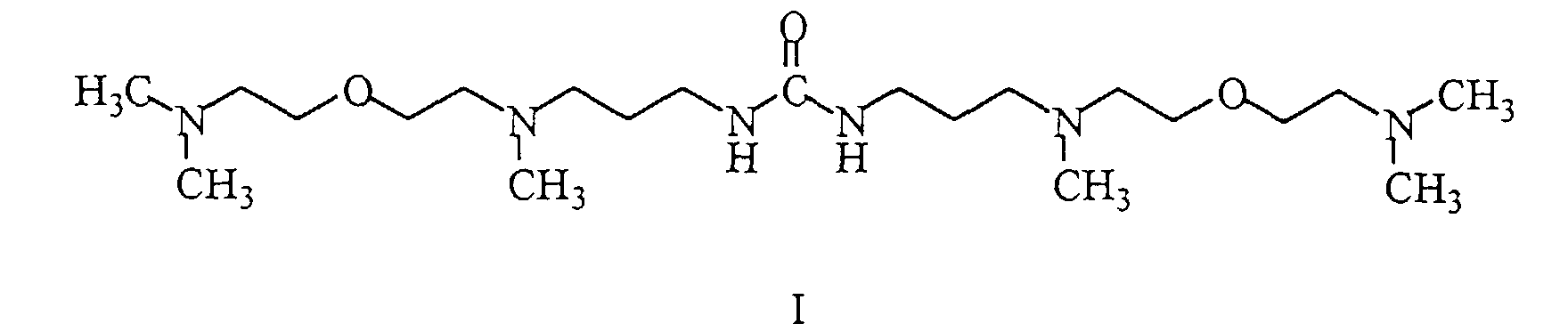
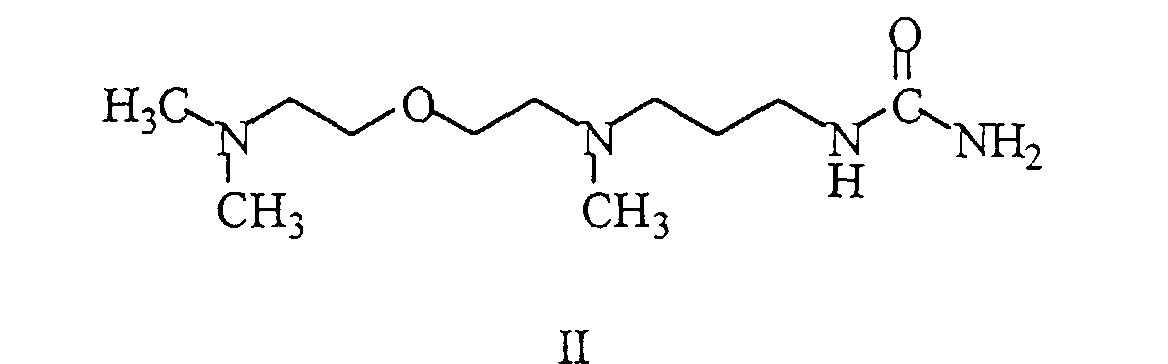
- the catalyst composition comprises an N,N,N'-trimethylbis(aminoethyl)ether substituted urea represented by formula I or II :
- the catalyst composition may comprise compound I , compound II , or a blend of compounds I and II in any weight ratio.
- catalyst compounds are their high activity and blowing selectivity. Additionally, they contain a ureido group which will react with isocyanate and chemically bond into the urethane during the reaction; therefore, the catalyst composition is not released from the finished product. The compositions are somewhat viscous and have minimal odor.
- the catalyst compositions according to the invention can catalyze (1) the reaction between an isocyanate functionality and an active hydrogen-containing compound, i.e. an alcohol, a polyol, an amine or water, especially the urethane (gelling) reaction of polyol hydroxyls with isocyanate to make polyurethanes and the blowing reaction of water with isocyanate to release carbon dioxide for making foamed polyurethanes, and/or (2) the trimerization of the isocyanate functionality to form polyisocyanurates.
- an active hydrogen-containing compound i.e. an alcohol, a polyol, an amine or water
- an active hydrogen-containing compound i.e. an alcohol, a polyol, an amine or water
- the polyurethane products are prepared using any suitable organic polyisocyanates well known in the art including, for example, hexamethylene diisocyanate, phenylene diisocyanate, toluene diisocyanate (“TDI”) and 4, 4'-diphenylmethane diisocyanate ("MDI").
- TDI hexamethylene diisocyanate
- MDI toluene diisocyanate
- MDI 4, 4'-diphenylmethane diisocyanate
- suitable isocyanates are mixtures of diisocyanates known commercially as "crude MDI", also known as PAPI, which contain about 60% of 4,4'-diphenylmethane diisocyanate along with other isomeric and analogous higher polyisocyanates.
- PAPI 4,4'-diphenylmethane diisocyanate
- prepolymers of these polyisocyanates comprising a partially prereacted mixture of a polyisocyanate and
- polyalkylene ether and polyester polyols Illustrative of suitable polyols as a component of the polyurethane composition are the polyalkylene ether and polyester polyols.
- the polyalkylene ether polyols include the poly(alkylene oxide) polymers such as poly(ethylene oxide) and poly(propylene oxide) polymers and copolymers with terminal hydroxyl groups derived from polyhydric compounds, including diols and triols; for example, among others, ethylene glycol, propylene glycol, 1,3-butane diol, 1,4-butane diol, 1,6-hexane diol, neopentyl glycol, diethylene glycol, dipropylene glycol, pentaerythritol, glycerol, diglycerol, trimethylol propane and like low molecular weight polyols.
- a single high molecular weight polyether polyol may be used.
- mixtures of high molecular weight polyether polyols such as mixtures of di- and trifunctional materials and/or different molecular weight or different chemical composition materials may be used.
- Useful polyester polyols include those produced by reacting a dicarboxylic acid with an excess of a do, for example, adipic acid with ethylene glycol or butanediol, or reacting a lactone with an excess of a diol such as caprolactone with propylene glycol.
- the masterbatches, or premix compositions frequently contain a polymer polyol.
- Polymer polyols are used in polyurethane foam to increase the foam's resistance to deformation, i.e. to increase the load-bearing properties of the foam.
- the first type described as a graft polyol, consists of a triol in which vinyl monomers are graft copolymerized. Styrene and acrylonitrile are the usual monomers of choice.
- the second type is a polyol containing a polyurea dispersion formed by the reaction of a diamine and TDI. Since TDI is used in excess, some of the TDI may react with both the polyol and polyurea.
- This second type of polymer polyol has a variant called PIPA polyol which is formed by the in-situ polymerization of TDI and alkanolamine in the polyol.
- polymer polyols may comprise 20-80% of the polyol portion of the masterbatch.
- chain extenders such as ethylene glycol and butanediol
- crosslinkers such as diethanolamine, diisopropanolamine, triethanolamine and tripropanolamine
- blowing agents such as water, CFCs, HCFCs, HFCs, pentane, and the like
- cell stabilizers such as silicones.
- a general polyurethane flexible foam formulation having a 1-3 lb/ft 3 (16-48 kg/m 3 ) density (e.g., automotive seating) containing a gelling catalyst such as triethylenediamine (TEDA) and a blowing catalyst such as the catalyst composition according to the invention would comprise the following components in parts by weight (pbw): Flexible Foam Formulation pbw Polyol 20-100 Polymer Polyol 80-0 Silicone Surfactant 1-2.5 Blowing Agent 2-4.5 Crosslinker 0.5-2 Catalyst 0.2-2 Isocyanate Index 70-115
- Any gelling catalyst known in the polyurethane art may be used with the catalyst compounds of the invention.
- Illustrative of suitable gelling catalysts are TEDA and tin urethane catalysts.
- the blowing catalyst composition comprises the compounds represented by the following formulas I and II , and any wt% combination of compounds I and II .
- Mixtures of compounds I and II may comprise 50 to 95 wt% compound I and 5 to 50 wt% compound II .
- the catalyst composition may also contain up to 20 wt% unreacted urea III .
- Compounds I and II are prepared by reacting urea and 4,10-diaza-4,10-di-methyl-7-oxa-undecanamine in the appropriate molar ratios under an inert atmosphere at elevated temperatures. Compounds I and II can be isolated individually by chromatography.
- a catalytically effective amount of the catalyst composition is used in the polyurethane formulation. More specifically, suitable amounts of the catalyst composition may range from about 0.01 to 10 parts by wt per 100 parts polyol (phpp) in the polyurethane formulation, preferably 0.05 to 0.5 phpp.
- the catalyst composition may be used in combination with, or also comprise, other tertiary amine, organotin or carboxylate urethane catalysts (gelling and/or blowing) well known in the urethane art.
- a one liter 3 neck round bottom flask was fitted with the following: mechanical stirrer, reflux condenser, nitrogen sparger, and a temperature controlled heating mantle.
- the flask was charged with 138.31 g of urea (CH 4 N 2 O) and 467.49 g of 4,10-diaza-4, 10-di-methyl-7-oxa-undecanamine ( IV ) (C 10 H 25 N 3 O).
- Compound IV can be prepared according to following Examples 5-7.
- the mixture was stirred at a constant rate while being slowly heated to 120°C.
- the reaction was controlled at 120°C until all signs of NH 3 evolution had ceased (as evidenced by bubbling in the N 2 pressure relief device).
- reaction Product Example 1 mole % 4,10-Diaza-4, 10-di-methyl-7-oxa-undecane urea 85.27 N,N'-Bis-(4,10-diaza-4, 10-di-methyl-7-oxa-undecane) urea 4.65 Urea 10.08
- a one liter 3 neck round bottom flask was fitted with the following: mechanical stirrer, reflux condenser, nitrogen sparger, and a temperature controlled heating mantle.
- the flask was charged with 8.88 g of urea (CH 4 N 2 O) and 63.03 g of 4,10-diaza-4,10-di-methyl-7-oxa-undecanamine ( IV ) (C 10 H 25 N 3 O).
- the mixture was stirred at a constant rate while being slowly heated to 120°C.
- the reaction was controlled at 120°C until all signs of NH 3 evolution had ceased (as evidenced by bubbling in the N 2 pressure relief device).
- a polyurethane foam was prepared in a conventional manner.
- E-648 a conventional, ethylene oxide tipped polyether polyol marketed by Arco Chemical Co.
- E-519 a styrene-acrylonitrile copolymer filled polyether polyol marketed by Arco Chemical Co.
- TDI 80 a mixture of 80 wt% 2,4-TDI and 20 wt% 2,6-TDI
- the catalyst (Table 4) was added to 202 g of the above premix in a 32 oz (951 ml) paper cup and the formulation was mixed for 20 seconds at 5000 RPM using an overhead stirrer fitted with a 2 in (5.1 cm) diameter stirring paddle.
- the 32 oz (951 ml) cup was dropped through a hole in the bottom of a 128 oz (3804 ml) paper cup placed on a stand. The hole was sized to catch the lip of the smaller cup.
- the total volume of the foam container was 160 oz (4755 ml). Foams approximated this volume at the end of the foam forming process. Maximum foam height and time to reach the top of the mixing cup (TOC1) and the top of the 128 oz. (3804 ml) cup (TOC2) were recorded (see Table 4).
- TMAEE N,N,N'-Trimethylbis(aminoethyl) ether
- a 2-liter stainless steel autoclave was charged with 499.4 g (3.75 moles) of dimethylaminoethoxyethanol (DMAEE) and 37.9 g of Cu/ZnO/Al 2 O 3 catalyst. After purging the reactor with N 2 and H 2 , the catalyst was reduced in situ under 56 bar of H 2 at a temperature of 195°C for 9 hr. The reactor was then cooled to 25°C and vented to ambient pressure. From a sample cylinder connected to a port in the reactor head, 177 g (5.7 moles) of monomethylamine (MMA) was charged using a 6.5 bar N 2 head to assist in the transfer.
- DMAEE dimethylaminoethoxyethanol
- MMA monomethylamine
- the reaction product was heated under vacuum to remove the low boiling components. A short path distillation was then done to remove heavies and any traces of Cu/ZnO/Al 2 O 3 catalyst.
- the overhead product from the short-path distillation (325.6 g) contained: Overhead Product from Short-Path Distillation wt% N,N,N'-trimethylbis(aminoethyl)ether 57.2 Dimethylaminoethoxyethanol 37.4 Other amines 5.4 This overhead product was used in the preparation of TMCEAEE in Example 6 below.
- TCEAEE N,N,N'-Trimethyl-N'-2-cyanoethylbis(aminoethyl) ether
- Example 7 Into a three necked round bottom flask equipped with a teflon coated magnetic stir bar, reflux condenser, pressure equalizing dropping funnel, and thermometer was placed 325g of the mixture from Example 5 (1.27 moles of contained N,N,N'-trimethylbis(aminoethyl) ether). The mixture was heated to 55°C and 71g (1.34 moles) of acrylonitrile was added over a period of two hours. The reaction was allowed to proceed an additional five hours until less than 1% of unreacted N,N',N'-trimethylbis(aminoethyl) ether remained. The crude product was used without purification in Example 7.
- the present invention provides a catalyst composition for preparing polyurethane products, especially polyurethane foams.
Landscapes
- Chemical & Material Sciences (AREA)
- Chemical Kinetics & Catalysis (AREA)
- Organic Chemistry (AREA)
- Engineering & Computer Science (AREA)
- Materials Engineering (AREA)
- Health & Medical Sciences (AREA)
- Medicinal Chemistry (AREA)
- Polymers & Plastics (AREA)
- Polyurethanes Or Polyureas (AREA)
- Organic Low-Molecular-Weight Compounds And Preparation Thereof (AREA)
Claims (14)
- 4,10-Diaza-4,10-dimethyl-7-oxaundecanharnstoff.
- N,N'-Bis-(4,10-diaza-4,10-dimethyl-7-oxaundecan)harnstoff.
- Katalysatorzusammensetzung, umfassend Verbindung I oder Verbindung II oder ein Gemisch aus den Verbindungen I und II
- Katalysatorzusammensetzung nach Anspruch 3, umfassend

- Katalysatorzusammensetzung nach Anspruch 3, umfassend

- Katalysatorzusammensetzung nach Anspruch 3, umfassend ein Gemisch ausund


- Verfahren zum Katalysieren der Trimerisierung eines Isocyanats und/oder der Reaktion zwischen einem Isocyanat und einer Verbindung, die reaktiven Wasserstoff enthält, gekennzeichnet durch die Verwendung einer Katalysatorzusammensetzung, die im wesentlichen aus Verbindung I oder Verbindung II oder einem Gemisch der Verbindungen I und II
 besteht.
- Verfahren nach Anspruch 7, in dem die Katalysatorzusammensetzungumfaßt.

- Verfahren nach Anspruch 7, in dem die Katalysatorzusammensetzungumfaßt.
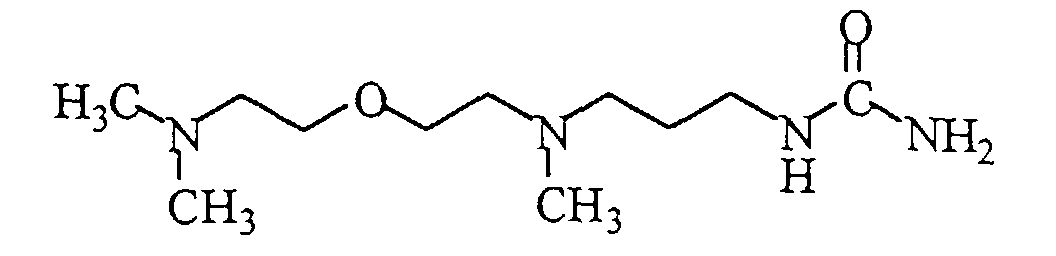
- Verfahren nach Anspruch 7, in dem die Katalysatorzusammensetzung ein Gemisch ausund
 umfaßt.
- Verfahren zur Herstellung eines Polyurethanschaums, das die Reaktion eines organischen Polyisocyanats und eines Polyols in Gegenwart eines Treibmittels, eines Zellstabilisators und einer Katalysatorzusammensetzung umfaßt, die im wesentlichen aus einem Gelbildungskatalysator und einem Aufblähkatalysator besteht, der Verbindung I oder Verbindung II oder ein Gemisch der Verbindungen I und II
 umfaßt.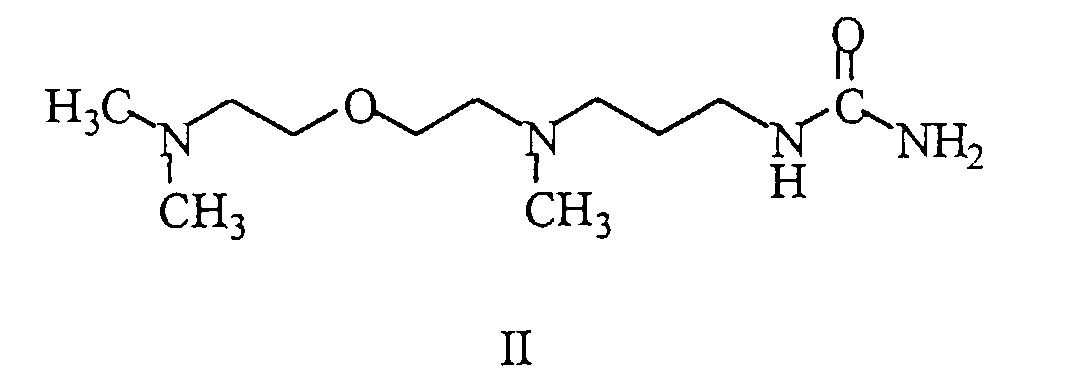
- Verfahren nach Anspruch 11, in dem der Aufblähkatalysatorumfaßt.

- Verfahren nach Anspruch 11, in dem der Aufblähkatalysatorumfaßt.
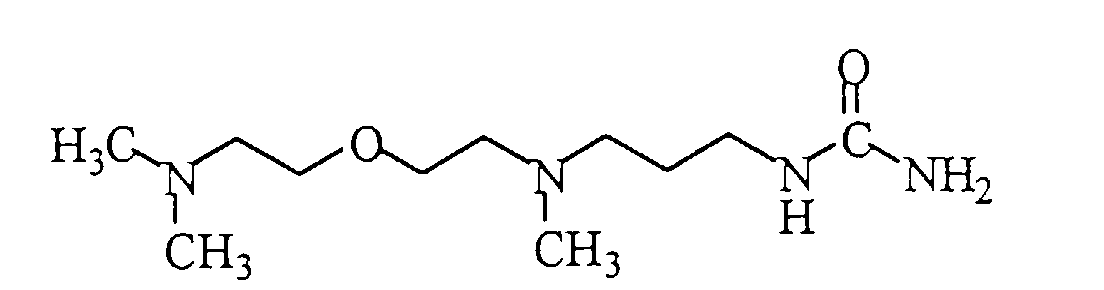
- Verfahren nach Anspruch 11, in dem der Aufblähkatalysator ein Gemisch ausund
 umfaßt.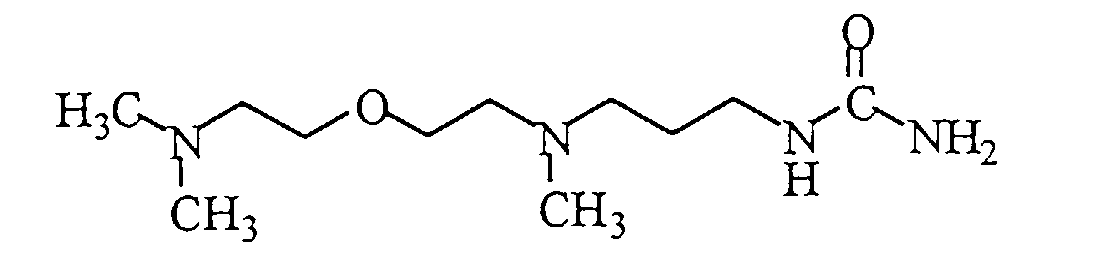
Applications Claiming Priority (2)
| Application Number | Priority Date | Filing Date | Title |
|---|---|---|---|
| US08/850,985 US5824711A (en) | 1997-05-05 | 1997-05-05 | N,N,N'-trimethylbis (Aminoethyl) ether substituted urea compostions for the production of polyurethanes |
| US850985 | 1997-05-06 |
Publications (2)
| Publication Number | Publication Date |
|---|---|
| EP0877016A1 EP0877016A1 (de) | 1998-11-11 |
| EP0877016B1 true EP0877016B1 (de) | 2001-01-17 |
Family
ID=25309643
Family Applications (1)
| Application Number | Title | Priority Date | Filing Date |
|---|---|---|---|
| EP98107857A Expired - Lifetime EP0877016B1 (de) | 1997-05-05 | 1998-04-29 | N,N,N'-trimethylbis(aminoethyl)ether-substituierte Harnstoffzusammensetzungen für die Herstellung von Polyurethanen |
Country Status (7)
| Country | Link |
|---|---|
| US (1) | US5824711A (de) |
| EP (1) | EP0877016B1 (de) |
| JP (1) | JP3168457B2 (de) |
| KR (1) | KR100274114B1 (de) |
| CN (1) | CN1064675C (de) |
| BR (1) | BR9801533A (de) |
| DE (1) | DE69800484T2 (de) |
Families Citing this family (25)
| Publication number | Priority date | Publication date | Assignee | Title |
|---|---|---|---|---|
| US5874483A (en) * | 1995-09-27 | 1999-02-23 | Air Products And Chemicals, Inc. | Aminopropylbis (aminoethyl) ether compositions for the production of polyurethanes |
| US6037297A (en) * | 1997-12-16 | 2000-03-14 | Exxon Research And Engineering Co. | Catalyst complexes and polymers therefrom |
| US6180788B1 (en) * | 1997-12-16 | 2001-01-30 | Exxon Research And Engineering Company | Catalyst compositions |
| US6037496A (en) * | 1999-03-26 | 2000-03-14 | Air Products And Chemicals, Inc. | 3-{N-[2-(N',N'-dimethylamino ethoxy)ethyl]-N-methylamino}propionamide for the production of polyurethanes |
| US6313346B1 (en) * | 1999-03-26 | 2001-11-06 | Air Products And Chemicals, Inc. | Catalyst compositions for the production of polyurethanes |
| US6156814A (en) * | 1999-03-26 | 2000-12-05 | Air Products And Chemicals, Inc. | Amido functional amine catalysts for the production of polyurethanes |
| US6248801B1 (en) * | 1999-11-12 | 2001-06-19 | Air Products And Chemicals, Inc. | Tertiary amine-containing active methylene compounds for improving the dimensional stability of polyurethane foam |
| US6501000B1 (en) | 2000-04-04 | 2002-12-31 | Exxonmobil Research And Engineering Company | Late transition metal catalyst complexes and oligomers therefrom |
| US6689928B2 (en) | 2000-04-04 | 2004-02-10 | Exxonmobil Research And Engineering Company | Transition metal complexes and oligomers therefrom |
| US6600001B1 (en) | 2002-01-11 | 2003-07-29 | Crompton Corporation | Alkylamino oxamides as low odor, non-fugitive catalysts for the production of polyurethanes |
| CA2417542A1 (en) * | 2002-01-28 | 2003-07-28 | Jeffrey D. Van Heumen | Foamed isocynate-based polymer having improved toughness and process for production thereof |
| US7009081B2 (en) * | 2003-08-04 | 2006-03-07 | Air Products And Chemicals, Inc. | N-methylated amines from selective vapor phase amination of amino ether alcohols |
| US6858654B1 (en) | 2003-10-27 | 2005-02-22 | Air Products And Chemicals, Inc. | Catalyst blends for producing low thermal desorption polyurethane foams |
| US20050267227A1 (en) * | 2004-05-28 | 2005-12-01 | Andrew Gary D | Fast demold/extended cream time polyurethane formulations |
| US8258198B2 (en) | 2004-05-28 | 2012-09-04 | Air Products And Chemicals, Inc. | Fast demold/extended cream time polyurethane formulations |
| US10023683B2 (en) * | 2006-06-12 | 2018-07-17 | Evonik Degussa Gmbh | Catalyst compositions for improving polyurethane foam performance |
| US20080269365A1 (en) | 2007-04-25 | 2008-10-30 | Gary Dale Andrew | Additives for Improving Surface Cure and Dimensional Stability of Polyurethane Foams |
| US8290705B2 (en) * | 2007-04-25 | 2012-10-16 | Rio Sisa Idea Farm | Mobile navigation system with graphic crime-risk display |
| US8637584B2 (en) * | 2007-05-25 | 2014-01-28 | Air Products And Chemicals, Inc. | Polyester polyol-containing polyurethane systems having improved hydrolytic stability |
| US8138378B2 (en) * | 2007-06-19 | 2012-03-20 | Huntsman Petrochemical Llc | Reactive amine catalysts for polyurethane foam |
| MX2009013796A (es) * | 2007-06-19 | 2010-04-22 | Huntsman Petrochemical Llc | Catalizadores de amina reactiva para espuma de poliuretano. |
| CN102503909A (zh) * | 2011-11-21 | 2012-06-20 | 武汉大学 | 含叔胺脲衍生物类化合物及其制备方法和应用 |
| PL4004079T3 (pl) | 2019-07-24 | 2025-10-20 | Evonik Operations Gmbh | Wytwarzanie pianek poliuretanowych |
| CN111205192B (zh) * | 2020-01-21 | 2023-01-13 | 新典化学材料(上海)有限公司 | 一种n,n,n′-三甲基双(氨基乙基)醚的制备方法 |
| CN116199589B (zh) * | 2022-09-29 | 2025-04-25 | 杭州恒海新材料科技有限公司 | N,n,n′-三甲基-n′-(3-氨基丙基)双(氨基乙基)醚的联产方法 |
Family Cites Families (11)
| Publication number | Priority date | Publication date | Assignee | Title |
|---|---|---|---|---|
| US4007140A (en) * | 1972-11-01 | 1977-02-08 | Imperial Chemical Industries Limited | Tertiary amines as catalysts in polyurethane manufacture |
| US4094827A (en) * | 1976-10-18 | 1978-06-13 | Texaco Development Corporation | Substituted ureas as polyurethane catalysts |
| DE2843739C3 (de) * | 1978-10-06 | 1982-04-22 | Bayer Ag, 5090 Leverkusen | Verfahren zur Herstellung von im wesentlichen homogenen Polyurethan-Elastomeren |
| US4194069A (en) * | 1978-10-16 | 1980-03-18 | Texaco Development Corporation | Urea derivative and use as polyurethane catalyst |
| DE3027796A1 (de) * | 1980-07-23 | 1982-02-18 | Bayer Ag, 5090 Leverkusen | Verfahren zur herstellung von polyurethanen unter verwendung von dialkylaminoalkylharnstoffen als katalysatoren |
| US4338408A (en) * | 1981-07-20 | 1982-07-06 | Texaco Inc. | Polyurethanes using bis(aminoethyl)ether derivatives as catalysts |
| DE3435070A1 (de) * | 1984-09-25 | 1986-04-03 | Bayer Ag, 5090 Leverkusen | Verfahren zur herstellung von gegebenenfalls geschaeumten polyurethanen, die mit einem anderen werkstoff verbunden oder konfektioniert worden sind |
| GB9221869D0 (en) * | 1992-10-19 | 1992-12-02 | Ici Plc | Novel polyols |
| US5559161A (en) * | 1994-02-18 | 1996-09-24 | Air Products And Chemicals, Inc. | Hydroxy-functional triamine catalyst compositions for the production of polyurethanes |
| US5616625A (en) * | 1995-02-17 | 1997-04-01 | National Starch And Chemical Investment Holding Corporation | Reactive hot melt foam |
| US5710191A (en) * | 1995-06-05 | 1998-01-20 | Air Products And Chemicals, Inc. | Hydroxymethyl quinuclidine catalyst compositions for making polyurethane foams |
-
1997
- 1997-05-05 US US08/850,985 patent/US5824711A/en not_active Expired - Fee Related
-
1998
- 1998-04-29 DE DE69800484T patent/DE69800484T2/de not_active Expired - Fee Related
- 1998-04-29 EP EP98107857A patent/EP0877016B1/de not_active Expired - Lifetime
- 1998-04-30 BR BR9801533A patent/BR9801533A/pt not_active IP Right Cessation
- 1998-05-01 JP JP12203298A patent/JP3168457B2/ja not_active Expired - Fee Related
- 1998-05-01 KR KR1019980015763A patent/KR100274114B1/ko not_active Expired - Fee Related
- 1998-05-05 CN CN981079946A patent/CN1064675C/zh not_active Expired - Fee Related
Also Published As
| Publication number | Publication date |
|---|---|
| US5824711A (en) | 1998-10-20 |
| KR100274114B1 (ko) | 2000-12-15 |
| CN1064675C (zh) | 2001-04-18 |
| CN1223255A (zh) | 1999-07-21 |
| DE69800484D1 (de) | 2001-02-22 |
| EP0877016A1 (de) | 1998-11-11 |
| DE69800484T2 (de) | 2001-05-03 |
| KR19980086707A (ko) | 1998-12-05 |
| JPH1121331A (ja) | 1999-01-26 |
| JP3168457B2 (ja) | 2001-05-21 |
| BR9801533A (pt) | 1999-06-29 |
Similar Documents
| Publication | Publication Date | Title |
|---|---|---|
| EP0877016B1 (de) | N,N,N'-trimethylbis(aminoethyl)ether-substituierte Harnstoffzusammensetzungen für die Herstellung von Polyurethanen | |
| US6201033B1 (en) | Reactive catalyst compositions for improving water blown polyurethane foam performance | |
| EP0765892B1 (de) | Aminopropylbis(aminoethyl)etherzusammensetzungen zur Herstellung von Polyurethanen | |
| EP0672695B1 (de) | Hydroxylgruppen enthaltende Triaminkatalysatorzusammensetzungen zur Polyurethanherstellung | |
| US5508314A (en) | Hydroxyl group-containing blowing catalyst compositions for the production of polyurethanes | |
| MXPA96004243A (es) | Composiciones de aminopropilbis(aminoetil)eterpara la produccion de poliuretanos | |
| EP0879837B1 (de) | Polyurethan-Katalysatorzusammensetzungen zur Verbesserung der Schaumstoffleistung | |
| US5756558A (en) | Hydroxyalkylbis(aminoethyl) ether compositions for the production of polyurethanes | |
| EP0877017B1 (de) | Aminomethyl-Pyrrolidin-Harnstoff-Zusammensetzungen für die Herstellung von Polyurethanen | |
| EP1038896A2 (de) | Amidofunktionnelle Aminkatalysatoren zur Herstellung von Polyurethanen | |
| US6998508B2 (en) | Tertiary alkanolamines containing surface active alkyl groups | |
| US6037496A (en) | 3-{N-[2-(N',N'-dimethylamino ethoxy)ethyl]-N-methylamino}propionamide for the production of polyurethanes | |
| US6313346B1 (en) | Catalyst compositions for the production of polyurethanes | |
| MXPA98003521A (en) | Urea compositions substituted with ether n, n, n'trimethylbis (aminoethylene) for the production of polyurette | |
| EP1457480B1 (de) | Tertiäre Alkanolamine mit oberflächenaktiven Alkylgruppen | |
| MXPA98003525A (en) | Compositions of aminometil pyrrolidine urea parala polyurette production | |
| MXPA00002794A (en) | New catalyst compositions for the production of polyurethanes | |
| MXPA97005017A (en) | Compositions of hydroxialquilbis (aminoethyl) eter for the production of polyureth |
Legal Events
| Date | Code | Title | Description |
|---|---|---|---|
| PUAI | Public reference made under article 153(3) epc to a published international application that has entered the european phase |
Free format text: ORIGINAL CODE: 0009012 |
|
| AK | Designated contracting states |
Kind code of ref document: A1 Designated state(s): DE FR GB IT |
|
| AX | Request for extension of the european patent |
Free format text: AL;LT;LV;MK;RO;SI |
|
| 17P | Request for examination filed |
Effective date: 19990427 |
|
| AKX | Designation fees paid |
Free format text: DE FR GB IT |
|
| 17Q | First examination report despatched |
Effective date: 19991122 |
|
| GRAG | Despatch of communication of intention to grant |
Free format text: ORIGINAL CODE: EPIDOS AGRA |
|
| GRAG | Despatch of communication of intention to grant |
Free format text: ORIGINAL CODE: EPIDOS AGRA |
|
| GRAH | Despatch of communication of intention to grant a patent |
Free format text: ORIGINAL CODE: EPIDOS IGRA |
|
| GRAH | Despatch of communication of intention to grant a patent |
Free format text: ORIGINAL CODE: EPIDOS IGRA |
|
| GRAA | (expected) grant |
Free format text: ORIGINAL CODE: 0009210 |
|
| AK | Designated contracting states |
Kind code of ref document: B1 Designated state(s): DE FR GB IT |
|
| ITF | It: translation for a ep patent filed | ||
| REF | Corresponds to: |
Ref document number: 69800484 Country of ref document: DE Date of ref document: 20010222 |
|
| ET | Fr: translation filed | ||
| PLBE | No opposition filed within time limit |
Free format text: ORIGINAL CODE: 0009261 |
|
| STAA | Information on the status of an ep patent application or granted ep patent |
Free format text: STATUS: NO OPPOSITION FILED WITHIN TIME LIMIT |
|
| REG | Reference to a national code |
Ref country code: GB Ref legal event code: IF02 |
|
| 26N | No opposition filed | ||
| PGFP | Annual fee paid to national office [announced via postgrant information from national office to epo] |
Ref country code: GB Payment date: 20080317 Year of fee payment: 11 |
|
| PGFP | Annual fee paid to national office [announced via postgrant information from national office to epo] |
Ref country code: IT Payment date: 20080416 Year of fee payment: 11 |
|
| PGFP | Annual fee paid to national office [announced via postgrant information from national office to epo] |
Ref country code: FR Payment date: 20090406 Year of fee payment: 12 Ref country code: DE Payment date: 20090430 Year of fee payment: 12 |
|
| GBPC | Gb: european patent ceased through non-payment of renewal fee |
Effective date: 20090429 |
|
| PG25 | Lapsed in a contracting state [announced via postgrant information from national office to epo] |
Ref country code: GB Free format text: LAPSE BECAUSE OF NON-PAYMENT OF DUE FEES Effective date: 20090429 |
|
| REG | Reference to a national code |
Ref country code: FR Ref legal event code: ST Effective date: 20101230 |
|
| PG25 | Lapsed in a contracting state [announced via postgrant information from national office to epo] |
Ref country code: DE Free format text: LAPSE BECAUSE OF NON-PAYMENT OF DUE FEES Effective date: 20101103 |
|
| PG25 | Lapsed in a contracting state [announced via postgrant information from national office to epo] |
Ref country code: IT Free format text: LAPSE BECAUSE OF NON-PAYMENT OF DUE FEES Effective date: 20090429 |
|
| PG25 | Lapsed in a contracting state [announced via postgrant information from national office to epo] |
Ref country code: FR Free format text: LAPSE BECAUSE OF NON-PAYMENT OF DUE FEES Effective date: 20100430 |