EP0877069A1 - Thermisch härtbare, haftklebrige Folie - Google Patents
Thermisch härtbare, haftklebrige Folie Download PDFInfo
- Publication number
- EP0877069A1 EP0877069A1 EP98107488A EP98107488A EP0877069A1 EP 0877069 A1 EP0877069 A1 EP 0877069A1 EP 98107488 A EP98107488 A EP 98107488A EP 98107488 A EP98107488 A EP 98107488A EP 0877069 A1 EP0877069 A1 EP 0877069A1
- Authority
- EP
- European Patent Office
- Prior art keywords
- film according
- carboxylic acid
- weight
- film
- polymer
- Prior art date
- Legal status (The legal status is an assumption and is not a legal conclusion. Google has not performed a legal analysis and makes no representation as to the accuracy of the status listed.)
- Granted
Links
- 230000001070 adhesive effect Effects 0.000 title description 21
- 239000000853 adhesive Substances 0.000 title description 20
- 239000011888 foil Substances 0.000 title 1
- 239000010426 asphalt Substances 0.000 claims abstract description 16
- 238000004073 vulcanization Methods 0.000 claims abstract description 13
- 229920001971 elastomer Polymers 0.000 claims abstract description 10
- 239000003921 oil Substances 0.000 claims abstract description 6
- 239000004014 plasticizer Substances 0.000 claims abstract description 6
- 239000000945 filler Substances 0.000 claims abstract description 5
- 229920000728 polyester Polymers 0.000 claims abstract description 5
- 239000002313 adhesive film Substances 0.000 claims abstract description 3
- NINIDFKCEFEMDL-UHFFFAOYSA-N Sulfur Chemical compound [S] NINIDFKCEFEMDL-UHFFFAOYSA-N 0.000 claims description 13
- AFZSMODLJJCVPP-UHFFFAOYSA-N dibenzothiazol-2-yl disulfide Chemical compound C1=CC=C2SC(SSC=3SC4=CC=CC=C4N=3)=NC2=C1 AFZSMODLJJCVPP-UHFFFAOYSA-N 0.000 claims description 12
- 239000000454 talc Substances 0.000 claims description 12
- 229910052623 talc Inorganic materials 0.000 claims description 12
- 239000012973 diazabicyclooctane Substances 0.000 claims description 11
- 229920000642 polymer Polymers 0.000 claims description 11
- 239000003054 catalyst Substances 0.000 claims description 8
- 230000032050 esterification Effects 0.000 claims description 8
- 238000005886 esterification reaction Methods 0.000 claims description 8
- 150000001244 carboxylic acid anhydrides Chemical group 0.000 claims description 7
- 125000002843 carboxylic acid group Chemical group 0.000 claims description 6
- 239000007788 liquid Substances 0.000 claims description 6
- 229920002521 macromolecule Polymers 0.000 claims description 6
- 125000002887 hydroxy group Chemical group [H]O* 0.000 claims description 5
- 239000000126 substance Substances 0.000 claims description 5
- GWEVSGVZZGPLCZ-UHFFFAOYSA-N Titan oxide Chemical compound O=[Ti]=O GWEVSGVZZGPLCZ-UHFFFAOYSA-N 0.000 claims description 4
- XLOMVQKBTHCTTD-UHFFFAOYSA-N Zinc monoxide Chemical compound [Zn]=O XLOMVQKBTHCTTD-UHFFFAOYSA-N 0.000 claims description 4
- TZCXTZWJZNENPQ-UHFFFAOYSA-L barium sulfate Chemical compound [Ba+2].[O-]S([O-])(=O)=O TZCXTZWJZNENPQ-UHFFFAOYSA-L 0.000 claims description 4
- 229920002959 polymer blend Polymers 0.000 claims description 4
- 229920005989 resin Polymers 0.000 claims description 4
- 239000011347 resin Substances 0.000 claims description 4
- KWYHDKDOAIKMQN-UHFFFAOYSA-N N,N,N',N'-tetramethylethylenediamine Chemical compound CN(C)CCN(C)C KWYHDKDOAIKMQN-UHFFFAOYSA-N 0.000 claims description 3
- 238000004026 adhesive bonding Methods 0.000 claims description 3
- 229910052717 sulfur Inorganic materials 0.000 claims description 3
- 239000011593 sulfur Substances 0.000 claims description 3
- GIWQSPITLQVMSG-UHFFFAOYSA-N 1,2-dimethylimidazole Chemical compound CC1=NC=CN1C GIWQSPITLQVMSG-UHFFFAOYSA-N 0.000 claims description 2
- NFDXQGNDWIPXQL-UHFFFAOYSA-N 1-cyclooctyldiazocane Chemical compound C1CCCCCCC1N1NCCCCCC1 NFDXQGNDWIPXQL-UHFFFAOYSA-N 0.000 claims description 2
- MCTWTZJPVLRJOU-UHFFFAOYSA-N 1-methyl-1H-imidazole Chemical compound CN1C=CN=C1 MCTWTZJPVLRJOU-UHFFFAOYSA-N 0.000 claims description 2
- XBDQKXXYIPTUBI-UHFFFAOYSA-M Propionate Chemical compound CCC([O-])=O XBDQKXXYIPTUBI-UHFFFAOYSA-M 0.000 claims description 2
- 150000001412 amines Chemical class 0.000 claims description 2
- BRPQOXSCLDDYGP-UHFFFAOYSA-N calcium oxide Chemical compound [O-2].[Ca+2] BRPQOXSCLDDYGP-UHFFFAOYSA-N 0.000 claims description 2
- 239000000292 calcium oxide Substances 0.000 claims description 2
- ODINCKMPIJJUCX-UHFFFAOYSA-N calcium oxide Inorganic materials [Ca]=O ODINCKMPIJJUCX-UHFFFAOYSA-N 0.000 claims description 2
- 239000006229 carbon black Substances 0.000 claims description 2
- 239000007795 chemical reaction product Substances 0.000 claims description 2
- JQVDAXLFBXTEQA-UHFFFAOYSA-N dibutylamine Chemical compound CCCCNCCCC JQVDAXLFBXTEQA-UHFFFAOYSA-N 0.000 claims description 2
- 229910021485 fumed silica Inorganic materials 0.000 claims description 2
- 239000003112 inhibitor Substances 0.000 claims description 2
- 230000003647 oxidation Effects 0.000 claims description 2
- 238000007254 oxidation reaction Methods 0.000 claims description 2
- UKODFQOELJFMII-UHFFFAOYSA-N pentamethyldiethylenetriamine Chemical compound CN(C)CCN(C)CCN(C)C UKODFQOELJFMII-UHFFFAOYSA-N 0.000 claims description 2
- 229920002857 polybutadiene Polymers 0.000 claims description 2
- 150000005619 secondary aliphatic amines Chemical class 0.000 claims description 2
- 150000003510 tertiary aliphatic amines Chemical class 0.000 claims description 2
- 239000004408 titanium dioxide Substances 0.000 claims description 2
- 239000011787 zinc oxide Substances 0.000 claims description 2
- NFHFRUOZVGFOOS-UHFFFAOYSA-N palladium;triphenylphosphane Chemical compound [Pd].C1=CC=CC=C1P(C=1C=CC=CC=1)C1=CC=CC=C1.C1=CC=CC=C1P(C=1C=CC=CC=1)C1=CC=CC=C1.C1=CC=CC=C1P(C=1C=CC=CC=1)C1=CC=CC=C1.C1=CC=CC=C1P(C=1C=CC=CC=1)C1=CC=CC=C1 NFHFRUOZVGFOOS-UHFFFAOYSA-N 0.000 claims 1
- 239000006057 Non-nutritive feed additive Substances 0.000 abstract 2
- 239000004840 adhesive resin Substances 0.000 abstract 1
- 229920006223 adhesive resin Polymers 0.000 abstract 1
- OKTJSMMVPCPJKN-UHFFFAOYSA-N Carbon Chemical compound [C] OKTJSMMVPCPJKN-UHFFFAOYSA-N 0.000 description 10
- 235000008733 Citrus aurantifolia Nutrition 0.000 description 10
- 235000011941 Tilia x europaea Nutrition 0.000 description 10
- 239000004571 lime Substances 0.000 description 10
- IMNIMPAHZVJRPE-UHFFFAOYSA-N triethylenediamine Chemical compound C1CN2CCN1CC2 IMNIMPAHZVJRPE-UHFFFAOYSA-N 0.000 description 9
- 239000000203 mixture Substances 0.000 description 8
- 239000000463 material Substances 0.000 description 7
- 235000011837 pasties Nutrition 0.000 description 6
- 239000004820 Pressure-sensitive adhesive Substances 0.000 description 5
- 229910052751 metal Inorganic materials 0.000 description 5
- 239000002184 metal Substances 0.000 description 5
- 238000000034 method Methods 0.000 description 5
- 229920000647 polyepoxide Polymers 0.000 description 5
- PEDCQBHIVMGVHV-UHFFFAOYSA-N Glycerine Chemical compound OCC(O)CO PEDCQBHIVMGVHV-UHFFFAOYSA-N 0.000 description 4
- 239000003822 epoxy resin Substances 0.000 description 4
- 238000002156 mixing Methods 0.000 description 4
- 239000000758 substrate Substances 0.000 description 4
- 239000004593 Epoxy Substances 0.000 description 3
- LYCAIKOWRPUZTN-UHFFFAOYSA-N Ethylene glycol Chemical compound OCCO LYCAIKOWRPUZTN-UHFFFAOYSA-N 0.000 description 3
- 229910001335 Galvanized steel Inorganic materials 0.000 description 3
- 229910000831 Steel Inorganic materials 0.000 description 3
- 150000001252 acrylic acid derivatives Chemical class 0.000 description 3
- 230000032683 aging Effects 0.000 description 3
- 238000005238 degreasing Methods 0.000 description 3
- 239000008397 galvanized steel Substances 0.000 description 3
- 230000007062 hydrolysis Effects 0.000 description 3
- 238000006460 hydrolysis reaction Methods 0.000 description 3
- 238000004519 manufacturing process Methods 0.000 description 3
- 239000010959 steel Substances 0.000 description 3
- 238000001029 thermal curing Methods 0.000 description 3
- NIXOWILDQLNWCW-UHFFFAOYSA-M Acrylate Chemical compound [O-]C(=O)C=C NIXOWILDQLNWCW-UHFFFAOYSA-M 0.000 description 2
- 238000004132 cross linking Methods 0.000 description 2
- 238000004070 electrodeposition Methods 0.000 description 2
- 235000011187 glycerol Nutrition 0.000 description 2
- LNEPOXFFQSENCJ-UHFFFAOYSA-N haloperidol Chemical compound C1CC(O)(C=2C=CC(Cl)=CC=2)CCN1CCCC(=O)C1=CC=C(F)C=C1 LNEPOXFFQSENCJ-UHFFFAOYSA-N 0.000 description 2
- 239000004615 ingredient Substances 0.000 description 2
- 238000002360 preparation method Methods 0.000 description 2
- 239000000047 product Substances 0.000 description 2
- 239000002994 raw material Substances 0.000 description 2
- KXGFMDJXCMQABM-UHFFFAOYSA-N 2-methoxy-6-methylphenol Chemical compound [CH]OC1=CC=CC([CH])=C1O KXGFMDJXCMQABM-UHFFFAOYSA-N 0.000 description 1
- 239000004925 Acrylic resin Substances 0.000 description 1
- 239000004970 Chain extender Substances 0.000 description 1
- 239000004971 Cross linker Substances 0.000 description 1
- 239000004823 Reactive adhesive Substances 0.000 description 1
- 230000002378 acidificating effect Effects 0.000 description 1
- 150000001298 alcohols Chemical class 0.000 description 1
- 230000015572 biosynthetic process Effects 0.000 description 1
- GXRDMEGSBKPONF-UHFFFAOYSA-N bis(2-methyloctyl) benzene-1,2-dicarboxylate Chemical compound CCCCCCC(C)COC(=O)C1=CC=CC=C1C(=O)OCC(C)CCCCCC GXRDMEGSBKPONF-UHFFFAOYSA-N 0.000 description 1
- 150000001732 carboxylic acid derivatives Chemical class 0.000 description 1
- 230000015556 catabolic process Effects 0.000 description 1
- -1 chalk Substances 0.000 description 1
- 238000006243 chemical reaction Methods 0.000 description 1
- 239000011248 coating agent Substances 0.000 description 1
- 238000000576 coating method Methods 0.000 description 1
- 230000000295 complement effect Effects 0.000 description 1
- 238000009833 condensation Methods 0.000 description 1
- 230000005494 condensation Effects 0.000 description 1
- 238000005260 corrosion Methods 0.000 description 1
- 230000007797 corrosion Effects 0.000 description 1
- 238000007872 degassing Methods 0.000 description 1
- 230000001419 dependent effect Effects 0.000 description 1
- 125000003700 epoxy group Chemical group 0.000 description 1
- 125000004185 ester group Chemical group 0.000 description 1
- 238000009472 formulation Methods 0.000 description 1
- 125000000524 functional group Chemical group 0.000 description 1
- 150000002334 glycols Chemical class 0.000 description 1
- 238000010438 heat treatment Methods 0.000 description 1
- 239000012943 hotmelt Substances 0.000 description 1
- 239000000155 melt Substances 0.000 description 1
- 150000002739 metals Chemical class 0.000 description 1
- 238000010422 painting Methods 0.000 description 1
- 229920001568 phenolic resin Polymers 0.000 description 1
- 239000005011 phenolic resin Substances 0.000 description 1
- XNGIFLGASWRNHJ-UHFFFAOYSA-L phthalate(2-) Chemical compound [O-]C(=O)C1=CC=CC=C1C([O-])=O XNGIFLGASWRNHJ-UHFFFAOYSA-L 0.000 description 1
- 230000001681 protective effect Effects 0.000 description 1
- 150000003839 salts Chemical class 0.000 description 1
- 239000007921 spray Substances 0.000 description 1
- 238000003860 storage Methods 0.000 description 1
- 150000003505 terpenes Chemical class 0.000 description 1
- 235000007586 terpenes Nutrition 0.000 description 1
- 238000011144 upstream manufacturing Methods 0.000 description 1
- 238000005406 washing Methods 0.000 description 1
- XLYOFNOQVPJJNP-UHFFFAOYSA-N water Substances O XLYOFNOQVPJJNP-UHFFFAOYSA-N 0.000 description 1
- 238000003466 welding Methods 0.000 description 1
Classifications
-
- C—CHEMISTRY; METALLURGY
- C09—DYES; PAINTS; POLISHES; NATURAL RESINS; ADHESIVES; COMPOSITIONS NOT OTHERWISE PROVIDED FOR; APPLICATIONS OF MATERIALS NOT OTHERWISE PROVIDED FOR
- C09J—ADHESIVES; NON-MECHANICAL ASPECTS OF ADHESIVE PROCESSES IN GENERAL; ADHESIVE PROCESSES NOT PROVIDED FOR ELSEWHERE; USE OF MATERIALS AS ADHESIVES
- C09J7/00—Adhesives in the form of films or foils
- C09J7/10—Adhesives in the form of films or foils without carriers
-
- C—CHEMISTRY; METALLURGY
- C09—DYES; PAINTS; POLISHES; NATURAL RESINS; ADHESIVES; COMPOSITIONS NOT OTHERWISE PROVIDED FOR; APPLICATIONS OF MATERIALS NOT OTHERWISE PROVIDED FOR
- C09J—ADHESIVES; NON-MECHANICAL ASPECTS OF ADHESIVE PROCESSES IN GENERAL; ADHESIVE PROCESSES NOT PROVIDED FOR ELSEWHERE; USE OF MATERIALS AS ADHESIVES
- C09J2421/00—Presence of unspecified rubber
-
- C—CHEMISTRY; METALLURGY
- C09—DYES; PAINTS; POLISHES; NATURAL RESINS; ADHESIVES; COMPOSITIONS NOT OTHERWISE PROVIDED FOR; APPLICATIONS OF MATERIALS NOT OTHERWISE PROVIDED FOR
- C09J—ADHESIVES; NON-MECHANICAL ASPECTS OF ADHESIVE PROCESSES IN GENERAL; ADHESIVE PROCESSES NOT PROVIDED FOR ELSEWHERE; USE OF MATERIALS AS ADHESIVES
- C09J2495/00—Presence of bitume
-
- Y—GENERAL TAGGING OF NEW TECHNOLOGICAL DEVELOPMENTS; GENERAL TAGGING OF CROSS-SECTIONAL TECHNOLOGIES SPANNING OVER SEVERAL SECTIONS OF THE IPC; TECHNICAL SUBJECTS COVERED BY FORMER USPC CROSS-REFERENCE ART COLLECTIONS [XRACs] AND DIGESTS
- Y10—TECHNICAL SUBJECTS COVERED BY FORMER USPC
- Y10T—TECHNICAL SUBJECTS COVERED BY FORMER US CLASSIFICATION
- Y10T428/00—Stock material or miscellaneous articles
- Y10T428/28—Web or sheet containing structurally defined element or component and having an adhesive outermost layer
- Y10T428/2848—Three or more layers
-
- Y—GENERAL TAGGING OF NEW TECHNOLOGICAL DEVELOPMENTS; GENERAL TAGGING OF CROSS-SECTIONAL TECHNOLOGIES SPANNING OVER SEVERAL SECTIONS OF THE IPC; TECHNICAL SUBJECTS COVERED BY FORMER USPC CROSS-REFERENCE ART COLLECTIONS [XRACs] AND DIGESTS
- Y10—TECHNICAL SUBJECTS COVERED BY FORMER USPC
- Y10T—TECHNICAL SUBJECTS COVERED BY FORMER US CLASSIFICATION
- Y10T428/00—Stock material or miscellaneous articles
- Y10T428/28—Web or sheet containing structurally defined element or component and having an adhesive outermost layer
- Y10T428/2852—Adhesive compositions
- Y10T428/2878—Adhesive compositions including addition polymer from unsaturated monomer
- Y10T428/2883—Adhesive compositions including addition polymer from unsaturated monomer including addition polymer of diene monomer [e.g., SBR, SIS, etc.]
Definitions
- the invention describes a double-sided adhesive film based on rubber, which can be thermally cured to achieve high adhesive strengths.
- the characteristic requirements for a structural adhesive are: There must be good, aging and hydrolysis-resistant adhesion to oiled sheets of different types, such as normal steel, hot-dip galvanized steel, galvanized steel or electrolytically galvanized steel, which must be reflected in a cohesive fracture pattern.
- the aging and hydrolysis stability is checked by storage at elevated temperatures, salt spray tests, condensation water tests, climate change tests and the like.
- a basic structural adhesive must not be washed out in the various degreasing baths and showers, in the phosphating and passivating baths and during the electrocoating process. In addition, it must harden in the KTL baking oven at approx. 180 ° C for 30 minutes and be stable to overburning up to approx. 230 ° C.
- Adhesive pastes have recently become available on the market at room temperature processable and nevertheless washable in some painting lines without pre-gelling are what is achieved through a pronounced pseudoplastic setting. But also these adhesives have disadvantages, because the sheet metal parts to be glued must be in front of the thermal curing of the adhesive to be mechanically fixed to prevent slipping prevent.
- Pressure-sensitive adhesive films do not have these disadvantages.
- Pressure sensitive adhesive films used for Achieving high strengths can also be thermally hardened previously known.
- JP 50 028 970 describes a blend of acrylates and epoxy resin made from solution described, which is initially tacky and high after thermal curing Shear strength achieved.
- JP 04 189 887, JP 04 189 885 and JP 04 189 884 also use special acrylate / epoxy resin blends used to get to thermally curable pressure sensitive adhesives.
- the structure of a rubber is known from German laid-open specification DE 38 30 895 A. described from at least two starting polymers, via ester groups are chemically linked and at least one of which is olefinically unsaturated is.
- EP 0 356 715 B1 describes a two-component adhesive that also makes use of the structure mentioned above and in which the Vulcanization of the mixture is described at higher temperatures. Use too is listed there as a body-in-white adhesive. However, this material applied to the substrates to be bonded before the polyesterification and can thus flow onto the substrates.
- the object of the invention was to provide a double-sided pressure-sensitive film which for Achieving high adhesive strengths can be cured thermally and after the thermal hardening, in particular on oiled sheets, such as those used in car body-in-white are used, adheres so well that cohesive fracture patterns are produced when tearing will.
- the film should also be free of epoxy resins.
- bitumen or the tackifying resins for example a terpene phenolic resin, are used to adjust the film's tack.
- the rubber is preferably the reaction product of a polymer or one Polymer mixture A with an average of at least two hydroxyl groups per macromolecule and a polymer compatible with A or polymer mixture B with at least on average two carboxylic acid groups or at least two carboxylic acid anhydride groups or at least one carboxylic acid group and one carboxylic anhydride group per Macromolecule, wherein at least one of the polymers A or B has olefinic double bonds contains, over which the rubber under the usual reaction conditions elevated temperature is vulcanizable ..
- the polymers A and B are liquid polybutadienes which carry on average at least two hydroxyl groups, carboxylic acid groups or carboxylic anhydride groups per macromolecule. These functional groups can be bound at the chain ends or at the ends of the side chains, but they can also be located internally on the chain.
- the rubber can be used as further starting components in short-chain hydroxyl or Have carboxylic anhydride or carboxylic acid terminated substances. These act with regard to polyester formation as a terminator (for example mono alcohols), Chain extenders (e.g. glycols) or crosslinkers (e.g. glycerin).
- a terminator for example mono alcohols
- Chain extenders e.g. glycols
- crosslinkers e.g. glycerin
- the polyester is further preferably esterified by the addition an esterification catalyst, in a proportion of 0.05% by weight to 0.5 % By weight.
- the esterification catalysts used are in particular basic esterification catalysts such as amines, preferably secondary and tertiary aliphatic amines, very particularly preferably n-dibutylamine, dimethycyclohexylamine. Diazabicyclooctane, tetramethylethylenediamine or pentamethyldiethylenetriamine and 1-methylimidazole or 1,2-dimethylimidazole.
- acidic esterification catalysts can also be used. The prerequisite is that this is compatible with the vulcanization system.
- Sulfur, 2,2'-dibenzothiazyl disulfide and optionally zinc oxide have proven to be particularly advantageous as vulcanization auxiliaries and accelerators.
- the substances mentioned are added in an amount customary for vulcanization.
- the film can also contain plasticizers compatible with the system or oils which act as plasticizers. Commercial phthalate plasticizers or naphthenic oils are preferred.
- the film according to the invention is excellently suitable for use in car body-in-white, especially for gluing oiled sheets. But also other metal parts can be glued very well to the film.
- the film shows excellent due to its formulation as described above Product properties that could not have been foreseen in this way even by a person skilled in the art.
- the film Before thermal crosslinking, the film has an adhesive strength of approx. 1 N / cm to 3 N / cm (both at a peel angle of 180 °) on both unoiled and oiled steel. After thermal curing (at 180 ° C and for 30 minutes), an adhesive strength of up to 14 N / mm 2 is achieved on both unoiled and oiled sheets. Significantly lower adhesive strengths can also be set, for example for relining bonds. The adhesive strength is controlled via the amount of sulfur used.
- the film shows good stability to hydrolysis and aging.
- Epoxy films because they do not contain any substances classified as irritating to the skin in a relevant one Contains concentration.
- the breakage patterns of the film are cohesive in many cases.
- Cohesive fracture patterns are understood to mean those fractures in which adhesive remains on both parts that have broken apart.
- the film is already in a pre-crosslinked state before being applied to the substrate. Adhesion to the substrate is finally achieved by making the film pressure-sensitive with bitumen or with tackifying resins in the sense of a pressure-sensitive adhesive tape.
- the ingredients listed are mixed separately with a commercially available dissolver, planetary mixer or kneader while applying a vacuum. Then the resulting components A and B are mixed together using a 2-component mixing system and immediately spread on a conventional coating system on a release paper to form a pasty film of any thickness, preferably 0.2 mm to 2.0 mm.
- the paste-like mixture is cured to a pressure-sensitive film at a temperature which must be significantly below the light-off temperature of the vulcanization and is otherwise essentially dependent on the type and amount of the esterification catalyst and the throughput speed. The temperature is usually between room temperature and 80 ° C. at a throughput speed of 1 m / min to 10 m / min.
- Table 1 lists the materials used to manufacture the film, each with its trade name and manufacturer. The chemicals mentioned are all freely available commercially. The raw materials are used in different mixing ratios depending on the application of the film.
- the B component was in each case the Polyvest C70.
- a and B components were mixed together using a 2-component mixing system and immediately on a conventional coater on a double-sided release paper spread to a pasty film of 1.0 mm thickness.
- the heat channel was passed through at 70 ° C. to form the pressure-sensitive film.
Landscapes
- Chemical & Material Sciences (AREA)
- Organic Chemistry (AREA)
- Adhesives Or Adhesive Processes (AREA)
- Compositions Of Macromolecular Compounds (AREA)
- Adhesive Tapes (AREA)
- Road Paving Structures (AREA)
Abstract
Description
Es muß eine gute, alterungs- und hydrolysebeständige Haftung auf geölten Blechen unterschiedlicher Sorten, wie zum Beispiel auf normalem Stahl, feuerverzinktem Stahl, galvannealed Stahl oder elektrolylisch verzinktem Stahl gegeben sein, was sich in einem kohäsiven Bruchbild niederschlagen muß. Die Alterungs- und Hydrolysestabilität wird durch Lagerung bei erhöhten Temperaturen, Salzsprühtests, Schwitzwassertests, Klimawechseltests und ähnliches geprüft.
Ein Rohbauklebstoff darf in den verschiedenen Entfettungsbädern und -duschen, in den Phosphatier- und Passivierbädern sowie während der Elektrotauchlackierung nicht ausgewaschen werden.
Er muß darüber hinaus im KTL-Einbrennofen bei ca. 180 °C während 30 Minuten aushärten und überbrennstabil bis ca. 230°C sein.
Entweder werden die flüssigen oder pastösen Materialien in einem den Waschbädern vorgeschalteten Ofen vorgeliert, oder die Materialien werden so hochviskos eingestellt, daß sie als Warmmelts oder Hotmelts verarbeitet werden müssen, d.h., sie müssen vor der Applikation auf eine Temperatur deutlich über Raumtemperatur erhitzt werden. Bei beiden Methoden fallen durch die Heizvorgänge Energiekosten an.
Mit solchen Systemen ist es bisher nicht möglich gewesen, kohäsive Bruchbilder auf geölten Automobilrohbaublechen bei Klebfestigkeitswerten größer 10 N/mm2 zu erzielen. Epoxidharze sind außerdem hautreizend, was bei der manuellen Applikation solcher Folien
unter Umständen besondere Schutzmaßen erforderlich macht.
- 15 - 60 Gew.-%
- aus einem thermisch vulkanisierbaren, polyveresterten Kautschuk,
- 10 - 30 Gew.-%
- aus Bitumen und/oder klebrigmachenden Harzen,
- 1 - 20 Gew.-%
- aus Vulkanisationshilfsmitteln,
- 0,2 - 5 Gew.-%
- aus Vulkanisationsbeschleunigern,
- 10 - 70 Gew.-%
- aus Füllstoffen und gegebenenfalls weiteren Hilfsstoffen, Weichmachern und Ölen.
Diese funktionellen Gruppen können endständig an den Kettenenden oder an den Enden der Seitenketten gebunden sein, sie können aber auch innenständig an der Kette liegen.
Jedoch können, falls keine Metalle verklebt werden sollen, auch saure Veresterungskatalysatoren eingesetzt werden. Voraussetzung ist, daß dies mit dem Vulkanisationssystem verträglich ist.
Der Zusatz der genannten Stoffe erfolgt in einer bei einer Vulkanisation üblichen Menge.
Weiterhin kann die Folie auch noch mit dem System verträgliche Weichmacher oder als Weichmacher fungierende Öle enthalten. Bevorzugt in Frage kommen handelsübliche Phthalat-Weichmacher oder naphthenische Öle.
Wesentlich niedrigere Klebfestigkeiten können auch eingestellt werden, zum Beispiel für Unterfütterungsklebungen. Die Steuerung der Klebfestigkeit erfolgt über die eingesetzte Schwefelmenge.
Unter köhäsiven Bruchbildern sind dabei solche Brüche zu verstehen, bei denen auf beiden, auseinander gebrochenen Teilen Kleber verbleibt.
Darüber hinaus gibt ein köhäsives Bruchbild dem Fachmann einen Hinweis darauf, daß die Folie insbesondere auf Blechen eine sehr gute Haftung zeigt.
Im Gegensatz zu dem in EP 0 356 715 beschriebenen Zweikomponenten-Klebstoff liegt die Folie vor dem Aufbringen auf das Substrat bereits in einem vorvernetzten Zustand vor. Die Haftung zum Substrat wird schließlich erreicht, indem die Folie mit Bitumen beziehungsweise mit klebrigmachenden Harzen im Sinne eines druckempfindlichen Klebebandes haftklebrig eingestellt wird.
Dann werden die daraus resultierenden Komponenten A und B über eine 2-Komponenten-Mischanlage zusammengemischt und sogleich auf einer üblichen Streichanlage auf einem Trennpapier zu einem pastösen Film beliebiger Dicke, vorzugsweise 0,2 mm bis 2,0 mm, ausgestrichen.
Im anschließenden Wärmekanaldurchlauf erfolgt bei einer Temperatur, die deutlich unterhalb der Anspringtemperatur der Vulkanisation liegen muß und ansonsten im wesentlichen abhängig von der Art und der Menge des Veresterungskatalysators und der Durchlaufgeschwindigkeit ist, die Aushärtung der pastösen Mischung zur haftklebrigen Folie. Üblicherweise liegt die Temperatur bei einer Durchlaufgeschwindigkeit von 1 m/min bis 10 m/min zwischen Raumtemperatur und 80 °C.

| Poly bd R 45 HT | 26,0 kg |
| Polyvest C 70 | 17,1 kg |
| Bitumen B 65 | 15,0 kg |
| Crystex N | 16,0 kg |
| Perkacit MBTS | 1,5 kg |
| Weißfeinkalk | 3,0 kg |
| Talkum Prever | 15,0 kg |
| Printex 30 | 6,1 kg |
| DABCO | 0,3 kg |
| Poly bd R 45 HT | 28,0 kg |
| Polyvest C 70 | 15,1 kg |
| Bitumen B 65 | 15,0 kg |
| Crystex N | 16,0 kg |
| Perkacit MBTS | 1,5 kg |
| Weißfeinkalk | 3,0 kg |
| Talkum Prever | 15,0 kg |
| Printex 30 | 6,1 kg |
| DABCO | 0,3 kg |
| Poly bd R 45 HT | 26,0 kg |
| Polyvest C 70 | 17,1 kg |
| Bitumen B 65 | 10,0 kg |
| Schenectady SP 553 | 5,0 kg |
| Crystex N | 16,0 kg |
| Perkacit MBTS | 1,5 kg |
| Weißfeinkalk | 3,0 kg |
| Talkum Prever | 15,0 kg |
| Printex 30 | 6,1 kg |
| DABCO | 0,3 kg |
| Poly bd R 45 HT | 26,0 kg |
| Polyvest C 70 | 17,1 kg |
| Bitumen B 65 | 10,0 kg |
| Gravex 942 | 5,0 kg |
| Crystex N | 16,0 kg |
| Perkacit MBTS | 1,5 kg |
| Weißfeinkalk | 3,0 kg |
| Talkum Prever | 15,0 kg |
| Printex 30 | 6,1 kg |
| DABCO | 0,3 kg |
| Poly bd R 45 HT | 26,0 kg |
| Polyvest C 70 | 17,1 kg |
| Bitumen B 65 | 10,0 kg |
| Palatinol N | 5,0 kg |
| Crystex N | 16,0 kg |
| Perkacit MBTS | 1,5 kg |
| Weißfeinkalk | 3,0 kg |
| Talkum Prever | 15,0 kg |
| Printex 30 | 6,1 kg |
| DABCO | 0,3 kg |
| Poly bd R 45 HT | 27,0 kg |
| Polyvest C 70 | 17,0 kg |
| Glycerin | 0,1 kg |
| Bitumen B 65 | 15,0 kg |
| Crystex N | 16,0 kg |
| Perkacit MBTS | 1,5 kg |
| Weißfeinkalk | 3,0 kg |
| Talkum Prever | 15,0 kg |
| Printex 30 | 5,1 kg |
| DABCO | 0,3 kg |
| Poly bd R 45 HT | 27,0 kg |
| Polyvest C 70 | 17,0 kg |
| Ethylenglykol | 0,1 kg |
| Bitumen B 65 | 15,0 kg |
| Crystex N | 16,0 kg |
| Perkacit MBTS | 1,5 kg |
| Weißfeinkalk | 3,0 kg |
| Talkum Prever | 15,0 kg |
| Printex 30 | 5,1 kg |
| DABCO | 0,3 kg |
| Poly bd R 45 HT | 27,5 kg |
| Polyvest C 70 | 18,7 kg |
| Bitumen B 65 | 15,0 kg |
| Crystex N | 13,0 kg |
| Perkacit MBTS | 1,5 kg |
| Weißfeinkalk | 3,0 kg |
| Talkum Prever | 15,0 kg |
| Printex 30 | 6,0 kg |
| DABCO | 0,3 kg |
| Poly bd R 45 HT | 33,5 kg |
| Polyvest C 70 | 22,8 kg |
| Bitumen B 65 | 15,0 kg |
| Crystex N | 4,0 kg |
| Perkacit MBTS | 0,4 kg |
| Weißfeinkalk | 3,0 kg |
| Talkum Prever | 15,0 kg |
| Printex 30 | 6,0 kg |
| DABCO | 0,3 kg |
| Poly bd R 45 HT | 26,0 kg |
| Polyvest C 70 | 17,1 kg |
| Bitumen B 65 | 15,0 kg |
| Crystex N | 16,0 kg |
| Perkacit MBTS | 1,5 kg |
| Weißfeinkalk | 3,0 kg |
| Talkum Prever | 15,0 kg |
| Printex 30 | 6,1 kg |
| TMEDA | 0,3 kg |
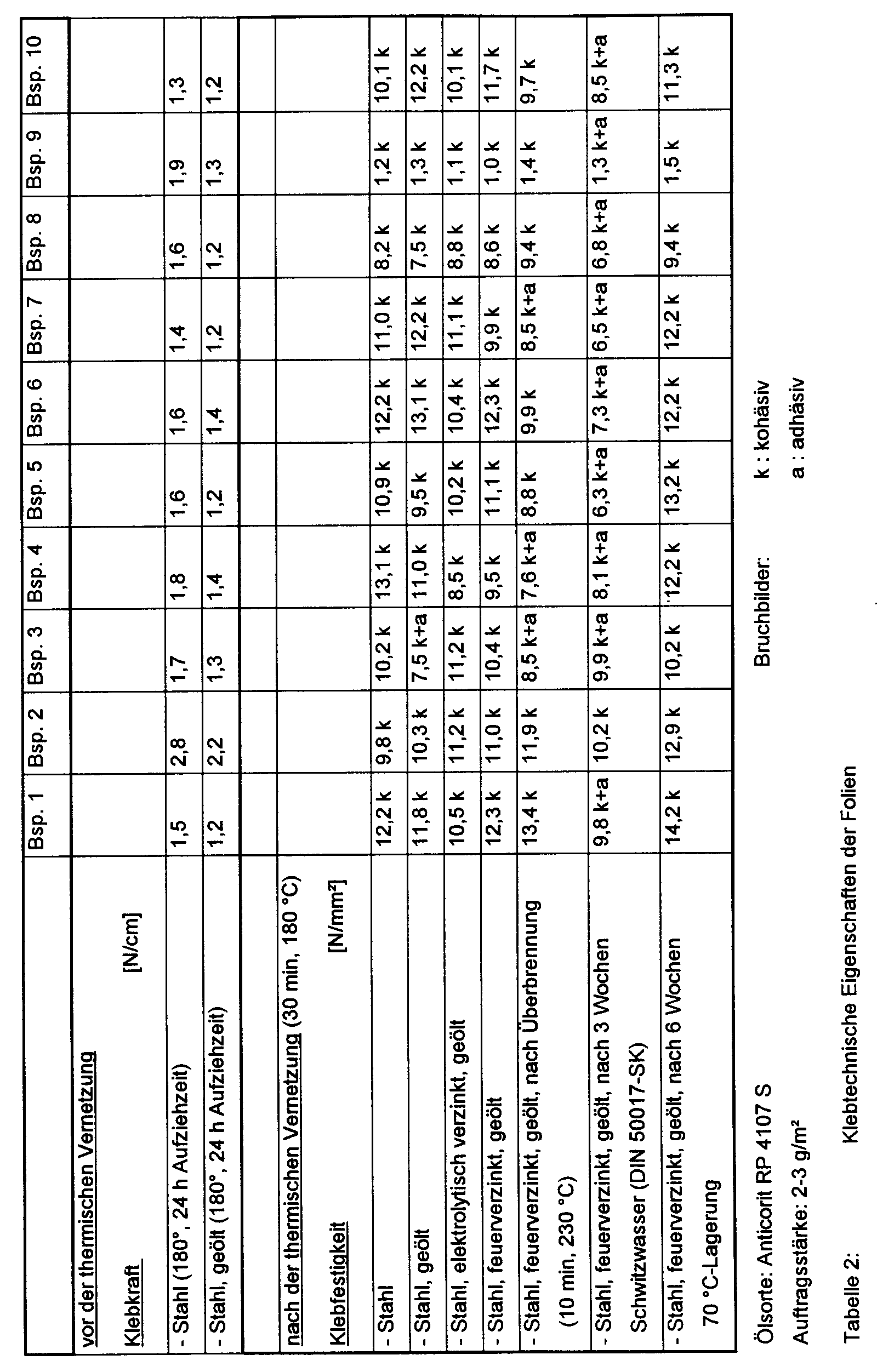
Claims (10)
- Beidseitig haftklebrige Folie, die sich aus folgenden Anteilen zusammensetzt, zu
- 15 - 60 Gew.-%
- aus einem thermisch vulkanisierbaren, polyveresterten Kautschuk,
- 10 - 30 Gew.-%
- aus Bitumen und/oder klebrigmachenden Harzen,
- 1 - 20 Gew.-%
- aus Vulkanisationshilfsmitteln,
- 0,2 - 5 Gew.-%
- aus Vulkanisationsbeschleunigern,
- 10 - 70 Gew.-%
- aus Füllstoffen und
- Folie nach Anspruch 1, dadurch gekennzeichnet, daß
der Kautschuk das Reaktionsprodukt eines Polymeren oder eines Polymergemisches A mit im Mittel mindestens zwei Hydroxylgruppen pro Makromolekül und eines mit A verträglichen Polymeren oder Polymergemisches B mit im Mittel mindestens zwei Carbonsäuregrupenn oder mindestens zwei Carbonsäureanhydridgruppen oder mindestens einer Carbonsäuregruppe sowie einer Carbonsäureanhydridgruppe pro Makromolekül, wobei mindestens eines der Polymeren A oder B olefinische Doppelbindungen enthält, ist. - Folie nach Anspruch 2, dadurch gekennzeichnet, daß
die Polymere A und B flüssige Polybutadiene sind, die im Mittel mindestens zwei Hydroxylgruppen, Carbonsäuregruppen oder Carbonsäureanhydridgruppen pro Makromolekül tragen. - Folie nach den Ansprüchen 1 bis 3, dadurch gekennzeichnet, daß
der Kautschuk als weitere Ausgangsbestandteile kurzkettige Hydroxyl- oder Carbonsäureanhydrid- oder Carbonsäure-terminierte Stoffe aufweist. - Folie nach den Ansprüchen 1 bis 4, dadurch gekennzeichnet, daß
die Polyveresterung des Kautschuks durch den Zusatz von 0,05 - 0,5 Gew.-% eines Veresterungskatalysators erfolgt. - Folie nach den Ansprüchen 1 bis 5, dadurch gekennzeichnet, daß
als Veresterungskatalysatoren basische Veresterungskatalysatoren wie Amine, bevorzugt sekundäre und tertiäre aliphatische Amine, ganz besonders bevorzugt n-Dibutylamin, Dimethycyclohexylamin, Diazabicyclooctan, Tetramethylethylendiamin oder Pentamethyldiethylentriamin sowie 1-Methylimidazol oder 1,2-Dimethylimidazol, eingesetzt sind. - Folie nach den Ansprüchen 1 bis 6, dadurch gekennzeichnet, daß
als Vulkanisationshilfsmittel und Vulkanisationsbeschleuniger Schwefel, 2,2'-Dibenzothiazyldisulfid und gegebenenfalls Zinkoxid zugesetzt sind. - Folie nach den Ansprüchen 1 bis 7, dadurch gekennzeichnet, daß
als Füllstoffe Kreide, Ruß, Titandioxid, Talkum, pyrogene Kieselsäure, Bariumsulfat oder Calciumoxid zugesetzt sind. - Folie nach den Ansprüchen 1 bis 8, dadurch gekennzeichnet, daß
als Hilfsstoffe Oxidationsinhibitoren, bevorzugt Pentaerythrityl-tetrakis-[3-(3,5-di-tert.butyl-4-hydroxiphenyl)-propionat], zugesetzt sind. - Verwendung einer Folie nach mindestens einem der vorangehenden Ansprüche im Automobilrohbau, insbesondere zur Verklebung von geölten Blechen.
Applications Claiming Priority (2)
| Application Number | Priority Date | Filing Date | Title |
|---|---|---|---|
| DE19719647 | 1997-05-09 | ||
| DE19719647A DE19719647A1 (de) | 1997-05-09 | 1997-05-09 | Thermisch härtbare, haftklebrige Folie |
Publications (2)
| Publication Number | Publication Date |
|---|---|
| EP0877069A1 true EP0877069A1 (de) | 1998-11-11 |
| EP0877069B1 EP0877069B1 (de) | 2000-06-28 |
Family
ID=7829122
Family Applications (1)
| Application Number | Title | Priority Date | Filing Date |
|---|---|---|---|
| EP98107488A Expired - Lifetime EP0877069B1 (de) | 1997-05-09 | 1998-04-24 | Thermisch härtbare, haftklebrige Folie |
Country Status (5)
| Country | Link |
|---|---|
| US (1) | US6063494A (de) |
| EP (1) | EP0877069B1 (de) |
| JP (1) | JP4060440B2 (de) |
| DE (2) | DE19719647A1 (de) |
| ES (1) | ES2149029T3 (de) |
Cited By (5)
| Publication number | Priority date | Publication date | Assignee | Title |
|---|---|---|---|---|
| DE102013216782A1 (de) | 2013-08-23 | 2015-02-26 | Tesa Se | Stanzling insbesondere zum dauerhaften Verschließen von Löchern |
| WO2018059931A1 (de) * | 2016-09-30 | 2018-04-05 | Tesa Se | Thermisch vulkanisierbarer klebstoff und daraus hergestelltes klebeband |
| DE102018203894A1 (de) | 2018-03-14 | 2019-09-19 | Tesa Se | Thermisch vulkanisierbares, während der Aufheiz- und Härtungsphase scherfestes Klebeband |
| EP3611237A1 (de) | 2018-08-16 | 2020-02-19 | tesa SE | Verfahren zur herstellung einer versiegelten falzverbindung |
| US11148407B2 (en) | 2016-10-17 | 2021-10-19 | Tesa Se | Method for producing a sealed folded joint |
Families Citing this family (5)
| Publication number | Priority date | Publication date | Assignee | Title |
|---|---|---|---|---|
| ATE537727T1 (de) | 2006-09-29 | 2012-01-15 | Janice Jordan | Verfahren und vorrichtungen zur aufbringung fester nagelbeschichtungen auf säugetier- und künstlichen nägeln |
| WO2016142966A1 (ja) * | 2015-03-11 | 2016-09-15 | 中島ゴム工業株式会社 | 接着シート |
| DE102016218964A1 (de) | 2016-09-30 | 2018-04-05 | Tesa Se | Hydroxyl-funktionalisiertes Polybutadien-Polyurethan-Hotmelt-Prepolymer |
| DE102017216070A1 (de) * | 2017-09-12 | 2019-03-14 | Tesa Se | Versiegelungsklebeband für Karosserien |
| DE102022113506A1 (de) | 2022-05-30 | 2023-11-30 | Tesa Se | Verfahren zum Verbinden, Ablösen und Wiederverbinden von Substraten |
Citations (3)
| Publication number | Priority date | Publication date | Assignee | Title |
|---|---|---|---|---|
| JPS5144137A (en) * | 1974-10-14 | 1976-04-15 | Kasei Co C I | Jikonenchakuseino netsuiyojuseishiito |
| JPS60123574A (ja) * | 1983-12-07 | 1985-07-02 | Hayakawa Rubber Co Ltd | 表面粘着ゴムシ−ト |
| EP0356715A1 (de) * | 1988-08-05 | 1990-03-07 | Henkel Kommanditgesellschaft auf Aktien | Vorgelierbarer Klebstoff |
Family Cites Families (10)
| Publication number | Priority date | Publication date | Assignee | Title |
|---|---|---|---|---|
| JPS581123B2 (ja) * | 1973-01-25 | 1983-01-10 | 日本曹達株式会社 | 難燃性樹脂組成物 |
| JPS539778B2 (de) * | 1974-12-11 | 1978-04-08 | ||
| US4994508A (en) * | 1987-07-16 | 1991-02-19 | Asahi Kasei Kogyo Kabushiki Kaisha | Specific hydrogenated block copolymer composition and process for producing the same |
| DE3912161A1 (de) * | 1989-04-13 | 1990-10-18 | Bpa Verpackung Gmbh | Doppelseitig klebendes band |
| US5256738A (en) * | 1990-02-05 | 1993-10-26 | Ppg Industries, Inc. | Functional rubber-based structural adhesive compositions |
| US5130185A (en) * | 1990-08-24 | 1992-07-14 | Ness Irving S | Doubled sided pressure sensitive adhesive |
| EP0519086B1 (de) * | 1991-01-09 | 1997-04-23 | Nitto Denko Corporation | Doppelseitiges klebeband, laminierte struktur desselben, klebeband und verfahren zur verwendung derselben |
| CA2116679C (en) * | 1991-10-01 | 2003-11-04 | David B. Herridge | Coextruded pressure-sensitive adhesive tape and method of making |
| US5466500A (en) * | 1994-02-16 | 1995-11-14 | Minnesota Mining And Manufacturing Company | Double-coated pressure-sensitive adhesive tape incorporating a strong, flexible thread |
| DE19614620C2 (de) * | 1996-04-13 | 1998-04-16 | Beiersdorf Ag | Druckempfindliches, doppelseitiges Selbstklebeband auf Polyurethanbasis und dessen Verwendung |
-
1997
- 1997-05-09 DE DE19719647A patent/DE19719647A1/de not_active Withdrawn
-
1998
- 1998-04-24 DE DE59800183T patent/DE59800183D1/de not_active Expired - Lifetime
- 1998-04-24 EP EP98107488A patent/EP0877069B1/de not_active Expired - Lifetime
- 1998-04-24 ES ES98107488T patent/ES2149029T3/es not_active Expired - Lifetime
- 1998-05-06 JP JP13742198A patent/JP4060440B2/ja not_active Expired - Fee Related
- 1998-05-07 US US09/074,228 patent/US6063494A/en not_active Expired - Lifetime
Patent Citations (3)
| Publication number | Priority date | Publication date | Assignee | Title |
|---|---|---|---|---|
| JPS5144137A (en) * | 1974-10-14 | 1976-04-15 | Kasei Co C I | Jikonenchakuseino netsuiyojuseishiito |
| JPS60123574A (ja) * | 1983-12-07 | 1985-07-02 | Hayakawa Rubber Co Ltd | 表面粘着ゴムシ−ト |
| EP0356715A1 (de) * | 1988-08-05 | 1990-03-07 | Henkel Kommanditgesellschaft auf Aktien | Vorgelierbarer Klebstoff |
Non-Patent Citations (2)
| Title |
|---|
| DATABASE WPI Section Ch Week 7622, Derwent World Patents Index; Class A12, AN 76-40920X, XP002073727 * |
| DATABASE WPI Section Ch Week 8532, Derwent World Patents Index; Class A18, AN 85-194723, XP002073726 * |
Cited By (9)
| Publication number | Priority date | Publication date | Assignee | Title |
|---|---|---|---|---|
| DE102013216782A1 (de) | 2013-08-23 | 2015-02-26 | Tesa Se | Stanzling insbesondere zum dauerhaften Verschließen von Löchern |
| WO2015024726A1 (de) * | 2013-08-23 | 2015-02-26 | Tesa Se | STANZLING INSBESONDERE ZUM DAUERHAFTEN VERSCHLIEßEN VON LÖCHERN |
| WO2018059931A1 (de) * | 2016-09-30 | 2018-04-05 | Tesa Se | Thermisch vulkanisierbarer klebstoff und daraus hergestelltes klebeband |
| TWI649383B (zh) * | 2016-09-30 | 2019-02-01 | 德商特薩股份有限公司 | 熱硫化型黏著劑、由其所製成之膠帶,及其製造方法 |
| US11148407B2 (en) | 2016-10-17 | 2021-10-19 | Tesa Se | Method for producing a sealed folded joint |
| DE102018203894A1 (de) | 2018-03-14 | 2019-09-19 | Tesa Se | Thermisch vulkanisierbares, während der Aufheiz- und Härtungsphase scherfestes Klebeband |
| US11111423B2 (en) | 2018-03-14 | 2021-09-07 | Tesa Se | Thermally vulcanizable adhesive tape with shear strength during the heating and curing phase |
| EP3611237A1 (de) | 2018-08-16 | 2020-02-19 | tesa SE | Verfahren zur herstellung einer versiegelten falzverbindung |
| US11440077B2 (en) | 2018-08-16 | 2022-09-13 | Tesa Se | Method for producing a sealed folded connection |
Also Published As
| Publication number | Publication date |
|---|---|
| ES2149029T3 (es) | 2000-10-16 |
| DE19719647A1 (de) | 1998-11-12 |
| US6063494A (en) | 2000-05-16 |
| EP0877069B1 (de) | 2000-06-28 |
| JP4060440B2 (ja) | 2008-03-12 |
| DE59800183D1 (de) | 2000-08-03 |
| JPH10316947A (ja) | 1998-12-02 |
Similar Documents
| Publication | Publication Date | Title |
|---|---|---|
| EP0805841B1 (de) | Strukturelle rohbauklebstoffe auf kautschukbasis | |
| EP0998538B1 (de) | Heisshärtende wäschefeste rohbau-versiegelung | |
| DE69024678T2 (de) | Druckempfindliche, thermohärtende Klebstoffe aus einer Epoxid-acrylester-Mischung | |
| EP0678544B2 (de) | Zweikomponentige Klebe-, Dichtungs- oder Beschichtungsmasse und deren Verwendung | |
| EP0356715B1 (de) | Vorgelierbarer Klebstoff | |
| EP0877069B1 (de) | Thermisch härtbare, haftklebrige Folie | |
| DE60015754T2 (de) | Gefertigte verbundene struktur | |
| WO2016034394A1 (de) | Zweikomponentiger polyurethanschmelzklebstoff mit hoher anfangs- und endfestigkeit | |
| EP3405540B1 (de) | Verwendung eines einkomponentigen laminierklebstoffs zur verbundfolienkaschierung | |
| EP0793697B1 (de) | Elastomerprodukte mit akustischen dämpfungseigenschaften | |
| WO2011020714A1 (de) | Kautschuk-zusammensetzung mit hoher elastizität | |
| EP3681965A1 (de) | Versiegelungsklebeband für karosserien | |
| WO2002048255A2 (de) | Kautschuk-zusammensetzungen mit plastisolartigem fliessverhalten | |
| EP1108767A2 (de) | Klebeband zum Maskieren einer KTL-Grundierung | |
| EP1108695B1 (de) | Klebeband mit thermisch härtbarem Kleber zum Maskieren einer KTL-Grundierung | |
| EP1101807A2 (de) | Klebeband zum Maskieren einer KTL-Grundierung | |
| EP3760686B1 (de) | Thermisch härtender klebstoff und daraus hergestelltes klebeband | |
| DE102018214534A1 (de) | Klebeband insbesondere für ölige Oberflächen | |
| EP2389418A1 (de) | Verfahren zur korrosionsschutzbehandlung | |
| DE2835289A1 (de) | Klebmittel und verfahren zur herstellung von klebebaendern | |
| EP2930219A1 (de) | Reaktive Klebstoffsysteme und deren Verwendung | |
| EP1341858B1 (de) | Wässrige einschicht-gummi-metall-bindemittel | |
| WO2007073827A1 (de) | Strukturklebstoff mit erhöhter elastizität | |
| DE1594043A1 (de) | Selbstklebendes Klebeband und Verfahren zur Herstellung desselben | |
| CH694639A5 (de) | Zweikomponenten-Klebstoffe für den Karosseriebau. |
Legal Events
| Date | Code | Title | Description |
|---|---|---|---|
| PUAI | Public reference made under article 153(3) epc to a published international application that has entered the european phase |
Free format text: ORIGINAL CODE: 0009012 |
|
| 17P | Request for examination filed |
Effective date: 19980818 |
|
| AK | Designated contracting states |
Kind code of ref document: A1 Designated state(s): BE DE ES FR GB IT PT SE |
|
| AX | Request for extension of the european patent |
Free format text: AL;LT;LV;MK;RO;SI |
|
| GRAG | Despatch of communication of intention to grant |
Free format text: ORIGINAL CODE: EPIDOS AGRA |
|
| AKX | Designation fees paid |
Free format text: BE DE ES FR GB IT PT SE |
|
| 17Q | First examination report despatched |
Effective date: 19990630 |
|
| GRAG | Despatch of communication of intention to grant |
Free format text: ORIGINAL CODE: EPIDOS AGRA |
|
| GRAH | Despatch of communication of intention to grant a patent |
Free format text: ORIGINAL CODE: EPIDOS IGRA |
|
| GRAH | Despatch of communication of intention to grant a patent |
Free format text: ORIGINAL CODE: EPIDOS IGRA |
|
| GRAA | (expected) grant |
Free format text: ORIGINAL CODE: 0009210 |
|
| AK | Designated contracting states |
Kind code of ref document: B1 Designated state(s): BE DE ES FR GB IT PT SE |
|
| REF | Corresponds to: |
Ref document number: 59800183 Country of ref document: DE Date of ref document: 20000803 |
|
| GBT | Gb: translation of ep patent filed (gb section 77(6)(a)/1977) |
Effective date: 20000724 |
|
| ITF | It: translation for a ep patent filed | ||
| PG25 | Lapsed in a contracting state [announced via postgrant information from national office to epo] |
Ref country code: SE Free format text: LAPSE BECAUSE OF FAILURE TO SUBMIT A TRANSLATION OF THE DESCRIPTION OR TO PAY THE FEE WITHIN THE PRESCRIBED TIME-LIMIT Effective date: 20000928 Ref country code: PT Free format text: LAPSE BECAUSE OF FAILURE TO SUBMIT A TRANSLATION OF THE DESCRIPTION OR TO PAY THE FEE WITHIN THE PRESCRIBED TIME-LIMIT Effective date: 20000928 |
|
| ET | Fr: translation filed | ||
| REG | Reference to a national code |
Ref country code: ES Ref legal event code: FG2A Ref document number: 2149029 Country of ref document: ES Kind code of ref document: T3 |
|
| PLBE | No opposition filed within time limit |
Free format text: ORIGINAL CODE: 0009261 |
|
| STAA | Information on the status of an ep patent application or granted ep patent |
Free format text: STATUS: NO OPPOSITION FILED WITHIN TIME LIMIT |
|
| PG25 | Lapsed in a contracting state [announced via postgrant information from national office to epo] |
Ref country code: BE Free format text: LAPSE BECAUSE OF NON-PAYMENT OF DUE FEES Effective date: 20010430 |
|
| 26N | No opposition filed | ||
| BERE | Be: lapsed |
Owner name: BEIERSDORF A.G. Effective date: 20010430 |
|
| REG | Reference to a national code |
Ref country code: GB Ref legal event code: IF02 |
|
| REG | Reference to a national code |
Ref country code: GB Ref legal event code: 732E |
|
| REG | Reference to a national code |
Ref country code: FR Ref legal event code: TP |
|
| REG | Reference to a national code |
Ref country code: FR Ref legal event code: CJ Ref country code: FR Ref legal event code: CD |
|
| REG | Reference to a national code |
Ref country code: ES Ref legal event code: PC2A Owner name: TESA SE Effective date: 20110415 |
|
| PGFP | Annual fee paid to national office [announced via postgrant information from national office to epo] |
Ref country code: FR Payment date: 20110510 Year of fee payment: 14 Ref country code: ES Payment date: 20110426 Year of fee payment: 14 |
|
| PGFP | Annual fee paid to national office [announced via postgrant information from national office to epo] |
Ref country code: GB Payment date: 20110421 Year of fee payment: 14 |
|
| PGFP | Annual fee paid to national office [announced via postgrant information from national office to epo] |
Ref country code: IT Payment date: 20110422 Year of fee payment: 14 |
|
| GBPC | Gb: european patent ceased through non-payment of renewal fee |
Effective date: 20120424 |
|
| REG | Reference to a national code |
Ref country code: FR Ref legal event code: ST Effective date: 20121228 |
|
| PG25 | Lapsed in a contracting state [announced via postgrant information from national office to epo] |
Ref country code: GB Free format text: LAPSE BECAUSE OF NON-PAYMENT OF DUE FEES Effective date: 20120424 |
|
| PG25 | Lapsed in a contracting state [announced via postgrant information from national office to epo] |
Ref country code: IT Free format text: LAPSE BECAUSE OF NON-PAYMENT OF DUE FEES Effective date: 20120424 Ref country code: FR Free format text: LAPSE BECAUSE OF NON-PAYMENT OF DUE FEES Effective date: 20120430 |
|
| REG | Reference to a national code |
Ref country code: ES Ref legal event code: FD2A Effective date: 20130716 |
|
| PG25 | Lapsed in a contracting state [announced via postgrant information from national office to epo] |
Ref country code: ES Free format text: LAPSE BECAUSE OF NON-PAYMENT OF DUE FEES Effective date: 20120425 |
|
| REG | Reference to a national code |
Ref country code: DE Ref legal event code: R081 Ref document number: 59800183 Country of ref document: DE Owner name: TESA SE, DE Free format text: FORMER OWNER: TESA SE, 20253 HAMBURG, DE |
|
| PGFP | Annual fee paid to national office [announced via postgrant information from national office to epo] |
Ref country code: DE Payment date: 20170419 Year of fee payment: 20 |
|
| REG | Reference to a national code |
Ref country code: DE Ref legal event code: R071 Ref document number: 59800183 Country of ref document: DE |