EP0877094B1 - Détection et quantification d'une ou plusieurs séquences nucléotidiques en utilisant une réplication de cibles spatialement localisée - Google Patents
Détection et quantification d'une ou plusieurs séquences nucléotidiques en utilisant une réplication de cibles spatialement localisée Download PDFInfo
- Publication number
- EP0877094B1 EP0877094B1 EP98107881A EP98107881A EP0877094B1 EP 0877094 B1 EP0877094 B1 EP 0877094B1 EP 98107881 A EP98107881 A EP 98107881A EP 98107881 A EP98107881 A EP 98107881A EP 0877094 B1 EP0877094 B1 EP 0877094B1
- Authority
- EP
- European Patent Office
- Prior art keywords
- media
- target analyte
- sample
- target
- colonies
- Prior art date
- Legal status (The legal status is an assumption and is not a legal conclusion. Google has not performed a legal analysis and makes no representation as to the accuracy of the status listed.)
- Expired - Lifetime
Links
Images



Classifications
-
- C—CHEMISTRY; METALLURGY
- C12—BIOCHEMISTRY; BEER; SPIRITS; WINE; VINEGAR; MICROBIOLOGY; ENZYMOLOGY; MUTATION OR GENETIC ENGINEERING
- C12Q—MEASURING OR TESTING PROCESSES INVOLVING ENZYMES, NUCLEIC ACIDS OR MICROORGANISMS; COMPOSITIONS OR TEST PAPERS THEREFOR; PROCESSES OF PREPARING SUCH COMPOSITIONS; CONDITION-RESPONSIVE CONTROL IN MICROBIOLOGICAL OR ENZYMOLOGICAL PROCESSES
- C12Q1/00—Measuring or testing processes involving enzymes, nucleic acids or microorganisms; Compositions therefor; Processes of preparing such compositions
- C12Q1/68—Measuring or testing processes involving enzymes, nucleic acids or microorganisms; Compositions therefor; Processes of preparing such compositions involving nucleic acids
- C12Q1/6844—Nucleic acid amplification reactions
- C12Q1/6851—Quantitative amplification
-
- C—CHEMISTRY; METALLURGY
- C12—BIOCHEMISTRY; BEER; SPIRITS; WINE; VINEGAR; MICROBIOLOGY; ENZYMOLOGY; MUTATION OR GENETIC ENGINEERING
- C12Q—MEASURING OR TESTING PROCESSES INVOLVING ENZYMES, NUCLEIC ACIDS OR MICROORGANISMS; COMPOSITIONS OR TEST PAPERS THEREFOR; PROCESSES OF PREPARING SUCH COMPOSITIONS; CONDITION-RESPONSIVE CONTROL IN MICROBIOLOGICAL OR ENZYMOLOGICAL PROCESSES
- C12Q1/00—Measuring or testing processes involving enzymes, nucleic acids or microorganisms; Compositions therefor; Processes of preparing such compositions
- C12Q1/68—Measuring or testing processes involving enzymes, nucleic acids or microorganisms; Compositions therefor; Processes of preparing such compositions involving nucleic acids
- C12Q1/6813—Hybridisation assays
- C12Q1/6834—Enzymatic or biochemical coupling of nucleic acids to a solid phase
-
- C—CHEMISTRY; METALLURGY
- C12—BIOCHEMISTRY; BEER; SPIRITS; WINE; VINEGAR; MICROBIOLOGY; ENZYMOLOGY; MUTATION OR GENETIC ENGINEERING
- C12Q—MEASURING OR TESTING PROCESSES INVOLVING ENZYMES, NUCLEIC ACIDS OR MICROORGANISMS; COMPOSITIONS OR TEST PAPERS THEREFOR; PROCESSES OF PREPARING SUCH COMPOSITIONS; CONDITION-RESPONSIVE CONTROL IN MICROBIOLOGICAL OR ENZYMOLOGICAL PROCESSES
- C12Q1/00—Measuring or testing processes involving enzymes, nucleic acids or microorganisms; Compositions therefor; Processes of preparing such compositions
- C12Q1/68—Measuring or testing processes involving enzymes, nucleic acids or microorganisms; Compositions therefor; Processes of preparing such compositions involving nucleic acids
- C12Q1/6844—Nucleic acid amplification reactions
- C12Q1/6846—Common amplification features
Definitions
- This invention relates to a method for detecting the presence or the absence of a target analyte in a substance sample; and quantifying the analyte when it is found to be present in the sample.
- the specimen being analyzed can be a biological substance; an environmental substance; a food stuff substance; or some other substance which can harbor the target analyte.
- the target analyte is a specific nucleotide sequence which is suspected of being in the substance being tested.
- the presence or absence of the suspect organism or target sequence can be determined by amplifying the target analyte with strand displacement amplification (SDA) or polymerase chain reaction (PCR) reagents.
- SDA strand displacement amplification
- PCR polymerase chain reaction
- RNA is the target analyte and SDA or PCR reagents are employed, it will be necessary to convert RNA to DNA by reverse transcription prior to the amplification step.
- target analyte RNA amplification methods such as Q ⁇ replicase or RNA-X amplifications, may, in certain cases, be used without transcription.
- the analysis can be performed in a gel or a semi-solid media which permits amplification of the target analyte, but restricts migration of the amplified target analyte so that the products of amplification will form stationary detectable target analyte colonies in the media.
- the colonies may be detected and counted by various techniques, including the use of detectable SDA or PCR primers; or target analyte-complementary specific nucleotide sequences; or the use of detectable intercalating probes such as ethidium bromide, acridine orange, SYBR green, and related products.
- detectable SDA or PCR primers or target analyte-complementary specific nucleotide sequences
- detectable intercalating probes such as ethidium bromide, acridine orange, SYBR green, and related products.
- Such probes are available from Molecular Probes, Inc. of Eugene, Oregon.
- the analysis of specimens for the presence or absence of target bacterial analytes, wherein the specimen is placed on a sterile growth media, is well known.
- Various bacteria can be detected in this manner in water, food stuffs; and in sample biological specimens, such as urine, cerebrospinal fluid, pleural fluid, ascites, joint fluid, stool, and the like.
- This testing procedure relies on the ability of the target analytes to replicate in the growth media to the extent that visible colonies of the target analytes can be observed.
- the various types of bacteria can be differentially labeled so as to aid in the differentiation between different bacterial colonies which grow in the media. When this analytic procedure is employed, the time necessary to form detectable colonies can be as short as one day, and as long as several weeks.
- Subject matter of the invention is a method for determining the presence or absence of one or more target nucleotide sequence analytes, hereinafter referred to as "target analytes", in a specimen sample, said method comprising the steps of:
- This invention relates to a method for detecting the presence or absence of one or more nucleotide targets in a sample. Detection of the nucleotide target is accomplished by amplifying a unique portion of the DNA or RNA sequence in a suitable viscous media so as to form relatively stationary colonies of the amplified nucleotide sequence in the media, and then detecting and counting any resultant nucleotide sequence colonies which may form in the media.
- the target analyte being detected is thus the amplified nucleotide sequences or sequences of the suspect life form. Diffusion of the formed target analyte colonies in the media is restricted relative to the diffusion of marker or probe reagents.
- nucleotide target(s) may be quantified, if desired.
- Preferred embodiments of the method of the present invention are claimed in the dependent claims.
- the media contains, or is combined with, target analyte-specific primers and suitable enzymes and reagents which will cause amplification of the specified nucleotide sequence in the target analyte DNA or RNA through the use of strand displacement amplification (SDA); or through the use of polymerase chain reaction (PCR), or any other amplification procedures such as single primer or primerless 3SR, and in certain cases, Q ⁇ replicase RNA amplification.
- SDA strand displacement amplification
- PCR polymerase chain reaction
- any other amplification procedures such as single primer or primerless 3SR, and in certain cases, Q ⁇ replicase RNA amplification.
- other amplification procedures as described in PCR Technology: Principals and Amplifications for DNA Amplification , Ehrlich, H. A. ed. 1989, Stockton Press, New York, may be used in performance of this invention.
- the result is the creation of localized high-density population colonies of the specified nucleotide sequence in the media. Segments of non-target genomes which are contained in the sample and are introduced into the media, and which are not replicated by the amplification step, will not multiply, nor will they be detected.
- the analysis is performed in a media which may also contain, or be combined with one or more labeled analyte-specific materials (LASMs).
- LASMs include a synthetic nucleotide sequence that is complementary to a portion of the specific nucleotide sequence forming the target analyte and which specific nucleotide sequence has been amplified.
- the label may be a free dye or fluorophore, or one which is attached to the complementary synthetic nucleotide sequence.
- the LASMs are initially distributed homogeneously throughout the media. The LASMs, following the laws of diffusion in the media, will migrate through the media to the amplified nucleotide sequence colonies, and will bind to these nucleotide sequences thereby differentially highlighting the colonies relative to the remainder of the media. Low intensity labeled halos will form around each colony due to localized migration of LASMs toward the colonies, and at the center of each halo will be a high intensity peak corresponding to the labeled colony.
- any unamplified molecules of DNA or RNA present on the media will be non-detectable by virtue of their low concentration, even if stained by acridine orange, ethidium bromide or other stains.
- the label may be attached to one or both of the oligonucleotide primers used for PCR or SDA amplification. In these cases, the primers will function as the LASMs.
- the use of a kinetic study of signal intensity can null out non-specific background signals such as may be caused by cellular debris, since such non-specific background signals will not significantly increase with amplification.
- the colonies may be detected by non-specific stains for DNA or RNA such as acridine orange or ethidium bromide.
- non-specific stains for DNA or RNA such as acridine orange or ethidium bromide.
- these fluorophores are able to intercalate non-specifically into any amplified nucleotide sequence, when such is produced, and specificity is achieved by the specificity of the amplification primers without the need to link the fluorophore to complementary nucleotide sequences.
- more than one complementary nucleotide sequence may be linked to one or more different fluorophores in order to highlight any amplified nucleotide sequence colonies which form in the media and to determine their type.
- Up to twenty one different target analytes could be detected in a single assay or analysis through the use of a LASM carrying up to three differentially detectable fluorophores.
- the amplified nucleotide sequence of the selected target analyte DNA or RNA be of such a size, i.e., about 150 mer to about 500 mer, so that the copies will be unable to migrate rapidly within the media, and thus will remain relatively stationary within the media during the course of the analysis. It is likewise important that the selected LASMs be of such a size, i.e., about 18 mer to about 40 mer, so as to be sufficiently small so that they will be able to diffuse more rapidly than the amplified target analyte sequences within the media, and yet sufficiently long so as to possess the necessary specificity to the amplified nucleotide sequences.
- LASM about 18 mer
- two or more LASMs of appropriate size which are directed against different nucleic acid sequences in the amplified target analyte may be used for enhanced specificity.
- the media must of course also be of such a type that the amplification reagents including the probes can diffuse within the media sufficiently rapidly to allow amplification to occur more rapidly than the products of such amplification can diffuse away from the colony.
- the sample is prepared for analysis by first lysing all of its cellular and organism components so as to release into solution all of the genetic material of the cellular and organism components of the sample, see: Maniatis, T., Fritsch, E. F., and Sambrook, J. (1987) Molecular Cloning: A Laboratory Manual, 2nd Ed., Cold Spring Harbor Press. A known volume of nucleotide-rich aliquot of the lysed sample is then introduced onto the media and evenly spread out over the media. If necessary, diffusion of the target analyte into the media could be augmented by vertical electrophoresis, and/or by reducing its size prior to analysis by restriction digestion or mechanical shearing.
- the genetic material, DNA and/or RNA of the target component of the sample is thus exposed to the amplifying materials in the media.
- a target nucleotide sequence on the exposed genetic material is thus amplified to the extent that colonies of copies of the target analyte will be formed on the media. Since the size of the target analyte, and thus the size of the copies, is relatively large, the amplified target analyte colonies will remain relatively stationary on the media.
- the LASMs if not pre-incorporated in the media, will be added to the media after the amplification step and be relatively homogeneously distributed there over.
- the LASMs are sized so as to be able to migrate in or through the media.
- the LASMs will then migrate to the target analyte colonies and will bind to the copies in the target analyte colonies. This binding will cause the colonies to emit a higher level of the label signal than surrounding areas in the media, and in fact, the immediately surrounding areas which border the colonies will emit a weakened label signal. The net result will be the formation of "bright” spots surrounded by "dim” halos in the media. In the event that there is no target analyte present in the sample, then the media will retain a relatively even level of label signal emission, and will appear to be evenly "colored".
- Detection of the binding of the complementary nucleotides containing a fluorophore to their respective target analytes may also be accomplished by time-resolved fluorescence as described in U.S. Patent No. 5,485,530, Lokowicz et al.
- the sample could be applied to the media prior to cell lysis, so that the localization of the target with respect to cellular nucleotides may be ascertained, i.e., to determine whether the target is intracellular or extracellular.
- the LASMs, as well as the other reagents required for amplification could be impregnated onto a solid support such as a nylon membrane or paper strip, and allowed to diffuse into the media by placing the membrane on top of the media.
- the assay can be completed within several hours after inoculating the media with the sample by producing copies of the target analytes in the media.
- Viruses, bacteria, fungi, mycoplasma, protozoa, or specific nucleotides present in any type of cell or specimen can be assayed by using the specific nucleotide sequence-amplification and detection method of this invention, and since one knows the volume of the specimen sample added to the media, by counting the number of highlighted colonies in the media, one can detect the amount of target analyte per unit volume of the specimen sample, thus enabling the securement of a quantitative analysis of the sample for target analyte.
- a portion of the media will be inoculated with a control sample containing no known target nucleotides, but treated and prepared exactly as the known sample. This portion of the media will serve as a negative control. In the event that amplified labeled colonies form in the negative control area of the media, one can presume contamination of the media or the amplification or lysing reagents, or all, and the results of the assay are invalid.
- Another portion of the media can also be segregated and used as a positive control by applying a sample containing a known amount of the target analyte(s) therein when the test is performed. If the positive control area of the media fails to have the appropriate number and type of colonies, then the amplification and/or detection steps of the assay are not functioning property, and the assay is invalid.
- FIG. 1 there is shown a plan view of a rectangular section of a media, denoted generally by the numeral 2, which is adapted for performing the method of this invention.
- the media field as shown in FIG. 1 is evenly shaded so as to indicate an evenly distributed label signal emission which will be detected by the human eye or by a scanning instrument either before the media has been inoculated with the sample; or after introduction and incubation of the sample, when there is no target analyte present in the sample.
- the area 3 in the media 2 is an area which will not be exposed to the sample being assayed, but which contains all of the reagents used in the test, and therefore serves as a negative control area.
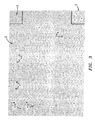
- FIGS. 2 and 3 are illustrative of the resulting change in the emission pattern in the media 2 when the target analyte is present in the sample.
- FIG. 2 shows the result of a relatively low level of target analyte in the sample which will produce a plurality of more highly labeled colonies 4 surrounded by halos 6 of lower level label in the media 2.
- FIG. 3 shows the result when there is a relatively high level of target analyte in the sample. It will be noted from FIGS.
- FIG. 4 is a pictograph of the emission intensity from the label that will be detected by an auto-analyzing instrument as it performs a linear scan of the media.
- the trace 8 represents the emission level of the media per se; the dips 10 represent the low levels of emission in the halos 6; and the peak 12 represents the high level of emission in the colonies 4.
- a target analyte gene for detecting HIV-1 is viral polymerase, whose function is the replication of the viral genome. (It is noted that the polymerase gene is only one of several HIV-1 genes that could be detected with this method. In fact, a protocol that simultaneously quantifies the concentrations of two HIV-1 genes, for example, both polymerase and protease, would be susceptible to very few false positive results since the polymerase-to-protease ratio will be relatively constant.)
- a forward primer that can be used to amplify the viral polymerase gene using PCR is: GCACTTTAAATTTTCCCATTAGTCC; and a reverse primer is: CCTGCGGGATGTGGTATTCC.
- LASM LASM
- the complementary nucleotide sequence can be attached covalently to a fluorophore which will provide the necessary emission signal.
- the LASM should lack a hydroxyl group on the 3' position of the nucleotide at the 3' end of the oligonucleotide to inhibit amplification of the product resulting from hybridization of one LASM with another. If a separate LASM is not used, then the fluorophore will be attached to the 5' terminus of one or both of the oligonucleotide primers used for PCR or to one or more of the internucleoside linkages.
- All primers and LASMs should lack a hydroxyl group on the 3' position of the nucleotide at the 3' end of the oligonucleotide to inhibit amplification of the product resulting from hybridization of one LASM with another.
- Suitable media include acrylamide gels containing 2.5 to 5.0% acrylamide, and between 0.025 and 2.5% bisacrylamide; or 0.5% agarose; and standard and low-melt agarose gels containing 0.75 to 1.5% agarose.
- the technique of this invention is optimized by using media compositions with low gel percentages, for example about 4 to 5% for an acrylamide gel, and 2% or less for agarose.
- a media impregnated with the appropriate PCR reagents can be prepared as follows.
- a 100 ml wash solution consisting of 20 mM Tris, having a pH of about 8.0, in 50 mM EDTA; and a 10 ml storage solution consisting of 2 mM Tris, having a pH of about 8.0, in 0.5 mM EDTA are prepared.
- the gel is immersed in 5 ml of the wash solution for about 15 minutes at room temperature. This step is repeated 5 times in fresh wash solution.
- the gel is then immersed in 5 ml of the storage solution containing PCR primers, enzyme and dNTPs, and the like.
- a forward primer that can be used to amplify the viral polymerase gene by SDA is: TTGAATAGTCGGTTACTTGTTGACACTCGGCACTTTAAAT; and a reverse primer is: ACCGACTATTGTTGACACTGCCTGCGGGATGTGGTATTCC.
- a separate LASM it will be complementary to some region between the aforesaid forward or reverse primers.
- the oligonucleotide-based LASM should not be complementary to either the forward or reverse primers, but be complementary to a portion of the target molecule. This act will specifically focus the detectable agent at the molecular colony, and not to primers that may be freely distributed throughout the media.
- the complementary nucleotide sequence can be attached covalently to one or more fluorophores which will provide the necessary emission signal(s). If a separate LASM is not used, then the fluorophore will be attached to the 3' terminus of one or both of the oligonucleotide primers used for SDA, or to one or more of the internucleoside linkages.
- a media impregnated with the appropriate SDA reagents can be prepared as follows.
- the gel is immersed in 5 ml of the wash solution for about 15 minutes at room temperature. This step is repeated 5 times in fresh wash solution. The gel is then immersed in 5 ml of the storage solution.
- a LASM can be prepared as follows.
- the complementary nucleotide sequence strands will contain one or more modified bases carrying an appended primary amine.
- the strand to be labeled is dissolved in 0.1 M sodium bicarbonate having a pH of 9.0, and the dye-isothiocyanate is dissolved in dry DMF at a concentration of 10 mg/ml.
- the dye solution is then added drop wise to the complementary nucleotide sequence solution with stirring and the reaction incubated at room temperature for 12 hours. Free dye is then removed by gel filtration and the dye-complementary nucleotide sequence conjugate purified by gel electrophoresis or HPLC.
- the complementary nucleotide sequence to be labeled is dissolved in 0.1 M sodium phosphate, having a pH of 8.0, and the complementary nucleotide sequence-label conjugating reaction is performed at 4 oC to minimize hydrolysis of the succinimidyl ester label.
- Various dye-labeled DNAs can be prepared directly by chemical synthesis and are widely used for DNA sequencing.
- the target analyte can be embedded in the media in the following manner.
- a suspension of approximately 2.5 x 10 7 cells is prepared from a tissue homogenate or culture, and washed thoroughly in tissue culture medium (no fetal calf serum) or isotonic saline. The mixture is then centrifuged at 2,000 g for 20 minutes at 4°C, the supernatant is removed, and the nucleic acid-containing pellet is drained thoroughly. The cells are re-suspended in 5 mL of 50 mM Tris (pH 8.0) and 50 mM EDTA and frozen at -20°C.
- lysozyme solution 10 mg/mL lysozyme in 0.25 M Tris (pH 8.0)
- STEP solution 0.5% sodium dodecyl sulfate, 50 mM Tris (pH 7.5), 0.4 M EDTA, 1 mg/mL Proteinase K (added immediately before use) is added and the solution incubated at 50°C for one hour.
- Six milliliters of buffered phenol is added and the emulsion centrifuged at 1,000g for 15 minutes. The upper, nucleic acid-containing layer is transferred to a separate tube.
- the precipitate containing DNA and RNA, is redissolved in 5 mL 50 mM Tris (pH 7.5) and 1 mM EDTA. If only cellular DNA is desired, 200 ⁇ g RNase A may be added.
- the nucleic acid may be applied directly to the media, or it may first be treated with a restriction enzyme or sheared with a needle to reduce its average size.
- the target analyte-amplifying PCR reaction can be performed as follows.
- the gel, specimen sample, PCR and LASM mixture is heated to 95°C for 3 minutes, and then 30 cycles of heating to 95°C for 45 seconds, annealing at 55°C for 90 seconds, and extending at 72°C for 1 minute for every 750 nucleotides.
- the reaction is finished with a 10 minute extension at 72°C.
- the media is then examined to determine the presence or absence of target analyte colonies in the media.
- the target analyte-amplifying SDA reaction can be performed as follows.
- the gel, specimen sample, SDA and LASM mixture is incubated at 37°C for between thirty minutes and four hours.
- the media is then examined to determine the presence or absence of target analyte colonies in the media.
- M. tuberculosis Another target analyte that can be detected and quantified using the technique of this invention is M. tuberculosis.
- the target gene for detecting M. tuberculosis is inhA whose function is fatty acid biosynthesis.
- the forward primer for amplification of inhA by PCR is: ACCCAATCGAATTGCCACACCCCG; and the reverse primer is: GGCGCGCGAGGCCGGCAAGTACGG.
- the primers will amplify a 279 base pair region of the inhA gene in M. tuberculosis. If a separate LASM is used, it will be complementary to some region between the aforesaid forward or reverse primers.
- the oligonucleotide-based LASM should not be complementary to either the forward or reverse primers, but be complementary to a portion of the target molecule. This act will specifically focus the detectable agent at the molecular colony, and not to primers that may be freely distributed throughout the media.
- the media and LASM preparation procedures are essentially the same as set forth in Example 1, as is the introduction procedure.
- a forward primer is: AGTCGGTTACTTGTTGACACTCGACCCAATCGAATTGCCA; and the reverse primer is: ACCGACTATTGTTGACACTGCGCGAGGCCGGCAAGTACGG.
- LASM reverse primer
- a further organism that can be detected and quantified by using the technique of this invention is INH-resistant M. tuberculosis.
- the target analyte gene for detecting INH-resisistant M. tuberculosis is mutant inhA whose function is fatty acid biosynthesis.
- the forward primer for amplification of the mutant inhA gene by PCR is: ACCCAATCGAATTGCCACACCCCG; and the reverse primer is: GCCGATCGATGAACCCCGGAGGTTCC.
- the primers will amplify a 159 base pair region of the mutant inhA gene in INH-resistant M. tuberculosis. If a separate LASM is used, it will be complementary to some region between the aforesaid forward or reverse primers.
- the oligonucleotide-based LASM should not be complementary to either the forward or reverse primers,' but be complementary to a portion of the target molecule. This act will specifically focus the detectable agent at the molecular colony, and not at primers that may be freely distributed throughout the media.
- the media and LASM preparation procedures are essentially as set forth in Example 1, as is the introduction procedure.
- a forward primer is: AGTCGGTTACTTGTTGACACACCCAATCGAATTGCCACAC: and the reverse primer is: ACCGACTATTGTTGACACTGCGATGAACCCCGGAGGTTCC.
- LASM reverse primer
- HBV An additional organism that can be detected and quantified using the technique of this invention is HBV.
- the target gene for detecting HBV is pX gene whose function is transcription.
- the forward primer for amplification of the pX gene by PCR is: GGTGAAGCGAAGTGCACACGGACCGGC; and the reverse primer is: GCTGGGGGAGGAGATTAGGTTAAAGG.
- the primers will amplify a 196 base pair region of the pX gene in HBV. If a separate LASM is used, it will be complementary to some region between the aforesaid forward or reverse primers.
- the oligonucleotide-based LASM should not be complementary to either the forward or reverse primers, but be complementary to a portion of the target molecule. This act will specifically focus the detectable agent at the molecular colony, and not at primers that may be freely distributed throughout the media.
- the media and LASM preparation procedures are essentially as set forth in Example 1, as is the introduction procedure.
- a forward primer is: AGTCGGTTACTTGTTGACACGGTGAAGCGAAGTGCACACG; and the reverse primer is: ACCGACTATTGTTGACACTGGCTGGGGGAGGAGATTAG.
- LASM reverse primer
- Pneumocystis carinii Another organism that can be detected and quantified using the technique of this invention is Pneumocystis carinii.
- the target analyte gene for detecting Pneumocystis carinii is mitochondrial rRNA whose function is protein synthesis.
- the forward primer for amplification of the Pneumocystis carinii mitochondrial rRNA gene is: GATGGCTGTTTCCAAGCCCA; and the reverse primer is: GTGTACGTTGCAAAGTACTC.
- the primers will amplify a 344 base pair region of the mitochondrial rRNA gene in Pneumocystis carinii. If a separate LASM is used, it will be complementary to some region between the aforesaid forward or reverse primers.
- the oligonucleotide-based LASM should not be complementary to either the forward or reverse primers, but be complementary to a portion of the target molecule. This act will specifically focus the detectable agent at the molecular colony, and not at primers that may be freely distributed throughout the media.
- the media and LASM preparation procedures are essentially as set forth in Example 1, as is the introduction procedure.
- a forward primer is: AGTCGGTTACTTGTTGACACGATGGCTGTTTCCAAGCCCA; ⁇ and the reverse primer is: ACGTGTACGTTGCAAAGTACGTGTACGTTGCAAAGTACTC.
- LASM reverse primer
- An additional organism that can be detected and quantified using the technique of this invention is methicillin-resistant S. aureus.
- the target analyte gene for detecting methicillin-resistant S. aureus is mecA which is a penicillin binding protein.
- the forward primer for amplifying the mecA gene by PCR is: AAAATCGATGGTAAAGGTTGGC; and the reverse primer is: AGTTCTGCAGTACCGGATTTGC.
- the primers will amplify a 533 base pair region of the mecA gene. If a separate LASM is used, it will be complementary to some region between the aforesaid forward or reverse primers.
- the oligonucleotide-based LASM should not be complementary to either the forward or reverse primers, but be complementary to a portion of the target molecule. This act will specifically focus the detectable agent at the molecular colony, and not at primers that may be freely distributed throughout the media.
- the media and LASM preparation procedures are essentially as set forth in Example 1, as is the introduction procedure.
- a forward primer is: AGTCGGTTACTTGTTGACACAAAATCGATGGTAAAGGTTG ; and the reverse primer is: GCTGGGGGAGGAGATTAGACAGTTCTGCAGTACCGGATTT.
- LASM reverse primer
- LASM LASM
- Specimen samples which can be analyzed by means of this invention include tissue, blood, biological fluids such as sputum for respiratory target analytes, stool for intestinal target analytes.
- tissue, blood, biological fluids such as sputum for respiratory target analytes, stool for intestinal target analytes.
- any life form including but not limited to, protozoa, bacteria, viruses, fungi, and the like can be detected in essentially any specimen sample by using the technology of this invention.
- different life forms, such as viruses and bacteria, to name two can be detected and quantified in a single test which is performed on a common sample by following the precepts of this invention.
- completely different causes of respiratory disease, diarrhea, genital disease, and many other diseases can be ascertained in a single test using the procedure of this invention.
Landscapes
- Chemical & Material Sciences (AREA)
- Organic Chemistry (AREA)
- Life Sciences & Earth Sciences (AREA)
- Zoology (AREA)
- Wood Science & Technology (AREA)
- Proteomics, Peptides & Aminoacids (AREA)
- Health & Medical Sciences (AREA)
- Engineering & Computer Science (AREA)
- Microbiology (AREA)
- Biochemistry (AREA)
- Physics & Mathematics (AREA)
- Molecular Biology (AREA)
- Biotechnology (AREA)
- Biophysics (AREA)
- Analytical Chemistry (AREA)
- Immunology (AREA)
- Bioinformatics & Cheminformatics (AREA)
- General Engineering & Computer Science (AREA)
- General Health & Medical Sciences (AREA)
- Genetics & Genomics (AREA)
- Chemical Kinetics & Catalysis (AREA)
- Measuring Or Testing Involving Enzymes Or Micro-Organisms (AREA)
Claims (9)
- Procédé pour déterminer la présence ou l'absence d'un ou de plusieurs analytes cibles de séquence nucléotidique, désignés ci-après "analytes cibles", dans un échantillon spécimen, ledit procédé comprenant les étapes consistant à :(a) fournir un échantillon spécimen à analyser ;(b) fournir un support de test approprié pour l'introduction de l'échantillon spécimen, ledit support de test contenant des substances d'amplification spécifique à l'analyte cible qui sont distribuées de manière sensiblement homogène dans l'ensemble dudit support ;(c) libérer un quelconque desdits analytes cibles vis-à-vis des organismes cibles qui peuvent être contenus dans l'échantillon spécimen ;(d) faire réagir un analyte cible quelconque libéré avec ladite substance d'amplification de l'analyte cible dans ledit support de manière à former des colonies amplifiées sensiblement immobiles dudit analyte cible dans ledit support ; et(e) faire réagir un analyte cible libéré quelconque avec une substance qui est distribuée de manière sensiblement homogène dans l'ensemble dudit support de test et qui peut migrer à travers ledit support de test, ladite substance étant activable pour la liaison à des unités d'analyte cible amplifié dans l'une quelconque des colonies d'analytes cibles formées dans ledit support de manière à mettre en évidence lesdites colonies d'analytes cibles par rapport au restant dudit support et ladite substance étant une matière spécifique à un analyte marquée (LASM) pour mettre en évidence de manière différenciée toute colonie d'analytes cibles amplifiés ou un agent d'intercalage qui peut s'intercaler dans ledit analyte cible ;caractérisé par ledit support définissant un champ de support et fournissant une première zone qui fait partie dudit champ du support comme zone de témoin négatif dans laquelle un échantillon ne contenant aucun nucléotide cible est introduit et/ou fournissant une deuxième zone qui fait partie dudit champ du support comme zone de témoin positif dans laquelle un échantillon témoin contenant une quantité connue d'analyte cible est introduit.
- Procédé selon la revendication 1, comprenant l'étape consistant à déterminer le pourcentage de colonies amplifiées de séquences d'acide nucléique dans l'échantillon et/ou le pourcentage d'organismes ou de cellules lysés in situ dans l'échantillon qui contient ledit analyte cible.
- Procédé selon la revendication 1 ou 2, dans lequel ladite substance est suffisamment mobile dans ledit support pour être capable de former des zones de colonies d'analytes cibles marquées à haute intensité dans ledit support, lesdites zones étant entourées par des zones marquées d'intensité plus faibles dans ledit support.
- Procédé selon l'une quelconque des revendications 1 à 3, dans lequel ladite LASM est une séquence nucléotidique spécifique à l'analyte cible artificiel qui est complémentaire audit analyte cible.
- Procédé selon l'une quelconque des revendications 1 à 4, dans lequel lesdits réactifs d'amplification sont des réactifs de réaction en chaîne polymérase.
- Procédé selon l'une quelconque des revendications 1 à 4, dans lequel lesdits réactifs d'amplification sont des réactifs d'amplification du déplacement des brins.
- Procédé selon l'une quelconque des revendications 1 à 6, dans lequel il existe plus d'une LASM, et lesdites LASM sont actives pour mettre en évidence de manière différenciée toute colonie d'analytes cibles amplifiée qui peut être formée dans ledit support, moyennant quoi tout colonie de l'un des analytes cibles qui se forment pourra être distinguée de tout colonie de l'autre des analytes cibles qui se forment dans le support.
- Procédé selon l'une quelconque des revendications 1 à 7, dans lequel ledit échantillon possède un volume fixe et dans lequel le nombre de colonies d'analytes cibles amplifiés mis en évidence est compté de manière à obtenir un analyte cible par unité de volume de la concentration de l'échantillon.
- Procédé selon la revendication 8, comprenant l'étape consistant à déterminer le pourcentage de colonies amplifiées de séquences d'acides nucléiques dans l'échantillon et/ou le pourcentage d'organismes ou de cellules lysés in situ qui contiennent ledit analyte cible dans l'échantillon.
Applications Claiming Priority (2)
| Application Number | Priority Date | Filing Date | Title |
|---|---|---|---|
| US841267 | 1997-04-29 | ||
| US08/841,267 US6007990A (en) | 1997-04-29 | 1997-04-29 | Detection and quantification of one or more nucleotide sequence target analytes in a sample using spatially localized target analyte replication |
Publications (3)
| Publication Number | Publication Date |
|---|---|
| EP0877094A2 EP0877094A2 (fr) | 1998-11-11 |
| EP0877094A3 EP0877094A3 (fr) | 2002-07-31 |
| EP0877094B1 true EP0877094B1 (fr) | 2006-09-27 |
Family
ID=25284447
Family Applications (1)
| Application Number | Title | Priority Date | Filing Date |
|---|---|---|---|
| EP98107881A Expired - Lifetime EP0877094B1 (fr) | 1997-04-29 | 1998-04-29 | Détection et quantification d'une ou plusieurs séquences nucléotidiques en utilisant une réplication de cibles spatialement localisée |
Country Status (10)
| Country | Link |
|---|---|
| US (1) | US6007990A (fr) |
| EP (1) | EP0877094B1 (fr) |
| JP (1) | JP3507692B2 (fr) |
| CN (1) | CN1166947C (fr) |
| AU (1) | AU733385B2 (fr) |
| CA (1) | CA2222909C (fr) |
| DE (1) | DE69835974T2 (fr) |
| ES (1) | ES2273381T3 (fr) |
| FI (1) | FI980925A7 (fr) |
| NO (1) | NO981923L (fr) |
Families Citing this family (6)
| Publication number | Priority date | Publication date | Assignee | Title |
|---|---|---|---|---|
| EP0958379A1 (fr) * | 1996-12-23 | 1999-11-24 | bioMerieux Vitek, Inc. | Materiau a matrice d'air utilise dans des reactions chimiques |
| EP1330541B1 (fr) * | 2000-10-23 | 2008-08-06 | Ingeny Holding BV | Procede et appareil de detection de mutation dans un fragment d'acide nucleique contenu dans un echantillon |
| US6509166B1 (en) * | 2000-11-28 | 2003-01-21 | Robert A. Levine | Detection and quantification of one or more target analytes in a sample using spatially localized analyte reproduction |
| US6518038B1 (en) * | 2000-11-28 | 2003-02-11 | Robert A. Levine | Detection and quantification of one or more target analytes in a sample using spatially localized analyte reproduction |
| EP2418286A1 (fr) | 2010-08-10 | 2012-02-15 | QIAGEN GmbH | Procédé amélioré pour l'amplification isotherme d'acides nucléiques |
| EP3094767A4 (fr) * | 2014-01-14 | 2017-07-05 | Aptitude Medical Systems, Inc. | Utilisation d'agents d'acides nucléiques pour détection et quantification numériques ultrasensibles de molécules cibles |
Family Cites Families (5)
| Publication number | Priority date | Publication date | Assignee | Title |
|---|---|---|---|---|
| US4711955A (en) * | 1981-04-17 | 1987-12-08 | Yale University | Modified nucleotides and methods of preparing and using same |
| US5188963A (en) * | 1989-11-17 | 1993-02-23 | Gene Tec Corporation | Device for processing biological specimens for analysis of nucleic acids |
| IL101522A (en) * | 1992-04-08 | 1997-09-30 | Combact Imaging Systems Ltd | Detection of microorganisms in a sample and determination of the sensitivity of microorganisms to antibiotics |
| RU2048522C1 (ru) * | 1992-10-14 | 1995-11-20 | Институт белка РАН | Способ размножения нуклеиновых кислот, способ их экспрессии и среда для их осуществления |
| US5604097A (en) * | 1994-10-13 | 1997-02-18 | Spectragen, Inc. | Methods for sorting polynucleotides using oligonucleotide tags |
-
1997
- 1997-04-29 US US08/841,267 patent/US6007990A/en not_active Expired - Lifetime
-
1998
- 1998-02-04 AU AU52891/98A patent/AU733385B2/en not_active Ceased
- 1998-02-05 CA CA002222909A patent/CA2222909C/fr not_active Expired - Fee Related
- 1998-03-20 JP JP07237998A patent/JP3507692B2/ja not_active Expired - Fee Related
- 1998-04-27 FI FI980925A patent/FI980925A7/fi not_active Application Discontinuation
- 1998-04-28 NO NO981923A patent/NO981923L/no not_active Application Discontinuation
- 1998-04-28 CN CNB981077773A patent/CN1166947C/zh not_active Expired - Fee Related
- 1998-04-29 EP EP98107881A patent/EP0877094B1/fr not_active Expired - Lifetime
- 1998-04-29 DE DE69835974T patent/DE69835974T2/de not_active Expired - Lifetime
- 1998-04-29 ES ES98107881T patent/ES2273381T3/es not_active Expired - Lifetime
Also Published As
| Publication number | Publication date |
|---|---|
| CA2222909A1 (fr) | 1998-10-29 |
| AU733385B2 (en) | 2001-05-10 |
| NO981923D0 (no) | 1998-04-28 |
| FI980925A0 (fi) | 1998-04-27 |
| CA2222909C (fr) | 2002-01-29 |
| NO981923L (no) | 1998-10-30 |
| DE69835974T2 (de) | 2007-06-14 |
| DE69835974D1 (de) | 2006-11-09 |
| CN1209546A (zh) | 1999-03-03 |
| EP0877094A2 (fr) | 1998-11-11 |
| JPH10304898A (ja) | 1998-11-17 |
| EP0877094A3 (fr) | 2002-07-31 |
| JP3507692B2 (ja) | 2004-03-15 |
| US6007990A (en) | 1999-12-28 |
| ES2273381T3 (es) | 2007-05-01 |
| CN1166947C (zh) | 2004-09-15 |
| AU5289198A (en) | 1998-11-05 |
| FI980925L (fi) | 1998-10-30 |
| FI980925A7 (fi) | 1998-10-30 |
Similar Documents
| Publication | Publication Date | Title |
|---|---|---|
| US6110684A (en) | Mismatch detection techniques | |
| Cooper et al. | Species identification in cell culture: a two-pronged molecular approach | |
| GB2125964A (en) | Assay method and probe for polynucleotide sequences | |
| US20030162197A1 (en) | Method of detecting neoplastic or non-neoplastic cells | |
| US8143388B2 (en) | Method and test kit for quantitative determination of polynucleotides in a mixture | |
| JPH03504324A (ja) | 遺伝子の検査方法 | |
| WO2013162026A1 (fr) | Procédé d'amplification d'acide nucléique et procédé de détection d'acide nucléique amplifié | |
| CN116829735A (zh) | 检测靶核酸序列的方法 | |
| CA2246238A1 (fr) | Procede d'amplification et de detection d'un fragment d'acide nucleique d'interet | |
| EP0877094B1 (fr) | Détection et quantification d'une ou plusieurs séquences nucléotidiques en utilisant une réplication de cibles spatialement localisée | |
| US6270972B1 (en) | Kit for detecting nucleic acid sequences using competitive hybridization probes | |
| WO1997044488A2 (fr) | Compositions et procedes de detection de mycobacterium kansasii | |
| JP2005532818A5 (fr) | ||
| MXPA98002123A (en) | Detection and quantification of one or more nucleotide sequences of objective analyts in a sample, using replication of objective analyte, located space | |
| JP3401722B2 (ja) | 核酸ハイブリッド形成アッセイにおける、またはそれに関する改良 | |
| JP2021159023A (ja) | マイコバクテロイデス・アブセッサス亜種を検出するためのプライマーセット、キット及び方法 | |
| RU2098822C1 (ru) | Способ диагностики туберкулеза | |
| KR101910172B1 (ko) | 유전자 증폭 방법을 이용한 식중독 유발 세균의 검출 방법 및 이 방법에 사용되는 키트 | |
| JPH10323190A (ja) | 微生物検出用オリゴヌクレオチド及び微生物検出方法 | |
| JP2003199600A (ja) | 標的核酸の検出方法 | |
| KR20260012324A (ko) | 해양 생물 바이러스 진단용 조성물 및 이를 이용한 해양 생물 바이러스 실시간 진단 방법 | |
| KR20230087965A (ko) | CRISPR-Cas 기반의 아프리카돼지열병 바이러스 검출용 조성물 및 이를 이용한 아프리카돼지열병 바이러스 검출방법 | |
| WO2021201206A1 (fr) | Procédé de détermination de la mutation d'une seule base du gène erm (41) d'un bacille acido-résistant appartenant au complexe mycobacteroides abscessus, ensemble d'amorces et sonde utilisés dans ce procédé | |
| JP2003254967A (ja) | 標的核酸の検出方法 | |
| JP2003247993A (ja) | 標的核酸の検出方法 |
Legal Events
| Date | Code | Title | Description |
|---|---|---|---|
| PUAI | Public reference made under article 153(3) epc to a published international application that has entered the european phase |
Free format text: ORIGINAL CODE: 0009012 |
|
| AK | Designated contracting states |
Kind code of ref document: A2 Designated state(s): AT BE CH CY DE DK ES FI FR GB GR IE IT LI LU MC NL PT SE |
|
| AX | Request for extension of the european patent |
Free format text: AL;LT;LV;MK;RO;SI |
|
| PUAL | Search report despatched |
Free format text: ORIGINAL CODE: 0009013 |
|
| AK | Designated contracting states |
Kind code of ref document: A3 Designated state(s): AT BE CH CY DE DK ES FI FR GB GR IE IT LI LU MC NL PT SE |
|
| AX | Request for extension of the european patent |
Free format text: AL;LT;LV;MK;RO;SI |
|
| 17P | Request for examination filed |
Effective date: 20030128 |
|
| AKX | Designation fees paid |
Designated state(s): CH DE ES FR GB IT LI |
|
| 17Q | First examination report despatched |
Effective date: 20030429 |
|
| GRAP | Despatch of communication of intention to grant a patent |
Free format text: ORIGINAL CODE: EPIDOSNIGR1 |
|
| GRAS | Grant fee paid |
Free format text: ORIGINAL CODE: EPIDOSNIGR3 |
|
| GRAA | (expected) grant |
Free format text: ORIGINAL CODE: 0009210 |
|
| AK | Designated contracting states |
Kind code of ref document: B1 Designated state(s): CH DE ES FR GB IT LI |
|
| PG25 | Lapsed in a contracting state [announced via postgrant information from national office to epo] |
Ref country code: IT Free format text: LAPSE BECAUSE OF FAILURE TO SUBMIT A TRANSLATION OF THE DESCRIPTION OR TO PAY THE FEE WITHIN THE PRESCRIBED TIME-LIMIT;WARNING: LAPSES OF ITALIAN PATENTS WITH EFFECTIVE DATE BEFORE 2007 MAY HAVE OCCURRED AT ANY TIME BEFORE 2007. THE CORRECT EFFECTIVE DATE MAY BE DIFFERENT FROM THE ONE RECORDED. Effective date: 20060927 |
|
| REG | Reference to a national code |
Ref country code: GB Ref legal event code: FG4D |
|
| REG | Reference to a national code |
Ref country code: CH Ref legal event code: EP |
|
| REF | Corresponds to: |
Ref document number: 69835974 Country of ref document: DE Date of ref document: 20061109 Kind code of ref document: P |
|
| ET | Fr: translation filed | ||
| REG | Reference to a national code |
Ref country code: ES Ref legal event code: FG2A Ref document number: 2273381 Country of ref document: ES Kind code of ref document: T3 |
|
| PLBE | No opposition filed within time limit |
Free format text: ORIGINAL CODE: 0009261 |
|
| STAA | Information on the status of an ep patent application or granted ep patent |
Free format text: STATUS: NO OPPOSITION FILED WITHIN TIME LIMIT |
|
| 26N | No opposition filed |
Effective date: 20070628 |
|
| REG | Reference to a national code |
Ref country code: FR Ref legal event code: PLFP Year of fee payment: 19 |
|
| PGFP | Annual fee paid to national office [announced via postgrant information from national office to epo] |
Ref country code: GB Payment date: 20160329 Year of fee payment: 19 Ref country code: FR Payment date: 20160331 Year of fee payment: 19 |
|
| PGFP | Annual fee paid to national office [announced via postgrant information from national office to epo] |
Ref country code: CH Payment date: 20160425 Year of fee payment: 19 Ref country code: DE Payment date: 20160414 Year of fee payment: 19 Ref country code: ES Payment date: 20160411 Year of fee payment: 19 |
|
| PGFP | Annual fee paid to national office [announced via postgrant information from national office to epo] |
Ref country code: IT Payment date: 20160414 Year of fee payment: 19 |
|
| REG | Reference to a national code |
Ref country code: DE Ref legal event code: R082 Ref document number: 69835974 Country of ref document: DE Representative=s name: SCHMITT-NILSON SCHRAUD WAIBEL WOHLFROM PATENTA, DE |
|
| REG | Reference to a national code |
Ref country code: DE Ref legal event code: R119 Ref document number: 69835974 Country of ref document: DE |
|
| REG | Reference to a national code |
Ref country code: CH Ref legal event code: PL |
|
| GBPC | Gb: european patent ceased through non-payment of renewal fee |
Effective date: 20170429 |
|
| REG | Reference to a national code |
Ref country code: FR Ref legal event code: ST Effective date: 20171229 |
|
| PG25 | Lapsed in a contracting state [announced via postgrant information from national office to epo] |
Ref country code: DE Free format text: LAPSE BECAUSE OF NON-PAYMENT OF DUE FEES Effective date: 20171103 Ref country code: FR Free format text: LAPSE BECAUSE OF NON-PAYMENT OF DUE FEES Effective date: 20170502 |
|
| PG25 | Lapsed in a contracting state [announced via postgrant information from national office to epo] |
Ref country code: GB Free format text: LAPSE BECAUSE OF NON-PAYMENT OF DUE FEES Effective date: 20170429 Ref country code: CH Free format text: LAPSE BECAUSE OF NON-PAYMENT OF DUE FEES Effective date: 20170430 Ref country code: LI Free format text: LAPSE BECAUSE OF NON-PAYMENT OF DUE FEES Effective date: 20170430 |
|
| PG25 | Lapsed in a contracting state [announced via postgrant information from national office to epo] |
Ref country code: IT Free format text: LAPSE BECAUSE OF NON-PAYMENT OF DUE FEES Effective date: 20170429 |
|
| REG | Reference to a national code |
Ref country code: ES Ref legal event code: FD2A Effective date: 20180625 |
|
| PG25 | Lapsed in a contracting state [announced via postgrant information from national office to epo] |
Ref country code: ES Free format text: LAPSE BECAUSE OF NON-PAYMENT OF DUE FEES Effective date: 20170430 |