EP0877134A2 - Serrure électronique comportant une commande de solénoide avec remise à zéro électronique - Google Patents
Serrure électronique comportant une commande de solénoide avec remise à zéro électronique Download PDFInfo
- Publication number
- EP0877134A2 EP0877134A2 EP98303569A EP98303569A EP0877134A2 EP 0877134 A2 EP0877134 A2 EP 0877134A2 EP 98303569 A EP98303569 A EP 98303569A EP 98303569 A EP98303569 A EP 98303569A EP 0877134 A2 EP0877134 A2 EP 0877134A2
- Authority
- EP
- European Patent Office
- Prior art keywords
- solenoid
- lock
- magnetic field
- armature
- bolt
- Prior art date
- Legal status (The legal status is an assumption and is not a legal conclusion. Google has not performed a legal analysis and makes no representation as to the accuracy of the status listed.)
- Withdrawn
Links
- 238000000034 method Methods 0.000 claims abstract description 6
- 239000003990 capacitor Substances 0.000 claims description 30
- 230000007246 mechanism Effects 0.000 claims description 12
- 230000005389 magnetism Effects 0.000 claims description 11
- 230000003750 conditioning effect Effects 0.000 claims description 3
- 238000007599 discharging Methods 0.000 claims 3
- 230000001143 conditioned effect Effects 0.000 abstract description 5
- 238000006073 displacement reaction Methods 0.000 abstract 1
- 125000006850 spacer group Chemical group 0.000 description 5
- 238000004804 winding Methods 0.000 description 5
- 238000007789 sealing Methods 0.000 description 4
- 230000004044 response Effects 0.000 description 3
- 230000009471 action Effects 0.000 description 2
- 230000003213 activating effect Effects 0.000 description 2
- 238000013461 design Methods 0.000 description 2
- 230000000977 initiatory effect Effects 0.000 description 2
- 230000004913 activation Effects 0.000 description 1
- 238000013459 approach Methods 0.000 description 1
- 230000009849 deactivation Effects 0.000 description 1
- 230000000694 effects Effects 0.000 description 1
- 230000005415 magnetization Effects 0.000 description 1
- 238000012986 modification Methods 0.000 description 1
- 230000004048 modification Effects 0.000 description 1
- 230000002035 prolonged effect Effects 0.000 description 1
- 230000000717 retained effect Effects 0.000 description 1
- 238000012552 review Methods 0.000 description 1
Images


Classifications
-
- E—FIXED CONSTRUCTIONS
- E05—LOCKS; KEYS; WINDOW OR DOOR FITTINGS; SAFES
- E05B—LOCKS; ACCESSORIES THEREFOR; HANDCUFFS
- E05B47/00—Operating or controlling locks or other fastening devices by electric or magnetic means
- E05B47/02—Movement of the bolt by electromagnetic means; Adaptation of locks, latches, or parts thereof, for movement of the bolt by electromagnetic means
-
- E—FIXED CONSTRUCTIONS
- E05—LOCKS; KEYS; WINDOW OR DOOR FITTINGS; SAFES
- E05B—LOCKS; ACCESSORIES THEREFOR; HANDCUFFS
- E05B47/00—Operating or controlling locks or other fastening devices by electric or magnetic means
- E05B47/06—Controlling mechanically-operated bolts by electro-magnetically-operated detents
- E05B47/0676—Controlling mechanically-operated bolts by electro-magnetically-operated detents by disconnecting the handle
- E05B47/0684—Controlling mechanically-operated bolts by electro-magnetically-operated detents by disconnecting the handle radially
- E05B47/0688—Controlling mechanically-operated bolts by electro-magnetically-operated detents by disconnecting the handle radially with a pivotally moveable coupling element
-
- E—FIXED CONSTRUCTIONS
- E05—LOCKS; KEYS; WINDOW OR DOOR FITTINGS; SAFES
- E05B—LOCKS; ACCESSORIES THEREFOR; HANDCUFFS
- E05B47/00—Operating or controlling locks or other fastening devices by electric or magnetic means
-
- E—FIXED CONSTRUCTIONS
- E05—LOCKS; KEYS; WINDOW OR DOOR FITTINGS; SAFES
- E05B—LOCKS; ACCESSORIES THEREFOR; HANDCUFFS
- E05B47/00—Operating or controlling locks or other fastening devices by electric or magnetic means
- E05B47/0001—Operating or controlling locks or other fastening devices by electric or magnetic means with electric actuators; Constructional features thereof
- E05B47/0002—Operating or controlling locks or other fastening devices by electric or magnetic means with electric actuators; Constructional features thereof with electromagnets
-
- E—FIXED CONSTRUCTIONS
- E05—LOCKS; KEYS; WINDOW OR DOOR FITTINGS; SAFES
- E05B—LOCKS; ACCESSORIES THEREFOR; HANDCUFFS
- E05B47/00—Operating or controlling locks or other fastening devices by electric or magnetic means
- E05B47/0038—Operating or controlling locks or other fastening devices by electric or magnetic means using permanent magnets
-
- G—PHYSICS
- G07—CHECKING-DEVICES
- G07C—TIME OR ATTENDANCE REGISTERS; REGISTERING OR INDICATING THE WORKING OF MACHINES; GENERATING RANDOM NUMBERS; VOTING OR LOTTERY APPARATUS; ARRANGEMENTS, SYSTEMS OR APPARATUS FOR CHECKING NOT PROVIDED FOR ELSEWHERE
- G07C9/00—Individual registration on entry or exit
- G07C9/00174—Electronically operated locks; Circuits therefor; Nonmechanical keys therefor, e.g. passive or active electrical keys or other data carriers without mechanical keys
- G07C9/00658—Electronically operated locks; Circuits therefor; Nonmechanical keys therefor, e.g. passive or active electrical keys or other data carriers without mechanical keys operated by passive electrical keys
- G07C9/00722—Electronically operated locks; Circuits therefor; Nonmechanical keys therefor, e.g. passive or active electrical keys or other data carriers without mechanical keys operated by passive electrical keys with magnetic components, e.g. magnets, magnetic strips, metallic inserts
- G07C9/0073—Electronically operated locks; Circuits therefor; Nonmechanical keys therefor, e.g. passive or active electrical keys or other data carriers without mechanical keys operated by passive electrical keys with magnetic components, e.g. magnets, magnetic strips, metallic inserts actuating magnetically controlled switches, e.g. reed relays
-
- E—FIXED CONSTRUCTIONS
- E05—LOCKS; KEYS; WINDOW OR DOOR FITTINGS; SAFES
- E05B—LOCKS; ACCESSORIES THEREFOR; HANDCUFFS
- E05B47/00—Operating or controlling locks or other fastening devices by electric or magnetic means
- E05B47/0001—Operating or controlling locks or other fastening devices by electric or magnetic means with electric actuators; Constructional features thereof
- E05B47/0002—Operating or controlling locks or other fastening devices by electric or magnetic means with electric actuators; Constructional features thereof with electromagnets
- E05B47/0006—Operating or controlling locks or other fastening devices by electric or magnetic means with electric actuators; Constructional features thereof with electromagnets having a non-movable core; with permanent magnet
-
- E—FIXED CONSTRUCTIONS
- E05—LOCKS; KEYS; WINDOW OR DOOR FITTINGS; SAFES
- E05B—LOCKS; ACCESSORIES THEREFOR; HANDCUFFS
- E05B49/00—Electric permutation locks; Circuits therefor ; Mechanical aspects of electronic locks; Mechanical keys therefor
-
- Y—GENERAL TAGGING OF NEW TECHNOLOGICAL DEVELOPMENTS; GENERAL TAGGING OF CROSS-SECTIONAL TECHNOLOGIES SPANNING OVER SEVERAL SECTIONS OF THE IPC; TECHNICAL SUBJECTS COVERED BY FORMER USPC CROSS-REFERENCE ART COLLECTIONS [XRACs] AND DIGESTS
- Y10—TECHNICAL SUBJECTS COVERED BY FORMER USPC
- Y10T—TECHNICAL SUBJECTS COVERED BY FORMER US CLASSIFICATION
- Y10T70/00—Locks
- Y10T70/70—Operating mechanism
- Y10T70/7051—Using a powered device [e.g., motor]
- Y10T70/7057—Permanent magnet
-
- Y—GENERAL TAGGING OF NEW TECHNOLOGICAL DEVELOPMENTS; GENERAL TAGGING OF CROSS-SECTIONAL TECHNOLOGIES SPANNING OVER SEVERAL SECTIONS OF THE IPC; TECHNICAL SUBJECTS COVERED BY FORMER USPC CROSS-REFERENCE ART COLLECTIONS [XRACs] AND DIGESTS
- Y10—TECHNICAL SUBJECTS COVERED BY FORMER USPC
- Y10T—TECHNICAL SUBJECTS COVERED BY FORMER US CLASSIFICATION
- Y10T70/00—Locks
- Y10T70/70—Operating mechanism
- Y10T70/7051—Using a powered device [e.g., motor]
- Y10T70/7062—Electrical type [e.g., solenoid]
- Y10T70/7068—Actuated after correct combination recognized [e.g., numerical, alphabetical, or magnet[s] pattern]
-
- Y—GENERAL TAGGING OF NEW TECHNOLOGICAL DEVELOPMENTS; GENERAL TAGGING OF CROSS-SECTIONAL TECHNOLOGIES SPANNING OVER SEVERAL SECTIONS OF THE IPC; TECHNICAL SUBJECTS COVERED BY FORMER USPC CROSS-REFERENCE ART COLLECTIONS [XRACs] AND DIGESTS
- Y10—TECHNICAL SUBJECTS COVERED BY FORMER USPC
- Y10T—TECHNICAL SUBJECTS COVERED BY FORMER US CLASSIFICATION
- Y10T70/00—Locks
- Y10T70/70—Operating mechanism
- Y10T70/7051—Using a powered device [e.g., motor]
- Y10T70/7062—Electrical type [e.g., solenoid]
- Y10T70/7068—Actuated after correct combination recognized [e.g., numerical, alphabetical, or magnet[s] pattern]
- Y10T70/7085—Using a dial having indicia or pointer and indicia
- Y10T70/7096—With mechanism having rocker arm or linked bars
-
- Y—GENERAL TAGGING OF NEW TECHNOLOGICAL DEVELOPMENTS; GENERAL TAGGING OF CROSS-SECTIONAL TECHNOLOGIES SPANNING OVER SEVERAL SECTIONS OF THE IPC; TECHNICAL SUBJECTS COVERED BY FORMER USPC CROSS-REFERENCE ART COLLECTIONS [XRACs] AND DIGESTS
- Y10—TECHNICAL SUBJECTS COVERED BY FORMER USPC
- Y10T—TECHNICAL SUBJECTS COVERED BY FORMER US CLASSIFICATION
- Y10T70/00—Locks
- Y10T70/70—Operating mechanism
- Y10T70/7051—Using a powered device [e.g., motor]
- Y10T70/7062—Electrical type [e.g., solenoid]
- Y10T70/7102—And details of blocking system [e.g., linkage, latch, pawl, spring]
-
- Y—GENERAL TAGGING OF NEW TECHNOLOGICAL DEVELOPMENTS; GENERAL TAGGING OF CROSS-SECTIONAL TECHNOLOGIES SPANNING OVER SEVERAL SECTIONS OF THE IPC; TECHNICAL SUBJECTS COVERED BY FORMER USPC CROSS-REFERENCE ART COLLECTIONS [XRACs] AND DIGESTS
- Y10—TECHNICAL SUBJECTS COVERED BY FORMER USPC
- Y10T—TECHNICAL SUBJECTS COVERED BY FORMER US CLASSIFICATION
- Y10T70/00—Locks
- Y10T70/70—Operating mechanism
- Y10T70/7153—Combination
- Y10T70/7181—Tumbler type
- Y10T70/7198—Single tumbler set
- Y10T70/7237—Rotary or swinging tumblers
- Y10T70/7243—Interset tumblers
- Y10T70/7249—Tumblers released
- Y10T70/7254—Fence held spaced from tumblers
Definitions
- This invention relates to electronic locks which utilize solenoids to control the lock opening operations and, more particularly, to solenoids which are fired electronically and which then remain in the activated position for a period of time, thereby permitting the operator to withdraw the bolt and open the lock.
- Solenoids used in electronic locks typically act to displace some member of the mechanical controls of the lock such that the remainder of the mechanical controls in the lock may function to withdraw the bolt and thereby open the lock.
- Some solenoids that have been used in previous electronic locks required either prolonged current flow through the solenoid to maintain the solenoid in its activated or actuated position, or a mechanical latching mechanism to hold the activated mechanism in its activated position until the lock is physically opened.
- a latch typically requires a reset input to return the lock to its locked secured condition.
- Solenoids of the push type typically have an armature which, upon the actuation of the solenoid by an electrical voltage applied thereto, extends from the body of the solenoid.
- the solenoids attract or pull an armature toward the solenoid housing and body; and, if the armature is such that it is pulled into contact with the body of the solenoid and no restore force is applied to the solenoid armature, then the armature seals and remains sealed to the solenoid body even after the electrical potential and current are removed from the solenoid.
- This sealing of the armature plate to the solenoid body commonly found on most push-type solenoids is referred to as a magnetic seal.
- Solenoids of the push-type typically are supplied from the manufacturer with a relatively thin, non-magnetic spacer or shim interposed between the armature plate and the solenoid body to prevent the armature plate from making contact with the solenoid body.
- This spacer keeps the armature plate sufficiently away from the body so that whenever the activating voltage is removed, any residual magnetic field in the housing and core of the solenoid will be displaced from the solenoid armature plate sufficiently that the residual magnetic field cannot hold the solenoid armature in a sealed position.
- the armature plate seals against the solenoid body, and there may be insufficient mechanical restoration force available to reset the solenoid to its unactuated position. Accordingly, the armature will remain in its actuated or picked position and will maintain the set condition whereby the lock is conditioned for opening and, therefore, is unlocked and insecure.
- the lock components and particularly the solenoid armature will reset and any displaced mechanical elements which are not latched in place, similarly will reset. This results in a lock which is only subject to being opened while the voltage potential is applied to the solenoid and the armature is in its actuated position.
- Electronic locks typically have a microprocessor or other electronic logic controls to produce appropriate control signals for the operation and control of the lock.
- one such signal is a signal to pulse or pick the solenoid to condition the remainder of the lock mechanism to be opened by the operator.
- a solenoid which is capable of being magnetically sealed in order to hold for a period of time the mechanical apparatus in an opening condition following the dissipation or the removal of the voltage source from the solenoid. If the individual operating the lock is not extremely quick in the manipulation of the dial or other element of the lock to cause withdrawal of the bolt following the conditioning of the solenoid, then the mechanism of the lock will not permit the individual to operate the lock mechanism to open it. At the least, this defeats the purpose of the lock in that it cannot be reliably opened and it creates a condition which is unacceptable from a human factors standpoint.
- the lock is capable of being opened following the actuation of the solenoid, without maintaining an activating or holding voltage on the solenoid.
- Locks using electromagnetic devices, such as a solenoid, to condition a portion of the mechanism of the lock for opening upon actuation and consequently the solenoid remains sealed are very advantageous in this respect.
- such a lock will require a secondary mechanism to reset the solenoid and to return the lock to a locked condition.
- locks which have this feature rely upon a mechanical input to the solenoid to displace the armature and armature plate sufficiently to remove the armature plate from proximity to the magnetic field to release it from its actuated condition. Because the lock is conditioned for opening upon the actuation of the solenoid, the period during which time the operator may manipulate the lock dial or other unlocking input member is indeterminate; and, therefore, the lock is left in a vulnerable condition for unlocking until such time as the lock bolt is withdrawn, the lock is unlocked, and the solenoid is reset.
- the lock described herein is provided with a release or reset circuit which causes the solenoid in response to an electrical signal to reset from its actuated position to its unactuated position.
- the armature plate on the armature of the solenoid is magnetically held to the solenoid body in a sealed state by the magnetic field emanating from the core and solenoid housing.
- This magnetic field is a residual magnetic field which remains as a result of the incomplete restoration of the magnet core and the solenoid housing to an unmagnetized state upon the removal of the electrical potential from the solenoid coil.
- a circuit provided in the electronic controls for the lock is responsive to a signal from the microprocessor which controls the operation of the lock.
- the controlled circuit is connected such that it will provide an electrical input to the solenoid and cause the solenoid to lose its residual magnetic holding force, thereby permitting a low-level mechanical force to restore the solenoid armature to its unactuated position.
- solenoids Two types may be used with this particular type of release circuit.
- One configuration allows the armature plate of the solenoid armature to magnetically seal in contact with the solenoid housing and then the armature is held by the residual magnetic attraction of the field emanating from the solenoid core and solenoid housing in the sealed position.
- the second type of solenoid which may be used with the release circuit is the type whereby the solenoid includes a permanent holding magnet which holds the armature in its magnetically attracted or actuated position, subject to release.
- the permanent magnets in this type of solenoid provide a significantly higher level or greater holding force than can be obtained with the residual magnetism of the typical push solenoid.
- the microprocessor performs a short time-out and thereafter sends a short electrical pulse signal to a control circuit to conduct a capacitively stored charge to the solenoid.
- the capacitor charge is such that the current flow through the coil of the solenoid is in the direction opposite to that of the current flow used to pick the solenoid. This opposite direction current flow will create a magnetic field in the coil.
- the created magnetic field has an opposite polarity to the magnetic field generated by the solenoid coil during normal actuation.
- the reversed polarity of the magnetic field will negate or neutralize the residual magnetic field of the solenoid body; moreover, in any event, if not completely negated or neutralized, the residual magnetism will be reduced so that the holding force on the armature plate will be less than the spring force acting through mechanical linkage onto the armature. The net spring force then will be sufficient to restore the mechanical mechanism thus restoring the lock to the secured or locked state.
- the electrical pulse provided to the solenoid for resetting the solenoid may be a voltage at or below the actuation voltage applied to the solenoid during the operational service.
- the reset pulse must be significantly shorter, preferably about one order of magnitude shorter, than the actuation pulse in order to prevent the resealing of the armature plate against the solenoid housing in response to the newly created residual magnetic field.
- the holding force is a permanent magnet field
- the reset pulse length may be longer, i.e., approximately equal to the pick pulse.
- the reset voltage may be, but need not be, a substantially smaller voltage than the actuation voltage.
- the voltage applied for purposes of resetting the solenoid and overcoming the residual magnetism need only be sufficient to create a magnetic field of sufficient intensity to neutralize or overcome the residual magnetism in the core and housing of the solenoid.
- the release of the armature allows the spring force exerted on the armature through the mechanical elements of the lock to restore the armature to its unattracted position and to restore the mechanical elements of the lock which have been previously displaced as a result of the actuation of the solenoid.
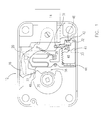
- Figs. 1 and 2 are illustrations of an electronic lock mechanism with the back cover and electronic controls removed to reveal the solenoid and the electromechanical elements of the lock.
- Fig. 3 is a schematic of a circuit which is responsive to microprocessor control and which, in turn, acts to provide a reverse polarity voltage and current flow through the solenoid in response to a command pulse from the microprocessor.
- the lock 10 includes a solenoid 40 which is a typical push-type solenoid having an armature plate 44 attached to or formed as one end of the armature or armature shaft 42 and extendible upon actuation of the solenoid 40 from the solenoid housing 41.
- the solenoid armature 42 upon extension, engages latch input tab 46. Movement of the armature 42 in the attracted direction will displace latch input tab 46 about pivot 31 and simultaneously displaces latch 32 counter clockwise about pivot 31.
- the cam 26 acting through nose portion 22 of bolt lever 16 and tenon 20 maintains slide 28 in a raised position freeing latch 32 for movement under the influence of latch input tab 46, whenever latch input tab 46 is pushed by armature 42.
- the lock illustrated in Fig. 2 is in the same condition as in Fig. 1 except that the solenoid 40 has been actuated. As can be seen from a review of Fig 2, the lock at this point has been unlatched; and whenever cam 26 ceases to hold bolt lever 16 in its raised position, maintaining slide 28 in its raised and retracted position, the slide 28 will be free to move. However, until such time as cam 26 is rotated to present the gate 58 to nose portion 22, the residual magnetism in solenoid 40 will maintain the armature plate 44 sealed against solenoid housing 41 with armature 42 extended and holding latch 32 out of engagement with slide 28 and particularly out of engagement with latch notch 33. The residual magnetic attractive force holding armature plate 44 exceeds the spring restore force exerted by spring 50 on latch 32.
- latch restore spring 50 is extended but exerts a force insufficient to overcome the residual magnetic holding force between the solenoid housing 41 and armature plate 44; therefore, the latch 32 will not restore to its locked position until such time as either the lock 10 is operated by the operator to withdraw bolt 14 or until such time as some external influence resets solenoid 40.
- the solenoid control circuit is shown.
- the windings of solenoid 40 are illustrated with the armature plate 44 and the armature 42.
- the armature 42 and armature plate 44 illustrated in the solid line position are in the unactuated position with the dotted line position showing the actuated position.
- the electrical power to control the solenoid 40 is supplied by V KICK which is a voltage provided by a manually powered generator preferably self-contained within the lock.
- V KICK acts to charge capacitor C7 and simultaneously charge capacitor C14.
- Capacitor C7 is a very large capacitance capacitor and has a nominal charging level of approximately twelve volts.
- Capacitor C14 similarly has a twelve volt charging level but may be a very much smaller capacitor and is used to reset the solenoid.
- the size of capacitor C7 is determined by the intensity of the magnet holding field.
- the capacitor C7 is connected through transistor Q1 to the solenoid 40 and is controlled to act upon solenoid 40 only under the influence of transistor Q6.
- Transistor Q6 is controlled by the pick signal from microprocessor 80.
- the pick signal typically 20 ms in duration and with a voltage of approximately three volts, the typical output voltage of microprocessor signals,is impressed upon the PICK line which then causes transistor Q6 to conduct.
- transistor Q6 Upon transistor Q6 becoming conductive, the potential on the base of transistor Q1 is reduced, causing transistor Q1 to conduct passing the electrical energy from capacitor C7 through the windings of solenoid 40 to ground.
- the current flowing from capacitor C7 through transistor Q1 and through the windings of solenoid 40 creates a magnetic field which attracts armature plate 44 and armature 42 from the solid line position 44, 42 to the dashed line position 44', 42'.
- the solenoid 40 only will be energized for approximately 20 ms, the length of time that the pick signal is present on transistor Q6.
- capacitor C14 When capacitor C7 was charged by voltage V kick , capacitor C14 was simultaneously charged. Capacitor C14 was not discharged at the time that capacitor C7 was discharged and, therefore, the charge on capacitor C14 remains available. After the pick signal is no longer present on transistor Q6, armature 42 and armature plate 44 will remain sealed against the solenoid 40 (40', 44' in Fig. 3).
- the latch 32 illustrated in Figs. 1 and 2 is held in its displaced and unlatched condition by the residual magnetism of the solenoid 40. In this condition the lock 10 is insecure and capable of being opened by anyone who rotates the dial, not shown, to retract the bolt 14 illustrated in Figs. 1 and 2 and as described earlier.
- Microprocessor 80 is capable of timing periods; upon the initiation of the pick voltage on transistor Q6 by microprocessor 80, the microprocessor 80 then will start timing. After a predetermined period of time, for example, six seconds, microprocessor 80 will initiate a reset pulse on the gate of transistor Q5. With the gate of transistor Q5 high, the transistor Q5 will conduct to ground and will pull the base of transistor Q2 to ground causing transistor Q2 to conduct and provide a discharge path between capacitor C14 and ground. With the discharge path from C14 to ground completed, capacitor C14 will discharge and will effectively create a current flow from ground to the negative side of capacitor C14 through the windings of solenoid 40. In the preferred embodiment, when this occurs, as defined by the capacitance of C14, the current will result in a short and relatively low-level current flow as compared to the actuating current flow through solenoid 40 from the capacitor C7.
- the period of time between the actuation of solenoid 40 by the discharge of capacitor C7 and the reset or release of the solenoid 40 by the discharge of capacitor C14 may be controlled by programming the microprocessor 80 to time a predetermined time period.
- the time period should be short enough that the lock 10 vulnerability is minimized while, at the same time, long enough to provide adequate opportunity for the operator of the lock 10 to react to the entry of a proper combination and turn the dial or move a manual input member to withdraw the bolt.
- the time-out in the microprocessor 80 will result in the release signal on the gate of transistor Q5 initiating the reset operation.
- the electronic reset operation under these circumstances will be ineffectual if the solenoid 40 already has been restored to its unattracted, unactuated position.
- the electronic reset capability provides a higher level of security to the lock particularly in those instances whereby the operator may be distracted upon entering the combination and conditioning the lock for opening but, for some reason, fails to physically withdraw the bolt.
- the operator fails to operate the mechanical linkages and parts within the lock sufficient to restore the solenoid armature to its unattracted position and restore the latch to a position whereby the lock is incapable of being opened at a later time without the use of the proper combination and operational sequences.
- a permanent magnet may be used to hold the armature.
- a permanent magnet holding solenoid has a permanent holding magnet arranged relative to the armature which is capable of holding the armature of the solenoid in its actuated, attracted position; the solenoid may be used so that it does not have to remain powered during the entire period of time necessary for the operator to be able to open the lock.
- Actuation of the solenoid coil with a reverse current flow as described above can be used to overcome or oppose the magnetic field of the permanent holding magnets and thus reduce the net magnetic holding force on the armature to a level less than that exerted by the mechanical restore springs, thereby permitting the mechanical restore springs both to act and restore the solenoid armature to its unattracted position.
- a larger or multiple capacitor may be used to achieve the magnetic field initially required for resetting
- this technique may be used to overcome the magnetic holding of a lock part in an unlocked position after a period of time deemed the longest necessary for the operator to withdraw the bolt.
Landscapes
- Physics & Mathematics (AREA)
- General Physics & Mathematics (AREA)
- Electromagnetism (AREA)
- Electromagnets (AREA)
- Lock And Its Accessories (AREA)
- Magnetically Actuated Valves (AREA)
Applications Claiming Priority (2)
| Application Number | Priority Date | Filing Date | Title |
|---|---|---|---|
| US852775 | 1997-05-07 | ||
| US08/852,775 US6006561A (en) | 1997-05-07 | 1997-05-07 | Electronic reset for solenoid activated control in an electronic lock |
Publications (2)
| Publication Number | Publication Date |
|---|---|
| EP0877134A2 true EP0877134A2 (fr) | 1998-11-11 |
| EP0877134A3 EP0877134A3 (fr) | 2000-09-13 |
Family
ID=25314183
Family Applications (1)
| Application Number | Title | Priority Date | Filing Date |
|---|---|---|---|
| EP19980303569 Withdrawn EP0877134A3 (fr) | 1997-05-07 | 1998-05-07 | Serrure électronique comportant une commande de solénoide avec remise à zéro électronique |
Country Status (6)
| Country | Link |
|---|---|
| US (2) | US6006561A (fr) |
| EP (1) | EP0877134A3 (fr) |
| JP (1) | JPH1144134A (fr) |
| KR (1) | KR19980086937A (fr) |
| CN (1) | CN1199127A (fr) |
| CA (1) | CA2236278A1 (fr) |
Cited By (3)
| Publication number | Priority date | Publication date | Assignee | Title |
|---|---|---|---|---|
| WO2000029698A1 (fr) * | 1998-11-13 | 2000-05-25 | Mas-Hamilton Group, Inc. | Mecanisme anti-choc pour verrou electronique |
| EP2331780A4 (fr) * | 2008-09-05 | 2014-12-31 | Lock Ii L L C | Serrure haute securite |
| EP3666997A1 (fr) * | 2012-12-19 | 2020-06-17 | Lock II, L.L.C. | Dispositif et procédés pour empêcher un accès indésirable à une enceinte verrouillée |
Families Citing this family (33)
| Publication number | Priority date | Publication date | Assignee | Title |
|---|---|---|---|---|
| US6006561A (en) * | 1997-05-07 | 1999-12-28 | Mas-Hamilton Group, Inc. | Electronic reset for solenoid activated control in an electronic lock |
| US6380787B1 (en) * | 1999-08-31 | 2002-04-30 | Micron Technology, Inc. | Integrated circuit and method for minimizing clock skews |
| US6361089B1 (en) * | 2000-06-16 | 2002-03-26 | Atlantes Services, Inc. | Adaptable low-power electronic locking mechanism |
| US6516640B2 (en) | 2000-12-05 | 2003-02-11 | Strattec Security Corporation | Steering column lock apparatus and method |
| US6571587B2 (en) | 2001-01-09 | 2003-06-03 | Strattec Security Corporation | Steering column lock apparatus and method |
| EP1625482A2 (fr) * | 2003-04-11 | 2006-02-15 | Strattec Security Corporation | Appareil et procede d'allumage |
| US7140213B2 (en) * | 2004-02-21 | 2006-11-28 | Strattec Security Corporation | Steering column lock apparatus and method |
| US20060226941A1 (en) * | 2005-03-30 | 2006-10-12 | Dimig Steven J | Residual magnetic devices and methods |
| US20060219499A1 (en) * | 2005-03-30 | 2006-10-05 | Organek Gregory J | Residual magnetic devices and methods |
| US20060219497A1 (en) * | 2005-03-30 | 2006-10-05 | Organek Gregory J | Residual magnetic devices and methods |
| US20060226942A1 (en) * | 2005-03-30 | 2006-10-12 | Dimig Steven J | Residual magnetic devices and methods |
| US20060219513A1 (en) * | 2005-03-30 | 2006-10-05 | Organek Gregory J | Residual magnetic devices and methods |
| US20060219498A1 (en) * | 2005-03-30 | 2006-10-05 | Organek Gregory J | Residual magnetic devices and methods |
| US20060238284A1 (en) * | 2005-03-30 | 2006-10-26 | Dimig Steven J | Residual magnetic devices and methods |
| US8403124B2 (en) | 2005-03-30 | 2013-03-26 | Strattec Security Corporation | Residual magnetic devices and methods |
| US20060220393A1 (en) * | 2005-03-30 | 2006-10-05 | Dimig Steven J | Residual magnetic devices and methods |
| US20060237959A1 (en) * | 2005-03-30 | 2006-10-26 | Dimig Steven J | Residual magnetic devices and methods |
| US7401483B2 (en) | 2005-03-30 | 2008-07-22 | Strattec Security Corporation | Residual magnetic devices and methods for an ignition actuation blockage device |
| US20060238285A1 (en) * | 2005-03-30 | 2006-10-26 | Dimig Steven J | Residual magnetic devices and methods |
| US7969705B2 (en) | 2005-03-30 | 2011-06-28 | Strattec Security Corporation | Residual magnetic devices and methods |
| US20060219496A1 (en) * | 2005-03-30 | 2006-10-05 | Dimig Steven J | Residual magnetic devices and methods |
| US20080211239A1 (en) * | 2007-03-02 | 2008-09-04 | Jon Edward Keller | Security improvement to solenoid-releasable mortise lockset having thumb-lever actuators |
| CA2794571C (fr) * | 2010-04-07 | 2017-08-15 | Sargent And Greenleaf, Inc. | Serrure resistant aux chocs |
| CA2807275A1 (fr) * | 2010-08-05 | 2012-02-09 | Sargent And Greenleaf, Inc. | Serrure haute securite |
| CA2902881C (fr) | 2013-03-15 | 2019-10-29 | Sargent Manufacturing Company | Circuit electronique servant a capturer des impulsions d'un dispositif de commande de verrou |
| US9696762B2 (en) * | 2013-06-19 | 2017-07-04 | Beijing Lenovo Software Ltd. | Unlocking method and electronic apparatus |
| CN103993786B (zh) * | 2014-04-29 | 2016-05-18 | 南京东屋电气有限公司 | 一种电子机械双控锁 |
| US9540847B2 (en) * | 2014-06-06 | 2017-01-10 | Rodolfo Pena | Magnetically enhanced key and lock system |
| US10436258B2 (en) | 2014-07-13 | 2019-10-08 | Dana Automotive Systems Group, Llc | Method and system for latching an actuator |
| EP3256671A4 (fr) * | 2015-02-09 | 2018-10-10 | MG Tech Center BV h.o.d.n. Lock Technology | Serrure à combinaison électronique et mécanique |
| US10323699B2 (en) | 2015-07-02 | 2019-06-18 | Dana Automotive Systems Group, Llc | Electromagnetic connect/disconnect system for a vehicle |
| US9396860B1 (en) | 2015-07-13 | 2016-07-19 | Dana Automotive Systems Group, Llc | Compliant plunger for latching solenoid |
| CN113360449B (zh) * | 2021-04-29 | 2022-12-27 | 山东英信计算机技术有限公司 | 一种服务器防护电路和服务器 |
Family Cites Families (26)
| Publication number | Priority date | Publication date | Assignee | Title |
|---|---|---|---|---|
| ZA77801B (en) * | 1976-03-11 | 1978-04-26 | Chubb & Sons Lock & Safe Co | Improvements relating to keyless combination locks |
| GB8313142D0 (en) * | 1983-05-12 | 1983-06-15 | Chubb & Sons Lock & Safe Co | Electro-mechanical actuators and lock mechanisms |
| EP0408953B1 (fr) * | 1989-07-21 | 1994-01-26 | Theodor Kromer GmbH & Co.KG Spezialfabrik für Sicherheitsschlösser | Serrure à combinaisons comportant un disque à cames et des disques à gorges |
| US5307656A (en) * | 1990-12-17 | 1994-05-03 | La Gard, Inc. | High security electronic dial combination lock |
| CA2071577A1 (fr) * | 1991-06-21 | 1992-12-22 | Gerald L. Dawson | Serrure electronique a combinaison, de haute securite |
| IL99716A (en) * | 1991-10-11 | 1996-09-12 | Technolock Engineering | Door locking system |
| JPH06229155A (ja) * | 1992-01-13 | 1994-08-16 | C & M Technology Inc | セキュリティロック機構 |
| DE4323493C1 (de) * | 1993-07-14 | 1994-10-27 | Kromer Theodor Gmbh & Co Kg | Zahlenkombinationsschloß mit einem Drehknopf, mit einer Nockenscheibe und mit einem Einfallhebel |
| WO1995012047A1 (fr) * | 1993-10-29 | 1995-05-04 | Sargent & Greenleaf, Inc. | Serrure a combinaison electronique |
| US5845523A (en) * | 1994-03-30 | 1998-12-08 | U-Code, Inc. | Electronic input and dial entry lock |
| US5887467A (en) * | 1994-03-30 | 1999-03-30 | U-Code, Inc. | Pawl & solenoid locking mechanism |
| DE19501420C1 (de) * | 1995-01-19 | 1995-12-21 | Dorma Gmbh & Co Kg | Verriegelung |
| US5749252A (en) * | 1996-04-15 | 1998-05-12 | Sargent & Greenleaf | Manipulation resistant combination lock and method |
| US5845524A (en) * | 1996-05-21 | 1998-12-08 | Koehler; Joseph E. | Lock assembly |
| US5862692A (en) * | 1996-10-11 | 1999-01-26 | C.L. Industries, Inc. | Safe door lock with servo motor operated cam |
| DE29618688U1 (de) * | 1996-10-26 | 1997-01-02 | Kiekert AG, 42579 Heiligenhaus | Einrichtung zum Abfragen von Schaltstellungen an einem Kraftfahrzeugtürverschluß |
| DE19646810C2 (de) * | 1996-11-13 | 1999-02-04 | Kiekert Ag | Kraftfahrzeugtürverschluß mit Schloßsystem, Schließsystem und auf eine Auswerteelektronik arbeitender Einrichtung Abfrage der Funktionsstellungen des Schließzylinders, die mit Hallsensor-Chips arbeitet |
| US5775142A (en) * | 1996-12-03 | 1998-07-07 | Kim; Jitae | Electronic door lock |
| US5852944A (en) * | 1997-04-18 | 1998-12-29 | Stephen C. Cohen | Remotely controlled door lock |
| US5893283A (en) * | 1997-05-07 | 1999-04-13 | Mas-Hamilton Group | Solenoid controlled bolt control for an electronic lock |
| US6006561A (en) * | 1997-05-07 | 1999-12-28 | Mas-Hamilton Group, Inc. | Electronic reset for solenoid activated control in an electronic lock |
| DE69726843D1 (de) * | 1997-05-30 | 2004-01-29 | Ilco Unican S A Relhor Divisio | Vorrichtung zum Aufheben der Öffnungssperre eines bedingt betätigbaren Schlosses |
| DE19724085C1 (de) * | 1997-06-07 | 1998-10-29 | Kiekert Ag | Kraftfahrzeugtürverschluß |
| US5881589A (en) * | 1997-06-12 | 1999-03-16 | Mas-Hamilton Group | Gear driven bolt withdrawal for an electronic combination lock |
| US6094952A (en) * | 1998-01-02 | 2000-08-01 | Sargent & Greenleaf, Inc. | Dead bolt combination lock with integrated re-locking features |
| US6067824A (en) * | 1998-10-29 | 2000-05-30 | Optek Technology, Inc. | Automobile ignition security system using a differential magnetic comparator |
-
1997
- 1997-05-07 US US08/852,775 patent/US6006561A/en not_active Expired - Fee Related
-
1998
- 1998-04-29 CA CA 2236278 patent/CA2236278A1/fr not_active Abandoned
- 1998-05-07 JP JP14049298A patent/JPH1144134A/ja not_active Withdrawn
- 1998-05-07 CN CN98102110A patent/CN1199127A/zh active Pending
- 1998-05-07 EP EP19980303569 patent/EP0877134A3/fr not_active Withdrawn
- 1998-05-07 KR KR1019980016842A patent/KR19980086937A/ko not_active Withdrawn
-
1999
- 1999-12-28 US US09/474,042 patent/US6178791B1/en not_active Expired - Lifetime
Cited By (5)
| Publication number | Priority date | Publication date | Assignee | Title |
|---|---|---|---|---|
| WO2000029698A1 (fr) * | 1998-11-13 | 2000-05-25 | Mas-Hamilton Group, Inc. | Mecanisme anti-choc pour verrou electronique |
| EP2331780A4 (fr) * | 2008-09-05 | 2014-12-31 | Lock Ii L L C | Serrure haute securite |
| EP3418477A1 (fr) * | 2008-09-05 | 2018-12-26 | Lock II, L.L.C. | Verrou de haute sécurité |
| EP3666997A1 (fr) * | 2012-12-19 | 2020-06-17 | Lock II, L.L.C. | Dispositif et procédés pour empêcher un accès indésirable à une enceinte verrouillée |
| US12331551B2 (en) | 2012-12-19 | 2025-06-17 | Lock Ii, Llc | Device and methods for preventing unwanted access to a locked enclosure |
Also Published As
| Publication number | Publication date |
|---|---|
| JPH1144134A (ja) | 1999-02-16 |
| CA2236278A1 (fr) | 1998-11-07 |
| EP0877134A3 (fr) | 2000-09-13 |
| US6006561A (en) | 1999-12-28 |
| US6178791B1 (en) | 2001-01-30 |
| CN1199127A (zh) | 1998-11-18 |
| KR19980086937A (ko) | 1998-12-05 |
Similar Documents
| Publication | Publication Date | Title |
|---|---|---|
| US6178791B1 (en) | Electronic reset for solenoid activated control in an electronic lock | |
| US5893283A (en) | Solenoid controlled bolt control for an electronic lock | |
| US4656850A (en) | Electric lock | |
| US7698918B2 (en) | Interchangeable lock operable in fail safe or fail secure modes | |
| EP3215697B1 (fr) | Loquet à cames | |
| US7963574B2 (en) | Fail safe/fail secure lock with quick change access window | |
| US4736970A (en) | Electrically controlled door lock | |
| US7712341B2 (en) | Electronic combination lock | |
| US6575003B1 (en) | Door lock for a vehicle with electrical locking/unlocking | |
| US3506883A (en) | Electrical locking device | |
| EP0260860A1 (fr) | Mécanisme pour serrure | |
| JPH0735706B2 (ja) | 電気錠 | |
| EP0333821B1 (fr) | Serrure a commande electrique | |
| DK160623B (da) | Apparat til elektromagnetisk fastlaasning til en laasecylinder i et mekanisk/elektronisk laasesystem | |
| US5678868A (en) | Electronic door locking mechanism | |
| GB2155535A (en) | Motor vehicle door lock | |
| GB2278394A (en) | Electrically operated door lock | |
| HK1012200A (en) | Electronic reset for solenoid activated control in an electronic lock | |
| JP3602870B2 (ja) | 電気錠 | |
| HK1015430A (en) | Solenoid controlled bolt control for an electronic lock | |
| EP0977228A3 (fr) | Interrupteur électromécanique de sécurité à clé avec dispositif de verrouillage électromagnétique | |
| GB2085956A (en) | Electromagnetic fastening | |
| RU2783155C1 (ru) | Электромеханическое замковое устройство | |
| JPH0423168Y2 (fr) | ||
| JPS62148780A (ja) | 電気錠装置 |
Legal Events
| Date | Code | Title | Description |
|---|---|---|---|
| PUAI | Public reference made under article 153(3) epc to a published international application that has entered the european phase |
Free format text: ORIGINAL CODE: 0009012 |
|
| AK | Designated contracting states |
Kind code of ref document: A2 Designated state(s): CH DE FR GB IT LI |
|
| AX | Request for extension of the european patent |
Free format text: AL;LT;LV;MK;RO;SI |
|
| PUAL | Search report despatched |
Free format text: ORIGINAL CODE: 0009013 |
|
| AK | Designated contracting states |
Kind code of ref document: A3 Designated state(s): AT BE CH CY DE DK ES FI FR GB GR IE IT LI LU MC NL PT SE |
|
| AX | Request for extension of the european patent |
Free format text: AL;LT;LV;MK;RO;SI |
|
| RIC1 | Information provided on ipc code assigned before grant |
Free format text: 7E 05B 47/06 A, 7E 05B 13/00 B, 7E 05B 49/00 B |
|
| 17P | Request for examination filed |
Effective date: 20010312 |
|
| AKX | Designation fees paid |
Free format text: BE CH DE FR IT LI |
|
| RBV | Designated contracting states (corrected) |
Designated state(s): CH DE FR GB IT LI |
|
| RAP1 | Party data changed (applicant data changed or rights of an application transferred) |
Owner name: KABA MAS CORPORATION |
|
| 17Q | First examination report despatched |
Effective date: 20031029 |
|
| STAA | Information on the status of an ep patent application or granted ep patent |
Free format text: STATUS: THE APPLICATION IS DEEMED TO BE WITHDRAWN |
|
| 18D | Application deemed to be withdrawn |
Effective date: 20041118 |
|
| REG | Reference to a national code |
Ref country code: HK Ref legal event code: WD Ref document number: 1012200 Country of ref document: HK |