EP0877511A2 - System und Verfahren zur Leistungsverbesserung eines CSMA/CD-Netzes bei einem Kollision - Google Patents
System und Verfahren zur Leistungsverbesserung eines CSMA/CD-Netzes bei einem Kollision Download PDFInfo
- Publication number
- EP0877511A2 EP0877511A2 EP98201025A EP98201025A EP0877511A2 EP 0877511 A2 EP0877511 A2 EP 0877511A2 EP 98201025 A EP98201025 A EP 98201025A EP 98201025 A EP98201025 A EP 98201025A EP 0877511 A2 EP0877511 A2 EP 0877511A2
- Authority
- EP
- European Patent Office
- Prior art keywords
- network node
- computer network
- collision
- nodes
- backoff
- Prior art date
- Legal status (The legal status is an assumption and is not a legal conclusion. Google has not performed a legal analysis and makes no representation as to the accuracy of the status listed.)
- Granted
Links
Images


Classifications
-
- H—ELECTRICITY
- H04—ELECTRIC COMMUNICATION TECHNIQUE
- H04L—TRANSMISSION OF DIGITAL INFORMATION, e.g. TELEGRAPHIC COMMUNICATION
- H04L12/00—Data switching networks
- H04L12/28—Data switching networks characterised by path configuration, e.g. LAN [Local Area Networks] or WAN [Wide Area Networks]
- H04L12/40—Bus networks
- H04L12/40006—Architecture of a communication node
- H04L12/40032—Details regarding a bus interface enhancer
-
- H—ELECTRICITY
- H04—ELECTRIC COMMUNICATION TECHNIQUE
- H04L—TRANSMISSION OF DIGITAL INFORMATION, e.g. TELEGRAPHIC COMMUNICATION
- H04L12/00—Data switching networks
- H04L12/28—Data switching networks characterised by path configuration, e.g. LAN [Local Area Networks] or WAN [Wide Area Networks]
- H04L12/40—Bus networks
- H04L12/407—Bus networks with decentralised control
- H04L12/413—Bus networks with decentralised control with random access, e.g. carrier-sense multiple-access with collision detection [CSMA-CD]
Definitions
- This invention relates to a network access protocol known as Carrier Sense Multiple Access with Collision Detection (CSMA/CD) and, more particularly, to a method for improving network performance when multiple parties collide in such a network.
- CSMA/CD Carrier Sense Multiple Access with Collision Detection
- the CSMA/CD protocol generally used in Ethernet LANs (local area networks), is defined in ANSI/IEEE Standard 802.3 published by the Institute of Electrical and Electronics Engineers (hereinafter, the "IEEE 802.3 standard").
- any node or station wishing to transmit must first listen to ensure that the channel is clear before beginning to transmit. All nodes on the network have equal priority of access and may begin transmitting as soon as the channel is clear and a required interpacket delay of 9.6 microseconds has elapsed. However, if a first node that has begun transmitting detects a collision with a transmission from another node, the first node continues transmitting for a short time to make sure that all nodes wishing to transmit will detect the collision (it is assumed that, while the attempts to transmit are nearly simultaneous, the first node is actually the first to begin). Every other node detecting the collision also continues to transmit for a short time.
- collision refers to the condition in which two or more nodes attempt to transmit nearly simultaneously after detecting the bus is clear.
- the IEEE 802.3 standard defines a collision backoff procedure referred to as "truncated binary exponential backoff.”
- truncated binary exponential backoff When a transmission attempt has terminated due to a collision, it is retried by the transmitting node after a selected backoff time until either the transmission is successful or a maximum number of attempts have been made and all have terminated due to collisions.
- the backoff time is selected by each node as an integral multiple of the "slot time" which is the maximum round trip propagation time for the network, i.e., the time required to propagate a data packet from one end of the network to the other and back.
- the slot time is defined by the IEEE 802.3 Standard as 51.2 microseconds.
- the backoff-time retransmission attempt number relationships are set forth in Table 1 below. Retransmission Attempt No. Backoff Time in Slot Times n r 1 0,1 2 0,1,2,3 3 0,1,2,3,4,5,6,7 4 0-15 n 0-(2 n - 1) 10 (max n) 0-1023
- a method has been developed in which backoff times in a two node collision in which one node has "captured" the system are selected to be different from those prescribed in the IEEE 802.3 standard, for example, in U.S. Patent No. 5,436,903.
- backoff times are changed, for example, by selecting backoff times deterministically and then using a stopped backoff technique in which a node's backoff timer is stopped when the collision signal on the bus is active. While apparently successful at preventing node capture, the system does not address the possibility that more than two nodes might collide.
- an access controller monitors voltage levels on the bus.
- a first voltage level corresponds to a collision between two parties on the bus.
- a second voltage level corresponds to more than two nodes colliding for access on the bus. If the second voltage level is detected during a collision, the nodes back off and select backoff times from a backoff time window greater than that corresponding to the prescribed standard.
- the present invention relates to a network node capable of detecting how many parties have collided during attempts to transmit on a bus. If more than one party has been detected to collide, the node selects a backoff window from a larger randomized group of possible backoff windows than if the node had collided with only one other party. In this way, delays due to multiple parties colliding are minimized.
- the communication network 100 includes a transmission medium or bus 108 which may comprise, for example, coaxial cable or unshielded twisted pair (UTP) wiring.
- a plurality of network devices or nodes 102, 104 and 106 are coupled to the transmission medium 108.
- the network devices 102, 104 and 106 comprise, for example, personal computers, printers, servers and other devices.
- the invention will be described with respect to exemplary device 102. While each network device 102, 104, 106 in network 100 may be similarly configured, the present invention is operable if only one node is so configured.
- the network device 102 includes an exemplary network interface unit 112, such as a network interface card, coupled to a central processing unit 110.
- the central processing unit 110 is representative of, for example, a Pentium or Pentium Pro type processor in a personal computer.
- the network interface unit 112 includes a bus interface 116 coupled to a transmission control interface 114.
- the bus interface 116 includes I/O drivers 120 and a collision detection unit 118.
- the collision detection unit 118 monitors the transmission medium 108 for the presence of data from the other network devices 104, 106 on the transmission medium 108. If the network device 102 needs to transmit data on the transmission medium 108, the collision detection unit 118 determines if the data from the network device 102 have collided with data from other the network devices 104, 106 on the transmission medium 108. If such a collision does occur, the collision detection unit 118 provides a control signal to the transmission control interface unit 114. More particularly, the transmission control interface unit 114 includes a transceiver 128 having transmitter and receiver logic (not shown). The transceiver 128 is coupled to an I/O buffer unit 122 which in turn is coupled to the CPU 110.
- a weighting circuit 130 which, as will be discussed in greater detail below, is used to select the appropriate retransmission window.
- the collision detection unit 118 is coupled to a collision counter 124 which is also coupled to the weighting unit 130.
- a random number generator 126 further couples the weighting unit 130 to the collision counter 124.
- the collision clock 124 clocks every time a collision occurs.
- the random number generator 126 and the weighting circuit 130 provide the determination of the randomized number of the retransmission window. This information is then provided back to the network interface 116 to permit another attempted retransmission via the I/O driver 120.
- the collision detection unit 118 determines how many devices are colliding on the transmission medium 108. In one embodiment, the collision detection unit 118 monitors voltage levels on the transmission medium 108. If two devices have collided on the transmission medium 108, a first voltage will be detected by the collision detection unit 118. If more than two devices have collided on the transmission medium 108, another (larger) voltage level will be detected. This information is then provided to the collision counter 124 of the transmission control interface 114. The collision counter 124 counts how many collisions have occurred. In the case of two parties colliding, this is the number of retransmission attempts.
- the collision counter provides the retransmission attempt number to the weighting circuit 130.
- the weighting circuit 130 selects the backoff time in slot times based upon the random number generator 126's output. The output of the weighting circuit 130 is then the backoff time which is provided to the transceiver 128.
- the transceiver 128 will wait the appropriate backoff time and then pause the I/O driver 120 prior to attempting a new transmission onto the transmission medium 108.
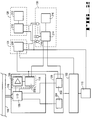
- FIG. 2 illustrates in greater detail the bus interface 116 and the transmission control interface 114. It is noted that while illustrated as discrete hardware, the bus interface 116 and the transmission control interface 114 may be embodied in one or more digital signal processors (DSPs). Thus, FIG. 2 and FIG. 3 are exemplary only.
- DSPs digital signal processors
- the network control interface 116 comprises an I/O driver unit 120 coupled to a collision detection unit 118.
- the I/O driver unit 120 drives data to and receives data from the bus 108.
- the collision detection unit 118 includes a comparator 200 coupled to a detection controller 202.
- the comparator 200 is used to compare voltage levels on the transmission medium 108 with predetermined levels. The predetermined levels are representative of, for example, two or more than two devices colliding on the transmission medium 108. If a collision is detected during a transmission attempt, the comparator 200 provides an output to the control unit 202 indicative of the number of devices that have collided on the transmission medium 108.
- the detection control unit 202 then suspends transmission along the transmission medium 108 and provides a control signal to the collision counter 124.
- the collision counter 124 includes, for example, a shift register 208.
- the shift register 208 may be configured to shift every time a collision is detected. For example, in the case of one device colliding with a transmission attempt by the device 102, the shift register 208 is shifted one place. However, if the comparator 200 provides an output to the detection control unit 202 which indicates that more than one device has collided on transmission medium 108, the shift register 208 may be shifted more than one place. For example, the shift register 208 may be shifted twice.
- the shift control signal is also provided to a transmission controller 206 in the transceiver 128.
- the transceiver 128 includes a receive unit 204, in addition to the transmission unit 206. Data are received from the CPU 110 through the I/O unit 122 and on to the transceiver 128. The data are the provided to the I/O drivers 120 and out onto the transmission medium 108.
- the shift register 208 provides outputs to a series of AND gates 218.
- the other inputs to the AND Gates 218 are derived from the random number generator 126. More particularly, the random number generator 126 includes a counter 210 and a clock 212.
- the clock 212 is a faster clock than the system clock.
- the counter 210 runs as a continually running clock counter.
- the AND gates 218 comprise a portion of the weighting circuit 130.
- the weighting circuit 130 further includes an up/down counter 214 coupled to a restart clock 216.
- the shift register 208 is clocked each time a collision occurs and the serial input thereof is, in turn, provided to count up the number of collisions occurring during those times when a packet is ready for transmission.
- the outputs of the AND Gates 218 are connected to the inputs of the up/down counter 214, which is clocked by the restart clock 216.
- the up/down counter 214 is loaded by the collision detection signal to begin a down count when a collision is detected. When the count reaches zero, a signal is sent to the transmission control 206 to cause retransmission of the data packet.
- FIG. 3 A flowchart illustrating operation of one embodiment of the invention is shown in FIG. 3.
- the collision detection unit 118 or other circuitry in the bus interface unit 116 continually monitors the transmission medium 108.
- the collision detection unit 118 determines whether or not the transmission medium is free in a step 306.
- a determination that the transmission medium 108 is free includes, for example, detecting the end of another node's transmission and waiting the predetermined interpacket gap of 9.6 microseconds. If the transmission medium 108 is determined to be free, the collision detection unit 118 allows the transmission to go forward in a step 308.
- the collision detection unit 118 continues to monitor the transmission line during transmission of the data from the network device 102 in a step 312. If there is no collision, the transmission continues until the transmission is concluded in a step 314. If, however, in step 312, a collision had been determined to occur, the collision detection unit 118 continues the transmission briefly until other units have detected their transmissions. The collision detection unit 118 then prevents the transceiver 128 from continuing the transmission and determines how many devices have collided in a step 316. As discussed above, the determination of how many devices has collided is accomplished in one embodiment through a comparator 200 comparing the received voltage level with a predetermined voltage level and providing an indication of the comparison to a detection control unit 202.
- the collision detection unit 118 would provide an indication of how many devices had collided in a step 320. As discussed above, this includes, for example, a monitoring of voltage levels on the transmission medium 108 with a higher voltage level being detected for more devices attempting to transmit simultaneously on the bus.
- the comparator 200 includes an edge detector, and a first pulse characteristic (i.e., a first pulse width or predetermined number of edges) corresponds to a first number of devices colliding; a second pulse characteristic corresponds to a second number of devices colliding.
- the detection control unit 202 of the collision detection unit 118 then provides a control signal to the shift register 208 indicative of a greater number of colliding devices on the transmission medium 108. For example, if two other devices have collided with the device 102, two clock signals causing two shifts may be provided to the shift register 208 in a step 322. Thus, a greater number of potential backoff windows are selectable.
- the network device 102 When the designated backoff window expires, the network device 102 will again attempt to transmit on the bus. If the bus is free, the network device will succeed in its transmission in a step 314.
Landscapes
- Engineering & Computer Science (AREA)
- Computer Networks & Wireless Communication (AREA)
- Signal Processing (AREA)
- Small-Scale Networks (AREA)
Applications Claiming Priority (2)
| Application Number | Priority Date | Filing Date | Title |
|---|---|---|---|
| US08/853,281 US6205153B1 (en) | 1997-05-09 | 1997-05-09 | System and method for improving CSMA/CD network performance during collisions |
| US853281 | 1997-05-09 |
Publications (3)
| Publication Number | Publication Date |
|---|---|
| EP0877511A2 true EP0877511A2 (de) | 1998-11-11 |
| EP0877511A3 EP0877511A3 (de) | 2001-12-05 |
| EP0877511B1 EP0877511B1 (de) | 2003-09-17 |
Family
ID=25315597
Family Applications (1)
| Application Number | Title | Priority Date | Filing Date |
|---|---|---|---|
| EP98201025A Expired - Lifetime EP0877511B1 (de) | 1997-05-09 | 1998-04-01 | System und Verfahren zur Leistungsverbesserung eines CSMA/CD-Netzes bei einer Kollision |
Country Status (3)
| Country | Link |
|---|---|
| US (1) | US6205153B1 (de) |
| EP (1) | EP0877511B1 (de) |
| DE (1) | DE69818139T2 (de) |
Cited By (4)
| Publication number | Priority date | Publication date | Assignee | Title |
|---|---|---|---|---|
| WO2001033769A3 (en) * | 1999-11-02 | 2002-05-30 | Broadcom Corp | A method and apparatus for the detection and classification of collisions on a shared access rf network |
| EP1255376A1 (de) * | 2001-05-03 | 2002-11-06 | Lucent Technologies Inc. | Fast optimale Fairness-Backoff-Verfahren und -System |
| KR20020084821A (ko) * | 2001-05-03 | 2002-11-11 | 루센트 테크놀러지스 인크 | 데이터 충돌 해결 방법 및 시스템 |
| US7626996B2 (en) | 2001-06-08 | 2009-12-01 | Broadcom Corporation | System for detecting collisions in a shared communications medium |
Families Citing this family (15)
| Publication number | Priority date | Publication date | Assignee | Title |
|---|---|---|---|---|
| KR100272547B1 (ko) * | 1998-10-21 | 2000-11-15 | 김영환 | 네트워크 사용의 공평성 향상방법 |
| KR100281138B1 (ko) * | 1998-12-18 | 2001-02-01 | 김영환 | 네트워크 사용의 공평성 향상방법 |
| US6493351B1 (en) * | 1999-04-21 | 2002-12-10 | Nortel Networks Ltd. | Collision detection on a differential bus |
| US6625163B1 (en) * | 1999-04-21 | 2003-09-23 | Nortel Networks Ltd. | Collision detection on a differential bus |
| US6725270B1 (en) * | 1999-05-21 | 2004-04-20 | Advanced Micro Devices, Inc. | Apparatus and method for programmably modifying a limit of a retry counter in a network switch port in response to exerting backpressure |
| US6606327B1 (en) * | 1999-08-10 | 2003-08-12 | 3Com Corporation | Method to dynamically adjust the maximum back off time of an ethernet controller in a half duplex network |
| US7051226B1 (en) * | 1999-08-10 | 2006-05-23 | 3Com Corporation | Method and system for providing priority to a station in a congested half duplex Ethernet network |
| US6810263B1 (en) * | 1999-12-22 | 2004-10-26 | Denso Corporation | Packet data reconnection timing control in mobile communication systems |
| WO2001061716A1 (en) * | 2000-02-16 | 2001-08-23 | Woodhead Industries, Inc. | Power monitor with indicators |
| US20020118661A1 (en) * | 2000-12-22 | 2002-08-29 | Daniel Voce | Method of optimizing random access performance in a mobile communications network using dynamically controlled persistence techniques |
| KR100891788B1 (ko) * | 2002-07-08 | 2009-04-07 | 삼성전자주식회사 | 실시간 어플리케이션을 위한 액세스 경쟁 방법 및 이를위한 매체 액세스 제어 계층 모듈 |
| US6981088B2 (en) * | 2003-03-26 | 2005-12-27 | Lsi Logic Corporation | System and method of transferring data words between master and slave devices |
| JP4196910B2 (ja) * | 2004-09-03 | 2008-12-17 | 沖電気工業株式会社 | 通信タイミング制御装置、通信タイミング制御方法、ノード及び通信システム |
| JP5332840B2 (ja) | 2009-04-08 | 2013-11-06 | ソニー株式会社 | 無線通信装置、無線通信システム、無線通信方法及びプログラム |
| DE102009041834B4 (de) * | 2009-09-18 | 2013-04-04 | Phoenix Contact Gmbh & Co. Kg | Netzwerk |
Family Cites Families (21)
| Publication number | Priority date | Publication date | Assignee | Title |
|---|---|---|---|---|
| US4063220A (en) | 1975-03-31 | 1977-12-13 | Xerox Corporation | Multipoint data communication system with collision detection |
| US4464658A (en) | 1982-03-05 | 1984-08-07 | At&T Laboratories | Multipoint data communication system with collision detection |
| US4584679A (en) * | 1983-01-21 | 1986-04-22 | E-Systems, Inc. | Tack-on acknowledgement in computer networks |
| US4598285A (en) | 1983-05-27 | 1986-07-01 | At&T Bell Laboratories | Scheme for reducing transmission delay following collision of transmissions in communication networks |
| US4630264A (en) | 1984-09-21 | 1986-12-16 | Wah Benjamin W | Efficient contention-resolution protocol for local multiaccess networks |
| GB2187367B (en) | 1986-01-09 | 1990-03-28 | Ricoh Kk | Control system for local area network |
| US5018138A (en) | 1987-11-10 | 1991-05-21 | Echelon Systems Corporation | Protocol for network having a plurality of intelligent cells |
| US5319641A (en) | 1990-12-03 | 1994-06-07 | Echelon Systems Corp. | Multiaccess carrier sensing network communication protocol with priority messages |
| US5268899A (en) | 1991-10-17 | 1993-12-07 | 3Com Corporation | Apparatus for generating pseudo-random numbers in a communication system, or other system involving a shared resource |
| US5422887A (en) | 1991-11-27 | 1995-06-06 | Ncr Corporation | Medium access protocol for wireless local area network |
| US5915054A (en) * | 1992-03-05 | 1999-06-22 | Fuji Xerox Co., Ltd. | Star coupler for an optical communication network |
| US5353287A (en) | 1992-03-25 | 1994-10-04 | Alcatel Network Systems, Inc. | Local area network with message priority |
| US5446735A (en) | 1992-12-18 | 1995-08-29 | Starlight Networks | Bandwidth allocation in a shared transmission channel employing CSMA/CD |
| US5381413A (en) | 1992-12-28 | 1995-01-10 | Starlight Networks | Data throttling system for a communications network |
| US5418784A (en) | 1993-06-30 | 1995-05-23 | Digital Equipment Corporation | Method and apparatus for use in a network of the ethernet type, to improve fairness by controlling the interpacket gap in the event of channel capture |
| US5436903A (en) | 1993-06-30 | 1995-07-25 | Digital Equipment Corporation | Method and apparatus for use in a network of the ethernet type, to improve fairness by controlling collision backoff times and using stopped backoff timing in the event of channel capture |
| EP0632619B1 (de) | 1993-06-30 | 2000-10-18 | Cabletron Systems, Inc. | Kollisionverminderungsverfahren für Ethernet-Netze |
| US5398244A (en) | 1993-07-16 | 1995-03-14 | Intel Corporation | Method and apparatus for reduced latency in hold bus cycles |
| JP2707981B2 (ja) * | 1994-10-21 | 1998-02-04 | 株式会社デンソー | 通信制御装置 |
| US5572511A (en) * | 1995-01-27 | 1996-11-05 | Tamarack Microelectronics, Inc. | Auto-adjustment circuit for collision detection of ethernet |
| US5692127A (en) * | 1995-03-17 | 1997-11-25 | Apple Computer, Inc. | System for transmitting multiple pulses PPM control signal to wireless device to indicate collision in a wired network while placing data on the network |
-
1997
- 1997-05-09 US US08/853,281 patent/US6205153B1/en not_active Expired - Lifetime
-
1998
- 1998-04-01 EP EP98201025A patent/EP0877511B1/de not_active Expired - Lifetime
- 1998-04-01 DE DE69818139T patent/DE69818139T2/de not_active Expired - Fee Related
Cited By (9)
| Publication number | Priority date | Publication date | Assignee | Title |
|---|---|---|---|---|
| WO2001033769A3 (en) * | 1999-11-02 | 2002-05-30 | Broadcom Corp | A method and apparatus for the detection and classification of collisions on a shared access rf network |
| US7420986B1 (en) | 1999-11-02 | 2008-09-02 | Broadcom Corporation | Method and apparatus for the detection and classification of collisions on a shared RF network |
| EP1255376A1 (de) * | 2001-05-03 | 2002-11-06 | Lucent Technologies Inc. | Fast optimale Fairness-Backoff-Verfahren und -System |
| KR20020084698A (ko) * | 2001-05-03 | 2002-11-09 | 루센트 테크놀러지스 인크 | 근사 최적 공정성 백 오프 방법들 및 시스템들 |
| KR20020084821A (ko) * | 2001-05-03 | 2002-11-11 | 루센트 테크놀러지스 인크 | 데이터 충돌 해결 방법 및 시스템 |
| EP1263170A1 (de) * | 2001-05-03 | 2002-12-04 | Lucent Technologies Inc. | Back-Off-Verfahren und System mit festem Kollisionsraten |
| US7127519B2 (en) | 2001-05-03 | 2006-10-24 | Lucent Technologies Inc. | Back off methods and systems |
| US7206319B2 (en) | 2001-05-03 | 2007-04-17 | Lucent Technologies Inc. | Fixed collision rate back off methods and systems |
| US7626996B2 (en) | 2001-06-08 | 2009-12-01 | Broadcom Corporation | System for detecting collisions in a shared communications medium |
Also Published As
| Publication number | Publication date |
|---|---|
| US6205153B1 (en) | 2001-03-20 |
| DE69818139D1 (de) | 2003-10-23 |
| EP0877511A3 (de) | 2001-12-05 |
| EP0877511B1 (de) | 2003-09-17 |
| DE69818139T2 (de) | 2004-07-08 |
Similar Documents
| Publication | Publication Date | Title |
|---|---|---|
| US6205153B1 (en) | System and method for improving CSMA/CD network performance during collisions | |
| US5436903A (en) | Method and apparatus for use in a network of the ethernet type, to improve fairness by controlling collision backoff times and using stopped backoff timing in the event of channel capture | |
| CN1105370C (zh) | 与10基t以太网兼容的无信通信的方法和收发信机及系统 | |
| US5960001A (en) | Apparatus and method for guaranteeing isochronous data flow on a CSMA/CD network | |
| US5121382A (en) | Station-to-station full duplex communication in a communications network | |
| EP0632619B1 (de) | Kollisionverminderungsverfahren für Ethernet-Netze | |
| US5894559A (en) | System for selectively reducing capture effect in a network station by increasing delay time after a predetermined number of consecutive successful transmissions | |
| US5353287A (en) | Local area network with message priority | |
| US5311114A (en) | Apparatus and method for full-duplex ethernet communications | |
| JP3160350B2 (ja) | 通信網制御方法 | |
| EP0022170A2 (de) | Verfahren zur Übertragung von Datenpaketen in einem örtlich gemeinsam benutzten Busleitungsnetzwerk und örtlich gemeinsam benutztes Busleitungsnetzwerk | |
| KR19980702323A (ko) | 패킷 자동 재전송용 네트워크 어댑터 장치 및 그 방법 | |
| US6172984B1 (en) | System and method for reducing the latency for time sensitive data over CSMA/CD networks | |
| US6778551B1 (en) | Collision control systems and methods utilizing an inter-frame gap code counter | |
| WO1997037464A1 (en) | Method and apparatus for modifying a delay time in a station accessing an ethernet network | |
| US5717889A (en) | Collison reduction algorithm for an ethernet backoff protocol | |
| US6522661B1 (en) | Method for improving fairness in use of network | |
| EP1051821B1 (de) | Arbitrierungsschema für ein serielles Interface | |
| US6601085B1 (en) | Collision live lock avoidance for multi-mac chips | |
| US6009104A (en) | Apparatus and method for selectively modulating interpacket gap interval following a collision to avoid capture effect | |
| USRE36353E (en) | Methods and apparatus for use in a network of the ethernet type, to improve fairness by controlling collision backoff times and using stopped backoff timing in the event of channel capture | |
| US5949818A (en) | Expandable ethernet network repeater unit | |
| KR100259363B1 (ko) | 근거리통신망 제어장치 및 방법 | |
| Georgiadis | Carrier-sense multiple access (CSMA) protocols | |
| WO1997011540A1 (en) | Method and apparatus for controlling flow of incoming data packets by target node on an ethernet network |
Legal Events
| Date | Code | Title | Description |
|---|---|---|---|
| PUAI | Public reference made under article 153(3) epc to a published international application that has entered the european phase |
Free format text: ORIGINAL CODE: 0009012 |
|
| AK | Designated contracting states |
Kind code of ref document: A2 Designated state(s): AT BE CH DE DK ES FI FR GB GR IE IT LI LU MC NL PT SE Kind code of ref document: A2 Designated state(s): DE FR GB |
|
| AX | Request for extension of the european patent |
Free format text: AL;LT;LV;MK;RO;SI |
|
| 17P | Request for examination filed |
Effective date: 19990319 |
|
| PUAL | Search report despatched |
Free format text: ORIGINAL CODE: 0009013 |
|
| RAP1 | Party data changed (applicant data changed or rights of an application transferred) |
Owner name: SIEMENS INFORMATION AND COMMUNICATION NETWORKS |
|
| AK | Designated contracting states |
Kind code of ref document: A3 Designated state(s): AT BE CH DE DK ES FI FR GB GR IE IT LI LU MC NL PT SE |
|
| AX | Request for extension of the european patent |
Free format text: AL;LT;LV;MK;RO;SI |
|
| 17Q | First examination report despatched |
Effective date: 20020326 |
|
| AKX | Designation fees paid |
Free format text: DE FR GB |
|
| GRAH | Despatch of communication of intention to grant a patent |
Free format text: ORIGINAL CODE: EPIDOS IGRA |
|
| RTI1 | Title (correction) |
Free format text: SYSTEM AND METHOD FOR IMPROVING CSMA/CD NETWORK PERFORMANCE DURING A COLLISION |
|
| GRAS | Grant fee paid |
Free format text: ORIGINAL CODE: EPIDOSNIGR3 |
|
| GRAA | (expected) grant |
Free format text: ORIGINAL CODE: 0009210 |
|
| AK | Designated contracting states |
Kind code of ref document: B1 Designated state(s): DE FR GB |
|
| REG | Reference to a national code |
Ref country code: GB Ref legal event code: FG4D |
|
| REF | Corresponds to: |
Ref document number: 69818139 Country of ref document: DE Date of ref document: 20031023 Kind code of ref document: P |
|
| REG | Reference to a national code |
Ref country code: IE Ref legal event code: FG4D |
|
| PGFP | Annual fee paid to national office [announced via postgrant information from national office to epo] |
Ref country code: DE Payment date: 20040621 Year of fee payment: 7 |
|
| ET | Fr: translation filed | ||
| PLBE | No opposition filed within time limit |
Free format text: ORIGINAL CODE: 0009261 |
|
| STAA | Information on the status of an ep patent application or granted ep patent |
Free format text: STATUS: NO OPPOSITION FILED WITHIN TIME LIMIT |
|
| 26N | No opposition filed |
Effective date: 20040618 |
|
| REG | Reference to a national code |
Ref country code: IE Ref legal event code: MM4A |
|
| PGFP | Annual fee paid to national office [announced via postgrant information from national office to epo] |
Ref country code: GB Payment date: 20050407 Year of fee payment: 8 |
|
| PGFP | Annual fee paid to national office [announced via postgrant information from national office to epo] |
Ref country code: FR Payment date: 20050421 Year of fee payment: 8 |
|
| PG25 | Lapsed in a contracting state [announced via postgrant information from national office to epo] |
Ref country code: DE Free format text: LAPSE BECAUSE OF NON-PAYMENT OF DUE FEES Effective date: 20051101 |
|
| PG25 | Lapsed in a contracting state [announced via postgrant information from national office to epo] |
Ref country code: GB Free format text: LAPSE BECAUSE OF NON-PAYMENT OF DUE FEES Effective date: 20060401 |
|
| GBPC | Gb: european patent ceased through non-payment of renewal fee |
Effective date: 20060401 |
|
| REG | Reference to a national code |
Ref country code: FR Ref legal event code: ST Effective date: 20061230 |
|
| PG25 | Lapsed in a contracting state [announced via postgrant information from national office to epo] |
Ref country code: FR Free format text: LAPSE BECAUSE OF NON-PAYMENT OF DUE FEES Effective date: 20060502 |