EP0878286A1 - Die for film extrusion - Google Patents
Die for film extrusion Download PDFInfo
- Publication number
- EP0878286A1 EP0878286A1 EP98201456A EP98201456A EP0878286A1 EP 0878286 A1 EP0878286 A1 EP 0878286A1 EP 98201456 A EP98201456 A EP 98201456A EP 98201456 A EP98201456 A EP 98201456A EP 0878286 A1 EP0878286 A1 EP 0878286A1
- Authority
- EP
- European Patent Office
- Prior art keywords
- die
- flow direction
- section
- polymer
- droplets
- Prior art date
- Legal status (The legal status is an assumption and is not a legal conclusion. Google has not performed a legal analysis and makes no representation as to the accuracy of the status listed.)
- Granted
Links
- 238000001125 extrusion Methods 0.000 title description 8
- 229920000642 polymer Polymers 0.000 claims abstract description 29
- 229920002959 polymer blend Polymers 0.000 claims abstract description 9
- 239000011159 matrix material Substances 0.000 claims abstract description 8
- 239000000155 melt Substances 0.000 claims abstract description 6
- 239000002861 polymer material Substances 0.000 claims description 7
- 230000003247 decreasing effect Effects 0.000 claims description 6
- 239000003831 antifriction material Substances 0.000 claims 1
- 229920000219 Ethylene vinyl alcohol Polymers 0.000 description 25
- 239000004715 ethylene vinyl alcohol Substances 0.000 description 24
- 239000004698 Polyethylene Substances 0.000 description 10
- 229920000573 polyethylene Polymers 0.000 description 10
- 230000004888 barrier function Effects 0.000 description 9
- 239000000203 mixture Substances 0.000 description 9
- QVGXLLKOCUKJST-UHFFFAOYSA-N atomic oxygen Chemical compound [O] QVGXLLKOCUKJST-UHFFFAOYSA-N 0.000 description 8
- 239000001301 oxygen Substances 0.000 description 8
- 229910052760 oxygen Inorganic materials 0.000 description 8
- 239000000463 material Substances 0.000 description 6
- 239000004743 Polypropylene Substances 0.000 description 5
- 238000000034 method Methods 0.000 description 5
- 229920001155 polypropylene Polymers 0.000 description 5
- 239000002994 raw material Substances 0.000 description 5
- 238000010438 heat treatment Methods 0.000 description 4
- 238000004519 manufacturing process Methods 0.000 description 4
- 241000446313 Lamella Species 0.000 description 3
- 238000004581 coalescence Methods 0.000 description 3
- 238000000576 coating method Methods 0.000 description 3
- 239000007789 gas Substances 0.000 description 3
- FPYJFEHAWHCUMM-UHFFFAOYSA-N maleic anhydride Chemical group O=C1OC(=O)C=C1 FPYJFEHAWHCUMM-UHFFFAOYSA-N 0.000 description 3
- 230000035699 permeability Effects 0.000 description 3
- 239000002904 solvent Substances 0.000 description 3
- 230000007704 transition Effects 0.000 description 3
- SMZOUWXMTYCWNB-UHFFFAOYSA-N 2-(2-methoxy-5-methylphenyl)ethanamine Chemical compound COC1=CC=C(C)C=C1CCN SMZOUWXMTYCWNB-UHFFFAOYSA-N 0.000 description 2
- NIXOWILDQLNWCW-UHFFFAOYSA-N 2-Propenoic acid Natural products OC(=O)C=C NIXOWILDQLNWCW-UHFFFAOYSA-N 0.000 description 2
- 239000000853 adhesive Substances 0.000 description 2
- 230000001070 adhesive effect Effects 0.000 description 2
- 230000015572 biosynthetic process Effects 0.000 description 2
- 239000011248 coating agent Substances 0.000 description 2
- 238000013329 compounding Methods 0.000 description 2
- 239000006185 dispersion Substances 0.000 description 2
- 239000011521 glass Substances 0.000 description 2
- 239000007788 liquid Substances 0.000 description 2
- 229920001684 low density polyethylene Polymers 0.000 description 2
- 239000004702 low-density polyethylene Substances 0.000 description 2
- 229910052751 metal Inorganic materials 0.000 description 2
- 239000002184 metal Substances 0.000 description 2
- 238000002156 mixing Methods 0.000 description 2
- 239000005022 packaging material Substances 0.000 description 2
- -1 polyethylene Polymers 0.000 description 2
- UGFAIRIUMAVXCW-UHFFFAOYSA-N Carbon monoxide Chemical compound [O+]#[C-] UGFAIRIUMAVXCW-UHFFFAOYSA-N 0.000 description 1
- 229920006362 Teflon® Polymers 0.000 description 1
- 239000000956 alloy Substances 0.000 description 1
- 229910045601 alloy Inorganic materials 0.000 description 1
- 229910002091 carbon monoxide Inorganic materials 0.000 description 1
- 229920000891 common polymer Polymers 0.000 description 1
- 230000001419 dependent effect Effects 0.000 description 1
- 230000000694 effects Effects 0.000 description 1
- 230000002349 favourable effect Effects 0.000 description 1
- 239000008187 granular material Substances 0.000 description 1
- 229920001519 homopolymer Polymers 0.000 description 1
- 238000005304 joining Methods 0.000 description 1
- 230000004660 morphological change Effects 0.000 description 1
- 239000000123 paper Substances 0.000 description 1
- 239000008188 pellet Substances 0.000 description 1
- 230000008569 process Effects 0.000 description 1
- 230000002035 prolonged effect Effects 0.000 description 1
- 230000035945 sensitivity Effects 0.000 description 1
- 239000000126 substance Substances 0.000 description 1
- XLYOFNOQVPJJNP-UHFFFAOYSA-N water Substances O XLYOFNOQVPJJNP-UHFFFAOYSA-N 0.000 description 1
Images
Classifications
-
- B—PERFORMING OPERATIONS; TRANSPORTING
- B29—WORKING OF PLASTICS; WORKING OF SUBSTANCES IN A PLASTIC STATE IN GENERAL
- B29C—SHAPING OR JOINING OF PLASTICS; SHAPING OF MATERIAL IN A PLASTIC STATE, NOT OTHERWISE PROVIDED FOR; AFTER-TREATMENT OF THE SHAPED PRODUCTS, e.g. REPAIRING
- B29C55/00—Shaping by stretching, e.g. drawing through a die; Apparatus therefor
-
- B—PERFORMING OPERATIONS; TRANSPORTING
- B29—WORKING OF PLASTICS; WORKING OF SUBSTANCES IN A PLASTIC STATE IN GENERAL
- B29C—SHAPING OR JOINING OF PLASTICS; SHAPING OF MATERIAL IN A PLASTIC STATE, NOT OTHERWISE PROVIDED FOR; AFTER-TREATMENT OF THE SHAPED PRODUCTS, e.g. REPAIRING
- B29C48/00—Extrusion moulding, i.e. expressing the moulding material through a die or nozzle which imparts the desired form; Apparatus therefor
- B29C48/03—Extrusion moulding, i.e. expressing the moulding material through a die or nozzle which imparts the desired form; Apparatus therefor characterised by the shape of the extruded material at extrusion
- B29C48/09—Articles with cross-sections having partially or fully enclosed cavities, e.g. pipes or channels
- B29C48/10—Articles with cross-sections having partially or fully enclosed cavities, e.g. pipes or channels flexible, e.g. blown foils
-
- B—PERFORMING OPERATIONS; TRANSPORTING
- B29—WORKING OF PLASTICS; WORKING OF SUBSTANCES IN A PLASTIC STATE IN GENERAL
- B29C—SHAPING OR JOINING OF PLASTICS; SHAPING OF MATERIAL IN A PLASTIC STATE, NOT OTHERWISE PROVIDED FOR; AFTER-TREATMENT OF THE SHAPED PRODUCTS, e.g. REPAIRING
- B29C48/00—Extrusion moulding, i.e. expressing the moulding material through a die or nozzle which imparts the desired form; Apparatus therefor
- B29C48/25—Component parts, details or accessories; Auxiliary operations
- B29C48/30—Extrusion nozzles or dies
- B29C48/305—Extrusion nozzles or dies having a wide opening, e.g. for forming sheets
-
- B—PERFORMING OPERATIONS; TRANSPORTING
- B29—WORKING OF PLASTICS; WORKING OF SUBSTANCES IN A PLASTIC STATE IN GENERAL
- B29C—SHAPING OR JOINING OF PLASTICS; SHAPING OF MATERIAL IN A PLASTIC STATE, NOT OTHERWISE PROVIDED FOR; AFTER-TREATMENT OF THE SHAPED PRODUCTS, e.g. REPAIRING
- B29C48/00—Extrusion moulding, i.e. expressing the moulding material through a die or nozzle which imparts the desired form; Apparatus therefor
- B29C48/03—Extrusion moulding, i.e. expressing the moulding material through a die or nozzle which imparts the desired form; Apparatus therefor characterised by the shape of the extruded material at extrusion
- B29C48/07—Flat, e.g. panels
- B29C48/08—Flat, e.g. panels flexible, e.g. films
-
- B—PERFORMING OPERATIONS; TRANSPORTING
- B29—WORKING OF PLASTICS; WORKING OF SUBSTANCES IN A PLASTIC STATE IN GENERAL
- B29K—INDEXING SCHEME ASSOCIATED WITH SUBCLASSES B29B, B29C OR B29D, RELATING TO MOULDING MATERIALS OR TO MATERIALS FOR MOULDS, REINFORCEMENTS, FILLERS OR PREFORMED PARTS, e.g. INSERTS
- B29K2029/00—Use of polyvinylalcohols, polyvinylethers, polyvinylaldehydes, polyvinylketones or polyvinylketals or derivatives thereof as moulding material
- B29K2029/04—PVOH, i.e. polyvinyl alcohol
Definitions
- the present invention relates to a die for extruding a melt of a polymer blend comprising droplets from a first polymer phase dispersed in a polymer matrix, which is incompatible with said first polymer phase, said die comprising a conical converging section prolonging the dispersed droplets in the flow direction and a diverging section broadening said dispersed droplets in a direction perpendicular to but within the same plane as the flow direction.
- a method for solving the problem with insufficient barrier properties of polymers has been the application of coextrusion of different polymer materials, where the combination of the best properties of different polymers is employed to optimise a product.
- coextrusion requires expensive and complicated equipment in the form of multi-layer dies, auxiliary extruders and proper adhesive tie layers between the polymer layers.
- the process optimisation is also very complicated when the polymer layers are laminated at large speeds and the high demands on homogenity of the polymer layers are then difficult to fulfil.
- EVOH ethylene vinyl-alcohol copolymer
- PE polyethylene
- PP polypropylene
- Such polymer blends commonly comprise a blend of two or several polymers. Blends comprising "soluble” polymers, i.e. blendable or so called compatible polymers, result in polymer alloys while most polymer blends comprise "insoluble” or so called incompatible polymers which form a dispersion of one polymer in the other one. The properties of such a blend will then to a large extent depend on the morphology and/or microstructure of the blend. Increased degree of adhesion may with such incompatible blends be achieved at the interfaces between the phases by the adhesion of a compatibilizer.
- WO 92/06837 it is previously disclosed a method for laminar extrusion, wherein overlapping layers of an EVOH phase are dispersed in a matrix phase of PP incompatible with the EVOH phase for the manufacture of a material having barrier properties to vapour, gas and/or organic liquids.
- the polymer blend is blended and melted in an ordinary extruder having a rotating screw and is injected into a die having a first conical section and a subsequent cylindrical section and finally a thin diverging section with substantially even thickness ending with a slot.
- a converging flow is achieved in order to prolong the dispersed bodies in the EVOH phase in the flow direction.
- the dispersed EVOH bodies are further prolonged, a diverging flow then being achieved in the diverging section in order to prolong the bodies in the second direction transversally to the first direction but within the same plane as the flow direction.
- This prolongation and broadening of the bodies at the extrusion achieves the overlapping layers of EVOH phase.
- the flow rate should however be relatively low. When it is desirable that the coating rate is very high this is a great disadvantage at large scale coatings.
- the object of the invention is to obtain a die for biaxial stretching of a polymer material at film extrusion, wherein coalescence of EVOH is achieved to a larger degree than by the known technique causing the formation of larger overlapping EVOH areas and further improved oxygen barrier properties.
- a second object of the invention is to obtain a die for biaxial stretching by which shear is substantially avoided and only stretching of the material occurs, a very homogenous film with evenly distributed lamellas being achieved over the whole width of the film.
- a third object of the invention is to obtain a die for biaxial stretching which, in spite of a high flow rate, accomplishes a film having good barrier properties. The latter is very important in large scale manufacturing with high material flow rates and high coating rates.
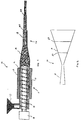
- Fig. 1 an extrusion device 10 comprising an extruder 11 and a die 12 according to the invention.
- the extruder 11 has a raw material hopper 13 for charging the raw material and a cylinder body 14 having a screw 15 of conventional type provided therein, said screw being rotatable around its longitudinal axis and being driven by an electric or hydraulic motor 16 having variable rotation speed.
- the raw material in the form of precompounded pellets of PE and EVOH with addition of compatibilizer is charged into the hopper 13 and falls down into the cylinder body 14 which is heated with external heating radiators or heating coils 17.
- the raw material is heated by the heating coils 17 and distributed by friction during transport forwards through the cylinder body 14 by the rotating screw 15.
- the polymer blend reaches the die 12 it is a melt which by means of the screw is injected into the die.
- EVOH and PE are incompatible polymers and the melted polymer blend consists of a PE matrix wherein an EVOH phase is dispersed in the form of droplets.
- the size of the EVOH spheres is determined by the blending extruder and the compounding device i.e. the extruder, the surface tensions in the interfaces and the reological properties of the components. Coalescence as well as dispersion occurs and the EVOH spheres obtain an equilibrium size.
- the size of the spheres may be affected by the addition of compatibilizers and/or the effect of shear forces. Since the lamellar and fibrillar morphologies are not equilibrium structures they are very dependent on the processing parameters. Also a homogenous blend can phase separate if for instance the temperature is changed.
- a compatibilizer makes the blend more stable to morphological changes between processing devices/steps such as screw, die, drawdown, etc. Thus the compatibilizers prevent the loss of a created and desirable morphology when the blend passes through a processing device/step having low or undesirable shear forces, for example from compounding to extruder or from die to drawdown.
- the die 12 comprises a first, converging section 18 having a form which is mainly frusto conical and has a circular cross section.
- the end of the converging section 18 having the largest diameter is connected to the extruder 11 and the other end transfers directly into another diverging section 19, the transition from the first section 18 to the second section 19 occuring via a transition area having a cross section which gradually changes from circular to substantially rectangular.
- the die 12 is also provided with heating coils.
- the dispersed EVOH droplets further coalescence, larger aggregates of droplets being formed at the same time as they are stretched in the flow direction.
- the die 12 according to the invention it is very important that shear is avoided and that the EVOH droplets substantially only are subjected to stretching.
- all inner surfaces of the die are very smooth and even, and the inner surfaces may therefore be coated by a material having low friction, e.g. Teflon®.
- the diverging section 19 is continuously broadened in the flow direction and has continuously or stepwise decreasing thickness in a plane perpendicular to the flow direction such that a converging as well as a diverging flow is obtained.
- a biaxial stretching of the polymer material therefore occurs, the elongated dispersed droplets being broadened in a direction perpendicular to but within the same plane as the flow direction under the formation of large thin layers or lamellas, at the same time as they are further lengthened in the flow direction in order to achieve a laminar structure having overlapping layers of EVOH within the PE matrix.
- the EVOH droplets are subjected to a biaxial stretching, i.e.
- the coalesced EVOH droplets are stretched within the plane of the die in the flow direction as well as in a plane perpendicular to the flow direction.
- the formed lamellas all have different sizes and shapes but are large enough to be overlapping each other, whereby an EVOH layer having very low oxygen permeability is achieved within the PE matrix.
- stepwise transitions 20 to lower hight are very even and preferably occurs with an angle of approximately 30-60°, preferably about 45°.
- LDPE Low Density Polyethylene
- compatibiliser of maleic acid anhydride or acrylic acid in varying concentrations were precompounded and blended in granular form in an extruder.
- the granules from the different materials were melted at high shear rates by a combination of a dispersive and distributing blending method.
- a film having a thickness of 50 ⁇ m was extruded and samples were analysed with respect to the oxygen barrier properties.
Landscapes
- Engineering & Computer Science (AREA)
- Mechanical Engineering (AREA)
- Manufacturing & Machinery (AREA)
- Extrusion Moulding Of Plastics Or The Like (AREA)
Abstract
Description
Claims (6)
- Die (12) for extruding a melt of a polymer blend comprising droplets from a first polymer phase dispersed in a polymer matrix, which is incompatible with said first polymer phase, said die (12) comprising a conical converging section (18) prolonging the dispersed droplets in the flow direction and a diverging section (19) broadening said dispersed droplets in a direction perpendicular to but within the same plane as the flow direction, charact erized in that the conical converging section (18) is connected directly to the diverging section (19), which in the flow direction has a decreasing thickness in a plane perpendicular to the flow direction in order to achieve a biaxial stretching of the polymer material and thus a laminar structure having overlapping layers of said first polymer phase dispersed in said polymer matrix.
- Die according to claim 1, characterized in that the diverging section (19) comprises at least two, preferably three, portions which in the flow direction have stepwise decreasing thickness in a plane perpendicular to the flow direction.
- Die according to claim 1, characterized in that the diverging section in the flow direction has a continuously decreasing thickness in a plane perpendicular to the flow direction.
- Die according to claim 2 or 3, characterized in that the conical converging section has a substantially circular cross section.
- Die according to claim 4, characterized in that the diverging section (19) has a substantially rectangular cross section.
- Die according to claim 5, characterized in that the inner surfaces of the die (12) are very even and preferably coated with an antifriction material.
Applications Claiming Priority (2)
| Application Number | Priority Date | Filing Date | Title |
|---|---|---|---|
| SE9701831A SE9701831L (en) | 1997-05-16 | 1997-05-16 | Film extrusion nozzle |
| SE9701831 | 1997-05-16 |
Publications (2)
| Publication Number | Publication Date |
|---|---|
| EP0878286A1 true EP0878286A1 (en) | 1998-11-18 |
| EP0878286B1 EP0878286B1 (en) | 2001-12-19 |
Family
ID=20406967
Family Applications (1)
| Application Number | Title | Priority Date | Filing Date |
|---|---|---|---|
| EP98201456A Expired - Lifetime EP0878286B1 (en) | 1997-05-16 | 1998-05-07 | Die for film extrusion |
Country Status (4)
| Country | Link |
|---|---|
| EP (1) | EP0878286B1 (en) |
| JP (1) | JPH1158492A (en) |
| DE (1) | DE69802999T2 (en) |
| SE (1) | SE9701831L (en) |
Cited By (2)
| Publication number | Priority date | Publication date | Assignee | Title |
|---|---|---|---|---|
| WO2010049080A1 (en) * | 2008-10-29 | 2010-05-06 | Bayer Materialscience Ag | Extrusion nozzle for polymers |
| CN106830117A (en) * | 2017-02-21 | 2017-06-13 | 武汉都市环保工程技术股份有限公司 | Underground water stratified sampling and layering prosthetic device |
Citations (5)
| Publication number | Priority date | Publication date | Assignee | Title |
|---|---|---|---|---|
| GB918910A (en) * | 1960-12-07 | 1963-02-20 | Goodrich Co B F | Methods and apparatus for making elongated magnets |
| GB926566A (en) * | 1958-09-09 | 1963-05-22 | Gore & Ass | Extruding fluorocarbons |
| US3267518A (en) * | 1961-02-09 | 1966-08-23 | Great Lakes Carbon Corp | Apparatus for making carbon electrodes or neutronic reactor core bars |
| US3788613A (en) * | 1971-04-03 | 1974-01-29 | Profiltex Sa | Apparatus for the extrusion of synthetic thermoplastic materials |
| WO1992006837A1 (en) * | 1990-10-16 | 1992-04-30 | The Royal Institution For The Advancement Of Learning | Laminar extrusion with evoh phase dispersed in pp or mapp matrix phase, and process and die unit for producing the same |
-
1997
- 1997-05-16 SE SE9701831A patent/SE9701831L/en not_active IP Right Cessation
-
1998
- 1998-05-07 EP EP98201456A patent/EP0878286B1/en not_active Expired - Lifetime
- 1998-05-07 DE DE69802999T patent/DE69802999T2/en not_active Expired - Fee Related
- 1998-05-18 JP JP10135534A patent/JPH1158492A/en not_active Ceased
Patent Citations (5)
| Publication number | Priority date | Publication date | Assignee | Title |
|---|---|---|---|---|
| GB926566A (en) * | 1958-09-09 | 1963-05-22 | Gore & Ass | Extruding fluorocarbons |
| GB918910A (en) * | 1960-12-07 | 1963-02-20 | Goodrich Co B F | Methods and apparatus for making elongated magnets |
| US3267518A (en) * | 1961-02-09 | 1966-08-23 | Great Lakes Carbon Corp | Apparatus for making carbon electrodes or neutronic reactor core bars |
| US3788613A (en) * | 1971-04-03 | 1974-01-29 | Profiltex Sa | Apparatus for the extrusion of synthetic thermoplastic materials |
| WO1992006837A1 (en) * | 1990-10-16 | 1992-04-30 | The Royal Institution For The Advancement Of Learning | Laminar extrusion with evoh phase dispersed in pp or mapp matrix phase, and process and die unit for producing the same |
Cited By (4)
| Publication number | Priority date | Publication date | Assignee | Title |
|---|---|---|---|---|
| WO2010049080A1 (en) * | 2008-10-29 | 2010-05-06 | Bayer Materialscience Ag | Extrusion nozzle for polymers |
| CN102202852B (en) * | 2008-10-29 | 2014-11-05 | 拜尔材料科学股份公司 | Extrusion nozzle for polymers |
| CN106830117A (en) * | 2017-02-21 | 2017-06-13 | 武汉都市环保工程技术股份有限公司 | Underground water stratified sampling and layering prosthetic device |
| CN106830117B (en) * | 2017-02-21 | 2023-02-28 | 中冶南方都市环保工程技术股份有限公司 | Underground water layered sampling and layered repairing device |
Also Published As
| Publication number | Publication date |
|---|---|
| DE69802999D1 (en) | 2002-01-31 |
| EP0878286B1 (en) | 2001-12-19 |
| SE9701831D0 (en) | 1997-05-16 |
| SE507181C2 (en) | 1998-04-20 |
| JPH1158492A (en) | 1999-03-02 |
| SE9701831L (en) | 1998-04-20 |
| DE69802999T2 (en) | 2002-06-20 |
Similar Documents
| Publication | Publication Date | Title |
|---|---|---|
| AU2005334397B2 (en) | Counter-rotating twin screw extruder | |
| Jang et al. | Oxygen barrier properties of biaxially oriented polypropylene/polyvinyl alcohol blend films | |
| KR100365710B1 (en) | Deformation Method of Polyethylene in Extruder | |
| US4622193A (en) | Method for making free flowing coated rubber pellets | |
| AU2009228817A1 (en) | Method for producing a phase-change material composition | |
| US6770340B2 (en) | Chaotic mixing method and structured materials formed therefrom | |
| CN101291788B (en) | Method for producing thermoplastic resin microporous film | |
| JPH09183198A (en) | Heat-shrinkable coextruded multi-layer polyolefin film with improved seal heat resistance | |
| US4803035A (en) | Method for making composite films | |
| WO1996006720A1 (en) | Filler reinforced thermoplastic composites having biaxially oriented components | |
| US6649103B1 (en) | Process for making multiphase polymeric film having a lamellar structure with controlled permeability and/or controlled mechanical properties | |
| EP2631060A1 (en) | A low-pressure process for preparing a polymer film by extrusion-blowing | |
| US5188784A (en) | Process for laminar pollymer extrusion | |
| JPS6198736A (en) | Production of flowable coated rubber pellet and pellet composition | |
| EP0878286A1 (en) | Die for film extrusion | |
| CA2102365A1 (en) | Lldpe composite film free of melt fracture | |
| EP2873685A1 (en) | Direct feeding of carbon black in the production of black compounds for pipe and wire and cable applications / Polymer composition with improved properties for pressure pipe applications | |
| Kulås et al. | PVC powder extrusion. Melting properties and particle morphology | |
| US4822545A (en) | Method for making free-flowing coated rubber pellets | |
| BE1003639A3 (en) | Plastic mass based on polyolefin and particulate mineral charge and multilayer structures made from that mass. | |
| US4970118A (en) | Method for making free-flowing coated rubber pellets | |
| CA2307083C (en) | Process for making multiphase polymeric film having a lamellar structure with controlled permeability and/or controlled mechanical properties | |
| CA2229273A1 (en) | Polymer segregation process | |
| EP1272557A1 (en) | Micro-composite polymer/polymer materials with semicrystalline dispersed phase and preparation method | |
| CN110240781A (en) | A kind of high flowing low-k polyether-ether-ketone composite material and preparation method thereof |
Legal Events
| Date | Code | Title | Description |
|---|---|---|---|
| PUAI | Public reference made under article 153(3) epc to a published international application that has entered the european phase |
Free format text: ORIGINAL CODE: 0009012 |
|
| AK | Designated contracting states |
Kind code of ref document: A1 Designated state(s): BE DE ES FR GB IT NL |
|
| AX | Request for extension of the european patent |
Free format text: AL;LT;LV;MK;RO;SI |
|
| 17P | Request for examination filed |
Effective date: 19990414 |
|
| AKX | Designation fees paid |
Free format text: BE DE ES FR GB IT NL |
|
| 17Q | First examination report despatched |
Effective date: 20000822 |
|
| GRAG | Despatch of communication of intention to grant |
Free format text: ORIGINAL CODE: EPIDOS AGRA |
|
| GRAG | Despatch of communication of intention to grant |
Free format text: ORIGINAL CODE: EPIDOS AGRA |
|
| GRAH | Despatch of communication of intention to grant a patent |
Free format text: ORIGINAL CODE: EPIDOS IGRA |
|
| GRAH | Despatch of communication of intention to grant a patent |
Free format text: ORIGINAL CODE: EPIDOS IGRA |
|
| GRAA | (expected) grant |
Free format text: ORIGINAL CODE: 0009210 |
|
| AK | Designated contracting states |
Kind code of ref document: B1 Designated state(s): BE DE ES FR GB IT NL |
|
| PG25 | Lapsed in a contracting state [announced via postgrant information from national office to epo] |
Ref country code: NL Free format text: LAPSE BECAUSE OF FAILURE TO SUBMIT A TRANSLATION OF THE DESCRIPTION OR TO PAY THE FEE WITHIN THE PRESCRIBED TIME-LIMIT Effective date: 20011219 Ref country code: BE Free format text: LAPSE BECAUSE OF FAILURE TO SUBMIT A TRANSLATION OF THE DESCRIPTION OR TO PAY THE FEE WITHIN THE PRESCRIBED TIME-LIMIT Effective date: 20011219 |
|
| REG | Reference to a national code |
Ref country code: GB Ref legal event code: IF02 |
|
| REF | Corresponds to: |
Ref document number: 69802999 Country of ref document: DE Date of ref document: 20020131 |
|
| PGFP | Annual fee paid to national office [announced via postgrant information from national office to epo] |
Ref country code: GB Payment date: 20020501 Year of fee payment: 5 |
|
| ET | Fr: translation filed | ||
| NLV1 | Nl: lapsed or annulled due to failure to fulfill the requirements of art. 29p and 29m of the patents act | ||
| PG25 | Lapsed in a contracting state [announced via postgrant information from national office to epo] |
Ref country code: ES Free format text: LAPSE BECAUSE OF FAILURE TO SUBMIT A TRANSLATION OF THE DESCRIPTION OR TO PAY THE FEE WITHIN THE PRESCRIBED TIME-LIMIT Effective date: 20020627 |
|
| PLBE | No opposition filed within time limit |
Free format text: ORIGINAL CODE: 0009261 |
|
| STAA | Information on the status of an ep patent application or granted ep patent |
Free format text: STATUS: NO OPPOSITION FILED WITHIN TIME LIMIT |
|
| 26N | No opposition filed | ||
| PG25 | Lapsed in a contracting state [announced via postgrant information from national office to epo] |
Ref country code: GB Free format text: LAPSE BECAUSE OF NON-PAYMENT OF DUE FEES Effective date: 20030507 |
|
| NLV1 | Nl: lapsed or annulled due to failure to fulfill the requirements of art. 29p and 29m of the patents act | ||
| GBPC | Gb: european patent ceased through non-payment of renewal fee |
Effective date: 20030507 |
|
| PGFP | Annual fee paid to national office [announced via postgrant information from national office to epo] |
Ref country code: IT Payment date: 20090527 Year of fee payment: 12 Ref country code: FR Payment date: 20090518 Year of fee payment: 12 Ref country code: DE Payment date: 20090528 Year of fee payment: 12 |
|
| REG | Reference to a national code |
Ref country code: FR Ref legal event code: ST Effective date: 20110131 |
|
| PG25 | Lapsed in a contracting state [announced via postgrant information from national office to epo] |
Ref country code: IT Free format text: LAPSE BECAUSE OF NON-PAYMENT OF DUE FEES Effective date: 20100507 |
|
| PG25 | Lapsed in a contracting state [announced via postgrant information from national office to epo] |
Ref country code: DE Free format text: LAPSE BECAUSE OF NON-PAYMENT OF DUE FEES Effective date: 20101201 |
|
| PG25 | Lapsed in a contracting state [announced via postgrant information from national office to epo] |
Ref country code: FR Free format text: LAPSE BECAUSE OF NON-PAYMENT OF DUE FEES Effective date: 20100531 |