EP0878771A2 - Programmierbare Kartierung von digitalen Daten mit niedriger Auflösung auf einem Ausgangsgerät mit hoher Auflösung - Google Patents
Programmierbare Kartierung von digitalen Daten mit niedriger Auflösung auf einem Ausgangsgerät mit hoher Auflösung Download PDFInfo
- Publication number
- EP0878771A2 EP0878771A2 EP98105543A EP98105543A EP0878771A2 EP 0878771 A2 EP0878771 A2 EP 0878771A2 EP 98105543 A EP98105543 A EP 98105543A EP 98105543 A EP98105543 A EP 98105543A EP 0878771 A2 EP0878771 A2 EP 0878771A2
- Authority
- EP
- European Patent Office
- Prior art keywords
- pixel
- data
- resolution format
- higher resolution
- synthesis template
- Prior art date
- Legal status (The legal status is an assumption and is not a legal conclusion. Google has not performed a legal analysis and makes no representation as to the accuracy of the status listed.)
- Withdrawn
Links
Images


Classifications
-
- G—PHYSICS
- G06—COMPUTING OR CALCULATING; COUNTING
- G06K—GRAPHICAL DATA READING; PRESENTATION OF DATA; RECORD CARRIERS; HANDLING RECORD CARRIERS
- G06K15/00—Arrangements for producing a permanent visual presentation of the output data, e.g. computer output printers
- G06K15/02—Arrangements for producing a permanent visual presentation of the output data, e.g. computer output printers using printers
-
- G—PHYSICS
- G06—COMPUTING OR CALCULATING; COUNTING
- G06K—GRAPHICAL DATA READING; PRESENTATION OF DATA; RECORD CARRIERS; HANDLING RECORD CARRIERS
- G06K15/00—Arrangements for producing a permanent visual presentation of the output data, e.g. computer output printers
- G06K15/02—Arrangements for producing a permanent visual presentation of the output data, e.g. computer output printers using printers
- G06K15/18—Conditioning data for presenting it to the physical printing elements
- G06K15/1867—Post-processing of the composed and rasterized print image
- G06K15/1872—Image enhancement
- G06K15/1873—Increasing spatial resolution; Anti-aliasing
- G06K15/1874—Increasing spatial resolution; Anti-aliasing with provisions for treating some of the print data differently
-
- G—PHYSICS
- G06—COMPUTING OR CALCULATING; COUNTING
- G06K—GRAPHICAL DATA READING; PRESENTATION OF DATA; RECORD CARRIERS; HANDLING RECORD CARRIERS
- G06K2215/00—Arrangements for producing a permanent visual presentation of the output data
- G06K2215/0002—Handling the output data
- G06K2215/0062—Handling the output data combining generic and host data, e.g. filling a raster
- G06K2215/0071—Post-treatment of the composed image, e.g. compression, rotation
Definitions
- This invention relates in general to imaging systems and print resolution enhancement and, more particularly, to mapping of lower resolution digital data to a higher resolution print engine.
- Electrophotographic processes for producing a permanent image on media are well known and commonly used.
- a common process includes: (1) charging a photoreceptor such as a roller or continuous belt bearing a photoconductive material; (2) exposing the charged area to a light image to produce an electrostatic charge on the area in the shape of the image; (3) presenting developer particles (toner) to the photoreceptor surface bearing the image so that the particles are transferred to the surface in the shape of the image; (4) transferring the particles in the shape of the image from the photoreceptor to the media; (5) fusing or fixing the particles in the shape of the image to the media; and (6) cleaning or restoring the photoreceptor for the next printing cycle.
- Many image forming apparatus such as laser printers, copy machines, and facsimile machines, utilize this well known electrophotographic printing process.
- an image is typically rasterized to form a bit pattern which is stored as a binary image bitmap for subsequent rendering to a final output image.
- the image bitmap is also referred to as a picture element ("pixel") raster image.
- graphic elements such as continuous lines (line art) and text character outlines are converted to pixel patterns that approximate the source image shape.
- Continuous tone data such as photographic data (both color and gray value images) are also converted to pixel patterns that approximate the source continuous tone image data.
- each pixel of the source image must be represented by multiple bits which define either a color or a gray level and which are subsequently converted, typically, to a binary image bitmap.
- gray when used, it applies to both color and black/white images and, when applied to a color image, relates to the intensity of the color.
- the pixel data in order to represent gray level images on a bi-level (black and white) printer, is converted into a gray level, multi-bit configuration.
- a gray level, multi-bit configuration For example, when a multi-bit configuration of 8 bits per pixel is employed, 256 gray levels can be represented by the digital pixel values.
- the individual gray level pixels are converted to binary level pixels (i.e., bi-level data for subsequent rendering) through the use of a dithering process.
- Spatial dithering or digital halftoning is the converting of the multi-bit pixel values (of a source image) to fixed-size, binary, multi-pixel groupings that approximate the average gray value of the corresponding source data.
- This dithering process provides a halftone texture to selected areas of the image so as to provide gray value variations therein.
- a 6 x 6 multi-pixel grouping can, in theory, simulate 36 levels of gray, and an 8 x 8 grouping can simulate 64 levels.
- the dithering process employs a comparison of the individual pixel values (specified by a source image intensity array) against a threshold matrix (dither matrix or device best threshold array) to control the conversion of the gray level values to appropriate patterns of bi-level data.
- a gray level value of 255 in a source image is considered to be "white", and a gray level value of 0 is "black”.
- the threshold matrix comprises a plurality of row-arranged gray level values which control the conversion of the gray level pixel values to bi-level pixel values which are stored in a resultant page buffer array (raster) bitmap.
- the threshold matrix is tiled across the image pixels to enable each gray level image pixel to be compared against the correspondingly, logically-positioned gray level value of the threshold matrix.
- each entry in the threshold matrix is a threshold gray level value which, if exceeded by the source image gray level pixel value, causes that gray level image pixel to be converted to a "white” pixel (or a binary logical “zero”). If, by contrast, the source image gray level pixel value is less than or equal to the corresponding threshold matrix gray level value, it is converted to a "black” pixel (or a binary logical "one").
- the modulated laser beam causes some pixel areas to be exposed to a light pulse and some not, thus causing a pattern of overlapping dots on each scan line.
- a pixel area dot
- the photosensitive drum is discharged, so that when it is subsequently toned, the toner adheres to the discharged areas and is repelled by the still charged areas.
- the toner that is adhered to the discharged areas is then transferred to paper and fixed in a known manner.
- the fidelity of the output image relative to the source data is directly related to the resolution of pixels (dots) in the output image.
- Arbitrary analog images cannot be exactly reproduced by a bitmap raster unless an infinite resolution is used.
- image edges that are either not parallel to the raster scan direction or not perpendicular to it appear stepped. This is especially noted in text and line art.
- enhancement techniques include: edge smoothing, fine line broadening, antialiasing (to smooth jagged edges), and increasing the resolution of the laser printer.
- These enhancing techniques typically modify the signals to the laser to produce smaller dots that are usually offset from the pixel center, or in other words, to produce gray scale dots.
- most of the enhancing techniques operate on the data after it has already been rasterized, and hence after the fine detail has already been lost.
- most enhancing techniques employ interpolation methods upon the raster data to "best" render the image.
- most enhancing techniques attempt to increase the virtual resolution of the image beyond the actual resolution of the print engine.
- Tung discloses a character generator that produces a bitmap of image data and inputs that bitmap into a first-in first-out (FIFO) data buffer.
- FIFO first-in first-out
- a fixed subset of the buffer stored bits forms a sampling window through which a selected block of the bitmap image data may be viewed (for example, a 9 x 9 block of pixels with the edge pixels truncated).
- the sampling window contains a center bit cell which changes on each shift of the image bits through the FIFO buffer.
- the sampling window views successive bit patterns formed by pixels located at the window's center bit cell and its surrounding neighbor bit cells.
- Each bit pattern formed by the center bit and its neighboring bits is compared in a matching network with prestored templates. If a match occurs, indicating that the center bit resides at an image edge and that the pixel it represents can be altered so as to improve the image's resolution, a modulation signal is generated that causes the laser beam to alter the center pixel configuration.
- the center pixel is made smaller than a standard unmodified bitmap pixel and is possibly moved within the confines of the pixel cell.
- RET Resolution Enhancement Technology
- conventional resolution enhancement techniques generally require more digital data of higher resolution to achieve the enhancement desired than what the printer resolution is actually capable of (for example, in RET, pixel size alteration is carried out by modulating the laser).
- a higher resolution print engine receives source image data that is lower in resolution than what the print engine is actually capable of, scaling must occur to map the lower resolution data to the higher resolution print engine.
- Conventional scaling is typically accomplished with a straight forward, block mapping technique. For example, a single 300 dot per inch (dpi) pixel that is to be scaled up to 600 dpi resolution is mapped directly to a block of four 600 dpi pixels (two horizontal pixels and two vertical).
- image integrity may in fact diminish at the 600 dpi level if 300 dpi data is scaled in a conventional manner to fit. This is unacceptable for many of today's printing standards.
- it is advantageous to work with lower resolution source data rather than higher resolution source data from a data processing perspective. Specifically, it is much less time consuming (less data to be processed) and cheaper (less hardware or memory intensive) to work with lower resolution data than higher resolution data.
- an object of the present invention is to improve resolution enhancement when processing lower resolution source data with a higher resolution print engine.
- lower resolution format data (30) is synthesized (34) to a higher resolution format (126) for rendering on a higher resolution output device (14) by selecting and using a synthesis template (34, 126) that represents a configuration of a plurality of pixel data in the higher resolution format into which the lower resolution format data is to be synthesized.
- a working or active pixel (130) is identified from the lower resolution format data, a synthesis template is selected (126), and then a subset of the synthesis template pixel data is substituted for the working pixel for rendering on the output device in the higher resolution format for a current scan pass.
- the working pixel is identified in the lower resolution data by recognizing a configuration of a plurality of pixel data adjacent the working pixel, such as with RET (124).
- the synthesis template comprises at least a two by two cell matrix (126) for pixel placement in the higher resolution format.
- the synthesis template pixel placement is formed to provide an apparent merge of the pixel data in the higher resolution format with the adjacent pixel data of the lower resolution format data.
- the synthesis template pixel placement is achieved through empirical evaluations of template comparisons with exemplary data generated to mimic a pixel configuration of the working pixel and adjacent pixel data of the lower resolution format data.
- the same synthesis template may, optionally, be used at varying levels of rendering, such as for each working pixel evaluated to be synthesized and rendered, for each page strip, or for each page of data to be rendered.
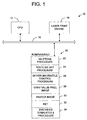
- FIG. 1 is a block diagram of a laser printer incorporating the invention hereof.
- FIGs. 2A-P depict exemplary synthesis templates.
- FIG. 3 is a block diagram depicting synthesis template matching of the present invention in a laser printer rendering process.
- FIG. 4 is a flow chart depicting a preferred method of the present invention.
- FIG. 1 is a block diagram of a laser printer 10 that incorporates the invention hereof for enhanced rendering of a lower resolution format source image on a higher resolution print engine.
- Selected pixel data of the lower resolution format source image is "synthesized" to the higher resolution format of the print engine or, alternatively, to an intermediate resolution format and then subsequently to the higher resolution format of the print engine.
- a laser printer will be hereafter described, the invention is equally applicable to any device which renders pixel data. More specifically, such devices include laser printers, copiers, facsimile devices, plotters, inkjet based devices, display monitors, etc.
- the invention is equally applicable with respect to binary or multi-bit pixel data.
- Laser printer 10 comprises a central processing unit (CPU) 12 and a laser print engine 14, interconnected via a bus 16.
- a read only memory (ROM) and/or random access memory (RAM) and/or application-specific integrated circuit (ASIC) 20 is/are also interconnected to bus 16.
- ROM/RAM/ASIC 20 is shown as a single block unit although as is well known in the art they are generally separate units for providing specific functionalities. It is also to be understood that the rasterizing, synthesizing and rendering procedures and data discussed herein for printer 10 may be maintained and utilized as control firmware in any conventional ROM, and/or implemented in an ASIC for high-speed hardware functionality, and/or implemented in connection with RAM for storage and buffering purposes.
- ROM/RAM/ASIC 20 includes procedures and data necessary to enable CPU 12 to carry out the rasterizing, synthesizing and rendering functions of the invention. More specifically, ROM/RAM/ASIC 20 includes halftone procedure 22, text and line art procedure 24, dither matrix and tile control subprocedure 26, and a gray value pixel image 28 which is to be altered into a raster image 30, suitable for rendering by laser print engine 14. Gray value pixel image 28 is received from a host processor (not shown). Halftone raster image 30 may be buffered in RAM or fed directly from an ASIC to print engine 14. Resolution enhancement technology (RET) procedure 32 provides edge smoothing for text and line art stored within raster image 30 upon final rendering. Synthesis templates and procedure 34 assist in providing some of the novel aspects of the present invention as discussed more fully herein.
- RET resolution enhancement technology
- Gray value pixel image 28 is of the known type wherein each pixel is represented by a multi-bit gray value. If gray value pixel image 28 is a color image, it will comprise (generally) four color planes with three of the color planes representing cyan, magenta and yellow color values (or red, green and blue color planes). Moreover, each color value in each plane may be represented by a predetermined number of bits -- for example, by 8 bits. A fourth plane, representing black, may be comprised of single or multiple bit values at each pixel location where a black or gray scale image value is to appear on the ultimate rendered output. Thus there may be a total of 25 to 32 bits per pixel in gray value pixel image 28 if color is embodied.
- gray value pixel image 28 is a non-color image
- each pixel may, for example, be represented simply by 8 bits to depict 256 levels of gray as well known in the art.
- Other bit depths and color planes, such as in hi-fi printing, are equally applicable in the present invention, as will be obvious to those of ordinary skill in the art.
- the object of halftone procedure 22 (along with dither matrix/tile control subprocedure 26) is to convert any continuous tone image within gray value pixel image 28 into a halftoned raster image 30.
- Text/line art procedure 24 also converts any text and line art images within gray value pixel image 28 into raster image 30. These may be conventional procedures known in the art.
- Laser print engine 14 is capable of rendering raster image 30 at a given dpi (dot per inch) resolution, such as at 300, 600 or 1200 dpi, depending on design criteria.
- print engine 14 is a 1200 dpi engine.
- raster image 30 is received and stored at a resolution format that is lower than the higher resolution format of print engine 14.
- image 30 may be stored at 300 or 600 dpi and yet be rendered at 1200 dpi on engine 14 with improved resolution over conventional scaling techniques.
- This resolution improvement is accomplished by using synthesis templates 34 to synthesize selected pixels of the lower resolution format into a configuration of a plurality of pixels in the higher resolution format of engine 14.
- This feature provides higher resolution quality as capable by the higher resolution print engine 14, yet allows raster image data 30 to be stored at the lower resolution format for significant savings in both memory consumption and processing requirements.
- synthesis templates refers to stored configurations of pixel data and/or algorithms capable of representing the same.
- Synthesis templates 34 define a plurality of unique templates wherein each template represents a configuration of a plurality of pixel data in the higher resolution format into which selected pixels of the lower resolution format image data 30 are to be "synthesized".
- each template represents a configuration of a plurality of pixel data in an intermediate resolution format, i.e., a resolution format that is higher than the lower resolution format but not necessarily as high as the higher resolution format of the output device (print engine 14).
- “synthesizing” means converting a lower resolution pixel into a unique configuration of a plurality of higher resolution format pixels. This unique configuration represents a "best fit” or “improved” visual identical over the selected pixel with respect to the selected pixel's adjacent pixel data.
- an apparent merge of the lower resolution pixel data with the plurality of pixels in the higher resolution format is provided such that the overall image appears visually more pleasing and/or perceptually indistinguishable from the higher resolution format.
- the synthesis templates pixel placement i.e., "best fit” or "visual identity" is achieved through empirical evaluations of template comparisons with exemplary data generated to mimic a pixel configuration of the working pixel and adjacent pixel data of the lower resolution format data.
- the empirical evaluations are tuned by psychometric evaluations and/or by artificial intellegence training programs (algorithms) to create the improved visual identity with the higher resolution rendering.
- the templates are formed and stored 34 (i.e., in ROM/RAM/ASIC 20 of FIG. 1) prior to synthesizing or rendering.
- FIGs 2A-P depict the 16 different exemplary synthesis templates for a two-by-two cell matrix representation for pixel placement in the higher resolution format.
- FIG. 2A depicts a two-by-two matrix with no pixels therein.
- FIGs. 2B-2P depict all the placement variations for pixels 90 therein. Although a two-by-two matrix is shown, it is obvious that other sizes are equally applicable.
- the size of the template cell matrix used is determined by the amount of increase in resolution that is to occur relative to the lower resolution image data 30 and the higher resolution print engine 14. Namely, for example, if 600 dpi resolution image data is being rendered on a 1200 dpi engine, then the increase in resolution is a factor of two and, thus, the two-by-two cell matrix synthesis templates of FIGs.
- 2A-P are used (or any subset of them).
- the increase in resolution is a factor of four and, thus, four-by-four cell matrix synthesis templates (not shown) are used.
- selected pixel data is synthesized multiple times. For example, two synthesis processes utilizing two-by-two cell matrix templates can be cascaded together to effectuate an intermediate synthesis from 300 dpi to 600 dpi, and then a final synthesis from 600 dpi to 1200 dpi. In this cascading scenario, rendering only occurs after the final synthesis step is completed.
- the number of different pixel configurations for any given template is c 2 , where c is the number of cells in the template matrix.
- FIG. 3 is a block diagram of register array 120 (evaluation window), raster image array 122, RET template match 124, and synthesis template match 126 of laser printer 10. These further describe the system and method of synthesizing lower resolution data for rendering at a higher resolution format according to the present invention.
- Register array 120 is a 5x5 array (for this example) and receives data in a conventional manner from raster image/page buffer array 122 through five line 600 dpi buffers 128.
- Center bit cell 130 is marked with an "X" to show the active/working cell/pixel for which rendering occurs as data is serially shifted through register array 120.
- Working pixel 130 is RET template matched 124 against previously stored RET templates by known methods (such as described in U.S. Patent No. 4,847,641). If a RET match occurs, the working pixel 130 is synthesized using synthesis template matching 126 under principles of the present invention. In essence, working pixel 130 is identified in the lower resolution data as a candidate for synthesizing by recognizing a configuration of a plurality of pixel data 132 adjacent the working pixel (i.e., the RET template match). Consequently, a synthesis template is selected 126 into which working pixel 130 is synthesized.
- a two-by-two cell synthesis template 126 is used for a conversion of the 600 dpi working pixel 130 to 1200 dpi of printer 14. If pixel 130 was 300 dpi and printer 14 was 1200 dpi, then synthesis template 126 would be a four-by-four cell template, or two synthesis processes utilizing the two-by-two cell matrix template 126 can be cascaded together to effectuate the synthesis from 300 dpi to 600 dpi and then from 600 dpi to 1200 dpi.
- the synthesis template may be dynamically selected for each working pixel identified. For example, if the working pixel was previously identified as text/line art data or as halftone data, the synthesis template may be dynamically selected to best fit the text, line art or halftone data. On the other hand, the synthesis template may be previously selected and defined for use at a page strip level, page level, or some other defined level of rendering, depending upon processing and system configurations/restrictions. In any case, this synthesis template selection feature provides a dynamic (or programmable) feature for the mapping of lower resolution data for rendering on a higher resolution output device.
- synthesis template that template configuration of pixel data in the higher resolution format is substituted for the working pixel for rendering on the output device (print engine 14). More precisely, though, a subset of the synthesis template pixel data is substituted for the working pixel for rendering on the output device for each scan pass of engine 14. This is because the template pixel data matches the higher resolution format of print engine 14 and, as such, each row of template pixel data correlates to a scan line of the higher resolution print engine. This is denoted in FIG. 3 by the dashed directional line labeled "First Pass" emanating from working pixel 130 of RET template match 124 and directed toward the first row of pixel data of synthesis template match 126.
- directional line labeled "Second Pass” emanates from working pixel 130 of RET template match 124 and is directed toward the second row of pixel data of synthesis template match 126. Consequently, each row of the synthesis template pixel data is rendered upon a different scan pass by print engine 14.
- each pixel of the scan line of data is processed and rendered such that any working pixel identified to be synthesized has only its first row of synthesis template data rendered.
- each working pixel 130 identified to be synthesized is rendered by rendering only the second row of data identified from the synthesis template match 126.
- FIG. 4 is a flow diagram demonstrating a preferred method of the present invention.
- a scan line of lower resolution format pixel data is identified for rendering processing. This "identification” occurs either by copying the data from page buffer array 122 into register array 120 (FIG. 3), or by recognizing that the data is already in register array 120. If register array 120 does not hold a full scan line of pixel data, a counting mechanism is used to count the pixel data as it is processed. To this regard, "identification" of the scan line of pixel data for step 210 may be a virtual aspect.
- the resolution-increase is that factor by which the lower resolution data working pixel is to be synthesized to the higher resolution of the output device (printer engine 14). Namely, the resolution-increase factor is two for synthesizing from 600 dpi to 1200 dpi, and the factor is four for 300 dpi to 1200 dpi.
- a working (active) pixel is selected 215 from the scan line of pixel data (as the data is serially shifted through register array 120). It must then be determined whether the working pixel is to be synthesized 220 into the higher resolution format of the output device.
- the working pixel is identified for synthesis in connection with a RET template match 124 (FIG. 3). This also enables the synthesizing to provide an apparent merge ("best fit" or "visual identity") of the pixel data in the higher resolution format synthesis template 126 with the pixel data 132 that is adjacent the working pixel 130 in the lower resolution format data.
- the synthesis template may be a previously selected template (i.e., relative to a page strip or page of data) or it may be uniquely selected for each working pixel identified. In any case, the synthesis template represents a configuration of a plurality of pixel data in the higher resolution format of print engine 14 into which the working pixel is to be synthesized.
- the synthesis template is selected 230, it is then substituted 235 for the working pixel for rendering purposes. This is accomplished by rendering only the row 240 (or subset) of pixel data in the synthesis template that correlates to the current count of the resolution-increase counter. For example, if the first scan pass is in process relative to the identified scan line of pixel data (and resolution-increase counter is "one"), then the first row of the synthesis template pixel data is rendered. In this manner, a single row of pixel data in the synthesis template will be rendered upon each scan pass of print engine 14, and each row that is rendered correlates to the current count identified by the resolution-increase counter for rendering the working pixel.
- control returns to select a next working pixel 215 to continue rendering of the scan line.
- the resolution-increase counter is incremented 247 to enable rendering of the next row of the synthesis template(s) upon the next scan pass.
- 250 if the resolution-increase counter is not greater than the resolution-increase factor 250 (or in other words, if all rows of the synthesis template(s) have not been rendered), then the same scan line of pixels needs to be rendered again 215. This is because the source data is of a lower resolution than the scan resolution of the print engine. As such, the data must be processed as many times as the resolution-increase factor dictates.
Landscapes
- Engineering & Computer Science (AREA)
- General Engineering & Computer Science (AREA)
- Physics & Mathematics (AREA)
- General Physics & Mathematics (AREA)
- Theoretical Computer Science (AREA)
- Image Processing (AREA)
- Editing Of Facsimile Originals (AREA)
- Laser Beam Printer (AREA)
Applications Claiming Priority (2)
| Application Number | Priority Date | Filing Date | Title |
|---|---|---|---|
| US85525397A | 1997-05-13 | 1997-05-13 | |
| US855253 | 1997-05-13 |
Publications (1)
| Publication Number | Publication Date |
|---|---|
| EP0878771A2 true EP0878771A2 (de) | 1998-11-18 |
Family
ID=25320766
Family Applications (1)
| Application Number | Title | Priority Date | Filing Date |
|---|---|---|---|
| EP98105543A Withdrawn EP0878771A2 (de) | 1997-05-13 | 1998-03-26 | Programmierbare Kartierung von digitalen Daten mit niedriger Auflösung auf einem Ausgangsgerät mit hoher Auflösung |
Country Status (3)
| Country | Link |
|---|---|
| US (1) | US6678426B1 (de) |
| EP (1) | EP0878771A2 (de) |
| JP (1) | JPH10315532A (de) |
Cited By (2)
| Publication number | Priority date | Publication date | Assignee | Title |
|---|---|---|---|---|
| EP1947836A3 (de) * | 2000-09-27 | 2011-10-05 | Ricoh Company, Ltd. | Bildverarbeitungsvorrichtung und Bildverarbeitungsverfahren |
| EP2429166A1 (de) * | 2010-09-14 | 2012-03-14 | Samsung Electronics Co., Ltd. | Bilderzeugungsvorrichtung und Bilderzeugungsverfahren dafür |
Families Citing this family (12)
| Publication number | Priority date | Publication date | Assignee | Title |
|---|---|---|---|---|
| US7164493B1 (en) * | 1998-11-06 | 2007-01-16 | Canon Kabushiki Kaisha | Image processing method, system and apparatus, and storage medium |
| JP4460093B2 (ja) * | 1999-11-30 | 2010-05-12 | 株式会社リコー | カラー印刷装置およびカラー印刷システム |
| US6944341B2 (en) * | 2000-05-01 | 2005-09-13 | Xerox Corporation | Loose gray-scale template matching for image processing of anti-aliased lines |
| JP2002335398A (ja) * | 2001-05-11 | 2002-11-22 | Fujitsu Ltd | 画像処理方法、画像処理装置及び画像形成装置 |
| US6816612B2 (en) * | 2001-06-29 | 2004-11-09 | Mustek Systems Inc. | Multi-mode image processing method and a system thereof |
| US7046863B2 (en) * | 2002-03-25 | 2006-05-16 | Sharp Laboratories Of America, Inc. | Optimizing the advantages of multi-level rendering |
| US20080285987A1 (en) * | 2007-05-18 | 2008-11-20 | David John Mickan | Electrophotographic Device Utilizing Multiple Laser Sources |
| JP5875336B2 (ja) * | 2011-11-15 | 2016-03-02 | キヤノン株式会社 | 画像処理装置及び画像処理方法 |
| JP6172506B2 (ja) * | 2013-05-02 | 2017-08-02 | 株式会社リコー | 画像形成装置及び画像形成方法 |
| US9208539B2 (en) * | 2013-11-30 | 2015-12-08 | Sharp Laboratories Of America, Inc. | Image enhancement using semantic components |
| EP3417618A4 (de) * | 2016-02-17 | 2019-07-24 | Telefonaktiebolaget LM Ericsson (publ) | Verfahren und vorrichtungen zur codierung und decodierung von videobildern |
| CN119987690A (zh) * | 2024-12-16 | 2025-05-13 | 得实打印机(江门)有限公司 | 激光打印方法、打印机及存储介质 |
Family Cites Families (19)
| Publication number | Priority date | Publication date | Assignee | Title |
|---|---|---|---|---|
| US4847641A (en) | 1988-08-16 | 1989-07-11 | Hewlett-Packard Company | Piece-wise print image enhancement for dot matrix printers |
| US5005139A (en) | 1988-08-16 | 1991-04-02 | Hewlett-Packard Company | Piece-wise print image enhancement for dot matrix printers |
| US5424780C1 (en) | 1989-05-22 | 2002-07-23 | James C Cooper | Apparatus and method for special scan modulation of a video display |
| US5299308A (en) | 1990-02-28 | 1994-03-29 | Ricoh Company, Ltd. | Graphic data processing apparatus for producing a tone for an edge pixel and reducing aliasing effects |
| US5134495A (en) | 1990-11-07 | 1992-07-28 | Dp-Tek, Inc. | Resolution transforming raster-based imaging system |
| US5193008A (en) | 1990-11-07 | 1993-03-09 | Dp-Tek, Inc. | Interleaving vertical pixels in raster-based laser printers |
| US5392061A (en) | 1993-01-25 | 1995-02-21 | Hewlett-Packard Company | Pixel resolution enhancement employing encoded dot size control |
| US5581292A (en) * | 1993-09-10 | 1996-12-03 | Xerox Corporation | Method and apparatus for enhancing charged area developed regions in a tri-level printing system |
| US5561721A (en) | 1993-10-29 | 1996-10-01 | Eastman Kodak Company | Method for enhancing binary-rendered graphics and text for multi-level printing |
| US5387985A (en) | 1993-12-17 | 1995-02-07 | Xerox Corporation | Non-integer image resolution conversion using statistically generated look-up tables |
| US5359423A (en) | 1993-12-17 | 1994-10-25 | Xerox Corporation | Method for statistical generation of density preserving templates for print enhancement |
| US5724455A (en) * | 1993-12-17 | 1998-03-03 | Xerox Corporation | Automated template design method for print enhancement |
| US5579445A (en) | 1993-12-17 | 1996-11-26 | Xerox Corporation | Image resolution conversion method that employs statistically generated multiple morphological filters |
| EP0678827A1 (de) | 1994-03-31 | 1995-10-25 | BULL HN INFORMATION SYSTEMS ITALIA S.p.A. | Auflösungsumsetzendes Rasterabbildungssystem und entsprechendes Umsetzungsverfahren |
| US5539866A (en) | 1994-05-11 | 1996-07-23 | Xerox Corporation | Method and apparatus for accurately rendering half-bitted image pixels |
| US5515480A (en) | 1994-06-15 | 1996-05-07 | Dp-Tek, Inc. | System and method for enhancing graphic features produced by marking engines |
| US5687297A (en) * | 1995-06-29 | 1997-11-11 | Xerox Corporation | Multifunctional apparatus for appearance tuning and resolution reconstruction of digital images |
| US5666470A (en) * | 1995-06-29 | 1997-09-09 | Xerox Corporation | Method and apparatus for appearance tuning of bitmap images |
| US5659399A (en) * | 1995-11-30 | 1997-08-19 | Xerox Corporation | Method for controlling compact dot growth |
-
1998
- 1998-03-24 US US09/047,315 patent/US6678426B1/en not_active Expired - Fee Related
- 1998-03-26 EP EP98105543A patent/EP0878771A2/de not_active Withdrawn
- 1998-05-12 JP JP10129085A patent/JPH10315532A/ja active Pending
Cited By (3)
| Publication number | Priority date | Publication date | Assignee | Title |
|---|---|---|---|---|
| EP1947836A3 (de) * | 2000-09-27 | 2011-10-05 | Ricoh Company, Ltd. | Bildverarbeitungsvorrichtung und Bildverarbeitungsverfahren |
| EP2429166A1 (de) * | 2010-09-14 | 2012-03-14 | Samsung Electronics Co., Ltd. | Bilderzeugungsvorrichtung und Bilderzeugungsverfahren dafür |
| US8693058B2 (en) | 2010-09-14 | 2014-04-08 | Samsung Electronics Co., Ltd. | Image forming apparatus and image forming method to provide multi-bit data by combining a plurality of successive binary data |
Also Published As
| Publication number | Publication date |
|---|---|
| US6678426B1 (en) | 2004-01-13 |
| JPH10315532A (ja) | 1998-12-02 |
Similar Documents
| Publication | Publication Date | Title |
|---|---|---|
| US5987221A (en) | Encoded orphan pixels for discriminating halftone data from text and line art data | |
| EP0881822B1 (de) | Auf Leuchtdichte basierte Verbesserung der Farbenauslösung | |
| US6775032B2 (en) | Apparatus and method for halftone hybrid screen generation | |
| US5249242A (en) | Method for enhancing raster pixel data | |
| US5742703A (en) | Method and apparatus for the resolution enhancement of gray-scale images that include text and line art | |
| US5387985A (en) | Non-integer image resolution conversion using statistically generated look-up tables | |
| US6683702B1 (en) | Compact-dot reproduction of scanned halftone screens | |
| US6678426B1 (en) | Programmable mapping of lower resolution digital data to a higher resolution for output on a lower resolution device | |
| US6608701B1 (en) | Compact high addressability rendering | |
| US6449396B1 (en) | Compact rendering for processing binary high addressability images | |
| US20020067509A1 (en) | Method, apparatus and system for dynamic switching of image processing techniques | |
| JP2644666B2 (ja) | 印刷装置 | |
| KR100869284B1 (ko) | 화상 처리 장치 및 화상 처리 방법 | |
| US6344870B1 (en) | Methods of providing lower resolution format data into higher resolution format | |
| EP0945823B1 (de) | Programmierbare Auflösungumwandlung von digitalen Daten mit niedriger Auflösung zu einer höheren Auflösung für die Wiedergabe auf einem niedrigauflösendem Ausgabegerät | |
| US5786843A (en) | Two-dimensional modulation for line screen printing | |
| EP0932301B1 (de) | Steuerung der entwickelten Tonermenge unter Verwendung von Lasermodulationen von getrennten Unterelementen eines Bildes | |
| JP4137067B2 (ja) | 画像処理方法及びその装置 | |
| JP2009134583A (ja) | 画像形成装置及び画像形成方法、コンピュータプログラム及び記録媒体 | |
| US6734990B1 (en) | Image formation apparatus and image formation method | |
| JP2674048B2 (ja) | 画像出力装置における階調表示方法 |
Legal Events
| Date | Code | Title | Description |
|---|---|---|---|
| PUAI | Public reference made under article 153(3) epc to a published international application that has entered the european phase |
Free format text: ORIGINAL CODE: 0009012 |
|
| AK | Designated contracting states |
Kind code of ref document: A2 Designated state(s): AT BE CH DE DK ES FI FR GB GR IE IT LI LU MC NL PT SE |
|
| AX | Request for extension of the european patent |
Free format text: AL;LT;LV;MK;RO;SI |
|
| STAA | Information on the status of an ep patent application or granted ep patent |
Free format text: STATUS: THE APPLICATION HAS BEEN WITHDRAWN |
|
| 18W | Application withdrawn |
Withdrawal date: 19990518 |