EP0879865A2 - Bitumen-Haftkleber - Google Patents
Bitumen-Haftkleber Download PDFInfo
- Publication number
- EP0879865A2 EP0879865A2 EP98108485A EP98108485A EP0879865A2 EP 0879865 A2 EP0879865 A2 EP 0879865A2 EP 98108485 A EP98108485 A EP 98108485A EP 98108485 A EP98108485 A EP 98108485A EP 0879865 A2 EP0879865 A2 EP 0879865A2
- Authority
- EP
- European Patent Office
- Prior art keywords
- pressure sensitive
- bitumen
- weight
- sensitive adhesive
- adhesive according
- Prior art date
- Legal status (The legal status is an assumption and is not a legal conclusion. Google has not performed a legal analysis and makes no representation as to the accuracy of the status listed.)
- Granted
Links
- 239000010426 asphalt Substances 0.000 title claims abstract description 95
- 239000004820 Pressure-sensitive adhesive Substances 0.000 title claims description 50
- 239000003995 emulsifying agent Substances 0.000 claims abstract description 29
- XLYOFNOQVPJJNP-UHFFFAOYSA-N water Substances O XLYOFNOQVPJJNP-UHFFFAOYSA-N 0.000 claims abstract description 25
- PEDCQBHIVMGVHV-UHFFFAOYSA-N Glycerine Chemical compound OCC(O)CO PEDCQBHIVMGVHV-UHFFFAOYSA-N 0.000 claims abstract description 18
- 125000002091 cationic group Chemical group 0.000 claims abstract description 10
- 239000013530 defoamer Substances 0.000 claims abstract description 10
- 229910052500 inorganic mineral Inorganic materials 0.000 claims abstract description 7
- 239000011707 mineral Substances 0.000 claims abstract description 7
- 239000002253 acid Substances 0.000 claims abstract description 5
- IAYPIBMASNFSPL-UHFFFAOYSA-N Ethylene oxide Chemical compound C1CO1 IAYPIBMASNFSPL-UHFFFAOYSA-N 0.000 claims abstract description 3
- KWIUHFFTVRNATP-UHFFFAOYSA-N Betaine Natural products C[N+](C)(C)CC([O-])=O KWIUHFFTVRNATP-UHFFFAOYSA-N 0.000 claims description 15
- 235000013162 Cocos nucifera Nutrition 0.000 claims description 8
- 244000060011 Cocos nucifera Species 0.000 claims description 8
- 229960003237 betaine Drugs 0.000 claims description 8
- 235000014113 dietary fatty acids Nutrition 0.000 claims description 8
- 239000000194 fatty acid Substances 0.000 claims description 8
- 229930195729 fatty acid Natural products 0.000 claims description 8
- 150000004665 fatty acids Chemical class 0.000 claims description 8
- 239000003960 organic solvent Substances 0.000 claims description 5
- 150000007513 acids Chemical class 0.000 claims description 2
- 229920000642 polymer Polymers 0.000 claims description 2
- KWIUHFFTVRNATP-UHFFFAOYSA-O N,N,N-trimethylglycinium Chemical compound C[N+](C)(C)CC(O)=O KWIUHFFTVRNATP-UHFFFAOYSA-O 0.000 claims 1
- 239000004821 Contact adhesive Substances 0.000 abstract description 2
- 239000000853 adhesive Substances 0.000 abstract description 2
- 230000001070 adhesive effect Effects 0.000 abstract description 2
- 239000000839 emulsion Substances 0.000 description 19
- 230000035515 penetration Effects 0.000 description 13
- 239000002904 solvent Substances 0.000 description 12
- -1 polypropylene Polymers 0.000 description 9
- VEXZGXHMUGYJMC-UHFFFAOYSA-N Hydrochloric acid Chemical compound Cl VEXZGXHMUGYJMC-UHFFFAOYSA-N 0.000 description 8
- 230000000052 comparative effect Effects 0.000 description 7
- 239000002518 antifoaming agent Substances 0.000 description 6
- 239000002736 nonionic surfactant Substances 0.000 description 6
- 239000011230 binding agent Substances 0.000 description 5
- 238000010276 construction Methods 0.000 description 4
- 239000000428 dust Substances 0.000 description 4
- 238000009434 installation Methods 0.000 description 4
- 239000000203 mixture Substances 0.000 description 4
- 239000000243 solution Substances 0.000 description 4
- QGJOPFRUJISHPQ-UHFFFAOYSA-N Carbon disulfide Chemical compound S=C=S QGJOPFRUJISHPQ-UHFFFAOYSA-N 0.000 description 3
- 229920001730 Moisture cure polyurethane Polymers 0.000 description 3
- 239000006185 dispersion Substances 0.000 description 3
- 238000004945 emulsification Methods 0.000 description 3
- 230000002378 acidificating effect Effects 0.000 description 2
- 238000005516 engineering process Methods 0.000 description 2
- 239000010696 ester oil Substances 0.000 description 2
- 238000001704 evaporation Methods 0.000 description 2
- 239000012530 fluid Substances 0.000 description 2
- 238000000034 method Methods 0.000 description 2
- 239000002245 particle Substances 0.000 description 2
- 238000004064 recycling Methods 0.000 description 2
- FKOKUHFZNIUSLW-UHFFFAOYSA-N 2-Hydroxypropyl stearate Chemical compound CCCCCCCCCCCCCCCCCC(=O)OCC(C)O FKOKUHFZNIUSLW-UHFFFAOYSA-N 0.000 description 1
- UBQXQCCAPASFJR-UHFFFAOYSA-N 2-[2-(2-nonanoyloxyethoxy)ethoxy]ethyl nonanoate Chemical compound CCCCCCCCC(=O)OCCOCCOCCOC(=O)CCCCCCCC UBQXQCCAPASFJR-UHFFFAOYSA-N 0.000 description 1
- RFVNOJDQRGSOEL-UHFFFAOYSA-N 2-hydroxyethyl octadecanoate Chemical compound CCCCCCCCCCCCCCCCCC(=O)OCCO RFVNOJDQRGSOEL-UHFFFAOYSA-N 0.000 description 1
- 239000004215 Carbon black (E152) Substances 0.000 description 1
- 241000196324 Embryophyta Species 0.000 description 1
- 239000004743 Polypropylene Substances 0.000 description 1
- 239000000654 additive Substances 0.000 description 1
- 238000004026 adhesive bonding Methods 0.000 description 1
- 125000000129 anionic group Chemical group 0.000 description 1
- 239000007864 aqueous solution Substances 0.000 description 1
- 239000012298 atmosphere Substances 0.000 description 1
- 125000004432 carbon atom Chemical group C* 0.000 description 1
- 239000003795 chemical substances by application Substances 0.000 description 1
- 239000011248 coating agent Substances 0.000 description 1
- 238000000576 coating method Methods 0.000 description 1
- 150000001875 compounds Chemical class 0.000 description 1
- GHVNFZFCNZKVNT-UHFFFAOYSA-M decanoate Chemical compound CCCCCCCCCC([O-])=O GHVNFZFCNZKVNT-UHFFFAOYSA-M 0.000 description 1
- 238000013461 design Methods 0.000 description 1
- 150000002009 diols Chemical class 0.000 description 1
- 238000006073 displacement reaction Methods 0.000 description 1
- 230000001804 emulsifying effect Effects 0.000 description 1
- 230000007613 environmental effect Effects 0.000 description 1
- 150000002148 esters Chemical class 0.000 description 1
- 230000008020 evaporation Effects 0.000 description 1
- 125000000524 functional group Chemical group 0.000 description 1
- 229930195733 hydrocarbon Natural products 0.000 description 1
- 150000002430 hydrocarbons Chemical class 0.000 description 1
- 239000004615 ingredient Substances 0.000 description 1
- 239000007788 liquid Substances 0.000 description 1
- 238000012423 maintenance Methods 0.000 description 1
- 238000004519 manufacturing process Methods 0.000 description 1
- 239000000463 material Substances 0.000 description 1
- 239000002184 metal Substances 0.000 description 1
- 239000002480 mineral oil Substances 0.000 description 1
- 229920003052 natural elastomer Polymers 0.000 description 1
- 229920001194 natural rubber Polymers 0.000 description 1
- 230000006855 networking Effects 0.000 description 1
- 239000007764 o/w emulsion Substances 0.000 description 1
- WWZKQHOCKIZLMA-UHFFFAOYSA-M octanoate Chemical compound CCCCCCCC([O-])=O WWZKQHOCKIZLMA-UHFFFAOYSA-M 0.000 description 1
- 239000003921 oil Substances 0.000 description 1
- 239000003208 petroleum Substances 0.000 description 1
- 229920001155 polypropylene Polymers 0.000 description 1
- 229920001296 polysiloxane Polymers 0.000 description 1
- 239000011148 porous material Substances 0.000 description 1
- 238000002360 preparation method Methods 0.000 description 1
- 238000012545 processing Methods 0.000 description 1
- 229940093625 propylene glycol monostearate Drugs 0.000 description 1
- 230000001172 regenerating effect Effects 0.000 description 1
- 150000003839 salts Chemical class 0.000 description 1
- 150000004666 short chain fatty acids Chemical class 0.000 description 1
- 235000021391 short chain fatty acids Nutrition 0.000 description 1
- 210000002023 somite Anatomy 0.000 description 1
- 238000003860 storage Methods 0.000 description 1
- 238000013517 stratification Methods 0.000 description 1
- 239000000126 substance Substances 0.000 description 1
- 229920003051 synthetic elastomer Polymers 0.000 description 1
- 229920003002 synthetic resin Polymers 0.000 description 1
- 239000000057 synthetic resin Substances 0.000 description 1
- 239000005061 synthetic rubber Substances 0.000 description 1
- 238000012360 testing method Methods 0.000 description 1
- ZIBGPFATKBEMQZ-UHFFFAOYSA-N triethylene glycol Chemical compound OCCOCCOCCO ZIBGPFATKBEMQZ-UHFFFAOYSA-N 0.000 description 1
- 235000013311 vegetables Nutrition 0.000 description 1
- 230000004580 weight loss Effects 0.000 description 1
- 238000009736 wetting Methods 0.000 description 1
Classifications
-
- C—CHEMISTRY; METALLURGY
- C08—ORGANIC MACROMOLECULAR COMPOUNDS; THEIR PREPARATION OR CHEMICAL WORKING-UP; COMPOSITIONS BASED THEREON
- C08L—COMPOSITIONS OF MACROMOLECULAR COMPOUNDS
- C08L95/00—Compositions of bituminous materials, e.g. asphalt, tar, pitch
- C08L95/005—Aqueous compositions, e.g. emulsions
-
- C—CHEMISTRY; METALLURGY
- C09—DYES; PAINTS; POLISHES; NATURAL RESINS; ADHESIVES; COMPOSITIONS NOT OTHERWISE PROVIDED FOR; APPLICATIONS OF MATERIALS NOT OTHERWISE PROVIDED FOR
- C09J—ADHESIVES; NON-MECHANICAL ASPECTS OF ADHESIVE PROCESSES IN GENERAL; ADHESIVE PROCESSES NOT PROVIDED FOR ELSEWHERE; USE OF MATERIALS AS ADHESIVES
- C09J195/00—Adhesives based on bituminous materials, e.g. asphalt, tar, pitch
- C09J195/005—Aqueous compositions, e.g. emulsions
Definitions
- the invention relates to a bitumen pressure sensitive adhesive which is free of organic solvents.
- Bitumen is used for the gentle processing of petroleum obtained dark-colored, hard to spring, meltable, high molecular weight hydrocarbon mixtures and the portions of natural asphaltenes soluble in carbon disulfide.
- Bitumen emulsions are specific Application form of this binder bitumen, the by emulsification in water in a cold liquid unstable state. Be in that state Bitumen emulsions predominantly, depending on their properties and adhesion conditions, in bituminous Road construction mostly processed cold or warm. The adhesion conditions are mainly characterized by external influences.
- Active liability is understood to mean the displacement of water and moisture from the contact surface. Passive liability exists when clean, dry surfaces are coated with a binder; no loss of liability may arise.
- a positive connection between the individual layers of an asphalt road pavement is an essential prerequisite for achieving the full load-bearing capacity of a pavement.
- the combination of thin layers is an important technical and design detail in asphalt road construction. Flawless execution becomes more difficult if, instead of connecting new layers to one another, there is an old asphalt surface that can also be dirty; if not only layers of water but also dust has to be penetrated. Soiled surfaces are the biggest problem of liability. Of course, existing dust should normally be removed. But there are types of dust and clayey layers that adhere so firmly to the surface that they can only be removed with great technical effort. Other clayey soiling can be so thin that it cannot be seen. In this respect, the installation regulations are not always strictly observed on site.
- DE 39 23 693 A1 describes a bitumen emulsion for environmentally friendly Recycling pitched asphalt described.
- this disclosure relates to a bitumen emulsion for environmentally friendly recycling of pitch-containing asphalt, which is characterized is that this bitumen emulsion is cationic emulsifiers and natural or synthetic rubber or synthetic resin dispersions be added.
- EP 0 387 909 B1 describes solvent-free mixtures described, which is an anhydrous, moisture-curable Asphalt dispersion with a softening point below of 176.67 ° C (350 ° F) in a polyurethane prepolymer include, the asphalt essentially no functional, with a functional group of the prepolymer reacting group contains the dispersion by compatibilizer is maintained, the compatibilizer in an amount ranging from 0.01 to 5 parts per 100 parts the mixture is present, the compatibilizer either from a series of short chain fatty acids with 6 up to 18 carbon atoms, their metal salts or from a group selected from propylene glycol monostearate, Bisstearyl ester polypropylene diol, ethylene glycol monostearate, Triethylene glycol caprinate caprylate and triethylene glycol dipelargonate consists.
- the polyurethane prepolymer acts like a solvent, however, remains within after networking the asphalt layer.
- the polyurethane prepolymer is in one Amount of 25 to 75% by weight, based on the total composition, used.
- bitumen pressure sensitive adhesive a solvent-based bitumen emulsion that is suitable for gluing of asphalt layers.
- the use of 3 is common up to 7% by weight of solvent.
- the type of charge can in principle be anionic, cationic or nonionic.
- the outer Texture should have the characteristics brown, fluid and homogeneous include.
- the German standards state that the water content is at most 60% and sieve residue may not exceed 0.5%.
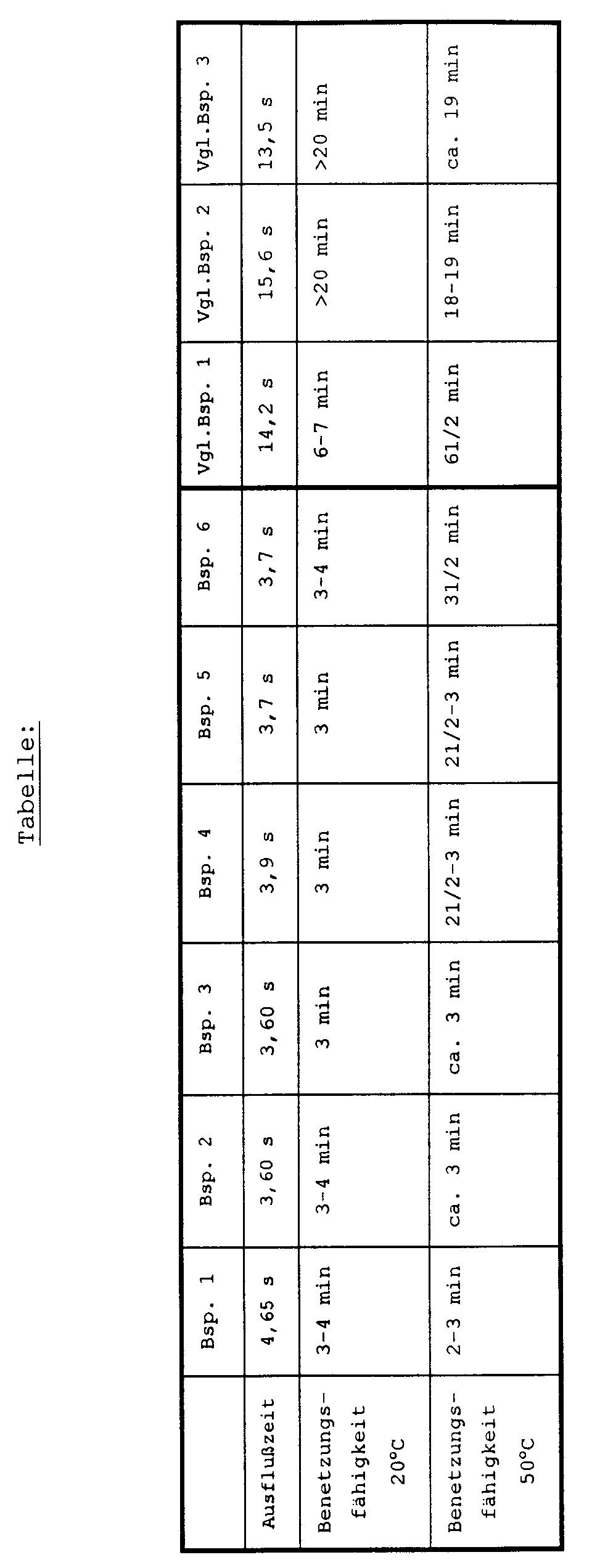
- Bitumen pressure sensitive adhesives are used instead of viscosity the outflow time with the street pitch outflow device measured according to DIN 52023 Part 1. Using a 4 mm nozzle at 20 ° C, the discharge time may be a maximum of 6 s.
- Weight loss may be in accordance with German standards be at most 70%.
- the softening point, determined through the ring and ball penetration, the evaporation residue should be in accordance with DIN 52045 Part 2 and DIN 52011 be at least 37 ° C.
- the object of the present invention is to be seen in to provide a bitumen pressure sensitive adhesive, all of the above requirements for bitumen pressure sensitive adhesives met, but completely without the use uses organic solvents.
- bitumen pressure sensitive adhesive are described as solvent-free bitumen emulsions, it means that the presence of organic, easily evaporating solvents, in English usage often as “volatile organic components ", is completely dispensed with. Nevertheless have the bitumen pressure sensitive adhesives according to the invention extremely low viscosities that meet the standards requirements adequate bitumen pressure sensitive adhesives are sufficient.
- bitumen pressure sensitive adhesive When applying the bitumen pressure sensitive adhesive according to the invention on older asphalt layers, due to the low Viscosity, get a rough surface, so that the asphalt layer applied to the pressure sensitive adhesive is not can float on a flat layer of pressure sensitive adhesive. With With the help of the present invention it is thus possible to Room temperature sprayable solvent-free bitumen pressure sensitive adhesives to provide. The liability of the binder on the mineral grain and the adhesion of the entire asphalt layer to the underground as well as the bond between individual Stratification is still very good.
- the water content the emulsion preferably in the range of 55 to 60 wt .-% set. It is the same in the same way preferred if the bitumen pressure sensitive adhesive 35 to 40 wt .-% Bitumen included.
- bitumen with the grade B80 with a needle penetration at 25 ° C from 70 to 100 per 1/10 mm and a softening point, determined by the Ring and ball test, also used from 44 to 49 ° C are, like softer, possibly emulsifiable bitumen according to the variety designation B200E, corresponding to one Needle penetration at 25 ° C from 160 to 210 per 1/10 mm and a ring and ball softening point from 37 to 44 ° C.
- Polymer-modified ones can also be used in the same way Use bitumen of grade B200, the viscosity values at a needle penetration of 25 ° C in the range of 160 to 220 per 1/10 mm and softening points, according to the ring and ball determined, from 36 to 42 ° C.
- the special one An advantage of the present invention is that that hard bitumen with a low guide number, for example B80, can also be used in cold installation. Bitumen types B300 are too hard so that they are mostly not used in road construction will.
- Nonionic Emulsifiers are common characterized by HLB values, the HLB value for the Hydrophilicity-lipophilia balance stands.
- HLB values the HLB value for the Hydrophilicity-lipophilia balance stands.
- alkoxylated glycerololeoricinolates as nonionic emulsifiers used with medium hydrophilicity.
- emulsifiers to be used in plant and synthetic Ester oils clearly soluble at room temperature, see above that these are particularly emulsifying for the preparation of themselves adjusted oils.
- Particularly preferred nonionic emulsifiers which in Add water spontaneously in fine, stable O / W emulsions are of particular interest, because environmental issues are being tried in many areas, Mineral oils through vegetable and synthetic ester oils too replace.
- Particularly preferred in the sense of the present The invention therefore contains the alkoxylated glycerol oleoricinolate 10 to 30 moles of ethylene oxide per mole of glycerol oleoricinolate.
- the inventive Bitumen pressure sensitive adhesives also cationic and / or amphoteric emulsifiers, especially in an amount of 0.5 up to 8% by weight.
- Particularly preferred in the sense of the present Invention are commercially available amphoteric emulsifiers used for bitumen.
- Exemplary in the sense of The present invention is therefore used as an amphoteric emulsifier coconut fatty acid betaine is particularly preferably used.
- the invention contain Bitumen pressure sensitive adhesives preferably low Proportions of mineral acids, in particular 0.005 to 0.3 wt .-%, the use of hydrochloric acid, mostly in dilute aqueous solution, for example 36.5%, particularly is preferred.
- the inventive Bitumen pressure sensitive adhesive if necessary, defoaming agent contain. These are available to one skilled in the art wide range available, with particular preference in the sense of the present invention polysiloxanes in the broadest Senses can be used. Particularly preferred For the purposes of the present invention, the bitumen pressure sensitive adhesives contain 0.001 to 0.01% by weight defoamer.
- bitumen pressure sensitive adhesives according to the invention have a light brown color to brown color on what a very slight Particle size speaks.
- Usual, commercially available Bitumen emulsions have a particle size of 10 ⁇ m and usually have a clearly darker color.
- the bitumen pressure sensitive adhesives according to the invention are generally very stable in storage and penetrate cracked when applied Surfaces deep into the underlying layers, so that extremely thin layers are possible.
- bitumen pressure sensitive adhesive was produced, which had a pH of 2.26.
- bitumen pressure sensitive adhesive was produced, which had a pH of 2.15.
- bitumen pressure sensitive adhesive was produced, which had a pH of 1.97.
- bitumen pressure sensitive adhesive Using 35% by weight of a bitumen of the variety B200E with a needle penetration of 25 ° C from 160 to 210 per 1/10 mm, one softening point, determined according to the ring and ball, from 37 to 44 ° C, an amount of 0.08% by weight, 36.5% HCl, 59.45% water, 0.80% amphoteric Emulsifier (coconut fatty acid betaine) (PROMAK® EK 7A), 4.5% by weight of a nonionic surfactant (polyethylene glycerol oleoricinolate TEGOTENS®V20) and 0.01% by weight defoamer (TEGO®Antifoam 1488) became a bitumen pressure sensitive adhesive prepared that had a pH of 1.66.
- a nonionic surfactant polyethylene glycerol oleoricinolate TEGOTENS®V20
- defoamer TEGO®Antifoam 1488
- bitumen pressure sensitive adhesive was produced, which had a pH of 1.92.
- an amphoteric emulsifier coconut fatty acid betaine
- PROMAK® EK 7A amphoteric emulsifier
- a nonionic Surfactants Polyethylene Glycerol Oleoricinolate TE
- a commercially available bitumen pressure sensitive adhesive was used as comparative example 1, the 35% by weight of a bitumen of grade B80 with a needle penetration at 25 ° C from 70 to 100 per 1/10 mm and a softening point, determined according to the ring and Sphere, from 44 to 49 ° C.
- the amount of water was determined to 60% and measured a pH value of 2.0. The Type and exact amount of the solvent used could cannot be determined.
- a commercially available bitumen pressure sensitive adhesive was used as comparative example 2, the 35% by weight of a bitumen of grade B80 with a needle penetration at 25 ° C from 70 to 100 per 1/10 mm and a softening point, determined according to the ring and Sphere, from 44 to 49 ° C. The amount of water was determined to 58% and a pH of 4.8 measured. The Art and exact amount of solvent used could not be determined.
- a commercially available bitumen pressure sensitive adhesive was used as comparative example 3, the 35% by weight of a bitumen of grade B80 with a needle penetration at 25 ° C from 70 to 100 per 1/10 mm and a softening point, determined according to the ring and Sphere, from 44 to 49 ° C.
- the amount of water was determined to 60% and measured the pH of 1.94. The Type and exact amount of the solvent used could cannot be determined.
- the table shows the types of outflow time in the road pitch viscometer as defined above and the wettability according to DIN 52046 at 20 ° C and the wettability at 50 ° C.
Landscapes
- Chemical & Material Sciences (AREA)
- Engineering & Computer Science (AREA)
- Materials Engineering (AREA)
- Organic Chemistry (AREA)
- Civil Engineering (AREA)
- Structural Engineering (AREA)
- Health & Medical Sciences (AREA)
- Chemical Kinetics & Catalysis (AREA)
- Medicinal Chemistry (AREA)
- Polymers & Plastics (AREA)
- Adhesives Or Adhesive Processes (AREA)
- Road Paving Structures (AREA)
Abstract
Description
Unter aktiver Haftung soll die Verdrängung von Wasser und Feuchtigkeit von der Kontaktoberfläche verstanden werden. Passive Haftung liegt vor, wenn saubere, trockene Oberflächen mit Bindemittel umhüllt werden; dabei darf kein Verlust an Haftung entstehen. Ein kraftschlüssiger Verbund zwischen den einzelnen Schichten einer Asphaltstraßenbefestigung ist eine unabdingbare Voraussetzung, um die volle Tragfähigkeit einer Befestigung zu erlangen. Der Verbund dünner Schichten ist ein wichtiges technisches und ausführungsmäßiges Detail im Asphaltstraßenbau. Eine einwandfreie Ausführung wird schwieriger, sofern statt der Verbindung neuer Lagen miteinander eine alte Asphaltunterlage vorhanden ist, die zudem noch verschmutzt sein kann; wenn also nicht nur Wasserschichten, sondern auch Staub durchdrungen werden muß. Verschmutzte Untergründe sind dabei das größte Problem der Haftung. Natürlich sollte vorhandener Staub normalerweise entfernt werden. Aber es gibt Arten von Staub und tonigen Schichten, die so fest am Untergrund haften, daß sie sich nur unter hohem technischen Aufwand beseitigen lassen. Andere tonige Verschmutzungen können so dünn sein, daß sie nicht erkennbar sind. Auch werden die Einbauvorschriften insoweit vor Ort nicht immer genau eingehalten.
- Einen sehr hohen Gehalt an in der Regel organischen
Lösemitteln (ca. 70 %, somit deutlich höher als beim
Regeneriermittel);
das bedeutet: bei einem üblichen Bitumengehalt von 30 bis 40 Gew.-% werden 6 bis 7 t Lösemitteldampf in die Atmosphäre abgegeben, wenn 10 t der Lösung verspritzt werden. - Dünne Schichten im Kalteinbau können nur aufgebracht werden, wenn die Lösemittel vollständig verdampft sind. Sie dürfen nicht mit eingeschlossen werden.
- 45 bis 60
- Gew.-% Wasser,
- 30 bis 45
- Gew.-% Bitumen,
- 1 bis 10
- Gew.-% nichtionische Emulgatoren,
- 0,2 bis 2
- Gew.-% kationische und/oder amphotere Emulgatoren,
- 0 bis 1
- Gew.-% Mineralsäure und
- 0 bis 0,1
- Gew.-% Entschäumer
Claims (12)
- Bitumen-Haftkleber, frei von organischen Lösungsmitteln, enthaltend
- 45 bis 60
- Gew.-% Wasser,
- 30 bis 45
- Gew.-% Bitumen,
- 1 bis 10
- Gew.-% nichtionische Emulgatoren,
- 0,2 bis 2
- Gew.-% kationische und/oder amphotere Emulgatoren,
- 0 bis 1
- Gew.-% Mineralsäure und
- 0 bis 0,1
- Gew.-% Entschäumer.
- Haftkleber nach Anspruch 1, enthaltend 55 bis 60 Gew.-% Wasser.
- Haftkleber nach Anspruch 1, enthaltend 35 bis 40 Gew.-% Bitumen.
- Haftkleber nach Anspruch 1, enthaltend harte, weiche, emulgierfähige und/oder polymermodifizierte Bitumen.
- Haftkleber nach Anspruch 1, enthaltend 3 bis 8 Gew.-% nichtionische Emulgatoren.
- Haftkleber nach Anspruch 1, wobei die nichtionischen Emulgatoren HLB-Werte im Bereich von 5 bis 15, insbesondere 7 bis 10 aufweisen.
- Haftkleber nach Anspruch 1, wobei die nichtionischen Emulgatoren ausgewählt sind aus alkoxylierten Glycerololeoricinolaten.
- Haftkleber nach Anspruch 7, dadurch gekennzeichnet, daß das alkoxylierte Glycerololeoricinolat 10 bis 30 Mol Ethylenoxid pro Mol Glycerololeoricinolat enthält.
- Haftkleber nach Anspruch 1, enthaltend 0,5 bis 8 Gew.-% kationische und/oder amphotere Emulgatoren.
- Haftkleber nach Anspruch 1, dadurch gekennzeichnet, daß die amphoteren Emulgatoren ausgewählt sind aus Kokosfettsäurebetain.
- Haftkleber nach Anspruch 1, enthaltend 0,05 bis 0,3 Gew.-% Mineralsäuren.
- Haftkleber nach Anspruch 1, enthaltend 0,001 bis 0,1 Gew.-% Entschäumer.
Applications Claiming Priority (2)
| Application Number | Priority Date | Filing Date | Title |
|---|---|---|---|
| DE19721558 | 1997-05-23 | ||
| DE19721558A DE19721558C1 (de) | 1997-05-23 | 1997-05-23 | Bitumen-Haftkleber |
Publications (3)
| Publication Number | Publication Date |
|---|---|
| EP0879865A2 true EP0879865A2 (de) | 1998-11-25 |
| EP0879865A3 EP0879865A3 (de) | 1999-02-10 |
| EP0879865B1 EP0879865B1 (de) | 2004-07-07 |
Family
ID=7830253
Family Applications (1)
| Application Number | Title | Priority Date | Filing Date |
|---|---|---|---|
| EP98108485A Expired - Lifetime EP0879865B1 (de) | 1997-05-23 | 1998-05-09 | Bitumen-Haftkleber |
Country Status (3)
| Country | Link |
|---|---|
| EP (1) | EP0879865B1 (de) |
| AT (1) | ATE270698T1 (de) |
| DE (2) | DE19721558C1 (de) |
Family Cites Families (6)
| Publication number | Priority date | Publication date | Assignee | Title |
|---|---|---|---|---|
| AT173781B (de) * | 1944-11-14 | 1953-01-26 | Dehtochema Narodni Podnik | Verfahren zum Verkleben von Schichten |
| US2537190A (en) * | 1947-04-29 | 1951-01-09 | Patent & Licensing Corp | Dispersions of bitumen and a rubber for use as adhesives |
| US3859227A (en) * | 1968-11-14 | 1975-01-07 | Chevron Res | Stable slow-setting cationic bituminous emulsions and their preparation |
| DD154297A1 (de) * | 1980-11-07 | 1982-03-10 | Eberhard Spur | Verfahren zur herstellung neutraler kationaktiver bitumenemulsionen |
| HU183533B (en) * | 1981-07-30 | 1984-05-28 | Bela Racz | Process for producing aquous bitumen-composition |
| US4464285A (en) * | 1982-05-17 | 1984-08-07 | Westvaco Corporation | Amphoterics as emulsifiers for bituminous emulsions |
-
1997
- 1997-05-23 DE DE19721558A patent/DE19721558C1/de not_active Expired - Fee Related
-
1998
- 1998-05-09 DE DE59811648T patent/DE59811648D1/de not_active Expired - Fee Related
- 1998-05-09 EP EP98108485A patent/EP0879865B1/de not_active Expired - Lifetime
- 1998-05-09 AT AT98108485T patent/ATE270698T1/de not_active IP Right Cessation
Also Published As
| Publication number | Publication date |
|---|---|
| ATE270698T1 (de) | 2004-07-15 |
| EP0879865B1 (de) | 2004-07-07 |
| DE59811648D1 (de) | 2004-08-12 |
| DE19721558C1 (de) | 1999-02-11 |
| EP0879865A3 (de) | 1999-02-10 |
Similar Documents
| Publication | Publication Date | Title |
|---|---|---|
| US4822425A (en) | Aggregate stabilization | |
| DE3700100C1 (de) | Fluessige,Ioesungsmittelfreie oder Ioesungsmittelarme,haertbare Polyurethan-Bitumen-Weichmacher-Einkomponenten-Zusammensetzung,Verfahren zu deren Herstellung und deren Verwendung | |
| DE1669229A1 (de) | Zusammensetzung fuer eine Behandlung,Behandlungsverfahren und behandelte Oberflaechen | |
| DE852883C (de) | Gegenueber Kohlenwasserstoffen widerstandsfaehige bituminoese Massen und Verfahren zum Schuetzen asphalthaltiger Oberflaechen gegen Kohlenwasserstoffe | |
| DE1944337C3 (de) | Bitumenhaltige Masse | |
| EP0879865B1 (de) | Bitumen-Haftkleber | |
| DE102008032083B4 (de) | Verfahren zur Verbesserung der Frühschlagregenfestigkeit von Beschichtungsmassen | |
| EP0207934B1 (de) | Rostinhibierende grundierungszusammensetzung | |
| DE2157810C2 (de) | Bituminöse Massen zur Verwendung als bei leichter Druckeinwirkung selbstklebende Schicht | |
| DE60316721T2 (de) | Verfahren zur herstellung von bitumen/polymer-zusammensetzungen mit verbesserter beständigkeit gegenüber erdöl-basierten lösungsmitteln, so erhaltene zusammensetzungen und deren verwendung als bituminöses bindemittel | |
| DE69414978T2 (de) | Adhäsivzusammensetzungen auf Basis wässriger Dispersionen von Kunstharzen und ihre Anwendung zum Verleimen von Wand- und Bodenbekleidungen | |
| DE2245962C3 (de) | Verfahren zur Herstellung elastifizierter bituminöser Mischungen | |
| DE4222410C2 (de) | Bienenwachshaltige Holzlasur | |
| DE69817980T2 (de) | Bitimineuse Emulsionen, Verfahren zu deren Herstellung und ihre Verwendung | |
| EP2438119A1 (de) | Zusammensetzung mit imprägnierender wirkung | |
| DE3780678T2 (de) | Saure zusammensetzung zum waschen der aussenseite von eisenbahnwagen und dergleichen. | |
| CA1312977C (en) | Dust suppressant forming a resilient layer | |
| EP2028234A2 (de) | Verwendung eines Haftvermittlers für Fasern, insbesondere zu deren Einbringung in Bitumen aufweisende Massen | |
| DE1594770C3 (de) | Verfahren zur Herstellung von Suspensionen von mit bituminösen Stoffen beschichteten Mineralstoffteilchen oder Fasern | |
| DE712015C (de) | Verfahren zum Behandeln bituminoeser Stoffe oder Massen, welche diese Stoffe enthalten | |
| AT251477B (de) | Bituminöse, die Konsistenz einer Schlämme aufweisende Masse für Straßenbauzwecke und Verfahren zu ihrer Herstellung | |
| DE1794138C3 (de) | Nicht absetzende Klebstottmischung auf Basis von Polychloropren | |
| DE2460110C3 (de) | Anionenaktive Bitumenemulsion und Verfahren zur Herstellung derselben | |
| AT244215B (de) | Verfahren zum Erneuern von verwittertem Asphalt | |
| DE19732507B4 (de) | Fraktioniertes Montanwachs |
Legal Events
| Date | Code | Title | Description |
|---|---|---|---|
| PUAI | Public reference made under article 153(3) epc to a published international application that has entered the european phase |
Free format text: ORIGINAL CODE: 0009012 |
|
| 17P | Request for examination filed |
Effective date: 19980514 |
|
| AK | Designated contracting states |
Kind code of ref document: A2 Designated state(s): AT CH DE FR GB IT LI NL |
|
| AX | Request for extension of the european patent |
Free format text: AL;LT;LV;MK;RO;SI |
|
| PUAL | Search report despatched |
Free format text: ORIGINAL CODE: 0009013 |
|
| AK | Designated contracting states |
Kind code of ref document: A3 Designated state(s): AT BE CH CY DE DK ES FI FR GB GR IE IT LI LU MC NL PT SE |
|
| AX | Request for extension of the european patent |
Free format text: AL;LT;LV;MK;RO;SI |
|
| AKX | Designation fees paid |
Free format text: AT CH DE FR GB IT LI NL |
|
| RAP1 | Party data changed (applicant data changed or rights of an application transferred) |
Owner name: GOLDSCHMIDT AG |
|
| 17Q | First examination report despatched |
Effective date: 20030522 |
|
| GRAP | Despatch of communication of intention to grant a patent |
Free format text: ORIGINAL CODE: EPIDOSNIGR1 |
|
| GRAS | Grant fee paid |
Free format text: ORIGINAL CODE: EPIDOSNIGR3 |
|
| GRAA | (expected) grant |
Free format text: ORIGINAL CODE: 0009210 |
|
| AK | Designated contracting states |
Kind code of ref document: B1 Designated state(s): AT CH DE FR GB IT LI NL |
|
| REG | Reference to a national code |
Ref country code: GB Ref legal event code: FG4D Free format text: NOT ENGLISH |
|
| REG | Reference to a national code |
Ref country code: CH Ref legal event code: EP |
|
| REF | Corresponds to: |
Ref document number: 59811648 Country of ref document: DE Date of ref document: 20040812 Kind code of ref document: P |
|
| GBT | Gb: translation of ep patent filed (gb section 77(6)(a)/1977) |
Effective date: 20040906 |
|
| ET | Fr: translation filed | ||
| RAP2 | Party data changed (patent owner data changed or rights of a patent transferred) |
Owner name: GOLDSCHMIDT GMBH |
|
| REG | Reference to a national code |
Ref country code: CH Ref legal event code: PFA Owner name: GOLDSCHMIDT GMBH Free format text: GOLDSCHMIDT AG#GOLDSCHMIDTSTRASSE 100#45127 ESSEN (DE) -TRANSFER TO- GOLDSCHMIDT GMBH#GOLDSCHMIDTSTRASSE 100#45127 ESSEN (DE) |
|
| PLBE | No opposition filed within time limit |
Free format text: ORIGINAL CODE: 0009261 |
|
| STAA | Information on the status of an ep patent application or granted ep patent |
Free format text: STATUS: NO OPPOSITION FILED WITHIN TIME LIMIT |
|
| NLT2 | Nl: modifications (of names), taken from the european patent patent bulletin |
Owner name: GOLDSCHMIDT GMBH |
|
| 26N | No opposition filed |
Effective date: 20050408 |
|
| REG | Reference to a national code |
Ref country code: FR Ref legal event code: CJ Ref country code: FR Ref legal event code: CD |
|
| PGFP | Annual fee paid to national office [announced via postgrant information from national office to epo] |
Ref country code: DE Payment date: 20080523 Year of fee payment: 11 Ref country code: CH Payment date: 20080515 Year of fee payment: 11 |
|
| PGFP | Annual fee paid to national office [announced via postgrant information from national office to epo] |
Ref country code: AT Payment date: 20080515 Year of fee payment: 11 |
|
| PGFP | Annual fee paid to national office [announced via postgrant information from national office to epo] |
Ref country code: IT Payment date: 20080524 Year of fee payment: 11 |
|
| PGFP | Annual fee paid to national office [announced via postgrant information from national office to epo] |
Ref country code: NL Payment date: 20080515 Year of fee payment: 11 |
|
| PGFP | Annual fee paid to national office [announced via postgrant information from national office to epo] |
Ref country code: GB Payment date: 20080522 Year of fee payment: 11 |
|
| REG | Reference to a national code |
Ref country code: CH Ref legal event code: PFA Owner name: EVONIK GOLDSCHMIDT GMBH Free format text: GOLDSCHMIDT GMBH#GOLDSCHMIDTSTRASSE 100#45127 ESSEN (DE) -TRANSFER TO- EVONIK GOLDSCHMIDT GMBH#GOLDSCHMIDTSTRASSE 100#45127 ESSEN (DE) |
|
| REG | Reference to a national code |
Ref country code: CH Ref legal event code: PL |
|
| REG | Reference to a national code |
Ref country code: FR Ref legal event code: CD |
|
| GBPC | Gb: european patent ceased through non-payment of renewal fee |
Effective date: 20090509 |
|
| PG25 | Lapsed in a contracting state [announced via postgrant information from national office to epo] |
Ref country code: LI Free format text: LAPSE BECAUSE OF NON-PAYMENT OF DUE FEES Effective date: 20090531 Ref country code: CH Free format text: LAPSE BECAUSE OF NON-PAYMENT OF DUE FEES Effective date: 20090531 Ref country code: AT Free format text: LAPSE BECAUSE OF NON-PAYMENT OF DUE FEES Effective date: 20090509 |
|
| NLV4 | Nl: lapsed or anulled due to non-payment of the annual fee |
Effective date: 20091201 |
|
| PG25 | Lapsed in a contracting state [announced via postgrant information from national office to epo] |
Ref country code: NL Free format text: LAPSE BECAUSE OF NON-PAYMENT OF DUE FEES Effective date: 20091201 |
|
| REG | Reference to a national code |
Ref country code: FR Ref legal event code: ST Effective date: 20100129 |
|
| PG25 | Lapsed in a contracting state [announced via postgrant information from national office to epo] |
Ref country code: FR Free format text: LAPSE BECAUSE OF NON-PAYMENT OF DUE FEES Effective date: 20090602 |
|
| PGFP | Annual fee paid to national office [announced via postgrant information from national office to epo] |
Ref country code: FR Payment date: 20080526 Year of fee payment: 11 |
|
| PG25 | Lapsed in a contracting state [announced via postgrant information from national office to epo] |
Ref country code: GB Free format text: LAPSE BECAUSE OF NON-PAYMENT OF DUE FEES Effective date: 20090509 |
|
| PG25 | Lapsed in a contracting state [announced via postgrant information from national office to epo] |
Ref country code: DE Free format text: LAPSE BECAUSE OF NON-PAYMENT OF DUE FEES Effective date: 20091201 |
|
| PG25 | Lapsed in a contracting state [announced via postgrant information from national office to epo] |
Ref country code: IT Free format text: LAPSE BECAUSE OF NON-PAYMENT OF DUE FEES Effective date: 20090509 |