EP0879915A2 - Procédé de fabrication d'une toile, spécialement une toile de store, à partir de bandes simples - Google Patents
Procédé de fabrication d'une toile, spécialement une toile de store, à partir de bandes simples Download PDFInfo
- Publication number
- EP0879915A2 EP0879915A2 EP98109162A EP98109162A EP0879915A2 EP 0879915 A2 EP0879915 A2 EP 0879915A2 EP 98109162 A EP98109162 A EP 98109162A EP 98109162 A EP98109162 A EP 98109162A EP 0879915 A2 EP0879915 A2 EP 0879915A2
- Authority
- EP
- European Patent Office
- Prior art keywords
- adhesive
- cloth
- action
- sheets
- fabric
- Prior art date
- Legal status (The legal status is an assumption and is not a legal conclusion. Google has not performed a legal analysis and makes no representation as to the accuracy of the status listed.)
- Withdrawn
Links
Images

Classifications
-
- D—TEXTILES; PAPER
- D06—TREATMENT OF TEXTILES OR THE LIKE; LAUNDERING; FLEXIBLE MATERIALS NOT OTHERWISE PROVIDED FOR
- D06H—MARKING, INSPECTING, SEAMING OR SEVERING TEXTILE MATERIALS
- D06H5/00—Seaming textile materials
-
- B—PERFORMING OPERATIONS; TRANSPORTING
- B29—WORKING OF PLASTICS; WORKING OF SUBSTANCES IN A PLASTIC STATE IN GENERAL
- B29C—SHAPING OR JOINING OF PLASTICS; SHAPING OF MATERIAL IN A PLASTIC STATE, NOT OTHERWISE PROVIDED FOR; AFTER-TREATMENT OF THE SHAPED PRODUCTS, e.g. REPAIRING
- B29C37/00—Component parts, details, accessories or auxiliary operations, not covered by group B29C33/00 or B29C35/00
- B29C37/0078—Measures or configurations for obtaining anchoring effects in the contact areas between layers
- B29C37/0082—Mechanical anchoring
- B29C37/0085—Mechanical anchoring by means of openings in the layers
-
- B—PERFORMING OPERATIONS; TRANSPORTING
- B29—WORKING OF PLASTICS; WORKING OF SUBSTANCES IN A PLASTIC STATE IN GENERAL
- B29C—SHAPING OR JOINING OF PLASTICS; SHAPING OF MATERIAL IN A PLASTIC STATE, NOT OTHERWISE PROVIDED FOR; AFTER-TREATMENT OF THE SHAPED PRODUCTS, e.g. REPAIRING
- B29C65/00—Joining or sealing of preformed parts, e.g. welding of plastics materials; Apparatus therefor
- B29C65/48—Joining or sealing of preformed parts, e.g. welding of plastics materials; Apparatus therefor using adhesives, i.e. using supplementary joining material; solvent bonding
-
- B—PERFORMING OPERATIONS; TRANSPORTING
- B29—WORKING OF PLASTICS; WORKING OF SUBSTANCES IN A PLASTIC STATE IN GENERAL
- B29C—SHAPING OR JOINING OF PLASTICS; SHAPING OF MATERIAL IN A PLASTIC STATE, NOT OTHERWISE PROVIDED FOR; AFTER-TREATMENT OF THE SHAPED PRODUCTS, e.g. REPAIRING
- B29C66/00—General aspects of processes or apparatus for joining preformed parts
- B29C66/01—General aspects dealing with the joint area or with the area to be joined
- B29C66/05—Particular design of joint configurations
- B29C66/10—Particular design of joint configurations particular design of the joint cross-sections
- B29C66/11—Joint cross-sections comprising a single joint-segment, i.e. one of the parts to be joined comprising a single joint-segment in the joint cross-section
- B29C66/114—Single butt joints
- B29C66/1142—Single butt to butt joints
-
- B—PERFORMING OPERATIONS; TRANSPORTING
- B29—WORKING OF PLASTICS; WORKING OF SUBSTANCES IN A PLASTIC STATE IN GENERAL
- B29C—SHAPING OR JOINING OF PLASTICS; SHAPING OF MATERIAL IN A PLASTIC STATE, NOT OTHERWISE PROVIDED FOR; AFTER-TREATMENT OF THE SHAPED PRODUCTS, e.g. REPAIRING
- B29C66/00—General aspects of processes or apparatus for joining preformed parts
- B29C66/01—General aspects dealing with the joint area or with the area to be joined
- B29C66/05—Particular design of joint configurations
- B29C66/304—Joining through openings in an intermediate part of the article
-
- B—PERFORMING OPERATIONS; TRANSPORTING
- B29—WORKING OF PLASTICS; WORKING OF SUBSTANCES IN A PLASTIC STATE IN GENERAL
- B29C—SHAPING OR JOINING OF PLASTICS; SHAPING OF MATERIAL IN A PLASTIC STATE, NOT OTHERWISE PROVIDED FOR; AFTER-TREATMENT OF THE SHAPED PRODUCTS, e.g. REPAIRING
- B29C66/00—General aspects of processes or apparatus for joining preformed parts
- B29C66/40—General aspects of joining substantially flat articles, e.g. plates, sheets or web-like materials; Making flat seams in tubular or hollow articles; Joining single elements to substantially flat surfaces
- B29C66/41—Joining substantially flat articles ; Making flat seams in tubular or hollow articles
- B29C66/43—Joining a relatively small portion of the surface of said articles
-
- B—PERFORMING OPERATIONS; TRANSPORTING
- B29—WORKING OF PLASTICS; WORKING OF SUBSTANCES IN A PLASTIC STATE IN GENERAL
- B29C—SHAPING OR JOINING OF PLASTICS; SHAPING OF MATERIAL IN A PLASTIC STATE, NOT OTHERWISE PROVIDED FOR; AFTER-TREATMENT OF THE SHAPED PRODUCTS, e.g. REPAIRING
- B29C66/00—General aspects of processes or apparatus for joining preformed parts
- B29C66/70—General aspects of processes or apparatus for joining preformed parts characterised by the composition, physical properties or the structure of the material of the parts to be joined; Joining with non-plastics material
- B29C66/72—General aspects of processes or apparatus for joining preformed parts characterised by the composition, physical properties or the structure of the material of the parts to be joined; Joining with non-plastics material characterised by the structure of the material of the parts to be joined
- B29C66/729—Textile or other fibrous material made from plastics
-
- B—PERFORMING OPERATIONS; TRANSPORTING
- B29—WORKING OF PLASTICS; WORKING OF SUBSTANCES IN A PLASTIC STATE IN GENERAL
- B29K—INDEXING SCHEME ASSOCIATED WITH SUBCLASSES B29B, B29C OR B29D, RELATING TO MOULDING MATERIALS OR TO MATERIALS FOR MOULDS, REINFORCEMENTS, FILLERS OR PREFORMED PARTS, e.g. INSERTS
- B29K2313/00—Use of textile products or fabrics as reinforcement
-
- D—TEXTILES; PAPER
- D10—INDEXING SCHEME ASSOCIATED WITH SUBLASSES OF SECTION D, RELATING TO TEXTILES
- D10B—INDEXING SCHEME ASSOCIATED WITH SUBLASSES OF SECTION D, RELATING TO TEXTILES
- D10B2505/00—Industrial
- D10B2505/18—Outdoor fabrics, e.g. tents, tarpaulins
Definitions
- awning covers and winter equipment mounting shadings are the following for simplicity only referred to as awning covers.
- Sheets of fabric are used for the awning fabrics are usually 1.2 m wide. Because awnings and conservatory shading generally a greater width than 1.2 m, the awning fabric must consist of several fabric sheets be put together. At the connection points each two adjacent sheets of cloth along each other turned longitudinal edge with an overlap of about 2 cm superimposed and sewn together with two longitudinal seams, which are called connecting seams in the following. To the both outer edges of the awning fabric will be with the two the outer longitudinal edge by about Turned 3 to 5 cm and also with two or more Longitudinal seams sewn, which are called seam seams below will. In the area of the connection seams and hem seams the awning fabric is twice as thick as the remaining surface areas, with the suture thread still a certain additional thickening of the awning fabric come in addition. This has several disadvantages.
- the cloth wrap When winding on the cloth shaft, the cloth wrap has in the Double seam area and hemstitch area Thickness and therefore a greater circumferential length than in the Areas in between. This will put the cloth in the Seam areas stronger and less in the intermediate areas very excited. This different tension creates especially in the vicinity of the seam areas Wrinkles that look like a waffle or herringbone pattern and especially when the awning fabric is partially open make a very poor aesthetic impression.
- the awning cloth In the seam areas, the awning cloth has double Fabric layer in the longitudinal direction a greater dimensional stability than in the intermediate areas. If over time the equipment of the awning cloth is reduced and that Awning cloth loses its stiffness and it is softer and becomes more unstable, it depends on the influence of wind and rain in the intermediate areas more than in the seam areas.
- the awning cloth looks as if it is in the Seam areas supported by mechanical reinforcements. It creates a kind of hammock effect. With a slight pitch of the awning cloth is the formation of water bags in the rain reinforced.
- the unequal tensions in the seam areas and on the other hand in the intermediate areas comes when winding up such a cloth that the cloth wave and bend the drop bar elastically and in give way more in the middle than in the end areas.
- a larger area is created in the area of the seams Tension than in the area of the seams, from the Not to mention intermediate areas.
- This will make it Area of the seam seams wound tighter on the cloth shaft than in the intermediate areas.
- the awning cloth is therefore in the Area of its seams gradually longer than in the wider interior areas. This causes the awning fabric to hang laterally stronger in the open state. At Wind tends to flutter around the edges. In the case of conservatory shading, this can sag more the outer areas cause the awning fabric to the outer surfaces of the winter garden and its glass panes rests and rubs against it under the influence of wind.
- the invention has for its object a method specify with which individual sheets of cloth to a cloth, in particular to form an awning cloth, in which the disadvantages described above of the conventional Process interconnected sheets of cloth at least are reduced or avoided entirely.
- This task is by a method with those specified in claim 1 Process steps solved.
- the penetration of the adhesive in the fabric and soaking the Cloth sheets with adhesive improved especially in cases in which the cloth sheets on their surface or in total are equipped with means by which their use as an awning cloth is improved, but also the Wettability for the adhesive is reduced.
- the the same is achieved by an embodiment according to claim 5 reached when the cloth webs after applying the But glue before the completion of the solidification process of the adhesive are pierced so that the adhesive Opportunity to get stronger in the fabric of the cloth panels to penetrate.
- the same will apply to one configuration achieved according to claim 6, when an adhesive is used, which can be reactivated by exposure to heat.
- an embodiment according to claim 7 is a reinforcement the outer edge area of an outer fabric sheet reached without doubling the fabric.
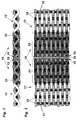
- Fig. 1 and Fig. 2 in large enlargement apparent cloth 10 that as an awning cloth or used as conservatory shading is by two Cloth sheets 11 and 12 formed along the each other facing longitudinal edges 13 and 14 with each other permanently are connected.
- the warp threads are clear for both fabric sheets 11 and 12 15 or 16 with increased mutual distance and shown lying at the same height and the weft threads 17th or 18 lying close together but more wounded shown, alternating for better distinction shown with a puncturing and without a puncturing are.
- the cloth webs which generally have a production range of Have 1.20 m, are for the total width of the Cloth 10 cut required web width, where appropriate the so-called repeat of an area or Stripe pattern is taken into account.
- the two sheets of cloth 11 and 12 are with each other facing longitudinal edges 13 and 14 in the same plane arranged side by side.
- the longitudinal edges 13 and 14 may be bumped into each other or there may be one if also very small, leaving space 19 between them will.
- edge region 21 of the sheet 11 and in the edge region 22 of the Cloth web 12 is at least on one side of the cloth webs an adhesive application 23 is attached, which the edge regions 21st and 22 soaked and at the same time the space 19 fills between the longitudinal edges 13 and 14.
- the adhesive 23 becomes at least in the extent of the void volume the fabric of the fabric sheets 11 and 12, better still with a small excess, applied depending on its viscosity is initially partially on the Outside of the fabric sheets. Even before solidifying of the adhesive is by means of a pressing device exerted a pressing force on the adhesive application 23 and thereby the glue into the voids of the fabric of the cloth webs 11 and 12 pressed in and at the same time at least approximately pressed the thickness of the two sheets of cloth. With parts of the pressing device that come into contact with the adhesive consist of one material or are with one Coated material to which the adhesive does not adhere.
- the solidification is by Exposure to oxygen and / or moisture and / or by the action of heat and / or by the action of pressure and / or initiated by exposure to radiation and carried out until solidification. Subsequently are the two sheets of cloth 11 and 12 by the in their Edge area 21 and 22 stored and through the Gap 19 between adhesive 23 filling them permanently connected.
- the fabric sheets 11 and 12 from different Reasons are equipped with substances that partly stick to the cloth sheets and partly also into the Cloth sheets are embedded, the wettability of the Cloth webs 11 and 12 restricted for the adhesive 23 be.
- the fabric sheets 11 and 12 in their edge region 21 or 22 it is advisable the fabric sheets 11 and 12 in their edge region 21 or 22 to be pierced multiple times, best in full height. The number and arrangement pattern of the punctures depend on the conditions of the cloth webs and the adhesive used.
- the fabric threads of the cloth sheets are pushed aside and created a through hole, which is later filled in by the adhesive, so that at least punctual adhesive bridges are created, which in height go through the entire fabric.
- the piercing is in many cases before applying the adhesive 23 can, so that the push-through tools with the adhesive do not come into contact. If necessary, the piercing but also after applying the adhesive if about piercing tools are used, which by suitable The coating prevents the adhesive from sticking will.
- the subsequent piercing is e.g. also then possible if the adhesive solidifies by exposure to heat is reactivated and also reactivated by heat can be. Then after the first solidification of the adhesive the piercing can be done. After that the adhesive is reactivated by exposure to heat and expediently also exerted a pressing force on him, so that it penetrates into the cavity of the punctures and fills them out.
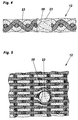
- a needle with a tapered tip 26 and cylindrical Shaft 27 is pierced.
- the warp and weft threads of the cloth web 12 Be at the piercing point the warp and weft threads of the cloth web 12 to the side pushed so that a continuous and at least approximately cylindrical cavity remains when the piercing tool 25 has been withdrawn from it.
- the warp threads and / or the weft threads once be pierced.
- the adhesive 23 fills the natural cavities of the fabric of the sheet 12 and on the other hand that by Puncturing generated through hole 28 in the fabric web 12th from (Fig. 4 and Fig. 5).
Landscapes
- Engineering & Computer Science (AREA)
- Mechanical Engineering (AREA)
- Textile Engineering (AREA)
- Tents Or Canopies (AREA)
- Laminated Bodies (AREA)
Applications Claiming Priority (2)
| Application Number | Priority Date | Filing Date | Title |
|---|---|---|---|
| DE19721781A DE19721781A1 (de) | 1997-05-24 | 1997-05-24 | Verfahren zum Herstellen eines Tuches, insbesondere eines Markisentuches, aus einzelnen Tuchbahnen |
| DE19721781 | 1997-05-24 |
Publications (2)
| Publication Number | Publication Date |
|---|---|
| EP0879915A2 true EP0879915A2 (fr) | 1998-11-25 |
| EP0879915A3 EP0879915A3 (fr) | 1998-12-23 |
Family
ID=7830398
Family Applications (1)
| Application Number | Title | Priority Date | Filing Date |
|---|---|---|---|
| EP98109162A Withdrawn EP0879915A3 (fr) | 1997-05-24 | 1998-05-20 | Procédé de fabrication d'une toile, spécialement une toile de store, à partir de bandes simples |
Country Status (2)
| Country | Link |
|---|---|
| EP (1) | EP0879915A3 (fr) |
| DE (1) | DE19721781A1 (fr) |
Cited By (6)
| Publication number | Priority date | Publication date | Assignee | Title |
|---|---|---|---|---|
| DE19853591A1 (de) * | 1998-11-20 | 2000-05-25 | Schmitz Werke | Markisentuch |
| ES2166240A1 (es) * | 1999-01-11 | 2002-04-01 | Vives Vidal Vivesa Sa | Metodo para obtener uniones o tramos de refuerzo extraplanos en materiales textiles y telas no tejidas, y articulo obtenido por dicho metodo. |
| EP1207231A1 (fr) * | 2000-11-16 | 2002-05-22 | Montefibre S.p.A. | Procédé pour la fabrication d'un produit fini en acrylique pour usage externe |
| EP1145657A3 (fr) * | 2000-04-14 | 2003-11-12 | Schmitz-Werke GmbH & Co. | Toile pour store et sa méthode de fabrication |
| EP1605093A1 (fr) * | 2004-06-11 | 2005-12-14 | MHZ HACHTEL GmbH & Co. KG | Toile de store ayant un allongement limité |
| FR2892727A1 (fr) * | 2005-10-28 | 2007-05-04 | Dickson Constant Sarl | Procede de preparation d'une toile confectionnee enduite sur une face, notamment pour toile de protection |
Families Citing this family (2)
| Publication number | Priority date | Publication date | Assignee | Title |
|---|---|---|---|---|
| DE19934653B4 (de) * | 1999-05-18 | 2008-10-30 | Hefele, Josef, Dr. | Verfahren und Vorrichtung zum rasterförmigen Beschichten von Flächengebilden mit Schmelzklebern im Transferverfahren |
| DE10214628C1 (de) * | 2002-04-02 | 2003-10-02 | Mhz Sonnenschutztech Gmbh | Tuch- oder Folienbahn |
Family Cites Families (15)
| Publication number | Priority date | Publication date | Assignee | Title |
|---|---|---|---|---|
| FR1154067A (fr) * | 1956-01-31 | 1958-04-02 | Minnesota Mining & Mfg | Joint et procédé d'assemblage |
| US3314844A (en) * | 1963-05-01 | 1967-04-18 | Hadley Company Inc | Fabric seam bonding |
| US3390038A (en) * | 1964-05-12 | 1968-06-25 | Hadley Company Inc | Method and apparatus for trimming and joining the ends of two web lengths |
| GB1326534A (en) * | 1969-09-19 | 1973-08-15 | Ingham & Co Ltd R E | Method of jointing edge to edge thin sheet sections and a tool for carrying out the method |
| DE2352038A1 (de) * | 1973-10-17 | 1975-04-24 | Bayer Ag | Verfahren zum verbinden von geweben |
| US4185718A (en) * | 1976-03-04 | 1980-01-29 | Bba Group Limited | Method of jointing textile belting or webbing |
| JPS53147873A (en) * | 1977-07-25 | 1978-12-22 | Isao Hayashi | Production of fiber cloth carpet with stripe pattern |
| CH644411A5 (en) * | 1979-01-19 | 1984-07-31 | Josef Boeck | Process for the margin reinforcement, cut-edge reinforcement, cut-edge protection and marginal connection of sheet-like material webs |
| US4610042A (en) * | 1984-12-19 | 1986-09-09 | Kurt Salmon Associates, Inc. | Method and apparatus for making disposable shoe covers |
| DE3623997A1 (de) * | 1986-07-16 | 1988-01-28 | Froehlich & Wolff Gmbh | Ausgeruestetes polyacrylnitril-gewebe zur verwendung als stoff fuer markisen, zelte, gartenmoebelbezuege u. dgl. |
| DE3943383A1 (de) * | 1989-12-30 | 1991-07-04 | Schmitz Werke | Markise |
| JPH0598561A (ja) * | 1991-10-07 | 1993-04-20 | Ryozo Tanaka | 織・編地の接着方法および接着織・編地体 |
| JPH06115767A (ja) * | 1992-10-07 | 1994-04-26 | Fuji Xerox Co Ltd | 画像形成装置の用紙搬送装置 |
| DE19602575C2 (de) * | 1996-01-25 | 1999-07-08 | Ernst Zechmeister | Verfahren zum Herstellen eines Tuches, insbesondere eines Markisentuches, aus einzelnen Tuchbahnen |
| GB2316353A (en) * | 1996-05-22 | 1998-02-25 | Sophia Lewis | Adhesive bonding of garments |
-
1997
- 1997-05-24 DE DE19721781A patent/DE19721781A1/de not_active Withdrawn
-
1998
- 1998-05-20 EP EP98109162A patent/EP0879915A3/fr not_active Withdrawn
Cited By (7)
| Publication number | Priority date | Publication date | Assignee | Title |
|---|---|---|---|---|
| DE19853591A1 (de) * | 1998-11-20 | 2000-05-25 | Schmitz Werke | Markisentuch |
| ES2166240A1 (es) * | 1999-01-11 | 2002-04-01 | Vives Vidal Vivesa Sa | Metodo para obtener uniones o tramos de refuerzo extraplanos en materiales textiles y telas no tejidas, y articulo obtenido por dicho metodo. |
| EP1145657A3 (fr) * | 2000-04-14 | 2003-11-12 | Schmitz-Werke GmbH & Co. | Toile pour store et sa méthode de fabrication |
| US6679963B2 (en) | 2000-11-15 | 2004-01-20 | Montefibre S.P.A. | Process for the preparation of acrylic end-products for external use |
| EP1207231A1 (fr) * | 2000-11-16 | 2002-05-22 | Montefibre S.p.A. | Procédé pour la fabrication d'un produit fini en acrylique pour usage externe |
| EP1605093A1 (fr) * | 2004-06-11 | 2005-12-14 | MHZ HACHTEL GmbH & Co. KG | Toile de store ayant un allongement limité |
| FR2892727A1 (fr) * | 2005-10-28 | 2007-05-04 | Dickson Constant Sarl | Procede de preparation d'une toile confectionnee enduite sur une face, notamment pour toile de protection |
Also Published As
| Publication number | Publication date |
|---|---|
| EP0879915A3 (fr) | 1998-12-23 |
| DE19721781A1 (de) | 1998-11-26 |
Similar Documents
| Publication | Publication Date | Title |
|---|---|---|
| DE2338826C3 (de) | Zeltartiges Gebäude | |
| DE69700012T2 (de) | Flexibles Wärmedämmpaneel und Verfahren zur Herstellung | |
| DE3733097A1 (de) | Reissbare wirrfaservliesbahn und verfahren zu deren herstellung | |
| DE3919166A1 (de) | Flexibles oberflaechenmaterial mit einer perforierten kunststoffolie und einer faserschicht sowie verfahren zur herstellung desselben | |
| DE19718450C2 (de) | Putzleiste mit daran befestigtem Armierungsmaterial | |
| DE19602575C2 (de) | Verfahren zum Herstellen eines Tuches, insbesondere eines Markisentuches, aus einzelnen Tuchbahnen | |
| WO2001044547A2 (fr) | Dispositif de fabrication d'une sangle de type tuyau pouvant etre retournee | |
| EP0879915A2 (fr) | Procédé de fabrication d'une toile, spécialement une toile de store, à partir de bandes simples | |
| AT407406B (de) | Rundballennetz | |
| DE69013641T2 (de) | Extrudiertes Profil zur Verwendung als First oder Rinne in einem Foliengewächshaus sowie Gewächshaus mit einem dergleichen Profil. | |
| DE3207850A1 (de) | Lamelle fuer einen vertikallamellenvorhang und verfahren zu ihrer herstellung | |
| DE2748032C3 (de) | Heftmittelband und Verfahren und Vorrichtung zum Konfektionieren desselben | |
| DE2440846A1 (de) | Durchbrochene sicht- und/oder sonnenschutzbahn | |
| DE2613822A1 (de) | Verfahren und vorrichtung zum strekken von vliesstoffbahnen aus orientierbarem, polymerem material | |
| EP1145657B1 (fr) | Toile pour store et sa méthode de fabrication | |
| DE4130343C2 (de) | Verbundvliesmaterial und Verfahren zur Herstellung eines Verbundvliesmaterials | |
| DE102021117447B4 (de) | Anbindungsband zum Anbinden eines Beschattungsmaterials an eine Führung und Verfahren | |
| EP0389603A1 (fr) | Procede et installation de fabrication de corps textiles plats | |
| DE3638278A1 (de) | Zeltplanbahnen fuer das dach und die waende von gross- und festzelten, zelthallen oder dgl. | |
| EP1605093B1 (fr) | Toile de store ayant un allongement limité | |
| DE2217116A1 (de) | Halterung für Deckenbespannungen | |
| EP0693614A1 (fr) | Dispositif d'ombrage | |
| EP0716828B1 (fr) | Recouvrement textile pour appareils de nettoyage | |
| DE60124491T2 (de) | Fensterrollo mit progressiv konischer Wickelwelle | |
| DE102005022505A1 (de) | Rollobahn |
Legal Events
| Date | Code | Title | Description |
|---|---|---|---|
| PUAI | Public reference made under article 153(3) epc to a published international application that has entered the european phase |
Free format text: ORIGINAL CODE: 0009012 |
|
| PUAL | Search report despatched |
Free format text: ORIGINAL CODE: 0009013 |
|
| AK | Designated contracting states |
Kind code of ref document: A2 Designated state(s): AT BE CH DE ES FR IT LI LU NL |
|
| AX | Request for extension of the european patent |
Free format text: AL;LT;LV;MK;RO;SI |
|
| AK | Designated contracting states |
Kind code of ref document: A3 Designated state(s): AT BE CH CY DE DK ES FI FR GB GR IE IT LI LU MC NL PT SE |
|
| AX | Request for extension of the european patent |
Free format text: AL;LT;LV;MK;RO;SI |
|
| 17P | Request for examination filed |
Effective date: 19990617 |
|
| AKX | Designation fees paid |
Free format text: AT BE CH DE ES FR IT LI LU NL |
|
| 17Q | First examination report despatched |
Effective date: 20010914 |
|
| STAA | Information on the status of an ep patent application or granted ep patent |
Free format text: STATUS: THE APPLICATION IS DEEMED TO BE WITHDRAWN |
|
| 18D | Application deemed to be withdrawn |
Effective date: 20011201 |