EP0880168A2 - Verfahren und Vorrichtung zur selektiven in-situ Reinigung von Kupferoberflächen um Kupferoxiden zu entfernen - Google Patents
Verfahren und Vorrichtung zur selektiven in-situ Reinigung von Kupferoberflächen um Kupferoxiden zu entfernen Download PDFInfo
- Publication number
- EP0880168A2 EP0880168A2 EP98304002A EP98304002A EP0880168A2 EP 0880168 A2 EP0880168 A2 EP 0880168A2 EP 98304002 A EP98304002 A EP 98304002A EP 98304002 A EP98304002 A EP 98304002A EP 0880168 A2 EP0880168 A2 EP 0880168A2
- Authority
- EP
- European Patent Office
- Prior art keywords
- metal
- metal level
- copper
- chamber
- oxides
- Prior art date
- Legal status (The legal status is an assumption and is not a legal conclusion. Google has not performed a legal analysis and makes no representation as to the accuracy of the status listed.)
- Ceased
Links
Images



Classifications
-
- C—CHEMISTRY; METALLURGY
- C23—COATING METALLIC MATERIAL; COATING MATERIAL WITH METALLIC MATERIAL; CHEMICAL SURFACE TREATMENT; DIFFUSION TREATMENT OF METALLIC MATERIAL; COATING BY VACUUM EVAPORATION, BY SPUTTERING, BY ION IMPLANTATION OR BY CHEMICAL VAPOUR DEPOSITION, IN GENERAL; INHIBITING CORROSION OF METALLIC MATERIAL OR INCRUSTATION IN GENERAL
- C23G—CLEANING OR DE-GREASING OF METALLIC MATERIAL BY CHEMICAL METHODS OTHER THAN ELECTROLYSIS
- C23G5/00—Cleaning or de-greasing metallic material by other methods; Apparatus for cleaning or de-greasing metallic material with organic solvents
-
- H—ELECTRICITY
- H10—SEMICONDUCTOR DEVICES; ELECTRIC SOLID-STATE DEVICES NOT OTHERWISE PROVIDED FOR
- H10P—GENERIC PROCESSES OR APPARATUS FOR THE MANUFACTURE OR TREATMENT OF DEVICES COVERED BY CLASS H10
- H10P50/00—Etching of wafers, substrates or parts of devices
- H10P50/20—Dry etching; Plasma etching; Reactive-ion etching
- H10P50/28—Dry etching; Plasma etching; Reactive-ion etching of insulating materials
- H10P50/282—Dry etching; Plasma etching; Reactive-ion etching of insulating materials of inorganic materials
- H10P50/283—Dry etching; Plasma etching; Reactive-ion etching of insulating materials of inorganic materials by chemical means
-
- H—ELECTRICITY
- H10—SEMICONDUCTOR DEVICES; ELECTRIC SOLID-STATE DEVICES NOT OTHERWISE PROVIDED FOR
- H10P—GENERIC PROCESSES OR APPARATUS FOR THE MANUFACTURE OR TREATMENT OF DEVICES COVERED BY CLASS H10
- H10P50/00—Etching of wafers, substrates or parts of devices
- H10P50/20—Dry etching; Plasma etching; Reactive-ion etching
- H10P50/28—Dry etching; Plasma etching; Reactive-ion etching of insulating materials
- H10P50/286—Dry etching; Plasma etching; Reactive-ion etching of insulating materials of organic materials
- H10P50/287—Dry etching; Plasma etching; Reactive-ion etching of insulating materials of organic materials by chemical means
-
- H—ELECTRICITY
- H10—SEMICONDUCTOR DEVICES; ELECTRIC SOLID-STATE DEVICES NOT OTHERWISE PROVIDED FOR
- H10P—GENERIC PROCESSES OR APPARATUS FOR THE MANUFACTURE OR TREATMENT OF DEVICES COVERED BY CLASS H10
- H10P50/00—Etching of wafers, substrates or parts of devices
- H10P50/60—Wet etching
- H10P50/66—Wet etching of conductive or resistive materials
- H10P50/663—Wet etching of conductive or resistive materials by chemical means only
- H10P50/667—Wet etching of conductive or resistive materials by chemical means only by liquid etching only
-
- H—ELECTRICITY
- H10—SEMICONDUCTOR DEVICES; ELECTRIC SOLID-STATE DEVICES NOT OTHERWISE PROVIDED FOR
- H10P—GENERIC PROCESSES OR APPARATUS FOR THE MANUFACTURE OR TREATMENT OF DEVICES COVERED BY CLASS H10
- H10P70/00—Cleaning of wafers, substrates or parts of devices
- H10P70/20—Cleaning during device manufacture
- H10P70/23—Cleaning during device manufacture during, before or after processing of insulating materials
- H10P70/234—Cleaning during device manufacture during, before or after processing of insulating materials the processing being the formation of vias or contact holes
-
- H—ELECTRICITY
- H10—SEMICONDUCTOR DEVICES; ELECTRIC SOLID-STATE DEVICES NOT OTHERWISE PROVIDED FOR
- H10W—GENERIC PACKAGES, INTERCONNECTIONS, CONNECTORS OR OTHER CONSTRUCTIONAL DETAILS OF DEVICES COVERED BY CLASS H10
- H10W20/00—Interconnections in chips, wafers or substrates
- H10W20/01—Manufacture or treatment
- H10W20/031—Manufacture or treatment of conductive parts of the interconnections
-
- H—ELECTRICITY
- H10—SEMICONDUCTOR DEVICES; ELECTRIC SOLID-STATE DEVICES NOT OTHERWISE PROVIDED FOR
- H10P—GENERIC PROCESSES OR APPARATUS FOR THE MANUFACTURE OR TREATMENT OF DEVICES COVERED BY CLASS H10
- H10P70/00—Cleaning of wafers, substrates or parts of devices
- H10P70/20—Cleaning during device manufacture
- H10P70/27—Cleaning during device manufacture during, before or after processing of conductive materials, e.g. polysilicon or amorphous silicon layers
Definitions
- This invention relates generally to integrated circuit (IC) processes and fabrication, and more particularly, a system and method for cleaning copper oxides from a copper IC surface, in-situ, to improve electrical conductivity between the copper and subsequently deposited conductive materials.
- IC integrated circuit
- interconnects and vias there is a need for interconnects and vias to have both low resistivity, and the ability to withstand volatile process environments.
- Aluminum and tungsten metals are often used in the production of integrated circuits for making interconnections or vias between electrically active areas. These metals are popular because they are easy to use in a production environment, unlike copper which requires special handling.
- Copper is a natural choice to replace aluminum in the effort to reduce the size of lines and vias in an electrical circuit.
- the conductivity of copper is approximately twice that of aluminum and over three times that of tungsten. As a result, the same current can be carried through a copper line having half the width of an aluminum line.
- the electromigration characteristics of copper are also much superior to those of aluminum.
- Aluminum is approximately ten times more susceptible than copper to degradation and breakage through electromigration.
- a copper line even one having a much smaller cross-section than an aluminum line, is better able to maintain electrical integrity.
- Metal cannot be deposited onto substrates, or into vias, using conventional metal deposition processes, such as sputtering, when the geometries of the selected IC features are small. It is impractical to sputter metal, either aluminum or copper, to fill small diameter vias, since the gap filling capability is poor. To deposit copper, various chemical vapor deposition (CVD) techniques are under development in the industry.
- CVD chemical vapor deposition
- copper is combined with an organic ligand to make a volatile copper compound or precursor. That is, copper is incorporated into a compound that is easily vaporized into a gas. Selected surfaces of an integrated circuit, such as diffusion barrier material, are exposed to the copper containing gas in an elevated temperature environment. When the volatile copper gas compound decomposes, copper is left behind on the heated selected surface.
- Several copper compounds are available for use with the CVD process. It is generally accepted that the molecular structure of the copper compound, at least partially, affects the conductivity of the copper film residue on the selected surface.
- Connections between metal levels, such as copper, which are separated by dielectric interlevels, are typically formed with a damascene method of via formation between metal levels.
- the underlying copper film is first completely covered with the dielectric, a typical dielectric is silicon dioxide.
- a patterned photoresist profile is then formed over the dielectric.
- the resist profile has an opening, or hole, in the photoresist corresponding to the area in the dielectric where the via is to be formed. Other areas of the dielectric to be left in place are covered with photoresist.
- the dielectric not covered with photoresist is then etched to remove oxide underlying the hole in the photoresist.
- the photoresist is then stripped away.
- a thin film of copper, or some other metallic material is then used to fill the via.
- a layer consisting of dielectric with a copper via through it now overlies the copper film. The excess copper remaining is removed with a chemical mechanical polish (CMP) process, as is well known in the art. The result is an "inlaid
- the deposition of copper using a CVD process often involves the deposition of by-products on the copper surface.
- the copper is combined with ligands in the CVD precursor until deposition.
- ligands, or parts of ligands may decompose in solid form, or combine with other materials in the environment, to degrade the copper film.
- the copper film is exposed to other IC material and etching processes which cover the film with by-products.
- These by-products must be removed to make a good electrical contact with subsequently deposited metal layers. As a result, these copper films must be cleaned to improve electrical conductivity, before they can be interfaced with metallic contacts in the IC.
- a method for selectively cleaning metal oxides, in-situ, from a surface on a first metal level, accessed through a via from the dielectric surface comprises the steps of:
- step c) includes using hexafluoroacetylacetonate (Hhfac) as the ⁇ -diketone to volatilize the oxides on the conductive interlevel connection surface.
- Hhfac hexafluoroacetylacetonate
- step c) includes delivering the Hhfac at a pressure of less than approximately 85 Torr and a temperature of approximately 20°C.
- the method typically includes the further step, following step d), of creating a vacuum to remove the volatile metal oxides obtained in step d) from the atmosphere.
- the volatile cleaning by-products are easily removed from the area of the IC by creating a vacuum.
- Another aspect of the invention includes the further step, before step c), of controlling the IC temperature to be in the range between 100°C and 450°C.
- the method includes the further step, following step d), of, while maintaining the atmosphere established in step b), depositing a second metal level overlying the first metal level surface to electrically interface to the first metal level.
- a cleaning process facilitates a low resistance electrical connection.
- the second metal level is a metal selected from the group consisting of TiN, TiSi x N y , TaSi x N y , TaN, WN, WSi x N y , Ti, Ta, W, Cu, Al, Ag, and Au.
- An integrated circuit comprising a dielectric interlevel with a dielectric surface, and a plurality of metal levels underlying the dielectric interlevel.
- the integrated circuit further comprises a via from the dielectric surface to a first metal level, and a surface on the first interlevel.
- the first metal level surface is accessed from the dielectric surface through the via.
- the first metal level surface is prepared for subsequent overlying metal depositions with a process for the selective, in-situ, cleaning the first metal level surface of metal oxides with a ⁇ -diketone vapor, in an atmosphere free of oxygen.
- the metal oxides are removed with a minimal loss of the first metal level surface.
- a system for the selective, in-situ, cleaning of metal oxides from a surface on a first metal level, accessed through a via from the dielectric surface to the first metal level comprises a chamber to control an atmosphere to be substantially free of oxygen, whereby the formation of metal oxides on the first metal level surface is minimized.
- the system also comprises a bubbler to introduce a ⁇ -diketone vapor into the chamber, and a wafer chuck located inside the chamber and upon which the IC is mounted.
- the wafer chuck has a predetermined temperature to control the temperature of the IC, whereby the ⁇ -diketone volatilizes metal oxides on the surface of the first metal, in preparation for electrical connection to subsequently deposited metal levels.
- Figs. 1 through 4 illustrate steps in the formation of an IC with a first metal level surface, prepared for a subsequent deposition of a second metal level, with a process for the selective, in-situ, cleaning of the first metal level surface of metal oxides.
- Fig. 5 is a representation of the keto-enol tautomerisms.
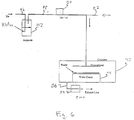
- Fig. 6 illustrates a system for the selective, in-situ, cleaning of metal oxides from a surface on a first metal level of an integrated circuit.
- Fig. 7 is a graph illustrating the relationship of Hhfac vapor pressure versus inverse temperature.
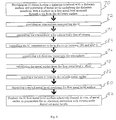
- Fig. 8 is a flow chart illustrating steps in a method for selectively cleaning metal oxides, in-situ, from a surface on a first metal level.
- Figs. 1 through 4 illustrate steps in the formation of an IC with a first metal level surface, prepared for a subsequent deposition of a second metal level, with a process for the selective, in-situ, cleaning of the first metal level surface of metal oxides.
- the metal oxides are cleaned with a ⁇ -diketone vapor in an atmosphere free of oxygen.
- Fig. 1 is a cross-sectional view of an IC 10.
- IC 10 consists of a dielectric interlevel 12 with a dielectric surface 14, and a plurality of metal levels underlying dielectric interlevel 12.
- Dielectric interlevel 14 is typically an electrical insulator such as an oxide or nitride of silicon, fluorinated carbon, or parylene (F or N).
- Underlying dielectric interlevel 12 is a barrier insulator layer 16, and underlying barrier insulator layer 16 is a first metal level 18.
- First metal level 18 is a metal selected from the group consisting of copper and silver.
- Underlying first metal level 18 is a barrier metal layer 20, and underlying barrier metal layer 20 is a layer of silicon 22.
- a number of materials may be used in the dielectric interlevels and barrier levels of IC 10, the materials chosen in Fig. 1, and the arrangement of the materials, are typical, but not exclusive, of those used in IC processes with first metal level 18.
- Barrier layers 16 and 20 are not required to enable the invention, but are included when it is important to prevent the migration of metal atoms from first metal level 18 to other sensitive IC circuit materials (not shown).
- IC 10 usually includes a variety of coupled electrical components such as transistors, capacitors, and resistors. Further, IC 10 includes assemblies of the above mentioned parts to create logic networks and integrated circuits.
- Fig. 1 is the first step in a damascene process of forming a metallic electrical interconnection to first metal level 18. That is, a via is to be formed from dielectric surface 14 to first metal level 18.
- One method of forming the via is to cover dielectric surface 14 with photoresist 24. Photoresist 24 is patterned so that a gap appears in the photoresist to expose dielectric surface 14. The via is to be formed in the area where dielectric surface 14 is exposed.
- IC 10 is etched to remove material from dielectric interlevel 12 below exposed dielectric surface 14.
- a fluorine, oxygen, or ozone plasma is typically used in the etching process.
- Fig. 2 is a cross-sectional view of IC 10 following the plasma etch step. Photoresist 24 has also been stripped away. As a result of the plasma etch performed in Fig. 1, various by-products and polymers 28 are formed on a first metal level surface 29 on first metal level 18, which is accessed from dielectric surface 14 through a via. By-products 28, formed as a result of etching dielectric interlevel 12 are often difficult to remove. A process operation referred to as ashing is often used to remove by-products 28. An oxygen or ozone plasma 30 isotropically etches by-products 28 from the via. In many processes, photoresist 24 (Fig. 1) and polymer by-products 28 are removed in the same step.
- Fig. 3 is a cross-sectional view of IC 10 following the process of ashing. Since the ashing operation involves the use of oxygen, metal oxides 32 are formed overlying first metal level surface 29. To remove metal oxide layer 32, a ⁇ -diketone vapor 34, such as Hhfac, is introduced. For example, when first metal level 18 is copper, Hhfac reacts with copper oxide to form water and the volatile Cu +2 (hfac) 2 complex. Since water is also volatile, CuO 32 is entirely removed from first metal level surface 29 in a vapor phase as shown below: CuO + 2Hhfac ⁇ Cu +2 (hfac) 2 + H 2 O
- ⁇ -diketone vapor 34 removes metal oxides 32 with a minimal loss of first metal level surface 29. To better appreciate the action of ⁇ -diketone vapor 34, a brief comparison is made to the cleaning action of fluorine and oxygen plasmas 26 and 30, below.
- Fluorine and oxygen plasma etchants, 26 and 30, depicted in Figs. 1 and 2 are anisotropic and relatively non-selective. That is, plasmas 26 and 30 are directional, removing intended target materials, and a portion of unintended target materials. IC 10 and a wafer chuck upon which IC 10 is mounted (not shown), must be suitably positioned in an ionized environment to direct the plasmas to intended targets.
- plasma 26 is directed perpendicular to dielectric surface 14 to form a via with minimum undercutting beneath photoresist layers 24.
- oxygen plasma 30 is directed to remove polymer layer 28 in the bottom of the via hole.
- Metal oxide layer 32 is likewise located in the bottom of the via. Care must be taken to protect sensitive surfaces that are not to be removed in the etching process.
- the ⁇ -diketone vapor is ubiquitous throughout the atmosphere in which IC 10 is placed, it works selectively to remove only metal oxide layer 32.
- the ⁇ -diketone is Hhfac.
- the cleaning by-products formed from the reaction of Hhfac with oxides of copper and silver are volatile. These volatile by-products are easily removed from first metal level surface 29 with a minimal loss of first metal level surface 29, and the area of IC 10 without breaking the chamber vacuum prior to the deposition of a subsequent metal layer.
- Fig. 4 is a cross-sectional view of IC 10 following the process for the selective, in-situ, cleaning of first metal level surface 29 of metal oxides 32 with ⁇ -diketone vapor 34 in an atmosphere free of oxygen, as shown in Fig. 3.
- First metal level surface 29 has not had an opportunity to form another layer of metal oxide, and is prepared for the subsequent deposition of a metal level.
- a second metal layer 36 overlies first metal level surface 29 in the via, and dielectric surface 14.
- Second metal layer 36 is deposited on first metal level surface 29, after the in-situ cleaning process shown in Fig. 3, to electrically communicate with first metal level 18.
- the in-situ cleaning process helps insure that a low resistance electrical interconnect, or interface, results between the two metal structures.
- Metal layer 36 is selected from the group of metals consisting of TiN, TiSi x N y , TaSi x N y , TaN, WN, WSi x N y , Ti, Ta, W, Cu, Al, Ag, and Au.
- second metal layer 36 is a barrier metal layer, such as barrier metal layer 20. It is used to prevent the migration of metal atoms from first metal level 18 into underlying semiconductor material (not shown). Second metal level 36 is conductive to electrically interface with a third metal level 38 deposited over second metal level 36. When it is not important to prevent the migration of metal atoms from first metal level 18, third metal level 38 is deposited on first metal level 18 without the barrier layer, second metal level 3G.
- second metal level 36 As the combination of second metal level 36 and third metal level 38 depicted in Fig. 4.
- Second metal layer 36 and third metal layer 38 have been introduced, above, as separate metal layers for the purposes of clarity, however, from this point on the second metal layer is understood to be the combination of layers 36 and 38.
- Hhfac vapor 34 selectively removes only metal oxides 32 from first metal level surface 29, a minimum of conductive material is removed from first metal level 18. This is an important consideration in IC fabrication, in many designs the first metal level is less than 0.5 microns thick.
- Hexafluoroacetylacetone or hfac is a particular example of a ⁇ -diketone.
- the prototypical example is the well known compound, acetylacetone or acac.
- This family of compounds is characterized by a molecular structure involving two carbonyl functional groups separated by a single carbon atom to which is attached at least one hydrogen atom.
- ⁇ -diketones are also characterized by keto-enol tautomerisms in which the enol form is stabilized by conjugated double bonds. This results in ⁇ -diketones having chemical properties of both ketones and enols.
- the conjugated nature of the double bonding implies significant delocalization of ⁇ -electrons.
- each ⁇ -diketone ligand coordinates twice with the metal atom to form a closed ring or chelated structure.
- the hydrogen atom involved in the keto-enol tautomerism is weakly bonded and, thus possesses significant acidic character.
- ⁇ -diketones readily form stable anions which can be combined with metallic cations to form stable complexes.
- the copper precursor (tmvs)(hfac)Cu(I) is an example of such a complex, however, many other types of these compounds exist and can be used for MOCVD.
- a specisc ⁇ -diketone as ligand in a MOCVD precursor is determined by the desirable characteristics of the resulting complex. Typically, such properties are thermal stability, high volatility, etc. Generally, it is found that hfac possesses such desirable properties, however, research continues into developing other ⁇ -diketones having even more desirable characteristics than hfac.
- Fig. 5 is a representation of the keto-enol tautomerisms.
- a compound such as a ⁇ -diketone exists in both keto and enol forms. That is, the ⁇ -diketone exists in all three forms, although is generally true that keto-acids are more stable. There is no preference between the right-most and leftmost enol forms.
- the O and OH groups are not predisposed in their carbon bonding to favor the formation of either enol form.
- bonds to R, R 1 , and X are selected from the set of groups consisting of C1 to C6 alkyls, perfluoroalkyls, and other substitutions which bond to the carbon atoms.
- the R and R 1 groups need not be the same.
- the number after the "C” refers to the number of carbon atoms in the alkyl group, for example, a C1 alkyl group contains 1 carbon atom.
- the X group is selected from the functional group consisting of H, F, CL, Br, I, alkyls, perfluoroalkyls, and substitutions which bond to the CH molecule. In Hhfac, for example, the R and R 1 groups are both F 3 , and the X functional group is H.
- Fig. 6 illustrates a system for the selective, in-situ, cleaning of metal oxides from a surface on a first metal level of an integrated circuit.
- the IC includes a dielectric interlevel with a dielectric surface, and a plurality of metal levels underlying the dielectric interlevel.
- the first metal level surface is accessed through a via from the dielectric surface to the first metal level.
- the system comprises a chamber 40 to control an atmosphere to be substantially free of oxygen during the cleaning and metal deposition process. The formation of metal oxides on the first metal level surface is, thus, minimized.
- chamber 40 is a cluster tool, or series of connected chambers sharing the same atmosphere.
- the system also comprises a bubbler 42 to introduce, or deliver, a ⁇ -diketone vapor into chamber 40.
- the system comprises a wafer chuck 44 located inside chamber 40, upon which the IC is mounted. Wafer chuck 44 has a predetermined temperature to control, or maintain, the temperature of the IC.
- the ⁇ -diketone volatilizes metal oxides on the surface of the first metal level in preparation for an electrical connection to subsequently deposited metal levels.
- Figs. 1-4 correspond to steps in the process of forming an interconnection in an IC that are carried out in a system such as the one depicted in Fig. 6.
- the first metal level of the IC prepared in the above system is a metal selected from the group consisting of copper and silver.
- the ⁇ -diketone vapor introduced by bubbler 42 is Hhfac, whereby metal oxides from the first metal level surface are volatilized for easy removal from chamber 40.
- Bubbler 42 delivers the Hhfac at a pressure of less than approximately 85 Torr at a temperature of approximately 20°C. It is the relative ease to which Hhfac is introduced to chamber 40 that gives the present invention much of its value.
- Bubbler 42 is a sealed ampule containing a ⁇ -diketone liquid such as Hhfac.
- the ampule is equipped with a gas inlet tube. The tube is inserted to below the surface of a liquid.
- a vapor output tube 48 is located at the top of bubbler 42 to draw away the Hhfac vapor.
- a carrier gas typically an inert gas such as He, is forced into inlet 46 at a predetermined flow rate and bubbled through the Hhfac. The carrier gas becomes saturated with the Hhfac vapor.
- the partial pressure of the Hhfac vapor in the carrier gas is determined, or controlled, by the temperature of the liquid.
- Fig. 7 is a graph illustrating the relationship of Hhfac vapor pressure versus inverse temperature. As shown in the graph, at room temperature (20°C) the corresponding Hhfac vapor pressure is approximately 85 Torr. This relationship shows that high vapor pressures can be achieved with no special preparation of the Hhfac liquid.
- a valve, mass flow controller (MFC), or orifice arrangement 50 located between bubbler 42 and chamber 40 is sufficient to control the amount of Hhfac that enters chamber 40.
- MFC mass flow controller
- wafer chuck 44 has a temperature is the range between 100 and 500°C. In this manner, the temperature of the IC is maintained in the range between 100 and 450°C during the cleaning and metal layer deposition processes.
- the system further comprises a liquid injector 52 to introduce liquid precursor compounds including metal into chamber 40.
- a second metal level is deposited on the first metal level surface, which is free of metal oxides, to facilitate a low resistance electrical connection. That is, after the process of cleaning metal oxides with the Hhfac, a liquid precursor is injected in line 52 to deposit the second metal level. Both the cleaning and the metal deposition processes are conducted in the oxygen-free environment of chamber 40, so that a minimum number of metal oxides are formed between steps.
- the second metal level overlying the first metal level surface is a metal selected from the group consisting of TiN, TiSi x N y , TaSi x N y , TaN, WN, WSi x N y , Ti, Ta, W, Cu, Al, Ag, and Au.
- a vapor delivery system introduces vapor precursor compounds including metal on line 52 into chamber 40.
- a second metal level is deposited on the first metal level surface, which is free of oxides, to facilitate a low resistance electrical interconnection.
- the second metal level overlying the first metal level surface is a metal selected from the group consisting of TiN, TiSi x N y , TaSi x N y , TaN, WN, WSi x N y , Ti, Ta, W, Cu, Al, Ag, and Au.
- This system also comprises a pump 54 to create a vacuum pressure in chamber 40.
- the volatile metal oxides of the first metal level surface are removed from chamber 40 through a line 56.
- Fig. 8 is a flow chart illustrating steps in a method for selectively cleaning metal oxides, in-situ, from a surface on a first metal level.
- Step 70 provides an IC circuit having a dielectric interlevel with a dielectric surface, and a plurality of metal levels underlying the dielectric interlevel. A surface on a first metal level is accessed through a via from the dielectric surface.
- Step 72 provides an atmosphere surrounding the IC.
- Step 74 controls the atmosphere to be substantially free of oxygen, whereby the formation of metal oxides on the first metal level surface is minimized.
- Step 76 introduces a ⁇ -diketone vapor into the atmosphere.
- Step 78 volatilizes the metal oxides from the first metal level surface using the ⁇ -diketone vapor introduced in step 76.
- step 80 deposits a second metal level overlying the first metal level surface to electrically interface to the first metal level surface, whereby the cleaning process facilitates a low resistance electrical connection.
- the second metal level is a metal selected from the group consisting of TiN, TiSi x N y , TaSi x N y , TaN, WN, WSi x N y , Ti, Ta, W, Cu, Al, Ag, and Au.
- Step 82 is a product, a multilevel interconnected integrated circuit having a first metal level surface selectively cleaned, in-situ, of metal oxides with a minimal amount of material removed from the first metal level surface.
- the first metal level surface is cleaned in preparation for an electrical connection with subsequently deposited metal levels.
- the first metal level is a metal selected from the group consisting of copper and silver. It is another aspect, that step 76 includes using Hhfac as the ⁇ -diketone to volatilize oxides on the conductive interlevel connection surface. Further, step 76 includes delivering the Hhfac at a pressure of less than approximately 85 Torr and a temperature of approximately 20°C.
- One aspect of the invention includes the further step 84, before step 76, of controlling the IC temperature to be in the range between 100 and 450°C.
- Another aspect of the invention includes the further step 86, following step 78, of, creating a vacuum to remove the volatile metal oxides obtained in step 78 from the atmosphere, whereby the cleaning by-products are easily removed from the area of the IC.
- the IC, method, and system described above have focused, for the purpose of greater clarity, on preparing a first metal layer to interconnect with a second, subsequently deposited, metal layer. It is typical to fabricate ICs with a large number of metal layers. Interconnections must be made to all these metal layers. It is understood that the Hhfac cleaning and metal deposition process is not limited to an IC having only two metal levels. The above described process is repeated for each metal level in an IC so that interconnections are made to every metal level in an IC having a large number of metal levels.
- the advantage of the present invention system of cleaning is that it is both simple and effective.
- the delivery system and preparation of the Hhfac is straightforward so it can be easily integrated into almost any IC process.
- This integration allows the cleaning to be conducted in-situ so that the IC is not exposed to oxygen prior to the deposition of the next metal layer.
- the above method simplifies the cleaning process because it is selective in reacting with only the oxides of copper or silver.
- the cleaning by-products are volatile, and easily removed from the IC environment.
- Subsequently deposited metal layers can be deposited from systems using either liquid or vapor precursors. Other variations and embodiments of the invention will occur to those skilled in the art.
Landscapes
- Chemical & Material Sciences (AREA)
- Chemical Kinetics & Catalysis (AREA)
- General Chemical & Material Sciences (AREA)
- Engineering & Computer Science (AREA)
- Materials Engineering (AREA)
- Mechanical Engineering (AREA)
- Metallurgy (AREA)
- Organic Chemistry (AREA)
- Internal Circuitry In Semiconductor Integrated Circuit Devices (AREA)
- Cleaning Or Drying Semiconductors (AREA)
- Electrodes Of Semiconductors (AREA)
- ing And Chemical Polishing (AREA)
- Drying Of Semiconductors (AREA)
- Weting (AREA)
Applications Claiming Priority (2)
| Application Number | Priority Date | Filing Date | Title |
|---|---|---|---|
| US861808 | 1977-12-19 | ||
| US08/861,808 US5939334A (en) | 1997-05-22 | 1997-05-22 | System and method of selectively cleaning copper substrate surfaces, in-situ, to remove copper oxides |
Publications (2)
| Publication Number | Publication Date |
|---|---|
| EP0880168A2 true EP0880168A2 (de) | 1998-11-25 |
| EP0880168A3 EP0880168A3 (de) | 1999-12-15 |
Family
ID=25336824
Family Applications (1)
| Application Number | Title | Priority Date | Filing Date |
|---|---|---|---|
| EP98304002A Ceased EP0880168A3 (de) | 1997-05-22 | 1998-05-20 | Verfahren und Vorrichtung zur selektiven in-situ Reinigung von Kupferoberflächen um Kupferoxiden zu entfernen |
Country Status (5)
| Country | Link |
|---|---|
| US (3) | US5939334A (de) |
| EP (1) | EP0880168A3 (de) |
| JP (1) | JPH10321594A (de) |
| KR (1) | KR100317508B1 (de) |
| TW (1) | TW408385B (de) |
Cited By (62)
| Publication number | Priority date | Publication date | Assignee | Title |
|---|---|---|---|---|
| EP0903781A3 (de) * | 1997-09-18 | 1999-07-21 | Ebara Corporation | Herstellungsverfahren und Struktur für eingebettete Kupferleitungsverbindung |
| WO2001024257A1 (en) * | 1999-09-30 | 2001-04-05 | Lam Research Corporation | Methods and apparatus for treating seed layer in copper interconnctions |
| WO2001088972A1 (en) * | 2000-05-15 | 2001-11-22 | Asm Microchemistry Oy | Process for producing integrated circuits |
| US6544585B1 (en) | 1997-09-02 | 2003-04-08 | Ebara Corporation | Method and apparatus for plating a substrate |
| US6679951B2 (en) | 2000-05-15 | 2004-01-20 | Asm Intenational N.V. | Metal anneal with oxidation prevention |
| US6878628B2 (en) | 2000-05-15 | 2005-04-12 | Asm International Nv | In situ reduction of copper oxide prior to silicon carbide deposition |
| US7067407B2 (en) | 2003-08-04 | 2006-06-27 | Asm International, N.V. | Method of growing electrical conductors |
| US7491634B2 (en) | 2006-04-28 | 2009-02-17 | Asm International N.V. | Methods for forming roughened surfaces and applications thereof |
| US7494927B2 (en) | 2000-05-15 | 2009-02-24 | Asm International N.V. | Method of growing electrical conductors |
| US7541284B2 (en) | 2006-02-15 | 2009-06-02 | Asm Genitech Korea Ltd. | Method of depositing Ru films having high density |
| US7563715B2 (en) | 2005-12-05 | 2009-07-21 | Asm International N.V. | Method of producing thin films |
| US7655564B2 (en) | 2007-12-12 | 2010-02-02 | Asm Japan, K.K. | Method for forming Ta-Ru liner layer for Cu wiring |
| US7666773B2 (en) | 2005-03-15 | 2010-02-23 | Asm International N.V. | Selective deposition of noble metal thin films |
| US7799674B2 (en) | 2008-02-19 | 2010-09-21 | Asm Japan K.K. | Ruthenium alloy film for copper interconnects |
| US7927942B2 (en) | 2008-12-19 | 2011-04-19 | Asm International N.V. | Selective silicide process |
| US7972977B2 (en) | 2006-10-05 | 2011-07-05 | Asm America, Inc. | ALD of metal silicate films |
| US8025922B2 (en) | 2005-03-15 | 2011-09-27 | Asm International N.V. | Enhanced deposition of noble metals |
| US8084104B2 (en) | 2008-08-29 | 2011-12-27 | Asm Japan K.K. | Atomic composition controlled ruthenium alloy film formed by plasma-enhanced atomic layer deposition |
| US8133555B2 (en) | 2008-10-14 | 2012-03-13 | Asm Japan K.K. | Method for forming metal film by ALD using beta-diketone metal complex |
| US8273408B2 (en) | 2007-10-17 | 2012-09-25 | Asm Genitech Korea Ltd. | Methods of depositing a ruthenium film |
| US8329569B2 (en) | 2009-07-31 | 2012-12-11 | Asm America, Inc. | Deposition of ruthenium or ruthenium dioxide |
| US8383525B2 (en) | 2008-04-25 | 2013-02-26 | Asm America, Inc. | Plasma-enhanced deposition process for forming a metal oxide thin film and related structures |
| US8545936B2 (en) | 2008-03-28 | 2013-10-01 | Asm International N.V. | Methods for forming carbon nanotubes |
| US9490145B2 (en) | 2015-02-23 | 2016-11-08 | Asm Ip Holding B.V. | Removal of surface passivation |
| US9607842B1 (en) | 2015-10-02 | 2017-03-28 | Asm Ip Holding B.V. | Methods of forming metal silicides |
| US9634106B2 (en) | 2008-12-19 | 2017-04-25 | Asm International N.V. | Doped metal germanide and methods for making the same |
| US9816180B2 (en) | 2015-02-03 | 2017-11-14 | Asm Ip Holding B.V. | Selective deposition |
| US9895715B2 (en) | 2014-02-04 | 2018-02-20 | Asm Ip Holding B.V. | Selective deposition of metals, metal oxides, and dielectrics |
| US9981286B2 (en) | 2016-03-08 | 2018-05-29 | Asm Ip Holding B.V. | Selective formation of metal silicides |
| US10014212B2 (en) | 2016-06-08 | 2018-07-03 | Asm Ip Holding B.V. | Selective deposition of metallic films |
| US10041166B2 (en) | 2016-06-08 | 2018-08-07 | Asm Ip Holding B.V. | Reaction chamber passivation and selective deposition of metallic films |
| US10047435B2 (en) | 2014-04-16 | 2018-08-14 | Asm Ip Holding B.V. | Dual selective deposition |
| US10049924B2 (en) | 2010-06-10 | 2018-08-14 | Asm International N.V. | Selective formation of metallic films on metallic surfaces |
| US10121699B2 (en) | 2015-08-05 | 2018-11-06 | Asm Ip Holding B.V. | Selective deposition of aluminum and nitrogen containing material |
| US10157786B2 (en) | 2011-12-09 | 2018-12-18 | Asm International N.V. | Selective formation of metallic films on metallic surfaces |
| US10204782B2 (en) | 2016-04-18 | 2019-02-12 | Imec Vzw | Combined anneal and selective deposition process |
| US10343186B2 (en) | 2015-10-09 | 2019-07-09 | Asm Ip Holding B.V. | Vapor phase deposition of organic films |
| US10373820B2 (en) | 2016-06-01 | 2019-08-06 | Asm Ip Holding B.V. | Deposition of organic films |
| US10428421B2 (en) | 2015-08-03 | 2019-10-01 | Asm Ip Holding B.V. | Selective deposition on metal or metallic surfaces relative to dielectric surfaces |
| US10453701B2 (en) | 2016-06-01 | 2019-10-22 | Asm Ip Holding B.V. | Deposition of organic films |
| US10553440B2 (en) | 2008-12-19 | 2020-02-04 | Asm International N.V. | Methods for depositing nickel films and for making nickel silicide and nickel germanide |
| US10551741B2 (en) | 2016-04-18 | 2020-02-04 | Asm Ip Holding B.V. | Method of forming a directed self-assembled layer on a substrate |
| US10566185B2 (en) | 2015-08-05 | 2020-02-18 | Asm Ip Holding B.V. | Selective deposition of aluminum and nitrogen containing material |
| CN111041502A (zh) * | 2019-12-25 | 2020-04-21 | 安徽力翔电池科技有限公司 | 一种无氧铜的清洗工艺 |
| US10695794B2 (en) | 2015-10-09 | 2020-06-30 | Asm Ip Holding B.V. | Vapor phase deposition of organic films |
| US10814349B2 (en) | 2015-10-09 | 2020-10-27 | Asm Ip Holding B.V. | Vapor phase deposition of organic films |
| US10872765B2 (en) | 2018-05-02 | 2020-12-22 | Asm Ip Holding B.V. | Selective layer formation using deposition and removing |
| US10900120B2 (en) | 2017-07-14 | 2021-01-26 | Asm Ip Holding B.V. | Passivation against vapor deposition |
| US11081342B2 (en) | 2016-05-05 | 2021-08-03 | Asm Ip Holding B.V. | Selective deposition using hydrophobic precursors |
| US11094535B2 (en) | 2017-02-14 | 2021-08-17 | Asm Ip Holding B.V. | Selective passivation and selective deposition |
| US11139163B2 (en) | 2019-10-31 | 2021-10-05 | Asm Ip Holding B.V. | Selective deposition of SiOC thin films |
| US11145506B2 (en) | 2018-10-02 | 2021-10-12 | Asm Ip Holding B.V. | Selective passivation and selective deposition |
| US11170993B2 (en) | 2017-05-16 | 2021-11-09 | Asm Ip Holding B.V. | Selective PEALD of oxide on dielectric |
| US11430656B2 (en) | 2016-11-29 | 2022-08-30 | Asm Ip Holding B.V. | Deposition of oxide thin films |
| US11501965B2 (en) | 2017-05-05 | 2022-11-15 | Asm Ip Holding B.V. | Plasma enhanced deposition processes for controlled formation of metal oxide thin films |
| US11608557B2 (en) | 2020-03-30 | 2023-03-21 | Asm Ip Holding B.V. | Simultaneous selective deposition of two different materials on two different surfaces |
| US11643720B2 (en) | 2020-03-30 | 2023-05-09 | Asm Ip Holding B.V. | Selective deposition of silicon oxide on metal surfaces |
| US11898240B2 (en) | 2020-03-30 | 2024-02-13 | Asm Ip Holding B.V. | Selective deposition of silicon oxide on dielectric surfaces relative to metal surfaces |
| US11965238B2 (en) | 2019-04-12 | 2024-04-23 | Asm Ip Holding B.V. | Selective deposition of metal oxides on metal surfaces |
| US12354877B2 (en) | 2020-06-24 | 2025-07-08 | Asm Ip Holding B.V. | Vapor deposition of films comprising molybdenum |
| US12359315B2 (en) | 2019-02-14 | 2025-07-15 | Asm Ip Holding B.V. | Deposition of oxides and nitrides |
| US12482648B2 (en) | 2018-10-02 | 2025-11-25 | Asm Ip Holding B.V. | Selective passivation and selective deposition |
Families Citing this family (57)
| Publication number | Priority date | Publication date | Assignee | Title |
|---|---|---|---|---|
| US6080526A (en) * | 1997-03-24 | 2000-06-27 | Alliedsignal Inc. | Integration of low-k polymers into interlevel dielectrics using controlled electron-beam radiation |
| US5939334A (en) * | 1997-05-22 | 1999-08-17 | Sharp Laboratories Of America, Inc. | System and method of selectively cleaning copper substrate surfaces, in-situ, to remove copper oxides |
| TW408443B (en) * | 1998-06-08 | 2000-10-11 | United Microelectronics Corp | The manufacture method of dual damascene |
| US6127258A (en) | 1998-06-25 | 2000-10-03 | Motorola Inc. | Method for forming a semiconductor device |
| US6284052B2 (en) * | 1998-08-19 | 2001-09-04 | Sharp Laboratories Of America, Inc. | In-situ method of cleaning a metal-organic chemical vapor deposition chamber |
| US6218303B1 (en) * | 1998-12-11 | 2001-04-17 | Vlsi Technology, Inc. | Via formation using oxide reduction of underlying copper |
| KR100322545B1 (ko) * | 1999-02-10 | 2002-03-18 | 윤종용 | 건식 세정 공정을 전 공정으로 이용하는 반도체 장치의콘택홀 채움 방법 |
| US6352081B1 (en) * | 1999-07-09 | 2002-03-05 | Applied Materials, Inc. | Method of cleaning a semiconductor device processing chamber after a copper etch process |
| US6475276B1 (en) | 1999-10-15 | 2002-11-05 | Asm Microchemistry Oy | Production of elemental thin films using a boron-containing reducing agent |
| US6352938B2 (en) * | 1999-12-09 | 2002-03-05 | United Microelectronics Corp. | Method of removing photoresist and reducing native oxide in dual damascene copper process |
| US20020072228A1 (en) * | 1999-12-15 | 2002-06-13 | Texas A&M University System | Semiconductor conductive pattern formation method |
| US6653243B2 (en) * | 2000-05-25 | 2003-11-25 | Micron Technology, Inc. | Methods of cleaning surfaces of copper-containing materials, and methods of forming openings to copper-containing substrates |
| US6261955B1 (en) | 2000-07-18 | 2001-07-17 | Chartered Semiconductor Manufacturing Ltd. | Application of vapor phase HFACAC-based compound for use in copper decontamination and cleaning processes |
| KR100673664B1 (ko) * | 2000-07-31 | 2007-01-23 | 주식회사 하이닉스반도체 | 반도체 소자의 구리 산화물 제거 방법 |
| US6602653B1 (en) * | 2000-08-25 | 2003-08-05 | Micron Technology, Inc. | Conductive material patterning methods |
| KR100671610B1 (ko) * | 2000-10-26 | 2007-01-18 | 주식회사 하이닉스반도체 | 반도체 소자의 금속 배선 형성 방법 |
| DE10059167A1 (de) * | 2000-11-29 | 2002-06-06 | Bsh Bosch Siemens Hausgeraete | Backofen |
| JP4333900B2 (ja) * | 2000-11-30 | 2009-09-16 | エーエスエム インターナショナル エヌ.ヴェー. | 磁気メモリセル、磁気構造体及び磁気素子の製造方法、並びに磁気構造体用金属層の成長方法 |
| KR20020056342A (ko) * | 2000-12-29 | 2002-07-10 | 박종섭 | 챔버 내부의 잔류물 제거 방법 |
| US9139906B2 (en) * | 2001-03-06 | 2015-09-22 | Asm America, Inc. | Doping with ALD technology |
| US6730605B2 (en) * | 2001-04-12 | 2004-05-04 | Tokyo Electron Limited | Redistribution of copper deposited films |
| US6759081B2 (en) | 2001-05-11 | 2004-07-06 | Asm International, N.V. | Method of depositing thin films for magnetic heads |
| US6673721B1 (en) * | 2001-07-02 | 2004-01-06 | Lsi Logic Corporation | Process for removal of photoresist mask used for making vias in low k carbon-doped silicon oxide dielectric material, and for removal of etch residues from formation of vias and removal of photoresist mask |
| AU2002333601A1 (en) * | 2001-09-14 | 2003-04-01 | Asm America, Inc. | Metal nitride deposition by ald using gettering reactant |
| US6589882B2 (en) * | 2001-10-24 | 2003-07-08 | Micron Technology, Inc. | Copper post-etch cleaning process |
| US6929637B2 (en) * | 2002-02-21 | 2005-08-16 | Spiration, Inc. | Device and method for intra-bronchial provision of a therapeutic agent |
| US20040129212A1 (en) * | 2002-05-20 | 2004-07-08 | Gadgil Pradad N. | Apparatus and method for delivery of reactive chemical precursors to the surface to be treated |
| US7459103B2 (en) | 2002-05-23 | 2008-12-02 | Columbian Chemicals Company | Conducting polymer-grafted carbon material for fuel cell applications |
| US7241334B2 (en) * | 2002-05-23 | 2007-07-10 | Columbian Chemicals Company | Sulfonated carbonaceous materials |
| CN100339913C (zh) | 2002-05-23 | 2007-09-26 | 哥伦比亚化学公司 | 用于燃料电池的、磺化导电聚合物接枝的碳材料 |
| US7195834B2 (en) * | 2002-05-23 | 2007-03-27 | Columbian Chemicals Company | Metallized conducting polymer-grafted carbon material and method for making |
| US7390441B2 (en) * | 2002-05-23 | 2008-06-24 | Columbian Chemicals Company | Sulfonated conducting polymer-grafted carbon material for fuel cell applications |
| EP1509929A4 (de) * | 2002-05-23 | 2007-03-21 | Columbian Chem | Leitungs-graftpolymerkohlenstoffmaterial für brennstoffzellenanwendungen |
| US20040118812A1 (en) * | 2002-08-09 | 2004-06-24 | Watkins James J. | Etch method using supercritical fluids |
| US20050142885A1 (en) * | 2002-08-30 | 2005-06-30 | Tokyo Electron Limited | Method of etching and etching apparatus |
| JP2006501651A (ja) * | 2002-09-27 | 2006-01-12 | 東京エレクトロン株式会社 | High−k誘電材料をエッチングするための方法及びシステム |
| US6843893B2 (en) * | 2002-12-12 | 2005-01-18 | International Business Machines Corporation | Metal dry etch using electronic field |
| WO2005017963A2 (en) * | 2003-08-04 | 2005-02-24 | Asm America, Inc. | Surface preparation prior to deposition on germanium |
| EP1673802A1 (de) * | 2003-10-14 | 2006-06-28 | EKC Technology, INC. | Entfernung von nachätzresten und kupferverunreinigungen von dielektrika mit niedrigem k durch verwendung von superkritischem co sb 2 /sb mit diketonzusatzstoffen |
| CN1312745C (zh) * | 2003-12-16 | 2007-04-25 | 上海华虹(集团)有限公司 | 一种去除铜籽晶表面氧化膜及增强铜层黏附力的前处理方法 |
| US6958308B2 (en) * | 2004-03-16 | 2005-10-25 | Columbian Chemicals Company | Deposition of dispersed metal particles onto substrates using supercritical fluids |
| US20050210455A1 (en) * | 2004-03-18 | 2005-09-22 | International Business Machines Corporation | Method for generating an executable workflow code from an unstructured cyclic process model |
| US20060019493A1 (en) * | 2004-07-15 | 2006-01-26 | Li Wei M | Methods of metallization for microelectronic devices utilizing metal oxide |
| US20060068987A1 (en) * | 2004-09-24 | 2006-03-30 | Srinivas Bollepalli | Carbon supported catalyst having reduced water retention |
| US20060177601A1 (en) * | 2005-02-10 | 2006-08-10 | Hyung-Sang Park | Method of forming a ruthenium thin film using a plasma enhanced atomic layer deposition apparatus and the method thereof |
| JP2008532271A (ja) * | 2005-02-22 | 2008-08-14 | エーエスエム アメリカ インコーポレイテッド | 原子層堆積のための表面のプラズマ前処理 |
| US7367343B2 (en) * | 2006-01-23 | 2008-05-06 | Micron Technology, Inc. | Method of cleaning a surface of a cobalt-containing material, method of forming an opening to a cobalt-containing material, semiconductor processing method of forming an integrated circuit comprising a copper-containing conductive line, and a cobalt-containing film cleaning solution |
| JP4579181B2 (ja) * | 2006-03-24 | 2010-11-10 | 富士通セミコンダクター株式会社 | 多層配線における配線の還元方法、多層配線の製造方法、並びに、半導体装置の製造方法 |
| US8138095B2 (en) * | 2006-03-27 | 2012-03-20 | Tokyo Electron Limited | Method of substrate treatment, process for producing semiconductor device, substrate treating apparatus, and recording medium |
| KR100832704B1 (ko) * | 2006-12-21 | 2008-05-28 | 동부일렉트로닉스 주식회사 | 반도체 소자 및 그 제조 방법 |
| US8324104B2 (en) * | 2008-04-11 | 2012-12-04 | Freescale Semiconductor, Inc. | Surface treatment in semiconductor manufacturing |
| US7871935B2 (en) * | 2008-04-23 | 2011-01-18 | International Business Machines Corporation | Non-plasma capping layer for interconnect applications |
| JP6529371B2 (ja) * | 2015-07-27 | 2019-06-12 | 東京エレクトロン株式会社 | エッチング方法及びエッチング装置 |
| US9805974B1 (en) | 2016-06-08 | 2017-10-31 | Asm Ip Holding B.V. | Selective deposition of metallic films |
| US9947582B1 (en) | 2017-06-02 | 2018-04-17 | Asm Ip Holding B.V. | Processes for preventing oxidation of metal thin films |
| CN114026674B (zh) * | 2019-06-24 | 2025-11-07 | 朗姆研究公司 | 衬底表面的蒸气清洁 |
| JPWO2022149565A1 (de) * | 2021-01-07 | 2022-07-14 |
Family Cites Families (23)
| Publication number | Priority date | Publication date | Assignee | Title |
|---|---|---|---|---|
| US5019531A (en) * | 1988-05-23 | 1991-05-28 | Nippon Telegraph And Telephone Corporation | Process for selectively growing thin metallic film of copper or gold |
| US5094701A (en) * | 1990-03-30 | 1992-03-10 | Air Products And Chemicals, Inc. | Cleaning agents comprising beta-diketone and beta-ketoimine ligands and a process for using the same |
| US5820664A (en) * | 1990-07-06 | 1998-10-13 | Advanced Technology Materials, Inc. | Precursor compositions for chemical vapor deposition, and ligand exchange resistant metal-organic precursor solutions comprising same |
| US5098516A (en) * | 1990-12-31 | 1992-03-24 | Air Products And Chemicals, Inc. | Processes for the chemical vapor deposition of copper and etching of copper |
| US5218303A (en) * | 1991-10-11 | 1993-06-08 | Boris Medvinsky | Broad span dynamic precious metal assay method by driving electrical pulses through an electrolyte wet junction |
| JP2885616B2 (ja) * | 1992-07-31 | 1999-04-26 | 株式会社東芝 | 半導体装置およびその製造方法 |
| KR0139876B1 (ko) * | 1993-09-14 | 1998-08-17 | 사토 후미오 | 금속산화막의 형성방법 |
| JP2862797B2 (ja) * | 1994-08-11 | 1999-03-03 | 日本酸素株式会社 | 半導体基板の乾式洗浄方法 |
| US5736002A (en) * | 1994-08-22 | 1998-04-07 | Sharp Microelectronics Technology, Inc. | Methods and equipment for anisotropic, patterned conversion of copper into selectively removable compounds and for removal of same |
| US5705443A (en) * | 1995-05-30 | 1998-01-06 | Advanced Technology Materials, Inc. | Etching method for refractory materials |
| JP3094868B2 (ja) * | 1995-09-07 | 2000-10-03 | 三菱マテリアル株式会社 | 高純度誘電体薄膜の作製方法 |
| US5821169A (en) * | 1996-08-05 | 1998-10-13 | Sharp Microelectronics Technology,Inc. | Hard mask method for transferring a multi-level photoresist pattern |
| US5851367A (en) * | 1996-10-11 | 1998-12-22 | Sharp Microelectronics Technology, Inc. | Differential copper deposition on integrated circuit surfaces and method for same |
| US5744192A (en) * | 1996-11-08 | 1998-04-28 | Sharp Microelectronics Technology, Inc. | Method of using water vapor to increase the conductivity of cooper desposited with cu(hfac)TMVS |
| US5789027A (en) * | 1996-11-12 | 1998-08-04 | University Of Massachusetts | Method of chemically depositing material onto a substrate |
| US5767301A (en) * | 1997-01-21 | 1998-06-16 | Sharp Microelectronics Technology, Inc. | Precursor with (alkyloxy)(alkyl)-silylolefin ligand to deposit copper |
| US5939334A (en) * | 1997-05-22 | 1999-08-17 | Sharp Laboratories Of America, Inc. | System and method of selectively cleaning copper substrate surfaces, in-situ, to remove copper oxides |
| TW460943B (en) * | 1997-06-11 | 2001-10-21 | Applied Materials Inc | Reduction of mobile ion and metal contamination in HDP-CVD chambers using chamber seasoning film depositions |
| US6204176B1 (en) * | 1998-11-10 | 2001-03-20 | Sharp Laboratories Of America, Inc. | Substituted phenylethylene precursor deposition method |
| US6207577B1 (en) * | 1999-01-27 | 2001-03-27 | Advanced Micro Devices, Inc. | Self-aligned dual damascene arrangement for metal interconnection with oxide dielectric layer and low k dielectric constant layer |
| US6380091B1 (en) * | 1999-01-27 | 2002-04-30 | Advanced Micro Devices, Inc. | Dual damascene arrangement for metal interconnection with oxide dielectric layer and low K dielectric constant layer |
| TW445581B (en) * | 1999-03-03 | 2001-07-11 | Taiwan Semiconductor Mfg | Manufacturing method of metal interconnect |
| US6261955B1 (en) * | 2000-07-18 | 2001-07-17 | Chartered Semiconductor Manufacturing Ltd. | Application of vapor phase HFACAC-based compound for use in copper decontamination and cleaning processes |
-
1997
- 1997-05-22 US US08/861,808 patent/US5939334A/en not_active Expired - Lifetime
-
1998
- 1998-02-19 JP JP10037122A patent/JPH10321594A/ja active Pending
- 1998-05-13 TW TW087107408A patent/TW408385B/zh not_active IP Right Cessation
- 1998-05-20 EP EP98304002A patent/EP0880168A3/de not_active Ceased
- 1998-05-22 KR KR1019980019359A patent/KR100317508B1/ko not_active Expired - Fee Related
-
1999
- 1999-03-15 US US09/270,901 patent/US6281589B1/en not_active Expired - Lifetime
-
2001
- 2001-08-27 US US09/941,023 patent/US6555916B2/en not_active Expired - Fee Related
Cited By (119)
| Publication number | Priority date | Publication date | Assignee | Title |
|---|---|---|---|---|
| US6544585B1 (en) | 1997-09-02 | 2003-04-08 | Ebara Corporation | Method and apparatus for plating a substrate |
| EP0903781A3 (de) * | 1997-09-18 | 1999-07-21 | Ebara Corporation | Herstellungsverfahren und Struktur für eingebettete Kupferleitungsverbindung |
| WO2001024257A1 (en) * | 1999-09-30 | 2001-04-05 | Lam Research Corporation | Methods and apparatus for treating seed layer in copper interconnctions |
| US6423200B1 (en) * | 1999-09-30 | 2002-07-23 | Lam Research Corporation | Copper interconnect seed layer treatment methods and apparatuses for treating the same |
| US6679951B2 (en) | 2000-05-15 | 2004-01-20 | Asm Intenational N.V. | Metal anneal with oxidation prevention |
| US6482740B2 (en) | 2000-05-15 | 2002-11-19 | Asm Microchemistry Oy | Method of growing electrical conductors by reducing metal oxide film with organic compound containing -OH, -CHO, or -COOH |
| US8536058B2 (en) | 2000-05-15 | 2013-09-17 | Asm International N.V. | Method of growing electrical conductors |
| US6878628B2 (en) | 2000-05-15 | 2005-04-12 | Asm International Nv | In situ reduction of copper oxide prior to silicon carbide deposition |
| US6887795B2 (en) | 2000-05-15 | 2005-05-03 | Asm International N.V. | Method of growing electrical conductors |
| US6921712B2 (en) | 2000-05-15 | 2005-07-26 | Asm International Nv | Process for producing integrated circuits including reduction using gaseous organic compounds |
| US7955979B2 (en) | 2000-05-15 | 2011-06-07 | Asm International N.V. | Method of growing electrical conductors |
| US7241677B2 (en) | 2000-05-15 | 2007-07-10 | Asm International N.V. | Process for producing integrated circuits including reduction using gaseous organic compounds |
| KR100775159B1 (ko) * | 2000-05-15 | 2007-11-12 | 에이에스엠 인터내셔널 엔.붸. | 집적회로의 생산 공정 |
| WO2001088972A1 (en) * | 2000-05-15 | 2001-11-22 | Asm Microchemistry Oy | Process for producing integrated circuits |
| US7494927B2 (en) | 2000-05-15 | 2009-02-24 | Asm International N.V. | Method of growing electrical conductors |
| US7067407B2 (en) | 2003-08-04 | 2006-06-27 | Asm International, N.V. | Method of growing electrical conductors |
| US7666773B2 (en) | 2005-03-15 | 2010-02-23 | Asm International N.V. | Selective deposition of noble metal thin films |
| US8025922B2 (en) | 2005-03-15 | 2011-09-27 | Asm International N.V. | Enhanced deposition of noble metals |
| US7985669B2 (en) | 2005-03-15 | 2011-07-26 | Asm International N.V. | Selective deposition of noble metal thin films |
| US7563715B2 (en) | 2005-12-05 | 2009-07-21 | Asm International N.V. | Method of producing thin films |
| US7541284B2 (en) | 2006-02-15 | 2009-06-02 | Asm Genitech Korea Ltd. | Method of depositing Ru films having high density |
| US7923382B2 (en) | 2006-04-28 | 2011-04-12 | Asm International N.V. | Method for forming roughened surface |
| US7491634B2 (en) | 2006-04-28 | 2009-02-17 | Asm International N.V. | Methods for forming roughened surfaces and applications thereof |
| US8252703B2 (en) | 2006-04-28 | 2012-08-28 | Asm International N.V. | Methods for forming roughened surfaces and applications thereof |
| US7972977B2 (en) | 2006-10-05 | 2011-07-05 | Asm America, Inc. | ALD of metal silicate films |
| US8563444B2 (en) | 2006-10-05 | 2013-10-22 | Asm America, Inc. | ALD of metal silicate films |
| US8273408B2 (en) | 2007-10-17 | 2012-09-25 | Asm Genitech Korea Ltd. | Methods of depositing a ruthenium film |
| US7655564B2 (en) | 2007-12-12 | 2010-02-02 | Asm Japan, K.K. | Method for forming Ta-Ru liner layer for Cu wiring |
| US7799674B2 (en) | 2008-02-19 | 2010-09-21 | Asm Japan K.K. | Ruthenium alloy film for copper interconnects |
| US8545936B2 (en) | 2008-03-28 | 2013-10-01 | Asm International N.V. | Methods for forming carbon nanotubes |
| US8383525B2 (en) | 2008-04-25 | 2013-02-26 | Asm America, Inc. | Plasma-enhanced deposition process for forming a metal oxide thin film and related structures |
| US8084104B2 (en) | 2008-08-29 | 2011-12-27 | Asm Japan K.K. | Atomic composition controlled ruthenium alloy film formed by plasma-enhanced atomic layer deposition |
| US8133555B2 (en) | 2008-10-14 | 2012-03-13 | Asm Japan K.K. | Method for forming metal film by ALD using beta-diketone metal complex |
| US8293597B2 (en) | 2008-12-19 | 2012-10-23 | Asm International N.V. | Selective silicide process |
| US7927942B2 (en) | 2008-12-19 | 2011-04-19 | Asm International N.V. | Selective silicide process |
| US10553440B2 (en) | 2008-12-19 | 2020-02-04 | Asm International N.V. | Methods for depositing nickel films and for making nickel silicide and nickel germanide |
| US9634106B2 (en) | 2008-12-19 | 2017-04-25 | Asm International N.V. | Doped metal germanide and methods for making the same |
| US8329569B2 (en) | 2009-07-31 | 2012-12-11 | Asm America, Inc. | Deposition of ruthenium or ruthenium dioxide |
| US10049924B2 (en) | 2010-06-10 | 2018-08-14 | Asm International N.V. | Selective formation of metallic films on metallic surfaces |
| US10043880B2 (en) | 2011-04-22 | 2018-08-07 | Asm International N.V. | Metal silicide, metal germanide, methods for making the same |
| US11056385B2 (en) | 2011-12-09 | 2021-07-06 | Asm International N.V. | Selective formation of metallic films on metallic surfaces |
| US10157786B2 (en) | 2011-12-09 | 2018-12-18 | Asm International N.V. | Selective formation of metallic films on metallic surfaces |
| US10456808B2 (en) | 2014-02-04 | 2019-10-29 | Asm Ip Holding B.V. | Selective deposition of metals, metal oxides, and dielectrics |
| US11975357B2 (en) | 2014-02-04 | 2024-05-07 | Asm Ip Holding B.V. | Selective deposition of metals, metal oxides, and dielectrics |
| US9895715B2 (en) | 2014-02-04 | 2018-02-20 | Asm Ip Holding B.V. | Selective deposition of metals, metal oxides, and dielectrics |
| US11213853B2 (en) | 2014-02-04 | 2022-01-04 | Asm Ip Holding B.V. | Selective deposition of metals, metal oxides, and dielectrics |
| US10443123B2 (en) | 2014-04-16 | 2019-10-15 | Asm Ip Holding B.V. | Dual selective deposition |
| US10047435B2 (en) | 2014-04-16 | 2018-08-14 | Asm Ip Holding B.V. | Dual selective deposition |
| US11525184B2 (en) | 2014-04-16 | 2022-12-13 | Asm Ip Holding B.V. | Dual selective deposition |
| US11047040B2 (en) | 2014-04-16 | 2021-06-29 | Asm Ip Holding B.V. | Dual selective deposition |
| US9816180B2 (en) | 2015-02-03 | 2017-11-14 | Asm Ip Holding B.V. | Selective deposition |
| US11062914B2 (en) | 2015-02-23 | 2021-07-13 | Asm Ip Holding B.V. | Removal of surface passivation |
| US10115603B2 (en) | 2015-02-23 | 2018-10-30 | Asm Ip Holding B.V. | Removal of surface passivation |
| US9490145B2 (en) | 2015-02-23 | 2016-11-08 | Asm Ip Holding B.V. | Removal of surface passivation |
| US10741411B2 (en) | 2015-02-23 | 2020-08-11 | Asm Ip Holding B.V. | Removal of surface passivation |
| US11174550B2 (en) | 2015-08-03 | 2021-11-16 | Asm Ip Holding B.V. | Selective deposition on metal or metallic surfaces relative to dielectric surfaces |
| US10428421B2 (en) | 2015-08-03 | 2019-10-01 | Asm Ip Holding B.V. | Selective deposition on metal or metallic surfaces relative to dielectric surfaces |
| US10903113B2 (en) | 2015-08-05 | 2021-01-26 | Asm Ip Holding B.V. | Selective deposition of aluminum and nitrogen containing material |
| US10847361B2 (en) | 2015-08-05 | 2020-11-24 | Asm Ip Holding B.V. | Selective deposition of aluminum and nitrogen containing material |
| US10553482B2 (en) | 2015-08-05 | 2020-02-04 | Asm Ip Holding B.V. | Selective deposition of aluminum and nitrogen containing material |
| US10566185B2 (en) | 2015-08-05 | 2020-02-18 | Asm Ip Holding B.V. | Selective deposition of aluminum and nitrogen containing material |
| US10121699B2 (en) | 2015-08-05 | 2018-11-06 | Asm Ip Holding B.V. | Selective deposition of aluminum and nitrogen containing material |
| US10199234B2 (en) | 2015-10-02 | 2019-02-05 | Asm Ip Holding B.V. | Methods of forming metal silicides |
| US9607842B1 (en) | 2015-10-02 | 2017-03-28 | Asm Ip Holding B.V. | Methods of forming metal silicides |
| US12138654B2 (en) | 2015-10-09 | 2024-11-12 | Asm Ip Holding B.V. | Vapor phase deposition of organic films |
| US11389824B2 (en) | 2015-10-09 | 2022-07-19 | Asm Ip Holding B.V. | Vapor phase deposition of organic films |
| US10695794B2 (en) | 2015-10-09 | 2020-06-30 | Asm Ip Holding B.V. | Vapor phase deposition of organic films |
| US10343186B2 (en) | 2015-10-09 | 2019-07-09 | Asm Ip Holding B.V. | Vapor phase deposition of organic films |
| US10814349B2 (en) | 2015-10-09 | 2020-10-27 | Asm Ip Holding B.V. | Vapor phase deposition of organic films |
| US11654454B2 (en) | 2015-10-09 | 2023-05-23 | Asm Ip Holding B.V. | Vapor phase deposition of organic films |
| US11446699B2 (en) | 2015-10-09 | 2022-09-20 | Asm Ip Holding B.V. | Vapor phase deposition of organic films |
| US12134108B2 (en) | 2015-10-09 | 2024-11-05 | Asm Ip Holding B.V. | Vapor phase deposition of organic films |
| US9981286B2 (en) | 2016-03-08 | 2018-05-29 | Asm Ip Holding B.V. | Selective formation of metal silicides |
| US10741394B2 (en) | 2016-04-18 | 2020-08-11 | Asm Ip Holding B.V. | Combined anneal and selective deposition process |
| US10551741B2 (en) | 2016-04-18 | 2020-02-04 | Asm Ip Holding B.V. | Method of forming a directed self-assembled layer on a substrate |
| US10204782B2 (en) | 2016-04-18 | 2019-02-12 | Imec Vzw | Combined anneal and selective deposition process |
| US12080548B2 (en) | 2016-05-05 | 2024-09-03 | Asm Ip Holding B.V. | Selective deposition using hydrophobic precursors |
| US11081342B2 (en) | 2016-05-05 | 2021-08-03 | Asm Ip Holding B.V. | Selective deposition using hydrophobic precursors |
| US10453701B2 (en) | 2016-06-01 | 2019-10-22 | Asm Ip Holding B.V. | Deposition of organic films |
| US12205820B2 (en) | 2016-06-01 | 2025-01-21 | Asm Ip Holding B.V. | Deposition of organic films |
| US11728175B2 (en) | 2016-06-01 | 2023-08-15 | Asm Ip Holding B.V. | Deposition of organic films |
| US10373820B2 (en) | 2016-06-01 | 2019-08-06 | Asm Ip Holding B.V. | Deposition of organic films |
| US12300505B2 (en) | 2016-06-01 | 2025-05-13 | Asm Ip Holding B.V. | Deposition of organic films |
| US10923361B2 (en) | 2016-06-01 | 2021-02-16 | Asm Ip Holding B.V. | Deposition of organic films |
| US10854460B2 (en) | 2016-06-01 | 2020-12-01 | Asm Ip Holding B.V. | Deposition of organic films |
| US11387107B2 (en) | 2016-06-01 | 2022-07-12 | Asm Ip Holding B.V. | Deposition of organic films |
| US10014212B2 (en) | 2016-06-08 | 2018-07-03 | Asm Ip Holding B.V. | Selective deposition of metallic films |
| US10480064B2 (en) | 2016-06-08 | 2019-11-19 | Asm Ip Holding B.V. | Reaction chamber passivation and selective deposition of metallic films |
| US10041166B2 (en) | 2016-06-08 | 2018-08-07 | Asm Ip Holding B.V. | Reaction chamber passivation and selective deposition of metallic films |
| US10793946B1 (en) | 2016-06-08 | 2020-10-06 | Asm Ip Holding B.V. | Reaction chamber passivation and selective deposition of metallic films |
| US12154785B2 (en) | 2016-11-29 | 2024-11-26 | Asm Ip Holding B.V. | Deposition of oxide thin films |
| US11430656B2 (en) | 2016-11-29 | 2022-08-30 | Asm Ip Holding B.V. | Deposition of oxide thin films |
| US11094535B2 (en) | 2017-02-14 | 2021-08-17 | Asm Ip Holding B.V. | Selective passivation and selective deposition |
| US12170197B2 (en) | 2017-02-14 | 2024-12-17 | Asm Ip Holding B.V. | Selective passivation and selective deposition |
| US11501965B2 (en) | 2017-05-05 | 2022-11-15 | Asm Ip Holding B.V. | Plasma enhanced deposition processes for controlled formation of metal oxide thin films |
| US11170993B2 (en) | 2017-05-16 | 2021-11-09 | Asm Ip Holding B.V. | Selective PEALD of oxide on dielectric |
| US11728164B2 (en) | 2017-05-16 | 2023-08-15 | Asm Ip Holding B.V. | Selective PEALD of oxide on dielectric |
| US10900120B2 (en) | 2017-07-14 | 2021-01-26 | Asm Ip Holding B.V. | Passivation against vapor deposition |
| US11396701B2 (en) | 2017-07-14 | 2022-07-26 | Asm Ip Holding B.V. | Passivation against vapor deposition |
| US11739422B2 (en) | 2017-07-14 | 2023-08-29 | Asm Ip Holding B.V. | Passivation against vapor deposition |
| US11804373B2 (en) | 2018-05-02 | 2023-10-31 | ASM IP Holding, B.V. | Selective layer formation using deposition and removing |
| US11501966B2 (en) | 2018-05-02 | 2022-11-15 | Asm Ip Holding B.V. | Selective layer formation using deposition and removing |
| US10872765B2 (en) | 2018-05-02 | 2020-12-22 | Asm Ip Holding B.V. | Selective layer formation using deposition and removing |
| US12322593B2 (en) | 2018-10-02 | 2025-06-03 | Asm Ip Holding B.V. | Selective passivation and selective deposition |
| US11145506B2 (en) | 2018-10-02 | 2021-10-12 | Asm Ip Holding B.V. | Selective passivation and selective deposition |
| US12482648B2 (en) | 2018-10-02 | 2025-11-25 | Asm Ip Holding B.V. | Selective passivation and selective deposition |
| US11830732B2 (en) | 2018-10-02 | 2023-11-28 | Asm Ip Holding B.V. | Selective passivation and selective deposition |
| US12359315B2 (en) | 2019-02-14 | 2025-07-15 | Asm Ip Holding B.V. | Deposition of oxides and nitrides |
| US11965238B2 (en) | 2019-04-12 | 2024-04-23 | Asm Ip Holding B.V. | Selective deposition of metal oxides on metal surfaces |
| US11139163B2 (en) | 2019-10-31 | 2021-10-05 | Asm Ip Holding B.V. | Selective deposition of SiOC thin films |
| US11664219B2 (en) | 2019-10-31 | 2023-05-30 | Asm Ip Holding B.V. | Selective deposition of SiOC thin films |
| US12068156B2 (en) | 2019-10-31 | 2024-08-20 | Asm Ip Holding B.V. | Selective deposition of SiOC thin films |
| CN111041502A (zh) * | 2019-12-25 | 2020-04-21 | 安徽力翔电池科技有限公司 | 一种无氧铜的清洗工艺 |
| US11898240B2 (en) | 2020-03-30 | 2024-02-13 | Asm Ip Holding B.V. | Selective deposition of silicon oxide on dielectric surfaces relative to metal surfaces |
| US11608557B2 (en) | 2020-03-30 | 2023-03-21 | Asm Ip Holding B.V. | Simultaneous selective deposition of two different materials on two different surfaces |
| US11643720B2 (en) | 2020-03-30 | 2023-05-09 | Asm Ip Holding B.V. | Selective deposition of silicon oxide on metal surfaces |
| US12540387B2 (en) | 2020-03-30 | 2026-02-03 | Asm Ip Holding B.V. | Simultaneous selective deposition of two different materials on two different surfaces |
| US12571093B2 (en) | 2020-03-30 | 2026-03-10 | Asm Ip Holding B.V. | Selective deposition of silicon oxide on metal surfaces |
| US12354877B2 (en) | 2020-06-24 | 2025-07-08 | Asm Ip Holding B.V. | Vapor deposition of films comprising molybdenum |
Also Published As
| Publication number | Publication date |
|---|---|
| US6281589B1 (en) | 2001-08-28 |
| KR19980087425A (ko) | 1998-12-05 |
| JPH10321594A (ja) | 1998-12-04 |
| TW408385B (en) | 2000-10-11 |
| US5939334A (en) | 1999-08-17 |
| KR100317508B1 (ko) | 2002-02-28 |
| EP0880168A3 (de) | 1999-12-15 |
| US20020047144A1 (en) | 2002-04-25 |
| US6555916B2 (en) | 2003-04-29 |
Similar Documents
| Publication | Publication Date | Title |
|---|---|---|
| US5939334A (en) | System and method of selectively cleaning copper substrate surfaces, in-situ, to remove copper oxides | |
| US6464779B1 (en) | Copper atomic layer chemical vapor desposition | |
| US6541374B1 (en) | Method of depositing a diffusion barrier for copper interconnection applications | |
| JP3739027B2 (ja) | 金属−有機物化学蒸着チャンバを洗浄する方法 | |
| JP2828540B2 (ja) | シリコン半導体ウエハのための低抵抗かつ低欠陥密度のタングステンコンタクトを形成する方法 | |
| EP0892428B1 (de) | Verfahren zum Herstellen von Kontakten mit niedrigem Widerstand zwischen Metallisierungsschichten eines integrierten Schaltkreises und dadurch hergestellte Strukturen | |
| US5391517A (en) | Process for forming copper interconnect structure | |
| TWI462178B (zh) | 用以改善銅與阻隔層間之黏接的自組裝單層膜 | |
| US10008448B2 (en) | Dielectric/metal barrier integration to prevent copper diffusion | |
| US5913144A (en) | Oxidized diffusion barrier surface for the adherence of copper and method for same | |
| US5851367A (en) | Differential copper deposition on integrated circuit surfaces and method for same | |
| JP3957380B2 (ja) | 半導体素子の金属配線形成方法 | |
| JP2004000006U (ja) | 半導体装置 | |
| US6723645B2 (en) | Method of forming a metal wiring in a semiconductor device | |
| JP2004000006U6 (ja) | 半導体装置 | |
| JPH11312734A (ja) | 半導体ウエハの絶縁層バイア内の銅層への接点を形成する方法及び構造 | |
| US7014709B1 (en) | Thin layer metal chemical vapor deposition | |
| JP2000087242A (ja) | 水を添加して銅の伝導率を向上させるCu(hfac)TMVS前駆体 | |
| KR100667905B1 (ko) | 반도체 소자의 구리 금속배선 형성방법 | |
| JPH10125785A (ja) | 半導体集積回路の配線形成方法 | |
| KR100282230B1 (ko) | 반도체 장치의 배선 제조 방법 | |
| KR20030003331A (ko) | 반도체 소자의 구리 배선 형성 방법 | |
| KR19980034235A (ko) | 반도체 장치의 금속 배선 및 그의 형성 방법 | |
| KR20010057734A (ko) | 구리막 형성방법 |
Legal Events
| Date | Code | Title | Description |
|---|---|---|---|
| PUAI | Public reference made under article 153(3) epc to a published international application that has entered the european phase |
Free format text: ORIGINAL CODE: 0009012 |
|
| AK | Designated contracting states |
Kind code of ref document: A2 Designated state(s): DE FR GB |
|
| AX | Request for extension of the european patent |
Free format text: AL;LT;LV;MK;RO;SI |
|
| PUAL | Search report despatched |
Free format text: ORIGINAL CODE: 0009013 |
|
| RIC1 | Information provided on ipc code assigned before grant |
Free format text: 6H 01L 21/321 A, 6H 01L 21/768 B, 6H 01L 21/3213 B |
|
| AK | Designated contracting states |
Kind code of ref document: A3 Designated state(s): AT BE CH CY DE DK ES FI FR GB GR IE IT LI LU MC NL PT SE |
|
| AX | Request for extension of the european patent |
Free format text: AL;LT;LV;MK;RO;SI |
|
| 17P | Request for examination filed |
Effective date: 20000315 |
|
| AKX | Designation fees paid |
Free format text: DE FR GB |
|
| 17Q | First examination report despatched |
Effective date: 20030718 |
|
| APBN | Date of receipt of notice of appeal recorded |
Free format text: ORIGINAL CODE: EPIDOSNNOA2E |
|
| APBR | Date of receipt of statement of grounds of appeal recorded |
Free format text: ORIGINAL CODE: EPIDOSNNOA3E |
|
| APBK | Appeal reference recorded |
Free format text: ORIGINAL CODE: EPIDOSNREFNE |
|
| APAF | Appeal reference modified |
Free format text: ORIGINAL CODE: EPIDOSCREFNE |
|
| APBT | Appeal procedure closed |
Free format text: ORIGINAL CODE: EPIDOSNNOA9E |
|
| STAA | Information on the status of an ep patent application or granted ep patent |
Free format text: STATUS: THE APPLICATION HAS BEEN REFUSED |
|
| 18R | Application refused |
Effective date: 20061128 |