EP0880968A1 - In physiologischem Medium schwerlösliche pharmazeutische Peptidezusammensetzungen - Google Patents
In physiologischem Medium schwerlösliche pharmazeutische Peptidezusammensetzungen Download PDFInfo
- Publication number
- EP0880968A1 EP0880968A1 EP97108593A EP97108593A EP0880968A1 EP 0880968 A1 EP0880968 A1 EP 0880968A1 EP 97108593 A EP97108593 A EP 97108593A EP 97108593 A EP97108593 A EP 97108593A EP 0880968 A1 EP0880968 A1 EP 0880968A1
- Authority
- EP
- European Patent Office
- Prior art keywords
- antide
- pharmaceutical composition
- nicotinamide
- solubility
- composition according
- Prior art date
- Legal status (The legal status is an assumption and is not a legal conclusion. Google has not performed a legal analysis and makes no representation as to the accuracy of the status listed.)
- Withdrawn
Links
Images
Classifications
-
- A—HUMAN NECESSITIES
- A61—MEDICAL OR VETERINARY SCIENCE; HYGIENE
- A61K—PREPARATIONS FOR MEDICAL, DENTAL OR TOILETRY PURPOSES
- A61K38/00—Medicinal preparations containing peptides
- A61K38/04—Peptides having up to 20 amino acids in a fully defined sequence; Derivatives thereof
- A61K38/08—Peptides having 5 to 11 amino acids
- A61K38/09—Luteinising hormone-releasing hormone [LHRH], i.e. Gonadotropin-releasing hormone [GnRH]; Related peptides
-
- A—HUMAN NECESSITIES
- A61—MEDICAL OR VETERINARY SCIENCE; HYGIENE
- A61K—PREPARATIONS FOR MEDICAL, DENTAL OR TOILETRY PURPOSES
- A61K47/00—Medicinal preparations characterised by the non-active ingredients used, e.g. carriers or inert additives; Targeting or modifying agents chemically bound to the active ingredient
- A61K47/06—Organic compounds, e.g. natural or synthetic hydrocarbons, polyolefins, mineral oil, petrolatum or ozokerite
- A61K47/08—Organic compounds, e.g. natural or synthetic hydrocarbons, polyolefins, mineral oil, petrolatum or ozokerite containing oxygen, e.g. ethers, acetals, ketones, quinones, aldehydes, peroxides
- A61K47/12—Carboxylic acids; Salts or anhydrides thereof
-
- A—HUMAN NECESSITIES
- A61—MEDICAL OR VETERINARY SCIENCE; HYGIENE
- A61K—PREPARATIONS FOR MEDICAL, DENTAL OR TOILETRY PURPOSES
- A61K47/00—Medicinal preparations characterised by the non-active ingredients used, e.g. carriers or inert additives; Targeting or modifying agents chemically bound to the active ingredient
- A61K47/06—Organic compounds, e.g. natural or synthetic hydrocarbons, polyolefins, mineral oil, petrolatum or ozokerite
- A61K47/16—Organic compounds, e.g. natural or synthetic hydrocarbons, polyolefins, mineral oil, petrolatum or ozokerite containing nitrogen, e.g. nitro-, nitroso-, azo-compounds, nitriles, cyanates
- A61K47/18—Amines; Amides; Ureas; Quaternary ammonium compounds; Amino acids; Oligopeptides having up to five amino acids
- A61K47/183—Amino acids, e.g. glycine, EDTA or aspartame
-
- A—HUMAN NECESSITIES
- A61—MEDICAL OR VETERINARY SCIENCE; HYGIENE
- A61K—PREPARATIONS FOR MEDICAL, DENTAL OR TOILETRY PURPOSES
- A61K47/00—Medicinal preparations characterised by the non-active ingredients used, e.g. carriers or inert additives; Targeting or modifying agents chemically bound to the active ingredient
- A61K47/06—Organic compounds, e.g. natural or synthetic hydrocarbons, polyolefins, mineral oil, petrolatum or ozokerite
- A61K47/22—Heterocyclic compounds, e.g. ascorbic acid, tocopherol or pyrrolidones
-
- A—HUMAN NECESSITIES
- A61—MEDICAL OR VETERINARY SCIENCE; HYGIENE
- A61K—PREPARATIONS FOR MEDICAL, DENTAL OR TOILETRY PURPOSES
- A61K9/00—Medicinal preparations characterised by special physical form
- A61K9/0012—Galenical forms characterised by the site of application
- A61K9/0019—Injectable compositions; Intramuscular, intravenous, arterial, subcutaneous administration; Compositions to be administered through the skin in an invasive manner
-
- A—HUMAN NECESSITIES
- A61—MEDICAL OR VETERINARY SCIENCE; HYGIENE
- A61K—PREPARATIONS FOR MEDICAL, DENTAL OR TOILETRY PURPOSES
- A61K9/00—Medicinal preparations characterised by special physical form
- A61K9/14—Particulate form, e.g. powders, Processes for size reducing of pure drugs or the resulting products, Pure drug nanoparticles
- A61K9/19—Particulate form, e.g. powders, Processes for size reducing of pure drugs or the resulting products, Pure drug nanoparticles lyophilised, i.e. freeze-dried, solutions or dispersions
-
- A—HUMAN NECESSITIES
- A61—MEDICAL OR VETERINARY SCIENCE; HYGIENE
- A61K—PREPARATIONS FOR MEDICAL, DENTAL OR TOILETRY PURPOSES
- A61K47/00—Medicinal preparations characterised by the non-active ingredients used, e.g. carriers or inert additives; Targeting or modifying agents chemically bound to the active ingredient
- A61K47/06—Organic compounds, e.g. natural or synthetic hydrocarbons, polyolefins, mineral oil, petrolatum or ozokerite
- A61K47/08—Organic compounds, e.g. natural or synthetic hydrocarbons, polyolefins, mineral oil, petrolatum or ozokerite containing oxygen, e.g. ethers, acetals, ketones, quinones, aldehydes, peroxides
- A61K47/10—Alcohols; Phenols; Salts thereof, e.g. glycerol; Polyethylene glycols [PEG]; Poloxamers; PEG/POE alkyl ethers
Definitions
- the present invention relates to a pharmaceutical composition
- a pharmaceutical composition comprising:
- the peptide (a) is an LHRH analogue.
- Peptide drugs are often poorly soluble in physiological media due to the presence of hydrophobic substituents.
- Solubility problems can also lead to poor absorption by other routes of administration and in some cases suitable solubilising agents can aid the absorption of the drug by other routes, for example oral or nasal.
- Luteinising hormone releasing hormone is a decapeptide secreted by hypothalamus and capable of inducing the release of both LH and FSH. It has the following formula: pyroGlu - His - Trp - Ser - Tyr - Gly - Leu - Arg - Pro - Gly - NH 2 .
- LHRH can either stimulate pituitary gonadotropin secretion or be a potent inhibitor. When administered in a precise pulsatile pattern LHRH can restore the normal cyclic gonadotropin secretion. Pulsatile administration of LHRH using a computerized pump was used with good results in the induction of ovulation in anovulatory women with hypothalamic dysfunction. When administered chronically, LHRH or its agonists proved to be potent inhibitors of gonadotropic secretion, providing a temporary (fully reversible) gonadotropin specific medical hypophisectomy.
- LHRH analogs have been synthesized, that can act either as agonists or antagonists.
- LHRH antagonists which work by receptor occupancy, it is necessary to substitute several amino acids on the LHRH molecule.
- Antagonists also require precise topological features to achieve high binding affinity to the receptor.
- LHRH analogues recently synthesized, in which the amino acids contain aromatic or other functional groups capable of the so-called hydrotropic interaction.
- the use of LHRH antagonists with their immediate inhibition of gonadotrophin release may be useful in therapeutic areas, such as contraception and in treatment of hormone-dependent disorders. In the case of hormone-dependent tumours, avoiding the initial stimulatory phase produced by LHRH agonists may be a particular advantage.
- LHRH analogues see Receive and Rivier, 1986.
- Antide in particular, is a potent LHRH antagonist, with formula, biological activity and preparation as described in EP Patent 377,665.
- antide has a very poor solubility in 0.9% NaCl solution (solubility 25 ⁇ g/ml) or other isotonic media such as phosphate buffered saline (solubility was 16 ⁇ g/ml).
- Previous formulations of antide e.g. antide 1 mg/ml in 5% glucose
- antide has shown poor bioavailability and pharmacokinetic reproducibility. This is due to antide being present at the site of injection in concentrations above 25 ⁇ g/ml for example, which leads to the formation of a precipitate on contact with the physiological medium. This precipitate can be gelatinous in nature and has a detrimental effect on drug absorption, as shown by clinical investigations carried out by the Applicant.
- gonadotrophin releasing hormone antagonists in aqueous solutions can form gel structures and in addition, the solubility is known to increase as the pH of the solution is reduced, due to increased ionisation of the molecule (Cannon J.B, et al, 1995).
- Nicotinamide has been reported to solubilise conventional pharmaceutical compounds (i.e. non-peptides with molecular weight less than 1000 daltons) by a process of charge transfer complexation, also called hydrotropic solubilisation. This process may result from the interaction of aromatic groups in the solubilising agent and aromatic or other suitable functional groups on the drug molecule. For example see Rasool et al., 1991.
- European Patent Application 0 649 655 describes the solubilisation of a water insoluble anti-ulcer drug using nicotinamide in order to produce a useful injectable form. Many potential derivatives of the active moiety are claimed, however, no in-vivo data were presented to demonstrate improved efficacy.
- PCT Application WO 96/10417 describes the co-administration of Asp B28 human insulin and nicotinamide in order to achieve a rapid onset of action of the hypoglycaemic effect.
- the claimed nicotinamide concentration range was 0.01 to 1 M (0.1-12% w/w), but preferably from 0.05 to 0.5 M.
- the document gives evidence for faster absorption during an in-vivo study in pigs, however, a mechanism by which the improved absoprtion occurs is not addressed and, therefore, no generalisable teachings can be drawn from this document.
- nicotinamide when nicotinamide is added to a saline solution (0.9% NaCl) of antide, the molecule can promote the solubility of this drug.
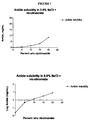
- the final concentration of antide solubilised is dependent on the concentration of nicotinamide added and increases exponentially with increased nicotinamide concentration, as shown below.
- the solubility of the gonadotrophin releasing hormone antagonists is known to increase as the pH of the solution is reduced, however, the data reported here in the experimental section for antide show that the increased solubility is not due to a pH effect.
- nicotinamide can also increase the solubility of antide in purely aqueous environments.
- the main object of the present invention is to provide a pharmaceutical composition comprising:
- the peptide active ingredient can be an LHRH analogue.
- the LHRH analogue is an antagonist. More preferably, it is antide.
- a non-limiting list of suitable pharmaceutically acceptable non-ionic aromatic hydrotropic agents comprises: nicotinamide, nicotinic acid, benzoic acid, salicylic acid, gentisic acid, ascorbic acid, histidine, tryptophan, phenylalanine, tyrosine, cresol, phenol, xanthines, pyridoxine, folic acid, saccharin.
- Nicotinamide is the preferred one.
- Nicotinamide is a commonly used source of vitamin B in pharmaceutical products and is administered mainly by the oral route, but also by injection. Doses of up to 500 mg daily (in divided doses) have been recommended, e.g. see Martindale.
- the physiological aqueous solution can be isotonic saline or phosphate buffered saline or any suitable solution containing inorganic salts at the same tonicity as the physiological medium.
- compositions of the present invention can be suitable for any administration route, such as oral, parenteral, nasal or pulmonary administration. They can be in liquid form, as well as, in solid form as an intimate mixture (for example following spray drying, lyophilisation, etc.). They can be, for example (but not limited to), in a solid dosage form, such as a gelatin capsule for oral administration, or formulated for nasal or pulmonary inhalation.
- a solid dosage form such as a gelatin capsule for oral administration, or formulated for nasal or pulmonary inhalation.
- Other pharmaceutically acceptable dosage forms could be employed such as suspension, emulsion, microemulsion, micronised powder, solution, suppository, pessary, microsphere, nanosphere, implant, etc, whereby the absorption of the peptide drug is improved by the combination with the non-ionic hydrotropic agent.
- compositions of the present invention can also be lyophilized and reconstitutable and further comprise one or more stabilizing agents, as well as one or more pharmaceutically acceptable excipients.
- composition ranges for an injectable composition are the following: antide 0.1 - 20.0 mg Nicotinamide 10 - 300 mg Aqueous phase, q.s. 1.0 ml.
- peptide as used in this application, means any compound made up of two or more amino acids. In it, the amino (NH 2 ) group of one amino acid joins the carboxyl (COOH) group of another, forming a peptide bond. Such amino acids can be naturally occurring, chemically synthesised or modified.
- the peptides according to the invention have generally up to 100 amino acids, preferably up to 50, more preferably up to 20.
- poorly soluble in aqueous physiological saline solution means that in such a solution, at room temperature without the addition of acids or bases, the peptide shows a solubility ⁇ 1 mg/ml and/or that the solubility in aqueous physiological saline solution is one order of magnitude lower than the solubility in water alone under the same conditions.
- Preliminary stability testing of 0.1 mg/ml antide solutions at -20°C, 4°C, 25°C and 40°C was performed to evaluate their stability at pH 2, 3 and 4.
- the solutions at 0.1 mg/ml were prepared dissolving antide in water and adjusting the pH using 0.01 M hydrochloric acid.
- Tables 3 to 7 summarise the observations collected in order to obtain information on the solubility behaviour of antide in water for injectables (WFI), WFI acidified by HCl or acetic acid, saline and saline acidified by acetic acid.
- WFI solubility behaviour of antide in water for injectables
- the natural pH of antide acetate in solution is from 4.4 to 5.0, depending on the amount dissolved. antide could be dissolved easily in water at a concentration of 1.0 mg/ml, however, without further acidification the solubility limit was found to be 8.1 mg/ml. The pH was not measured when the solution had gelled.
- Tables 4 and 5 show that significant amounts of acetic acid did not effectively solubilise antide in water.
- Table 7 shows that antide at a concentration of 10 mg/ml in saline is not soluble at a pH of 3.0 or 4.6, using 4% acetic acid to achieve the reduction in pH.
- the pH was measured when the solution was prepared, after which the gel gradually formed indicating the partial solubility of the drug.
- the solubility of the drug in saline solution was found to be 2.2 mg/ml, compared to the value of 0.025 mg/ml at the natural pH of 5.04 for this solution.
- Table 8 shows the effect of low concentrations (1.5% w/w) of the hydrotropic agents selected on the pH of the solution as measured before drug addition, however, they were not effective in solubilising antide at a level of 10 mg/ml in saline.
- the amounts of nicotinamide required to solubilise antide following injection may be greater than the isotonic concentration of nicotinamide which is 4.5%. Therefore, following injection at an extravascular site, the body fluids would re-equilibrate to adjust the osmotic balance, resuiting in a dilution of the solubilising agent.
- the effect of diluting formulations containing antide and nicotinamide in phosphate buffered solution (PBS) was studied by the following in-vitro experiments. The dilutions were made to bring the nicotinamide concentration to 5% following the addition of PBS.
- suitable formulations containing for example 15% nicotinamide and 2 mg/ml of antide or 5% nicotinamide and 0.5 mg/ml of antide avoid precipitation at the injection site after administration.
- Other suitable formulations such as those described above, can be determined from the solubility profiles in Figure 1 and are preferred in accordance with this invention.
- antide can be effectively solubilised by a number of agents which are non-ionic aromatic hydrotropic compounds, while the addition of ionised species reduces the aqueous solubility.
- antide solubility is shown to increase with decreasing pH, while the chemical stability of antide decreases as the pH is reduced below the value of pH 4.
Landscapes
- Health & Medical Sciences (AREA)
- Chemical & Material Sciences (AREA)
- Life Sciences & Earth Sciences (AREA)
- Pharmacology & Pharmacy (AREA)
- Veterinary Medicine (AREA)
- Public Health (AREA)
- General Health & Medical Sciences (AREA)
- Animal Behavior & Ethology (AREA)
- Epidemiology (AREA)
- Medicinal Chemistry (AREA)
- Engineering & Computer Science (AREA)
- Chemical Kinetics & Catalysis (AREA)
- Oil, Petroleum & Natural Gas (AREA)
- General Chemical & Material Sciences (AREA)
- Proteomics, Peptides & Aminoacids (AREA)
- Bioinformatics & Cheminformatics (AREA)
- Gastroenterology & Hepatology (AREA)
- Endocrinology (AREA)
- Reproductive Health (AREA)
- Immunology (AREA)
- Dermatology (AREA)
- Medicines That Contain Protein Lipid Enzymes And Other Medicines (AREA)
- Medicinal Preparation (AREA)
- Pharmaceuticals Containing Other Organic And Inorganic Compounds (AREA)
Priority Applications (33)
| Application Number | Priority Date | Filing Date | Title |
|---|---|---|---|
| EP97108593A EP0880968A1 (de) | 1997-05-28 | 1997-05-28 | In physiologischem Medium schwerlösliche pharmazeutische Peptidezusammensetzungen |
| EP97121246A EP0880969A1 (de) | 1997-05-28 | 1997-12-03 | Im physiologischem Medium schwerlösliche pharmazeutische Peptidezusammensetzungen |
| IL13317698A IL133176A0 (en) | 1997-05-28 | 1998-05-26 | Pharmaceutical compositions of peptides having low solubility in physiological medium |
| NZ500777A NZ500777A (en) | 1997-05-28 | 1998-05-26 | Pharmaceutical compositions comprising low solubility peptides |
| SK1597-99A SK284640B6 (sk) | 1997-05-28 | 1998-05-26 | Farmaceutický prostriedok zahŕňajúci LHRH agonistu, antagonistu alebo GRF |
| KR1019997010204A KR100552546B1 (ko) | 1997-05-28 | 1998-05-26 | 생리학적 매체에서 용해도가 낮은 펩티드로 구성된제약학적 조성물 |
| BR9809708-3A BR9809708A (pt) | 1997-05-28 | 1998-05-26 | Composições farmacêuticas de peptìdeos tendo solubilidade baixa em meio fisiológico |
| SI9830555T SI0984788T1 (en) | 1997-05-28 | 1998-05-26 | Pharmaceutical compositions of peptides having low solubility in physiological medium |
| CNB988054671A CN1159062C (zh) | 1997-05-28 | 1998-05-26 | 所含肽难溶于生理介质的药物组合物 |
| PCT/EP1998/003079 WO1998053844A1 (en) | 1997-05-28 | 1998-05-26 | Pharmaceutical compostions of peptides having low solubility in physiological medium |
| ES98930729T ES2210772T3 (es) | 1997-05-28 | 1998-05-26 | Composiciones farmaceuticas de peptidos que tienen baja solubilidad en medio fisiologico. |
| AT98930729T ATE252909T1 (de) | 1997-05-28 | 1998-05-26 | Pharmazeutische zubereitung enthaltend peptide mit geringer löslichkeit in physiologischem medium |
| ZA984469A ZA984469B (en) | 1997-05-28 | 1998-05-26 | Pharmaceutical compositions of peptides having low solubility of physiological medium |
| HK01100764.3A HK1029928B (en) | 1997-05-28 | 1998-05-26 | Pharmaceutical compositions of peptides having low solubility in physiological medium |
| EP98930729A EP0984788B1 (de) | 1997-05-28 | 1998-05-26 | Pharmazeutische zubereitung enthaltend peptide mit geringer löslichkeit in physiologischem medium |
| CZ0423199A CZ298825B6 (cs) | 1997-05-28 | 1998-05-26 | Farmaceutický prostredek |
| CA002291765A CA2291765A1 (en) | 1997-05-28 | 1998-05-26 | Pharmaceutical compositions of peptides having low solubility in physiological medium |
| DK98930729T DK0984788T3 (da) | 1997-05-28 | 1998-05-26 | Farmaceutiske præparater af peptider med lav opløselighed i fysiologiske medier |
| DE69819322T DE69819322T2 (de) | 1997-05-28 | 1998-05-26 | Pharmazeutische zubereitung enthaltend peptide mit geringer löslichkeit in physiologischem medium |
| PT98930729T PT984788E (pt) | 1997-05-28 | 1998-05-26 | Composicoes farmaceuticas de peptidos com baixa solubilidade em meio fisiologico |
| EEP199900545A EE04001B1 (et) | 1997-05-28 | 1998-05-26 | Peptiidne farmatseutiline kompositsioon |
| PL336982A PL192647B1 (pl) | 1997-05-28 | 1998-05-26 | Kompozycja farmaceutyczna peptydów o niskiej rozpuszczalności w środowisku fizjologicznym |
| UA99127138A UA62969C2 (en) | 1997-05-28 | 1998-05-26 | Pharmaceutical compositions of peptides poorly soluble in physiological saline solution |
| JP50021999A JP2002502384A (ja) | 1997-05-28 | 1998-05-26 | 生理学上の媒体中において低い溶解性を有するペプチドの薬剤組成物 |
| TR1999/02865T TR199902865T2 (xx) | 1997-05-28 | 1998-05-26 | Fizyolojiksel ortamda d���k ��z�n�rl��e sahip peptidlerin farmakolojik kompozisyonlar�. |
| EA199901089A EA002227B1 (ru) | 1997-05-28 | 1998-05-26 | Фармацевтические композиции пептидов, имеющих низкую растворимость в физиологической среде |
| AU81062/98A AU743152B2 (en) | 1997-05-28 | 1998-05-26 | Pharmaceutical compositions of peptides having low solubility in physiological medium |
| ARP980102454A AR012868A1 (es) | 1997-05-28 | 1998-05-27 | COMPOSICIoN FARMACÉUTICA QUE COMPRENDE UN PÉPTIDO AGONISTA DE LHRH, UN ANTAGONISTA DE LHRH O UN PÉPTIDO DE GRF Y NICOTINAMIDA. |
| TW087108696A TW533081B (en) | 1997-05-28 | 1998-06-03 | Pharmaceutical compositions of peptides having low solubility in physiological medium |
| BG103884A BG64668B1 (bg) | 1997-05-28 | 1999-11-15 | Фармацевтични състави на пептиди, притежаващи малка разтворимост във физиологична среда |
| NO19995763A NO323697B1 (no) | 1997-05-28 | 1999-11-24 | Farmasoytiske sammensetninger som inneholder peptider med lav opploselighet i fysiologisk medium |
| IL133176A IL133176A (en) | 1997-05-28 | 1999-11-28 | Pharmaceutical preparations containing peptides in a low solubility vessel in a physiological medium |
| US09/451,013 US6331520B1 (en) | 1997-05-28 | 1999-11-29 | Pharmaceutical compositions of peptides having low solubility in physiological medium |
Applications Claiming Priority (1)
| Application Number | Priority Date | Filing Date | Title |
|---|---|---|---|
| EP97108593A EP0880968A1 (de) | 1997-05-28 | 1997-05-28 | In physiologischem Medium schwerlösliche pharmazeutische Peptidezusammensetzungen |
Publications (1)
| Publication Number | Publication Date |
|---|---|
| EP0880968A1 true EP0880968A1 (de) | 1998-12-02 |
Family
ID=8226838
Family Applications (1)
| Application Number | Title | Priority Date | Filing Date |
|---|---|---|---|
| EP97108593A Withdrawn EP0880968A1 (de) | 1997-05-28 | 1997-05-28 | In physiologischem Medium schwerlösliche pharmazeutische Peptidezusammensetzungen |
Country Status (4)
| Country | Link |
|---|---|
| EP (1) | EP0880968A1 (de) |
| TW (1) | TW533081B (de) |
| UA (1) | UA62969C2 (de) |
| ZA (1) | ZA984469B (de) |
Citations (4)
| Publication number | Priority date | Publication date | Assignee | Title |
|---|---|---|---|---|
| EP0626170A2 (de) * | 1993-05-10 | 1994-11-30 | Sandoz Ltd. | Stabilisierung pharmakologisch aktiver Verbindungen in Mitteln mit verzögerter Freisetzung |
| US5446025A (en) * | 1992-06-12 | 1995-08-29 | Abbott Laboratories | Formulations and method of the percutaneous administration of leuprolide |
| WO1996010417A1 (en) * | 1994-10-04 | 1996-04-11 | Novo Nordisk A/S | PREPARATIONS CONTAINING AspB28 HUMAN INSULIN AND NICOTINAMIDE |
| EP0787497A2 (de) * | 1996-02-02 | 1997-08-06 | MITSUI TOATSU CHEMICALS, Inc. | Humanes Wachstumshormon enthaltendes pharmazeutisches Präparat |
-
1997
- 1997-05-28 EP EP97108593A patent/EP0880968A1/de not_active Withdrawn
-
1998
- 1998-05-26 UA UA99127138A patent/UA62969C2/uk unknown
- 1998-05-26 ZA ZA984469A patent/ZA984469B/xx unknown
- 1998-06-03 TW TW087108696A patent/TW533081B/zh not_active IP Right Cessation
Patent Citations (4)
| Publication number | Priority date | Publication date | Assignee | Title |
|---|---|---|---|---|
| US5446025A (en) * | 1992-06-12 | 1995-08-29 | Abbott Laboratories | Formulations and method of the percutaneous administration of leuprolide |
| EP0626170A2 (de) * | 1993-05-10 | 1994-11-30 | Sandoz Ltd. | Stabilisierung pharmakologisch aktiver Verbindungen in Mitteln mit verzögerter Freisetzung |
| WO1996010417A1 (en) * | 1994-10-04 | 1996-04-11 | Novo Nordisk A/S | PREPARATIONS CONTAINING AspB28 HUMAN INSULIN AND NICOTINAMIDE |
| EP0787497A2 (de) * | 1996-02-02 | 1997-08-06 | MITSUI TOATSU CHEMICALS, Inc. | Humanes Wachstumshormon enthaltendes pharmazeutisches Präparat |
Non-Patent Citations (1)
| Title |
|---|
| RASOOL A. ET AL.: "Solubility Enhancement of Some Water-Insoluble Drugs in the Presence of Nicotinamide and Related Compounds", JOURNAL OF PHARMACEUTICAL SCIENCES., vol. 80, 1991, WASHINGTON US, pages 387 - 393, XP000200540 * |
Also Published As
| Publication number | Publication date |
|---|---|
| ZA984469B (en) | 1999-01-08 |
| TW533081B (en) | 2003-05-21 |
| UA62969C2 (en) | 2004-01-15 |
Similar Documents
| Publication | Publication Date | Title |
|---|---|---|
| EP0984788B1 (de) | Pharmazeutische zubereitung enthaltend peptide mit geringer löslichkeit in physiologischem medium | |
| JP3698721B2 (ja) | 有機溶媒を用いて処理したポリペプチドの賦形剤安定化 | |
| EP1136068B1 (de) | Pulver enthaltende physiologisch aktive Peptide | |
| EP2586459B1 (de) | VEGF-Antagonistenformulierungen | |
| WO2000074736A1 (en) | Formulations comprising dehydrated particles of pharmaceutical agents and process for preparing the same | |
| EP0610502B1 (de) | Parathyroidhormon enthaltene emulsion zur nasalen verabreichung | |
| KR100633280B1 (ko) | 약제학적 활성 펩티드의 서방형 투여 형태 및 이의 제조 방법 | |
| KR20030063457A (ko) | 파모티딘 주사액 | |
| WO1998000155A1 (en) | Stabilization and oral delivery of calcitonin | |
| CA3143663A1 (en) | A stable formulation of cetrorelix | |
| MXPA99010863A (en) | Pharmaceutical compostions of peptides having low solubility in physiological medium | |
| AU778208C (en) | GRF-containing lyophilized pharmaceutical compositions | |
| HUP0002118A2 (hu) | Fiziológiai közegben rosszul oldódó peptideket tartalmazó gyógyszerkészítmények | |
| AU2005200879B2 (en) | GRF-containing lyophilized pharmaceutical compositions | |
| UA62969C2 (en) | Pharmaceutical compositions of peptides poorly soluble in physiological saline solution |
Legal Events
| Date | Code | Title | Description |
|---|---|---|---|
| PUAI | Public reference made under article 153(3) epc to a published international application that has entered the european phase |
Free format text: ORIGINAL CODE: 0009012 |
|
| AK | Designated contracting states |
Kind code of ref document: A1 Designated state(s): IT |
|
| RAP1 | Party data changed (applicant data changed or rights of an application transferred) |
Owner name: APPLIED RESEARCH SYSTEMS ARS HOLDING N.V. |
|
| AKX | Designation fees paid |
Free format text: IT |
|
| STAA | Information on the status of an ep patent application or granted ep patent |
Free format text: STATUS: THE APPLICATION IS DEEMED TO BE WITHDRAWN |
|
| 18D | Application deemed to be withdrawn |
Effective date: 19990603 |