EP0881008A2 - Procédé de fabrication de tubes de refroidissement pour échangeurs de chaleur - Google Patents
Procédé de fabrication de tubes de refroidissement pour échangeurs de chaleur Download PDFInfo
- Publication number
- EP0881008A2 EP0881008A2 EP98303307A EP98303307A EP0881008A2 EP 0881008 A2 EP0881008 A2 EP 0881008A2 EP 98303307 A EP98303307 A EP 98303307A EP 98303307 A EP98303307 A EP 98303307A EP 0881008 A2 EP0881008 A2 EP 0881008A2
- Authority
- EP
- European Patent Office
- Prior art keywords
- tube
- forming
- members
- side edge
- tube members
- Prior art date
- Legal status (The legal status is an assumption and is not a legal conclusion. Google has not performed a legal analysis and makes no representation as to the accuracy of the status listed.)
- Withdrawn
Links
Images
Classifications
-
- B—PERFORMING OPERATIONS; TRANSPORTING
- B23—MACHINE TOOLS; METAL-WORKING NOT OTHERWISE PROVIDED FOR
- B23P—METAL-WORKING NOT OTHERWISE PROVIDED FOR; COMBINED OPERATIONS; UNIVERSAL MACHINE TOOLS
- B23P15/00—Making specific metal objects by operations not covered by a single other subclass or a group in this subclass
- B23P15/26—Making specific metal objects by operations not covered by a single other subclass or a group in this subclass heat exchangers or the like
-
- B—PERFORMING OPERATIONS; TRANSPORTING
- B21—MECHANICAL METAL-WORKING WITHOUT ESSENTIALLY REMOVING MATERIAL; PUNCHING METAL
- B21C—MANUFACTURE OF METAL SHEETS, WIRE, RODS, TUBES, PROFILES OR LIKE SEMI-MANUFACTURED PRODUCTS OTHERWISE THAN BY ROLLING; AUXILIARY OPERATIONS USED IN CONNECTION WITH METAL-WORKING WITHOUT ESSENTIALLY REMOVING MATERIAL
- B21C37/00—Manufacture of metal sheets, rods, wire, tubes, profiles or like semi-manufactured products, not otherwise provided for; Manufacture of tubes of special shape
- B21C37/06—Manufacture of metal sheets, rods, wire, tubes, profiles or like semi-manufactured products, not otherwise provided for; Manufacture of tubes of special shape of tubes or metal hoses; Combined procedures for making tubes, e.g. for making multi-wall tubes
- B21C37/15—Making tubes of special shape; Making tube fittings
- B21C37/151—Making tubes with multiple passages
-
- F—MECHANICAL ENGINEERING; LIGHTING; HEATING; WEAPONS; BLASTING
- F28—HEAT EXCHANGE IN GENERAL
- F28D—HEAT-EXCHANGE APPARATUS, NOT PROVIDED FOR IN ANOTHER SUBCLASS, IN WHICH THE HEAT-EXCHANGE MEDIA DO NOT COME INTO DIRECT CONTACT
- F28D1/00—Heat-exchange apparatus having stationary conduit assemblies for one heat-exchange medium only, the media being in contact with different sides of the conduit wall, in which the other heat-exchange medium is a large body of fluid, e.g. domestic or motor car radiators
- F28D1/02—Heat-exchange apparatus having stationary conduit assemblies for one heat-exchange medium only, the media being in contact with different sides of the conduit wall, in which the other heat-exchange medium is a large body of fluid, e.g. domestic or motor car radiators with heat-exchange conduits immersed in the body of fluid
- F28D1/03—Heat-exchange apparatus having stationary conduit assemblies for one heat-exchange medium only, the media being in contact with different sides of the conduit wall, in which the other heat-exchange medium is a large body of fluid, e.g. domestic or motor car radiators with heat-exchange conduits immersed in the body of fluid with plate-like or laminated conduits
- F28D1/0308—Heat-exchange apparatus having stationary conduit assemblies for one heat-exchange medium only, the media being in contact with different sides of the conduit wall, in which the other heat-exchange medium is a large body of fluid, e.g. domestic or motor car radiators with heat-exchange conduits immersed in the body of fluid with plate-like or laminated conduits the conduits being formed by paired plates touching each other
- F28D1/0316—Assemblies of conduits in parallel
-
- F—MECHANICAL ENGINEERING; LIGHTING; HEATING; WEAPONS; BLASTING
- F28—HEAT EXCHANGE IN GENERAL
- F28F—DETAILS OF HEAT-EXCHANGE AND HEAT-TRANSFER APPARATUS, OF GENERAL APPLICATION
- F28F1/00—Tubular elements; Assemblies of tubular elements
- F28F1/02—Tubular elements of cross-section which is non-circular
- F28F1/04—Tubular elements of cross-section which is non-circular polygonal, e.g. rectangular
- F28F1/045—Tubular elements of cross-section which is non-circular polygonal, e.g. rectangular with assemblies of stacked elements
-
- B—PERFORMING OPERATIONS; TRANSPORTING
- B23—MACHINE TOOLS; METAL-WORKING NOT OTHERWISE PROVIDED FOR
- B23K—SOLDERING OR UNSOLDERING; WELDING; CLADDING OR PLATING BY SOLDERING OR WELDING; CUTTING BY APPLYING HEAT LOCALLY, e.g. FLAME CUTTING; WORKING BY LASER BEAM
- B23K1/00—Soldering, e.g. brazing, or unsoldering
- B23K1/0008—Soldering, e.g. brazing, or unsoldering specially adapted for particular articles or work
- B23K1/0012—Brazing of heat exchangers
-
- B—PERFORMING OPERATIONS; TRANSPORTING
- B23—MACHINE TOOLS; METAL-WORKING NOT OTHERWISE PROVIDED FOR
- B23K—SOLDERING OR UNSOLDERING; WELDING; CLADDING OR PLATING BY SOLDERING OR WELDING; CUTTING BY APPLYING HEAT LOCALLY, e.g. FLAME CUTTING; WORKING BY LASER BEAM
- B23K1/00—Soldering, e.g. brazing, or unsoldering
- B23K1/20—Preliminary treatment of work or areas to be soldered, e.g. in respect of a galvanic coating
- B23K1/203—Fluxing, i.e. applying flux onto surfaces
-
- F—MECHANICAL ENGINEERING; LIGHTING; HEATING; WEAPONS; BLASTING
- F28—HEAT EXCHANGE IN GENERAL
- F28F—DETAILS OF HEAT-EXCHANGE AND HEAT-TRANSFER APPARATUS, OF GENERAL APPLICATION
- F28F1/00—Tubular elements; Assemblies of tubular elements
- F28F1/10—Tubular elements and assemblies thereof with means for increasing heat-transfer area, e.g. with fins, with projections, with recesses
- F28F1/12—Tubular elements and assemblies thereof with means for increasing heat-transfer area, e.g. with fins, with projections, with recesses the means being only outside the tubular element
- F28F1/126—Tubular elements and assemblies thereof with means for increasing heat-transfer area, e.g. with fins, with projections, with recesses the means being only outside the tubular element consisting of zig-zag shaped fins
-
- F—MECHANICAL ENGINEERING; LIGHTING; HEATING; WEAPONS; BLASTING
- F28—HEAT EXCHANGE IN GENERAL
- F28F—DETAILS OF HEAT-EXCHANGE AND HEAT-TRANSFER APPARATUS, OF GENERAL APPLICATION
- F28F21/00—Constructions of heat-exchange apparatus characterised by the selection of particular materials
- F28F21/08—Constructions of heat-exchange apparatus characterised by the selection of particular materials of metal
- F28F21/081—Heat exchange elements made from metals or metal alloys
- F28F21/084—Heat exchange elements made from metals or metal alloys from aluminium or aluminium alloys
-
- F—MECHANICAL ENGINEERING; LIGHTING; HEATING; WEAPONS; BLASTING
- F28—HEAT EXCHANGE IN GENERAL
- F28F—DETAILS OF HEAT-EXCHANGE AND HEAT-TRANSFER APPARATUS, OF GENERAL APPLICATION
- F28F2255/00—Heat exchanger elements made of materials having special features or resulting from particular manufacturing processes
- F28F2255/16—Heat exchanger elements made of materials having special features or resulting from particular manufacturing processes extruded
-
- Y—GENERAL TAGGING OF NEW TECHNOLOGICAL DEVELOPMENTS; GENERAL TAGGING OF CROSS-SECTIONAL TECHNOLOGIES SPANNING OVER SEVERAL SECTIONS OF THE IPC; TECHNICAL SUBJECTS COVERED BY FORMER USPC CROSS-REFERENCE ART COLLECTIONS [XRACs] AND DIGESTS
- Y10—TECHNICAL SUBJECTS COVERED BY FORMER USPC
- Y10T—TECHNICAL SUBJECTS COVERED BY FORMER US CLASSIFICATION
- Y10T29/00—Metal working
- Y10T29/49—Method of mechanical manufacture
- Y10T29/4935—Heat exchanger or boiler making
- Y10T29/49377—Tube with heat transfer means
-
- Y—GENERAL TAGGING OF NEW TECHNOLOGICAL DEVELOPMENTS; GENERAL TAGGING OF CROSS-SECTIONAL TECHNOLOGIES SPANNING OVER SEVERAL SECTIONS OF THE IPC; TECHNICAL SUBJECTS COVERED BY FORMER USPC CROSS-REFERENCE ART COLLECTIONS [XRACs] AND DIGESTS
- Y10—TECHNICAL SUBJECTS COVERED BY FORMER USPC
- Y10T—TECHNICAL SUBJECTS COVERED BY FORMER US CLASSIFICATION
- Y10T29/00—Metal working
- Y10T29/49—Method of mechanical manufacture
- Y10T29/4935—Heat exchanger or boiler making
- Y10T29/49391—Tube making or reforming
-
- Y—GENERAL TAGGING OF NEW TECHNOLOGICAL DEVELOPMENTS; GENERAL TAGGING OF CROSS-SECTIONAL TECHNOLOGIES SPANNING OVER SEVERAL SECTIONS OF THE IPC; TECHNICAL SUBJECTS COVERED BY FORMER USPC CROSS-REFERENCE ART COLLECTIONS [XRACs] AND DIGESTS
- Y10—TECHNICAL SUBJECTS COVERED BY FORMER USPC
- Y10T—TECHNICAL SUBJECTS COVERED BY FORMER US CLASSIFICATION
- Y10T29/00—Metal working
- Y10T29/49—Method of mechanical manufacture
- Y10T29/4935—Heat exchanger or boiler making
- Y10T29/49393—Heat exchanger or boiler making with metallurgical bonding
Definitions
- the present invention relates generally to methods for making refrigerant tubes for heat exchangers. More particularly, the present invention relates to a method for making a refrigerant tube for a heat exchanger wherein the tube is formed from identical members having asymmetric sides.
- Heat exchangers employ a wide variety of tube geometries depending upon the heat transfer characteristics needed to be achieved.
- U.S. Patent No. 5,381,600 discloses a condenser for an automotive vehicle using round tubes having an internal surface with corrugation-like teeth formed thereon.
- Other heat exchanger designs use different types of tubes.
- a second example can be found in air conditioning system condensers of the parallel flow type. In this type of condenser, substantially flat refrigerant tubes are used. These tubes must withstand high pressure gaseous refrigerant which flows through them and still achieve high heat transfer characteristics.
- these flat tubes have a plurality of discrete flow paths formed therein. The flow paths can be formed by inserting an undulating metal insert into the tube and brazing the insert into place. The flow paths can also be formed by forming walls in the tube during an extrusion process.
- U.S. Patent No. 5,553,377 teaches a method for making refrigerant tubes for use in condensers.
- the tubes in the '377 patent are formed from two members, a bottom member having a plurality of walls along the longitudinal length of the tube and a top member which acts as a "lid" or cover.
- the top member is brazed to the bottom member to form the tube.
- the top member must be held securely in place to prevent it from sliding relative to the bottom member.
- the top and bottom members of the tube are substantially different in shape, requiring further labour and expense in fabricating this tube. It would be advantageous to achieve the beneficial effects of a generally flat tube formed by joining two members together without incurring the substantial labour and cost associated with multiple designs.
- the present invention provides a method for making a refrigerant tube for a heat exchanger comprising the steps of providing blanks of aluminium material and cladding the blanks of aluminium material with a coating of cladding material of a substantially constant thickness.
- a pair of identical tube members are then formed from the cladded blanks, each one of the tube members having interior and exterior surfaces with a generally planar base and a pair of asymmetric, elongated side edges.
- a first side edge of the tube member has a substantially constant cross-section, while the second side edge of the tube member has a tapering cross-section.
- the method further includes applying a flux material to the internal surfaces of the tube members and interlocking the elongated side edges of the tube members to form a tube.
- the ends of the first side edge of the tube are then rolled over the exterior surfaces of the tube and the tube is brazed at a predetermined temperature for a predetermined time.
- the method further includes the steps of forming a plurality of interior elongate walls extending longitudinally along the length of each of the tube members. Each one of the plurality of walls extends generally perpendicularly from the plane of the base of each tube member a predetermined distance.
- the method also includes forming a detent wall in each one of the tube members spaced apart from the first side edge a predetermined distance such that the detent wall tapers from a greater width at the tube member base to a lesser width at a distance spaced from the tube member base.
- the detent wall locks the first side edge of one of the tube members into the mating tube member to prevent the tube members from moving during the remaining fabrication process.
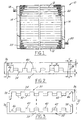
- FIG. 1 shows a heat exchanger 10 for use in an automotive applications, such as a radiator or a condenser.
- the heat exchanger 10 includes a set of generally parallel tubes 12 extending between oppositely disposed headers 14, 16.
- a fluid inlet 18 for conducting cooling fluid into the heat exchanger 10 is formed in the header 14 and an outlet 20 is formed in header 16 for directing fluid out of the heat exchanger.
- Convoluted or serpentine fins 22 are attached to the exterior of the tubes 12 and serve as a means for conducting heat away from the tubes 12 while providing additional surface area for convective heat transfer by air flowing over the heat exchanger 10.
- the fins are disposed between each of the tubes 12 of the heat exchanger 10.
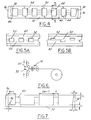
- FIGS 2-4 show one embodiment of a heat exchanger tube 12 constructed according to the present invention.
- the tube 12 is a two piece assembly, having an upper tube member 30 and a lower tube member 32 joined together in opposed, mirrored relationship. Because each of the tube members 30, 32 are identical, mirror images of one another, only one will be described. It should be noted that the upper tube member 30 and lower tube member 32 are manufactured in a roll forming process and have identical features.
- Each of the upper 30 and lower 32 tube members includes a generally planar base 34 and a pair of asymmetric elongated side edges 36, 38 extending along the entire longitudinal length thereof.
- the side edges 36, 38 are asymmetric in that one edge 36 has a substantially rectangular, constant cross-section while the second side edge 38 has a tapering cross-section.
- edge 38 tapers from a greater thickness, t, near the base of the member to a lesser thickness, t', at a predetermined distance from the base.
- the height of the second side edge 38 is also less than the height of the first side edge 36 by an amount, h, equal to or less than the thickness of the base 34.
- the importance of the side edge 38 with the tapering cross-section will become apparent below.
- the corners of the side edges 36, 38 can also be rounded to ease in the fabrication process.
- Each of the tube members 30, 32 further includes a plurality of longitudinally extending, elongated walls 40 projecting from the base 34 of the tube members.
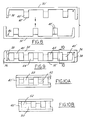
- the walls 40 project from the base 34 of the tube member a predetermined distance. This distance is one of the differences between the tube embodiment shown in Figures 2-5 and that shown in Figures 7-10. Each will be described in detail.
- the walls 40 shown in the tube 12 of Figures 2-5 project from the base by a distance approximately equal to one-half the overall height of the tube 12. These walls 40 are also disposed on the base and spaced apart from one another by an amount, W, such that when the upper tube member 30 is inverted and placed matingly over the bottom tube member 32 as shown in Figure 4, the top surfaces 42 of the walls 40 contact each other to define a plurality of flow paths 44. Because the walls 40 contact opposing walls, the height of the walls 40 must be one-half of the tube height or the tube would not close.
- the walls 40' project from the base 34' by a distance approximately equal to the overall tube height. These walls 40' are disposed on the base of the upper 30' and lower 32' tube members such that the walls 40' are offset to one another.
- the top surfaces 42' of the walls 40' contact the base 34' of the opposing tube member to define a plurality of flow paths 44'.
- the tube members 30, 32 also include a detent wall 46.
- the detent wall 46 can be a wall extending along the entire longitudinal length of the tube or simply a step or series of interrupted steps.
- the detent wall 46 is spaced apart from the first side edge 36 by a distance t' and is disposed at an angle relative to this edge 36.
- the detent wall 46 also tapers from a greater width at the base of the tube member to a lesser width a predetermined distance therefrom.
- the detent wall 46 secures the second side edge 38, 38' (of tapering cross-section) of one of the tube members (upper or lower) in an interference fit into the space between the detent wall 46 and the first side edge 36, 36' of the opposed tube member. This interference fit prevents the tube members from becoming separated during the remaining fabrication process which will be described in greater detail below.
- the walls 40, 40' may be formed in a roll forming process as a continuous, elongate wall extending the entire length of the tube.
- the walls 40, 40' may include stepped portions 50 of varying heights. These stepped portions 50 form windows which provide for a non-discrete flow path between adjacent flow paths 44 in each of the two tube embodiments.
- the stepped portions 50 form windows 52 when aligned or windows 54 when misaligned relative to one another when the upper 30 and lower 32 tube members are secured together.
- the stepped portions 50' of Figures 9A and B form similar windows 52', 54'. The size of the windows is critical to the heat transfer characteristic of the tube 12.
- the first step in the method is to provide blanks of aluminium material from which to fabricate the tubes and clad the blanks with a coating of any of a plurality of known cladding materials, such as an aluminium-silicon cladding material, of a substantially constant thickness. Preferably, both sides of the blanks are coated with the cladding material.
- a pair of identical tube members are formed by roll forming the cladded blanks.
- the blanks are formed into the upper (or lower) tube members 30, 32, each one having interior and exterior surfaces with a generally planar base and a pair of asymmetric, elongated side edges.
- a first side edge 36 of the tube member has a substantially constant cross-section while the second side edge 38 has a tapering cross-section.
- a plurality of interior elongate walls 40 extending longitudinally along the length of each of the tube members is also formed.
- the walls 40 extend generally perpendicularly from the plane of the base of each tube member a predetermined distance. As explained above, this distance is either one-half the overall tube height or approximately equal to the tube height. Stepped portions of varying height may also be formed in the longitudinally extending walls 40 at this point in fabrication. The stepped portions co-operate to form windows between flow paths as explained above.
- a detent wall 46 is also roll formed in each one of the tube members, spaced apart from the first side edge 36 a predetermined distance. The detent wall 46 is formed such that the detent wall tapers from a greater width at the tube base to a lesser width at a distance spaced therefrom.
- a flux material is applied to the internal surfaces of the members and the members are inverted and placed one over the other in opposed, mirrored relationship and rolled together as shown in Figure 6. This causes the side edges to interlock between the first side edge 36 and the detent wall 46 to form a tube.
- the end 56 of the first side edge 36 is then rolled over the exterior surfaces of the tube, such as in a coining operation.
- the tube can then be brazed at a predetermined temperature for a predetermined time to cause the upper and lower members to join together to form a completed tube. More typically, however, the assembled (not brazed) tube is assembled into a heat exchanger assembly and the entire assembly is brazed to form a unit. This prevents the tube from passing through a brazing operation twice.
Landscapes
- Engineering & Computer Science (AREA)
- Mechanical Engineering (AREA)
- Physics & Mathematics (AREA)
- Thermal Sciences (AREA)
- General Engineering & Computer Science (AREA)
- Geometry (AREA)
- Heat-Exchange Devices With Radiators And Conduit Assemblies (AREA)
Applications Claiming Priority (2)
| Application Number | Priority Date | Filing Date | Title |
|---|---|---|---|
| US865588 | 1997-05-29 | ||
| US08/865,588 US5881457A (en) | 1997-05-29 | 1997-05-29 | Method of making refrigerant tubes for heat exchangers |
Publications (2)
| Publication Number | Publication Date |
|---|---|
| EP0881008A2 true EP0881008A2 (fr) | 1998-12-02 |
| EP0881008A3 EP0881008A3 (fr) | 1999-11-03 |
Family
ID=25345835
Family Applications (1)
| Application Number | Title | Priority Date | Filing Date |
|---|---|---|---|
| EP98303307A Withdrawn EP0881008A3 (fr) | 1997-05-29 | 1998-04-28 | Procédé de fabrication de tubes de refroidissement pour échangeurs de chaleur |
Country Status (3)
| Country | Link |
|---|---|
| US (1) | US5881457A (fr) |
| EP (1) | EP0881008A3 (fr) |
| KR (1) | KR19980087449A (fr) |
Cited By (1)
| Publication number | Priority date | Publication date | Assignee | Title |
|---|---|---|---|---|
| EP1759157A1 (fr) * | 2004-06-09 | 2007-03-07 | Philipp Pustelnik | Refroidisseur a plaques |
Families Citing this family (3)
| Publication number | Priority date | Publication date | Assignee | Title |
|---|---|---|---|---|
| US7341099B2 (en) * | 2001-06-08 | 2008-03-11 | Showa Denko K.K. | Metal plate for producing flat tube, flat tube and process for producing the flat tube |
| US20080245518A1 (en) * | 2004-03-09 | 2008-10-09 | Showa Denko K.K. | Flat Tube Making Platelike Body, Flat Tube, Heat Exchanger and Process for Fabricating Heat Exchanger |
| JP2007198623A (ja) * | 2006-01-24 | 2007-08-09 | Denso Corp | 熱交換器 |
Family Cites Families (21)
| Publication number | Priority date | Publication date | Assignee | Title |
|---|---|---|---|---|
| US3158181A (en) * | 1959-05-11 | 1964-11-24 | Gore & Ass | Polymeric tubate product and process |
| US3650005A (en) * | 1970-03-19 | 1972-03-21 | Showa Aluminium Co Ltd | Method for producing tube in sheets |
| US4805693A (en) * | 1986-11-20 | 1989-02-21 | Modine Manufacturing | Multiple piece tube assembly for use in heat exchangers |
| DE3704215C2 (de) * | 1987-02-11 | 1995-11-30 | Laengerer & Reich Kuehler | Strangpreßprofilrohr für Wärmeaustauscher |
| KR940010978B1 (ko) * | 1988-08-12 | 1994-11-21 | 갈소니꾸 가부시끼가이샤 | 멀티플로우형의 열교환기 |
| US4900328A (en) * | 1989-02-23 | 1990-02-13 | General Motors Corporation | Method for assembling heat exchanger plate pair by snap fit |
| US5271151A (en) * | 1990-04-23 | 1993-12-21 | Wallis Bernard J | Method of making a high pressure condenser |
| US5186250A (en) * | 1990-05-11 | 1993-02-16 | Showa Aluminum Kabushiki Kaisha | Tube for heat exchangers and a method for manufacturing the tube |
| US5172476A (en) * | 1991-08-14 | 1992-12-22 | General Motors Corporation | Method of manufacturing heat exchanger tubing |
| JPH0566073A (ja) * | 1991-09-05 | 1993-03-19 | Sanden Corp | 積層型熱交換器 |
| JP3311001B2 (ja) * | 1991-12-27 | 2002-08-05 | 昭和電工株式会社 | 熱交換器用チューブの製造方法 |
| US5185925A (en) * | 1992-01-29 | 1993-02-16 | General Motors Corporation | Method of manufacturing a tube for a heat exchanger |
| GB2268260A (en) * | 1992-06-24 | 1994-01-05 | Llanelli Radiators Ltd | Heat exchange tubes formed from a unitary portion of sheet or strip material |
| DE4330204C1 (de) * | 1992-12-08 | 1994-09-22 | Fritz Werner Praezismaschbau | Vorrichtung für die Durchführung eines Verfahrens zur Herstellung von Latentwärmespeicherzellen eines Kraftfahrzeug-Wärmespeichers |
| JP3364665B2 (ja) * | 1993-03-26 | 2003-01-08 | 昭和電工株式会社 | 熱交換器用冷媒流通管 |
| JPH06300473A (ja) * | 1993-04-19 | 1994-10-28 | Sanden Corp | 偏平冷媒管 |
| US5381600A (en) * | 1993-10-06 | 1995-01-17 | Ford Motor Company | Heat exchanger and method of making the same |
| US5441105A (en) * | 1993-11-18 | 1995-08-15 | Wynn's Climate Systems, Inc. | Folded parallel flow condenser tube |
| US5456006A (en) * | 1994-09-02 | 1995-10-10 | Ford Motor Company | Method for making a heat exchanger tube |
| JPH08200977A (ja) * | 1995-01-27 | 1996-08-09 | Zexel Corp | 熱交換器用偏平チューブ及びその製造方法 |
| US5579837A (en) * | 1995-11-15 | 1996-12-03 | Ford Motor Company | Heat exchanger tube and method of making the same |
-
1997
- 1997-05-29 US US08/865,588 patent/US5881457A/en not_active Expired - Fee Related
-
1998
- 1998-04-28 EP EP98303307A patent/EP0881008A3/fr not_active Withdrawn
- 1998-05-28 KR KR1019980019446A patent/KR19980087449A/ko not_active Withdrawn
Cited By (1)
| Publication number | Priority date | Publication date | Assignee | Title |
|---|---|---|---|---|
| EP1759157A1 (fr) * | 2004-06-09 | 2007-03-07 | Philipp Pustelnik | Refroidisseur a plaques |
Also Published As
| Publication number | Publication date |
|---|---|
| KR19980087449A (ko) | 1998-12-05 |
| EP0881008A3 (fr) | 1999-11-03 |
| US5881457A (en) | 1999-03-16 |
Similar Documents
| Publication | Publication Date | Title |
|---|---|---|
| US5799727A (en) | Refrigerant tubes for heat exchangers | |
| US7749609B2 (en) | Metal plate for producing flat tube, flat tube and process for producing the flat tube | |
| US5579837A (en) | Heat exchanger tube and method of making the same | |
| EP1065466B1 (fr) | Turbulateur plat pour un tube et sa méthode de fabrication | |
| US5797184A (en) | Method of making a heat exchanger | |
| JP3064055B2 (ja) | 熱交換器の製造方法 | |
| JP4099513B2 (ja) | 偏平管製造用金属板、偏平管および偏平管の製造方法 | |
| EP0719611B1 (fr) | Procede de brasage de tubes plats pour echangeurs thermiques stratifies | |
| EP1180403A1 (fr) | Procédé pour la fabrication de tubes plats pour échangeurs de chaleur | |
| AU2002304254A1 (en) | Metal plate for producing flat tube, flat tube and process for producing the flat tube | |
| US5931226A (en) | Refrigerant tubes for heat exchangers | |
| JP4105320B2 (ja) | 熱交換器 | |
| JPH1114288A (ja) | 熱交換器 | |
| EP0762070B1 (fr) | Tubes de refroidissement pour échangeurs de chaleur | |
| EP1225408A2 (fr) | Tube d'échangeur de chaleur | |
| US5890288A (en) | Method for making a heat exchanger tube | |
| US5934365A (en) | Heat exchanger | |
| US5867904A (en) | Method of making an automotive heat exchanger with indented pins | |
| US20060162919A1 (en) | Flat tube and process for producing heat exchanger with use of the flat tube | |
| US5881457A (en) | Method of making refrigerant tubes for heat exchangers | |
| JP2000193387A5 (fr) | ||
| JP4423096B2 (ja) | 熱交換器の製造方法 | |
| US20080245518A1 (en) | Flat Tube Making Platelike Body, Flat Tube, Heat Exchanger and Process for Fabricating Heat Exchanger | |
| JP5066709B2 (ja) | 扁平管の製造方法 | |
| JP2935071B2 (ja) | 熱交換器用偏平管 |
Legal Events
| Date | Code | Title | Description |
|---|---|---|---|
| PUAI | Public reference made under article 153(3) epc to a published international application that has entered the european phase |
Free format text: ORIGINAL CODE: 0009012 |
|
| AK | Designated contracting states |
Kind code of ref document: A2 Designated state(s): DE FR GB |
|
| AX | Request for extension of the european patent |
Free format text: AL;LT;LV;MK;RO;SI |
|
| PUAL | Search report despatched |
Free format text: ORIGINAL CODE: 0009013 |
|
| AK | Designated contracting states |
Kind code of ref document: A3 Designated state(s): AT BE CH CY DE DK ES FI FR GB GR IE IT LI LU MC NL PT SE |
|
| AX | Request for extension of the european patent |
Free format text: AL;LT;LV;MK;RO;SI |
|
| 17P | Request for examination filed |
Effective date: 20000323 |
|
| AKX | Designation fees paid |
Free format text: DE FR GB |
|
| 17Q | First examination report despatched |
Effective date: 20011106 |
|
| STAA | Information on the status of an ep patent application or granted ep patent |
Free format text: STATUS: THE APPLICATION HAS BEEN WITHDRAWN |
|
| 18W | Application withdrawn |
Withdrawal date: 20020409 |