EP0881271A1 - Composition d'adhésif acrylique absorbant de vibration, résistant à la chaleur et sensible à la pression et bande adhésive qui en est produite - Google Patents
Composition d'adhésif acrylique absorbant de vibration, résistant à la chaleur et sensible à la pression et bande adhésive qui en est produite Download PDFInfo
- Publication number
- EP0881271A1 EP0881271A1 EP98108230A EP98108230A EP0881271A1 EP 0881271 A1 EP0881271 A1 EP 0881271A1 EP 98108230 A EP98108230 A EP 98108230A EP 98108230 A EP98108230 A EP 98108230A EP 0881271 A1 EP0881271 A1 EP 0881271A1
- Authority
- EP
- European Patent Office
- Prior art keywords
- bismaleimide
- adhesive composition
- composition according
- bar
- adhesive
- Prior art date
- Legal status (The legal status is an assumption and is not a legal conclusion. Google has not performed a legal analysis and makes no representation as to the accuracy of the status listed.)
- Granted
Links
- 239000000203 mixture Substances 0.000 title claims abstract description 39
- 239000002390 adhesive tape Substances 0.000 title claims abstract description 8
- 239000003522 acrylic cement Substances 0.000 title 1
- 239000000853 adhesive Substances 0.000 claims abstract description 27
- 230000001070 adhesive effect Effects 0.000 claims abstract description 26
- 238000013016 damping Methods 0.000 claims abstract description 21
- 229920003192 poly(bis maleimide) Polymers 0.000 claims abstract description 18
- XQUPVDVFXZDTLT-UHFFFAOYSA-N 1-[4-[[4-(2,5-dioxopyrrol-1-yl)phenyl]methyl]phenyl]pyrrole-2,5-dione Chemical compound O=C1C=CC(=O)N1C(C=C1)=CC=C1CC1=CC=C(N2C(C=CC2=O)=O)C=C1 XQUPVDVFXZDTLT-UHFFFAOYSA-N 0.000 claims abstract description 15
- 125000003368 amide group Chemical group 0.000 claims abstract description 10
- 229920001577 copolymer Polymers 0.000 claims abstract description 7
- 125000002924 primary amino group Chemical group [H]N([H])* 0.000 claims abstract description 7
- 239000004971 Cross linker Substances 0.000 claims abstract description 6
- CERQOIWHTDAKMF-UHFFFAOYSA-N Methacrylic acid Chemical class CC(=C)C(O)=O CERQOIWHTDAKMF-UHFFFAOYSA-N 0.000 claims abstract description 6
- 239000011248 coating agent Substances 0.000 claims abstract description 6
- 238000000576 coating method Methods 0.000 claims abstract description 6
- 238000000034 method Methods 0.000 claims abstract description 6
- 239000002904 solvent Substances 0.000 claims abstract description 6
- 230000008569 process Effects 0.000 claims abstract description 5
- 239000004820 Pressure-sensitive adhesive Substances 0.000 claims description 22
- IPJGAEWUPXWFPL-UHFFFAOYSA-N 1-[3-(2,5-dioxopyrrol-1-yl)phenyl]pyrrole-2,5-dione Chemical compound O=C1C=CC(=O)N1C1=CC=CC(N2C(C=CC2=O)=O)=C1 IPJGAEWUPXWFPL-UHFFFAOYSA-N 0.000 claims description 10
- 125000003118 aryl group Chemical group 0.000 claims description 9
- 238000004132 cross linking Methods 0.000 claims description 6
- 125000004432 carbon atom Chemical group C* 0.000 claims description 5
- 125000000467 secondary amino group Chemical group [H]N([*:1])[*:2] 0.000 claims description 5
- 125000001931 aliphatic group Chemical group 0.000 claims description 3
- 238000012546 transfer Methods 0.000 claims description 3
- RYSXWUYLAWPLES-MTOQALJVSA-N (Z)-4-hydroxypent-3-en-2-one titanium Chemical compound [Ti].C\C(O)=C\C(C)=O.C\C(O)=C\C(C)=O.C\C(O)=C\C(C)=O.C\C(O)=C\C(C)=O RYSXWUYLAWPLES-MTOQALJVSA-N 0.000 claims description 2
- 239000004215 Carbon black (E152) Substances 0.000 claims description 2
- 229930195733 hydrocarbon Natural products 0.000 claims description 2
- 229920003145 methacrylic acid copolymer Polymers 0.000 claims description 2
- 229910052757 nitrogen Inorganic materials 0.000 claims 18
- PEEHTFAAVSWFBL-UHFFFAOYSA-N Maleimide Chemical compound O=C1NC(=O)C=C1 PEEHTFAAVSWFBL-UHFFFAOYSA-N 0.000 claims 2
- 239000003431 cross linking reagent Substances 0.000 claims 2
- IJGRMHOSHXDMSA-UHFFFAOYSA-N nitrogen Substances N#N IJGRMHOSHXDMSA-UHFFFAOYSA-N 0.000 claims 2
- QJGQUHMNIGDVPM-UHFFFAOYSA-N nitrogen group Chemical group [N] QJGQUHMNIGDVPM-UHFFFAOYSA-N 0.000 claims 2
- JIAARYAFYJHUJI-UHFFFAOYSA-L zinc dichloride Chemical compound [Cl-].[Cl-].[Zn+2] JIAARYAFYJHUJI-UHFFFAOYSA-L 0.000 claims 2
- PUKLCKVOVCZYKF-UHFFFAOYSA-N 1-[2-(2,5-dioxopyrrol-1-yl)ethyl]pyrrole-2,5-dione Chemical compound O=C1C=CC(=O)N1CCN1C(=O)C=CC1=O PUKLCKVOVCZYKF-UHFFFAOYSA-N 0.000 claims 1
- PYVHLZLQVWXBDZ-UHFFFAOYSA-N 1-[6-(2,5-dioxopyrrol-1-yl)hexyl]pyrrole-2,5-dione Chemical compound O=C1C=CC(=O)N1CCCCCCN1C(=O)C=CC1=O PYVHLZLQVWXBDZ-UHFFFAOYSA-N 0.000 claims 1
- YZNRUKFQQNBZLO-UHFFFAOYSA-N 1-[[2-[(2,5-dioxopyrrol-1-yl)methyl]phenyl]methyl]pyrrole-2,5-dione Chemical compound O=C1C=CC(=O)N1CC1=CC=CC=C1CN1C(=O)C=CC1=O YZNRUKFQQNBZLO-UHFFFAOYSA-N 0.000 claims 1
- GZVHEAJQGPRDLQ-UHFFFAOYSA-N 6-phenyl-1,3,5-triazine-2,4-diamine Chemical compound NC1=NC(N)=NC(C=2C=CC=CC=2)=N1 GZVHEAJQGPRDLQ-UHFFFAOYSA-N 0.000 claims 1
- 229920000877 Melamine resin Polymers 0.000 claims 1
- 229920001807 Urea-formaldehyde Polymers 0.000 claims 1
- 150000001541 aziridines Chemical class 0.000 claims 1
- 239000004305 biphenyl Substances 0.000 claims 1
- 239000002738 chelating agent Substances 0.000 claims 1
- 229920005989 resin Polymers 0.000 claims 1
- 239000011347 resin Substances 0.000 claims 1
- 235000005074 zinc chloride Nutrition 0.000 claims 1
- 239000011592 zinc chloride Substances 0.000 claims 1
- 238000004519 manufacturing process Methods 0.000 abstract description 6
- 230000006855 networking Effects 0.000 description 25
- HRPVXLWXLXDGHG-UHFFFAOYSA-N Acrylamide Chemical compound NC(=O)C=C HRPVXLWXLXDGHG-UHFFFAOYSA-N 0.000 description 14
- 238000012360 testing method Methods 0.000 description 10
- 239000000178 monomer Substances 0.000 description 7
- XEKOWRVHYACXOJ-UHFFFAOYSA-N Ethyl acetate Chemical compound CCOC(C)=O XEKOWRVHYACXOJ-UHFFFAOYSA-N 0.000 description 6
- 239000013065 commercial product Substances 0.000 description 6
- VVQNEPGJFQJSBK-UHFFFAOYSA-N Methyl methacrylate Chemical compound COC(=O)C(C)=C VVQNEPGJFQJSBK-UHFFFAOYSA-N 0.000 description 5
- 239000000243 solution Substances 0.000 description 5
- 238000003860 storage Methods 0.000 description 5
- OZAIFHULBGXAKX-UHFFFAOYSA-N 2-(2-cyanopropan-2-yldiazenyl)-2-methylpropanenitrile Chemical compound N#CC(C)(C)N=NC(C)(C)C#N OZAIFHULBGXAKX-UHFFFAOYSA-N 0.000 description 4
- KFZMGEQAYNKOFK-UHFFFAOYSA-N Isopropanol Chemical compound CC(C)O KFZMGEQAYNKOFK-UHFFFAOYSA-N 0.000 description 4
- 239000007858 starting material Substances 0.000 description 4
- GOXQRTZXKQZDDN-UHFFFAOYSA-N 2-Ethylhexyl acrylate Chemical compound CCCCC(CC)COC(=O)C=C GOXQRTZXKQZDDN-UHFFFAOYSA-N 0.000 description 3
- OZAIFHULBGXAKX-VAWYXSNFSA-N AIBN Substances N#CC(C)(C)\N=N\C(C)(C)C#N OZAIFHULBGXAKX-VAWYXSNFSA-N 0.000 description 3
- 239000004952 Polyamide Substances 0.000 description 3
- 229910000831 Steel Inorganic materials 0.000 description 3
- NIXOWILDQLNWCW-UHFFFAOYSA-N acrylic acid group Chemical group C(C=C)(=O)O NIXOWILDQLNWCW-UHFFFAOYSA-N 0.000 description 3
- 239000006185 dispersion Substances 0.000 description 3
- 238000009472 formulation Methods 0.000 description 3
- 239000007788 liquid Substances 0.000 description 3
- 239000000463 material Substances 0.000 description 3
- YPHQUSNPXDGUHL-UHFFFAOYSA-N n-methylprop-2-enamide Chemical compound CNC(=O)C=C YPHQUSNPXDGUHL-UHFFFAOYSA-N 0.000 description 3
- 229920002647 polyamide Polymers 0.000 description 3
- 239000010959 steel Substances 0.000 description 3
- XTUAWCZYONBWON-UHFFFAOYSA-N 1-ethylimidazolidin-2-one;2-methylprop-2-enoic acid Chemical compound CC(=C)C(O)=O.CCN1CCNC1=O XTUAWCZYONBWON-UHFFFAOYSA-N 0.000 description 2
- SLJJEYCPTRKHFI-UHFFFAOYSA-N 3-[6-(2,5-dioxopyrrol-3-yl)hexyl]pyrrole-2,5-dione Chemical group O=C1NC(=O)C(CCCCCCC=2C(NC(=O)C=2)=O)=C1 SLJJEYCPTRKHFI-UHFFFAOYSA-N 0.000 description 2
- CSCPPACGZOOCGX-UHFFFAOYSA-N Acetone Chemical compound CC(C)=O CSCPPACGZOOCGX-UHFFFAOYSA-N 0.000 description 2
- OWYWGLHRNBIFJP-UHFFFAOYSA-N Ipazine Chemical compound CCN(CC)C1=NC(Cl)=NC(NC(C)C)=N1 OWYWGLHRNBIFJP-UHFFFAOYSA-N 0.000 description 2
- 150000001252 acrylic acid derivatives Chemical class 0.000 description 2
- 239000003963 antioxidant agent Substances 0.000 description 2
- 238000009835 boiling Methods 0.000 description 2
- 238000006243 chemical reaction Methods 0.000 description 2
- 230000000052 comparative effect Effects 0.000 description 2
- 150000001875 compounds Chemical class 0.000 description 2
- 238000000354 decomposition reaction Methods 0.000 description 2
- 238000006073 displacement reaction Methods 0.000 description 2
- 230000009477 glass transition Effects 0.000 description 2
- 239000012943 hotmelt Substances 0.000 description 2
- 229920002681 hypalon Polymers 0.000 description 2
- 229910052751 metal Inorganic materials 0.000 description 2
- 239000002184 metal Substances 0.000 description 2
- VLKZOEOYAKHREP-UHFFFAOYSA-N n-Hexane Chemical compound CCCCCC VLKZOEOYAKHREP-UHFFFAOYSA-N 0.000 description 2
- 239000007787 solid Substances 0.000 description 2
- 230000003068 static effect Effects 0.000 description 2
- 239000000126 substance Substances 0.000 description 2
- 238000009864 tensile test Methods 0.000 description 2
- JYEUMXHLPRZUAT-UHFFFAOYSA-N 1,2,3-triazine Chemical compound C1=CN=NN=C1 JYEUMXHLPRZUAT-UHFFFAOYSA-N 0.000 description 1
- -1 2,4-tolylene, 1,3-phenylene, 1,4-phenylene residues Chemical group 0.000 description 1
- SMZOUWXMTYCWNB-UHFFFAOYSA-N 2-(2-methoxy-5-methylphenyl)ethanamine Chemical compound COC1=CC=C(C)C=C1CCN SMZOUWXMTYCWNB-UHFFFAOYSA-N 0.000 description 1
- VXPSQDAMFATNNG-UHFFFAOYSA-N 3-[2-(2,5-dioxopyrrol-3-yl)phenyl]pyrrole-2,5-dione Chemical compound O=C1NC(=O)C(C=2C(=CC=CC=2)C=2C(NC(=O)C=2)=O)=C1 VXPSQDAMFATNNG-UHFFFAOYSA-N 0.000 description 1
- MVSBPSPKVXSVIG-UHFFFAOYSA-N 3-[3-(2,5-dioxopyrrol-3-yl)phenyl]pyrrole-2,5-dione Chemical compound O=C1NC(=O)C(C=2C=C(C=CC=2)C=2C(NC(=O)C=2)=O)=C1 MVSBPSPKVXSVIG-UHFFFAOYSA-N 0.000 description 1
- UPMLOUAZCHDJJD-UHFFFAOYSA-N 4,4'-Diphenylmethane Diisocyanate Chemical compound C1=CC(N=C=O)=CC=C1CC1=CC=C(N=C=O)C=C1 UPMLOUAZCHDJJD-UHFFFAOYSA-N 0.000 description 1
- RINDUYMVZWQJDB-UHFFFAOYSA-N 4-amino-2-methylidenebutanamide Chemical compound NCCC(=C)C(N)=O RINDUYMVZWQJDB-UHFFFAOYSA-N 0.000 description 1
- NIXOWILDQLNWCW-UHFFFAOYSA-M Acrylate Chemical compound [O-]C(=O)C=C NIXOWILDQLNWCW-UHFFFAOYSA-M 0.000 description 1
- 239000004925 Acrylic resin Substances 0.000 description 1
- 0 CC(*)*(C)(C)NC Chemical compound CC(*)*(C)(C)NC 0.000 description 1
- 239000004831 Hot glue Substances 0.000 description 1
- 238000006845 Michael addition reaction Methods 0.000 description 1
- 239000006057 Non-nutritive feed additive Substances 0.000 description 1
- 239000004823 Reactive adhesive Substances 0.000 description 1
- RTAQQCXQSZGOHL-UHFFFAOYSA-N Titanium Chemical compound [Ti] RTAQQCXQSZGOHL-UHFFFAOYSA-N 0.000 description 1
- 230000002378 acidificating effect Effects 0.000 description 1
- 239000000654 additive Substances 0.000 description 1
- 238000004026 adhesive bonding Methods 0.000 description 1
- 239000012790 adhesive layer Substances 0.000 description 1
- 239000004840 adhesive resin Substances 0.000 description 1
- 229920006223 adhesive resin Polymers 0.000 description 1
- 125000005250 alkyl acrylate group Chemical group 0.000 description 1
- 238000004458 analytical method Methods 0.000 description 1
- 230000003078 antioxidant effect Effects 0.000 description 1
- 229920005601 base polymer Polymers 0.000 description 1
- 239000012267 brine Substances 0.000 description 1
- 239000013522 chelant Substances 0.000 description 1
- 238000002485 combustion reaction Methods 0.000 description 1
- 238000007334 copolymerization reaction Methods 0.000 description 1
- USIUVYZYUHIAEV-UHFFFAOYSA-N diphenyl ether Natural products C=1C=CC=CC=1OC1=CC=CC=C1 USIUVYZYUHIAEV-UHFFFAOYSA-N 0.000 description 1
- 239000000975 dye Substances 0.000 description 1
- 229920001971 elastomer Polymers 0.000 description 1
- 238000004924 electrostatic deposition Methods 0.000 description 1
- 238000007720 emulsion polymerization reaction Methods 0.000 description 1
- 238000005516 engineering process Methods 0.000 description 1
- 230000005284 excitation Effects 0.000 description 1
- 239000003063 flame retardant Substances 0.000 description 1
- 239000012530 fluid Substances 0.000 description 1
- 239000011888 foil Substances 0.000 description 1
- 239000007789 gas Substances 0.000 description 1
- 239000011491 glass wool Substances 0.000 description 1
- 150000002430 hydrocarbons Chemical group 0.000 description 1
- 125000004435 hydrogen atom Chemical group [H]* 0.000 description 1
- 238000010348 incorporation Methods 0.000 description 1
- 150000002468 indanes Chemical class 0.000 description 1
- 239000003999 initiator Substances 0.000 description 1
- 238000011835 investigation Methods 0.000 description 1
- 150000004658 ketimines Chemical class 0.000 description 1
- 230000002045 lasting effect Effects 0.000 description 1
- 239000004849 latent hardener Substances 0.000 description 1
- 230000007774 longterm Effects 0.000 description 1
- 238000005259 measurement Methods 0.000 description 1
- 230000007246 mechanism Effects 0.000 description 1
- 239000011259 mixed solution Substances 0.000 description 1
- 238000012986 modification Methods 0.000 description 1
- 230000004048 modification Effects 0.000 description 1
- 238000000465 moulding Methods 0.000 description 1
- AWGZKFQMWZYCHF-UHFFFAOYSA-N n-octylprop-2-enamide Chemical compound CCCCCCCCNC(=O)C=C AWGZKFQMWZYCHF-UHFFFAOYSA-N 0.000 description 1
- 230000010355 oscillation Effects 0.000 description 1
- 230000003647 oxidation Effects 0.000 description 1
- 238000007254 oxidation reaction Methods 0.000 description 1
- 238000010422 painting Methods 0.000 description 1
- 230000000737 periodic effect Effects 0.000 description 1
- 239000002985 plastic film Substances 0.000 description 1
- 229920006255 plastic film Polymers 0.000 description 1
- 229920001084 poly(chloroprene) Polymers 0.000 description 1
- 239000004848 polyfunctional curative Substances 0.000 description 1
- 239000002861 polymer material Substances 0.000 description 1
- 238000006116 polymerization reaction Methods 0.000 description 1
- 229920000098 polyolefin Polymers 0.000 description 1
- 229920001296 polysiloxane Polymers 0.000 description 1
- 229920002635 polyurethane Polymers 0.000 description 1
- 239000004814 polyurethane Substances 0.000 description 1
- 238000002360 preparation method Methods 0.000 description 1
- 238000003825 pressing Methods 0.000 description 1
- 239000000047 product Substances 0.000 description 1
- 230000005855 radiation Effects 0.000 description 1
- 239000002994 raw material Substances 0.000 description 1
- 230000009467 reduction Effects 0.000 description 1
- 238000010992 reflux Methods 0.000 description 1
- 230000000717 retained effect Effects 0.000 description 1
- 239000005060 rubber Substances 0.000 description 1
- HPALAKNZSZLMCH-UHFFFAOYSA-M sodium;chloride;hydrate Chemical compound O.[Na+].[Cl-] HPALAKNZSZLMCH-UHFFFAOYSA-M 0.000 description 1
- 229910001220 stainless steel Inorganic materials 0.000 description 1
- 238000003756 stirring Methods 0.000 description 1
- 239000000758 substrate Substances 0.000 description 1
- 239000010936 titanium Substances 0.000 description 1
- 229910052719 titanium Inorganic materials 0.000 description 1
- 238000009736 wetting Methods 0.000 description 1
Images
Classifications
-
- C—CHEMISTRY; METALLURGY
- C09—DYES; PAINTS; POLISHES; NATURAL RESINS; ADHESIVES; COMPOSITIONS NOT OTHERWISE PROVIDED FOR; APPLICATIONS OF MATERIALS NOT OTHERWISE PROVIDED FOR
- C09J—ADHESIVES; NON-MECHANICAL ASPECTS OF ADHESIVE PROCESSES IN GENERAL; ADHESIVE PROCESSES NOT PROVIDED FOR ELSEWHERE; USE OF MATERIALS AS ADHESIVES
- C09J4/00—Adhesives based on organic non-macromolecular compounds having at least one polymerisable carbon-to-carbon unsaturated bond ; adhesives, based on monomers of macromolecular compounds of groups C09J183/00 - C09J183/16
- C09J4/06—Organic non-macromolecular compounds having at least one polymerisable carbon-to-carbon unsaturated bond in combination with a macromolecular compound other than an unsaturated polymer of groups C09J159/00 - C09J187/00
-
- C—CHEMISTRY; METALLURGY
- C08—ORGANIC MACROMOLECULAR COMPOUNDS; THEIR PREPARATION OR CHEMICAL WORKING-UP; COMPOSITIONS BASED THEREON
- C08F—MACROMOLECULAR COMPOUNDS OBTAINED BY REACTIONS ONLY INVOLVING CARBON-TO-CARBON UNSATURATED BONDS
- C08F265/00—Macromolecular compounds obtained by polymerising monomers on to polymers of unsaturated monocarboxylic acids or derivatives thereof as defined in group C08F20/00
- C08F265/04—Macromolecular compounds obtained by polymerising monomers on to polymers of unsaturated monocarboxylic acids or derivatives thereof as defined in group C08F20/00 on to polymers of esters
-
- C—CHEMISTRY; METALLURGY
- C09—DYES; PAINTS; POLISHES; NATURAL RESINS; ADHESIVES; COMPOSITIONS NOT OTHERWISE PROVIDED FOR; APPLICATIONS OF MATERIALS NOT OTHERWISE PROVIDED FOR
- C09J—ADHESIVES; NON-MECHANICAL ASPECTS OF ADHESIVE PROCESSES IN GENERAL; ADHESIVE PROCESSES NOT PROVIDED FOR ELSEWHERE; USE OF MATERIALS AS ADHESIVES
- C09J133/00—Adhesives based on homopolymers or copolymers of compounds having one or more unsaturated aliphatic radicals, each having only one carbon-to-carbon double bond, and at least one being terminated by only one carboxyl radical, or of salts, anhydrides, esters, amides, imides, or nitriles thereof; Adhesives based on derivatives of such polymers
- C09J133/04—Homopolymers or copolymers of esters
- C09J133/06—Homopolymers or copolymers of esters of esters containing only carbon, hydrogen and oxygen, the oxygen atom being present only as part of the carboxyl radical
- C09J133/062—Copolymers with monomers not covered by C09J133/06
-
- C—CHEMISTRY; METALLURGY
- C08—ORGANIC MACROMOLECULAR COMPOUNDS; THEIR PREPARATION OR CHEMICAL WORKING-UP; COMPOSITIONS BASED THEREON
- C08L—COMPOSITIONS OF MACROMOLECULAR COMPOUNDS
- C08L2666/00—Composition of polymers characterized by a further compound in the blend, being organic macromolecular compounds, natural resins, waxes or and bituminous materials, non-macromolecular organic substances, inorganic substances or characterized by their function in the composition
- C08L2666/28—Non-macromolecular organic substances
- C08L2666/36—Nitrogen-containing compounds
-
- C—CHEMISTRY; METALLURGY
- C09—DYES; PAINTS; POLISHES; NATURAL RESINS; ADHESIVES; COMPOSITIONS NOT OTHERWISE PROVIDED FOR; APPLICATIONS OF MATERIALS NOT OTHERWISE PROVIDED FOR
- C09J—ADHESIVES; NON-MECHANICAL ASPECTS OF ADHESIVE PROCESSES IN GENERAL; ADHESIVE PROCESSES NOT PROVIDED FOR ELSEWHERE; USE OF MATERIALS AS ADHESIVES
- C09J2301/00—Additional features of adhesives in the form of films or foils
- C09J2301/30—Additional features of adhesives in the form of films or foils characterized by the chemical, physicochemical or physical properties of the adhesive or the carrier
- C09J2301/302—Additional features of adhesives in the form of films or foils characterized by the chemical, physicochemical or physical properties of the adhesive or the carrier the adhesive being pressure-sensitive, i.e. tacky at temperatures inferior to 30°C
Definitions
- the invention relates to a vibration-damping, high temperature resistant and pressure sensitive adhesive composition and pressure-sensitive adhesive tapes made therefrom.
- a pressure sensitive adhesive is a type of adhesive that in a dry (solvent-free) state at room temperature is permanently sticky and when in direct contact a variety of different surfaces adheres to by pressing on the surface of the adhesive Joining parts is brought about a sufficient wetting Liability forces results.
- the application of these pressure sensitive adhesives is widespread. They are preferred to Manufacture of various self-adhesive articles used, e.g. for adhesive tapes and foils, self-adhesive labels, Plasters, stamps, etc.
- the state of the Technique in the field of pressure sensitive adhesive is e.g. in Donatas Satas (ed.), Handbook of Pressure sensitive adhesive Technology, Verlag van Nostrand Reinhold, New York, 1989, reproduced.
- the oscillations become periodic or cyclical Process, that is, a process that takes place in one Time interval (period duration) again the same Phase.
- the reciprocal of the period is called (period) frequency of the vibration.
- the mechanical Vibration are the location coordinates, pressure or Density the vibration quantities. Becomes a vibrating system (Oscillator) deprived of energy, it leads one damped vibration, that means a vibration with amplitude getting smaller and smaller.
- Vibration dampers are devices that withdraw energy from vibrating mechanical systems (due to friction, flow losses, eddy currents, etc.) and so reduce the vibration amplitudes. In rubber vibration dampers becomes vibrational energy through inner Friction converted into heat. Liquid vibration damper (hydraulic vibration dampers) act through generation of shear stresses in oil or by displacement of Oil through throttling points; Here too is vibrational energy converted into heat. In internal combustion engines Vibration damper especially for damping torsional vibrations used by crankshafts, also in measuring devices for damping pointer vibrations.
- vibration damping materials are also Adhesives widely used, e.g. for automotive parts and numerous applications where noise reduction matters. Many investigations have been carried out been to reduce the dependence of the vibration damping To determine properties of the temperature and to find out the best working temperature conditions. In many applications it is desirable that the damping over a wider temperature range, e.g. -50 ° C to + 200 ° C, and a wide frequency range from e.g. 0.1-5 Hz is retained. This frequency roughly corresponds to that by seismic Vibrations or strong winds occur in tall buildings. For example, higher frequencies of approximately 1 kHz arise on computer drives, even higher from 5-10 kHz are used in fast rotating applications such as Crankshafts observed.
- US 3,983,297 describes a pressure sensitive Pressure sensitive adhesive containing a copolymer of 94-98 mol% Alkyl acrylates, 2-6 mol% (meth) acrylic acid and 0.002-0.05 Mol% internal crosslinker.
- EP 0 147 067 describes in Example 2 a copolymer of 90 parts of 2 ethylhexyl acrylate and 10 parts methacrylic acid. The uncrosslinked copolymer is used as a pressure sensitive adhesive.
- Both patents describe pressure sensitive adhesives with vibration-damping properties. Decompose the pressure sensitive adhesives of this type however, or oxidize in long-term or high temperature use, what different problems with it brings. The decomposition or oxidation of the high polymer Material leads to hardening and thus loss of vibration damping and adhesion properties. In the Decomposition also creates questionable proportions of volatile gases that pollute the environment.
- WO 92/20752 describes a mixture consisting of a solvent-free silicone pressure sensitive adhesive and acrylate monomers as well as photo initiator and photo networker based on triazine with subsequent coating on a support and UV radiation.
- EP 0 542 201 describes a UV-based acrylic prepolymer with an antioxidant and reactive thinners mixed and then coated on a support and UV-irradiated. Both Processes are technically complex and also from the raw material side forth expensive.
- the vibration damping properties only stated at 60 ° C and not for a wide temperature range.
- the invention is based on this prior art based on the task of pressure sensitive adhesives and pressure sensitive adhesive tapes to be specified for the applications mentioned in which these on the one hand as aggressive pressure sensitive adhesives able to fix connecting parts and on the other hand nevertheless are stable to high temperatures when glued and vibration damping over a wide range of temperatures Possess properties.
- these pressure sensitive adhesives and tape systems inexpensive to manufacture on conventional systems be.
- Adhesive composition in the preamble of claim 1 marked type suggested that they are a Has mixture containing a copolymer of (Meth) acrylic acid derivatives, the primary and secondary or contains secondary amino and / or amide groups and with at least one bismaleimide added as a crosslinker is.
- the adhesive composition according to the invention easy handling enables them out containing one or more copoly (meth) acrylates primary and / or secondary amino and / or amide groups, exists through the use of bismaleimides as latent hardeners for copolyacrylates are post-crosslinked can.
- the curing takes place through thermal energy supply, being surprisingly strong and lasting Form bonds over a wide temperature range have vibration damping properties and do not decompose even at high temperatures.
- the curing is advantageously carried out in the adhesive joint.
- For Production of the adhesive tape can therefore additionally conventional crosslinker may be included.
- the copolyacrylates are carried out in the usual way Emulsion polymerization or solvent polymerization prepared, the incorporation of amino or amide groups is brought about by the fact that ethylenically unsaturated Monomers containing amino or amide groups for which Copolymerization can be used.
- This amino or Amide groups must have acidic hydrogen atoms, so that only secondary and primary amino or amide groups come into question come.
- Typical examples of monomers that can be used are therefore acrylamide, N-methyl acrylamide, N-octylacrylamide, 2-aminoethyl-acrylamide and ethylimidazolidone methacrylate, acrylamide is preferred.
- Bismaleinimides e.g. Used in preparations with polyolefins, polyurethanes and polyamides. So e.g. m-phenylene-bismaleimide as a hardener for chlorosulfonated Polyethylene (hypalon) and neoprene used.
- the modification of polyamide molding compounds from polyamide 6.10 with bismaleimides is by A. T. Voloschin et al., Zh. Prikl. Khim. (Leningrad) 60 (1987) 7, 1607-1610, described. It acts as a reaction mechanism discussed a Michael addition, that is the addition of amino and / or amide groups on the maleimide double bond.
- the further prior art results for example from H.G. Ruppe, I.C. Dupuis, "HVA-2", company lettering from Du Pont.
- No. 4,037,018 describes a dispersion in example 6, the ketimine modified copoly (meth) acrylate resin and contains o-phenylene bismaleimide.
- the mixture is used for coating and painting metal sheets through electrostatic deposition, being hard, flexible Coatings are created.
- the wording has none adhesive properties and is due to their composition not suitable over a wide temperature range to dampen vibrations.
- Aromatic or aromatic / aliphatic or aromatic / cycloaliphatic Hydrocarbon residues with 6-50 Carbon atoms are particularly preferred from the group selected from 4,4'-diphenylmethane, 4,4'-diphenylpropane, 4,4'-diphenylsulfone, 4,4'-diphenyl ether, 2,4-tolylene, 1,3-phenylene, 1,4-phenylene residues and indane derivatives such as. 6-maleimide-1- (4'-maleimidephenyl) -1,3,3-trimethylindane consists.
- the bismaleimides can, however, also according to S. Takeda, H. Akiyama, H.Kagiuchi, J.Appl.Pol.Sci.35, 1341 (1988).
- the necessary for this Polyoxyalkylenediamines can be called Jeffamine® (Huntsman Corp.).
- the mixture according to the invention can be in a known manner in the form of aqueous dispersions, in solution or as a hot melt pressure sensitive adhesive be used.
- the mixture according to the invention can in addition to the copoly (meth) acrylates and bismaleimides depending on the application other common additives, e.g. Processing aids, Dyes, antioxidants, flame retardants, Adhesive resins and other crosslinking systems for copoly (meth) acrylates contain.
- Processing aids, Dyes, antioxidants, flame retardants, Adhesive resins and other crosslinking systems for copoly (meth) acrylates contain.
- the specialist is a great one Number of such substances available as commercial products are known.
- the as a dispersion, solvent adhesive or hot melt pressure sensitive adhesive resulting mixtures according to the invention can on known machine and system systems on web-shaped Materials such as Plastic films or papers are coated and in a manner known per se PSA tapes are processed. These so made PSA tapes with post-crosslinking potential are stable in storage and ready for dispatch, can later with the desired Substrates are glued and in the gluing post-crosslinked by thermal energy supply.
- the Post-crosslinking leads to permanent, vibration-damping, high temperature and solvent resistant Bonds.
- the dynamic peeling resistance of a sample is tested based on AFERA 4001 and is specified in N / 25 mm 2 .
- the adhesive strip is laminated onto an AFERA steel plate using a metal roller under a load of 2 kg / cm. With a test speed of 300 mm / min and an angle of 180 °, the sample is pulled off the test surface by a tensile testing machine. In the case of storage tests in liquids, the peel strength is measured after a reconditioning time of 1 hour.
- the static shear strength is determined according to FINAT 8.
- the load is 1 kg / 6.25 cm 2 .
- the holding time is given in minutes.
- the tensile shear strength is determined based on ISO 4587 or DIN EN 1465. For this purpose, overlap bonds are made with INOX steel sheets with a test area of 312.5 mm 2 (width: 25 mm, length: 12.5 mm). The joint parts glued in this way are stored for 10 min at 160 ° C. under a pressure of 6 bar. The tensile shear strength is then determined using a tensile testing machine at a testing speed of 5 m / min. The slope of the force-displacement curve at the point F max (break) is also calculated.
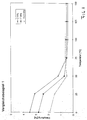
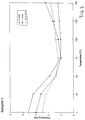
- the vibration damping is on the steel plate with the dimensions 110 mm x 60 mm x 5 mm investigating adhesive tape applied.
- the tape is punched out in the middle so that an accelerometer can be screwed directly onto the steel plate.
- a vibration-isolating mat e.g. fireproof Glass wool
- the excitation takes place in the middle an impulse hammer.
- the frequency analysis shows three natural frequencies at around 2.7 kHz, 7 kHz and 11.5 kHz.
- a modal analysis program or a corresponding arithmetic operation (3 dB point) supplies the associated attenuation in Percent.
- the measurements are made in temperature jumps from 25 ° C starting from 0 ° C to 150 ° C repeated, the Temperature specifications apply to the test plate.
- Ethyl acetate and n-hexane are placed in a reactor.
- the monomers are weighed into a round bottom flask and mixed.
- the starter solution made from AIBN (Vazo 64) and ethyl acetate. Starter solution and monomer mixture are mixed and poured into a dropping funnel.
- the reactor is heated up to boiling temperature. After reaching the boiling temperature becomes 10% of the mixed solution (Monomer mixture + starter solution) added. Subsequently the start of the reaction is awaited (reflux). After The remaining monomer and starter solution begins to react metered in within 120 min. Then leaves you stir another 180 min. After the reactor on below Is cooled to 60 ° C, isopropanol to a theoretical Solids content of approx. 40-45% diluted.
- the base polymer thus prepared becomes the invention post-crosslinkable pressure-sensitive adhesive mixture processed, by the respective amount of bismaleimide in acetone and / or titanium acetylacetonate in isopropanol and then stirred for a further 5 min.
- the so made Mixture has a solids content of approx. 30%.
- the aforementioned PSA formulations 1-10 and comparative examples V1 and V2 are processed in a conventional solvent coating system to form transfer adhesive tapes.
- the application weight is 100 g / m 2 .
Landscapes
- Chemical & Material Sciences (AREA)
- Organic Chemistry (AREA)
- Health & Medical Sciences (AREA)
- Chemical Kinetics & Catalysis (AREA)
- Medicinal Chemistry (AREA)
- Polymers & Plastics (AREA)
- Adhesives Or Adhesive Processes (AREA)
- Adhesive Tapes (AREA)
- Addition Polymer Or Copolymer, Post-Treatments, Or Chemical Modifications (AREA)
Applications Claiming Priority (2)
| Application Number | Priority Date | Filing Date | Title |
|---|---|---|---|
| DE19721846A DE19721846A1 (de) | 1997-05-26 | 1997-05-26 | Schwingungsdämpfende, hitzebeständige, druckempfindliche Acrylatklebstoffzusammensetzung sowie ein daraus hergestelltes Haftklebeband |
| DE19721846 | 1997-05-26 |
Publications (2)
| Publication Number | Publication Date |
|---|---|
| EP0881271A1 true EP0881271A1 (fr) | 1998-12-02 |
| EP0881271B1 EP0881271B1 (fr) | 2003-03-26 |
Family
ID=7830444
Family Applications (1)
| Application Number | Title | Priority Date | Filing Date |
|---|---|---|---|
| EP98108230A Expired - Lifetime EP0881271B1 (fr) | 1997-05-26 | 1998-05-06 | Composition d'adhésif acrylique absorbant de vibration, résistant à la chaleur et sensible à la pression et bande adhésive qui en est produite |
Country Status (3)
| Country | Link |
|---|---|
| EP (1) | EP0881271B1 (fr) |
| AT (1) | ATE235540T1 (fr) |
| DE (2) | DE19721846A1 (fr) |
Families Citing this family (2)
| Publication number | Priority date | Publication date | Assignee | Title |
|---|---|---|---|---|
| DE102009055091A1 (de) | 2009-12-21 | 2011-06-22 | tesa SE, 20253 | Induktiv erwärmbares Klebeband mit differentiellem Löseverhalten |
| DE102011079685A1 (de) | 2011-07-22 | 2013-01-24 | Tesa Se | Verfahren zum Herstellen einer Klebverbindung mit einem hitzeaktivierbaren Kleber mittels Induktionserwärmung |
Citations (2)
| Publication number | Priority date | Publication date | Assignee | Title |
|---|---|---|---|---|
| WO1993022391A1 (fr) * | 1992-04-28 | 1993-11-11 | Minnesota Mining And Manufacturing Company | Auto-adhesif resistant au plastifiant pour film de marquage en vinyle |
| WO1996018701A1 (fr) * | 1994-12-13 | 1996-06-20 | Minnesota Mining And Manufacturing Company | Adhesif autocollant amovible et article |
Family Cites Families (2)
| Publication number | Priority date | Publication date | Assignee | Title |
|---|---|---|---|---|
| JP3186143B2 (ja) * | 1991-11-11 | 2001-07-11 | 日東電工株式会社 | 耐熱性の良好な制振性感圧接着剤組成物とその製法 |
| DE4205860A1 (de) * | 1992-02-26 | 1993-09-02 | Atochem Elf Deutschland | Reaktivschmelzkleber und reaktivbeschichtungsmittel |
-
1997
- 1997-05-26 DE DE19721846A patent/DE19721846A1/de not_active Withdrawn
-
1998
- 1998-05-06 EP EP98108230A patent/EP0881271B1/fr not_active Expired - Lifetime
- 1998-05-06 DE DE59807604T patent/DE59807604D1/de not_active Expired - Fee Related
- 1998-05-06 AT AT98108230T patent/ATE235540T1/de not_active IP Right Cessation
Patent Citations (2)
| Publication number | Priority date | Publication date | Assignee | Title |
|---|---|---|---|---|
| WO1993022391A1 (fr) * | 1992-04-28 | 1993-11-11 | Minnesota Mining And Manufacturing Company | Auto-adhesif resistant au plastifiant pour film de marquage en vinyle |
| WO1996018701A1 (fr) * | 1994-12-13 | 1996-06-20 | Minnesota Mining And Manufacturing Company | Adhesif autocollant amovible et article |
Also Published As
| Publication number | Publication date |
|---|---|
| DE19721846A1 (de) | 1998-12-03 |
| DE59807604D1 (de) | 2003-04-30 |
| EP0881271B1 (fr) | 2003-03-26 |
| ATE235540T1 (de) | 2003-04-15 |
Similar Documents
| Publication | Publication Date | Title |
|---|---|---|
| DE69527846T2 (de) | Wiederaufbringbarer, klebrige mikrokügelchen umfassender haftklebstoff | |
| DE3720883C2 (fr) | ||
| DE69526802T2 (de) | Entfernbarer haftklebstoff und gegenstand damit | |
| DE69214164T2 (de) | Entfernbare, druckenpfindliche klebemittel mit niedriger schmelzviscositaet | |
| DE69419637T2 (de) | Haftkleber mit verbesserter Haftung zu gegen sauren Regen beständigen Fahrzeugteilen | |
| DE68910056T2 (de) | Klebriggemachte Terpolymer-Klebstoffe. | |
| DE69023292T2 (de) | Druckempfindliche klebstoffe auf basis von siloxanemulsionen. | |
| DE69304203T2 (de) | Dispersionen auf basis von fluoroalkylsiloxanen und vinylcopolymeren und daraus hergestellte kontaktklebestoffe mit verbesserter resistenz gegen lösungsmittel | |
| DE102013222739A1 (de) | Reaktives 2-Komponentenklebesystem in Filmform | |
| EP2718385B1 (fr) | Adhesif thermofusible durcissable par rayonnement contanant du poly(méth)acrylate et de l'oligo(méth)acrylate contenant des c-c double liaisons non acryliques | |
| DE19905800B4 (de) | Haft- und Strukturklebstoff und dessen Verwendung | |
| WO2019106194A1 (fr) | Polyacrylate résistant aux produits chimiques et matière autoadhésive à base de ce polyacrylate | |
| DE69514383T2 (de) | Dämpfende konstruktionen enthaltend mindestens eine Schlicht aus einem viskoelastischen Material auf einem vibrierenden Festkörper | |
| DE60203090T2 (de) | Druckempfindliches Acrylklebmittel und diese enthaltende Klebfilme | |
| EP3322764B1 (fr) | Adhésif fusible contenant un poly(méth)acrylate constitué par des (méth)acrylates d'alkyle et des (méth)acrylates contenant des groupes hétérocycliques déterminés | |
| DE102015217131A1 (de) | Klebharz-modifizierte Haftklebemasse | |
| DE69626251T2 (de) | Wasserdispergierbare druckempfindliche klebstoffzusammensetzung, verfahren zu deren herstellung und daraus hergestellte druckempfindliche klebeartikel | |
| EP2638120A2 (fr) | Rubans adhésifs de contact pour le collage de fenêtres, en particulier dans des appareils mobiles | |
| EP0881271B1 (fr) | Composition d'adhésif acrylique absorbant de vibration, résistant à la chaleur et sensible à la pression et bande adhésive qui en est produite | |
| DE69126926T2 (de) | Druckempfindliches klebkraftverstärkbares acrylemulsionsklebemittel mit ausgezeichneten niedrigtemperatureigenschaften | |
| DE69919829T2 (de) | Acrylische druckempfindliche Klebstoff-Zusammensetzung und Verfahren zu ihrer Herstellung | |
| DE10259457B4 (de) | Verfahren zum Aufbringen von Haftklebebändern auf raue und/oder unebene Oberflächen | |
| DE102019220303A1 (de) | Haftklebmasse für Papierverklebungen | |
| EP4202004A1 (fr) | Masse adhésive pour le collage de plaques d'impression | |
| DE69411353T2 (de) | Silikonfreies trennmittelpolymer |
Legal Events
| Date | Code | Title | Description |
|---|---|---|---|
| PUAI | Public reference made under article 153(3) epc to a published international application that has entered the european phase |
Free format text: ORIGINAL CODE: 0009012 |
|
| AK | Designated contracting states |
Kind code of ref document: A1 Designated state(s): AT BE CH DE DK ES FI FR GB GR IE IT LI LU NL PT SE |
|
| AX | Request for extension of the european patent |
Free format text: AL;LT;LV;MK;RO;SI PAYMENT 980506 |
|
| 17P | Request for examination filed |
Effective date: 19990330 |
|
| AKX | Designation fees paid |
Free format text: AT BE CH CY DE DK ES FI LI |
|
| AXX | Extension fees paid |
Free format text: SI PAYMENT 19980506 |
|
| RBV | Designated contracting states (corrected) |
Designated state(s): AT BE CH DE DK ES FI FR GB GR IE IT LI LU NL PT SE |
|
| 17Q | First examination report despatched |
Effective date: 20020326 |
|
| GRAH | Despatch of communication of intention to grant a patent |
Free format text: ORIGINAL CODE: EPIDOS IGRA |
|
| GRAH | Despatch of communication of intention to grant a patent |
Free format text: ORIGINAL CODE: EPIDOS IGRA |
|
| GRAA | (expected) grant |
Free format text: ORIGINAL CODE: 0009210 |
|
| AK | Designated contracting states |
Designated state(s): AT BE CH DE DK ES FI FR GB GR IE IT LI LU NL PT SE |
|
| AX | Request for extension of the european patent |
Extension state: SI |
|
| PG25 | Lapsed in a contracting state [announced via postgrant information from national office to epo] |
Ref country code: NL Free format text: LAPSE BECAUSE OF FAILURE TO SUBMIT A TRANSLATION OF THE DESCRIPTION OR TO PAY THE FEE WITHIN THE PRESCRIBED TIME-LIMIT Effective date: 20030326 Ref country code: IT Free format text: LAPSE BECAUSE OF FAILURE TO SUBMIT A TRANSLATION OF THE DESCRIPTION OR TO PAY THE FEE WITHIN THE PRE;WARNING: LAPSES OF ITALIAN PATENTS WITH EFFECTIVE DATE BEFORE 2007 MAY HAVE OCCURRED AT ANY TIME BEFORE 2007. THE CORRECT EFFECTIVE DATE MAY BE DIFFERENT FROM THE ONE RECORDED.SCRIBED TIME-LIMIT Effective date: 20030326 Ref country code: IE Free format text: LAPSE BECAUSE OF NON-PAYMENT OF DUE FEES Effective date: 20030326 Ref country code: GR Free format text: LAPSE BECAUSE OF FAILURE TO SUBMIT A TRANSLATION OF THE DESCRIPTION OR TO PAY THE FEE WITHIN THE PRESCRIBED TIME-LIMIT Effective date: 20030326 Ref country code: GB Free format text: LAPSE BECAUSE OF FAILURE TO SUBMIT A TRANSLATION OF THE DESCRIPTION OR TO PAY THE FEE WITHIN THE PRESCRIBED TIME-LIMIT Effective date: 20030326 Ref country code: FR Free format text: LAPSE BECAUSE OF FAILURE TO SUBMIT A TRANSLATION OF THE DESCRIPTION OR TO PAY THE FEE WITHIN THE PRESCRIBED TIME-LIMIT Effective date: 20030326 Ref country code: FI Free format text: LAPSE BECAUSE OF FAILURE TO SUBMIT A TRANSLATION OF THE DESCRIPTION OR TO PAY THE FEE WITHIN THE PRESCRIBED TIME-LIMIT Effective date: 20030326 |
|
| REG | Reference to a national code |
Ref country code: GB Ref legal event code: FG4D Free format text: NOT ENGLISH |
|
| REG | Reference to a national code |
Ref country code: CH Ref legal event code: EP |
|
| REF | Corresponds to: |
Ref document number: 59807604 Country of ref document: DE Date of ref document: 20030430 Kind code of ref document: P |
|
| REG | Reference to a national code |
Ref country code: IE Ref legal event code: FG4D Free format text: GERMAN |
|
| PG25 | Lapsed in a contracting state [announced via postgrant information from national office to epo] |
Ref country code: LU Free format text: LAPSE BECAUSE OF NON-PAYMENT OF DUE FEES Effective date: 20030506 Ref country code: AT Free format text: LAPSE BECAUSE OF NON-PAYMENT OF DUE FEES Effective date: 20030506 |
|
| PG25 | Lapsed in a contracting state [announced via postgrant information from national office to epo] |
Ref country code: LI Free format text: LAPSE BECAUSE OF NON-PAYMENT OF DUE FEES Effective date: 20030531 Ref country code: CH Free format text: LAPSE BECAUSE OF NON-PAYMENT OF DUE FEES Effective date: 20030531 Ref country code: BE Free format text: LAPSE BECAUSE OF NON-PAYMENT OF DUE FEES Effective date: 20030531 |
|
| PG25 | Lapsed in a contracting state [announced via postgrant information from national office to epo] |
Ref country code: SE Free format text: LAPSE BECAUSE OF FAILURE TO SUBMIT A TRANSLATION OF THE DESCRIPTION OR TO PAY THE FEE WITHIN THE PRESCRIBED TIME-LIMIT Effective date: 20030626 Ref country code: PT Free format text: LAPSE BECAUSE OF FAILURE TO SUBMIT A TRANSLATION OF THE DESCRIPTION OR TO PAY THE FEE WITHIN THE PRESCRIBED TIME-LIMIT Effective date: 20030626 Ref country code: DK Free format text: LAPSE BECAUSE OF FAILURE TO SUBMIT A TRANSLATION OF THE DESCRIPTION OR TO PAY THE FEE WITHIN THE PRESCRIBED TIME-LIMIT Effective date: 20030626 |
|
| NLV1 | Nl: lapsed or annulled due to failure to fulfill the requirements of art. 29p and 29m of the patents act | ||
| GBV | Gb: ep patent (uk) treated as always having been void in accordance with gb section 77(7)/1977 [no translation filed] |
Effective date: 20030326 |
|
| PG25 | Lapsed in a contracting state [announced via postgrant information from national office to epo] |
Ref country code: ES Free format text: LAPSE BECAUSE OF FAILURE TO SUBMIT A TRANSLATION OF THE DESCRIPTION OR TO PAY THE FEE WITHIN THE PRESCRIBED TIME-LIMIT Effective date: 20030930 |
|
| REG | Reference to a national code |
Ref country code: IE Ref legal event code: FD4D Ref document number: 0881271E Country of ref document: IE |
|
| BERE | Be: lapsed |
Owner name: *LOHMANN G.M.B.H. & CO. K.G. Effective date: 20030531 |
|
| PG25 | Lapsed in a contracting state [announced via postgrant information from national office to epo] |
Ref country code: DE Free format text: LAPSE BECAUSE OF NON-PAYMENT OF DUE FEES Effective date: 20031202 |
|
| REG | Reference to a national code |
Ref country code: CH Ref legal event code: PL |
|
| PLBE | No opposition filed within time limit |
Free format text: ORIGINAL CODE: 0009261 |
|
| STAA | Information on the status of an ep patent application or granted ep patent |
Free format text: STATUS: NO OPPOSITION FILED WITHIN TIME LIMIT |
|
| EN | Fr: translation not filed | ||
| 26N | No opposition filed |
Effective date: 20031230 |