EP0881601A2 - Méthode et système de reconnaissance automatique des images indices numeriques délibérément distordues pour les rendre non-lisibles - Google Patents
Méthode et système de reconnaissance automatique des images indices numeriques délibérément distordues pour les rendre non-lisibles Download PDFInfo
- Publication number
- EP0881601A2 EP0881601A2 EP98109545A EP98109545A EP0881601A2 EP 0881601 A2 EP0881601 A2 EP 0881601A2 EP 98109545 A EP98109545 A EP 98109545A EP 98109545 A EP98109545 A EP 98109545A EP 0881601 A2 EP0881601 A2 EP 0881601A2
- Authority
- EP
- European Patent Office
- Prior art keywords
- data
- readable
- processing
- indicium
- Prior art date
- Legal status (The legal status is an assumption and is not a legal conclusion. Google has not performed a legal analysis and makes no representation as to the accuracy of the status listed.)
- Withdrawn
Links
- 238000000034 method Methods 0.000 title claims abstract description 60
- 238000012545 processing Methods 0.000 claims abstract description 28
- 230000003287 optical effect Effects 0.000 claims abstract description 3
- 230000008569 process Effects 0.000 claims description 37
- 238000010200 validation analysis Methods 0.000 claims description 24
- 238000011835 investigation Methods 0.000 claims description 9
- 230000007547 defect Effects 0.000 claims description 8
- 238000007639 printing Methods 0.000 abstract description 32
- 239000000758 substrate Substances 0.000 abstract description 9
- 238000013528 artificial neural network Methods 0.000 description 19
- 238000012795 verification Methods 0.000 description 7
- 238000012549 training Methods 0.000 description 6
- 238000001514 detection method Methods 0.000 description 4
- 239000000976 ink Substances 0.000 description 4
- 230000007246 mechanism Effects 0.000 description 3
- 230000008859 change Effects 0.000 description 2
- 238000012937 correction Methods 0.000 description 2
- 230000001419 dependent effect Effects 0.000 description 2
- 238000007689 inspection Methods 0.000 description 2
- 230000003993 interaction Effects 0.000 description 2
- 238000012986 modification Methods 0.000 description 2
- 230000004048 modification Effects 0.000 description 2
- 230000001537 neural effect Effects 0.000 description 2
- 238000003909 pattern recognition Methods 0.000 description 2
- 238000013459 approach Methods 0.000 description 1
- 230000001174 ascending effect Effects 0.000 description 1
- 238000013475 authorization Methods 0.000 description 1
- 238000004891 communication Methods 0.000 description 1
- 230000002950 deficient Effects 0.000 description 1
- 238000013461 design Methods 0.000 description 1
- 238000010586 diagram Methods 0.000 description 1
- 239000006185 dispersion Substances 0.000 description 1
- 230000000694 effects Effects 0.000 description 1
- 238000005516 engineering process Methods 0.000 description 1
- 238000012804 iterative process Methods 0.000 description 1
- 230000008520 organization Effects 0.000 description 1
- 238000011084 recovery Methods 0.000 description 1
- 238000009877 rendering Methods 0.000 description 1
- 238000012552 review Methods 0.000 description 1
- 238000012360 testing method Methods 0.000 description 1
- 238000012546 transfer Methods 0.000 description 1
- 230000000007 visual effect Effects 0.000 description 1
Images

Classifications
-
- G—PHYSICS
- G07—CHECKING-DEVICES
- G07B—TICKET-ISSUING APPARATUS; FARE-REGISTERING APPARATUS; FRANKING APPARATUS
- G07B17/00—Franking apparatus
- G07B17/00733—Cryptography or similar special procedures in a franking system
-
- G—PHYSICS
- G07—CHECKING-DEVICES
- G07B—TICKET-ISSUING APPARATUS; FARE-REGISTERING APPARATUS; FRANKING APPARATUS
- G07B17/00—Franking apparatus
- G07B17/00185—Details internally of apparatus in a franking system, e.g. franking machine at customer or apparatus at post office
- G07B17/00435—Details specific to central, non-customer apparatus, e.g. servers at post office or vendor
-
- G—PHYSICS
- G07—CHECKING-DEVICES
- G07B—TICKET-ISSUING APPARATUS; FARE-REGISTERING APPARATUS; FRANKING APPARATUS
- G07B17/00—Franking apparatus
- G07B17/00459—Details relating to mailpieces in a franking system
- G07B17/00661—Sensing or measuring mailpieces
-
- G—PHYSICS
- G07—CHECKING-DEVICES
- G07B—TICKET-ISSUING APPARATUS; FARE-REGISTERING APPARATUS; FRANKING APPARATUS
- G07B17/00—Franking apparatus
- G07B17/00185—Details internally of apparatus in a franking system, e.g. franking machine at customer or apparatus at post office
- G07B17/00435—Details specific to central, non-customer apparatus, e.g. servers at post office or vendor
- G07B2017/00443—Verification of mailpieces, e.g. by checking databases
-
- G—PHYSICS
- G07—CHECKING-DEVICES
- G07B—TICKET-ISSUING APPARATUS; FARE-REGISTERING APPARATUS; FRANKING APPARATUS
- G07B17/00—Franking apparatus
- G07B17/00459—Details relating to mailpieces in a franking system
- G07B17/00661—Sensing or measuring mailpieces
- G07B2017/00709—Scanning mailpieces
- G07B2017/00717—Reading barcodes
-
- G—PHYSICS
- G07—CHECKING-DEVICES
- G07B—TICKET-ISSUING APPARATUS; FARE-REGISTERING APPARATUS; FRANKING APPARATUS
- G07B17/00—Franking apparatus
- G07B17/00459—Details relating to mailpieces in a franking system
- G07B17/00661—Sensing or measuring mailpieces
- G07B2017/00709—Scanning mailpieces
- G07B2017/00725—Reading symbols, e.g. OCR
-
- G—PHYSICS
- G07—CHECKING-DEVICES
- G07B—TICKET-ISSUING APPARATUS; FARE-REGISTERING APPARATUS; FRANKING APPARATUS
- G07B17/00—Franking apparatus
- G07B17/00733—Cryptography or similar special procedures in a franking system
- G07B2017/00959—Cryptographic modules, e.g. a PC encryption board
- G07B2017/00967—PSD [Postal Security Device] as defined by the USPS [US Postal Service]
Definitions
- the present invention relates to printing and verifying images and, more particularly, to printing and verifying digital indicia, such as those used for proof of postage payment or other value printing applications.
- a mailer prepares a mailpiece or a series of mailpieces for delivery to a recipient by a carrier service such as the United States Postal Service or other postal service or a private carrier delivery service.
- the carrier services upon receiving or accepting a mailpiece or a series of mailpieces from a mailer, processes the mailpiece to prepare it for physical delivery to the recipient.
- Payment for the postal service or private carrier delivery service may be made by means of value metering devices such as postage meters.
- the user prints an indicia, which may be digital token or other evidence of payment on the mailpiece or on a tape that is adhered to the mailpiece.
- the postage metering systems print and account for postage and other unit value printing such as parcel delivery service charges and tax stamps.
- Prepayment meters employ descending registers for securely storing value within the meter prior to printing whole post payment (current account) meters employ ascending registers account for value imprinted.
- Postal charges or other terms referring to postal or postage meter or meter system as used herein should be understood to mean charges for either postal charges, tax charges, private carrier charges, tax service or private carrier service, as the case may be, and other value metering systems, such as certificate metering systems such as is disclosed in European Patent Application of Cordery, Lee, Pintsov, Ryan and Weiant, filed August 21, 1996, and published under No. 0762692, for SECURE USER CERTIFICATION FOR ELECTRONIC COMMERCE EMPLOYING VALUE METERING SYSTEM and assigned to Pitney Bowes, Inc.
- Mail pieces as used herein includes both letters of all types and parcels of all types.
- Postage metering systems have also been developed which employ encrypted information on a mailpiece.
- the postage value for a mailpiece may be encrypted together with the other data to generate a digital token.
- a digital token is encrypted information that authenticates the information imprinted on a mailpiece such as postage value. Examples of postage metering systems which generate and employ digital tokens are described in U.S. Patent No. 4,757,537 for SYSTEM FOR DETECTING UNACCOUNTED FOR PRINTING IN A VALUE PRINTING SYSTEM, issued July 12, 1988; U.S. Patent No. 4,831,555 for SECURE POSTAGE APPLYING SYSTEM, issued May 15, 1989; U.S. Patent No.
- the postage printing program of the user directly controls the printer so as to prevent end users from printing more that one copy of any envelope or label with the same serial number.
- the patent suggests that by capturing and storing the serial numbers on all mailpieces, and then periodically processing the information, the postal service can detect fraudulent duplication of envelopes or labels. In this system, funds are accounted for by and at the mailer site. The mailer creates and issues the unique serial number which is not submitted to the postal service prior to mail entering the postal service mail processing stream. Moreover, no assistance is provided to enhance the deliverability of the mail beyond current existing systems.
- various postage meter designs may include electronic accounting systems which may be secured within a meter housing or smart cards or other types of portable accounting systems.
- encrypted indicia involve the use of various verification techniques to insure that the indicia is valid. This may be implemented via machine reading the indicia and subsequent validation. Alternatively, the encrypted indicia data may be human readable and thereafter manually entered into a computing system for validation. The nature of the validation process requires the retrieval of sufficient data to execute the validation process. A problem with validation exists, however, when the encrypted indicia is defective such that sufficient data necessary for the validation process cannot be obtained either by machine or human reading. This is a case where data available to the verifying party is insufficient for validation of the indicium. Accordingly, a decision must be made as how to further process such mail, either to reject the mail piece or to place the mail piece in the mail delivery stream.
- the imprinted indicia is verifiable so long as certain indicia characteristics are legible as, for example, tels intention included in the indicia.
- the imprinted indicia if legible, can be compared to stored indicia specimens for the meter system.
- a method embodying the present invention includes processing mail pieces containing data printed thereon scans a mail piece and obtains information concerning the data printed on the mail piece. The information is processed to determine if the data is readable. Non readable data information is processed to determine if the non readable data is due to predetermined causes of a first type or predetermined causes of a second type.
- a substrate may be used instead of a mail piece and the printed information may be any type of printed information such as a printed indicium.
- the printing may be optical character recognzable type printing, bar code printing of any type or other types of printing.
- mail pieces or substrates with non readable data due to the first type of predetermined causes are processed in a first manner and mail pieces or substrates with non readable data due to the second type of predetermined causes are processed in a second manner.
- the present method allows for automatic recognition of images which were deliberately distorted for the purpose of rendering them to be non readable to avoid detection as counterfeited.
- the practical significance of this invention lies in the fact that:
- the invention closes a potentially wide open loophole in the postage payment system based on digital images incorporating validation codes (digital tokens or truncated ciphertexts), thus creating secure systems trusted by mailers and posts payment system.
- the postage payment system which is based on digital images incorporating validation codes (digital tokens or truncated ciphertexts)
- the verifying party usually a Postal Administration
- the verifying party can automatically capture and recognize information printed in the digital indicium and validate the indicium authenticity and information integrity by using an appropriate cryptographic algorithm.
- the rate of error free automatic recognition is assumed to be high due to special data format and error control data in the indicium with which the postage evidencing device (franking machine, a computer printer and the like) prints the indicium.
- the postage evidencing device franking machine, a computer printer and the like
- a reading error that is the rejection of the indicium as unreadable by the recognition process
- an error recovery mechanism based on manual key entry of the information in the indicium into the verifying computer.
- the verifying party is left with an unpleasant policy decision: should the mail piece be accepted for delivery or rejected based on illegibility of the information in the indicium.
- This dilemma emphasizes the need to find a way to automatically discriminate with a high level of confidence between legitimate and counterfeited images of poor quality. The point about the confidence level is important. Due to the very large number of mail pieces processed daily, the process of discrimination is statistical by nature.
- an image When an image is digitized it may be represented as a collection of pixels, color, gray scale level or binary values with associated X and Y coordinates.
- the digital image of an indicium consists of pixels representing graphical elements and characters.
- the characters crucial for indicium validation may be in certain systems only numerals of certain shape, reducing the total number of shapes to be considered for recognition purpose from hundreds for a typical text reading application to 10.
- a neural network approach can be very effective for this particular application.
- a three layer network can be employed.
- the first layer consists of the number of input nodes equal to the number of preselected image statistics, for example 30 for each character shape, 9 for graphic elements and 3 for total number of pixels, that is 42 input nodes.
- the intermediate level may have, for example, 10 nodes. On how to select the intermediate level: see for example, R. Hecht-Nielsen, Neural Networks, Addison-Wesley, 1991).
- the output layer consist of two nodes, corresponding to human readable or human nonreadable. Such network can then be trained with a supervision on the basis of a collected sample of readable and non readable images.
- the supervisor presents the network with input data together with the correct result (readable, nonreadable).
- the process converges to a stable state, when weights assigned to connections between nodes are stable and assigned certain values.
- the process of training can employ a known algorithm of back propagation of errors (see, R. Hecht-Nielsen, Neural Networks, Addison-Wesley, 1991).
- the network is employed to classify real images, which were not a part of the initial training set.
- One interesting method of using network is to "interrogater" the network, upon conclusion of the training process as to which inputs were deciding factors in during the classification process. In practice this means listing connection weights between the nodes in descending order and selecting inputs contributed most to these weights.
- the selected inputs then can be used as features in a conventional statistical classifier.
- the computing resources required to classify images can be minimized, since conventional classifiers are typically more computationally effective than neural networks.
- the process can also be implemented without a neural network by cataloging the various types of illegible printed data. These categories include printed data intentionally made illegible.
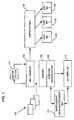
- FIGURE 1 A series of mail piece shown generally at 102 are placed on a mail transport 104.
- the mail pieces contain an indicia having a validation code. This has been termed an encrypted indicia.
- the encrypted indicia may contain digital tokens used in the validation process.
- Indicium data must be recovered to verify the proof of payment imprinted on the mail piece. The data necessary to do this is dependent on the form and architecture of the cryptographic process utilized. Encrypted and non-encrypted information needs to be recovered to initiate most validation processes.
- the mail pieces 102 are transported past a scanner 106 by mail transport 104.
- the scanner scans necessary information from the mail piece to enable the validation process to proceed and for other purposes in connection with the mail processes. In one embodiment, the scanner may capture and digitize the image of the indicium for subsequent processing.
- the captured digitized image may be sent to a key entry unit 110 where a determination has been made that the captured image is likely to be human readable.
- the mail piece involved may be held in the buffer station 111 while the key entry process is implemented.
- the data is sent to a cryptographic validation processor unit 112.
- the processor unit 112 determines, based on the available data from the mail piece, whether the printed indicia is valid.
- the mail pieces proceed, either along the transport or from the buffer station to a sorting station 114 to be sorted based on the determination made by the cryptographic validation processor unit 112 to either a first sortation bin 116 for accepted mail which will be put into the mail delivery stream or to sortation bin 118 where the cryptographic process has indicated that the mail piece has an invalid imprint.
- this is a cryptographic indication of an invalid mail piece which is a fraudulent mail piece in that the data recovered from the mail piece is internally inconsistent.
- a third category of mail is still present in the mall stream. This is mail where the mail piece data is not machine recognizable nor is it human readable. This mail is processed to be sorted by mail sorting station 114 into either first sortation bin 116 of accepted mail or into a 120 third sortation bin 120 for mail requiring further investigation. This mail bin 120 is reserved for mail pieces which are likely fraudulent but require further investigation because of the inconclusive nature of the recovered data.
- the mail processing system as described herein further reduces the number of mail pieces sorted into sortation bin 120 by allowing mail pieces that are likely not fraudulent to be accepted.
- FIGURE 2 It should be expressly recognized that various encrypted data including alpha numeric and graphical representations, such as bar code, may be employed in the present invention. The following description is merely for the purpose of illustrating but one of many examples of how the present process may be implemented.
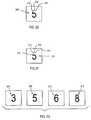
- FIGURE 2a depicts an image of the numeral 5 which is shown at 202 as a completely formed defect free numeral. That is, all of the graphical elements necessary to fully represent the numeral are present.
- FIGURE 2b depicts the same numeral "5," however, a portion of the image is missing. Specifically, the top most right hand portion shown at area 204 is not present. This means the upper right most portion of the image contains no imprinted pixels (no black dots or markings for the portion of the image).
- FIGURE 2c The numeral "5" now has an additional area 206 missing from the numeral "5.”
- FIGURE 1 Should the validation system in FIGURE 1 recover an image of a numeral such as shown in FIGURE 2c, for the particular numeral type set being utilized, three possibilities might exist.
- the recovered numeral intended to be printed could be a "3" as shown at 208, could be the original numeral "5" as shown at 202 or might be the numeral "6" as shown at 210.
- any of the possibilities shown in FIGURE 2D are potentially plausible.
- the numeral "5" has a further area 212 missing from the imprint. However, as shown in FIGURE 2f, yet further information can be eliminated from the imprint, specifically the area 214.
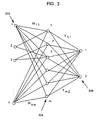
- FIGURE 3 A standard neural network system is employed to determine the characteristics of human readable and non human readable indicia. This is done through an iterative process of learning through a supervisor guided learning process. In such a process human intervention is included to provide the right identification (human readable or human non readable) for the network based on the input indicia for the data set involved.
- the training of the neural network is partially dependent upon having a set predetermined number of parameters which do not vary.
- the processing of the neural network to determine readability or non-readability, human readability or non-readability is based on a particular printer and equipment, a particular scanner and printer.
- the variables include the interaction of the inks with large varieties of papers; however, since the other variables are stable, a iterative neural network learning process can be implemented to improve the decision making process and accepting and rejecting mail pieces. This makes the universe of different factors which could impact the decision more limited and therefore manageable.
- the data set to the input layer nodes 1-n shown generally at 302 may include, for example, the following data concerning an indicia. These may be input at 302 via the various in put layer nodes 1-n and may be comprised of the following:
- the neural and network system includes an intermediate layer shown generally at 304.
- the intermediate layer computes a sum of the inputs times the weight. This is, again, processed to an output layer shown generally at 306 to ultimately formulate the characteristics of human readable and human nonreadable indicium.
- the neural network may operate, for example, as described in the text Neural Networks by R. Hecht-Nielsen identified above.
- each layer is connected to a preceding layer and the subsequent layer in the network. In that connection, each node is connected to other nodes in the preceding or forwarding layer and the connection between the nodes is defined by a weight associated through this connection as is shown if FIGURE 3.
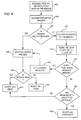
- FIGURE 4 A mail piece is scanned and a digitized image of the indicium obtained at 402. The recovered image is subjected to a machine recognition process at 404. A determination is made at 406 if the indicium is machine readable. If the indicium is machine readable, the data is sent to a process at 408. A determination is made at 410 if the processed indicium is valid. If it is valid, the mail piece is accepted at 412. The mail piece is then placed in the mail delivery stream. If the indicium is determined as not valid, the mail piece is rejected at 414.
- statistics of the indicium are computed at 416. These statistics are subjected to neural network or statistical classifier processing at 418. A determination is made at 420 whether the indicium is likely to be human readable, that is, the likelihood of the indicium being readable is high, the indicium data image is sent for key entry at 422. The key entered indicium data is thereafter processed at 408 and the process continues as previously noted.
- the decisions as explained above regarding expected readability of the indicium image is, of course, a statistical one.
- the neural or traditional classifier will return a yes/no/do not know decision with a certain confidence level.
- the normal process of accepting or rejecting the decision based on confidence level is then employed based on predetermined (by policy decision) level of threshold. If the confidence level is below the threshold level, the mail piece can be diverted for manual inspection. As a result of such inspection, if the image is deemed to be a human nonreadable mail piece, it can either be accepted or rejected depending on revenue protection policy. More specifically, the determination made in decision box 406 is deterministic. Either the indicium is machine readable or it is not machine readable.
- decisions made in decision box 420 and 422 may be statistically determined. Alternatively, these determinations may be made as a result of review and classification of various non-machine readable indicia. The level of these determinations, this is, that the yes/no decision may be formulated by policy considerations as to revenue protection and the level of confidence required to allow mail to be accepted at block 412.
- the method and system described above is applicable to other coding systems, including all forms of bar code.
- the indicium includes several types of redundancy.
- the geometric structure of the bar code allows locating particular code words. This structure includes a target to help the scanner locate and determine the size and format of the bar code, and a specific lattice structure of the image.
- Each code word within the bar code includes redundant data, possibly linked to the location of the code word within the symbol.
- the bar code usually also includes substantial error detection and correction code.
- the data included in the bar code is redundant, for example, the date contains redundant data and the postal origin is determined by the meter number through a meter database.
- the mail piece and indicium may contain human readable, and OCR readable data that is included in the bar code. The verification system can check the consistency of this human readable data with partial data from the bar code.
- the verification system can employ the redundancies noted above to detect deliberately fraudulent non readable indicia, as well as to help partially decode symbols not readable with a standard decode algorithm.
- PDF417 has three distinct clusters of code words, and substantial structure within a code word. The three clusters are used sequentially in separate rows. The verification system can check that code words are consistent with their rows.
- An attacker may smear the bar code.
- a naturally occurring smear is unlikely, in a well designed system to hide all the information and redundancy.
- the verification system can still detect inconsistencies in the image.
- An attacker may alternatively omit printing part of an image, imitating nozzle blockage in an ink jet printer or printing over a thickness variation with a thermal transfer printer.
- Naturally occurring faults of this type are unlikely to completely obliterate the indicium information, so again in this case, the redundancy can be detected.
Landscapes
- Physics & Mathematics (AREA)
- General Physics & Mathematics (AREA)
- Engineering & Computer Science (AREA)
- Theoretical Computer Science (AREA)
- Devices For Checking Fares Or Tickets At Control Points (AREA)
- Editing Of Facsimile Originals (AREA)
- Sorting Of Articles (AREA)
Applications Claiming Priority (2)
| Application Number | Priority Date | Filing Date | Title |
|---|---|---|---|
| US08/827,982 US6058190A (en) | 1997-05-27 | 1997-05-27 | Method and system for automatic recognition of digital indicia images deliberately distorted to be non readable |
| US827982 | 1997-05-27 |
Publications (2)
| Publication Number | Publication Date |
|---|---|
| EP0881601A2 true EP0881601A2 (fr) | 1998-12-02 |
| EP0881601A3 EP0881601A3 (fr) | 2000-06-07 |
Family
ID=25250629
Family Applications (1)
| Application Number | Title | Priority Date | Filing Date |
|---|---|---|---|
| EP98109545A Withdrawn EP0881601A3 (fr) | 1997-05-27 | 1998-05-26 | Méthode et système de reconnaissance automatique des images indices numeriques délibérément distordues pour les rendre non-lisibles |
Country Status (3)
| Country | Link |
|---|---|
| US (1) | US6058190A (fr) |
| EP (1) | EP0881601A3 (fr) |
| CA (1) | CA2238196C (fr) |
Cited By (3)
| Publication number | Priority date | Publication date | Assignee | Title |
|---|---|---|---|---|
| WO2002045028A3 (fr) * | 2000-12-01 | 2004-02-26 | Hewlett Packard Co | Attestation graphique de paiement inviolable et a echelle modifiable |
| EP1887528A1 (fr) * | 2006-08-02 | 2008-02-13 | Pitney Bowes Inc. | Procédé et système pour détecter une impression reproduite d'indice dans un système métrique |
| EP1909234A1 (fr) * | 2001-02-02 | 2008-04-09 | Deutsche Post AG | Centre de contrôle destiné au contrôle d'affranchissements appliqués sur des courriers postaux |
Families Citing this family (14)
| Publication number | Priority date | Publication date | Assignee | Title |
|---|---|---|---|---|
| US6175827B1 (en) * | 1998-03-31 | 2001-01-16 | Pitney Bowes Inc. | Robus digital token generation and verification system accommodating token verification where addressee information cannot be recreated automated mail processing |
| US6839693B1 (en) | 2000-09-21 | 2005-01-04 | Pitney Bowes Inc. | System for detecting mail pieces with duplicate indicia |
| US7269303B2 (en) * | 2001-06-04 | 2007-09-11 | Hewlett-Packard Development Company, L.P. | Remote digital image enhancement system and method |
| US6739510B2 (en) * | 2002-03-08 | 2004-05-25 | Lockheed Martin Corporation | OCR/BCR sequencing priority |
| US6648230B1 (en) | 2002-05-22 | 2003-11-18 | Lockheed Martin Corporation | Method and apparatus for evaluating a confidence level of a decoded barcode |
| DE10300297A1 (de) * | 2003-01-02 | 2004-07-22 | Deutsche Post Ag | Verfahren und Vorrichtung zur Bearbeitung von auf Oberflächen von Postsendungen befindlichen graphischen Informationen |
| US7406183B2 (en) * | 2003-04-28 | 2008-07-29 | International Business Machines Corporation | System and method of sorting document images based on image quality |
| US7356163B2 (en) * | 2004-06-10 | 2008-04-08 | Lockheed Martin Corporation | Postal image augmented bio-warfare aerosolized agent trigger |
| JP2006115466A (ja) * | 2004-09-16 | 2006-04-27 | Ricoh Co Ltd | 画像処理装置、画像処理方法および画像処理プログラム |
| US20070124261A1 (en) * | 2005-11-28 | 2007-05-31 | Pitney Bowes Incorporated | System and method for processing custom postal indicia |
| US20080008383A1 (en) * | 2006-07-07 | 2008-01-10 | Lockheed Martin Corporation | Detection and identification of postal metermarks |
| US7941378B2 (en) * | 2008-05-16 | 2011-05-10 | Siemens Industry, Inc. | Stamp testing and monitoring |
| US12125247B2 (en) * | 2020-10-02 | 2024-10-22 | Google Llc | Processing images using self-attention based neural networks |
| CN112836726B (zh) * | 2021-01-12 | 2022-06-07 | 云南电网有限责任公司电力科学研究院 | 一种基于视频信息的指针类仪表示数读取方法及装置 |
Citations (8)
| Publication number | Priority date | Publication date | Assignee | Title |
|---|---|---|---|---|
| US3978457A (en) | 1974-12-23 | 1976-08-31 | Pitney-Bowes, Inc. | Microcomputerized electronic postage meter system |
| US4168533A (en) | 1976-01-14 | 1979-09-18 | Pitney-Bowes, Inc. | Microcomputerized miniature postage meter |
| US4301507A (en) | 1979-10-30 | 1981-11-17 | Pitney Bowes Inc. | Electronic postage meter having plural computing systems |
| US4493252A (en) | 1983-03-09 | 1985-01-15 | Pitney Bowes Inc. | Postage printing apparatus having a movable print head in a print drum |
| US4579054A (en) | 1982-12-08 | 1986-04-01 | Pitney Bowes Inc. | Stand-alone electronic mailing machine |
| US4757537A (en) | 1985-04-17 | 1988-07-12 | Pitney Bowes Inc. | System for detecting unaccounted for printing in a value printing system |
| US4831555A (en) | 1985-08-06 | 1989-05-16 | Pitney Bowes Inc. | Unsecured postage applying system |
| EP0762692A2 (fr) | 1995-08-21 | 1997-03-12 | Pitney Bowes Inc. | Certification sécurisée d'un utilisateur pour le commerce électronique utilisant un système compteur de valeur |
Family Cites Families (14)
| Publication number | Priority date | Publication date | Assignee | Title |
|---|---|---|---|---|
| US4660221A (en) * | 1983-07-18 | 1987-04-21 | Pitney Bowes Inc. | System for printing encrypted messages with bar-code representation |
| US4775246A (en) * | 1985-04-17 | 1988-10-04 | Pitney Bowes Inc. | System for detecting unaccounted for printing in a value printing system |
| US4725718A (en) * | 1985-08-06 | 1988-02-16 | Pitney Bowes Inc. | Postage and mailing information applying system |
| US5375172A (en) * | 1986-07-07 | 1994-12-20 | Chrosny; Wojciech M. | Postage payment system employing encryption techniques and accounting for postage payment at a time subsequent to the printing of postage |
| US4796193A (en) * | 1986-07-07 | 1989-01-03 | Pitney Bowes Inc. | Postage payment system where accounting for postage payment occurs at a time subsequent to the printing of the postage and employing a visual marking imprinted on the mailpiece to show that accounting has occurred |
| US5031223A (en) * | 1989-10-24 | 1991-07-09 | International Business Machines Corporation | System and method for deferred processing of OCR scanned mail |
| US5293319A (en) * | 1990-12-24 | 1994-03-08 | Pitney Bowes Inc. | Postage meter system |
| DE4344471A1 (de) * | 1993-12-21 | 1995-08-17 | Francotyp Postalia Gmbh | Verfahren und Anordnung zur Erzeugung und Überprüfung eines Sicherheitsabdruckes |
| US5475603A (en) * | 1994-06-21 | 1995-12-12 | Pitney Bowes Inc. | Apparatus and method for mail qualification and traying |
| US5612889A (en) * | 1994-10-04 | 1997-03-18 | Pitney Bowes Inc. | Mail processing system with unique mailpiece authorization assigned in advance of mailpieces entering carrier service mail processing stream |
| US5523552A (en) * | 1994-10-19 | 1996-06-04 | Symbol Technologies, Inc. | Method and apparatus to scan randomly oriented two-dimensional bar code symbols |
| US5671282A (en) * | 1995-01-23 | 1997-09-23 | Ricoh Corporation | Method and apparatus for document verification and tracking |
| US5659163A (en) * | 1995-02-01 | 1997-08-19 | Publisher's Clearing House | Method for processing mail |
| US5974147A (en) * | 1996-11-07 | 1999-10-26 | Pitney Bowes Inc. | Method of verifying unreadable indicia for an information-based indicia program |
-
1997
- 1997-05-27 US US08/827,982 patent/US6058190A/en not_active Expired - Fee Related
-
1998
- 1998-05-21 CA CA002238196A patent/CA2238196C/fr not_active Expired - Fee Related
- 1998-05-26 EP EP98109545A patent/EP0881601A3/fr not_active Withdrawn
Patent Citations (8)
| Publication number | Priority date | Publication date | Assignee | Title |
|---|---|---|---|---|
| US3978457A (en) | 1974-12-23 | 1976-08-31 | Pitney-Bowes, Inc. | Microcomputerized electronic postage meter system |
| US4168533A (en) | 1976-01-14 | 1979-09-18 | Pitney-Bowes, Inc. | Microcomputerized miniature postage meter |
| US4301507A (en) | 1979-10-30 | 1981-11-17 | Pitney Bowes Inc. | Electronic postage meter having plural computing systems |
| US4579054A (en) | 1982-12-08 | 1986-04-01 | Pitney Bowes Inc. | Stand-alone electronic mailing machine |
| US4493252A (en) | 1983-03-09 | 1985-01-15 | Pitney Bowes Inc. | Postage printing apparatus having a movable print head in a print drum |
| US4757537A (en) | 1985-04-17 | 1988-07-12 | Pitney Bowes Inc. | System for detecting unaccounted for printing in a value printing system |
| US4831555A (en) | 1985-08-06 | 1989-05-16 | Pitney Bowes Inc. | Unsecured postage applying system |
| EP0762692A2 (fr) | 1995-08-21 | 1997-03-12 | Pitney Bowes Inc. | Certification sécurisée d'un utilisateur pour le commerce électronique utilisant un système compteur de valeur |
Cited By (4)
| Publication number | Priority date | Publication date | Assignee | Title |
|---|---|---|---|---|
| WO2002045028A3 (fr) * | 2000-12-01 | 2004-02-26 | Hewlett Packard Co | Attestation graphique de paiement inviolable et a echelle modifiable |
| US6938017B2 (en) | 2000-12-01 | 2005-08-30 | Hewlett-Packard Development Company, L.P. | Scalable, fraud resistant graphical payment indicia |
| EP1909234A1 (fr) * | 2001-02-02 | 2008-04-09 | Deutsche Post AG | Centre de contrôle destiné au contrôle d'affranchissements appliqués sur des courriers postaux |
| EP1887528A1 (fr) * | 2006-08-02 | 2008-02-13 | Pitney Bowes Inc. | Procédé et système pour détecter une impression reproduite d'indice dans un système métrique |
Also Published As
| Publication number | Publication date |
|---|---|
| US6058190A (en) | 2000-05-02 |
| CA2238196C (fr) | 2001-08-07 |
| EP0881601A3 (fr) | 2000-06-07 |
| CA2238196A1 (fr) | 1998-11-27 |
Similar Documents
| Publication | Publication Date | Title |
|---|---|---|
| US6363484B1 (en) | Method of verifying unreadable indicia for an information-based indicia program | |
| CA2238196C (fr) | Methode et systeme de reconnaissance automatique de marques informatiques graphiques deliberement deformees pour etre illisibles | |
| AU763942B2 (en) | Robust digital token generation and verification system accommodating token verification where addressee information cannot be recreated in automated mail processing | |
| EP0331352B1 (fr) | Système d'affranchissement | |
| CA1301336C (fr) | Systeme d'affranchissement des envois postaux mettant en oeuvre des techniques croptographiques et une comptabilite en differe | |
| AU771315B2 (en) | System and method for linking an indicium with a mailpiece in a closed system postage meter | |
| US6430543B1 (en) | Controlled acceptance mail fraud detection system | |
| EP1825440B1 (fr) | Verification automatique de produits d'affranchissement | |
| EP1704481B1 (fr) | Procede de codage, de protection et de recuperation des donnees d'image de bloc d'adresse postale dans des applications de paiement postal | |
| US6240196B1 (en) | Mail generation system with enhanced security by use of modified print graphic information | |
| JP2007533420A (ja) | 郵便物の画像情報の処理方法及び装置 | |
| EP1410340B1 (fr) | Système de détection d'objets postaux porteurs de marques en double | |
| US6938016B1 (en) | Digital coin-based postage meter | |
| GB2410361A (en) | Method of generating a postage mark | |
| EP1804218A1 (fr) | Système et procédé de traitement de vignettes postales personnalisées | |
| EP0647923A2 (fr) | Système de machine d'affranchissement avec indice en mode point comprenant une protection contre la fraude | |
| GB2376334A (en) | Authenticating postage marks | |
| Tygar | Designing Cryptographic Postage Indicia | |
| US20080249964A1 (en) | Method for providing a refund for indicium-based postage | |
| GB2376333A (en) | Authenticating postage marks |
Legal Events
| Date | Code | Title | Description |
|---|---|---|---|
| PUAI | Public reference made under article 153(3) epc to a published international application that has entered the european phase |
Free format text: ORIGINAL CODE: 0009012 |
|
| AK | Designated contracting states |
Kind code of ref document: A2 Designated state(s): DE FR GB |
|
| AX | Request for extension of the european patent |
Free format text: AL;LT;LV;MK;RO;SI |
|
| PUAL | Search report despatched |
Free format text: ORIGINAL CODE: 0009013 |
|
| AK | Designated contracting states |
Kind code of ref document: A3 Designated state(s): AT BE CH CY DE DK ES FI FR GB GR IE IT LI LU MC NL PT SE |
|
| AX | Request for extension of the european patent |
Free format text: AL;LT;LV;MK;RO;SI |
|
| 17P | Request for examination filed |
Effective date: 20001130 |
|
| AKX | Designation fees paid |
Free format text: DE FR GB |
|
| 17Q | First examination report despatched |
Effective date: 20071219 |
|
| GRAP | Despatch of communication of intention to grant a patent |
Free format text: ORIGINAL CODE: EPIDOSNIGR1 |
|
| STAA | Information on the status of an ep patent application or granted ep patent |
Free format text: STATUS: THE APPLICATION IS DEEMED TO BE WITHDRAWN |
|
| 18D | Application deemed to be withdrawn |
Effective date: 20110902 |