EP0881793A2 - Videowiedergabegerät und Anzeigevorrichtung für Verwendung in Flugzeugunterhaltungssysteme - Google Patents
Videowiedergabegerät und Anzeigevorrichtung für Verwendung in Flugzeugunterhaltungssysteme Download PDFInfo
- Publication number
- EP0881793A2 EP0881793A2 EP98109744A EP98109744A EP0881793A2 EP 0881793 A2 EP0881793 A2 EP 0881793A2 EP 98109744 A EP98109744 A EP 98109744A EP 98109744 A EP98109744 A EP 98109744A EP 0881793 A2 EP0881793 A2 EP 0881793A2
- Authority
- EP
- European Patent Office
- Prior art keywords
- video
- video player
- display
- player
- aircraft
- Prior art date
- Legal status (The legal status is an assumption and is not a legal conclusion. Google has not performed a legal analysis and makes no representation as to the accuracy of the status listed.)
- Withdrawn
Links
Images

Classifications
-
- H—ELECTRICITY
- H04—ELECTRIC COMMUNICATION TECHNIQUE
- H04H—BROADCAST COMMUNICATION
- H04H20/00—Arrangements for broadcast or for distribution combined with broadcast
- H04H20/53—Arrangements specially adapted for specific applications, e.g. for traffic information or for mobile receivers
- H04H20/61—Arrangements specially adapted for specific applications, e.g. for traffic information or for mobile receivers for local area broadcast, e.g. instore broadcast
- H04H20/62—Arrangements specially adapted for specific applications, e.g. for traffic information or for mobile receivers for local area broadcast, e.g. instore broadcast for transportation systems, e.g. in vehicles
-
- G—PHYSICS
- G11—INFORMATION STORAGE
- G11B—INFORMATION STORAGE BASED ON RELATIVE MOVEMENT BETWEEN RECORD CARRIER AND TRANSDUCER
- G11B31/00—Arrangements for the associated working of recording or reproducing apparatus with related apparatus
-
- H—ELECTRICITY
- H04—ELECTRIC COMMUNICATION TECHNIQUE
- H04N—PICTORIAL COMMUNICATION, e.g. TELEVISION
- H04N7/00—Television systems
- H04N7/10—Adaptations for transmission by electrical cable
- H04N7/106—Adaptations for transmission by electrical cable for domestic distribution
-
- H—ELECTRICITY
- H04—ELECTRIC COMMUNICATION TECHNIQUE
- H04N—PICTORIAL COMMUNICATION, e.g. TELEVISION
- H04N7/00—Television systems
- H04N7/18—Closed-circuit television [CCTV] systems, i.e. systems in which the video signal is not broadcast
-
- H—ELECTRICITY
- H04—ELECTRIC COMMUNICATION TECHNIQUE
- H04R—LOUDSPEAKERS, MICROPHONES, GRAMOPHONE PICK-UPS OR LIKE ACOUSTIC ELECTROMECHANICAL TRANSDUCERS; ELECTRIC HEARING AIDS; PUBLIC ADDRESS SYSTEMS
- H04R27/00—Public address systems
Definitions
- the present invention relates generally to aircraft entertainments systems. More particularly, it relates to a video player and display device for use in aircraft entertainment systems.
- Aircrafts typically include some form of electronic distribution system for controlling and coordinating the distribution throughout the aircraft of electronic communications such as seat lighting commands, attendant call commands, audio announcements, and audio/video entertainment signals.
- electronic communications such as seat lighting commands, attendant call commands, audio announcements, and audio/video entertainment signals.
- data communications such as video game software or menus of the available aircraft services may also be distributed.
- a typical aircraft communication system includes a headend area, a signal distribution network, and a plurality of peripheral stations consisting primarily of passenger seat stations or terminals.
- the headend is located at the front of the aircraft cabin, and provides, inter alia, a central location for the assembly of the entertainment related signals/services that are transmitted to passenger terminals via the aircraft communication system.
- the communication signals relate to entertainment services
- the aircraft communication system is often referred to as an in-flight entertainment (IFE) system.
- IFE in-flight entertainment
- a typical headend of an IFE system includes sources for video and related audio, audio unrelated to the video, and entertainment data such as game software and/or menu data.
- the audio source can include radio broadcasts, audio tape players (digital and analog), compact disk (CD) players, and other similar devices
- the video source can include conventional video tape players (digital and analog), conventional video disk players, and other similar devices.
- the data source can be a conventional hard or floppy disk storage medium and a conventional computer. Because aircraft weight is always a consideration, the total number of the above-references audio, video and data source devices is typically kept to a minimum.
- IFE headend components are typically arranged in a fairly compact area that does not allow for easy disassembly of the various audio, video and data source components.
- a particularly difficult IFE component to troubleshoot is the video tape/disk player component. If the IFE goes down, it is difficult to know whether the malfunction is in the video player, the distribution network, or the passenger seat terminal. Also, where several video machines are concurrently playing different video choices, the flight attendant cannot confirm that the correct tape is playing in the correct machine without actually going into the cabin and looking at the passenger terminal screens. Tapping a conventional television monitor into the video player output would allow the operation of the video machine to be monitored at the headend, but would also add considerable extra weight to the aircraft and take up considerable extra space, particularly where multiple video players are being utilized.
- the present invention is embodied in a video player and display device for use in an aircraft entertainment system.
- a conventional video player unit is modified to incorporate a video display on its face panel.
- the size of the display is chosen to fit within the available space on the face panel of a conventional video player.
- the face panel controls are arranged such that the display can be isolated in one area of the face panel.
- the video/audio output of the video player is provided to its output terminals and to its face-panel monitor.
- the face-panel monitor of the present invention allows the video player to more easily utilize its functionality in the context of an aircraft IFE system. For example, if the video player is capable of performing automated timed play operations, the video player can more easily be programmed to start and/or stop at a particular time when programming can be carried out in conjunction with a display screen. Also, if the IFE goes down, it is easy to determine whether the malfunction is in the video player by checking the monitor output. Where several video machines are concurrently playing different video choices, the flight attendant can easily confirm that the correct video is playing in the correct machine without having to actually go into the cabin and look at what is being displayed on the passenger terminal screens.
- the video player and monitor of the present invention can also be provided with diagnostic circuitry that checks basic device parameters and/or operations, and displays the results of these checks on the display for easy viewing and consideration.
- FIG. 1 is a diagram of an aircraft electronic distribution system capable utilizing the present invention.
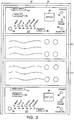
- FIG. 2 is a diagram of a portion of the headend area of the system shown in FIG. 1.
- the headend incorporates a video player and face-panel monitor embodying the present invention.
- FIG. 3 is a block diagram of the video player and face-panel monitor shown in FIG 2.
- the present invention is embodied in a video player and display device for use in an aircraft entertainment system.
- a conventional video player unit is modified to incorporate a video display on its face panel.
- the size of the display is chosen to fit within the available space on the face panel of a conventional video player.
- the face panel controls are arranged such that the display can be isolated in one area of the face panel.
- the video/audio output of the video player is provided to its output terminals and to its face-panel monitor.
- the face-panel monitor of the present invention allows the video player to more easily utilize its functionality in the context of an aircraft IFE system. For example, if the video player is capable of performing automated timed play operations, the video player can more easily be programmed to start and/or stop at a particular time when programming can be carried out in conjunction with a display screen. Also, if the IFE goes down, it is easy to determine whether the malfunction is in the video player by checking the monitor output. Where several video machines are concurrently playing different video choices, the flight attendant can easily confirm that the correct video is playing in the correct machine without having to actually go into the cabin and look at what is being displayed on the passenger terminal screens.
- the video player and monitor of the present invention can also be provided with diagnostic circuitry that checks basic device parameters and/or operations, and displays the results of these checks on the display for easy viewing and consideration.
- FIG. 1 illustrates an aircraft electronic distribution system capable utilizing the present invention
- FIG. 2 is a diagram of a portion of the headend area of the system shown in FIG. 1, wherein the headend incorporates a video player and face-panel monitor embodying the present invention
- FIG. 3 is a block diagram of the video player and face-panel monitor shown in FIG 2.
- an aircraft 10 incorporates an aircraft electronic signal distribution system 12.
- Aircrafts typically include some form of electronic distribution system for controlling and coordinating the distribution throughout the aircraft of electronic communications such as seat lighting commands, attendant call commands, audio announcements, and audio/video entertainment signals.
- electronic communications such as seat lighting commands, attendant call commands, audio announcements, and audio/video entertainment signals.
- data communications such as video game software or menus of the available aircraft services may also be distributed.
- the aircraft communication system 12 includes a headend area 14, a signal distribution network 16, and a plurality of peripherals 18 consisting primarily of passenger seat stations or terminals.
- the headend 14 is located at the front of the aircraft cabin, and provides, inter alia, a central location for the assembly of the entertainment related signals/services that are transmitted to the passenger terminals 18 via the aircraft communication system 12.
- the aircraft communication system 12 is often referred to as an in-flight entertainment (IFE) system 12.
- IFE in-flight entertainment
- a typical headend 14 of an IFE system 12 includes sources for video and related audio, audio unrelated to the video, and entertainment data such as game software and/or menu data.
- the audio source can include radio broadcasts, audio tape players (digital and analog), compact disk (CD) players, and other similar devices.
- the video source can include conventional video tape players (digital and analog), conventional video disk players, and other similar devices.
- the data source can be a conventional hard or floppy disk storage medium and a conventional computer. Because aircraft weight is always a consideration, the total number of the above-references audio, video and data source devices is typically kept to a minimum.
- FIG. 2 is a diagram of a portion 20 of the headend area 14 of the system 12 shown in FIG. 1, wherein the headend 14 incorporates a video player 26 and face-panel display 28 embodying the present invention.
- the illustrated portion 20 of the headend area 14 preferably takes the form of a housing 20 chat incorporates a variety of headend equipment 22, 24, 26.
- the headend equipment 22, 24, 26 may be arranged within the housing 20 in a variety of configurations.
- the headend equipment 22, 24, 26 is stacked on top of one another such that only the face panels of the various headend equipment is exposed for access by an operator or flight attendant.
- the headend equipment 22, 24 can take a variety of forms, for example they could be sources for video and related audio, audio unrelated to the video, and entertainment data such as game software and/or menu data.
- the audio source can include radio broadcasts, audio tape players (digital and analog), compact disk (CD) players, and other similar devices.
- the video source can include conventional video tape players (digital and analog), conventional video disk players, and other similar devices.
- the data source can be a conventional hard or floppy disk storage medium and a conventional computer.
- the video player 26 and video display 28 includes a front panel 27 on which the display is mounted, a video source input 30, speakers 32, a rewind control 34, a play control 36, a forward fast control 38, a stop control 40, a pause control 42, an eject control 44, an infra-red (IR) and/or radio-frequency (RF) receiver 46, a power control 48, a headphone input 50, an audio selection control 52, and a conventional alphanumeric display 54.
- IR infra-red
- RF radio-frequency
- the video player 26 can take a variety of forms including analog tape, digital tape, or video disk.
- the display 28 can also take a variety of forms including liquid crystal display (LCD), cathode ray tube (CRT), plasma, and others.
- LCD liquid crystal display
- CRT cathode ray tube
- the display 28 can incorporate touch controls that perform the rewind, play, forward fast, stop, pause, eject and other functions.
- FIG. 3 is a block diagram of the video player 26 and face-panel display 28 shown in FIG 2.
- the video player 26 includes a play mechanism 60 coupled to the display 28.
- a controller 62 is connected to the play mechanism 60 and the display 28, and a power supply 64 is connected to the play mechanism 60 and the display 28.
- the video player 26 generally includes inputs for AC, DC, remote control signals, and P/A ("public address") control signals.
- the P/A control signals allow the audio output of the video player 26 to be overridden in favor of cabin P/A announcements.
- the controller 62 provides conventional control functions found in a video player device.
- the controller 62 may implement scheduled play operations using an internal clock to automatically activate the video play mechanism 60 at a predetermined time.
- the controller 60 may also incorporate general diagnostic operations that tests various important operations of the video player 26 and determines whether they are operating properly.
- the display 28 also facilitates the use of other video player functions such as the above-described scheduled play operations and diagnostic functions.
- the display 28 could provide prompts via displayed text communications that walk the user through the scheduling operations in a similar fashion to the way on-screen displays on a conventional television are used to walk a user through the steps for programming a conventional video cassette recorder.
- the display 28 could also display the results of whatever diagnostic tests are performed by the controller 60.
- the size of the face-panel display 28 is chosen to fit within the available space on the face panel 27 of a conventional video player.
- the face panel controls power, forward fast, rewind, play, stop, etc.
- the video player of the present invention is incorporated into a conventional aircraft IFE system, it is typically housed with other IFE components in a relatively compact area that exposes only the face panel of the video player. Because the video player's display, according to the present invention, is small enough to fit on the existing area of the face panel, it adds little weight to the IFE system, and requires no additional space.
- the video/audio output of the video player is provided to its output terminals and to its face-panel monitor.
- the face-panel monitor of the present invention allows the video player to more easily utilize its functionality in the context of an aircraft IFE system.
- the video player is capable of performing automated timed play operations, the video player can more easily be programmed to start and/or stop at a particular time when programming can be carried out in conjunction with a display screen.
- the IFE malfunctions, it is easy to determine whether the malfunction is in the video player by checking the monitor output. Where several video machines are concurrently playing different video choices, the flight attendant can easily confirm that the correct video is playing in the correct machine without having to actually go into the cabin and look at what is being displayed on the passenger terminal screens.
- the video player and monitor of the present invention can also be provided with diagnostic circuitry that checks basic device parameters and/or operations, and displays the results of these checks on the display for easy viewing and consideration.
Landscapes
- Engineering & Computer Science (AREA)
- Signal Processing (AREA)
- Multimedia (AREA)
- Physics & Mathematics (AREA)
- Acoustics & Sound (AREA)
- Controls And Circuits For Display Device (AREA)
- Fittings On The Vehicle Exterior For Carrying Loads, And Devices For Holding Or Mounting Articles (AREA)
- Closed-Circuit Television Systems (AREA)
Applications Claiming Priority (2)
| Application Number | Priority Date | Filing Date | Title |
|---|---|---|---|
| US86459697A | 1997-05-28 | 1997-05-28 | |
| US864596 | 1997-05-28 |
Publications (2)
| Publication Number | Publication Date |
|---|---|
| EP0881793A2 true EP0881793A2 (de) | 1998-12-02 |
| EP0881793A3 EP0881793A3 (de) | 2003-12-17 |
Family
ID=25343625
Family Applications (1)
| Application Number | Title | Priority Date | Filing Date |
|---|---|---|---|
| EP98109744A Withdrawn EP0881793A3 (de) | 1997-05-28 | 1998-05-28 | Videowiedergabegerät und Anzeigevorrichtung für Verwendung in Flugzeugunterhaltungssysteme |
Country Status (1)
| Country | Link |
|---|---|
| EP (1) | EP0881793A3 (de) |
Family Cites Families (3)
| Publication number | Priority date | Publication date | Assignee | Title |
|---|---|---|---|---|
| JP2581055B2 (ja) * | 1987-02-23 | 1997-02-12 | ソニー株式会社 | 集中制御装置 |
| DE3835261A1 (de) * | 1988-10-15 | 1990-04-19 | Gaby E Walter | Tragbares audio- und/oder videogeraet |
| US5596647A (en) * | 1993-06-01 | 1997-01-21 | Matsushita Avionics Development Corporation | Integrated video and audio signal distribution system and method for use on commercial aircraft and other vehicles |
-
1998
- 1998-05-28 EP EP98109744A patent/EP0881793A3/de not_active Withdrawn
Also Published As
| Publication number | Publication date |
|---|---|
| EP0881793A3 (de) | 2003-12-17 |
Similar Documents
| Publication | Publication Date | Title |
|---|---|---|
| US5926207A (en) | Channel server functionality | |
| US6449726B1 (en) | Method, system, software, and signal for estimating battery life in a remote control device | |
| EP0779572B1 (de) | Fernsteuerung für elektronische Vorrichtungen | |
| US6556219B1 (en) | Method and system for peripheral device user interface construction | |
| US7114171B2 (en) | Method for controlling an in-flight entertainment system | |
| US6483987B1 (en) | Method and apparatus for recording program data without commercials | |
| US5977964A (en) | Method and apparatus for automatically configuring a system based on a user's monitored system interaction and preferred system access times | |
| EP0577054B1 (de) | Unterhaltungs- und Datenverwaltungssystem für Passagierfahrzeug mit individuellem interaktiven Videoendgerät im Sitz | |
| US6532592B1 (en) | Bi-directional remote control unit and method of using the same | |
| US9241137B2 (en) | Aircraft in-flight entertainment system with enhanced seatback tray passenger control units and associated methods | |
| US7698727B2 (en) | Method and apparatus for notifying users of interactive functions using a remote device | |
| US7086081B2 (en) | Multi-terminal docking station system | |
| WO1999035833A1 (en) | Multipurpose channel banner | |
| US20050134746A1 (en) | Controllable video switching method and apparatus | |
| EP0784400A2 (de) | Unterhaltungssystem für tragbaren Rechner | |
| JP2000507752A (ja) | コンピュータ制御の家庭用娯楽システム | |
| US20060288370A1 (en) | System and method for controlling a plurality of electronic devices | |
| US6313873B1 (en) | Trouble-diagnosing system and method for television receiver | |
| US7028103B2 (en) | Multi-media synchronization system | |
| US20070283389A1 (en) | Method and system for helping operate a media-playing set | |
| EP1294188A1 (de) | Videoaufnahmesteuerung | |
| EP0881793A2 (de) | Videowiedergabegerät und Anzeigevorrichtung für Verwendung in Flugzeugunterhaltungssysteme | |
| US20120141087A1 (en) | Method and system for a simple user interface to an electronic device | |
| JPH1029597A (ja) | 機内娯楽システム | |
| US20080055245A1 (en) | Method, Apparatus, and Computer Program Product for Providing Non-Visual Access to On-Screen Menus for Remote Controlled Devices |
Legal Events
| Date | Code | Title | Description |
|---|---|---|---|
| PUAI | Public reference made under article 153(3) epc to a published international application that has entered the european phase |
Free format text: ORIGINAL CODE: 0009012 |
|
| AK | Designated contracting states |
Kind code of ref document: A2 Designated state(s): AT BE CH CY DE DK ES FI FR GB GR IE IT LI LU MC NL PT SE |
|
| AX | Request for extension of the european patent |
Free format text: AL;LT;LV;MK;RO;SI |
|
| RIN1 | Information on inventor provided before grant (corrected) |
Inventor name: LE, JOSEPH H. Inventor name: HO, KESSE |
|
| APAB | Appeal dossier modified |
Free format text: ORIGINAL CODE: EPIDOS NOAPE |
|
| APBJ | Interlocutory revision of appeal recorded |
Free format text: ORIGINAL CODE: EPIDOS IRAPE |
|
| RIN1 | Information on inventor provided before grant (corrected) |
Inventor name: LE, JOSEPH H. Inventor name: HO, KESSE |
|
| PUAL | Search report despatched |
Free format text: ORIGINAL CODE: 0009013 |
|
| AK | Designated contracting states |
Kind code of ref document: A3 Designated state(s): AT BE CH CY DE DK ES FI FR GB GR IE IT LI LU MC NL PT SE |
|
| AX | Request for extension of the european patent |
Extension state: AL LT LV MK RO SI |
|
| RIC1 | Information provided on ipc code assigned before grant |
Ipc: 7B 64D 11/00 B Ipc: 7H 04R 27/00 B Ipc: 7H 04H 1/02 A |
|
| AKX | Designation fees paid | ||
| REG | Reference to a national code |
Ref country code: DE Ref legal event code: 8566 |
|
| STAA | Information on the status of an ep patent application or granted ep patent |
Free format text: STATUS: THE APPLICATION IS DEEMED TO BE WITHDRAWN |
|
| 18D | Application deemed to be withdrawn |
Effective date: 20021202 |