EP0882555B1 - Méthode pour la préparation des composites antibactériens et antifongiques de bois avec de la matière inorganique - Google Patents
Méthode pour la préparation des composites antibactériens et antifongiques de bois avec de la matière inorganique Download PDFInfo
- Publication number
- EP0882555B1 EP0882555B1 EP98304435A EP98304435A EP0882555B1 EP 0882555 B1 EP0882555 B1 EP 0882555B1 EP 98304435 A EP98304435 A EP 98304435A EP 98304435 A EP98304435 A EP 98304435A EP 0882555 B1 EP0882555 B1 EP 0882555B1
- Authority
- EP
- European Patent Office
- Prior art keywords
- wood
- formula
- carbon atoms
- sio
- oligomer
- Prior art date
- Legal status (The legal status is an assumption and is not a legal conclusion. Google has not performed a legal analysis and makes no representation as to the accuracy of the status listed.)
- Expired - Lifetime
Links
- 239000002023 wood Substances 0.000 title claims description 135
- 230000000844 anti-bacterial effect Effects 0.000 title claims description 56
- 238000000034 method Methods 0.000 title claims description 46
- 239000012871 anti-fungal composition Substances 0.000 title 1
- 230000000843 anti-fungal effect Effects 0.000 claims description 53
- 125000004432 carbon atom Chemical group C* 0.000 claims description 51
- 150000003377 silicon compounds Chemical class 0.000 claims description 51
- -1 silicon alkoxide Chemical class 0.000 claims description 43
- 229940121375 antifungal agent Drugs 0.000 claims description 41
- KPUWHANPEXNPJT-UHFFFAOYSA-N disiloxane Chemical class [SiH3]O[SiH3] KPUWHANPEXNPJT-UHFFFAOYSA-N 0.000 claims description 31
- 229910052710 silicon Inorganic materials 0.000 claims description 31
- 239000010703 silicon Substances 0.000 claims description 29
- XLYOFNOQVPJJNP-UHFFFAOYSA-N water Substances O XLYOFNOQVPJJNP-UHFFFAOYSA-N 0.000 claims description 29
- 229910020487 SiO3/2 Inorganic materials 0.000 claims description 25
- 125000001183 hydrocarbyl group Chemical group 0.000 claims description 24
- 125000000217 alkyl group Chemical group 0.000 claims description 19
- 238000006460 hydrolysis reaction Methods 0.000 claims description 16
- 210000002421 cell wall Anatomy 0.000 claims description 14
- 230000007062 hydrolysis Effects 0.000 claims description 14
- 125000002496 methyl group Chemical group [H]C([H])([H])* 0.000 claims description 14
- 125000005843 halogen group Chemical group 0.000 claims description 13
- 238000006068 polycondensation reaction Methods 0.000 claims description 11
- 239000002131 composite material Substances 0.000 claims description 9
- 125000002887 hydroxy group Chemical group [H]O* 0.000 claims description 9
- 125000000962 organic group Chemical group 0.000 claims description 9
- HJIMAFKWSKZMBK-UHFFFAOYSA-N 3,3,4,4,5,5,6,6,7,7,8,8,9,9,10,10,10-heptadecafluorodecyl(trimethoxy)silane Chemical compound CO[Si](OC)(OC)CCC(F)(F)C(F)(F)C(F)(F)C(F)(F)C(F)(F)C(F)(F)C(F)(F)C(F)(F)F HJIMAFKWSKZMBK-UHFFFAOYSA-N 0.000 claims description 8
- 125000004435 hydrogen atom Chemical group [H]* 0.000 claims description 8
- 229910020485 SiO4/2 Inorganic materials 0.000 claims description 7
- 125000000484 butyl group Chemical group [H]C([*])([H])C([H])([H])C([H])([H])C([H])([H])[H] 0.000 claims description 7
- 125000001495 ethyl group Chemical group [H]C([H])([H])C([H])([H])* 0.000 claims description 7
- 238000005470 impregnation Methods 0.000 claims description 7
- 125000002924 primary amino group Chemical group [H]N([H])* 0.000 claims description 7
- 239000002904 solvent Substances 0.000 claims description 7
- 125000004079 stearyl group Chemical group [H]C([*])([H])C([H])([H])C([H])([H])C([H])([H])C([H])([H])C([H])([H])C([H])([H])C([H])([H])C([H])([H])C([H])([H])C([H])([H])C([H])([H])C([H])([H])C([H])([H])C([H])([H])C([H])([H])C([H])([H])C([H])([H])[H] 0.000 claims description 7
- 125000001931 aliphatic group Chemical group 0.000 claims description 5
- 125000003545 alkoxy group Chemical group 0.000 claims description 5
- 125000003438 dodecyl group Chemical group [H]C([H])([H])C([H])([H])C([H])([H])C([H])([H])C([H])([H])C([H])([H])C([H])([H])C([H])([H])C([H])([H])C([H])([H])C([H])([H])C([H])([H])* 0.000 claims description 5
- 125000004051 hexyl group Chemical group [H]C([H])([H])C([H])([H])C([H])([H])C([H])([H])C([H])([H])C([H])([H])* 0.000 claims description 5
- 210000003093 intracellular space Anatomy 0.000 claims description 5
- 230000001143 conditioned effect Effects 0.000 claims description 4
- 125000001421 myristyl group Chemical group [H]C([*])([H])C([H])([H])C([H])([H])C([H])([H])C([H])([H])C([H])([H])C([H])([H])C([H])([H])C([H])([H])C([H])([H])C([H])([H])C([H])([H])C([H])([H])C([H])([H])[H] 0.000 claims description 4
- 125000001147 pentyl group Chemical group C(CCCC)* 0.000 claims description 4
- PCJYFGIQDRJEGA-UHFFFAOYSA-N 3,3,4,4,6,6,6-heptafluorohexyl(trimethoxy)silane Chemical compound CO[Si](OC)(OC)CCC(F)(F)C(F)(F)CC(F)(F)F PCJYFGIQDRJEGA-UHFFFAOYSA-N 0.000 claims description 3
- UFHFLCQGNIYNRP-UHFFFAOYSA-N Hydrogen Chemical compound [H][H] UFHFLCQGNIYNRP-UHFFFAOYSA-N 0.000 claims description 3
- 125000002704 decyl group Chemical group [H]C([H])([H])C([H])([H])C([H])([H])C([H])([H])C([H])([H])C([H])([H])C([H])([H])C([H])([H])C([H])([H])C([H])([H])* 0.000 claims description 3
- 238000001035 drying Methods 0.000 claims description 3
- 229910052739 hydrogen Inorganic materials 0.000 claims description 3
- 239000001257 hydrogen Substances 0.000 claims description 3
- 125000002347 octyl group Chemical group [H]C([*])([H])C([H])([H])C([H])([H])C([H])([H])C([H])([H])C([H])([H])C([H])([H])C([H])([H])[H] 0.000 claims description 3
- 125000004368 propenyl group Chemical group C(=CC)* 0.000 claims description 3
- ZLGWXNBXAXOQBG-UHFFFAOYSA-N triethoxy(3,3,3-trifluoropropyl)silane Chemical compound CCO[Si](OCC)(OCC)CCC(F)(F)F ZLGWXNBXAXOQBG-UHFFFAOYSA-N 0.000 claims description 3
- JLGNHOJUQFHYEZ-UHFFFAOYSA-N trimethoxy(3,3,3-trifluoropropyl)silane Chemical compound CO[Si](OC)(OC)CCC(F)(F)F JLGNHOJUQFHYEZ-UHFFFAOYSA-N 0.000 claims description 3
- 125000003903 2-propenyl group Chemical group [H]C([*])([H])C([H])=C([H])[H] 0.000 claims description 2
- 125000001797 benzyl group Chemical group [H]C1=C([H])C([H])=C(C([H])=C1[H])C([H])([H])* 0.000 claims description 2
- 125000004369 butenyl group Chemical group C(=CCC)* 0.000 claims description 2
- 125000001153 fluoro group Chemical group F* 0.000 claims description 2
- 125000001997 phenyl group Chemical group [H]C1=C([H])C([H])=C(*)C([H])=C1[H] 0.000 claims description 2
- 125000000286 phenylethyl group Chemical group [H]C1=C([H])C([H])=C(C([H])=C1[H])C([H])([H])C([H])([H])* 0.000 claims description 2
- 239000011120 plywood Substances 0.000 claims description 2
- 125000003944 tolyl group Chemical group 0.000 claims description 2
- 125000000391 vinyl group Chemical group [H]C([*])=C([H])[H] 0.000 claims description 2
- 229920002554 vinyl polymer Polymers 0.000 claims description 2
- 125000004178 (C1-C4) alkyl group Chemical group 0.000 claims 1
- 229910052736 halogen Inorganic materials 0.000 claims 1
- 150000002367 halogens Chemical class 0.000 claims 1
- 238000012360 testing method Methods 0.000 description 63
- 239000000243 solution Substances 0.000 description 51
- 230000004580 weight loss Effects 0.000 description 41
- 230000004584 weight gain Effects 0.000 description 37
- 235000019786 weight gain Nutrition 0.000 description 37
- 238000006243 chemical reaction Methods 0.000 description 31
- 241000233866 Fungi Species 0.000 description 30
- OKKJLVBELUTLKV-UHFFFAOYSA-N Methanol Chemical compound OC OKKJLVBELUTLKV-UHFFFAOYSA-N 0.000 description 30
- BOTDANWDWHJENH-UHFFFAOYSA-N Tetraethyl orthosilicate Chemical compound CCO[Si](OCC)(OCC)OCC BOTDANWDWHJENH-UHFFFAOYSA-N 0.000 description 26
- VYPSYNLAJGMNEJ-UHFFFAOYSA-N Silicium dioxide Chemical compound O=[Si]=O VYPSYNLAJGMNEJ-UHFFFAOYSA-N 0.000 description 20
- 230000000052 comparative effect Effects 0.000 description 17
- LFQSCWFLJHTTHZ-UHFFFAOYSA-N Ethanol Chemical compound CCO LFQSCWFLJHTTHZ-UHFFFAOYSA-N 0.000 description 14
- 150000001875 compounds Chemical class 0.000 description 14
- CSCPPACGZOOCGX-UHFFFAOYSA-N Acetone Chemical compound CC(C)=O CSCPPACGZOOCGX-UHFFFAOYSA-N 0.000 description 12
- 239000005871 repellent Substances 0.000 description 12
- 238000011282 treatment Methods 0.000 description 12
- 239000010875 treated wood Substances 0.000 description 11
- 229910044991 metal oxide Inorganic materials 0.000 description 10
- 150000004706 metal oxides Chemical class 0.000 description 10
- QTBSBXVTEAMEQO-UHFFFAOYSA-N Acetic acid Chemical compound CC(O)=O QTBSBXVTEAMEQO-UHFFFAOYSA-N 0.000 description 9
- 125000005370 alkoxysilyl group Chemical group 0.000 description 9
- 229910052751 metal Inorganic materials 0.000 description 9
- 239000002184 metal Substances 0.000 description 9
- 239000000203 mixture Substances 0.000 description 8
- 238000006116 polymerization reaction Methods 0.000 description 8
- 235000012239 silicon dioxide Nutrition 0.000 description 8
- 239000000377 silicon dioxide Substances 0.000 description 8
- WHRZCXAVMTUTDD-UHFFFAOYSA-N 1h-furo[2,3-d]pyrimidin-2-one Chemical compound N1C(=O)N=C2OC=CC2=C1 WHRZCXAVMTUTDD-UHFFFAOYSA-N 0.000 description 7
- 235000006173 Larrea tridentata Nutrition 0.000 description 7
- 244000073231 Larrea tridentata Species 0.000 description 7
- 239000003054 catalyst Substances 0.000 description 7
- 210000004027 cell Anatomy 0.000 description 7
- 229960002126 creosote Drugs 0.000 description 7
- 235000019441 ethanol Nutrition 0.000 description 7
- 239000003921 oil Substances 0.000 description 7
- SJECZPVISLOESU-UHFFFAOYSA-N 3-trimethoxysilylpropan-1-amine Chemical compound CO[Si](OC)(OC)CCCN SJECZPVISLOESU-UHFFFAOYSA-N 0.000 description 6
- ZMXDDKWLCZADIW-UHFFFAOYSA-N N,N-Dimethylformamide Chemical compound CN(C)C=O ZMXDDKWLCZADIW-UHFFFAOYSA-N 0.000 description 6
- DKGAVHZHDRPRBM-UHFFFAOYSA-N Tert-Butanol Chemical compound CC(C)(C)O DKGAVHZHDRPRBM-UHFFFAOYSA-N 0.000 description 6
- 150000004703 alkoxides Chemical class 0.000 description 6
- 125000001436 propyl group Chemical group [H]C([*])([H])C([H])([H])C([H])([H])[H] 0.000 description 6
- 238000011160 research Methods 0.000 description 6
- RUPBZQFQVRMKDG-UHFFFAOYSA-M Didecyldimethylammonium chloride Chemical group [Cl-].CCCCCCCCCC[N+](C)(C)CCCCCCCCCC RUPBZQFQVRMKDG-UHFFFAOYSA-M 0.000 description 5
- 125000000956 methoxy group Chemical group [H]C([H])([H])O* 0.000 description 5
- 239000011259 mixed solution Substances 0.000 description 5
- 239000003755 preservative agent Substances 0.000 description 5
- 230000002335 preservative effect Effects 0.000 description 5
- 238000000944 Soxhlet extraction Methods 0.000 description 4
- 239000011651 chromium Substances 0.000 description 4
- WSFMFXQNYPNYGG-UHFFFAOYSA-M dimethyl-octadecyl-(3-trimethoxysilylpropyl)azanium;chloride Chemical compound [Cl-].CCCCCCCCCCCCCCCCCC[N+](C)(C)CCC[Si](OC)(OC)OC WSFMFXQNYPNYGG-UHFFFAOYSA-M 0.000 description 4
- 230000007613 environmental effect Effects 0.000 description 4
- 239000003960 organic solvent Substances 0.000 description 4
- 230000008569 process Effects 0.000 description 4
- 230000002940 repellent Effects 0.000 description 4
- 229920006395 saturated elastomer Polymers 0.000 description 4
- 229910052814 silicon oxide Inorganic materials 0.000 description 4
- 239000002689 soil Substances 0.000 description 4
- 239000010876 untreated wood Substances 0.000 description 4
- ZWEHNKRNPOVVGH-UHFFFAOYSA-N 2-Butanone Chemical compound CCC(C)=O ZWEHNKRNPOVVGH-UHFFFAOYSA-N 0.000 description 3
- VYZAMTAEIAYCRO-UHFFFAOYSA-N Chromium Chemical compound [Cr] VYZAMTAEIAYCRO-UHFFFAOYSA-N 0.000 description 3
- 241000256602 Isoptera Species 0.000 description 3
- XUIMIQQOPSSXEZ-UHFFFAOYSA-N Silicon Chemical compound [Si] XUIMIQQOPSSXEZ-UHFFFAOYSA-N 0.000 description 3
- 125000003342 alkenyl group Chemical group 0.000 description 3
- 230000008901 benefit Effects 0.000 description 3
- 239000013043 chemical agent Substances 0.000 description 3
- 239000003795 chemical substances by application Substances 0.000 description 3
- 229910052804 chromium Inorganic materials 0.000 description 3
- 239000010949 copper Substances 0.000 description 3
- 239000008367 deionised water Substances 0.000 description 3
- 229910021641 deionized water Inorganic materials 0.000 description 3
- 238000009826 distribution Methods 0.000 description 3
- 230000000694 effects Effects 0.000 description 3
- 239000002085 irritant Substances 0.000 description 3
- 238000002386 leaching Methods 0.000 description 3
- 238000004519 manufacturing process Methods 0.000 description 3
- BFXIKLCIZHOAAZ-UHFFFAOYSA-N methyltrimethoxysilane Chemical compound CO[Si](C)(OC)OC BFXIKLCIZHOAAZ-UHFFFAOYSA-N 0.000 description 3
- 229920002050 silicone resin Polymers 0.000 description 3
- 125000001424 substituent group Chemical group 0.000 description 3
- 231100000331 toxic Toxicity 0.000 description 3
- 230000002588 toxic effect Effects 0.000 description 3
- 125000001731 2-cyanoethyl group Chemical group [H]C([H])(*)C([H])([H])C#N 0.000 description 2
- OXYZDRAJMHGSMW-UHFFFAOYSA-N 3-chloropropyl(trimethoxy)silane Chemical compound CO[Si](OC)(OC)CCCCl OXYZDRAJMHGSMW-UHFFFAOYSA-N 0.000 description 2
- RYGMFSIKBFXOCR-UHFFFAOYSA-N Copper Chemical compound [Cu] RYGMFSIKBFXOCR-UHFFFAOYSA-N 0.000 description 2
- 241000218691 Cupressaceae Species 0.000 description 2
- YCKRFDGAMUMZLT-UHFFFAOYSA-N Fluorine atom Chemical compound [F] YCKRFDGAMUMZLT-UHFFFAOYSA-N 0.000 description 2
- 238000003916 acid precipitation Methods 0.000 description 2
- 230000002378 acidificating effect Effects 0.000 description 2
- 150000001298 alcohols Chemical class 0.000 description 2
- 239000007864 aqueous solution Substances 0.000 description 2
- 150000004945 aromatic hydrocarbons Chemical class 0.000 description 2
- 229910052785 arsenic Inorganic materials 0.000 description 2
- RQNWIZPPADIBDY-UHFFFAOYSA-N arsenic atom Chemical compound [As] RQNWIZPPADIBDY-UHFFFAOYSA-N 0.000 description 2
- 125000004429 atom Chemical group 0.000 description 2
- 239000011248 coating agent Substances 0.000 description 2
- 238000000576 coating method Methods 0.000 description 2
- 229910052802 copper Inorganic materials 0.000 description 2
- 125000004093 cyano group Chemical group *C#N 0.000 description 2
- KQAHMVLQCSALSX-UHFFFAOYSA-N decyl(trimethoxy)silane Chemical compound CCCCCCCCCC[Si](OC)(OC)OC KQAHMVLQCSALSX-UHFFFAOYSA-N 0.000 description 2
- 238000010790 dilution Methods 0.000 description 2
- 239000012895 dilution Substances 0.000 description 2
- 229910052731 fluorine Inorganic materials 0.000 description 2
- 239000011737 fluorine Substances 0.000 description 2
- 229910001385 heavy metal Inorganic materials 0.000 description 2
- 239000004615 ingredient Substances 0.000 description 2
- 231100000021 irritant Toxicity 0.000 description 2
- 125000001449 isopropyl group Chemical group [H]C([H])([H])C([H])(*)C([H])([H])[H] 0.000 description 2
- 231100000053 low toxicity Toxicity 0.000 description 2
- 125000005010 perfluoroalkyl group Chemical group 0.000 description 2
- 125000001453 quaternary ammonium group Chemical group 0.000 description 2
- 150000003242 quaternary ammonium salts Chemical class 0.000 description 2
- 230000005070 ripening Effects 0.000 description 2
- 150000003839 salts Chemical class 0.000 description 2
- 238000003756 stirring Methods 0.000 description 2
- WYTZZXDRDKSJID-UHFFFAOYSA-N (3-aminopropyl)triethoxysilane Chemical compound CCO[Si](OCC)(OCC)CCCN WYTZZXDRDKSJID-UHFFFAOYSA-N 0.000 description 1
- HNNQYHFROJDYHQ-UHFFFAOYSA-N 3-(4-ethylcyclohexyl)propanoic acid 3-(3-ethylcyclopentyl)propanoic acid Chemical class CCC1CCC(CCC(O)=O)C1.CCC1CCC(CCC(O)=O)CC1 HNNQYHFROJDYHQ-UHFFFAOYSA-N 0.000 description 1
- ZCYVEMRRCGMTRW-UHFFFAOYSA-N 7553-56-2 Chemical compound [I] ZCYVEMRRCGMTRW-UHFFFAOYSA-N 0.000 description 1
- 241000251468 Actinopterygii Species 0.000 description 1
- WKBOTKDWSSQWDR-UHFFFAOYSA-N Bromine atom Chemical compound [Br] WKBOTKDWSSQWDR-UHFFFAOYSA-N 0.000 description 1
- ZAMOUSCENKQFHK-UHFFFAOYSA-N Chlorine atom Chemical compound [Cl] ZAMOUSCENKQFHK-UHFFFAOYSA-N 0.000 description 1
- SNRUBQQJIBEYMU-UHFFFAOYSA-N Dodecane Natural products CCCCCCCCCCCC SNRUBQQJIBEYMU-UHFFFAOYSA-N 0.000 description 1
- KRHYYFGTRYWZRS-UHFFFAOYSA-M Fluoride anion Chemical compound [F-] KRHYYFGTRYWZRS-UHFFFAOYSA-M 0.000 description 1
- 241001105467 Fomitopsis palustris Species 0.000 description 1
- 206010016952 Food poisoning Diseases 0.000 description 1
- 208000019331 Foodborne disease Diseases 0.000 description 1
- 206010058667 Oral toxicity Diseases 0.000 description 1
- 239000004721 Polyphenylene oxide Substances 0.000 description 1
- 229910002808 Si–O–Si Inorganic materials 0.000 description 1
- 241000222355 Trametes versicolor Species 0.000 description 1
- 230000009471 action Effects 0.000 description 1
- 230000002411 adverse Effects 0.000 description 1
- 150000001338 aliphatic hydrocarbons Chemical class 0.000 description 1
- HSFWRNGVRCDJHI-UHFFFAOYSA-N alpha-acetylene Natural products C#C HSFWRNGVRCDJHI-UHFFFAOYSA-N 0.000 description 1
- 125000003277 amino group Chemical group 0.000 description 1
- 230000000845 anti-microbial effect Effects 0.000 description 1
- 239000004599 antimicrobial Substances 0.000 description 1
- GOLCXWYRSKYTSP-UHFFFAOYSA-N arsenic trioxide Inorganic materials O1[As]2O[As]1O2 GOLCXWYRSKYTSP-UHFFFAOYSA-N 0.000 description 1
- 125000003710 aryl alkyl group Chemical group 0.000 description 1
- 125000003118 aryl group Chemical group 0.000 description 1
- KGBXLFKZBHKPEV-UHFFFAOYSA-N boric acid Chemical compound OB(O)O KGBXLFKZBHKPEV-UHFFFAOYSA-N 0.000 description 1
- 239000004327 boric acid Substances 0.000 description 1
- GDTBXPJZTBHREO-UHFFFAOYSA-N bromine Substances BrBr GDTBXPJZTBHREO-UHFFFAOYSA-N 0.000 description 1
- 229910052794 bromium Inorganic materials 0.000 description 1
- 229910052801 chlorine Inorganic materials 0.000 description 1
- 239000000460 chlorine Substances 0.000 description 1
- KTTMEOWBIWLMSE-UHFFFAOYSA-N diarsenic trioxide Chemical compound O1[As](O2)O[As]3O[As]1O[As]2O3 KTTMEOWBIWLMSE-UHFFFAOYSA-N 0.000 description 1
- 229960004670 didecyldimethylammonium chloride Drugs 0.000 description 1
- VJYNTADJZPKUAF-UHFFFAOYSA-N diethoxy-methyl-(3,3,3-trifluoropropyl)silane Chemical compound CCO[Si](C)(OCC)CCC(F)(F)F VJYNTADJZPKUAF-UHFFFAOYSA-N 0.000 description 1
- 238000007865 diluting Methods 0.000 description 1
- 239000003085 diluting agent Substances 0.000 description 1
- JJQZDUKDJDQPMQ-UHFFFAOYSA-N dimethoxy(dimethyl)silane Chemical compound CO[Si](C)(C)OC JJQZDUKDJDQPMQ-UHFFFAOYSA-N 0.000 description 1
- PKTOVQRKCNPVKY-UHFFFAOYSA-N dimethoxy(methyl)silicon Chemical compound CO[Si](C)OC PKTOVQRKCNPVKY-UHFFFAOYSA-N 0.000 description 1
- DIJRHOZMLZRNLM-UHFFFAOYSA-N dimethoxy-methyl-(3,3,3-trifluoropropyl)silane Chemical compound CO[Si](C)(OC)CCC(F)(F)F DIJRHOZMLZRNLM-UHFFFAOYSA-N 0.000 description 1
- 238000007598 dipping method Methods 0.000 description 1
- 238000003912 environmental pollution Methods 0.000 description 1
- 125000002534 ethynyl group Chemical group [H]C#C* 0.000 description 1
- 238000001704 evaporation Methods 0.000 description 1
- 230000008020 evaporation Effects 0.000 description 1
- 238000000605 extraction Methods 0.000 description 1
- 239000003517 fume Substances 0.000 description 1
- 230000002538 fungal effect Effects 0.000 description 1
- 239000011521 glass Substances 0.000 description 1
- PCHJSUWPFVWCPO-UHFFFAOYSA-N gold Chemical compound [Au] PCHJSUWPFVWCPO-UHFFFAOYSA-N 0.000 description 1
- 229910052737 gold Inorganic materials 0.000 description 1
- 239000010931 gold Substances 0.000 description 1
- 238000010438 heat treatment Methods 0.000 description 1
- 239000000413 hydrolysate Substances 0.000 description 1
- 238000009413 insulation Methods 0.000 description 1
- 230000003834 intracellular effect Effects 0.000 description 1
- 238000011835 investigation Methods 0.000 description 1
- 229910052740 iodine Inorganic materials 0.000 description 1
- 239000011630 iodine Substances 0.000 description 1
- 150000002576 ketones Chemical class 0.000 description 1
- 230000007774 longterm Effects 0.000 description 1
- 230000014759 maintenance of location Effects 0.000 description 1
- 239000000463 material Substances 0.000 description 1
- INJVFBCDVXYHGQ-UHFFFAOYSA-N n'-(3-triethoxysilylpropyl)ethane-1,2-diamine Chemical compound CCO[Si](OCC)(OCC)CCCNCCN INJVFBCDVXYHGQ-UHFFFAOYSA-N 0.000 description 1
- PHQOGHDTIVQXHL-UHFFFAOYSA-N n'-(3-trimethoxysilylpropyl)ethane-1,2-diamine Chemical compound CO[Si](OC)(OC)CCCNCCN PHQOGHDTIVQXHL-UHFFFAOYSA-N 0.000 description 1
- MQWFLKHKWJMCEN-UHFFFAOYSA-N n'-[3-[dimethoxy(methyl)silyl]propyl]ethane-1,2-diamine Chemical compound CO[Si](C)(OC)CCCNCCN MQWFLKHKWJMCEN-UHFFFAOYSA-N 0.000 description 1
- 125000005609 naphthenate group Chemical group 0.000 description 1
- 231100000418 oral toxicity Toxicity 0.000 description 1
- 150000002894 organic compounds Chemical class 0.000 description 1
- UJMWVICAENGCRF-UHFFFAOYSA-N oxygen difluoride Chemical group FOF UJMWVICAENGCRF-UHFFFAOYSA-N 0.000 description 1
- SOQBVABWOPYFQZ-UHFFFAOYSA-N oxygen(2-);titanium(4+) Chemical group [O-2].[O-2].[Ti+4] SOQBVABWOPYFQZ-UHFFFAOYSA-N 0.000 description 1
- 230000001717 pathogenic effect Effects 0.000 description 1
- 230000035515 penetration Effects 0.000 description 1
- 239000010702 perfluoropolyether Chemical group 0.000 description 1
- 230000000704 physical effect Effects 0.000 description 1
- 229920000570 polyether Polymers 0.000 description 1
- 239000011148 porous material Substances 0.000 description 1
- 238000004321 preservation Methods 0.000 description 1
- 238000012545 processing Methods 0.000 description 1
- 238000000197 pyrolysis Methods 0.000 description 1
- 238000012827 research and development Methods 0.000 description 1
- 229920005989 resin Polymers 0.000 description 1
- 239000011347 resin Substances 0.000 description 1
- 150000004819 silanols Chemical class 0.000 description 1
- 238000003980 solgel method Methods 0.000 description 1
- 241000894007 species Species 0.000 description 1
- 238000005507 spraying Methods 0.000 description 1
- 239000000126 substance Substances 0.000 description 1
- 238000004381 surface treatment Methods 0.000 description 1
- 238000010998 test method Methods 0.000 description 1
- LFQCEHFDDXELDD-UHFFFAOYSA-N tetramethyl orthosilicate Chemical compound CO[Si](OC)(OC)OC LFQCEHFDDXELDD-UHFFFAOYSA-N 0.000 description 1
- 239000010936 titanium Substances 0.000 description 1
- 229910052719 titanium Inorganic materials 0.000 description 1
- 231100000419 toxicity Toxicity 0.000 description 1
- 230000001988 toxicity Effects 0.000 description 1
- 150000003623 transition metal compounds Chemical class 0.000 description 1
- CPUDPFPXCZDNGI-UHFFFAOYSA-N triethoxy(methyl)silane Chemical compound CCO[Si](C)(OCC)OCC CPUDPFPXCZDNGI-UHFFFAOYSA-N 0.000 description 1
- 239000003171 wood protecting agent Substances 0.000 description 1
Images


Classifications
-
- B—PERFORMING OPERATIONS; TRANSPORTING
- B27—WORKING OR PRESERVING WOOD OR SIMILAR MATERIAL; NAILING OR STAPLING MACHINES IN GENERAL
- B27K—PROCESSES, APPARATUS OR SELECTION OF SUBSTANCES FOR IMPREGNATING, STAINING, DYEING, BLEACHING OF WOOD OR SIMILAR MATERIALS, OR TREATING OF WOOD OR SIMILAR MATERIALS WITH PERMEANT LIQUIDS, NOT OTHERWISE PROVIDED FOR; CHEMICAL OR PHYSICAL TREATMENT OF CORK, CANE, REED, STRAW OR SIMILAR MATERIALS
- B27K3/00—Impregnating wood, e.g. impregnation pretreatment, for example puncturing; Wood impregnation aids not directly involved in the impregnation process
- B27K3/02—Processes; Apparatus
- B27K3/15—Impregnating involving polymerisation including use of polymer-containing impregnating agents
-
- A—HUMAN NECESSITIES
- A01—AGRICULTURE; FORESTRY; ANIMAL HUSBANDRY; HUNTING; TRAPPING; FISHING
- A01N—PRESERVATION OF BODIES OF HUMANS OR ANIMALS OR PLANTS OR PARTS THEREOF; BIOCIDES, e.g. AS DISINFECTANTS, AS PESTICIDES OR AS HERBICIDES; PEST REPELLANTS OR ATTRACTANTS; PLANT GROWTH REGULATORS
- A01N59/00—Biocides, pest repellants or attractants, or plant growth regulators containing elements or inorganic compounds
-
- C—CHEMISTRY; METALLURGY
- C08—ORGANIC MACROMOLECULAR COMPOUNDS; THEIR PREPARATION OR CHEMICAL WORKING-UP; COMPOSITIONS BASED THEREON
- C08L—COMPOSITIONS OF MACROMOLECULAR COMPOUNDS
- C08L97/00—Compositions of lignin-containing materials
- C08L97/02—Lignocellulosic material, e.g. wood, straw or bagasse
-
- C—CHEMISTRY; METALLURGY
- C08—ORGANIC MACROMOLECULAR COMPOUNDS; THEIR PREPARATION OR CHEMICAL WORKING-UP; COMPOSITIONS BASED THEREON
- C08L—COMPOSITIONS OF MACROMOLECULAR COMPOUNDS
- C08L83/00—Compositions of macromolecular compounds obtained by reactions forming in the main chain of the macromolecule a linkage containing silicon with or without sulfur, nitrogen, oxygen or carbon only; Compositions of derivatives of such polymers
- C08L83/04—Polysiloxanes
Definitions
- This invention relates to methods for preparing antibacterial/antifungal inorganic matter-composited wood having an antibacterial/antifungal component incorporated therein in such a manner that the antibacterial/antifungal component is prevented from being leached out in water and the antibacterial/antifungal function is semi-permanently imparted to the wood.
- creosote oil is a mixture of aromatic hydrocarbons as a main component and numerous compounds.
- the creosote oil-treated wood found application as railroad ties and utility poles.
- creosote oil has the advantages of low cost, ease of penetration and effective preservative action and the disadvantages of giving off evil-smelling and eye and skin-irritant fumes.
- creosote oil can contaminate the surrounding soil and leach into rivers or lakes where it is toxic to fish. In many aspects, creosote oil imposes a heavy burden on the environment.
- CCA The exterior wood which is most frequently used at , present is CCA-impregnated wood.
- CCA is a water-soluble chemical agent containing copper (Cu), chromium (Cr) and arsenic (As) as active components. It is in wide-spread use over the world because wood treated therewith exhibits excellent performance. However, the inclusion of such elements as chromium and arsenic draws concerns about the safety of this chemical agent. In some countries, the use of CCA is restricted. Since CCA-treated wood pieces are often used for play apparatus in parks and schools, the influence of CCA on human bodies through skin contact is also a concern. With respect to oral toxicity, the toxicity of CCA must be carefully examined because CCA-treated wood pieces are used as outdoor play apparatus for children.
- metal salts of naphthenic acid are used as a preservative of the surface treatment type and also as a chemical agent for pressure impregnation. They are known to be fully safe, but the retention of their effect is yet a problem. For this reason, the metal naphthenates are mainly used for the treatment of foundations (see “Wood Science Series 5 - Environment,” Kaisei-sha, 1995).
- the social demand for antibacterial/antifungal and bactericidal properties is very high as demonstrated in Japan during the prevalence of group food poisoning by pathogenic E. colibacillus 0-157 in 1996. It is urgently required to develop a wood treating agent capable of retaining its effect semi-permanently and remaining safe.
- This composited wood maintains the advantages of wood including light weight, strength and heat insulation, that is, it is a modified wood which is provided with rot resistance, dimensional stability and flame retardance while maintaining the porous feature of wood (see the Journal of the Japan Wood Research Society, 39, 3, 301 (1993)). If the wood used is a water-saturated piece i.e. not only the cell walls but also the cell cavities are full of water), there results an inorganic matter-composited wood in which not only the cell walls but also the cell cavities are filled with silicon dioxide (see the Journal of the Japan Wood Research Society, 39, 3, 301 (1993)).
- titanium alkoxide having a high rate of hydrolysis and subsequent polycondensation is used, for example, titanium oxide forms solely in cell cavities in the case of a moisture-conditioned piece. In the case of a water-saturated piece, oxide forms solely on the outer surface of the piece, but no metal oxide is composited in the interior of the piece. See the Journal of the Japan Wood Research Society, 39, 3, 308 (1993).
- EP-A-0 683 022, EP-A-0 552 875 and US-A-5 538 547 disclose various uses of silicon alkoxides together with organosilicon having both an antimicrobial moiety and a hydrolysable alkoxysilyl group for protecting porous materials such as wood.
- the general aim herein is to provide new and useful methods for treating wood to confer antibacterial and/or antifungal properties while forming an inorganic wood composite therewith.
- a preferred aim is to provide an antibacterial and/or antifungal functionality that resists long-term leaching.
- inorganic matter-composited wood having an antibacterial/antifungal function.
- silicon dioxide distributed and fixed in wood cell walls and an antibacterial/antifungal organic silicon compound form covalent bonds through Si-O-Si linkages, the antibacterial/antifungal component is semi-permanently fixed in the wood.
- the resulting inorganic matter-composited wood is capable of exerting a stable antibacterial/antifungal function over an extended term. More particularly, we have found a brand new technique capable of manufacturing an antibacterial/antifungal wood article in a simple and consistent manner while keeping the original texture of wood itself.
- the invention provides a method of preparing a composite of wood with antibacterial/antifungal inorganic matter, comprising the steps of:
- the invention provides a method of preparing a composite of wood with antibacterial/antifungal inorganic matter, comprising the steps of
- the treating solution further contains another organic silicon compound of the following general formula (3): R 3 m Si(OR 4 ) 4-m wherein R 3 is a substituted or unsubstituted monovalent hydrocarbon group having 2 to 18 carbon atoms, R 4 is a monovalent hydrocarbon group having 1 to 6 carbon atoms, and letter m is equal to 1, 2 or 3. More preferably, at least one of the R 3 groups is a group wherein some or all of the hydrogen atoms attached to carbon atoms are replaced by fluorine atoms.
- R 3 m Si(OR 4 ) 4-m wherein R 3 is a substituted or unsubstituted monovalent hydrocarbon group having 2 to 18 carbon atoms, R 4 is a monovalent hydrocarbon group having 1 to 6 carbon atoms, and letter m is equal to 1, 2 or 3. More preferably, at least one of the R 3 groups is a group wherein some or all of the hydrogen atoms attached to carbon atoms are replaced by fluorine atoms.
- a silicone resin containing an antibacterial/antifungal organic silicon compound and optionally, a water repellent organic silicon compound is incorporated in the wood.
- a silicone resin containing an antibacterial/antifungal organic silicon compound and optionally, a water repellent organic silicon compound is incorporated in the wood.
- the water-repellent function given by the water-repellent organic silicon compound helps the antibacterial/antifungal organic silicon compound exert its function.
- an organic silicon compound having an amino group is additionally used, the solubility of the siloxane oligomer in a solvent is improved. Particularly when the solubility of the siloxane oligomer in water is improved, the siloxane oligomer can be used as an aqueous solution.
- antibacterial/antifungal activity or function is used herein in a broader sense to encompass preservative and bactericidal activities as well
- the starting wood used herein is not critical. Logs, sawed lumber, sliced veneer, and plywood are included. The species of tree is not critical.
- the first method involves impregnating wood with a solution containing a silicon alkoxide and an antibacterial/antifungal organic silicon compound.
- the silicon alkoxide used herein is of the general formula (1).
- (CH 3 ) a Si(OR) 4-a R is selected from substituted or unsubstituted monovalent hydrocarbon groups having 1 to 12 carbon atoms, preferably 1 to 4 carbon atoms, for example, alkyl groups such as methyl, ethyl, propyl, isopropyl, butyl, hexyl, octyl, decyl and dodecyl.
- R is selected from alkyl groups of 1 to 4 carbon atoms such as methyl, ethyl, propyl, isopropyl and butyl.
- Letter a is 0, 1, 2 or 3, preferably 0 or 1.
- the silicon alkoxides of formula (1) may be used alone or in admixture of two or more.
- the antibacterial/antifungal organic silicon compound having a hydrolysable alkoxysilyl group is of the following general formula (2): wherein R 1 is a monovalent aliphatic hydrocarbon group having 11 to 22 carbon atoms, R 2 is an alkyl group having 1 to 4 carbon atoms, X is a halogen atom, and letter b is equal to 0 or 1.
- the monovalent aliphatic hydrocarbon groups of 11 to 22 carbon atoms represented by R 1 may be either saturated or unsaturated and either normal or branched hydrocarbon groups. Some or all of the hydrogen atoms attached to carbon atoms may be replaced by substituents such as hydroxyl groups and halogen atoms. Exemplary are octadecyl, lauryl, myristyl, and stearyl. Examples of the alkyl group represented by R 2 are methyl, ethyl, propyl and butyl.
- the halogen atoms represented by X include chlorine, bromine and iodine.
- the compound of formula (2) is an organic silicon compound having a quaternary ammonium base and terminated with a hydrolysable alkoxysilyl group and having an antibacterial/antifungal function. Because of the absence of toxic heavy metal atoms, this compound does not pollute the soil and rivers and has very low toxicity to humans. Additionally, it is less irritant and less odorous.
- the organic silicon compound of formula (2) can be readily prepared as a quaternary ammonium salt type compound by reacting a compound having a 3-halogenopropyl group and an alkoxyl group each directly attached to a silicon atom, for example, 3-chloropropyltrimethoxysilane with an amine compound of the formula: R 1 N(CH 3 ) 2 wherein R 1 is a monovalent aliphatic hydrocarbon group of 11 to 22 carbon atoms, for example, C 16 H 33 N(CH 3 ) 2 or C 18 H 37 N(CH 3 ) 2 in a suitable solvent, such as dimethylformamide, at an elevated temperature.
- a suitable solvent such as dimethylformamide
- An appropriate amount of the antibacterial/antifungal silicon compound added is usually 0.0001 to 0.5 mol, more preferably 0.001 to 0.01 mol per mol of the silicon alkoxide of formula (1). Greater amounts of the organic silicon compound outside this range may sometimes adversely affect the antibacterial/antifungal effect. This is easily tested.
- the treating solution further contains a water-repellent organic silicon compound having a hydrolysable alkoxysilyl group.
- This organic compound is preferably of the following general formula (3): R 3 m Si(OR 4 ) 4-m R 3 is selected from substituted or unsubstituted monovalent hydrocarbon groups having 2 to 18 carbon atoms, preferably 2 to 12 carbon atoms, for example, alkyl groups such as ethyl, propyl, butyl, pentyl, and hexyl.
- substituted hydrocarbon groups in which some or all of the hydrogen atoms attached to carbon atoms are replaced by substituents such as halogen atoms and cyano groups, for example, perfluoroalkyl groups such as 3,3,3-trifluoropropyl, 2-(heptafluorobutyl)ethyl and 2-(heptadecafluorooctyl)ethyl, perfluoropolyether groups, and cyano-substituted groups such as cyanoethyl.
- substituents such as halogen atoms and cyano groups
- perfluoroalkyl groups such as 3,3,3-trifluoropropyl, 2-(heptafluorobutyl)ethyl and 2-(heptadecafluorooctyl)ethyl
- perfluoropolyether groups perfluoropolyether groups
- cyano-substituted groups such as cyanoethyl
- R 4 is selected from monovalent hydrocarbon groups having 1 to 6 carbon atoms, especially 1 to 4 carbon atoms, typically alkyl groups of 1 to 6 carbon atoms and alkenyl groups of 2 to 6 carbon atoms, for example, such as methyl, ethyl, propyl, butyl, pentyl, hexyl, ethynyl and propenyl.
- Letter m is equal to 1, 2 or 3 and preferably equal to 1.
- Examples of the compound of formula (3) include 3,3,3-trifluoropropyltrimethoxysilane, 2-(heptafluorobutyl)ethyltrimethoxysilane, 2-(heptadecafluorooctyl)ethyltrimethoxysilane, and 3,3,3-trifluoropropyltriethoxysilane.
- An appropriate amount of the organic silicon compound (3) added is usually 0.0001 to 0.5 mol, most preferably about 0.01 mol per mol of the silicon alkoxide of formula (1). Greater amounts outside this range may sometimes fail to provide uniform water repellence. This is easily tested.
- the first method for preparing an antibacterial/antifungal inorganic matter-composited wood is carried out as follows. To a solution containing one or more silicon alkoxides of formula (1) are added an antibacterial/antifungal organic silicon compound having a hydrolysable alkoxysilyl group of formula (2) and optionally, a water-repellent organic silicon compound having a hydrolysable alkoxysilyl group of formula (3). A moisture-conditioned piece of wood is impregnated with the treating solution so that the wood's inter- and intracellular spaces are filled with the solution.
- the silicon alkoxide and the organic silicon compound(s) within the inter- and intracellular spaces are subjected to hydrolysis, followed by polycondensation, thereby forming silicon oxide with which the antibacterial/antifungal organic silicon compound forms a covalent bond and the optional water-repellent organic silicon compound also forms a covalent bond.
- the treated wood piece is finally dried.
- the treating solution may also be obtained by using a mixed solution of the silicon alkoxide and the organic silicon compound or using dilutions of the respective compounds in suitable solvents such as alcohols, acetone, aliphatic hydrocarbons or aromatic hydrocarbons. Acidic or alkaline catalysts may be added or not.
- the wood In impregnating wood with the mixed solution, the wood may be in a moisture-conditioned or water-saturated state, preferably in a state conditioned to a water content of 10 to 50% by weight.
- the wood may be directly immersed in the mixed solution.
- a vacuum or pressure impregnation technique may also be used.
- the wood is kept immersed in the mixed solution at room temperature under a vacuum of about 1.3 to 2.0 kPa (10 to 15 mmHg) for about 1 to about 7 days. Thereafter, the wood is taken out of the solution, allowed to stand at room temperature for about one day, and heated for drying at about 50 to 110°C for about 1/2 to about 2 days.
- the silicon alkoxide is hydrolysed at various temperatures and then polycondensed whereby it is converted into silicon dioxide which is fixed within cell walls.
- the organic silicon compound(s) coexisting with the silicon alkoxide form covalent bonds with the silicon dioxide whereby they are semi-permanently fixed within the wood.
- the second method for preparing an antibacterial/antifungal inorganic matter-composited wood involves the steps of treating wood with a siloxane oligomer and curing the siloxane oligomer.
- the siloxane oligomer is of the following average compositional formula (4): (R 5 c R 6 SiO (3-c)/2 ) i (R 7 d R 8 SiO (3-d)/2 ) j (R 9 e R 10 SiO (3-e)/2 ) k (SiO 4/2 ) n wherein R 5 , R 7 and R 9 are hydrogen or halogen- or cyano-substituted or unsubstituted monovalent hydrocarbon groups having 1 to 10 carbon atoms, R 6 is a halogen- or cyano-substituted or unsubstituted monovalent hydrocarbon groups having 1 to 18 carbon atoms, R 8 is an amino-bearing monovalent organic group having 1 to 18 carbon atoms, R 10 is a monovalent organic group of the general formula (5): [-(CH 2 ) 3 NR 11 (CH 3 ) 2 ] + X - wherein R 11 is a monovalent hydrocarbon group of 11 to 22 carbon atom
- the monovalent hydrocarbon groups represented by R 5 , R 7 and R 9 include alkyl groups such as methyl, ethyl, propyl, butyl, pentyl, hexyl, octyl, and decyl; alkenyl groups such as vinyl, allyl, propenyl and butenyl; aryl groups such as phenyl and tolyl; aralkyl groups such as benzyl and phenylethyl; substituted hydrocarbon groups in which some or all of the hydrogen atoms attached to carbon atoms are replaced by substituents such as halogen atoms and cyano groups, for example, fluorine-substituted alkyl groups such as 3,3,3-trifluoropropyl, 2-(heptafluorobutyl)ethyl and 2-(heptadecafluorooctyl)ethyl, fluorine-substituted polyether groups, and cyano-substi
- R 6 examples include the same examples as described for R 5 , R 7 and R 9 as well as long-chain alkyl groups such as lauryl, myristyl and stearyl, and substituted ones thereof in which some or all of the hydrogen atoms are replaced by halogen atoms such as fluorine.
- R 6 is selected from halogen-substituted alkyl groups in which some or all of the hydrogen atoms are replaced by halogen atoms, especially fluorine-substituted alkyl groups.
- R 8 is preferably an amino-bearing monovalent organic group of the formula: -(CH 2 ) x -[NH-(CH 2 ) y -] z -NH 2 wherein x is 1 to 8, especially 1 to 6, y is 2 to 10, especially 2 to 6, and z is 0 to 8, especially 0 to 5.
- R 10 is a monovalent organic group of the general formula (5): [-(CH 2 ) 3 NR 11 (CH 3 ) 2 ] + X - wherein R 11 is preferably a long chain alkyl or alkenyl group.
- Each of the units R 5 c R 6 SiO (3-c)/2 , R 7 d R 8 SiO (3-d)/2 , and R 9 e R 10 SiO (3-e)/2 may be a mixture of different structures.
- the R 5 c R 6 SiO (3-c)/2 unit which is to impart water repellence to wood, is preferably composed of CH 3 SiO 3/2 units and R'SiO 3/2 units wherein R' is alkyl of 5 to 18 carbon atoms or CH 3 SiO 3/2 units and R"SiO 3/2 units wherein R" is fluorinated alkyl of 1 to 18 carbon atoms.
- the content of CH 3 SiO 3/2 units is preferably 5 to 100 mol% of the R 5 c R 6 SiO (3-c)/2 unit.
- i is preferably from 0 to 0.9999 and especially from 0.1 to 0.9 (that is, 0 ⁇ i ⁇ 0.9999, especially 0.1 ⁇ i ⁇ 0.9).
- Letter j is preferably 0 to 0.800 (that is, 0 ⁇ j ⁇ 0.800). It is noted that the R 7 d R 8 SiO (3-d)/2 unit with suffix j is introduced when it is desired to impart water solubility to the siloxane oligomer.
- Letter k is a positive number and preferably from 0.0001 to 0.5 and especially from 0.001 to 0.2 (that is, 0.0001 ⁇ k ⁇ 0.5, and especially 0.001 ⁇ k ⁇ 0.2).
- Letter n is preferably 0 to 0.9999 (that is, 0 ⁇ n ⁇ 0.9999). Both i and n are not equal to 0. That is, when i is 0, n is a positive number. When n is 0, i is a positive number.
- the siloxane oligomer of formula (4) preferably has an average degree of polymerization of 2 to 20. If the degree of polymerization is more than 20, a longer time is required for impregnation.
- the siloxane oligomer of formula (4) can be obtained by a conventional process of effecting co-hydrolysis of an antibacterial/antifungal organic silicon compound and a water-repellent organic silicon compound and/or a tetrafunctional silicon alkoxide such as tetramethoxysilane or tetraethoxysilane and optionally, an amino-bearing organic silicon compound.
- the silicon alkoxide and the organic silicon compound(s) are independently previously subjected to partial hydrolysis before they are mixed and co-hydrolysed.
- the tetrafunctional silicon alkoxide used herein is usually of the following general formula (6): Si(OR 12 ) 4 wherein R 12 is an alkyl group of 1 to 4 carbon atoms.
- the antibacterial/antifungal organic silicon compound used herein is usually of the following general formula (7): R 9 e R 10 Si(OR 13 ) 3-e wherein R 9 , R 10 and e are as defined above, and R 13 is an alkyl group of 1 to 4 carbon atoms.
- the compound of formula (7) is an organic silicon compound having a quaternary ammonium base and terminated with a hydrolysable alkoxysilyl group and having an antibacterial/antifungal function. Because of the absence of toxic heavy metal atoms, this compound does not pollute the soil and rivers and has very low toxicity to humans. Additionally, it is less irritant and less odorous.
- the organic silicon compound of formula (7) can be readily prepared as a quaternary ammonium salt type compound by reacting a compound having a 3-halogenopropyl group and an alkoxyl group each directly attached to a silicon atom, for example, 3-chloropropyltrimethoxysilane with an amine compound of the formula: R 11 N(CH 3 ) 2 wherein R 11 is a monovalent hydrocarbon group of 11 to 22 carbon atoms, for example, C 16 H 33 N(CH 3 ) 2 or C 18 H 37 (CH 3 ) 2 in a suitable solvent such as dimethylformamide at an elevated temperature.
- the water-repellent organic silicon compound may be of the following general formula (8): R 5 c R 6 Si(OR 14 ) 3-c wherein R 5 , R 6 and c are as defined above, and R 14 is an alkyl group of 1 to 4 carbon atoms.
- Examples of the compound of formula (8) include methyltrimethoxysilane, methyltriethoxysilane, 3,3,3-trifluoropropyltrimethoxysilane, 2-(heptafluorobutyl)ethyltrimethoxysilane, 2-(heptadecafluorooctyl)ethyltrimethoxysilane, 3,3,3-trifluoropropyltriethoxysilane, 3,3,3-trifluoropropylmethyldimethoxysilane, and 3,3,3-trifluoropropylmethyldiethoxysilane.
- the amino-bearing organic silicon compound may be of the following general formula (9): R 7 d R 8 Si(OR 15 ) 3-d wherein R 7 , R 8 , and d are as defined above, and R 15 is an alkyl group of 1 to 4 carbon atoms.
- Examples of the compound of formula (9) include 3-aminopropyltrimethoxysilane, 3-aminopropyltriethoxysilane, N-(2-aminoethyl)-3-aminopropyltrimethoxysilane, N-(2-aminoethyl)-3-aminopropyltriethoxysilane, and N-(2-aminoethyl)-3-aminopropylmethyldimethoxysilane.
- alkoxysilanes of the above formulae (6) to (9) are reacted in such amounts that i, j, k and n may satisfy the above-mentioned molar fractions.
- catalysts such as acidic catalysts, alkaline catalysts, fluoride catalysts, and transition metal compound catalysts may be used.
- the siloxane oligomer When wood is treated with the siloxane oligomer of formula (4), the siloxane oligomer may be used as such or after diluting with suitable organic solvents, for example, alcohols such as methyl alcohol and ethyl alcohol and ketones such as acetone and methyl ethyl ketone.
- suitable organic solvents for example, alcohols such as methyl alcohol and ethyl alcohol and ketones such as acetone and methyl ethyl ketone.
- organic solvents is not recommended because strict restriction is now made on organic solvents and the use of organic solvents can lead to environmental damage.
- the siloxane oligomer of formula (4) according to the invention is soluble in water when j > 0 in formula (4), that is, when a siloxane unit having an amino-bearing monovalent organic group is contained. Then the siloxane oligomer can be diluted with water which is the preferred diluent.
- an additional organic silicon compound such as dimethyldimethoxysilane or methyldimethoxysilane may be added and mixed for imparting flexibility to the resin.
- the additional organic silicon compound may be added to tetraethoxysilane or a partial hydrolysate thereof whereupon it is subject to co-hydrolysis.
- a termite-resistant ingredient such as boric acid may be added. The termite-resistant ingredient may be added during the reaction to form the siloxane oligomer or post-added to the oligomer.
- the wood is preferably in a moisture-conditioned state although the state of wood is not critical.
- the treatment may be done by spraying, brush coating, dipping, and vacuum or pressure impregnation.
- the wood After treatment with the siloxane oligomer, the wood is dried e.g. at elevated temperature in a range which does not cause pyrolysis of the wood, for example, 50 to 110°C. During the process, the solvent volatilizes off and the oligomer is concentrated, hydrolysed, then polycondensed and cured whereby the oligomer converts into a silicone resin having antibacterial/antifungal activity.
- the method for preparing an antibacterial/antifungal inorganic matter-composited wood according to the invention has the advantage that since the antibacterial/antifungal and water-repellent organic silicon compounds are used along with the silicon alkoxide, the antibacterial/antifungal component is semi-permanently fixed within the wood and water repellence can be imparted to further improve the antibacterial/antifungal effect. Then wood is given an anti-rotting (antibacterial/antifungal) function while preventing the extraction or leaching of the antibacterial/antifungal component which has never been prevented in the prior art, and without obstructing the bonding and coating functions of wood during working.
- methods disclosed herein should enable the production on a large scale of antibacterial/antifungal wood which is suitable as members in open areas e.g. complying with the Japanese building standards, interior members and exterior members.
- JWPA Japan Wood Preservation Association
- test pieces After cultivation in an incubator at room temperature (26°C) and a relative humidity of 55 to 65% for 8 weeks, the test pieces were taken out, and the fungal cells were wiped off from the surface. The absolute dry weight of the test pieces was determined. A percent weight loss by wood-rot fungus was calculated from the absolute dry weight of the test pieces before the test.
- a microtome Using a microtome, a thin section was cut from the interior of the test piece obtained in the rotting test (2). After gold evaporation, the section was observed under a scanning electron microscope for observing the growth of wood-rot fungi.
- Test pieces of untreated wood and inorganic matter-composited wood were subjected to Soxhlet extraction with acetone and water each for 24 hours.
- a subterranean test of burying the test pieces in non-sterilized soil 17 cm deep from the ground surface was carried out for 9 months.
- a percent weight loss was calculated from the absolute dry weights of each test piece before and after the burying test, from which the progress of decay was presumed.
- Veneer pieces of cypress sapwood (50 mm x 100 mm x 1 mm thick) were subjected to Soxhlet extraction with acetone and water each for 24 hours, and conditioned to a moisture content of 25%.
- a reaction solution composed of tetraethoxysilane (TEOS, Si(OC 2 H 5 ) 4 ), ethanol, and acetic acid in a molar ratio of 1:1:0.01 a 40 wt% methanol solution of 3-(trimethoxysilyl)propyloctadecyldimethylammonium chloride (TMSAC) was added so as to give a molar ratio of 0.001 mol of TMSAC per mol of TEOS.
- TMSAC 3-(trimethoxysilyl)propyloctadecyldimethylammonium chloride
- the wood pieces were impregnated with this reaction solution at room temperature under vacuum for 3 days. Thereafter, the wood pieces were heated at 65°C for 24 hours and then at 105°C for 24 hours for ripening the resulting gel, obtaining pieces of inorganic matter-composited wood. These pieces had a weight gain (WG) of 4.6% mainly by silicon dioxide. After the 8-week wood rotting test using white and brown rot fungi, they showed weight losses of 3.0% and 4.0%, respectively. After the 9-month subterranean rotting test, they showed a weight loss of 10.4%.
- WG weight gain
- Pieces of inorganic matter-composited wood were obtained as in Example 1 except that the amount of TMSAC added was changed to a molar ratio of 0.005 mol of TMSAC per mol of TEOS. These pieces had a weight gain (WG) of 5.6%. After the rotting test using white and brown rot fungi, they showed weight losses of 2.4% and 2.8%, respectively. After the subterranean test, they showed a weight loss of 5.4%. The results are shown in Table 1.
- Pieces of inorganic matter-composited wood were obtained as in Example 1 except that the amount of TMSAC added was changed to a molar ratio of 0.01 mol of TMSAC per mol of TEOS. These pieces had a weight gain (WG) of 8.1%. After the rotting test using white and brown rot fungi, they showed weight losses of 2.9% and 0.4%, respectively. After the subterranean test, they showed a weight loss of 7.8%. The results are shown in Table 1.
- Pieces of inorganic matter-composited wood were obtained as in Example 1 except that 2-(heptadecafluorooctyl)ethyltrimethoxysilane (HFOETMOS) was further added to the reaction solution in a molar ratio of 0.004 mol per mol of TEOS. These pieces had a weight gain (WG) of 4.8%. After the rotting test using white and brown rot fungi, they showed a weight loss of 0% for both. After the subterranean test, they showed a weight loss of 1.7%. The results are shown in Table 1.
- HFOETMOS 2-(heptadecafluorooctyl)ethyltrimethoxysilane
- Pieces of inorganic matter-composited wood were obtained as in Example 2 except that 2-(heptadecafluorooctyl)ethyltrimethoxysilane (HFOETMOS) was further added to the reaction solution in a molar ratio of 0.004 mol per mol of TEOS. These pieces had a weight gain (WG) of 7.0%. After the rotting test using white and brown rot fungi, they showed a weight loss of 0% for both. After the subterranean test, they showed a weight loss of 3.1%. The results are shown in Table 1.
- HFOETMOS 2-(heptadecafluorooctyl)ethyltrimethoxysilane
- Pieces of inorganic matter-composited wood were obtained as in Example 3 except that 2-(heptadecafluorooctyl)ethyltrimethoxysilane (HFOETMOS) was further added to the reaction solution in a molar ratio of 0.004 mol per mol of TEOS. These pieces had a weight gain (WG) of 8.8%. After the rotting test using white and brown rot fungi, they showed a weight loss of 0% for both. After the subterranean test, they showed a weight loss of 2.7%. The results are shown in Table 1.
- HFOETMOS 2-(heptadecafluorooctyl)ethyltrimethoxysilane
- Pieces of inorganic matter-composited wood were obtained as in Example 1 except that TMSAC was not added to the reaction solution. These pieces had a weight gain (WG) of 6.5%. After the rotting test using white and brown rot fungi, they showed weight losses of 11.4% and 4.3%, respectively. After the subterranean test, they showed a weight loss of 18.0%. The results are shown in Table 1.
- Pieces of TMSAC-treated wood were obtained as in Example 1 except that in the reaction solution, TEOS was omitted and the same volume of ethanol was added instead. These pieces had a weight gain (WG) of 0.1%. After the rotting test using white and brown rot fungi, they showed weight losses of 5.1% and 5.3%, respectively, indicating relatively good results. After the subterranean test, they showed a weight loss of 15.6%, indicating low antibacterial/antifungal activity against the 9-month test. The results are shown in Table 1.
- Pieces of TMSAC-treated wood were obtained as in Example 1 except that in the reaction solution, TEOS was omitted and the same volume of ethanol was added instead, and the amount of TMSAC (40 wt% methanol solution) added was increased so as to give a molar ratio of 0.005. These pieces had a weight gain (WG) of 1.0%. After the rotting test using white and brown rot fungi, they showed weight losses of 5.5% and 5.8%, respectively. After the subterranean test, they showed a weight loss of 6.8%. The results are shown in Table 1.
- Pieces of TMSAC-treated wood were obtained as in Example 1 except that in the reaction solution, TEOS was omitted and the same volume of ethanol was added instead, and the amount of TMSAC (40 wt% methanol solution) added was increased so as to give a molar ratio of 0.01. These pieces had a weight gain (WG) of 1.8%. After the rotting test using white and brown rot fungi, they showed weight losses of 1.7% and 2.2%, respectively, indicating relatively good results. After the subterranean test, however, they showed a fairly increased weight loss of 9.0%. The results are shown in Table 1.
- FIG. 1 is a collection of SEM photomicrographs of the test pieces rotten with white rot fungus of Examples 2 and 5 and Comparative Example 1, 2 and 4.
- FIG. 2 is a collection of similar SEM photomicrographs of the test pieces rotten with brown rot fungus.
- sections (a), (b), (c), (d), and (e) correspond to the test pieces of Comparative Example 1, Comparative Example 2, Comparative Example 4, Example 2, and Example 5, respectively.
- Many white and brown rot fungi are observed in (a), (b), and (c), but few in (d) and (e).
- TEOS tetraethoxysilane
- HFOETMOS 2-(heptadecafluorooctyl)ethyltrimethoxysilane
- TMSAC 3-(trimethoxysilyl)propyloctadecyldimethylammonium chloride
- acetic acid a 1-liter flask was charged with 208 grams (1.0 mol) of tetraethoxysilane (TEOS), 2.8 grams (0.005 mol) of 2-(heptadecafluorooctyl)ethyltrimethoxysilane (HFOETMOS), 2.5 grams (0.005 mol) of 3-(trimethoxysilyl)propyloctadecyldimethylammonium chloride (TMSAC), 0.5 gram (0.008 mol) of acetic acid, and 208 grams of methanol.
- TMSAC trimethoxysilylpropyloctadecyldimethylammonium
- This oligomer had the average composition: [C 8 F 17 C 2 H 4 SiO 3/2 ] 0.0049 [H 2 NC 3 H 6 SiO 3/2 ] 0.0049 - [Cl - [(CH 3 ) 2 (C 18 H 37 )NC 3 H 6 ] + SiO 3/2 ] 0.0049 [SiO 4/2 ] 0.9853 , and an average degree of polymerization of about 6, and was terminated with methoxy and hydroxyl groups.
- Veneer pieces of cypress sapwood (50 mm x 100 mm x 1 mm thick) were subjected to Soxhlet extraction with acetone and water each for 24 hours, and conditioned to a moisture content of 25%.
- the wood pieces were impregnated with the oligomer solution at room temperature under vacuum for 3 days. Thereafter, the wood pieces were heated at 65°C for 24 hours and then at 105°C for 24 hours for ripening the resulting gel, obtaining pieces of inorganic matter-composited wood.
- These pieces had a weight gain (WG) of 11.0% mainly by silicon dioxide.
- WG weight gain
- After the 9-month subterranean rotting test they showed a weight loss of 2.5%.
- Reaction was carried out as in Example 7 except that 5 grams (0.01 mol) of TMSAC was used and APTMOS was omitted.
- the reaction solution was diluted with methanol to a solution containing 10% by weight of the oligomer, which was used for treatment.
- This oligomer had the average composition: [C 8 F 17 C 2 H 4 SiO 3/2 ] 0.0049 [Cl - [(CH 3 ) 2 (C 18 H 37 )NC 3 H 6 ] + SiO 3/2 ] 0.0099 [SiO 4/2 ] 0.9857 and an average degree of polymerization of about 8, and was terminated with methoxy and hydroxyl groups.
- Example 7 pieces of inorganic matter-composited wood were obtained as in Example 7. These pieces had a weight gain (WG) of 10.5%. After the rotting test using white and brown rot fungi, they showed a weight loss of 0% for both. After the subterranean test, they showed a weight loss of 2.8%.
- WG weight gain
- Reaction was carried out as in Example 7 except that TMSAC was omitted.
- the reaction solution was diluted with methanol to a solution containing 10% by weight of the oligomer, which was used for treatment.
- This oligomer had the average composition: [C 8 F 17 C 2 H 4 SiO 3/2 ] 0.0050 [H 2 NC 3 H 6 SiO 3/2 ] 0.0050 [SiO 4/2 ] 0.9900 and an average degree of polymerization of about 5, and was terminated with methoxy and hydroxyl groups.
- Example 7 pieces of inorganic matter-composited wood were obtained as in Example 7. These pieces had a weight gain (WG) of 9.3%. After the rotting test using white and brown rot fungi, they showed weight losses of 11.5% and 5.3%, respectively. After the subterranean test, they showed a weight loss of 18.9%.
- Reaction was carried out as in Example 7 except that TEOS was omitted.
- the reaction solution was diluted with methanol to a solution containing 10% by weight of the oligomer, which was used for treatment.
- This oligomer had the average composition: [C 8 F 17 C 2 H 4 SiO 3/2 ] 0.3333 [H 2 NC 3 H 6 SiO 3/2 ] 0.3333 - [Cl - [(CH 3 ) 2 (C 18 H 37 )NC 3 H 6 ] + SiO 3/2 ] 0.3333 , and an average degree of polymerization of about 4, and was terminated with methoxy and hydroxyl groups.
- Example 7 pieces of inorganic matter-composited wood were obtained as in Example 7. These pieces had a weight gain (WG) of 0.5%. After the rotting test using white and brown rot fungi, they showed weight losses of 5.5% and 4.7%, respectively. After the subterranean test, they showed a weight loss of 14.9%.
- WG weight gain
- Reaction was carried out as in Example 7 except that HFOETMOS was omitted.
- the reaction solution was diluted with methanol to a solution containing 10% by weight of the oligomer, which was used for treatment.
- This oligomer had the average composition: [H 2 NC 3 H 6 SiO 3/2 ] 0.0050 [Cl - [(CH 3 ) 2 (C 18 H 37 )NC 3 H 6 ] + SiO 3/2 ] 0.0050 [SiO 4/2 ] 0.9900 , and an average degree of polymerization of about 4, and was terminated with methoxy and hydroxyl groups.
- Example 7 pieces of inorganic matter-composited wood were obtained as in Example 7. These pieces had a weight gain (WG) of 8.7%. After the rotting test using white and brown rot fungi, they showed weight losses of 1.5% and 2.5%, respectively. After the subterranean test, they showed a weight loss of 7.9%.
- WG weight gain
- a 1-liter flask was charged with 136 grams (1.0 mol) of methyltrimethoxysilane (MTMOS), 2.6 grams (0.01 mol) of decyltrimethoxysilane (DTMOS), 5 grams (0.01 mol) of 3-(trimethoxysilyl)propyloctadecyldimethylammonium chloride (TMSAC), 90 grams (1.5 moles) of acetic acid, and 500 grams of t-butanol.
- MTMOS methyltrimethoxysilane
- DTMOS decyltrimethoxysilane
- TMSAC 3-(trimethoxysilyl)propyloctadecyldimethylammonium chloride
- TMSAC 3-(trimethoxysilyl)propyloctadecyldimethylammonium chloride
- This oligomer had the average composition: [C 10 H 21 SiO 3/2 ] 0.005 [H 2 NC 3 H 6 SiO 3/2 ] 0.4950 - [Cl - [(CH 3 ) 2 (C 18 H 37 )NC 3 H 6 ] + SiO 3/2 ] 0.005 [CH 3 SiO 3/2 ] 0.4950 , and an average degree of polymerization of about 5, and was terminated with methoxy, hydroxyl and t-butoxy groups.
- Example 11 The procedure of Example 11 was repeated except that instead of t-butanol, deionized water was added to the reaction solution for dilution, obtaining an aqueous solution of 5% oligomer. Using this oligomer solution, pieces of inorganic matter-composited wood were obtained as in Example 7. These pieces had a weight gain (WG) of 7.6%. After the rotting test using white and brown rot fungi, they showed a weight loss of 0% for both. After the subterranean test, they showed a weight loss of 3.6%.
- WG weight gain
Landscapes
- Life Sciences & Earth Sciences (AREA)
- Engineering & Computer Science (AREA)
- Chemical & Material Sciences (AREA)
- Wood Science & Technology (AREA)
- Health & Medical Sciences (AREA)
- Agronomy & Crop Science (AREA)
- Pest Control & Pesticides (AREA)
- Medicinal Chemistry (AREA)
- Polymers & Plastics (AREA)
- Organic Chemistry (AREA)
- Materials Engineering (AREA)
- Inorganic Chemistry (AREA)
- Chemical Kinetics & Catalysis (AREA)
- Plant Pathology (AREA)
- Dentistry (AREA)
- General Health & Medical Sciences (AREA)
- Zoology (AREA)
- Environmental Sciences (AREA)
- Forests & Forestry (AREA)
- Chemical And Physical Treatments For Wood And The Like (AREA)
- Agricultural Chemicals And Associated Chemicals (AREA)
Claims (23)
- Méthode de préparation d'un composite de bois avec une matière inorganique antibactérienne/antifongique, comprenant les étapes de:(i) imprégner le bois d'une solution de traitement, contenant (a) un alcoxyde de silicium de la formule générale (1) qui suit:où R1 est un groupe hydrocarbure aliphatique monovalent ayant 11 à 22 atomes de carbone, R2 est un groupe alkyle ayant 1 à 4 atomes de carbone, X est un atome d'halogène, et b est 0 ou 1; pour combler les espaces inter - et intracellulaires des parois des cellules du bois au moyen de la solution de traitement, et
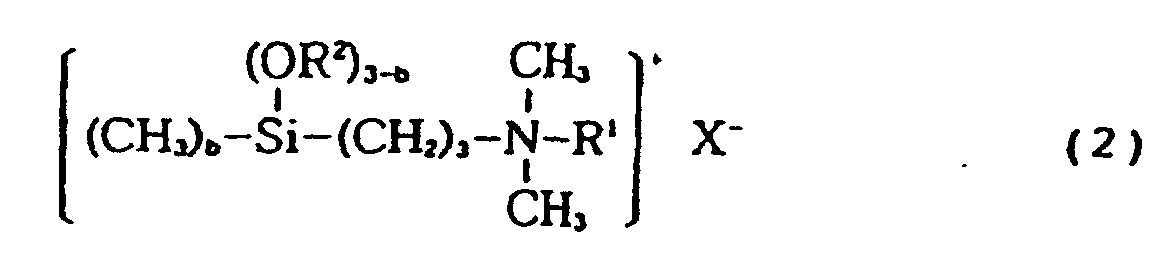 (ii) soumettre l'alcoxyde de silicium et le composé de silicium organique dans lesdits espaces des parois des cellules à une hydrolyse et une polycondensation pour former ledit composite.
 - Méthode de la revendication 1 où ladite solution de traitement contient un autre composé de silicium organique de la formule générale (3) qui suit:
- Méthode de la revendication 2 où, dans la formule (3), au moins un groupe R 3 est un groupe où, une partie ou la totalité des atomes d'hydrogène attachés aux atomes de carbone sont remplacés par des atomes de fluor.
- Méthode selon la revendication 2 ou 3, dans laquelle dans la formule (3) m est 1.
- Méthode selon la revendication 4 dans laquelle le composé de silicium organique de la formule (3) est sélectionné parmi 3,3,3-trifluoropropyltriméthoxysilane, 2-(heptafluorobutyl)éthyl-triméthoxysilane, 2-(heptadécafluorooctyl)éthyl-triméthoxy-silane, et 3,3,3 -trifluoropropyltriéthoxysilane.
- Méthode selon l'une quelconque des revendications 2 à 5 dans laquelle la quantité du composé de silicium organique de formule (3) est de 0,0001 à 0,5 mole par mole de l'alcoxyde de silicium de formule (1).
- Méthode selon l'une quelconque des revendications précédentes, dans laquelle, dans l'alcoxyde de silicium de formule (1), les groupes R sont sélectionnés parmi des groupes alkyles C1-4 et a est 0 ou 1.
- Méthode selon l'une quelconque des revendications précédentes dans laquelle dans le composé de silicium organique de la fo rmule (2), R 1 est sélectionné parmi octadécyle, lauryle, myristyle et stéaryle.
- Méthode selon l'une quelconque des revendications précédentes, dans laquelle la quantité du composé de silicium organique de formule (2) est de 0,0001 à 0,5 mole par mole de l'alcoxyde de silicium de formule (1).
- Méthode selon la revendication 9 dans laquelle la quantité du composé de silicium organique de formule (2) est de 0,001 à 0,01 mole par mole de l'alcoxyde de silicium de formule (1).
- Méthode selon l'une quelconque des revendications précédentes dans laquelle le bois imprégné à l'étape (i) est conditionné à une teneur en eau de 10 à 50% pds.
- Méthode selon l'une quelconque des revendications précédentes dans laquelle l'imprégnation est par immersion du bois dans la solution de traitement à température ambiante sous un vide de 1,33 à 2,0 kPa (10 à 15 mmHg) pendant 1 à 7 jours.
- Méthode de préparation d'un composite de bois avec une matière inorganique antibactérienne/antifongique, comprenant les étapes de(i) traiter le bois avec un oligomère de siloxane de la formule de composition moyenne (4) qui suit:(ii) durcir l'oligomère de siloxane par séchage pour qu'ainsi l'oligomère soit concentré, hydrolysé, polycondensé et durci pour former ledit composite avec le bois.
- Méthode selon la revendication 13 dans laquelle R5, R7 et R9 sont sélectionnés parmi méthyle, éthyle, butyle, pentyle, hexyle, octyle, décyle, vinyle, allyle, propényle, butényle, phényle, tolyle, benzyle, phényléthyle, et formes halogéno- et cyano - substituées de ceux-ci.
- Méthode selon la revendication 13 ou 14 dans laquelle R6 est ou sont sélectionnés parmi lauryle, myristyle, stéaryle, leurs formes halogéno-substituées, et des options telles que spécifiées pour R5, R7 et R9 à la revendication 14.
- Méthode selon l'une quelconque des revendications 13 à 15 dans laquelle R6 est de la formule
- Méthode selon l'une quelconque des revendications 13 à 16 dans laquelle dans l'oligomère, de 5 à 100% en moles des unités R5 cR6SiO(3-c)/2 sont des unités CH3SiO3/2.
- Méthode selon l'une quelconque des revendications 13 à 17 dans laquelle, dans l'oligomère, les unités R5 cR6SiO(3-c)/2 se composent d'unités CH3SiO3/2, et d'unités R'SiO3/2 ou d'unités R"SiO3/2 où R' est alkyle C5-18 et R" est alkyle C1-18 fluoré.
- Méthode selon l'une quelconque des revendications 13 à 18 dans laquelle, dans la formule (4) pour l'oligomère de siloxane;
i est de 0,1 à 0,9;
j est de 0 à 0,800;
k est de 0,001 à 0,2, et
n est de 0 à 0,9999,
où i+j+k+n = 1. - Méthode selon l'une quelconque des revendications 13 à 19 dans laquelle l'oligomère de siloxane de formule (4) a un degré moyen de polymérisation de 2 à 20.
- Méthode selon l'une quelconque des revendications 13 à 20 dans laquelle j > 0 dans la formule (4), l'oligomère est soluble dans l'eau et est dilué avec de l'eau pour l'imprégnation du bois.
- Méthode selon l'une quelconque des revendications 13 à 21 dans laquelle, à l'étape (ii) le bois est séché à une température dans la gamme de 50 à 110°C pour volatiliser le solvant, hydrolyser, polycondenser et durcir l'oligomère de siloxane.
- Méthode selon l'une quelconque des revendications précédentes dans laquelle le bois est des grosses buches, du bois de charpente scié, du bois de placage tranché ou du contreplaqué.
Applications Claiming Priority (6)
| Application Number | Priority Date | Filing Date | Title |
|---|---|---|---|
| JP16066897 | 1997-06-04 | ||
| JP160668/97 | 1997-06-04 | ||
| JP16066897A JP3360268B2 (ja) | 1997-06-04 | 1997-06-04 | 防菌・防黴性無機質複合化木材の製造方法 |
| JP18046897 | 1997-06-20 | ||
| JP180468/97 | 1997-06-20 | ||
| JP18046897 | 1997-06-20 |
Publications (3)
| Publication Number | Publication Date |
|---|---|
| EP0882555A2 EP0882555A2 (fr) | 1998-12-09 |
| EP0882555A3 EP0882555A3 (fr) | 2001-08-22 |
| EP0882555B1 true EP0882555B1 (fr) | 2005-04-20 |
Family
ID=26487099
Family Applications (1)
| Application Number | Title | Priority Date | Filing Date |
|---|---|---|---|
| EP98304435A Expired - Lifetime EP0882555B1 (fr) | 1997-06-04 | 1998-06-04 | Méthode pour la préparation des composites antibactériens et antifongiques de bois avec de la matière inorganique |
Country Status (3)
| Country | Link |
|---|---|
| US (1) | US5985372A (fr) |
| EP (1) | EP0882555B1 (fr) |
| DE (1) | DE69829798T2 (fr) |
Families Citing this family (15)
| Publication number | Priority date | Publication date | Assignee | Title |
|---|---|---|---|---|
| US6772838B2 (en) | 1996-11-27 | 2004-08-10 | Bj Services Company | Lightweight particulate materials and uses therefor |
| JP3204301B2 (ja) * | 1997-10-14 | 2001-09-04 | 日本電気株式会社 | ポインティングデバイスとコンピュータ間の制御方法 |
| AUPQ544900A0 (en) | 2000-02-04 | 2000-02-24 | Commonwealth Scientific And Industrial Research Organisation | Treatment of cellulosic material |
| WO2002068558A1 (fr) * | 2001-02-22 | 2002-09-06 | Shin-Etsu Chemical Co., Ltd. | Agent hydrofuge aqueux pour le traitement de substrats |
| JP3912520B2 (ja) | 2002-09-26 | 2007-05-09 | 信越化学工業株式会社 | 改質木材の製造方法 |
| US20040187221A1 (en) * | 2003-03-31 | 2004-09-30 | Certainteed Corporation | Compositions and methods for inhibiting tannin release |
| DE102004036918A1 (de) * | 2004-07-29 | 2007-02-08 | Georg-August-Universität Göttingen | Schutzmittel und Vergütung für Holz |
| WO2010000476A1 (fr) * | 2008-07-02 | 2010-01-07 | Padana Ag | Matériau poreux comprenant des nanoparticules |
| CN103561875B (zh) * | 2011-07-11 | 2015-11-25 | 英派尔科技开发有限公司 | 木材处理用方法和组合物 |
| WO2013012421A2 (fr) | 2011-07-20 | 2013-01-24 | Empire Technology Development Llc | Compositions et procédés de fabrication de bois renforcé par du verre |
| JP2017025120A (ja) * | 2014-04-28 | 2017-02-02 | 旭硝子株式会社 | 液状組成物および抗菌性物品 |
| CA2967755C (fr) * | 2014-11-12 | 2024-05-14 | University Of Houston System | Revetements resistant aux intemperies, aux champignons et aux taches et procedes d'application sur bois, maconnerie ou autres materiaux poreux |
| US20160283874A1 (en) * | 2015-03-23 | 2016-09-29 | International Business Machines Corporation | Failure modeling by incorporation of terrestrial conditions |
| RU2614817C1 (ru) * | 2016-02-16 | 2017-03-29 | Федеральное государственное бюджетное учреждение науки Ордена Трудового Красного Знамени Институт химии силикатов им. И.В. Гребенщикова Российской академии наук (ИХС РАН) | Способ формирования защитно-декоративного покрытия на древесине хвойных пород |
| CN111469231A (zh) * | 2019-01-23 | 2020-07-31 | 山东卓远装饰材料有限公司 | 一种防腐抗菌高分子聚合家具板材及其制备工艺 |
Family Cites Families (10)
| Publication number | Priority date | Publication date | Assignee | Title |
|---|---|---|---|---|
| DE2903452A1 (de) * | 1979-01-30 | 1980-08-07 | Wacker Chemie Gmbh | Polymerholz und verfahren zu seiner herstellung |
| US4282366A (en) * | 1979-11-06 | 1981-08-04 | International Paper Company | Organosilicon quaternary ammonium antimicrobial compounds |
| DE3900303A1 (de) * | 1989-01-07 | 1990-07-12 | Degussa | Verfahren zum impraegnieren von holz |
| DE3905919A1 (de) * | 1989-02-25 | 1990-08-30 | Degussa | Organosiliciumverbindungen-enthaltende gemische und deren verwendung zur hydrophobierenden und antimikrobiellen impraegnierung |
| US5120581A (en) * | 1989-10-13 | 1992-06-09 | Advanced Chemical Technologies, Co. | Method for reducing the combustibility of combustible materials |
| US5209775A (en) * | 1992-01-23 | 1993-05-11 | Dow Corning Corporation | Water repellents containing organosilicon compounds |
| DE4313219A1 (de) * | 1993-04-22 | 1994-10-27 | Wacker Chemie Gmbh | Verfahren zum Imprägnieren von Holz |
| US5393330A (en) * | 1993-06-30 | 1995-02-28 | Osi Specialties, Inc. | Cationic emulsions of alkylalkoxysilanes |
| US5421866A (en) * | 1994-05-16 | 1995-06-06 | Dow Corning Corporation | Water repellent compositions |
| JP2962191B2 (ja) * | 1995-05-25 | 1999-10-12 | 信越化学工業株式会社 | 改質木材の製造方法 |
-
1998
- 1998-06-04 EP EP98304435A patent/EP0882555B1/fr not_active Expired - Lifetime
- 1998-06-04 US US09/090,338 patent/US5985372A/en not_active Expired - Lifetime
- 1998-06-04 DE DE69829798T patent/DE69829798T2/de not_active Expired - Lifetime
Also Published As
| Publication number | Publication date |
|---|---|
| EP0882555A3 (fr) | 2001-08-22 |
| US5985372A (en) | 1999-11-16 |
| DE69829798D1 (de) | 2005-05-25 |
| DE69829798T2 (de) | 2006-03-09 |
| EP0882555A2 (fr) | 1998-12-09 |
Similar Documents
| Publication | Publication Date | Title |
|---|---|---|
| US5985372A (en) | Method for preparing antibacterial/antifungal inorganic matter-composited wood | |
| CN103764725B (zh) | 用于处理木质纤维素材料的官能化的聚有机硅氧烷或硅烷 | |
| US8481165B2 (en) | Agent for providing substrates based on cellulose and/or starch with water repellent and simultaneously antifungal, antibacterial insect-repellent and antialgal properties | |
| JP3829918B2 (ja) | 防菌・防黴・防蟻性木材用水系撥水剤及びその製造方法 | |
| JP4336974B2 (ja) | 水系撥水処理剤及び撥水処理方法 | |
| EP0641633B1 (fr) | Compositions pour la préservation des produits en bois | |
| JP2004114501A (ja) | 改質木材の製造方法 | |
| AU692984B2 (en) | Method for the preservation of timber products | |
| JP3891238B2 (ja) | 防菌・防黴性無機質複合化木材の製造方法 | |
| TANNO et al. | Antimicrobial TMSAC-added wood-inorganic composites prepared by the sol-gel process | |
| JP3360268B2 (ja) | 防菌・防黴性無機質複合化木材の製造方法 | |
| Vignali et al. | Interpenetration of wood with NH2R-functionalized silica xerogels anchoring copper (II) for preservation purposes | |
| JP2004066461A (ja) | 木材用水系撥水剤組成物 | |
| Palanti et al. | Copper complexes grafted to functionalized silica gel as wood preservatives against the brown rot fungus Coniophora puteana | |
| WO2006013146A1 (fr) | Produit de protection et de traitement du bois | |
| DE102012103372A1 (de) | Verwendung von aminofunktionellen Polyorganosiloxanen als Holzschutzmittel | |
| US20060135664A1 (en) | Methods and compositions of matter for treatment of cellulose | |
| US20060135366A1 (en) | Methods and compositions of matter for treatment of cellulose | |
| US20250100180A1 (en) | Treatment of wood with polyorganosiloxanes | |
| JP3384417B2 (ja) | 木材類の処理剤 | |
| Vignali | Wood treatments with siloxane materials and metal complexes for preservation purposes | |
| JPH09109112A (ja) | 木材の保存処理方法 | |
| HK40114125A (zh) | 用聚有机硅氧烷处理木材 | |
| US20060134337A1 (en) | Methods for preventing warping in wood products | |
| Hübert et al. | Sol-Gel Wood Preservation 97 |
Legal Events
| Date | Code | Title | Description |
|---|---|---|---|
| PUAI | Public reference made under article 153(3) epc to a published international application that has entered the european phase |
Free format text: ORIGINAL CODE: 0009012 |
|
| AK | Designated contracting states |
Kind code of ref document: A2 Designated state(s): AT BE CH CY DE DK ES FI FR GB GR IE IT LI LU MC NL PT SE |
|
| AX | Request for extension of the european patent |
Free format text: AL;LT;LV;MK;RO;SI |
|
| RIN1 | Information on inventor provided before grant (corrected) |
Inventor name: HIGUCHI, KOICHI, SHIN-ETSU CHEMICAL CO., LTD. Inventor name: TANAKA, MASAKI, SHIN-ETSU CHEMICAL CO., LTD. Inventor name: YAMAMOTO, AKIRA, SHIN-ETSU CHEMICAL CO., LTD. Inventor name: TANNO, FUMIE Inventor name: SAKA, SHIRO |
|
| PUAL | Search report despatched |
Free format text: ORIGINAL CODE: 0009013 |
|
| AK | Designated contracting states |
Kind code of ref document: A3 Designated state(s): AT BE CH CY DE DK ES FI FR GB GR IE IT LI LU MC NL PT SE |
|
| AX | Request for extension of the european patent |
Free format text: AL;LT;LV;MK;RO;SI |
|
| 17P | Request for examination filed |
Effective date: 20011207 |
|
| AKX | Designation fees paid |
Free format text: DE FR GB |
|
| 17Q | First examination report despatched |
Effective date: 20021220 |
|
| RTI1 | Title (correction) |
Free format text: METHODS FOR PREPARING ANTIBACTERIAL/ANTIFUNGAL COMPOSITIONS OF WOOD WITH INORGANIC MATTER |
|
| GRAP | Despatch of communication of intention to grant a patent |
Free format text: ORIGINAL CODE: EPIDOSNIGR1 |
|
| GRAP | Despatch of communication of intention to grant a patent |
Free format text: ORIGINAL CODE: EPIDOSNIGR1 |
|
| GRAS | Grant fee paid |
Free format text: ORIGINAL CODE: EPIDOSNIGR3 |
|
| GRAA | (expected) grant |
Free format text: ORIGINAL CODE: 0009210 |
|
| AK | Designated contracting states |
Kind code of ref document: B1 Designated state(s): DE FR GB |
|
| REG | Reference to a national code |
Ref country code: GB Ref legal event code: FG4D |
|
| REF | Corresponds to: |
Ref document number: 69829798 Country of ref document: DE Date of ref document: 20050525 Kind code of ref document: P |
|
| PLBE | No opposition filed within time limit |
Free format text: ORIGINAL CODE: 0009261 |
|
| STAA | Information on the status of an ep patent application or granted ep patent |
Free format text: STATUS: NO OPPOSITION FILED WITHIN TIME LIMIT |
|
| ET | Fr: translation filed | ||
| 26N | No opposition filed |
Effective date: 20060123 |
|
| PGFP | Annual fee paid to national office [announced via postgrant information from national office to epo] |
Ref country code: DE Payment date: 20130529 Year of fee payment: 16 Ref country code: GB Payment date: 20130529 Year of fee payment: 16 |
|
| PGFP | Annual fee paid to national office [announced via postgrant information from national office to epo] |
Ref country code: FR Payment date: 20130624 Year of fee payment: 16 |
|
| REG | Reference to a national code |
Ref country code: DE Ref legal event code: R119 Ref document number: 69829798 Country of ref document: DE |
|
| GBPC | Gb: european patent ceased through non-payment of renewal fee |
Effective date: 20140604 |
|
| REG | Reference to a national code |
Ref country code: FR Ref legal event code: ST Effective date: 20150227 |
|
| REG | Reference to a national code |
Ref country code: DE Ref legal event code: R119 Ref document number: 69829798 Country of ref document: DE Effective date: 20150101 |
|
| PG25 | Lapsed in a contracting state [announced via postgrant information from national office to epo] |
Ref country code: DE Free format text: LAPSE BECAUSE OF NON-PAYMENT OF DUE FEES Effective date: 20150101 |
|
| PG25 | Lapsed in a contracting state [announced via postgrant information from national office to epo] |
Ref country code: GB Free format text: LAPSE BECAUSE OF NON-PAYMENT OF DUE FEES Effective date: 20140604 Ref country code: FR Free format text: LAPSE BECAUSE OF NON-PAYMENT OF DUE FEES Effective date: 20140630 |