EP0882802A1 - Procede d'evaluation de l'activite de la telomerase - Google Patents
Procede d'evaluation de l'activite de la telomerase Download PDFInfo
- Publication number
- EP0882802A1 EP0882802A1 EP97901809A EP97901809A EP0882802A1 EP 0882802 A1 EP0882802 A1 EP 0882802A1 EP 97901809 A EP97901809 A EP 97901809A EP 97901809 A EP97901809 A EP 97901809A EP 0882802 A1 EP0882802 A1 EP 0882802A1
- Authority
- EP
- European Patent Office
- Prior art keywords
- telomerase
- telomerase activity
- binding
- primer
- materials capable
- Prior art date
- Legal status (The legal status is an assumption and is not a legal conclusion. Google has not performed a legal analysis and makes no representation as to the accuracy of the status listed.)
- Withdrawn
Links
Images


Classifications
-
- C—CHEMISTRY; METALLURGY
- C12—BIOCHEMISTRY; BEER; SPIRITS; WINE; VINEGAR; MICROBIOLOGY; ENZYMOLOGY; MUTATION OR GENETIC ENGINEERING
- C12Q—MEASURING OR TESTING PROCESSES INVOLVING ENZYMES, NUCLEIC ACIDS OR MICROORGANISMS; COMPOSITIONS OR TEST PAPERS THEREFOR; PROCESSES OF PREPARING SUCH COMPOSITIONS; CONDITION-RESPONSIVE CONTROL IN MICROBIOLOGICAL OR ENZYMOLOGICAL PROCESSES
- C12Q1/00—Measuring or testing processes involving enzymes, nucleic acids or microorganisms; Compositions therefor; Processes of preparing such compositions
- C12Q1/68—Measuring or testing processes involving enzymes, nucleic acids or microorganisms; Compositions therefor; Processes of preparing such compositions involving nucleic acids
-
- G—PHYSICS
- G01—MEASURING; TESTING
- G01N—INVESTIGATING OR ANALYSING MATERIALS BY DETERMINING THEIR CHEMICAL OR PHYSICAL PROPERTIES
- G01N33/00—Investigating or analysing materials by specific methods not covered by groups G01N1/00 - G01N31/00
- G01N33/48—Biological material, e.g. blood, urine; Haemocytometers
- G01N33/50—Chemical analysis of biological material, e.g. blood, urine; Testing involving biospecific ligand binding methods; Immunological testing
- G01N33/53—Immunoassay; Biospecific binding assay; Materials therefor
- G01N33/573—Immunoassay; Biospecific binding assay; Materials therefor for enzymes or isoenzymes
-
- C—CHEMISTRY; METALLURGY
- C07—ORGANIC CHEMISTRY
- C07H—SUGARS; DERIVATIVES THEREOF; NUCLEOSIDES; NUCLEOTIDES; NUCLEIC ACIDS
- C07H21/00—Compounds containing two or more mononucleotide units having separate phosphate or polyphosphate groups linked by saccharide radicals of nucleoside groups, e.g. nucleic acids
- C07H21/04—Compounds containing two or more mononucleotide units having separate phosphate or polyphosphate groups linked by saccharide radicals of nucleoside groups, e.g. nucleic acids with deoxyribosyl as saccharide radical
-
- C—CHEMISTRY; METALLURGY
- C12—BIOCHEMISTRY; BEER; SPIRITS; WINE; VINEGAR; MICROBIOLOGY; ENZYMOLOGY; MUTATION OR GENETIC ENGINEERING
- C12N—MICROORGANISMS OR ENZYMES; COMPOSITIONS THEREOF; PROPAGATING, PRESERVING, OR MAINTAINING MICROORGANISMS; MUTATION OR GENETIC ENGINEERING; CULTURE MEDIA
- C12N15/00—Mutation or genetic engineering; DNA or RNA concerning genetic engineering, vectors, e.g. plasmids, or their isolation, preparation or purification; Use of hosts therefor
- C12N15/09—Recombinant DNA-technology
- C12N15/11—DNA or RNA fragments; Modified forms thereof; Non-coding nucleic acids having a biological activity
-
- C—CHEMISTRY; METALLURGY
- C12—BIOCHEMISTRY; BEER; SPIRITS; WINE; VINEGAR; MICROBIOLOGY; ENZYMOLOGY; MUTATION OR GENETIC ENGINEERING
- C12Q—MEASURING OR TESTING PROCESSES INVOLVING ENZYMES, NUCLEIC ACIDS OR MICROORGANISMS; COMPOSITIONS OR TEST PAPERS THEREFOR; PROCESSES OF PREPARING SUCH COMPOSITIONS; CONDITION-RESPONSIVE CONTROL IN MICROBIOLOGICAL OR ENZYMOLOGICAL PROCESSES
- C12Q1/00—Measuring or testing processes involving enzymes, nucleic acids or microorganisms; Compositions therefor; Processes of preparing such compositions
- C12Q1/48—Measuring or testing processes involving enzymes, nucleic acids or microorganisms; Compositions therefor; Processes of preparing such compositions involving transferase
-
- C—CHEMISTRY; METALLURGY
- C12—BIOCHEMISTRY; BEER; SPIRITS; WINE; VINEGAR; MICROBIOLOGY; ENZYMOLOGY; MUTATION OR GENETIC ENGINEERING
- C12Q—MEASURING OR TESTING PROCESSES INVOLVING ENZYMES, NUCLEIC ACIDS OR MICROORGANISMS; COMPOSITIONS OR TEST PAPERS THEREFOR; PROCESSES OF PREPARING SUCH COMPOSITIONS; CONDITION-RESPONSIVE CONTROL IN MICROBIOLOGICAL OR ENZYMOLOGICAL PROCESSES
- C12Q1/00—Measuring or testing processes involving enzymes, nucleic acids or microorganisms; Compositions therefor; Processes of preparing such compositions
- C12Q1/68—Measuring or testing processes involving enzymes, nucleic acids or microorganisms; Compositions therefor; Processes of preparing such compositions involving nucleic acids
- C12Q1/6876—Nucleic acid products used in the analysis of nucleic acids, e.g. primers or probes
- C12Q1/6883—Nucleic acid products used in the analysis of nucleic acids, e.g. primers or probes for diseases caused by alterations of genetic material
- C12Q1/6886—Nucleic acid products used in the analysis of nucleic acids, e.g. primers or probes for diseases caused by alterations of genetic material for cancer
Definitions
- the present invention relates to a method for the quantitative determination of telomerase activity.
- Telomerase is known to be an enzyme which catalyzes the extension of the telomere terminal end (terminal portion of a linear chromosome) and many studies thereon have been conducted: Greider C.W. and Blackburn E.H., (1987) Cell, 51, 887-898; Morin G.B. (1989) Cell, 59, 521-529.
- telomere activity is not detected in normal cells except in certain cells such as hemopoietic stem cells, while strong telomerase activity can be detected in most cancer cells. Telomerase is considered to be associated with the maintenance of infinite proliferation of cancer cells. Thus, the detection and quantitative determination of the telomerase activity is important in the diagnosis of cancer. Further, an inhibitor therefor may be expected to be an anti-cancer agent with little side-effect on normal cells: Counter C.M. et al., (1989) EMBO J., 11, 1921-1929; Counter C.M. et al., (1994) Proc. Natl. Acad. Sci. USA, 91, 2900-2904; Chadeneau C.
- telomere was detected in a single primer extension assay system.
- Substrates required for such an assay are the single-stranded telomere oligonucleotide sequence (TTGGGG) 3 , dGTP, dTTP and dGTP labelled with 32 P.
- TTGGGG which is the telomere sequence of Tetrahymena is added to the 3' end of the oligonucleotide primer during short incubation at room temperature. Then, the reaction product is detected by electrophoresis and autoradiography.
- telomeres are as small as 92 and it has been considered that it is impossible to detect the telomerase activity.
- the telomerase activity was found in the telomerase assay using extracts of Hela cell line derived from human cervical cancer and it was elucidated that the enzyme adds a number of TTAGGG repeat sequences to the 3' end of telomere (Morin, 1989). It has been suggested that telomerase is an enzyme conserved in all eucaryotic cells and is markedly activated in human tumor cells (Counter et al., 1992; 1994).
- TRAP telomeric repeat amplification protocol
- telomere reaction involves the telomerase reaction and polymerase chain reaction followed by the detection of reaction products by polyacrylamide gel electrophoresis and autoradiography.
- quantitative determination of telomerase activity is performed by measuring the intensities of appearing bands with a densitometer or other means and comparing them with known amounts of, e.g., Hela cell extracts, used as a control.
- This method has improved the sensitivity, enabling the detection of telomerase activity even in a small number of cells, such as 100 cells. That is to say, the sensitivity of detection of telomerase activity can be increased 10 4 times as compared with conventional assay methods; the sensitivity has been greatly improved as compared with the conventional techniques.
- telomerase activity can be rapidly detected and quantitatively determined with a high sensitivity by constructing a system comprising the DNA synthetic reaction with teromerase in combination with the scintillation proximity assay technology (SPA) developed by Amersham (Bothworth N. and Towers P. (1989) Nature, 341, 167-168), leading to the completion of the present invention.
- SPA scintillation proximity assay technology
- the present invention is a method for the quantitative determination of telomerase activity comprising: amplifying an oligonucleotide sequence which has been synthesized by a DNA synthesis reaction with a telomerase, using a primer modified with either of two materials capable of mutually binding to each other, in the presence of a radioisotope element; making the resulting sequence to bind to a fine particle which has been previously coated with the other of said two materials capable of mutually binding to each other; and measuring scintillation generated from the fine particle due to said binding to quantitatively determine the telomerase activity.
- the present invention is a method for the quantitative determination of telomerase activity comprising: carrying out a DNA synthesis reaction with a telomerase, using a primer modified with either of two materials capable of mutually binding to each other, in the presence of a radioisotope element; making the resulting reaction product to bind to a fine particle which has been previously coated with the other of said two materials capable of mutually binding to each other; and measuring scintillation generated from the fine particle due to said binding to quantitatively determine the telomerase activity.
- the two materials capable of mutually binding to each other as used herein include biotin and avidin.
- the present invention is a method for detecting and quantitatively determining telomerase activity in cell extracts.
- the present invention involves a method for amplifying an oligonucleotide sequence (telomere repeat sequence) synthesized by a DNA synthesis reaction with a telomerase, using a primer modified with either one of two materials capable of mutually binding to each other, in the presence of a radioisotope.
- a method for reacting without amplification of the telomere repeat sequence is also included in the present invention.
- the resulting reaction product is allowed to bind to a fine particle which has been previously coated with the other of said two materials capable of mutually binding to each other and scintillation generated from the fine particle due to said binding is measured to quantitatively determine the telomerase activity.
- the telomerase activity may be easily determined quantitatively with good reproducibility and a large amount of samples can be handled with ease.
- telomerase activity in tissues obtained clinically is very useful to diagnose cancers and to monitor the progression of the cancer and the prognosis of treatment (Hiyama et al., 1995).
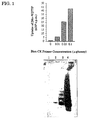
- Fig. 1 shows the detection results according to the present invention in relation to the primer concentration.
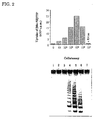
- Fig. 2 shows the detection results according to the present invention in relation to the number of cells.
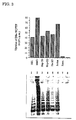
- Fig. 3 shows the detection results according to the present invention in relation to various cells.
- Fig. 4 shows the detection results according to the present invention in relation to the number of cycles in the polymerase chain reaction.
- Fig. 5 shows the detection results according to the present invention in relation to the number of cells.
- Cell extracts were prepared by a known method (Kim N.W. et al., (1994) Science, 206, 2011-2015) with several modifications.
- Human erythroleukemia cell line HEL was cultivated and cells in the logarithmic growth phase were centrifuged at 2000 rpm for 5 minutes to collect the cells. The cells were washed twice with ice-cooled PBS and once with ice-cooled, RNase-free washing buffer (10 mM Hepes pH 7.5, 1 mM MgCl 2 , 10 mM KCl, 1 mM DTT).
- the cell pellet was re-suspended at 5 x 10 5 cells/ ⁇ l in RNase-free lytic buffer (10 mM Tris-HCl pH 7.5, 1 mM MgCl 2 , 1 mM EGTA, 0.1 mM PMSF, 5 mM ⁇ -mercaptoethanol, 0.5% CHAPS (Cholamidopropyl-dimethylammonio-1- propanesulfonate) and 10% glycerol). The suspension was lightly stirred, incubated on ice for 30 minutes, and centrifuged at 15,000 rpm for 30 minutes to remove impurities in the lysate. The supernatant was divided into small portions and stored at -80°C.
- RNase-free lytic buffer 10 mM Tris-HCl pH 7.5, 1 mM MgCl 2 , 1 mM EGTA, 0.1 mM PMSF, 5 mM ⁇ -mercaptoethanol, 0.5% CHAPS (Cholamidopropyl
- TS primer SEQ ID NO. 1
- CX primer SEQ ID NO. 2
- the biotinated CX and TS primers were synthesized by coupling biotin LC biotin-ONTM phosphoramidite (Clontech) to the 5' end of the oligonucleotides.
- the primers were purified using ABI OPC column according to the manufacturer's instructions, lyophilized and re-suspended in water treated with DEPC (diethylpyrocarbonate).
- the TRAP/SPA assay according to the present invention was carried out in a known method (Kim N.W. et al., (1994) Science, 206, 2011-2015; Piatyszek M.A. et al., (1995) Meth. Cell Sci., 17, 1-15) with several modifications as follows.
- a predetermined amount (0, 0.01, 0.05, 0.1 ⁇ g/assay) of biotinated CX primer (Biot-CX) was trapped under a wax layer of Hot-Start tube (GIBCO-BRL).
- the mixture was heated at 90°C for 90 seconds and 31 cycles of polymerase chain reaction were carried out with each cycle comprising at 94°C for 30 seconds, at 50°C for 30 seconds and at 72 °C for 45 seconds.
- reaction product 40 ⁇ l was transferred to 96 well plate (Wallac), and 50 ⁇ l of fine particles Fluoromicrosphere coated with streptavidin (1:4 solution in 0.56 M EDTA) was added and incubated at 37°C for 10 minutes to link the biotinylated, 3 H-labelled reaction product to the streptavidin beads.
- the plate was counted on MicroBeta scintillation counter (Wallac).
- reaction product was subjected to 10% polyacrylamide gel electrophoresis (SDS-PAGE) in 0.3xTBE and exposed to Phosphorimager (Fuji Imaging Plate) to analyze the reaction product (40 ⁇ l).
- SDS-PAGE polyacrylamide gel electrophoresis
- Phosphorimager Fluji Imaging Plate
- telomere extension reaction 50 ⁇ l of a reaction liquid containing HEL cell CHAPS extracts (corresponding to 10 4 and 10 5 cells), 20 mM Tris-HCl, 1.5 mM MgCl 2 , 63 mM KCl, 0.005% Tween 20, 1 mM EDTA, 50 ⁇ M dATP and dGTP each, 1 ⁇ M dTTP, 2 ⁇ Ci [Me- 3 H] TTP (Amersham, 114 Ci/mmol), 0.1 ⁇ g BSA, and 0.1 ⁇ g of biotinated primer (TTAGGG) 4 was incubated at room temperature for 30 minutes.
- HEL cell CHAPS extracts corresponding to 10 4 and 10 5 cells
- 20 mM Tris-HCl 1.5 mM MgCl 2 , 63 mM KCl, 0.005% Tween 20
- 1 mM EDTA 50 ⁇ M dATP and dGTP each, 1 ⁇ M dTTP, 2
- reaction product 40 ⁇ l was transferred to 96 well plate, mixed with 50 ⁇ of fine particles Fluoromicrosphere coated with streptavidin (1:4 solution in 0.56 M EDTA), and incubated at 37°C for 10 minutes to link the biotinated, 3 H-labelled reaction product to the streptavidin beads.
- telomerase reaction mixture the dGTP concentration was changed to 5 ⁇ M, 2 ⁇ Ci of ( ⁇ 32P) dGTP (Amersham, 800 Ci/mmol) was added, and the dTTP concentration was increased to 50 ⁇ M.
- reaction product (40 ⁇ l) was electrophoresed on 8% polyacrylamide gel containing 7 M urea and exposed to an paging plate for 4 days.
- Fig. 1, upper and lower panels The effects of primer concentrations were the same in both the method of the present invention and the conventional method (Fig. 1, upper and lower panels).
- lanes 1 to 4 are primer concentrations 0, 0.01, 0.05 and 0.1 ⁇ g/assay, respectively, which correspond to the primer concentrations in Fig. 1, upper panel.
- telomerase activities can be detected and quantitatively determined without carrying out autoradiography after electrophoresis.
- the sensitivity of the SPA detection according to the present invention was determined by comparing with conventional TRAP assay (TRAP-PAGE) where HEL CHAPS extracts (CHAPS extracts of HEL cells) were stepwise diluted.
- the detection limit is about 100 cells per assay (Fig. 2, lower panel) in the conventional TRAP-PAGE assay, whereas in the TRAP-SPA assay of the present invention, the telomerase activity can be clearly detected even in only 10 cells (Fig. 2, upper panel).
- Lanes 1 to 7 in Fig. 2, lower panel correspond to 0, 10, 10 2 , 10 3 , 10 4 and 10 5 cells/assay and a mixture of 10 4 and RNase, respectively, in Fig. 2, upper panel.
- the telomerase activity can be detected quantitatively with a high sensitivity according to the method of the present invention.
- telomere activity could be detected and quantitatively determined in a similar manner (Fig. 5). As shown in Fig. 5, the telomerase activity in relation to the number of cells was similar in both the method of the present invention (upper) and the conventional method (lower).
- telomerase activity there is provided a method enabling the rapid and highly sensitive detection and quantitative determination of telomerase activity.
Landscapes
- Chemical & Material Sciences (AREA)
- Life Sciences & Earth Sciences (AREA)
- Health & Medical Sciences (AREA)
- Engineering & Computer Science (AREA)
- Organic Chemistry (AREA)
- Molecular Biology (AREA)
- Immunology (AREA)
- Genetics & Genomics (AREA)
- Wood Science & Technology (AREA)
- Zoology (AREA)
- Proteomics, Peptides & Aminoacids (AREA)
- Biotechnology (AREA)
- Biochemistry (AREA)
- Analytical Chemistry (AREA)
- General Health & Medical Sciences (AREA)
- Microbiology (AREA)
- Physics & Mathematics (AREA)
- Biomedical Technology (AREA)
- General Engineering & Computer Science (AREA)
- Bioinformatics & Cheminformatics (AREA)
- Pathology (AREA)
- Biophysics (AREA)
- Urology & Nephrology (AREA)
- Hematology (AREA)
- Food Science & Technology (AREA)
- Oncology (AREA)
- Cell Biology (AREA)
- Hospice & Palliative Care (AREA)
- General Physics & Mathematics (AREA)
- Medicinal Chemistry (AREA)
- Plant Pathology (AREA)
- Measuring Or Testing Involving Enzymes Or Micro-Organisms (AREA)
Applications Claiming Priority (3)
| Application Number | Priority Date | Filing Date | Title |
|---|---|---|---|
| JP17830/96 | 1996-02-02 | ||
| JP1783096 | 1996-02-02 | ||
| PCT/JP1997/000245 WO1997028281A1 (fr) | 1996-02-02 | 1997-01-31 | Procede d'evaluation de l'activite de la telomerase |
Publications (2)
| Publication Number | Publication Date |
|---|---|
| EP0882802A1 true EP0882802A1 (fr) | 1998-12-09 |
| EP0882802A4 EP0882802A4 (fr) | 2001-01-03 |
Family
ID=11954631
Family Applications (1)
| Application Number | Title | Priority Date | Filing Date |
|---|---|---|---|
| EP97901809A Withdrawn EP0882802A4 (fr) | 1996-02-02 | 1997-01-31 | Procede d'evaluation de l'activite de la telomerase |
Country Status (6)
| Country | Link |
|---|---|
| US (1) | US6221590B1 (fr) |
| EP (1) | EP0882802A4 (fr) |
| KR (1) | KR100289993B1 (fr) |
| AU (1) | AU716160B2 (fr) |
| TW (1) | TW479072B (fr) |
| WO (1) | WO1997028281A1 (fr) |
Cited By (1)
| Publication number | Priority date | Publication date | Assignee | Title |
|---|---|---|---|---|
| GB2372810A (en) * | 2000-11-10 | 2002-09-04 | Amersham Pharm Biotech Uk Ltd | Support and method for cell based assays |
Families Citing this family (4)
| Publication number | Priority date | Publication date | Assignee | Title |
|---|---|---|---|---|
| US6979728B2 (en) * | 1998-05-04 | 2005-12-27 | Baylor College Of Medicine | Articles of manufacture and methods for array based analysis of biological molecules |
| US20050032060A1 (en) * | 2001-08-31 | 2005-02-10 | Shishir Shah | Arrays comprising pre-labeled biological molecules and methods for making and using these arrays |
| EP1472340A4 (fr) * | 2002-02-05 | 2006-11-08 | Rappaport Family Inst For Res | Cellules souches determinees pour une lignee selectionnees pour l'activite du promoteur de la telomerase |
| US6916621B2 (en) * | 2002-03-27 | 2005-07-12 | Spectral Genomics, Inc. | Methods for array-based comparitive binding assays |
Family Cites Families (5)
| Publication number | Priority date | Publication date | Assignee | Title |
|---|---|---|---|---|
| US5077192A (en) * | 1988-10-25 | 1991-12-31 | The General Hospital Corporation | Method of detecting antigenic, nucleic acid-containing macromolecular entities |
| US5837453A (en) * | 1992-05-13 | 1998-11-17 | Geron Corporation | Telomerase activity assays |
| US5645986A (en) * | 1992-05-13 | 1997-07-08 | Board Of Reagents, The University Of Texas System | Therapy and diagnosis of conditions related to telomere length and/or telomerase activity |
| JPH11507839A (ja) * | 1995-06-07 | 1999-07-13 | ジェロン コーポレイション | テロメラーゼ活性検定 |
| US5856096A (en) * | 1995-09-20 | 1999-01-05 | Ctrc Research Foundation | Rapid and sensitive assays for detecting and distinguishing between processive and non-processive telomerase activities |
-
1997
- 1997-01-29 TW TW086101014A patent/TW479072B/zh not_active IP Right Cessation
- 1997-01-31 AU AU15576/97A patent/AU716160B2/en not_active Ceased
- 1997-01-31 EP EP97901809A patent/EP0882802A4/fr not_active Withdrawn
- 1997-01-31 KR KR1019980705955A patent/KR100289993B1/ko not_active Expired - Fee Related
- 1997-01-31 WO PCT/JP1997/000245 patent/WO1997028281A1/fr not_active Ceased
- 1997-01-31 US US09/117,570 patent/US6221590B1/en not_active Expired - Fee Related
Cited By (2)
| Publication number | Priority date | Publication date | Assignee | Title |
|---|---|---|---|---|
| GB2372810A (en) * | 2000-11-10 | 2002-09-04 | Amersham Pharm Biotech Uk Ltd | Support and method for cell based assays |
| GB2372810B (en) * | 2000-11-10 | 2003-05-07 | Amersham Pharm Biotech Uk Ltd | Support and method for cell based assays |
Also Published As
| Publication number | Publication date |
|---|---|
| EP0882802A4 (fr) | 2001-01-03 |
| US6221590B1 (en) | 2001-04-24 |
| AU1557697A (en) | 1997-08-22 |
| KR19990082227A (ko) | 1999-11-25 |
| AU716160B2 (en) | 2000-02-17 |
| KR100289993B1 (ko) | 2001-05-15 |
| WO1997028281A1 (fr) | 1997-08-07 |
| TW479072B (en) | 2002-03-11 |
Similar Documents
| Publication | Publication Date | Title |
|---|---|---|
| JPH11243998A (ja) | テロメラーゼ活性アッセイ | |
| US5863726A (en) | Telomerase activity assays | |
| US5856096A (en) | Rapid and sensitive assays for detecting and distinguishing between processive and non-processive telomerase activities | |
| Uehara et al. | Detection of telomerase activity utilizing energy transfer primers: comparison with gel-and ELISA-based detection | |
| CA2318354A1 (fr) | Marqueurs biochimiques et cibles pour le diagnostic, le pronostic et le traitement des affections de la prostate | |
| CA2467629A1 (fr) | Procedes pour evaluer une expression genique de resistance aux medicaments chez un patient atteint d'un cancer | |
| WO1997011198A9 (fr) | Dosages rapides et sensibles de detection et de discrimination entre les activites processives et non processives de la telomerase | |
| PT1994410E (pt) | Métodos e estojos para detecção precoce de cancro ou de predisposição a este | |
| Bashmakova et al. | Bioluminescent SNP genotyping technique: Development and application for detection of melanocortin 1 receptor gene polymorphisms | |
| US6221590B1 (en) | Method for the quantitative determination of telomerase activity | |
| Reis et al. | Mutation analysis of hBUB1, hBUBR1 and hBUB3 genes in glioblastomas | |
| Yajima et al. | Establishment of quantitative reverse transcription–polymerase chain reaction assays for human telomerase-associated genes | |
| JP3718892B2 (ja) | ヒト・テロメラーゼ活性の測定方法 | |
| Cheng et al. | Polymerase chain reaction‐based enzyme immunoassay for quantitation of telomerase activity: Application to colorectal cancers | |
| JPH11507839A (ja) | テロメラーゼ活性検定 | |
| CA2984516C (fr) | Methode, sequences, compositions et trousse pour la detection de mutations dans le promoteur du gene htert | |
| WO2001083816A2 (fr) | Procedes de detection de tumeurs | |
| US20040248142A1 (en) | Method for detecting hepatocellular carcinoma | |
| de Cremoux et al. | Polymerase chain reaction compared with dot blotting for the determination of N‐myc gene amplification in neuroblastoma | |
| Ni et al. | Detection of bcr/abl fusion transcripts by semiquantitative multiplex RT-PCR combined with a colormetric assay in Ph positive leukemia | |
| EP0856066B1 (fr) | Procede servant a determiner l'activite de polymerases d'adn | |
| KR20060087977A (ko) | 폐암 진단용 마커 | |
| CA2345000A1 (fr) | Nouveau procede pour diagnostiquer, surveiller, etablir la stadification, obtenir des images et traiter des cancers gastro-intestinaux | |
| Abdel-Salam et al. | Telomerase activity in bilharzial bladder cancer: prognostic implications | |
| JPH09308499A (ja) | テロメラーゼ活性の定量方法 |
Legal Events
| Date | Code | Title | Description |
|---|---|---|---|
| PUAI | Public reference made under article 153(3) epc to a published international application that has entered the european phase |
Free format text: ORIGINAL CODE: 0009012 |
|
| 17P | Request for examination filed |
Effective date: 19980831 |
|
| AK | Designated contracting states |
Kind code of ref document: A1 Designated state(s): AT BE CH DE DK ES FI FR GB GR IE IT LI LU MC NL PT SE |
|
| A4 | Supplementary search report drawn up and despatched |
Effective date: 20001120 |
|
| AK | Designated contracting states |
Kind code of ref document: A4 Designated state(s): AT BE CH DE DK ES FI FR GB GR IE IT LI LU MC NL PT SE |
|
| 17Q | First examination report despatched |
Effective date: 20060904 |
|
| STAA | Information on the status of an ep patent application or granted ep patent |
Free format text: STATUS: THE APPLICATION IS DEEMED TO BE WITHDRAWN |
|
| 18D | Application deemed to be withdrawn |
Effective date: 20070116 |